AI Generated British Restrictive Covenant Agreement
PDF & Word - 2026 Updated
Docaro Pricing
When do you need a Restrictive Covenant in the United Kingdom?
British Legal Rules for a Restrictive Covenant
Using the wrong structure for a non-compete agreement may render it unenforceable under UK competition law.
What a Proper Restrictive Covenant Should Include
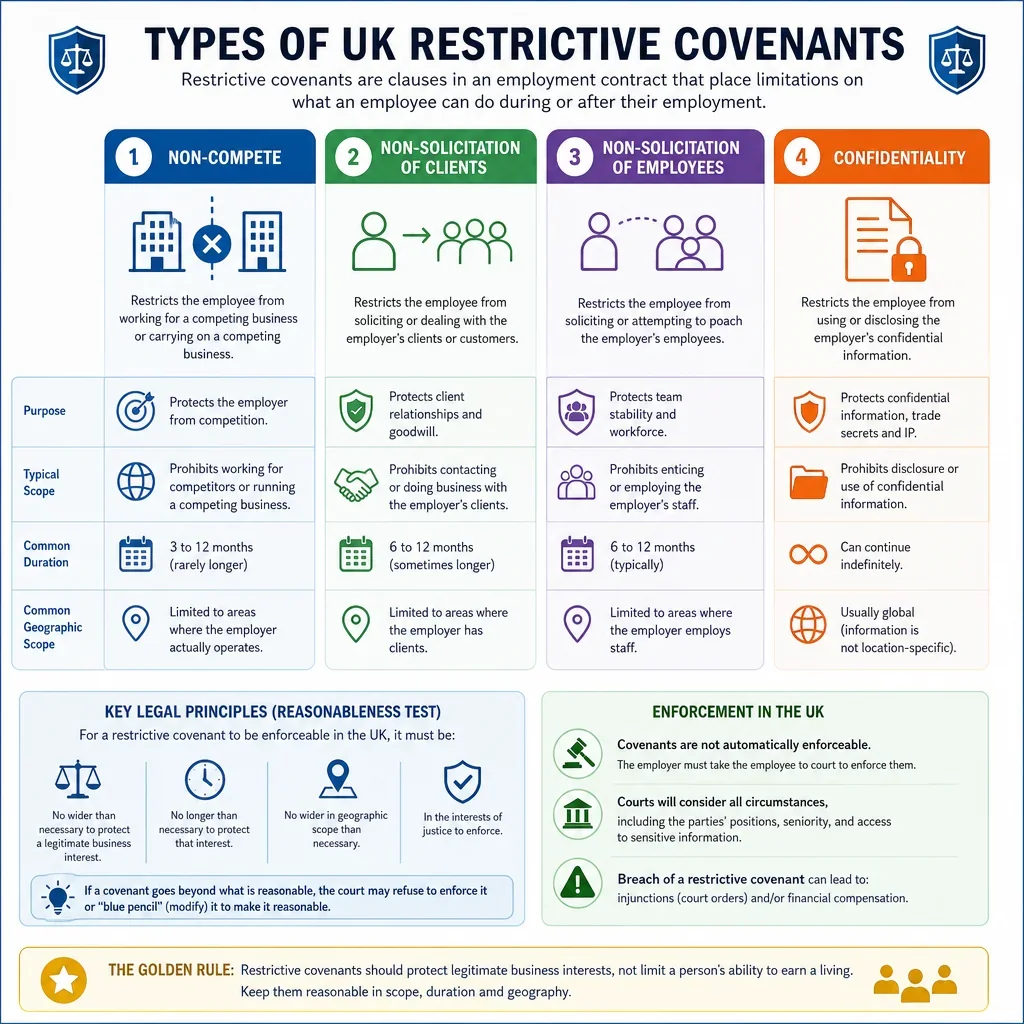
- Non-Compete ClauseThis limits the employee from working for competitors in a specific area for a set time after leaving the job.
- Non-Solicitation ClauseThis prevents the employee from contacting or taking away the company's customers or clients for a defined period.
- Non-Poaching ClauseThis stops the employee from hiring or recruiting the company's other staff members after they leave.
- Confidentiality AgreementThis requires the employee to keep the company's private information secret both during and after employment.
- Geographic LimitsThis specifies the area where the restrictions apply, such as a city or region, to keep them reasonable.
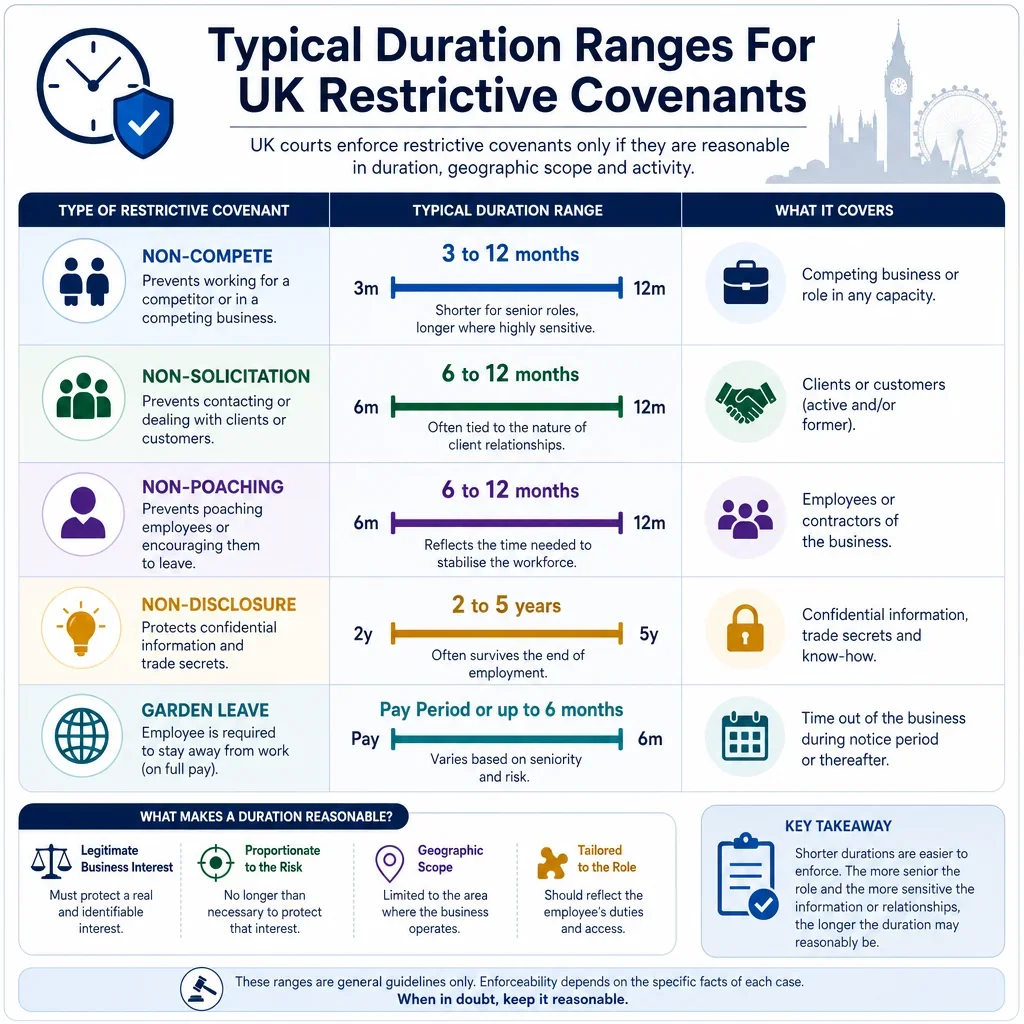
- Time RestrictionsThis sets a clear end date for the restrictions, usually 3 to 12 months, to ensure they are not overly long.
Generate Your Document in 4 Easy Steps
Why Use Docaro?
 United Kingdom
Free Example Restrictive Covenant Template
Below is a free template example of a Restrictive Covenant for use in the United Kingdom generated by our AI model.
The clauses in your actual Restrictive Covenant will vary from this example as they will be entirely bespoke to your requirements as set out in the questionnaire you complete.
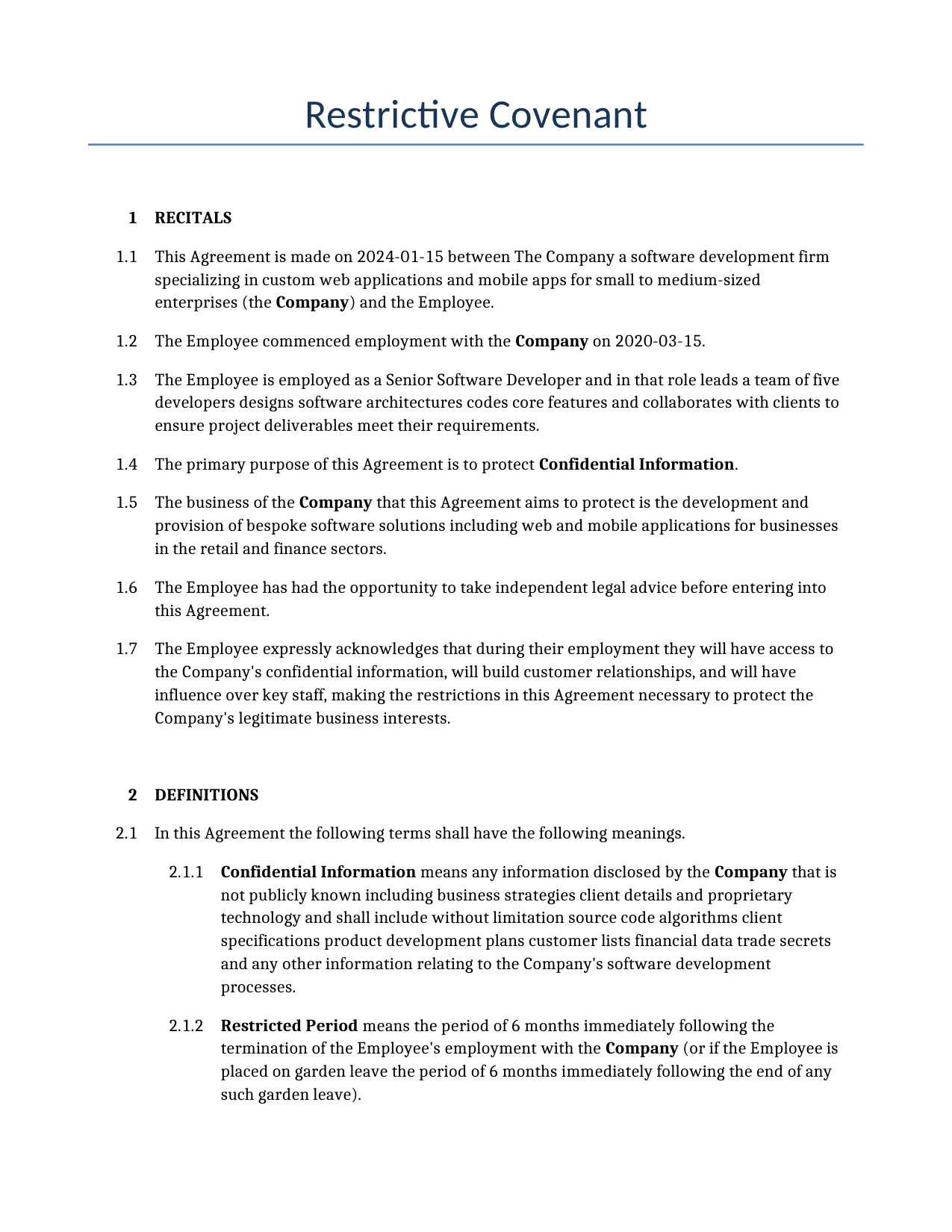
Restrictive Covenant Agreement
1RECITALS
This Agreement is made on 2024-01-15 between The Company a software development firm specializing in custom web applications and mobile apps for small to medium-sized enterprises (the Company) and the Employee.
The Employee commenced employment with the Company on 2020-03-15.
The Employee is employed as a Senior Software Developer and in that role leads a team of five developers designs software architectures codes core features and collaborates with clients to ensure project deliverables meet their requirements.
The primary purpose of this Agreement is to protect Confidential Information.
The business of the Company that this Agreement aims to protect is the development and provision of bespoke software solutions including web and mobile applications for businesses in the retail and finance sectors.
The Employee has had the opportunity to take independent legal advice before entering into this Agreement.
The Employee expressly acknowledges that during their employment they will have access to the Company's confidential information, will build customer relationships, and will have influence over key staff, making the restrictions in this Agreement necessary to protect the Company's legitimate business interests.
2DEFINITIONS
In this Agreement the following terms shall have the following meanings.
Confidential Information means any information disclosed by the Company that is not publicly known including business strategies client details and proprietary technology and shall include without limitation source code algorithms client specifications product development plans customer lists financial data trade secrets and any other information relating to the Company's software development processes.
Restricted Period means the period of 6 months immediately following the termination of the Employee's employment with the Company (or if the Employee is placed on garden leave the period of 6 months immediately following the end of any such garden leave).
Restricted Business means the development and provision of bespoke software solutions including web and mobile applications for businesses in the retail and finance sectors to the extent that the Employee was materially involved in such activities during the 12 months prior to the termination of their employment.
Restricted Customers means any individual or entity that has purchased goods or services from the Company in the last 12 months prior to the termination of the Employee's employment and with whom the Employee had material dealings during that period.
Key Employees means those senior developers project managers or other employees or contractors of the Company with whom the Employee had material dealings during the 12 months prior to the termination of their employment (by way of example only this may include members of the Employee's development team).
Garden Leave means a period during which the Company requires the Employee not to attend work and/or not to undertake any duties (or only specific duties) during the notice period while remaining employed and in receipt of full pay and benefits.
This Agreement is a standalone agreement supplemental to the Employee's contract of employment with the Company dated on or around 2020-03-15. The covenants in this Agreement are supported by adequate consideration including the Employee's continued employment access to confidential information and the associated benefits provided by the Company.
3RESTRICTIVE COVENANTS
The Employee agrees to be bound by the covenants set out in this Agreement in consideration of continued employment with the Company access to confidential information customer connections and the associated benefits including salary health insurance promotion or bonus. The Employee further agrees to notify any future employer of the restrictions contained in this Agreement prior to commencing new employment.
4LEGITIMATE BUSINESS INTERESTS
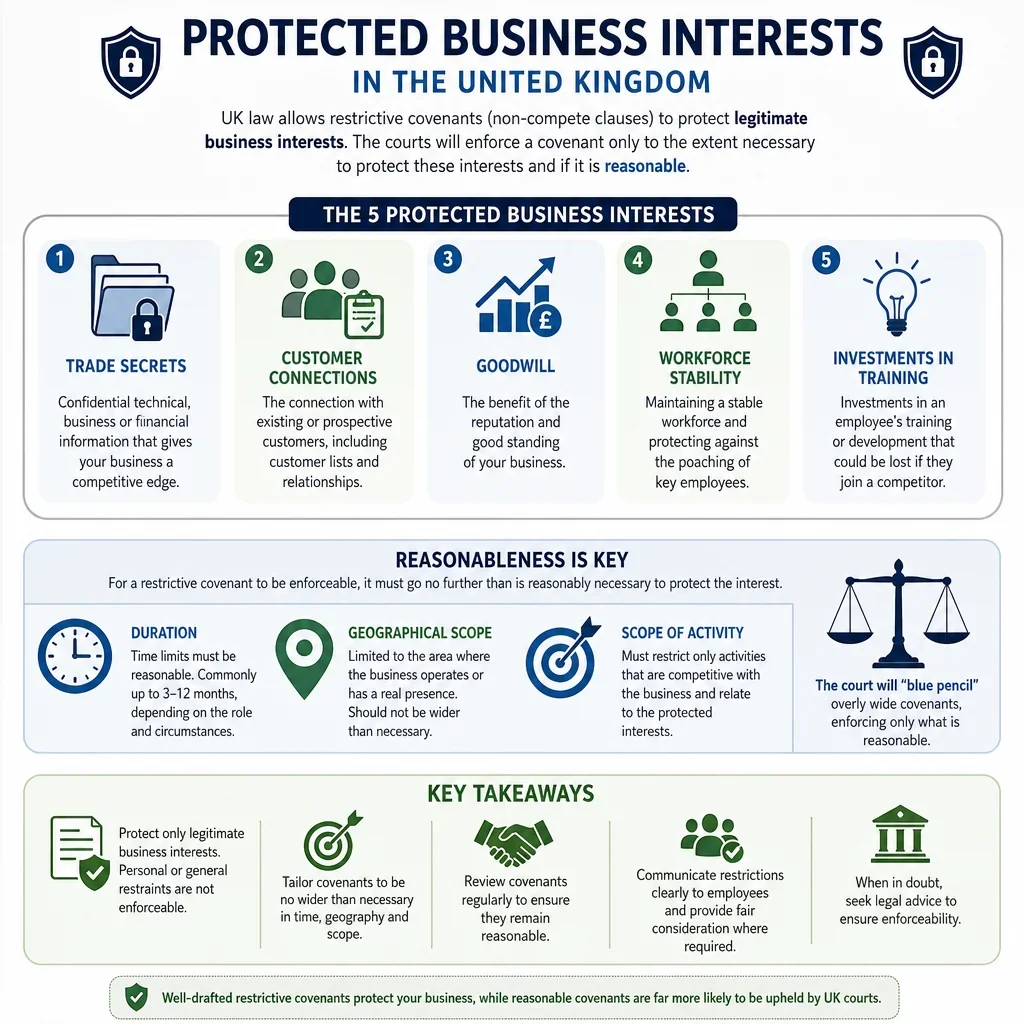
The Employee acknowledges that during their employment as a Senior Software Developer they will have access to the Company's trade secrets and confidential information (including source code and algorithms) will develop and maintain customer connections and goodwill and will have influence over key members of the workforce.
The parties agree that the covenants in this Agreement are reasonable and necessary to protect the Company's legitimate business interests in its trade secrets confidential information customer connections goodwill and the stability of its workforce.
The Employee expressly acknowledges and agrees that the restrictions in this Agreement are fair and proportionate in scope duration and geography given their senior role as a Senior Software Developer their access to confidential information and their influence over customers and key staff.
5NON-COMPETITION
The Employee shall not during the Restricted Period and within a 25-mile radius of the Company's headquarters in Birmingham engage in the development sale or marketing of bespoke software solutions (to the extent that the Employee was materially involved in such activities) for businesses in the retail and finance sectors that compete with the Restricted Business.
The non-competition restriction in clause 4.1 shall take effect from the later of the termination of the Employee's employment or the end of any period of Garden Leave.
If a court finds any part of this clause 4 too wide it may be modified or severed to the minimum extent necessary to make it enforceable.
6NON-SOLICITATION OF CUSTOMERS
The Employee shall not during the Restricted Period directly or indirectly solicit the business of any Restricted Customers or any clients or suppliers of the Company with whom the Employee had material dealings in the 12 months prior to termination.
The Employee shall not during the Restricted Period directly or indirectly deal with any Restricted Customers or any clients or suppliers of the Company with whom the Employee had material dealings in the 12 months prior to termination (non-dealing).
The Employee shall notify any new employer of the restrictions contained in this Agreement prior to commencing new employment.
7NON-SOLICITATION OF EMPLOYEES
The Employee shall not during the Restricted Period directly or indirectly solicit or attempt to solicit any Key Employees or any employees or contractors of the Company with whom the Employee had material dealings for the purpose of employing or engaging them in any business competing with the Restricted Business.
8CONFIDENTIALITY OBLIGATIONS
The Employee shall during the term of employment with the Company and for a period of 5 years from the date of termination of such employment maintain the confidentiality of all Confidential Information and shall not disclose it to any third party except where such disclosure is required by law or to professional advisors or with the prior written consent of the Company.
The Employee shall upon termination of employment return to the Company all documents materials and other items containing or relating to Confidential Information.
The obligations under this clause 7 shall survive the termination of the Employee's employment.
9DURATION OF RESTRICTIONS
The Company may at its discretion place the Employee on Garden Leave for a maximum period of 3 months during the notice period with full pay and benefits during such period. During any Garden Leave the Employee shall not attend the Company's premises contact customers or key staff (except as directed) and the Restricted Period shall be reduced by the length of any Garden Leave served. The Company may make a payment in lieu of notice (PILON) in accordance with the Employee's contract of employment which shall not affect the enforceability of the restrictions in this Agreement.
The restrictive covenants in this Agreement shall apply for the Restricted Period which shall run from the later of the date of termination of the Employee's employment or the end of any period of Garden Leave.
10GEOGRAPHICAL SCOPE
The restrictions in this Agreement shall apply within a 25-mile radius of the Company's headquarters in Birmingham to the extent justifiable for a Birmingham-based SME and only in relation to the specific sectors and activities in which the Employee was materially involved as a Senior Software Developer.
11CONSIDERATION
In consideration for the Employee agreeing to the restrictive covenants contained in this Agreement (which are supported by adequate consideration beyond continued employment alone) the Employee shall receive continued employment access to confidential information customer connections and the associated benefits including salary health insurance together with any applicable promotion or bonus (particularly relevant as this Agreement is entered into after the commencement of employment).
12MODIFICATION AND SEVERANCE
If any restriction in this Agreement is found to be unenforceable the parties agree that it may be modified by the court to the minimum extent necessary to make it enforceable. The invalidity or unenforceability of any one covenant shall not affect the validity or enforceability of the other covenants which shall remain in full force and effect.
13SEVERABILITY
If any provision of this Agreement is held to be invalid or unenforceable in whole or in part the remaining provisions of this Agreement shall continue to be valid and enforceable.
This clause 11 shall apply to the entire Agreement including all schedules and annexes.
14ENTIRE AGREEMENT
This Agreement constitutes the entire agreement between the parties and supersedes all prior agreements understandings and arrangements whether oral or in writing relating to its subject matter.
This Agreement takes effect on 2024-01-15 and supersedes all prior understandings from that point.
Each party acknowledges that in entering into this Agreement it has not relied on any representation or warranty not set out in this Agreement and that liability for any pre-contractual representations is excluded to the fullest extent permitted by law.
15GOVERNING LAW
This Agreement and any dispute or claim arising out of or in connection with it or its subject matter or formation shall be governed by and construed in accordance with the laws of England and Wales.
16JURISDICTION
The parties irrevocably agree that the courts of England and Wales shall have exclusive jurisdiction to settle any dispute or claim that arises out of or in connection with this Agreement or its subject matter or formation.
17ASSIGNMENT
The Employee shall not assign transfer or deal in any other manner with any of the Employee's rights and obligations under this Agreement.
The Company may assign transfer or deal in any other manner with any of its rights and obligations under this Agreement.
This Agreement shall bind and enure to the benefit of the parties and their respective successors and assigns.
18NOTICES
Any notice given under this Agreement shall be in writing and may be served by hand delivery post or email.
Notices shall be deemed served on the date of delivery if served by hand or email or on the second business day after posting if served by post excluding non-business days when calculating such periods.
Notices to the Employee shall be sent to 123 Example Street London SW1A 1AA United Kingdom or to the Employee's last known address or email address.
Notices to the Company shall be sent to its registered office or to such other address as the Company may notify to the Employee from time to time.
19WAIVER
No failure or delay by either party in exercising any right power or remedy under this Agreement shall operate as a waiver of that right power or remedy.
The rights powers and remedies provided in this Agreement are cumulative and do not exclude any rights powers or remedies provided by law.
20COUNTERPARTS
This Agreement may be executed in any number of counterparts each of which when executed and delivered shall constitute a duplicate original but all the counterparts shall together constitute one agreement.
The parties may execute this Agreement by electronic signature and may exchange counterparts by email.
21EMPLOYEE ACKNOWLEDGMENT
The Employee confirms that they have read and understood the terms of this Agreement have had the opportunity to take independent legal advice and agree that all restrictions are reasonable and necessary to protect the Company's legitimate business interests given their role as Senior Software Developer.
22SIGNATURES
Signed by the Employee: _______________________________ Date: _______________
Signed by a duly authorised representative of the Company: _______________________________ Date: _______________
This example shows approximately 70% of a typical document and is provided for illustrative purposes only. The remaining content has been omitted.
Every document generated by Docaro is tailored to your specific circumstances, jurisdiction and the information you provide. The completed document includes all applicable clauses and provisions required for your situation.
To generate the full, personalised document, answer a short series of questions and your document will be created instantly.
Useful Resources When Considering a Restrictive Covenant in the United Kingdom
United Kingdom Reference Legislation
Restrictive Covenant FAQs
Document Generation FAQs
Related Articles