AI Generated Sale and Purchase Agreement for use in the United Kingdom
PDF & Word - 2026 Updated
Docaro Pricing
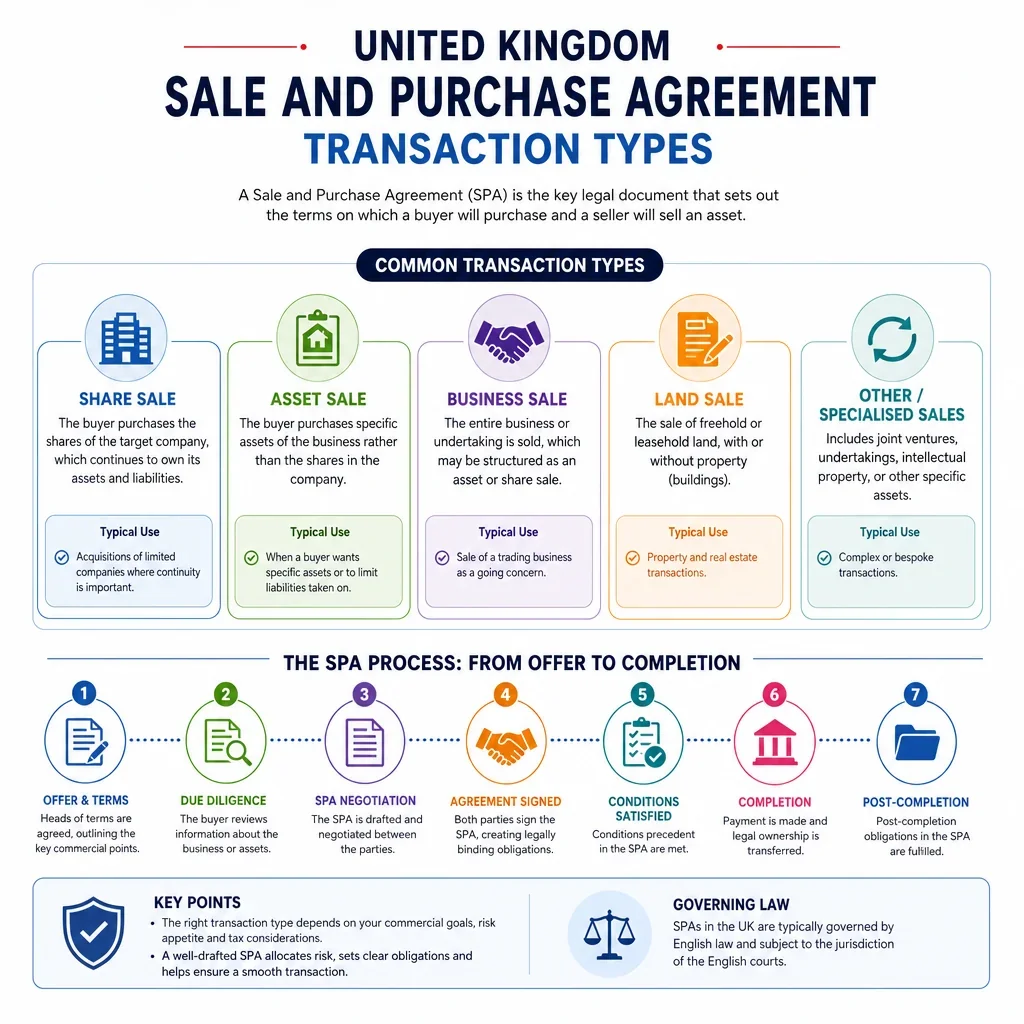
When do you need a Sale and Purchase Agreement in the United Kingdom?
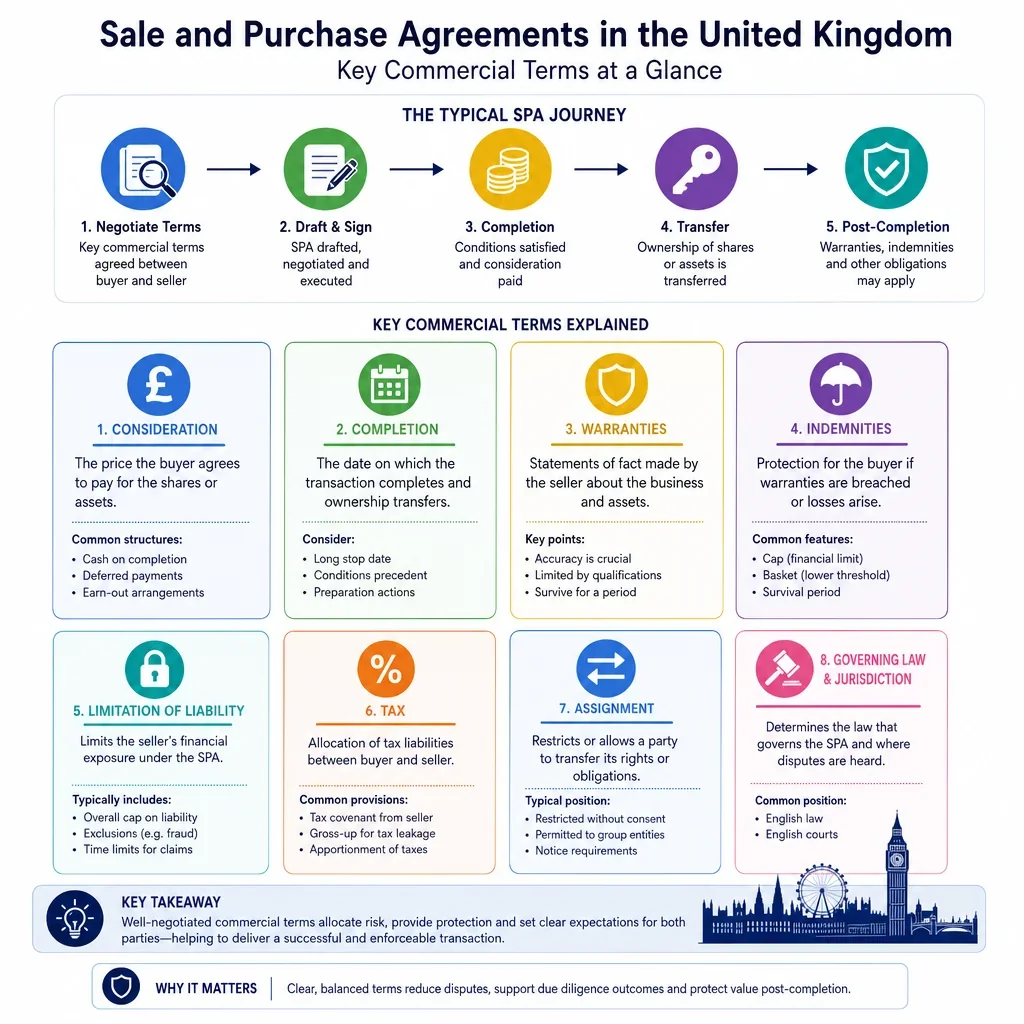
British Legal Rules for a Sale and Purchase Agreement
Using the wrong structure for a sale and purchase agreement can lead to unenforceable terms or unintended liabilities.
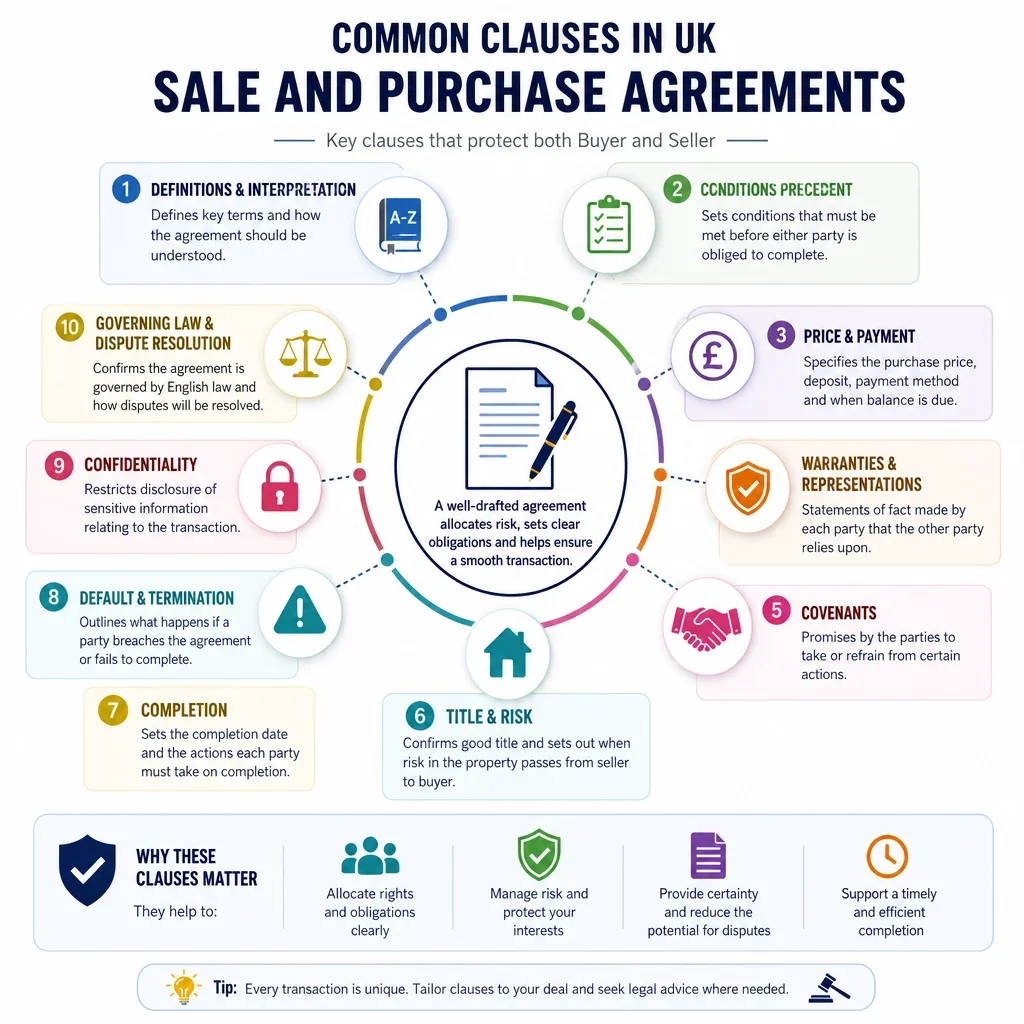
What a Proper Sale and Purchase Agreement Should Include
- Parties InvolvedClearly identify the buyer and seller, including their full names and addresses.
- Property DetailsDescribe the property being sold, including its address, size, and any included fixtures or fittings.
- Purchase PriceState the total price, payment method, and any deposit required upfront.
- Payment TermsOutline how and when payments will be made, including any instalments or completion date.
- Completion DateSpecify the date when ownership transfers and the buyer takes possession.
- Conditions and WarrantiesInclude assurances about the property's condition and any special conditions like surveys or financing.
- Title and OwnershipConfirm the seller has clear legal rights to the property with no outstanding claims.
Generate Your Document in 4 Easy Steps
Why Use Docaro?
 United Kingdom
Free Example Sale and Purchase Agreement Template
Below is a free template example of a Sale and Purchase Agreement for use in the United Kingdom generated by our AI model.
The clauses in your actual Sale and Purchase Agreement will vary from this example as they will be entirely bespoke to your requirements as set out in the questionnaire you complete.
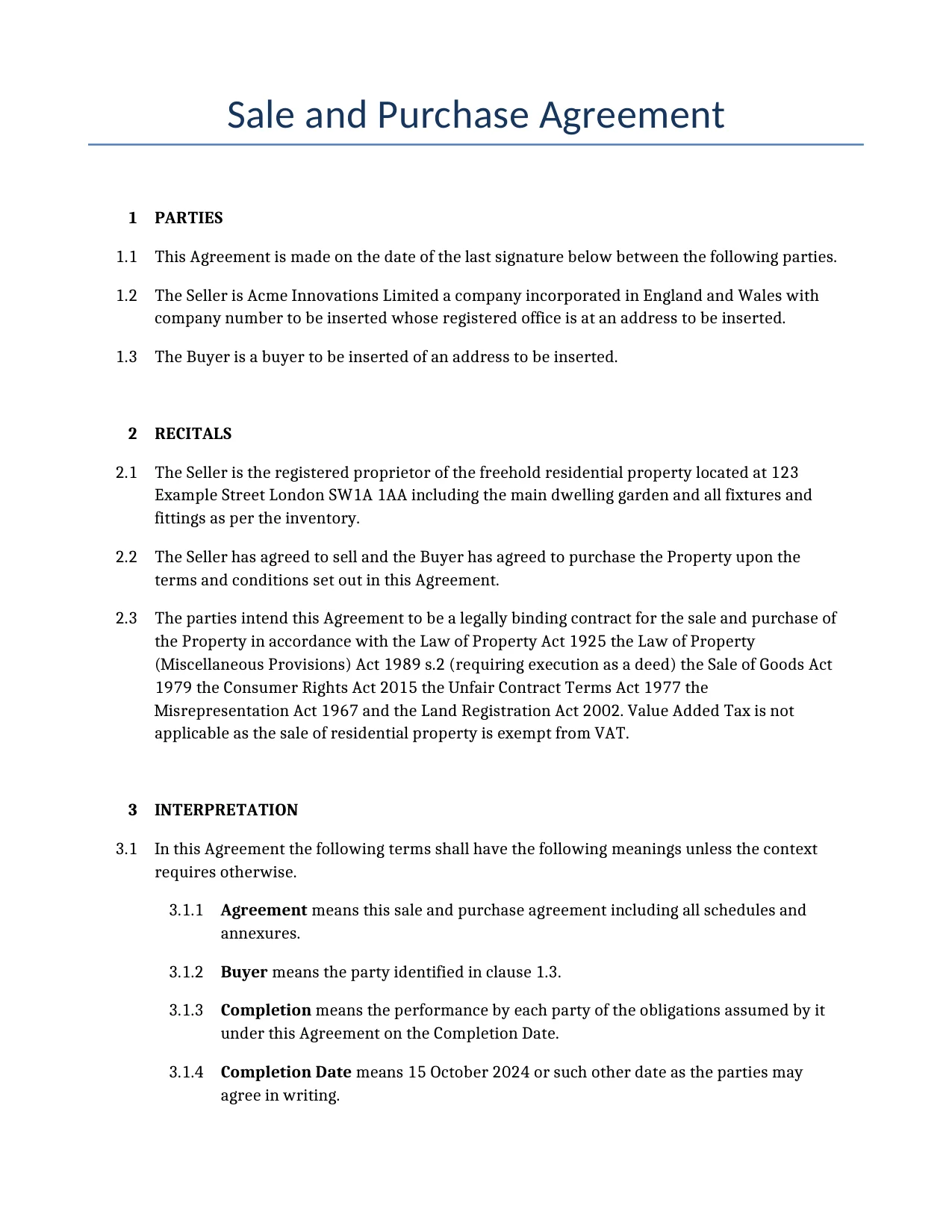
Sale and Purchase Agreement
1PARTIES
This Agreement is made on the date of the last signature below between the following parties.
The Seller is Acme Innovations Limited a company incorporated in England and Wales with company number to be inserted whose registered office is at an address to be inserted.
The Buyer is a buyer to be inserted of an address to be inserted.
2RECITALS
The Seller is the registered proprietor of the freehold residential property located at 123 Example Street London SW1A 1AA including the main dwelling garden and all fixtures and fittings as per the inventory.
The Seller has agreed to sell and the Buyer has agreed to purchase the Property upon the terms and conditions set out in this Agreement.
The parties intend this Agreement to be a legally binding contract for the sale and purchase of the Property in accordance with the Law of Property Act 1925 the Law of Property (Miscellaneous Provisions) Act 1989 s.2 (requiring execution as a deed) the Sale of Goods Act 1979 the Consumer Rights Act 2015 the Unfair Contract Terms Act 1977 the Misrepresentation Act 1967 and the Land Registration Act 2002. Value Added Tax is not applicable as the sale of residential property is exempt from VAT.
3INTERPRETATION
In this Agreement the following terms shall have the following meanings unless the context requires otherwise.
Agreement means this sale and purchase agreement including all schedules and annexures.
Buyer means the party identified in clause 1.3.
Completion means the performance by each party of the obligations assumed by it under this Agreement on the Completion Date.
Completion Date means 15 October 2024 or such other date as the parties may agree in writing.
Property means the freehold residential property located at 123 Example Street London SW1A 1AA including the main dwelling garden and all fixtures and fittings as per the inventory attached at Schedule 1.
Purchase Price means two hundred and fifty thousand pounds sterling (GBP 250000.00).
Seller means the party identified in clause 1.2.
Deposit means the sum of ten per cent (10\%) of the Purchase Price.
SDLT means Stamp Duty Land Tax payable under the Finance Act 2003.
References to clauses and schedules are to the clauses and schedules of this Agreement.
Headings are for convenience only and shall not affect the interpretation of this Agreement.
4DEFINITIONS
In addition to the terms defined in the Interpretation section the following definitions apply in this Agreement.
Conditions means the conditions precedent to Completion including satisfactory results of local authority searches environmental searches surveys verification of planning permissions and building regulations compliance and any other standard pre-completion enquiries in accordance with the Law Society conveyancing protocol.
Apportionments means the apportionment of outgoings including council tax water rates gas electricity and other utilities as at the Completion Date in accordance with standard UK residential conveyancing practice.
5DEPOSIT
The Buyer shall pay the Deposit to the Seller's solicitors to be held by them as stakeholder upon exchange of this Agreement in accordance with the Standard Conditions of Sale (Fifth Edition).
The Deposit shall be held by the stakeholder until Completion or earlier termination of this Agreement.
If the Buyer is in breach of this Agreement and the Agreement is terminated the Seller may forfeit the Deposit and the stakeholder shall pay it to the Seller as liquidated damages on account of the Seller's loss.
The balance of the Purchase Price shall be paid on Completion in accordance with clause 6.2.
6SALE AND PURCHASE
The Seller agrees to sell and the Buyer agrees to purchase the Property free from all liens charges and encumbrances but subject to the matters referred to in this Agreement and subject to the Conditions.
The sale and purchase of the Property shall be completed on the Completion Date.
7PURCHASE PRICE
The Purchase Price for the Property shall be the sum of two hundred and fifty thousand pounds sterling (GBP 250000.00).
The Buyer shall pay the Purchase Price (less the Deposit paid on exchange) to the Seller on the Completion Date by electronic transfer to the Seller's solicitors' client account details of which shall be provided to the Buyer not less than five business days prior to the Completion Date.
The Purchase Price is exclusive of value added tax which shall be payable by the Buyer in addition if applicable (though usually exempt for residential freehold sales).
8CONDITIONS AND PRE-COMPLETION
Completion is conditional upon the Buyer obtaining satisfactory results from all usual pre-completion searches and surveys including but not limited to local authority searches environmental and flood searches title searches and physical surveys of the Property.
The Buyer shall raise standard pre-contract enquiries and the Seller shall reply fully and accurately in accordance with the Law Society's TA6 Property Information Form and other standard forms.
The Seller warrants that the Property has all necessary planning permissions and building regulation approvals for any works carried out and there are no outstanding notices disputes or enforcement actions in relation to the Property.
On or before Completion the parties shall make Apportionments for council tax utilities and other outgoings so that the Seller is responsible for all such charges up to and including the day before Completion and the Buyer thereafter. Any over or under payments shall be adjusted on Completion.
If any Condition is not satisfied by the Completion Date either party may rescind this Agreement and the Deposit shall be returned to the Buyer without deduction.
9TITLE AND POSSESSION
The Seller warrants that it has good and marketable title to the Property and full power to sell and convey the Property to the Buyer in accordance with the Law of Property Act 1925 and the Land Registration Act 2002.
Title to the Property will be transferred to the Buyer via a Transfer executed as a deed by the Seller and registered with the Land Registry in accordance with the Land Registration Act 2002.
On Completion the Seller shall give vacant possession of the Property to the Buyer.
10COMPLETION
Completion shall take place on the Completion Date at the offices of the Buyer's solicitors or such other location as the parties may agree.
On Completion the Seller shall deliver to the Buyer the executed Transfer deed all title documents and all other documents necessary to complete the registration of the Property in the name of the Buyer at the Land Registry.
The Buyer shall pay the balance of the Purchase Price to the Seller on Completion in accordance with clause 7.2.
On Completion the risk in the Property passes to the Buyer and the Seller's insurance obligations cease.
11WARRANTIES
The Seller warrants to the Buyer that the statements set out in Schedule 2 are true and accurate as at the date of this Agreement and will be true and accurate as at the Completion Date.
The Buyer acknowledges that it has not entered into this Agreement in reliance upon any representation warranty or undertaking not expressly incorporated in this Agreement in accordance with the Misrepresentation Act 1967.
The warranties given by the Seller are given subject to the disclosures set out in Schedule 3.
12RISK AND INSURANCE
The Property shall remain at the risk of the Seller until Completion.
The Seller shall maintain adequate insurance cover for the Property until the Completion Date.
13ENTIRE AGREEMENT
This Agreement constitutes the entire agreement between the parties relating to the subject matter hereof and supersedes all prior agreements understandings or arrangements whether oral or in writing.
Each party acknowledges that it has not entered into this Agreement in reliance on any representation or warranty not expressly set out in this Agreement.
14SEVERABILITY
If any provision of this Agreement is held to be invalid or unenforceable such provision shall be severed from this Agreement and the remaining provisions shall continue in full force and effect.
15GOVERNING LAW
This Agreement and any dispute or claim arising out of or in connection with it or its subject matter or formation shall be governed by and construed in accordance with the laws of England and Wales.
The parties agree that the courts of England and Wales shall have exclusive jurisdiction to settle any dispute or claim arising out of or in connection with this Agreement.
16NOTICES
Any notice required to be given under this Agreement shall be in writing and shall be delivered personally or sent by pre-paid first class post or recorded delivery to the address of the relevant party set out in clause 1 or such other address as that party may notify to the other party in writing.
A notice shall be deemed to have been received at the time of delivery if delivered personally or forty eight hours after posting in the case of pre-paid first class post or recorded delivery.
17VARIATION
No variation of this Agreement shall be effective unless it is in writing and signed by or on behalf of each of the parties.
18THIRD PARTY RIGHTS
A person who is not a party to this Agreement shall not have any rights under the Contracts (Rights of Third Parties) Act 1999 to enforce any term of this Agreement.
19COUNTERPARTS
This Agreement may be executed in any number of counterparts each of which when executed shall constitute a duplicate original but all the counterparts shall together constitute one agreement.
20LIABILITY AND LIMITATIONS
The Seller's liability under the warranties in this Agreement shall be limited as follows: (a) the Buyer must notify the Seller of any claim within 6 months of Completion; (b) the maximum aggregate liability of the Seller shall not exceed the Purchase Price; (c) the Seller shall not be liable for any indirect or consequential loss; and (d) the Seller shall not be liable for any matter disclosed in Schedule 3 or which the Buyer knew or ought to have known prior to exchange.
The limitations in this clause do not apply to claims for breach of title warranties or in cases of fraud or fraudulent misrepresentation in accordance with the Misrepresentation Act 1967.
If the Buyer is a consumer the parties acknowledge the application of the Consumer Rights Act 2015 and nothing in this Agreement shall exclude or restrict the Buyer's statutory rights.
21BUYER OBLIGATIONS AND ASSIGNMENT
The Buyer warrants to the Seller that it has the financial resources to complete the purchase and will comply with all anti-money laundering requirements including providing evidence of identity and source of funds as required by the Money Laundering Terrorist Financing and Transfer of Funds (Information on the Payer) Regulations 2017.
This Agreement is personal to the Buyer and the Buyer shall not assign transfer or charge its rights or obligations under this Agreement without the prior written consent of the Seller.
The Buyer shall be responsible for paying all SDLT arising on the purchase and registering the transfer at the Land Registry. The Buyer shall bear its own legal costs and the Seller shall bear its own legal costs.
22REMEDIES
In the event of a breach of this Agreement by either party the innocent party shall be entitled to all remedies available at law including specific performance damages and rescission (subject to the limitations in clause 20).
On breach by the Buyer the Seller may forfeit the Deposit in accordance with clause 5.3.
23CONFIDENTIALITY
Each party shall keep confidential and shall not disclose to any person the existence or terms of this Agreement except as required by law or to its professional advisers on a need-to-know basis.
24DATA PROTECTION
Each party shall comply with its obligations under the UK GDPR the Data Protection Act 2018 and all applicable data protection legislation in relation to any personal data processed in connection with this transaction.
25MERGER
The provisions of this Agreement shall not merge on Completion but shall remain in full force and effect so far as they are not performed at Completion.
26COSTS AND TAXES
The Buyer shall be responsible for the payment of all SDLT arising on the purchase of the Property and shall submit the appropriate Land Transaction Return within the statutory time limits.
The Buyer shall pay all Land Registry fees in connection with the registration of the transfer.
Each party shall bear its own legal and other professional costs in relation to this Agreement and the transaction contemplated by it.
The parties shall comply with all anti-money laundering regulations and each party's solicitors may require identification evidence and other information before proceeding.
27SCHEDULES
Schedule 1: Inventory of Fixtures and Fittings. The Property includes the following items which are included in the sale at no extra cost: all fitted carpets curtains blinds light fittings kitchen units and appliances (oven hob extractor fan dishwasher washing machine fridge-freezer) bathroom fittings (bath shower basin WC) and garden shed. No loose furniture or furnishings are included unless expressly stated. The Buyer has inspected the Property and accepts the inventory in its present condition.
Schedule 2: Seller's Warranties. 1. The Seller is the registered proprietor of the Property with absolute title registered at HM Land Registry under title number to be inserted. 2. The Seller has full power and authority to sell the Property and there are no restrictions on disposition. 3. There are no mortgages charges liens or other encumbrances affecting the Property other than those which will be discharged on or before Completion. 4. No notices have been served by any local or other authority in respect of the Property and there are no outstanding disputes claims or litigation affecting the Property. 5. The Property complies with all applicable planning laws building regulations and environmental laws and there has been no unauthorised development or use. 6. All utilities serving the Property are connected and in working order and there are no known defects. 7. There are no boundary disputes and the Property is as described in the registered title. 8. The Seller has not received any requests or demands from any third party in respect of the Property. These warranties are given subject to matters in Schedule 3 and the Buyer's own enquiries.
Schedule 3: Disclosures. The following matters are disclosed to the Buyer and the warranties in Schedule 2 are given subject to these disclosures: 1. The Property is subject to the rights granted and reserved in the registered title including rights of way for services and support. 2. The Property is located in a conservation area (if applicable) or flood zone (if applicable) - details to be confirmed by searches. 3. Minor works were carried out to the kitchen and bathroom in 2020 without formal building regulation approval but the works were completed to a satisfactory standard by qualified contractors. 4. The Seller is not aware of any material defects but the Buyer has been advised to undertake its own survey. 5. Copies of guarantees for boiler and double glazing have been provided to the Buyer. The Buyer confirms it has had the opportunity to raise further enquiries and is satisfied with the disclosures for the purposes of the Misrepresentation Act 1967 and Consumer Rights Act 2015.
28EXECUTION
This Agreement is executed and delivered as a deed by the parties in accordance with section 1 of the Law of Property (Miscellaneous Provisions) Act 1989. It shall be delivered upon the date of the last signature below and shall take effect as a deed on that date.
29SIGNATURES
Signed as a deed by Acme Innovations Limited acting by a director in the presence of a witness.
Director Signature.
Witness Signature.
Witness Name.
Witness Address.
Signed as a deed by the Buyer in the presence of a witness.
Buyer Signature.
Witness Signature.
Witness Name.
Witness Address.
This example shows approximately 70% of a typical document and is provided for illustrative purposes only. The remaining content has been omitted.
Every document generated by Docaro is tailored to your specific circumstances, jurisdiction and the information you provide. The completed document includes all applicable clauses and provisions required for your situation.
To generate the full, personalised document, answer a short series of questions and your document will be created instantly.
Useful Resources When Considering a Sale and Purchase Agreement in the United Kingdom
United Kingdom Reference Legislation
Sale and Purchase Agreement FAQs
Document Generation FAQs
Related Articles