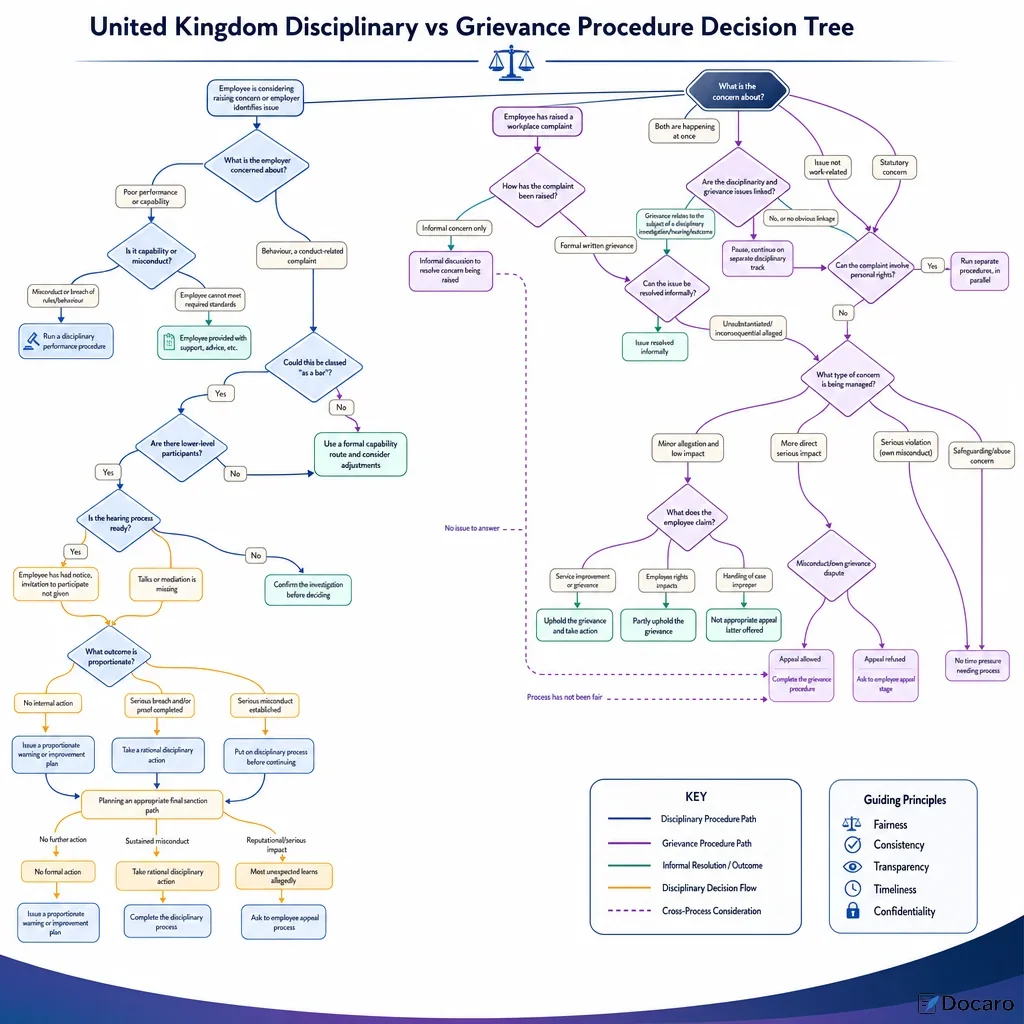
AI Generated Disciplinary and Grievance Procedures for use in the United Kingdom
PDF & Word - 2026 Updated
Docaro Pricing
When do you need Disciplinary and Grievance Procedures in the United Kingdom?
British Legal Rules for Disciplinary and Grievance Procedures
Using an inappropriate structure for disciplinary and grievance procedures can lead to non-compliance with UK employment law and potential tribunal claims.
What a Proper Disciplinary and Grievance Procedure Should Include
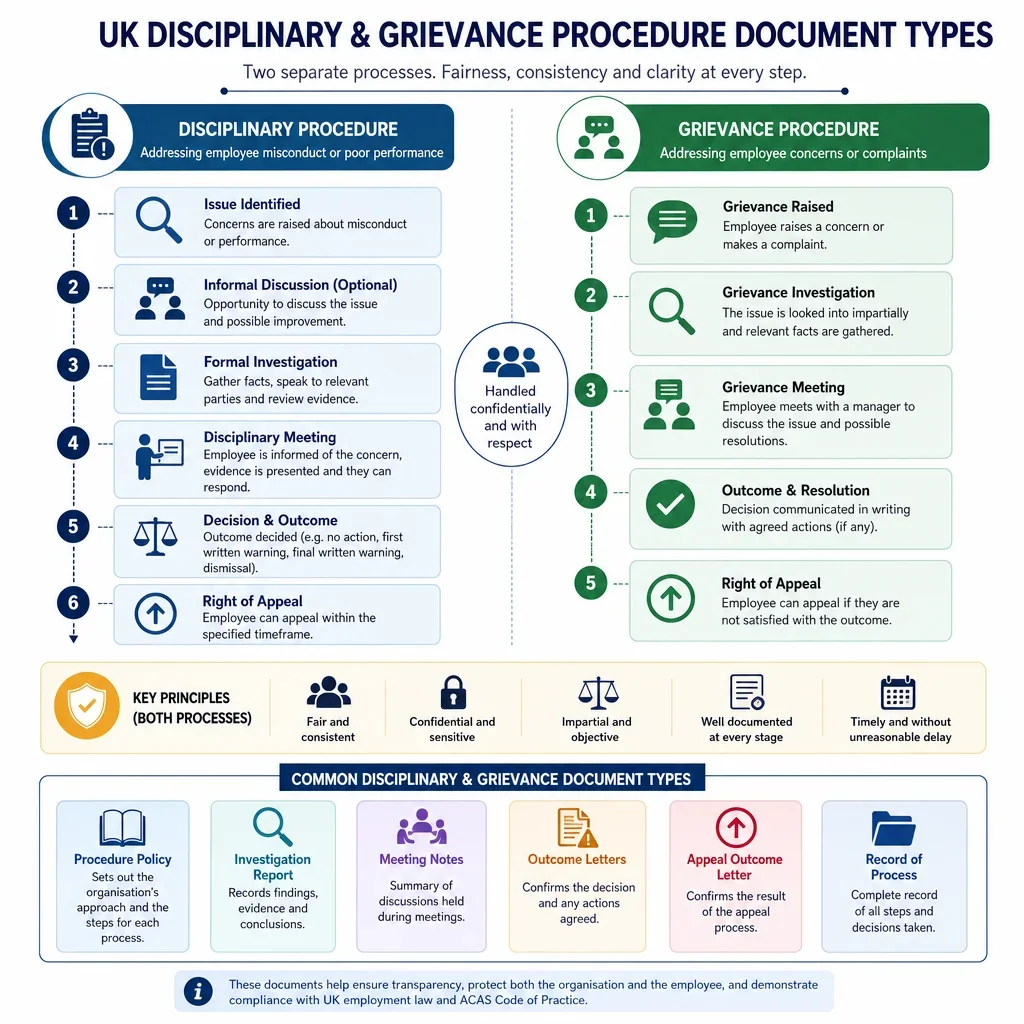
- Clear Written RulesYour procedure must outline the rules and standards employees are expected to follow to avoid confusion.
- Informal Resolution StepsStart with informal discussions to resolve issues quickly before escalating to formal action.
- Written NotificationProvide employees with clear written details of any concerns or complaints raised against them.
- Right to AccompanimentAllow employees to bring a colleague or union representative to formal meetings for support.
- Fair InvestigationConduct a thorough and impartial investigation to gather all relevant facts before decisions.
- Opportunity to RespondGive employees a chance to explain their side and respond to allegations in a meeting.
- Right to AppealOffer a way for employees to appeal any disciplinary decision they disagree with.
- Timely HandlingDeal with disciplinary and grievance matters promptly to minimize stress and uncertainty.
- Record KeepingKeep confidential records of all steps taken in the process for fairness and review.
Generate Your Document in 4 Easy Steps
Why Use Docaro?
 United Kingdom
Free Example Disciplinary and Grievance Procedures Template
Below is a free template example of a Disciplinary and Grievance Procedures for use in the United Kingdom generated by our AI model.
The clauses in your actual Disciplinary and Grievance Procedures will vary from this example as they will be entirely bespoke to your requirements as set out in the questionnaire you complete.
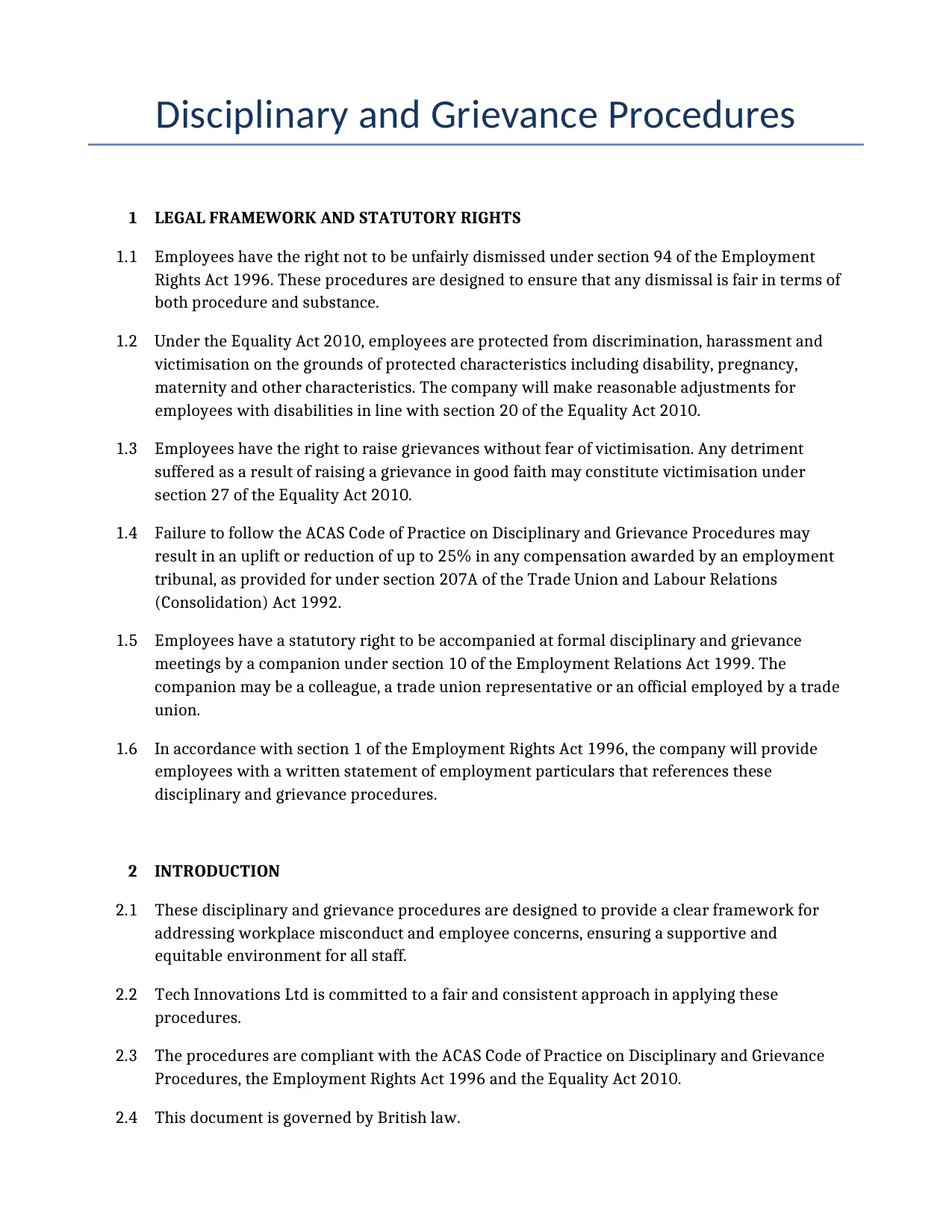
Disciplinary and Grievance Procedures
1LEGAL FRAMEWORK AND STATUTORY RIGHTS
Employees have the right not to be unfairly dismissed under section 94 of the Employment Rights Act 1996. These procedures are designed to ensure that any dismissal is fair in terms of both procedure and substance.
Under the Equality Act 2010, employees are protected from discrimination, harassment and victimisation on the grounds of protected characteristics including disability, pregnancy, maternity and other characteristics. The company will make reasonable adjustments for employees with disabilities in line with section 20 of the Equality Act 2010.
Employees have the right to raise grievances without fear of victimisation. Any detriment suffered as a result of raising a grievance in good faith may constitute victimisation under section 27 of the Equality Act 2010.
Failure to follow the ACAS Code of Practice on Disciplinary and Grievance Procedures may result in an uplift or reduction of up to 25% in any compensation awarded by an employment tribunal, as provided for under section 207A of the Trade Union and Labour Relations (Consolidation) Act 1992.
Employees have a statutory right to be accompanied at formal disciplinary and grievance meetings by a companion under section 10 of the Employment Relations Act 1999. The companion may be a colleague, a trade union representative or an official employed by a trade union.
In accordance with section 1 of the Employment Rights Act 1996, the company will provide employees with a written statement of employment particulars that references these disciplinary and grievance procedures.
2INTRODUCTION
These disciplinary and grievance procedures are designed to provide a clear framework for addressing workplace misconduct and employee concerns, ensuring a supportive and equitable environment for all staff.
Tech Innovations Ltd is committed to a fair and consistent approach in applying these procedures.
The procedures are compliant with the ACAS Code of Practice on Disciplinary and Grievance Procedures, the Employment Rights Act 1996 and the Equality Act 2010.
This document is governed by British law.
3PRINCIPLES
All procedures will be conducted in a manner that ensures natural justice, providing all parties with a fair opportunity to present their case without bias or prejudice.
Decision makers shall have no prior involvement in the case to ensure impartiality.
The company shall comply with the ACAS Code of Practice on Disciplinary and Grievance Procedures.
Confidentiality shall be maintained throughout all stages of the procedures.
All matters shall be dealt with in a timely manner.
Employees have the right to be accompanied at formal meetings.
The company will make reasonable adjustments under the Equality Act 2010 for any employee who has a disability, mental health condition, is pregnant or on maternity leave, or has caring responsibilities. This includes adjusting time limits, providing additional support during meetings, allowing breaks, or changing the format of meetings where appropriate. For disciplinary issues related to long-term sickness absence, the company will consider whether any policy or practice (PCP) puts the disabled employee at a disadvantage and whether the absence is a consequence of the disability (discrimination arising from disability under section 15 of the Equality Act 2010). Adjustments may include obtaining medical advice, considering alternative roles, or modifying procedures before any formal action is taken.
4SCOPE AND APPLICABILITY
These procedures apply to all employees and workers of Tech Innovations Ltd.
The procedures cover disciplinary matters related to misconduct and grievances concerning working conditions.
The procedures also cover performance related to conduct, discrimination or harassment.
The procedures exclude issues like redundancy or performance unrelated to conduct.
Contractors are not covered by these procedures.
These procedures become effective from 2024-01-01.
5DEFINITIONS
Misconduct refers to any behaviour or action by an employee that breaches the company's standards of conduct, such as unauthorised absences, minor insubordination, or failure to follow reasonable instructions, but which does not warrant summary dismissal.
Gross misconduct is a serious breach of the employment contract, including theft, violence, serious negligence, or gross insubordination, which may justify immediate dismissal without notice.
Grievance is a complaint made by an employee concerning their employment, such as unfair treatment, working conditions, or breaches of policy, which is raised formally or informally with the employer.
Informal resolution involves discussing and addressing a concern or grievance directly with the relevant manager or colleague in a non-formal manner, aiming to resolve issues without escalating to a formal procedure.
Companion is a work colleague or trade union representative chosen by the employee to provide support and advice during formal disciplinary or grievance meetings. Family members are not permitted as companions.
6INFORMAL RESOLUTION
The informal resolution process encourages open and honest dialogue between employees and their managers to address minor concerns promptly and constructively, aiming to resolve issues without the need for formal escalation.
Low-level performance concerns, minor interpersonal misunderstandings and absence or lateness explanations are eligible for informal resolution.
The company shall aim to complete informal resolutions without unreasonable delay.
The issue shall escalate to the formal procedure if it persists after discussion, if the employee requests the formal process or if the time limit is exceeded.
7INVESTIGATIONS
The company shall appoint an impartial investigator who has HR training and investigative experience to conduct investigations into alleged misconduct. Investigations must be thorough, timely, neutral and conducted without unreasonable delay. The investigator shall gather all relevant evidence, including from the employee where appropriate, and maintain neutrality.
The company shall aim to complete investigations without unreasonable delay.
The company may suspend the employee on full pay during the investigation only where necessary to protect the investigation, the business or other staff. Suspension must not be used as a sanction.
The company may use external investigators for certain cases.
The investigator shall gather evidence using document review, digital data collection (in compliance with UK GDPR) and witness statements.
Witnesses shall have the right to be accompanied during interviews.
Information shall be kept confidential, shared only as necessary and in compliance with UK GDPR and the Data Protection Act 2018.
This section becomes effective from 2024-01-01.
8FORMAL DISCIPLINARY PROCEDURE
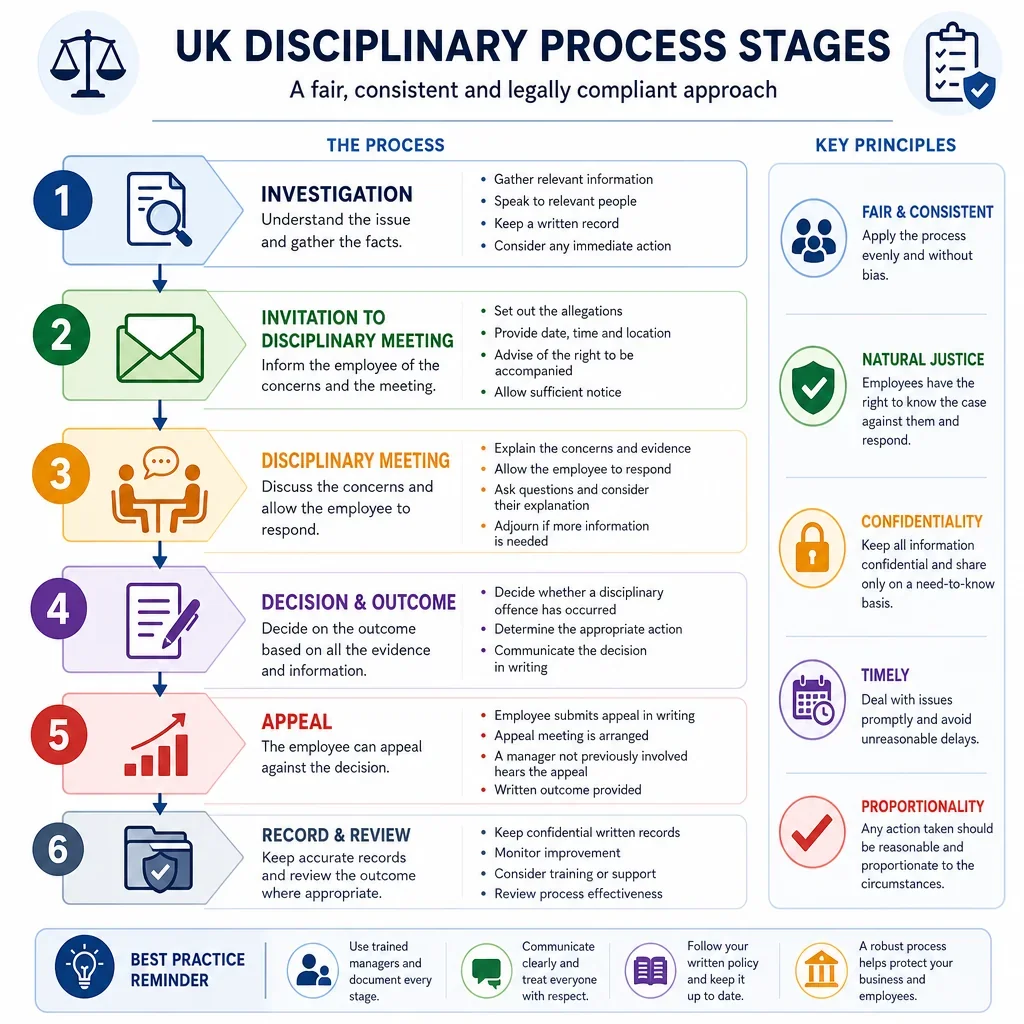
Following a thorough and impartial investigation conducted without unreasonable delay, the company shall provide the employee with written notification of the disciplinary allegations. The notification shall be sent as soon as practicable and shall include all evidence and witness statements to be relied upon so that the employee has a full opportunity to prepare a response.
The written notification shall include the nature of the allegations in detail, all evidence or information supporting the allegations (provided in advance), the employee's right to be accompanied at the disciplinary meeting by a colleague or trade union representative, the date, time, and location of the meeting (with at least 48 hours' notice), and a statement informing the employee that the meeting could result in disciplinary action up to and including dismissal. The employee must be given a reasonable opportunity to respond to all allegations before any decision is made. The burden of proof shall be on the balance of probabilities.
The employee shall have the right to call relevant witnesses and to question evidence presented.
The company shall notify the employee of the disciplinary decision in writing without unreasonable delay and, in any event, normally within 5 working days after the meeting. The decision letter shall explain the reasons and the right of appeal.
9DISCIPLINARY MEETINGS
The company shall schedule the disciplinary meeting without unreasonable delay after notification and shall provide the employee with at least 48 hours' written notice. The employee has the right to see all evidence in advance of the meeting.
The employee shall have the right to be accompanied at the disciplinary meeting by a work colleague or a trade union representative (but not a family member).
Disciplinary meetings shall be held in a private location at the company's premises or via video conference if remote attendance is necessary.
The meeting shall be conducted in a structured format where the employer presents the allegations first, followed by the employee's full opportunity to respond to all allegations before any decision is reached. The employee has the right to call witnesses.
Discussions shall be held in a fair and open manner, allowing questions from both sides. The burden of proof is on the balance of probabilities.
Notes shall be taken by a designated note-taker, shared with all parties for accuracy, and retained in accordance with the Record Keeping section.
The employee shall have the right to present their case, call witnesses and respond to all allegations during the disciplinary meeting. The meeting may be adjourned if the employee requires more time to respond, new evidence arises, a witness is unavailable, or due to health, disability or wellbeing issues (with reasonable adjustments made).
All evidence must be provided to the employee in advance. No new evidence can be introduced without prior agreement and, if necessary, an adjournment to allow the employee time to consider it.
During the meeting evidence can be presented verbally or through documents, with an opportunity for questioning.
The company shall require minutes or records of the disciplinary meeting.
The agenda for the disciplinary meeting shall include an introduction and purpose of the meeting, presentation of allegations and evidence, the employee's response and presentation of their case (including witnesses), discussion of any mitigating factors, an outline of possible outcomes and next steps, and adjournment if needed.
10DISCIPLINARY ACTIONS AND PENALTIES
Following the disciplinary meeting the company may impose a verbal warning, a written warning, a final written warning, demotion or dismissal. Dismissal must be a reasonable response in all the circumstances.
A verbal warning is given for minor misconduct and serves as a reminder to improve behavior. It shall remain active on an employee's record for 6 months.
A written warning is issued for repeated minor issues or more serious misconduct, documented in the employee's file. It shall remain active on an employee's record for 12 months.
A final written warning indicates that further misconduct may result in dismissal. It shall remain active on an employee's record for 24 months or such other period as is reasonable in the circumstances.
Previous disciplinary records can only be considered where they are relevant, live and related to the current allegations. Spent warnings must be disregarded.
Demotion may be applied for serious performance failures related to conduct, reducing the employee's role and responsibilities.
Dismissal (with or without notice) is appropriate only for gross misconduct or where prior warnings have been given and there is no improvement. The company will consider all circumstances, including mitigating factors and whether dismissal is within the range of reasonable responses.
The employee shall have the right to appeal all disciplinary actions.
The progressive steps do not apply where the misconduct is so serious as to constitute gross misconduct, in which case summary dismissal may be appropriate.
11GROSS MISCONDUCT
The company shall apply an expedited procedure for handling gross misconduct allegations without unreasonable delay. This shall include suspension on full pay only where necessary, a thorough investigation, a disciplinary hearing at which the employee may be accompanied and has the right to see all evidence in advance, and the right of appeal.
The company may apply summary dismissal (without notice or pay in lieu) only in cases of confirmed gross misconduct where dismissal is a reasonable response.
This section becomes effective from 2024-01-01.
The following are examples of gross misconduct (this list is non-exhaustive): theft or fraud, violence or bullying, gross negligence, serious breach of confidentiality, intoxication at work, serious insubordination, discrimination or harassment, or any other conduct that fundamentally breaches the contract of employment.
12APPEALS PROCESS
The employee shall have the right to appeal all disciplinary decisions made by the employer.
The employee should submit a written appeal to the HR department, stating the grounds for the appeal (such as new evidence, procedural unfairness or that the penalty is too severe), without unreasonable delay and normally within 5 working days of receipt of the decision.
The company shall schedule the appeal hearing without unreasonable delay, normally within 10 working days after the appeal is lodged, and shall provide the employee with at least 48 hours' notice in writing. The appeal shall be heard by a manager more senior than the original decision maker who has not been previously involved.
The employee shall have the same right to be accompanied at the appeal hearing as in the initial meeting.
The company shall confirm the final appeal decision in writing to the employee without unreasonable delay and normally within 5 working days of the hearing, either upholding, modifying, or overturning the original decision. The appeal decision is final.
The company shall keep records of all appeal hearings and decisions in accordance with the Record Keeping section.
Possible outcomes of the appeal decision are to uphold the original decision, overturn it and reinstate the employee, or substitute with a lesser sanction such as a warning.
13FORMAL GRIEVANCE PROCEDURE
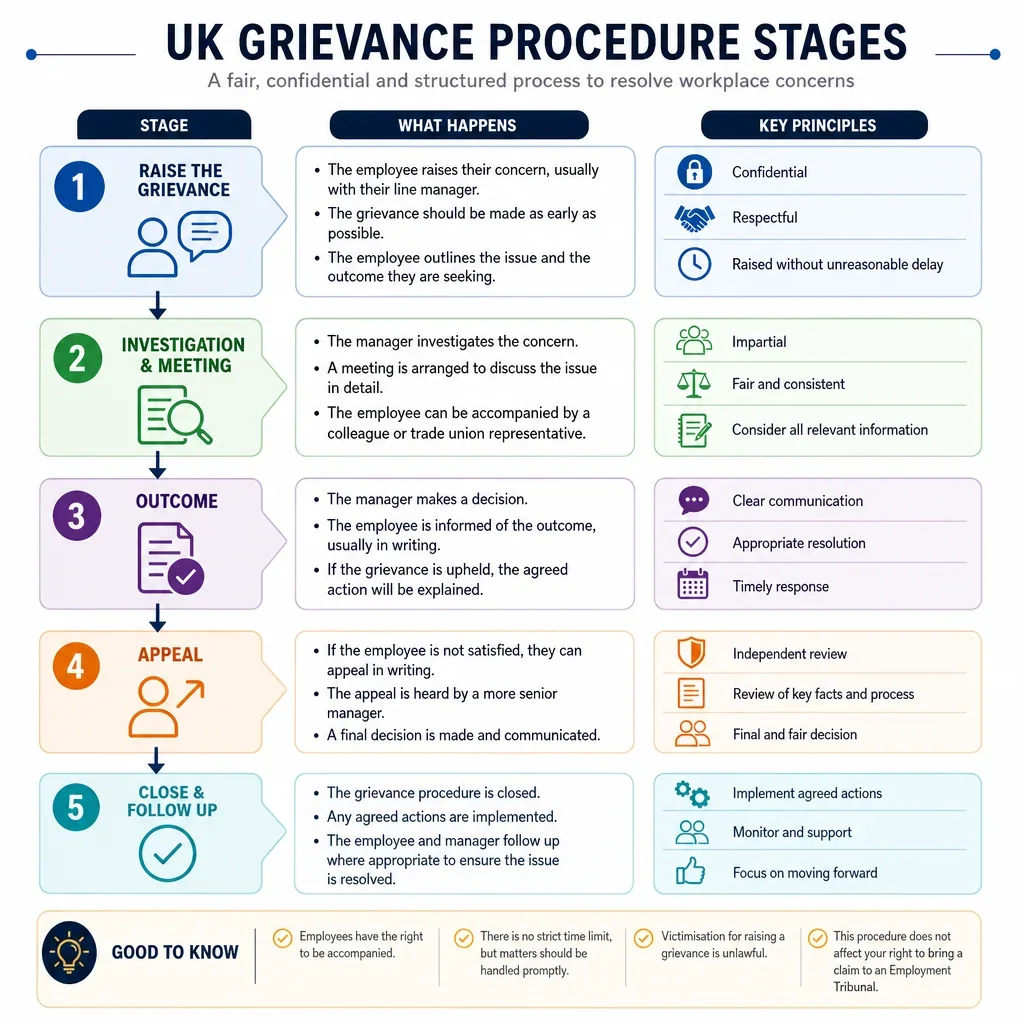
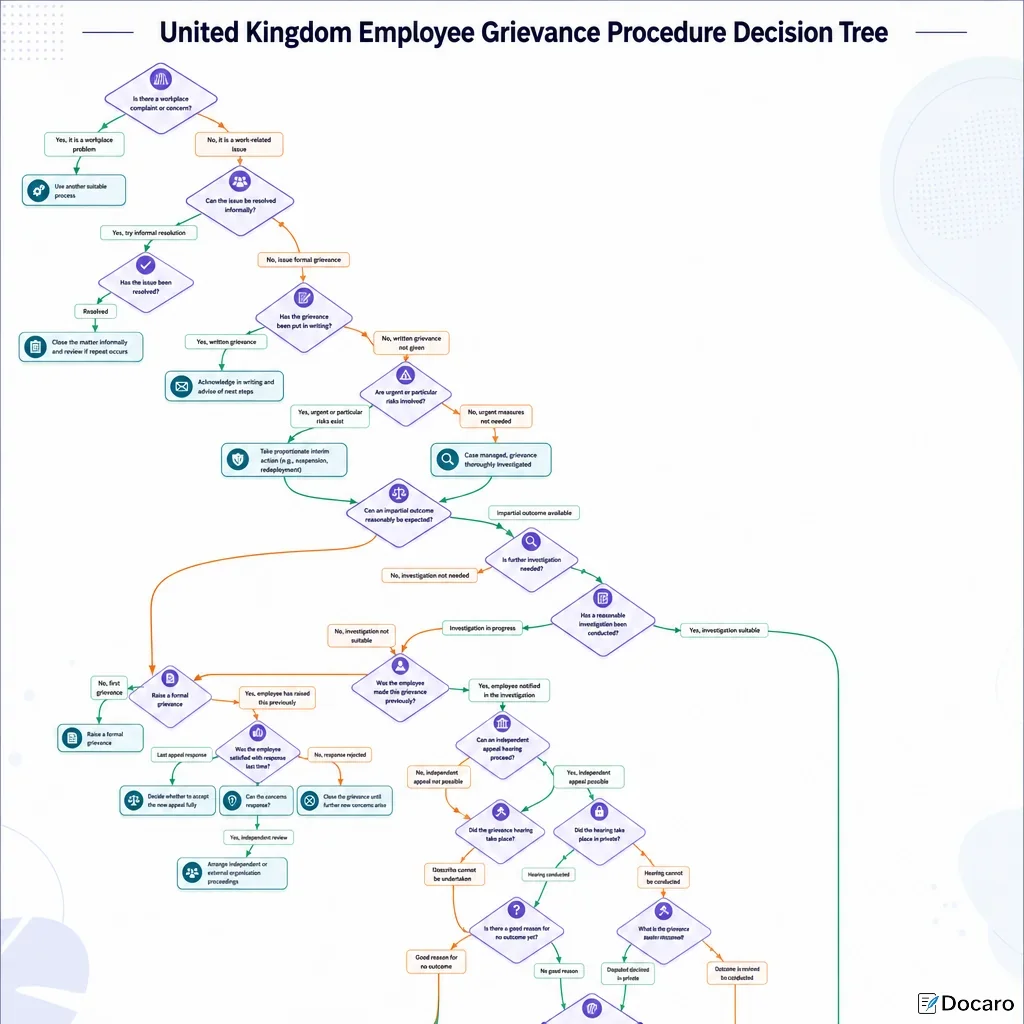
Employees shall submit formal grievances in writing, either by email to hr@techinnovations.co.uk or by hand-delivering a letter to the HR department. Grievances may be raised during employment or after employment has ended.
The HR Manager (or another appropriate impartial person) shall be the initial recipient of formal grievances. If the grievance concerns the HR Manager or the grievance procedure itself, it shall be referred to a more senior manager or an external independent party.
Formal grievance submissions shall include the nature of the grievance, relevant dates and times, names of any individuals involved, and any supporting evidence.
The company shall acknowledge receipt of a formal grievance without unreasonable delay and normally within 5 working days.
Time limits for raising grievances align with statutory claims periods. For example, discrimination claims under the Equality Act 2010 must normally be brought in an employment tribunal within 3 months less one day from the date of the act complained of. The company encourages grievances to be raised as soon as possible.
A senior manager not previously involved in the matter shall be the impartial decision maker for formal grievances.
The company shall communicate the decision to the employee in writing without unreasonable delay and normally within 5 working days after the meeting, with reasons and information about the right to appeal.
This grievance procedure becomes effective from 2024-01-01.
14GRIEVANCE MEETINGS AND INVESTIGATIONS
The company shall appoint an impartial and independent investigator for formal grievances. The investigator shall have had no prior involvement. Investigations must be thorough, timely, neutral, and conducted without unreasonable delay. Detailed steps shall include: identifying the issues, gathering all relevant evidence (including from the grievant), interviewing all relevant witnesses, reviewing relevant documents and policies, analysing the facts, and producing a report with findings.
The scope of the investigation into formal grievances shall include gathering evidence from relevant parties, reviewing company policies (including this procedure and the Equality Act 2010 where discrimination or harassment is alleged), and assessing the validity of the grievance claims.
The investigation shall commence without unreasonable delay and be completed without unreasonable delay. Any extension beyond normal timescales must be justified and communicated to the employee.
The company shall notify the employee in writing of the meeting date (with at least 48 hours' notice), allow accompaniment by a colleague or trade union representative, present the case, discuss the grievance fully, and outline next steps when conducting the formal grievance meeting. The employee must have the opportunity to respond to all evidence before any decision is made.
The employee shall have the right to be accompanied at grievance meetings by a work colleague or a trade union representative. The companion may address the meeting, ask questions and confer with the employee.
The meeting may be adjourned if new evidence arises, further investigation is required, or due to the employee's health, disability or request for reasonable adjustment.
15GRIEVANCE APPEALS
The employee shall have an explicit right to appeal any grievance decision. The appeal must be submitted in writing, stating the grounds, without unreasonable delay and normally within 5 working days of receipt of the decision (or such longer period as is reasonable, for example where the grievance concerns discrimination).
The company shall schedule the appeal hearing without unreasonable delay, normally within 10 working days after the appeal is lodged, and provide at least 48 hours' written notice. The appeal shall be heard by a more senior manager or director who has not been previously involved and is impartial.
The company shall communicate the appeal decision to the employee in writing without unreasonable delay and normally within 5 working days of the hearing, with reasons. The appeal decision is final.
The employee shall be allowed to be accompanied at the grievance appeal hearing by a colleague or trade union representative.
The company shall provide for the possibility of independent involvement in the grievance appeal process if needed (for example, where the grievance concerns senior management or the procedure itself).
Where a grievance concerns discrimination, harassment or victimisation, the company will treat it with particular seriousness, investigate in line with the Equality Act 2010, and take appropriate remedial action. Protection against victimisation is provided under section 27 of the Equality Act 2010.
16RIGHT TO ACCOMPANIMENT
Employees have the statutory right to be accompanied at formal disciplinary and grievance meetings under section 10 of the Employment Relations Act 1999. The companion must be a colleague, a trade union representative or an official employed by a trade union. Family members are not permitted.
The company shall allow employees to be accompanied by a work colleague at formal disciplinary and grievance meetings.
The company shall allow employees to be accompanied by a trade union representative at formal disciplinary and grievance meetings.
The accompanying person may address the meeting on the employee's behalf, confer with the employee during the meeting, and provide support and advice to the employee but may not answer questions on the employee's behalf.
17CONFIDENTIALITY AND DATA PROTECTION
All discussions, documents, and information related to disciplinary and grievance procedures will be kept confidential, shared only with those who have a legitimate need to know, and processed in accordance with UK GDPR, the Data Protection Act 2018 and ACAS guidance. Overly restrictive confidentiality agreements will not be required.
Information can be shared where legally required, for example with regulators, in connection with legal proceedings, or where there is a safeguarding concern.
Electronic records will be stored securely with appropriate technical and organisational measures including password protection and encryption.
The procedures shall comply with UK GDPR and the Data Protection Act 2018. Employees have data subject rights including the right to access their personal data, request rectification, erasure (subject to legal obligations), restriction of processing, and to complain to the Information Commissioner's Office.
Any alleged breaches of confidentiality or data protection during the processes shall be investigated and reported as required by law.
18RECORD KEEPING
The company shall maintain records of meetings, decisions, outcomes, evidence and appeals. These shall include notes of meetings, decision letters, investigation reports, employee statements and appeal documents.
Records shall be stored securely on a company server or encrypted cloud service compliant with UK GDPR. Access shall be restricted to authorised HR personnel, relevant managers and senior management only as necessary.
The HR department shall be responsible for maintaining the records.
In line with ICO guidance, records of disciplinary warnings shall normally be retained for 6-12 months after expiry (depending on the severity), or longer for serious misconduct or dismissal cases where there may be ongoing legal risk (up to 6 years for contract claims or longer if tribunal proceedings are anticipated). Records shall not be kept indefinitely except where justified.
When destroying records after the retention period, the company shall use secure digital deletion methods and shred physical copies, with a record kept of the destruction.
This record keeping policy becomes effective from 2024-01-01.
Employees may request access to their records in accordance with data subject rights under UK GDPR.
19TIME LIMITS
All disciplinary and grievance matters shall be dealt with promptly and without unreasonable delay, in line with ACAS recommendations. Specific time limits are indicative only and may be extended by agreement where justified (for example, due to complexity, employee absence, disability-related adjustments or availability of witnesses).
The company shall acknowledge receipt of a grievance or disciplinary matter without unreasonable delay, normally within 5 working days.
Investigations shall be completed without unreasonable delay.
Meetings shall be arranged without unreasonable delay, normally within 10 working days of completion of any investigation, with at least 48 hours' notice provided to the employee.
Evidence shall be provided to the employee as soon as possible and in sufficient time to prepare for the meeting.
The company shall communicate the decision after the meeting without unreasonable delay, normally within 5 working days.
The employee shall submit an appeal without unreasonable delay, normally within 5 working days of receipt of the decision.
The company shall arrange the appeal meeting without unreasonable delay, normally within 10 working days.
The company shall communicate the appeal decision without unreasonable delay, normally within 5 working days.
The company shall include provisions for extending time limits where justified by the circumstances, including for disabilities or where a grievance concerns discrimination (in which case statutory time limits under the Equality Act 2010 apply to any tribunal claim).
20SPECIAL CIRCUMSTANCES
The company shall make reasonable adjustments for employees with disabilities (including mental health conditions), in line with sections 20-21 of the Equality Act 2010. This includes adjustments to the disciplinary or grievance procedure itself (for example, allowing more time, providing documents in alternative formats, permitting a support person in addition to a companion, or holding meetings at a different time or place). The employee should be consulted about what adjustments may be required.
For employees who are pregnant, on maternity leave or have caring responsibilities, the company will consider any impact on their ability to participate in the procedures and make appropriate adjustments. Disciplinary action related to pregnancy or maternity will be scrutinised for compliance with the Equality Act 2010.
The company shall include specific procedures for handling long-term sickness absence in disciplinary matters. Before taking action, the company will obtain appropriate medical advice (with the employee's consent), consider whether any absence is connected to a disability, assess whether any PCP puts the disabled person at a substantial disadvantage, and consider adjustments or alternative employment. Reference will be made to relevant case law on disability discrimination arising from sickness absence.
Where a grievance and disciplinary case overlap, the company will normally consider the grievance first and may pause the disciplinary procedure if the grievance outcome could affect it. The company will ensure that raising a grievance does not lead to victimisation.
Protection against victimisation is a key principle. No employee will suffer detriment for raising a grievance in good faith, participating in these procedures, or exercising rights under the Equality Act 2010.
Grievances about discrimination, harassment or the disciplinary/grievance procedure itself will be handled with particular care, investigated impartially (potentially by an external party if internal resources are conflicted), and may involve specialist advice. Such grievances may be raised after employment ends.
The company shall require medical evidence only where necessary and proportionate for long-term absences, and always in compliance with UK GDPR and with appropriate consent.
21EXTERNAL RESOLUTION AND LEGAL RIGHTS
The company shall include information about ACAS early conciliation as an external resolution option in the document. Employees may contact ACAS for independent, confidential advice at any stage.
The company shall include details about employment tribunals as an external recourse option in the document. Time limits for tribunal claims are strict (normally 3 months less one day from the relevant act or dismissal).
The company shall emphasize preserving unfair dismissal rights and discrimination protections as statutory rights. These procedures do not replace an employee's statutory rights.
22TRAINING AND REVIEW
The company shall provide training to its managers on the disciplinary and grievance procedures.
All managers will receive a half-day workshop covering the key elements of the disciplinary and grievance procedures, including legal requirements under UK employment law, practical handling of cases, and role-playing scenarios.
The company shall provide manager training on these procedures annually.
The company commits to periodically reviewing and updating this disciplinary and grievance policy.
The company shall review this policy annually.
The policy will be reviewed annually by the HR department in consultation with senior management and employee representatives.
Any necessary updates will be documented, approved by the board, and communicated to all staff via email and the company intranet.
23CONTACT INFORMATION
Employees should contact Jane Smith for advice.
The email address for Jane Smith is jane.smith@company.co.uk.
The phone number for Jane Smith is 020 7946 0000.
HR representatives are available Monday to Friday, 9:00 AM to 5:00 PM GMT.
Employees can access the Employee Handbook on the company intranet, which includes detailed disciplinary and grievance policies.
The HR Portal provides templates and FAQs for common issues.
24SIGNATURE SECTION
This document is approved on behalf of Tech Innovations Ltd.
Signed: _______________________________ Date: _______________
Name: _______________________________ Position: _______________
I acknowledge that I have received and understood these disciplinary and grievance procedures.
Signed: _______________________________ Date: _______________
Name: _______________________________
This example shows approximately 70% of a typical document and is provided for illustrative purposes only. The remaining content has been omitted.
Every document generated by Docaro is tailored to your specific circumstances, jurisdiction and the information you provide. The completed document includes all applicable clauses and provisions required for your situation.
To generate the full, personalised document, answer a short series of questions and your document will be created instantly.
Useful Resources When Considering a Disciplinary and Grievance Procedures in the United Kingdom
United Kingdom Reference Legislation
Disciplinary and Grievance Procedures FAQs
Document Generation FAQs
Related Articles