AI Generated British Contract for Services
PDF & Word - 2026 Updated
Docaro Pricing
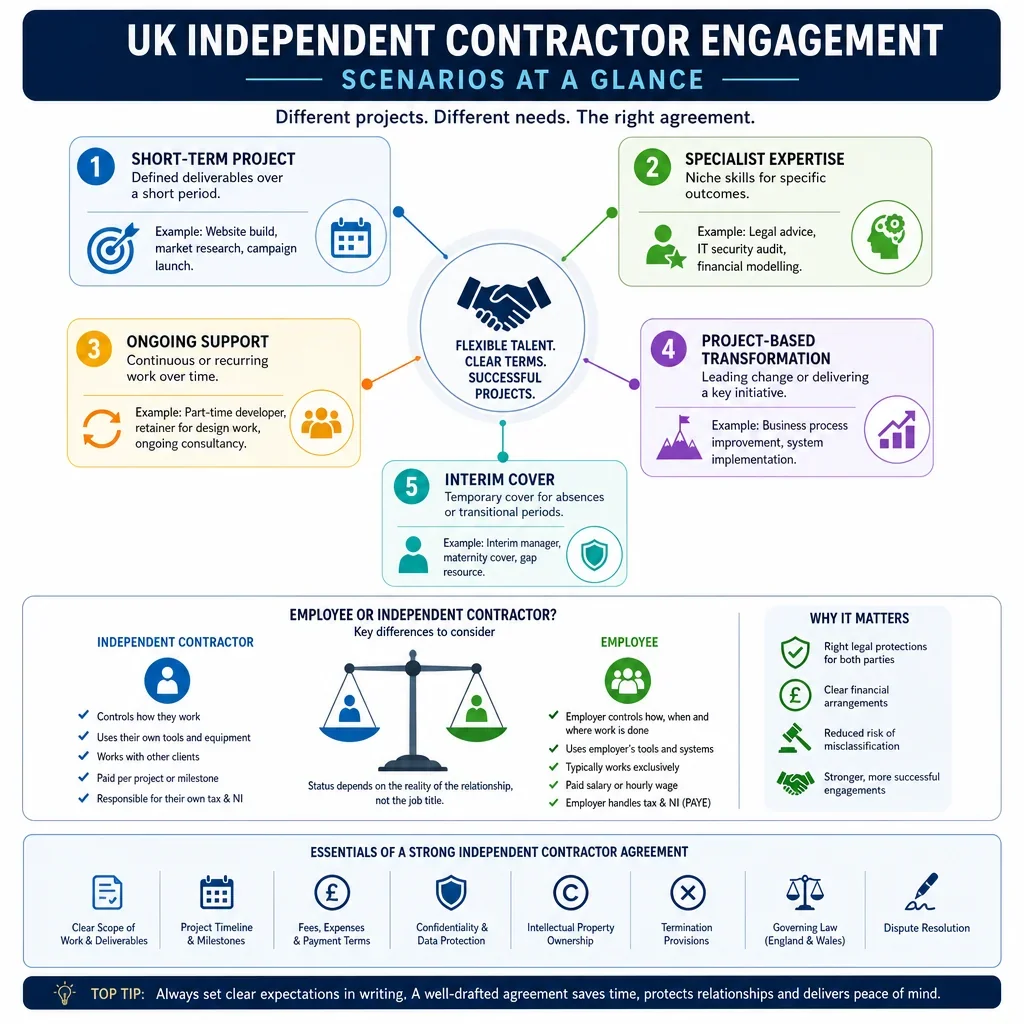
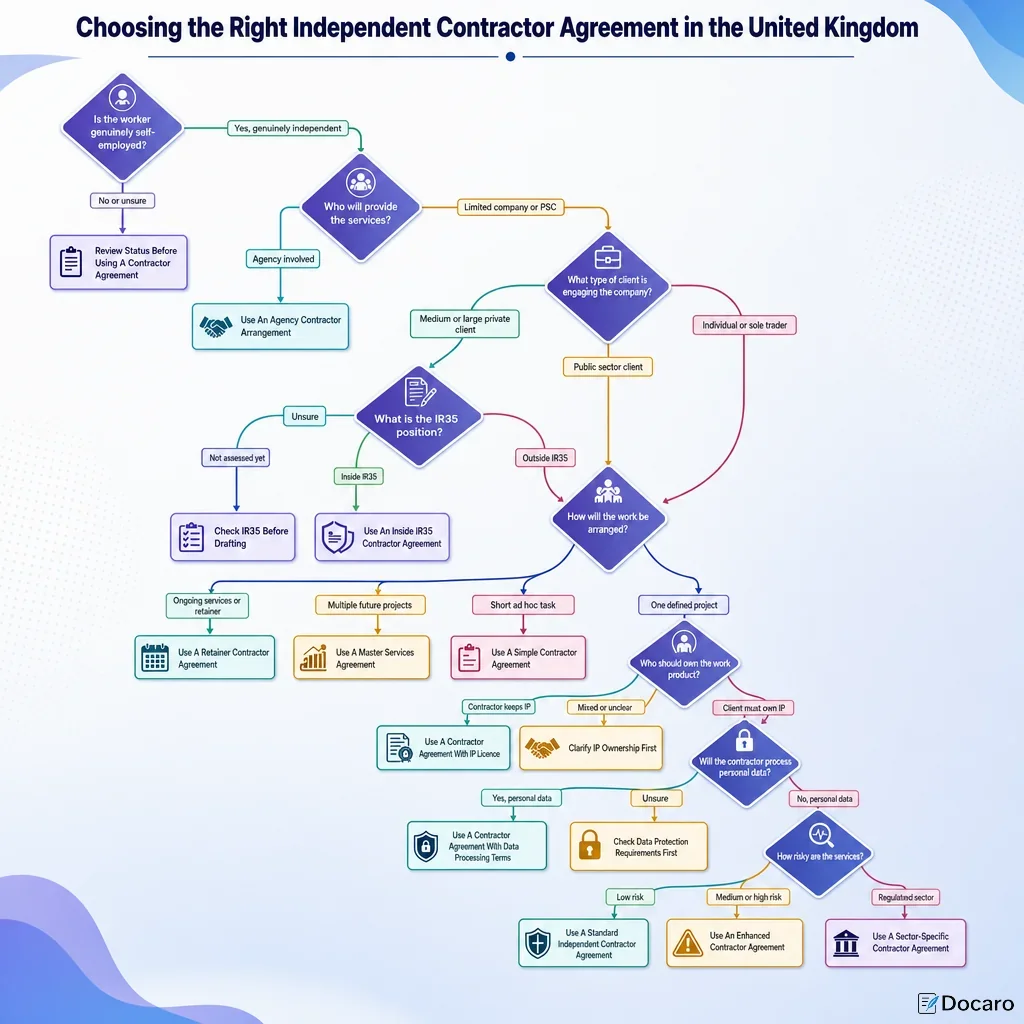
When do you need an Independent Contractor Agreement in the United Kingdom?
British Legal Rules for an Independent Contractor Agreement
Using the wrong type of agreement can inadvertently create an employment relationship, entitling the worker to employee rights and benefits under UK law.
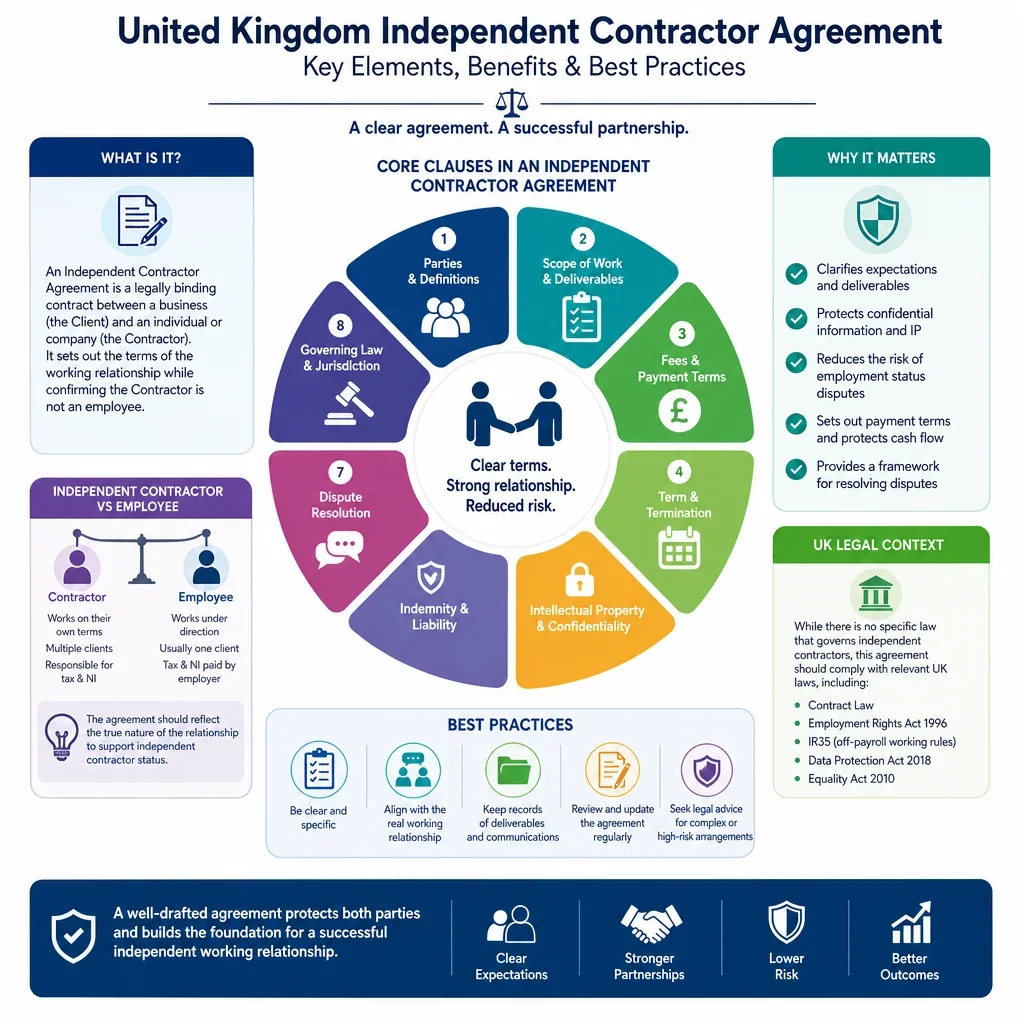
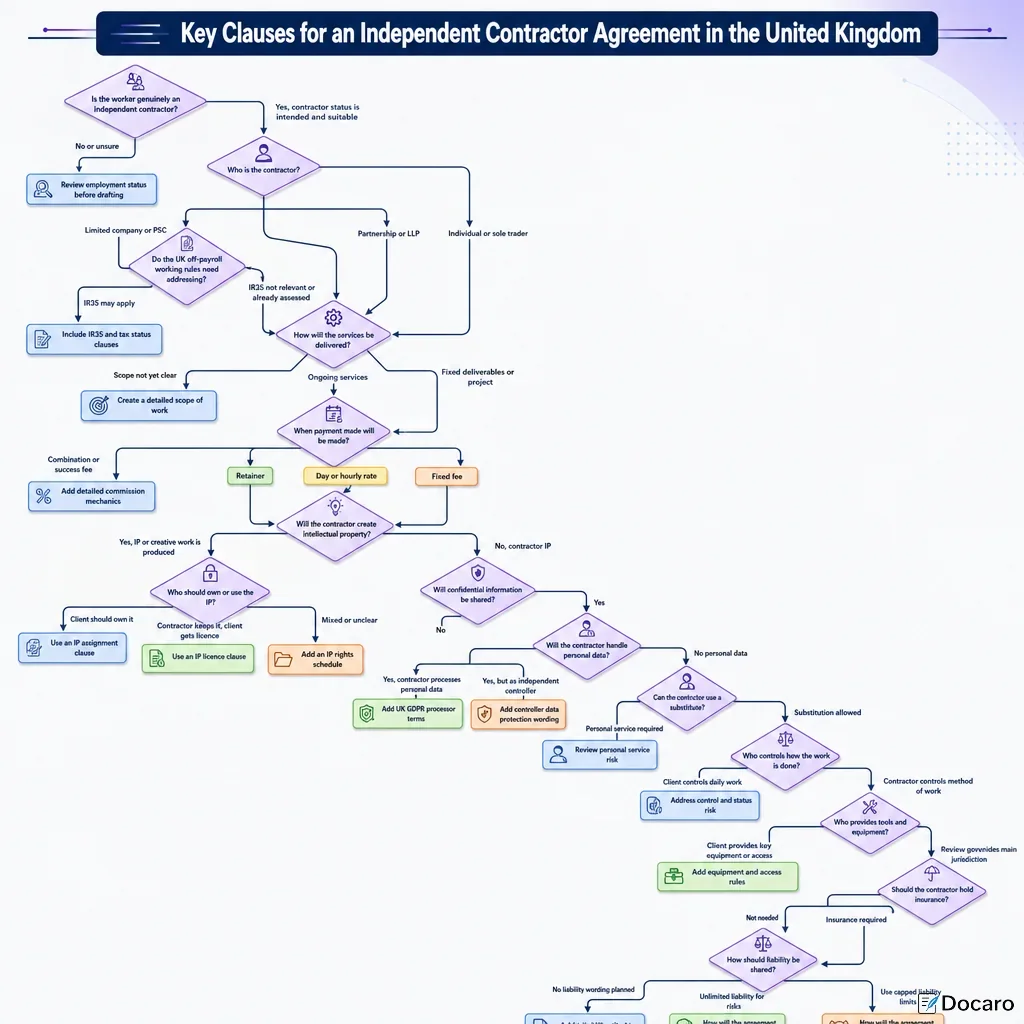
What a Proper Independent Contractor Agreement Should Include
- Parties InvolvedClearly name the hiring company and the contractor, including their contact details and addresses.
- Work DescriptionDetail the specific services or tasks the contractor will provide to avoid any confusion.
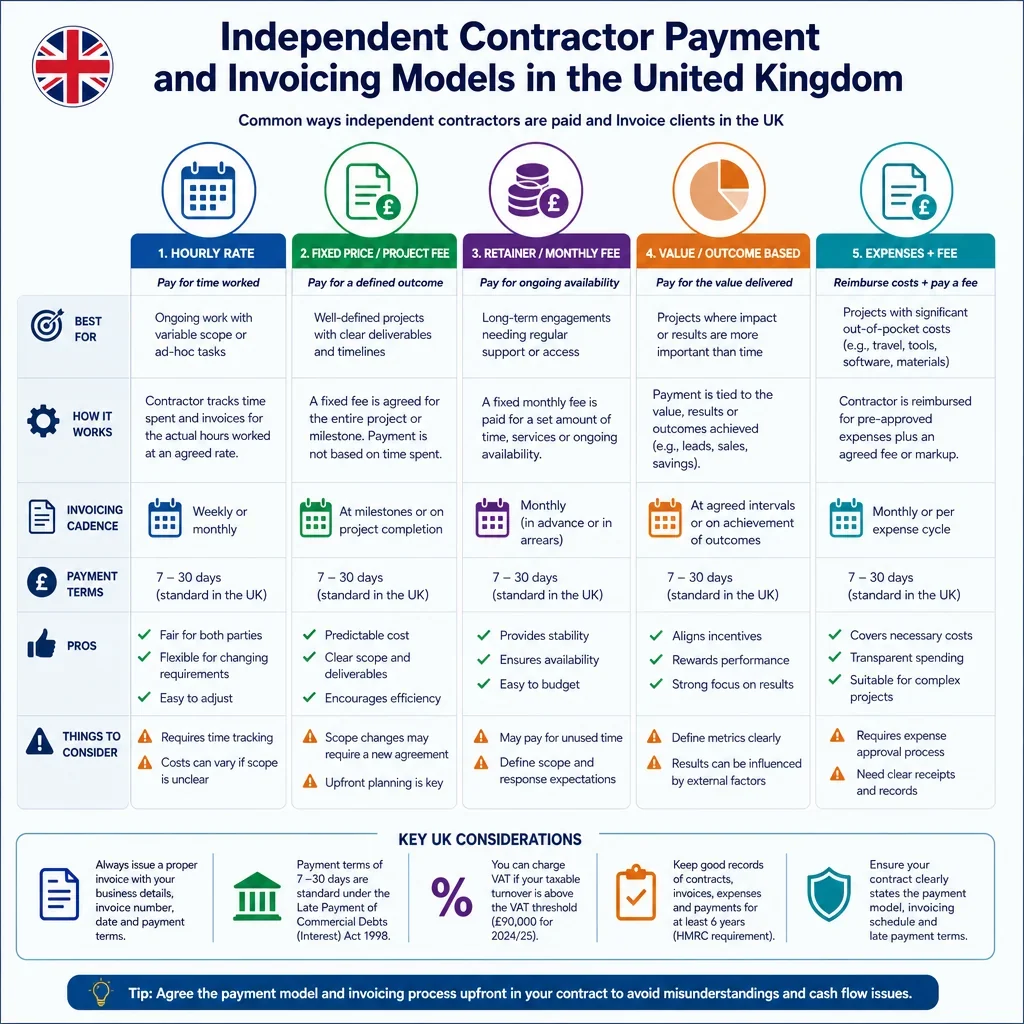
- Payment TermsSpecify the payment amount, method, schedule, and any expenses to be reimbursed.
- Duration and TimelineState the start and end dates of the agreement, or if it's ongoing, how it can be ended.
- Independent StatusConfirm that the contractor is not an employee and handles their own taxes and insurance.
- ConfidentialityRequire the contractor to keep the company's sensitive information private during and after the work.
- Intellectual Property RightsOutline who owns any new ideas, designs, or inventions created during the project.
- Termination RulesExplain how either party can end the agreement and what notice is required.
- Dispute ResolutionDescribe how disagreements will be handled, such as through negotiation or mediation.
- Governing LawSpecify that the laws of England and Wales (or relevant UK jurisdiction) apply to the agreement.
Generate Your Document in 4 Easy Steps
Why Use Docaro?
 United Kingdom
Free Example Independent Contractor Agreement Template
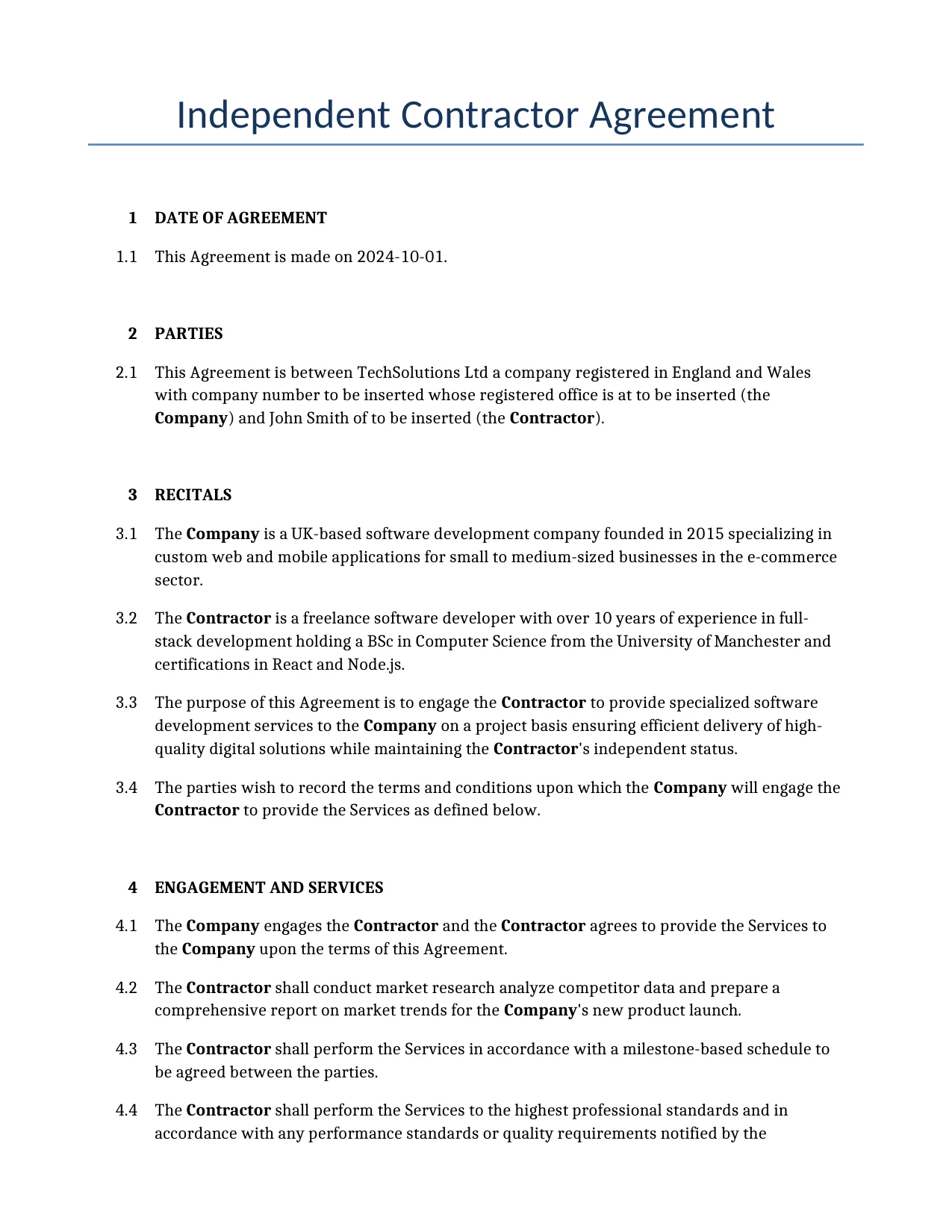
Below is a free template example of a Independent Contractor Agreement for use in the United Kingdom generated by our AI model.
The clauses in your actual Independent Contractor Agreement will vary from this example as they will be entirely bespoke to your requirements as set out in the questionnaire you complete.
Independent Contractor Agreement
1DATE OF AGREEMENT
This Agreement is made on 2024-10-01.
2PARTIES
This Agreement is between TechSolutions Ltd a company registered in England and Wales with company number to be inserted whose registered office is at to be inserted (the Company) and John Smith of to be inserted (the Contractor).
3RECITALS
The Company is a UK-based software development company founded in 2015 specializing in custom web and mobile applications for small to medium-sized businesses in the e-commerce sector.
The Contractor is a freelance software developer with over 10 years of experience in full-stack development holding a BSc in Computer Science from the University of Manchester and certifications in React and Node.js.
The purpose of this Agreement is to engage the Contractor to provide specialized software development services to the Company on a project basis ensuring efficient delivery of high-quality digital solutions while maintaining the Contractor's independent status.
The parties wish to record the terms and conditions upon which the Company will engage the Contractor to provide the Services as defined below.
4ENGAGEMENT AND SERVICES
The Company engages the Contractor and the Contractor agrees to provide the Services to the Company upon the terms of this Agreement.
The Contractor shall conduct market research analyze competitor data and prepare a comprehensive report on market trends for the Company's new product launch.
The Contractor shall perform the Services in accordance with a milestone-based schedule to be agreed between the parties.
The Contractor shall perform the Services to the highest professional standards and in accordance with any performance standards or quality requirements notified by the Company from time to time.
The Contractor shall not be required to provide the Services exclusively to the Company during the term of this Agreement.
5TERM OF AGREEMENT
This Agreement shall commence on 2024-10-01 and shall continue until the completion of the Services or until terminated earlier in accordance with clause 15.
This Agreement shall not renew automatically.
6COMPENSATION AND PAYMENT TERMS
In consideration for the provision of the Services the Company shall pay the Contractor a fixed fee of 5000.0 pounds sterling exclusive of VAT.
The Company shall pay the Contractor monthly on the 15th day of each month.
The Company shall pay each invoice within 30 days of receipt.
The Contractor shall submit invoices monthly via email to the Company's accounts department including detailed descriptions of services rendered hours worked and any applicable taxes.
All payments shall be made in pounds sterling by bank transfer to the Contractor's nominated account.
The fixed fee is exclusive of VAT. If the Contractor is registered for VAT the Contractor must provide a valid VAT invoice and the Company will pay the VAT in addition to the fixed fee where applicable.
7EXPENSES
The Company shall reimburse the Contractor for reasonable expenses incurred in providing the Services.
The Contractor may claim reimbursement for travel expenses office supplies and equipment and professional fees.
The Contractor shall obtain the prior written approval of the Company for any expense exceeding 100 pounds sterling.
The Contractor shall submit original receipts for all claimed expenses together with each relevant invoice.
The Company shall reimburse approved expenses within 30 days of receipt of the relevant invoice.
The Company shall reimburse VAT on allowable expenses where the Contractor provides a valid VAT receipt.
8INDEPENDENT CONTRACTOR STATUS
The Contractor confirms that the Contractor is engaged as an independent contractor and not as an employee of the Company.
The Company shall have no control over the methods and processes by which the Contractor performs the Services and the Contractor shall have full autonomy in such methods and processes.
The Contractor shall provide all necessary equipment and tools at the Contractor's own expense.
The Contractor shall bear the financial risk associated with performing the Services including covering the Contractor's own costs and liabilities.
The Contractor's role involves providing specialized freelance software development services on a project basis which is separate from the Company's ongoing internal development team and core operational activities allowing the Contractor to work independently without being part of the Company's daily business structure.
Nothing in this Agreement shall be construed as creating a contract of employment partnership or joint venture between the parties.
The Contractor is responsible for their own tax affairs including the payment of income tax National Insurance contributions and VAT where applicable. The Company will not deduct any taxes from payments made to the Contractor under this Agreement.
The Contractor has the right to substitute or engage helpers to perform the Services at the Contractor's own cost provided that any substitute or helper meets the required standards and any obligations under this Agreement are fulfilled. This right to substitute further demonstrates the Contractor's status as an independent contractor under UK law.
9CONFIDENTIALITY
The Contractor shall keep confidential all Confidential Information disclosed by the Company to the Contractor.
Confidential Information means any information disclosed by the Company to the Contractor that is marked as confidential or that reasonably should be understood to be confidential given the nature of the information and the circumstances of disclosure including but not limited to business plans technical data and customer lists.
The obligations of confidentiality shall apply during the term of this Agreement and for 5 years after termination.
The Contractor may disclose Confidential Information where required by law or to professional advisers bound by equivalent duties of confidence.
Upon termination of this Agreement the Contractor shall return or destroy all copies of Confidential Information and certify compliance to the Company.
10INTELLECTUAL PROPERTY RIGHTS
The Contractor shall retain ownership of any pre-existing intellectual property that the Contractor brings to the provision of the Services.
The Contractor grants the Company a non-exclusive licence limited to the Services to use any pre-existing intellectual property of the Contractor that is necessary for the Company to use the deliverables of the Services.
The Contractor shall assign all intellectual property rights in any new intellectual property created during the provision of the Services to the Company.
The Contractor waives all moral rights in the new intellectual property created for the Services.
The Company grants the Contractor a non-exclusive licence to use the Company's background intellectual property as necessary for providing the Services.
The Contractor shall keep confidential any intellectual property information disclosed by the Company during the Services.
The Contractor shall indemnify the Company against all claims losses and expenses arising from any infringement of third party intellectual property rights by the Contractor in the provision of the Services.
11INDEMNIFICATION
The Contractor shall indemnify the Company against all claims losses damages and expenses arising from the Contractor's negligence or breach of this Agreement.
The Company shall give the Contractor notice of any indemnified claim within 14 days of becoming aware of it.
12LIMITATION OF LIABILITY
Subject to any liability that cannot be excluded or limited by law the Contractor's total liability to the Company under or in connection with this Agreement shall not exceed the total fees paid to the Contractor under this Agreement. This limitation shall not apply to claims for indemnification or intellectual property infringement under this Agreement.
Neither party shall be liable to the other for any indirect or consequential losses including but not limited to loss of profits loss of goodwill or loss of data.
13INSURANCE
The Contractor shall maintain public liability insurance with a minimum coverage of 5000000 pounds sterling and professional indemnity insurance with a minimum coverage of 1000000 pounds sterling from 2024-01-01 throughout the term of this Agreement.
The Contractor shall provide proof of such insurance to the Company upon signing this Agreement and upon request thereafter.
14NON-COMPETE AND NON-SOLICITATION
The Contractor shall not for a period of 6 months after termination of this Agreement directly or indirectly compete with the Company in the provision of software development and IT consulting services for small businesses within 50 miles of the Company's main office. These restrictions are no broader than is necessary to protect the Company's legitimate business interests.
The Contractor shall not for a period of 12 months after termination of this Agreement solicit any clients or customers of the Company with whom the Contractor had direct contact or about whom the Contractor learned Confidential Information during the term of this Agreement.
The Contractor shall not for a period of 12 months after termination of this Agreement solicit any employees of the Company.
15TERMINATION
This Agreement may be terminated by either party on 4 weeks' notice in writing if the other party commits a material breach and fails to remedy it within 14 days of notice.
This Agreement may be terminated by the Company on 4 weeks' notice for convenience.
This Agreement may be terminated by mutual agreement of the parties.
This Agreement may be terminated immediately by either party if the other party becomes insolvent or enters administration.
Upon termination the Company shall pay the Contractor all fees accrued up to the date of termination within 30 days.
Upon termination the Contractor shall return all confidential documents company laptops access keys and any other proprietary materials provided by the Company.
Upon termination the Contractor must provide a written confirmation that all Services have been completed up to the termination date and return any Company property.
16CONSEQUENCES OF TERMINATION
The Contractor shall return all materials and property belonging to the Company within 7 days of termination.
The Company shall make final payments to the Contractor within 30 days of termination.
Accrued but unpaid obligations including fees for completed work shall survive termination.
The provisions of clauses 9 10 11 14 and 19 shall survive termination of this Agreement.
17FORCE MAJEURE
Neither party shall be liable for any delay or failure to perform its obligations under this Agreement to the extent that such delay or failure is caused by a force majeure event including natural disasters such as earthquakes floods or hurricanes acts of terrorism war or civil unrest pandemics and government-imposed lockdowns.
The affected party shall give written notice to the other party within 5 days of the force majeure event.
Both parties shall use reasonable endeavours to mitigate the effects of any force majeure event.
18GOVERNING LAW
This Agreement and any dispute or claim arising out of or in connection with it or its subject matter or formation shall be governed by and construed in accordance with the laws of England and Wales.
The parties agree that the courts of England and Wales shall have exclusive jurisdiction to settle any dispute or claim arising out of or in connection with this Agreement.
19DISPUTE RESOLUTION
Any dispute arising out of or in connection with this Agreement shall first be referred to mediation in accordance with the London Court of International Arbitration mediation rules.
If the dispute is not resolved by mediation within 30 days it shall be referred to and finally resolved by arbitration under the London Court of International Arbitration rules.
The seat of arbitration shall be London and the language shall be English.
The parties agree that the dispute resolution mechanisms in this clause 19 are the exclusive remedies and that neither party may commence litigation until the mediation and arbitration processes have been exhausted.
20ENTIRE AGREEMENT
This Agreement constitutes the entire agreement between the parties and supersedes all prior agreements understandings or arrangements whether oral or in writing.
Each party acknowledges that it has not entered into this Agreement in reliance on any representation warranty or undertaking not expressly set out in this Agreement.
21VARIATION
Any variation to this Agreement must be in writing and signed by both parties to be effective.
22SEVERABILITY
If any provision of this Agreement is held to be invalid illegal or unenforceable by a court of competent jurisdiction such provision shall be severed and the remainder of this Agreement shall continue in full force and effect.
23WAIVER
No failure or delay by either party in exercising any right or remedy under this Agreement shall constitute a waiver of that right or remedy.
A waiver of any breach shall not constitute a waiver of any subsequent breach.
24ASSIGNMENT
The Contractor shall not assign transfer or subcontract any of the Contractor's rights or obligations under this Agreement without the prior written consent of the Company.
The Company may assign its rights under this Agreement to any affiliate or successor in title.
25NOTICES
Any notice required to be given under this Agreement shall be in writing and may be delivered by hand registered post or email.
Notices to the Contractor shall be sent to 123 High Street London SW1A 1AA United Kingdom or the Contractor's email address on record.
Notices to the Company shall be sent to 456 Business Park Manchester M1 1AA United Kingdom or the Company's email address on record.
Notices sent by registered post shall be deemed received 2 business days after posting.
Notices sent by email shall be deemed received on the next business day if sent on a non-business day.
26DATA PROTECTION
The parties acknowledge that for the purposes of the UK GDPR and Data Protection Act 2018 the Company is the data controller and the Contractor is the data processor in respect of any personal data processed in connection with the Services.
If applicable the parties shall enter into a separate data processing agreement setting out the subject matter duration nature and purpose of the processing the type of personal data and categories of data subjects.
The Contractor shall comply with all obligations under the Data Protection Act 2018 and UK GDPR when processing personal data on behalf of the Company including implementing appropriate technical and organisational security measures to protect personal data against unauthorised or unlawful processing and against accidental loss destruction or damage.
The Contractor shall notify the Company without undue delay upon becoming aware of any personal data breach and shall assist the Company in responding to data subject requests exercising their rights under the UK GDPR.
The obligations in this clause 26 shall take effect from 2024-10-01.
27ANTI-BRIBERY AND CORRUPTION
The Contractor shall comply with all applicable laws relating to anti-bribery and anti-corruption including the Bribery Act 2010.
The Contractor shall maintain adequate procedures to prevent bribery as required by the Bribery Act 2010.
28HEALTH AND SAFETY
The Contractor shall comply with all applicable health and safety legislation when performing the Services.
The Contractor shall provide all necessary personal protective equipment at the Contractor's own cost.
The Contractor shall report any health and safety incidents or near-misses to the Company promptly and in any event within 24 hours.
29COMPLIANCE WITH LEGISLATION
The parties shall comply with the Employment Rights Act 1996 the Working Time Regulations 1998 the Equality Act 2010 the Income Tax (Earnings and Pensions) Act 2003 the Social Security Contributions and Benefits Act 1992 the IR35 intermediaries legislation the Agency Workers Regulations 2010 the Consumer Rights Act 2015 and the Unfair Contract Terms Act 1977 to the extent that each statute applies to this Agreement.
30IR35 STATUS
The parties agree that this engagement falls outside the scope of the off-payroll working rules (IR35 legislation). The Contractor is responsible for their own tax and National Insurance contributions. The Contractor warrants that they will not be deemed an employee of the Company under IR35 legislation and shall indemnify the Company against any tax National Insurance or other liabilities arising from any determination that the Contractor is an employee for tax purposes.
31SIGNATURES
Signed for and on behalf of the Company ___________________________ Name: Position: Date:
Signed by the Contractor ___________________________ Name: John Smith Date:
This example shows approximately 70% of a typical document and is provided for illustrative purposes only. The remaining content has been omitted.
Every document generated by Docaro is tailored to your specific circumstances, jurisdiction and the information you provide. The completed document includes all applicable clauses and provisions required for your situation.
To generate the full, personalised document, answer a short series of questions and your document will be created instantly.
Useful Resources When Considering a Independent Contractor Agreement in the United Kingdom
United Kingdom Reference Legislation
Independent Contractor Agreement FAQs
Document Generation FAQs
Related Articles