AI Generated Stock Transfer Form for use in the United Kingdom
PDF & Word - 2026 Updated
Docaro Pricing
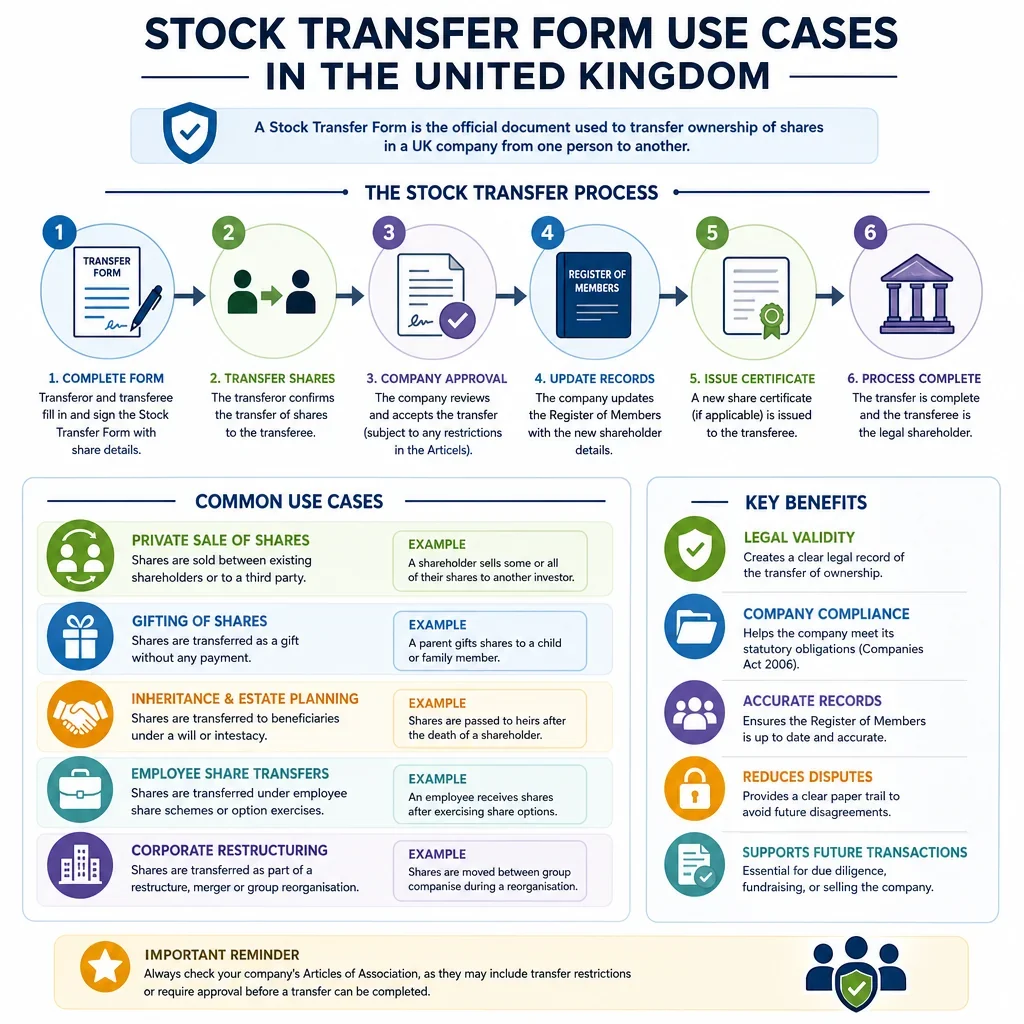
When do you need a Stock Transfer Form in the United Kingdom?
British Legal Rules for a Stock Transfer Form
Using the incorrect stock transfer form may invalidate the share transfer or fail to comply with Companies Act requirements.
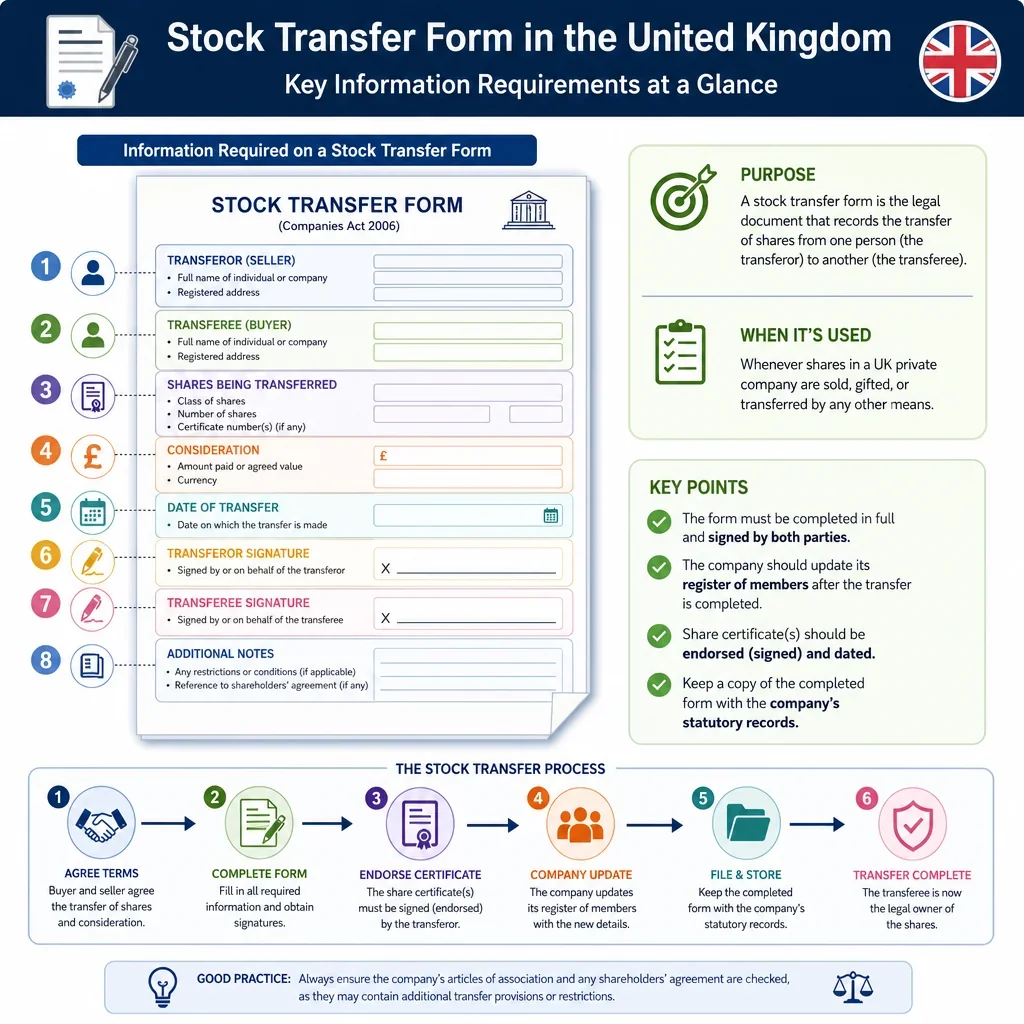
What a Proper Stock Transfer Form Should Include
- Transferor's DetailsInclude the full name and address of the person or company transferring the shares.
- Transferee's DetailsProvide the full name and address of the person or company receiving the shares.
- Company NameState the exact name of the company whose shares are being transferred.
- Share DescriptionDescribe the type and number of shares being transferred, including any class or value.
- Transfer DateSpecify the date when the share transfer takes effect.
- Consideration AmountIndicate the price or value paid for the shares, or note if it's a gift.
- SignaturesHave both the transferor and transferee sign the form to confirm agreement.
Generate Your Document in 4 Easy Steps
Why Use Docaro?
 United Kingdom
Free Example Stock Transfer Form Template
Below is a free template example of a Stock Transfer Form for use in the United Kingdom generated by our AI model.
The clauses in your actual Stock Transfer Form will vary from this example as they will be entirely bespoke to your requirements as set out in the questionnaire you complete.
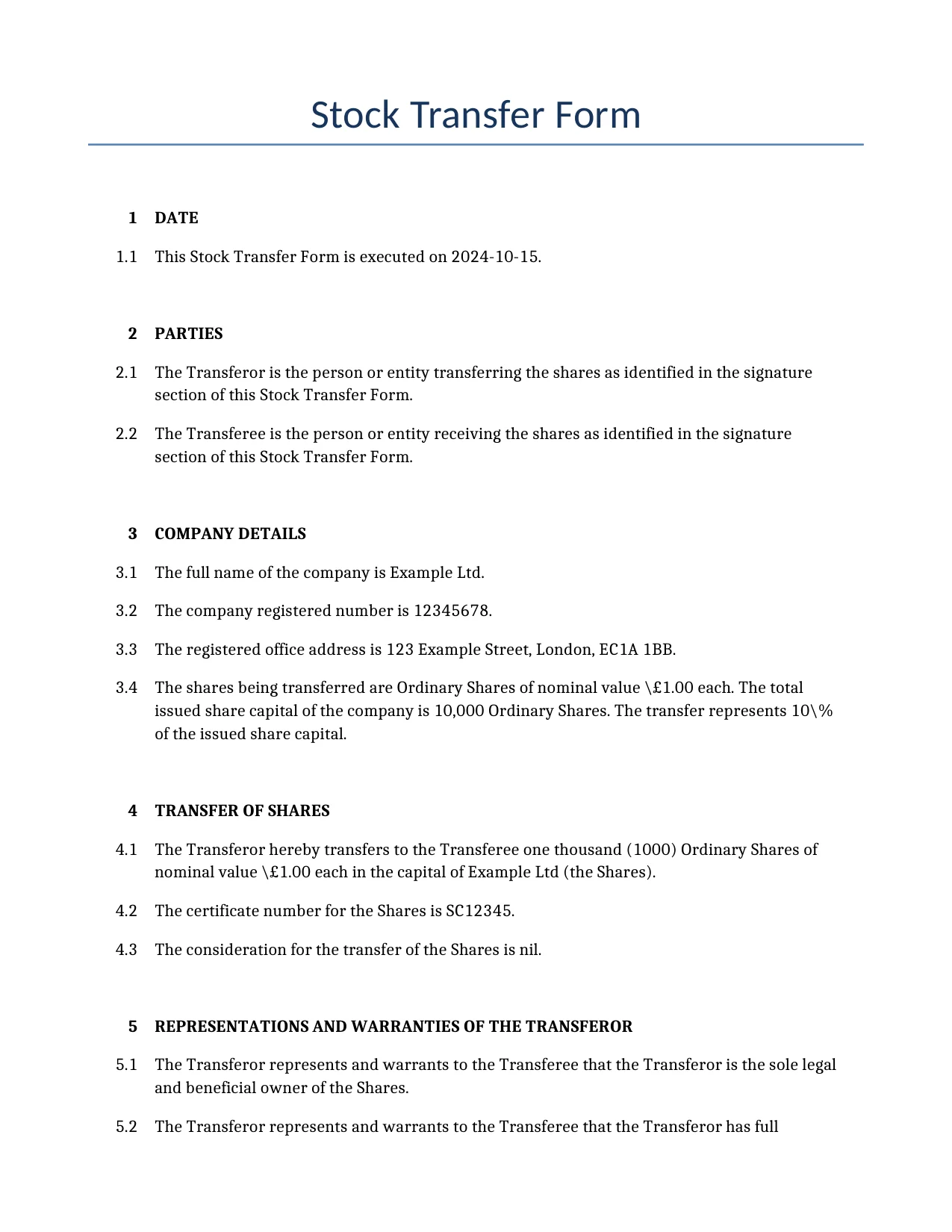
Stock Transfer Form
1DATE
This Stock Transfer Form is executed on 2024-10-15.
2PARTIES
The Transferor is the person or entity transferring the shares as identified in the signature section of this Stock Transfer Form.
The Transferee is the person or entity receiving the shares as identified in the signature section of this Stock Transfer Form.
3COMPANY DETAILS
The full name of the company is Example Ltd.
The company registered number is 12345678.
The registered office address is 123 Example Street, London, EC1A 1BB.
The shares being transferred are Ordinary Shares of nominal value \£1.00 each. The total issued share capital of the company is 10,000 Ordinary Shares. The transfer represents 10\% of the issued share capital.
4TRANSFER OF SHARES
The Transferor hereby transfers to the Transferee one thousand (1000) Ordinary Shares of nominal value \£1.00 each in the capital of Example Ltd (the Shares).
The certificate number for the Shares is SC12345.
The consideration for the transfer of the Shares is nil.
5REPRESENTATIONS AND WARRANTIES OF THE TRANSFEROR
The Transferor represents and warrants to the Transferee that the Transferor is the sole legal and beneficial owner of the Shares.
The Transferor represents and warrants to the Transferee that the Transferor has full authority to transfer the Shares without needing consent from any other person or entity.
The Transferor represents and warrants to the Transferee that the Shares are free from any encumbrances liens charges or security interests.
The Transferor represents and warrants to the Transferee that there are no pending legal proceedings or disputes that could affect the Shares.
The Transferor represents and warrants to the Transferee that the Transferor acquired the Shares on 2020-05-15.
The Transferor represents and warrants to the Transferee that there are no restrictions on the transfer of the Shares such as pre-emption rights or transfer approvals.
The Transferor represents and warrants to the Transferee that the share certificate provided is accurate and complete in all respects.
The Transferor represents and warrants to the Transferee that this transfer fully complies with the company\'s articles of association.
6COMPLIANCE WITH LEGISLATION
This Stock Transfer Form is executed and delivered in accordance with the Companies Act 2006, the Stock Transfer Act 1963, the Uncertificated Securities Regulations 2001, the Financial Services and Markets Act 2000, the Stamp Duty Reserve Tax Regulations 1986, the Stamp Act 1891 (as amended), the Finance Act 1986, the Finance Act 2008 and all other applicable legislation.
The parties acknowledge that this transfer may require stamping or submission of appropriate forms in accordance with applicable legislation.
If stamp duty is payable on this transfer, the Stock Transfer Form must be submitted to HM Revenue and Customs (HMRC) together with the appropriate stamp duty payment within the statutory time limits.
7FURTHER ASSURANCE
Each party shall at the request of the other party do all things and execute all documents as may be reasonably necessary to give effect to the transfer of the Shares in accordance with this Stock Transfer Form.
8ENTIRE AGREEMENT
This Stock Transfer Form constitutes the entire agreement between the parties relating to the transfer of the Shares and supersedes all prior agreements understandings or arrangements whether oral or in writing.
This entire agreement is effective as of 2024-10-01.
9SEVERABILITY
If any provision of this Stock Transfer Form is held to be invalid or unenforceable then such provision shall be severed from this Stock Transfer Form and the remaining provisions shall continue in full force and effect.
10NOTICES
Any notice required to be given under this Stock Transfer Form shall be in writing and shall be duly served if delivered personally or sent by first class post to the address of the relevant party as set out in the signature section or to such other address as that party may notify to the other party from time to time.
11VARIATION
No variation of this Stock Transfer Form shall be effective unless it is in writing and signed by or on behalf of each of the parties.
12GOVERNING LAW
This Stock Transfer Form and any dispute or claim arising out of or in connection with it or its subject matter or formation (including non-contractual disputes or claims) shall be governed by and construed in accordance with the laws of England and Wales.
The parties irrevocably agree that the courts of England and Wales shall have exclusive jurisdiction to settle any dispute or claim (including non-contractual disputes or claims) that arises out of or in connection with this Stock Transfer Form or its subject matter or formation.
13EXECUTION
IN WITNESS WHEREOF the parties have executed this Stock Transfer Form on the date first above written.
14SIGNATURES
Signed by the Transferor in the presence of a witness: _______________________________ (Signature of Transferor) Name: [Insert Full Name] Address: [Insert Address] Capacity: [Insert Capacity e.g. Individual/Director] Date: ________________
Witness Signature: _______________________________ Name of Witness: [Insert Name] Address of Witness: [Insert Address]
Signed by the Transferee in the presence of a witness: _______________________________ (Signature of Transferee) Name: [Insert Full Name] Address: [Insert Address] Capacity: [Insert Capacity e.g. Individual/Director] Date: ________________
Witness Signature: _______________________________ Name of Witness: [Insert Name] Address of Witness: [Insert Address]
Transferee Details (if a company): Company Registration Number: [Insert Company Number] Registered Office: [Insert Address]
Company Certification (if applicable): I certify that the terms of the above transfer have been approved by the board of directors of Example Ltd on [Date]. Signed: _______________________________ (Signature of Director/Secretary) Name: [Insert Name] Position: [Director/Secretary] Date: ________________ Company Seal (if applicable): ________________
This example shows approximately 70% of a typical document and is provided for illustrative purposes only. The remaining content has been omitted.
Every document generated by Docaro is tailored to your specific circumstances, jurisdiction and the information you provide. The completed document includes all applicable clauses and provisions required for your situation.
To generate the full, personalised document, answer a short series of questions and your document will be created instantly.
Useful Resources When Considering a Stock Transfer Form in the United Kingdom
United Kingdom Reference Legislation
Stock Transfer Form FAQs
Document Generation FAQs
Related Articles