AI Generated Health and Safety Manual for use in the United Kingdom
PDF & Word - 2026 Updated
Docaro Pricing
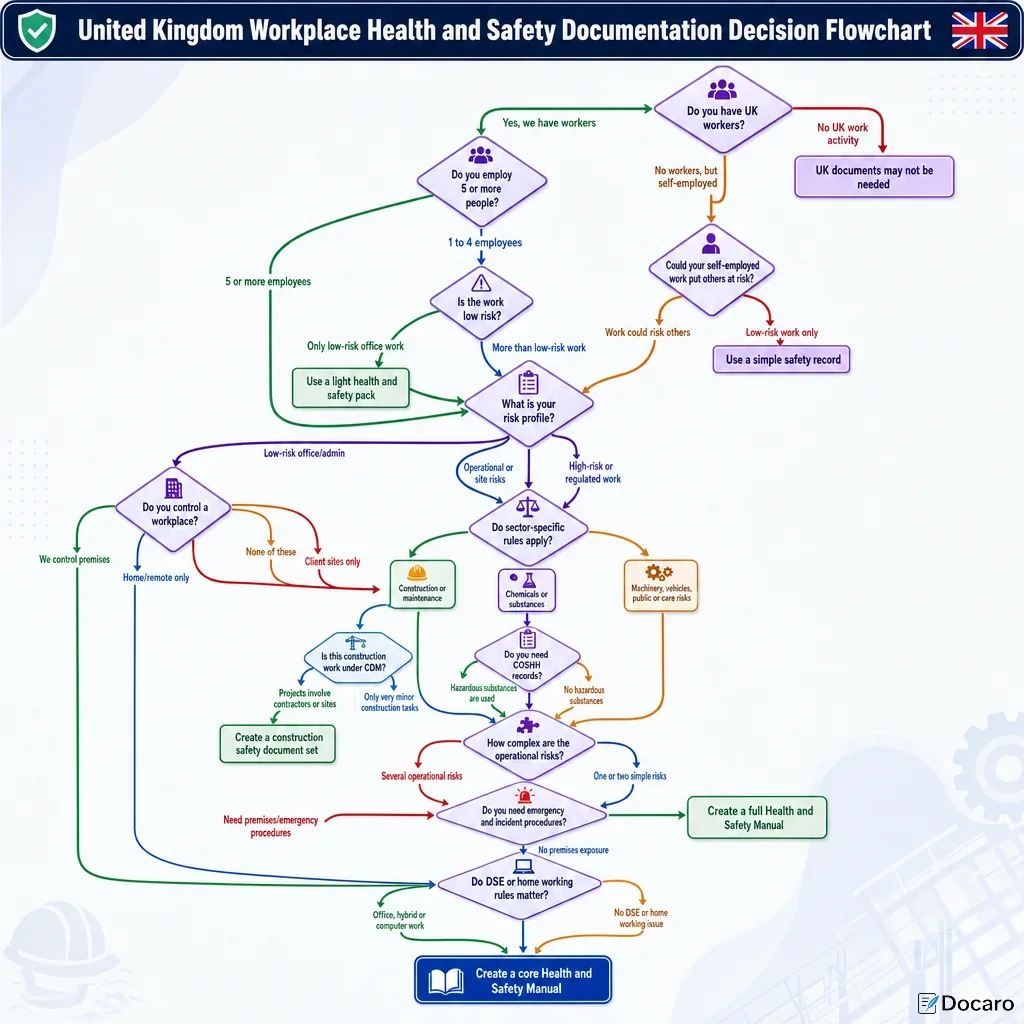
When Do You Need a Health and Safety Manual in the United Kingdom?
British Legal Rules for a Health and Safety Manual
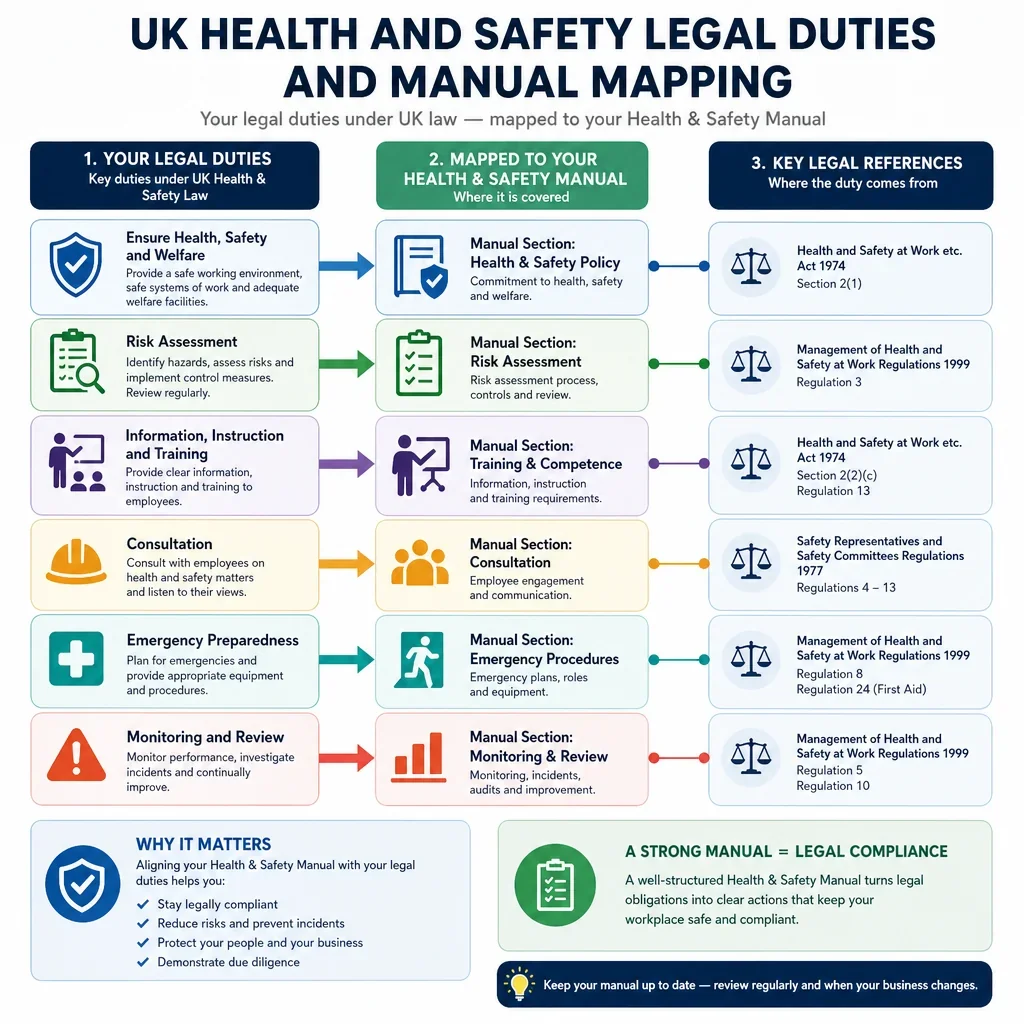
Failing to align the health and safety manual with relevant UK regulations, such as the Health and Safety at Work Act 1974, may result in non-compliance and potential legal liabilities.
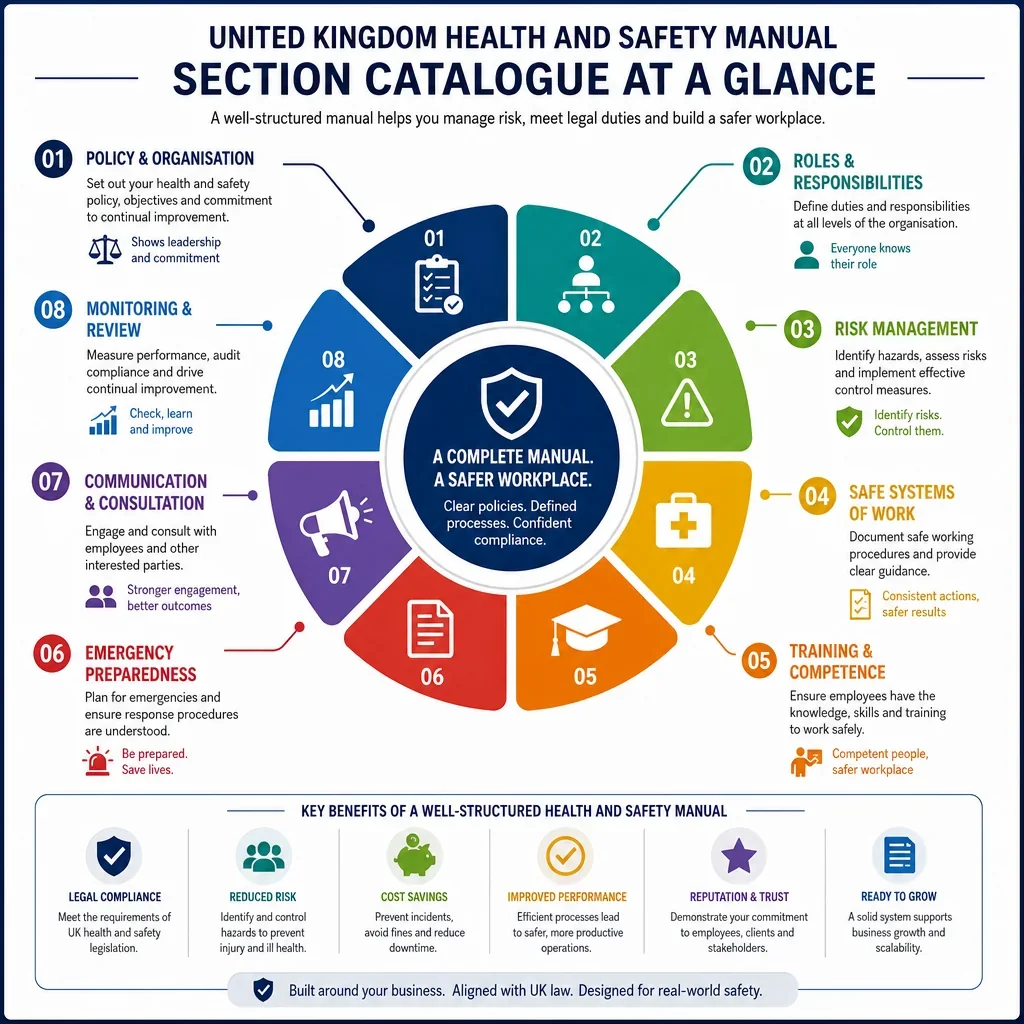
What a Proper Health and Safety Manual Should Include
- Policy StatementA clear commitment from management to ensure a safe workplace for everyone.
- Risk Assessment ProcessSteps to identify potential hazards and decide how to reduce risks effectively.
- Worker ResponsibilitiesWhat each employee must do to keep themselves and others safe at work.
- Emergency ProceduresClear instructions on what to do in case of fire, accidents, or other emergencies.
- Training and InformationHow staff will be trained and informed about safety rules and practices.
- Health MonitoringWays to check and support the health of workers exposed to risks.
- Incident ReportingSimple process for reporting accidents or near misses to prevent future issues.
- Equipment and MaintenanceRules for safely using and regularly checking work tools and machinery.
Generate Your Document in 4 Easy Steps
Why Use Docaro?
 United Kingdom
Free Example Health and Safety Manual Template
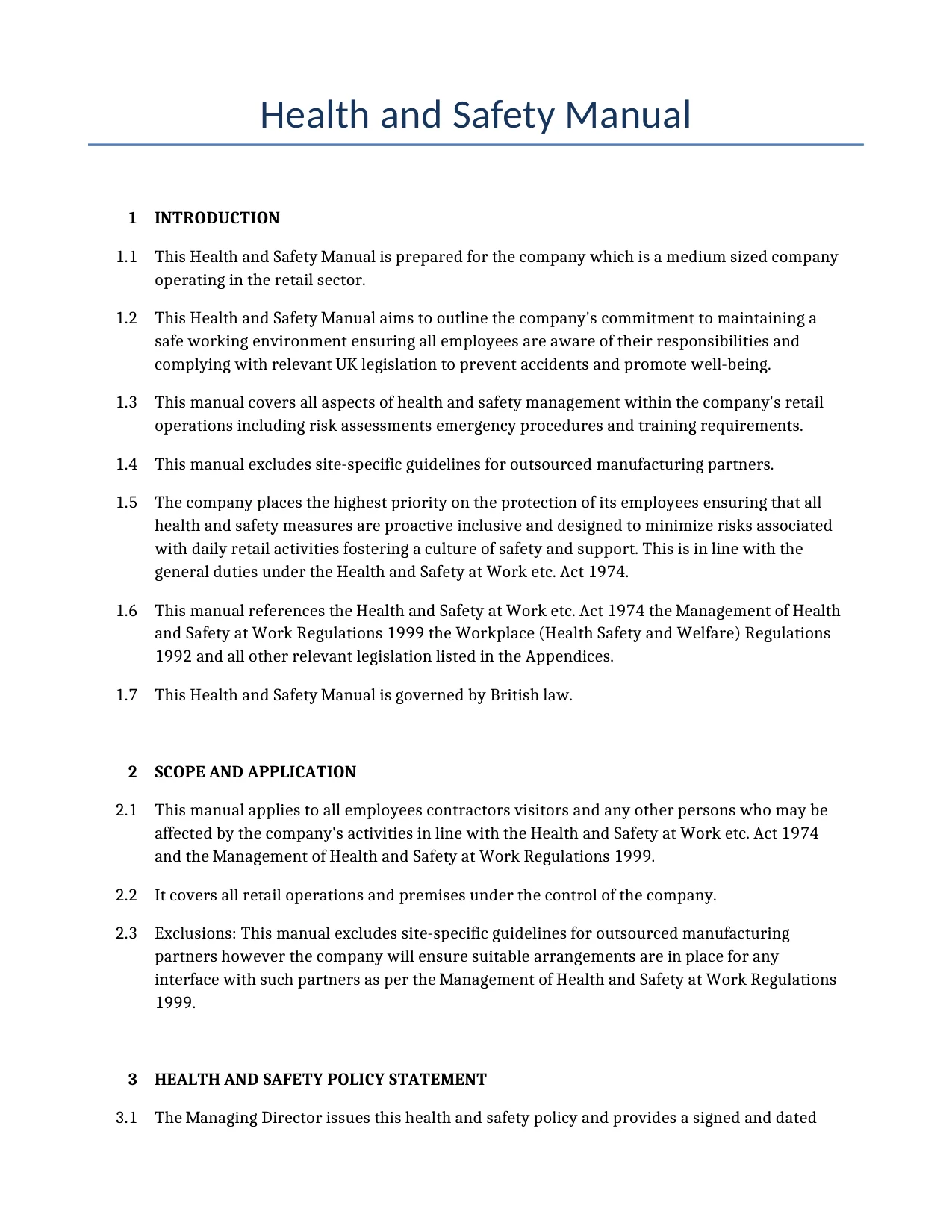
Below is a free template example of a Health and Safety Manual for use in the United Kingdom generated by our AI model.
The clauses in your actual Health and Safety Manual will vary from this example as they will be entirely bespoke to your requirements as set out in the questionnaire you complete.
Health and Safety Manual
1INTRODUCTION
This Health and Safety Manual is prepared for the company which is a medium sized company operating in the retail sector.
This Health and Safety Manual aims to outline the company's commitment to maintaining a safe working environment ensuring all employees are aware of their responsibilities and complying with relevant UK legislation to prevent accidents and promote well-being.
This manual covers all aspects of health and safety management within the company's retail operations including risk assessments emergency procedures and training requirements.
This manual excludes site-specific guidelines for outsourced manufacturing partners.
The company places the highest priority on the protection of its employees ensuring that all health and safety measures are proactive inclusive and designed to minimize risks associated with daily retail activities fostering a culture of safety and support. This is in line with the general duties under the Health and Safety at Work etc. Act 1974.
This manual references the Health and Safety at Work etc. Act 1974 the Management of Health and Safety at Work Regulations 1999 the Workplace (Health Safety and Welfare) Regulations 1992 and all other relevant legislation listed in the Appendices.
This Health and Safety Manual is governed by British law.
2SCOPE AND APPLICATION
This manual applies to all employees contractors visitors and any other persons who may be affected by the company's activities in line with the Health and Safety at Work etc. Act 1974 and the Management of Health and Safety at Work Regulations 1999.
It covers all retail operations and premises under the control of the company.
Exclusions: This manual excludes site-specific guidelines for outsourced manufacturing partners however the company will ensure suitable arrangements are in place for any interface with such partners as per the Management of Health and Safety at Work Regulations 1999.
3HEALTH AND SAFETY POLICY STATEMENT
The Managing Director issues this health and safety policy and provides a signed and dated commitment on behalf of the highest level of management.
The company is committed to ensuring so far as is reasonably practicable the health safety and welfare of all its employees contractors and visitors in accordance with the Health and Safety at Work etc. Act 1974. This includes a commitment to continuous improvement in health and safety performance.
The company will consult with employees and their safety representatives in accordance with the Safety Representatives and Safety Committees Regulations 1977 and the Health and Safety (Consultation with Employees) Regulations 1996.
The general aims of this policy are to ensure the health safety and welfare of all employees contractors and visitors to comply with all relevant health and safety legislation including the Health and Safety at Work etc. Act 1974 and the Management of Health and Safety at Work Regulations 1999 and to prevent injury ill health and loss of property through proactive risk management.
The specific objectives of this policy are to conduct suitable and sufficient risk assessments for all work activities to provide comprehensive health and safety training to all staff to maintain a safe working environment in line with HSE guidance and to achieve continual improvement in health and safety standards.
The directors shall approve the health and safety policy shall allocate sufficient resources for safety measures shall oversee risk assessments and compliance shall promote a positive health and safety culture and shall review the policy at least annually.
The managers shall conduct regular safety inspections shall ensure employee training on safety procedures shall report accidents and near-misses shall consult with employees on health and safety matters and shall enforce safety rules among staff.
The employees shall follow all safety procedures and instructions shall use personal protective equipment correctly shall report hazards or unsafe conditions immediately shall participate in safety training and drills and shall cooperate with the employer to enable compliance with statutory duties.
The health and safety policy will be reviewed at least annually or sooner if there are significant changes in legislation operations or incidents. This policy will be brought to the attention of all employees and relevant parties.
4ORGANISATION AND RESPONSIBILITIES
The organisation has a board of directors who have overall responsibility for health and safety.
The directors are responsible for ensuring compliance with the Health and Safety at Work etc. Act 1974 for providing adequate resources for health and safety measures for approving the health and safety policy for overseeing risk assessments across the organisation and for ensuring that suitable arrangements are made for health and safety management as required by the Management of Health and Safety at Work Regulations 1999.
The directors receive appropriate health and safety training.
The organisation has appointed a competent health and safety advisor/officer as required by the Management of Health and Safety at Work Regulations 1999. This person has the necessary training knowledge experience and other qualities to assist in compliance with health and safety law. The company ensures the competence of all persons with health and safety responsibilities through appropriate selection training and periodic review.
The senior managers are tasked with implementing the health and safety policy at departmental levels with conducting regular inspections with reporting hazards to the board with ensuring that all staff adhere to safety protocols and with consulting employees on health and safety matters.
Supervisors must monitor daily operations for safety risks must train team members on safe working practices must investigate accidents must enforce the use of personal protective equipment and must consult with their teams on health and safety issues.
The employees are required to follow all safety instructions are required to report any hazards or incidents immediately are required to use equipment safely are required to participate in health and safety training sessions and are required to cooperate with employers in complying with statutory duties.
Safety representatives have been appointed in the organisation. Their specific duties under the Safety Representatives and Safety Committees Regulations 1977 include representing employees in consultations with employers on health and safety matters investigating potential hazards and dangerous occurrences examining the causes of accidents inspecting the workplace and consulting with employers on the introduction of new technology.
Contractors: All contractors must comply with the company's health and safety standards and procedures. The company will ensure that contractors are competent provide them with relevant information on risks and monitor their performance. See also the Construction and Contractors section for further details under the Construction (Design and Management) Regulations 2015.
Visitors: All visitors must be briefed on relevant health and safety rules escorted where necessary and required to comply with site safety procedures.
The company's health and safety policy is reviewed at least annually. Cross-reference to Section 3 (Health and Safety Policy Statement) and Section 26 (Monitoring Auditing and Review).
5RISK ASSESSMENT AND MANAGEMENT
The company has suitable and sufficient risk assessment procedures in full alignment with the Management of Health and Safety at Work Regulations 1999.
Hazards are identified through workplace inspections employee consultations accident and incident reviews and other appropriate methods.
The company conducts suitable and sufficient risk assessments for all work activities. These assessments cover all employees including young persons expectant mothers and other vulnerable groups.
Significant findings of risk assessments will be recorded. The findings of risk assessments will be shared with employees and safety representatives.
Risk assessments will be reviewed at least annually or sooner if there are significant changes to the work activity premises or following an incident or near-miss.
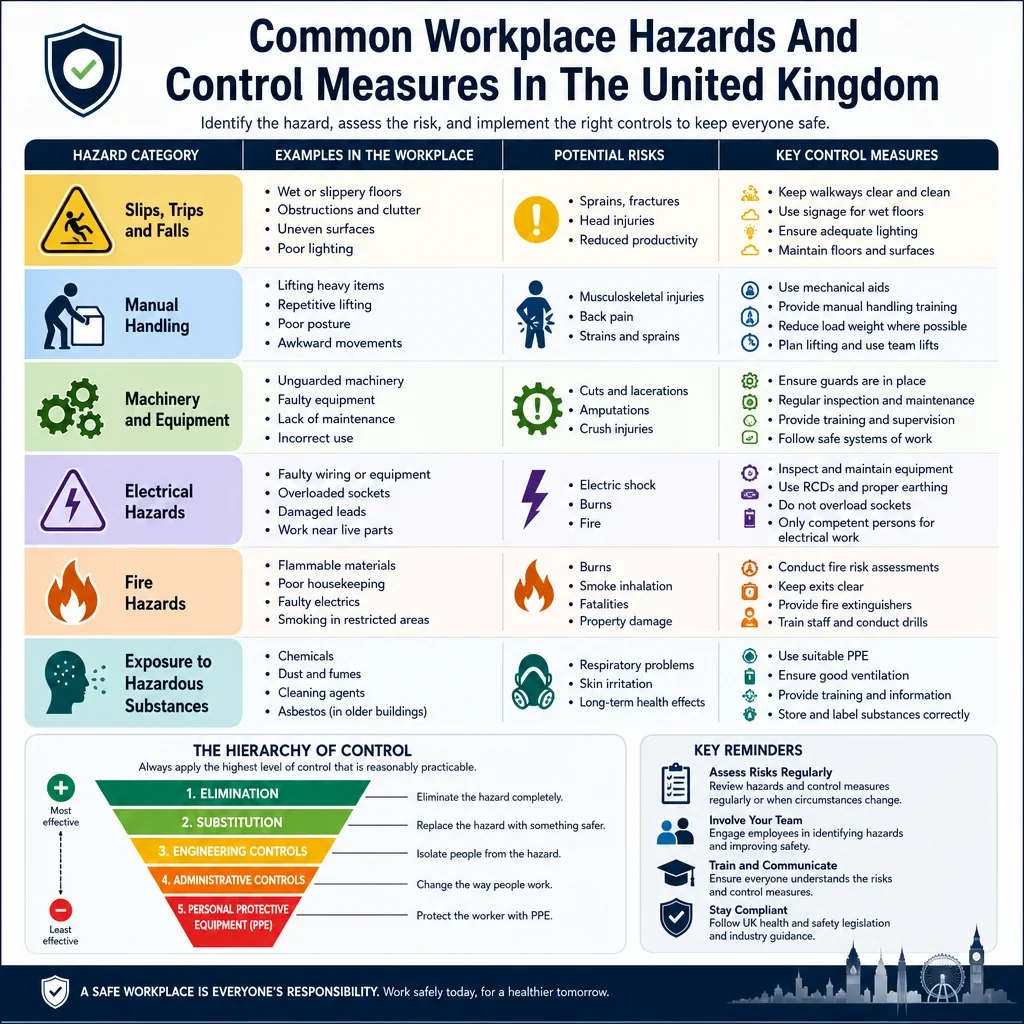
After identifying risks the company will implement preventive and protective measures following the hierarchy of controls (elimination substitution engineering controls administrative controls and PPE) assign responsibilities set timelines and monitor effectiveness.
Competent persons are designated for conducting risk assessments. Cross-reference to Section 4 (Organisation and Responsibilities) for competence arrangements.
6ARRANGEMENTS FOR HEALTH AND SAFETY
This section details the specific arrangements for health and safety management as required by the Management of Health and Safety at Work Regulations 1999.
Consultation with employees: The company will consult with employees and their representatives on all matters relating to health and safety in accordance with the Safety Representatives and Safety Committees Regulations 1977 and the Health and Safety (Consultation with Employees) Regulations 1996. See also Section 4 (Organisation and Responsibilities) and Section 23 in previous numbering for further details.
Emergency planning: The company has arrangements for emergency procedures including fire evacuation first aid and other foreseeable emergencies. These are detailed in the relevant sections of this manual (e.g. Fire Safety First Aid). Plans will be tested regularly and communicated to all relevant parties including contractors and visitors.
Performance monitoring: The company will monitor health and safety performance through active and reactive measures including inspections audits incident reporting and key performance indicators (KPIs). Findings will be used to drive continual improvement. See Section 26 (Monitoring Auditing and Review) for further details.
7HAZARDOUS SUBSTANCES AND COSHH
The company handles substances hazardous to health in its operations in full compliance with the Control of Substances Hazardous to Health Regulations 2002 (COSHH).
The types of hazardous substances handled by the business are chemicals fumes and dusts. Specific substances include solvents such as acetone and toluene cleaning agents including bleach and paints containing isocyanates.
All Safety Data Sheets are stored in a dedicated digital folder on the company intranet and in physical binders in the chemical storage room.
The company has conducted suitable and sufficient COSHH risk assessments for all hazardous substances. Control measures include substitution engineering controls and personal protective equipment as appropriate.
The company has a program to monitor employee exposure to hazardous substances where required and operates a health surveillance program for employees exposed to hazardous substances. Health surveillance records will be retained for at least 40 years.
Employees will be provided with suitable information instruction and training on the risks from hazardous substances and the control measures in place.
COSHH assessments will be reviewed at least every 5 years or sooner if there are changes to the substance process or following an incident.
The company includes specific procedures for reporting incidents involving hazardous substances. In case of a spill the area is immediately evacuated the spill is contained using appropriate absorbents and the responsible person is notified. For exposures affected employees rinse the area with water for 15 minutes and seek medical attention if necessary. All incidents are reported via the company incident form. Cross-reference to Section 25 (Incident Reporting and Investigation).
8MANUAL HANDLING AND DSEAR
Manual Handling (under the Manual Handling Operations Regulations 1992)
The employer conducts suitable and sufficient manual handling risk assessments for all relevant operations. Hazardous manual handling operations will be avoided where possible.
The manual handling training program includes annual training sessions covering proper lifting techniques (including kinetic lifting) use of equipment risk awareness and safe systems of work for all employees involved in manual handling.
The employer implements mechanical aids such as trolleys or lifts team handling procedures and ergonomic workstation adjustments as control measures for manual handling operations.
DSEAR (under the Dangerous Substances and Explosive Atmospheres Regulations 2002)
The employer performs suitable and sufficient DSEAR risk assessments. The types of dangerous substances used or stored are flammable solvents such as acetone and ethanol and compressed gases including propane stored in designated areas.
The company classifies areas with explosive atmospheres as required under DSEAR (e.g. Zone 1 or 21 for occasional explosive atmosphere and Zone 2 or 22 for rare explosive atmosphere).
Equipment in zoned areas will be suitably certified. Emergency plans will be in place for DSEAR-related incidents.
The employer schedules a review of each DSEAR risk assessment at least every 12 months or sooner if changes occur. Bi-annual training is provided on identifying explosive risks safe handling of substances and emergency response procedures for relevant employees.
9WORK EQUIPMENT AND MACHINERY SAFETY
All work equipment provided to employees is suitable for the intended use maintained in a safe condition and inspected as required under the Provision and Use of Work Equipment Regulations 1998 (PUWER).
The company has conducted risk assessments for all work equipment and machinery used in its operations. Suitable information instruction training and supervision are provided.
All employees receive initial induction training on equipment operation followed by refresher courses covering safe use hazard identification and emergency procedures. Records of training are maintained.
The company has a documented maintenance schedule for all work equipment as required by PUWER. The maintenance team follows procedures including isolation before work and post-maintenance testing. Inspections are carried out at suitable intervals.
The company provides guards protective devices and safety controls on all machinery as per PUWER. Specific safety measures include fixed guards interlocking devices and emergency stop buttons.
If lifting equipment is used the company complies with the Lifting Operations and Lifting Equipment Regulations 1998 (LOLER). Thorough examinations are carried out by competent persons at least every 6 months for accessories and 12 months for equipment (or as per scheme of examination). Records of thorough examinations are kept for at least 2 years or until the equipment is taken out of use.
The company ensures all equipment is used maintained and inspected in line with manufacturer instructions. Competent persons are appointed for inspections and maintenance.
10WORKPLACE AND WORK ENVIRONMENT
The company ensures the workplace and work environment comply with the Workplace (Health Safety and Welfare) Regulations 1992. This includes suitable ventilation temperature lighting welfare facilities and maintenance.
The company regularly monitors and records workplace temperatures (typical range 18.5 to 22.0 degrees Celsius) maintains lighting (natural and artificial) and ensures welfare facilities are kept clean and accessible.
Risk assessments are conducted for the workplace environment. Inspections of workplace facilities and environment are carried out regularly. Cross-reference to Section 5 (Risk Assessment and Management) and Section 12 (Slips Trips and Falls).
11WORK AT HEIGHT
The company complies with the Work at Height Regulations 2005 for any work at height activities (even if infrequent in a retail setting).
All work at height is properly planned and risk assessed in advance. The hierarchy of controls is followed: avoid work at height where possible prevent falls by using collective protection (e.g. guardrails) and minimise the distance and consequences of a fall where prevention is not possible.
Suitable equipment is selected for work at height and is inspected before use at suitable intervals by a competent person. Records of inspections are maintained.
Employees involved in work at height receive appropriate training and instruction. Emergency rescue procedures are in place.
12ASBESTOS MANAGEMENT
The company complies with the Control of Asbestos Regulations 2012. An asbestos survey has been conducted by a competent person and an asbestos register has been prepared. The asbestos register is kept in the health and safety office and is available to all contractors and relevant personnel.
All work that could disturb asbestos is strictly controlled. Asbestos-containing materials will be managed in situ where possible or removed by licensed contractors where necessary.
Employees and contractors receive awareness training on asbestos management. Emergency procedures are in place in the event of accidental disturbance of asbestos (e.g. stop work evacuate area and seek specialist advice).
The asbestos register is reviewed and updated regularly or after any changes to the building.
13FIRE SAFETY AND EMERGENCY PROCEDURES
The company fully complies with the Regulatory Reform (Fire Safety) Order 2005. A suitable and sufficient fire risk assessment has been conducted and is reviewed regularly.
Fire prevention measures include smoke detectors fire extinguishers a no smoking policy and good housekeeping. Specific fire hazards are managed through the risk assessment process.
Fire wardens are appointed with specific roles including assisting in evacuations and accounting for personnel. Fire safety training is provided to all employees.
The fire alarm is tested weekly. Emergency lighting is tested monthly. Fire extinguishers are maintained annually by competent persons. Fire safety records (including risk assessments drills and maintenance) are kept for at least 3 years.
In the event of a fire alarm all employees must immediately stop work proceed to the nearest exit using the marked escape routes and assemble at the designated assembly point. A headcount will be taken and no one is to re-enter until cleared by the fire service. Emergency plans are tested through regular drills. Cross-reference to Section 6 (Arrangements for Health and Safety).
14FIRST AID AND MEDICAL EMERGENCIES
The company complies with the Health and Safety (First-Aid) Regulations 1981. A first aid needs assessment has been conducted considering the level of risk (low risk for retail setting).
An appropriate number of trained first aiders are appointed (considering the ratio for low risk environments e.g. 1 first aider per 50 employees). First aiders receive training from a competent provider and refresher training as required.
First aid kits are provided in accessible locations and contain the recommended contents per HSE guidance (e.g. sterile plasters eye pads bandages etc.). Appropriate signage indicates the locations of first aid equipment and first aiders.
The company uses an incident reporting system. For RIDDOR compliance the following are reportable: deaths specified injuries (e.g. fractures amputations) injuries resulting in more than 7 days incapacitation occupational diseases dangerous occurrences and certain gas incidents. Reports are made to the HSE without delay (immediately for deaths and specified injuries) and a written report is submitted within 10 days where required. Records are kept for at least 3 years. Cross-reference to Section 25 (Incident Reporting and Investigation).
Employees can contact first aiders via internal communication systems. Arrangements are in place for different shifts or remote work.
15PERSONAL PROTECTIVE EQUIPMENT (PPE)
The company complies with the Personal Protective Equipment at Work Regulations 1992. A risk assessment has been conducted to identify where PPE is required. PPE is provided free of charge is suitable for the risks and environment and is maintained.
Types of PPE include eye and face protection hearing protection head protection and hand and arm protection as identified by risk assessment.
Procedures are in place for cleaning maintenance storage and replacement of PPE. Employees receive training on the correct use maintenance and storage of PPE and are responsible for its care. Cross-reference to Section 5 (Risk Assessment and Management).
16SLIPS, TRIPS AND FALLS
The company manages risks of slips trips and falls in line with HSE guidance and the Workplace (Health Safety and Welfare) Regulations 1992.
Risk assessments are conducted for floor surfaces cleaning regimes obstacle management and other factors. Suitable flooring is maintained cleaning regimes are established to prevent slips on wet surfaces obstacles are managed and appropriate signage is used where necessary.
Employees are consulted on these arrangements and incidents are investigated to prevent recurrence. Cross-reference to Section 5 (Risk Assessment and Management) and Section 10 (Workplace and Work Environment).
17NOISE AND VIBRATION CONTROL
The company complies with the Control of Noise at Work Regulations 2005 and the Control of Vibration at Work Regulations 2005. Suitable and sufficient noise and vibration assessments have been conducted.
Where noise levels exceed action values the company implements engineering controls provision of hearing protection and noise monitoring. Similar controls are applied for vibration (e.g. low-vibration tools limiting exposure time and health surveillance).
Employees exposed to noise or vibration receive appropriate information instruction and training. Health surveillance is provided where required.
18DISPLAY SCREEN EQUIPMENT (DSE)
The company fully complies with the Health and Safety (Display Screen Equipment) Regulations 1992. Workstation assessments are conducted for all identified DSE users (including home workers).
Adjustable furniture and equipment is provided as necessary. The company offers eye and eyesight tests (with reimbursement for glasses if required specifically for DSE work) and provides information and training on DSE risks.
Users are encouraged to take regular breaks from screen work (e.g. following the 20-20-20 rule or as per assessment). Assessments are reviewed regularly or after changes.
19ELECTRICAL SAFETY
The company ensures compliance with the Electricity at Work Regulations 1989. A portable appliance testing (PAT) program is in place with testing carried out at appropriate frequencies by competent persons. Fixed electrical installations are inspected periodically.
Records of inspections and tests are maintained. Emergency procedures for electrical faults are in place and employees receive appropriate training.
20GAS SAFETY
The company complies with the Gas Safety (Installation and Use) Regulations 1998. All gas appliances fittings and flues are maintained in a safe condition by a registered Gas Safe engineer at least annually.
Records of gas safety checks are kept for at least 2 years. Emergency procedures for gas leaks (e.g. shut off supply ventilate and seek specialist help) are in place and communicated to relevant personnel.
21CONSTRUCTION AND CONTRACTORS
The company complies with the Construction (Design and Management) Regulations 2015 (CDM 2015). Where applicable a principal designer and principal contractor are appointed with defined duties.
The company ensures competence of all duty holders prepares and provides pre-construction information maintains a health and safety file for the project and ensures suitable welfare facilities are provided on construction sites.
The HSE is notified where projects meet the criteria for notifiable works. High-risk activities (e.g. work at height excavation) are specifically risk assessed. Contractors are selected based on competence and are provided with site induction training. Cross-reference to Section 4 (Organisation and Responsibilities) and Section 5 (Risk Assessment and Management).
22DRIVING AND VEHICLE SAFETY
The company complies with the Road Traffic Act 1988 and other relevant legislation. A safe driving policy is in place covering company vehicles (cars vans lorries).
Driver eligibility criteria include a valid UK driving licence appropriate experience medical fitness and no relevant convictions. Regular vehicle checks and maintenance are required.
Occupational road risk assessments are conducted. Arrangements include management of driver hours (in line with applicable regulations) fatigue management and a strict policy on mobile phone use while driving (no hand-held devices).
Incidents and near-misses must be reported. Training is provided to drivers. Cross-reference to Section 5 (Risk Assessment and Management) and Section 25 (Incident Reporting and Investigation).
23LONE WORKING AND OUT OF HOURS WORK
The company has a formal lone working policy in line with HSE guidance and the Management of Health and Safety at Work Regulations 1999.
Suitable and sufficient risk assessments are conducted for lone working and out of hours activities. Controls include communication devices (e.g. mobile phones with check-in procedures) emergency procedures and appropriate training.
In an emergency lone workers must follow established procedures (e.g. use of panic alarms notifying a designated contact). Managers ensure that lone working is only permitted where risks are adequately controlled.
24VIOLENCE AND AGGRESSION AT WORK
The company has a written policy on the prevention and management of violence and aggression at work. Risk assessments are conducted and reviewed regularly.
Staff receive training on recognising and managing risks of violence and aggression. Support mechanisms include counselling services and an employee assistance programme for affected staff.
All incidents must be reported and investigated. Cross-reference to Section 25 (Incident Reporting and Investigation).
25LEGIONELLA MANAGEMENT
The company complies with the Approved Code of Practice and guidance on the Control of Legionella Bacteria in Water Systems (L8).
A suitable and sufficient legionella risk assessment has been conducted for the water systems. A written scheme of control is in place including monitoring of water temperatures (e.g. hot water above 60°C and cold below 20°C) regular flushing of seldom-used outlets and other control measures.
Records of risk assessments monitoring testing and maintenance are kept for at least 5 years. Competent persons are appointed to manage legionella risks.
26STRESS MANAGEMENT AND MENTAL HEALTH
The company aligns with the HSE Management Standards for work-related stress. Stress risk assessments are conducted using HSE tools with employee involvement.
Specific measures are in place for each of the six stress risk areas: Demands (workload work patterns and environment) Control (how much say people have in the way they do their work) Support (encouragement resources and line management) Relationships (promoting positive working to avoid conflict) Role (clarity on roles and responsibilities) and Change (how organisational change is managed).
Mental health first aiders are appointed. The company provides an employee assistance programme (EAP) mental health awareness training for managers and promotes mental wellbeing through various channels. An annual employee survey on mental wellbeing is conducted.
27TRAINING AND COMPETENCE
The company provides appropriate health and safety training and ensures competence of employees as required by the Management of Health and Safety at Work Regulations 1999. This includes mandatory induction training for new employees in-person workshops online modules and specialist training for high-risk tasks.
Competence is assessed through practical demonstrations tests and evaluations. Refresher training is provided as appropriate. The Health and Safety Manager oversees training programs. Cross-reference to Section 4 (Organisation and Responsibilities).
28INCIDENT REPORTING AND INVESTIGATION
The company complies with the Reporting of Injuries Diseases and Dangerous Occurrences Regulations 2013 (RIDDOR). Reportable incidents include: deaths specified injuries (as defined in RIDDOR) injuries resulting in absence from work for more than 7 consecutive days occupational diseases dangerous occurrences (as listed in Schedule 2) and incidents involving certain gases.
Reports to the HSE must be made without delay (by telephone for deaths and specified injuries) and a written report submitted within 10 days where required. Internal reporting of all incidents and near-misses is required immediately or within 24 hours.
Records of reportable incidents are kept for a minimum of 3 years. All incidents are investigated using root cause analysis methods (e.g. 5 Whys or fishbone diagrams). The investigation team includes appropriate personnel and lessons learned are shared across the company to prevent recurrence.
Employees receive training on incident reporting. Cross-reference to Section 14 (First Aid and Medical Emergencies) and Section 6 (Arrangements for Health and Safety).
29MONITORING, AUDITING, AND REVIEW
The company conducts active monitoring (e.g. inspections audits) and reactive monitoring (e.g. incident investigation) as required by the Management of Health and Safety at Work Regulations 1999.
Key performance indicators (KPIs) include incident rates training completion rates compliance audit scores and other metrics. Management reviews are conducted periodically.
Findings from monitoring and auditing lead to actions for continual improvement. The health and safety manual and policies are reviewed at least annually or following significant changes. Cross-reference to Section 3 (Health and Safety Policy Statement) and Section 6 (Arrangements for Health and Safety).
30CONSULTATION AND COMMUNICATION
The company has a formal policy on consulting with employees and safety representatives on health and safety matters in accordance with the Safety Representatives and Safety Committees Regulations 1977 and the Health and Safety (Consultation with Employees) Regulations 1996.
Methods include regular meetings written communications and elected representatives. The company provides employees with timely information on health and safety matters using email notifications notice boards and the intranet.
Consultation meetings are held at least quarterly. Cross-reference to Section 4 (Organisation and Responsibilities) and Section 6 (Arrangements for Health and Safety).
31DOCUMENT CONTROL AND VERSION HISTORY
This manual is version controlled with version numbering (e.g. v1.0). All revisions are approved by the Managing Director or designated competent person.
A distribution list is maintained to ensure all relevant parties (employees contractors etc.) receive updated versions. The manual is reviewed at least annually or following significant changes with review dates recorded.
Version history: Changes are logged with dates reasons for change and author. This ensures the manual remains current and compliant.
32APPENDICES AND REFERENCES
A template for risk assessments is included in the appendices.
An incident report form is included in the appendices.
The specific UK health and safety legal references listed in the appendices include (but are not limited to): the Health and Safety at Work etc. Act 1974 the Management of Health and Safety at Work Regulations 1999 the Control of Substances Hazardous to Health Regulations 2002 the Provision and Use of Work Equipment Regulations 1998 the Work at Height Regulations 2005 the Regulatory Reform (Fire Safety) Order 2005 the Control of Asbestos Regulations 2012 the Reporting of Injuries Diseases and Dangerous Occurrences Regulations 2013 (RIDDOR) the Safety Representatives and Safety Committees Regulations 1977 the Health and Safety (Display Screen Equipment) Regulations 1992 the Manual Handling Operations Regulations 1992 the Dangerous Substances and Explosive Atmospheres Regulations 2002 the Lifting Operations and Lifting Equipment Regulations 1998 the Workplace (Health Safety and Welfare) Regulations 1992 the Control of Noise at Work Regulations 2005 the Personal Protective Equipment at Work Regulations 1992 the Electricity at Work Regulations 1989 the Gas Safety (Installation and Use) Regulations 1998 the Construction (Design and Management) Regulations 2015 the Control of Legionella Bacteria in Water Systems (L8) and the Health and Safety (First-Aid) Regulations 1981.
The external resources listed in the appendices are the HSE website (www.hse.gov.uk) INDG163 (Five Steps to Risk Assessment) COSHH Essentials guidance booklet and other relevant HSE publications.
Contact information for the internal health and safety officer is included in the appendices.
Contact information for the relevant HSE office is included.
Additional templates forms (e.g. COSHH assessment form DSE workstation checklist PPE inspection form) and a full list of applicable legislation are included.
33SIGNATURE SECTION
I the undersigned as Managing Director confirm that I have read understood and endorse the commitment set out in this Health and Safety Manual. The company is committed to continuous improvement and full compliance with the Health and Safety at Work etc. Act 1974 and all other relevant legislation.
Signed ___________________________ Date ___________________________
Print Name: Managing Director Position: Managing Director
This example shows approximately 70% of a typical document and is provided for illustrative purposes only. The remaining content has been omitted.
Every document generated by Docaro is tailored to your specific circumstances, jurisdiction and the information you provide. The completed document includes all applicable clauses and provisions required for your situation.
To generate the full, personalised document, answer a short series of questions and your document will be created instantly.
Useful Resources When Considering a Health and Safety Manual in the United Kingdom
United Kingdom Reference Legislation
Health and Safety Manual FAQs
Document Generation FAQs
Related Articles