AI Generated British Contract of Employment
PDF & Word - 2026 Updated
Docaro Pricing
When Do You Need an Employment Contract in the United Kingdom?
British Legal Rules for an Employment Contract
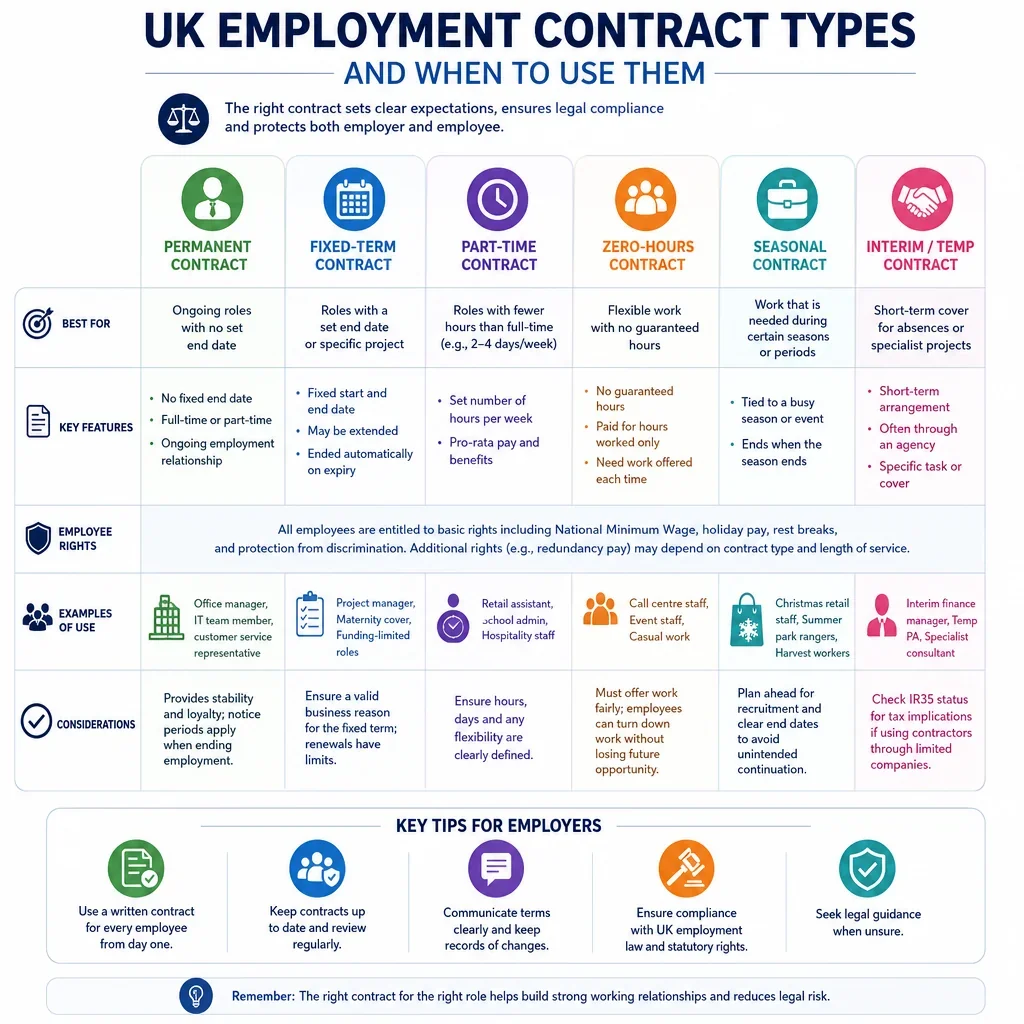
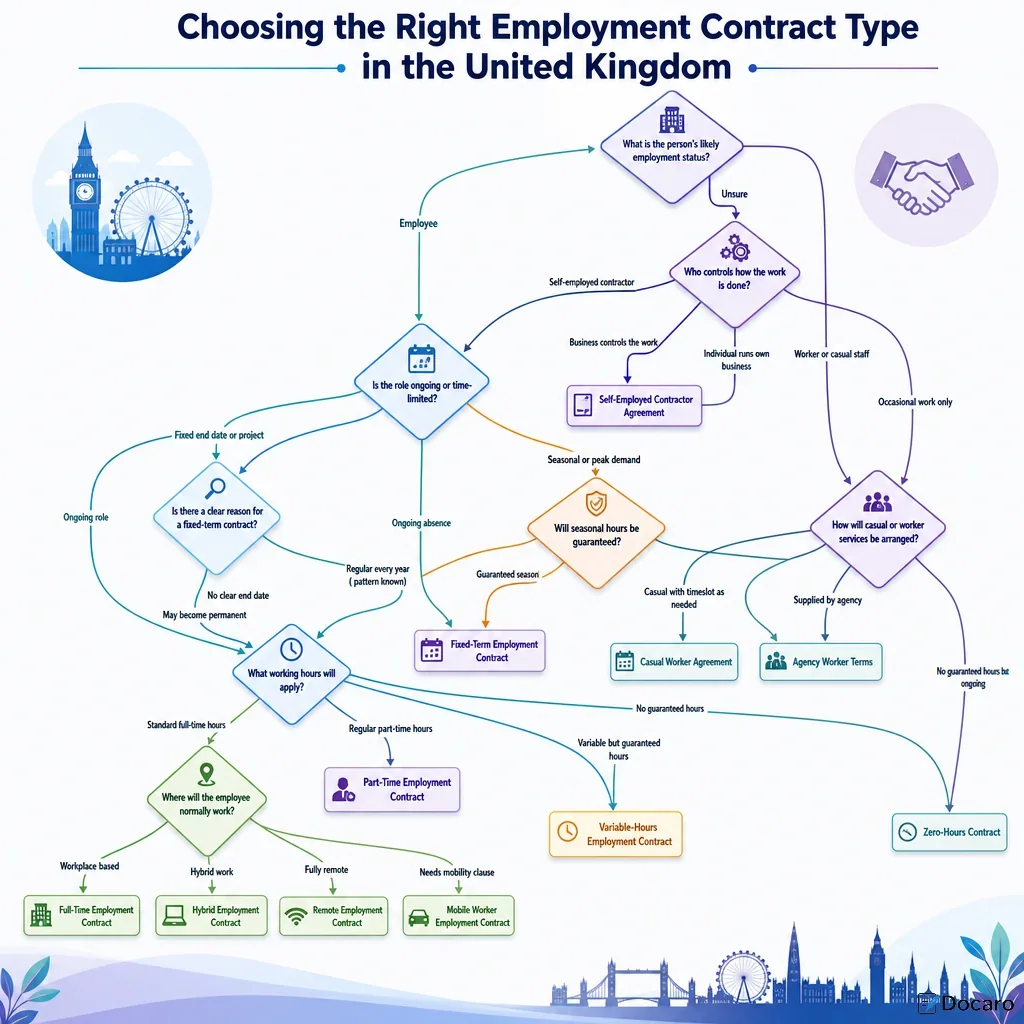
Using the wrong type of employment contract can result in unintended statutory rights or obligations for either party.
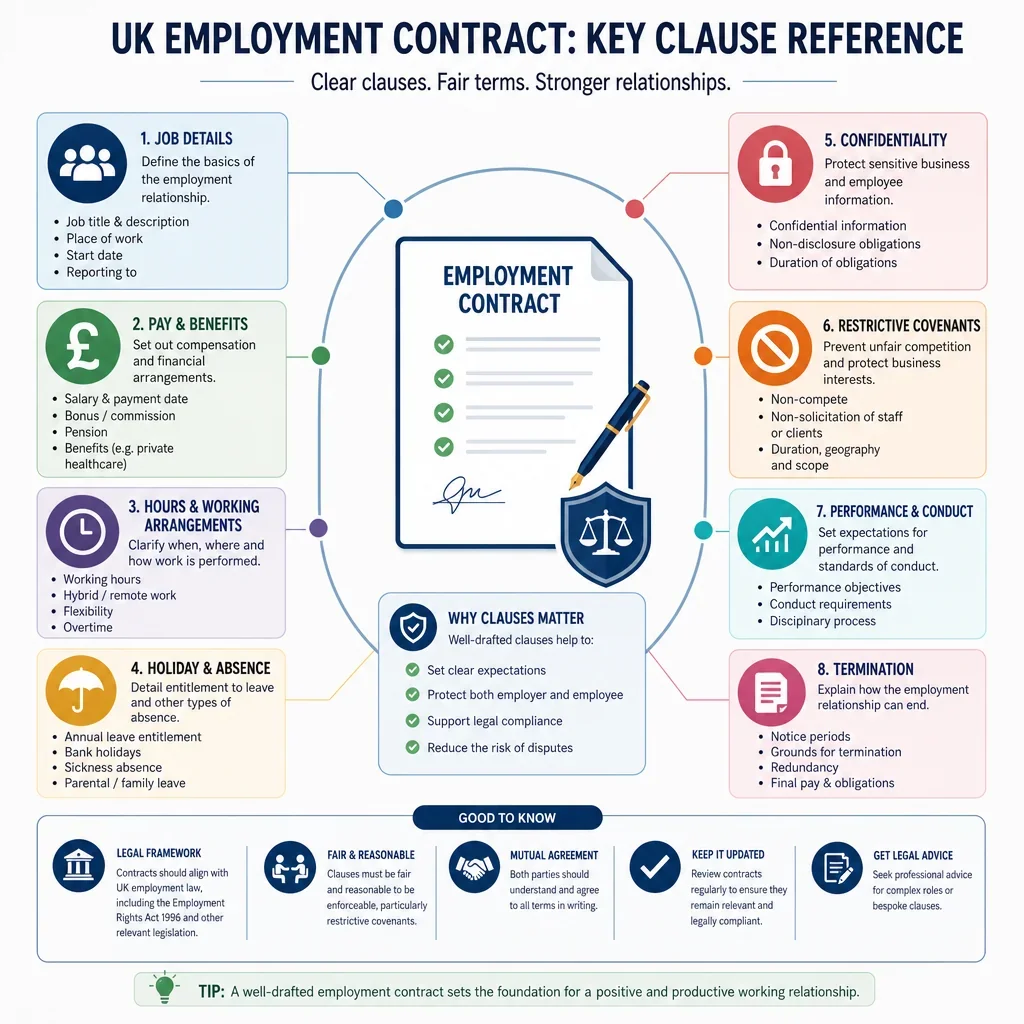
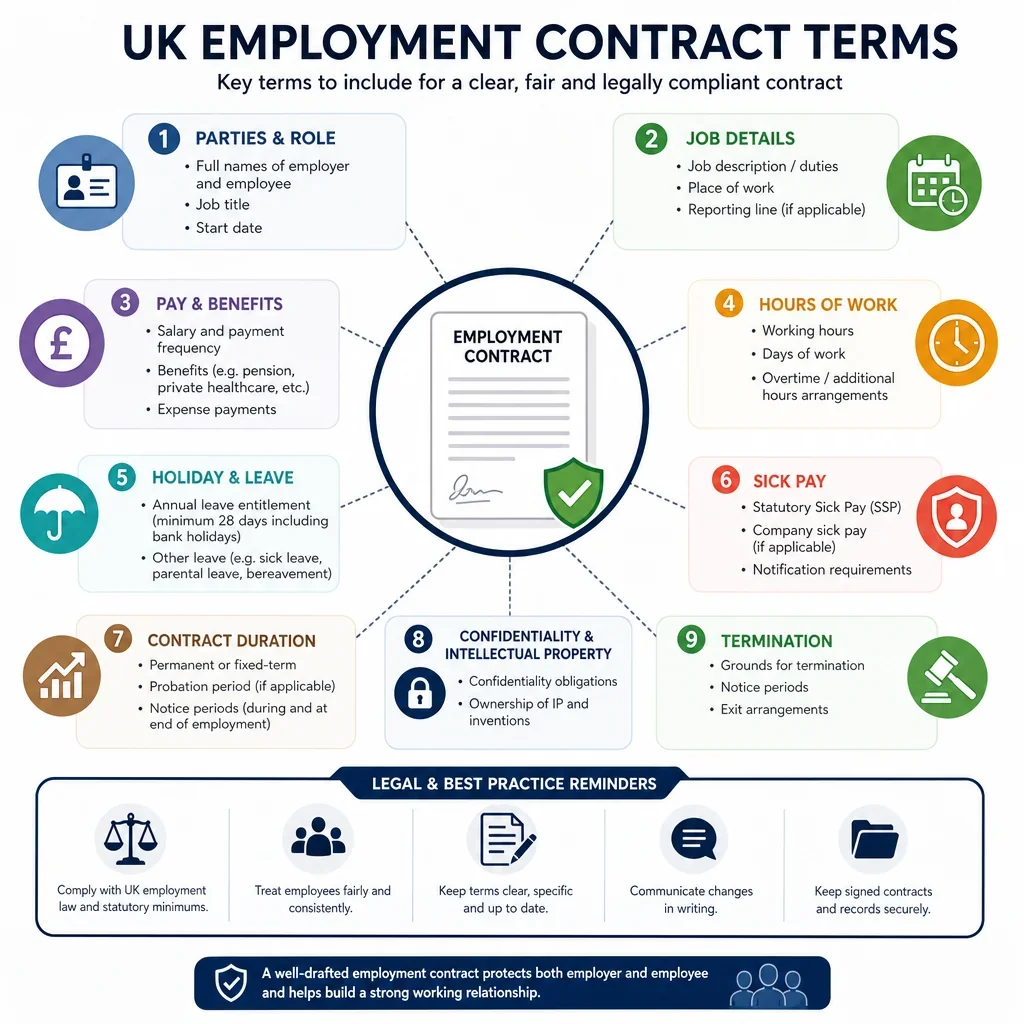
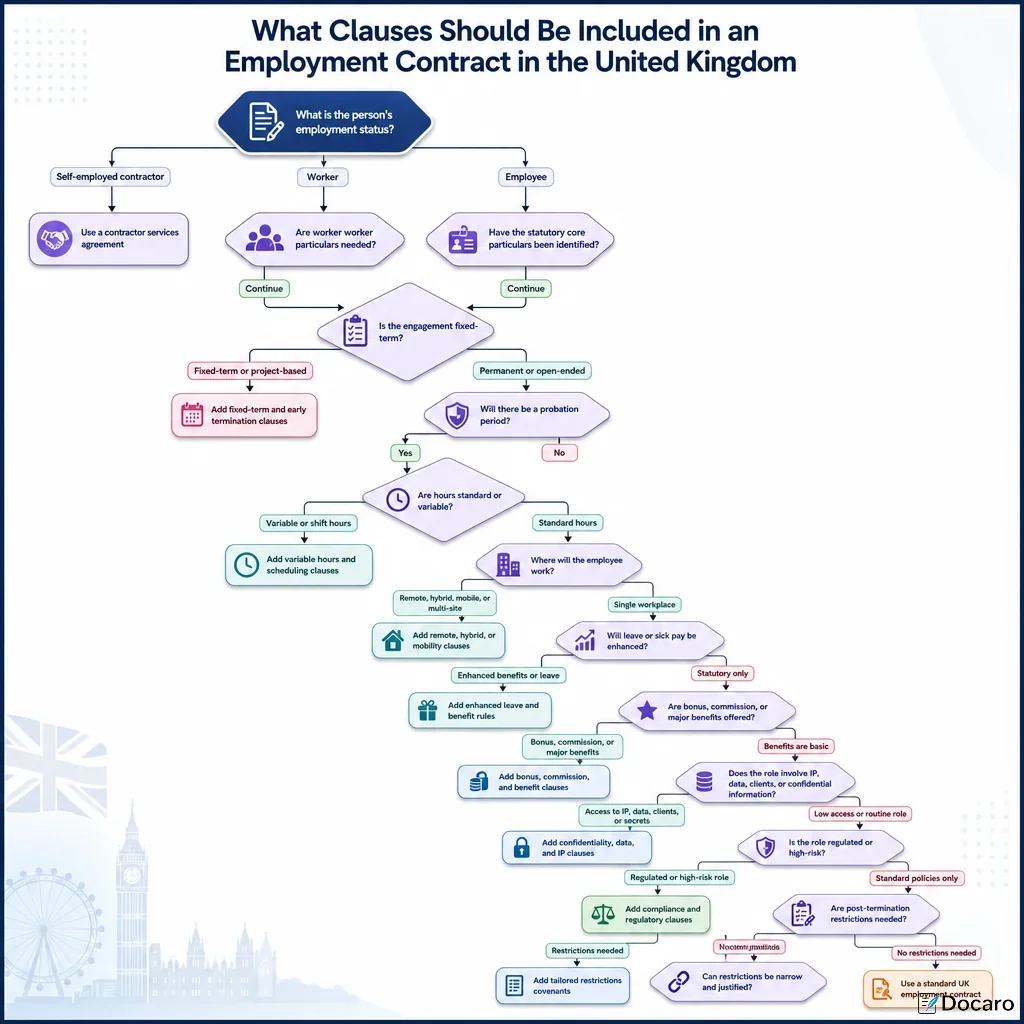
What a Proper Employment Contract Should Include
- Employee and Employer DetailsClearly state the full names, addresses, and contact information of both the employee and the employer to identify the parties involved.
- Job Title and DescriptionSpecify the employee's job title and a brief outline of their main duties and responsibilities.
- Start Date and Probation PeriodInclude the date the employment begins and any initial trial period with its length and conditions.
- Pay and Payment ScheduleDetail the salary amount, how often it will be paid, and any additional benefits like bonuses or allowances.
- Working Hours and LocationOutline the standard working hours, any overtime expectations, and the primary place of work.
- Holiday and Sick LeaveExplain the entitlement to paid holidays, how sick leave is handled, and any notice requirements.
- Notice Period for Ending EmploymentState how much notice either party must give to end the contract and under what circumstances it can be immediate.
- Confidentiality and Non-Compete RulesDescribe how the employee must protect company information and any restrictions on working for competitors after leaving.
Generate Your Document in 4 Easy Steps
Why Use Docaro?
 United Kingdom
Free Example Employment Contract Template
Below is a free template example of a Employment Contract for use in the United Kingdom generated by our AI model.
The clauses in your actual Employment Contract will vary from this example as they will be entirely bespoke to your requirements as set out in the questionnaire you complete.
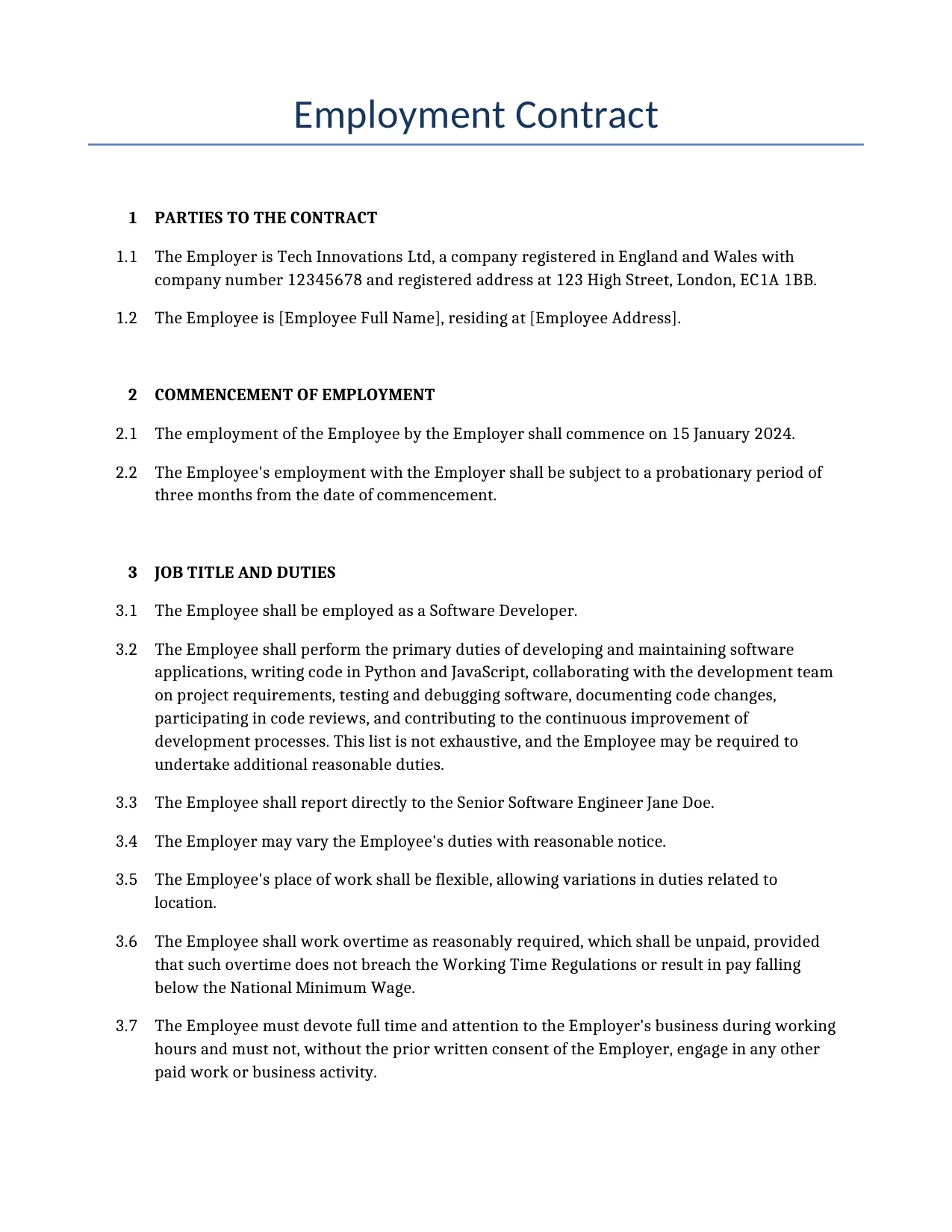
Employment Contract
1PARTIES TO THE CONTRACT
The Employer is Tech Innovations Ltd, a company registered in England and Wales with company number 12345678 and registered address at 123 High Street, London, EC1A 1BB.
The Employee is [Employee Full Name], residing at [Employee Address].
2COMMENCEMENT OF EMPLOYMENT
The employment of the Employee by the Employer shall commence on 15 January 2024.
The Employee's employment with the Employer shall be subject to a probationary period of three months from the date of commencement.
3JOB TITLE AND DUTIES
The Employee shall be employed as a Software Developer.
The Employee shall perform the primary duties of developing and maintaining software applications, writing code in Python and JavaScript, collaborating with the development team on project requirements, testing and debugging software, documenting code changes, participating in code reviews, and contributing to the continuous improvement of development processes. This list is not exhaustive, and the Employee may be required to undertake additional reasonable duties.
The Employee shall report directly to the Senior Software Engineer Jane Doe.
The Employer may vary the Employee's duties with reasonable notice.
The Employee's place of work shall be flexible, allowing variations in duties related to location.
The Employee shall work overtime as reasonably required, which shall be unpaid, provided that such overtime does not breach the Working Time Regulations or result in pay falling below the National Minimum Wage.
The Employee must devote full time and attention to the Employer's business during working hours and must not, without the prior written consent of the Employer, engage in any other paid work or business activity.
4PLACE OF WORK
The principal place of work for the Employee shall be 123 High Street, London, EC1A 1BB.
The Employee shall be permitted to work remotely from the principal place of work.
The employment shall not require mobility from the Employee such as travel to other locations.
5HOURS OF WORK
The standard working day for the Employee shall commence at 9:00 AM and finish at 5:00 PM.
The Employee shall work eight hours per day and 40 hours per week as standard.
The Employee shall work on Monday, Tuesday, Wednesday, Thursday, and Friday.
The Employer may require the Employee to work overtime when needed, provided that such overtime complies with the Working Time Regulations 1998 (as amended) and does not cause the Employee's average working hours to exceed 48 hours per week (unless the Employee has opted out) or result in pay below the National Minimum Wage.
The Employer shall provide for flexible working arrangements for the Employee.
The Employee is entitled to the following rest breaks in accordance with the Working Time Regulations: an uninterrupted break of at least 20 minutes when daily working time exceeds six hours; a daily rest period of at least 11 consecutive hours in each 24-hour period; and an uninterrupted weekly rest period of at least 24 hours in each seven-day period (or 48 hours in each 14-day period).
The 48-hour average weekly working time limit applies unless the Employee has signed an opt-out agreement, a copy of which is attached to this Contract. The Employee may withdraw any opt-out by giving the Employer the required notice.
6REMUNERATION AND SALARY
The basic annual salary of the Employee shall be £45,000, which shall be paid monthly in arrears.
The Employer shall conduct a periodic salary review.
The Employer shall provide the Employee with statutory itemised payslips on or before each payment date.
The Employer shall make no deductions from the Employee's salary other than those required or permitted by law.
The Employer shall reimburse the Employee for all reasonable business expenses incurred in the performance of duties, subject to the provision of appropriate receipts or other evidence as required by the Employer's expenses policy.
The Employee is not entitled to any commission or bonus.
7HOLIDAY ENTITLEMENT
The Employee shall be entitled to 28 days of annual leave (inclusive of bank and public holidays) each holiday year. Holiday pay shall be at the rate of the Employee's normal salary.
The holiday year for the Employee shall start on 01 January.
The Employee must request holiday in advance in accordance with the Employer's holiday policy (which requires at least two weeks' notice for periods of one week or more). The Employer reserves the right to refuse holiday requests at its discretion, taking into account business needs.
Bank and public holidays are included within the 28 days' entitlement. The Employee is not entitled to take additional days for bank or public holidays that fall outside the agreed annual leave.
The Employee's holiday entitlement shall be pro-rated if the Employee works part-time or joins or leaves part way through a holiday year. Untaken holiday must generally be taken within the holiday year and cannot be carried over to the next holiday year except in exceptional circumstances with the prior written approval of the Employer, in line with the Working Time Regulations.
8SICKNESS AND ABSENCE
The Employer shall provide enhanced sick pay to the Employee beyond the statutory requirements, as follows: full pay for up to six weeks in any 12-month period, followed by half pay for up to a further six weeks. This is subject to the rules set out in the Employer's sickness absence policy.
The enhanced sick pay shall be calculated based on the Employee's basic salary.
A waiting period of three days shall apply before sick pay starts for the Employee (self-certification is permitted for the first seven calendar days of absence).
The Employee shall notify the Employer of sickness absence by a phone call to a designated person by 10:00 AM on the first day of absence.
The Employee shall provide a medical certificate (fit note) for absences beyond seven days.
The Employee must complete a return-to-work interview with the line manager upon returning from any period of sickness absence.
A formal review of the Employee's sickness absence shall be triggered by more than four weeks' continuous absence or 10 or more days' absence in a 12-month period (or as otherwise set out in the Employer's policy). This is in line with best practice and the ACAS Code of Practice.
The Employee is also entitled to Statutory Sick Pay in accordance with the legislation in force from time to time.
9PENSION AND BENEFITS
The Employee shall participate in the Employer's Defined Contribution pension scheme, which complies with the automatic enrolment requirements under the Pensions Act 2008.
The Employer shall contribute 3.5 percent of the Employee's qualifying earnings to the pension scheme. The Employee shall contribute 5 percent of qualifying earnings (or such other rates as may be required to meet the minimum contribution levels under auto-enrolment from time to time). The Employer shall review and adjust contributions as necessary to ensure they meet or exceed the statutory minimum.
The Employer shall provide life assurance benefits to the Employee (four times basic annual salary).
The Employee shall be eligible for private medical insurance (subject to the terms of the policy, which may be varied or withdrawn at the Employer's discretion). No other benefits are provided. Pension contributions vest in accordance with the scheme rules.
10CONFIDENTIALITY
Confidential Information means any information (whether or not marked as confidential) which relates to the business, affairs, customers, clients, suppliers, plans or strategy of the Employer or any Group Company, including trade secrets, technical data, business methods, financial information, customer lists, pricing information, and any information which the Employee is told or has been told is confidential or which the Employee might reasonably expect to be confidential.
The Employee shall not during the term of employment (except in the proper performance of duties) or at any time after termination (for whatever reason and without limit in time), directly or indirectly, use, disclose, or enable any person to obtain any Confidential Information.
The Employee shall return all confidential materials upon termination of employment and shall, if requested, confirm in writing that this obligation has been complied with.
The obligations in this clause do not apply to information which is in or comes into the public domain (otherwise than by breach of this clause), is required to be disclosed by law or court order, is disclosed to professional advisers on a confidential basis, or is the subject of protected disclosure under the Public Interest Disclosure Act 1998 (whistleblowing). This clause is without prejudice to the Employee's obligations under the Data Protection Act 2018 and UK GDPR.
The post-termination restrictions in this section shall last for 12 months after termination, which the parties agree is reasonable.
11INTELLECTUAL PROPERTY
The Employee shall promptly disclose to the Employer any invention, discovery, design, computer program, or other work (whether or not capable of being patented or registered) made or created by the Employee in the course of employment (whether alone or jointly). All such IP shall belong to and vest in the Employer.
The Employee shall, at the Employer's request and expense (both during employment and for a reasonable period not exceeding 12 months after termination), do all acts necessary to vest ownership of such IP in the Employer, apply for and prosecute patent or other registrations, and defend any challenges to such rights.
The Employee waives all moral rights in any copyright works created in the course of employment to the fullest extent permitted by law.
The ownership of the Employee's pre-existing intellectual property is listed in the Schedule to this Contract and shall be subject to a non-exclusive, royalty-free licence to the Employer to use such IP for its business purposes.
The Employee shall keep all intellectual property information confidential in accordance with clause 9.
12RESTRICTIVE COVENANTS
In order to protect the legitimate business interests of the Employer, the Employee covenants that for a period of three months after the termination of employment (howsoever caused), the Employee shall not, without the prior written consent of the Employer, directly or indirectly be engaged, concerned, or interested in any business which competes with the business of the Employer carried on at the date of termination within the United Kingdom.
For the purposes of this clause, a 'competitor' means any person, firm, or company carrying on business which is the same as or materially similar to any business carried on by the Employer at the date of termination.
The Employee covenants that for a period of six months after the termination of employment (howsoever caused), the Employee shall not, without the prior written consent of the Employer, directly or indirectly solicit, canvass, or approach, or cause to be solicited, canvassed, or approached, any person, firm, or company who was a client or customer of the Employer with whom the Employee had material dealings in the 12 months immediately preceding the date of termination.
The Employee covenants that for a period of six months after the termination of employment (howsoever caused), the Employee shall not, without the prior written consent of the Employer, directly or indirectly solicit, canvass, or approach, or cause to be solicited, canvassed, or approached, any employee of the Employer with whom the Employee had material dealings in the 12 months immediately preceding the date of termination, for the purpose of employing or engaging such person.
The Employee further covenants that for a period of six months after the termination of employment (howsoever caused), the Employee shall not, without the prior written consent of the Employer, directly or indirectly deal with, or have any business dealings with, any person, firm, or company who was a client or customer of the Employer with whom the Employee had material dealings in the 12 months immediately preceding the date of termination.
If the Employer places the Employee on garden leave for any period, the duration of the restrictive covenants set out above shall be reduced by the length of such garden leave.
The Employee acknowledges that the covenants are reasonable in scope, duration, and geographical area. If any such restriction is found to be invalid or unenforceable, the parties agree that the court shall sever or amend the offending provision(s) to the minimum extent necessary to make them enforceable, and the remainder of the covenants shall continue in full force and effect.
In consideration for the Employee entering into the restrictive covenants in this clause (where the restricted period exceeds three months), the Employer shall pay the Employee a sum equivalent to 50 percent of basic salary during the restricted period (pro-rated), payable monthly in arrears, subject to the Employee complying with the covenants.
13DATA PROTECTION
The Employer will collect and process the Employee's personal data in accordance with its Privacy Notice (a copy of which is provided to the Employee and is available on the intranet). The Employee should read the Privacy Notice carefully.
The Employer shall collect and process the Employee's basic contact details, identification documents, and performance and disciplinary records.
The Employer shall process the Employee's personal data to manage payroll, administer benefits, monitor performance, ensure compliance with health and safety regulations, and fulfil legal reporting requirements. The Employer relies on the performance of the employment contract, compliance with a legal obligation, and the legitimate interests of the Employer as the lawful basis for processing (consent is not the sole basis).
The Employer may share the Employee's personal data with third parties such as pension providers or regulatory bodies, as set out in the Privacy Notice.
The Employer shall implement appropriate technical and organisational security measures, including encryption of sensitive data, access controls and authentication, regular security audits, and training, to protect the Employee's personal data in accordance with the UK GDPR and Data Protection Act 2018.
The Employer may retain the Employee's personal data for a period after the end of employment in accordance with its data retention policy (a copy of which is available on request). Different retention periods apply depending on the type of data and legal requirements.
The Employee has the right to access the Employee's personal data, request rectification of inaccurate information, request erasure of data where appropriate, object to processing in certain circumstances, and complain to the Information Commissioner's Office (ICO). Requests should be made in writing to the HR department.
14HEALTH AND SAFETY
The Employer shall, so far as is reasonably practicable, provide and maintain a safe working environment for the Employee, provide appropriate training, and comply with its obligations under the Health and Safety at Work etc. Act 1974 and all other relevant legislation.
The Employee shall take reasonable care for the health and safety of themselves and of other persons who may be affected by their acts or omissions at work, report any defects in safety equipment or any health and safety incidents or concerns immediately to the Employer, and shall not intentionally or recklessly interfere with or misuse anything provided in the interests of health and safety.
The Employee shall undergo health and safety training provided by the Employer and shall comply with all health and safety instructions and procedures issued by the Employer.
The Employer shall provide safety helmets, protective gloves, and safety footwear to the Employee where appropriate.
15EQUAL OPPORTUNITIES AND DIVERSITY
The Employer is committed to the principles of equal opportunities and diversity in employment and has a detailed Equal Opportunities Policy, a copy of which is available on the intranet. The Employee must familiarise themselves with and comply with this policy.
The Employer shall promote diversity in the workplace and is committed to non-discrimination in all employment practices.
The non-discrimination policy shall explicitly cover age, disability, gender reassignment, marriage and civil partnership, pregnancy and maternity, race, religion or belief, sex, and sexual orientation.
The Employer is committed to making reasonable adjustments for disabled employees in accordance with the Equality Act 2010.
The Employer has a zero-tolerance approach to harassment, bullying, and victimisation. Any complaint of harassment, victimisation, or discrimination will be investigated promptly and fairly.
The Employee may report discrimination or diversity concerns to the HR Department.
16GRIEVANCE AND DISCIPLINARY PROCEDURES
The grievance and disciplinary procedures are set out in the Employer's separate Grievance Policy and Disciplinary Policy (copies of which are available on the intranet). These procedures are non-contractual and do not form part of this Contract.
The Employer shall follow the ACAS Code of Practice on disciplinary and grievance procedures. Grievances should be raised as soon as reasonably practicable, and investigations and meetings shall be arranged as soon as reasonably practicable.
The Employee shall be permitted to be accompanied at grievance and disciplinary meetings by a colleague or trade union representative. The Employee shall have the right to appeal the outcome of any grievance or disciplinary decision.
17TERMINATION OF EMPLOYMENT
The employment may be terminated by resignation of the Employee or by dismissal by the Employer. The Employer may only dismiss the Employee for a fair reason under the Employment Rights Act 1996, which includes (but is not limited to) capability, conduct, redundancy, or some other substantial reason.
The Employer may summarily dismiss the Employee without notice for gross misconduct or breach of confidentiality.
The Employer may make payment in lieu of notice to the Employee.
Post-termination restrictions such as non-compete clauses shall apply to the Employee.
If the Employee has been continuously employed for two years or more and requests one, the Employee is entitled to a written statement of reasons for dismissal.
18NOTICE PERIOD
The notice period to be given by the Employee to terminate the employment shall be four weeks (or one week during the probationary period).
The notice period to be given by the Employer to terminate the employment shall be one week's notice for each complete year of continuous service (up to a maximum of 12 weeks) or four weeks, whichever is the greater (or one week during the probationary period).
19GARDEN LEAVE
The Employer may, at its absolute discretion, place the Employee on garden leave during all or part of the notice period (up to a maximum period equal to the applicable notice period).
Garden leave may be triggered if the Employee gives notice to resign or if the Employer gives notice of termination to the Employee.
The Employee shall receive full contractual pay and benefits during garden leave.
During garden leave, the Employee shall be restricted from competing with the Employer, from soliciting the Employer's clients, and from soliciting the Employer's employees. These restrictions apply only for the duration of the garden leave period.
20RETURN OF COMPANY PROPERTY
The Employee shall return all company property upon termination of employment.
The Employee shall return all company documents (including electronic copies) and all company equipment on the last day of employment (or earlier if requested).
21APPLICABLE LAW AND COMPLIANCE
The Employee must comply with all applicable laws, the Employer's policies and procedures (as varied from time to time), the Bribery Act 2010 (including anti-bribery and anti-corruption rules), the Employer's modern slavery statement, and the whistleblowing policy.
22COLLECTIVE AGREEMENTS
There are no collective agreements that directly affect the terms and conditions of the Employee's employment.
23EMPLOYEE HANDBOOK
The Employee must comply with all policies and procedures set out in the Employee Handbook (as varied from time to time). The Handbook does not form part of this Contract.
24FAMILY FRIENDLY RIGHTS
The Employee is entitled to statutory family friendly rights, including maternity leave, paternity leave, adoption leave, shared parental leave, and parental leave, in accordance with the applicable legislation in force from time to time. Details are set out in the Employer's family friendly policies.
The Employee has the right to make a request for flexible working. Any such request will be considered in accordance with the statutory procedure and the Employer's flexible working policy.
25ENTIRE AGREEMENT
This agreement constitutes the entire agreement between the parties and supersedes all prior understandings. It takes effect from 15 January 2024.
26GOVERNING LAW
This contract shall be governed by the laws of England and Wales.
27JURISDICTION
The courts of England and Wales shall have exclusive authority over all disputes arising from this employment contract.
28SEVERABILITY
If any provision of this contract is held to be invalid or unenforceable, the remainder of the contract shall continue in full force and effect.
This severability clause shall apply to any schedules or appendices in this employment contract.
29VARIATION
Any changes to this employment contract must be made in writing and signed by both the Employer and the Employee.
30THIRD PARTY RIGHTS
No third parties shall have rights under this contract pursuant to the Contracts (Rights of Third Parties) Act 1999.
31COUNTERPARTS
This contract may be executed in counterparts, each of which shall be considered an original and may be executed by wet ink or electronic means.
32SIGNATURES
| EMPLOYER | |
| Signature: | |
| Print Name: | |
| Date: |
| EMPLOYEE | |
| Signature: | |
| Print Name: | |
| Date: |
This example shows approximately 70% of a typical document and is provided for illustrative purposes only. The remaining content has been omitted.
Every document generated by Docaro is tailored to your specific circumstances, jurisdiction and the information you provide. The completed document includes all applicable clauses and provisions required for your situation.
To generate the full, personalised document, answer a short series of questions and your document will be created instantly.
Useful Resources When Considering a Employment Contract in the United Kingdom
United Kingdom Reference Legislation
Employment Contract FAQs
Document Generation FAQs
Related Articles