AI Generated British Advance Decision
PDF & Word - 2026 Updated
Docaro Pricing
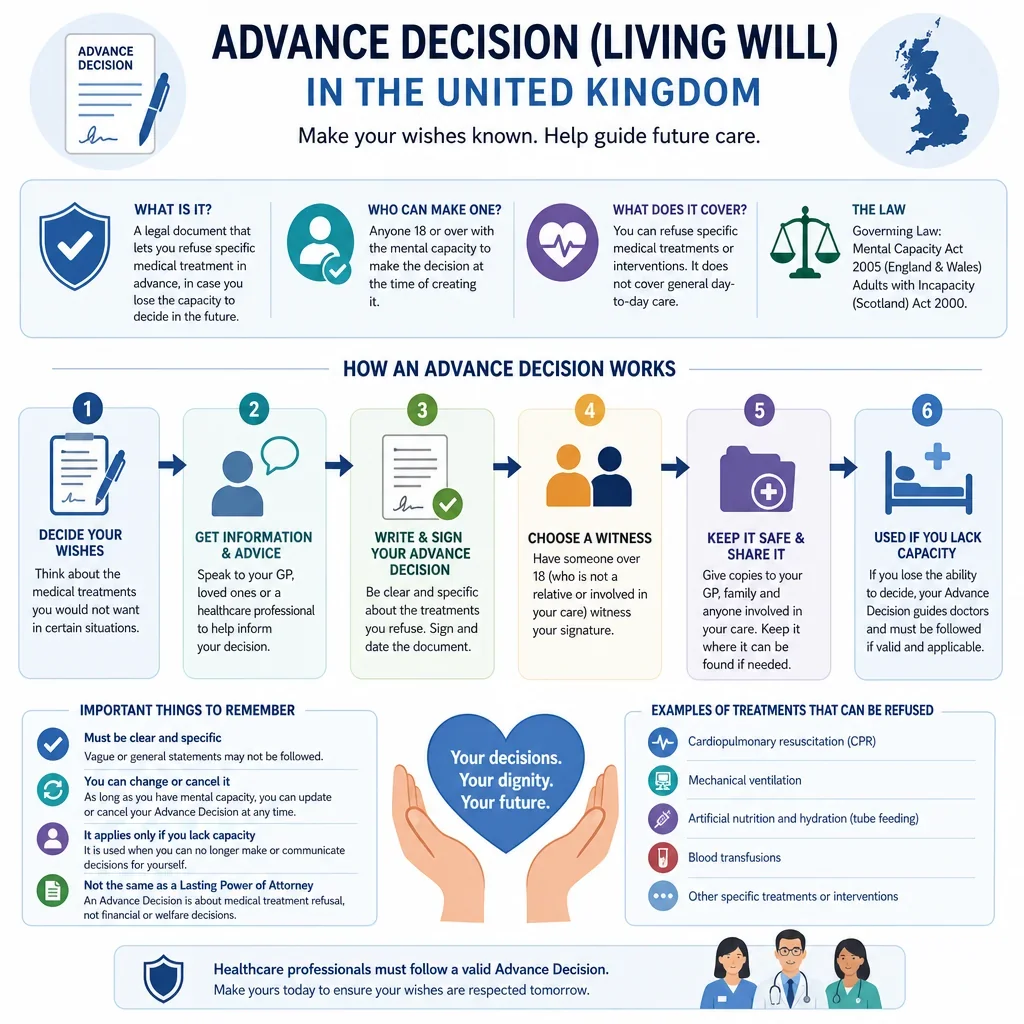
When do you need an Advance Decision in the United Kingdom?
British Legal Rules for an Advance Decision
Using the wrong structure for a living will may result in your medical wishes not being legally enforceable.
What a Proper Advance Decision Should Include
- Your Specific RefusalsClearly state the medical treatments or life-sustaining interventions you do not want, such as refusing artificial feeding or ventilation.
- Conditions for RefusalDescribe any situations or diagnoses where your refusals apply, like only if you're in a permanent vegetative state.
- Your Personal DetailsInclude your full name, date of birth, address, and the date you made the decision to confirm it's yours.
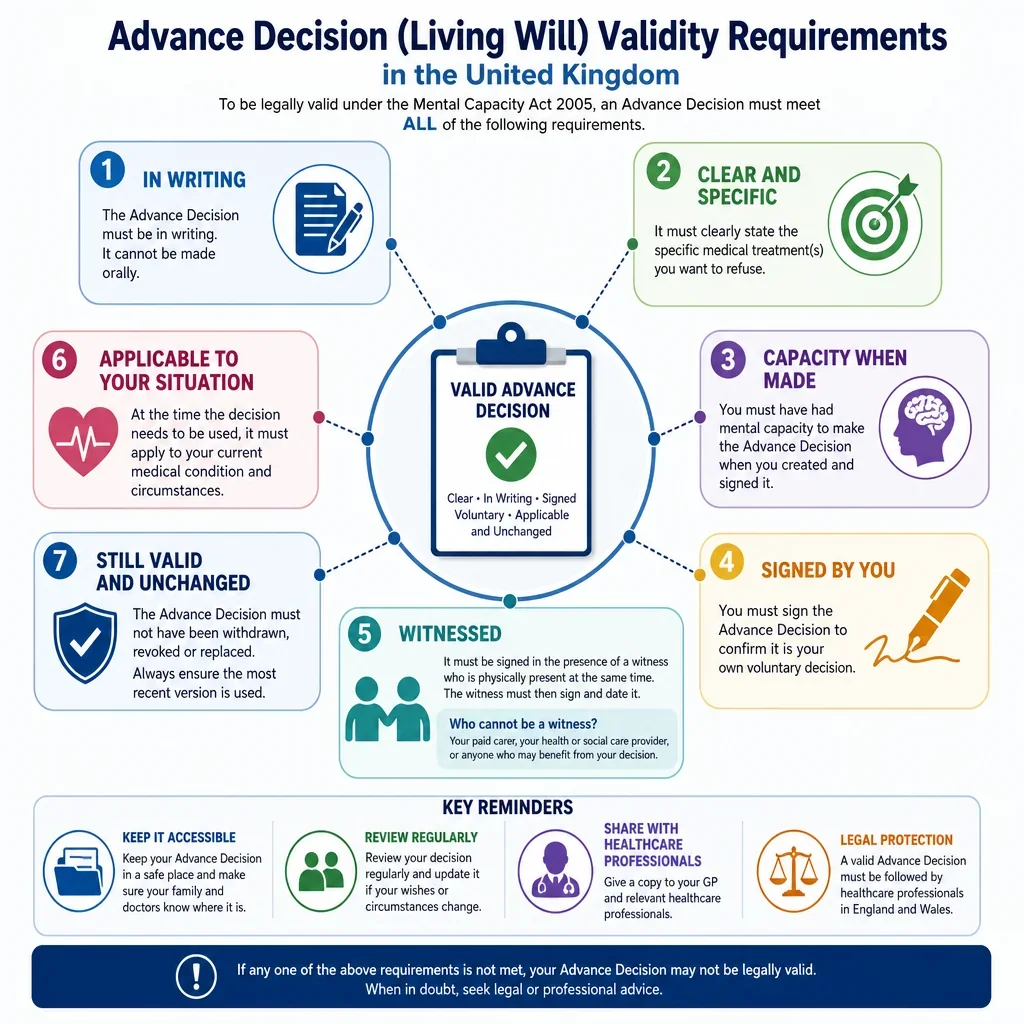
- Witness ConfirmationHave at least one independent witness sign to verify that you made the decision voluntarily and understood it.
- Signature and DateSign and date the document yourself to make it legally valid and show it's current.
- Mental Capacity StatementConfirm that you have the mental ability to make this decision at the time of writing.
Generate Your Document in 4 Easy Steps
Why Use Docaro?
 United Kingdom
Free Example Advance Decision Template
Below is a free template example of a Advance Decision for use in the United Kingdom generated by our AI model.
The clauses in your actual Advance Decision will vary from this example as they will be entirely bespoke to your requirements as set out in the questionnaire you complete.
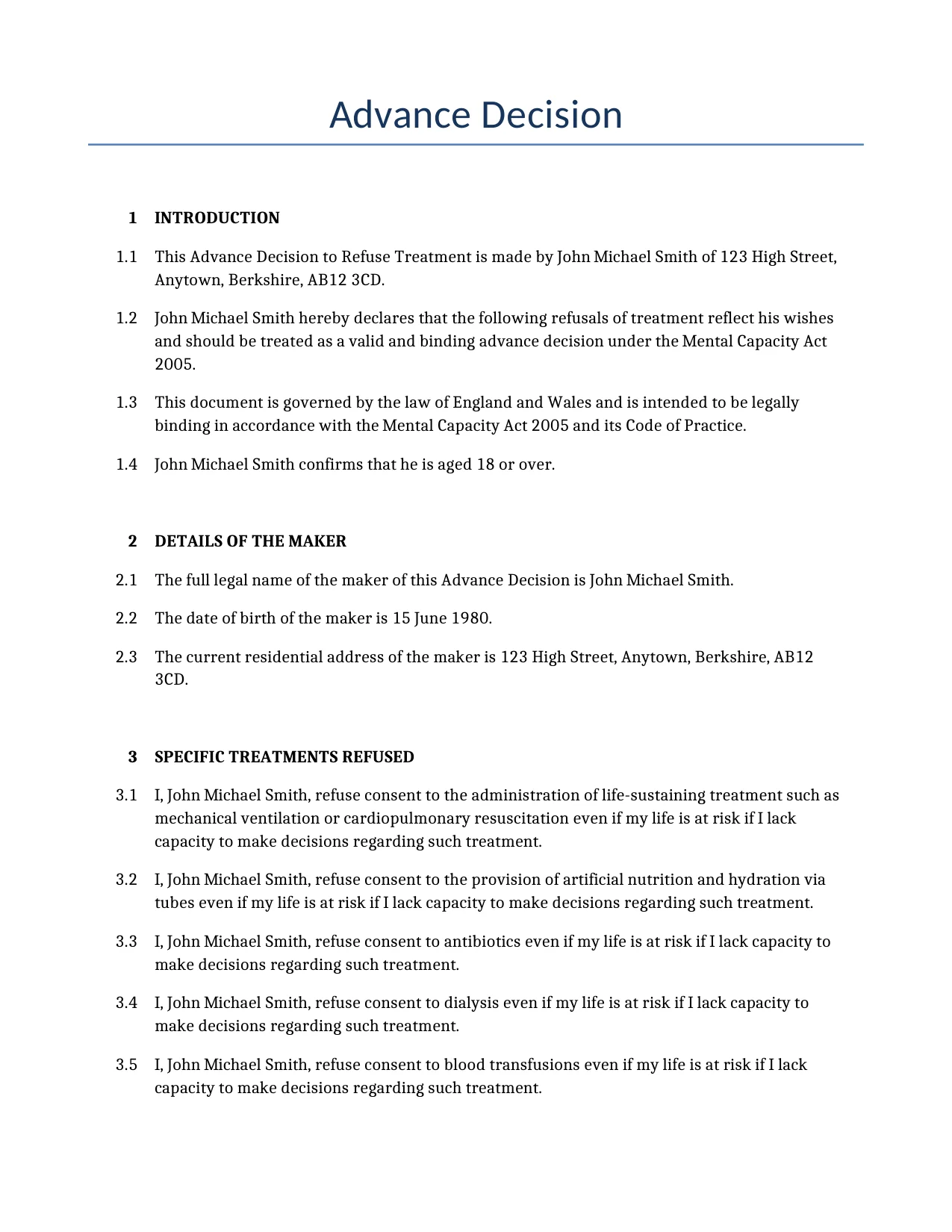
Advance Decision to Refuse Treatment
1INTRODUCTION
This Advance Decision to Refuse Treatment is made by John Michael Smith of 123 High Street, Anytown, Berkshire, AB12 3CD.
John Michael Smith hereby declares that the following refusals of treatment reflect his wishes and should be treated as a valid and binding advance decision under the Mental Capacity Act 2005.
This document is governed by the law of England and Wales and is intended to be legally binding in accordance with the Mental Capacity Act 2005 and its Code of Practice.
John Michael Smith confirms that he is aged 18 or over.
2DETAILS OF THE MAKER
The full legal name of the maker of this Advance Decision is John Michael Smith.
The date of birth of the maker is 15 June 1980.
The current residential address of the maker is 123 High Street, Anytown, Berkshire, AB12 3CD.
3SPECIFIC TREATMENTS REFUSED
I, John Michael Smith, refuse consent to the administration of life-sustaining treatment such as mechanical ventilation or cardiopulmonary resuscitation even if my life is at risk if I lack capacity to make decisions regarding such treatment.
I, John Michael Smith, refuse consent to the provision of artificial nutrition and hydration via tubes even if my life is at risk if I lack capacity to make decisions regarding such treatment.
I, John Michael Smith, refuse consent to antibiotics even if my life is at risk if I lack capacity to make decisions regarding such treatment.
I, John Michael Smith, refuse consent to dialysis even if my life is at risk if I lack capacity to make decisions regarding such treatment.
I, John Michael Smith, refuse consent to blood transfusions even if my life is at risk if I lack capacity to make decisions regarding such treatment.
4CIRCUMSTANCES AND CONDITIONS
The refusals set out in section 3 of this Advance Decision shall apply in the following circumstances if I lack capacity to make the specific decision at the time: terminal illness where recovery is unlikely; permanent unconsciousness or coma with no prospect of recovery; severe dementia with no prospect of recovery.
5CAPACITY AND UNDERSTANDING
John Michael Smith confirms that he has the mental capacity to make this Advance Decision on the date of its execution.
John Michael Smith understands that this Advance Decision may lead to his death or the worsening of his condition by refusing treatment.
John Michael Smith confirms that he is making this Advance Decision entirely of his own free will without any pressure from others.
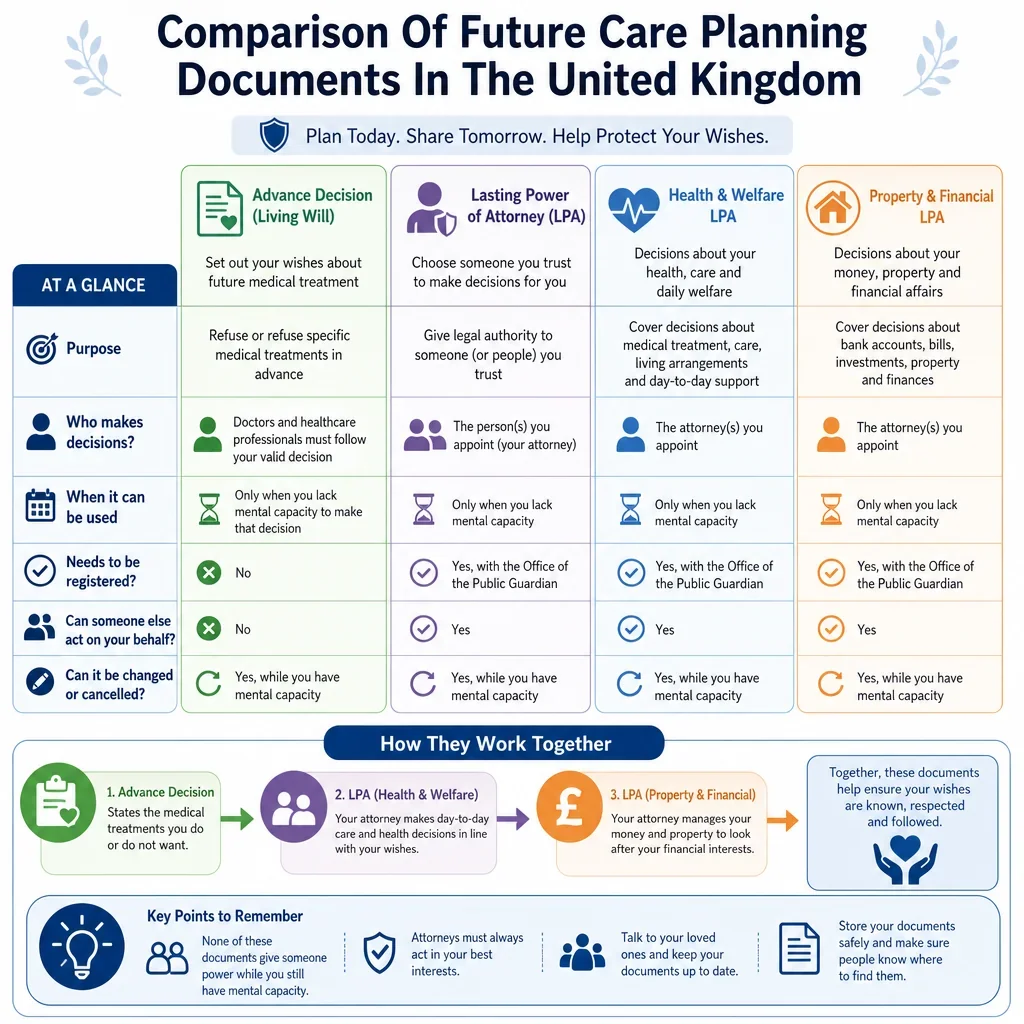
John Michael Smith confirms that he has been made aware of the option to create a Lasting Power of Attorney for health and welfare.
6REVOCATION OF PREVIOUS DECISIONS
John Michael Smith hereby revokes all previous advance decisions that he has made.
This Advance Decision shall not revoke any existing health and welfare lasting power of attorney which shall remain in effect.
No property and financial lasting power of attorney exists in respect of John Michael Smith.
No welfare deputyship exists in respect of John Michael Smith.
7LASTING POWER OF ATTORNEY
No health and welfare Lasting Power of Attorney has been made. If one exists or is made in the future, it takes precedence where applicable.
8NON-BINDING WISHES AND PREFERENCES
The following are non-binding wishes and preferences. They are not legally binding refusals of treatment and do not form part of the Advance Decision to Refuse Treatment.
John Michael Smith wishes for full family involvement in all discussions regarding his care decisions.
John Michael Smith wishes for maximum privacy during medical examinations and treatments.
John Michael Smith wishes to receive care at home if possible.
John Michael Smith wishes for pain relief to be the highest priority in his care even if it shortens life.
John Michael Smith wishes for healthcare professionals to communicate with him by providing written materials.
9DURATION AND REVIEW
John Michael Smith wishes to review this Advance Decision at regular intervals.
John Michael Smith understands that this Advance Decision has no automatic expiry date and remains valid indefinitely unless revoked.
10LEGAL VALIDITY AND COMPLIANCE
John Michael Smith intends for this document to be a valid Advance Decision under the Mental Capacity Act 2005 (sections 24-26).
This Advance Decision is intended to apply in England and Wales only.
11DECLARATION
I John Michael Smith confirm that the statements and refusals contained in this document accurately reflect my wishes.
I have read and understood all of the information contained in this Advance Decision.
These refusals only apply if I lack capacity to make the specific decision at the time.
12ADDITIONAL INFORMATION
Specific treatments refused in more detail: antibiotics, dialysis, blood transfusions (as detailed in section 3).
Religious or value-based statements: None provided.
13EXECUTION
This Advance Decision was executed on 2023-10-05.
14SIGNATURE OF THE MAKER
Signed by John Michael Smith on the date specified above in the presence of the witnesses whose details appear below.
15WITNESSES
This Advance Decision was signed by John Michael Smith in our presence and we confirm that he appeared to have capacity to make this Advance Decision, that he understood the purpose and effect of this Advance Decision at the time of signing, and that the two witnesses are independent of each other and not the appointed attorney or related to the maker.
The first witness is Johnathan Smith of 123 High Street, London, SW1A 1AA.
The second witness is Emily Johnson of 456 Oak Road, Manchester, M1 1AA.
This Advance Decision was signed and dated by the maker and witnesses on the same date with full names, addresses and signatures referenced.
16SIGNATURE OF WITNESSES
Signed by the first witness on the date of execution of this Advance Decision.
Signed by the second witness on the date of execution of this Advance Decision.
This example shows approximately 70% of a typical document and is provided for illustrative purposes only. The remaining content has been omitted.
Every document generated by Docaro is tailored to your specific circumstances, jurisdiction and the information you provide. The completed document includes all applicable clauses and provisions required for your situation.
To generate the full, personalised document, answer a short series of questions and your document will be created instantly.
Useful Resources When Considering a Advance Decision in the United Kingdom
United Kingdom Reference Legislation
Advance Decision FAQs
Document Generation FAQs
Related Articles