Docaro

AI Generated British Notice to Quit - 2026 Updated

A photorealistic image depicting a professional landlord and tenant in a modern UK apartment, shaking hands over a lease agreement in a living room, symbolizing the eviction notice process without showing any legal documents directly. The scene conveys a sense of formal negotiation in a residential setting, with British elements like a Union Jack flag subtly in the background. No children are present.
Effortlessly create a legally compliant Notice to Quit with our AI-driven document service in the UK.
Free instant document creation.
Legally compliant agreements.
No signup required.
Generate your document for free.
Download PDF, Word and email for $4.99 USD.

Generate Your Section 21 Notice in 4 Easy Steps

1
Answer a Few Questions
Our AI guides you through the info required.
2
Generate Your Document
Docaro builds the document based on your requirements.
3
Review & Edit
Review your document and submit any further requested changes.
4
Download & Sign
Download your ready to sign document as a PDF, Word, Txt or HTML.

Why Use Our AI Section 21 Notice Generator?

Fast Generation
Quickly generate a comprehensive Section 21 Notice, eliminating the hassle and time associated with traditional document drafting.
Guided Process
Our user-friendly platform simplifies the document creation process, enabling you to complete agreements with just a few clicks.
Professionally Formatted Document
Your Section 21 Notice will be formatted to professional standards, including headings, clause numbers and structured layout. No further editing is required.
High Accuracy
Our AI ensures high accuracy by using advanced algorithms to craft agreements that perfectly cater to your specific requirements.
Compliance with British Law
Rest assured that all generated documents meet the latest legal standards and regulations of the United Kingdom, enhancing trust and reliability.
Cost-Effective
Save money by generating legally sound tenancy agreements without the need for expensive legal services or consultations.
Get Started for Free - No Sign Up Required
No payment or sign up is required to start generating your Section 21 Notice. Simply answer a few questions and a preview of your final document will be generated.
Looking to Generate a Section 21 Notice in a Different Country?
Choose a different country:

Compliance Legislation

Your AI Generated Section 21 Notice will be checked for compliance against the following legislation and regulations:
Primary legislation governing assured shorthold tenancies (ASTs) in England and Wales, including provisions for serving notices to quit or end tenancies, such as Section 21 (no-fault eviction) and Section 8 notices for grounds of possession.
Regulates tenancy agreements, including implied terms for repairs and notices, applicable to most residential tenancies in England and Wales.
Prohibits unlawful eviction and harassment, requiring valid notices to end tenancies and court orders for possession in England and Wales.
Amends tenancy notice periods and procedures, including reducing Section 21 notice periods to 2 months for assured shorthold tenancies in England.
Governs private residential tenancies in Scotland, including requirements for end of tenancy notices (e.g., 28 days' notice by landlord).
Introduces the private residential tenancy model in Scotland, specifying notice periods and grounds for ending tenancies.
Applies to tenancies in Northern Ireland, covering notices to quit and possession proceedings similar to England and Wales.
Regulates controlled tenancies in Northern Ireland, including notice requirements for termination.

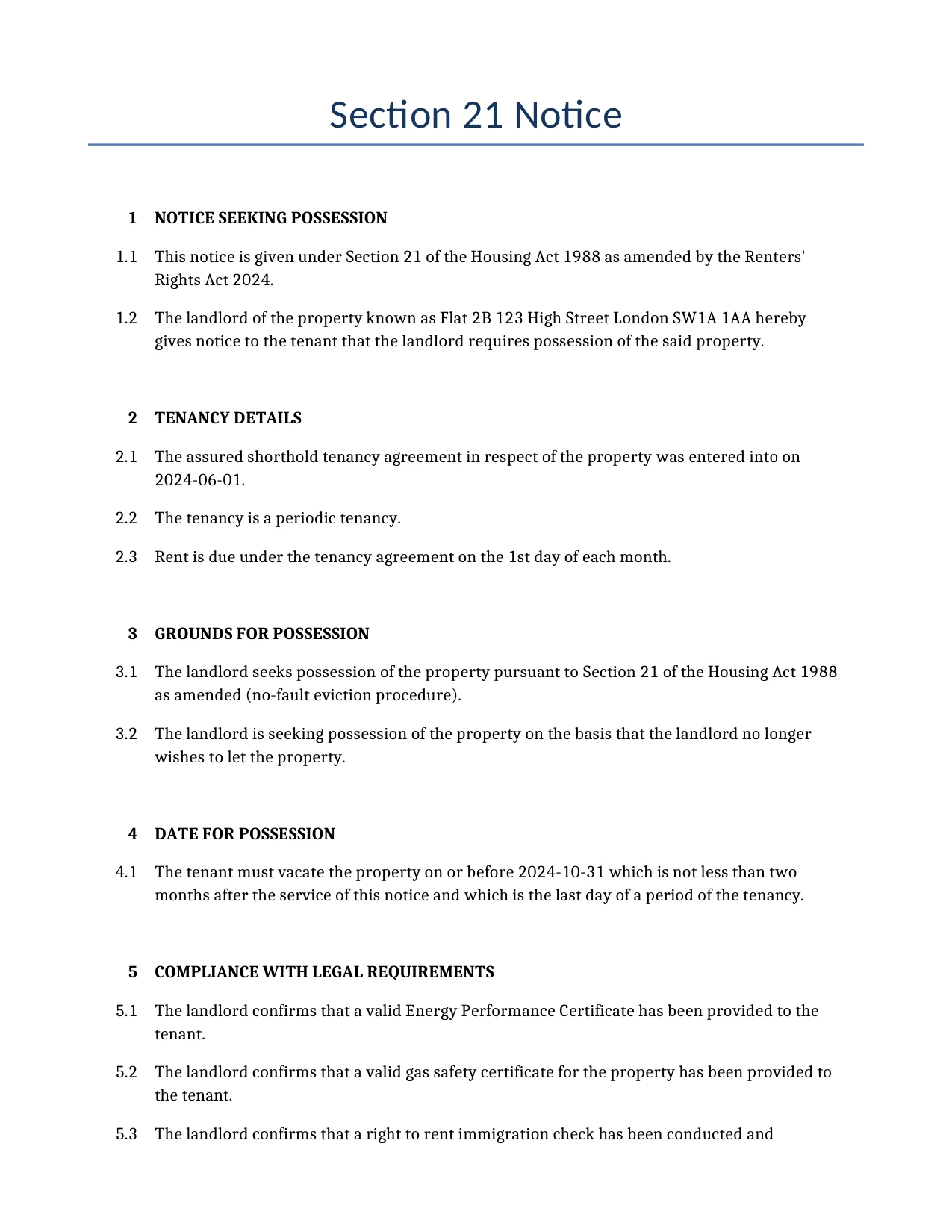
Example Section 21 Notice

Below is an example of a Section 21 Notice generated by our AI model. The clauses in your Section 21 Notice will vary from this example as they will be entirely bespoke to your requirements as set out in the questionnaire you complete.
Page 1

What is a Section 21 Notice in the United Kingdom?

A Section 21 Notice is a legal document used by landlords in the UK to evict tenants without providing a reason, commonly known as a no-fault eviction. Under the Housing Act 1988, this notice serves as a key tool for regaining possession of a property at the end of a tenancy agreement. Its purpose is to allow landlords to end an assured shorthold tenancy (AST) efficiently, provided the correct procedures are followed.

Within the AST framework, the Section 21 Notice plays a central role by enabling landlords to terminate the tenancy after the fixed term expires or during a periodic tenancy. It must be served with at least two months' notice, and tenants have the right to challenge it if the landlord has not complied with legal requirements, such as protecting the deposit or providing gas safety certificates. This mechanism balances landlord rights with tenant protections in UK housing law.

  • Legal basis: Primarily outlined in Section 21 of the Housing Act 1988, as amended by subsequent legislation like the Deregulation Act 2015.
  • Key requirements: Landlords must use the prescribed form and ensure no retaliatory eviction grounds apply, per guidance from the UK government.
  • Recent reforms: Note that the Renters (Reform) Bill proposes changes that may abolish Section 21 notices in the future.

When should a Section 21 Notice be used and when should it not?

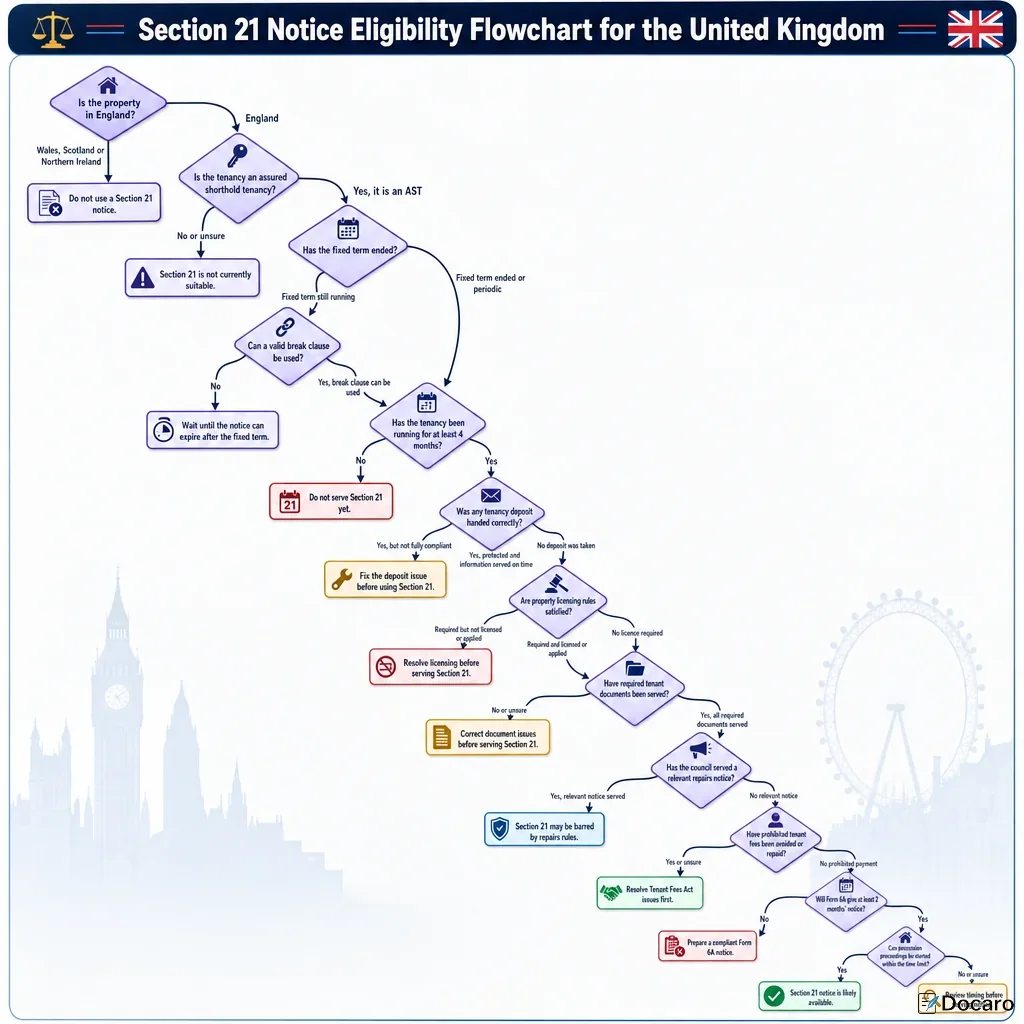
A Section 21 Notice, often called a no-fault eviction notice under the Housing Act 1988, is appropriate for landlords seeking to end an Assured Shorthold Tenancy (AST) without proving tenant fault. For instance, it can be used after the fixed term of the AST has expired, allowing the landlord to regain possession typically after two months' notice. It is also suitable during a periodic tenancy, such as a rolling monthly agreement, where the landlord wishes to terminate without allegations of rent arrears or anti-social behavior. This process streamlines evictions for legitimate reasons like selling the property or moving in personally, as outlined in GOV.UK guidance on Section 21 notices.

However, a Section 21 Notice should not be used during the first four months of a new tenancy to prevent abuse by landlords, as per amendments in the Deregulation Act 2015. It is invalid if the tenant's deposit has not been protected in an approved scheme or if the prescribed information was not provided within 30 days, rendering the notice unenforceable under the Housing Act 2004. Additionally, it cannot be served in cases of retaliatory evictions, where the notice follows tenant complaints about property conditions, protected by the Deregulation Act 2015 which prohibits such actions if the local authority deems the eviction retaliatory.

To ensure compliance, landlords must avoid using Section 21 in prohibited scenarios, such as tenancies involving certain student accommodations or when a possession order is already in place. Failure to adhere to these rules can lead to court rejection of the eviction, emphasizing the need for legal advice. For detailed rules, refer to the official legislation on Section 21 from the UK Parliament website.

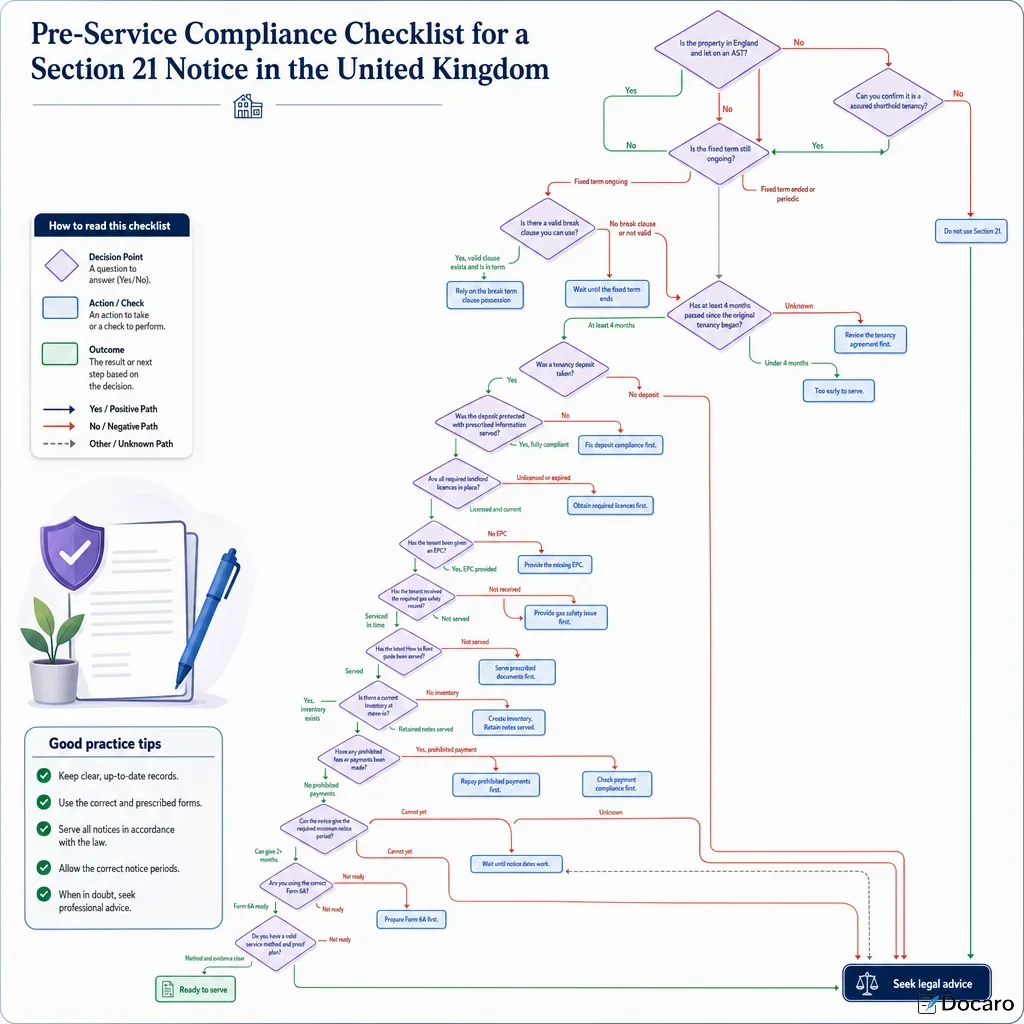
"Landlords must ensure all statutory prerequisites under the Housing Act 1988 are fully satisfied before serving a Section 21 notice, as any failure risks invalidation and potential legal challenges," states the UK Government's Housing guidance (2023). Recommendation: Always verify compliance with requirements like deposit protection and gas safety certificates prior to issuance.
Solicitor reviewing Section 21 notice

What are the key clauses in a Section 21 Notice document?

A Section 21 Notice, also known as a no-fault eviction notice under UK housing law, requires specific essential clauses to ensure its validity and enforceability. The first crucial clause is the property address, which must be clearly stated to identify the exact rental premises involved, preventing any ambiguity that could invalidate the notice. Including this detail is vital because courts require precise identification to confirm the notice applies to the correct tenancy, as outlined in GOV.UK guidance on Section 21 notices.

Next, the notice must include the tenant names (or all joint tenants) to specify who is being evicted, ensuring the document is personalized and legally binding on the correct parties. Omitting or misstating names can lead to the notice being deemed invalid, as it fails to properly serve the intended recipients under the Housing Act 1988. This clause is essential for compliance with tenancy agreement terms and to avoid challenges during possession proceedings.

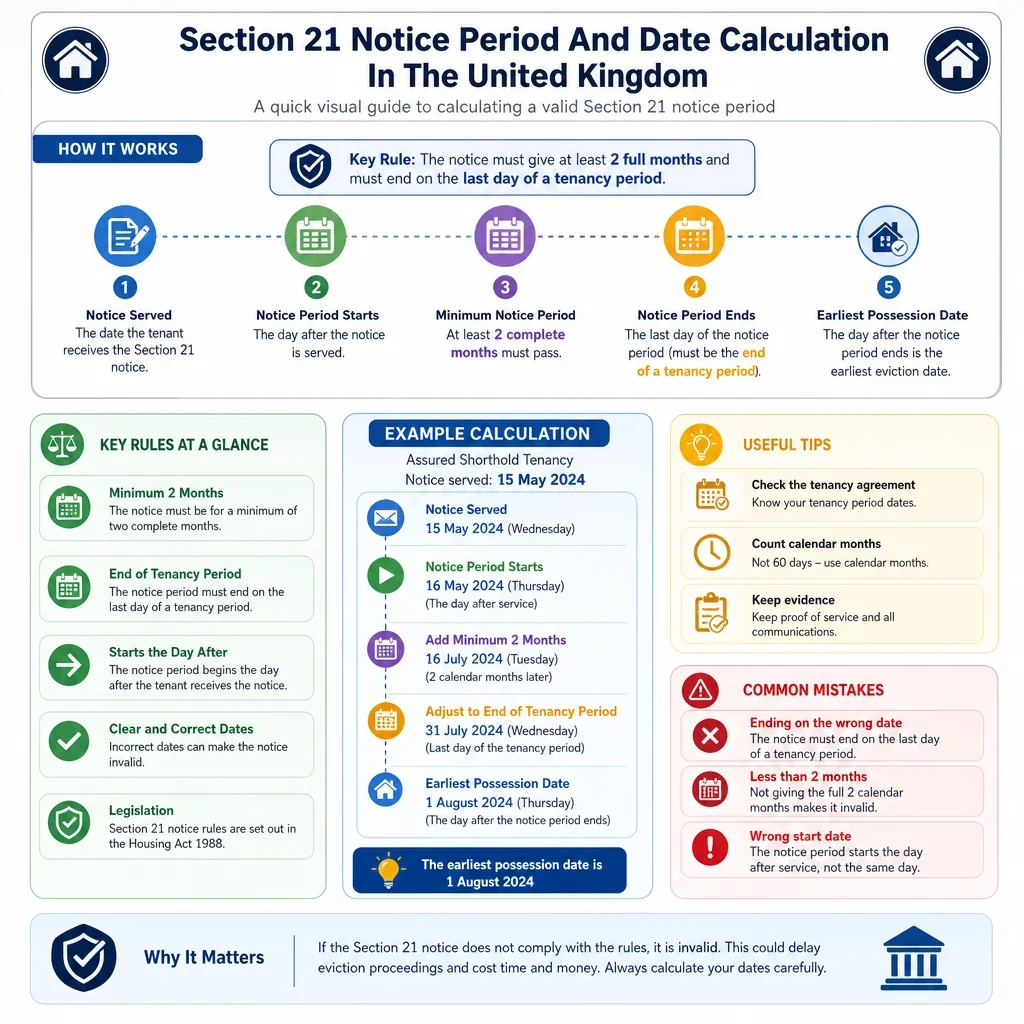
The notice period, typically two months, and the expiry date must be explicitly mentioned, allowing tenants sufficient time to vacate while setting a clear deadline for possession. These elements are crucial because failing to provide the statutory minimum period or an accurate end date can render the notice void, delaying eviction processes.

How do these clauses ensure compliance?

Properly drafted key clauses in a Section 21 notice are essential for ensuring compliance with legal requirements under the Housing Act 1988, as they clearly outline the eviction process and tenant rights. By including precise details such as the notice period, property address, and termination date, these clauses minimize ambiguities that could lead to tenant challenges or court dismissals. For basics of Section 21 notice compliance, refer to our landlord's guide for a comprehensive overview.

Key clauses like the prescribed form requirements and deposit protection confirmations reduce the risk of invalidation, as courts often scrutinize these for adherence to the Deregulation Act 2015. Without them, landlords may face delays or penalties, emphasizing the need for accurate drafting to avoid disputes. Authoritative guidance from the UK Government's eviction rules page underscores how such precision supports Section 21 eviction compliance.

  • Notice Period Clause: Specifies the required 2 months' notice, preventing premature evictions.
  • Deposit Clause: Confirms protection within a government-approved scheme, averting legal pitfalls.
  • Termination Clause: Clearly states the end of the tenancy, reducing court challenges on validity.
Tenant receiving eviction notice

What are the key rights and obligations of landlords and tenants regarding Section 21 Notices?

In the UK rental market, landlords have key obligations such as serving a valid notice to end a tenancy and protecting tenants' deposits in a government-approved scheme within 30 days of receipt. This ensures tenants' security and compliance with the Housing Act 2004. Tenants, in turn, have the right to at least two months' notice under a Section 21 eviction and can challenge invalid notices through legal channels, safeguarding against unfair evictions. For detailed guidance on how to serve Section 21 notice correctly in the UK, refer to authoritative resources.

Mutual obligations include both parties maintaining the property to ensure a safe and habitable living environment, as outlined in the Landlord and Tenant Act 1985. Landlords must handle repairs for structural issues, while tenants are responsible for day-to-day upkeep and reporting damages promptly. These shared duties promote harmonious tenancies and can be further explored on the official Gov.uk How to Rent guide for comprehensive UK tenancy rights.

Gavel and legal eviction papers

Are there any key exclusions or restrictions for Section 21 Notices?

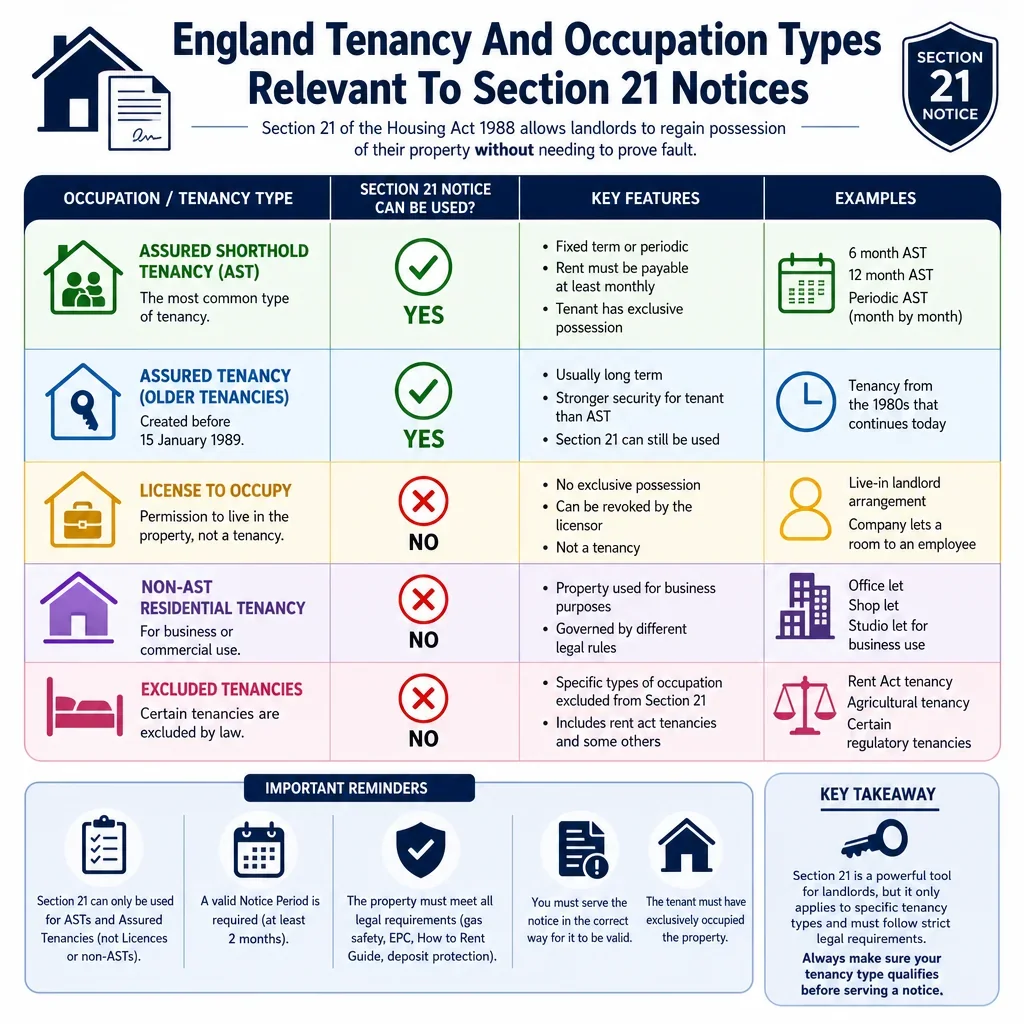
Section 21 evictions, a key tool for landlords in the UK to regain possession of rental properties without cause, come with several key exclusions that prevent their use in specific scenarios. For instance, tenancies in shared houses with resident landlords fall under the more protective assured shorthold tenancy rules, requiring alternative eviction grounds. Similarly, holiday lets and short-term accommodations are excluded as they do not qualify as standard residential tenancies under the Housing Act 1988.

Another critical restriction is the ban on using Section 21 within six months of a previous eviction notice if the tenant remains in the property, aimed at preventing abuse of the process. This "six-month rule" ensures landlords cannot repeatedly issue notices to pressure tenants. For detailed guidance, refer to the official UK Government guidance on Section 21 notices.

  • Student accommodations: Often exempt if they are licensed halls of residence or purpose-built for educational purposes, falling outside standard Section 21 applicability.
  • Other exclusions: Properties let under the Rent Act 1977 or those with specific local authority tenancies also prohibit Section 21 use.

What recent or upcoming legal changes affect Section 21 Notices?

The UK rental market has undergone significant shifts in recent years, particularly with temporary restrictions during the COVID-19 pandemic that limited evictions to protect tenants facing financial hardships. These measures, including bans on most eviction notices from March 2020 to June 2021, aimed to provide stability amid economic uncertainty. Landlords could only pursue evictions under specific grounds like serious anti-social behavior, highlighting a temporary pivot towards tenant safeguards in the private rented sector.

Looking ahead, the Renters (Reform) Bill, introduced in 2024, promises major reforms by abolishing Section 21 notices—no-fault evictions that allowed landlords to end tenancies without reason—and replacing them with expanded Section 8 evictions requiring just cause. This change seeks to enhance tenant security while maintaining landlord rights for issues like rent arrears or property damage. As of 2023, the bill was in development stages, with full implementation expected post-2024 elections; for the latest status, check authoritative sources like the UK government's housing updates.

Always verify current rental laws, as reforms in the private rented sector can evolve rapidly; consulting a legal expert or the latest parliamentary updates is recommended for accurate eviction notice advice.

How can landlords avoid common mistakes with Section 21 Notices?

1
Verify Eligibility
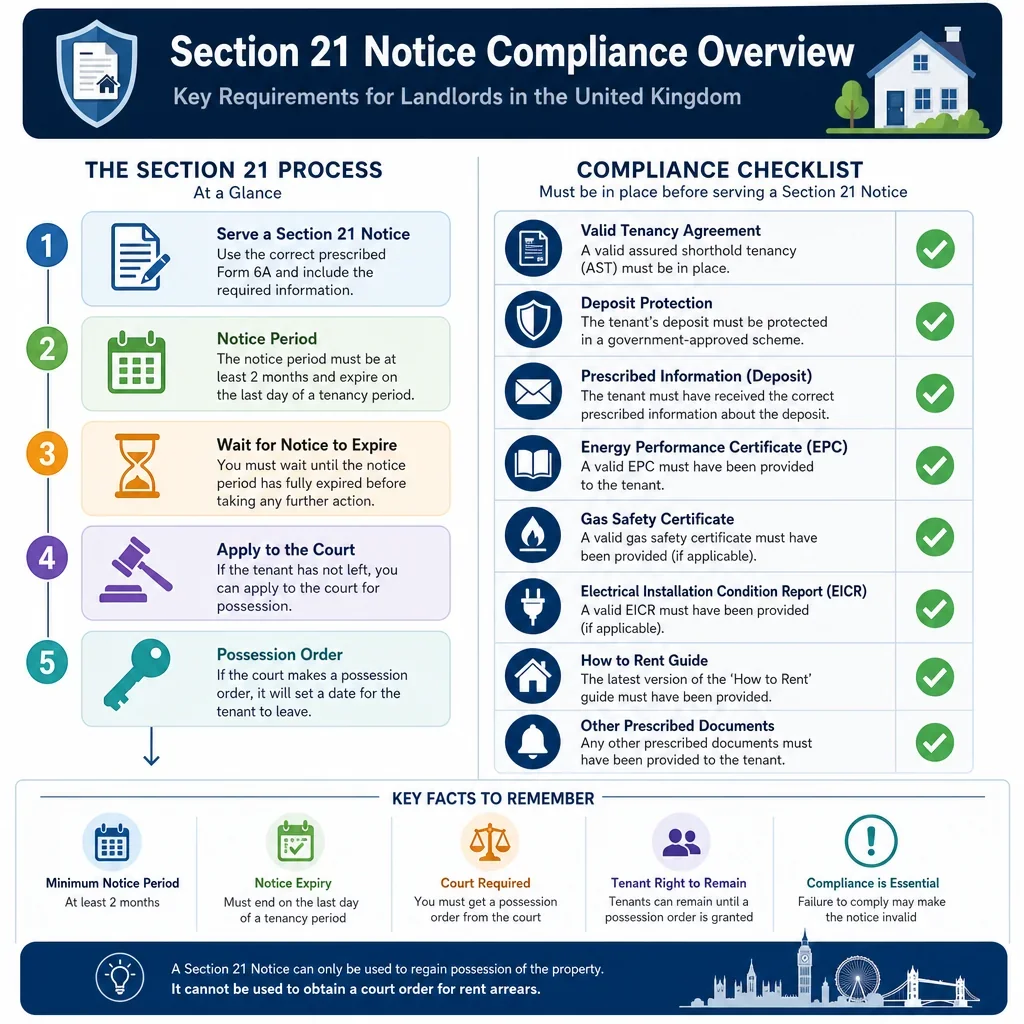
Confirm you meet all Section 21 requirements: valid tenancy deposit protection, gas safety certificate, EPC, and How to Rent guide provided to tenant.
2
Draft the Notice
Use the correct prescribed form for Section 21 notice, specifying the possession date at least 2 months from service.
3
Serve Properly
Deliver the notice in person, by post, or leave at the property; obtain proof of service like recorded delivery receipt.
4
Prepare for Proceedings
If tenant doesn\'t vacate, file for possession at court. Avoid errors by reviewing common mistakes at /en-gb/a/common-mistakes-section-21-evictions-avoid.

Section 21 Notice FAQs

A Section 21 Notice, also known as an eviction notice or no-fault eviction notice, is a legal document under the Housing Act 1988 that allows landlords in England and Wales to regain possession of a rental property at the end of an assured shorthold tenancy (AST) without providing a reason. It's commonly used for end-of-tenancy evictions.

Document Generation FAQs

Docaro is an AI-powered legal document generator that helps you create fully formatted, legally sound contracts and agreements in minutes. Just answer a few guided questions and download your document instantly.
You Might Also Be Interested In
Residential Rental Agreement
Room Rental Agreement
House Share Agreement
Rent Increase Notice
Lodger Agreement

Related Articles

A photorealistic image of a professional landlord in a modern rental property, standing confidently in a well-lit apartment with keys in hand, symbolizing property management and tenancy processes, no legal documents visible.
Learn all about Section 21 notices as a landlord. This comprehensive guide covers how to issue them correctly, legal requirements, and common pitfalls to avoid in the UK housing market.
A photorealistic image of a professional landlord or letting agent in a modern UK rental property, such as a cozy apartment, handing over keys to an adult tenant during a move-out process, symbolizing the end of a tenancy agreement. The scene conveys a sense of smooth transition and compliance with legal procedures, with natural lighting and realistic details. No children are present in the image.
Learn how to serve a Section 21 notice correctly in the UK with our step-by-step guide. Ensure compliance with housing laws to avoid invalid evictions and legal issues for landlords.
A photorealistic image of a stressed adult tenant packing boxes in a modest apartment, with an eviction notice subtly in the background on a table, symbolizing the challenges of Section 21 evictions. The scene conveys a sense of urgency and the need to avoid common mistakes, focusing on an adult individual in a real-life setting without any children present.
Discover the most common mistakes landlords make with Section 21 evictions and learn practical tips to avoid them. Ensure compliance with UK housing laws for a smooth process.