AI Generated Business Continuity Plan for use in the United Kingdom
PDF & Word - 2026 Updated
Docaro Pricing
When do you need a Business Continuity Plan in the United Kingdom?
British Legal Rules for a Business Continuity Plan
Failing to tailor the business continuity and disaster recovery plan to your organization's specific risks and regulatory requirements may leave critical vulnerabilities unaddressed.
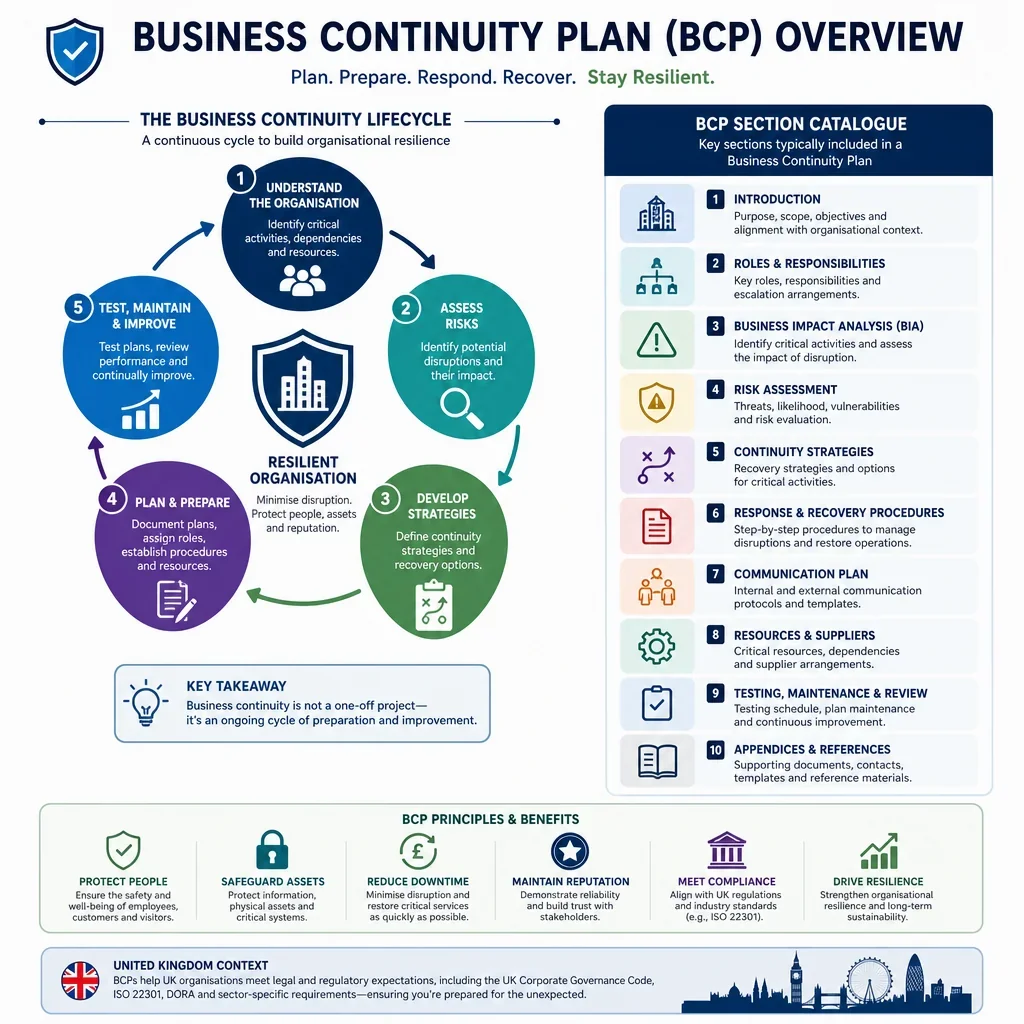
What a Proper Business Continuity Plan Should Include
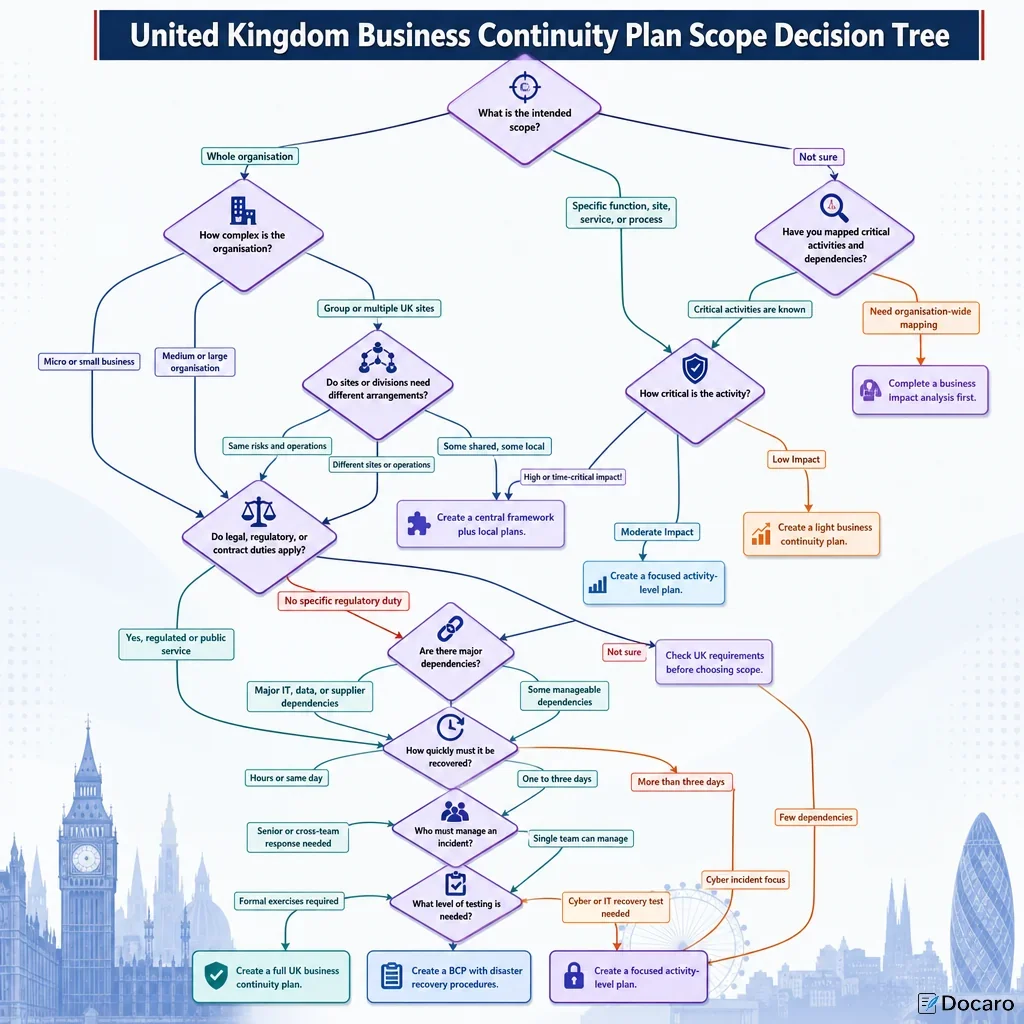
- Introduction and ScopeThis section outlines the plan's purpose, covers the entire organisation, and identifies key risks like natural disasters or cyber attacks.
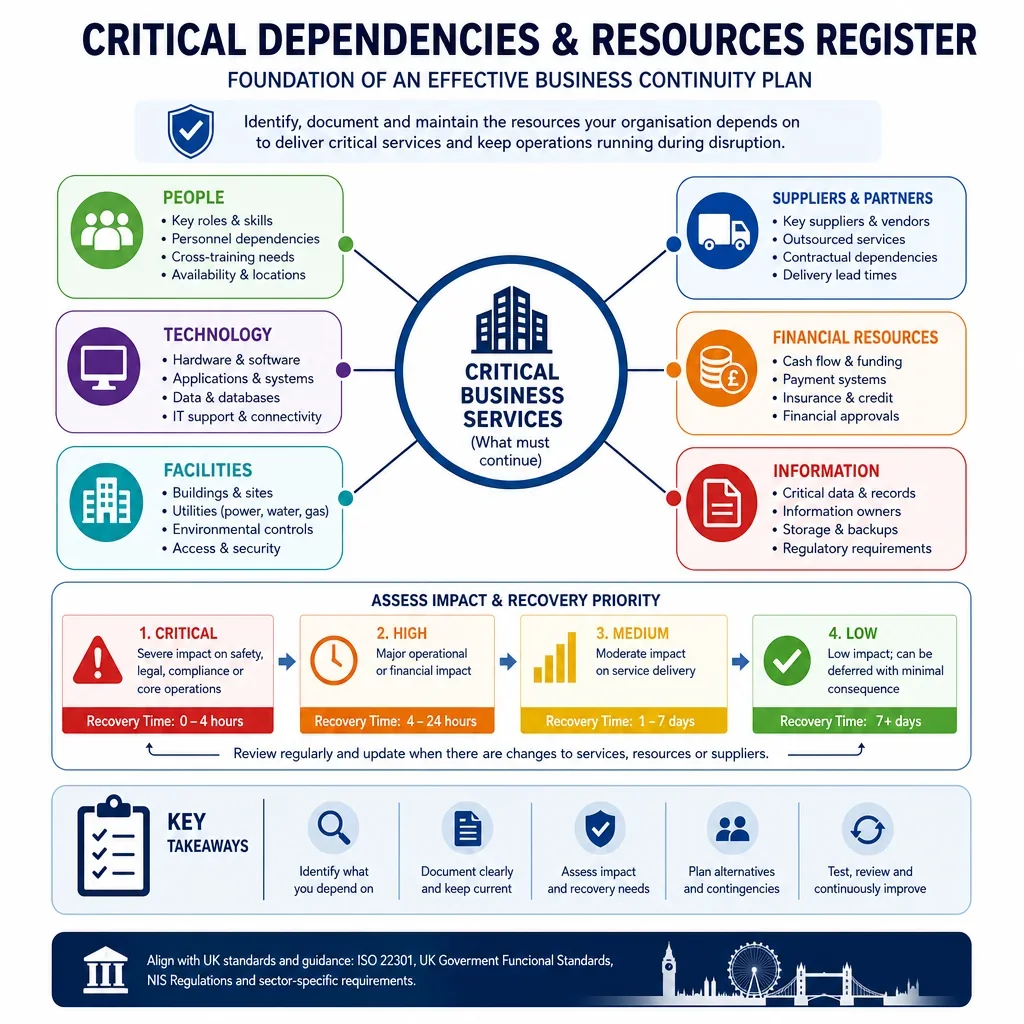
- Business Impact AnalysisIt assesses the potential effects of disruptions on operations, prioritising critical functions and resources to minimise losses.
- Risk AssessmentThis identifies potential threats and evaluates their likelihood and impact to guide protective measures.
- Recovery StrategiesDetailed steps are provided for restoring essential services, including backup systems and alternative work arrangements.
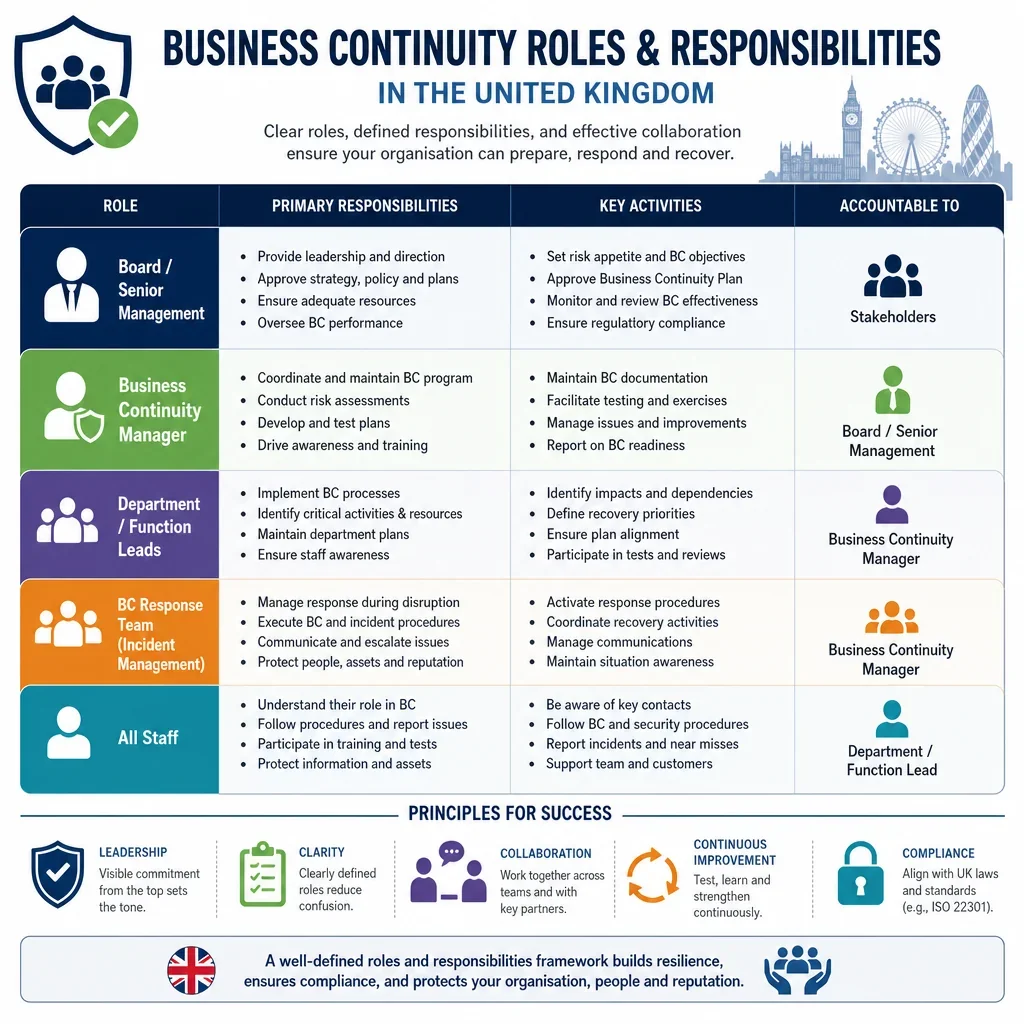
- Roles and ResponsibilitiesClear assignments of duties to team members ensure everyone knows their part during a disruption.
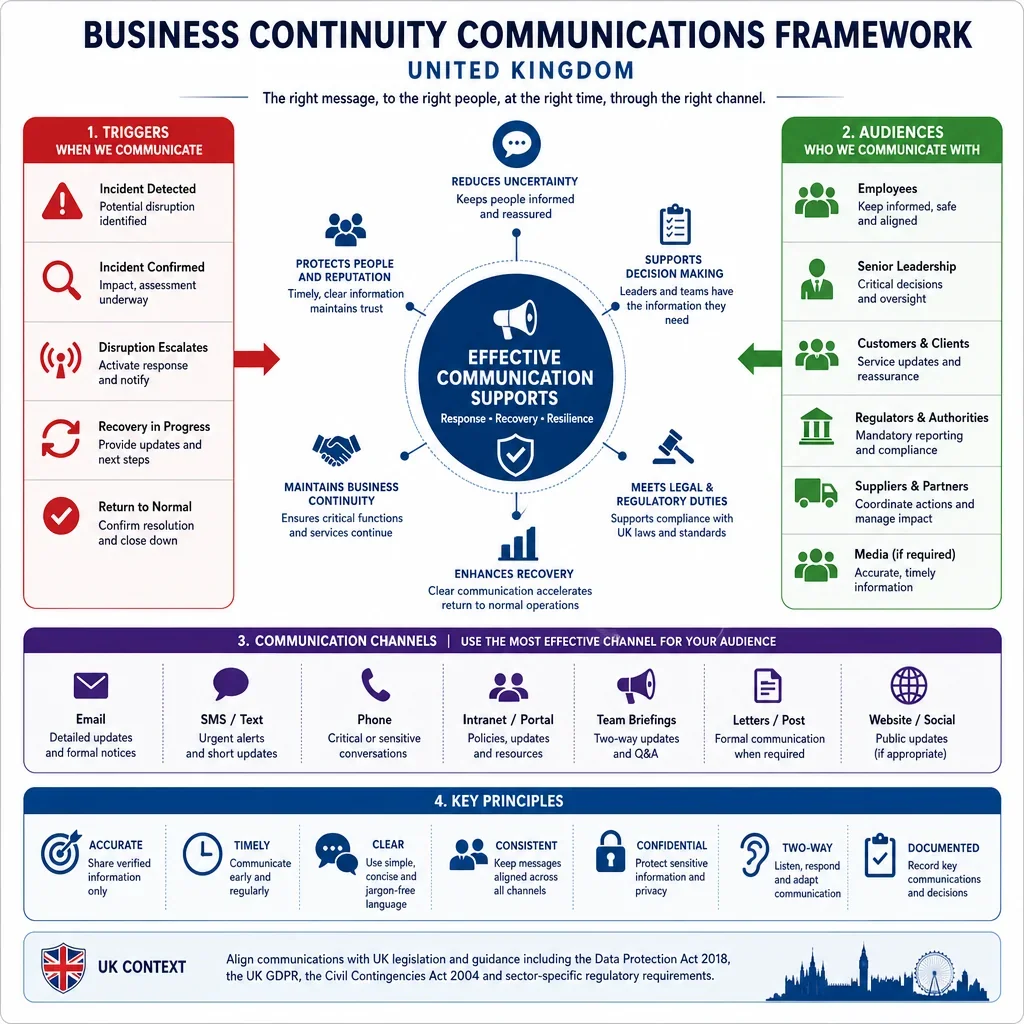
- Communication PlanGuidelines for internal and external messaging keep stakeholders informed and coordinated during an incident.
- Training and AwarenessRegular programmes educate staff on the plan, ensuring readiness and effective response.
- Testing and MaintenanceScheduled drills and reviews keep the plan up-to-date and effective against evolving risks.
Generate Your Document in 4 Easy Steps
Why Use Docaro?
 United Kingdom
Free Example Business Continuity Plan Template
Below is a free template example of a Business Continuity Plan for use in the United Kingdom generated by our AI model.
The clauses in your actual Business Continuity Plan will vary from this example as they will be entirely bespoke to your requirements as set out in the questionnaire you complete.
Business Continuity Plan for ABC Ltd
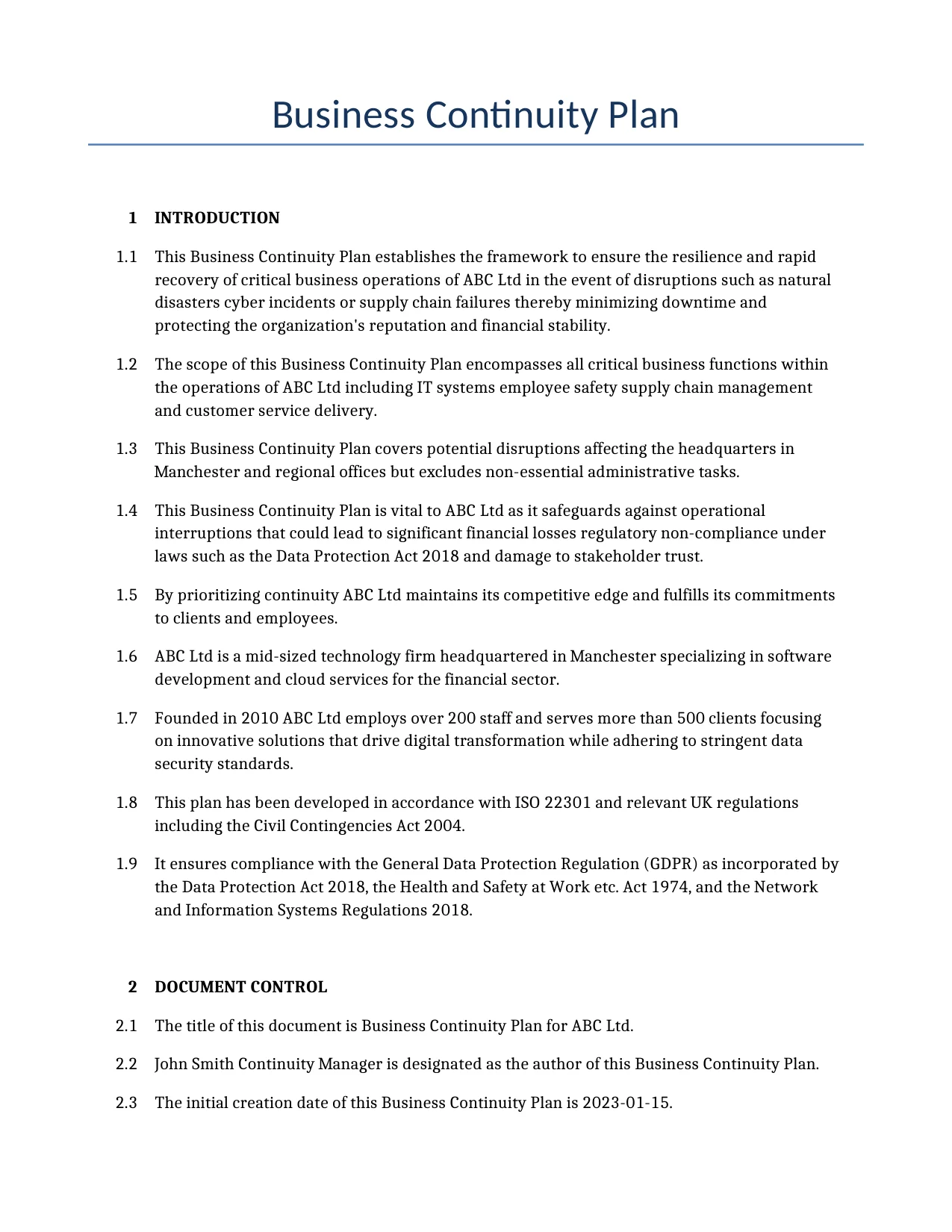
1INTRODUCTION
This Business Continuity Plan establishes the framework to ensure the resilience and rapid recovery of critical business operations of ABC Ltd in the event of disruptions such as natural disasters cyber incidents or supply chain failures thereby minimizing downtime and protecting the organization's reputation and financial stability.
The scope of this Business Continuity Plan encompasses all critical business functions within the operations of ABC Ltd including IT systems employee safety supply chain management and customer service delivery.
This Business Continuity Plan covers potential disruptions affecting the headquarters in Manchester and regional offices but excludes non-essential administrative tasks.
This Business Continuity Plan is vital to ABC Ltd as it safeguards against operational interruptions that could lead to significant financial losses regulatory non-compliance under laws such as the Data Protection Act 2018 and damage to stakeholder trust.
By prioritizing continuity ABC Ltd maintains its competitive edge and fulfills its commitments to clients and employees.
ABC Ltd is a mid-sized technology firm headquartered in Manchester specializing in software development and cloud services for the financial sector.
Founded in 2010 ABC Ltd employs over 200 staff and serves more than 500 clients focusing on innovative solutions that drive digital transformation while adhering to stringent data security standards.
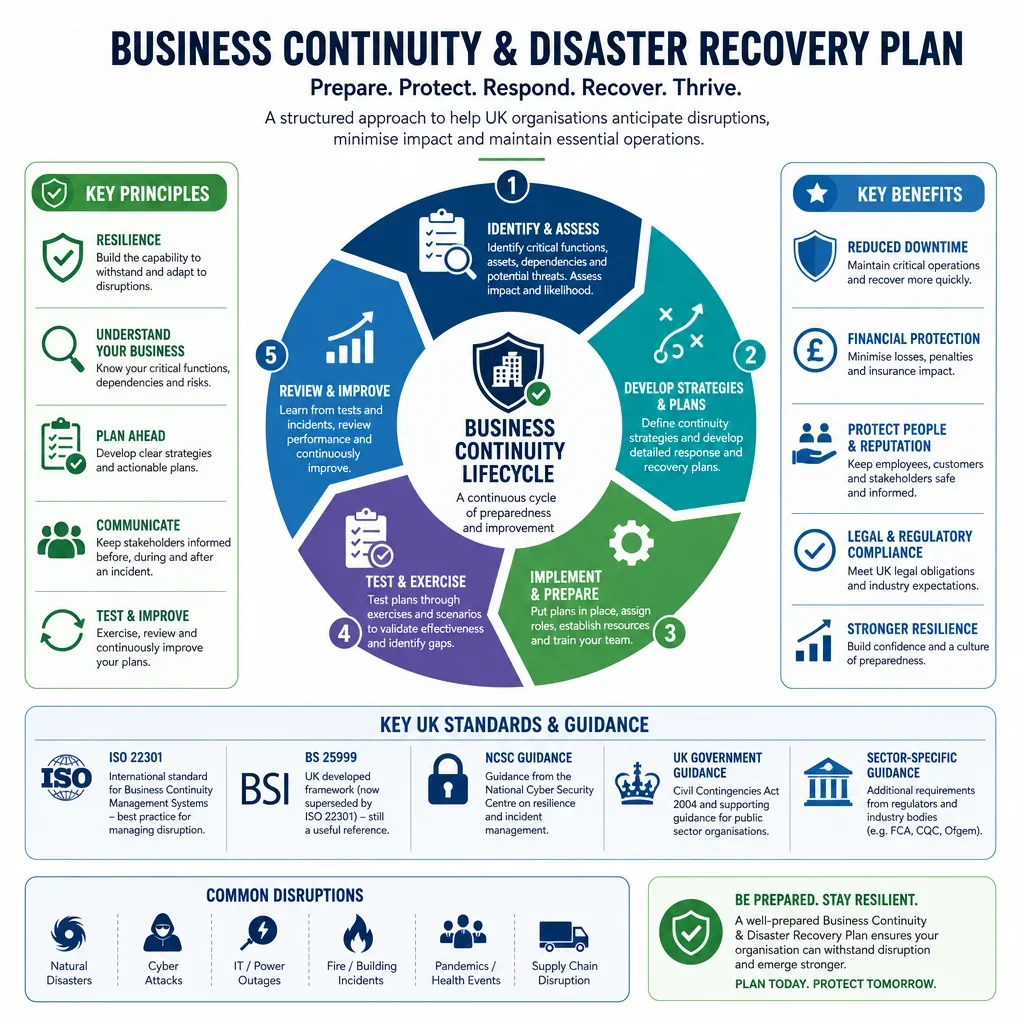
This plan has been developed in accordance with ISO 22301 and relevant UK regulations including the Civil Contingencies Act 2004.
It ensures compliance with the General Data Protection Regulation (GDPR) as incorporated by the Data Protection Act 2018, the Health and Safety at Work etc. Act 1974, and the Network and Information Systems Regulations 2018.
2DOCUMENT CONTROL
The title of this document is Business Continuity Plan for ABC Ltd.
John Smith Continuity Manager is designated as the author of this Business Continuity Plan.
The initial creation date of this Business Continuity Plan is 2023-01-15.
The latest approval date of this Business Continuity Plan is 2024-03-20.
The Senior Management Board is the approving authority for this Business Continuity Plan.
The version numbering scheme for this Business Continuity Plan is Sequential Numbering.
The current version number of this Business Continuity Plan is 1.
The distribution methods for this Business Continuity Plan are Email Distribution and Secure Portal Access.
The distribution list for this Business Continuity Plan includes Senior Management Department Heads IT Team and Legal Department.
This Business Continuity Plan requires an annual review.
Updates to this Business Continuity Plan shall be initiated by the Continuity Manager upon identification of changes in business processes risks or regulations.
Proposed changes to this Business Continuity Plan will be reviewed by the Senior Management Board and documented in the version history.
The Continuity Management Team is responsible for maintaining this Business Continuity Plan.
This Business Continuity Plan was developed on 2023-01-15.
3BUSINESS IMPACT ANALYSIS
The name of the business is ABC Ltd.
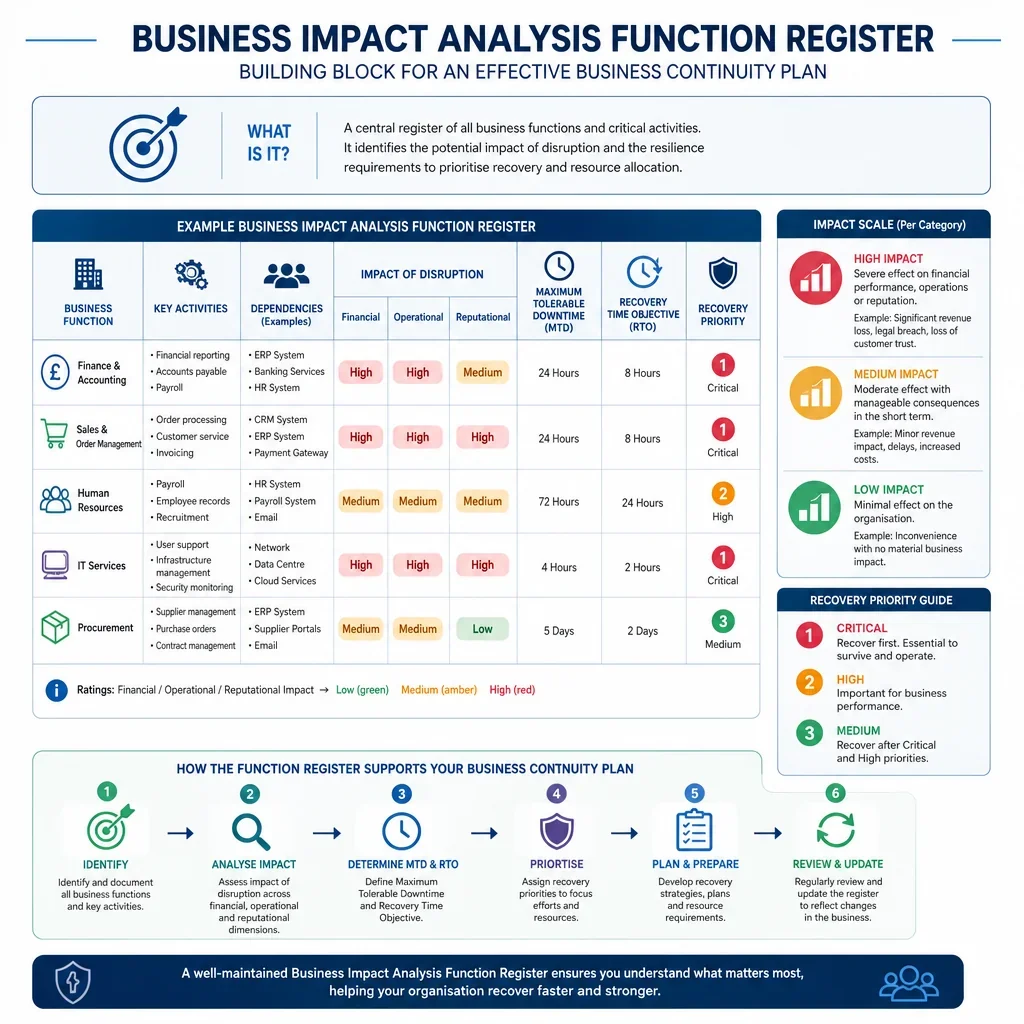
The critical business functions of ABC Ltd are Finance and Accounting IT and Data Management and Sales and Marketing.
Finance and Accounting handles all financial transactions budgeting and reporting.
IT and Data Management manages servers databases and software applications essential for operations.
Sales and Marketing drives customer acquisition through digital campaigns and sales pipelines.
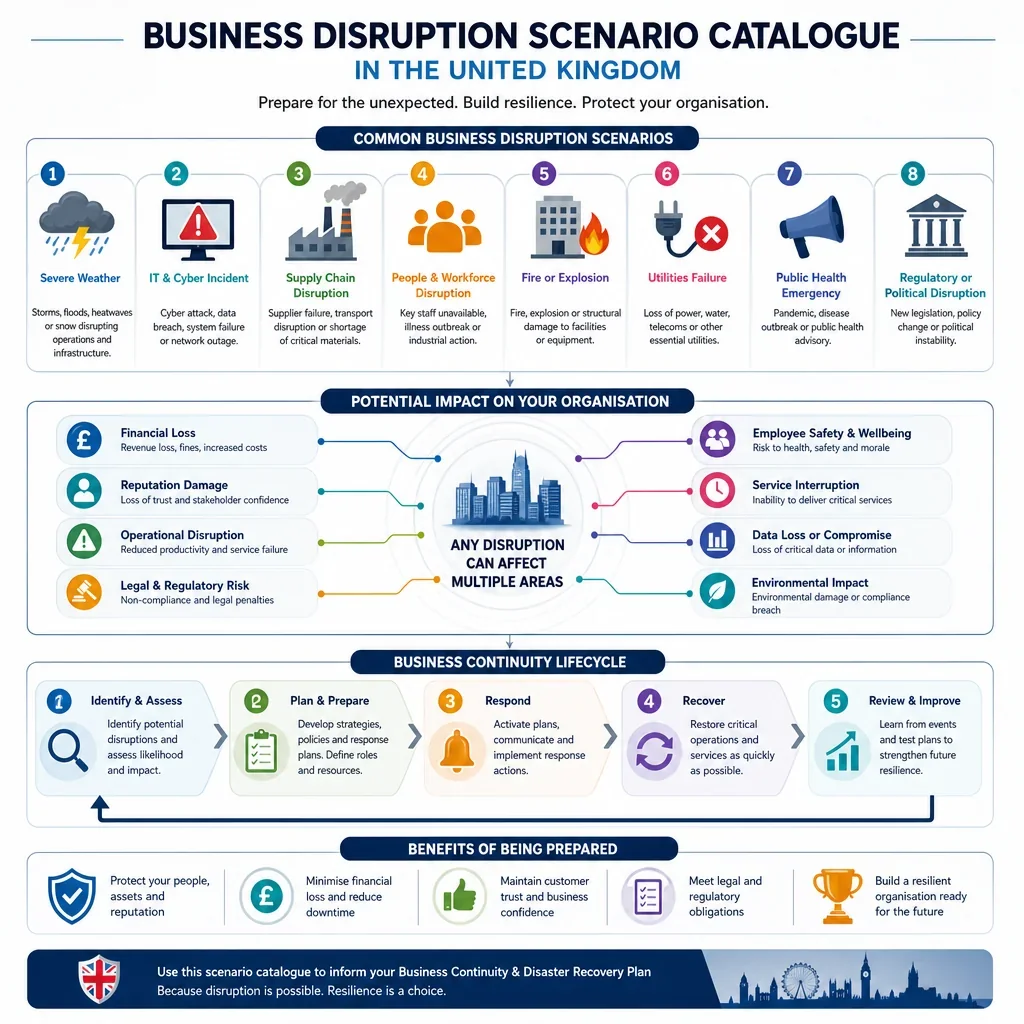
The types of disruptions that could affect the critical business functions are Cyber Attack Power Outage and Supply Chain Failure.
A Cyber Attack could lead to data breaches halting IT operations and exposing financial data.
A Power Outage would disrupt all functions preventing access to systems and sales activities.
A Supply Chain Failure affects Sales and Marketing by delaying product deliveries reducing revenue.
The estimated financial loss per day is 10000 GBP for Finance and Accounting 12000 GBP for IT and Data Management and 8000 GBP for Sales and Marketing.
The severity level of the impact for each disruption is High.
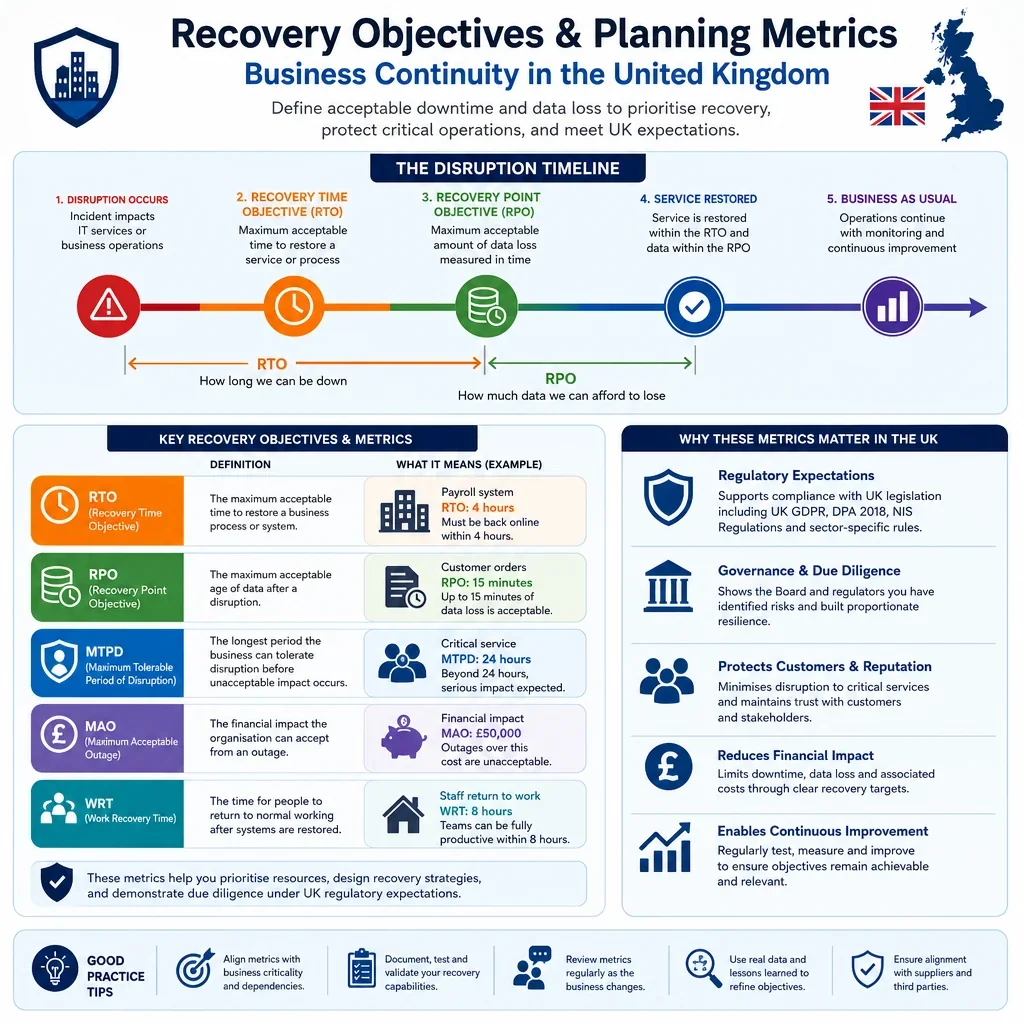
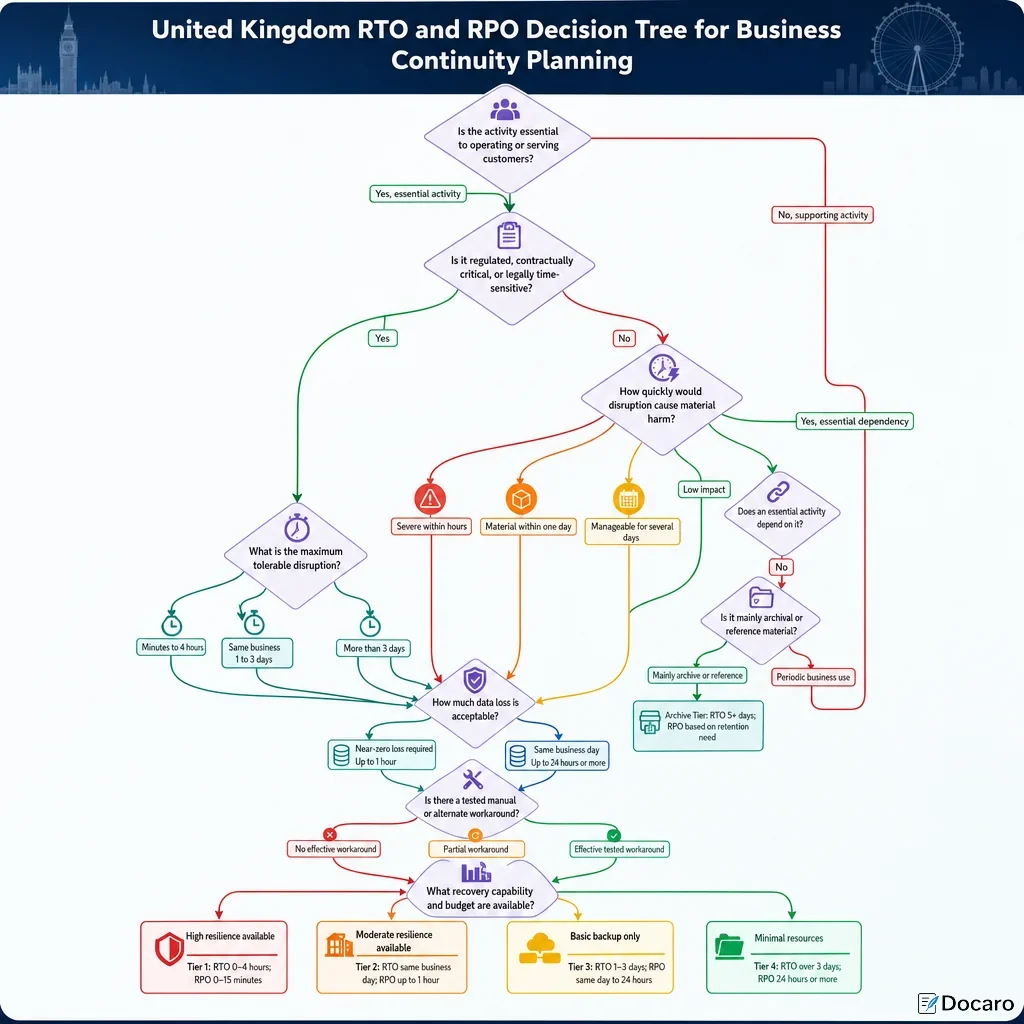
The maximum acceptable downtime in hours for each critical function known as the Recovery Time Objective is 4.
The maximum acceptable data loss in minutes for each critical function known as the Recovery Point Objective is 30.
The critical functions depend on external parties or suppliers.
The recovery priority for each critical function is High Priority.
Key dependencies include: Finance and Accounting relies on IT and Data Management for system access and external banking partners; IT and Data Management depends on cloud infrastructure providers and internal network systems with interdependency on Sales and Marketing data feeds; Sales and Marketing relies on IT systems for CRM access and external digital advertising platforms. Internal interdependencies center on data flow between functions while external dependencies include third-party cloud services and financial institutions.
For Finance and Accounting: RTO is 4 hours RPO is 15 minutes financial impact of downtime is 10000 GBP per day with dependencies on IT systems secure networks and external banking APIs. For IT and Data Management: RTO is 2 hours RPO is 5 minutes financial impact of downtime is 12000 GBP per day with dependencies on cloud providers power supply and internal server infrastructure. For Sales and Marketing: RTO is 4 hours RPO is 30 minutes financial impact of downtime is 8000 GBP per day with dependencies on CRM platforms digital marketing tools and customer databases managed by IT.
4RISK ASSESSMENT
The natural disasters that are potential threats to the organization are Flooding and Severe Weather Storms.
The cyber threats that the organization faces are Data Breaches and Phishing and Social Engineering.
The supply chain disruptions that could impact the organization are Geopolitical Events and Logistics Delays.
The organization complies with regulatory requirements for risk assessment.
Five critical vulnerable assets are the primary data center key personnel cloud infrastructure network infrastructure and customer data repositories.
The estimated annual financial exposure is 75000 GBP for natural disasters 50000 GBP for cyber threats and 25000 GBP for supply chain disruptions totaling 150000 GBP.
The overall priority level assigned to completing this Risk Assessment section is High.
Risk: Flooding (Natural Disaster). Likelihood: 2. Impact: 4. Risk score: 8. Existing controls: Flood barriers raised server rooms insurance coverage. Residual risk: Medium. Vulnerable assets: primary data center.
Risk: Severe Weather Storms (Natural Disaster). Likelihood: 3. Impact: 3. Risk score: 9. Existing controls: Backup generators weather monitoring alerts. Residual risk: Medium. Vulnerable assets: network infrastructure.
Risk: Data Breaches (Cyber Threat). Likelihood: 4. Impact: 5. Risk score: 20. Existing controls: Firewalls encryption intrusion detection multi-factor authentication. Residual risk: Medium. Vulnerable assets: customer data repositories.
Risk: Phishing and Social Engineering (Cyber Threat). Likelihood: 4. Impact: 4. Risk score: 16. Existing controls: Staff training email filters. Residual risk: High. Vulnerable assets: key personnel.
Risk: Geopolitical Events (Supply Chain). Likelihood: 2. Impact: 4. Risk score: 8. Existing controls: Supplier diversification contracts. Residual risk: Low. Vulnerable assets: cloud infrastructure.
Risk: Logistics Delays (Supply Chain). Likelihood: 3. Impact: 3. Risk score: 9. Existing controls: Multiple logistics partners inventory buffers. Residual risk: Medium. Vulnerable assets: primary data center.
Additional risks and full risk register details are provided in Appendix C.
Supply chain risk management includes regular supplier audits dual-sourcing for critical IT components and contractual clauses requiring BCP alignment from vendors.
5BUSINESS CONTINUITY STRATEGIES
Remote working is included as a strategy for business continuity.
The alternative sites for business operations in case of disruption to the primary location are Secondary Office and Cloud Based Virtual Site.
The suppliers will be diversified to mitigate risks of supply chain disruptions.
Three diversified suppliers will be engaged for critical operations.
Supplier diversification will be implemented in IT hardware procurement raw material sourcing for manufacturing and logistics services to reduce dependency on single providers.
Backup power supplies will be implemented to ensure operational continuity during outages.
The outlined business continuity strategies will be implemented by 2024-12-31.
The risk mitigation strategies prioritized in this business continuity plan are Cybersecurity Measures and Data Backup Procedures.
6RESOURCE REQUIREMENTS
Required resources include: People (crisis team trained staff); Facilities (alternate office space); Technology (backup servers cloud access backup generators); Information (contact lists recovery manuals critical data backups).
Minimum resource levels for recovery: 50% of critical staff on-site or remote 1 alternate facility access to cloud infrastructure with replicated data full access to backed-up information within RTO targets.
Gaps identified: Limited alternate facility capacity incomplete training for 20% of staff dependency on single cloud provider for some services insufficient backup hardware for full load.
Gaps will be addressed through procurement of additional hardware partnership with a second cloud provider expanded training programs and leasing of additional recovery space by Q4 2024. Insurance policies cover key assets and business interruption.
7INCIDENT RESPONSE PLAN
The organization will detect incidents through a combination of employee reporting via a dedicated hotline continuous monitoring of IT systems using intrusion detection software and regular audits of operational processes to identify potential disruptions early.
Automated detection tools are enabled for incidents in this plan.
This plan covers the following types of incidents for immediate response: Cyber Security Breach Natural Disaster and Supply Chain Disruption.
Upon incident detection the designated incident response coordinator will immediately send an alert via email and SMS to predefined recipients followed by a conference call within 15 minutes to brief the team and assign roles ensuring compliance with data protection regulations.
The recipients in the incident notification process are Internal IT Team Senior Management and Legal Counsel.
Initial containment measures include isolating affected systems by disconnecting them from the network revoking access credentials for compromised accounts and activating backup procedures to prevent further spread all while documenting actions for post-incident review.
The maximum response time for initial containment is 30 minutes.
An escalation procedure is included if initial containment fails.
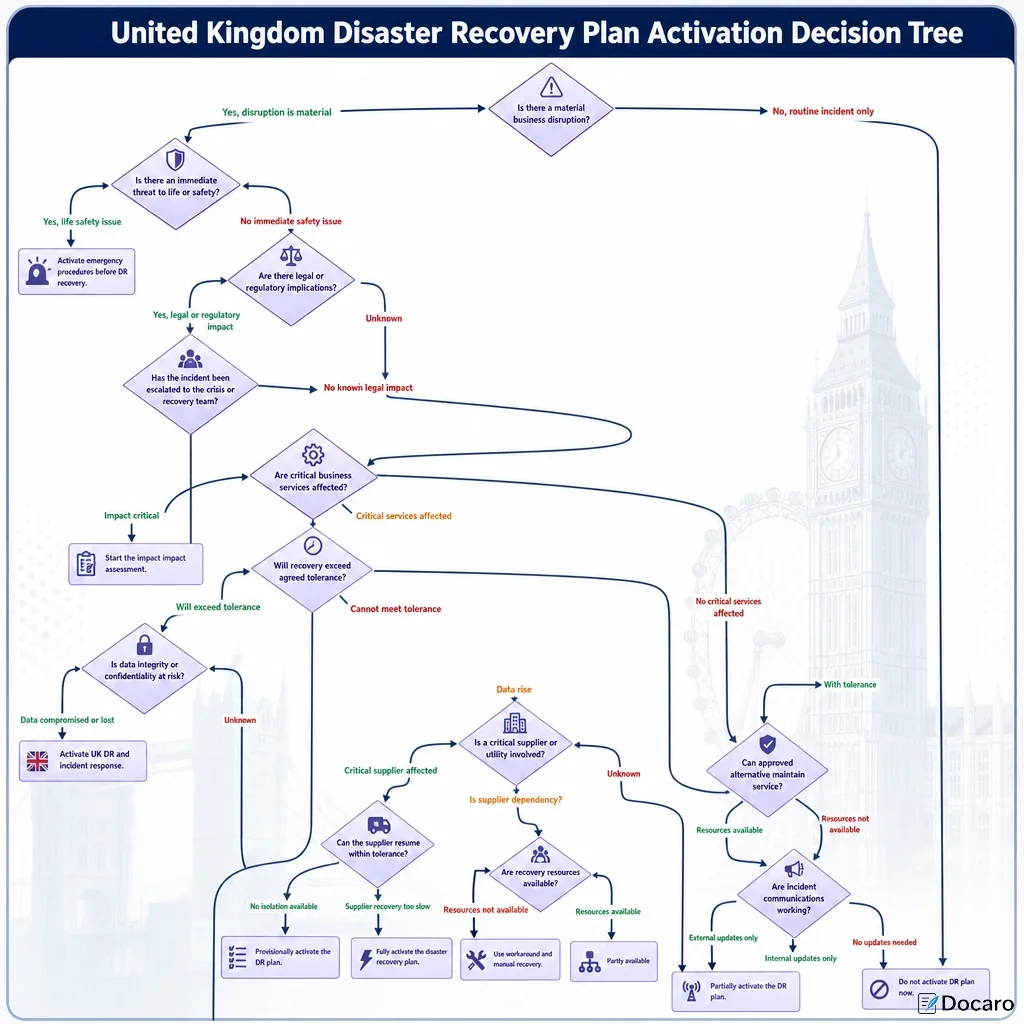
Activation trigger: Any event causing or likely to cause downtime exceeding 1 hour or data loss impacting operations. Criteria for declaring an incident: Assessment confirms impact on critical functions exceeds defined thresholds (e.g. RTO breach risk or financial loss over 5000 GBP).
For Cyber Security Breach: 1. Isolate systems 2. Engage cybersecurity team for malware scan 3. Notify ICO if personal data breach per GDPR 4. Restore from clean backups. Roles: IT Manager leads technical response Crisis Manager has decision authority. Integration with emergency services: Police for criminal breaches if required under UK law.
For Natural Disaster: 1. Ensure staff safety per Health and Safety at Work Act 2. Activate alternate site 3. Assess damage 4. Restore operations. Roles: Operations lead coordinates Crisis Manager declares incident. Integration with emergency services: Coordinate with local authorities and emergency responders as per Civil Contingencies Act 2004.
For Supply Chain Disruption: 1. Activate alternative suppliers 2. Adjust operations 3. Communicate with clients. Roles: Procurement lead manages response Senior Manager authorizes expenditures. Post-incident review processes will document lessons and update the plan.
8RECOVERY PROCEDURES
The critical business functions that require specific recovery procedures in this Business Continuity Plan are IT Systems Customer Service and Financial Operations.
The Recovery Time Objectives are as follows: IT Systems 4 hours Customer Service 6 hours and Financial Operations 8 hours.
The maximum number of hours the business can tolerate for downtime before recovery must be completed is 24.
The first step in the recovery procedure for restoring critical functions post-disruption is to assess the disruption and activate the incident response team to evaluate the impact on critical functions.
Backup systems are in place for all critical functions as part of the recovery procedures.
The last test of the backup systems was conducted on 2023-10-15.
The roles assigned to the recovery team responsible for implementing the procedures are Incident Coordinator IT Recovery Specialist and Operations Manager.
The communication protocols to be followed during the recovery procedures are to use secure email and phone lines for internal team updates notify stakeholders via designated channels within 1 hour of disruption and maintain a log of all communications.
There are 3 phases in the step-by-step recovery procedures.
The resources required to execute the recovery procedures are access to off-site data centres backup generators spare hardware equipment and external IT support contractors.
An annual review of the Recovery Procedures section is scheduled.
The steps that will be taken to evaluate the effectiveness of the recovery procedures after implementation are to conduct a debrief meeting with the recovery team within 48 hours review downtime metrics against RTOs document lessons learned and update procedures as needed.
Phase 1 - Initial Response (0-2 hours): Assess damage secure site notify team (Responsible: Incident Coordinator Success: Impact evaluated team assembled). Phase 2 - Recovery Execution (2-8 hours): Restore systems from backups failover to alternate sites (Responsible: IT Recovery Specialist and Operations Manager Success: Critical functions operational within RTO). Phase 3 - Testing and Verification (within RTO): Test restored systems validate data integrity (Responsible: All team members Success: No errors systems fully functional).
Recovery aligns with RTO (time to restore) and RPO (data loss tolerance) targets from the Business Impact Analysis by prioritizing functions and using tested backups. Procedures for transitioning back to normal operations (de-escalation): Gradual return of operations post-verification communication to stakeholders formal sign-off by Crisis Manager post-incident review within 5 days.
This section addresses business impact on customers through prioritized recovery of customer-facing functions and notification protocols.
9CRISIS MANAGEMENT TEAM
The name of the crisis management team is Corporate Crisis Response Team.
The Chief Executive Officer is designated as the leader of the crisis management team.
The full name of the designated crisis management team leader is Johnathan Smith.
The email address of the crisis management team leader is johnathan.smith@company.co.uk.
The phone number of the crisis management team leader is +44 20 7946 0000.
The Head of Operations is designated as the deputy leader of the crisis management team.
The full name of the designated deputy crisis management team leader is Sarah Johnson.
The email address of the deputy crisis management team leader is sarah.johnson@company.co.uk.
The phone number of the deputy crisis management team leader is +44 20 7946 0001.
Additional members are included in the crisis management team beyond the leader and deputy.
The Head of Communications is assigned as the communication lead for the crisis management team.
The full name of the communication lead for the crisis management team is Emily Davis.
The email address of the communication lead for the crisis management team is emily.davis@company.co.uk.
The phone number of the communication lead for the crisis management team is +44 20 7946 0002.
The Operations Manager is assigned as the operations coordinator for the crisis management team.
The full name of the operations coordinator for the crisis management team is Michael Brown.
The email address of the operations coordinator for the crisis management team is michael.brown@company.co.uk.
The phone number of the operations coordinator for the crisis management team is +44 20 7946 0003.
The Corporate Crisis Response Team is responsible for activating the business continuity plan during a crisis coordinating response efforts across departments communicating with stakeholders assessing impacts and ensuring recovery of critical operations within defined recovery time objectives.
The next review of the crisis management team section is planned for 2025-06-01.
Organizational chart/hierarchy: CEO (Team Leader) -> Deputy (Head of Operations) -> Functional Leads (Communications Lead Operations Coordinator IT Lead Finance Lead). Clear delegation of authority: Leader has final decision-making authority deputy assumes in absence. Decision-making protocols: Consensus where possible escalation to leader for critical choices documented in log. Team activation criteria: Incident declared per section 7. Meeting frequency during a crisis: Every 2 hours initially then as agreed. Interfaces with external authorities: Designated liaison reports to emergency services regulators per Civil Contingencies Act 2004 requirements.
10COMMUNICATION PLAN
During a disruption all internal communications will be coordinated through the company's intranet and emergency email alerts.
Department heads will be notified first via phone followed by a cascade notification to all employees using a predefined contact tree to ensure rapid dissemination of information while maintaining operational continuity.
External communications will be managed by the PR team starting with pre-approved templates for updates.
All statements will be reviewed for accuracy and compliance before release prioritizing transparency with affected parties while protecting sensitive information in line with regulations.
A specific individual or team is designated as the media contact for handling press inquiries during a disruption.
Media inquiries will be directed to the designated spokesperson only.
All responses will use holding statements initially followed by factual updates.
No off-the-record comments will be given and all interactions will be logged for post-incident review.
The key stakeholders included in the notification protocols during a disruption are Customers Suppliers Employees Regulators and Investors.
Internal notifications will occur within 1 hour of disruption confirmation with senior management first followed by all employees within 2 hours via multiple channels.
External notifications will be issued within 4 hours for critical stakeholders with public updates via the website within 24 hours ensuring timely and accurate information flow.
All communications will be reviewed for compliance with data protection laws before issuance.
The communication channels to be used for stakeholder notifications during a disruption are Email Phone Calls SMS Text Messages and Company Website or Portal.
The Head of Communications Emily Davis will oversee all communications with a deputy from the PR team as backup. Designated media contact: Emily Davis Head of Communications email emily.davis@company.co.uk phone +44 20 7946 0002.
Procedures for handling reputational risks: Monitor social media in real-time using dedicated tools prepare response templates address misinformation promptly. Compliance with FCA rules for financial sector clients: All external comms reviewed by Legal for SYSC compliance. Sample internal template: 'Dear Team Incident declared at [time]. Please follow these instructions: [details]. Updates via [channel].' Sample external: 'ABC Ltd is addressing [incident]. We apologize for any inconvenience and are working to restore services. Contact [details] for support.' Templates and full details in Appendix D.
11IT DISASTER RECOVERY
The business-critical IT systems that require recovery procedures are Customer Relationship Management (CRM) software Enterprise Resource Planning (ERP) system email servers and financial database.
An established data backup policy exists for the IT systems.
Daily incremental backups and weekly full backups are performed using automated tape and disk-based methods.
The data backups are primarily stored at an Offsite Facility and with a Cloud Provider.
The most recent full data backup was on 2023-10-15.
The target Recovery Time Objective (RTO) in hours for critical IT systems is 4 for IT and Data Management 4 for Finance and Accounting and 4 for Sales and Marketing aligned with Business Impact Analysis.
The target Recovery Point Objective (RPO) in hours representing the maximum acceptable data loss is 0.25 (15 min) for Finance 0.083 (5 min) for IT and 0.5 (30 min) for Sales aligned with Business Impact Analysis.
The specific procedures for recovering the network infrastructure such as routers and switches are to isolate affected network segments restore from last known good configuration backups on routers and switches test connectivity with failover hardware reconfigure IP addresses and VLANs as needed and verify full network functionality with monitoring tools.
A designated offsite recovery site exists for IT systems.
The IT Disaster Recovery procedures are tested quarterly.
The key personnel responsible for executing the IT Disaster Recovery procedures are the IT Manager John Smith as lead coordinator the Network Administrator Jane Doe for network recovery and the Data Specialist Alex Johnson for backup restoration.
Backup verification processes: Weekly integrity checks automated validation monthly full restore tests. Data restoration testing: Quarterly drills with success measured by RPO/RTO achievement. Cybersecurity measures during recovery: Full malware scanning of backups isolation in sandbox environment multi-factor re-authentication. Compliance with NIS Regulations and GDPR for data handling: All recoveries logged audit trails maintained data minimization during restore processes breach notification within 72 hours if applicable.
12TRAINING AND AWARENESS
The training program is a comprehensive initiative designed to equip all employees with the knowledge and skills needed to respond effectively to business disruptions.
It includes interactive sessions covering risk identification emergency response protocols and recovery strategies.
The program is structured over two days incorporating real-world case studies role-playing exercises and assessments to ensure understanding.
Delivered annually it emphasizes the importance of maintaining operations during events like cyber incidents or natural disasters tailored to the regulatory environment including compliance with ISO 22301 standards.
A program is in place for raising awareness of potential risks among employees.
Training sessions for employees on business continuity procedures are conducted annually.
One hundred and fifty employees have been trained on business continuity procedures in the past year.
The target audience for the business continuity training program includes all full-time employees across departments such as IT operations HR and finance with a focus on key personnel like managers and crisis response team members.
New hires will also receive onboarding training within their first month.
The methods to be used for delivering the business continuity training are Online modules and Webinars.
The awareness activities include monthly newsletters highlighting recent risk events and mitigation tips quarterly lunch-and-learn sessions with guest speakers from emergency services and interactive e-learning quizzes distributed via the company intranet.
Posters and infographics will be placed in common areas to reinforce key messages about risks like data breaches and supply interruptions.
The potential risks to be covered in the awareness program are cyber threats natural disasters and supply chain disruptions.
Jane Doe Head of Human Resources is the designated person responsible for overseeing the training program who will coordinate scheduling content development and evaluation of the training program.
Evaluation methods: Pre/post training tests drill participation feedback surveys scoring effectiveness above 80% pass rate. Training matrix by role: All staff - general awareness; Managers - response protocols; Crisis team - specialized leadership annually. Complies with Health and Safety at Work Act by including evacuation and incident response. Schedule: Annual refresher for all specialized for crisis team bi-annually. Key performance indicators for BC effectiveness included in post-training metrics.
13TESTING AND EXERCISES
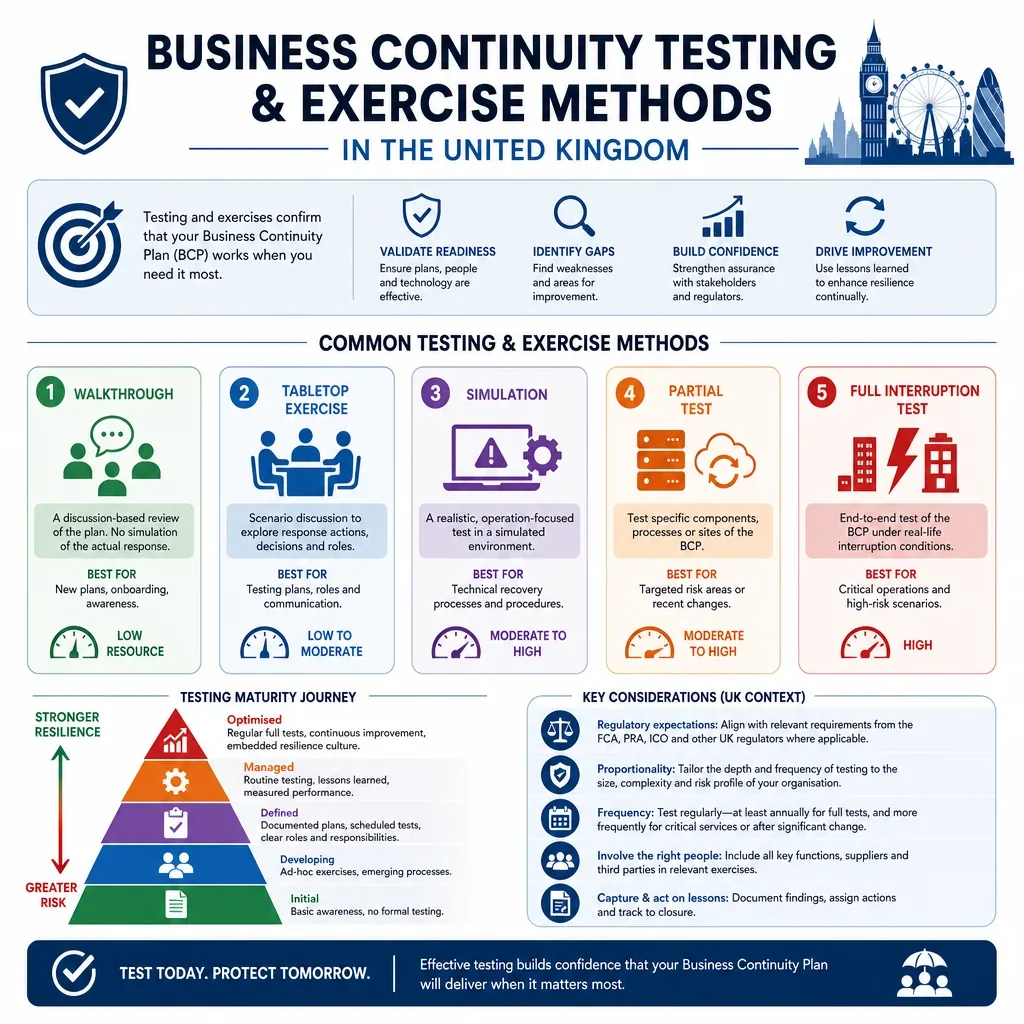
The testing methods included in the Testing and Exercises section of this Business Continuity Plan are Tabletop Exercises and Simulations.
At least one full test of the Business Continuity Plan will be conducted each year.
The next testing exercise is scheduled for 2024-12-15.
The specific evaluation criteria to be used for assessing the outcomes of testing exercises are effectiveness of response times completeness of recovery procedures identification of gaps in the plan and participant feedback on clarity and usability.
The roles within the organisation to be involved in the testing and exercises are Senior Management IT Department and Operations Team.
A mandatory post-exercise review and lessons learned process is included.
Multi-year testing schedule: Year 1 - tabletop quarterly walkthroughs; Year 2 - full-scale simulation annually. Exercise types: Tabletop (discussion-based) Walkthrough (step-by-step) Full-scale (live simulation). Lessons learned incorporated into plan updates within 30 days. Metrics for success: 90% RTO achievement participant satisfaction >85% regulatory compliance verified in all tests. Last test report summary in Appendix E.
14PLAN MAINTENANCE AND REVIEW
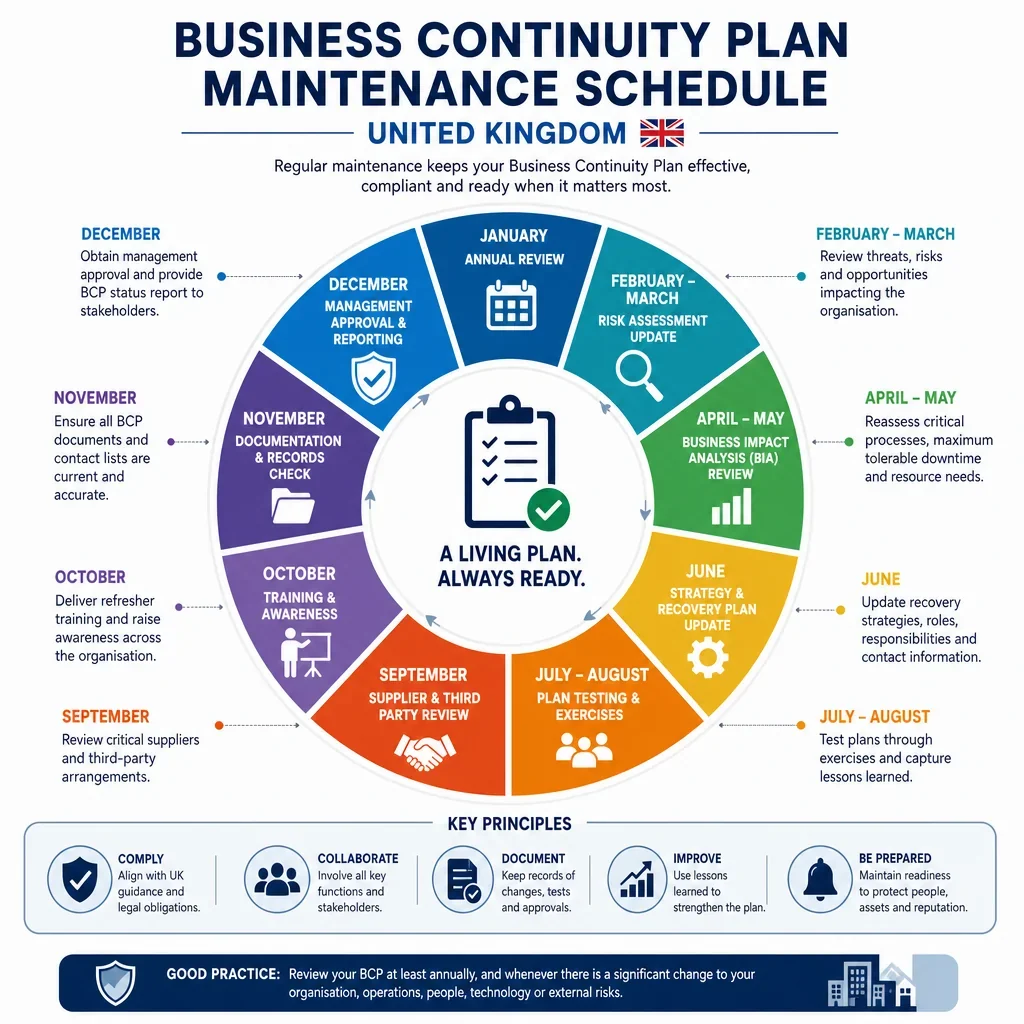
The desired frequency for regular reviews of the Business Continuity Plan is quarterly reviews to ensure the plan remains aligned with current business operations.
The next review of the Business Continuity Plan is scheduled for 2024-12-31.
An annual internal audit is established as part of the Plan Maintenance and Review process.
The Business Continuity Manager is designated as responsible for conducting the regular reviews and updates of the Business Continuity Plan.
After each review or incident the responsible party will document changes obtain approval from senior management and redistribute the updated plan within two weeks.
The events that will trigger an immediate review and potential update of the Business Continuity Plan are Significant Organisational Change Major Incident or Disruption and Regulatory or Legal Changes.
Audits of the Business Continuity Plan will be conducted every 12 months.
The distribution list for notifications of Business Continuity Plan updates includes the Senior Management Team Department Heads Business Continuity Manager and all key stakeholders involved in critical operations.
Version control: All updates tracked with version number date and description of changes. Change management process: Formal request review by Continuity Manager approval by Senior Management Board. Updates communicated via email and secure portal. Continuous improvement: Post-incident reviews KPIs (e.g. recovery success rate >95%) fed into annual updates. Integration with other management systems including quality and information security per ISO 22301.
15REGULATORY COMPLIANCE AND APPENDICES
The organisation complies with the Civil Contingencies Act 2004 by maintaining a comprehensive business continuity plan that identifies risks establishes response procedures and conducts regular training exercises to ensure resilience against emergencies.
The organisation is compliant with the Data Protection Act 2018 in its business continuity processes.
The relevant regulatory frameworks that apply to the organisation's business continuity planning are the Civil Contingencies Act 2004 the UK GDPR as incorporated by the Data Protection Act 2018 the Health and Safety at Work etc. Act 1974 the Network and Information Systems Regulations 2018 (implementing the NIS Directive) the Financial Conduct Authority Handbook SYSC 3.2 and 15A for financial services clients and ISO 22301.
This Business Continuity Plan is governed by and shall be construed in accordance with British law.
The name of the primary emergency contact for regulatory reporting is John Smith.
The email address for the primary emergency contact is john.smith@company.co.uk.
The phone number for the primary emergency contact is +44 20 1234 5678.
The incident reporting template includes sections for incident description date and time affected areas initial response actions and escalation contacts structured in a simple form format for quick completion.
The date of the last regulatory compliance review for business continuity was 2023-06-15.
The organisation conducts compliance audits for the Business Continuity Plan annually.
Appendix listing: A - Contact Lists B - Glossary C - Detailed Risk Register D - Communication Templates E - Test Reports F - Insurance Details. All listed regulations are accurately described above. Sector-specific requirements for financial services clients addressed via FCA SYSC compliance in comms and data handling. Post-incident reviews mandated in multiple sections. Comprehensive coverage of internal (e.g. inter-function) and external (suppliers cloud providers) dependencies throughout the plan including in BIA and risk sections. KPIs for BC effectiveness: Recovery within RTO 95% of tests staff training completion rate >90% downtime under targets.
16APPENDICES
Contact lists: Crisis Team - Johnathan Smith CEO +44 20 7946 0000 johnathan.smith@company.co.uk; Sarah Johnson Head of Operations +44 20 7946 0001 sarah.johnson@company.co.uk; Emily Davis Head of Communications +44 20 7946 0002 emily.davis@company.co.uk; Michael Brown Operations Manager +44 20 7946 0003 michael.brown@company.co.uk; Additional IT Finance Legal contacts available in secure portal.
Glossary of terms: RTO (Recovery Time Objective) - maximum acceptable downtime; RPO (Recovery Point Objective) - maximum acceptable data loss; MTPD (Maximum Tolerable Period of Disruption) - 24 hours as defined in section 8; BCP - Business Continuity Plan; ISO 22301 - International standard for business continuity management systems.
Detailed risk register: See section 4 subsections 4.8-4.13 and full matrix in attached spreadsheet with all scores controls and mitigations updated per latest review.
Sample communication templates: See section 10.15 for examples. Full set including holding statements customer notifications regulatory reports available as separate documents.
Last test report summary: Test date 2023-10-15 Type - Tabletop Exercise Success rate 85% (RTO met in 4/5 scenarios) Lessons: Improve notification speed incorporated into plan update. Full report available.
Insurance considerations: Business interruption insurance covers up to 500000 GBP per incident cyber liability policy in place for data breaches. Reviewed annually as part of maintenance.
17SIGNATURES
This Business Continuity Plan is approved and accepted by the parties whose signatures appear below.
For and on behalf of ABC Ltd: _______________________________ Date: _______________ Name: Johnathan Smith Title: Chief Executive Officer.
For and on behalf of the Senior Management Board: _______________________________ Date: _______________ Name: Sarah Johnson Title: Head of Operations.
This example shows approximately 70% of a typical document and is provided for illustrative purposes only. The remaining content has been omitted.
Every document generated by Docaro is tailored to your specific circumstances, jurisdiction and the information you provide. The completed document includes all applicable clauses and provisions required for your situation.
To generate the full, personalised document, answer a short series of questions and your document will be created instantly.
Useful Resources When Considering a Business Continuity Plan in the United Kingdom
United Kingdom Reference Legislation
Business Continuity Plan FAQs
Document Generation FAQs
Related Articles