AI Generated British Licence Agreement for Photographic Images
PDF & Word - 2026 Updated
Docaro Pricing
When do you need a Licence Agreement for Photographic Images in the United Kingdom?
British Legal Rules for a Licence Agreement for Photographic Images
Using the wrong type of photo licensing agreement can lead to unintended ownership disputes or unenforceable rights over image usage.
What a Proper Licence Agreement for Photographic Images Should Include
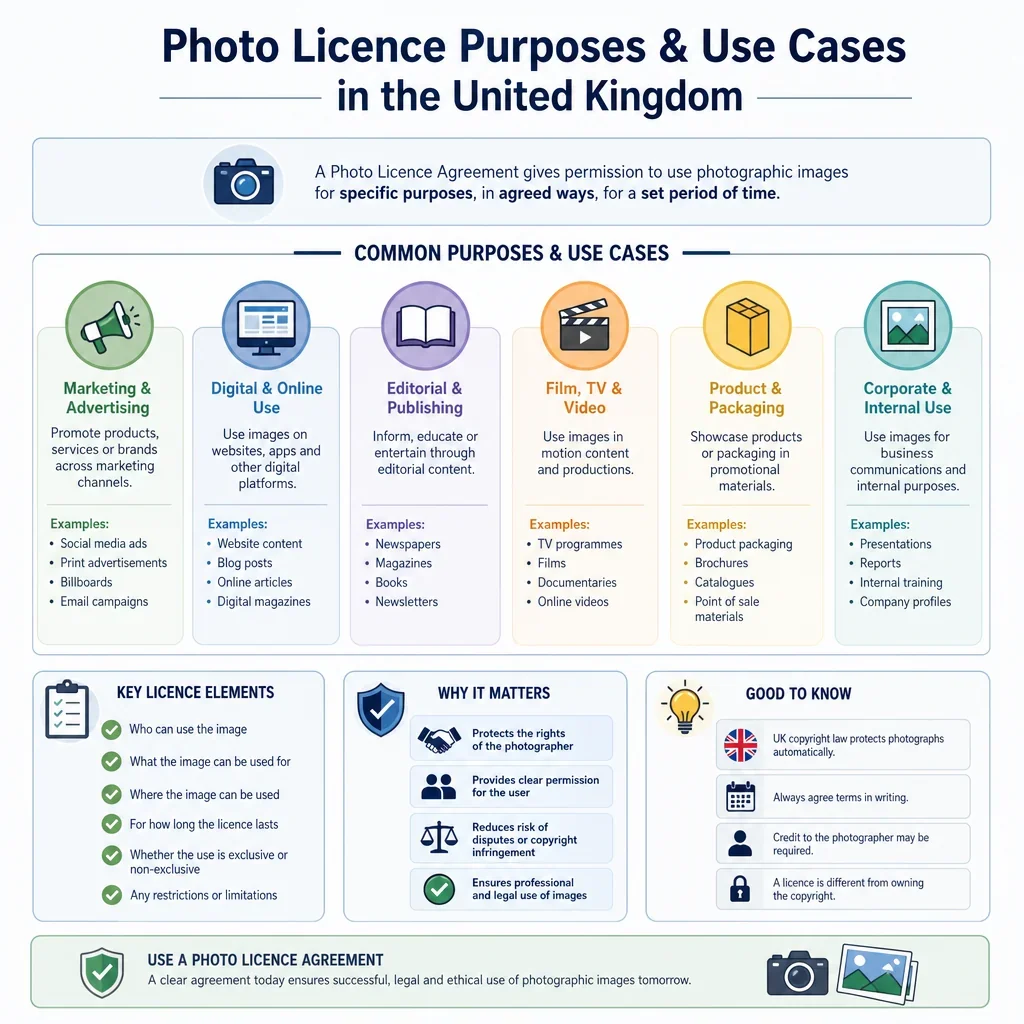
- Parties InvolvedClearly identify the photographer or copyright owner and the person or company receiving permission to use the images.
- Image DescriptionProvide a detailed description of the specific photographs covered by the agreement to avoid any confusion.
- Rights GrantedSpecify exactly what the licensee can do with the images, such as reproducing, distributing, or displaying them.
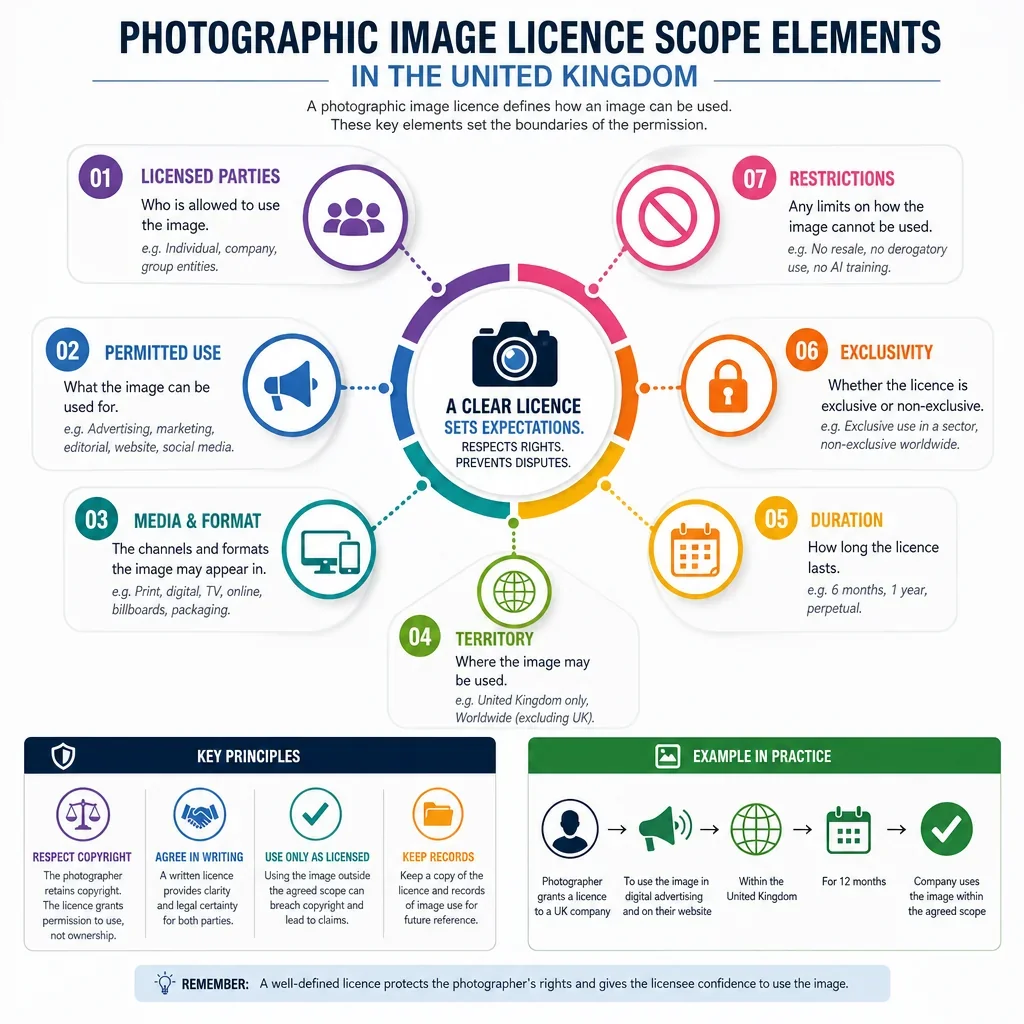
- Scope and LimitationsDefine the boundaries of use, including where, how, and for how long the images can be used.
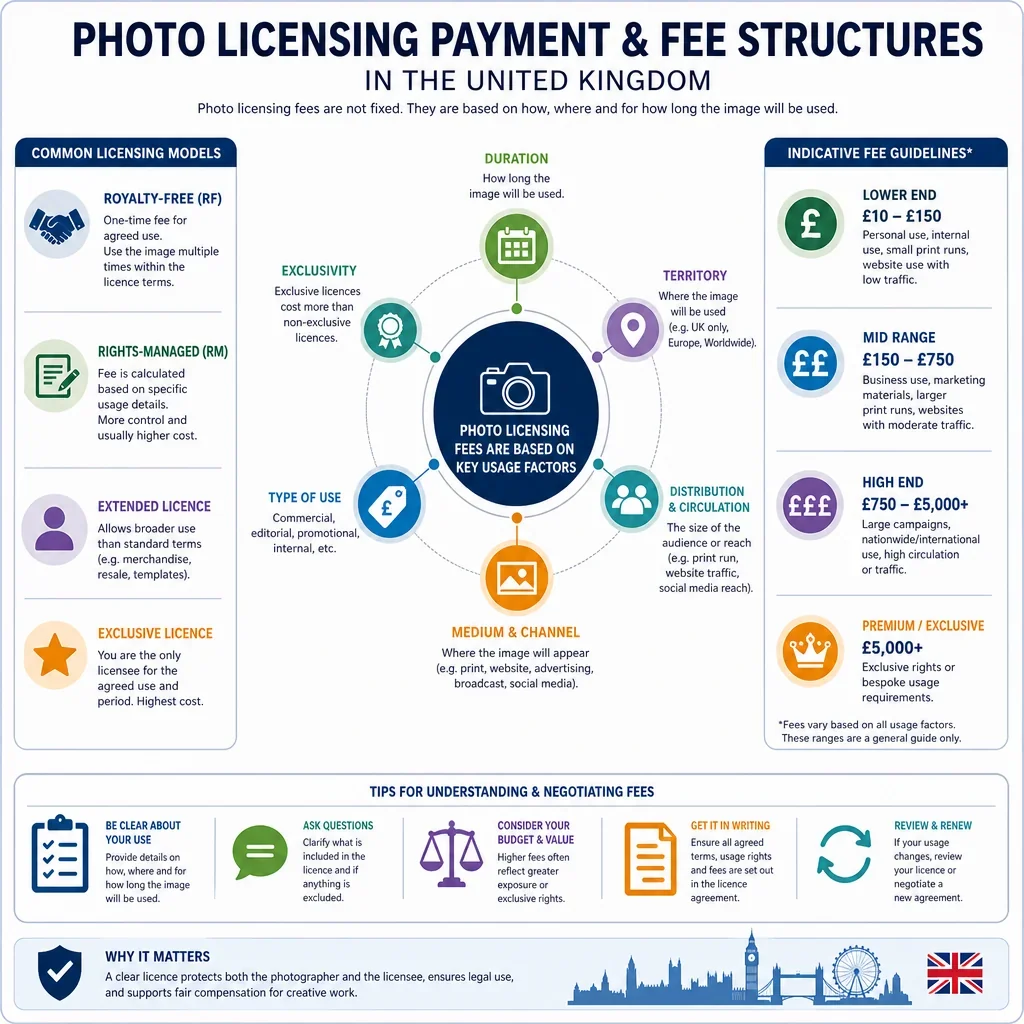
- Payment TermsOutline any fees, royalties, or payment structure for using the images.
- Duration of LicenceState how long the permission to use the images will last, whether it's for a fixed period or ongoing.
- TerritoryIndicate the geographical areas where the images can be used.
- ExclusivityClarify if the licence is exclusive, meaning only the licensee can use the images, or non-exclusive.
- Copyright NoticeRequire the licensee to include proper credits or notices acknowledging the photographer's ownership.
- Termination ConditionsExplain the circumstances under which the agreement can end and what happens next.
- Warranties and LiabilityConfirm that the images don't infringe on others' rights and limit responsibility for any issues arising from their use.
Generate Your Document in 4 Easy Steps
Why Use Docaro?
 United Kingdom
Free Example Licence Agreement for Photographic Images Template
Below is a free template example of a Licence Agreement for Photographic Images for use in the United Kingdom generated by our AI model.
The clauses in your actual Licence Agreement for Photographic Images will vary from this example as they will be entirely bespoke to your requirements as set out in the questionnaire you complete.
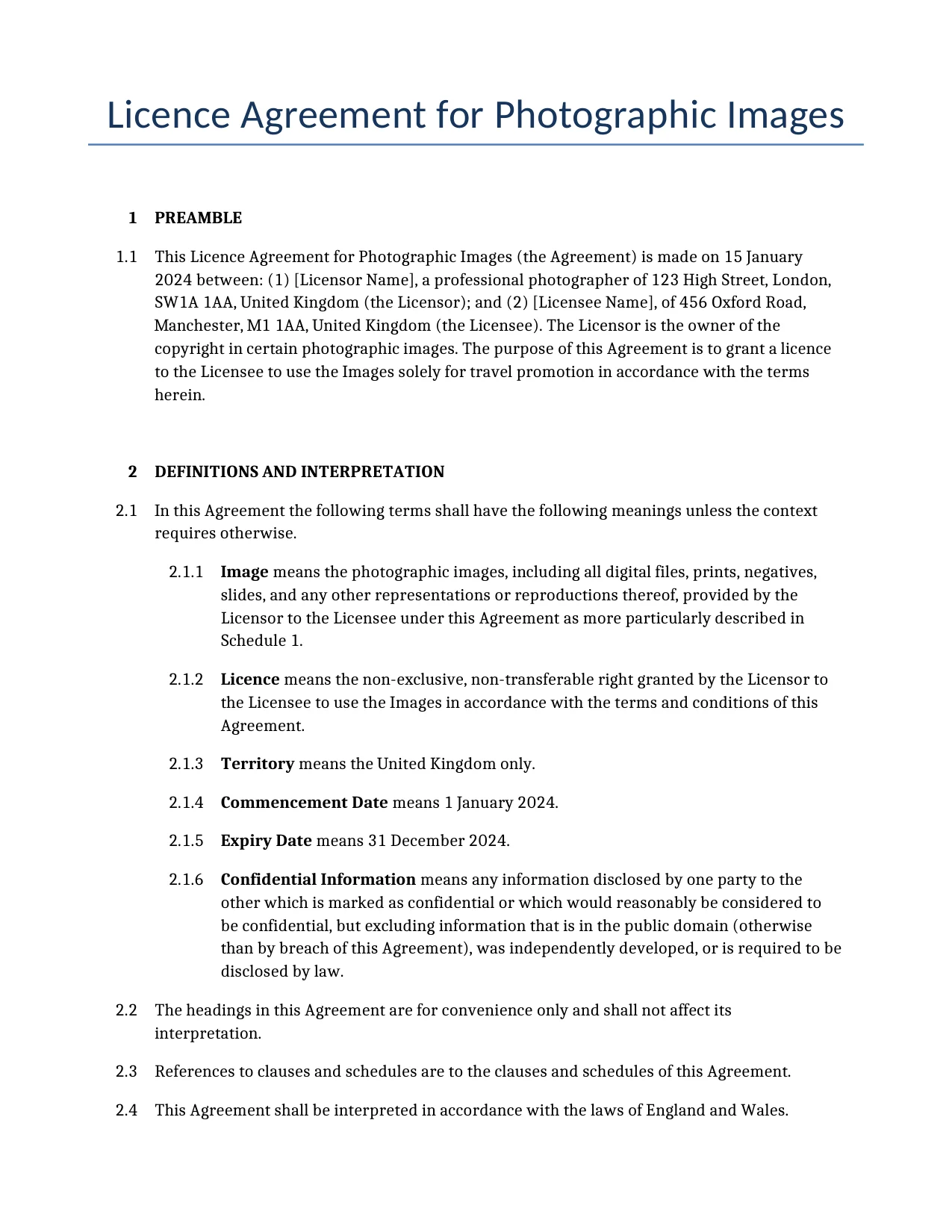
Licence Agreement for Photographic Images
1PREAMBLE
This Licence Agreement for Photographic Images (the Agreement) is made on 15 January 2024 between: (1) [Licensor Name], a professional photographer of 123 High Street, London, SW1A 1AA, United Kingdom (the Licensor); and (2) [Licensee Name], of 456 Oxford Road, Manchester, M1 1AA, United Kingdom (the Licensee). The Licensor is the owner of the copyright in certain photographic images. The purpose of this Agreement is to grant a licence to the Licensee to use the Images solely for travel promotion in accordance with the terms herein.
2DEFINITIONS AND INTERPRETATION
In this Agreement the following terms shall have the following meanings unless the context requires otherwise.
Image means the photographic images, including all digital files, prints, negatives, slides, and any other representations or reproductions thereof, provided by the Licensor to the Licensee under this Agreement as more particularly described in Schedule 1.
Licence means the non-exclusive, non-transferable right granted by the Licensor to the Licensee to use the Images in accordance with the terms and conditions of this Agreement.
Territory means the United Kingdom only.
Commencement Date means 1 January 2024.
Expiry Date means 31 December 2024.
Confidential Information means any information disclosed by one party to the other which is marked as confidential or which would reasonably be considered to be confidential, but excluding information that is in the public domain (otherwise than by breach of this Agreement), was independently developed, or is required to be disclosed by law.
The headings in this Agreement are for convenience only and shall not affect its interpretation.
References to clauses and schedules are to the clauses and schedules of this Agreement.
This Agreement shall be interpreted in accordance with the laws of England and Wales.
3OWNERSHIP AND COPYRIGHT
The Licensor retains all ownership and copyright in the Images. The Licence is limited to the specific uses, Territory, and term expressly set out in this Agreement. No title or ownership in the Images transfers to the Licensee. All rights not expressly granted are reserved by the Licensor. This Agreement is governed by the Copyright, Designs and Patents Act 1988 (CDPA).
4LICENCE TYPES AND EXCLUSIVITY
The licence granted under this Agreement is non-exclusive and non-transferable. It is strictly limited to the uses, Territory, and term specified in this Agreement. No exclusive rights are granted unless expressly agreed in writing and attached as an amendment to this Agreement.
5GRANT OF LICENCE
Subject to the terms of this Agreement and payment of the Licence Fee, the Licensor grants to the Licensee a non-exclusive, non-transferable Licence commencing on the Commencement Date and expiring on the Expiry Date to use the Images solely for travel promotion purposes as follows: (a) digital formats limited to JPEG or PNG files no larger than 2000 pixels on the longest edge for online advertisements on the Licensee’s company website and social media platforms; (b) up to 5000 printed copies in brochures (A5 size or smaller) distributed at UK trade shows; and (c) no other formats or contexts are permitted. Any use outside the Territory requires the prior written consent of the Licensor.
The Licensee may not modify, alter, crop, or create derivative works from the Images without the prior written consent of the Licensor. The Licensee shall not sublicense the rights granted under this Agreement to any third party.
The Licence is granted on a fixed term basis, is not perpetual, and automatically expires on the Expiry Date.
6LICENCE FEE AND PAYMENT TERMS
The Licensee shall pay to the Licensor a licence fee of 1500.00 GBP excluding Value Added Tax by way of a single upfront payment on or before 15 January 2024.
Value Added Tax shall be payable by the Licensee in addition to the licence fee at the prevailing rate.
If any sum payable under this Agreement is not paid on the due date then the Licensor shall be entitled to charge interest on the overdue amount at the rate of 8.5 percent per annum from the due date until the date of actual payment.
Schedule 2 sets out all payment obligations including the fixed fee, VAT, and any applicable interest. No royalties shall be payable under this Agreement.
7RIGHTS AND RESTRICTIONS
The Licensee shall only use the Images in the Territory and for the exact purposes set out in clause 4.1. Any use outside the United Kingdom requires the prior written consent of the Licensor. The contradictory wording in the original clause 4.1 is deleted and replaced by this provision.
The Licensee shall not use the Images in any political campaigns, adult or explicit content, or in any manner that could infringe the UK Advertising Standards Authority (ASA) codes, constitute defamation under UK law, breach the UK GDPR or Data Protection Act 2018, or otherwise violate any applicable UK laws or regulations.
The Licensee shall comply with all restrictions set out in this Agreement. Any use outside the permitted uses, formats, quantities, or contexts requires the Licensor’s prior written consent.
8REPRESENTATIONS AND WARRANTIES
The Licensor represents and warrants that: (a) the Licensor is the sole owner of all rights in the Images; (b) the Licensor personally photographed and created the Images as an independent photographer and holds all copyright as the original author under the CDPA; (c) the Images are original works and do not incorporate any third-party materials; (d) all necessary clearances have been obtained; (e) the Images do not and will not infringe any third-party intellectual property rights or moral rights; (f) the Images were created on 15 May 2023; (g) no model releases are required as the persons in the Images are not identifiable or, if identifiable, all necessary model releases have been obtained; (h) property releases have been obtained for all identifiable properties; (i) there are no known or threatened claims, disputes, or litigation regarding the rights in the Images; and (j) the Licensor has the full right and authority to grant the Licence.
The Licensor further warrants that it has complied with the Copyright, Designs and Patents Act 1988, that all moral rights have been waived or cleared in accordance with s.87 of the CDPA, and that the Images do not breach any UK privacy, model release, or data protection laws.
The Licensee represents and warrants that: (a) the primary intended use of the Images is for commercial advertising and digital online use in accordance with clause 4.1; (b) the Images will be used only in the manner described in clause 5.12 of the original Agreement (as updated by this Agreement); (c) the intended use will comply with all applicable UK laws including the UK GDPR, Data Protection Act 2018, ASA Advertising Codes, and defamation laws; and (d) it will not use the Images in any way that violates the UK GDPR or Advertising Codes.
9INTELLECTUAL PROPERTY
The Licensee must include the following copyright notice on all uses of the Images where feasible: \© [Licensor Name] [Year of Creation]. The Licensee shall not remove, obscure, or alter any metadata, copyright information, or watermarks from the digital files of the Images.
10INDEMNIFICATION
Each party shall indemnify, defend, and hold harmless the other party from and against any and all claims, losses, damages, liabilities, and expenses (including reasonable legal fees) arising out of or in connection with: (a) any breach of its representations, warranties, or obligations under this Agreement; (b) infringement of third-party intellectual property rights; (c) breach of moral rights under the CDPA; (d) violations of data protection laws including the UK GDPR; or (e) defamation or breach of privacy under UK law.
The indemnifying party shall have control of any claim and the indemnified party shall provide reasonable cooperation. The indemnified party shall take reasonable steps to mitigate any losses. The indemnified party shall give prompt notice of any claim (and in any event within 30 days) to the indemnifying party.
11LIMITATION OF LIABILITY
Nothing in this Agreement excludes or limits either party’s liability for death or personal injury caused by its negligence, for fraud or fraudulent misrepresentation, or for any other liability that cannot be excluded or limited under the Unfair Contract Terms Act 1977 or the Consumer Rights Act 2015 (if applicable).
Subject to clause 10.1, neither party shall be liable to the other for any indirect, consequential, or incidental damages arising out of or in connection with this Agreement.
Subject to clause 10.1, the total liability of each party to the other under this Agreement shall not exceed 5000.00 GBP (being an amount higher than the Licence Fee to reflect the commercial nature of this contract).
No claim may be brought under this Agreement more than 12 months after the date on which the claiming party became aware (or should reasonably have become aware) of the circumstances giving rise to the claim. The parties acknowledge that the limitations in this clause are reasonable under the Unfair Contract Terms Act 1977 for a commercial contract between businesses.
12AUDIT RIGHTS
The Licensor may, upon reasonable notice (not less than 14 days), audit the Licensee’s use of the Images and any records relating to payments or royalties (if applicable). The Licensee shall maintain accurate records for at least 6 years from the Expiry Date and shall provide reasonable access to such records during normal business hours.
13CONFIDENTIALITY
Each party shall keep the Confidential Information of the other party secret and shall not disclose it to any third party without the prior written consent of the disclosing party. The obligations of confidentiality shall continue for 5 years after the Expiry Date or termination of this Agreement (whichever is later).
In the event of a breach of confidentiality the non-breaching party shall be entitled to seek injunctive relief without prejudice to any other rights or remedies.
14TERMINATION
This Agreement shall terminate automatically on the Expiry Date. Either party may terminate this Agreement immediately by giving written notice to the other if the other party commits a material breach (and, if the breach is capable of remedy, fails to remedy it within 30 days of notice), becomes insolvent, or fails to pay any fees due.
Upon termination or expiry: (a) the Licensee shall immediately cease all use of the Images except that it may continue to use lawfully made printed copies that were produced before termination/expiry for a period not exceeding 3 months solely to exhaust existing stock; (b) the Licensee shall destroy all digital copies of the Images in its possession or control within 30 days; and (c) the Licensee shall settle all outstanding payments.
The following clauses shall survive termination or expiry: clauses relating to Ownership and Copyright, Intellectual Property, Indemnification, Limitation of Liability, Confidentiality, Audit Rights, Data Protection, Moral Rights, Governing Law and Jurisdiction, and any other clause expressed to survive or which by its nature should survive.
15FORCE MAJEURE
Neither party shall be liable for any failure to perform its obligations under this Agreement if such failure is caused by a force majeure event beyond its reasonable control including but not limited to acts of God, war, strikes, or governmental action. The affected party shall give the other party notice of the force majeure event within seven days of its occurrence and shall use reasonable efforts to mitigate its effects. If the event continues for more than three months either party may terminate this Agreement by written notice.
16ASSIGNMENT AND SUB-LICENSING
Neither party may assign its rights or obligations under this Agreement without the prior written consent of the other party (such consent not to be unreasonably withheld or delayed). Any permitted assignee must be bound by all terms of this Agreement including the Territory and use restrictions.
The Licensee may not sublicense the Images or any rights granted under this Agreement to any third party without the prior written consent of the Licensor. Any permitted sub-licence must be on terms no less onerous than this Agreement and the Licensee shall remain liable for the acts and omissions of any sublicensee.
17DATA PROTECTION
Both parties shall comply with the UK GDPR and the Data Protection Act 2018. Each party acts as an independent data controller in respect of any personal data contained in the Images. If either party processes personal data on behalf of the other, the parties shall enter into a data processing addendum. The Licensee shall act as an independent controller and shall implement appropriate technical and organisational measures to protect such data. Upon termination or expiry the Licensee shall securely delete or destroy all Images containing personal data and certify such deletion in writing.
18MORAL RIGHTS
The Licensor irrevocably waives all moral rights in the Images under the Copyright, Designs and Patents Act 1988 (including the right to be identified as the author and the right to object to derogatory treatment) in favour of the Licensee and its successors in title. Such waiver is given in writing and complies with s.87 of the CDPA.
The Licensee must not falsely attribute the Images to any person or treat the Images in a derogatory manner that would be prejudicial to the honour or reputation of the Licensor.
19ENTIRE AGREEMENT
This Agreement constitutes the entire agreement between the parties and supersedes all prior agreements, understandings, or representations whether oral or in writing relating to the licensing of the Images. The parties acknowledge that they have not relied on any representations or warranties outside of this written Agreement. This Agreement shall become effective on 15 January 2024.
20SEVERABILITY
If any provision of this Agreement is held to be invalid or unenforceable by any court or competent authority then such provision shall be severed from this Agreement and the remaining provisions shall continue in full force and effect. The parties shall negotiate in good faith to replace any invalid provision with a valid one that achieves the same commercial effect.
21WAIVER
No waiver of any right under this Agreement shall be effective unless it is in a signed writing. A failure or delay by either party to enforce any right under this Agreement shall not constitute a waiver of that right.
22NOTICES
Any notice required to be given under this Agreement shall be in writing and shall be sent by post or email to the addresses specified below. Notices sent by post shall be deemed delivered two business days after posting. Notices sent by email shall be deemed delivered on the day of transmission provided no delivery failure message is received. If a notice is sent on a non-business day it shall be deemed delivered on the next business day.
The address for notices to the Licensor is 123 High Street, London, SW1A 1AA, United Kingdom. The address for notices to the Licensee is 456 Oxford Road, Manchester, M1 1AA, United Kingdom.
23SCHEDULES AND ANNEXES
Schedule 1 shall include a detailed list or thumbnails of each specific Image licensed, with file names, descriptions, creation dates, and any other identifying information. Schedule 2 shall detail all payment obligations including the fixed fee, VAT, any royalties (none in this case), interest on late payments, and payment deadlines.
24SIGNATURES
This Agreement is executed by the duly authorised representatives of the parties on the date set out at the beginning of this Agreement.
Signed for and on behalf of the Licensor: _______________________________ Name: _______________________________ Title: _______________________________ Date: _______________________________
Signed for and on behalf of the Licensee: _______________________________ Name: _______________________________ Title: _______________________________ Date: _______________________________
This example shows approximately 70% of a typical document and is provided for illustrative purposes only. The remaining content has been omitted.
Every document generated by Docaro is tailored to your specific circumstances, jurisdiction and the information you provide. The completed document includes all applicable clauses and provisions required for your situation.
To generate the full, personalised document, answer a short series of questions and your document will be created instantly.
Useful Resources When Considering a Licence Agreement for Photographic Images in the United Kingdom
United Kingdom Reference Legislation
Licence Agreement for Photographic Images FAQs
Document Generation FAQs
Related Articles