AI Generated British Training Agreement
PDF & Word - 2026 Updated
Docaro Pricing
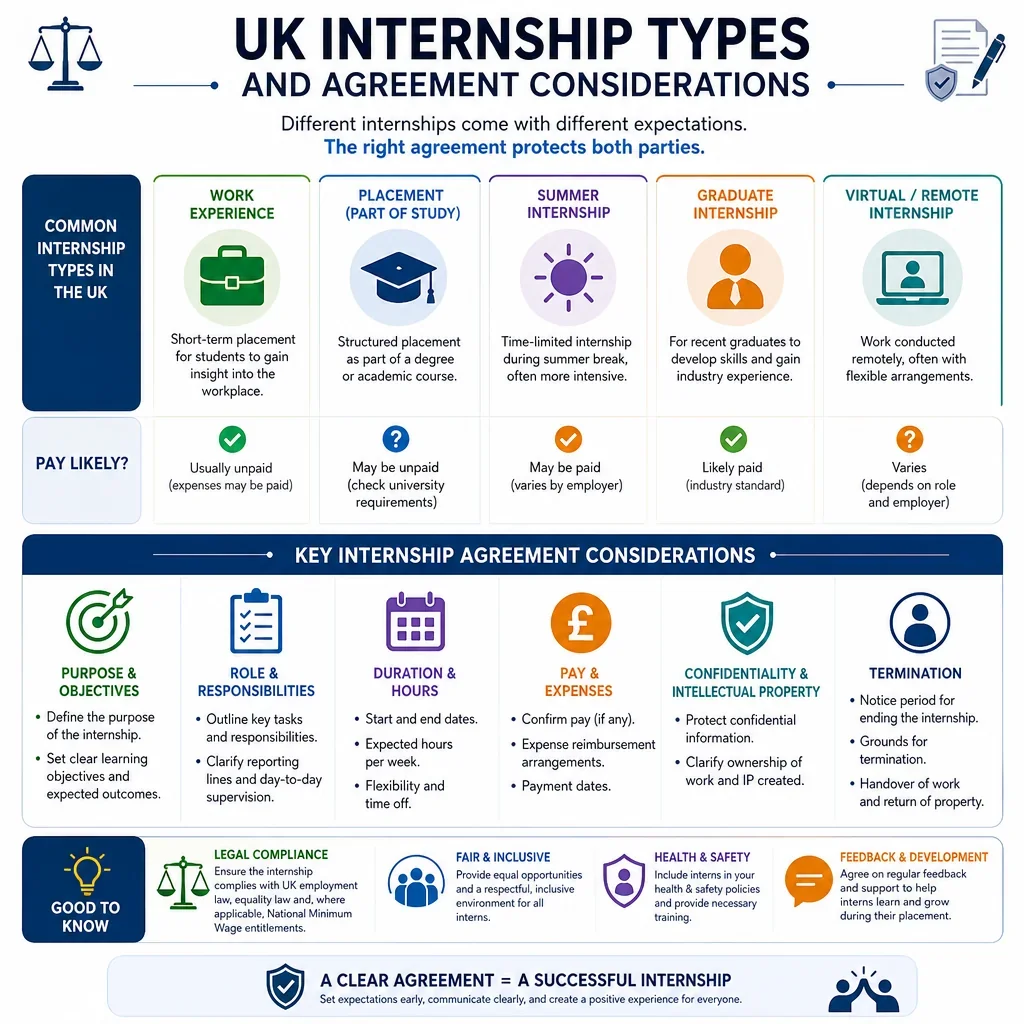
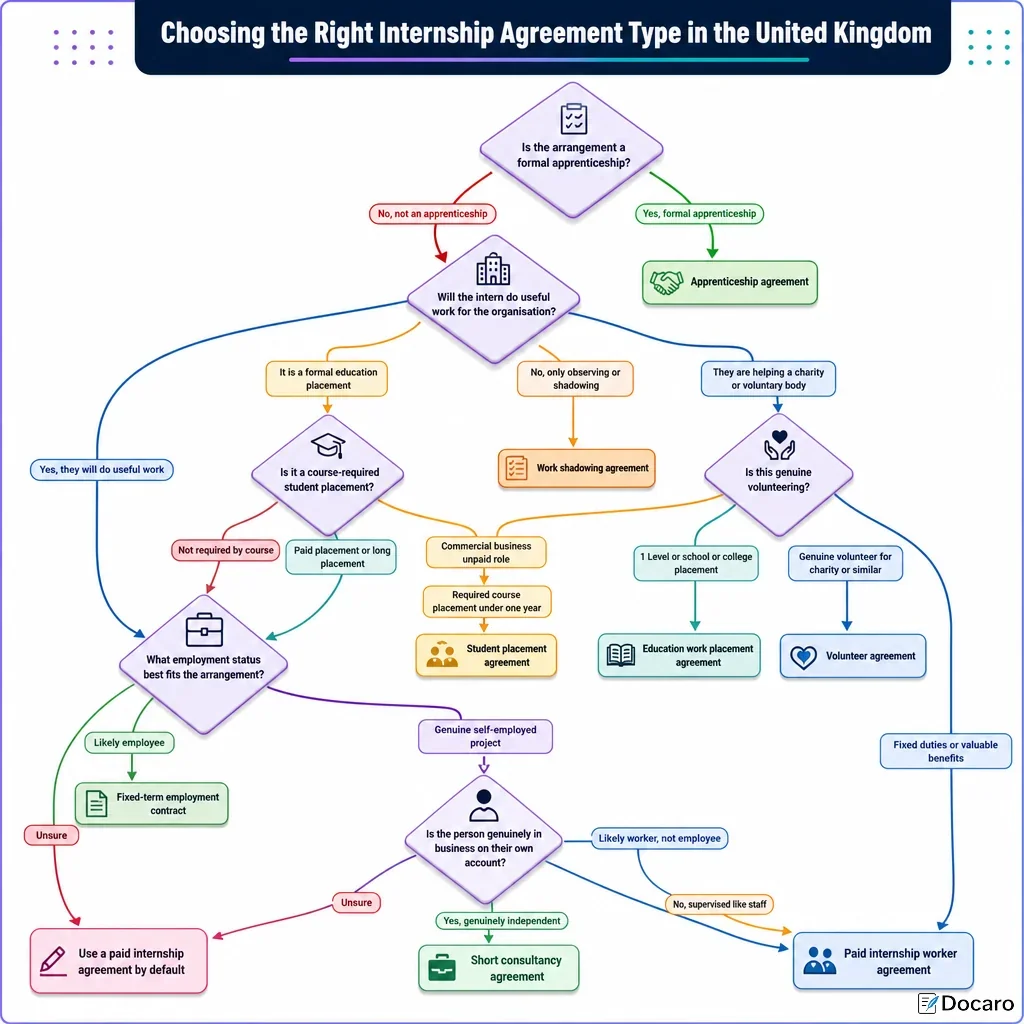
When do you need an Internship Agreement in the United Kingdom?
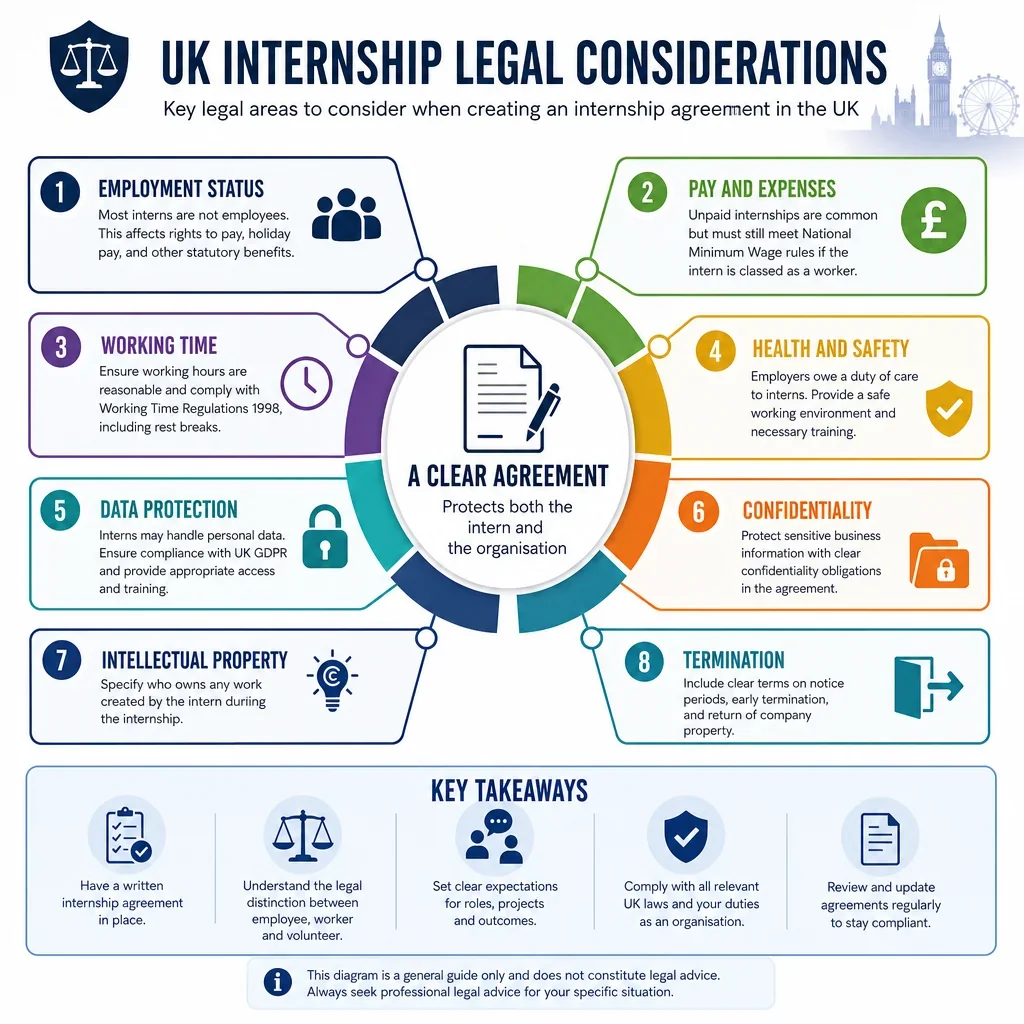
British Legal Rules for an Internship Agreement
Using the wrong structure for an internship agreement may inadvertently create an employment contract, granting the intern full employee rights and protections.
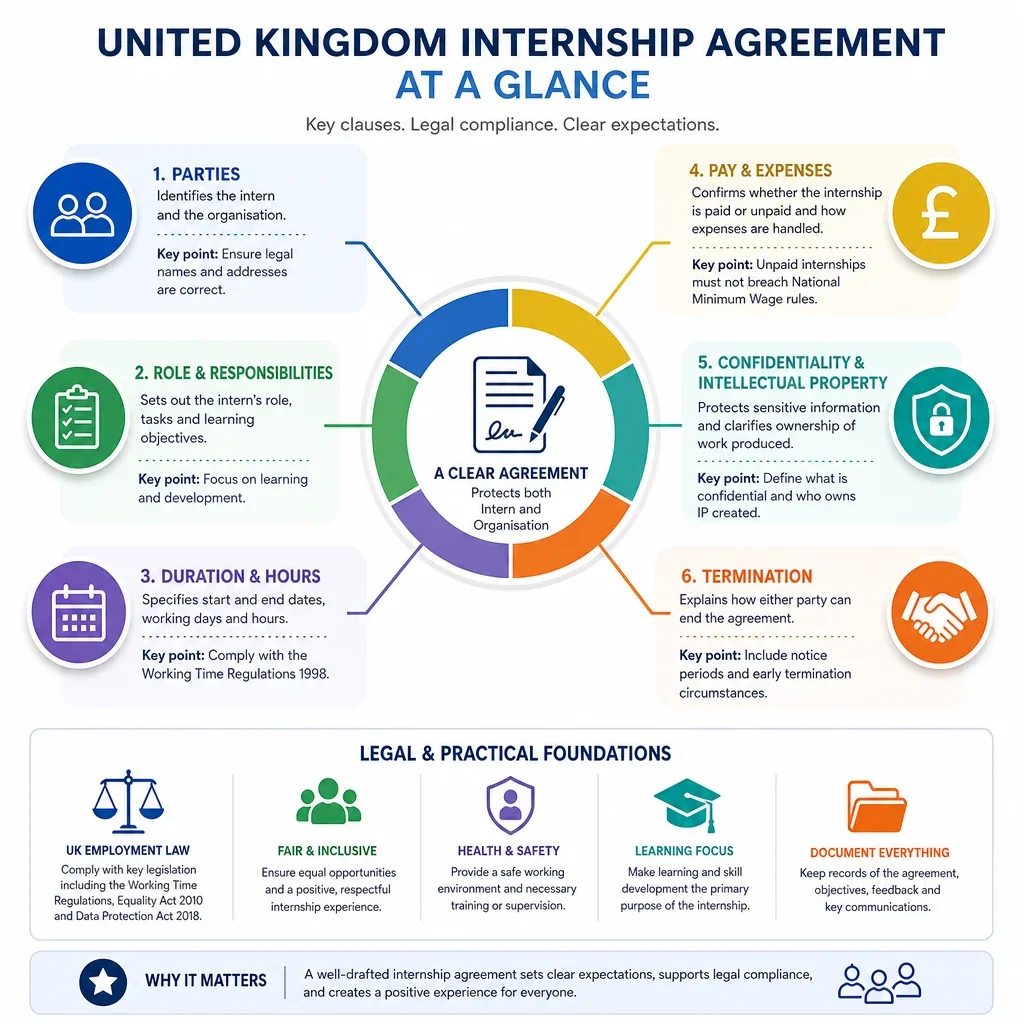
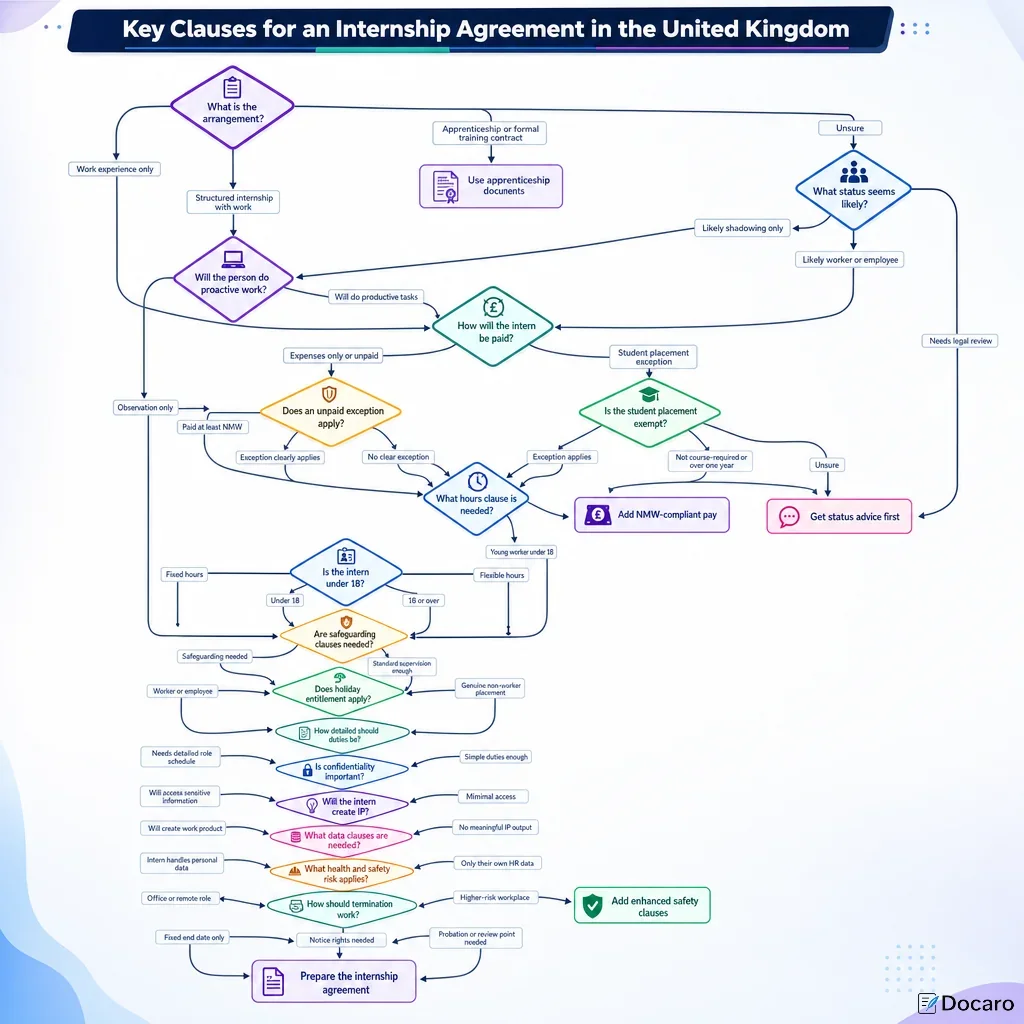
What a Proper Internship Agreement Should Include
- Intern DetailsClearly state the intern's full name, contact information, and the duration of the internship.
- Company InformationInclude the company's name, address, and details of the supervisor or contact person.
- Role and DutiesDescribe the intern's main responsibilities and daily tasks in simple terms.
- Duration and ScheduleSpecify the start and end dates, working hours, and any breaks or holidays.
- CompensationOutline any payment, expenses covered, or confirmation that it's unpaid if applicable.
- Working ConditionsCover the location of work, health and safety rules, and any equipment provided.
- Rights and BenefitsExplain the intern's entitlements like holiday pay, sick leave, or training opportunities.
- ConfidentialityState what information must be kept private and the consequences of sharing it.
- Termination RulesDetail how and when the internship can end early, including notice periods.
- SignaturesRequire signatures from both the intern and company representative to make it official.
Generate Your Document in 4 Easy Steps
Why Use Docaro?
 United Kingdom
Free Example Internship Agreement Template
Below is a free template example of a Internship Agreement for use in the United Kingdom generated by our AI model.
The clauses in your actual Internship Agreement will vary from this example as they will be entirely bespoke to your requirements as set out in the questionnaire you complete.
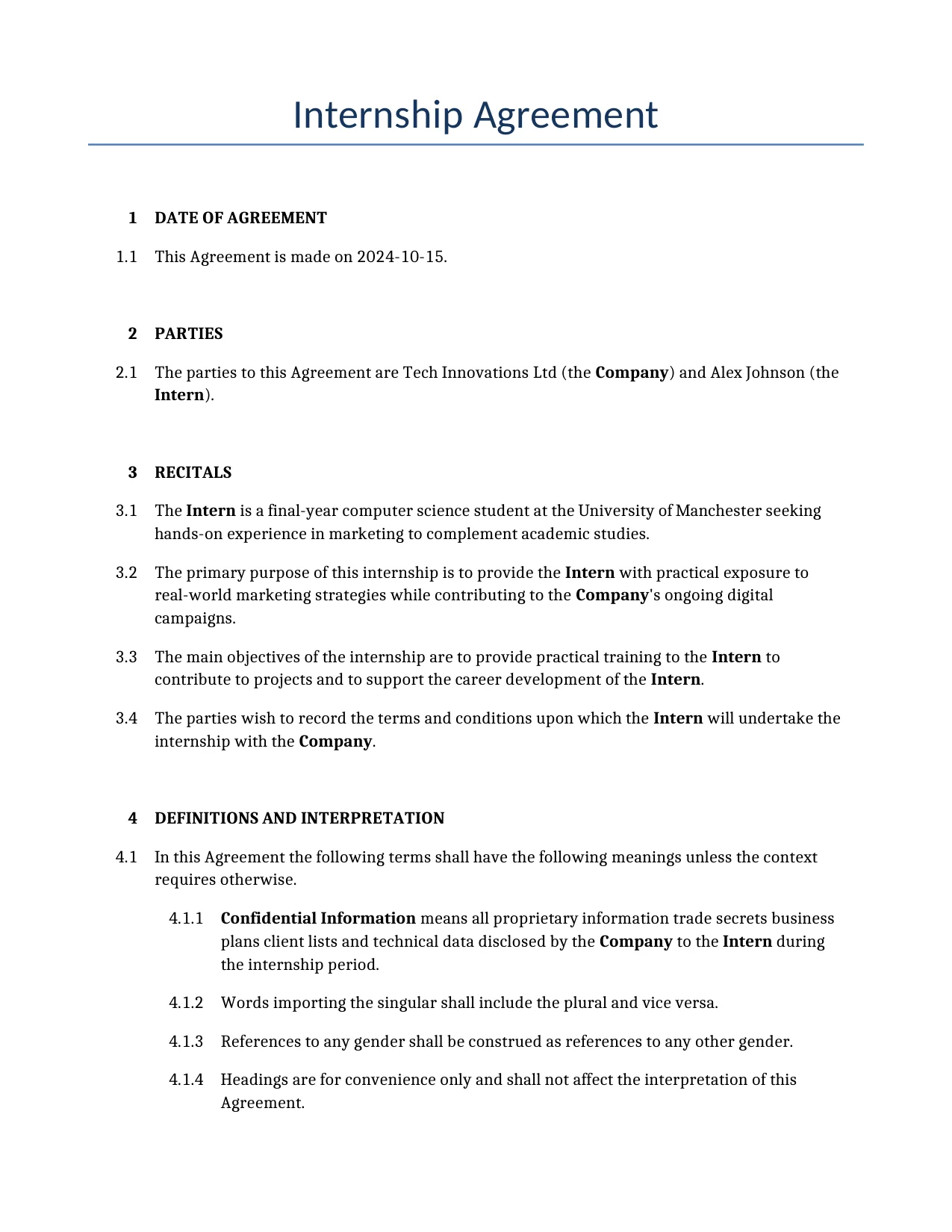
Internship Agreement
1DATE OF AGREEMENT
This Agreement is made on 2024-10-15.
2PARTIES
The parties to this Agreement are Tech Innovations Ltd (the Company) and Alex Johnson (the Intern).
3RECITALS
The Intern is a final-year computer science student at the University of Manchester seeking hands-on experience in marketing to complement academic studies.
The primary purpose of this internship is to provide the Intern with practical exposure to real-world marketing strategies while contributing to the Company's ongoing digital campaigns.
The main objectives of the internship are to provide practical training to the Intern to contribute to projects and to support the career development of the Intern.
The parties wish to record the terms and conditions upon which the Intern will undertake the internship with the Company.
4DEFINITIONS AND INTERPRETATION
In this Agreement the following terms shall have the following meanings unless the context requires otherwise.
Confidential Information means all proprietary information trade secrets business plans client lists and technical data disclosed by the Company to the Intern during the internship period.
Words importing the singular shall include the plural and vice versa.
References to any gender shall be construed as references to any other gender.
Headings are for convenience only and shall not affect the interpretation of this Agreement.
5INTERNSHIP DETAILS
The Intern is engaged by the Company as a Marketing Assistant Intern.
The main responsibilities of the Intern shall be to conduct research and analysis on specific projects to assist in client meetings and communications and to contribute to team projects and reports.
In addition to the main responsibilities the Intern shall perform the duties of conducting market research surveys drafting social media content analysing competitor strategies and preparing weekly progress reports.
The key objectives of the internship are for the Intern to develop practical skills in the relevant field to gain industry exposure and networking opportunities and to prepare for future employment in the sector.
The success of the internship shall be measured through completion of assigned projects feedback from supervisors achievement of learning objectives and a final performance review at the end of the internship period.
6DURATION AND TERM
This Agreement shall commence on 2024-10-15 and shall continue for a fixed term until 2025-10-14 unless terminated earlier in accordance with this Agreement.
The Company may at its discretion extend the term of the internship by mutual written agreement between the parties.
Either party may terminate this Agreement early in accordance with the provisions of Clause 14.
7WORKING HOURS AND LOCATION
The Intern shall work no more than 35 hours per week to ensure compliance with the Working Time Regulations 1998 particularly if the Intern is a student. This is calculated based on a typical 7-hour day over 5 days.
The Intern shall work 5 days per week and shall typically work 7 hours per day.
The expected work schedule for the Intern shall be Monday to Friday from 9am to 5pm with a 1-hour unpaid lunch break each day.
The primary place of work for the Intern shall be the Company office in London UK. The Intern may be required to work remotely on occasion with prior agreement.
The Intern shall not be required to work overtime. Any additional hours must be agreed in advance and will be compensated at the applicable National Minimum Wage rate or by time off in lieu.
The Intern shall not have any on-call or standby duties outside standard hours.
The Intern shall comply with the Working Time Regulations 1998 including entitlement to 20-minute rest breaks for shifts over 6 hours daily and 11 hours rest between working days.
8REMUNERATION AND EXPENSES
The Company shall pay the Intern a stipend at the National Minimum Wage rate applicable to the Intern\'s age (currently \£11.44 per hour for those 21 and over as of April 2024) for all hours worked. This ensures compliance with the National Minimum Wage Regulations 2015. Payment shall be made monthly in arrears.
The Company shall reimburse the Intern for reasonable expenses incurred during the internship in accordance with the Company\'s expenses policy provided they are approved in advance and supported by receipts.
The Intern shall not be entitled to any allowances from the Company other than the stipend and expense reimbursements.
9HOLIDAYS AND LEAVE
The Intern shall be entitled to paid holiday on a pro-rata basis for the fixed-term internship. For a 12-month term this equates to 28 days (including bank holidays) calculated as 5.6 weeks \× (35/7) hours per week. Holiday must be taken during the internship period and cannot be carried over.
Holiday requests must be approved in advance by the supervisor and at least two weeks notice must be provided.
Upon termination any accrued but untaken holiday will be paid in lieu on a pro-rata basis.
The Intern must notify the supervisor by 9am on the first day of any sick leave. The Intern is not eligible for Statutory Sick Pay as this is an internship but may qualify for SSP if average weekly earnings exceed the lower earnings limit.
The Intern shall be entitled to other types of leave including maternity paternity or bereavement leave in accordance with statutory requirements under the Employment Rights Act 1996 and the Company\'s policies.
10HEALTH AND SAFETY
The Company shall provide the Intern with training on fire safety procedures emergency evacuation protocols and safe handling of office equipment on or before the start date.
The Company shall provide personal protective equipment to the Intern where required in accordance with the Health and Safety at Work etc. Act 1974.
The Intern shall comply with all safety protocols report any hazards observed in the workplace and attend all required training sessions.
The Intern agrees to report any accidents or near-misses to the Company immediately.
The Company shall comply with all obligations under the Health and Safety at Work etc. Act 1974 in respect of the Intern.
11CONFIDENTIALITY
The Intern shall keep all Confidential Information strictly confidential during and after the internship and shall not disclose it to any third party without the prior written consent of the Company.
The obligation of confidentiality shall not apply to any information which the Intern is required to disclose by law or by order of a court or which is already in the public domain through no fault of the Intern.
The Intern shall return or destroy all materials containing Confidential Information to the Company upon termination of the internship.
12INTELLECTUAL PROPERTY
All intellectual property rights in any work created by the Intern during the internship in the course of their duties shall belong to and be assigned to the Company in accordance with the Copyright Designs and Patents Act 1988.
The Intern shall disclose to the Company any pre-existing intellectual property that the Intern may use during the internship and grant the Company a licence to use it as necessary.
The Intern waives all moral rights in the intellectual property created during the internship to the fullest extent permitted by law.
The Intern shall assist the Company at the Company\'s expense in protecting and registering the intellectual property after the internship ends.
The Intern represents that any work product created during the internship does not infringe third-party intellectual property rights.
13NON-COMPETE AND NON-SOLICITATION
For a period of three months after the termination of the internship the Intern shall not directly or indirectly solicit or attempt to solicit any clients or employees of the Company with whom they had material dealings during the internship.
The Intern shall not for a period of three months after termination be engaged in any business within the UK which competes with the Company\'s marketing services in a role similar to the internship. This restriction is limited in scope duration and geography to protect legitimate business interests and is considered reasonable and enforceable.
14TERMINATION
Either party may terminate this Agreement by giving 1 weeks notice in writing to the other in accordance with the Employment Rights Act 1996 for internships of this duration.
Either party may terminate this Agreement immediately without notice if the other party commits a serious breach of this Agreement including gross misconduct harassment discrimination or failure to comply with health and safety obligations.
Upon termination the Intern shall return all Company property and complete any outstanding work as directed.
15INSURANCE
The Company maintains Employers Liability Insurance with a minimum cover of \£5 million as required by law and Public Liability Insurance covering the internship period from 2024-10-15 to 2025-10-14. These policies extend to cover the Intern as a worker.
16DATA PROTECTION
The Company shall process the Intern\'s personal data in accordance with the UK General Data Protection Regulation (UK GDPR) and the Data Protection Act 2018.
The Data Protection Officer of the Company is Dr. Emily Carter who can be contacted at emily.carter@company.co.uk.
The Company shall process the Intern\'s personal data for the purposes of managing the internship program including onboarding performance evaluation payroll processing and providing necessary training and feedback. The lawful bases are contract performance legitimate interests and legal obligations.
The Intern has the right to access rectification erasure restriction portability and objection regarding their personal data. Requests should be made to the Data Protection Officer.
In the event of a personal data breach the Company shall notify the Information Commissioner\'s Office where required and the Intern if the breach is likely to result in a high risk to their rights and freedoms.
The Company shall not transfer any of the Intern\'s personal data outside the United Kingdom without appropriate safeguards.
The Company shall retain the Intern\'s personal data for 6 years after the end of the internship in accordance with applicable tax and employment record-keeping requirements after which it will be securely deleted.
The Company has specific technical and organisational measures in place to secure the Intern\'s personal data including encryption access controls and regular audits.
17EQUAL OPPORTUNITIES AND DIVERSITY
The Company is committed to equal opportunities and shall not discriminate on the grounds of age disability gender reassignment marriage and civil partnership pregnancy and maternity race religion or belief sex or sexual orientation in accordance with the Equality Act 2010.
The Intern may report any concerns regarding discrimination or harassment (including sexual harassment) to their supervisor the HR manager or via the Company\'s confidential whistleblowing hotline. All reports will be investigated promptly and fairly.
The Intern agrees not to discriminate against or harass others on any protected characteristic. The Company maintains a zero-tolerance policy towards bullying and harassment.
18DISPUTE RESOLUTION
Any dispute arising out of or in connection with this Agreement shall be resolved amicably in the first instance through internal discussion with the supervisor or HR.
If unresolved the dispute may be referred to ACAS for early conciliation. The parties agree to the jurisdiction of the UK courts for employment disputes and this clause does not mandate arbitration which may be unenforceable for certain employment claims.
19GOVERNING LAW
This Agreement shall be governed by and construed in accordance with the laws of England and Wales.
20ENTIRE AGREEMENT
This Agreement constitutes the entire understanding between the parties and supersedes all prior written agreements all prior oral agreements and all prior negotiations.
Any modifications to this Agreement must be in writing and signed by both the Company and the Intern.
21SEVERABILITY
If any provision of this Agreement is found to be invalid or unenforceable the remaining provisions shall remain valid and in full force and effect.
22ASSIGNMENT
The Intern may not assign any obligations under this Agreement without the prior written consent of the Company.
The Company may assign this Agreement to a successor entity without the Intern\'s consent provided the Intern\'s rights are not adversely affected.
23NOTICES
Any formal notice under this Agreement shall be sent to the Company at 123 Business Street London EC1A 1BB United Kingdom or by email to notices@company.co.uk and to the Intern by email to intern@example.com.
Notices may be delivered by hand delivery registered post or email.
Notices sent by post shall be deemed delivered two business days after posting.
Notices sent by email shall be deemed delivered on the date of transmission if no bounce-back is received.
24FORCE MAJEURE
Neither party shall be liable for any failure to perform its obligations under this Agreement if such failure is due to a Force Majeure event including war terrorism civil unrest pandemics epidemics public health emergencies floods and storms or earthquakes.
The affected party shall give written notice of any Force Majeure event within 14 days.
Both parties shall use reasonable endeavours to mitigate the effects of any Force Majeure event.
If the Force Majeure event continues for more than 60 days the parties may terminate this Agreement by mutual agreement.
25VARIATION
No variation of this Agreement shall be effective unless it is in writing and signed by the parties.
26RIGHT TO WORK
The Intern confirms that they have the legal right to work in the UK and will provide original documents to evidence this prior to commencement in accordance with UK Visas and Immigration requirements.
The Company will conduct right to work checks before the internship begins and may repeat these as required by law.
If the Intern loses the right to work in the UK this Agreement will terminate immediately.
27PROBATIONARY PERIOD
The first 4 weeks of the internship shall be a probationary period during which the Intern\'s performance and suitability will be assessed.
During the probationary period the notice period for termination by either party shall be 48 hours.
At the end of the probationary period a review meeting will be held to provide feedback. The probation may be extended by up to 4 weeks by mutual agreement.
28PENSION AND AUTO-ENROLMENT
As this is a fixed-term internship of less than 12 weeks in total duration the Intern is not eligible for auto-enrolment into a workplace pension under the Pensions Act 2008.
The Intern may opt into a pension scheme if eligible but the Company is not required to make employer contributions for short-term interns.
29STATUTORY SICK PAY AND ABSENCE
The Intern will be eligible for Statutory Sick Pay (SSP) if they meet the qualifying conditions under the Social Security Contributions and Benefits Act 1992 including average weekly earnings above the lower earnings limit.
The Intern must provide a self-certificate for absences of 7 days or less and a fit note from a doctor for longer absences.
The Company will pay SSP where due in accordance with HMRC rules. No contractual sick pay is provided beyond SSP.
30COMPANY POLICIES
The Intern agrees to comply with all Company policies including but not limited to the IT Acceptable Use Policy Social Media Policy Anti-Bullying and Harassment Policy and Expenses Policy. Copies are provided with this Agreement and available on request.
Breach of any policy may result in disciplinary action up to and including immediate termination.
31DISCIPLINARY AND GRIEVANCE PROCEDURES
The Company\'s disciplinary and grievance procedures are based on the ACAS Code of Practice. Details are set out in the Company Handbook provided to the Intern.
In cases of minor misconduct the Intern will be given an informal warning. For serious issues a formal investigation and hearing will be held with the right to be accompanied.
For grievances the Intern should raise the issue informally first with their supervisor. If unresolved a formal written grievance should be submitted and will be investigated promptly.
Appeals against disciplinary or grievance outcomes may be made in writing within 5 working days.
32TRAINING AND DEVELOPMENT
The Company will provide training on health and safety data protection equality and diversity and any role-specific skills required for the internship.
The Intern is expected to attend all scheduled training sessions and to actively participate in learning opportunities provided.
A dedicated supervisor will provide regular feedback and support to assist the Intern in achieving their learning objectives.
33SIGNATURES
Signed by a duly authorised representative of the Company Name: Position: Date:
Signed by the Intern Name: Alex Johnson Date:
This example shows approximately 70% of a typical document and is provided for illustrative purposes only. The remaining content has been omitted.
Every document generated by Docaro is tailored to your specific circumstances, jurisdiction and the information you provide. The completed document includes all applicable clauses and provisions required for your situation.
To generate the full, personalised document, answer a short series of questions and your document will be created instantly.
Useful Resources When Considering a Internship Agreement in the United Kingdom
United Kingdom Reference Legislation
Internship Agreement FAQs
Document Generation FAQs
Related Articles