AI Generated British Cookie Policy
PDF & Word - 2026 Updated
Docaro Pricing
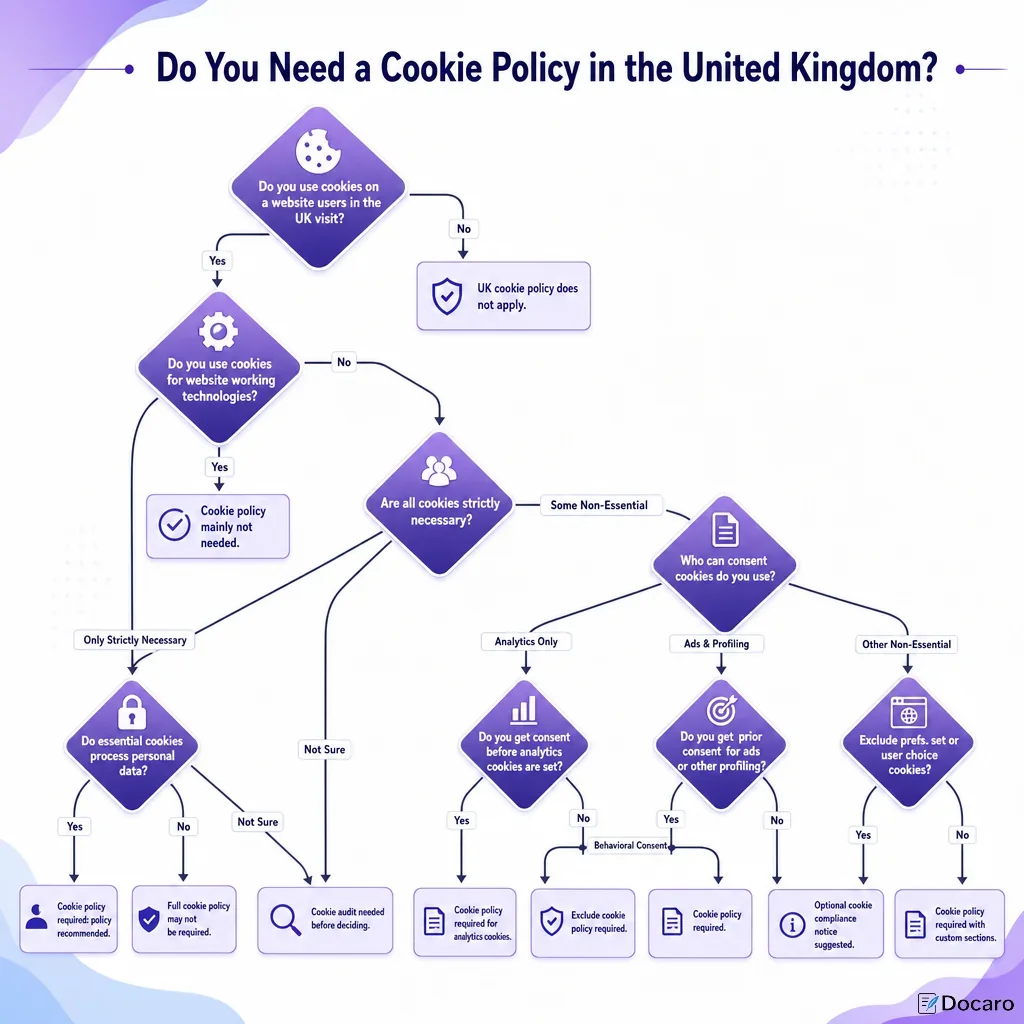
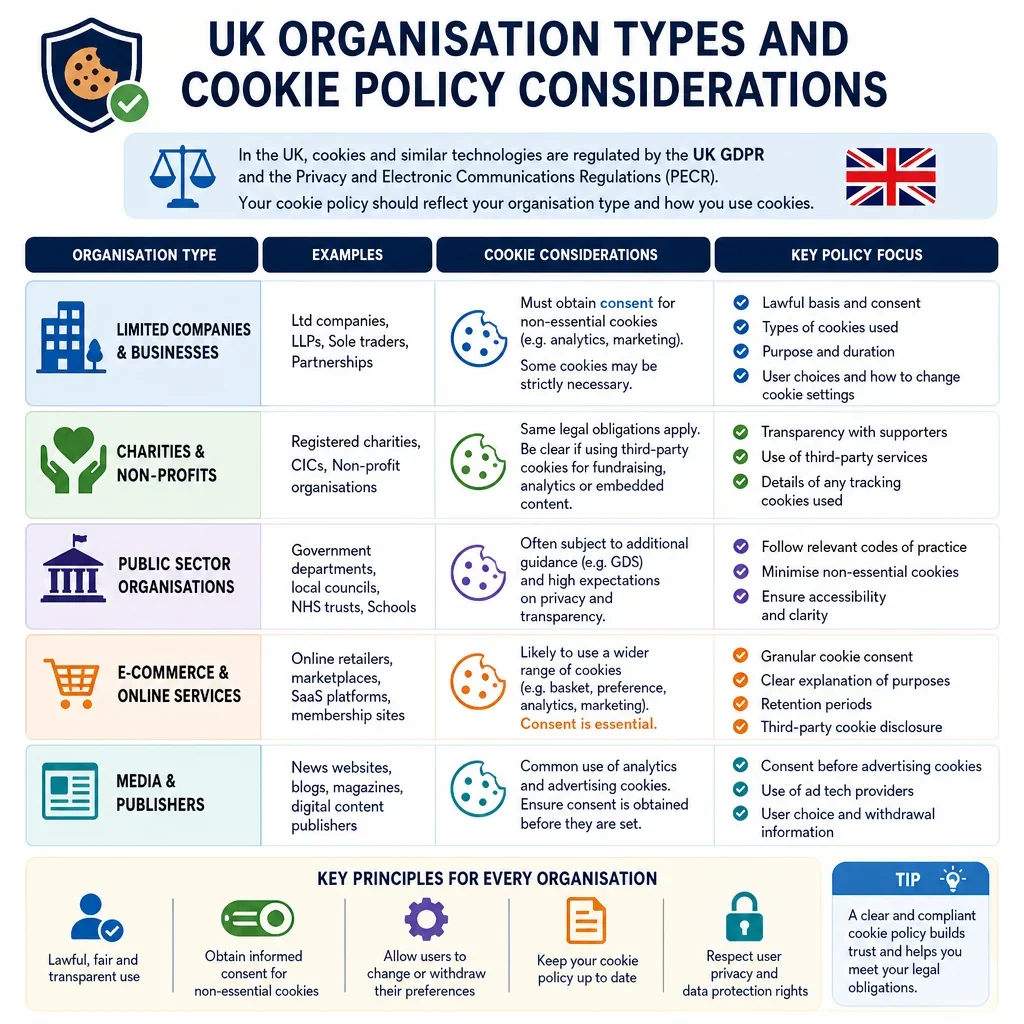
When do you need a Cookie Policy in the United Kingdom?
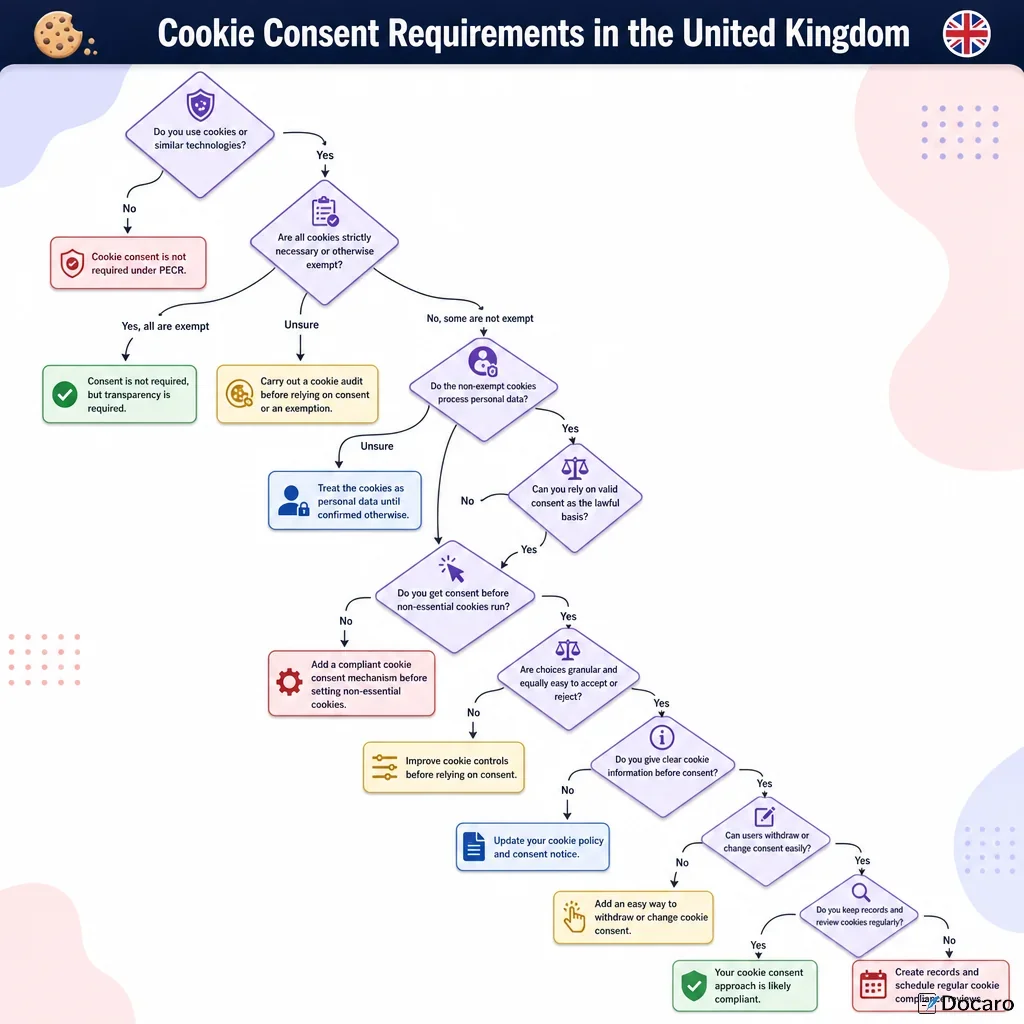
British Legal Rules for a Cookie Policy
Failing to structure a cookie policy in compliance with UK GDPR and PECR requirements can lead to regulatory fines and legal challenges.
What a Proper Cookie Policy Should Include
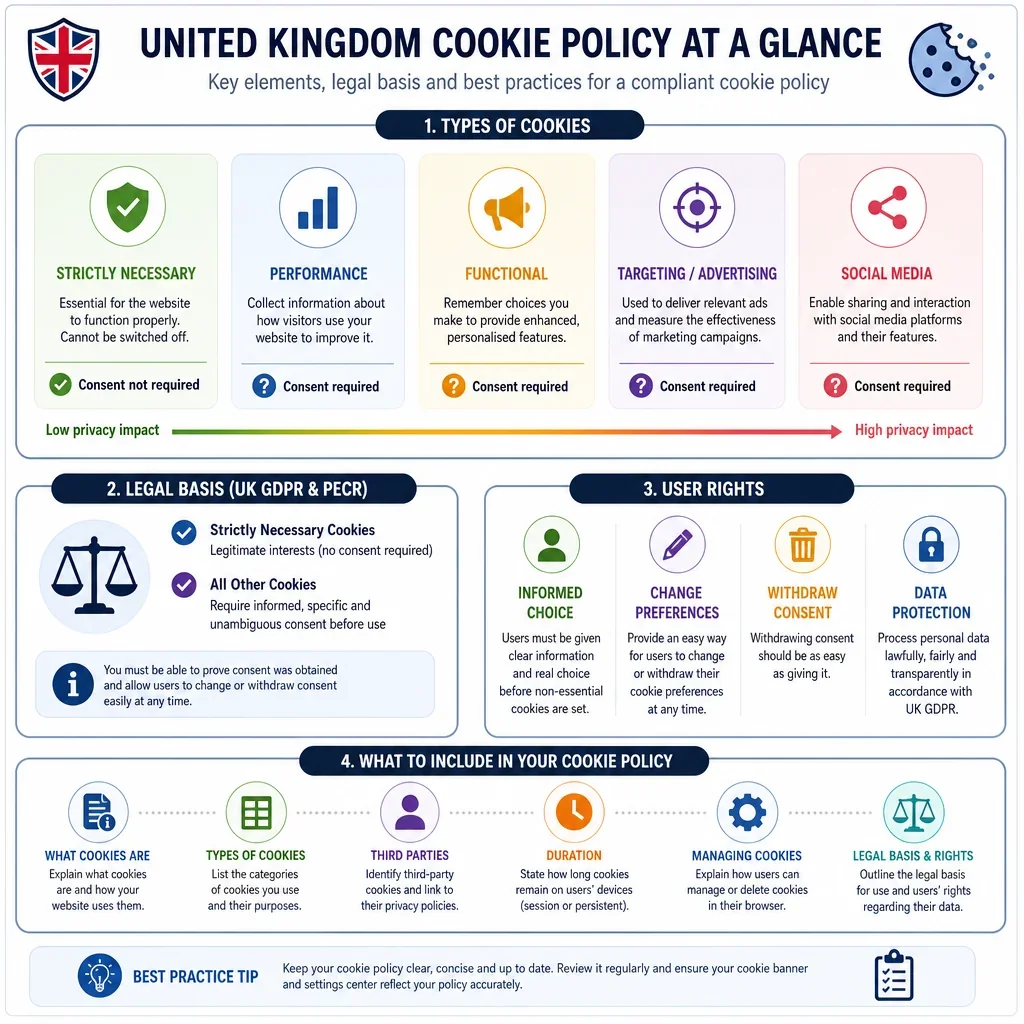
- Introduction to CookiesExplain what cookies are and how your website uses them to help users understand their purpose.
- Types of CookiesList the different kinds of cookies your site uses, such as essential ones for functionality and optional ones for tracking.
- How Cookies WorkDescribe how cookies collect and store data on visitors' devices without revealing technical details.
- Visitor ChoicesOutline how users can accept, reject, or manage cookies through your site's settings.
- Data SharingClarify if and how cookie data is shared with third parties like analytics providers.
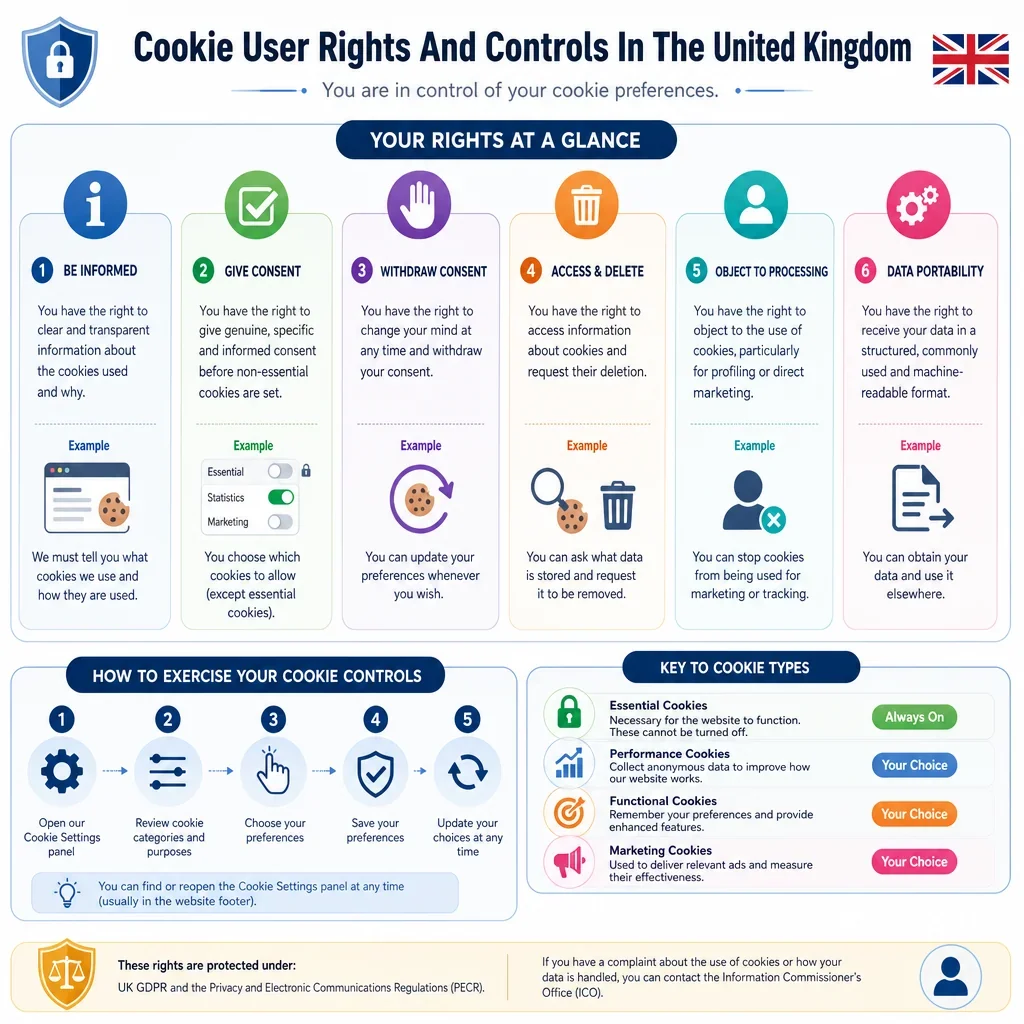
- Privacy RightsInform users about their rights to access, delete, or object to cookie data under UK privacy laws.
- Policy UpdatesState how and when the cookie policy might change, and how users will be notified.
Generate Your Document in 4 Easy Steps
Why Use Docaro?
 United Kingdom
Free Example Cookie Policy Template
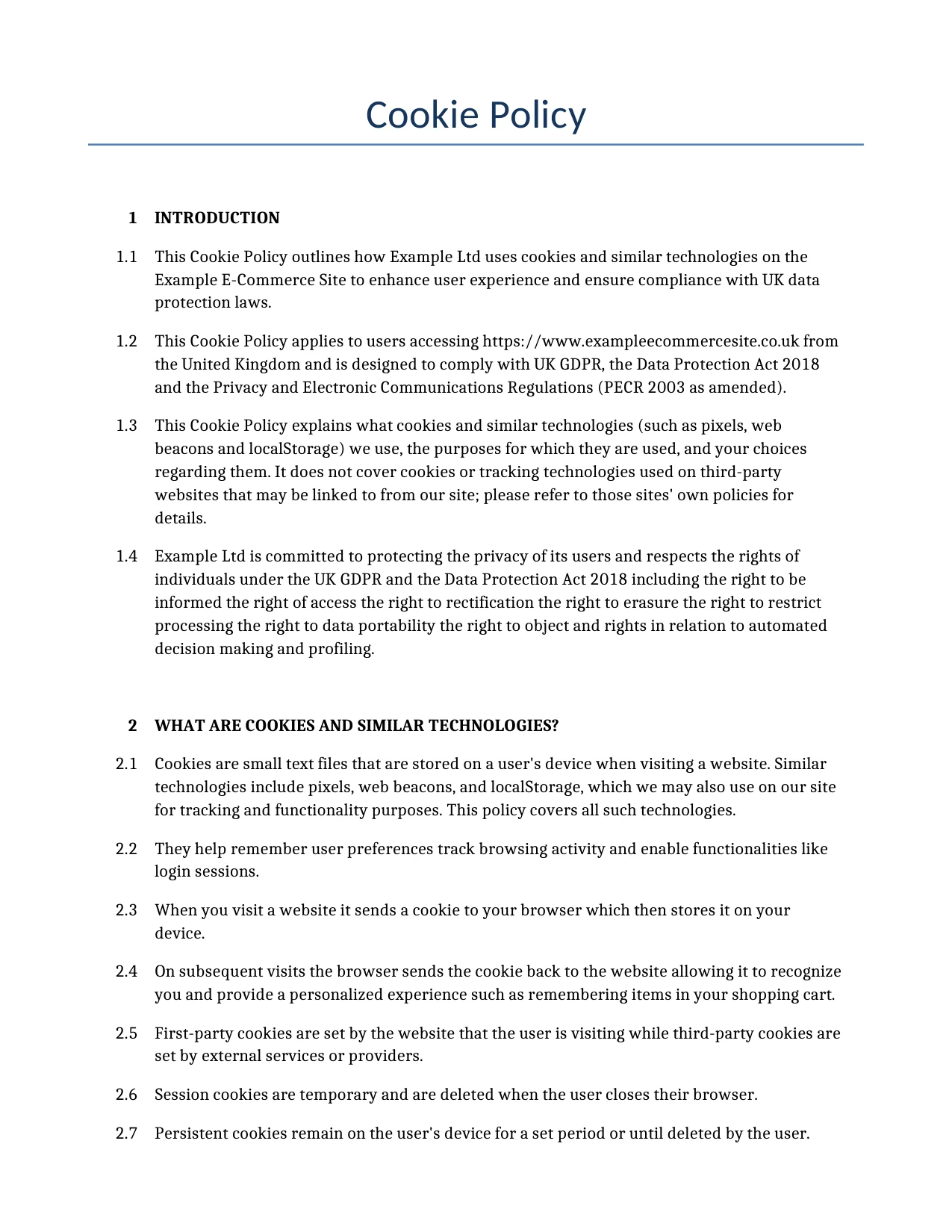
Below is a free template example of a Cookie Policy for use in the United Kingdom generated by our AI model.
The clauses in your actual Cookie Policy will vary from this example as they will be entirely bespoke to your requirements as set out in the questionnaire you complete.
Cookie Policy
1INTRODUCTION
This Cookie Policy outlines how Example Ltd uses cookies and similar technologies on the Example E-Commerce Site to enhance user experience and ensure compliance with UK data protection laws.
This Cookie Policy applies to users accessing https://www.exampleecommercesite.co.uk from the United Kingdom and is designed to comply with UK GDPR, the Data Protection Act 2018 and the Privacy and Electronic Communications Regulations (PECR 2003 as amended).
This Cookie Policy explains what cookies and similar technologies (such as pixels, web beacons and localStorage) we use, the purposes for which they are used, and your choices regarding them. It does not cover cookies or tracking technologies used on third-party websites that may be linked to from our site; please refer to those sites' own policies for details.
Example Ltd is committed to protecting the privacy of its users and respects the rights of individuals under the UK GDPR and the Data Protection Act 2018 including the right to be informed the right of access the right to rectification the right to erasure the right to restrict processing the right to data portability the right to object and rights in relation to automated decision making and profiling.
2WHAT ARE COOKIES AND SIMILAR TECHNOLOGIES?
Cookies are small text files that are stored on a user's device when visiting a website. Similar technologies include pixels, web beacons, and localStorage, which we may also use on our site for tracking and functionality purposes. This policy covers all such technologies.
They help remember user preferences track browsing activity and enable functionalities like login sessions.
When you visit a website it sends a cookie to your browser which then stores it on your device.
On subsequent visits the browser sends the cookie back to the website allowing it to recognize you and provide a personalized experience such as remembering items in your shopping cart.
First-party cookies are set by the website that the user is visiting while third-party cookies are set by external services or providers.
Session cookies are temporary and are deleted when the user closes their browser.
Persistent cookies remain on the user's device for a set period or until deleted by the user.
3HOW WE USE COOKIES
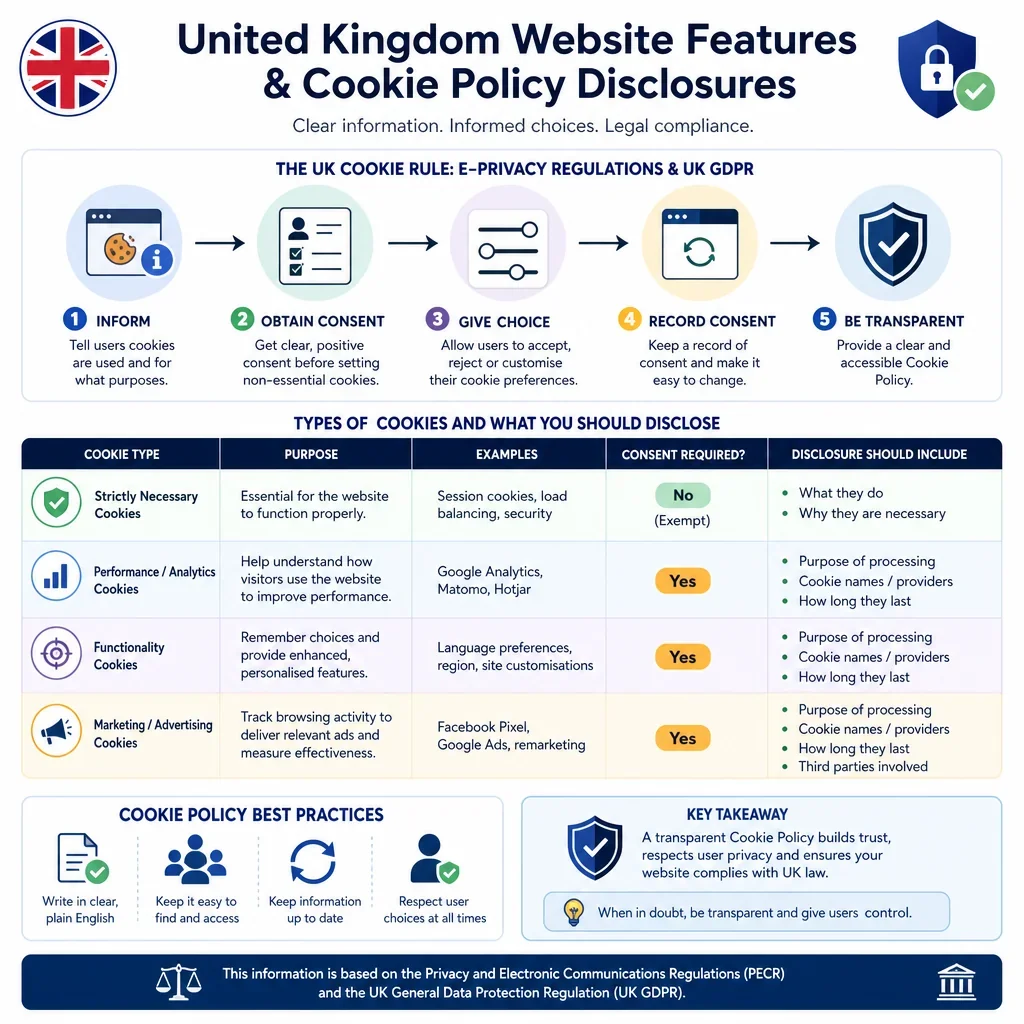
We use cookies and similar technologies to enable the core functioning of our e-commerce site, to analyse performance, to provide enhanced functionality, and for targeted marketing where consent is given.
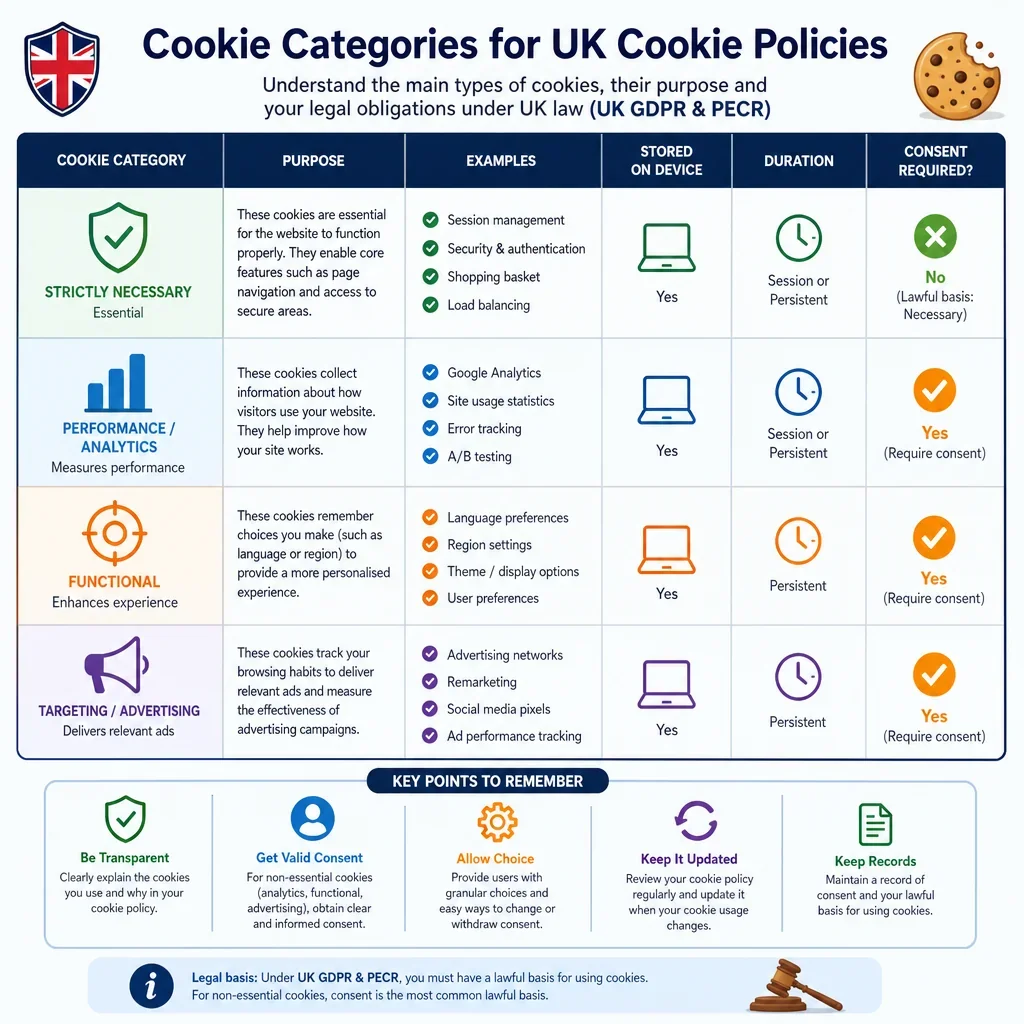
Strictly necessary (essential) cookies are required for the website to operate and do not require consent under PECR. These enable basic features such as page navigation, maintaining shopping cart contents, and securing user sessions.
Performance and analytics cookies help us understand how visitors interact with our site, such as which pages are most popular or if users encounter errors. These allow us to improve the site over time. These require explicit opt-in consent.
Functionality cookies allow the website to remember choices you make (such as your language or region) and provide enhanced, personalised features. These require explicit opt-in consent.
Targeting and marketing cookies are used to deliver personalised advertisements, measure the effectiveness of campaigns, and track users across sites. These require explicit opt-in consent under PECR. Continuing to browse the site without interacting with the consent banner does not constitute valid consent.
4TYPES OF COOKIES WE USE
The table below provides details of the specific cookies and similar technologies we use. This list is representative of those on an e-commerce platform and includes both first- and third-party examples.
Cookie Name | Provider | Purpose | Type | Duration
_ga | Google | Used to distinguish users for analytics | Analytics/Performance | Persistent (2 years)
session_id | Example Ltd (first-party) | Maintains user shopping session | Strictly Necessary | Session
_gid | Google | Used to distinguish users for analytics | Analytics/Performance | Persistent (24 hours)
cart_id | Example Ltd (first-party) | Remembers items in shopping cart | Strictly Necessary | Persistent (30 days)
_fbp | Facebook | Used for Facebook advertising and conversion tracking (Pixel) | Targeting/Marketing | Persistent (90 days)
user_prefs | Example Ltd (first-party) | Remembers user preferences like currency or language | Functionality | Persistent (90 days)
NID | Google | Used for personalised search and ads | Targeting/Marketing | Persistent (6 months)
__utma | Google Analytics | Tracks user sessions for analytics | Analytics/Performance | Persistent (2 years)
auth_token | Example Ltd (first-party) | Maintains logged-in state securely | Strictly Necessary | Persistent (14 days)
localStorage items (e.g. viewed_products) | Example Ltd (first-party) | Stores recently viewed products for recommendations | Functionality | Persistent (until cleared)
We may update this list periodically as we add or change services.
5THIRD-PARTY COOKIES AND SERVICES
We work with the following third-party providers who may set cookies or use similar technologies on our site:
Google Analytics and Google services - Privacy Policy: https://policies.google.com/privacy. Opt-out: https://tools.google.com/dlpage/gaoptout (browser add-on).
Meta (Facebook Pixel) - Privacy Policy: https://www.facebook.com/privacy/policy/. Opt-out: https://www.facebook.com/help/568137493302217.
Additional providers may include payment gateways (e.g. Stripe - https://stripe.com/privacy), advertising networks, and affiliate partners. Full details are in the cookie list above and our Privacy Policy.
You can opt out of third-party cookies via the consent management tool or by using browser settings and the opt-out links provided.
6YOUR COOKIE CHOICES AND CONSENT
We use a consent management platform (cookie banner) to obtain and record your preferences for non-essential cookies.
The cookie banner will inform you about the types of cookies and similar technologies we use, their purposes, which ones are essential and cannot be disabled, how you can manage your preferences via the banner or browser settings, and includes a clear link to this full Cookie Policy.
The banner appears on your first visit (and subsequently if consent has expired or been withdrawn).
Continuing to browse the site without clicking 'Accept' or making a selection does not constitute valid consent under PECR. Consent must be freely given, specific, informed, and unambiguous. Pre-ticked boxes or implied consent (such as scrolling) are not used or considered valid.
You can provide granular consent for categories (e.g. analytics, functionality, marketing). Buttons are provided to 'Accept All' or 'Reject All' non-essential categories.
You may withdraw or change your consent at any time by clicking the 'Cookie Settings' link in the footer.
7CONSENT RECORDING AND MANAGEMENT
We record the date, time, your choices (including granular selections), and a unique identifier for your consent. This consent record is stored securely for audit purposes.
Consent for non-essential cookies typically lasts for 12 months, after which you will be prompted to refresh your consent. You can change your preferences at any time; a withdrawal does not affect the lawfulness of processing before withdrawal.
Consent must meet the standards of being granular, freely given, specific, informed, and unambiguous. We do not use pre-ticked boxes, silence, or implied consent for non-essential cookies.
8COOKIE MANAGEMENT TOOLS
In addition to the consent banner, you can manage cookies through your browser settings. Note that disabling all cookies (including essential ones) may prevent the site from functioning correctly, such as completing purchases.
Instructions for common browsers: Google Chrome, Mozilla Firefox, Apple Safari, and Microsoft Edge are available via our help pages or the ICO guidance linked below.
9LEGAL BASIS FOR USING COOKIES
Under PECR, strictly necessary cookies do not require consent and are used on the basis of contractual necessity (to provide the service you request) or our legitimate interests (e.g. basic site security).
For all non-essential cookies (performance/analytics, functionality, targeting/marketing), we rely on your explicit consent under PECR. This is separate from any UK GDPR lawful basis that may apply to the underlying personal data processing (such as legitimate interests or consent under GDPR).
We conduct Legitimate Interests Assessments (LIAs) where legitimate interests are relied upon for essential cookies or related processing. These balance our interests against your rights and freedoms.
The purposes for processing include: enabling transactions and security (essential); analysing site usage to improve performance (analytics); personalising features based on your choices (functionality); and delivering relevant advertising and measuring campaign success (marketing, with consent).
We obtain and record consent for non-essential cookies via the banner described above.
10DATA SHARING AND INTERNATIONAL TRANSFERS
Data collected via cookies may be shared with the third parties listed in section 5 for the purposes described.
Some providers are based outside the UK. Where personal data is transferred internationally, appropriate safeguards such as the UK International Data Transfer Agreement, standard contractual clauses, or adequacy decisions are used.
11RETENTION OF COOKIE DATA
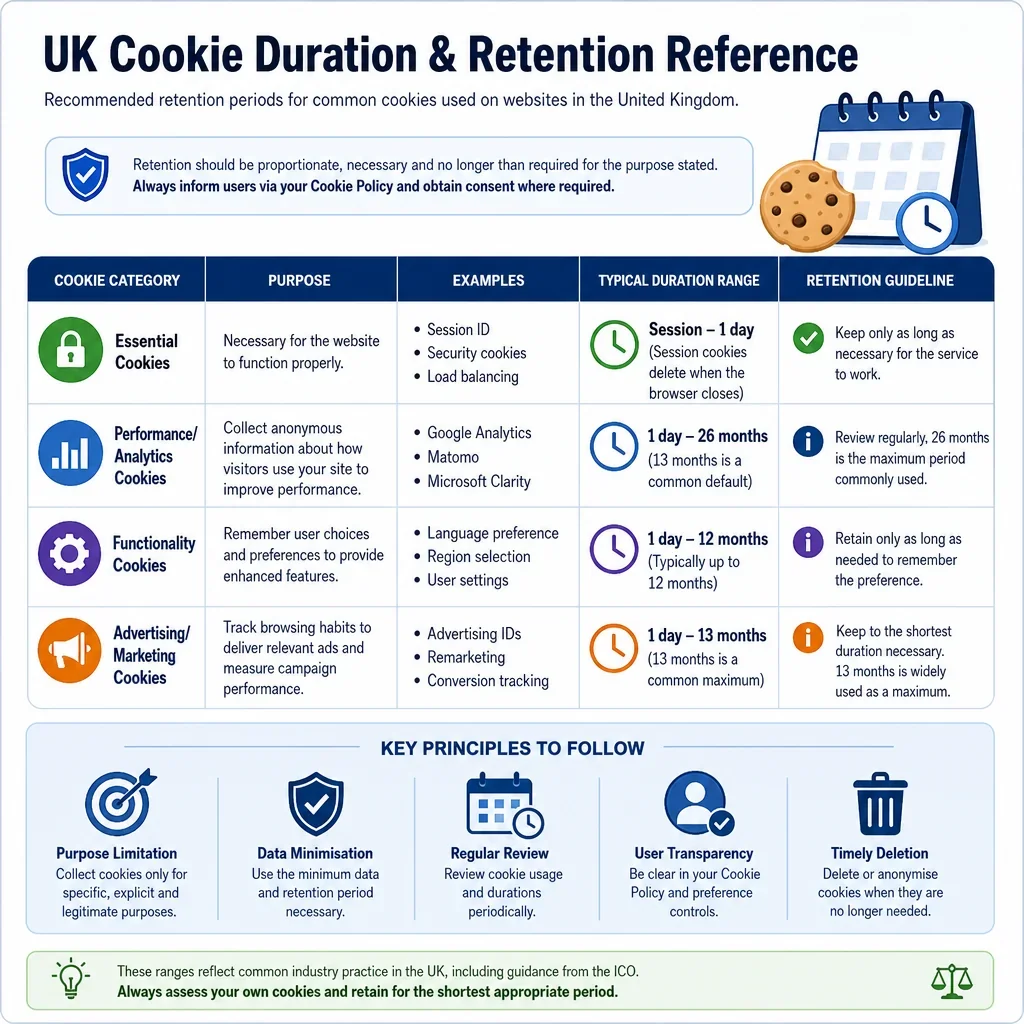
The retention period for each cookie is specified in the detailed list in section 4. Cookies expire automatically at the end of their set duration (e.g. session cookies at the end of the browsing session, persistent cookies after months or years).
We reference the lifetimes listed for each specific cookie or similar technology. Upon expiration or deletion, the data is no longer stored on your device by that cookie.
Any associated personal data processed from cookies is retained only as long as necessary for the purposes outlined, in line with our Privacy Policy. Retention practices are reviewed annually.
12YOUR RIGHTS
Under UK GDPR you have the following rights regarding your personal data (including that collected via cookies and similar technologies): the right to be informed, right of access, right to rectification, right to erasure, right to restrict processing, right to data portability, right to object to processing, and rights related to automated decision-making and profiling.
Example Ltd responds to requests to exercise these rights within one month although this period may be extended in certain circumstances.
Users may contact Example Ltd to exercise their rights under UK GDPR regarding cookie data by emailing privacy@company.com or using the contact form on our website.
Exercising these rights is generally free of charge although a reasonable fee may be charged for manifestly unfounded or excessive requests.
Example Ltd maintains processes to handle user rights requests related to cookie data such as access or deletion.
If you are not satisfied with how we have handled your request, you have the right to complain to the UK Information Commissioner's Office (ICO) at https://ico.org.uk/make-a-complaint/.
13UPDATES TO THIS COOKIE POLICY
This Cookie Policy is reviewed periodically and may be updated to reflect changes in our practices or legal requirements.
Users will be notified of material changes via the website banner and/or email where appropriate. Continued use after changes implies acceptance of the updated policy, but we will seek fresh consent where required by law.
The current version is effective from 01 January 2025.
14CONTACT INFORMATION
The data controller is Example Ltd whose registered office is at 123 High Street London SW1A 1AA.
Queries about cookies and data protection may be addressed to privacy@example.com.
Example Ltd has a designated Data Protection Officer who may be contacted using the details above.
15GOVERNING LAW
This Cookie Policy is governed by the laws of England and Wales. Any disputes shall be subject to the jurisdiction of the courts of England and Wales.
16FURTHER INFORMATION
For more details on how we process personal data generally, please see our full Privacy Policy at https://www.exampleecommercesite.co.uk/privacy-policy.
You can disable cookies via your browser settings (see section 8), but please note this may degrade your experience on the site and prevent certain features from working, such as remembering your shopping cart.
For official guidance on cookies, visit the ICO website: https://ico.org.uk/for-organisations/uk-gdpr-guidance-and-resources/cookies-and-similar-technologies/.
17SIGNATURE
This Cookie Policy is issued by Example Ltd and is effective from 01 January 2025. By using the Example E-Commerce Site users acknowledge that they have read and understood this Cookie Policy.
This example shows approximately 70% of a typical document and is provided for illustrative purposes only. The remaining content has been omitted.
Every document generated by Docaro is tailored to your specific circumstances, jurisdiction and the information you provide. The completed document includes all applicable clauses and provisions required for your situation.
To generate the full, personalised document, answer a short series of questions and your document will be created instantly.
Useful Resources When Considering a Cookie Policy in the United Kingdom
United Kingdom Reference Legislation
Cookie Policy FAQs
Document Generation FAQs
Related Articles