AI Generated British Tenancy Renewal Agreement
PDF & Word - 2026 Updated
Docaro Pricing
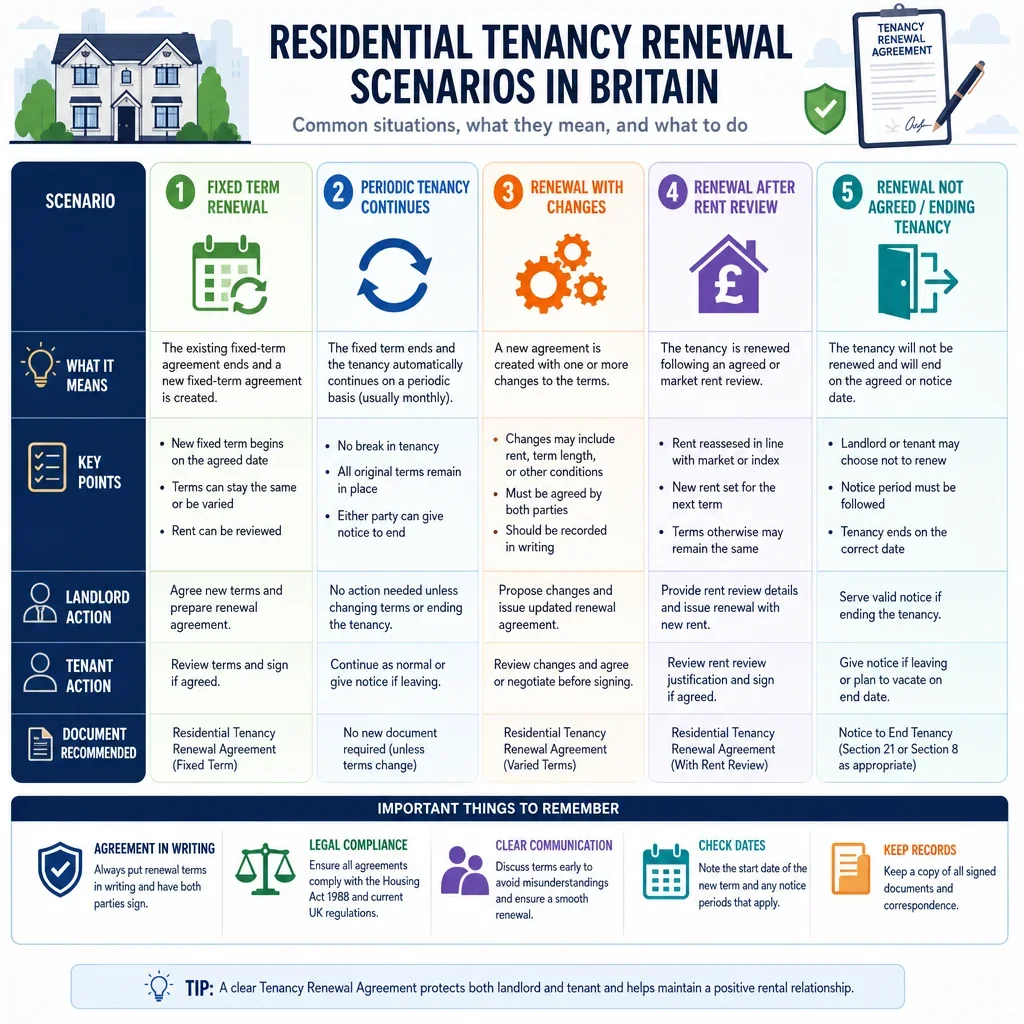
When do you need a Tenancy Renewal Agreement in the United Kingdom?
British Legal Rules for a Tenancy Renewal Agreement
Using the wrong type of lease renewal agreement may inadvertently create or alter tenancy rights under UK housing law.
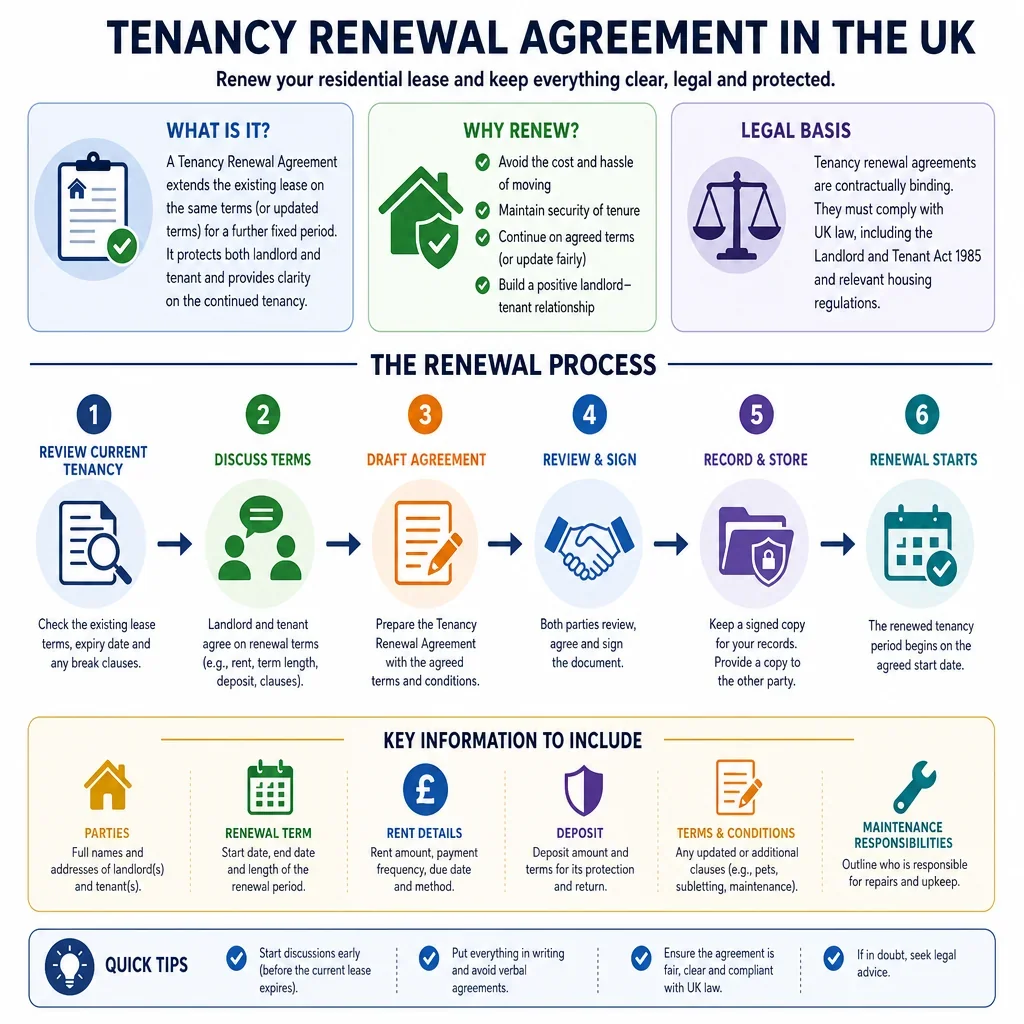
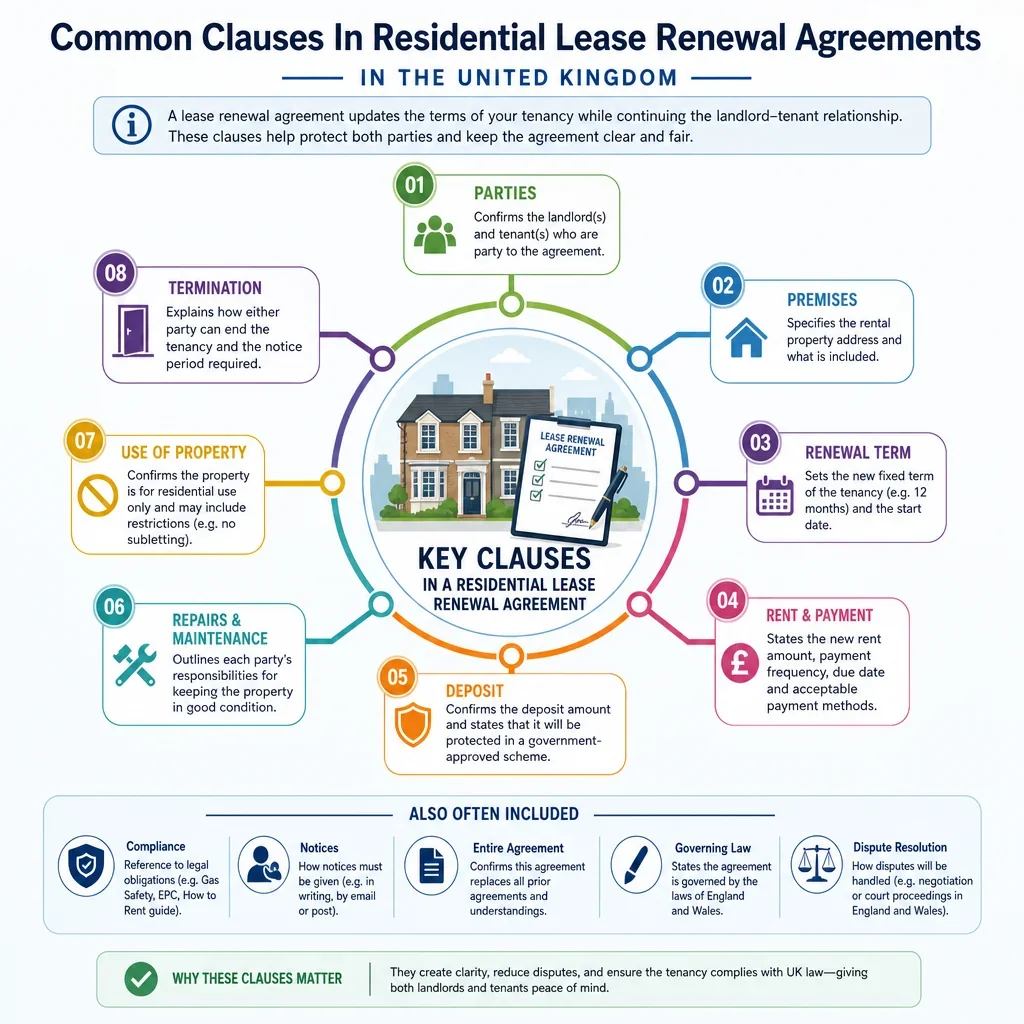
What a Proper Tenancy Renewal Agreement Should Include
- Renewal TermSpecifies the length of the new tenancy period, such as another six or twelve months.
- Rent AmountSets the new rent price and when payments are due, including any increases.
- Deposit DetailsConfirms the security deposit amount and how it will be handled at the end of the tenancy.
- ResponsibilitiesOutlines duties for maintenance and repairs for both landlord and tenant.
- Rules for UseLists any restrictions on property use, like no pets or subletting.
- Ending the AgreementExplains how and when the tenancy can be terminated by either party.
- SignaturesRequires both landlord and tenant to sign and date the document to make it valid.
Generate Your Document in 4 Easy Steps
Why Use Docaro?
 United Kingdom
Free Example Tenancy Renewal Agreement Template
Below is a free template example of a Tenancy Renewal Agreement for use in the United Kingdom generated by our AI model.
The clauses in your actual Tenancy Renewal Agreement will vary from this example as they will be entirely bespoke to your requirements as set out in the questionnaire you complete.
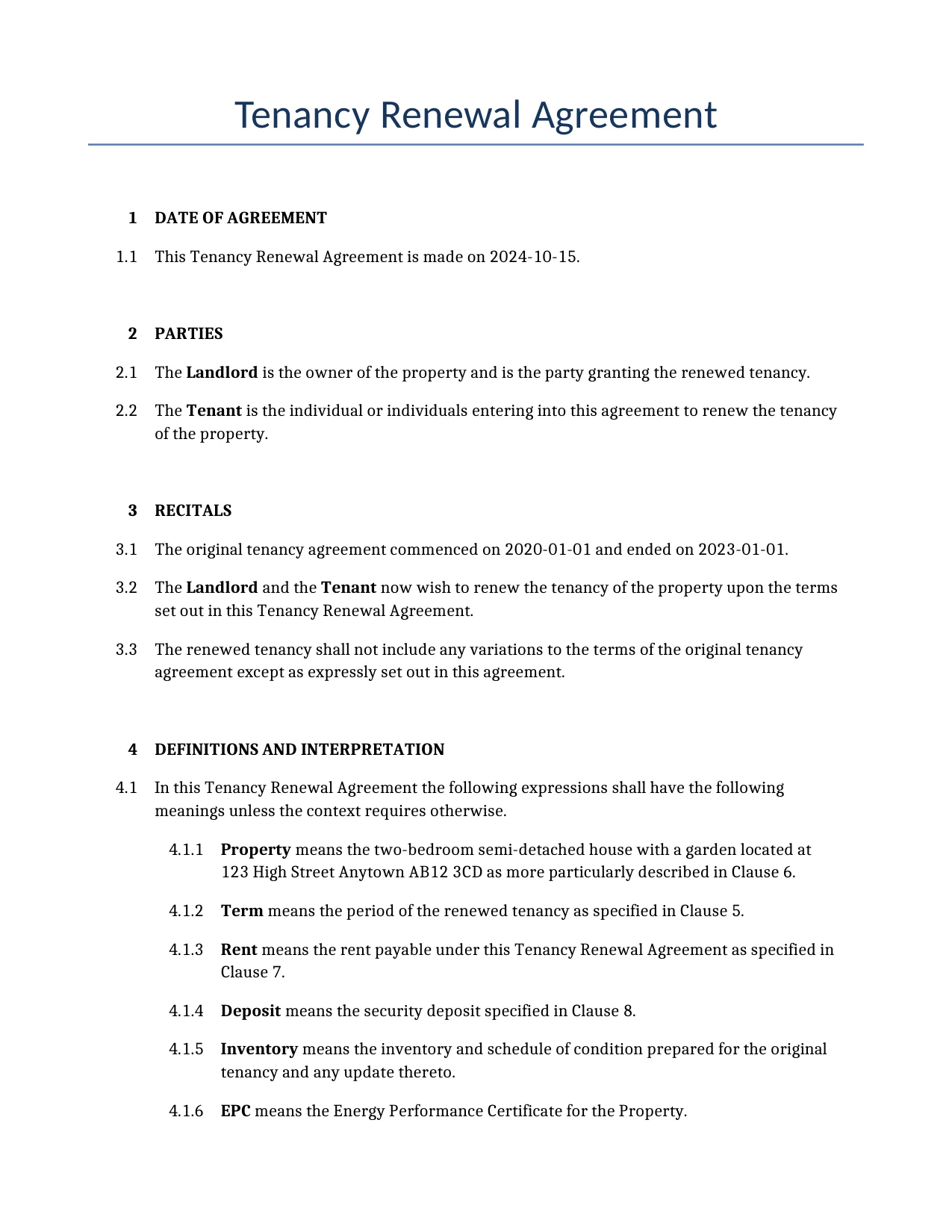
Tenancy Renewal Agreement
1DATE OF AGREEMENT
This Tenancy Renewal Agreement is made on 2024-10-15.
2PARTIES
The Landlord is the owner of the property and is the party granting the renewed tenancy.
The Tenant is the individual or individuals entering into this agreement to renew the tenancy of the property.
3RECITALS
The original tenancy agreement commenced on 2020-01-01 and ended on 2023-01-01.
The Landlord and the Tenant now wish to renew the tenancy of the property upon the terms set out in this Tenancy Renewal Agreement.
The renewed tenancy shall not include any variations to the terms of the original tenancy agreement except as expressly set out in this agreement.
4DEFINITIONS AND INTERPRETATION
In this Tenancy Renewal Agreement the following expressions shall have the following meanings unless the context requires otherwise.
Property means the two-bedroom semi-detached house with a garden located at 123 High Street Anytown AB12 3CD as more particularly described in Clause 6.
Term means the period of the renewed tenancy as specified in Clause 5.
Rent means the rent payable under this Tenancy Renewal Agreement as specified in Clause 7.
Deposit means the security deposit specified in Clause 8.
Inventory means the inventory and schedule of condition prepared for the original tenancy and any update thereto.
EPC means the Energy Performance Certificate for the Property.
Headings in this Tenancy Renewal Agreement are for convenience only and do not affect its interpretation.
Words importing one gender include all genders.
Words importing the singular include the plural and vice versa.
References to any legislation include any modification or re-enactment of that legislation and any subordinate legislation made under it.
5RENEWAL TERM
The Landlord agrees to let and the Tenant agrees to take the Property for a fixed term of twelve months commencing on 2024-01-01 and ending on 2024-12-31.
This Tenancy Renewal Agreement creates an assured shorthold tenancy within the meaning of the Housing Act 1988 (as amended by the Housing Act 2004 and the Deregulation Act 2015).
6PROPERTY DESCRIPTION
The Property is a two-bedroom semi-detached house with a garden located at 123 High Street Anytown AB12 3CD and is furnished as per the Inventory.
The full description of the Property is a two-bedroom semi-detached house with a garden located in a quiet residential area.
The current EPC rating for the Property is [insert rating, e.g. D]. The Landlord confirms that the Property complies with the minimum energy efficiency standards under the Energy Efficiency (Private Rented Property) (England and Wales) Regulations 2015 (as amended).
The Landlord confirms that the Property has working smoke alarms and carbon monoxide alarms installed in accordance with the Smoke and Carbon Monoxide Alarm (England) Regulations 2015 (as amended).
7RENT
The Tenant shall pay the Rent of 1300.50 GBP per month to the Landlord.
The Rent shall be payable monthly in advance on the first day of each month by bank transfer or standing order.
The renewed monthly rent amount that the Tenant will pay to the Landlord is 1300.50 GBP and shall take effect from 2024-06-01.
The Landlord may not increase the Rent during the fixed Term. Any increase after the fixed Term must follow the procedure in Section 13 or Section 14 of the Housing Act 1988 (as amended) or by mutual agreement in writing. No fee may be charged to the Tenant in connection with any rent review in accordance with the Tenant Fees Act 2019.
8DEPOSIT
The Tenant shall pay (or has paid) a Deposit of 1300.50 GBP to the Landlord (or the previous deposit of 1300.50 GBP has been carried over to this renewed tenancy).
The Deposit has been increased from the previous tenancy agreement (if applicable) and any additional amount has been paid.
The Landlord shall protect the Deposit with the Deposit Protection Service (DPS) under membership or reference number DPS-12345678 and the Deposit was protected within 30 days of receipt in accordance with the Housing Act 2004. The Landlord has provided or will provide the Tenant with the prescribed information relating to the Deposit protection scheme within 30 days of receipt of the Deposit.
The Landlord may make deductions from the Deposit for unpaid rent, damage to the Property beyond fair wear and tear, reasonable cleaning costs if the Property is not left in a clean condition at the end of the tenancy, and any outstanding utility bills. The Deposit will be returned (less any lawful deductions) in accordance with the rules of the chosen protection scheme.
The Deposit shall be handled in accordance with the Housing Act 2004 (as amended) and the Housing Act 1988 (as amended).
9TENANT'S OBLIGATIONS
The Tenant shall keep the interior of the Property in the same condition as at the commencement of the original tenancy (fair wear and tear excepted) in accordance with the Inventory and the Landlord and Tenant Act 1985.
The Tenant shall pay for all utilities including gas, electricity, water, council tax, telephone, broadband and television licence during the tenancy.
The Tenant shall comply with all applicable laws and regulations during the tenancy, including not smoking or vaping inside the Property and not causing nuisance or annoyance to neighbours.
The Tenant shall not make any alterations to the Property without the Landlord's prior written consent.
No smoking or vaping is permitted anywhere in the Property.
The Tenant shall not cause nuisance or annoyance to neighbours.
The Tenant shall comply with the obligations set out in this Clause 9 in accordance with the Landlord and Tenant Act 1985, the Housing Act 1988 (as amended), the Consumer Rights Act 2015 and all other applicable legislation.
The Tenant acknowledges receipt of the gas safety certificate, electrical safety certificate (EICRs), EPC and the latest version of the 'How to Rent' guide.
10LANDLORD'S OBLIGATIONS
The Landlord shall maintain the Property in good repair including the structure and exterior and installations for services in accordance with section 11 of the Landlord and Tenant Act 1985.
The Landlord shall maintain buildings insurance on the Property.
The Landlord covenants that the Tenant shall have quiet enjoyment of the Property.
The Landlord shall comply with all relevant UK housing regulations including those under the Landlord and Tenant Act 1985, the Housing Act 2004, the Protection from Eviction Act 1977, the Deregulation Act 2015, the Tenant Fees Act 2019 and all gas, electrical and fire safety regulations.
The Landlord confirms that all right to rent checks have been carried out in accordance with the Immigration Act 2014 (as amended).
11UTILITIES AND OUTGOINGS
The Tenant shall be responsible for water rates, gas supply charges, electricity supply charges, council tax, telephone and broadband charges and the television licence fee from 2024-06-01.
12ACCESS AND INSPECTIONS
The Landlord may access the Property for inspections, repairs and maintenance and gas, electrical and fire safety checks upon giving the Tenant at least 24 hours' notice in writing.
The Landlord may access the Property immediately without notice in the case of an emergency.
This Clause 12 is in accordance with the requirements of the Protection from Eviction Act 1977.
13ALTERATIONS AND IMPROVEMENTS
The Tenant shall not make any alterations or improvements to the Property without the prior written consent of the Landlord.
If the Tenant makes any alterations with consent the Tenant shall reinstate the Property to its original condition at the end of the tenancy (fair wear and tear excepted).
The Tenant shall not be permitted to make non-structural alterations without prior consent.
The Tenant shall not claim compensation for any improvements made to the Property.
All proposed alterations must have obtained necessary planning permissions or building regulations approval where required.
14SUBLETTING AND ASSIGNMENT
The Tenant shall not sublet the Property or any part of it.
The Tenant shall not assign the tenancy to another party without the Landlord's prior written consent (which shall not be unreasonably withheld in the case of an assignment of the whole of the tenancy).
15INSURANCE
The Landlord shall maintain buildings insurance for the Property.
The Tenant shall maintain contents insurance for their personal belongings in the Property.
The Tenant shall provide proof of their contents insurance by supplying a copy of the policy document to the Landlord upon request.
16REPAIRS AND MAINTENANCE
The Tenant shall be responsible for minor repairs up to a monetary threshold of 150.00 and shall report all disrepair to the Landlord promptly.
The Tenant may make minor decorations to the Property during the tenancy with the Landlord's prior consent.
The Landlord may conduct maintenance inspections of the Property annually upon reasonable notice.
The Tenant shall maintain the interior of the Property including cleaning and minor upkeep in accordance with the Inventory.
The Landlord shall have responsibility for emergency repairs such as for heating, plumbing or leaks.
The obligations in this Clause 16 are in accordance with the Landlord and Tenant Act 1985 (as amended).
17COMPLIANCE WITH LAWS
The Tenant shall comply with all applicable laws during the tenancy renewal period.
The Landlord shall comply with all applicable laws during the tenancy renewal period.
The last gas safety check for the Property was carried out on 2023-10-15 by a Gas Safe registered engineer and a copy of the certificate has been provided to the Tenant. The last electrical safety inspection (EICR) was carried out on 2023-11-20 by a qualified person and a copy of the report has been provided to the Tenant. The Landlord will provide updated certificates as required by law.
Both parties shall comply with the requirements of the Landlord and Tenant Act 1985, the Housing Act 1988 (as amended), the Housing Act 2004, the Consumer Rights Act 2015, the Deregulation Act 2015, the Tenant Fees Act 2019 and all other applicable legislation.
The Landlord confirms that the Tenant has the right to rent the Property in accordance with the Immigration Act 2014.
The Landlord will comply with all requirements of the Renters (Reform) Act 2024 (once in force) including any changes to tenancy types, notice periods and eviction grounds.
18TERMINATION AND BREAK CLAUSES
Either party may terminate this Tenancy Renewal Agreement at the end of the fixed Term by giving at least two months' notice in writing. The Tenant may terminate this agreement early only with the Landlord's prior written agreement or in accordance with any statutory rights. No unilateral break clause is granted to the Tenant during the fixed term.
This clause does not affect the Landlord's rights to serve a notice under Section 8 or (before 1 June 2025 or as per the Renters (Reform) Act 2024) Section 21 of the Housing Act 1988.
Upon termination the Tenant shall provide vacant possession of the Property and leave it in the condition required by this Agreement.
This Clause 18 is without prejudice to the provisions of the Housing Act 1988 (as amended), the Protection from Eviction Act 1977 and the Deregulation Act 2015.
19NOTICES
Any notice given under this Tenancy Renewal Agreement shall be in writing and shall be served at the following addresses.
Notices to the Landlord shall be served at 123 High Street London SW1A 1AA.
Notices to the Tenant shall be served at 456 Oak Avenue Manchester M1 1AB or at the Property.
Notices may be served by first class post, recorded delivery or email (where proof of delivery can be shown).
A notice sent by first class post shall be deemed served 48 hours after posting. A notice sent by recorded delivery shall be deemed served at the time of delivery.
This Clause 19 complies with section 196 of the Law of Property Act 1925.
20DISPUTE RESOLUTION
Any dispute arising out of or in connection with this Tenancy Renewal Agreement shall first be referred to mediation.
Mediation shall be encouraged before any court proceedings are commenced.
The courts of England and Wales shall have exclusive jurisdiction to hear any disputes.
21ENTIRE AGREEMENT
This Tenancy Renewal Agreement constitutes the entire agreement between the Landlord and the Tenant and supersedes all prior oral or written agreements that are not incorporated into this Tenancy Renewal Agreement.
The Landlord and the Tenant confirm that there are no prior oral or written agreements between them that are not incorporated into this Tenancy Renewal Agreement.
22SEVERABILITY
If any provision of this Tenancy Renewal Agreement is held to be invalid or unenforceable such invalidity or unenforceability shall not affect the validity or enforceability of the remaining provisions of this Tenancy Renewal Agreement.
23VARIATION
No variation of this Tenancy Renewal Agreement shall be effective unless it is in writing and signed by or on behalf of each of the Landlord and the Tenant.
24DATA PROTECTION AND PRIVACY
The Landlord will process the Tenant's personal data in accordance with the UK General Data Protection Regulation (UK GDPR) and the Data Protection Act 2018. The Landlord will only use the Tenant's personal information for the purposes of managing the tenancy, protecting the Deposit, and complying with legal obligations. The Tenant has the right to access, rectify, or erase their personal data in accordance with data protection laws. Full details are available in the Landlord's privacy notice which has been provided to the Tenant.
25PROHIBITED PAYMENTS
In accordance with the Tenant Fees Act 2019 the only permitted payments under this tenancy are: rent, a refundable tenancy deposit (capped in accordance with the Act), a holding deposit (capped in accordance with the Act), payments for utilities, council tax, television licence, and charges for late rent payments or breach of the tenancy agreement where permitted by the Act. No other fees are payable by the Tenant.
26INVENTORY
The Tenant acknowledges receipt of the Inventory and Schedule of Condition. The Tenant agrees that the Inventory is a true record of the condition of the Property and its contents at the start of the original tenancy (subject to any agreed amendments). The Tenant agrees to return the Property and contents in the same condition at the end of the tenancy (fair wear and tear excepted).
27GOVERNING LAW
This Tenancy Renewal Agreement and any dispute or claim arising out of or in connection with it or its subject matter or formation shall be governed by and construed in accordance with English law.
The parties agree that the courts of England and Wales shall have exclusive jurisdiction to settle any dispute or claim that arises out of or in connection with this Tenancy Renewal Agreement or its subject matter or formation.
28EXECUTION
| LANDLORD | |
| Signature: | |
| Print Name: | |
| Date: |
| TENANT | |
| Signature: | |
| Print Name: | |
| Date: |
This example shows approximately 70% of a typical document and is provided for illustrative purposes only. The remaining content has been omitted.
Every document generated by Docaro is tailored to your specific circumstances, jurisdiction and the information you provide. The completed document includes all applicable clauses and provisions required for your situation.
To generate the full, personalised document, answer a short series of questions and your document will be created instantly.
Useful Resources When Considering a Tenancy Renewal Agreement in the United Kingdom
United Kingdom Reference Legislation
Tenancy Renewal Agreement FAQs
Document Generation FAQs
Related Articles