AI Generated British Postnuptial Agreement
PDF & Word - 2026 Updated
Docaro Pricing
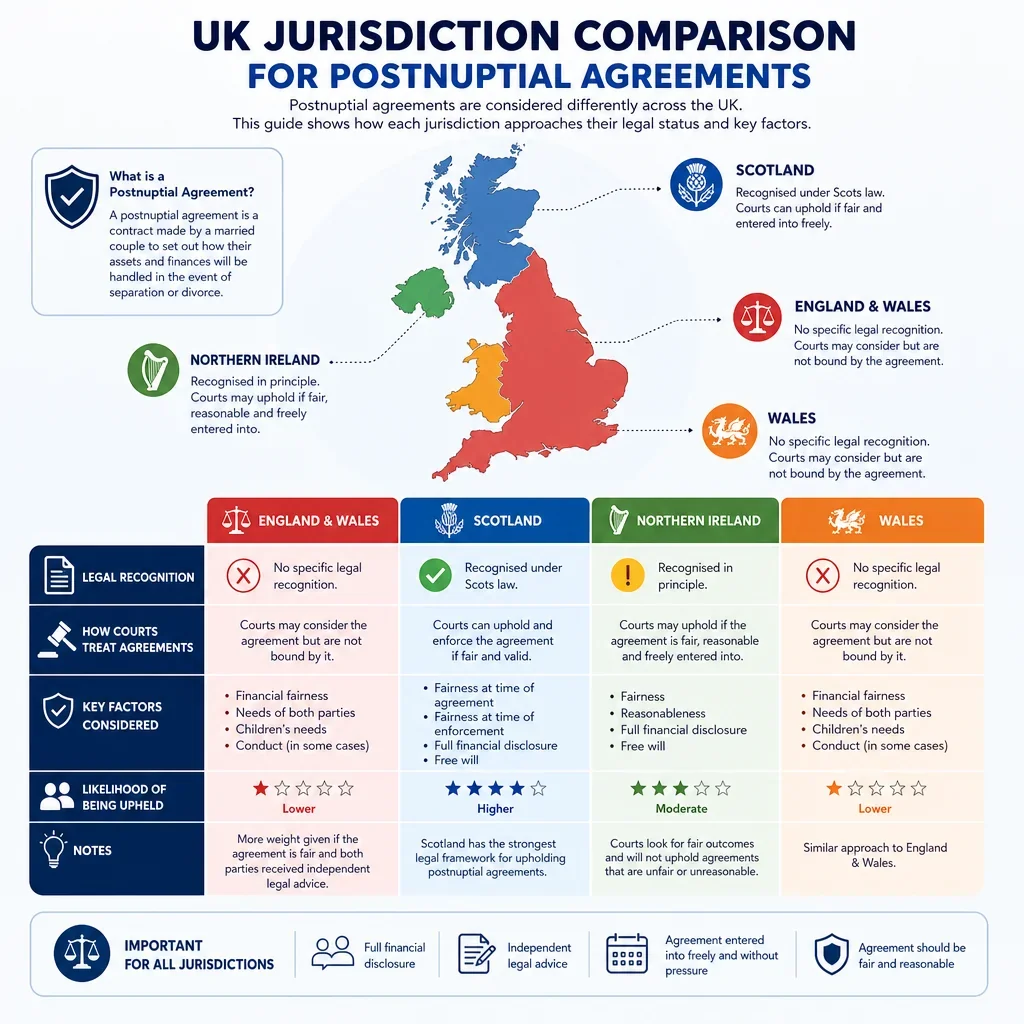
When do you need a Postnuptial Agreement in the United Kingdom?
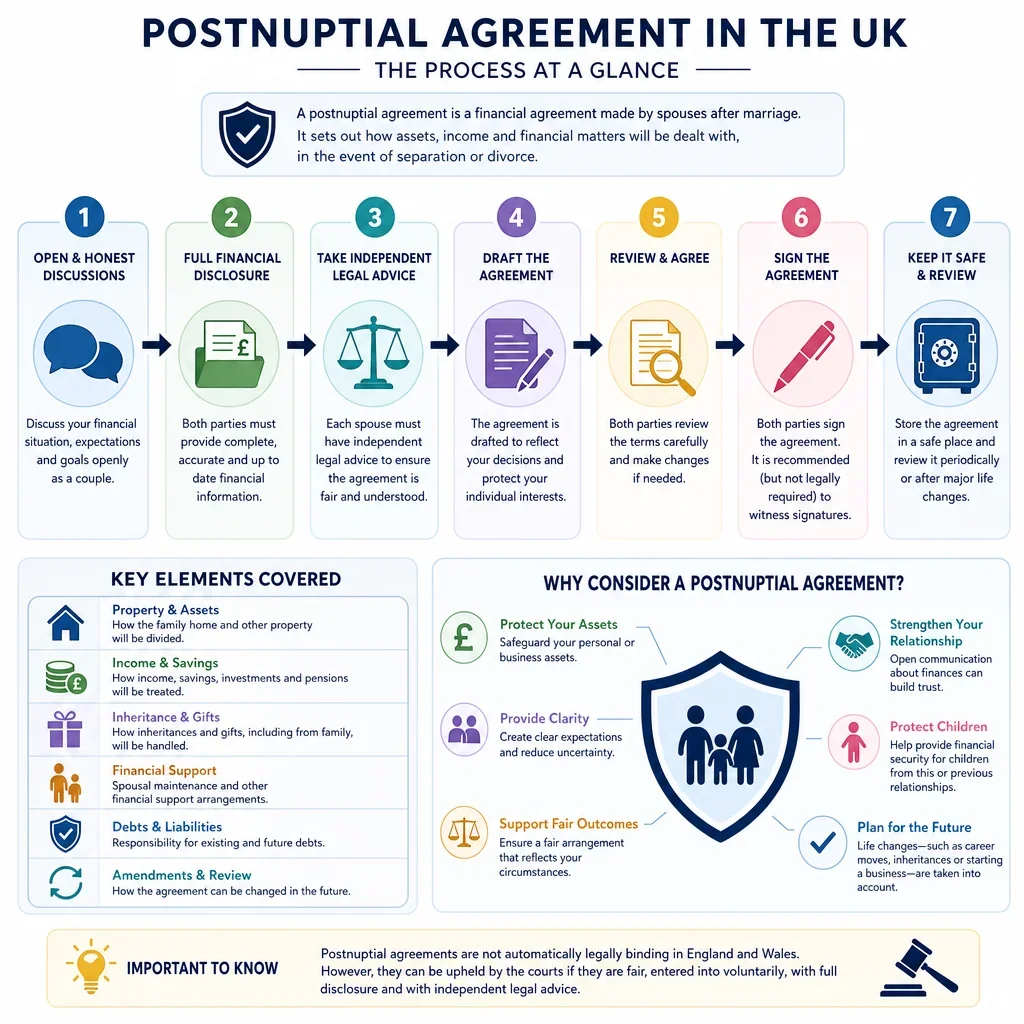
British Legal Rules for a Postnuptial Agreement
Using the wrong type or structure of postnuptial agreement can render it unenforceable under UK law.
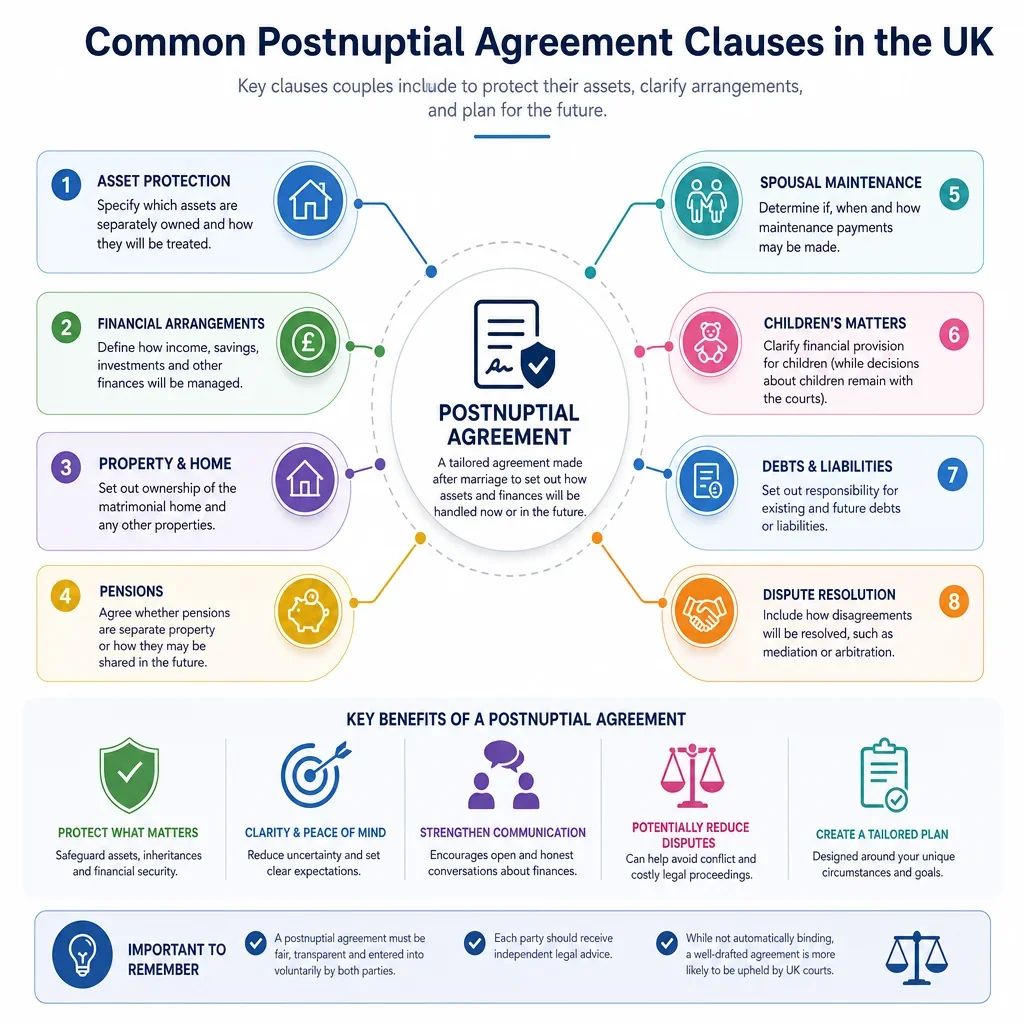
What a Proper Postnuptial Agreement Should Include
- Identification of PartiesClearly state the full names and details of both spouses entering the agreement.
- Asset and Debt DivisionList and specify how all current and future assets, like property and savings, as well as debts, will be divided if the marriage ends.
- Financial Support DetailsOutline any agreements on spousal maintenance or financial support during and after separation.
- Inheritance and WillsAddress how assets will be handled in case of death, including any protections for inheritances.
- Business and InvestmentsDetail the treatment of business interests, shares, and other investments in the event of divorce.
- Children and Family MattersInclude provisions for child custody, support, and education if applicable, though courts may override these.
- Signatures and DatesRequire both parties to sign and date the agreement, ideally with independent legal advice noted for validity.
Generate Your Document in 4 Easy Steps
Why Use Docaro?
 United Kingdom
Free Example Postnuptial Agreement Template
Below is a free template example of a Postnuptial Agreement for use in the United Kingdom generated by our AI model.
The clauses in your actual Postnuptial Agreement will vary from this example as they will be entirely bespoke to your requirements as set out in the questionnaire you complete.
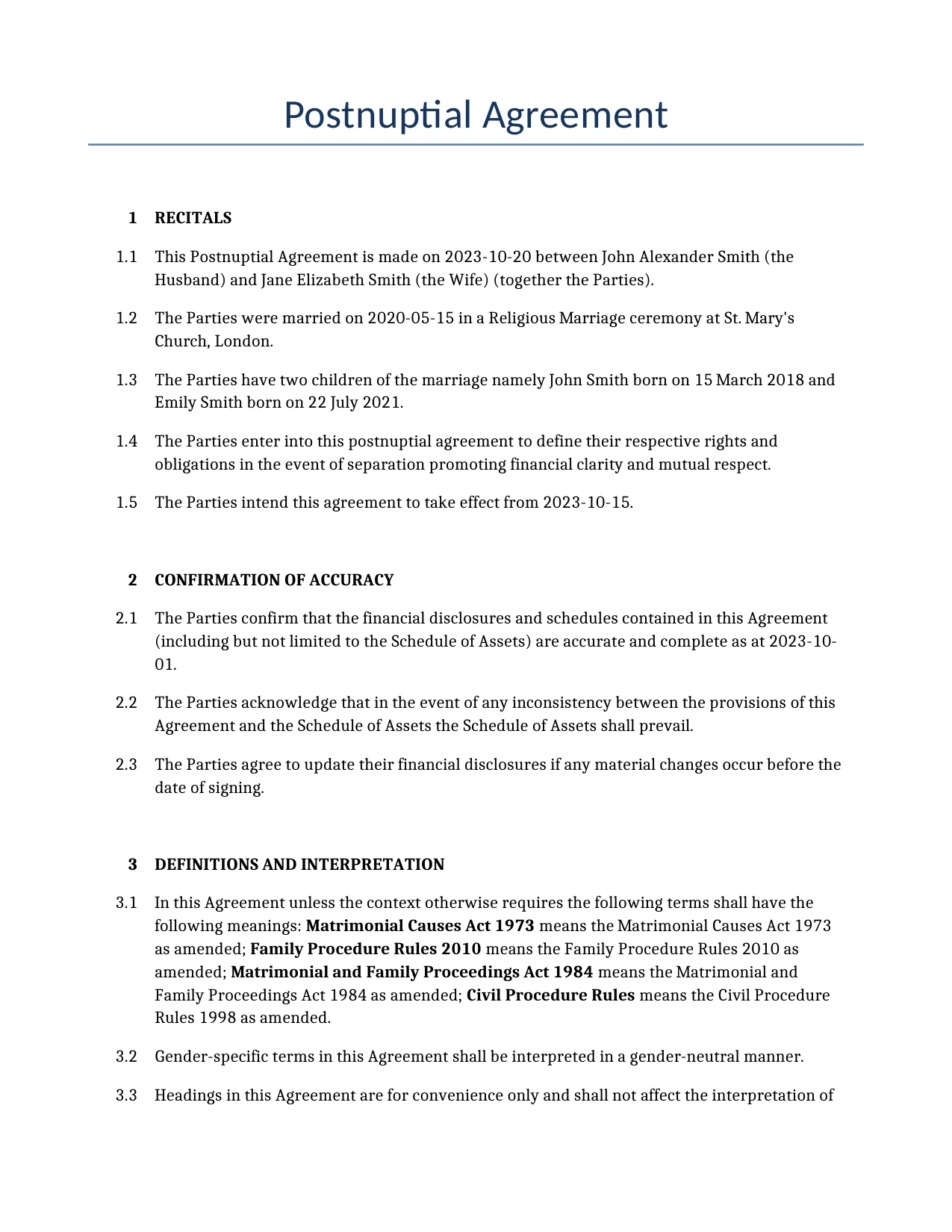
Postnuptial Agreement
1RECITALS
This Postnuptial Agreement is made on 2023-10-20 between John Alexander Smith (the Husband) and Jane Elizabeth Smith (the Wife) (together the Parties).
The Parties were married on 2020-05-15 in a Religious Marriage ceremony at St. Mary's Church, London.
The Parties have two children of the marriage namely John Smith born on 15 March 2018 and Emily Smith born on 22 July 2021.
The Parties enter into this postnuptial agreement to define their respective rights and obligations in the event of separation promoting financial clarity and mutual respect.
The Parties intend this agreement to take effect from 2023-10-15.
2CONFIRMATION OF ACCURACY
The Parties confirm that the financial disclosures and schedules contained in this Agreement (including but not limited to the Schedule of Assets) are accurate and complete as at 2023-10-01.
The Parties acknowledge that in the event of any inconsistency between the provisions of this Agreement and the Schedule of Assets the Schedule of Assets shall prevail.
The Parties agree to update their financial disclosures if any material changes occur before the date of signing.
3DEFINITIONS AND INTERPRETATION
In this Agreement unless the context otherwise requires the following terms shall have the following meanings: Matrimonial Causes Act 1973 means the Matrimonial Causes Act 1973 as amended; Family Procedure Rules 2010 means the Family Procedure Rules 2010 as amended; Matrimonial and Family Proceedings Act 1984 means the Matrimonial and Family Proceedings Act 1984 as amended; Civil Procedure Rules means the Civil Procedure Rules 1998 as amended.
Gender-specific terms in this Agreement shall be interpreted in a gender-neutral manner.
Headings in this Agreement are for convenience only and shall not affect the interpretation of this Agreement.
References to any statute or statutory provision shall include any subordinate legislation made under that statute or statutory provision whether before or after the date of this Agreement.
4GOVERNING LAW AND JURISDICTION
This Agreement shall be governed by and construed in accordance with the laws of England and Wales.
The courts of England and Wales shall have exclusive jurisdiction to settle any dispute or claim arising out of or in connection with this Agreement.
This Agreement shall take effect in accordance with British law and shall be interpreted in compliance with the Matrimonial Causes Act 1973 the Matrimonial and Family Proceedings Act 1984 the Family Procedure Rules 2010 (Part 9) and the Civil Procedure Rules (Part 36).
The Parties intend this to be a qualifying nuptial agreement as discussed in Radmacher v Granatino [2010] UKSC 42 and intend it to be given full weight by the court in any future financial remedy proceedings under the Matrimonial Causes Act 1973 provided it meets the criteria of fairness at the time of enforcement.
5FINANCIAL DISCLOSURE
Each Party confirms that he or she has fully and frankly disclosed to the other all of his or her assets income and financial resources as at the date of this Agreement.
The Husband's financial disclosure includes a Current Account at HSBC with account number 12345678 and balance of \£5,000 a Savings Account at Barclays with account number 87654321 and balance of \£10,000 shares in Apple Inc. of 100 shares at \£150 each UK Government Bonds of \£8,000 face value a Pension Fund in the Vanguard Global Equity Fund of \£12,000 invested the family home at 123 High Street valued at \£500,000 jointly owned a holiday cottage in Cornwall at 456 Sea View valued at \£200,000 in his sole ownership 50 percent ownership in Tech Startup Ltd valued at \£150,000 a BMW X5 motor vehicle valued at \£40,000 jewellery valued at \£5,000 and an art collection valued at \£10,000.
The total value of the Husband's assets is \£700,000 for properties \£25,000 for investments \£15,000 for bank accounts \£80,000 for pensions \£150,000 for business interests and \£55,000 for other assets with total debts of \£12,000.
Each Party confirms that he or she has had the opportunity to seek independent legal advice regarding the financial disclosure and the terms of this Agreement.
Each Party confirms that all financial information has been fully and accurately disclosed.
6VOLUNTARY AGREEMENT AND DISCLOSURE
The Parties affirm that they have each entered into this Agreement voluntarily without any duress undue influence coercion or misrepresentation.
Full and frank financial disclosure by both Parties is a prerequisite for the validity and enforceability of this Agreement and each Party confirms that such disclosure has been made.
Each Party has had the opportunity to take independent legal advice before signing and understands the implications of this Agreement.
The Parties acknowledge the principles for enforceability of nuptial agreements under English law as set out in Radmacher v Granatino [2010] UKSC 42 and intend this Agreement to be enforceable in accordance with those principles provided it is fair at the time of enforcement.
7DIVISION OF ASSETS
The Parties agree that pre-marital assets shall be ring-fenced and shall remain the separate property of the Party who owned them prior to the marriage.
The pre-marital assets of the Husband include a small investment property in London and shares in a technology company with an estimated total value of \£150,000.
The matrimonial home at 123 High Street, Manchester, M1 1AA shall be treated as jointly owned by the Parties with a current estimated value of \£450,000.50.
Pension rights shall be shared equally between the Parties in the event of separation or divorce.
The Husband's interest in the business known as Tech Startup Ltd shall be retained by him subject to the provisions of clause 10.
Assets acquired during the marriage shall be included in the division of assets in accordance with the terms of this Agreement.
In the event of separation or divorce the division of assets shall follow the approach of ring-fencing pre-marital assets while dividing marital assets in accordance with the principles set out in the Matrimonial Causes Act 1973.
8DEBTS AND LIABILITIES
The Parties agree that each Party shall be responsible for his or her own personal debts and liabilities.
Joint debts including the joint mortgage on the family home and the shared car loan with a total outstanding amount of \£250,000 originated on 2020-05-15 shall be shared equally between the Parties.
The Husband's personal debts including credit card debt and a student loan with a total outstanding amount of \£15,000.50 originated on 2015-09-01 shall remain his sole responsibility.
Neither Party is acting as a guarantor or co-signer for the debts of the other Party.
There are no contingent liabilities such as pending lawsuits or guarantees of which either Party is aware.
Each Party confirms that he or she has disclosed all debts and liabilities to the best of his or her knowledge.
The total amount of debts to be considered under this Agreement is \£265,000.50.
9INCOME AND EARNINGS
The Husband's average monthly income from all sources is \£3,500 with average monthly expenses of \£2,500.50 and a current monthly salary before tax of \£3,200.
The Husband is not self-employed but anticipates a significant change in his career or earnings in the next five years.
Future earnings from employment shall be treated as separate property and shall not be subject to sharing between the Parties upon separation.
The Parties shall not share income equally during the marriage.
Pension contributions shall be included as part of earnings for the purposes of this Agreement.
10SPOUSAL MAINTENANCE
The Parties agree that in the event of separation the Husband shall pay to the Wife periodical payments by way of spousal maintenance in the sum of \£1,000 per month (or such other sum as may be agreed or ordered).
Such payments shall continue until the earliest of the Wife's remarriage cohabitation for a period of 6 months the death of either Party or 5 years from the date of separation subject to review in the event of a significant change in circumstances (such as loss of employment serious illness or substantial change in income or assets).
The Parties intend this to be a clean break where possible but acknowledge that the court retains jurisdiction to vary this provision under section 31 of the Matrimonial Causes Act 1973 if there is a significant change in circumstances.
The Parties acknowledge that any order for spousal maintenance may be subject to variation by a court of competent jurisdiction.
11CHILDREN AND CHILD SUPPORT
The Parties have two children together. Any child arrangements proposed in this Agreement (including residence and contact) are provisional only and are subject to court approval or variation.
Nothing in this Agreement is intended to fetter the discretion of the court or the Child Maintenance Service. All arrangements for children must always prioritise the best interests of the children in accordance with the Children Act 1989.
Child maintenance shall be determined in accordance with the Child Support Act 1991 and any applicable guidelines or court order and shall not be limited by any fixed sum set out in this Agreement.
The Parties agree to share additional expenses for the children such as education and medical costs.
The Parties agree that there is no existing court order regarding the children's custody or maintenance.
Any disputes regarding child arrangements shall be resolved by mediation in the first instance.
The Parties acknowledge that a court may override the provisions of this clause if it considers that to do so would be in the best interests of the child or children in accordance with the Children Act 1989 the Matrimonial Causes Act 1973 and the Family Procedure Rules 2010.
12INHERITANCE AND WILLS
The Parties do not intend to enter into mutual wills as part of this Agreement.
Each Party currently has a valid will in place.
Neither Party waives any rights to inherit from the other spouse's estate.
Each Party agrees to update his or her will to reflect the terms of this Agreement regarding inheritance.
13EFFECT OF DEATH
This Agreement shall survive the death of either Party and continue to have effect in respect of the division of assets and other financial matters between the Parties' estates.
Each Party agrees to waive any claims against the estate of the other under the terms of this Agreement but this is without prejudice to any rights either Party or their dependents may have under the Inheritance (Provision for Family and Dependants) Act 1975 unless such rights are explicitly waived in a separate deed.
The Parties acknowledge that any waiver of rights under the Inheritance (Provision for Family and Dependants) Act 1975 must be reasonable and the court retains discretion to make orders if appropriate.
14BUSINESS INTERESTS
The Husband owns 100 percent of the limited company known as Smith Consulting Ltd which was established on 2015-03-15 and which has a current estimated market value of \£250,000.
The business interest in Smith Consulting Ltd shall be retained by the Husband in the event of separation or divorce with compensation to the Wife in accordance with the principles of the Matrimonial Causes Act 1973.
The business interest shall not be treated as marital property subject to equal division.
15PENSIONS AND RETIREMENT BENEFITS
Each Party consents to the full disclosure of all pension and retirement benefit information for the purposes of this Agreement.
The Parties agree that pension rights shall be divided by way of pension sharing in the event of divorce in accordance with the Matrimonial Causes Act 1973.
State pension rights shall not be included in the division of retirement benefits.
Neither Party has any international pension schemes or benefits.
16PROPERTY RIGHTS
The matrimonial home is located at 123 High Street, London, SW1A 1AA, United Kingdom and is currently owned by the Parties as joint tenants.
The Parties agree to convert the ownership of the matrimonial home to tenancy in common with equal shares.
The matrimonial home has an estimated current market value of \£450,000 was purchased on 2015-06-15 for \£350,000 and has an outstanding mortgage.
This Agreement does not include other real estate properties besides the matrimonial home.
17PERSONAL PROPERTY AND HOUSEHOLD GOODS
The Parties agree that household goods shall be divided by specific allocation rather than equally.
The Husband shall retain exclusively his wedding ring gold necklace and all his work clothes.
Vehicles are separately owned by each Party.
The estimated total value of personal property and household goods is \£12,500.50.
The Parties have identified certain sentimental household items that shall not be divided equally.
In the event of disagreement over the division of personal property the Parties shall resolve the dispute by mediation.
18INSURANCE POLICIES
The Parties have life insurance policies and other insurance policies such as critical illness or income protection but do not have health insurance policies.
The Parties agree to designate joint insurance policies in accordance with this Agreement.
The Parties agree that the spouse shall be the primary beneficiary of the insurance policies with the children or dependents as secondary beneficiaries.
19TAXES AND TAX LIABILITIES
The Parties agree to file joint tax returns for the current and future tax years.
The Parties do not agree that both Parties shall be jointly liable for any tax debts arising from joint filings.
Responsibility for tax liabilities from pre-agreement joint returns shall be shared equally.
Any disputes over tax liabilities shall be resolved by mediation.
The date of the last joint tax filing with HMRC was 2023-04-06.
The Parties agree to file separate tax returns going forward to avoid joint liabilities.
20CONFIDENTIALITY
The Parties agree to keep the terms of this Agreement confidential.
The confidentiality obligation shall commence on 2024-01-01 and shall last indefinitely.
In the event that either Party breaches the confidentiality obligation the other Party shall be entitled to seek such remedies as may be available at law including but not limited to damages and injunctive relief.
21DISPUTE RESOLUTION
Any dispute arising out of or in connection with this Agreement shall first be referred to mediation.
If mediation fails to resolve the dispute the dispute shall then be referred to arbitration.
The costs of any dispute resolution process shall be shared equally between the Parties.
The dispute resolution provisions shall become effective on 2024-01-15.
The dispute resolution process shall be governed by the laws of England and Wales.
22ENTIRE AGREEMENT
This Agreement constitutes the entire understanding between the Parties in respect of financial and property matters only and supersedes all prior verbal and written agreements between the Parties.
This clause shall take effect from 2024-10-01.
23SEVERABILITY
If any provision of this Agreement is held to be invalid or unenforceable the remaining provisions shall continue in full force and effect.
24AMENDMENTS
Any amendments to this Agreement must be made in writing and signed by both Parties.
Oral amendments to this Agreement shall not be permitted.
25REVIEW OF AGREEMENT
The Parties agree to review this Agreement every 5 years or upon significant life events including the birth of another child serious illness of either Party or a substantial change in income or assets.
The Agreement may be varied by a written instrument signed by both Parties to reflect changed circumstances and to ensure ongoing fairness in accordance with the principles in Radmacher v Granatino [2010] UKSC 42.
26WAIVER
No failure or delay by either Party in exercising any right power or remedy under this Agreement shall operate as a waiver of that right power or remedy.
27INDEPENDENT LEGAL ADVICE
Each Party has received independent legal advice regarding this Agreement.
The Husband received independent legal advice from Johnathan Smith of Smith & Associates Law Firm on 2023-10-15.
The solicitor explained the legal implications of this Agreement including asset division financial obligations and enforceability under British law.
Each Party is satisfied that the independent legal advice received adequately covered all aspects of this Agreement.
Certification: Each Party hereby certifies that (a) they have made full and frank disclosure of their assets liabilities and income (b) they have had the opportunity to take independent legal advice before signing and (c) they enter this Agreement voluntarily without duress undue influence or misrepresentation. Certificates of independent legal advice from each Party's solicitor are attached to this Agreement and form part of it.
28CHANGES IN LAW
The Parties agree that if future changes in legislation tax regimes or other UK regulations materially affect the intended operation of this Agreement they will cooperate in good faith to amend the Agreement by written instrument to maintain its objectives and ensure continued compliance with applicable law.
29LEGAL ADVICE CERTIFICATES
This Agreement is accompanied by certificates of independent legal advice from the solicitors for each Party. The certificate for the Husband is from [Solicitor Name] a solicitor qualified in England and Wales at [Firm Name] who confirmed that the Agreement was explained in detail the implications were fully understood and the Husband was not under any pressure to sign. The certificate for the Wife is from [Solicitor Name] a solicitor qualified in England and Wales at [Firm Name] who confirmed that the Agreement was explained in detail the implications were fully understood and the Wife was not under any pressure to sign.
30EXECUTION IN COUNTERPARTS
This Agreement may be executed in any number of counterparts each of which when executed and delivered shall constitute a duplicate original but all counterparts together shall constitute one agreement.
31SCHEDULE OF ASSETS
The assets liabilities and financial details of the Husband as at 2023-10-01 are as follows: full legal name John Alexander Smith date of birth 1980-05-15 current marital status married current balance in main bank account \£12,500.50 held at Barclays Bank PLC account number 12345678 joint bank accounts with spouse exist primary residence at 123 High Street, London, SW1A 1AA with estimated market value of \£450,000 jointly owned with spouse current value of pension fund \£75,000 provided by Aviva Pension Scheme no expected inheritance in the near future and the majority of assets are located in the United Kingdom.
32EXECUTION
This Agreement is executed as a deed and shall be governed by the laws of England and Wales.
SIGNED as a deed by the said John Alexander Smith in the presence of: Witness signature: ____________________ Witness name: ____________________ Witness address: ____________________
SIGNED as a deed by the said Jane Elizabeth Smith in the presence of: Witness signature: ____________________ Witness name: ____________________ Witness address: ____________________
This example shows approximately 70% of a typical document and is provided for illustrative purposes only. The remaining content has been omitted.
Every document generated by Docaro is tailored to your specific circumstances, jurisdiction and the information you provide. The completed document includes all applicable clauses and provisions required for your situation.
To generate the full, personalised document, answer a short series of questions and your document will be created instantly.
Useful Resources When Considering a Postnuptial Agreement in the United Kingdom
United Kingdom Reference Legislation
Postnuptial Agreement FAQs
Document Generation FAQs
Related Articles