AI Generated British Letter Before Action
PDF & Word - 2026 Updated
Docaro Pricing
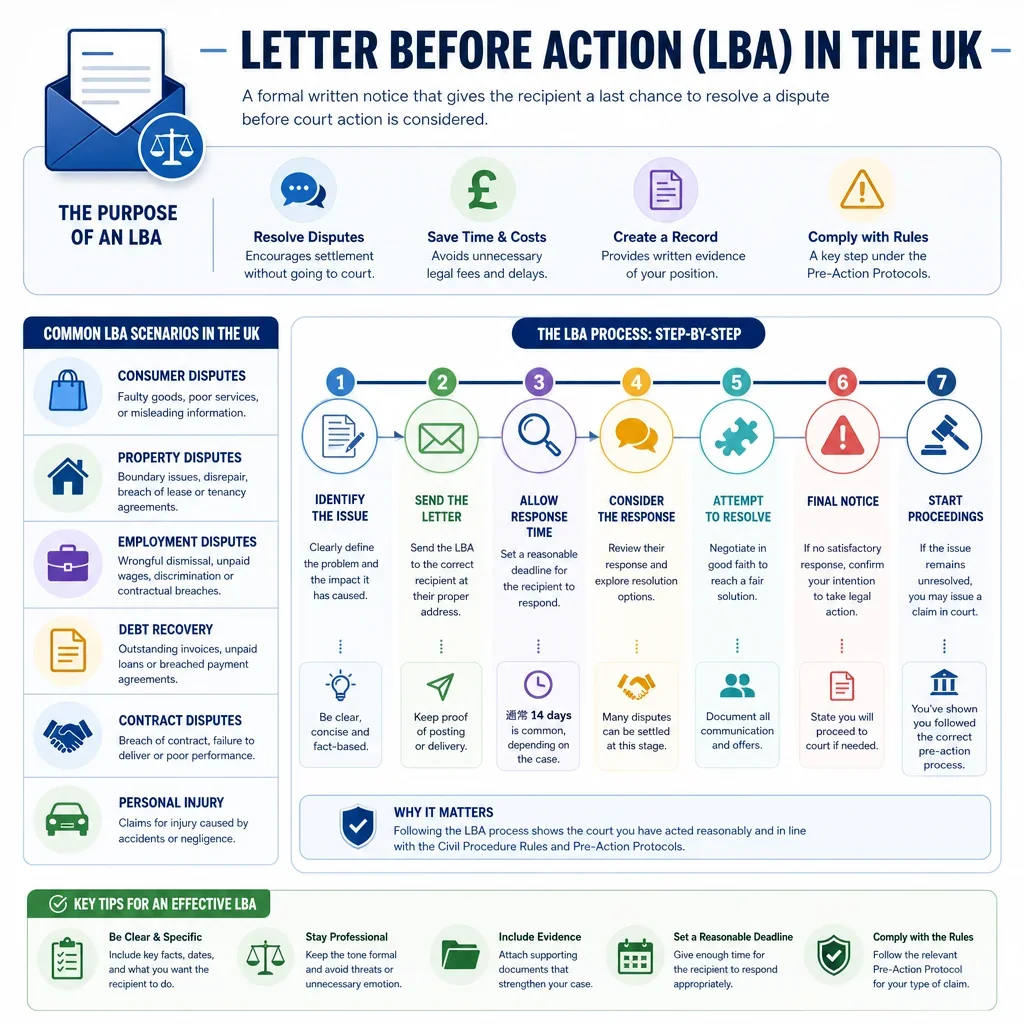
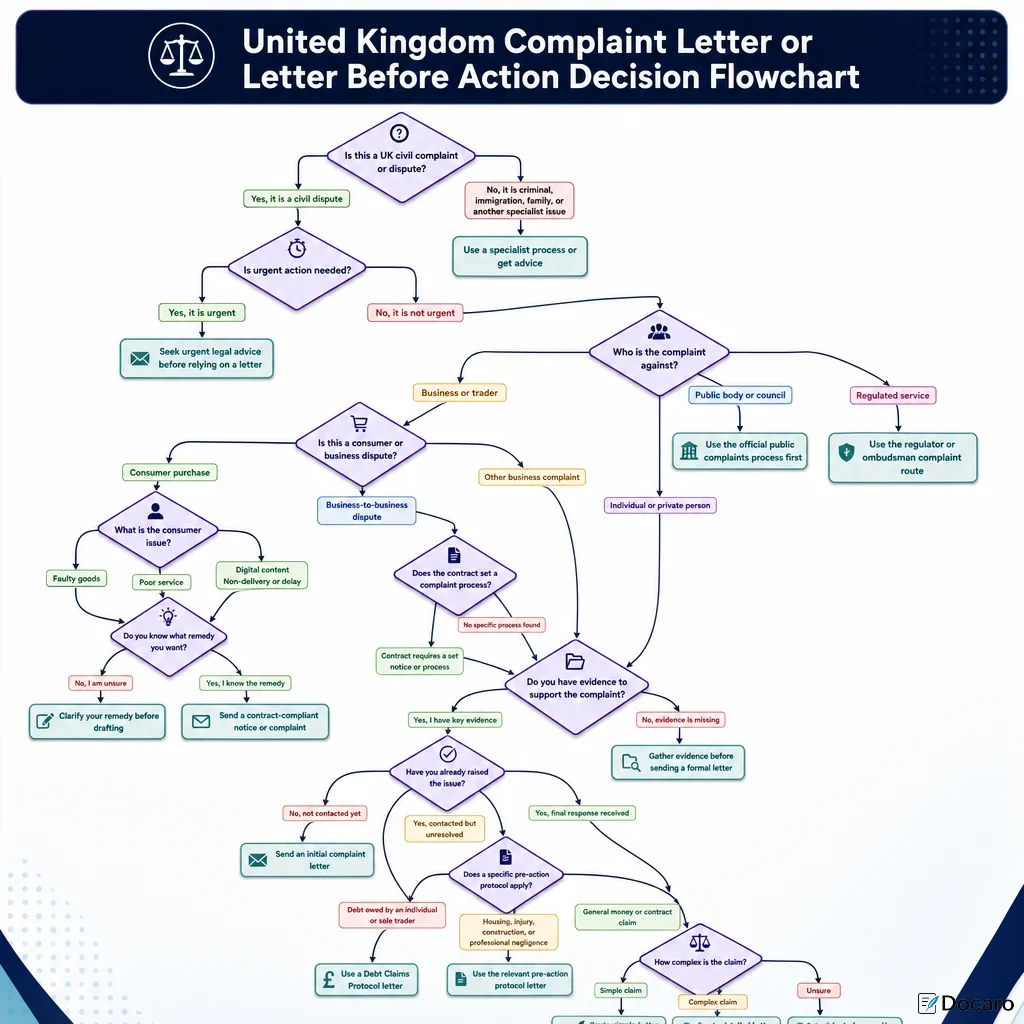
When do you need a Letter Before Action in the United Kingdom?
British Legal Rules for a Letter Before Action
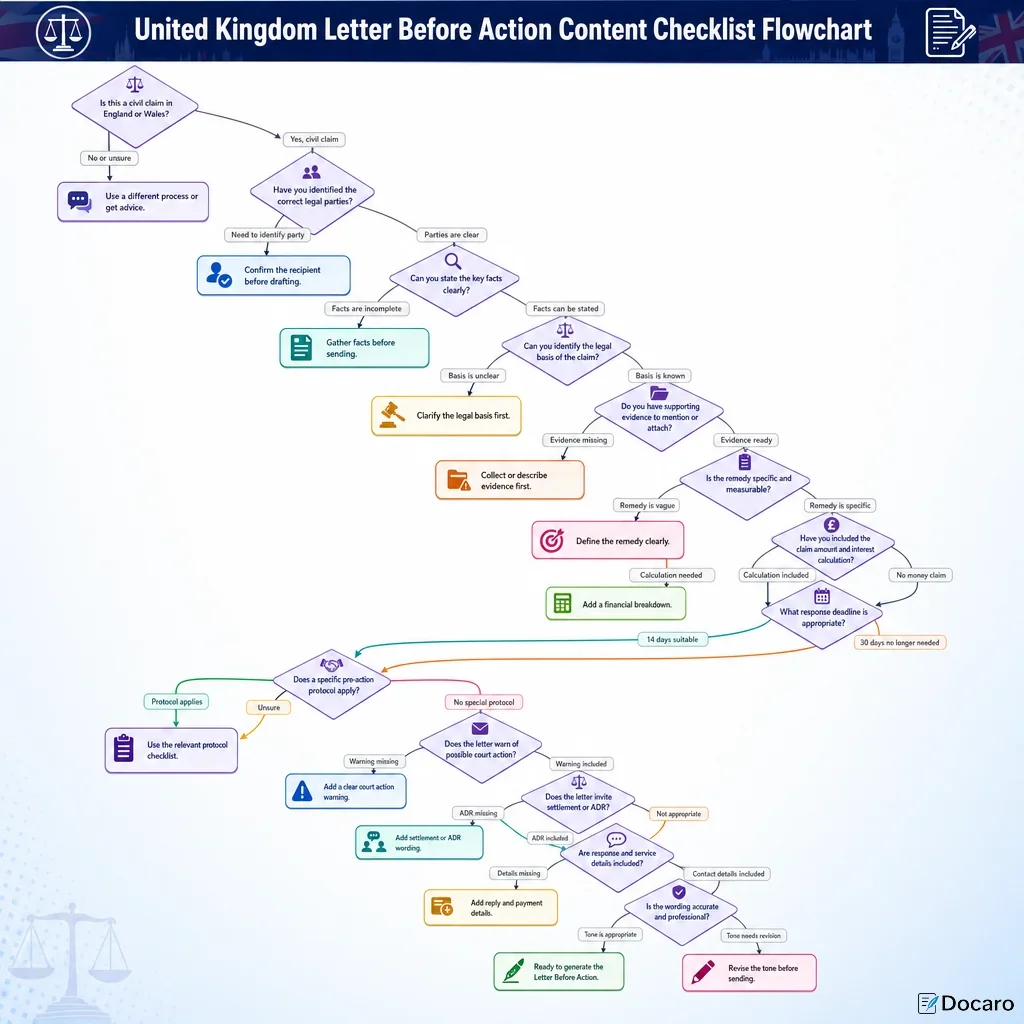
Using the wrong structure for a complaint letter can undermine its legal effectiveness or lead to procedural errors.
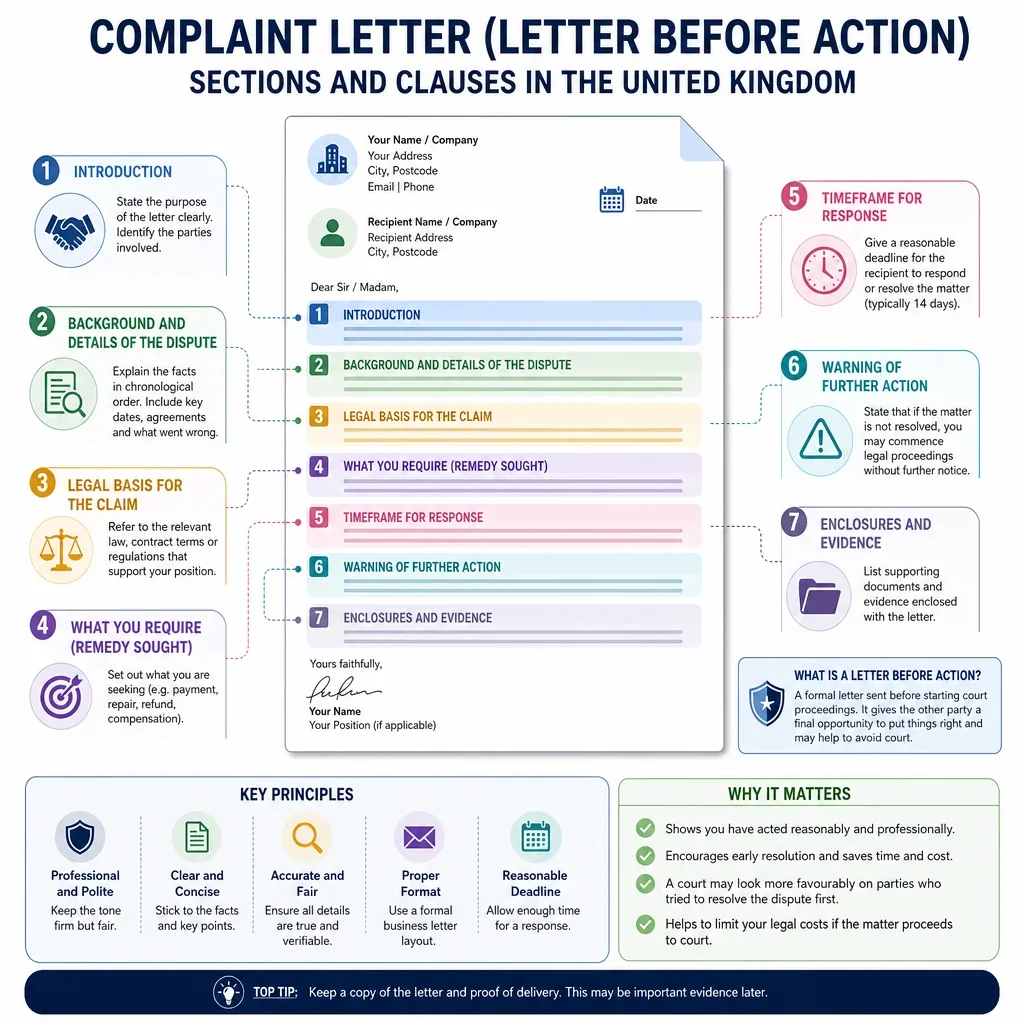
What a Proper Letter Before Action Should Include
- Your DetailsInclude your full name, address, and contact information at the top for easy identification.
- Their DetailsList the recipient's full name, address, and any relevant company details to ensure the letter reaches the right person.
- Clear Statement of the ProblemBriefly describe what went wrong, including key dates and facts, so the recipient understands the issue.
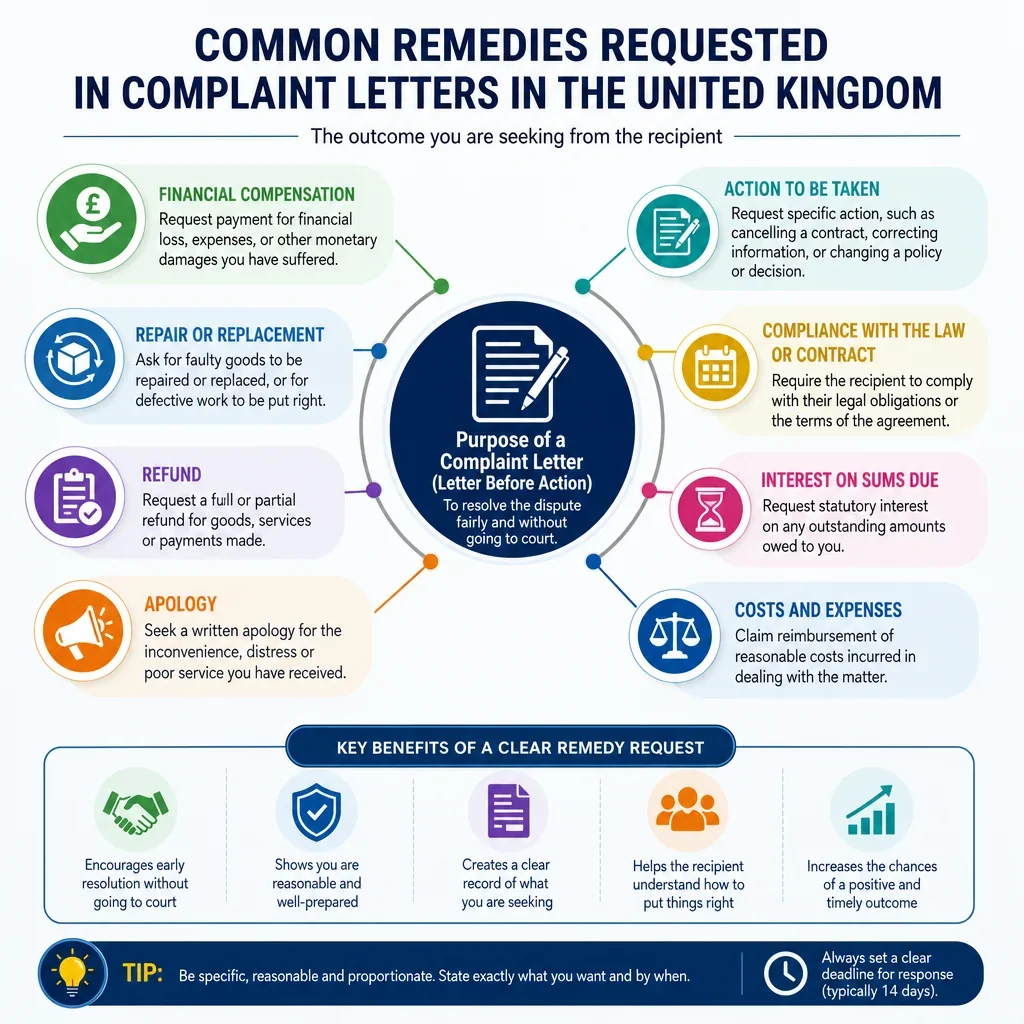
- What You WantSpecify exactly what you're asking for, such as payment or fixing the problem, to make your demands clear.
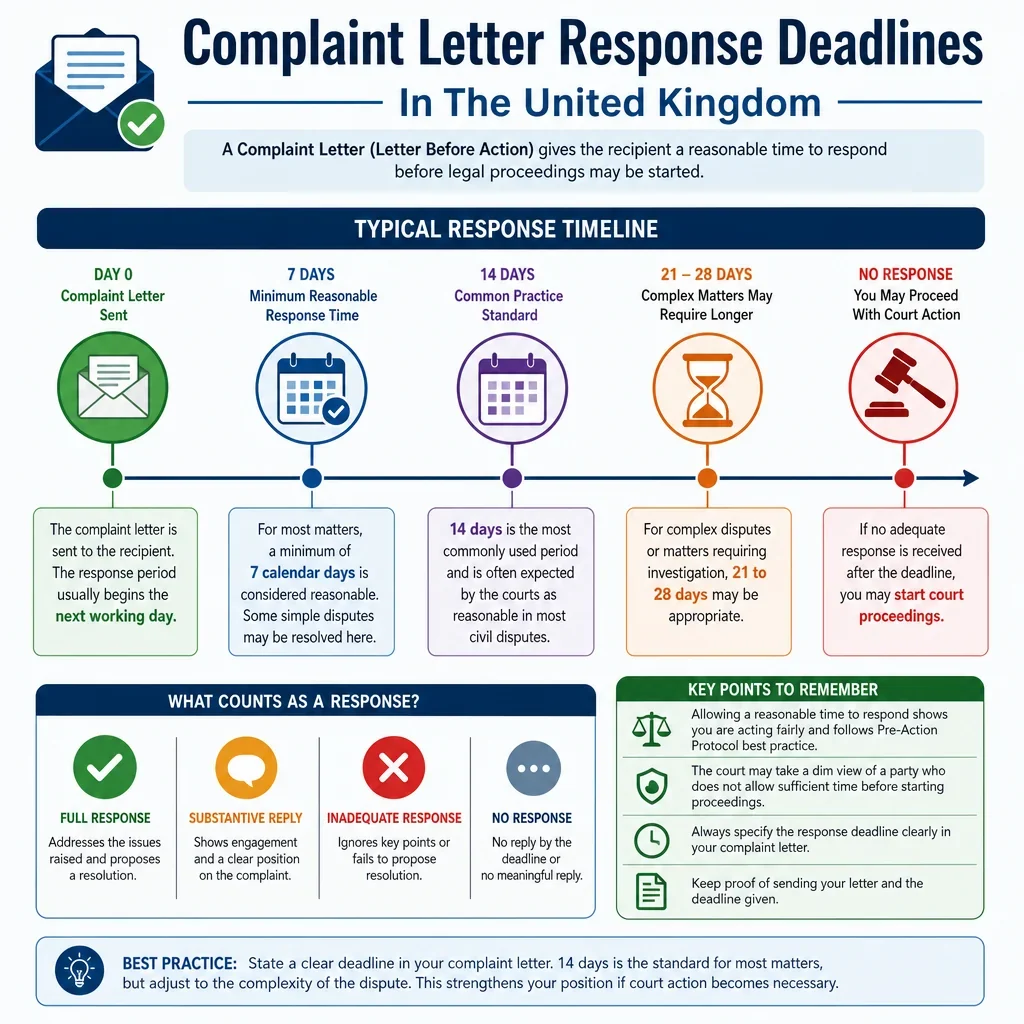
- Deadline for ResponseSet a reasonable time limit, usually 14 days, for them to reply or take action before you proceed further.
- Warning of Next StepsMention that you may take legal action, like going to court, if they don't respond or resolve the issue in time.
- How to ReplyProvide instructions on how they can contact you to discuss or settle the matter.
Generate Your Document in 4 Easy Steps
Why Use Docaro?
 United Kingdom
Free Example Letter Before Action Template
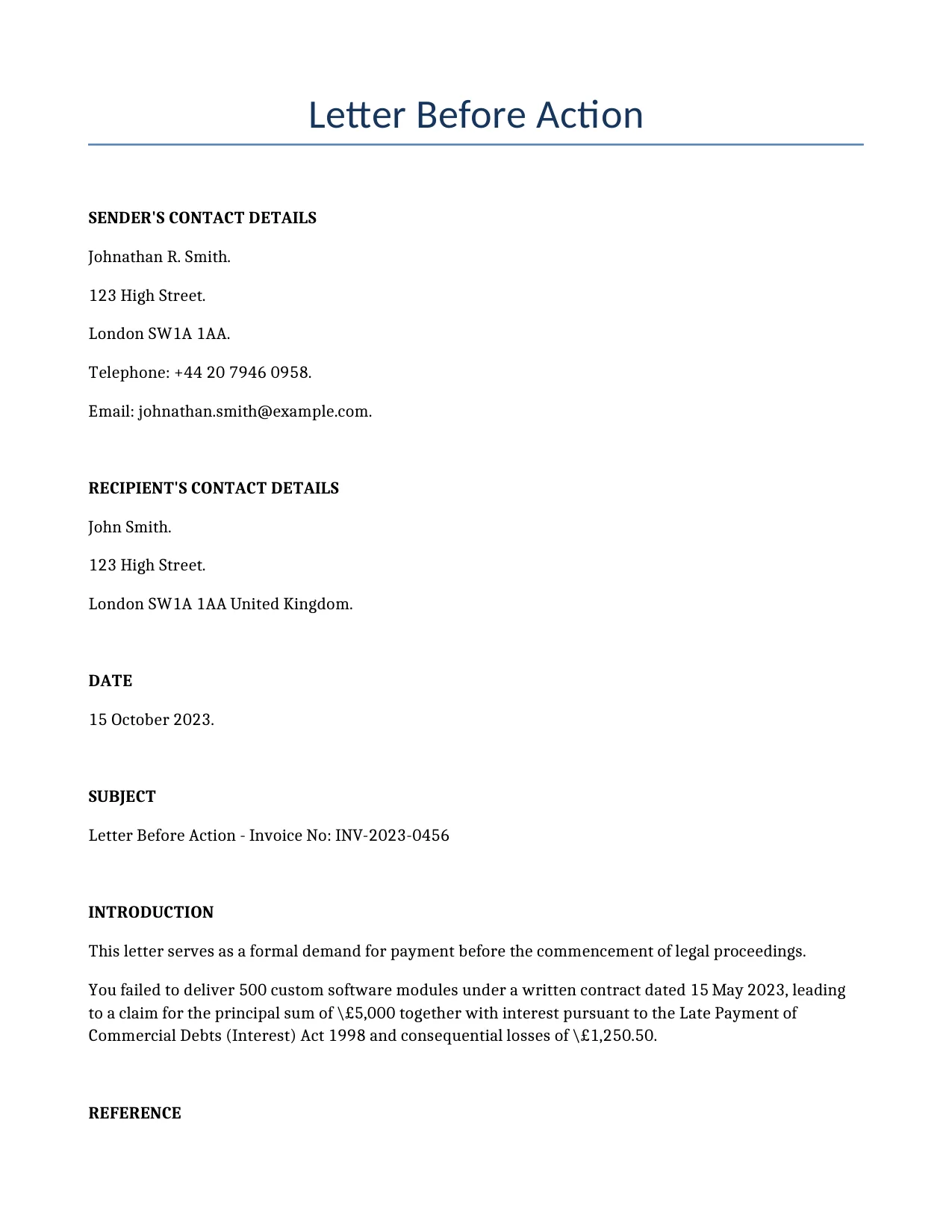
Below is a free template example of a Letter Before Action for use in the United Kingdom generated by our AI model.
The clauses in your actual Letter Before Action will vary from this example as they will be entirely bespoke to your requirements as set out in the questionnaire you complete.
Letter Before Action
SENDER'S CONTACT DETAILS
Johnathan R. Smith.
123 High Street.
London SW1A 1AA.
Telephone: +44 20 7946 0958.
Email: johnathan.smith@example.com.
RECIPIENT'S CONTACT DETAILS
John Smith.
123 High Street.
London SW1A 1AA United Kingdom.
DATE
15 October 2023.
SUBJECT
Letter Before Action - Invoice No: INV-2023-0456
INTRODUCTION
This letter serves as a formal demand for payment before the commencement of legal proceedings.
You failed to deliver 500 custom software modules under a written contract dated 15 May 2023, leading to a claim for the principal sum of \£5,000 together with interest pursuant to the Late Payment of Commercial Debts (Interest) Act 1998 and consequential losses of \£1,250.50.
REFERENCE
Our Reference: Invoice No: INV-2023-0456
BACKGROUND AND FACTS
A written contract was entered into between us on 15 May 2023 (enclosed).
The key terms of the contract required you to supply and deliver 500 custom software modules by 31 July 2023 in consideration of payment of \£5,000.
No delivery of the software modules has been made by the due date or at all, despite multiple reminders.
The breach committed by you is non-delivery of the software modules.
Communications with you about the breach include an email sent on 1 August 2023 requesting immediate delivery and an explanation for the delay, a follow-up phone call on 10 August 2023 where you promised delivery by 15 August but failed to do so, and a final email sent on 20 August 2023 demanding resolution or compensation.
The timeline of relevant events is as follows: on 15 May 2023 the contract was signed for delivery of the software modules by 31 July 2023, on 1 July 2023 an initial progress check was made via email and you confirmed being on track, on 31 July 2023 the delivery deadline was missed with no modules received, on 1 August 2023 an email was sent demanding delivery, on 10 August 2023 a phone call was made with promises of delivery by 15 August, on 15 August 2023 there was still no delivery and the project was stalled, and on 20 August 2023 a final demand email was sent with no response received. Copies of this correspondence are enclosed.
THE CLAIM
The nature of the claim is for damages for breach of contract arising from your failure to deliver the 500 custom software modules by the contractual deadline of 31 July 2023.
The primary legal basis for the claim is breach of contract.
The specific breach committed by you is non-delivery of the software modules by 31 July 2023 as required by the contract dated 15 May 2023.
Despite multiple follow-up communications no delivery was made and no refund or alternative arrangement was offered, leading to project delays and additional costs.
The breach occurred on 31 July 2023.
AMOUNT CLAIMED
A breakdown of the amount claimed is as follows: (a) principal debt of \£5,000.00; (b) interest under the Late Payment of Commercial Debts (Interest) Act 1998; (c) consequential losses of \£1,250.50.
Interest is claimed pursuant to the Late Payment of Commercial Debts (Interest) Act 1998 at the rate of 8\% above the Bank of England base rate (currently 13.5\% per annum). Interest accrues at the daily rate of \£1.85.
Interest has accrued from 31 July 2023 (the day after the due date for delivery and payment) to the date of this letter (15 October 2023), a period of 76 days, amounting to \£140.60.
A worked example of the interest calculation is: \£5,000 \× 0.135 \÷ 365 \× 76 = \£140.60.
Interest will continue to accrue at the daily rate of \£1.85 until judgment or payment in full.
OTHER COSTS OR DAMAGES
Other costs or damages are claimed in addition to the principal and interest.
Due to the breach of contract additional repair costs for damaged equipment and lost revenue from downtime were incurred.
The types of other damages claimed are consequential losses.
The amount of the other damages is \£1,250.50.
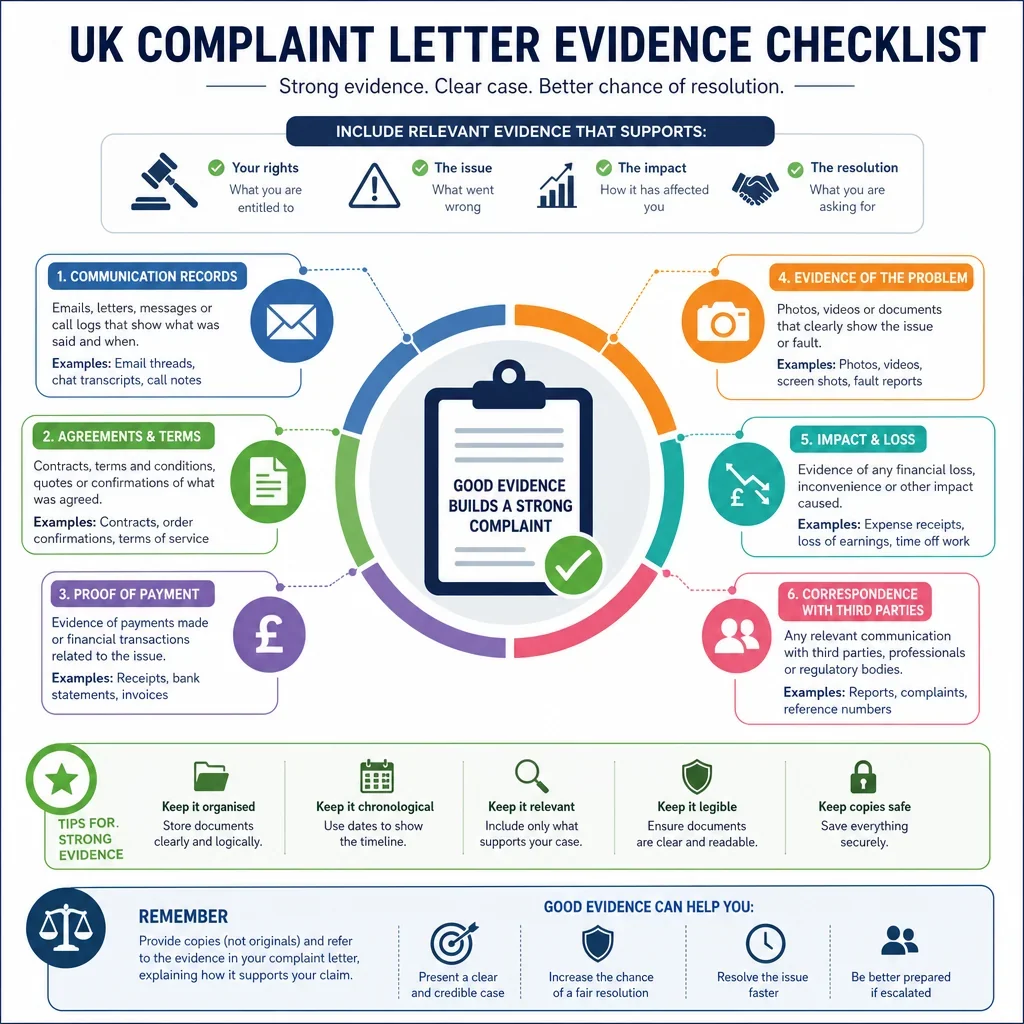
Supporting evidence for the other costs or damages consists of repair invoices from the service provider totaling \£850 and a financial statement showing lost revenue of \£400.50. Copies are enclosed.
The specific remedy sought from you is full reimbursement of the repair costs and compensation for the lost revenue, plus any applicable interest.
The total amount claimed, including principal, interest to the date of this letter, and other costs, is \£6,391.10 (plus continuing interest).
Calculation of Consequential Losses
The consequential losses are itemised as follows: \£850 (repair costs - see enclosed invoice ref. REP-0782) and \£400.50 (lost revenue - see enclosed loss calculation spreadsheet ref. LOSS-2310).
These are foreseeable losses within the principles established in Hadley v Baxendale and are claimed pursuant to the contract and/or common law.
PREVIOUS ATTEMPTS TO RESOLVE
Prior contact has been made with you regarding this dispute.
The methods of communication used in prior attempts to resolve this matter are email and telephone call.
The previous attempts made to resolve this matter amicably consist of an initial email outlining the issue and proposing a resolution, a follow-up phone call two weeks later to discuss further but with no satisfactory response received, and a final email reiterating the concerns.
The first attempt to contact you regarding this issue was made on 1 August 2023.
The most recent attempt to resolve this matter was made on 20 August 2023.
You have been contacted approximately 3 times in attempts to resolve this.
The responses from you to the attempts to resolve the matter were that you acknowledged the initial email but provided no substantive response, the phone call went unanswered, and the final email was met with a brief email denying liability without offering any resolution.
Alternative dispute resolution methods such as mediation have been considered but you have not engaged.
The outcome of any negotiations or settlement discussions so far is that settlement discussions failed.
PRE-ACTION PROTOCOL COMPLIANCE
This letter is sent in accordance with the Pre-Action Protocol for Debt Claims. It provides a summary of the facts, encloses the key documents relied upon, states the amount claimed (including a breakdown of interest and other damages), and explains how the amounts are calculated. The claimant has complied with all steps required by the Protocol before issuing proceedings.
DEMAND FOR PAYMENT OR ACTION
We demand immediate payment of the sum of \£6,391.10 (comprising the principal debt of \£5,000, interest of \£140.60 calculated to the date of this letter, and consequential losses of \£1,250.50) plus continuing interest pursuant to the Late Payment of Commercial Debts (Interest) Act 1998. This demand is made with reference to Invoice No: INV-2023-0456.
Payment must be made by bank transfer to our account: Sort Code 12-34-56, Account Number 12345678.
You shall have 14 days from the date of receipt of this letter to comply with the demand.
TIME FOR COMPLIANCE
The compliance period specified is 14 days from the date of receipt of this letter.
A clear warning is included that proceedings may be issued if the deadline is not met.
The compliance deadline is calculated on the basis of calendar days from receipt.
CONSEQUENCES OF NON-COMPLIANCE
If you fail to comply within the timeframe the consequences that will follow are the initiation of legal proceedings without further notice.
Failure to comply will result in court proceedings.
You will be liable for all associated costs if you fail to comply.
The types of costs that you may be liable for are legal fees, court fees, and other disbursements.
In addition, if court proceedings are issued you will also be liable for the claimant's legal costs, court fees, and any applicable late payment interest and statutory compensation under the Late Payment of Commercial Debts (Interest) Act 1998. Judgment may be entered and enforced if the claim is undefended.
INTENTION TO ISSUE PROCEEDINGS
If this matter is not resolved within the specified deadline we intend to issue proceedings in the County Court (or the Business and Property Courts if the value or complexity so requires) without further notice. We will seek judgment in default if no acknowledgement of service or defence is filed within the required time limits.
ALTERNATIVE DISPUTE RESOLUTION
Alternative dispute resolution options to resolve the dispute without going to court will be considered.
No previous attempt at any form of alternative dispute resolution with you in relation to this dispute has been made.
DOCUMENTS ENCLOSED
The following documents are enclosed: (1) copy of the written contract dated 15 May 2023; (2) unpaid invoice INV-2023-0456; (3) correspondence chain (emails and call notes); (4) repair invoices; (5) loss calculation spreadsheet.
GOVERNING LAW
This letter and any dispute arising from it shall be governed by and construed in accordance with English Law.
The chosen governing law applies exclusively to the dispute.
CONCLUSION
You are required to pay the total sum of \£6,391.10 plus continuing interest by bank transfer to Sort Code 12-34-56, Account Number 12345678 within 14 days of receipt of this letter (Our Reference: INV-2023-0456). Failure to do so will result in court proceedings being issued without further notice, in which event you will be liable for legal costs, court fees, further interest and statutory compensation. We hope this can be avoided and look forward to receipt of payment.
SIGNATURE
Signed: _______________________________
Name: Johnathan R. Smith
Date: _______________________________
This example shows approximately 70% of a typical document and is provided for illustrative purposes only. The remaining content has been omitted.
Every document generated by Docaro is tailored to your specific circumstances, jurisdiction and the information you provide. The completed document includes all applicable clauses and provisions required for your situation.
To generate the full, personalised document, answer a short series of questions and your document will be created instantly.
Useful Resources When Considering a Letter Before Action in the United Kingdom
United Kingdom Reference Legislation
Letter Before Action FAQs
Document Generation FAQs
Related Articles