AI Generated British Articles of Association
PDF & Word - 2026 Updated
Docaro Pricing
When do you need Articles of Association in the United Kingdom?
Key Rules for Articles of Association in the UK
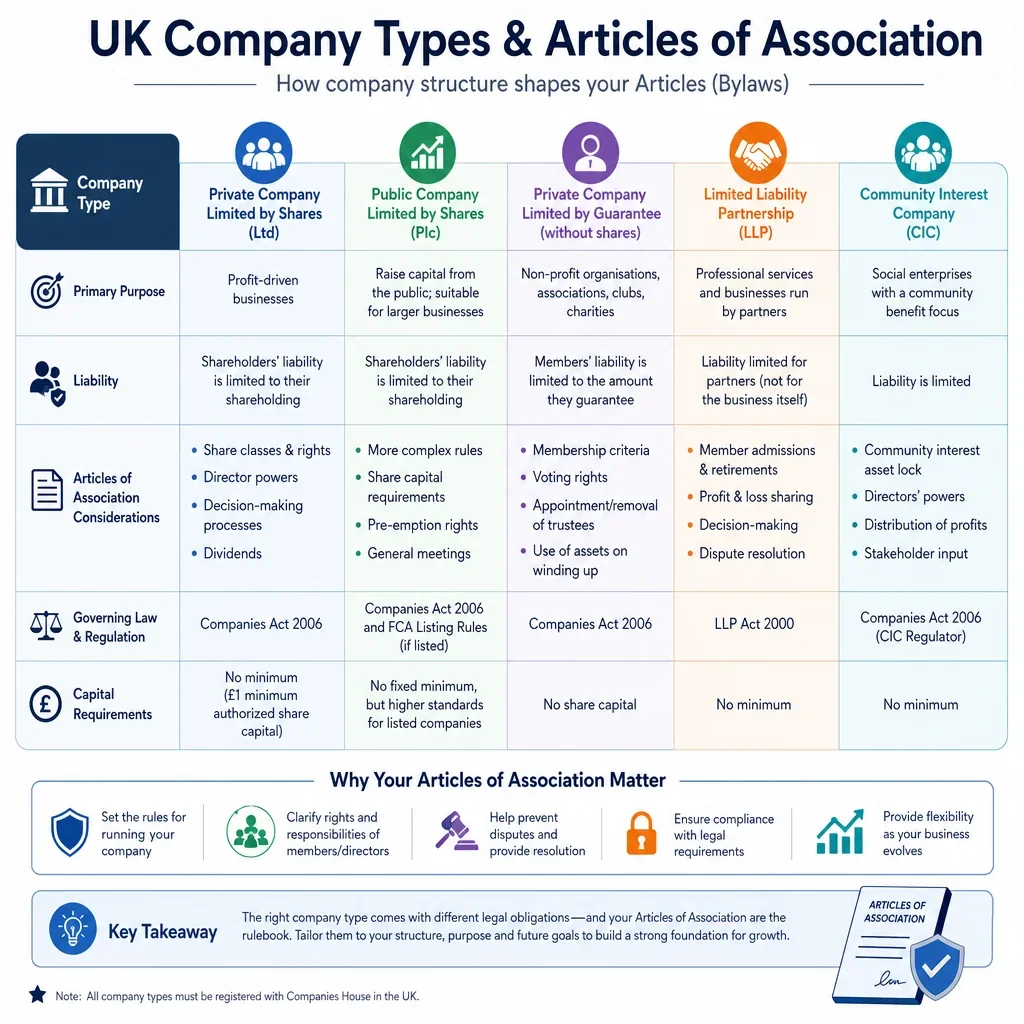
Selecting the incorrect corporate structure or bylaw format can result in non-compliance with UK company law and potential invalidation of governance provisions.
What Proper Articles of Association Should Include
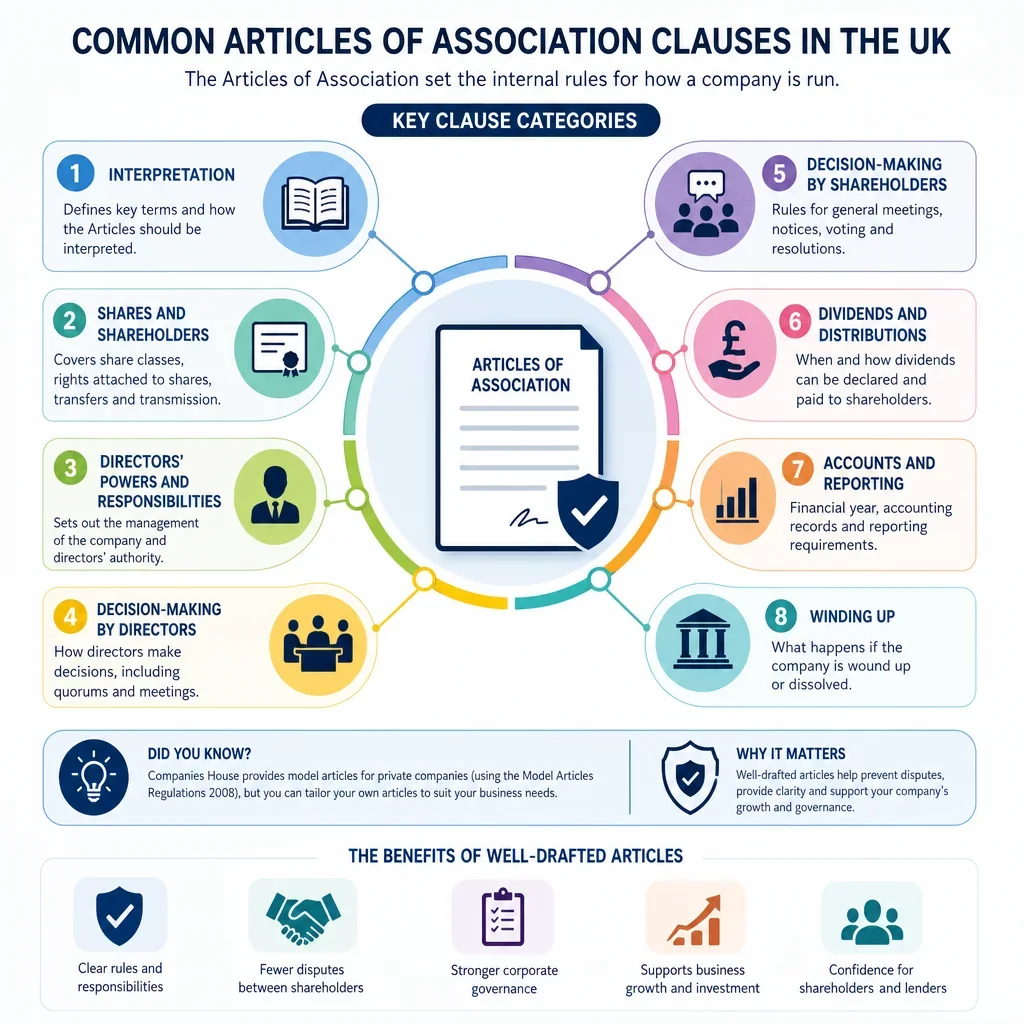
- Company Name and TypeStates the official name of the company and its legal structure, such as limited by shares.
- Objectives and PowersOutlines the main goals of the company and what it is allowed to do in pursuit of those goals.
- Share Capital DetailsDescribes the total shares the company can issue and their value.
- Shareholder RightsExplains how shares are distributed and the rights of those who own them, like voting.
- Director ResponsibilitiesSets out who can be a director, their duties, and how they are appointed or removed.
- Meeting ProceduresDetails how and when company meetings are held, including notice requirements and voting rules.
- Decision-Making RulesCovers how major decisions are made, such as through board votes or shareholder approvals.
- Profit DistributionSpecifies how the company's profits are shared among shareholders as dividends.
- Winding Up ProcessDescribes what happens to the company's assets if it is closed down.
Generate Your Document in 4 Easy Steps
Why Use Docaro?
 United Kingdom
Free Example Articles of Association Template
Below is a free template example of a Articles of Association for use in the United Kingdom generated by our AI model.
The clauses in your actual Articles of Association will vary from this example as they will be entirely bespoke to your requirements as set out in the questionnaire you complete.
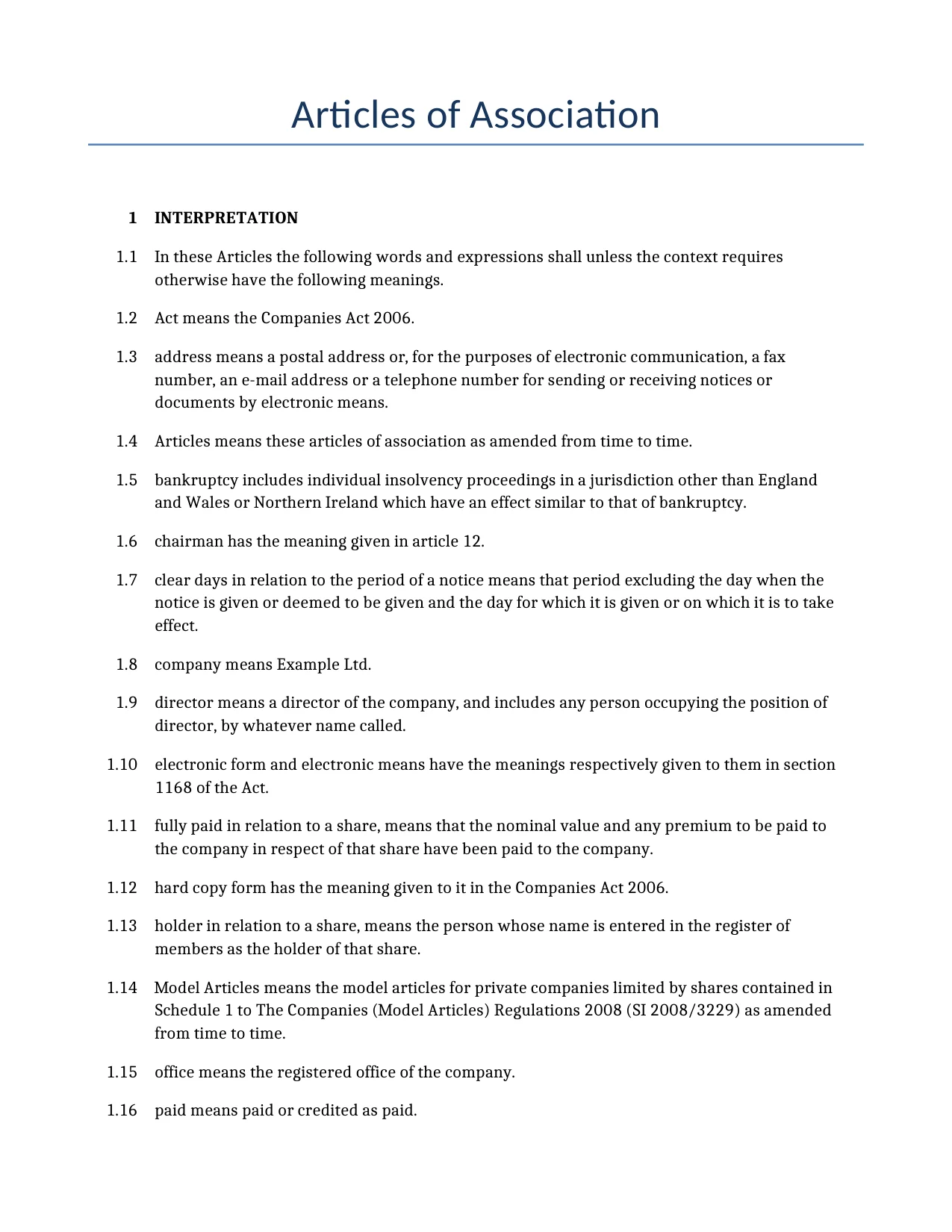
Articles of Association
1INTERPRETATION
In these Articles the following words and expressions shall unless the context requires otherwise have the following meanings.
Act means the Companies Act 2006.
address means a postal address or, for the purposes of electronic communication, a fax number, an e-mail address or a telephone number for sending or receiving notices or documents by electronic means.
Articles means these articles of association as amended from time to time.
bankruptcy includes individual insolvency proceedings in a jurisdiction other than England and Wales or Northern Ireland which have an effect similar to that of bankruptcy.
chairman has the meaning given in article 12.
clear days in relation to the period of a notice means that period excluding the day when the notice is given or deemed to be given and the day for which it is given or on which it is to take effect.
company means Example Ltd.
director means a director of the company, and includes any person occupying the position of director, by whatever name called.
electronic form and electronic means have the meanings respectively given to them in section 1168 of the Act.
fully paid in relation to a share, means that the nominal value and any premium to be paid to the company in respect of that share have been paid to the company.
hard copy form has the meaning given to it in the Companies Act 2006.
holder in relation to a share, means the person whose name is entered in the register of members as the holder of that share.
Model Articles means the model articles for private companies limited by shares contained in Schedule 1 to The Companies (Model Articles) Regulations 2008 (SI 2008/3229) as amended from time to time.
office means the registered office of the company.
paid means paid or credited as paid.
proxy means a person who is appointed by a member to attend and vote at a general meeting in accordance with the procedures set out in the Model Articles.
secretary means the secretary of the company or any other person appointed to perform the duties of the secretary of the company, including a joint, assistant or deputy secretary.
shareholder means a holder of a share in the company.
shares means shares in the company.
writing means the representation or reproduction of words, symbols or other information in a visible form by any method or combination of methods, whether sent or supplied in electronic form or otherwise.
These Articles adopt and incorporate the Model Articles save that in the event of any conflict between the provisions of the Model Articles and the following provisions of these Articles, the following provisions shall prevail. The following provisions of the Model Articles shall not apply: articles 7, 8, 9, 10, 14(1)-(3), 15, 20, 21, 26(5), 30, 44, 52, 53, 54, 55, 56, 57, 58 and 59.
References in these Articles to any statute or statutory provision include a reference to that statute or statutory provision as amended, re-enacted or extended at the relevant time and to any subordinate legislation made under it.
Headings in these Articles do not affect the interpretation of these Articles.
2LIABILITY OF MEMBERS
The liability of the members of the company is limited to the amount, if any, unpaid on the shares held by them.
The company is a private company limited by shares.
3DIRECTORS' GENERAL AUTHORITY
Subject to the Articles, the directors are responsible for the management of the company’s business, for which purpose they may exercise all the powers of the company.
All acts done by a meeting of the directors or by a committee of directors or by any person acting as a director shall, notwithstanding that it be afterwards discovered that there was a defect in the appointment of any such director or person acting as aforesaid or that they or any of them were disqualified from holding office or had vacated office or were not entitled to vote, be as valid as if every such person had been duly appointed and was qualified and had continued to be a director and had been entitled to vote.
All acts done by a meeting of the directors or by a committee of directors or by any person acting as a director shall, notwithstanding that it be afterwards discovered that there was some defect in the procedure or some procedural irregularity, be as valid as if every such procedure had been duly followed.
4SHAREHOLDERS' RESERVE POWER
The shareholders may, by special resolution, direct the directors to take, or refrain from taking, specified action.
No such special resolution invalidates anything which the directors have done before the passing of the resolution.
5DIRECTORS MAY DELEGATE
Subject to the articles, the directors may delegate any of the powers which are conferred on them under the articles to any person or committee.
Any such delegation may be made subject to any conditions the directors may impose, and either collaterally with or to the exclusion of their own powers and may be revoked or altered.
Subject to the articles, the directors may delegate any of the powers which are conferred on them under the articles to any committee consisting of one or more directors.
The directors may delegate any of their powers to any individual director or any other person as a third party agent.
6BORROWING POWERS
The directors may exercise all the powers of the company to borrow money, to mortgage or charge its undertaking, property and uncalled capital, and to issue debentures, debenture stock and other securities whether outright or as security for any debt, liability or obligation of the company or of any third party.
7DIRECTORS' DUTIES AND CONFLICTS OF INTEREST
The directors shall comply with their duties under the Act including the general duties set out in sections 171 to 177 of the Act.
The board of directors is authorised, in accordance with section 175 of the Act and the procedures set out in the Model Articles, to approve any situation in which a director has, or may have, a direct or indirect interest that conflicts, or possibly may conflict, with the interests of the company.
A director who is interested in a matter shall be entitled to vote and be counted in the quorum for the meeting at which that matter is considered, provided that the director has disclosed the nature and extent of the interest to the other directors and the directors have authorised the conflict in accordance with the procedures set out in the Model Articles.
8DECISION-MAKING BY DIRECTORS
The general rule about decision-making by directors is that any decision of the directors must be either a majority decision at a meeting or a decision taken in accordance with article 8.7.
The quorum for directors’ meetings may be fixed from time to time by a decision of the directors, but it must never be less than two, and unless otherwise fixed it is two.
Directors may participate in directors’ meetings by means of telephone, video conference or other similar means by which all persons participating can hear and be heard by each other.
Each director shall have one vote on each resolution at a directors’ meeting.
In the case of an equality of votes, the chairman shall have a casting vote in addition to any vote he or she may have as a director.
If no chairman is present at a directors’ meeting, the directors present shall elect one of their number to chair the meeting.
A resolution in writing signed or approved by all the directors entitled to receive notice of a directors’ meeting shall be as valid and effectual as if it had been passed at a directors’ meeting duly convened and held.
9DIRECTORS' DISQUALIFICATION
A director shall cease to hold office if he or she becomes bankrupt or makes any arrangement or composition with his or her creditors generally or is prohibited by law from being a director or is subject to a disqualification order made under the Company Directors Disqualification Act 1986.
No director shall automatically be disqualified or barred from acting as a director for any fixed period beyond that which may be imposed by the Company Directors Disqualification Act 1986 or other applicable law.
No director shall be removed under this article unless he or she has first been given written notice of the proposed removal and a reasonable opportunity to make representations.
10ALTERNATE DIRECTORS
Any director (the appointor) may appoint any other director, or any other person approved by the directors, to be an alternate director.
An alternate director is entitled to receive notice of all meetings of directors and of all meetings of committees of directors of which his appointor is a member, to attend and vote at any such meeting at which the appointor is not personally present, and generally to perform all the functions of his appointor as a director in his absence.
The appointment of an alternate director shall be by written notice to the company.
The appointment of an alternate director shall automatically terminate if the appointing director ceases to be a director.
11APPOINTMENT OF DIRECTORS
The first directors of the company shall be the two persons named in the statement of proposed officers delivered to the registrar on incorporation.
Any person who is willing to act as a director, and is permitted by law to do so, may be appointed to be a director by ordinary resolution of the members or by a decision of the directors.
12RETIREMENT AND REMOVAL OF DIRECTORS
A director may be removed from office by ordinary resolution of the shareholders before the expiration of his period of office.
A director may resign from office by giving notice in writing to the company.
A director shall cease to hold office if he or she becomes bankrupt or makes any arrangement or composition with his or her creditors generally or is prohibited by law from being a director or is subject to a disqualification order made under the Company Directors Disqualification Act 1986.
13GRATUITOUS PAYMENTS TO DIRECTORS
The company may make a payment to a director by way of compensation for loss of office or as a gratuity on his or her retirement or in connection with his or her retirement only in accordance with sections 215 to 222 of the Act and with the prior approval of the shareholders by ordinary resolution.
14DIRECTORS' EXPENSES
The directors may be paid all travelling, hotel and other expenses properly incurred by them in connection with the discharge of their duties.
The directors shall provide receipts or other evidence of all expenses claimed as they may reasonably require.
15SHARE CAPITAL
The share capital of the company is £1000 divided into 1000 ordinary shares of £1 each.
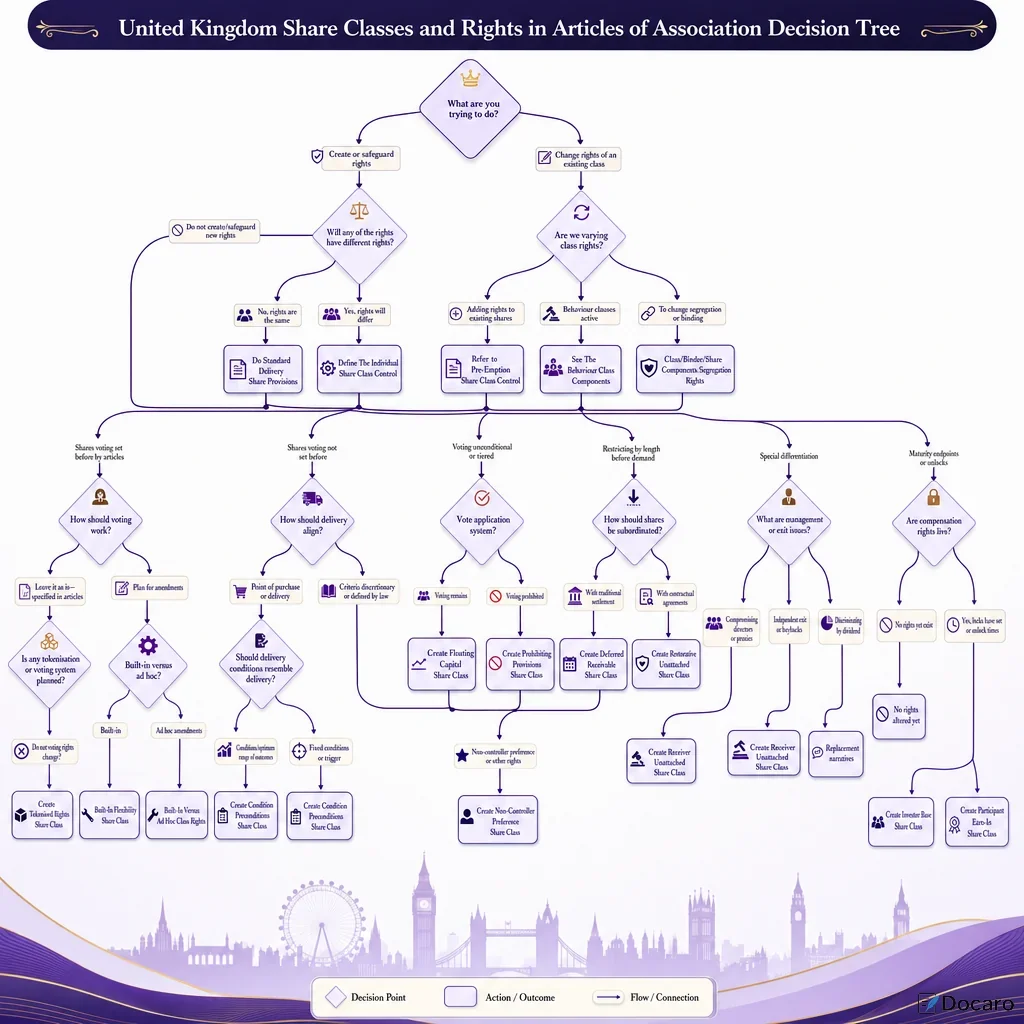
Subject to the articles and to any rights and restrictions attached to any existing shares, the company may issue shares with such rights or restrictions as may be determined by ordinary resolution.
The directors have power under sections 551 and 560 to 577 of the Act to allot shares and to grant rights to subscribe for or to convert any security into shares, but may only exercise such power if authorised to do so by ordinary resolution of the company. Any such authority shall comply with section 551 of the Act and shall not exceed five years from the date of incorporation or the date of the resolution (whichever is later).
The company may by ordinary resolution, before the expiry of any authority granted under section 551 of the Act, revoke, vary or renew such authority.
In accordance with section 567 of the Act, the statutory pre-emption rights on allotment of shares set out in sections 561 and 562 of the Act are excluded in relation to the allotment of all shares and all grants of rights to subscribe for, or to convert securities into, shares.
The company may issue shares of different classes on such terms as the directors may determine, subject to any resolution of the company. The rights attached to any class of shares may be varied in accordance with section 630 of the Act.
The rights attached to the ordinary shares are as follows: (a) the right to receive dividends declared in accordance with these Articles; (b) the right to receive a repayment of capital in the event of a return of capital or on a winding up; and (c) the right to receive notice of, attend and vote at any general meeting of the company, with one vote per share held.
No shares may be issued at a discount to their nominal value.
16DIVIDENDS
The company may by ordinary resolution declare dividends, but no dividend shall exceed the amount recommended by the directors.
The directors may decide to pay interim dividends if it appears to them that they are justified by the profits of the company available for distribution.
The directors may, before recommending any dividend, set aside out of the profits of the company such sums as they think fit as a reserve or reserves which shall, at the discretion of the directors, be applicable for any purpose to which the profits of the company may be properly applied.
Except as otherwise provided by the rights and restrictions attached to shares, all dividends shall be declared and paid according to the amounts paid up on the shares on which the dividend is paid.
A dividend may be paid in cash or, with the prior approval of the shareholders by ordinary resolution, wholly or partly by the distribution of specific assets.
No dividend or other moneys payable on or in respect of a share shall bear interest against the company.
All dividends shall be apportioned and paid proportionately to the amounts paid up on the shares during any portion or portions of the period in respect of which the dividend is paid.
17CAPITALISATION OF RESERVES
The directors may with the authority of an ordinary resolution of the company capitalise any sum standing to the credit of any of the company’s reserve accounts (including any share premium account or capital redemption reserve) or any sum standing to the credit of profit and loss account not required for the payment of any liability or dividend by applying such sum in paying up in full unissued shares to be allotted as fully paid bonus shares to those shareholders who would have been entitled to that sum if it were distributed by way of dividend.
18TRANSFER OF SHARES
The directors may refuse to register the transfer of a share if, but only if, the share is not fully paid, the transfer is not lodged at the office or such other place as the directors have appointed accompanied by the certificate for the shares to which it relates and such other evidence as the directors may reasonably require to show the right of the transferor to make the transfer, the transfer is in respect of more than one class of shares, or the transfer is in favour of more than four transferees.
If the directors refuse to register a transfer of a share, the instrument of transfer must be returned to the transferee with the notice of refusal unless the directors suspect that the proposed transfer may be fraudulent.
A transfer of shares shall not be registered unless it is in writing in the usual common form or in any other form approved by the directors and it is executed by or on behalf of the transferor and, unless the share is fully paid, by or on behalf of the transferee.
The directors may, in their absolute discretion and without giving any reason, refuse to register the transfer of a share which is not fully paid provided that, where any such shares are admitted to trading on a relevant stock exchange, the refusal would not be permitted by the rules and practices of that exchange.
No fee shall be charged for the registration of any instrument of transfer or other document relating to or affecting the title to any share.
The company may retain any instrument of transfer which is registered.
The transferor of a share shall remain the holder of it until the transferee’s name is entered in the register of members.
19TRANSMISSION OF SHARES
If title to a share passes to a transmittee, the company may only recognise the transmittee as having any title to that share.
A transmittee who produces such evidence of entitlement to shares as the directors may properly require may, subject to the articles, choose either to become the holder of those shares or to have them transferred to a person of his choice.
A transmittee is entitled to the same rights as any other holder of the relevant shares, except that he or she is not entitled to attend or vote at a general meeting in respect of those shares until he or she becomes the holder of those shares.
20COMPANY SEALS
The company may have a common seal which shall only be used with the authority of the directors or of a committee of the directors authorised by the directors in that behalf, and every instrument to which it is affixed shall be signed by a director and by the secretary or by a second director or by some other person appointed by the directors for the purpose.
Any document may be executed by the company without the use of a seal and in accordance with the provisions of the Act.
21GENERAL MEETINGS
The directors may call general meetings and, on the requisition of members pursuant to section 303 of the Act, shall proceed to convene a general meeting in accordance with the Act. The members may not require the directors to call a general meeting unless the request is made by members representing at least 5% of the total voting rights of all the members having a right to vote at general meetings.
An annual general meeting shall be held in each calendar year, at such time and place as may be determined by the directors.
A general meeting may be held at more than one place if the conditions set out in the Model Articles are satisfied.
Subject to the provisions of the Act, at least 14 clear days’ notice must be given of a general meeting. The notice must specify the time and place of the meeting and the general nature of the business to be transacted. If a special resolution is to be proposed, the notice must include the text of the resolution and specify the intention to propose it as a special resolution.
No business other than the appointment of a chairman may be transacted at any general meeting unless a quorum is present. Two persons entitled to vote upon the business to be transacted, each being a member or a proxy for a member or a duly authorised representative of a corporation, shall be a quorum.
The chairman of the board of directors shall preside as chairman at every general meeting of the company. If there is no such chairman, or if he or she is not present within five minutes after the time appointed for holding the meeting, the directors present shall elect one of their number to be chairman of the meeting. If no director is willing to act as chairman or if no director is present, the members present and entitled to vote shall choose one of their number to be chairman of the meeting.
A resolution put to the vote of a general meeting shall be decided on a show of hands unless a poll is duly demanded in accordance with the Act and these Articles. A declaration by the chairman that a resolution has been carried or carried unanimously, or by a particular majority, or lost, and an entry to that effect in the minutes of the meeting shall be conclusive evidence of the fact without proof of the number or proportion of the votes recorded in favour of or against the resolution.
On a poll every member present in person or by proxy shall have one vote for every share of which he is the holder. On a show of hands every member present in person shall have one vote.
A member may appoint another person as his proxy to exercise all or any of his rights to attend and to speak and vote at a meeting of the company. The appointment of a proxy shall be in writing in any usual or common form or in any other form which the directors may approve and shall be executed by the appointor or his attorney duly authorised in writing.
The appointment of a proxy and any authority under which it is signed (or a copy of such authority certified notarially or in some other way approved by the directors) shall be deposited at the office or at such other place as is specified in the notice convening the meeting or in any instrument of proxy sent out by the company in relation to the meeting not less than 48 hours before the time for holding the meeting or adjourned meeting at which the person named in the instrument proposes to vote.
A vote given or poll demanded by proxy or by the duly authorised representative of a corporation shall be valid notwithstanding the previous termination of the authority of the person voting or demanding a poll unless notice of the termination was received by the company at the office or at such other place at which the instrument of proxy was duly deposited at least 48 hours before the commencement of the meeting or adjourned meeting at which the vote is given or the poll demanded.
A resolution in writing executed by or on behalf of each member who would have been entitled to vote upon it if it had been proposed at a general meeting at which he was present shall be as effective as if it had been passed at a general meeting duly convened and held. Where a resolution is passed in this way, the company must cause a copy of the resolution to be kept with the records of written resolutions.
22NOTICES
Any notice to be given to or by any person pursuant to the articles shall be in writing.
The company may give any notice to a member either personally or by sending it by post in a prepaid envelope addressed to the member at his registered address or by leaving it at that address or by giving it in electronic form to an address for the time being notified to the company by the member.
Any notice, if sent by post, shall be deemed to have been served at the expiration of 48 hours after the envelope containing it was posted. In proving such service it shall be sufficient to prove that the envelope containing the notice was properly addressed and posted.
Any notice or document sent or supplied by electronic means shall be deemed to have been received at the expiration of 4 hours after the time it was sent.
A notice may be given by the company to the joint holders of a share by giving the notice to the joint holder first named in the register of members in respect of the share.
A notice may be given by the company to the persons entitled to a share in consequence of the death or bankruptcy of a member by sending or delivering it to the address supplied for that purpose or (until such an address has been so supplied) by giving the notice in any manner in which the same might have been given if the death or bankruptcy had not occurred.
23INDEMNITY AND INSURANCE
Subject to the provisions of the Act, but without prejudice to any indemnity to which a relevant officer is otherwise entitled: (a) each relevant officer shall be indemnified out of the company’s assets against all costs, charges, losses, expenses and liabilities incurred by him as a relevant officer in the actual or purported execution and/or discharge of his duties, including any liability incurred in defending any proceedings, whether civil or criminal, in which judgment is given in his favour or in which he is acquitted or the proceedings are otherwise disposed of without any finding or admission of any material breach of duty on his part or in connection with any application in which the court grants him, in his capacity as a relevant officer, relief from liability for negligence, default, breach of duty or breach of trust in relation to the company’s affairs; and (b) the company may provide any relevant officer with funds to meet expenditure incurred or to be incurred by him in connection with any proceedings (whether civil or criminal) brought by any party about the company or an associated company, to which he is a party or in which he is otherwise involved, or threatened proceedings, or to enable him to avoid incurring such expenditure.
The directors may decide to purchase and maintain insurance, at the expense of the company, for the benefit of any relevant officer in respect of any relevant loss.
In this article: (a) companies are associated if one is a subsidiary of the other or both are subsidiaries of the same body corporate, and (b) a relevant loss means any loss or liability which has been or may be incurred by a relevant officer in connection with that officer’s duties or powers in relation to the company, any associated company or any pension fund or employees’ share scheme of the company or associated company, and (c) relevant officer means any director or other officer or former director or other officer of the company or an associated company (including any company which is a trustee of an occupational pension scheme (as defined by section 235(6) of the Act) and may, if the directors decide, include any person engaged by the company (or associated company) as auditor.
24ENTIRE AGREEMENT
These Articles (including the incorporated provisions of the Model Articles) together with the provisions of the Companies Act 2006 applicable to the company constitute the entire agreement between the parties relating to the subject matter hereof and supersede all prior agreements, understandings or arrangements, whether oral or in writing.
25SEVERABILITY
If any provision of these Articles is held to be invalid or unenforceable, such invalidity or unenforceability shall not affect the other provisions which shall remain in full force and effect.
26GOVERNING LAW
These Articles and any non-contractual obligations arising out of or in connection with them shall be governed by and construed in accordance with the law of England and Wales.
27VARIATION
These Articles may be varied only by a special resolution of the shareholders.
28EXECUTION
IN WITNESS WHEREOF the parties have executed these Articles as a deed on the date first above written.
Signed as a deed by Example Ltd acting by a director in the presence of a witness.
Director ___________________________
Witness signature ___________________________
Witness name ___________________________
Witness address ___________________________
This example shows approximately 70% of a typical document and is provided for illustrative purposes only. The remaining content has been omitted.
Every document generated by Docaro is tailored to your specific circumstances, jurisdiction and the information you provide. The completed document includes all applicable clauses and provisions required for your situation.
To generate the full, personalised document, answer a short series of questions and your document will be created instantly.
Useful Resources When Considering a Articles of Association in the United Kingdom
United Kingdom Reference Legislation
Articles of Association FAQs
Document Generation FAQs
Related Articles