AI Generated Safeguarding Policy for use in the United Kingdom
PDF & Word - 2026 Updated
Docaro Pricing
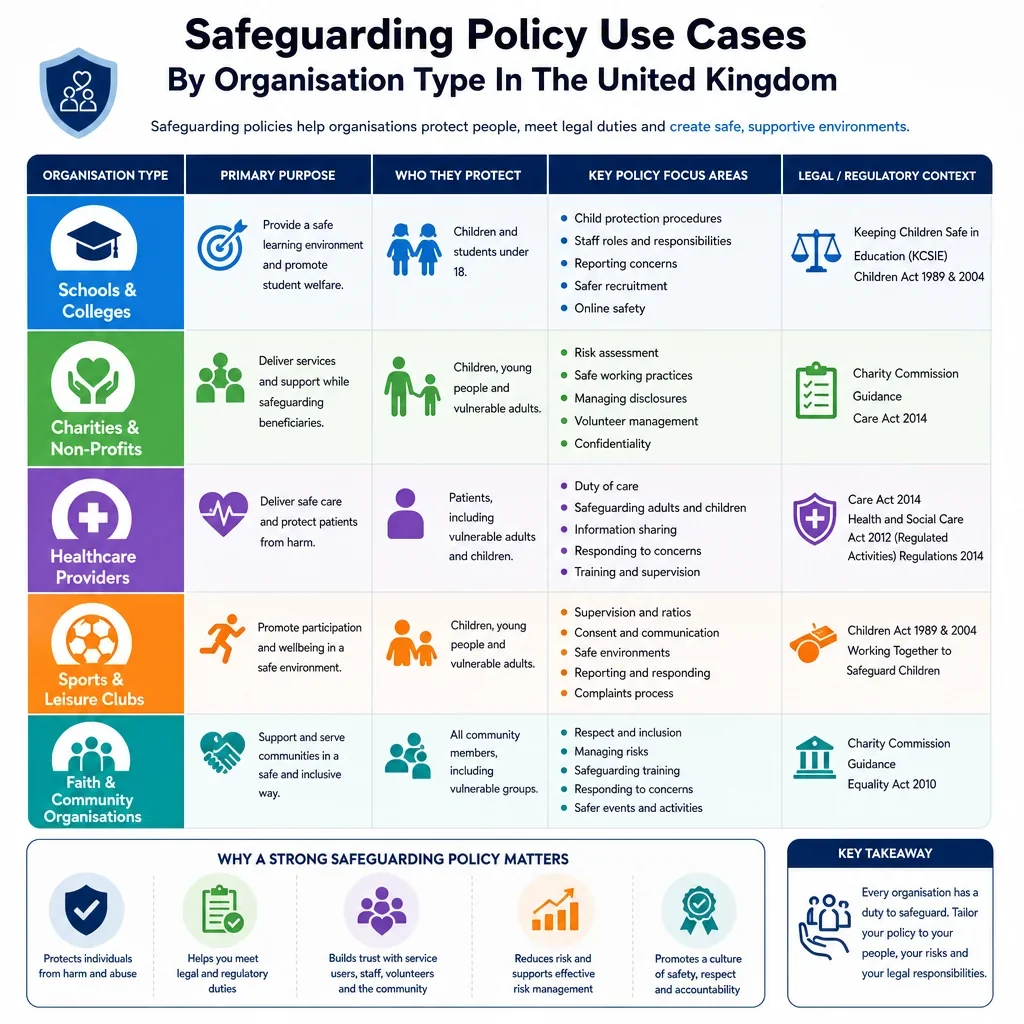
When do you need a Safeguarding Policy in the United Kingdom?
British Legal Rules for a Safeguarding Policy
Using an inappropriate structure for a safeguarding policy may fail to adequately protect vulnerable individuals or comply with statutory requirements.
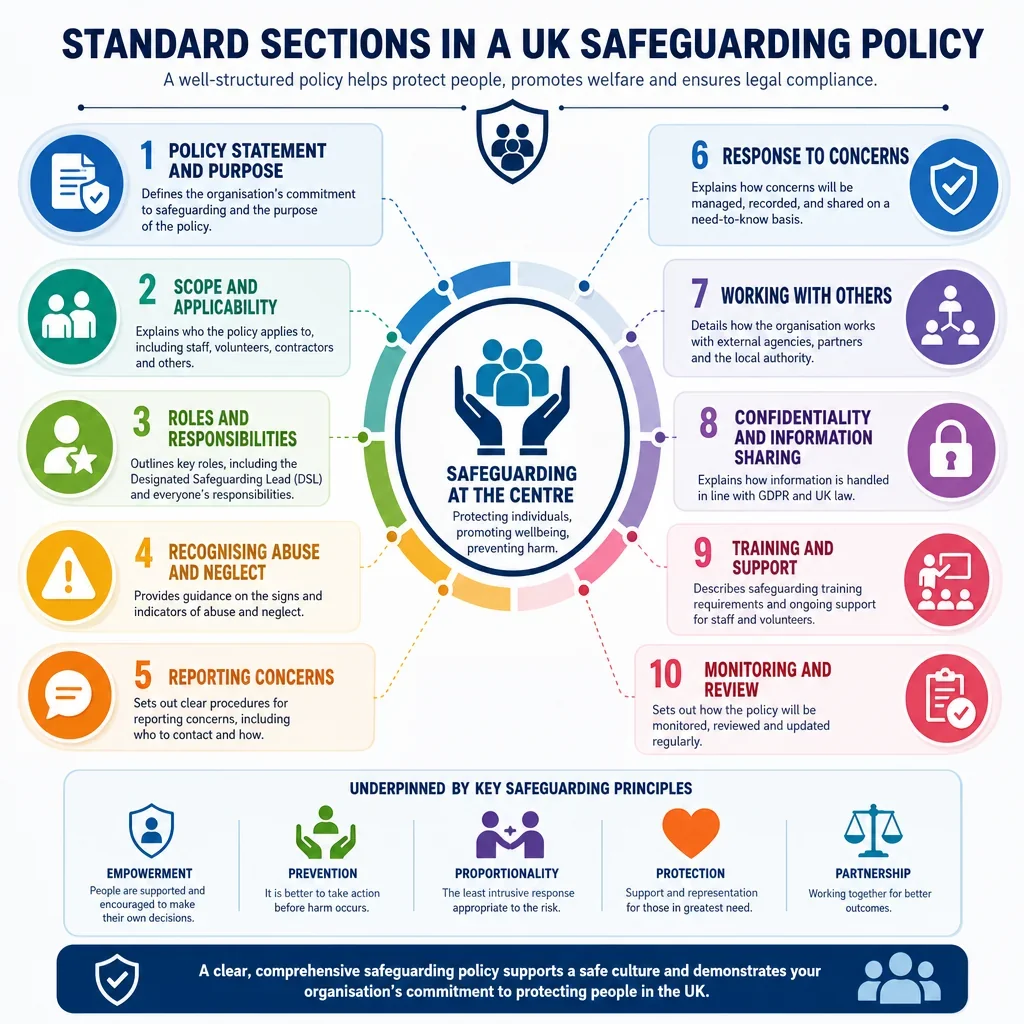
What a Proper Safeguarding Policy Should Include
- Purpose and ScopeClearly state the policy's aim to protect children and vulnerable adults from harm, and outline who it applies to in your organisation.
- Key DefinitionsDefine important terms like safeguarding, abuse, and neglect to ensure everyone understands the policy's language.
- Roles and ResponsibilitiesAssign clear duties to staff, leaders, and volunteers for identifying, reporting, and preventing risks to safety.
- Recognising RisksDescribe common signs of harm or danger, such as physical, emotional, or online threats, to help spot issues early.
- Reporting ProceduresExplain simple steps for reporting concerns, including who to contact and how to record incidents promptly.
- Responding to ConcernsDetail how the organisation will investigate and support those affected while working with authorities if needed.
- Safer RecruitmentOutline checks like background screenings to ensure people working with vulnerable groups are suitable.
- Training and AwarenessCommit to regular training for all staff on safeguarding topics to keep knowledge current and effective.
- Review and MonitoringSet out how the policy will be checked and updated regularly to stay relevant and compliant.
Generate Your Document in 4 Easy Steps
Why Use Docaro?
 United Kingdom
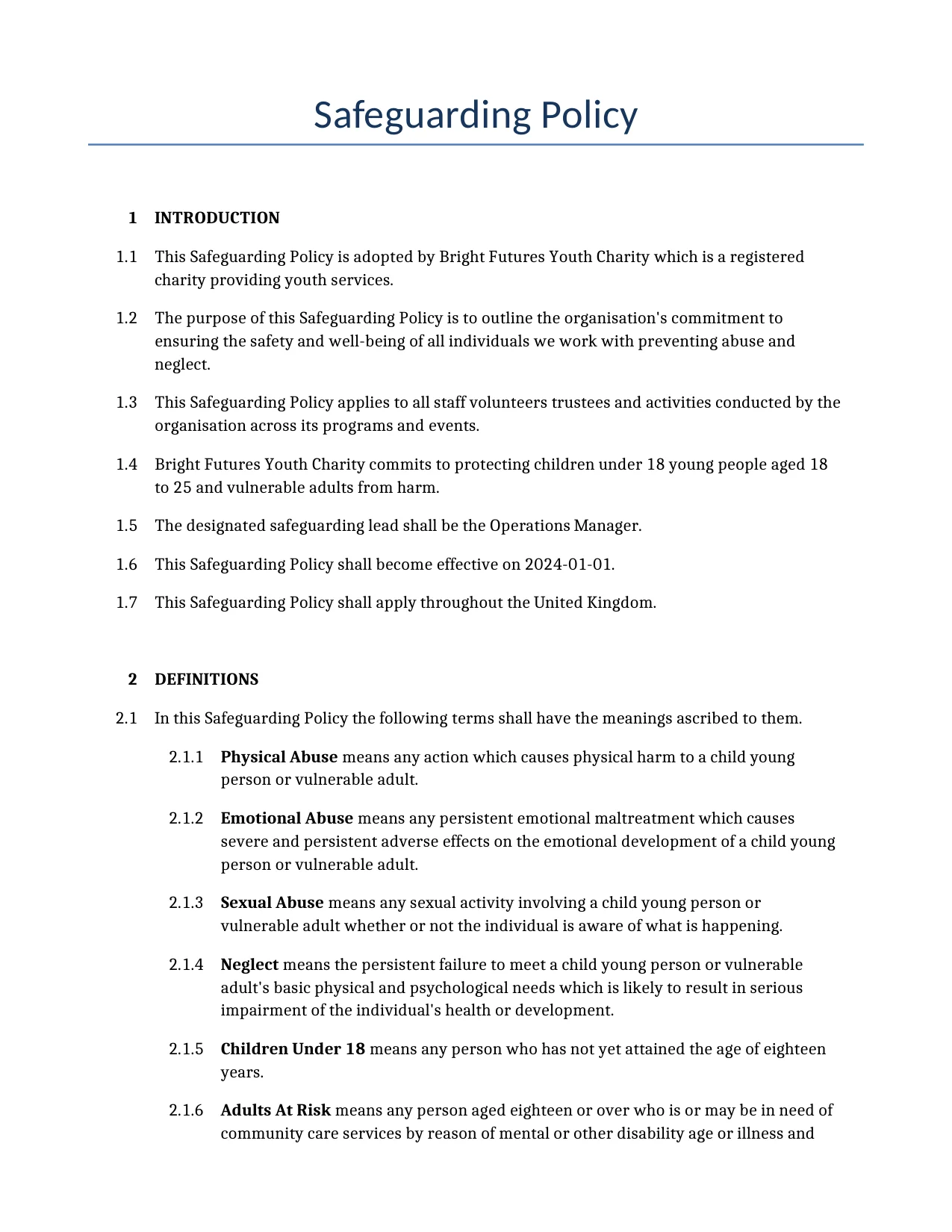
Free Example Safeguarding Policy Template
Below is a free template example of a Safeguarding Policy for use in the United Kingdom generated by our AI model.
The clauses in your actual Safeguarding Policy will vary from this example as they will be entirely bespoke to your requirements as set out in the questionnaire you complete.
Safeguarding Policy
1INTRODUCTION
This Safeguarding Policy is adopted by Bright Futures Youth Charity which is a registered charity providing youth services.
The purpose of this Safeguarding Policy is to outline the organisation's commitment to ensuring the safety and well-being of all individuals we work with preventing abuse and neglect.
This Safeguarding Policy applies to all staff volunteers trustees and activities conducted by the organisation across its programs and events.
Bright Futures Youth Charity commits to protecting children under 18 young people aged 18 to 25 and vulnerable adults from harm.
The designated safeguarding lead shall be the Operations Manager.
This Safeguarding Policy shall become effective on 2024-01-01.
This Safeguarding Policy shall apply throughout the United Kingdom.
2DEFINITIONS
In this Safeguarding Policy the following terms shall have the meanings ascribed to them.
Physical Abuse means any action which causes physical harm to a child young person or vulnerable adult.
Emotional Abuse means any persistent emotional maltreatment which causes severe and persistent adverse effects on the emotional development of a child young person or vulnerable adult.
Sexual Abuse means any sexual activity involving a child young person or vulnerable adult whether or not the individual is aware of what is happening.
Neglect means the persistent failure to meet a child young person or vulnerable adult's basic physical and psychological needs which is likely to result in serious impairment of the individual's health or development.
Children Under 18 means any person who has not yet attained the age of eighteen years.
Adults At Risk means any person aged eighteen or over who is or may be in need of community care services by reason of mental or other disability age or illness and who is or may be unable to take care of himself or herself or unable to protect himself or herself against significant harm or exploitation.
Disabled Individuals means any person who has a physical or mental impairment which has a substantial and long-term adverse effect on that person's ability to carry out normal day-to-day activities.
Radicalisation refers to the process by which a person comes to support terrorism and extremist ideologies associated with terrorist groups as defined in the Prevent duty guidance.
Female Genital Mutilation (FGM) means all procedures involving partial or total removal of the external female genitalia or other injury to the female genital organs for non-medical reasons.
Child Sexual Exploitation (CSE) occurs where an individual or group takes advantage of an imbalance of power to coerce manipulate or deceive a child or young person under the age of 18 into sexual activity in exchange for something the victim needs or wants and/or for the financial advantage or increased status of the perpetrator or facilitator.
County Lines is a term used to describe gangs and organised criminal networks involved in exporting illegal drugs into one or more importing areas within the UK using dedicated mobile phone lines or other form of \'deal line\'.
Domestic Abuse is any incident or pattern of incidents of controlling coercive threatening behaviour violence or abuse between those aged 16 or over who are or have been intimate partners or family members.
Peer-on-Peer Abuse is any form of abuse inflicted by children or young people on other children or young people including bullying sexual violence and harassment.
Modern Slavery encompasses slavery servitude forced or compulsory labour and human trafficking as defined in the Modern Slavery Act 2015.
3LEGAL AND REGULATORY FRAMEWORK
This Safeguarding Policy is governed by and shall be construed in accordance with the law of England and Wales.
Bright Futures Youth Charity complies with the Children Act 1989 by prioritizing the welfare of the child ensuring that all decisions and actions are guided by the paramountcy principle and maintaining detailed records of child protection cases to support legal proceedings if necessary.
Bright Futures Youth Charity has adopted the statutory guidance from Working Together to Safeguard Children 2018.
Bright Futures Youth Charity implements Keeping Children Safe in Education through mandatory staff training on recognizing signs of abuse establishing clear reporting procedures for child protection concerns and conducting regular safeguarding audits to ensure ongoing compliance.
Bright Futures Youth Charity shall comply with the Children Act 2004 the Safeguarding Vulnerable Groups Act 2006 the Care Act 2014 the Mental Capacity Act 2005 the Safeguarding Adults Boards Regulations 2015 the Data Protection Act 2018 the UK GDPR and the Prevent duty under the Counter-Terrorism and Security Act 2015.
Bright Futures Youth Charity has a formal agreement with the local authority for safeguarding arrangements as required under relevant legislation.
This policy also has regard to Charity Commission guidance on safeguarding and protecting people for charities and trustees.
4POLICY STATEMENT
Bright Futures Youth Charity is committed to creating a safe environment for children young people and adults at risk and to promoting their welfare. We will act quickly and decisively to protect them from harm including abuse neglect exploitation radicalisation FGM CSE county lines domestic abuse and online harm.
We recognise our responsibilities under the Prevent duty and will work to prevent people from being drawn into terrorism including making Channel referrals where appropriate.
We are committed to the principles of child-centred practice prevention early intervention multi-agency working and equality of opportunity.
This policy applies to all staff volunteers trustees and anyone working on behalf of the charity.
5PRINCIPLES OF SAFEGUARDING
Our child-centered approach prioritizes the voice needs and best interests of the child in all safeguarding decisions.
Bright Futures Youth Charity shall ensure that children are actively involved where appropriate and all actions are tailored to support their individual circumstances promoting their safety welfare and development.
Prevention shall be a core principle of this Safeguarding Policy.
Early intervention shall be a guiding principle of this Safeguarding Policy.
Early intervention procedures shall include regular risk assessments staff training on recognizing signs of potential harm immediate referral to support services upon identification of concerns and follow-up monitoring to ensure timely and effective support is provided to at-risk children and families.
Multi-agency collaboration shall be a core principle of this Safeguarding Policy.
These core principles of child-centered approaches prevention early intervention and multi-agency collaboration will underpin all our safeguarding practices ensuring a proactive collaborative and supportive environment that protects children and promotes their well-being in line with statutory requirements.
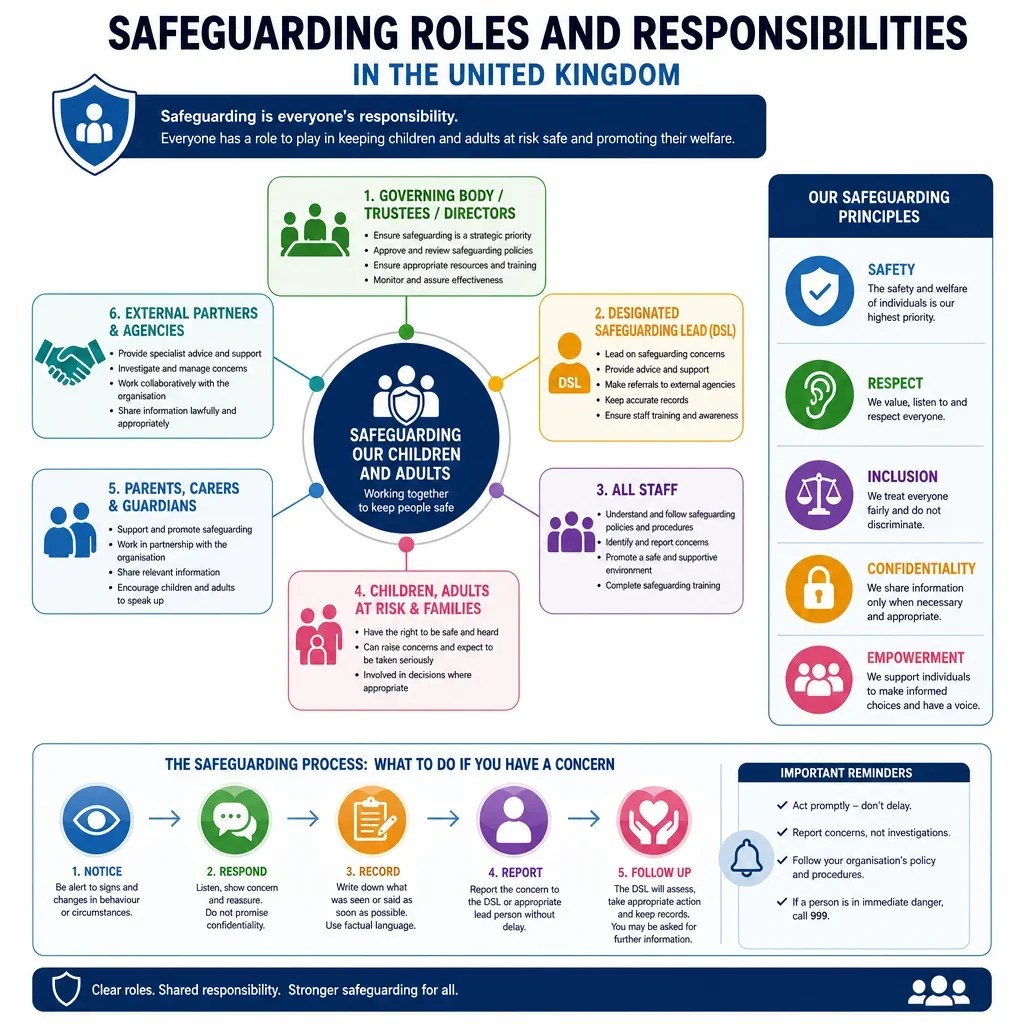
6ROLES AND RESPONSIBILITIES
The Board of Trustees shall be the governing body of Bright Futures Youth Charity.
The Board of Trustees shall have the duty to oversee safeguarding arrangements.
The Board of Trustees shall approve the safeguarding policy annually ensure resources are allocated for training and review safeguarding reports quarterly.
The Senior Management Team shall be responsible for implementing the safeguarding policy.
The Senior Management Team shall organise training sessions monitor training completion and evaluate training effectiveness.
The designated safeguarding lead (DSL) is Jane Smith (also known as the Operations Manager).
The designated safeguarding lead shall manage referrals to children's social care provide advice and support to staff on safeguarding issues and liaise with external agencies.
The designated safeguarding lead shall be available during term time and holidays. Contact details: jane.smith@brightfutures.org.uk 020 1234 5678.
All staff shall identify signs of abuse report concerns immediately and maintain confidentiality.
Volunteers shall assist with after-school activities and event supervision.
All volunteers shall undergo DBS checks.
Volunteers shall observe and report any concerns about child safety to the designated safeguarding lead and complete mandatory safeguarding training.
The main external partners involved in the activities of Bright Futures Youth Charity are local social services youth charities and educational consultants.
External partners shall provide DBS clearance follow the safeguarding policy of Bright Futures Youth Charity and report concerns to the designated safeguarding lead.
7SAFER RECRUITMENT PRACTICES
Bright Futures Youth Charity is committed to safer recruitment practices to protect children and vulnerable adults from harm ensuring that all appointments are made with the utmost regard for safeguarding.
All staff and volunteers in regulated activity will undergo an enhanced DBS check including barred list information where appropriate.
At least two references shall be obtained and verified for every candidate one of which must be from the most recent employer.
All interviews shall be conducted as a panel interview and shall include questions specifically about safeguarding and protecting vulnerable individuals.
Identity checks proof of right to work in the UK and verification of qualifications will be carried out.
All new staff will receive a safeguarding induction.
A single central record of recruitment and vetting checks will be maintained in line with statutory requirements.
8STAFF CODE OF CONDUCT
All staff and volunteers must adhere to the organisation's code of conduct which sets out expectations for professional behaviour including maintaining appropriate boundaries respecting privacy avoiding favouritism and promoting an inclusive environment.
The code forms part of the safer working practices section of this policy and is provided to all staff and volunteers on induction.
9LOW-LEVEL CONCERNS
The organisation has a low-level concerns policy and procedure. A low-level concern is any concern that an adult working with children may have acted in a way that is inconsistent with the staff code of conduct but does not meet the harms threshold for referral to the Local Authority Designated Officer (LADO).
Low-level concerns should be reported to the DSL and will be recorded and reviewed as part of the organisation's safeguarding quality assurance processes.
10TRAINING AND AWARENESS
All staff volunteers and trustees shall undergo safeguarding induction training upon joining Bright Futures Youth Charity.
Ongoing safeguarding training shall be mandated for all staff volunteers and trustees at regular intervals and shall be updated in line with statutory guidance.
The DSL and deputies will receive advanced training every two years.
Training will cover all relevant topics including radicalisation FGM CSE county lines domestic abuse online safety mental health awareness and Prevent.
A training matrix will be maintained recording who has been trained when and at what level.
11RECOGNISING AND RESPONDING TO CONCERNS
This policy provides specific guidance on recognising signs of physical emotional sexual abuse neglect radicalisation FGM CSE county lines domestic abuse peer-on-peer abuse online harm and mental health concerns.
Mandatory staff training on recognising concerns shall be referenced in this Safeguarding Policy.
When responding to concerns staff shall first ensure the immediate safety of the child or vulnerable adult and then notify the designated safeguarding lead without delay.
Concerns shall be reported immediately to the DSL Jane Smith.
Concerns shall be reported to external bodies immediately if there is imminent risk of harm by contacting the local authority children's services or police via their designated channels.
The designated contact person for internal reporting of safeguarding concerns shall be Jane Smith.
The email address for the designated internal reporting contact shall be jane.smith@brightfutures.org.uk.
The phone number for the designated internal reporting contact shall be 020 1234 5678.
When a safeguarding concern is identified staff shall ensure safety of the individual notify the designated safeguarding lead and document initial observations.
All concerns must be documented factually including dates times observations and any statements made without speculation.
A standard reporting form shall be used for documenting safeguarding concerns.
A safeguarding concern shall be escalated to external authorities if the concern involves serious harm repeated incidents or if internal resolution is not possible within twenty four hours.
The external authorities for escalation shall include local authority children's services the police and the NSPCC helpline.
Staff shall be required to report a safeguarding concern internally within twenty four hours after identifying the concern.
Anonymous reporting of safeguarding concerns shall be allowed.
See Appendix for flowchart on reporting concerns and handling disclosures.
12REPORTING PROCEDURES
All safeguarding concerns shall be reported internally in the first instance to the designated safeguarding lead Jane Smith.
The designated safeguarding lead shall determine whether the concern requires referral to external authorities including local authority children's services or the police.
Immediate actions shall be taken to ensure the safety of the individual concerned.
All reports shall be documented in accordance with the procedures set out in section 11 of this Safeguarding Policy.
Escalation to authorities shall occur without delay where there is risk of significant harm.
Information sharing protocols follow the guidance in Working Together to Safeguard Children and the Data Protection Act 2018/UK GDPR. Confidentiality may be overridden where there is risk of significant harm to a child or vulnerable adult or where there is a legal obligation to share.
13MANAGING ALLEGATIONS AGAINST STAFF
All allegations against staff or volunteers shall be referred to the Local Authority Designated Officer (LADO) within one working day.
The DSL Jane Smith is responsible for managing these allegations and may be contacted at jane.smith@brightfutures.org.uk or 020 1234 5678.
Staff or volunteers shall not be automatically suspended but a risk assessment will be carried out.
This Safeguarding Policy shall cover allegations of physical abuse emotional abuse sexual abuse neglect and low-level concerns against staff or volunteers.
Immediate police contact shall be required for criminal allegations against staff.
All allegation records shall be kept in line with the organisation's retention policy and statutory guidance.
14WHISTLEBLOWING
Anonymous whistleblowing reports shall be allowed.
The recipients for whistleblowing concerns shall be the Safeguarding Lead Jane Smith and Senior Management.
Whistleblowers will be protected from any form of victimisation discrimination or unfair treatment.
The identity of whistleblowers will be kept confidential where possible and they will not face adverse employment consequences for raising genuine concerns in good faith.
A strict no-retaliation clause shall apply to whistleblowers.
Training shall be required for staff on whistleblowing.
Concerns raised via whistleblowing shall be acknowledged within five days.
15SAFER WORKING PRACTICES
The code of conduct for staff and volunteers shall outline expectations for professional behavior including maintaining confidentiality respecting privacy avoiding favoritism and promoting an inclusive environment for all participants.
Boundaries with children and vulnerable adults shall be set through clear communication of professional limits prohibition on personal social media contact rules against giving or accepting gifts and guidelines on one-to-one meetings.
Guidelines for the use of technology by staff and volunteers shall require that all communications must use official organization channels no personal devices for work-related contact devices must be password-protected internet use must be monitored to prevent access to inappropriate content and regular training on online safety must be provided.
Permitted physical contact shall include comforting hugs with consent assistance with mobility for vulnerable adults and sports-related contact with supervision.
Prohibited physical contact shall include any physical contact that is not essential for safety or program activities touching of private areas roughhousing or play-fighting and all contact must be appropriate to the context and never secretive.
The supervision ratio for children shall be one adult per eight children.
The supervision ratio for vulnerable adults shall be one adult per five vulnerable adults.
Safeguarding training shall be mandatory for all staff.
Risk minimization strategies shall include regular risk assessments background checks for all personnel incident reporting protocols and peer support and oversight.
This section includes a lone working policy site security measures missing child procedures and procedures in the event of the death of a child.
16ONLINE SAFETY AND DIGITAL SAFEGUARDING
A policy on safe internet use for staff volunteers and young people shall be included.
Content filtering systems shall be implemented to block inappropriate websites and monitoring software used.
Digital literacy education shall include annual workshops for staff curriculum integration for young people and parental awareness sessions.
Procedures for addressing cyberbullying incidents sexting (youth produced sexual imagery) and online grooming shall be followed in line with KCSIE guidance.
Specific measures to prevent online grooming such as staff training on recognising signs shall be included.
Exposure to inappropriate content shall be reported to the designated safeguarding lead.
Guidelines for safe use of social media platforms by young people and staff shall be included.
17SPECIFIC SAFEGUARDING ISSUES
The charity has specific procedures for radicalisation and the Prevent duty including making referrals to Channel where appropriate.
Staff are trained to recognise signs of FGM CSE county lines domestic abuse modern slavery and peer-on-peer abuse and to respond in accordance with statutory guidance.
Mental health awareness is embedded in training and staff know how to refer young people requiring support.
18MULTI-AGENCY WORKING AND INFORMATION SHARING
Collaboration with external agencies shall be promoted.
The external agencies with which Bright Futures Youth Charity shall collaborate are Local Authority Children's Services the Police NHS Health Services and Channel partners.
Bright Futures Youth Charity actively promotes collaboration with external agencies to ensure a coordinated approach to safeguarding.
This includes regular meetings joint training sessions and shared resources to address risks effectively.
Information sharing protocols in line with GDPR and statutory guidance shall be included.
Information will be shared only on a need-to-know basis in compliance with GDPR principles of lawfulness fairness and transparency.
Bright Futures Youth Charity adheres to statutory guidance such as Working Together to Safeguard Children ensuring consent is obtained where possible and data protection impact assessments are conducted for sensitive sharing.
Participation in local safeguarding arrangements shall be included.
Bright Futures Youth Charity shall participate in the Safeguarding Children Partnership and Multi-Agency Risk Assessment Conference.
Bright Futures Youth Charity commits to full participation in local safeguarding arrangements including attending meetings of the Safeguarding Children Partnership and contributing to Multi-Agency Risk Assessment Conferences to support vulnerable individuals in our community.
19SUPPORT FOR VICTIMS AND SURVIVORS
Access to counseling services shall be provided for victims and survivors affected by safeguarding issues.
Pastoral care shall be offered to victims and survivors.
Victims and survivors shall be referred to Local Authority Social Services NHS Mental Health Services and specialist charities such as the NSPCC.
Upon identifying a safeguarding issue the designated safeguarding lead shall assess the situation and discuss options with the victim or survivor.
If specialist services are needed consent shall be obtained where possible and direct referrals shall be made via secure channels such as email or phone providing all relevant details while maintaining confidentiality.
Follow up shall be conducted to ensure the referral is actioned and ongoing support shall be offered throughout the process.
A policy on how victims and survivors can access support services shall be included.
20COMPLAINTS PROCEDURE
Anyone who has a complaint or concern about the charity's safeguarding practice should raise this in the first instance with the DSL or a trustee. The charity's formal complaints procedure will then be followed. All complaints will be taken seriously and responded to within 10 working days.
21EQUALITY IMPACT STATEMENT
This policy has been equality impact assessed and has due regard to eliminating discrimination advancing equality of opportunity and fostering good relations between people with protected characteristics.
22MONITORING REVIEW AND QUALITY ASSURANCE
Auditing of safeguarding practices shall be conducted quarterly to ensure ongoing compliance and effectiveness.
A detailed process for analyzing safeguarding incidents shall be included.
The safeguarding policy shall be reviewed following a significant safeguarding incident after changes in relevant legislation or guidance and upon organizational restructuring in addition to the annual review.
The next annual review of the safeguarding policy shall occur on 2025-01-01.
The stakeholders to be involved in the monitoring and review processes shall be the senior management team the designated safeguarding lead frontline staff and external advisors or auditors.
Quality assurance shall involve regular audits feedback collection from staff and service users and benchmarking against national standards to continuously improve safeguarding measures. Metrics include number of concerns reported training compliance rates and timely referrals.
This policy and its implementation will be monitored through staff supervision performance management and annual reports to the Board of Trustees.
23POLICY DISSEMINATION
This policy will be made available to all staff volunteers and trustees on induction and annually thereafter. It will be published on the charity's website and a copy provided to parents and carers on request or at the start of any programme. Young people will be made aware of the policy in age-appropriate language.
24APPENDICES
The primary emergency contact for the organisation is Sarah Johnson who may be contacted on 07700 900123 or at sarah.johnson@brightfutures.org.uk.
The Designated Safeguarding Lead is Jane Smith who may be contacted on 020 1234 5678 or at jane.smith@brightfutures.org.uk.
The local authority's designated safeguarding team is the Westminster Children's Safeguarding Team which may be contacted on 020 7641 4000.
The templates for recording concerns to be included are the Child Protection Incident Form and the General Safeguarding Report Template.
The external resource links to be included are the GOV.UK Safeguarding Guidance the NSPCC Learning Portal Keeping Children Safe in Education and Working Together to Safeguard Children.
Flowchart: Reporting Safeguarding Concerns.
Flowchart: Handling Disclosures.
List of Useful Contacts including LADO Prevent lead and FGM helpline.
Risk Assessment Template.
IT Acceptable Use Policy.
25BOILERPLATE PROVISIONS
This Safeguarding Policy constitutes the entire agreement between the parties relating to its subject matter and supersedes all prior agreements understandings or arrangements whether oral or in writing.
If any provision of this Safeguarding Policy is held to be invalid or unenforceable such provision shall be severed and the remaining provisions shall continue in full force and effect.
Any notice required to be given under this Safeguarding Policy shall be in writing and shall be delivered personally sent by pre-paid first class post or sent by email to the address of the relevant party set out in this Safeguarding Policy or such other address as that party may notify to the other party from time to time.
No variation of this Safeguarding Policy shall be effective unless it is in writing and signed by the parties.
This Safeguarding Policy is governed by and shall be construed in accordance with the law of England and Wales.
26SIGNATURE SECTION
Signed for and on behalf of Bright Futures Youth Charity:
Name: _______________________________
Position: _____________________________
Signature: ___________________________
Date: ________________________________
This example shows approximately 70% of a typical document and is provided for illustrative purposes only. The remaining content has been omitted.
Every document generated by Docaro is tailored to your specific circumstances, jurisdiction and the information you provide. The completed document includes all applicable clauses and provisions required for your situation.
To generate the full, personalised document, answer a short series of questions and your document will be created instantly.
Useful Resources When Considering a Safeguarding Policy in the United Kingdom
United Kingdom Reference Legislation
Safeguarding Policy FAQs
Document Generation FAQs
Related Articles