Docaro

AI Generated British Arbitration Agreement
PDF & Word - 2026 Updated
A photorealistic image symbolizing arbitration and dispute resolution in the UK legal context, featuring two professional adults in business attire seated across a polished wooden table in a modern conference room, engaged in a calm discussion with hand gestures indicating negotiation, a Union Jack flag subtly visible in the background, natural daylight streaming through large windows, conveying fairness, agreement, and resolution without showing any legal documents.
Generate a custom AI-powered British arbitration agreement tailored for UK disputes, ensuring efficient and legally compliant resolution outside traditional courts.
Free instant document creation.
Compliant with United Kingdom law.
No sign up or monthly subscription.

Docaro Pricing

Basic
Free
Document Generation
No Sign Up
No Subscription
Download Watermarked PDF
Premium
$4.99 USD
Document Generation
No Sign Up
No Subscription
Download Clean PDF
Download Microsoft Word
Download HTML
Download Text
Email Document
Generate your document for free. Only pay if you like the result and need an un-watermarked version.

When do you need an Arbitration Agreement in the United Kingdom?

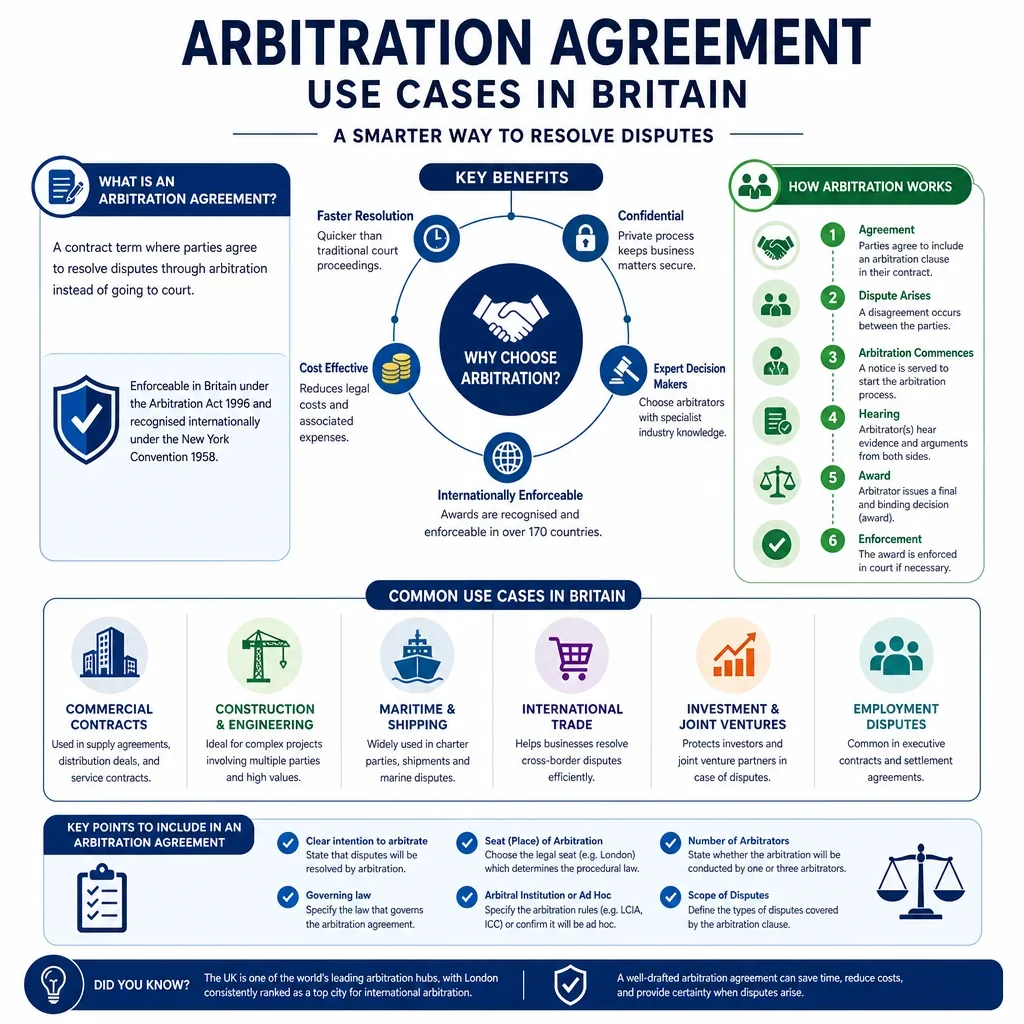
  • Resolving Business Disputes Privately
    Use an arbitration agreement when you want to settle business disagreements outside of public courts, keeping the process confidential and efficient.
  • International Business Deals
    It's essential for cross-border contracts to avoid complications from different country laws by agreeing on a neutral way to handle disputes.
  • Construction or Commercial Projects
    In large projects like building or trading deals, it helps resolve issues quickly without halting work, saving time and money.
  • Employment or Partnership Conflicts
    For work or business partnerships, it provides a fair, private method to address disagreements, protecting relationships and reputations.
  • Importance of a Well-Drafted Agreement
    A carefully written document ensures the process is clear and enforceable, preventing further disputes and giving everyone peace of mind.

British Legal Rules for an Arbitration Agreement

  • What It Is
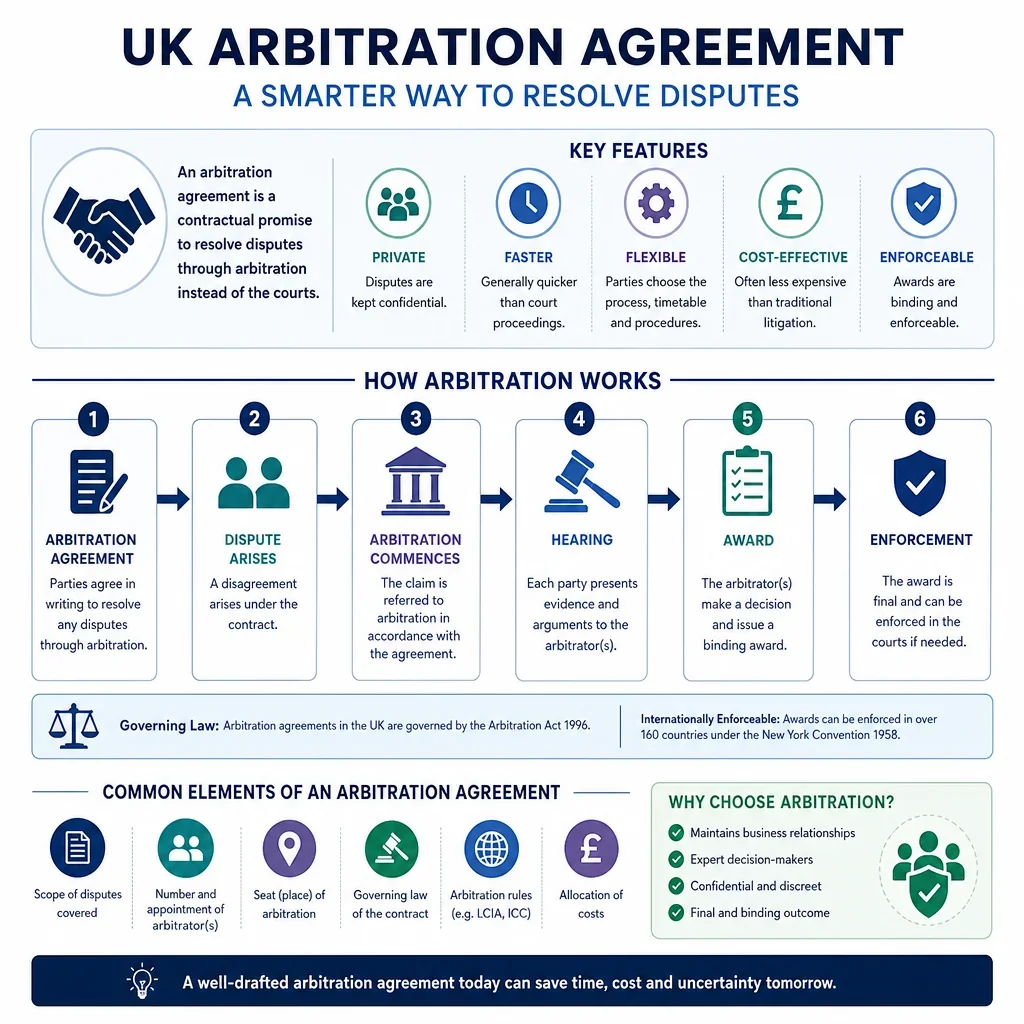
    An arbitration agreement is a contract where two parties agree to settle disputes through an independent arbitrator instead of going to court.
  • Governed by Law
    In the UK, these agreements follow the Arbitration Act 1996, which sets out how arbitration works and when courts can get involved.
  • Written Form
    The agreement must be in writing, either as a separate document or a clause in a larger contract, to be valid.
  • Clear Intent
    Both parties need to clearly agree to use arbitration for their disputes, showing they understand what it means.
  • Scope of Disputes
    The agreement should specify which types of disputes it covers, like business disagreements or contract issues.
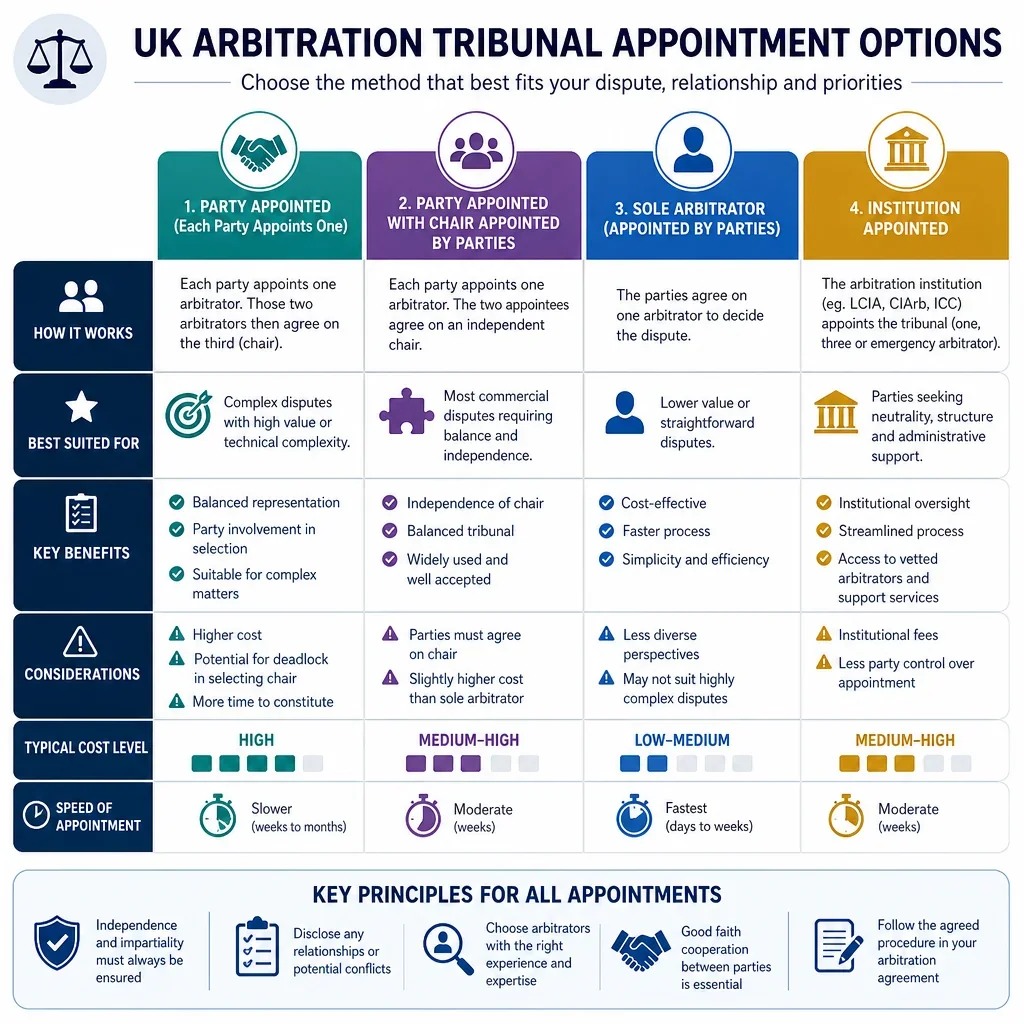
  • Choosing Arbitrators
    Parties can select a neutral arbitrator or let an organization appoint one to ensure fairness.
  • Binding Decisions
    The arbitrator's decision is final and legally binding, with limited options to appeal unless there's a serious error.
  • Court Involvement
    Courts support arbitration but can step in if the process is unfair or the agreement is invalid.
  • Privacy Benefits
    Arbitration hearings are private, unlike public court cases, which helps keep sensitive information confidential.
  • International Aspects
    For cross-border disputes, the New York Convention helps enforce UK arbitration agreements abroad.
Important

Using the wrong type or structure of arbitration agreement can lead to unenforceability or unintended legal consequences.

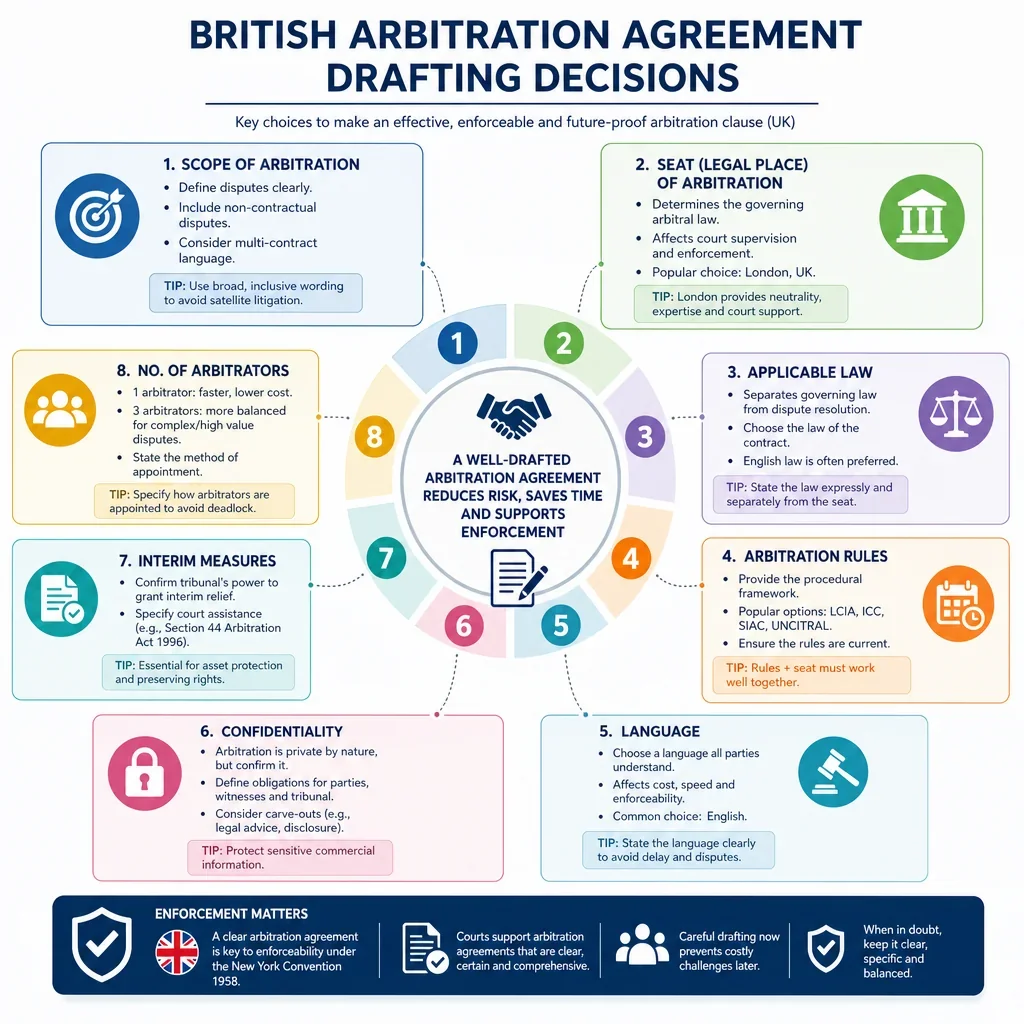
What a Proper Arbitration Agreement Should Include

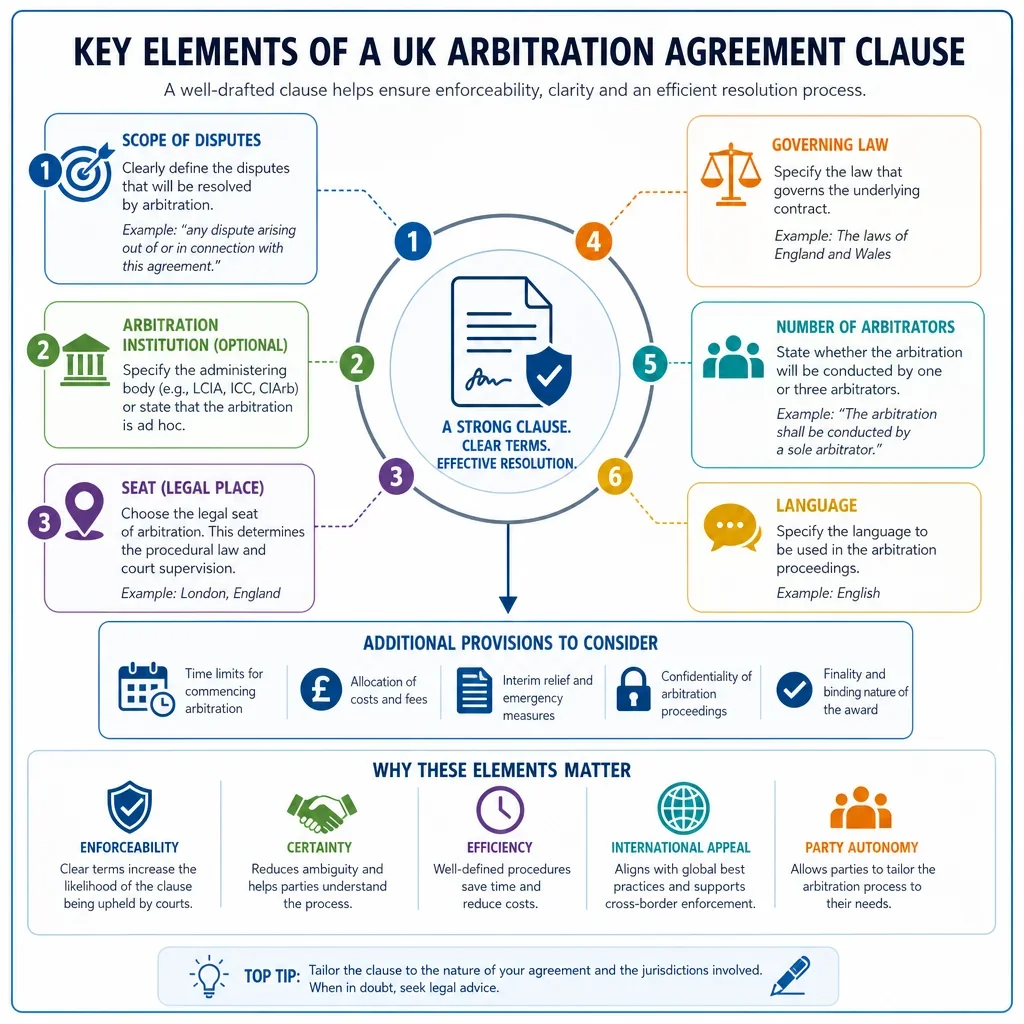
  • Clear Choice of Arbitration
    State that disputes will be resolved through arbitration instead of going to court.
  • Rules and Institution
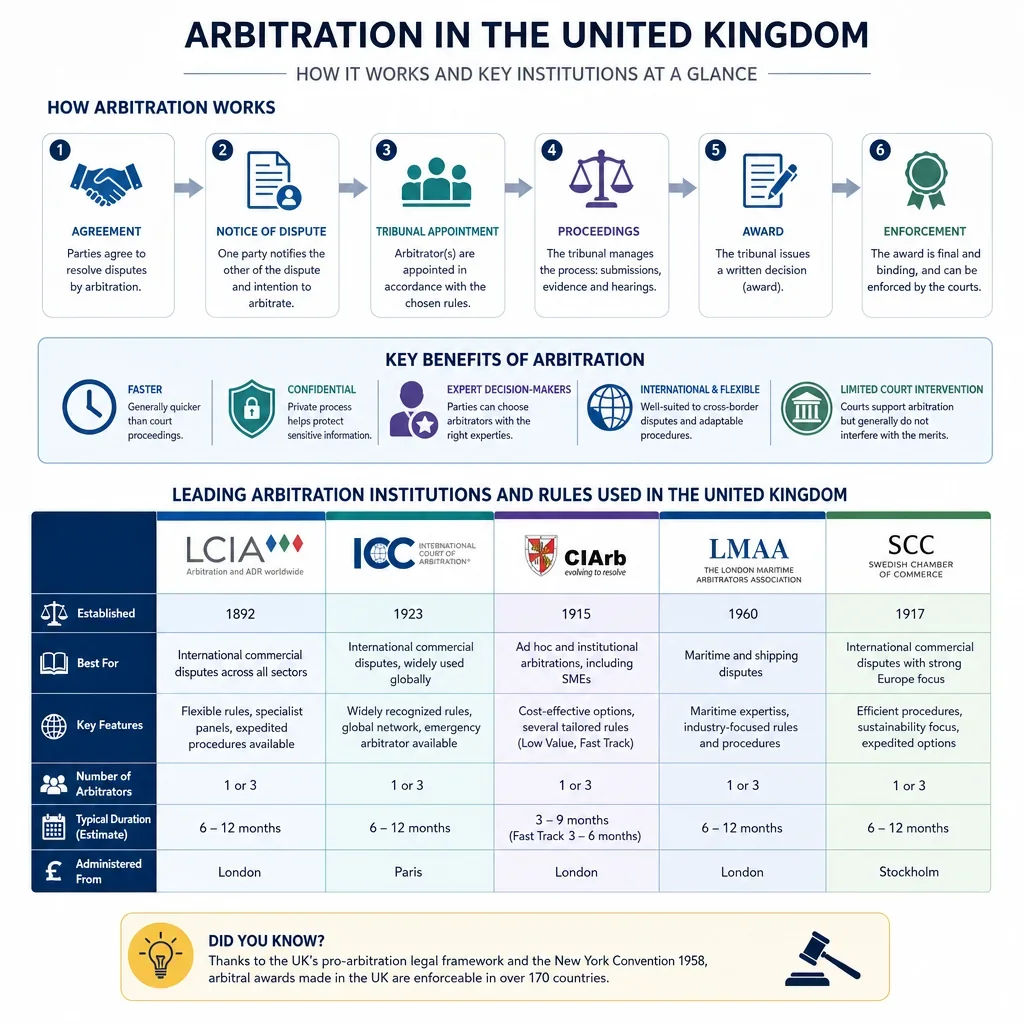
    Specify the arbitration rules and the organization that will oversee the process, such as the London Court of International Arbitration.
  • Number of Arbitrators
    Decide on the number of arbitrators, typically one or three, to handle the dispute.
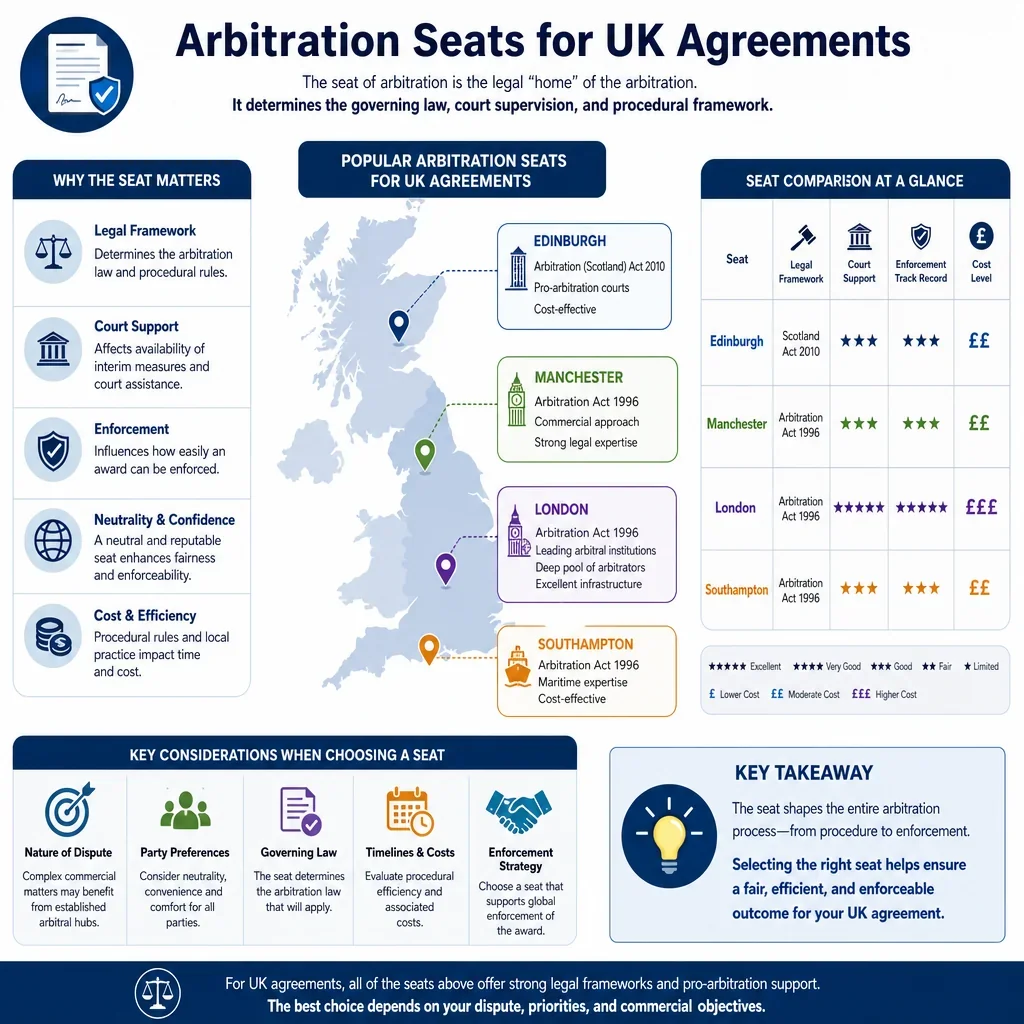
  • Location of Arbitration
    Indicate where the arbitration hearings will take place, often in a major city like London.
  • Governing Law
    Define the law that will apply to the arbitration agreement and the underlying contract.
  • Language of Proceedings
    Set the language to be used during the arbitration, usually English for UK matters.
  • Finality of Award
    Agree that the arbitrator's decision will be final and binding, with limited options for appeal.
  • Costs and Expenses
    Outline how the costs of arbitration will be shared or paid by the parties.

Why Free Templates Can Be Risky for Arbitration Agreements

Free arbitration agreement templates often use generic clauses that fail to address UK-specific jurisdictional requirements or the unique details of your dispute, potentially rendering the agreement unenforceable, exposing you to costly litigation in courts instead of efficient arbitration, or leading to disputes over validity that undermine the entire process.

An AI-generated bespoke arbitration agreement tailors every clause to your exact circumstances, parties involved, governing law, and arbitration rules, ensuring full enforceability under UK law, seamless integration with your business needs, and robust protection against challenges for a streamlined and effective resolution.

Generate Your Bespoke Arbitration Agreement in 4 Easy Steps

1
Answer a Few Questions
Our AI guides you through the info required.
2
Generate Your Document
Docaro builds a bespoke document tailored specifically on your requirements.
3
Review & Edit
Review your document and submit any further requested changes.
4
Download & Sign
Download your ready to sign document as a PDF, Microsoft Word, Txt or HTML.

Why Use Our AI Arbitration Agreement Generator?

Fast Generation
Quickly generate a comprehensive Arbitration Agreement, eliminating the hassle and time associated with traditional document drafting.
Guided Process
Our user-friendly platform guides you step by step through each section of the document, providing context and guidance to ensure you provide all the necessary information for a complete and accurate Arbitration Agreement.
Safer Than Legal Templates
We never use legal templates. All documents are generated from first principles clause by clause, ensuring that your document is bespoke and tailored specifically to the information you provide. This results in a much safer and more accurate document than any legal template could provide.
Professionally Formatted
Your Arbitration Agreement will be formatted to professional standards, including headings, clause numbers and structured layout. No further editing is required. Download your document in PDF, Microsoft Word, TXT or HTML.
Compliance with British Law
Rest assured that all generated documents meet the latest legal standards and regulations of the United Kingdom, enhancing trust and reliability.
Cost-Effective
Save money by generating legally sound Arbitration Agreement without the need for expensive legal services or consultations.
Get Started for Free - No Sign Up or Monthly Subscription Required
No payment or sign up is required to start generating your Arbitration Agreement. Generate and download a watermarked version of your document for free. Pay only if you want to remove the watermark and gain full access to your document. No monthly subscriptions or hidden fees. Pay once and use your document forever.
Need to Generate a Arbitration Agreement in a Different Country?
Choose country:

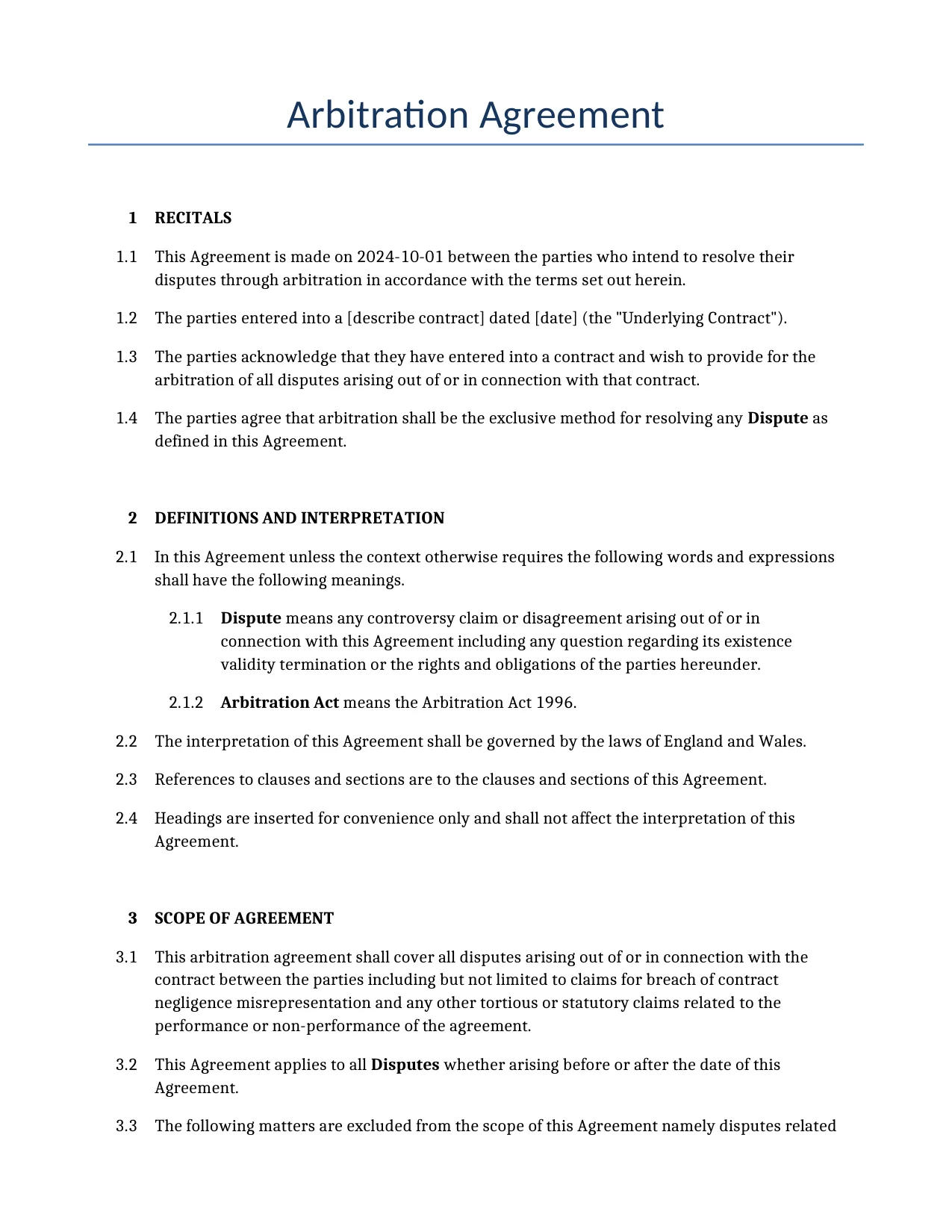
Free Example Arbitration Agreement Template

Below is a free template example of a Arbitration Agreement for use in the United Kingdom generated by our AI model.

The clauses in your actual Arbitration Agreement will vary from this example as they will be entirely bespoke to your requirements as set out in the questionnaire you complete.

Page 1

Useful Resources When Considering a Arbitration Agreement in the United Kingdom

LEGISLATION.GOV.UK
LEGISLATION.GOV.UK
LEGISLATION.GOV.UK
LEGISLATION.GOV.UK
LEGISLATION.GOV.UK
LEGISLATION.GOV.UK
LEGISLATION.GOV.UK
LEGISLATION.GOV.UK

United Kingdom Compliance Legislation

Your AI Generated Arbitration Agreement will be checked for compliance against the following legislation and regulations:
The primary legislation governing arbitration in England and Wales, including the formation, validity, and enforceability of arbitration agreements.
Regulates unfair terms in contracts, which can apply to arbitration agreements in consumer or business contracts to ensure fairness.
Provides protections against unfair terms in consumer contracts, including scrutiny of arbitration clauses in consumer agreements.
Governs the enforcement of arbitration agreements and awards with an international element; implemented in UK domestic law.
Incorporates the European Convention on Human Rights, which may influence the fairness and access to justice in arbitration agreements.

What is an Arbitration Agreement in the United Kingdom?

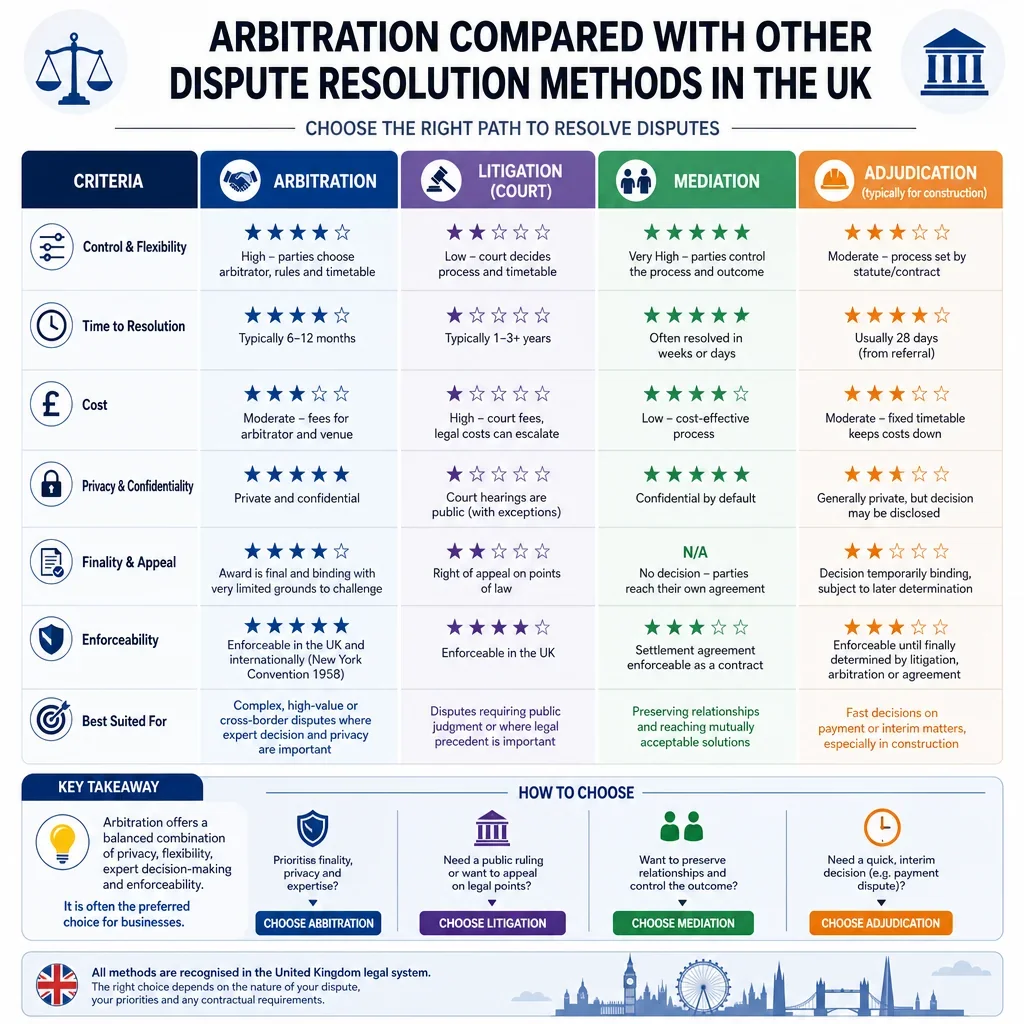
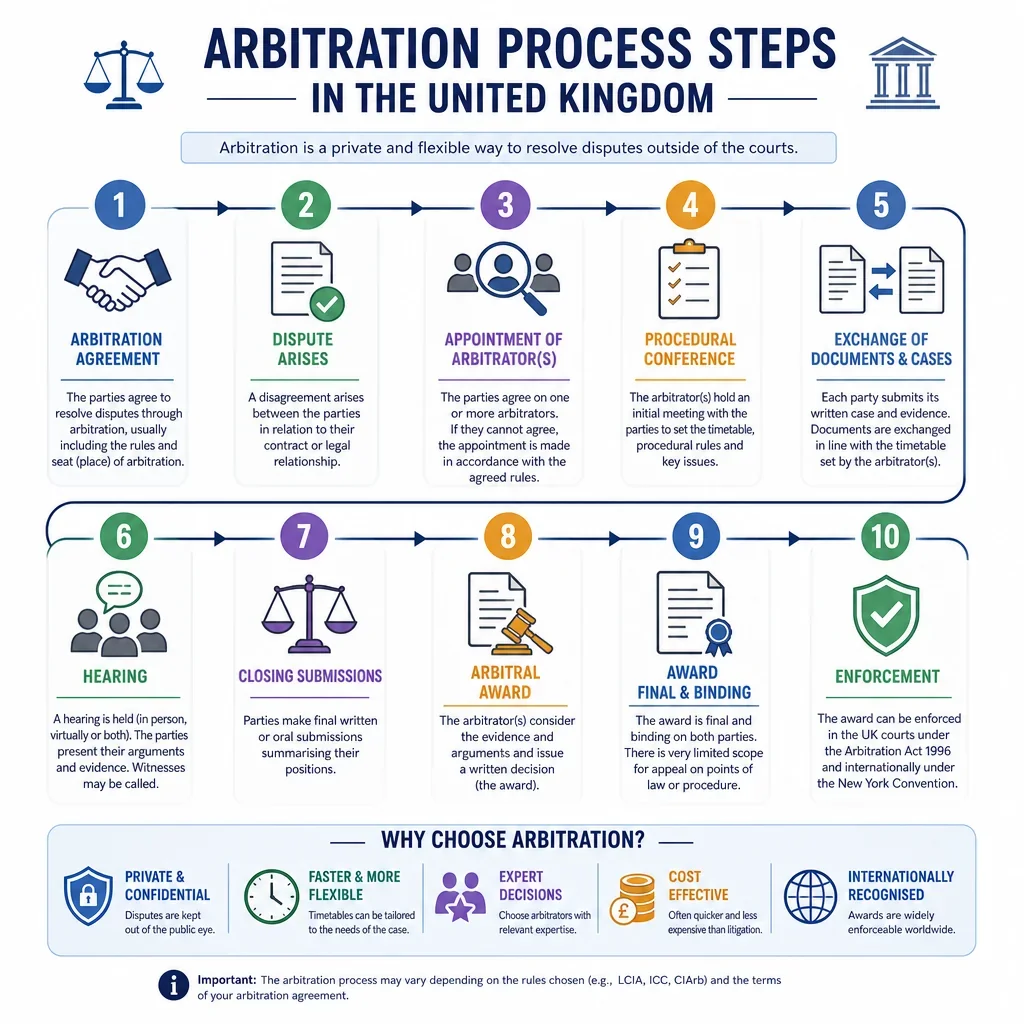
An arbitration agreement under UK law is a written pact between parties to resolve disputes through arbitration rather than court litigation. Governed primarily by the Arbitration Act 1996, this agreement defines the scope of disputes it covers and outlines the arbitration process, ensuring confidentiality and efficiency.

The primary purpose of an arbitration agreement is to provide a neutral, private alternative to traditional court proceedings, allowing parties to select arbitrators with relevant expertise and control the timeline. This mechanism promotes faster resolutions while maintaining enforceability of awards, which can be upheld internationally under frameworks like the New York Convention.

Within broader dispute resolution frameworks in the UK, arbitration fits as a key pillar alongside negotiation, mediation, and litigation, often integrated into contracts for commercial matters. For deeper insights into arbitration agreements UK, explore Understanding Arbitration Agreements in the UK: Key Elements and Benefits.

  • Key benefits include confidentiality and expert decision-making, as detailed in official guidance from the UK government at Arbitration Overview.
  • Parties are encouraged to use bespoke AI-generated legal documents via Docaro for tailored arbitration clauses, avoiding generic templates.
Section 9(1) of the Arbitration Act 1996 states: "A party to an arbitration agreement against whom proceedings are brought in respect of a matter which under the agreement is to be referred to arbitration may... apply to the court to stay the proceedings." This underscores the voluntary yet binding nature of arbitration agreements in the UK, compelling parties to honor their commitment to arbitrate disputes. For tailored legal documents that reflect this framework, consider using Docaro to generate bespoke AI-assisted agreements suited to your specific needs.

When Should You Use an Arbitration Agreement?

In commercial contracts within the UK, an arbitration agreement proves highly beneficial by enabling swift resolution of disputes through expert arbitrators who possess deep industry knowledge. This approach ensures confidentiality, protecting sensitive business information from public scrutiny, which is crucial for maintaining competitive edges in high-stakes negotiations.

For international trade involving UK parties, arbitration under agreements like those governed by the Arbitration Act 1996 offers speedier outcomes compared to lengthy court proceedings, minimizing disruptions to global supply chains. The expertise of specialized arbitrators, often drawn from international panels, ensures fair handling of cross-border complexities while upholding confidentiality to safeguard proprietary trade secrets.

In construction disputes in the UK, arbitration agreements facilitate efficient problem-solving by leveraging arbitrators with technical expertise in building standards and contracts. This method's emphasis on speed and confidentiality helps prevent project delays and public exposure of contractual flaws, allowing parties to focus on completion rather than litigation.

Businesses seeking tailored arbitration clauses should consider bespoke AI-generated legal documents via Docaro for customized protection. For authoritative guidance, refer to the UK Government's arbitration overview or the London Court of International Arbitration resources.

When Should You Avoid Using an Arbitration Agreement?

Arbitration agreements in the UK are not suitable for matters involving public policy issues, where courts must uphold societal interests. For instance, disputes related to criminal acts, fraud, or statutory rights that protect the public good cannot be arbitrated, as confirmed by the Arbitration Act 1996, ensuring judicial oversight for broader implications.

In family law matters, such as divorce, child custody, or domestic violence cases, arbitration agreements are generally inappropriate due to the need for impartial court judgments and public safeguarding. These sensitive issues require the involvement of family courts to prioritize welfare and legal protections under UK family law frameworks.

Employment disputes with inequality of bargaining power, like those involving unfair dismissal or discrimination, often render arbitration clauses unenforceable. Employees in weaker positions may face coerced agreements, so UK tribunals, as outlined by the Advisory, Conciliation and Arbitration Service (Acas), provide a fairer resolution path without such imbalances.

Court intervention is essential for injunctions in urgent situations, such as freezing assets or restraining orders, where immediate judicial action is required. Arbitration's slower process cannot replace the court's authority to grant provisional remedies swiftly, preserving legal remedies under English procedural rules.

What Are the Key Clauses in an Arbitration Agreement?

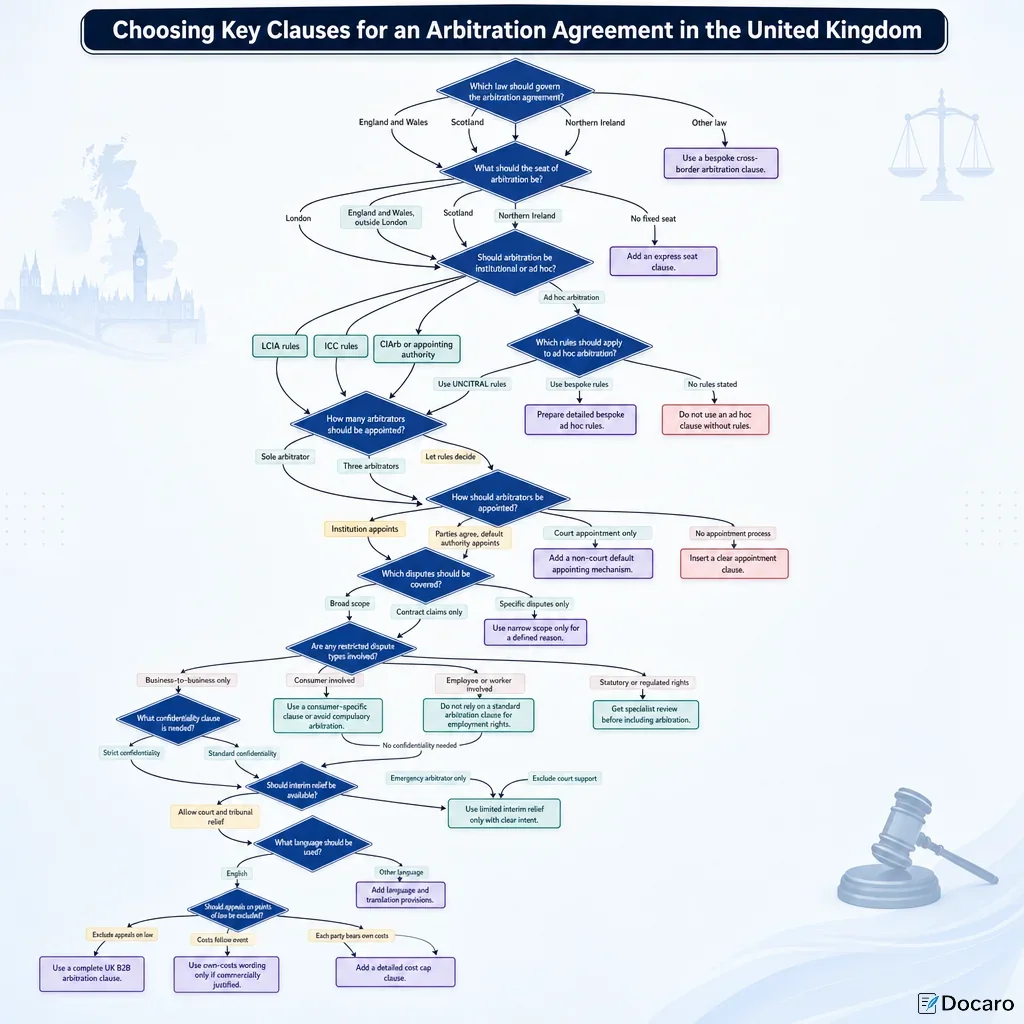
A UK arbitration agreement must clearly define the scope of disputes to ensure all intended matters, such as contractual disagreements or commercial disputes, are covered under arbitration rather than litigation. This clause should specify the types of claims excluded, like those involving criminal matters, to avoid ambiguity and promote efficient resolution.

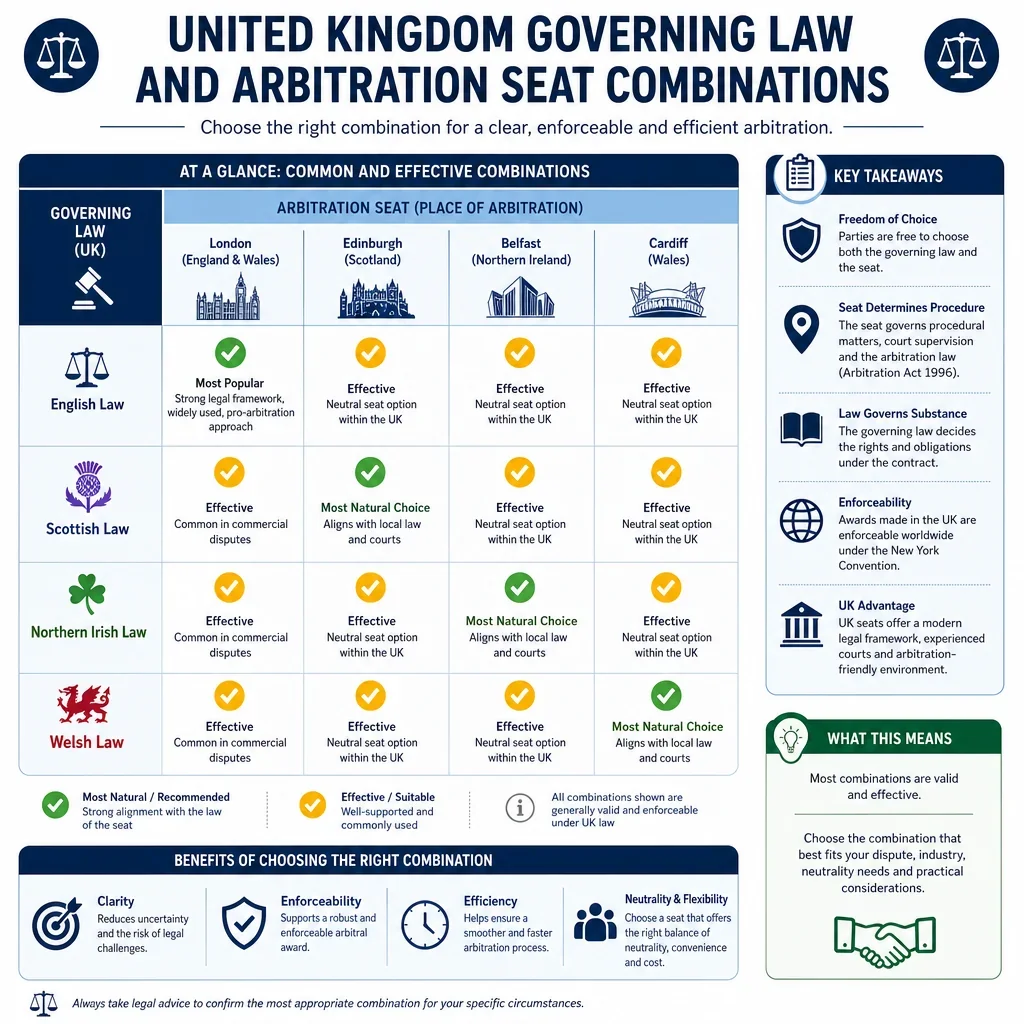
Selecting the choice of arbitral institution, such as the London Court of International Arbitration (LCIA), and designating the seat of arbitration in a UK location like London, are crucial for establishing jurisdiction and procedural rules. The governing law clause should reference English law to align with the Arbitration Act 1996, ensuring enforceability. For authoritative guidance, refer to the UK Government's arbitration overview.

The agreement should stipulate the number of arbitrators, typically one or three, to streamline the process and reduce costs. For comprehensive drafting tips, explore our resource on How to Draft an Effective Arbitration Agreement Under UK Law. Opt for bespoke AI-generated legal documents via Docaro to tailor agreements precisely to your needs.

Common Key Exclusions in Arbitration Agreements

In the UK arbitration agreements, certain matters are inherently non-arbitrable, meaning they cannot be resolved through arbitration. Criminal proceedings fall outside the scope of arbitration, as these are matters for the public courts to handle, ensuring public interest and legal enforcement are maintained.

Additionally, statutory rights such as those under employment law, consumer protection, or competition regulations may be excluded from arbitration, particularly where public policy demands judicial oversight. For instance, claims involving discrimination or antitrust issues often require court intervention to uphold broader societal protections, as outlined in the Arbitration Act 1996.

Arbitration agreements typically include provisions for interim relief from courts, allowing parties to seek urgent measures like injunctions or freezing orders directly from the judiciary. This exclusion ensures that time-sensitive remedies are not delayed by arbitration processes, balancing efficiency with access to justice.

To draft robust arbitration clauses tailored to specific needs, consider bespoke AI-generated legal documents via Docaro, which can incorporate these key exclusions effectively.

What Are the Key Rights and Obligations of Parties in Arbitration Agreements?

In a UK arbitration agreement, parties have the primary right to a fair hearing, ensuring that each side can present their case fully and equally before an impartial arbitrator. This right is enshrined in the Arbitration Act 1996, which mandates procedural fairness to uphold justice in dispute resolution.

The arbitrator bears a strict duty to act fairly and impartially, avoiding any bias or undue influence that could compromise the proceedings. Parties, in turn, must cooperate by providing relevant evidence and adhering to agreed timelines, fostering an efficient arbitration process.

Confidentiality obligations are a cornerstone of UK arbitration, protecting sensitive information disclosed during the process from public disclosure unless mutually agreed otherwise. This privacy enhances trust and is supported by the Act, making arbitration preferable for commercial disputes.

Arbitration awards in the UK are final and binding, enforceable through the courts with limited grounds for appeal, providing certainty and closure to the parties involved. For authoritative guidance, refer to the Arbitration Act 1996 on the official UK legislation website.

Are There Recent or Upcoming Legal Changes Affecting Arbitration Agreements in the UK?

The UK's Arbitration Act 1996 is set for significant updates following the 2023 Law Commission review, which recommended modernizations to strengthen London's position as a global arbitration hub. These proposed amendments aim to introduce default rules on confidentiality, clarify arbitrator immunity, and enhance summary disposal powers, with the government planning to implement them through primary legislation in the near future.

Brexit has had a mixed impact on international arbitration in the UK, removing the EU's automatic enforcement regime under the Brussels Regulation but reinforcing reliance on the New York Convention. This shift has prompted UK courts to uphold arbitration agreements more robustly, as seen in recent cases emphasizing party autonomy post-Brexit.

For the latest developments, refer to the official Law Commission report on the Arbitration Act 1996, which details the proposed reforms to confidentiality and other key areas.

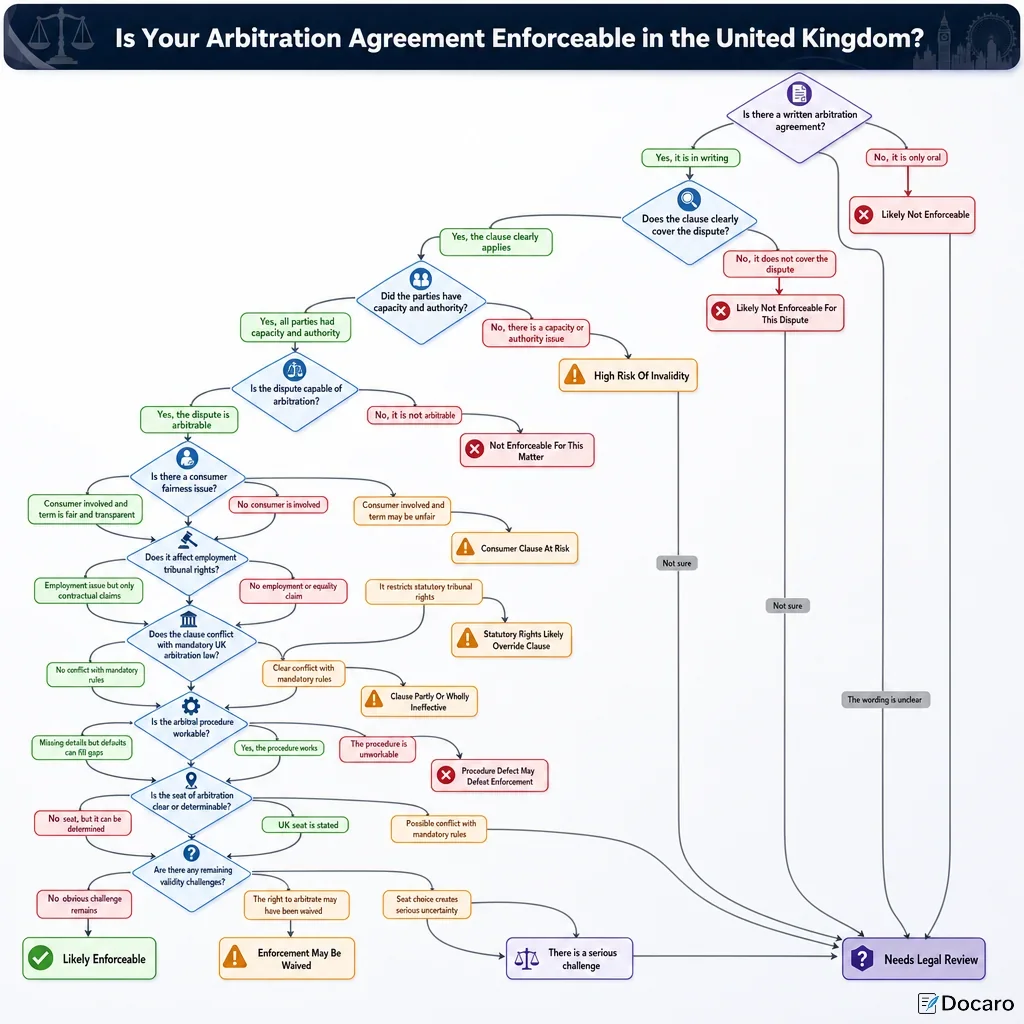
How Can You Enforce an Arbitration Agreement in the UK?

In the United Kingdom, the enforcement of arbitration agreements is primarily governed by the Arbitration Act 1996, which promotes arbitration as an effective alternative to litigation. This Act ensures that parties honour their agreement to arbitrate disputes, thereby supporting the efficiency of commercial arbitration processes.

Under section 9 of the Arbitration Act 1996, a party to an arbitration agreement can apply for a stay of court proceedings if the dispute falls within the agreement's scope. Courts must grant the stay unless the agreement is null and void, inoperative, or incapable of being performed, effectively redirecting the matter to arbitration.

The recognition and enforcement of arbitral awards in the UK follow the New York Convention, incorporated via the Arbitration Act 1996. Awards are treated as binding and enforceable in the same manner as court judgments, with limited grounds for refusal such as public policy violations; for detailed insights, see Enforcing Arbitration Agreements in the United Kingdom: Legal Insights.

  • Key enforcement steps include verifying the award's validity and applying to the court under section 66 of the Act.
  • For authoritative guidance, refer to the UK Government's resources on arbitration in the UK.
  • Parties are encouraged to use bespoke AI-generated legal documents via Docaro for tailored arbitration clauses.
1
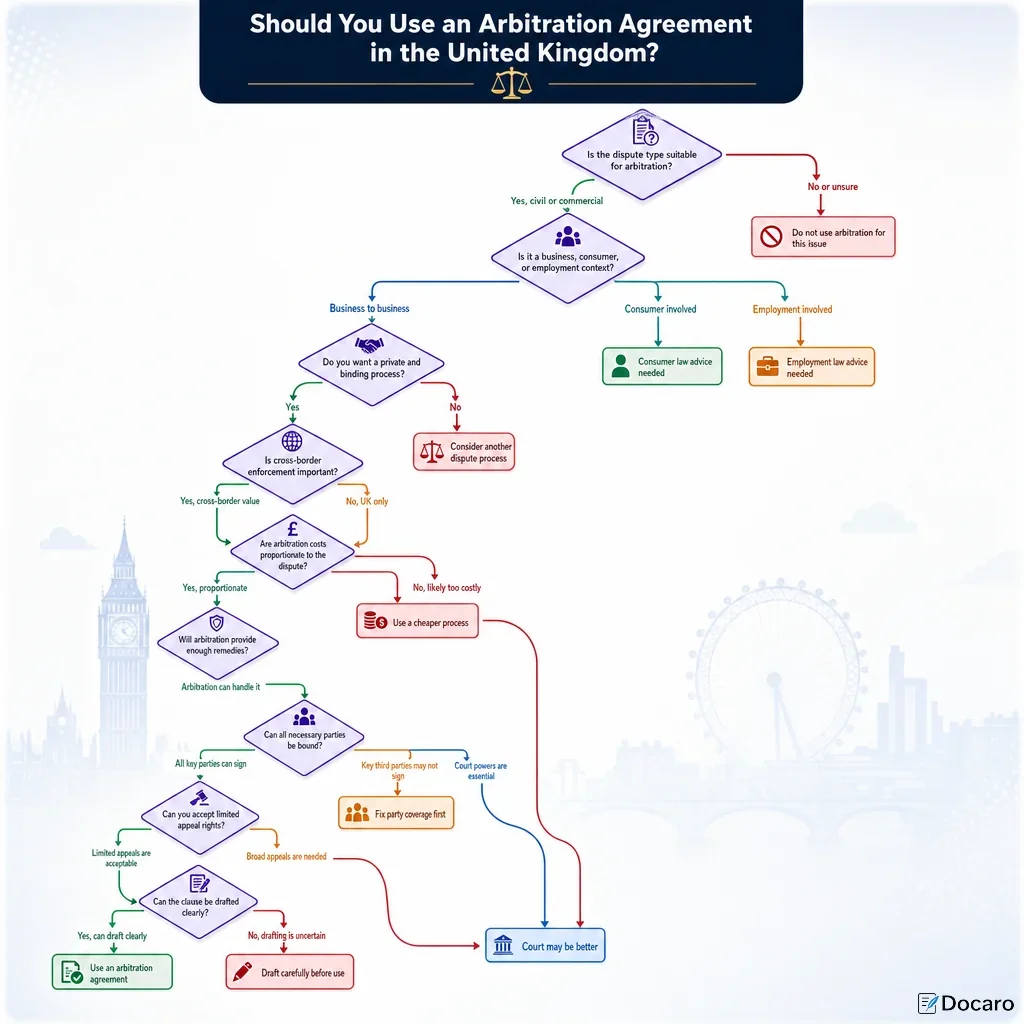
Assess Suitability
Evaluate if arbitration suits your commercial contract by considering dispute nature, parties' locations, and enforcement needs under UK law.
2
Draft Agreement
Use Docaro to generate a bespoke arbitration clause tailored to your contract, specifying rules, seat, and governing law.
3
Integrate into Contract
Incorporate the AI-generated arbitration clause seamlessly into the new commercial contract document.
4
Seek Legal Review
Consult a UK-qualified lawyer to review the contract and arbitration agreement for compliance and enforceability.

Arbitration Agreement FAQs

An arbitration agreement in the UK is a legally binding contract where parties agree to resolve disputes through arbitration rather than court litigation. Governed by the Arbitration Act 1996, it allows for a neutral arbitrator to make a binding decision, offering a private and efficient alternative to traditional courts.

Document Generation FAQs

Docaro is an AI-powered legal and corporate document generator that helps you create fully formatted, legally sound contracts and agreements in minutes. Just answer a few guided questions and download your document instantly.
You Might Also Be Interested In
A Legally Binding Contract Where Parties Agree To Resolve A Dispute And Settle Claims, Often Including Confidentiality And Non-disparagement Clauses.
A Legally Binding Contract Outlining The Terms Of A Mediation Process To Resolve Disputes Amicably.
A Formal Letter Demanding That The Recipient Stop An Alleged Illegal Activity And Refrain From Continuing It.
A Formal Letter Outlining A Grievance Or Dispute And Demanding Resolution Before Initiating Legal Proceedings.
A Legal Document In Which One Party Agrees To Release Another From Liability For Potential Risks Or Damages.
A Legal Document Where Two Parties Agree To Release Each Other From All Claims And Obligations Arising From A Prior Agreement Or Dispute.
A Formal Notice Sent To A Debtor Or Party In Dispute, Outlining The Claim And Demanding Resolution Before Initiating Legal Proceedings.
A Sworn Written Statement Used As Evidence In Court.

Related Articles

A photorealistic image of two professional adults, a man and a woman in business attire, shaking hands across a conference table in a modern UK office setting, symbolizing agreement and resolution in arbitration, with subtle UK elements like a Union Jack flag in the background, no children or legal documents visible.
Explore the essentials of arbitration agreements in the UK, including key elements, benefits over litigation, and how they provide efficient dispute resolution for businesses and individuals.
A photorealistic image representing the purpose of drafting an effective arbitration agreement under UK law, showing two professional adults in a modern conference room shaking hands after a successful negotiation, symbolizing dispute resolution and agreement, with a subtle Union Jack flag in the background to indicate UK context, no children present, highly detailed and realistic photography style.
Learn how to draft a robust arbitration agreement under UK law. This comprehensive guide covers key clauses, best practices, and legal requirements to ensure enforceable dispute resolution.
A photorealistic image representing the enforcement of arbitration agreements in the UK, showing two professional adults in a modern conference room shaking hands across a table, symbolizing agreement and resolution, with subtle UK elements like a Union Jack flag in the background, no children or documents visible.
Explore the legal framework for enforcing arbitration agreements in the United Kingdom. Gain insights into key laws, court procedures, and best practices for businesses and individuals navigating disputes.