AI Generated British Child Arrangements Order
PDF & Word - 2026 Updated
Docaro Pricing
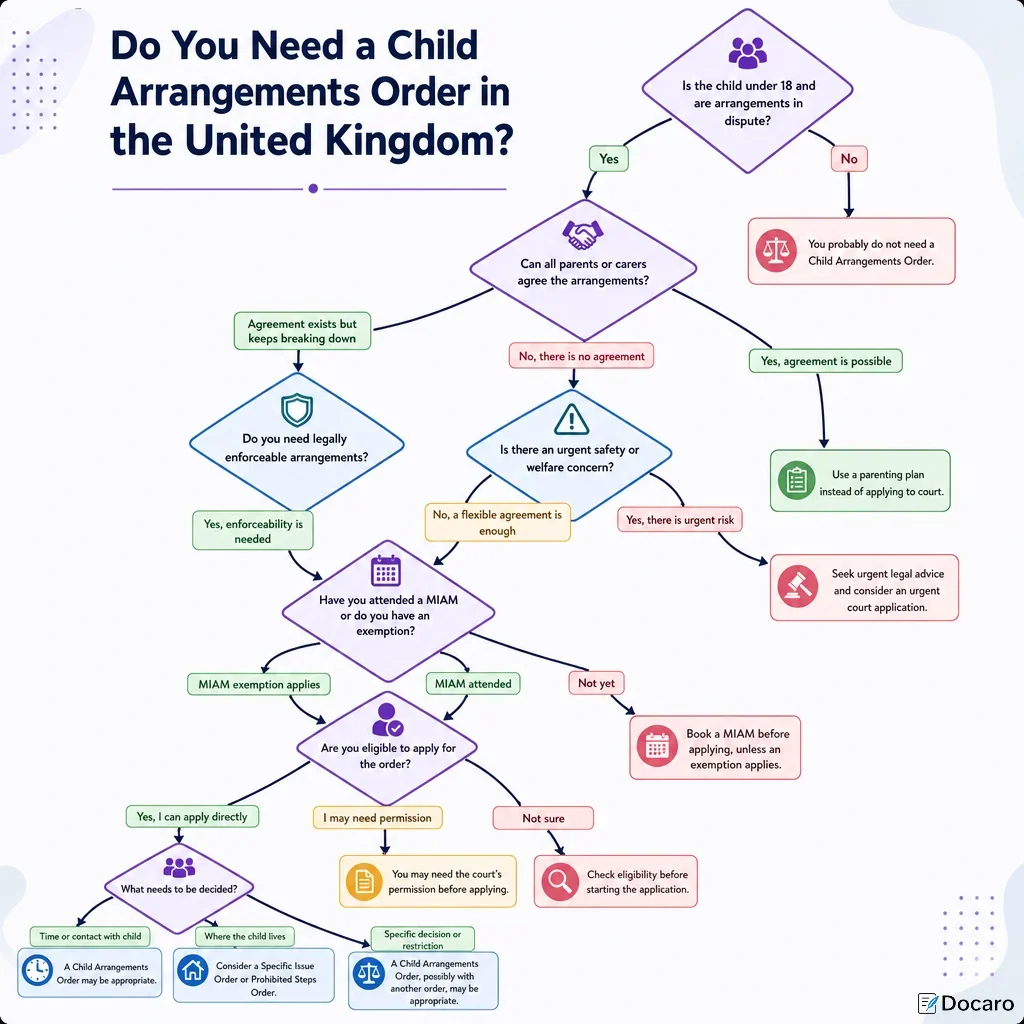
When do you need a Child Arrangements Order in the United Kingdom?
British Legal Rules for a Child Arrangements Order
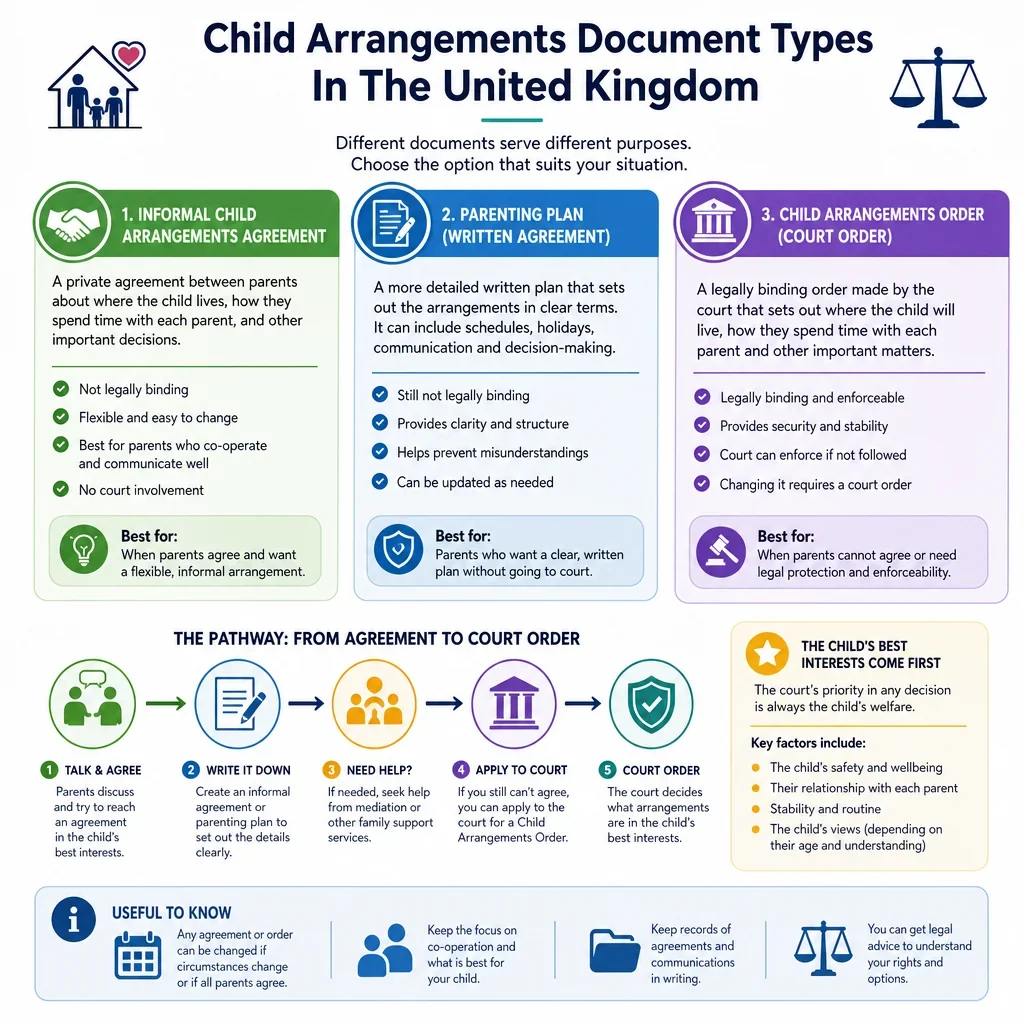
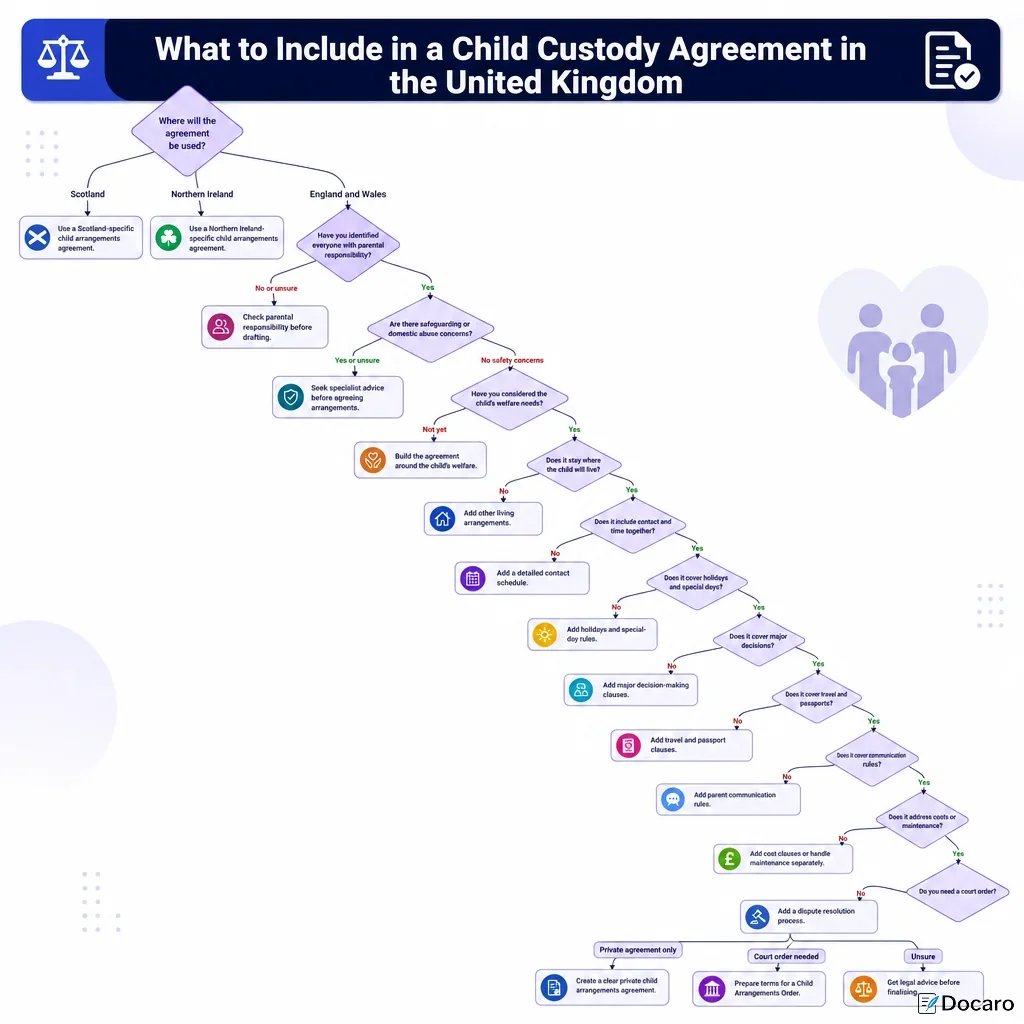
Using the wrong type of custody agreement can undermine enforceability or fail to address jurisdiction-specific requirements under UK family law.
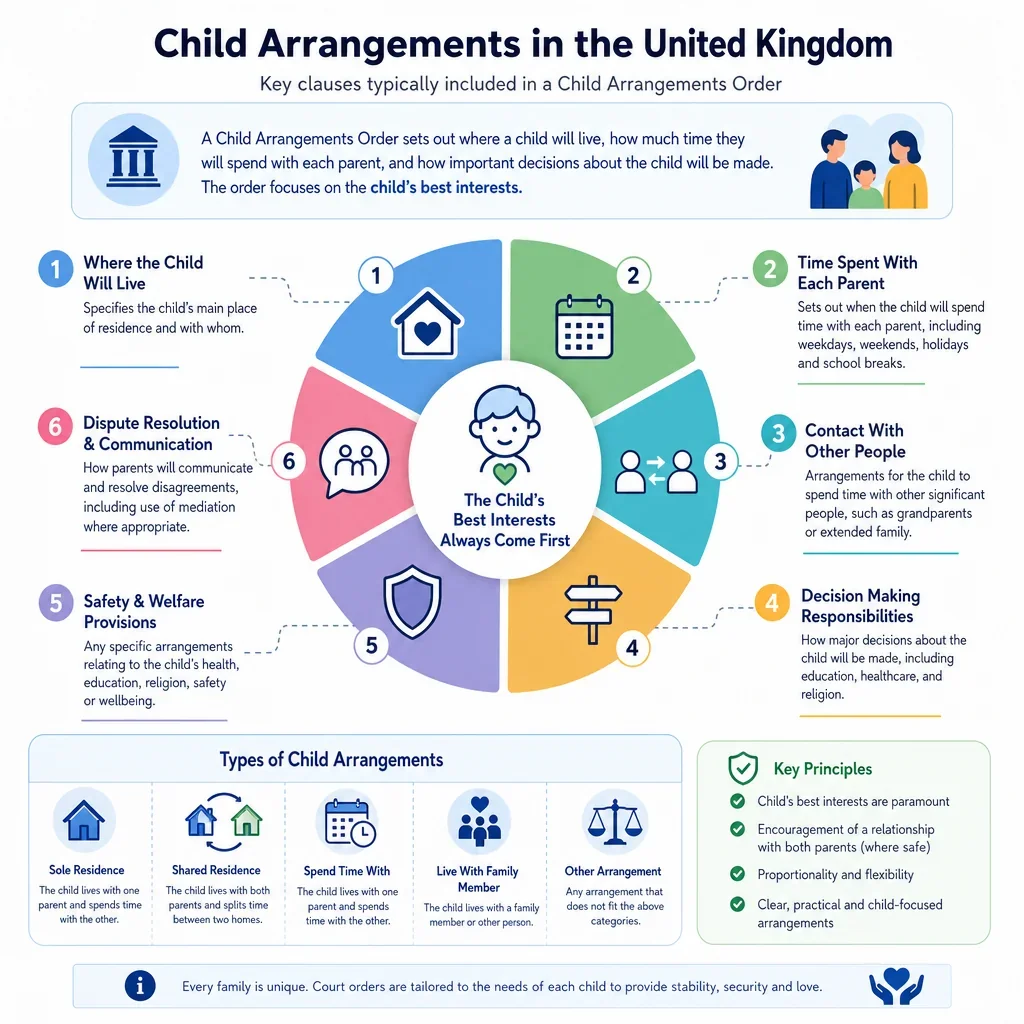
What a Proper Child Arrangements Order Should Include
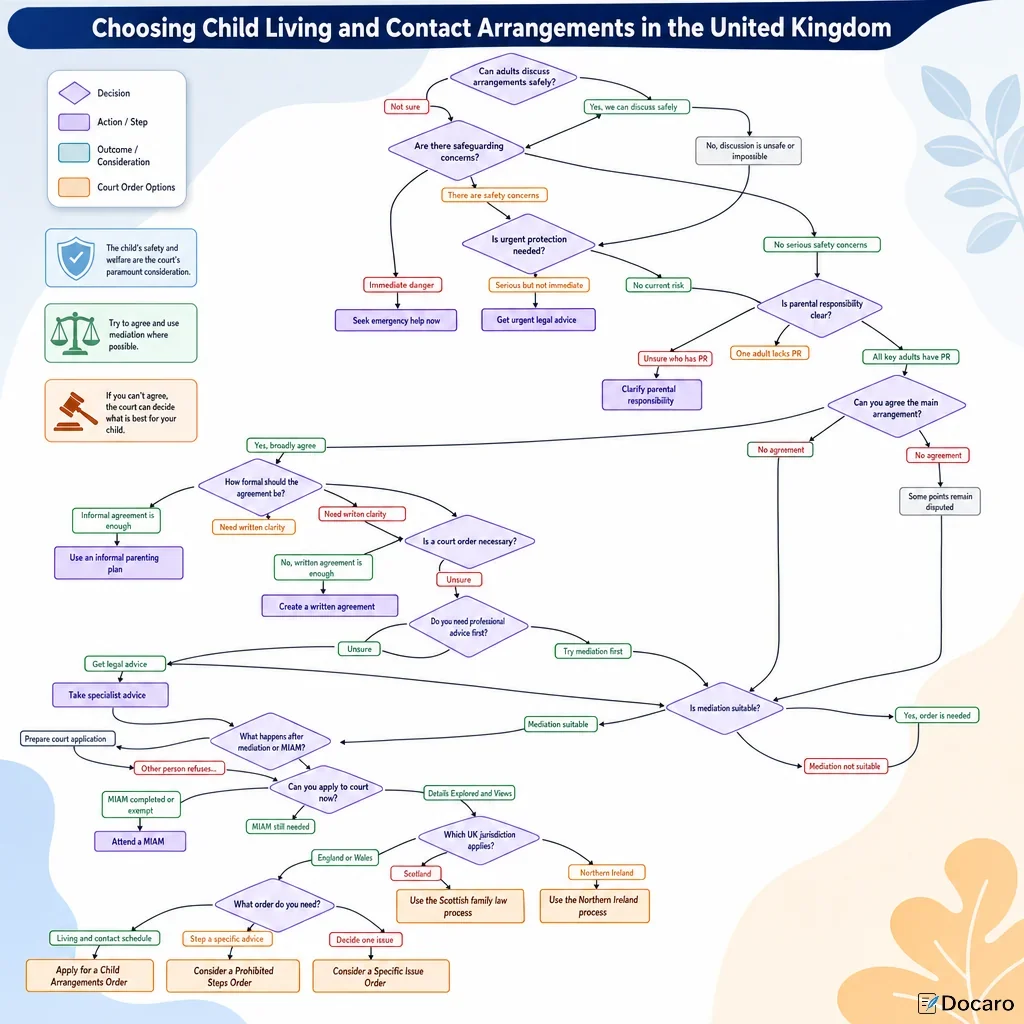
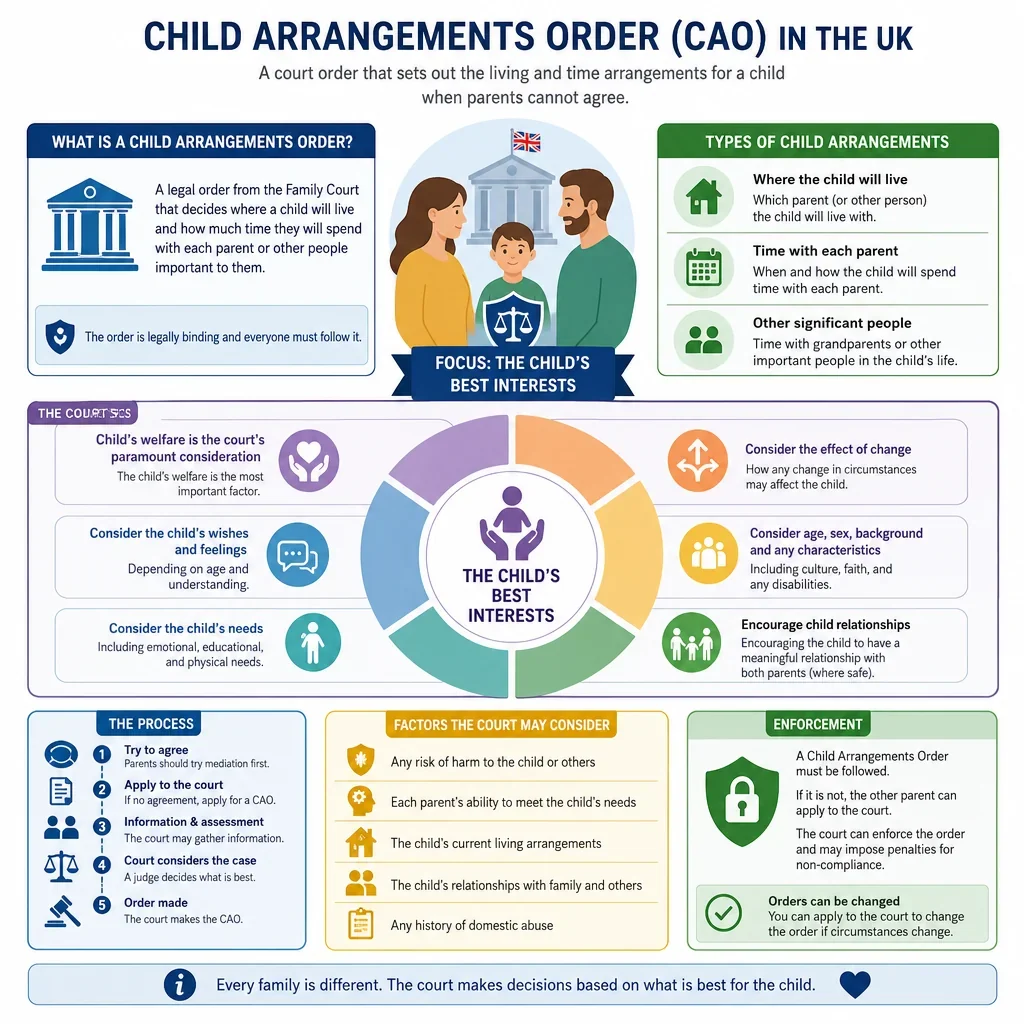
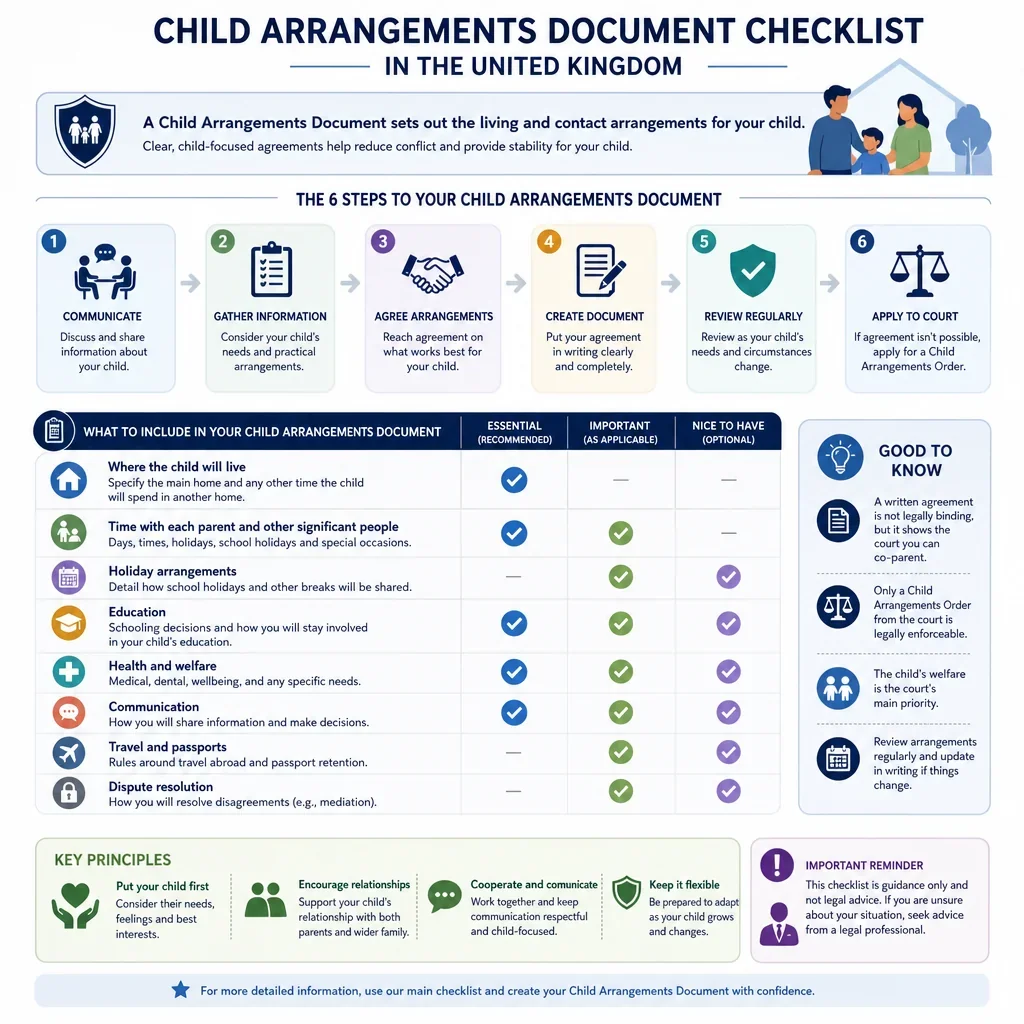
- Where the Child LivesThis specifies the child's main home and any shared living arrangements between parents or guardians.
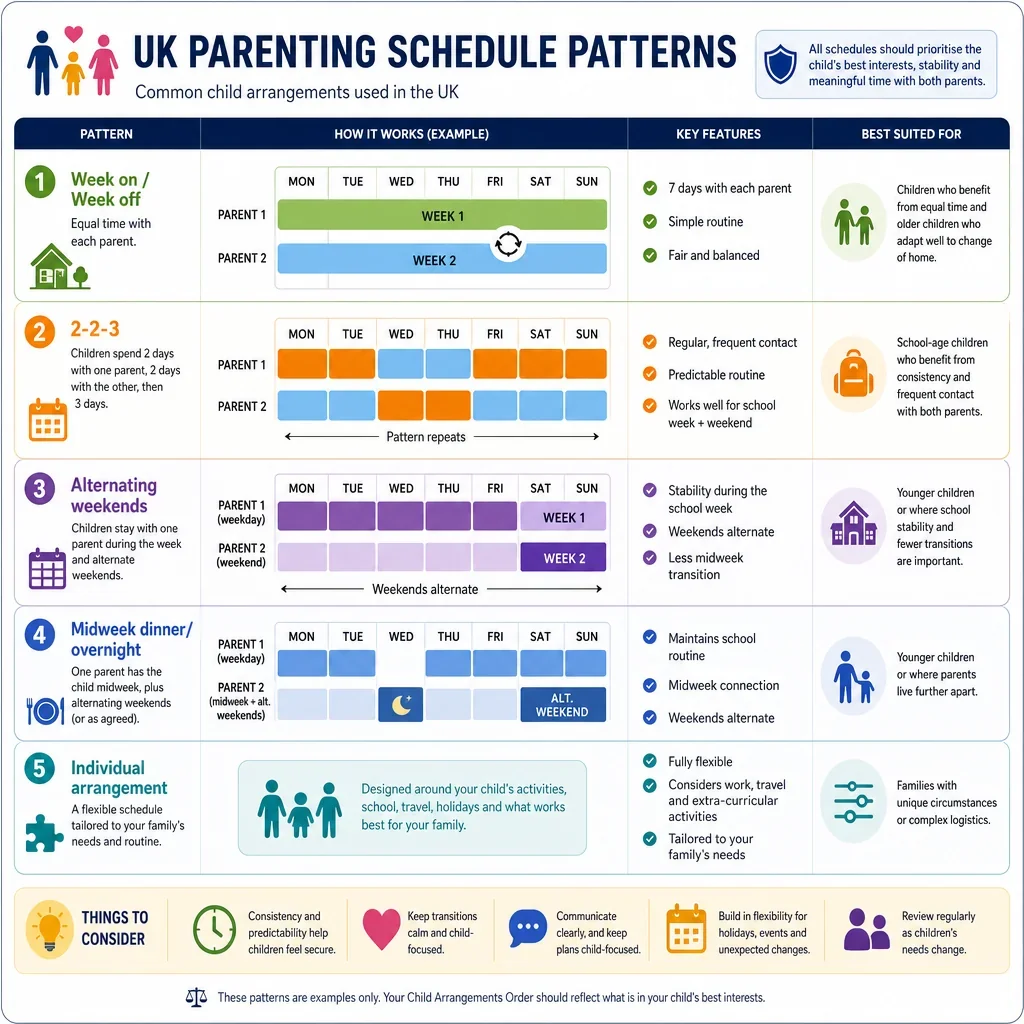
- Time Spent with Each ParentThis outlines a schedule for when the child will spend time with each parent, including weekends, holidays, and daily routines.
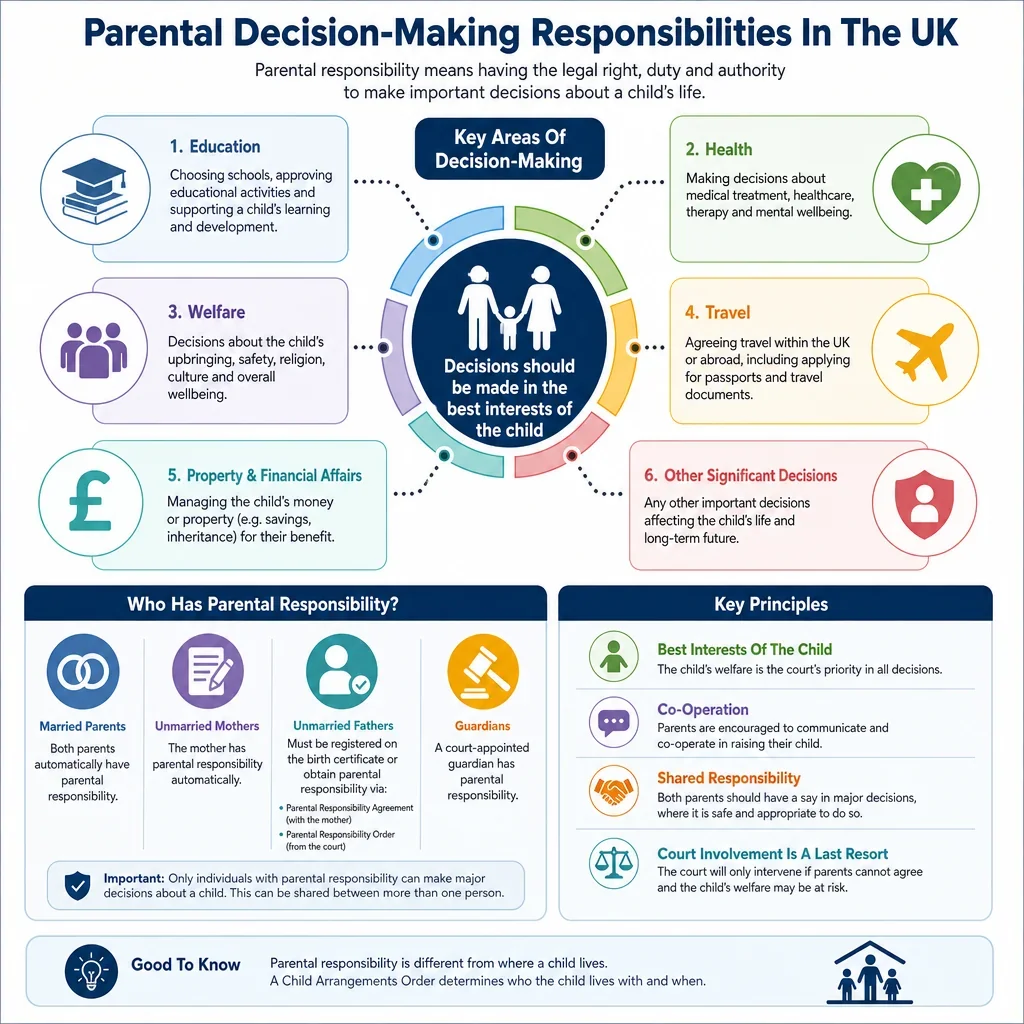
- Decision-Making ResponsibilitiesThis details how parents will jointly make important decisions about the child's education, health, and welfare.
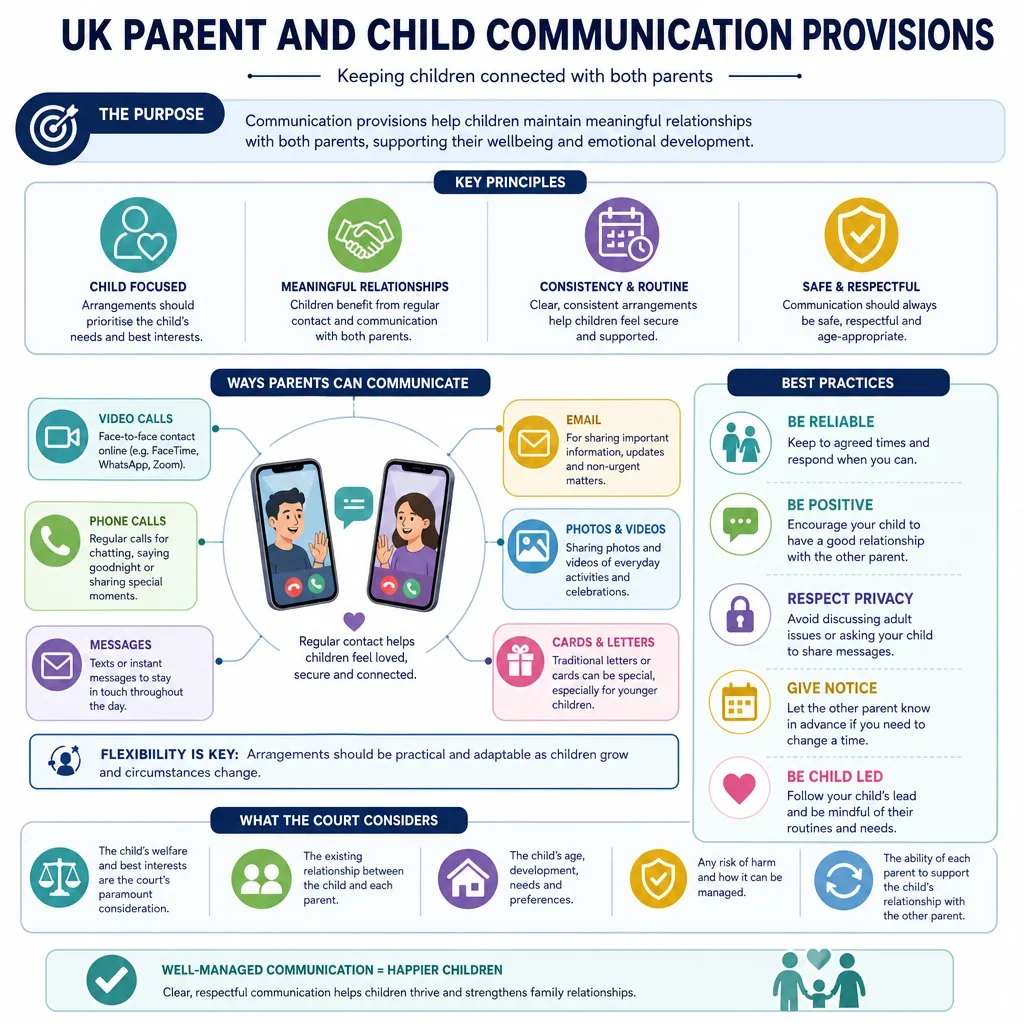
- Communication GuidelinesThis sets rules for how parents and the child will communicate, such as phone calls, video chats, or letters.
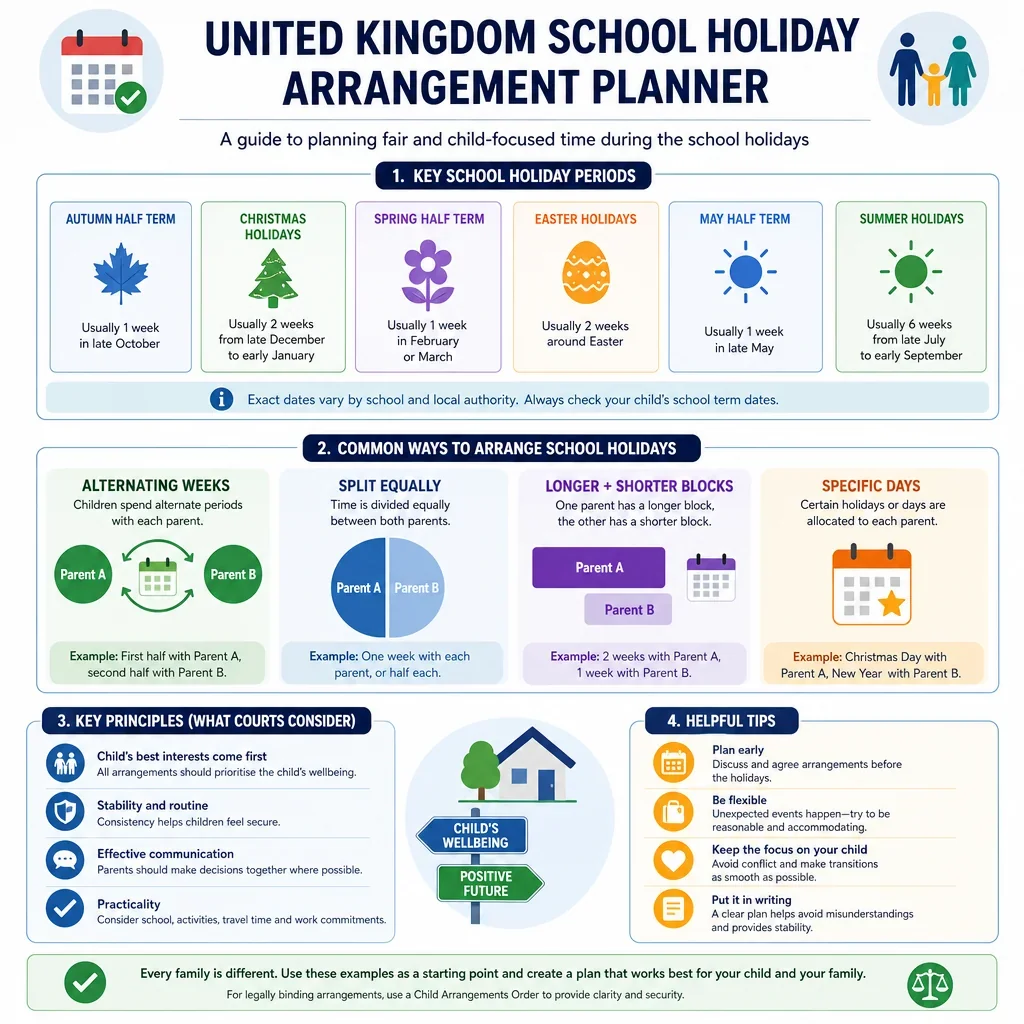
- Holiday and Special Occasion PlansThis covers arrangements for birthdays, school holidays, and other special events to ensure fair sharing.
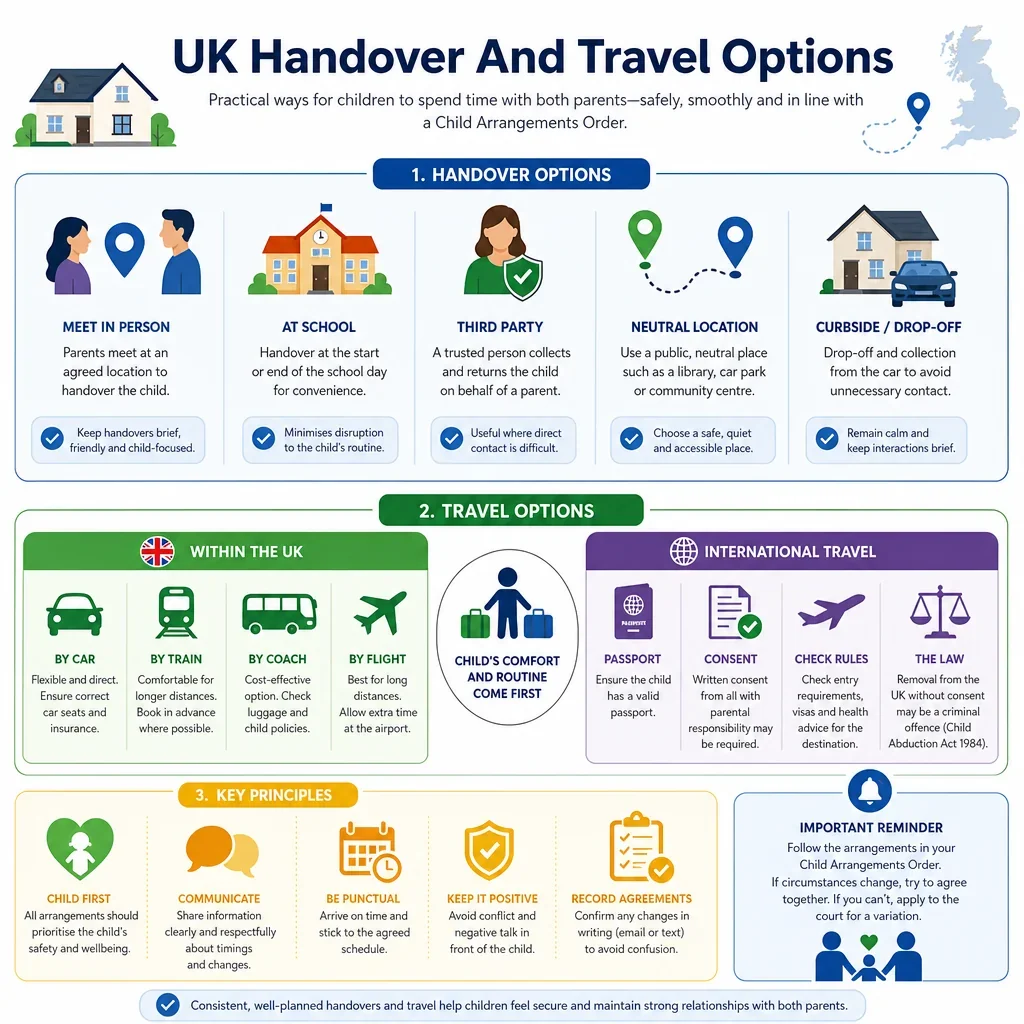
- Travel and Relocation RulesThis addresses permissions for the child to travel abroad or if a parent plans to move.
- Financial Support DetailsThis may include agreements on child maintenance payments and sharing of costs for the child's needs.
- Dispute Resolution ProcessThis provides steps for parents to resolve disagreements without returning to court, like mediation.
Generate Your Document in 4 Easy Steps
Why Use Docaro?
 United Kingdom
Free Example Child Arrangements Order Template
Below is a free template example of a Child Arrangements Order for use in the United Kingdom generated by our AI model.
The clauses in your actual Child Arrangements Order will vary from this example as they will be entirely bespoke to your requirements as set out in the questionnaire you complete.
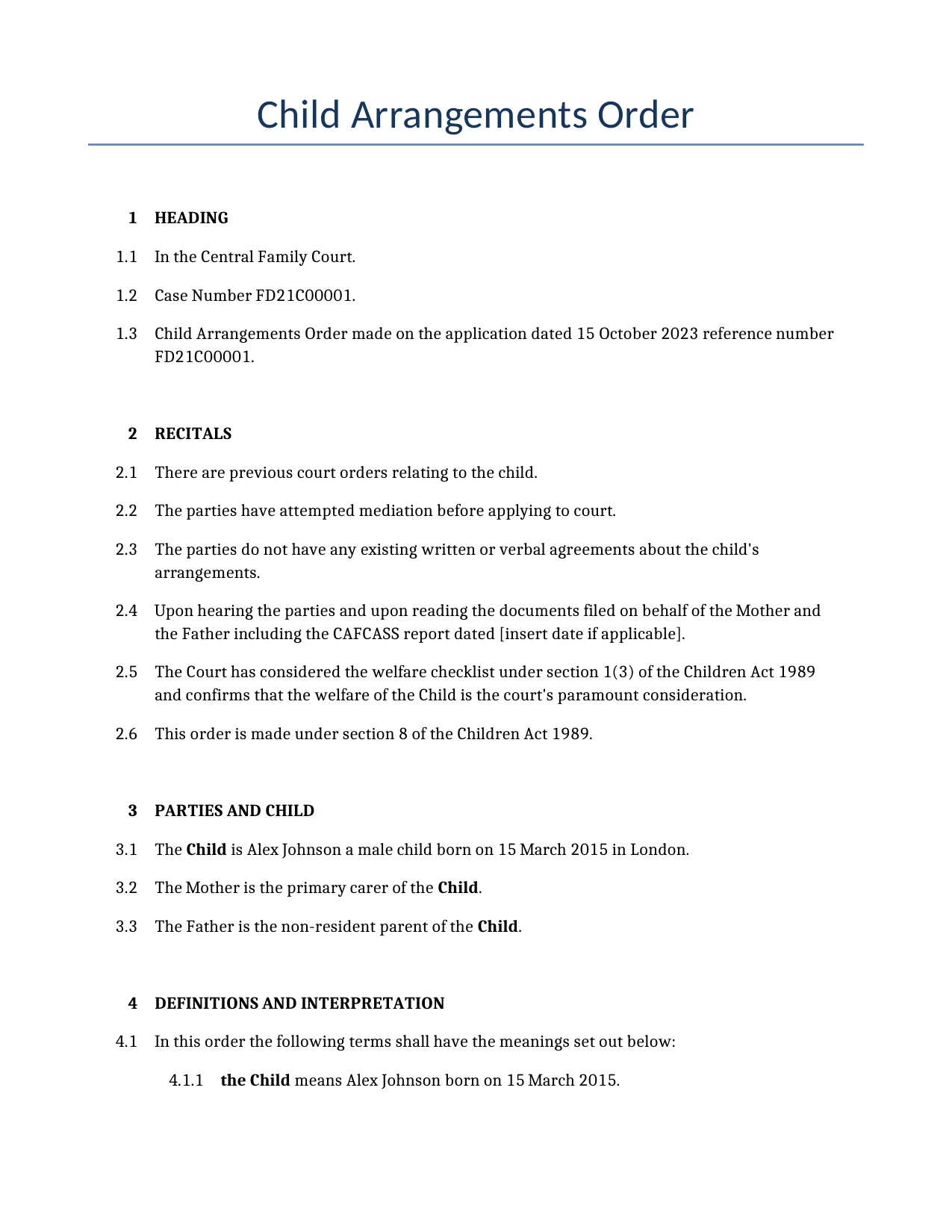
Child Arrangements Order
1HEADING
In the Central Family Court.
Case Number FD21C00001.
Child Arrangements Order made on the application dated 15 October 2023 reference number FD21C00001.
2RECITALS
There are previous court orders relating to the child.
The parties have attempted mediation before applying to court.
The parties do not have any existing written or verbal agreements about the child's arrangements.
Upon hearing the parties and upon reading the documents filed on behalf of the Mother and the Father including the CAFCASS report dated [insert date if applicable].
The Court has considered the welfare checklist under section 1(3) of the Children Act 1989 and confirms that the welfare of the Child is the court's paramount consideration.
This order is made under section 8 of the Children Act 1989.
3PARTIES AND CHILD
The Child is Alex Johnson a male child born on 15 March 2015 in London.
The Mother is the primary carer of the Child.
The Father is the non-resident parent of the Child.
4DEFINITIONS AND INTERPRETATION
In this order the following terms shall have the meanings set out below:
the Child means Alex Johnson born on 15 March 2015.
the Mother means [Mother's full name].
the Father means [Father's full name].
live with has the meaning given in section 8 of the Children Act 1989.
spend time with has the meaning given in section 8 of the Children Act 1989 and replaces the former term 'contact'.
contact refers to indirect or supervised arrangements where specified.
This order is made under the law of England and Wales and the courts of England and Wales have exclusive jurisdiction.
Headings in this order are for convenience only and do not affect the interpretation of the order.
5LIVING ARRANGEMENTS
The Child shall live with the Mother under a lives with order pursuant to section 8 of the Children Act 1989.
The Child shall spend time with the Father under a spends time with order pursuant to section 8 of the Children Act 1989.
During term time the Child shall live with the Mother from Monday to Friday and shall spend time with the Father every other weekend from Friday after school (or 3.30pm if not a school day) until Sunday at 6pm. The Father shall collect the Child from school (or the Mother's home if not a school day) and return the Child to the Mother's home.
The primary residence is the Mother's home which has two bedrooms available for the Child.
The Child shall attend the school nearest to the Mother's home.
The parties shall share transport responsibilities for the Child to attend school.
6CONTACT ARRANGEMENTS
The Child shall spend time with the Father (which may include the paternal grandparents by agreement) every Saturday from 10am until 2pm and every Sunday from 10am until 2pm.
The Father shall collect the Child from the Mother's home at the start of contact and return the Child to the Mother's home at the end of contact.
In addition to the above the parties shall have reasonable contact (including indirect contact by telephone or video call) at other times by agreement.
All contact shall be unsupervised unless otherwise agreed or ordered by the court.
The contact arrangements shall commence on 1 January 2024.
7HOLIDAY AND SPECIAL OCCASION CONTACT
The parties shall divide each school holiday period equally with the Child spending the first half with the Mother and the second half with the Father in even numbered years and vice versa in odd numbered years (with the changeover taking place at 12 noon on the middle day of the holiday period).
Christmas shall be spent with the Mother in even numbered years (from 12 noon on 24 December until 12 noon on 27 December) and with the Father in odd numbered years (from 12 noon on 27 December until 12 noon on 30 December).
Easter shall be spent with the Mother in even numbered years and with the Father in odd numbered years (from 12 noon on Good Friday until 12 noon on Easter Monday).
The Child's birthday shall be spent with the Mother in even numbered years and with the Father in odd numbered years (from 9am until 5pm). The non-resident parent shall have a video call with the Child on the birthday in the other years.
Mother's Day shall be spent with the Mother and Father's Day shall be spent with the Father.
For international travel during any holiday period the travelling parent must obtain the written consent of the other parent at least 28 days in advance. The Child's passport shall be provided to the travelling parent at least 7 days before departure and returned within 7 days of return. The travelling parent shall provide full itinerary details including flight numbers accommodation address and emergency contact details at least 14 days before travel.
8SCHOOL AND MEDICAL ARRANGEMENTS
Both parents have parental responsibility for the Child.
The Child currently attends St. Mary's Primary School at 123 Oak Street London SW1A 1AA. Both parents shall have access to school records reports and events. Major decisions about the Child's education (including choice of school) require the agreement of both parents or an order of the court.
Both parents shall have access to the Child's medical records. Joint consent of both parents is required for all non-emergency medical treatments. In the event of an emergency either parent may consent to necessary medical treatment and must notify the other parent as soon as practicable.
The Child has asthma and a peanut allergy. Both parents shall notify each other immediately of any medical appointments illnesses or changes in the Child's health or education by telephone and by email or text within 24 hours.
9PROHIBITED STEPS
Neither parent shall use or permit the use of physical chastisement on the Child.
Neither parent shall expose the Child to inappropriate adults criminal activity alcohol abuse or illegal substances.
Neither parent shall change the Child's name or surname without the written consent of the other parent or an order of the court.
Neither parent shall remove the Child from their current school without the written agreement of the other parent or an order of the court.
The Father is prohibited from changing the Child's primary residence without the written consent of the Mother or an order of the court.
The Father is prohibited from taking the Child out of the United Kingdom without the written consent of the Mother or an order of the court (save as provided in the holiday section above).
Nothing in this order shall permit a local authority to accommodate the Child under section 20 of the Children Act 1989 without the written consent of both parents pursuant to section 2(8) of the Children Act 1989.
10COMMUNICATION PROVISIONS
Parent-to-parent communication shall be conducted respectfully via email or the OurFamilyWizard app. The parties shall not discuss court proceedings the other parent's conduct or any adult issues in the presence of or with the Child.
Parent-to-child communication shall be by telephone or video call. During such calls the parties shall not discuss court proceedings adult issues or make negative comments about the other parent.
Such communication shall occur at least weekly at reasonable times by agreement.
For emergencies either parent may contact the other by telephone at any time.
The communication provisions shall commence on 1 January 2024.
11TRANSPORT AND HANDOVER
Handovers shall take place at the McDonald's car park at 456 High Street London SW1A 2BB.
The collecting parent shall arrive no later than 10 minutes before the scheduled time. If a party is more than 15 minutes late without prior notice the waiting parent may return home and the contact shall be deemed cancelled with make-up time to be agreed.
The parent with whom the Child is living at the start of the handover is responsible for ensuring the Child is ready with all necessary belongings.
All transport shall use a vehicle with appropriate child car seats and seatbelts in accordance with UK law. Both parents shall ensure the Child is transported safely.
Each parent shall bear their own transport costs unless otherwise agreed.
The transport and handover arrangements shall commence on 15 January 2024.
12INFORMATION SHARING
Both parents shall promptly share school reports end of term updates medical records and any information about events affecting the Child's welfare (including significant health education or emotional issues).
The preferred method for sharing information is via the OurFamilyWizard app. All communications shall comply with UK GDPR and the Data Protection Act 2018.
The information sharing obligations shall continue until the Child turns 18 or further order.
13ENFORCEMENT AND VARIATION
All parties must comply with the terms of this order. Breach of this order may result in contempt of court proceedings.
In the event of non-compliance the court may make an enforcement order under section 11J of the Children Act 1989 (including an order for unpaid work) a compensation order for financial loss caused by the breach or such other order as the court considers appropriate. Referral to mediation may also be considered.
The terms of this order may be varied by a subsequent application to the court. The parties should first attempt mediation unless exempt.
14DURATION AND REVIEW
This order shall remain in force until the Child reaches 18 years of age or until further order of the court whichever is sooner.
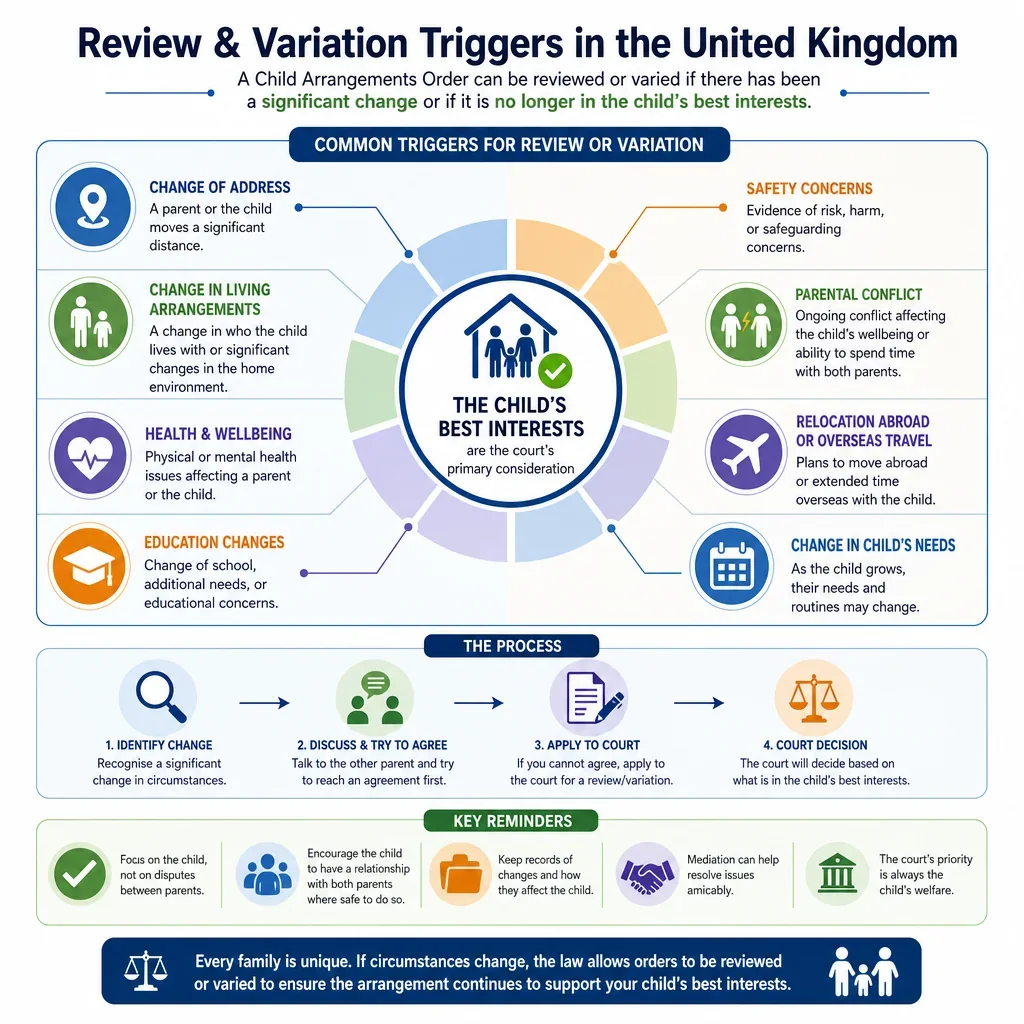
The order shall be reviewed in 12 months from the date of this order or earlier if there is a significant change in circumstances.
This order shall automatically terminate if the Child takes up residence with another person or upon any order of the court varying or discharging it.
15PARENTAL RESPONSIBILITY
Both the Mother and the Father have parental responsibility for the Child under section 2 of the Children Act 1989.
Each parent shall exercise parental responsibility in consultation with the other and in accordance with the terms of this order.
The following decisions require the joint agreement of both parents: change of the Child's name religion major medical treatment (except in emergencies) overseas travel (except as provided in this order) and change of school.
16GENERAL PROVISIONS
The welfare of the Child is the paramount consideration in all decisions made under this order in accordance with section 1 of the Children Act 1989 the Human Rights Act 1998 and all other relevant legislation.
This order is made in compliance with the Children Act 1989 the Family Procedure Rules 2010 and the Child Arrangements Programme. Any reference to other legislation in previous drafts is corrected accordingly.
This order is governed by the law of England and Wales.
This order shall be served on both parents and any other relevant parties as directed by the court.
A penal notice is attached to this order: You must obey the terms of this order. If you do not obey this order you may be held in contempt of court and imprisoned or fined or your assets may be seized.
No order for costs.
Any notice required under this order shall be given in writing and delivered by hand or sent by first class post or by email to the last known address of the relevant party.
No variation of this order shall be effective unless it is made by a subsequent order of the court.
17SIGNATURES
Signed by the Mother: ___________________________ Date: ______________
Signed by the Father: ___________________________ Date: ______________
Approved by the Court: ___________________________ Date: ______________
18COURT ORDER
It is ordered that:
The Child shall live with the Mother and spend time with the Father in accordance with the living arrangements set out in section 5 above.
Contact arrangements shall be as set out in sections 6 and 7 above.
School and medical arrangements shall be as set out in section 8 above.
The prohibited steps in section 9 above shall apply.
Communication transport handover information sharing and all other provisions in this order shall be complied with.
Upon hearing the parties and upon reading the documents filed. The Court has considered the welfare of the Child as paramount under the Children Act 1989.
Dated this [insert date] day of [insert month] 2024.
HHJ [Insert Judge's Name] Central Family Court.
This example shows approximately 70% of a typical document and is provided for illustrative purposes only. The remaining content has been omitted.
Every document generated by Docaro is tailored to your specific circumstances, jurisdiction and the information you provide. The completed document includes all applicable clauses and provisions required for your situation.
To generate the full, personalised document, answer a short series of questions and your document will be created instantly.
Useful Resources When Considering a Child Arrangements Order in the United Kingdom
United Kingdom Reference Legislation
Child Arrangements Order FAQs
Document Generation FAQs
Related Articles