AI Generated British Waiver of Liability
PDF & Word - 2026 Updated
Docaro Pricing
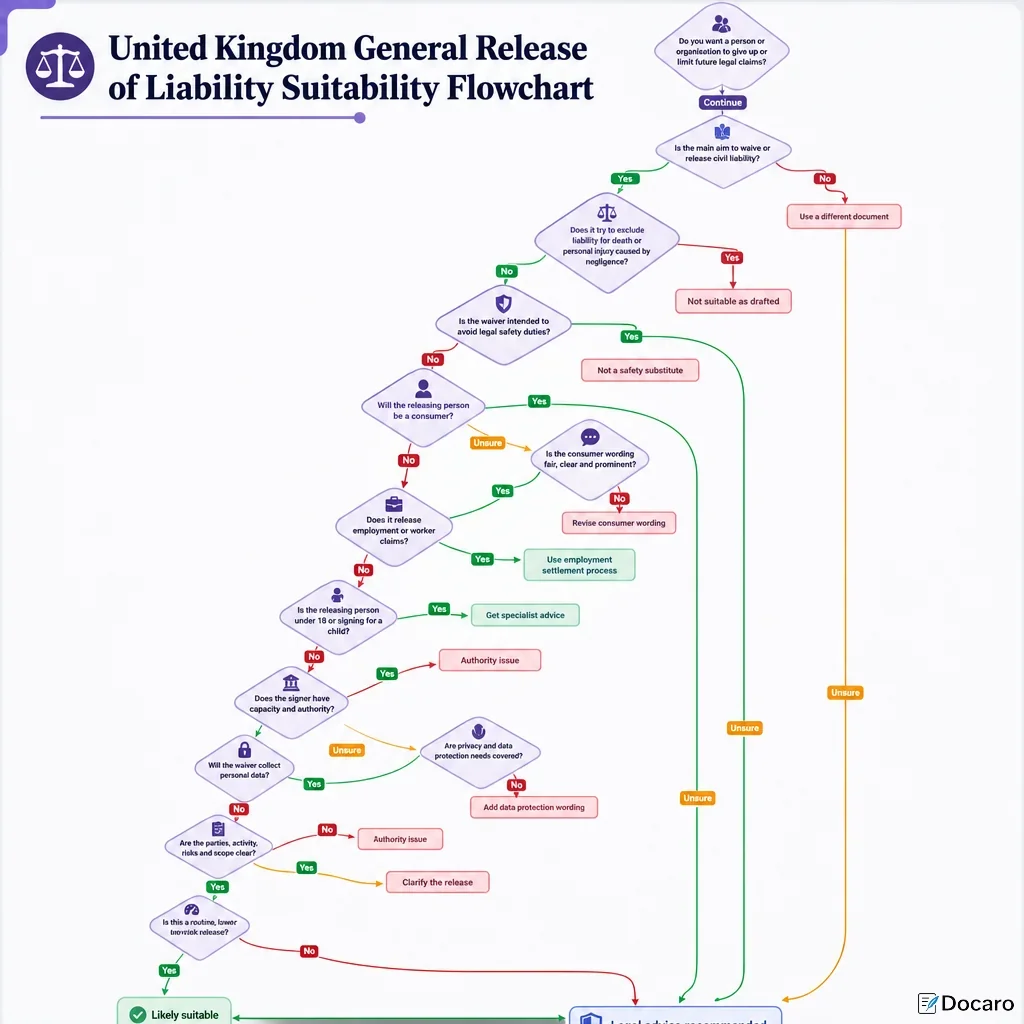
When do you need a Waiver of Liability in the United Kingdom?
British Legal Rules for a Waiver of Liability
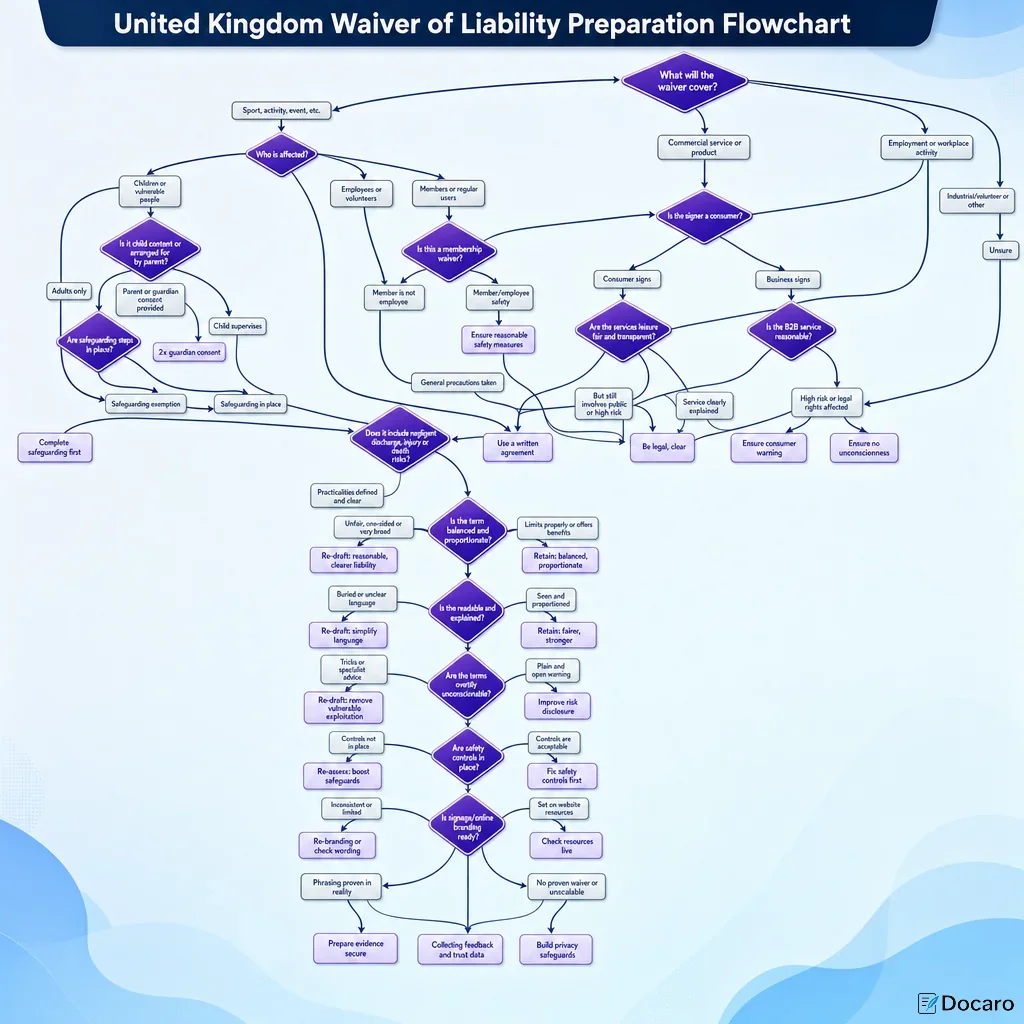
Using an incorrect structure for a release of liability may fail to adequately protect against specific claims or render the agreement unenforceable under UK law.
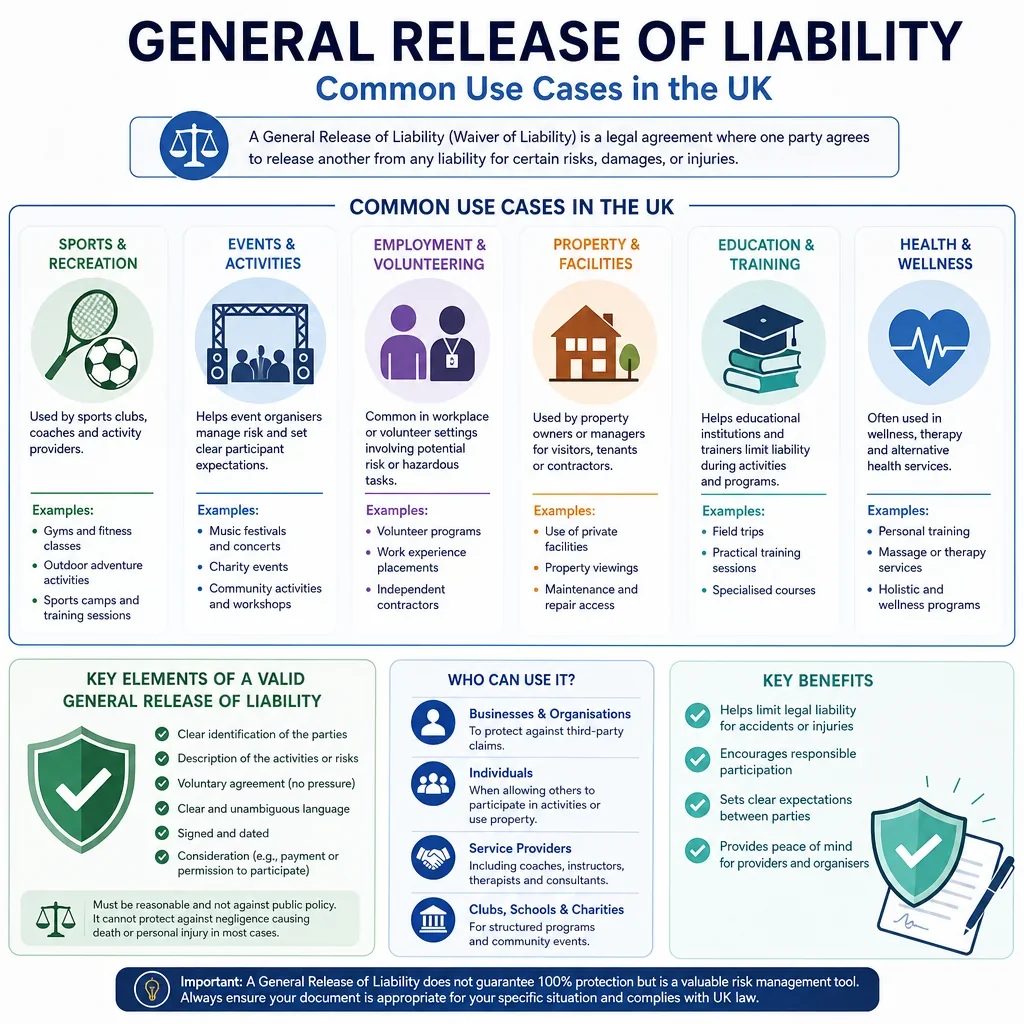
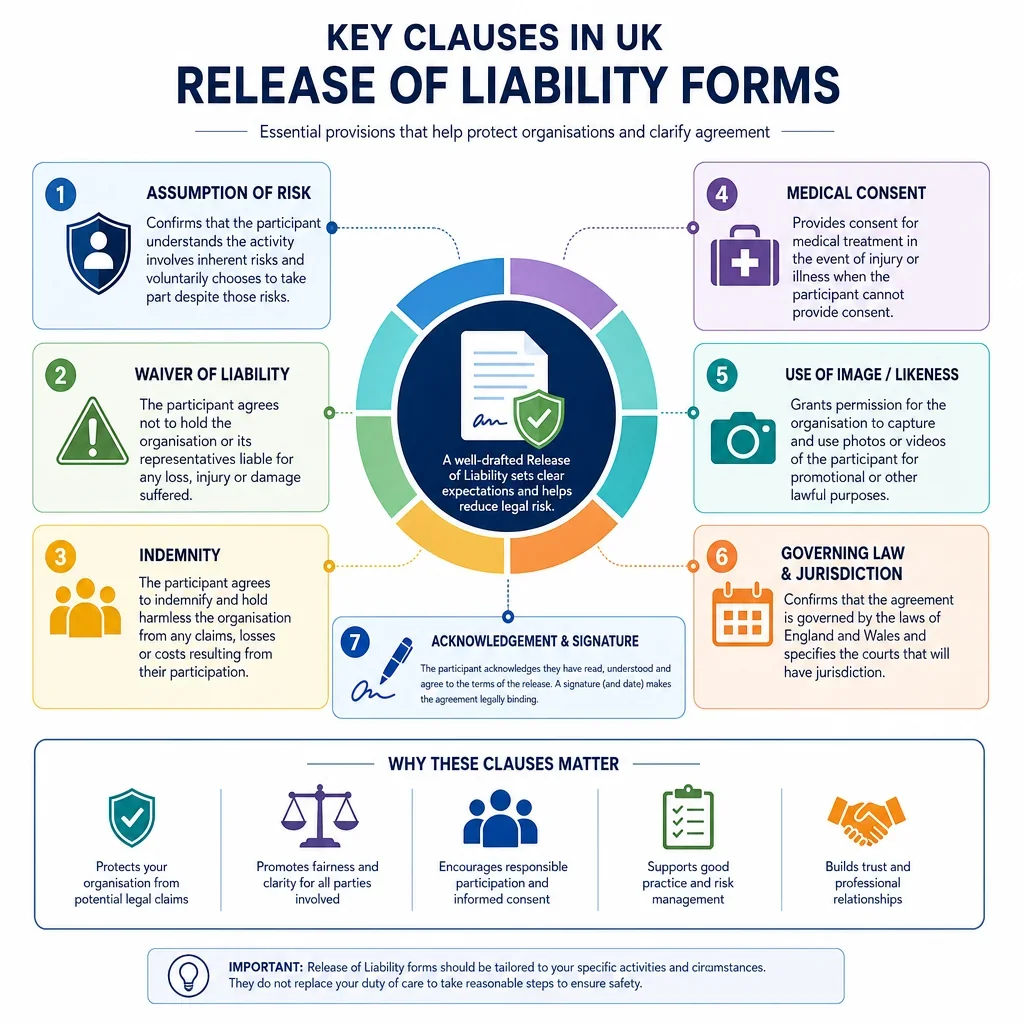
What a Proper Waiver of Liability Should Include
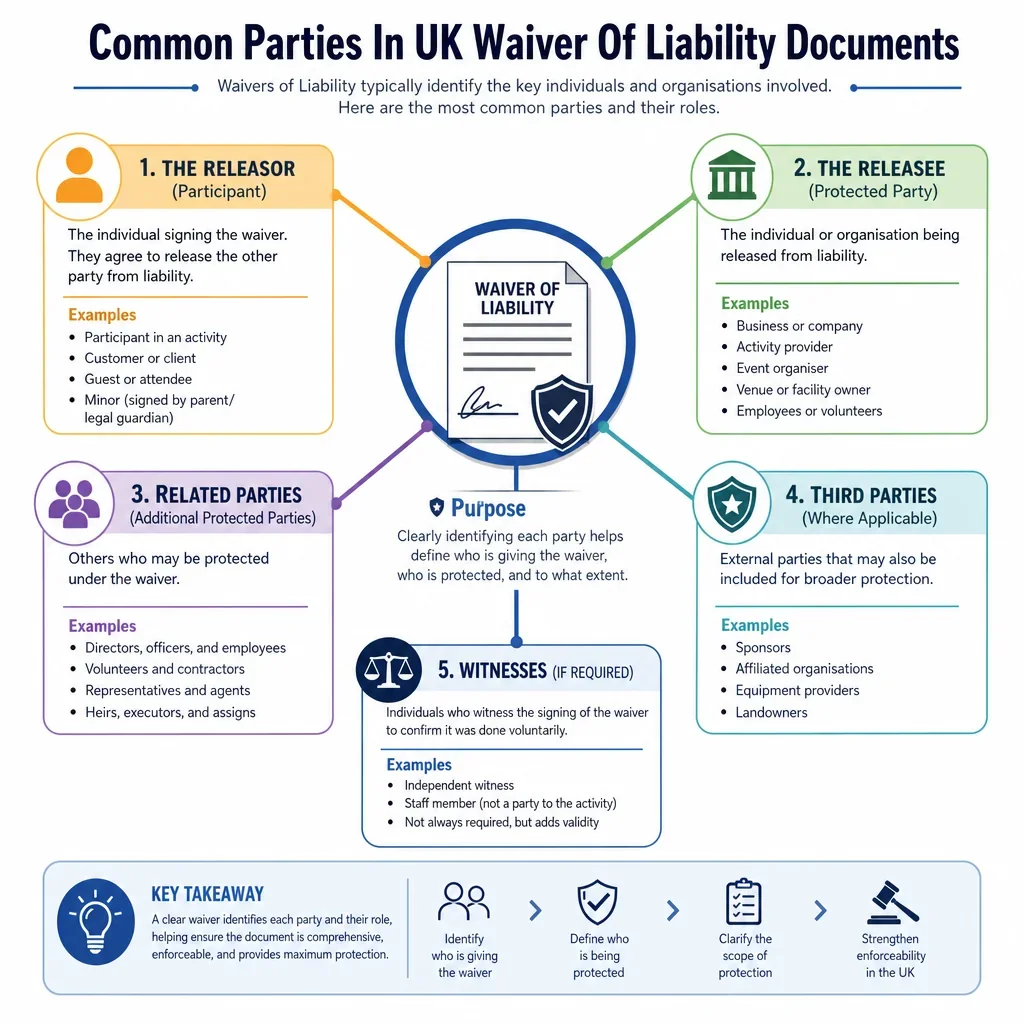
- Clear Identification of PartiesState the full names and roles of the person or organization releasing claims and the one being protected from liability.
- Description of the ActivityBriefly outline the specific event, sport, or situation where the waiver applies to avoid any confusion.
- Acknowledgment of RisksExplain that the signer understands the potential dangers involved and accepts them voluntarily.
- Release of ClaimsDeclare that the signer will not hold the protected party responsible for any injuries or losses that occur.
- Assumption of ResponsibilityConfirm that the signer takes full responsibility for their own safety and any resulting damages.
- Signature and DateRequire the signer's handwritten or electronic signature along with the date to make the waiver legally binding.
- Governing Law StatementSpecify that the waiver is governed by the laws of England and Wales to clarify its legal framework.
Generate Your Document in 4 Easy Steps
Why Use Docaro?
 United Kingdom
Free Example Waiver of Liability Template
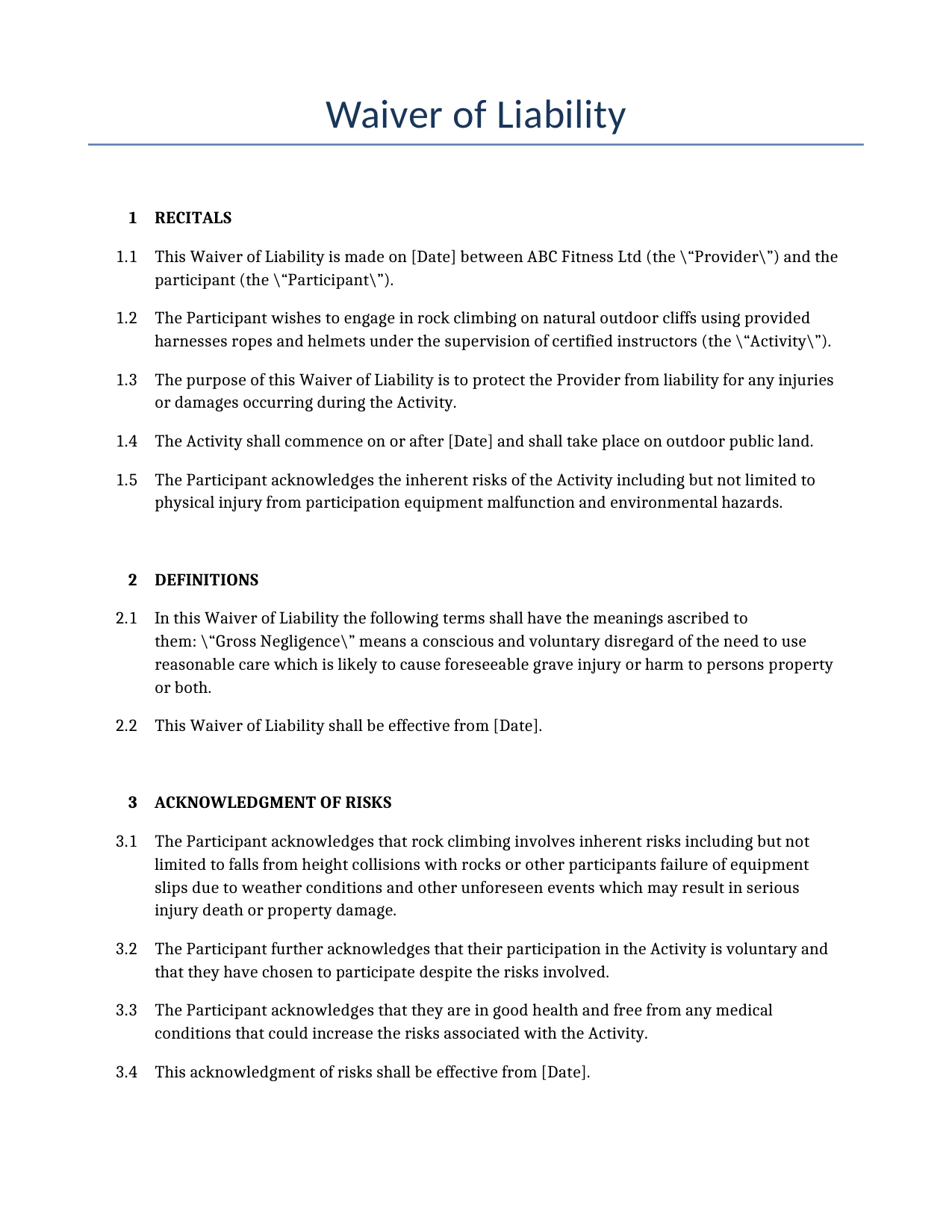
Below is a free template example of a Waiver of Liability for use in the United Kingdom generated by our AI model.
The clauses in your actual Waiver of Liability will vary from this example as they will be entirely bespoke to your requirements as set out in the questionnaire you complete.
Adventure Sports Waiver of Liability
1RECITALS
This Waiver of Liability is made on [Date] between ABC Fitness Ltd (the \“Provider\”) and the participant (the \“Participant\”).
The Participant wishes to engage in rock climbing on natural outdoor cliffs using provided harnesses ropes and helmets under the supervision of certified instructors (the \“Activity\”).
The purpose of this Waiver of Liability is to protect the Provider from liability for any injuries or damages occurring during the Activity.
The Activity shall commence on or after [Date] and shall take place on outdoor public land.
The Participant acknowledges the inherent risks of the Activity including but not limited to physical injury from participation equipment malfunction and environmental hazards.
2DEFINITIONS
In this Waiver of Liability the following terms shall have the meanings ascribed to them: \“Gross Negligence\” means a conscious and voluntary disregard of the need to use reasonable care which is likely to cause foreseeable grave injury or harm to persons property or both.
This Waiver of Liability shall be effective from [Date].
3ACKNOWLEDGMENT OF RISKS
The Participant acknowledges that rock climbing involves inherent risks including but not limited to falls from height collisions with rocks or other participants failure of equipment slips due to weather conditions and other unforeseen events which may result in serious injury death or property damage.
The Participant further acknowledges that their participation in the Activity is voluntary and that they have chosen to participate despite the risks involved.
The Participant acknowledges that they are in good health and free from any medical conditions that could increase the risks associated with the Activity.
This acknowledgment of risks shall be effective from [Date].
4ASSUMPTION OF RISK
The Participant assumes all risks of injury damage or loss arising from the rock climbing expedition at outdoor cliffs including physical injury risks property damage risks and health and medical risks.
The Participant assumes all inherent risks of the Activity including those associated with the Provider's negligence or the negligence of third parties.
This assumption of risk applies to the Activity and does not extend to future or repeated participations unless a new waiver is executed.
5WAIVER AND RELEASE OF LIABILITY
The Participant (the \“Releasing Party\”) hereby waives and releases the Provider its directors officers employees agents and affiliates (the \“Released Party\”) from any and all claims liabilities demands damages losses costs and expenses arising from participation in a rock climbing adventure at outdoor cliffs.
The Releasing Party confirms that they have no known medical conditions that could affect their participation in the Activity understand the risks and hazards associated with the Activity and are participating voluntarily and without coercion.
The Releasing Party explicitly waives and releases claims for injury or death due to negligence and property damage against the Released Party.
This waiver and release shall become effective on [Date].
6INDEMNITY
The Participant agrees to indemnify the Provider against any claims made by third parties arising from injury or damage during the Activity negligence by the Participant or breach of the terms of this Waiver of Liability.
7NO NEGLIGENCE ADMISSION
Nothing in this Adventure Sports Waiver of Liability shall constitute an admission of liability or fault by the adventure sports company providing guided hiking and climbing activities.
8MEDICAL FITNESS
The Participant declares the following pre-existing medical conditions that may affect participation: none declared beyond those specified.
The Participant is currently taking painkillers or anti-inflammatories and cardiovascular medications.
The Participant has food allergies and medication allergies.
The Participant has had soft tissue injuries and surgeries.
The Participant has no mental health conditions that could impact participation and is not currently pregnant.
The Participant's current physical fitness level is good with moderate weekly exercise.
The Participant has consulted a medical professional regarding their fitness for this Activity in the last 12 months.
9EMERGENCY MEDICAL TREATMENT
The Participant consents to emergency medical treatment by qualified medical professionals if they are unable to make decisions during the Activity.
The Participant releases the Provider from liability for any risks complications or outcomes arising from such emergency medical treatment.
The Participant confirms that they have or will obtain insurance covering emergency medical treatment and consents to its use if needed.
10GOVERNING LAW
This Waiver of Liability shall be governed by and construed in accordance with English Law.
11JURISDICTION
The parties agree that the courts of England and Wales shall have exclusive jurisdiction to settle any dispute or claim arising out of or in connection with this Waiver of Liability.
12SEVERABILITY
If any provision of this Waiver of Liability is held to be invalid or unenforceable such provision shall be severed and the remaining provisions shall continue in full force and effect.
13ENTIRE AGREEMENT
This Waiver of Liability constitutes the entire agreement between the parties and supersedes all prior agreements understandings or arrangements whether oral or in writing.
Any amendments to this Waiver of Liability must be in writing and signed by both parties.
This entire agreement clause shall be effective from [Date].
14NO WAIVER OF RIGHTS
The failure of ABC Fitness Ltd to enforce any provision of this Waiver of Liability shall not constitute a waiver of its right to enforce that or any other provision in the future.
15COUNTERPARTS
This Waiver of Liability may be executed in any number of counterparts each of which when executed shall constitute a duplicate original but all counterparts together shall constitute one agreement.
Transmission of an executed counterpart of this Waiver of Liability by email or other electronic means shall take effect as delivery of an executed original counterpart of this Waiver of Liability.
16ASSIGNMENT
The Participant shall not assign transfer or otherwise deal with any of their rights or obligations under this Waiver of Liability without the prior written consent of the Provider.
Any assignment of rights under this Waiver of Liability must be in writing.
17NOTICES
Any notice required to be given under this Waiver of Liability shall be in writing and shall be served by post email or hand delivery to the address of the Provider at 123 Example Street London SW1A 1AA United Kingdom or such other address as may be notified.
Notices served by post shall be deemed served two business days after posting.
18FORCE MAJEURE
Neither party shall be liable for any failure to perform its obligations under this Waiver of Liability if such failure is due to acts of God war terrorism strikes natural disasters such as floods or earthquakes government restrictions pandemics and health crises cyber attacks and IT failures or terrorism and civil unrest (each a \“Force Majeure Event\”).
The affected party shall give notice of the Force Majeure Event to the other party as soon as reasonably practicable.
The affected party shall take reasonable steps to mitigate the effects of the Force Majeure Event.
If the Force Majeure Event continues for a period exceeding thirty days the parties shall negotiate in good faith for a further period of thirty days failing which either party may terminate this Waiver of Liability.
Economic hardship or changes in market conditions shall not constitute a Force Majeure Event.
19DATA PROTECTION
The Provider will process personal data in accordance with the UK GDPR relying on the lawful bases of contract and legitimate interests.
No personal data will be transferred outside the United Kingdom.
Personal data will be retained for 7 years after the activity covered by this Waiver of Liability or until the end of any related legal proceedings whichever is longer to comply with applicable limitation periods.
The processing of personal data under this Waiver of Liability does not involve automated decision-making including profiling that produces legal effects or significantly affects individuals.
20AGE AND CAPACITY
The Participant is over 18 years of age and has full legal capacity to enter into this Waiver of Liability.
21MINORS
Where the Participant is under 18 years of age this Waiver of Liability must be executed by a parent or legal guardian who consents to the minor's participation in the Activity commencing on [Date].
Parental consent shall be verified by written signature or email confirmation.
22INSURANCE
The Participant confirms that they have adequate insurance coverage including public liability insurance and personal accident insurance for the Activity.
The Provider maintains its own insurance coverage and shall verify the Participant's insurance and provide proof of its own insurance upon request.
23PHOTOGRAPHIC RELEASE
The Participant grants the Provider consent to use their photographs and videos in promotional materials without compensation.
24COMPLIANCE WITH LEGISLATION
This Waiver of Liability is drafted in compliance with the Unfair Contract Terms Act 1977 the Occupiers' Liability Act 1957 the Occupiers' Liability Act 1984 the Consumer Rights Act 2015 the Contracts (Rights of Third Parties) Act 1999 and the Health and Safety at Work etc. Act 1974.
Nothing in this Waiver of Liability shall exclude or restrict liability for death or personal injury resulting from the Provider's negligence or for any other liability which cannot be excluded or restricted under applicable British law.
25EXECUTION
IN WITNESS WHEREOF the parties have executed this Waiver of Liability on the date first above written.
Signed by the Participant: _______________________________ Date: _______________
Signed by the Provider: _______________________________ Date: _______________
This example shows approximately 70% of a typical document and is provided for illustrative purposes only. The remaining content has been omitted.
Every document generated by Docaro is tailored to your specific circumstances, jurisdiction and the information you provide. The completed document includes all applicable clauses and provisions required for your situation.
To generate the full, personalised document, answer a short series of questions and your document will be created instantly.
Useful Resources When Considering a Waiver of Liability in the United Kingdom
United Kingdom Reference Legislation
Waiver of Liability FAQs
Document Generation FAQs
Related Articles