AI Generated Promotion Justification Memo for use in the United Kingdom
PDF & Word - 2026 Updated
Docaro Pricing
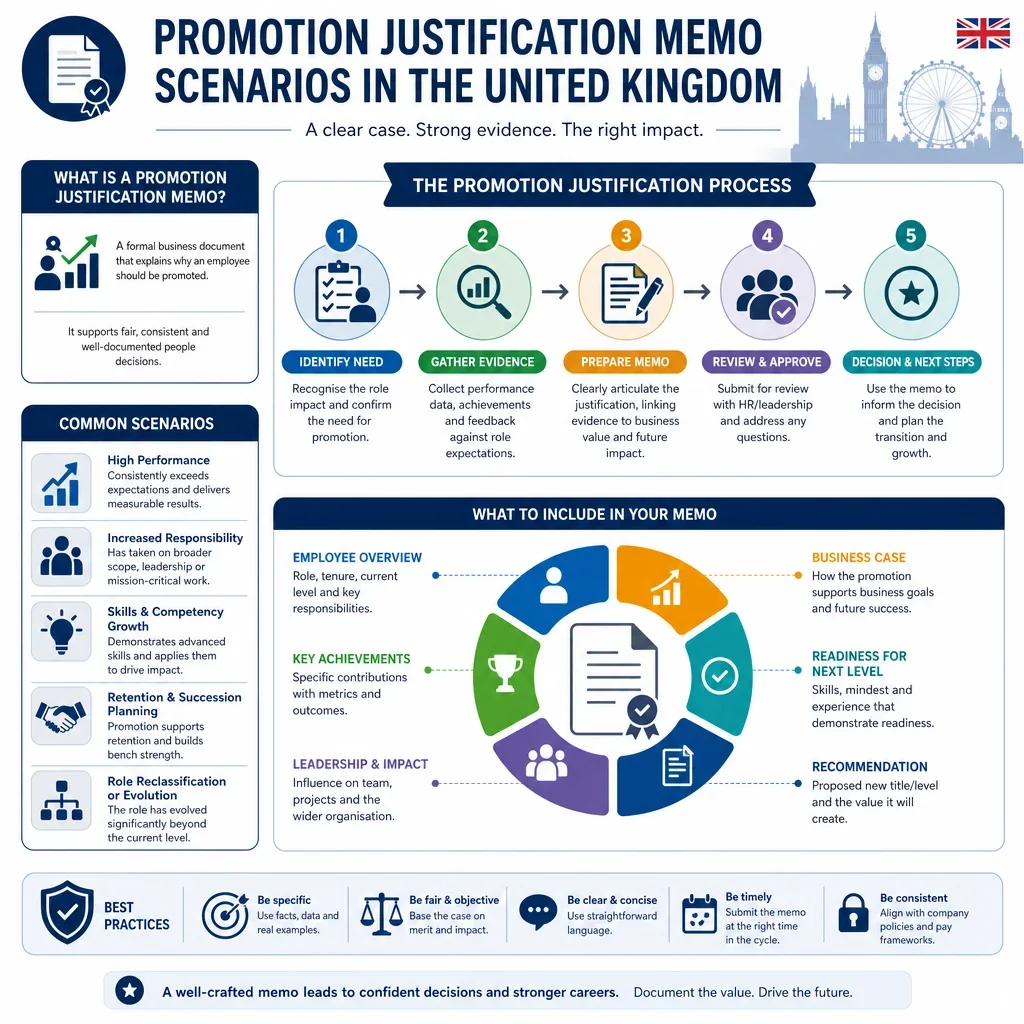
When do you need a Promotion Justification Memo in the United Kingdom?
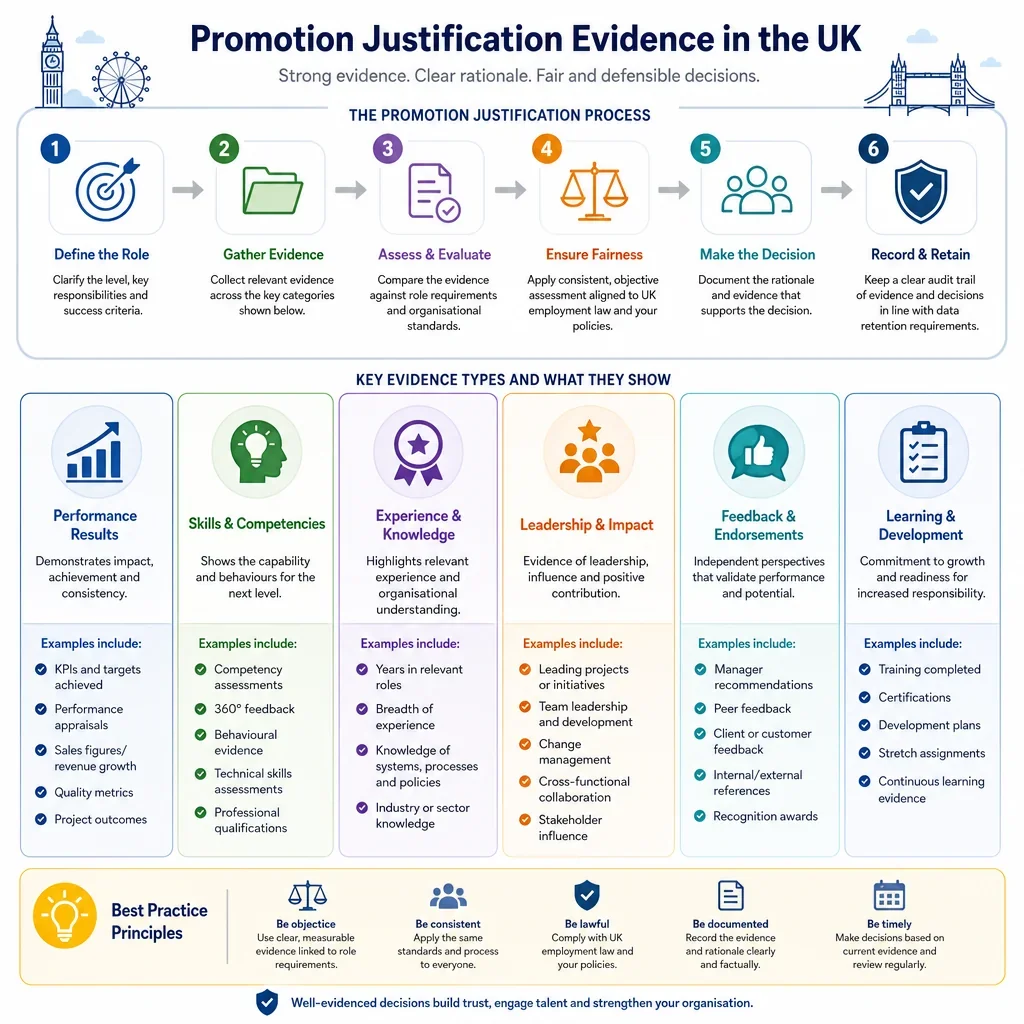
British Legal Rules for a Promotion Justification Memo
Using an incorrect structure for a promotion justification memo may fail to adequately demonstrate compliance with UK employment law requirements on promotions and equality.
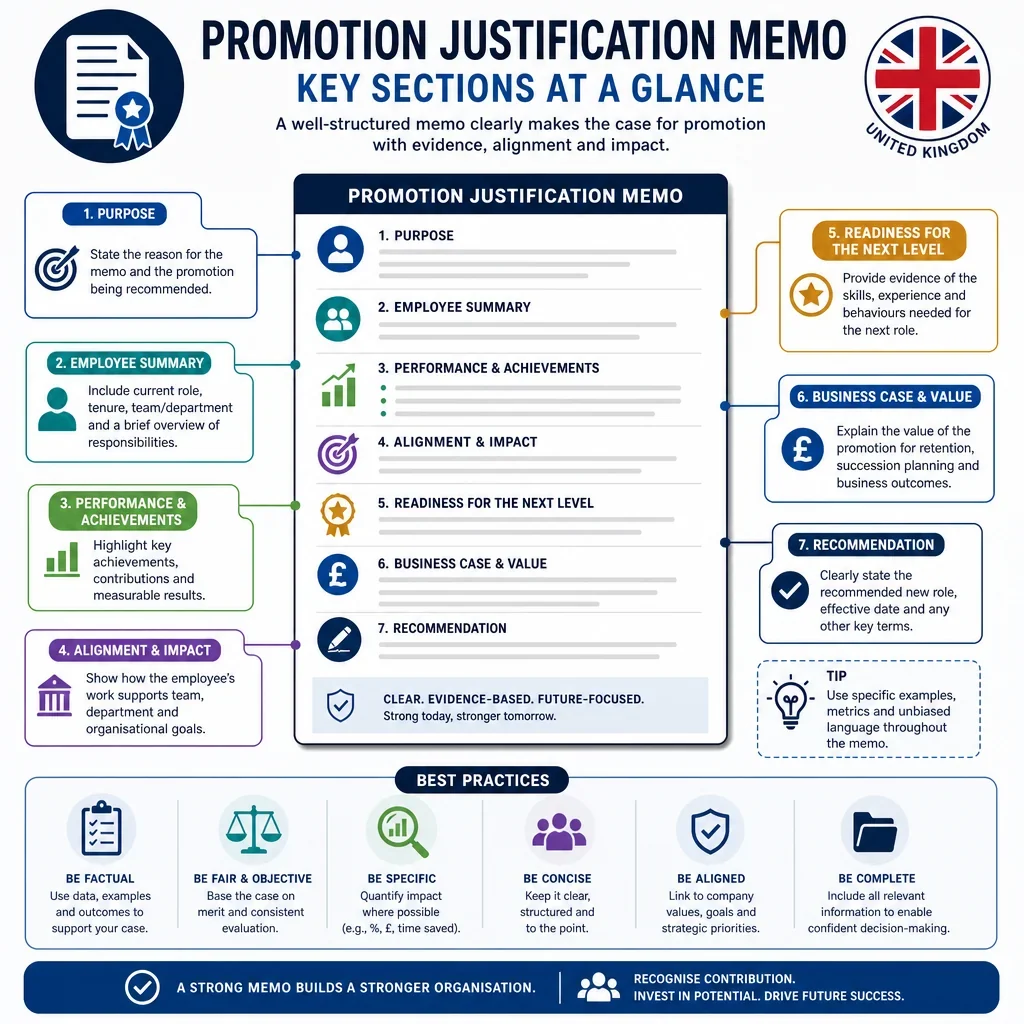
What a Proper Promotion Justification Memo Should Include
- Employee DetailsInclude the employee's full name, current position, department, and length of service to clearly identify who is being promoted.
- Current Role and PerformanceDescribe the employee's current responsibilities and highlight their strong performance and achievements in the role.
- Reason for PromotionExplain why the employee deserves the promotion, focusing on their skills, contributions, and readiness for more responsibility.
- New Position DetailsSpecify the proposed new job title, key duties, and reporting structure for the promoted role.
- Impact on the BusinessOutline how the promotion will benefit the team and company, such as improved productivity or leadership.
- Recommendation and ApprovalState a clear recommendation for the promotion and include spaces for managerial approval signatures.
Generate Your Document in 4 Easy Steps
Why Use Docaro?
 United Kingdom
Free Example Promotion Justification Memo Template
Below is a free template example of a Promotion Justification Memo for use in the United Kingdom generated by our AI model.
The clauses in your actual Promotion Justification Memo will vary from this example as they will be entirely bespoke to your requirements as set out in the questionnaire you complete.
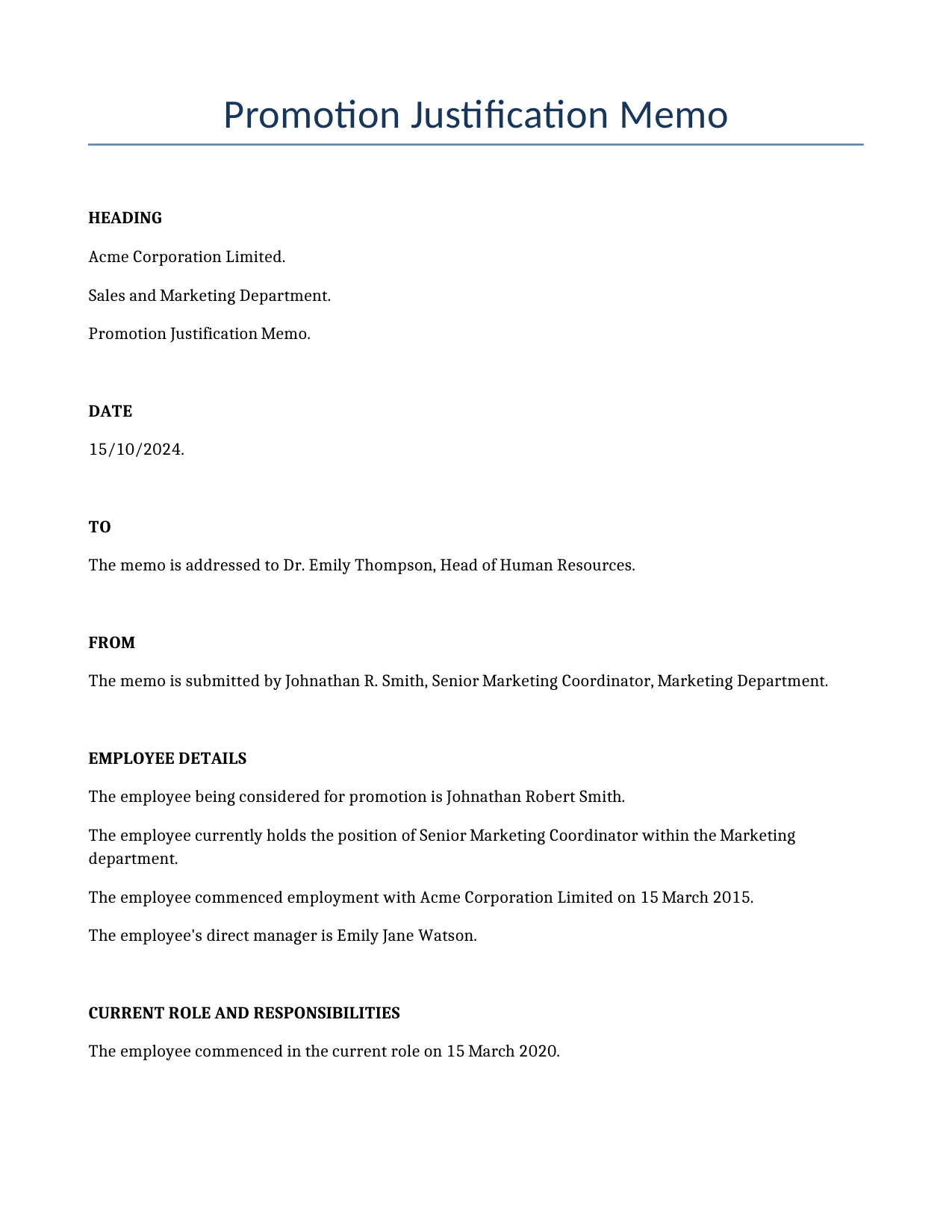
Promotion Justification Memo
HEADING
Acme Corporation Limited.
Sales and Marketing Department.
Promotion Justification Memo.
DATE
15/10/2024.
TO
The memo is addressed to Dr. Emily Thompson, Head of Human Resources.
FROM
The memo is submitted by Johnathan R. Smith, Senior Marketing Coordinator, Marketing Department.
EMPLOYEE DETAILS
The employee being considered for promotion is Johnathan Robert Smith.
The employee currently holds the position of Senior Marketing Coordinator within the Marketing department.
The employee commenced employment with Acme Corporation Limited on 15 March 2015.
The employee's direct manager is Emily Jane Watson.
CURRENT ROLE AND RESPONSIBILITIES
The employee commenced in the current role on 15 March 2020.
The primary daily duties in the current role include managing social media campaigns, coordinating with the content team to develop marketing materials, analysing campaign performance data, and liaising with external partners to ensure brand consistency.
The employee has handled key projects including leading the launch of the company's new product line which resulted in a 25 percent increase in market share, spearheading a digital transformation initiative for the marketing department, and managing the annual trade show exhibition that attracted over 500 leads.
The employee's performance metrics and achievements include achieving a 30 percent year-over-year growth in customer engagement metrics, consistently meeting or exceeding quarterly sales targets by an average of 15 percent, and receiving the Employee of the Quarter award twice in the last year for innovative campaign strategies.
The employee's current performance rating is Exceeds Expectations.
PROPOSED PROMOTION
The proposed new job title for the promotion is Senior Marketing Manager.
The new position will be in the Marketing Department.
The new role will report to the Head of Marketing.
The promotion is justified on the basis of expanded responsibilities and exceptional performance.
PERFORMANCE JUSTIFICATION
The key performance indicators set for the employee in the current role include achieving 95 percent of marketing targets quarterly, reducing campaign delivery time by 20 percent, and maintaining a customer satisfaction score above 90 percent.
The employee has exceeded some or all of the key performance indicators in the review period.
The employee has led or contributed to 5 successful projects in the past year.
The most significant successful projects include leading a major product launch project that resulted in a 25 percent increase in market share where the employee managed a cross-functional team, coordinated with stakeholders, and ensured delivery ahead of schedule, and implementing a new digital analytics system which improved efficiency by 25 percent and reduced errors significantly.
The date of the employee's most recent performance review is 15 June 2024.
The overall rating in the employee's most recent performance review is Exceeds Expectations.
SKILLS AND COMPETENCIES
The employee holds a degree in Marketing which is a Bachelor of Arts in Marketing from the University of London obtained in 2015 and a Management Certification which is a Certified Manager from the Chartered Institute of Marketing obtained in 2020.
The employee has demonstrated key skills including Leadership and Team Management, Digital Strategy Development, Campaign Leadership, and Data Analysis.
The employee applied Leadership and Team Management by leading a team of five marketing specialists in a high-stakes product launch resulting in successful completion ahead of schedule and applied Campaign Leadership by developing and executing integrated marketing campaigns with external partners securing a 25 percent increase in customer engagement while maintaining strong relationships.
The employee has 8 years of relevant professional experience.
The employee's last professional training or development course was on 15 June 2024.
BUSINESS NEED
The primary business need for the promotion is business growth.
The company is expanding operations into new markets in Europe requiring additional leadership capacity to manage increased project volumes and ensure smooth scaling of the team.
This promotion is not part of a formal succession planning process.
The urgency level for implementing this promotion is medium urgency.
Internal sales forecasts indicate a 25 percent growth in revenue over the next fiscal year supported by market analysis from Deloitte showing increased demand in the UK tech sector.
COMPARISON WITH JOB DESCRIPTION
The title of the role to which the employee is being promoted is Senior Marketing Manager.
The key responsibilities in the job description for the promoted role include leading marketing strategies, managing a team of five, developing campaigns for UK and EU markets, analysing market trends, and reporting to the board on return on investment.
The qualifications and skills required in the person specification for the promoted role include a degree in Marketing or Business, 5 or more years in marketing, strong leadership skills, proficiency in digital tools like Google Analytics, and excellent communication abilities.
The employee's educational background fully matches the requirements in the person specification for the promoted role.
The employee has spent 9 years in marketing roles including 4 years as a Senior Marketing Coordinator where the employee led campaign executions and team projects directly aligning with the leadership and strategy aspects of the Senior Marketing Manager position.
The employee has 9 years of relevant experience that matches the promoted role.
The employee's key skills exceed the requirements specified in the person specification for the promoted role.
In the last year the employee increased campaign return on investment by 25 percent through innovative digital strategies and successfully managed a cross-departmental project that expanded market reach in the United Kingdom.
The employee's recent performance reviews have been consistently positive and indicative of readiness for promotion.
There are no identified gaps between the employee's profile and the job description or person specification.
IMPACT OF PROMOTION
The anticipated benefits to the organisation from this promotion include enabling the employee to take on strategic leadership roles driving a 15 percent increase in overall departmental efficiency and supporting the organisation's growth objectives in the UK market by fostering innovation and better resource allocation.
The anticipated benefits to the team from this promotion include boosting team morale and collaboration as the employee will mentor junior staff leading to faster project delivery and a more cohesive team dynamic that enhances collective performance.
The anticipated benefits to the employee from this promotion include career advancement, increased responsibilities, and a competitive salary adjustment which will enhance the employee's job satisfaction, professional development, and work-life balance.
This promotion will contribute to employee retention within the organisation by recognising high-performing talent through promotion which signals a commitment to internal growth reducing turnover rates by motivating employees to stay and invest in their long-term careers with the organisation.
The key areas that the promotion will impact the most include enhanced productivity, improved retention, and team development.
COMPENSATION AND BENEFITS
The employee's current annual base salary is \£45,000.
The proposed new annual base salary for the employee is \£49,500.
The exact amount of the salary increase proposed for the employee is \£4,500.
The percentage increase in salary proposed for the employee is 10 percent.
The proposed compensation aligns with UK market rates for this role at the market median.
The source used to benchmark the proposed compensation against UK market rates is the Hays Salary Guide 2024 for Marketing roles in London.
The proposed compensation is consistent with the internal pay band.
The effective date for the proposed salary and benefits changes is 1 January 2025.
COMPLIANCE AND EQUALITY
The promotion complies with all relevant legislation including the Equality Act 2010, the Employment Rights Act 1996, the Data Protection Act 2018, and the UK GDPR. The process ensures no direct or indirect discrimination by basing decisions solely on merit, skills, and experience. An equality impact assessment has been completed, confirming no adverse effects on any protected characteristics under the Equality Act 2010. The promotion fully adheres to the company's diversity and inclusion policy, for example by prioritising objective criteria that support gender balance in leadership roles and considering applications from candidates of diverse ethnic backgrounds in line with ACAS guidelines.
The promotion adheres to the organisation's internal equality and diversity policies.
The promotion decision considered the candidate's qualifications and experience without regard to protected characteristics such as gender, ethnicity, or age ensuring a fair process that promotes diversity by selecting from a diverse applicant pool.
The organisation has conducted a risk assessment for potential indirect discrimination in this promotion.
The promotion process followed best practices by using objective criteria for selection, conducting blind curriculum vitae reviews to reduce bias, and ensuring representation from underrepresented groups in the shortlisting stage in line with the Equality Act 2010 and ACAS guidelines.
RISKS AND MITIGATION
The potential risks associated with the promotion include team disruption and resentment among peers.
The promotion may cause team disruption due to changes in reporting structures and responsibilities potentially leading to confusion among team members and there could be resentment among peers who feel overlooked for the promotion which might affect morale and collaboration within the team.
The strategies planned to address the identified risks include a communication plan and training and support.
To address team disruption a comprehensive communication plan will be implemented that includes team meetings to explain the changes and their benefits ensuring transparency and for resentment among peers training and support programs such as leadership workshops and one-on-one coaching sessions will be provided to help team members develop their skills and feel valued in their roles.
The planned start date for implementing the mitigation strategies is 15 January 2025.
Sarah Thompson, HR Manager, will be responsible for overseeing the mitigation strategies.
RECOMMENDATION
I strongly recommend the promotion of the employee to the Senior Marketing Manager position effective immediately based on the employee's exceptional performance and leadership contributions.
The key justifications include the employee's consistent exceedance of marketing targets by 20 percent over the past two years, the employee's successful leadership of cross-functional teams resulting in innovative campaign improvements, and the employee's alignment with the company's strategic goals for growth in the UK market.
The promotion aligns with business needs by supporting expansion into new markets and increased leadership capacity.
ATTACHMENTS
The following supporting documents are attached to this memo: Curriculum Vitae, Performance Appraisals dated 15 June 2024, and Endorsement Letters.
The proposed job description for the promoted role is also attached.
GOVERNING LAW
This Promotion Justification Memo shall be governed by and construed in accordance with the laws of England and Wales.
APPROVAL PROCESS
The approval process for this promotion follows UK best practices and ACAS guidelines. It begins with a review by the HR department to verify compliance with company policies and employment laws. The proposal is then assessed for alignment with the organisation's promotion policy, including consideration of internal equity and business needs. Consultations with the relevant department head and, if required, a formal interview or assessment panel will be conducted. Final approval is granted by senior management following these steps to ensure a fair, transparent, and documented process.
DECLARATION
I confirm that the information provided in this memo is accurate and truthful to the best of my knowledge. The personal data contained in this memo is processed in accordance with the UK GDPR and the Data Protection Act 2018.
SIGNATURES
Submitted by: _______________________________ Date: _______________ Johnathan R. Smith, Senior Marketing Coordinator.
Reviewed and Approved by: _______________________________ Date: _______________ Dr. Emily Thompson, Head of Human Resources.
This example shows approximately 70% of a typical document and is provided for illustrative purposes only. The remaining content has been omitted.
Every document generated by Docaro is tailored to your specific circumstances, jurisdiction and the information you provide. The completed document includes all applicable clauses and provisions required for your situation.
To generate the full, personalised document, answer a short series of questions and your document will be created instantly.
Useful Resources When Considering a Promotion Justification Memo in the United Kingdom
United Kingdom Reference Legislation
Promotion Justification Memo FAQs
Document Generation FAQs
Related Articles