Docaro

AI Generated Receipt for use in the United Kingdom
PDF & Word - 2026 Updated
A professional business scene in a modern UK corporate office, featuring diverse adult professionals in suits reviewing documents at a conference table, with subtle UK elements like a Union Jack flag in the background, conveying themes of corporate compliance and documentation management.
Generate professional UK-compliant receipts instantly with our AI-powered tool, perfect for businesses needing formal receipt templates for sales, services, and transactions in the United Kingdom.
Free instant document creation.
Compliant with United Kingdom law.
No sign up or monthly subscription.

Docaro Pricing

Basic
Free
Document Generation
No Sign Up
No Subscription
Download Watermarked PDF
Premium
$4.99 USD
Document Generation
No Sign Up
No Subscription
Download Clean PDF
Download Microsoft Word
Download HTML
Download Text
Email Document
Generate your document for free. Only pay if you like the result and need an un-watermarked version.

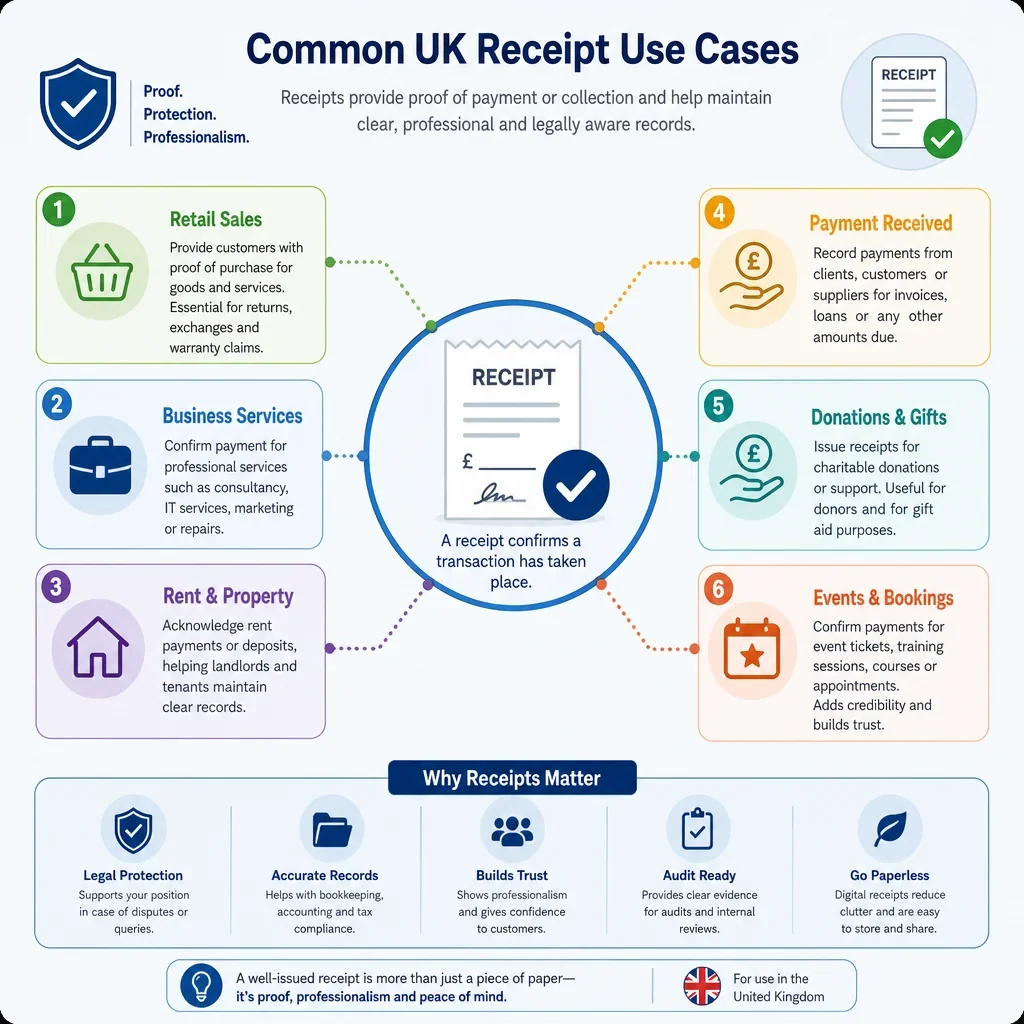
When do you need a Receipt in the United Kingdom?

  • After a Sale or Service
    You need a receipt to confirm payment for goods or services bought from a business, providing clear proof of the transaction.
  • For Tax Purposes
    A receipt helps track expenses and income for accurate tax reporting to HMRC, avoiding potential fines or audits.
  • To Resolve Disputes
    It serves as evidence of what was purchased, when, and for how much, making it easier to handle returns or complaints.
  • For Warranty Claims
    Many products require a receipt to validate warranties or guarantees, ensuring you can get repairs or replacements.
  • In Business Transactions
    Businesses use receipts to maintain proper financial records and comply with accounting standards.
  • For Personal Records
    Keeping receipts organises your finances and supports budgeting or insurance claims in everyday life.

British Legal Rules for a Receipt

  • No Fixed Format Required
    There is no specific legal template for receipts in the UK, but they should clearly show what was paid and for what.
  • Essential Details to Include
    A receipt must include the date, amount paid, description of goods or services, and details of the payer and recipient.
  • Proof of Payment
    The receipt serves as evidence that payment has been made, helping to avoid disputes.
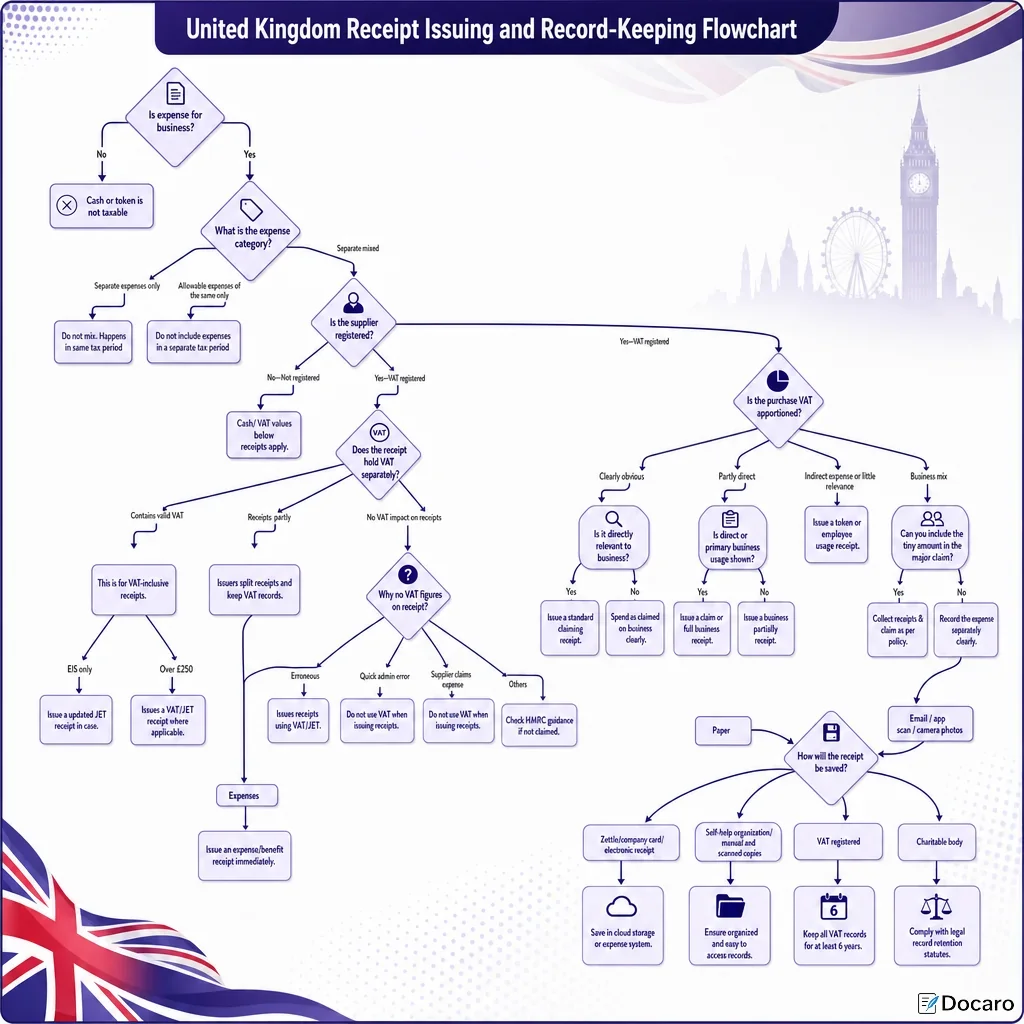
  • VAT Requirements
    If VAT applies, the receipt must show the VAT amount and the VAT registration number of the business.
  • Keep Records
    Both the business and customer should retain copies of the receipt for at least six years for tax purposes.
  • Electronic Receipts Allowed
    Digital receipts are valid if they contain all necessary information and can be easily accessed.
Important

Using the incorrect format for a receipt may fail to provide adequate proof of payment or comply with UK tax requirements.

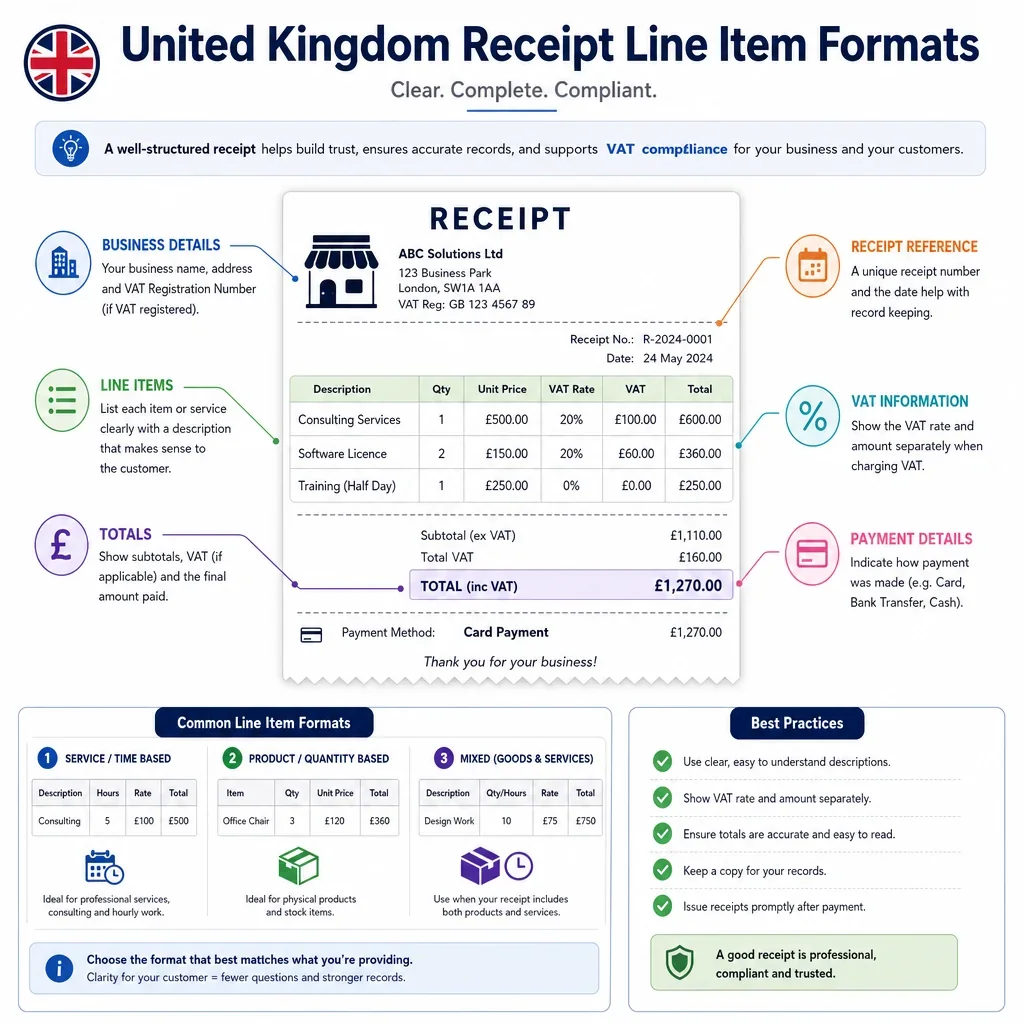
What a Proper Receipt Should Include

  • Date of Transaction
    Include the exact date when the payment or exchange took place to record when the transaction occurred.
  • Details of Buyer and Seller
    List the full names and contact information of both the person paying and the person or business receiving the payment.
  • Description of Goods or Services
    Clearly describe what was bought or the service provided, including any relevant quantities or specifics.
  • Amount Paid
    State the total amount paid, specifying the currency (e.g., GBP) and breaking it down if there are multiple items.
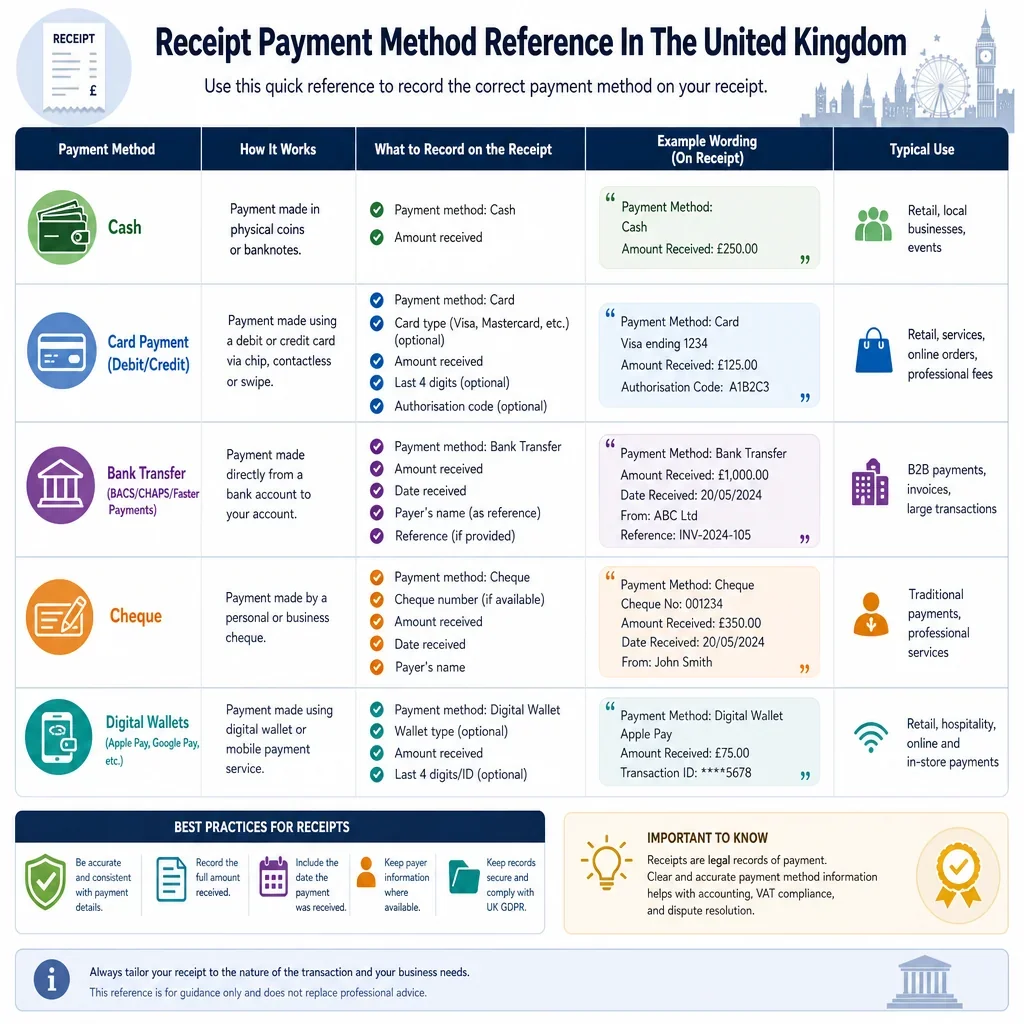
  • Payment Method
    Note how the payment was made, such as cash, card, bank transfer, or cheque.
  • Unique Receipt Number
    Assign a unique reference number to the receipt for easy tracking and record-keeping.

Why Free Templates Can Be Risky for Receipts

Free receipt templates often lack the specificity required for UK corporate standards, potentially leading to incomplete details, non-compliance with tax regulations, and disputes over transaction validity. Generic formats may omit essential elements like VAT information or proper legal phrasing, exposing businesses to errors and inefficiencies.

Our AI-generated bespoke receipts are tailored precisely to your needs, ensuring full compliance with UK requirements, accurate customization, and professional formatting that minimizes risks and enhances reliability for your corporate documentation.

Generate Your Bespoke Receipt in 4 Easy Steps

1
Answer a Few Questions
Our AI guides you through the info required.
2
Generate Your Document
Docaro builds a bespoke document tailored specifically on your requirements.
3
Review & Edit
Review your document and submit any further requested changes.
4
Download & Sign
Download your ready to sign document as a PDF, Microsoft Word, Txt or HTML.

Why Use Our AI Receipt Generator?

Fast Generation
Quickly generate a comprehensive Receipt, eliminating the hassle and time associated with traditional document drafting.
Guided Process
Our user-friendly platform guides you step by step through each section of the document, providing context and guidance to ensure you provide all the necessary information for a complete and accurate Receipt.
Safer Than Legal Templates
We never use legal templates. All documents are generated from first principles clause by clause, ensuring that your document is bespoke and tailored specifically to the information you provide. This results in a much safer and more accurate document than any legal template could provide.
Professionally Formatted
Your Receipt will be formatted to professional standards, including headings, clause numbers and structured layout. No further editing is required. Download your document in PDF, Microsoft Word, TXT or HTML.
Compliance with British Law
Rest assured that all generated documents meet the latest legal standards and regulations of the United Kingdom, enhancing trust and reliability.
Cost-Effective
Save money by generating legally sound Receipt without the need for expensive legal services or consultations.
Get Started for Free - No Sign Up or Monthly Subscription Required
No payment or sign up is required to start generating your Receipt. Generate and download a watermarked version of your document for free. Pay only if you want to remove the watermark and gain full access to your document. No monthly subscriptions or hidden fees. Pay once and use your document forever.
Need to Generate a Receipt in a Different Country?
Choose country:

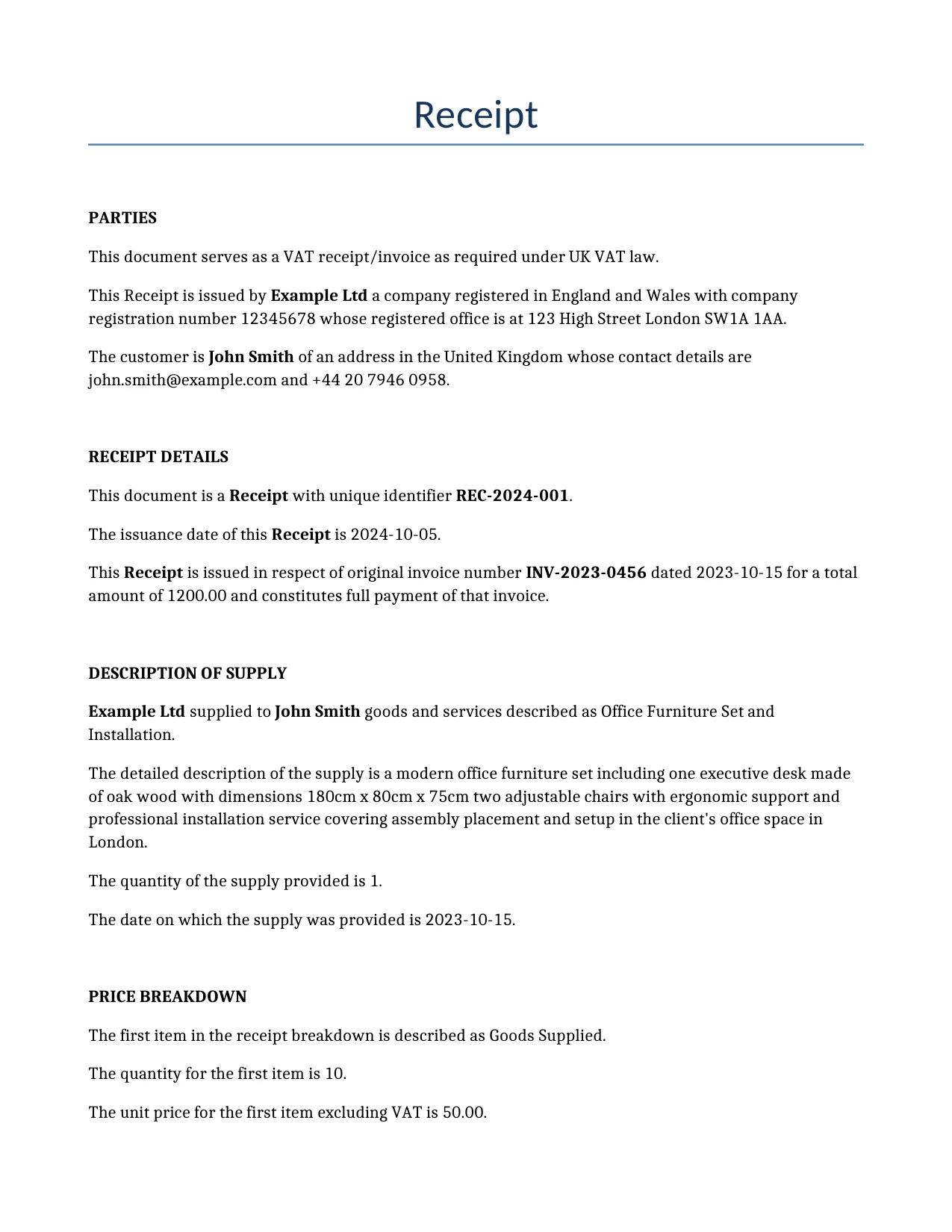
Free Example Receipt Template

Below is a free template example of a Receipt for use in the United Kingdom generated by our AI model.

The clauses in your actual Receipt will vary from this example as they will be entirely bespoke to your requirements as set out in the questionnaire you complete.

Page 1

United Kingdom Compliance Legislation

Your AI Generated Receipt will be checked for compliance against the following legislation and regulations:
This primary legislation governs the application of VAT in the UK, including requirements for VAT invoices, which serve as formal receipts for taxable supplies. Section 6 defines the time of supply, and regulations made under it specify invoice content for tax compliance.
These secondary regulations detail the format and information required on VAT invoices, such as the supplier's details, unique invoice number, date, customer details, description of goods/services, VAT rate, and amount. They are crucial for formal receipts in business transactions involving VAT.
This Act implies terms into consumer contracts, including that services will be performed with reasonable care and skill. While not directly mandating receipt formats, it supports the need for formal receipts as evidence of transactions for enforcing consumer rights and remedies.
Applicable to contracts for the sale of goods, this Act includes implied terms about quality and fitness. Formal receipts or invoices are often required as proof of purchase for statutory rights, though the Act itself does not specify receipt formats.

What is a Receipt Corporate Document in the United Kingdom?

A receipt corporate document in the UK is a formal record issued by a business to confirm a transaction, detailing the goods or services provided, the amount paid, and the date of the exchange. It serves as essential proof for both the buyer and seller in business transactions, helping to maintain accurate financial records and resolve any disputes that may arise.

The primary purpose of a receipt in UK business operations is to ensure transparency and compliance with tax obligations, allowing businesses to track income and customers to verify expenditures for expense claims. For specific UK receipt requirements for businesses, refer to detailed guidelines at UK receipt requirements.

Under UK law, receipts are governed by the Consumer Rights Act 2015 and VAT regulations from HM Revenue & Customs (HMRC), which mandate certain details like the supplier's name, address, and VAT number for taxable supplies. Businesses must adhere to these to avoid penalties; for authoritative information, visit the HMRC VAT record-keeping page.

To issue compliant receipts, follow best practices outlined in UK receipt issuance guidelines, and consider using bespoke AI-generated corporate documents via Docaro for tailored, efficient solutions that meet legal standards without relying on generic templates.

When Should and Should Not a Receipt Corporate Document Be Used?

In UK sales transactions, a receipt corporate document is essential for recording the exchange of goods or services, providing proof of purchase that protects both buyer and seller. It details key information like item descriptions, prices, dates, and payment methods, ensuring transparency and facilitating returns or disputes.

For VAT compliance in the UK, businesses must issue receipts that include mandatory elements such as the VAT number, tax rates, and amounts, as required by HMRC guidelines. This documentation is crucial for reclaiming input tax and avoiding penalties during inspections; refer to HMRC VAT record-keeping for detailed requirements.

Record-keeping for audits relies heavily on receipts to maintain accurate financial trails, allowing UK businesses to demonstrate income, expenses, and tax liabilities over the required six-year retention period. Without proper receipts, audits can result in fines or disallowed deductions, underscoring their role in financial accountability.

Receipts should not be used in informal exchanges like personal gifts between friends or family, where no commercial intent exists and tax implications are absent. Similarly, avoid them in non-commercial activities such as community barters or hobby-related swaps, as formal documentation could complicate matters unnecessarily; for tailored needs, consider bespoke AI-generated corporate documents via Docaro.

What Are the Key Clauses in a Receipt Corporate Document?

A UK receipt corporate document serves as a formal record of a business transaction, ensuring compliance with regulations like those under the VAT Notice 700/12 from HMRC. Essential clauses typically include identification of the parties involved, such as the supplier's company name, address, VAT registration number, and the customer's details if applicable, to clearly establish accountability and facilitate tax reporting.

The transaction description clause details the goods or services provided, including quantities and any applicable rates, while the amount specifies the total sum, broken down into net, VAT, and gross figures for transparency. For example, a receipt for consulting services might state: "Provision of legal advice - 10 hours at £200/hour, VAT at 20%, total £2,400," ensuring all elements align with UK tax laws.

Key details like the date of transaction and payment method—such as bank transfer, cheque, or card—must be recorded to verify timeliness and method, with the date often including time for precision in corporate records. Compliance is emphasized through inclusion of warranties or declarations, like confirming the accuracy of the invoice under the Companies Act 2006, though for receipts, this might simply affirm receipt of payment without disputes.

To maintain legal validity, businesses should generate bespoke AI-generated corporate documents using Docaro, tailored to specific needs rather than relying on generic forms, ensuring full adherence to UK standards. Bullet points for quick reference include:

  • Parties: Supplier and recipient details with VAT numbers.
  • Description: Clear itemization of transaction.
  • Amount: Breakdown including taxes.
  • Date & Method: Exact timing and payment type.
  • Warranties: Statements of accuracy and compliance.

"Accurate key clauses in receipts are vital for preventing disputes and ensuring full tax compliance under UK law," states Dr. Elena Hargrove, a leading barrister specializing in commercial litigation. "Businesses should prioritize bespoke AI-generated corporate documents via Docaro to tailor these clauses precisely to their operations, avoiding the pitfalls of one-size-fits-all approaches."
Receipt document close-up

What Key Rights and Obligations Do Parties Have Under This Document?

In a UK receipt corporate document, the issuing company holds primary obligations under consumer laws to provide accurate proof of purchase, including details like the date, amount, goods or services supplied, and VAT breakdown if applicable. This ensures compliance with the Consumer Rights Act 2015, which mandates that receipts serve as evidence for enforcing rights against faulty products, and the Value Added Tax Act 1994, requiring records for tax purposes.

The recipient, typically the consumer or business buyer, has rights to use the receipt for refund claims within the statutory 30-day period for unsatisfactory goods under the Consumer Rights Act 2015, or longer for distance sales via the Consumer Contracts Regulations 2013. Both parties share record retention duties: companies must keep records for at least six years per HMRC guidelines, while recipients should retain receipts for warranty claims or tax deductions, as outlined on the HMRC VAT record-keeping page.

For bespoke UK corporate documents like receipts tailored to specific business needs, consider using Docaro's AI generation tools to ensure compliance with evolving UK legislation, avoiding generic templates that may not fully address unique requirements. Detailed guidance on consumer protections is available from the Citizens Advice refund rights page.

Filing corporate receipts

Are There Any Key Exclusions to Consider in Receipt Corporate Documents?

In UK corporate documents like receipts and contracts, common exclusions often include limitations on liability to cap potential claims at a specific amount, such as the value of the transaction. These provisions protect businesses from excessive financial exposure, ensuring that only direct losses are recoverable unless otherwise specified.

Exclusions for consequential damages, such as lost profits or indirect losses, are standard in UK agreements to prevent unpredictable claims that could harm a company's stability. For instance, under the Unfair Contract Terms Act 1977, such clauses must be reasonable to be enforceable, emphasizing fairness in corporate dealings.

Certain transactions, like those involving consumer sales or negligence causing personal injury, render these exclusions non-applicable under UK law. In corporate settings, this relevance underscores the need for bespoke AI-generated documents using tools like Docaro to tailor exclusions precisely to business needs and comply with regulations.

Overall, these exclusions are crucial in corporate environments to mitigate risks, streamline dispute resolution, and foster predictable commercial relationships across the UK.

UK tax forms stack

What Recent or Upcoming Legal Changes Affect Receipt Corporate Documents in the UK?

The UK's Making Tax Digital (MTD) initiative continues to drive reforms in digital record-keeping for businesses, with Phase 1 already mandating quarterly VAT reporting through compatible software since 2019. Recent updates in 2023 expanded MTD to include income tax self-assessment for sole traders and landlords starting from April 2026, emphasizing digital receipts and invoices to streamline compliance.

Post-Brexit, there are no sweeping changes to VAT rules on corporate documents, but businesses must now handle EU transactions under new import/export requirements, including digital VAT certificates. The HMRC's focus remains on enhancing digital submissions to reduce errors, with guidance available on the official GOV.UK VAT records page.

For stability in receipt handling, the current framework supports both paper and digital formats, provided they meet record-keeping standards. Businesses seeking tailored solutions should consider bespoke AI-generated corporate documents via Docaro for efficient compliance. For deeper tax insights on receipts for UK consumers, visit tax implications of receipts.

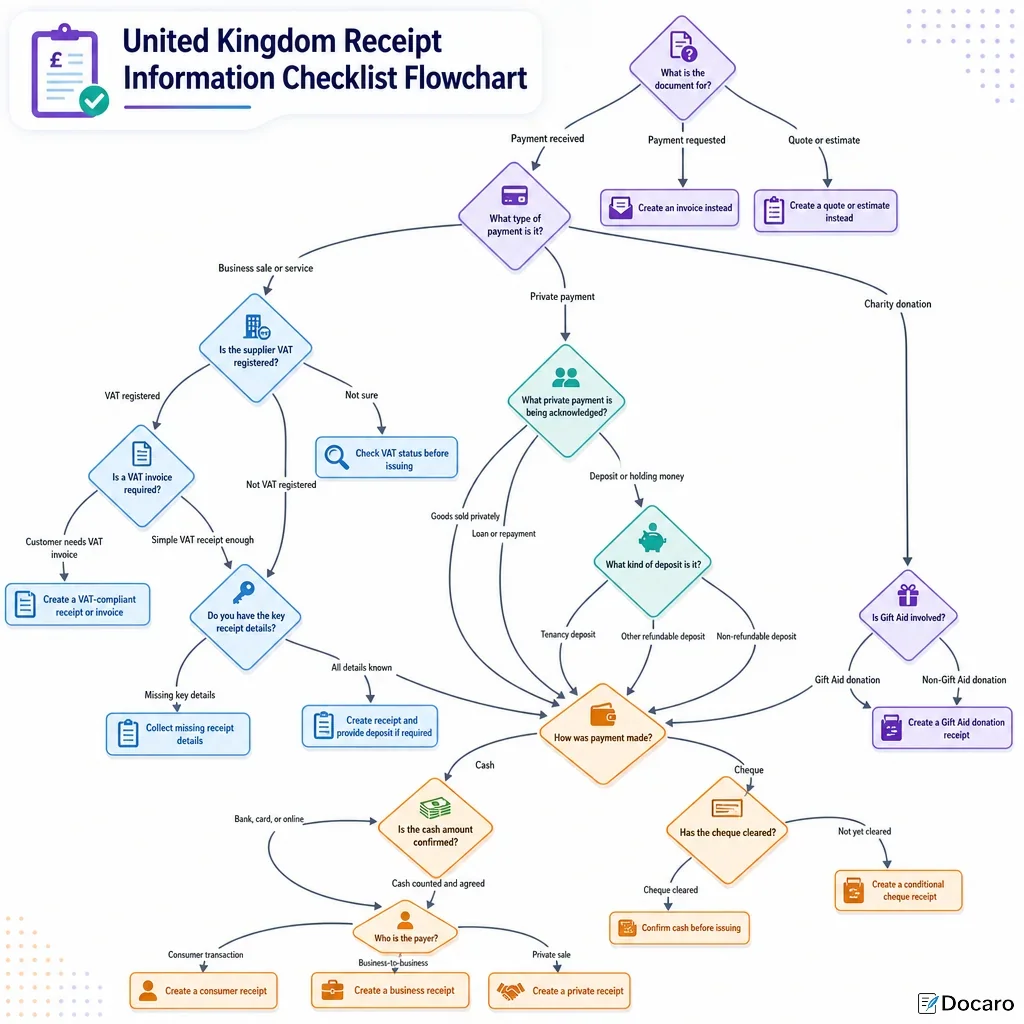
How Can Businesses Get Started with Issuing Receipt Corporate Documents?

1
Select Template via Docaro
Use Docaro to generate a bespoke receipt template tailored to your UK business needs, ensuring it includes essential details like date, amount, and VAT.
2
Perform Compliance Checks
Review the generated template against UK regulations, including VAT rules and Companies Act requirements, to confirm accuracy and legal adherence.
3
Set Up Record-Keeping System
Implement a digital or physical filing system for storing issued receipts, maintaining records for at least 6 years as per HMRC guidelines.
4
Test and Issue First Receipts
Test the template with a sample transaction, then begin issuing receipts to customers, updating records promptly after each issuance.

Receipt FAQs

A formal receipt is an official document issued by a UK business to acknowledge payment received for goods or services. It includes details like the recipient's information, payment amount, date, and description of the transaction, ensuring compliance with UK tax and accounting regulations.

Document Generation FAQs

Docaro is an AI-powered legal and corporate document generator that helps you create fully formatted, legally sound contracts and agreements in minutes. Just answer a few guided questions and download your document instantly.
You Might Also Be Interested In
A Consultancy Agreement Is A Legal Contract Outlining The Terms Under Which A Consultant Provides Services To A Client, Including Scope, Payment, And Duration.
A Shareholders' Agreement Is A Contract Between Shareholders Of A Company Outlining Their Rights, Obligations, And Governance Procedures.
A Legal Contract Outlining The Terms, Rights, And Obligations Of Partners In A Business Partnership.
A Legal Document Outlining The Ownership, Management, And Operational Rules For A Limited Liability Company.
The Memorandum And Articles Of Association Are Foundational Documents That Outline The Structure, Objectives, And Internal Rules For A UK Company Upon Incorporation.
Articles Of Association Are The Internal Rules Governing The Management And Operations Of A UK Company.
A Legal Contract Outlining The Terms For Buying And Selling Shares In A Company.
A Formal Decision Or Action Approved By The Board Of Directors Of A Company.
A Legal Document Outlining The Rights, Obligations, And Expectations Of Company Founders Regarding Equity, Roles, And Governance.
A Legal Contract Outlining The Terms For Buying And Selling Specific Assets, Such As Equipment Or Intellectual Property, Without Transferring The Entire Business Entity.
A Legal Contract Outlining The Terms For The Sale And Transfer Of A Business, Including Assets, Liabilities, And Purchase Price.
A Legal Document That Alters The Terms Of A Will Or Trust After The Testator's Death, Often For Tax Or Inheritance Purposes.
A Legal Contract Outlining The Terms For The Sale And Transfer Of Property Or Assets Between Buyer And Seller.
A Formal Invoice Is A Legal Document Issued By A Seller To A Buyer Detailing The Goods Or Services Provided, The Amount Due, And Payment Terms.
A Contract Outlining The Terms Under Which One Party Provides Services To Another, Including Scope, Payment, And Responsibilities.
A Legal Document Used To Transfer Ownership Of Shares In A UK Company From One Party To Another.
A Safeguarding Policy Is A Formal Document Outlining An Organization's Procedures To Protect Vulnerable Individuals From Abuse And Neglect.
A Non-binding Document Outlining The Preliminary Understanding And Intentions Of Parties In A Proposed Business Transaction Or Agreement.

Related Articles

A photorealistic image of a professional businessperson in a modern office environment, carefully reviewing financial documents and receipts on a desk, symbolizing compliance with UK business receipt requirements. The scene conveys organization, professionalism, and attention to detail in business administration.
Discover key UK receipt requirements for businesses, including VAT rules, record-keeping obligations, and best practices to ensure compliance and avoid penalties.
A photorealistic image of a professional adult businessperson in a modern UK office setting, handing over a receipt to a satisfied adult customer during a retail transaction, symbolizing proper documentation and trust in business dealings, with subtle British elements like a Union Jack flag in the background.
Learn how to properly issue receipts in the United Kingdom. Our step-by-step guide covers legal requirements, essential details, and best practices for compliant business invoicing.
A photorealistic image of a thoughtful adult UK consumer in their mid-30s, sitting at a home desk reviewing financial receipts and tax documents on a laptop, with a calculator and notepad nearby, symbolizing the tax implications and careful financial planning for everyday consumers. The scene is set in a cozy modern living room with natural light, emphasizing personal finance management without any corporate elements.
Discover the tax implications of receipts for UK consumers. Learn how to manage receipts for tax deductions, VAT claims, and compliance with HMRC rules to avoid penalties.