AI Generated Standard Operating Procedure for use in the United Kingdom
PDF & Word - 2026 Updated
Docaro Pricing
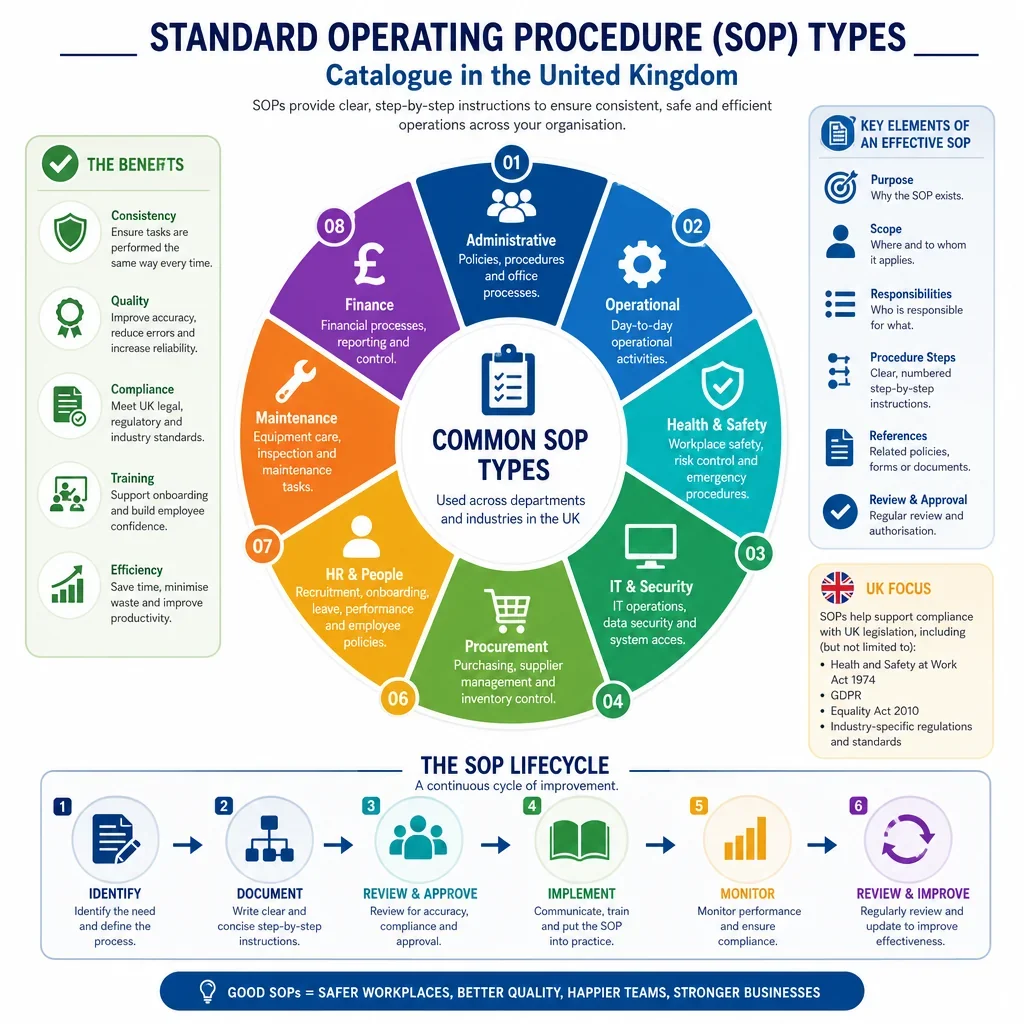
When do you need a Standard Operating Procedure in the United Kingdom?
British Legal Rules for a Standard Operating Procedure
Using an inappropriate structure for a standard operating procedure may lead to operational inefficiencies or compliance failures.
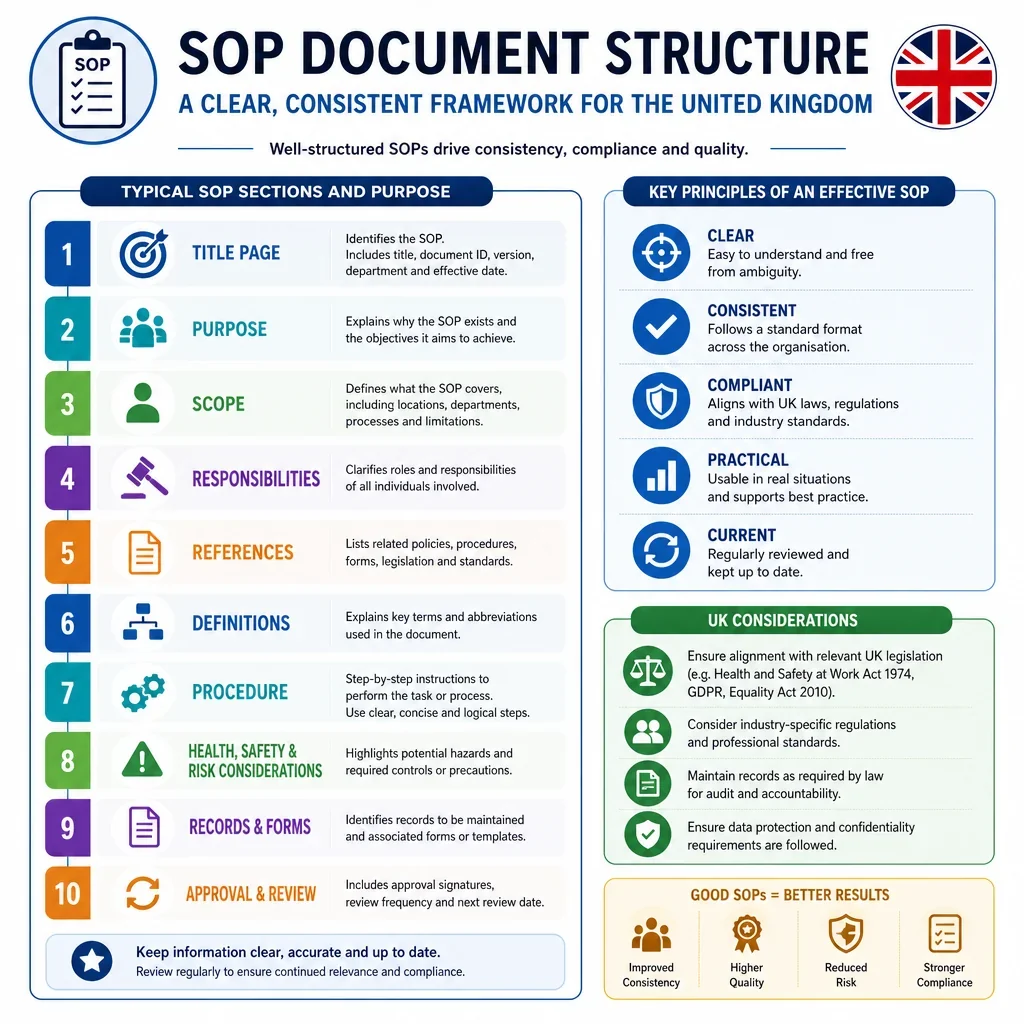
What a Proper Standard Operating Procedure Should Include
- PurposeClearly state the goal of the procedure to ensure everyone understands its objective.
- ScopeDefine what activities and areas the procedure covers to set clear boundaries.
- ResponsibilitiesOutline who is responsible for each step to promote accountability.
- Step-by-Step InstructionsProvide detailed, sequential guidance on how to perform the tasks safely and effectively.
- Resources and MaterialsList any tools, equipment, or documents needed to complete the procedure.
- Safety MeasuresHighlight potential risks and steps to avoid harm or accidents.
- ReferencesInclude links to related policies, guidelines, or external standards for further information.
- Review and Update ProcessDescribe how and when the procedure will be checked and revised to keep it current.
Generate Your Document in 4 Easy Steps
Why Use Docaro?
 United Kingdom
Free Example Standard Operating Procedure Template
Below is a free template example of a Standard Operating Procedure for use in the United Kingdom generated by our AI model.
The clauses in your actual Standard Operating Procedure will vary from this example as they will be entirely bespoke to your requirements as set out in the questionnaire you complete.
Standard Operating Procedure for Employee Onboarding Process
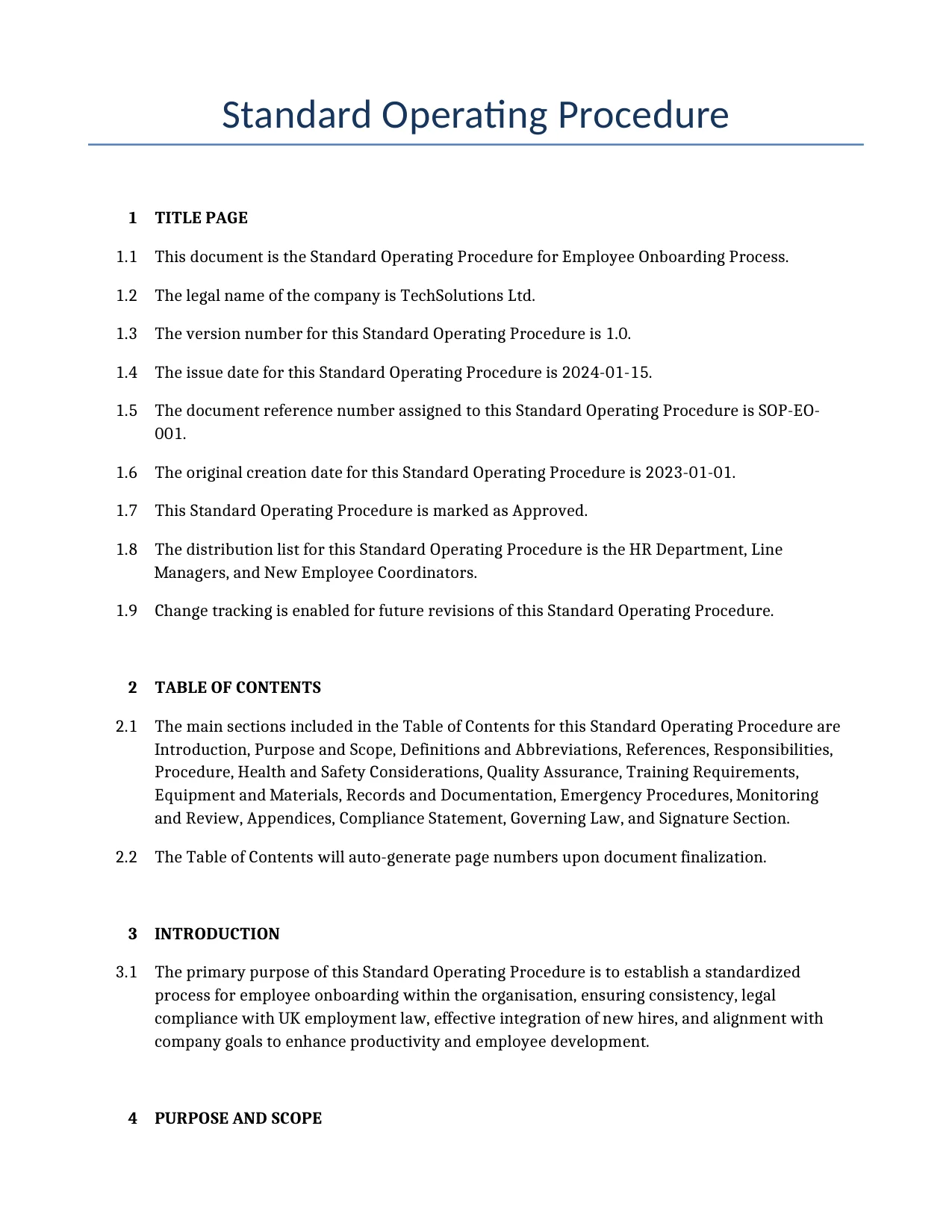
1TITLE PAGE
This document is the Standard Operating Procedure for Employee Onboarding Process.
The legal name of the company is TechSolutions Ltd.
The version number for this Standard Operating Procedure is 1.0.
The issue date for this Standard Operating Procedure is 2024-01-15.
The document reference number assigned to this Standard Operating Procedure is SOP-EO-001.
The original creation date for this Standard Operating Procedure is 2023-01-01.
This Standard Operating Procedure is marked as Approved.
The distribution list for this Standard Operating Procedure is the HR Department, Line Managers, and New Employee Coordinators.
Change tracking is enabled for future revisions of this Standard Operating Procedure.
2TABLE OF CONTENTS
The main sections included in the Table of Contents for this Standard Operating Procedure are Introduction, Purpose and Scope, Definitions and Abbreviations, References, Responsibilities, Procedure, Health and Safety Considerations, Quality Assurance, Training Requirements, Equipment and Materials, Records and Documentation, Emergency Procedures, Monitoring and Review, Appendices, Compliance Statement, Governing Law, and Signature Section.
The Table of Contents will auto-generate page numbers upon document finalization.
3INTRODUCTION
The primary purpose of this Standard Operating Procedure is to establish a standardized process for employee onboarding within the organisation, ensuring consistency, legal compliance with UK employment law, effective integration of new hires, and alignment with company goals to enhance productivity and employee development.
4PURPOSE AND SCOPE
The primary purpose of this Standard Operating Procedure is to standardise the onboarding process for new employees to ensure compliance with UK employment law, promote consistency across the organisation, and integrate new hires effectively into their roles and company culture.
This Standard Operating Procedure applies to all new hires including full-time, part-time, and contractors in UK operations.
This Standard Operating Procedure does not cover internal promotions or overseas hires, which are managed under separate procedures.
The primary objectives that this Standard Operating Procedure aims to achieve are reducing time-to-productivity for new employees, ensuring full legal compliance with UK regulations, improving new hire retention, and fostering a positive employee experience from day one.
This Standard Operating Procedure becomes effective on 2024-01-15.
The HR Director is responsible for approving this Standard Operating Procedure.
This Standard Operating Procedure applies to the Human Resources, Line Management, IT, and Compliance departments within the organisation.
This Standard Operating Procedure includes all new starters in UK operations, whether permanent, fixed-term, or on a contract basis.
This Standard Operating Procedure does not cover legal disputes arising from employment contracts, which are managed by the Legal Department.
5DEFINITIONS AND ABBREVIATIONS
SOP means Standard Operating Procedure: A documented set of instructions outlining the processes and procedures to be followed in order to ensure consistency and compliance within the organisation.
Onboarding means the structured process of integrating a new employee into the organisation, covering administrative, legal, cultural, and role-specific elements from offer acceptance to full productivity.
Induction means the initial introduction and training provided to new employees on their first days, including company policies, health and safety, and role expectations.
Right to Work Check means the verification of an individual's eligibility to work in the UK as required by the Immigration, Asylum and Nationality Act 2006.
DBS Check means Disclosure and Barring Service Check: A background check for roles involving vulnerable groups, compliant with relevant UK legislation.
Probationary Period means the initial trial period of employment (typically 3-6 months) during which performance is assessed before full confirmation.
UK GDPR means United Kingdom General Data Protection Regulation: The UK data protection law governing the processing of personal data.
Personal Data means any information relating to an identified or identifiable natural person, as defined under the Data Protection Act 2018 and UK GDPR.
Equality Act means the Equality Act 2010: UK legislation prohibiting discrimination in employment on protected characteristics.
HRIS means Human Resources Information System: The digital platform used to manage employee records and onboarding processes.
DPO means Data Protection Officer: The individual responsible for overseeing data protection compliance including during onboarding.
6REFERENCES
The Employment Rights Act 1996 is referenced with an effective date of 1996-08-22.
The Equality Act 2010 is referenced with an effective date of 2010-10-01.
The Data Protection Act 2018 is referenced with an effective date of 2018-05-25.
UK GDPR is referenced with an effective date of 2021-01-01 (post-Brexit retained law).
The Immigration, Asylum and Nationality Act 2006 is referenced for right to work checks with an effective date of 2006-07-01.
ACAS Guidance on Employment Contracts and Induction is referenced with a publication date of 2023-09-01.
The Company Onboarding Policy is an internal company policy with a version date of 2024-01-15.
The Pensions Act 2008 is referenced for auto-enrolment obligations with an effective date of 2008-11-26.
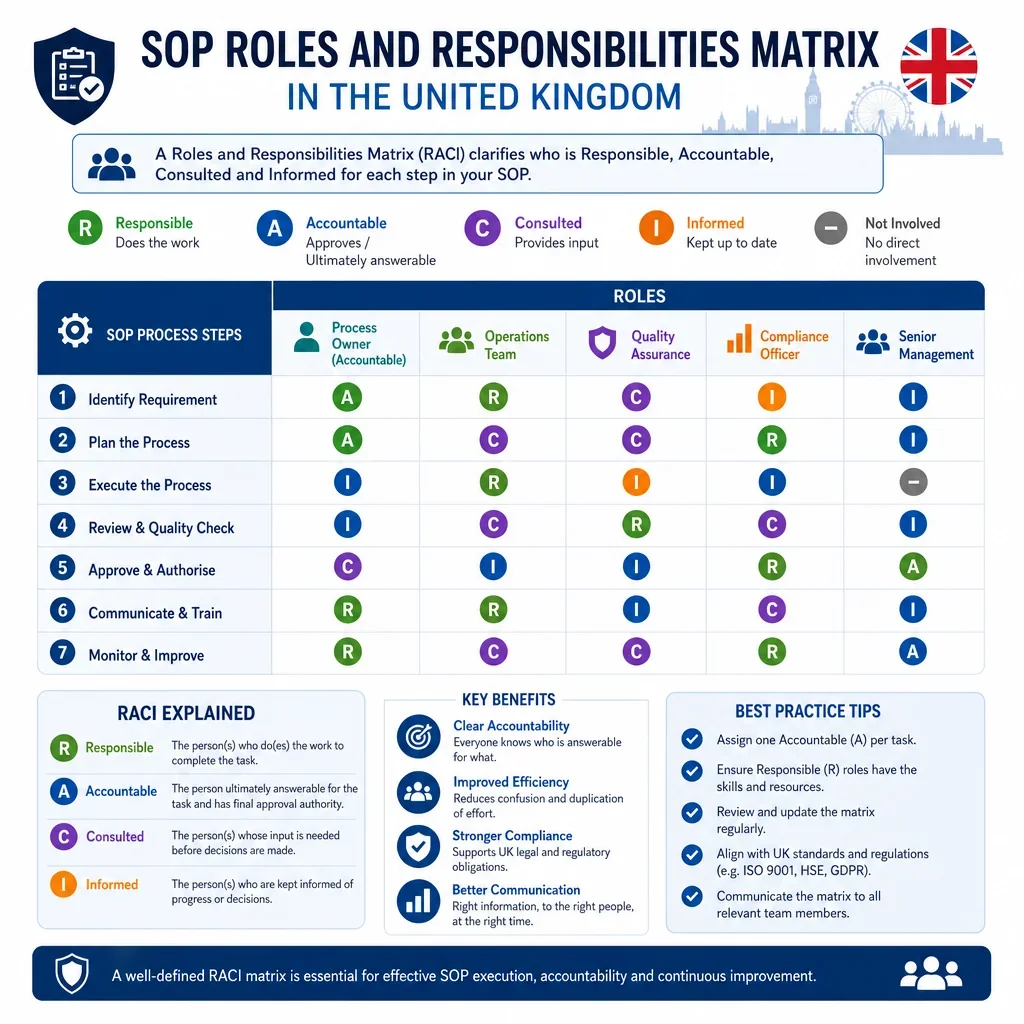
7RESPONSIBILITIES
The process for which responsibilities are defined is the Employee Onboarding Process.
The individuals or departments involved in the process are the HR Department, Line Managers, IT Department, Data Protection Officer, and Compliance Officer.
HR is responsible for conducting eligibility checks including right to work verification and DBS checks where applicable, issuing contracts, and managing overall onboarding coordination.
The Line Manager is responsible for providing role-specific induction, explaining the probationary period, conducting 30/60/90 day reviews, and supporting integration.
The IT Department is responsible for setting up equipment, user accounts, and access permissions in line with security policies.
The Data Protection Officer is responsible for ensuring UK GDPR compliance for new employee personal data, including privacy notices and consent management.
The Compliance Officer is designated as accountable for overall compliance in the process including alignment with the Employment Rights Act 1996, Equality Act 2010, and other relevant laws.
The responsibilities in this section shall be reviewed annually.
The next review of these responsibilities shall occur on 2024-12-31.
All involved parties must complete mandatory training on anti-discrimination (Equality Act 2010), data protection (UK GDPR), and health and safety.
8PROCEDURE
This section is titled Employee Onboarding Process.
This procedure outlines the step-by-step process for onboarding new employees in the company, ensuring a smooth integration into the team, compliance with UK employment laws, and efficient allocation of resources.
Pre-hire: Issue a compliant offer letter and contract of employment in line with the Employment Rights Act 1996 (written terms must be provided within two months of start date). Conduct right to work checks per the Immigration, Asylum and Nationality Act 2006.
Day 1: Welcome the new employee, complete verification of right to work documents, provide data protection (UK GDPR) training and privacy notice, deliver health and safety induction in accordance with the Management of Health and Safety at Work Regulations 1999, issue welcome pack and equipment, and explain the probationary period.
First week: Deliver role-specific training by Line Manager, complete equality monitoring (voluntary under Equality Act 2010), enrol in pension scheme per Pensions Act 2008 auto-enrolment rules, and use a standardised onboarding checklist to track completion.
30/60/90 day reviews: Line Manager conducts structured reviews during the probationary period to assess progress, provide feedback, and address any issues. Document all steps in the HRIS.
This Procedure is carried out for each new hire. Compliance with this Procedure will be monitored quarterly through human resources audits, feedback from new hires via surveys, and reviews of onboarding timelines to ensure all steps are completed within seven days of hire.
9HEALTH AND SAFETY CONSIDERATIONS
This procedure involves office-based activities for new employee onboarding including workstation setup and induction training.
Hazards may include display screen equipment risks, poor workstation ergonomics, fire safety, and mental health or stress during the transition period.
No personal protective equipment is typically required beyond standard office provisions; however, a workstation assessment is mandatory.
New employees need a general health and safety induction, display screen equipment training, fire safety briefing, emergency procedures overview, and mental health awareness session.
Workstation and display screen equipment assessments shall be conducted within the first week of employment.
In case of a medical emergency during onboarding, the employee or coordinator shall call 999, notify the Line Manager, and follow first aid protocols.
An established system exists for reporting health and safety incidents or concerns raised during onboarding.
The Health and Safety at Work etc. Act 1974, the Management of Health and Safety at Work Regulations 1999, and the Health and Safety (Display Screen Equipment) Regulations 1992 are particularly relevant to this procedure.
The Health and Safety Officer is the designated person responsible for overseeing health and safety elements of the onboarding procedure.
10QUALITY ASSURANCE
The quality assurance measures include tracking completion rates of induction within 7 days, new hire satisfaction scores (target above 80\%), compliance audit pass rate for legal checks, and retention rate at 6 months, aligned with ISO 9001 principles where applicable.
Regular internal audits are scheduled as part of the quality assurance for the procedure.
Internal audits shall occur quarterly.
Provisions for external audits are included in the quality assurance measures where required for compliance certification.
The quality assurance must address compliance with the Employment Rights Act 1996 (for contracts), the Equality Act 2010 (for diversity and non-discrimination), the Data Protection Act 2018 and UK GDPR (for data handling during onboarding), and the Health and Safety at Work etc. Act 1974.
The quality check methods incorporated into the assurance process are document reviews, performance metrics, staff interviews, and new hire feedback surveys.
The HR Manager is designated as the person responsible for overseeing quality assurance.
11TRAINING REQUIREMENTS
All new employees will receive mandatory training on company policies, data protection (UK GDPR), equality and diversity (Equality Act 2010), health and safety (including display screen equipment and fire safety), cybersecurity, and role-specific skills.
This training will ensure all participants understand their legal obligations, company expectations, and can perform tasks accurately, efficiently, and in compliance with UK law.
The training will be delivered through a mix of e-learning modules, in-person workshops, virtual sessions, and on-the-job mentoring by the Line Manager.
Each new employee shall complete a minimum of four hours of core compliance training within the first week, with role-specific training tailored to requirements (typically 8-16 hours in the first month).
Certification or sign-off is required upon completion of all mandatory modules.
Refresher training on UK GDPR, Equality Act, and health and safety shall be conducted annually or upon significant legal changes.
A formal system (HRIS) shall be used to track staff training completion, certification, and refresher due dates.
12EQUIPMENT AND MATERIALS
The Company Laptop is equipment required for this procedure.
The Company Laptop is a standard business device provided to enable the new employee to perform their role securely, with pre-installed software, access controls, and security features compliant with company IT policy.
The equipment is owned by the company.
The equipment requires IT security training and acceptable use policy acknowledgement.
The Access Card is equipment required for this procedure.
The Access Card provides secure entry to company premises and is linked to the employee's profile for access logging.
The equipment is owned by the company and must be returned upon termination of employment.
One unit of the equipment is needed per new employee.
There are specific storage and return requirements for the equipment.
The resource is available on-site from the IT or Facilities team.
The Welcome Pack is a material required for this procedure.
The Welcome Pack includes the employee handbook, company branded merchandise, stationery, and informational materials to aid cultural integration.
The material is provided to the employee for their use.
One unit of the material is needed per new employee.
The Employee Handbook is a key component of the welcome pack and must be read in conjunction with mandatory training.
13RECORDS AND DOCUMENTATION
The organisation needs to keep signed contracts, right to work evidence, GDPR privacy notices and consent records, equality monitoring forms (where provided), training and induction sign-offs, probation review forms, and pension enrolment records.
The organisation shall primarily use secure digital formats for storing records and documentation within the HRIS.
The organisation shall use encryption, role-based access controls, regular backups, audit logs, and version tracking to maintain records and documentation in compliance with UK GDPR.
The organisation shall retain contracts and related employment records for 6 years after termination (per Limitation Act 1980), payroll-related records for 6 years, and certain pension records indefinitely or for 6 years post-termination as applicable.
The records retention policy shall be implemented starting on 2024-01-15.
The GDPR compliance measures included in the organisation's records management procedures are data encryption, consent management, data subject rights procedures, privacy by design, and regular data protection impact assessments where relevant.
The Data Protection Officer is designated as responsible for overseeing records and documentation maintenance.
14EMERGENCY PROCEDURES
The types of emergencies or deviations from standard procedures outlined in this section are discovery of invalid right to work documentation, suspected data breach during induction, new hire medical emergency, or failure to complete statutory checks within required timelines.
The HR Manager is designated to be responsible for overseeing responses to onboarding emergencies or deviations.
The phone number for the designated coordinator is +44 20 7946 0000.
The email address for the designated coordinator is hr.manager@techsolutions.co.uk.
The initial response steps for invalid right to work are to suspend the start date, seek advice from the Home Office, and not permit work until resolved. For a data breach, follow the company incident response plan including notification to the DPO and ICO if required. For medical emergencies, call 999 and provide first aid.
The employee or coordinator shall use the internal HR hotline or direct notification to the HR Manager as the reporting mechanisms for notifying emergencies or deviations.
Procedures are included for reporting certain emergencies to external authorities (e.g., Home Office for immigration issues, ICO for reportable data breaches).
The maximum time allowed for initial response to an emergency before escalation is one hour.
The process for reviewing and updating procedures after an emergency occurs is to conduct a debrief meeting within 48 hours, to document lessons learned, and to update the Standard Operating Procedure within two weeks if necessary.
15MONITORING AND REVIEW
The methods used to monitor the effectiveness of the Standard Operating Procedure are KPIs such as time to full productivity (target under 90 days), retention rate at 6 months (target above 85\%), completion rate of statutory checks, new hire satisfaction scores, and compliance with all legal deadlines (e.g., issuing contracts).
The review frequency for the Standard Operating Procedure is annually or upon changes in UK employment law.
The next review of the Standard Operating Procedure shall occur on 2025-01-15.
Provisions are included for updates triggered by specific events rather than just scheduled reviews, such as legislative changes to the Employment Rights Act 1996, Equality Act 2010, UK GDPR, or ACAS guidance.
The HR Manager or Compliance Officer is responsible for monitoring the effectiveness of the Standard Operating Procedure.
16APPENDICES
The title for the first appendix is New Starter Checklist.
The first appendix includes a template covering right to work checks, DBS if needed, contract issuance, GDPR privacy notice acknowledgement, voluntary equality monitoring form, induction programme, and probation review form.
The second appendix is an Induction Programme Template detailing Day 1, first week, and 30/60/90 day activities with responsible parties and sign-off.
Version control log is included showing version 1.0 issued 2024-01-15, approved by HR Director, with change history for future updates.
17COMPLIANCE STATEMENT
This Standard Operating Procedure ensures compliance with all relevant UK legislation including but not limited to the Employment Rights Act 1996, National Minimum Wage Act 1998, Working Time Regulations 1998, Equality Act 2010, Data Protection Act 2018, UK GDPR, Health and Safety at Work etc. Act 1974, Pensions Act 2008, and the Immigration, Asylum and Nationality Act 2006. It has been reviewed by a qualified employment law professional to confirm alignment with current requirements.
18GOVERNING LAW
This Standard Operating Procedure is governed by and shall be construed in accordance with the laws of England and Wales.
19SIGNATURE SECTION
The undersigned parties agree to the terms and conditions set forth in this Standard Operating Procedure.
Signed on behalf of TechSolutions Ltd by the HR Director: ___________________________ Date: _______________
Signed by the Compliance Officer: ___________________________ Date: _______________
This example shows approximately 70% of a typical document and is provided for illustrative purposes only. The remaining content has been omitted.
Every document generated by Docaro is tailored to your specific circumstances, jurisdiction and the information you provide. The completed document includes all applicable clauses and provisions required for your situation.
To generate the full, personalised document, answer a short series of questions and your document will be created instantly.
Useful Resources When Considering a Standard Operating Procedure in the United Kingdom
United Kingdom Reference Legislation
Standard Operating Procedure FAQs
Document Generation FAQs
Related Articles