AI Generated British Non-disclosure Agreement (NDA)
PDF & Word - 2026 Updated
Docaro Pricing
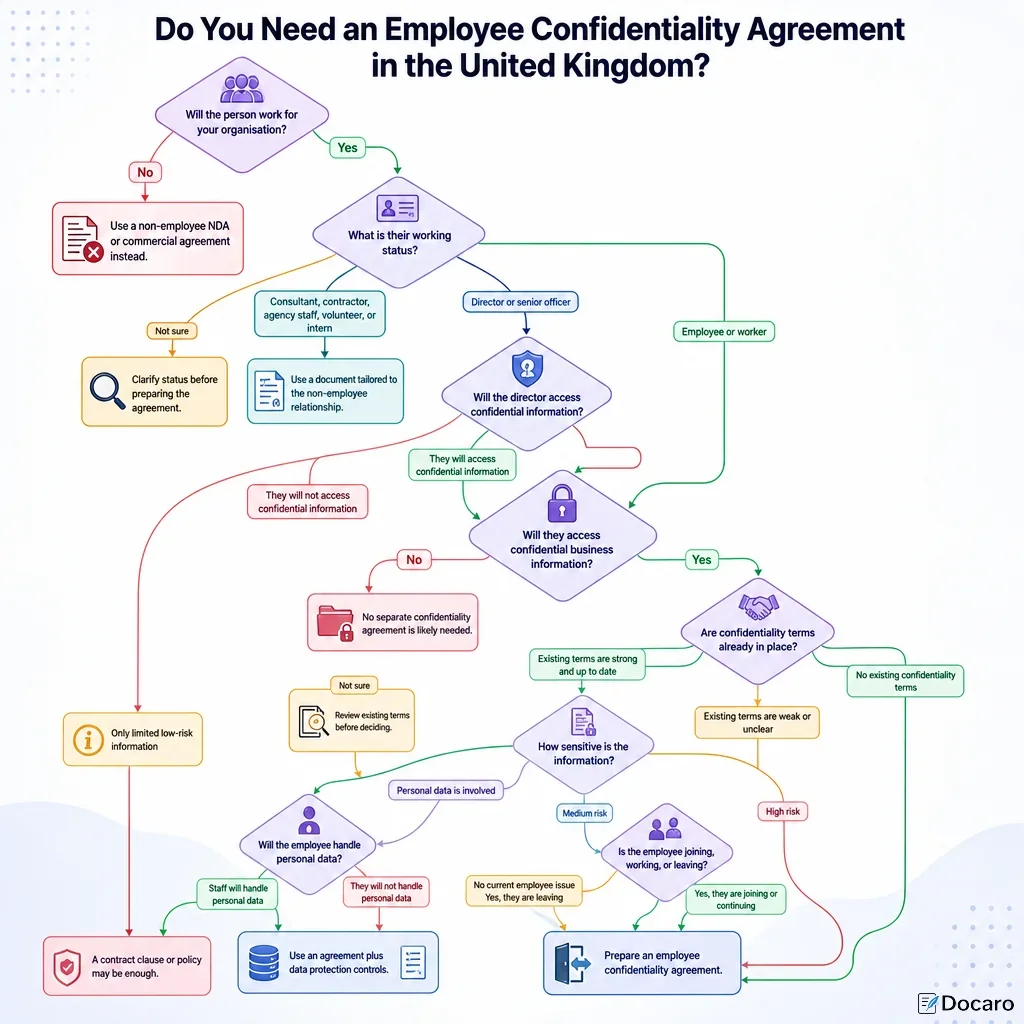
When do you need a Non-Disclosure Agreement in the United Kingdom?
British Legal Rules for a Non-Disclosure Agreement
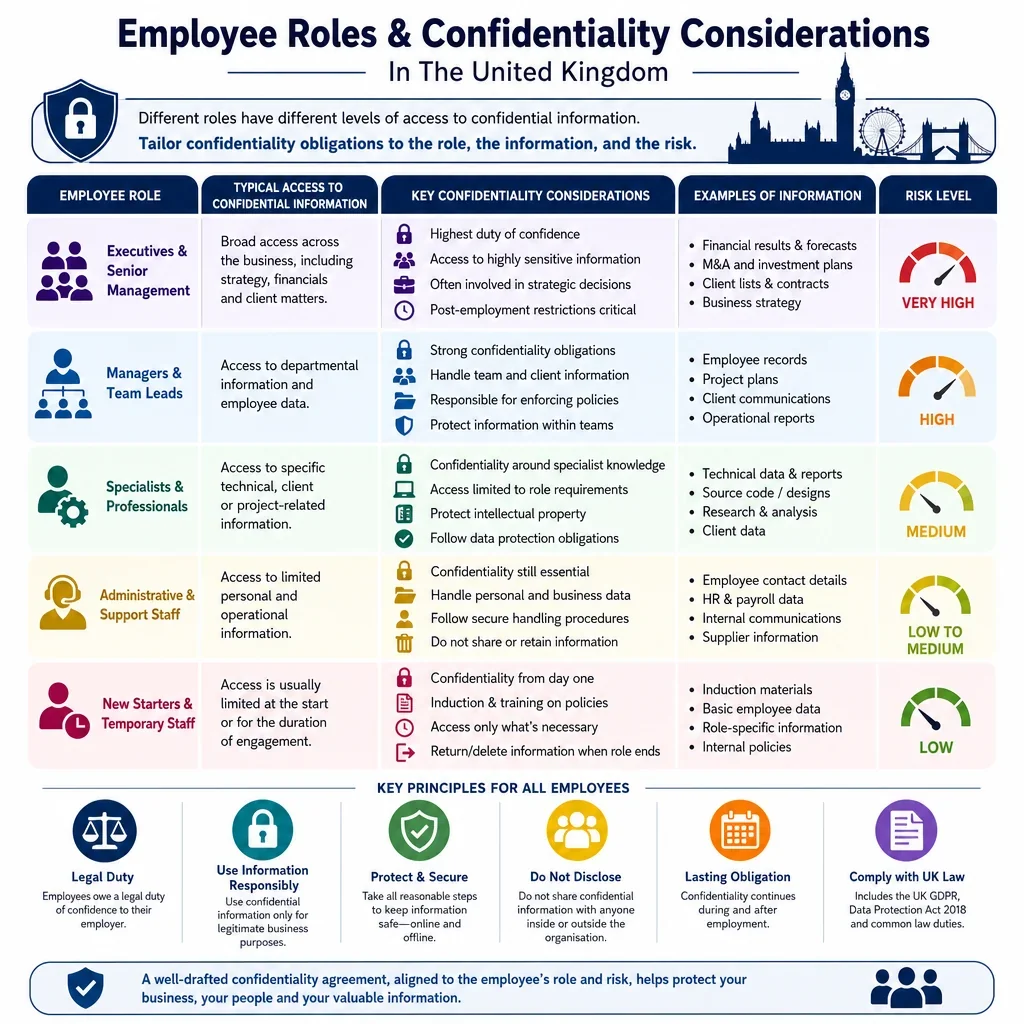
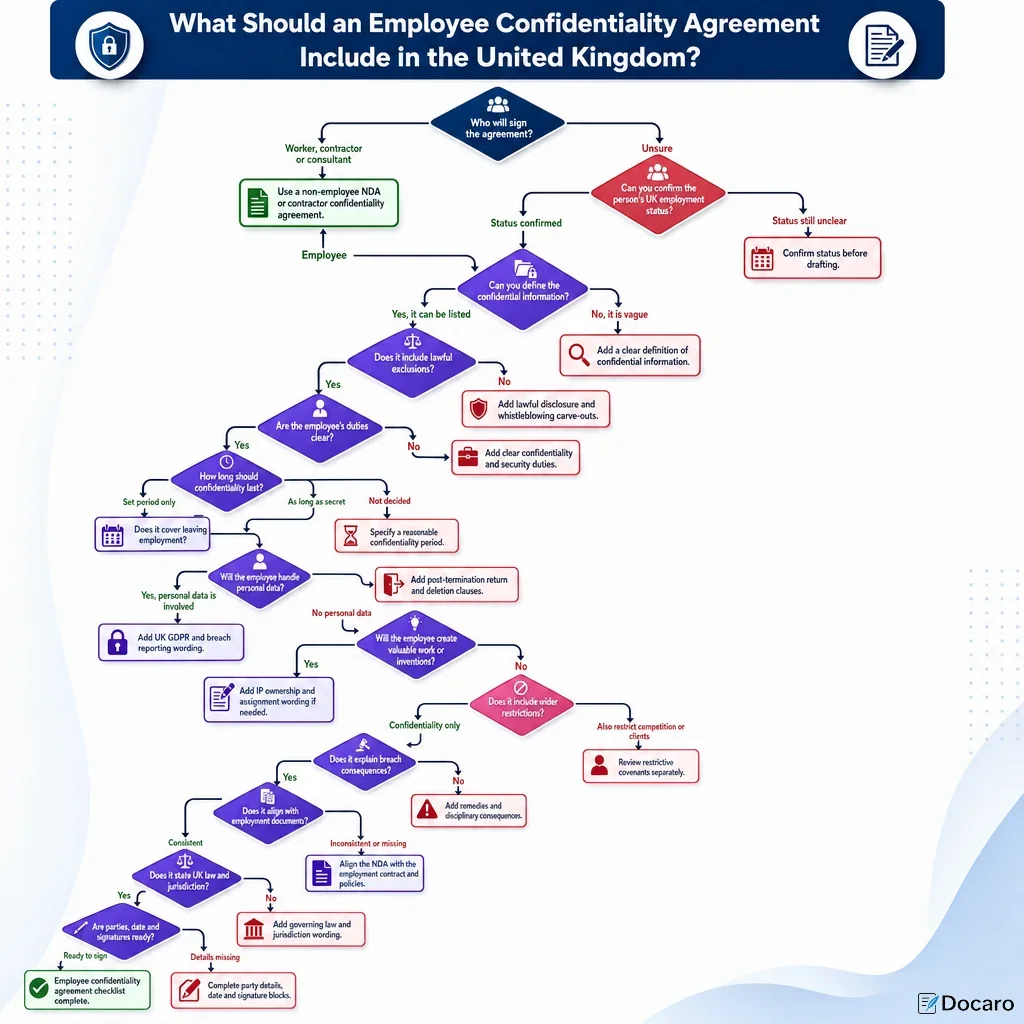
Using the wrong type of confidentiality agreement can fail to adequately protect sensitive information or expose the employer to unintended disclosure risks.
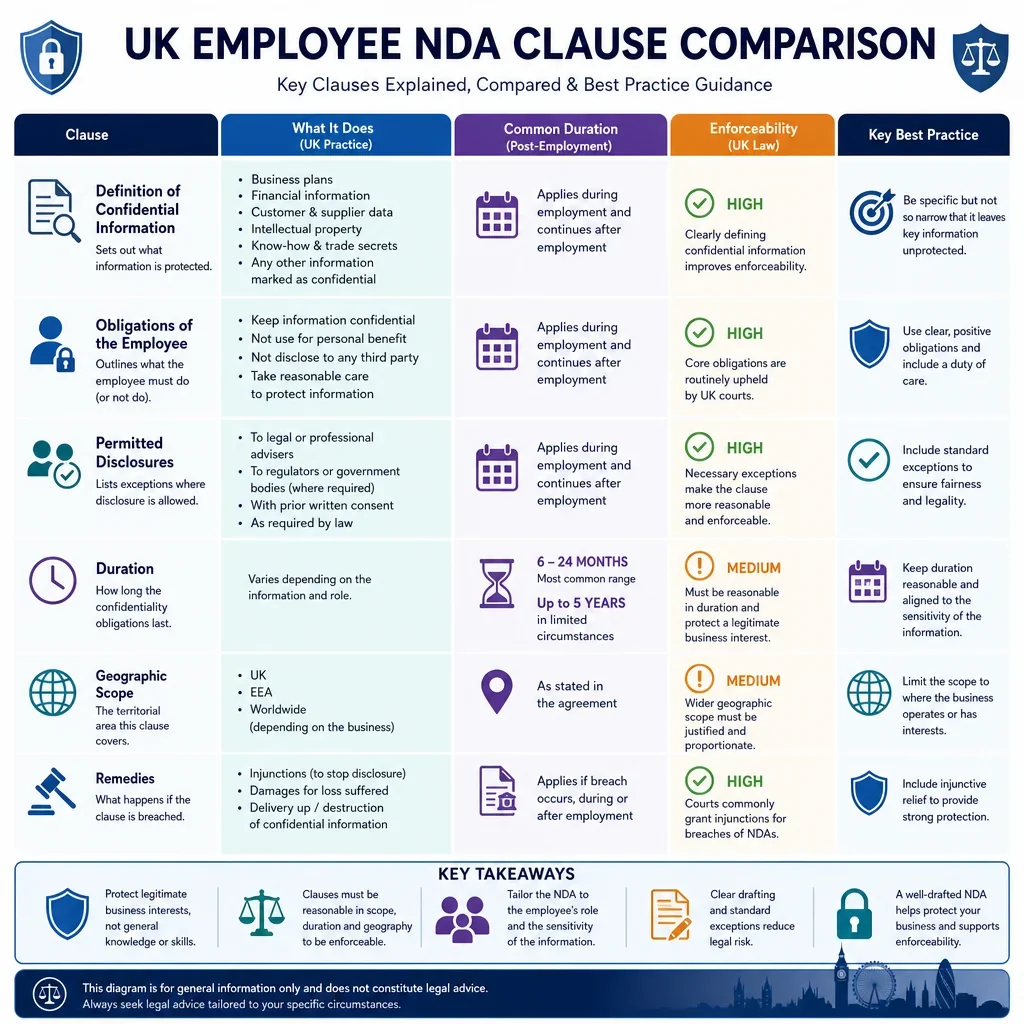
What a Proper Non-Disclosure Agreement Should Include
- Parties InvolvedClearly name the person or company sharing the information and the recipient who must keep it secret.
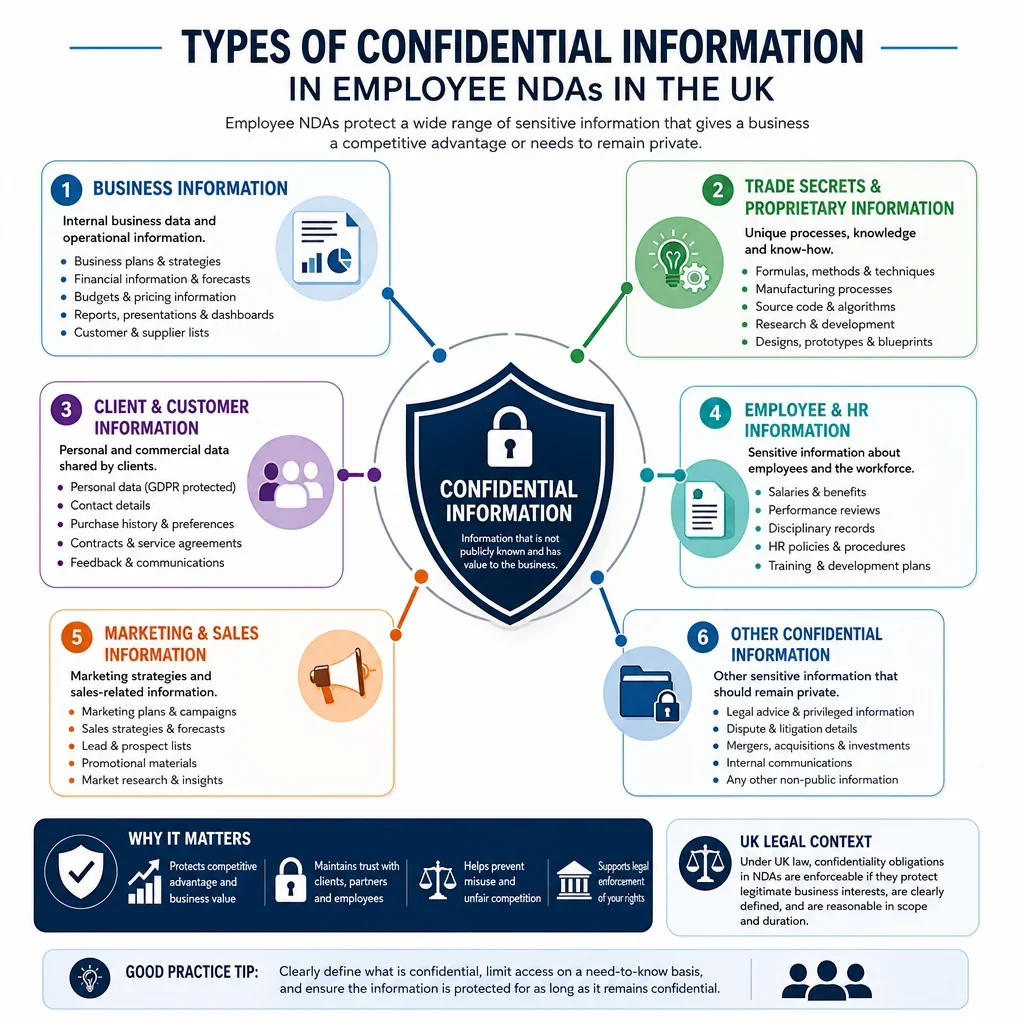
- Definition of Confidential InformationSpecify what counts as secret information, such as business plans, customer lists, or technical details.
- Obligations of the RecipientState that the recipient must not share, copy, or use the information except as allowed.
- Permitted Uses and DisclosuresOutline when the information can be used or shared, like for a specific project or if required by law.
- Duration of the AgreementDefine how long the confidentiality duty lasts, often during the relationship and for years after.
- Return or Destruction of InformationRequire the recipient to return or securely destroy the information when the agreement ends.
- Remedies for BreachExplain consequences of breaking the agreement, such as legal action or compensation for losses.
- Governing LawSpecify that the laws of England and Wales apply to any disputes.
Generate Your Document in 4 Easy Steps
Why Use Docaro?
 United Kingdom
Free Example Non-Disclosure Agreement Template
Below is a free template example of a Non-Disclosure Agreement for use in the United Kingdom generated by our AI model.
The clauses in your actual Non-Disclosure Agreement will vary from this example as they will be entirely bespoke to your requirements as set out in the questionnaire you complete.
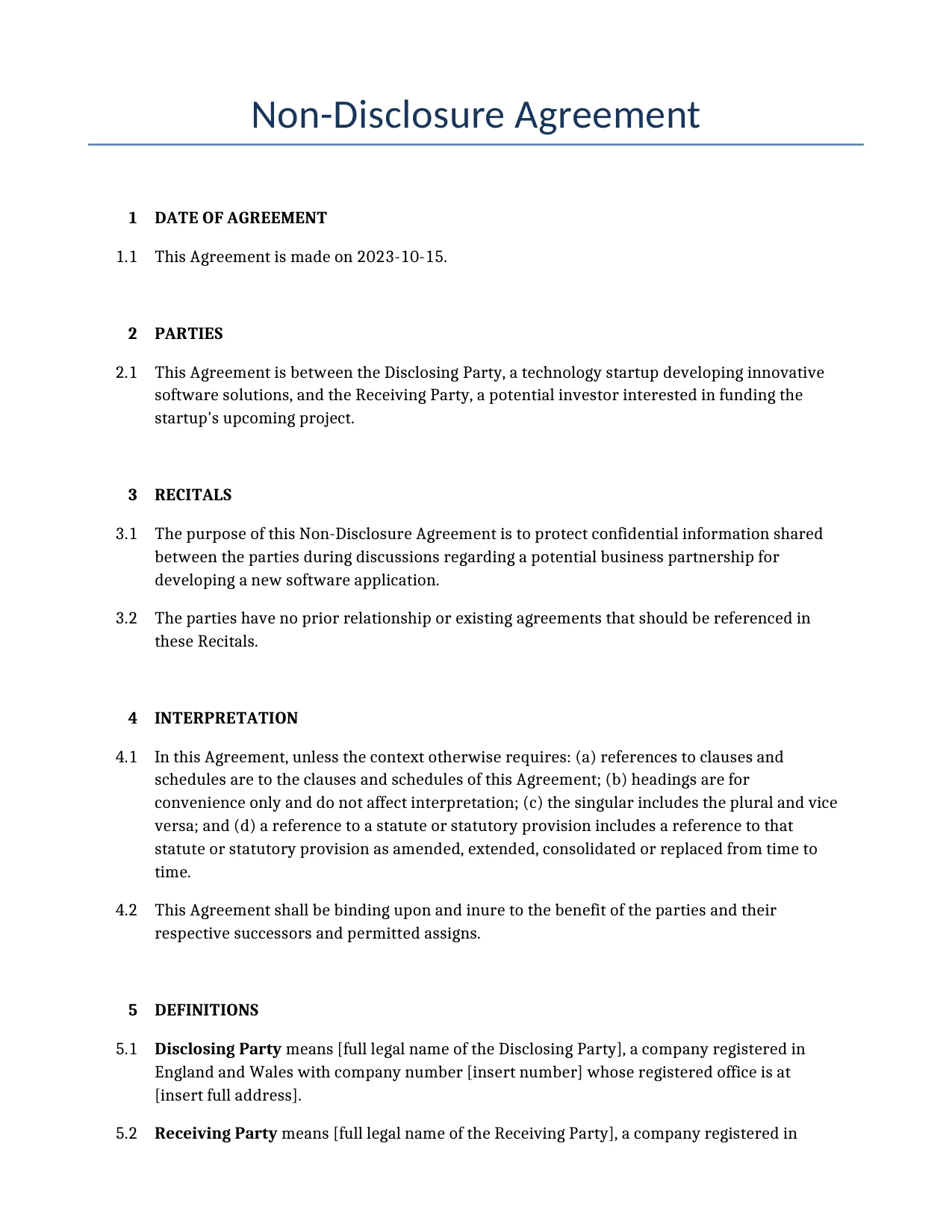
Non-Disclosure Agreement
1DATE OF AGREEMENT
This Agreement is made on 2023-10-15.
2PARTIES
This Agreement is between the Disclosing Party, a technology startup developing innovative software solutions, and the Receiving Party, a potential investor interested in funding the startup's upcoming project.
3RECITALS
The purpose of this Non-Disclosure Agreement is to protect confidential information shared between the parties during discussions regarding a potential business partnership for developing a new software application.
The parties have no prior relationship or existing agreements that should be referenced in these Recitals.
4INTERPRETATION
In this Agreement, unless the context otherwise requires: (a) references to clauses and schedules are to the clauses and schedules of this Agreement; (b) headings are for convenience only and do not affect interpretation; (c) the singular includes the plural and vice versa; and (d) a reference to a statute or statutory provision includes a reference to that statute or statutory provision as amended, extended, consolidated or replaced from time to time.
This Agreement shall be binding upon and inure to the benefit of the parties and their respective successors and permitted assigns.
5DEFINITIONS
Disclosing Party means [full legal name of the Disclosing Party], a company registered in England and Wales with company number [insert number] whose registered office is at [insert full address].
Receiving Party means [full legal name of the Receiving Party], a company registered in England and Wales with company number [insert number] whose registered office is at [insert full address].
Confidential Information has the meaning given in clause 6.
Trade Secrets means any information which meets the definition of a trade secret under the Trade Secrets (Enforcement, etc.) Regulations 2018 including but not limited to technical data, formulas, processes, know-how and customer lists.
Permitted Purpose means the evaluation of a potential investment or business collaboration between the parties in respect of the development of a new software application for the financial services sector.
Affiliate means any entity that directly or indirectly Controls, is Controlled by, or is under common Control with a party.
6CONFIDENTIAL INFORMATION
Confidential Information means all information (however recorded or preserved) disclosed or made available, directly or indirectly, by the Disclosing Party (or its employees, officers, representatives, advisers or subcontractors) to the Receiving Party (or its employees, officers, representatives, advisers or subcontractors) whether before or after the date of this Agreement, in connection with the Permitted Purpose, including but not limited to: (a) the fact that discussions are taking place concerning the Permitted Purpose; (b) the existence and terms of this Agreement; (c) any information that would be regarded as confidential by a reasonable business person relating to: (i) the business, affairs, customers, clients, suppliers, plans, intentions or market opportunities of the Disclosing Party; (ii) the operations, processes, products, inventions, designs, know-how, trade secrets, technical information, financial information or software of the Disclosing Party; and (d) any information or analysis derived from the information referred to above.
The Receiving Party acknowledges that the Confidential Information may be marked or designated as confidential at the time of disclosure or that its confidential nature would be apparent to a reasonable person.
Confidential Information shall not include information that: (a) is or becomes generally available to the public other than as a direct or indirect result of the information being disclosed by the Receiving Party in breach of this Agreement; (b) was already lawfully known to the Receiving Party before it was disclosed by the Disclosing Party; (c) has been received by the Receiving Party from a third party source that is not connected with the Disclosing Party and that such third party was not under any obligation of confidence in respect of that information; (d) was independently developed by the Receiving Party without access to or use of the Confidential Information; or (e) the Receiving Party is required by law, court order or any governmental or regulatory authority to disclose, provided that the Receiving Party shall, to the extent permitted by law, give the Disclosing Party as much notice of such disclosure as possible and shall provide all reasonable assistance to the Disclosing Party to enable it to seek a protective order or other remedy.
7OBLIGATIONS OF THE RECEIVING PARTY
The Receiving Party shall: (a) keep the Confidential Information strictly confidential and not disclose it to any person save as expressly permitted by this Agreement; (b) not use or exploit the Confidential Information for any purpose other than the Permitted Purpose; and (c) apply to the Confidential Information at least the same security measures and degree of care as it applies to its own confidential information of a similar nature, and in any event no less than reasonable care.
The Receiving Party shall only make copies of the Confidential Information to the extent strictly necessary for the Permitted Purpose and shall mark all such copies as confidential.
The Receiving Party shall ensure that the Confidential Information is stored securely and accessed only on a need-to-know basis by its employees, officers, representatives, advisers or subcontractors who have been informed of the confidential nature of the Confidential Information and have agreed to comply with the obligations in this clause 7.
The Receiving Party shall immediately notify the Disclosing Party in writing if it becomes aware of any suspected or actual unauthorised disclosure, loss or misuse of the Confidential Information.
At any time during the term of this Agreement, the Receiving Party shall, at the Disclosing Party's request, promptly return to the Disclosing Party or destroy all copies of the Confidential Information in its possession or control (and, if requested, certify in writing that it has done so) save that it may retain one copy solely for the purposes of complying with its legal and regulatory obligations (subject always to the continuing application of the obligations in this Agreement to such retained copy).
8PERMITTED DISCLOSURES
The Receiving Party may disclose the Confidential Information to any of its employees, officers, representatives, professional advisers or funders/investors who need to know such information for the Permitted Purpose, provided that: (a) it informs such persons of the confidential nature of the Confidential Information before disclosure; and (b) it procures that such persons comply with the obligations set out in clause 7 as if they were the Receiving Party (and it shall be liable for the acts or omissions of such persons as if they were the acts or omissions of the Receiving Party).
The Receiving Party may disclose the Confidential Information where such disclosure is required by law, by any court of competent jurisdiction, by any governmental or regulatory authority, or by the rules of any listing authority or stock exchange, provided that it gives the Disclosing Party as much notice of such disclosure as is reasonably practicable and, where reasonably possible and at the Disclosing Party's cost, provides the Disclosing Party with all reasonable assistance to enable it to seek a protective order or other appropriate remedy.
9TERM AND DURATION OF OBLIGATIONS
This Agreement shall commence on the date of this Agreement or the date of first disclosure of Confidential Information (whichever is earlier) and shall continue in full force and effect for a period of [2] years from that date (the Term), unless terminated earlier in accordance with clause 9.4.
The obligations of confidentiality and all other obligations under this Agreement shall survive termination or expiry of this Agreement and shall continue: (a) for a period of [5] years from the date of disclosure in respect of Confidential Information that does not constitute a Trade Secret; and (b) without limit in time in respect of Trade Secrets.
Termination or expiry of this Agreement shall not affect the accrued rights, remedies, obligations or liabilities of the parties existing at termination or expiry.
Either party may terminate this Agreement at any time by giving not less than [30] days' written notice to the other party.
10RETURN OR DESTRUCTION OF INFORMATION
Upon request by the Disclosing Party or upon termination of this Agreement, the Receiving Party shall return or destroy all copies of the Confidential Information.
The Receiving Party shall provide a written certification of compliance with the obligations set out in this clause.
11NO LICENCE OR OWNERSHIP
Nothing in this Agreement grants the Receiving Party any licence, interest, or ownership rights in the Confidential Information.
No implied or express licence is granted to the Receiving Party for the use of the Confidential Information beyond the Permitted Purpose.
All intellectual property rights in the Confidential Information shall remain the exclusive property of the Disclosing Party (or its licensors). The Receiving Party shall not acquire any right, title or interest in or to any intellectual property rights in the Confidential Information.
12NO PARTNERSHIP OR AGENCY
Nothing in this Agreement is intended to, or shall be deemed to, establish any partnership or joint venture between the parties, constitute any party the agent of the other party, or authorise any party to make or enter into any commitments for or on behalf of the other party.
Each party confirms it is acting on its own behalf and not for the benefit of any other person.
13REPRESENTATIONS AND WARRANTIES
Each party represents and warrants to the other that it has full power and authority to enter into this Agreement and to perform its obligations hereunder.
The Disclosing Party warrants that it has the right to disclose the Confidential Information to the Receiving Party and that, to the best of its knowledge, the Confidential Information is accurate and complete. However, the Disclosing Party does not warrant the accuracy or completeness of the Confidential Information and the Receiving Party relies on it at its own risk.
Except as expressly provided in this Agreement, no representations or warranties are given by either party.
14LIMITATION OF LIABILITY
Nothing in this Agreement limits or excludes the liability of either party for: (a) death or personal injury resulting from its negligence; (b) fraud or fraudulent misrepresentation; or (c) any other liability which cannot be excluded or limited by law.
Subject to clause 14.1, the Disclosing Party shall not be liable to the Receiving Party (whether in contract, tort (including negligence), breach of statutory duty or otherwise) for any loss of profits, loss of sales or business, loss of agreements or contracts, loss of anticipated savings, loss of use or corruption of software, data or information, loss of or damage to goodwill, or any indirect or consequential loss arising under or in connection with this Agreement.
Subject to clauses 14.1 and 14.2, the total liability of the Disclosing Party to the Receiving Party in respect of all claims arising under or in connection with this Agreement (whether in contract, tort (including negligence), breach of statutory duty or otherwise) shall not exceed £[50,000].
The remedies available to the Disclosing Party for breach of confidence shall not be limited by the provisions of this clause 14.
15REMEDIES FOR BREACH
The Receiving Party acknowledges that any breach of its obligations under this Agreement may cause the Disclosing Party irreparable harm for which damages alone may not be an adequate remedy. Accordingly, the Disclosing Party shall be entitled to seek equitable relief (including injunctive relief and specific performance) in respect of any actual or threatened breach, without the need to prove irreparable harm or to post a bond or other security.
The rights and remedies provided under this Agreement are cumulative and in addition to, and not exclusive of, any rights or remedies provided by law.
The Receiving Party agrees that the restrictions and obligations contained in this Agreement are reasonable and necessary to protect the legitimate interests of the Disclosing Party.
16INDEMNITY
The Receiving Party shall indemnify and hold harmless the Disclosing Party from and against any and all losses, damages, liabilities, costs (including reasonable legal fees) and expenses suffered or incurred by the Disclosing Party as a result of any breach by the Receiving Party (or any person to whom it has disclosed Confidential Information pursuant to clause 8) of the terms of this Agreement.
The Receiving Party shall, at the Disclosing Party's request, provide all reasonable assistance to defend any third party claim arising from the Receiving Party's breach of this Agreement.
17COMPLIANCE WITH LEGISLATION
Each party shall comply with all applicable laws, statutes and regulations relating to anti-bribery and anti-corruption including but not limited to the Bribery Act 2010.
The parties shall comply with the Data Protection Act 2018, the UK General Data Protection Regulation (UK GDPR), and all other applicable data protection and privacy laws in respect of any personal data comprised in the Confidential Information. The Receiving Party shall only process such personal data on documented instructions from the Disclosing Party and shall implement appropriate technical and organisational measures to protect such personal data.
The Receiving Party shall comply with all applicable export control laws and sanctions regulations including those of the United Kingdom, the European Union and the United States of America. The Receiving Party shall not export, re-export or transfer any Confidential Information in violation of such laws.
The Receiving Party shall comply with the Modern Slavery Act 2015 and shall not engage in any activity which constitutes an offence under that Act.
The Receiving Party shall maintain in force, with a reputable insurance company, professional indemnity insurance and public liability insurance in an amount not less than £[5,000,000] per claim and shall, on the Disclosing Party's request, produce both the insurance certificate and receipt for the current year's premium.
18FORCE MAJEURE
Neither party shall be in breach of this Agreement nor liable for delay in performing, or failure to perform, any of its obligations under this Agreement if such delay or failure results from events, circumstances or causes beyond its reasonable control including acts of God, flood, drought, earthquake or other natural disaster, epidemic, pandemic, terrorist attack, civil war, civil commotion or riots, war, threat of or preparation for war, armed conflict, imposition of sanctions, embargo, or breaking off of diplomatic relations, nuclear, chemical or biological contamination, any law or any action taken by a government or public authority (including without limitation imposing an export or import restriction, quota or prohibition).
The party affected by a force majeure event shall use all reasonable endeavours to mitigate the effect of the force majeure event and resume performance of its obligations as soon as reasonably practicable.
19ANTI-BRIBERY AND CORRUPTION
Each party shall: (a) comply with all applicable laws, statutes, regulations and codes relating to anti-bribery and anti-corruption including but not limited to the Bribery Act 2010; (b) not engage in any activity, practice or conduct which would constitute an offence under sections 1, 2 or 6 of the Bribery Act 2010 if such activity, practice or conduct had been carried out in the UK; (c) comply with any ethics and anti-bribery policies of the other party as notified from time to time; and (d) promptly report to the other party any request for undue financial or other advantage of any kind received in connection with this Agreement.
Breach of this clause 19 shall be deemed a material breach of this Agreement.
20GOVERNING LAW
This Agreement and any dispute or claim arising out of or in connection with it or its subject matter or formation shall be governed by and construed in accordance with the law of England and Wales.
The parties agree that the law of England and Wales shall apply without reference to conflict of laws principles.
21JURISDICTION
The courts of England and Wales shall have exclusive jurisdiction over any dispute arising out of or in connection with this Agreement.
22ENTIRE AGREEMENT
This Agreement constitutes the entire understanding between the parties and supersedes all prior agreements or understandings, oral or written, relating to its subject matter.
This Agreement includes any schedules, attachments, or annexes which form part of the full agreement.
23SEVERABILITY
If any provision of this Agreement is held to be invalid or unenforceable, such provision shall be severed and the remaining provisions shall continue in full force and effect.
24WAIVER
No waiver of any breach of this Agreement shall be deemed a waiver of any subsequent breach.
Any waiver of a breach must be in writing to be effective.
25ASSIGNMENT
Neither the Disclosing Party nor the Receiving Party may assign this Agreement or any rights or obligations under it without the prior written consent of the other party.
Such consent must not be unreasonably withheld.
26NOTICES
Any notice given to a party under or in connection with this Agreement shall be in writing and shall be: (a) delivered by hand or by pre-paid first-class post or other next working day delivery service at its registered office (if a company) or its principal place of business (in any other case); or (b) sent by email to the address specified in this clause or as otherwise notified to the other party in accordance with this clause.
The addresses for service of notices are: Disclosing Party: [insert address and email]; Receiving Party: [insert address and email].
Any notice shall be deemed to have been received: (a) if delivered by hand, on signature of a delivery receipt; (b) if sent by pre-paid first-class post or other next working day delivery service, at 9.00 am on the second Business Day after posting; and (c) if sent by email, at the time of transmission, or, if this time falls outside business hours in the place of receipt, when business hours resume. In this clause, business hours means 9.00am to 5.00pm Monday to Friday on a day that is not a public holiday in the place of receipt.
This clause does not apply to the service of any proceedings or other documents in any legal action or other method of dispute resolution.
27THIRD PARTY RIGHTS
A person who is not a party to this Agreement shall have no rights under the Contracts (Rights of Third Parties) Act 1999 to enforce any term of this Agreement.
28VARIATION
No variation of this Agreement shall be effective unless it is in writing and signed by the parties.
29EXECUTION
IN WITNESS WHEREOF, the parties have executed this Agreement as of the date first above written.
Executed and delivered as a deed by [full legal name of Disclosing Party] acting by a director in the presence of a witness: Director: _______________________________ Signature: _______________________________ Witness name: _______________________________ Witness signature: _______________________________ Witness address: _______________________________ Witness occupation: _______________________________ Date: _______________
Executed and delivered as a deed by [full legal name of Receiving Party] acting by a director in the presence of a witness: Director: _______________________________ Signature: _______________________________ Witness name: _______________________________ Witness signature: _______________________________ Witness address: _______________________________ Witness occupation: _______________________________ Date: _______________
This example shows approximately 70% of a typical document and is provided for illustrative purposes only. The remaining content has been omitted.
Every document generated by Docaro is tailored to your specific circumstances, jurisdiction and the information you provide. The completed document includes all applicable clauses and provisions required for your situation.
To generate the full, personalised document, answer a short series of questions and your document will be created instantly.
Useful Resources When Considering a Non-Disclosure Agreement in the United Kingdom
United Kingdom Reference Legislation
Non-Disclosure Agreement FAQs
Document Generation FAQs
Related Articles