AI Generated Data Retention and Records Management Policy for use in the United Kingdom
PDF & Word - 2026 Updated
Docaro Pricing
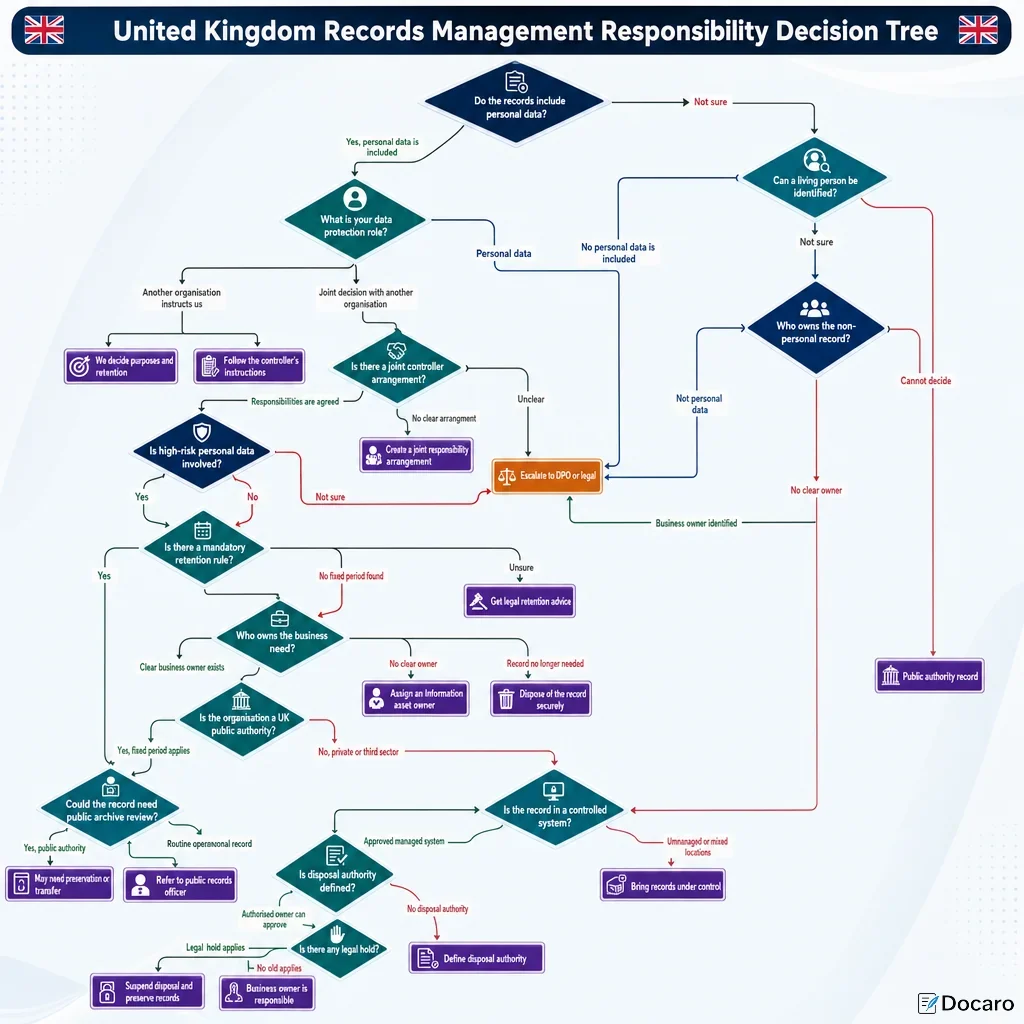
When do you need a Data Retention and Records Management Policy in the United Kingdom?
British Legal Rules for a Data Retention and Records Management Policy
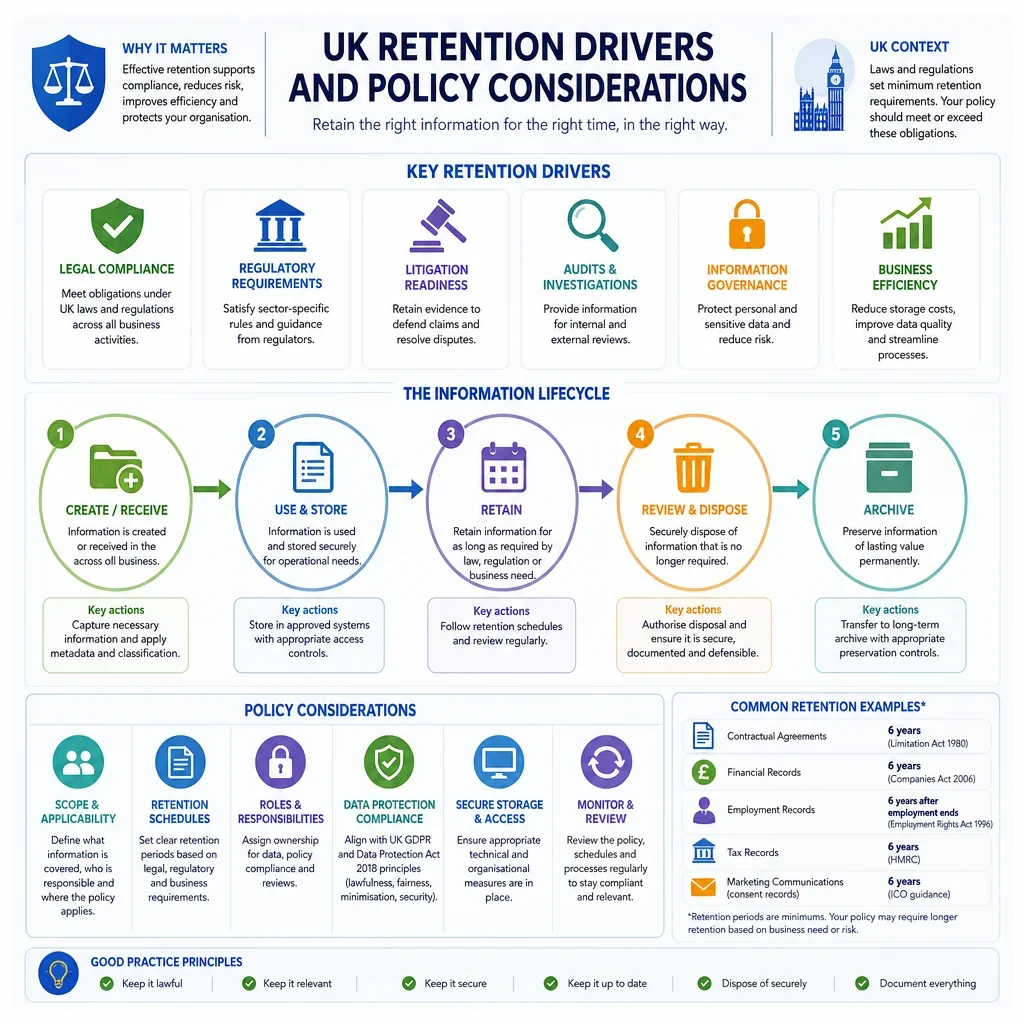
Failing to align the data retention policy with relevant UK data protection laws, such as the UK GDPR, can result in non-compliance and regulatory penalties.
What a Proper Data Retention and Records Management Policy Should Include
- Purpose of the PolicyThis section explains why the policy exists, such as protecting data, meeting legal requirements, and supporting business operations.
- Scope and ApplicabilityIt defines which types of records and data the policy covers and who in the organization must follow it.
- Key DefinitionsSimple explanations of terms like 'records,' 'retention period,' and 'disposal' to ensure everyone understands the policy.
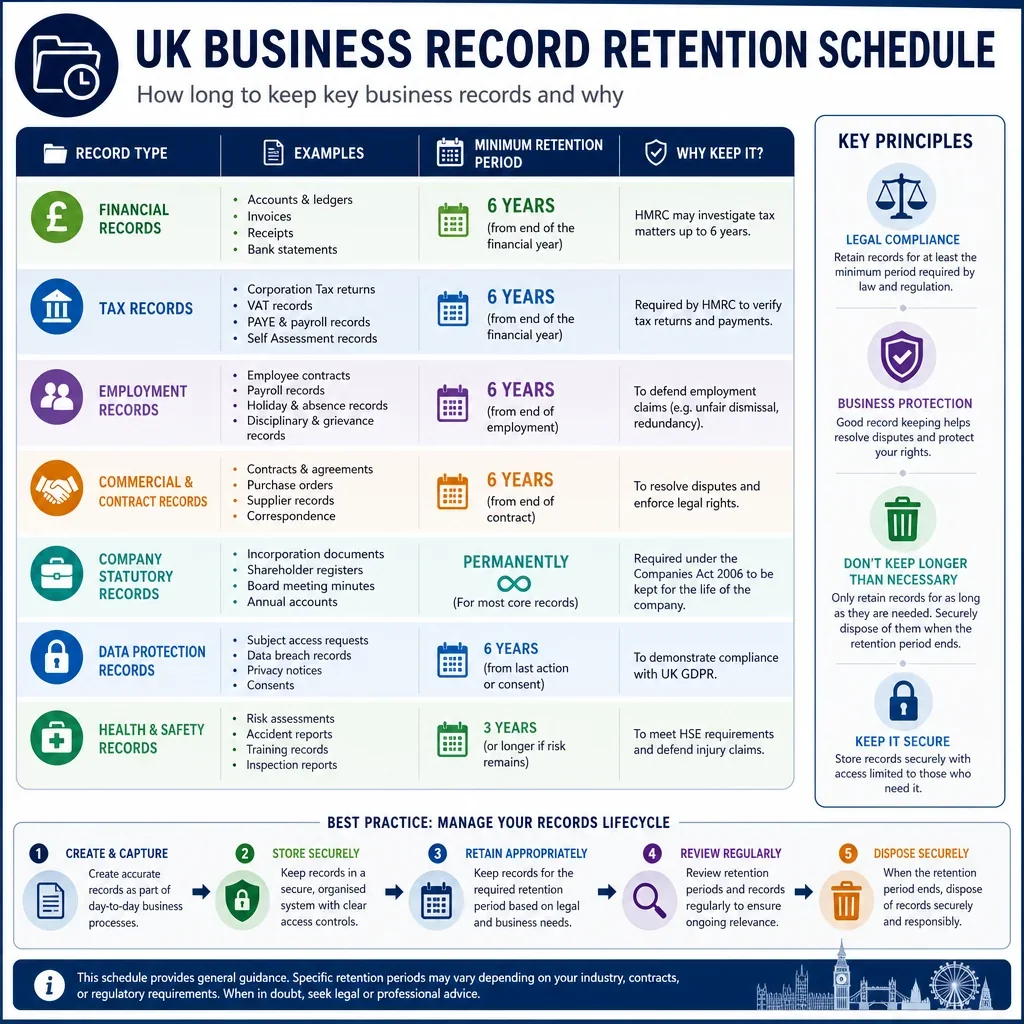
- Retention SchedulesA list of how long different types of data, such as customer info or financial records, should be kept before deletion.
- Data ClassificationGuidelines for categorizing records by importance, like public or confidential, to decide retention needs.
- Storage and SecurityRules for safely storing records, including digital security measures and access controls.
- Disposal ProceduresSteps for securely deleting or destroying records once their retention period ends.
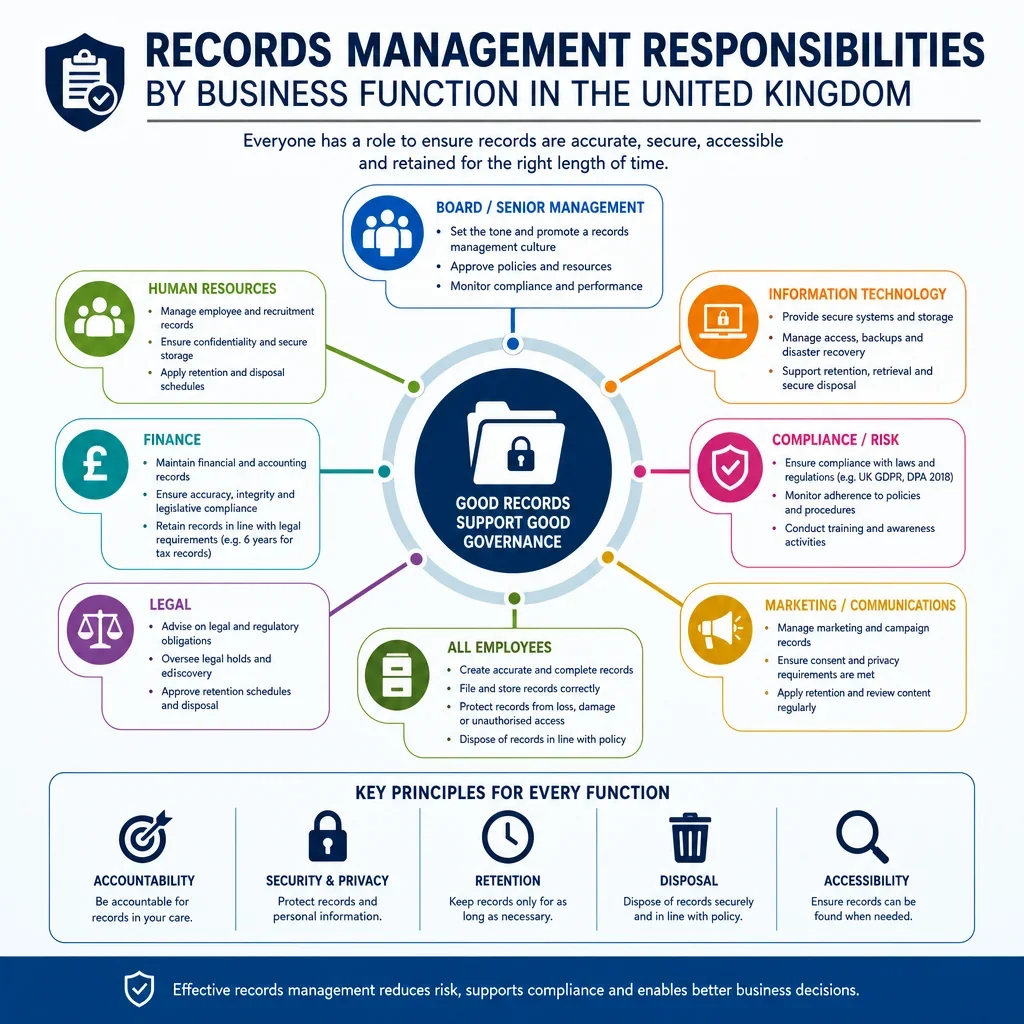
- Roles and ResponsibilitiesClear assignment of duties to staff or departments for managing records throughout their lifecycle.
- Compliance and TrainingRequirements for training employees and monitoring adherence to the policy to avoid legal issues.
- Review and UpdatesA plan for regularly reviewing and updating the policy to reflect new laws or business changes.
Generate Your Document in 4 Easy Steps
Why Use Docaro?
 United Kingdom
Free Example Data Retention and Records Management Policy Template
Below is a free template example of a Data Retention and Records Management Policy for use in the United Kingdom generated by our AI model.
The clauses in your actual Data Retention and Records Management Policy will vary from this example as they will be entirely bespoke to your requirements as set out in the questionnaire you complete.
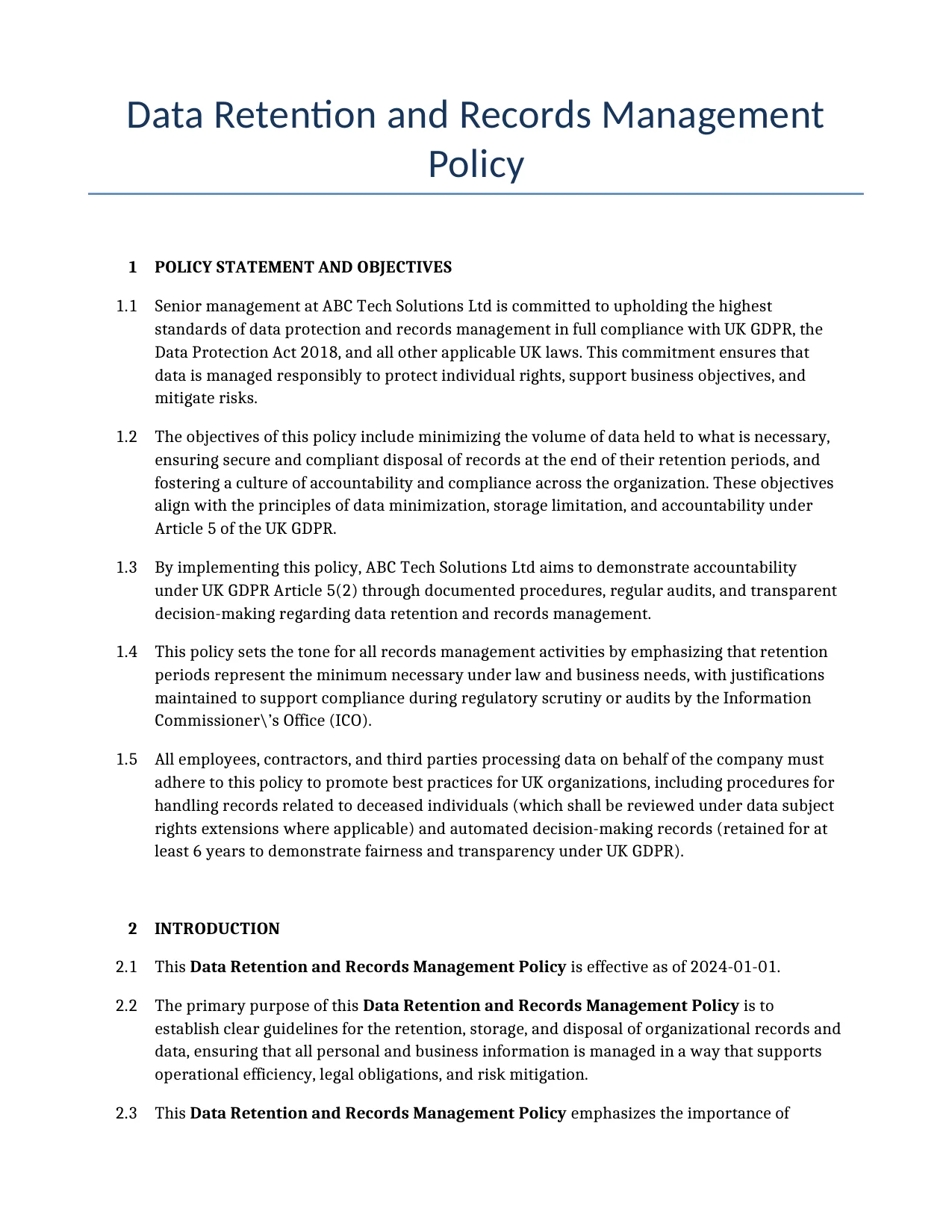
Data Retention and Records Management Policy
1POLICY STATEMENT AND OBJECTIVES
Senior management at ABC Tech Solutions Ltd is committed to upholding the highest standards of data protection and records management in full compliance with UK GDPR, the Data Protection Act 2018, and all other applicable UK laws. This commitment ensures that data is managed responsibly to protect individual rights, support business objectives, and mitigate risks.
The objectives of this policy include minimizing the volume of data held to what is necessary, ensuring secure and compliant disposal of records at the end of their retention periods, and fostering a culture of accountability and compliance across the organization. These objectives align with the principles of data minimization, storage limitation, and accountability under Article 5 of the UK GDPR.
By implementing this policy, ABC Tech Solutions Ltd aims to demonstrate accountability under UK GDPR Article 5(2) through documented procedures, regular audits, and transparent decision-making regarding data retention and records management.
This policy sets the tone for all records management activities by emphasizing that retention periods represent the minimum necessary under law and business needs, with justifications maintained to support compliance during regulatory scrutiny or audits by the Information Commissioner\’s Office (ICO).
All employees, contractors, and third parties processing data on behalf of the company must adhere to this policy to promote best practices for UK organizations, including procedures for handling records related to deceased individuals (which shall be reviewed under data subject rights extensions where applicable) and automated decision-making records (retained for at least 6 years to demonstrate fairness and transparency under UK GDPR).
2INTRODUCTION
This Data Retention and Records Management Policy is effective as of 2024-01-01.
The primary purpose of this Data Retention and Records Management Policy is to establish clear guidelines for the retention, storage, and disposal of organizational records and data, ensuring that all personal and business information is managed in a way that supports operational efficiency, legal obligations, and risk mitigation.
This Data Retention and Records Management Policy emphasizes the importance of compliance with the UK General Data Protection Regulation (UK GDPR) and the Data Protection Act 2018.
ABC Tech Solutions Ltd shall ensure that all aspects of this Data Retention and Records Management Policy align with the governing law which is British law.
3SCOPE AND APPLICABILITY
This Data Retention and Records Management Policy applies to all data retention and records management activities within ABC Tech Solutions Ltd, covering Personal Data, Financial Data, Customer Data, and Employee Data across all departments including Human Resources, Finance, IT and Data Management, and Sales and Marketing.
ABC Tech Solutions Ltd is a software development company specializing in cloud-based solutions for small and medium-sized enterprises, with operations focused on custom application development and IT consulting services.
This Data Retention and Records Management Policy applies to Full-Time Employees, Part-Time Employees, Contractors and Consultants, and Senior Management.
This Data Retention and Records Management Policy applies to any subsidiaries of ABC Tech Solutions Ltd.
This Data Retention and Records Management Policy covers data processing locations in the United Kingdom Only and the European Union.
4DEFINITIONS
Records are any documents, files, or data created or received by the organisation in the course of its business activities, including electronic and paper formats.
The retention period is the designated length of time that records must be kept before they can be disposed of, based on legal, regulatory, and business requirements.
Disposal refers to the secure destruction or deletion of records at the end of their retention period, ensuring no unauthorised recovery is possible.
Sensitive Personal Data means data revealing racial or ethnic origin, political opinions, religious or philosophical beliefs, or trade union membership, and the processing of genetic data, biometric data for the purpose of uniquely identifying a natural person, data concerning health or data concerning a natural person\’s sex life or sexual orientation.
Archival records are records identified for permanent preservation due to their historical, legal, or operational significance that have exceeded their active use but require long-term retention.
\‘Personal data breach\’ means a breach of security leading to the accidental or unlawful destruction, loss, alteration, unauthorised disclosure of, or access to, personal data transmitted, stored or otherwise processed (as defined under UK GDPR Article 4).
\‘Controller\’ means the natural or legal person, public authority, agency or other body which, alone or jointly with others, determines the purposes and means of the processing of personal data (as defined under UK GDPR Article 4). All sections of this policy reference accountability obligations on the controller under UK GDPR Article 5(2).
5LEGAL AND REGULATORY FRAMEWORK
This Data Retention and Records Management Policy is governed by British law and complies with the Data Protection Act 2018, UK General Data Protection Regulation (UK GDPR), Freedom of Information Act 2000, Limitation Act 1980, Companies Act 2006, Financial Services and Markets Act 2000, Regulation (EU) No 596/2014 (Market Abuse Regulation) as retained in UK law, the Privacy and Electronic Communications Regulations 2003 (PECR), and the Electronic Communications Data Protection Directive as retained in UK law. It also aligns with ISO 15489 standards for records management.
As ABC Tech Solutions Ltd operates in the Finance sector, this Data Retention and Records Management Policy incorporates sector-specific retention requirements under the Financial Services and Markets Act 2000 and the retained Market Abuse Regulation.
PECR impacts data retention by requiring that electronic marketing communications records (such as consent and opt-out records) be retained only as long as necessary for compliance, typically no more than 6 years after consent withdrawal to align with limitation periods, thereby reducing risks of unnecessary data storage and potential fines for non-compliance.
The retained Electronic Communications Data Protection Directive and ISO 15489 emphasize structured records management systems that mandate secure disposal practices, including audit trails for destruction. For a UK-based software company, this means implementing automated deletion protocols post-retention to mitigate data breach risks and demonstrate accountability under UK GDPR.
6ROLES AND RESPONSIBILITIES
Dr. Emily Carter, the Data Protection Officer belonging to the Legal and Compliance department, shall oversee compliance with this Data Retention and Records Management Policy, particularly where the organization processes sensitive personal data as defined under UK GDPR.
James Thompson, the Records Manager belonging to the Information Services department, shall develop and maintain retention schedules, oversee records storage and disposal, and conduct regular audits of records practices.
Each Department Director shall ensure department compliance with retention schedules, identify department-specific retention needs, and approve disposal of department records.
All employees shall complete mandatory training on data retention and records management, classify documents according to retention categories, report potential retention breaches immediately, and follow approved disposal procedures for obsolete records.
Senior management shall be responsible for overall oversight and approval of the Data Retention and Records Management Policy.
7CLASSIFICATION OF RECORDS
The classification system categorizes records based on their content, sensitivity, and legal requirements to ensure appropriate handling, storage, and retention.
Records are divided into categories such as personal data, financial records, operational records, and confidential information, with clear criteria for each to facilitate compliance with UK data protection laws.
Personal data includes records containing information that relates to an identified or identifiable living individual, such as names, contact details, employee records, or customer information, in line with the UK GDPR definitions.
Financial records include records involving monetary transactions, budgets, invoices, payroll, tax documents, or financial statements that require auditing and compliance with UK financial regulations.
Operational records include records related to day-to-day business activities, including project files, meeting minutes, process documentation, and internal communications that support ongoing operations but do not fall into other sensitive categories.
Confidential information includes records marked as confidential if their disclosure could cause harm to the organization, individuals, or third parties, including trade secrets, legal agreements, sensitive HR information, or proprietary business strategies.
The classification system shall be reviewed by 2025-12-31.
8RETENTION SCHEDULES
Employee files shall be retained for 7 years after employment ends.
Contracts shall be retained for 6 years after contract expiry.
Customer data shall be retained for 5 years after customer relationship ends.
Financial Records, Health and Safety Records, and Board Meeting Minutes shall be retained in accordance with the schedules set out in the Appendices, incorporating sector-specific regulations applicable to the Finance sector.
The retention schedule shall be reviewed by 2025-12-31.
The following enumerated list details minimum retention periods for various record types, cross-referenced to legal bases. Retention is the minimum necessary period justified for accountability under UK GDPR Article 5(2), Data Protection Act 2018, and other referenced laws. 1. Tax Records (e.g., VAT, corporation tax): 6 years from end of accounting period (Legal basis: Finance Act 1998, Companies Act 2006; Justification: Statutory limitation for HMRC claims). 2. Health and Safety Records (incident reports): 40 years where asbestos-related, otherwise 6 years (Legal basis: Control of Asbestos Regulations 2012, UK GDPR Art. 9; Justification: Long-term liability protection). 3. Marketing Consent Records: 6 years after consent withdrawal (Legal basis: PECR 2003, UK GDPR Art. 6(1)(a); Justification: Limitation for disputes). 4. IT System Logs and Access Records: 12 months (Legal basis: UK GDPR Art. 5(1)(e), Network and Information Systems Regulations 2018; Justification: Security monitoring without excess storage). 5. Payroll Records: 6 years (Legal basis: Income Tax (Employments) Regulations 2003; Justification: Tax and employment claims). 6. Customer Contracts: 6 years post-termination (Legal basis: Limitation Act 1980; Justification: Contractual dispute limitation). 7. Employee Contracts and HR Files: 7 years post-termination (Legal basis: Limitation Act 1980, UK GDPR; Justification: Employment tribunal claims). 8. Board Meeting Minutes: Indefinitely (Legal basis: Companies Act 2006; Justification: Historical and legal significance). 9. Automated Decision-Making Records: 6 years (Legal basis: UK GDPR Art. 22, Art. 5(2); Justification: Demonstrate fairness in processing). 10. Records Relating to Deceased Individuals: 7 years or as per estate claims (Legal basis: UK GDPR Recital 27, Administration of Estates Act; Justification: Handle queries from executors). 11. Financial Audit Trails: 6 years (Legal basis: Companies Act 2006; Justification: Audit and fraud prevention). 12. Supplier Invoices: 6 years (Legal basis: VAT Act 1994; Justification: Tax authority requirements). 13. Data Breach Incident Logs: 6 years (Legal basis: UK GDPR Art. 33(5); Justification: ICO accountability). 14. Training Records: 6 years (Legal basis: UK GDPR Art. 5(2); Justification: Prove staff awareness). 15. Website Analytics Data: 26 months (Legal basis: PECR 2003, UK GDPR; Justification: Cookie consent and minimization). 16. Insurance Policies and Claims: 7 years post-expiry (Legal basis: Limitation Act 1980; Justification: Claim defense).
9DATA STORAGE AND PRESERVATION
Records that require physical storage shall be stored in on-site secure rooms or off-site storage facilities.
All applicable records shall be stored using digital storage methods including cloud-based storage and on-premises servers.
All digital records shall be protected using AES-256 encryption or stronger standards such as AES-512 where supported by systems, justified by current best practices from NIST and NCSC guidelines to exceed minimum UK GDPR security requirements under Article 32.
Regular backup procedures shall be required for all stored records.
The integrity of stored records over the retention period shall be verified using checksum validation and periodic audits.
This section shall be first reviewed by 2025-01-01.
Pseudonymization techniques shall be applied where appropriate for personal data storage to enhance privacy, alongside strict data minimization practices ensuring only necessary fields are retained in active systems, in line with UK GDPR principles.
Procedures for regular vulnerability assessments (at least quarterly) and integration with the organization\’s Information Security Management System (ISMS) compliant with ISO 27001 shall be followed. Reference ICO guidance on data security and retention which emphasizes risk-based approaches to storage and deletion.
10ACCESS CONTROLS AND SECURITY
Role-based access controls shall be implemented to ensure records remain accessible only to authorised personnel.
Access to records shall require multi factor authentication and password authentication.
Encryption using AES 256 (or stronger) and TLS 1.3 shall be enabled for records stored at rest in systems and for records transmitted over networks.
Access shall be granted based on predefined roles within the organisation, with approvals required from department heads for sensitive records, and protocols shall include just-in-time access for temporary needs and regular reviews every six months.
Regular security audits shall be scheduled to test access controls for records.
Intrusion detection systems, access logging and monitoring, and employee training programs shall be implemented to protect against unauthorised access or data breaches.
Data minimization in storage shall be enforced by automatically archiving or deleting non-essential data fields. Reference to ICO\’s guidance on data retention and security highlights the need for pseudonymization in access logs where full identification is not required.
Integration with the ISMS includes annual penetration testing and vulnerability assessments. Encryption standards are justified per NCSC recommendations, which advocate for quantum-resistant algorithms in addition to AES-256 for long-term sensitive data protection under UK GDPR Article 32.
11RECORD CREATION AND CAPTURE
All records must be created with clear authorship, dated accurately, and include a brief description of the content to ensure traceability and completeness.
Guidelines for capturing automated records generated by systems shall be followed.
Records shall be captured in PDF or DOCX formats.
All captured records shall include metadata consisting of date created, author name, document title, version number, and keywords for searchability.
Metadata capture shall be mandatory for every record created or captured.
This section becomes effective on 2024-01-01.
The Compliance Department shall be responsible for overseeing record creation and capture compliance.
12DISPOSAL AND DESTRUCTION
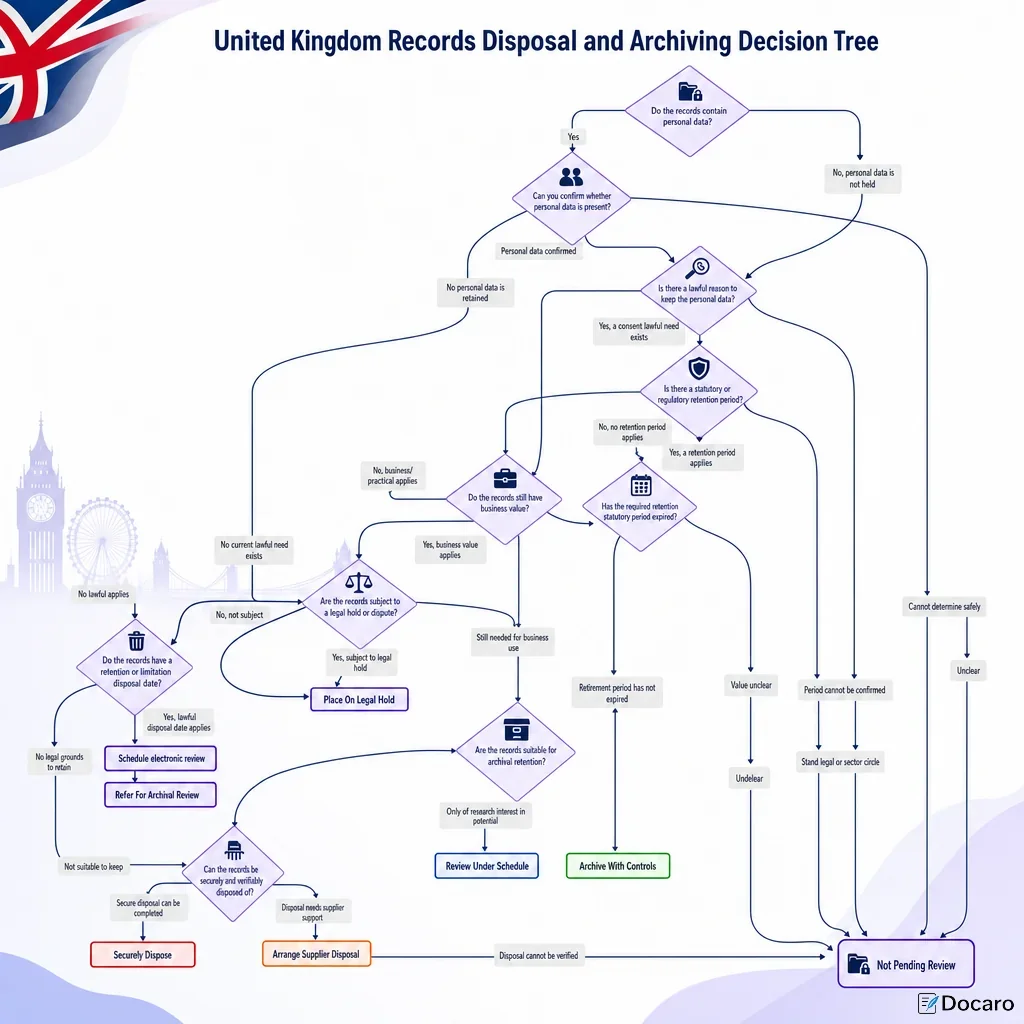
At the end of the retention period, all records will be reviewed by the Records Management Team to confirm eligibility for disposal.
Eligible records will be securely transported to an approved destruction facility.
A certificate of destruction will be obtained and filed in the company\’s records system.
Any exceptions will be documented and reported to the Data Protection Officer.
Shredding for paper records, secure deletion software for digital files, and degaussing for magnetic media shall be used for the destruction of records.
All disposals must be documented using the standard Disposal Log Form, which includes the date, description of records disposed, method used, responsible personnel, and any exceptions noted, and copies of certificates of destruction must be attached and retained for 7 years.
A procedure for handling litigation holds that suspend disposal during legal proceedings shall be followed as set out in Section 13.
The Records Management Officer, in coordination with the IT Department for digital records, shall oversee record disposal.
Audits of the disposal process shall be conducted annually.
13LITIGATION HOLDS AND PRESERVATION ORDERS
A formal policy for implementing legal holds is included in this Data Retention and Records Management Policy.
The Chief Compliance Officer shall be designated as the preservation officer responsible for overseeing legal holds.
Anticipated litigation, receipt of court order, or regulatory investigation shall constitute trigger events for initiating a litigation hold.
The procedure for preserving records under a legal hold shall include identifying and notifying relevant custodians of records, suspending all deletion or alteration of specified records, collecting and securing records in a designated repository, and monitoring compliance and reporting any issues to the preservation officer.
Electronic communications, digital files, and metadata and logs shall be explicitly required to be preserved under litigation holds.
Annual training for employees on litigation hold procedures shall be mandated.
The initiation and release of each litigation hold shall be documented by maintaining a centralized log including the date of initiation, trigger event, affected records, custodians notified, and date of release, with all entries signed off by the preservation officer and stored in the organization\’s secure records management system.
14AUDITS AND COMPLIANCE MONITORING
The company shall conduct internal audits to ensure adherence to this Data Retention and Records Management Policy.
Audits and reviews shall be conducted quarterly.
A dedicated compliance officer shall be appointed to oversee the audits and monitoring.
The next audit or review shall occur on 2024-12-01.
Formal reporting mechanisms for audit findings to senior management shall be implemented.
Compliance reports shall be sent to the Senior Management Team and Board of Directors.
Specific corrective actions for identified non-compliance issues shall be defined in this Data Retention and Records Management Policy.
Corrective actions shall be initiated within 30 days after identifying a compliance issue.
All audit results and monitoring outcomes shall be formally documented and retained.
15TRAINING AND AWARENESS
Formal training programs on data retention and records management obligations shall be required for staff.
The training programs shall have the objectives to ensure all staff understand legal requirements for data retention under UK GDPR, identify retention periods for different record types, and apply proper records management practices to avoid compliance risks.
All employees and managers and supervisors shall be targeted for the training and awareness initiatives.
Online modules and in-person workshops shall be included as delivery methods for the training programs.
Staff shall undergo refresher training on data retention obligations every 12 months.
Non-training awareness initiatives, such as posters or newsletters, shall be included to educate staff on records management.
The Compliance Team shall be responsible for overseeing the training and awareness programs.
Requirements for measuring the effectiveness of the training and awareness programs shall be included.
16DATA SUBJECT RIGHTS AND REQUESTS
Dr. Emily Carter shall be the designated Data Protection Officer responsible for overseeing data subject rights compliance, and may be contacted at emily.carter@company.co.uk.
An automated system shall be implemented for handling data subject access requests.
The organization aims to respond to data subject rights requests within 30 days.
Online portal and email correspondence shall be used for handling common data subject rights such as access, rectification, and erasure.
Upon receiving a rectification request, the Data Protection Officer will verify the requester\’s identity, assess the accuracy of the data in question, and update the records within 30 days if the request is valid, and the requester will be notified of the outcome in writing.
The erasure procedure begins with identity verification and evaluation of the request, and if approved, data will be deleted from all systems unless retention is required by law (for example, for tax or audit purposes), in which case the requester will be informed of the limitations and the data will be anonymized where possible.
Data retention periods may limit certain data subject rights, such as erasure, in cases of legal obligations.
Staff shall be trained on handling data subject rights and retention interactions annually.
17THIRD-PARTY AND VENDOR MANAGEMENT
ABC Tech Solutions Ltd uses third-party services or vendors for processing personal data or records in the United Kingdom, specifically cloud storage providers, data processing vendors, and IT support and maintenance.
Key third-party vendors include AWS for cloud storage of employee records, a payroll processing firm for handling financial data, and an IT maintenance company that manages servers for data backups.
Data processing agreements are in place with all third-party processors as required by UK GDPR.
Contracts with third parties include specific clauses on data retention periods and deletion obligations.
Audits on third-party compliance with retention policies shall be conducted annually.
Rights to audit third parties for retention compliance shall be included in contracts.
Ongoing monitoring of third-party compliance with data retention requirements shall be implemented.
Third parties shall report retention-related breaches within 24 hours.
Contracts shall require third parties to return or delete all data upon termination, per retention policies.
18DATA TRANSFERS AND INTERNATIONAL CONSIDERATIONS
ABC Tech Solutions Ltd engages in transfers of personal data to the EU/EEA and to the USA.
Personal data is transferred outside the United Kingdom to European Economic Area (EEA) countries and the United States.
Employee contact details and customer email addresses are transferred to the EU subsidiary for collaboration purposes, involving approximately 500 records monthly, and anonymized analytics data is shared with a US-based cloud provider, totaling around 10,000 data points per quarter.
International laws in recipient countries do not impose retention periods that conflict with this Data Retention and Records Management Policy.
Audits of international data transfers shall be conducted annually.
19TECHNOLOGY AND SYSTEMS
An Electronic Document Management System (EDMS) and cloud storage solutions are used for records management.
Automation shall be implemented for applying retention schedules to records within systems.
Records management tools shall integrate with existing IT infrastructure, such as CRM or ERP systems.
Approximately 150 users in the organisation will require access to the records management systems.
Daily incremental backups will be performed with full weekly backups stored on secure servers, and recovery procedures include regular testing of restores to ensure data integrity, with offsite replication for disaster recovery.
Records shall be primarily stored with UK cloud providers.
Comprehensive audit logging shall be enabled for all actions on records in the systems.
Pseudonymization shall be integrated into systems for non-essential personal identifiers. Data minimization shall be enforced at the storage layer per UK GDPR Article 5. Regular vulnerability assessments (minimum bi-annual) and full ISMS integration per ICO guidance on security are mandatory.
Encryption standards beyond AES-256, such as post-quantum cryptography options where feasible, align with NCSC and ICO best practices for technology used in records management under the Data Protection Act 2018.
20POLICY REVIEW AND UPDATES
This Data Retention and Records Management Policy shall be reviewed annually.
Reviews shall be triggered by changes in UK laws or regulations or by audit findings or compliance assessments.
The Data Protection Officer shall be responsible for initiating and conducting the policy reviews.
The process for conducting the policy reviews and updates shall consist of the Data Protection Officer initiating the review by gathering current data on legal changes and internal feedback, assessing the policy against new requirements and identifying gaps, drafting proposed updates, consulting with relevant stakeholders for input, finalizing and obtaining necessary approvals, implementing changes, and communicating to all affected parties.
Updates to this Data Retention and Records Management Policy shall require formal approval from senior management or the board.
The next scheduled review of this Data Retention and Records Management Policy shall occur on 2025-01-01.
All updates shall be documented in a version-controlled log including the date, changes made, and rationale, and updates shall be communicated via email to all employees and posted on the internal intranet, with training sessions for key teams if significant changes occur.
21BREACH NOTIFICATION AND INCIDENT RESPONSE
A data breach is a security incident that leads to the accidental or unlawful destruction, loss, alteration, unauthorised disclosure of, or access to, personal data transmitted, stored or otherwise processed.
Any suspected data breach shall be reported immediately internally to the Data Protection Officer.
The severity of a data breach shall be assessed by evaluation of data sensitivity, number of individuals impacted, and potential harm to rights and freedoms.
A data breach shall be contained by isolating affected systems immediately, stopping any ongoing unauthorized access, and preserving evidence without altering data.
The cause and scope of a data breach shall be investigated by identifying the source and entry point of the breach, determining the extent of data compromised, and interviewing involved personnel and reviewing logs.
The ICO shall be notified of a reportable breach within 72 hours.
Affected individuals shall be notified directly in the event of a breach where required.
Following a data breach, remediation actions shall include system restoration and backups, security enhancements, and staff training updates.
A post-incident review shall be conducted by convening a review team within 30 days to analyze root causes, evaluate response effectiveness, and recommend preventive measures.
Records of breaches shall be retained for 6 years.
22APPENDICES
A detailed retention schedule is included in this Appendix, covering Financial Records, Human Resources Records, and Legal and Compliance Documents, with a default retention period of 7 years for general records.
Record management templates are included in this Appendix.
References to related policies including the Data Protection Policy and Privacy Policy are included in this Appendix.
This Data Retention and Records Management Policy is effective as of 2024-01-01.
Sample Retention Schedule Table: Record Type | Retention Period | Legal Basis | Justification
Tax Records | 6 years | Finance Act 1998 | HMRC compliance
Employee Files | 7 years post-termination | Limitation Act 1980 | Tribunal claims (full table available in policy folder).
Disposal Request Form Template: [Form fields: Requester Name, Record Description, Retention Expiry Date, Justification for Disposal, Approver Signature, Date]. This form must be completed prior to any disposal action to ensure UK GDPR accountability.
Retention Review Checklist Template: 1. Confirm record type and applicable schedule. 2. Verify no active litigation hold. 3. Check for data subject requests. 4. Assess minimization compliance. 5. Document decision with reference to UK GDPR Article 5. (Use this checklist in all annual reviews).
Expanded List of Related Policies: This policy should be read in conjunction with the Data Breach Response Policy, Information Security Policy, Acceptable Use Policy, Data Protection Policy, Privacy Policy, and Incident Response Plan. All policies reference UK GDPR accountability principles.
23MONITORING AND CONTINUOUS IMPROVEMENT
ABC Tech Solutions Ltd shall implement ongoing monitoring procedures to assess the effectiveness of this Data Retention and Records Management Policy, in line with UK GDPR accountability requirements (Article 5(2)) and ICO guidance on compliance measures. This includes tracking key performance indicators (KPIs) such as annual compliance rates (target: \>95\% adherence in audits) and reduction in data retention-related incidents (target: 20\% year-on-year decrease).
Mechanisms for gathering feedback shall include anonymous employee surveys conducted biannually, departmental workshops, and a dedicated reporting channel for records management issues. Feedback from all departments, including Legal, IT, and HR, shall be reviewed by the Data Protection Officer to identify gaps in policy application.
Processes for making iterative improvements shall be based on audit findings, incident reports, evolving best practices from the ICO and National Cyber Security Centre (NCSC), and changes in UK law (including UK GDPR, Data Protection Act 2018, and PECR). Improvements may include updates to retention schedules, enhanced training, or technology upgrades, with all changes documented to demonstrate continuous compliance and risk mitigation.
The company shall conduct an annual review of monitoring data, incorporating lessons from any personal data breaches or near-misses, to refine procedures. This aligns with ISO 15489 principles for records management and ensures retention practices remain proportionate and necessary.
Annual reporting on these monitoring and improvement activities shall be provided to senior management and the Board, including KPI metrics, feedback summaries, implemented changes, and forward-looking risk assessments. Reports shall be retained for at least 6 years as evidence of accountability under UK GDPR.
24SIGNATURE SECTION
This Data Retention and Records Management Policy is approved and adopted by ABC Tech Solutions Ltd on the effective date stated herein.
Signed: _______________________________ Date: _______________
Name: Dr. Emily Carter
Title: Data Protection Officer
Signed: _______________________________ Date: _______________
Name: James Thompson
Title: Records Manager
This example shows approximately 70% of a typical document and is provided for illustrative purposes only. The remaining content has been omitted.
Every document generated by Docaro is tailored to your specific circumstances, jurisdiction and the information you provide. The completed document includes all applicable clauses and provisions required for your situation.
To generate the full, personalised document, answer a short series of questions and your document will be created instantly.
Useful Resources When Considering a Data Retention and Records Management Policy in the United Kingdom
United Kingdom Reference Legislation
Data Retention and Records Management Policy FAQs
Document Generation FAQs
Related Articles