AI Generated British Patent Licence Agreement
PDF & Word - 2026 Updated
Docaro Pricing
When do you need a Patent Licence Agreement in the United Kingdom?
British Legal Rules for a Patent Licence Agreement
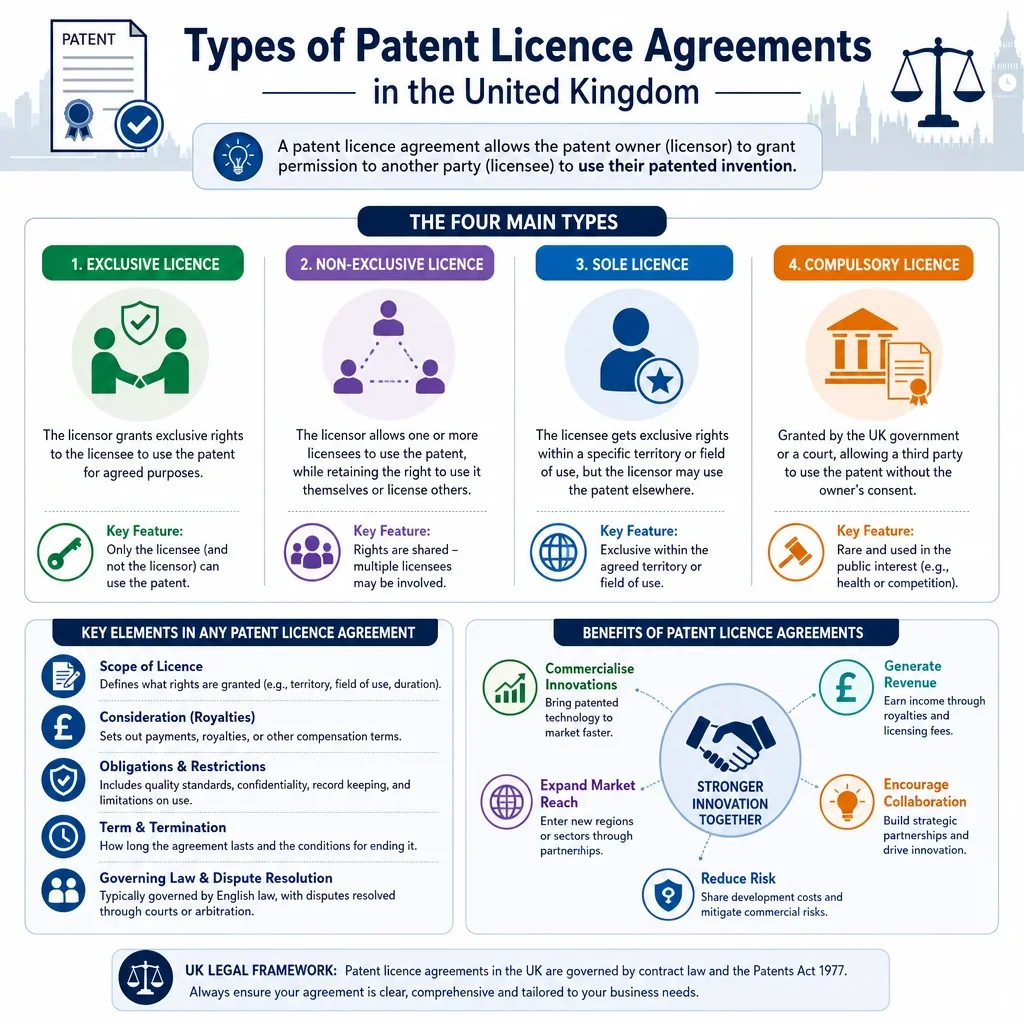
Selecting the incorrect structure for a patent license agreement can inadvertently grant broader rights or fail to protect essential intellectual property interests.
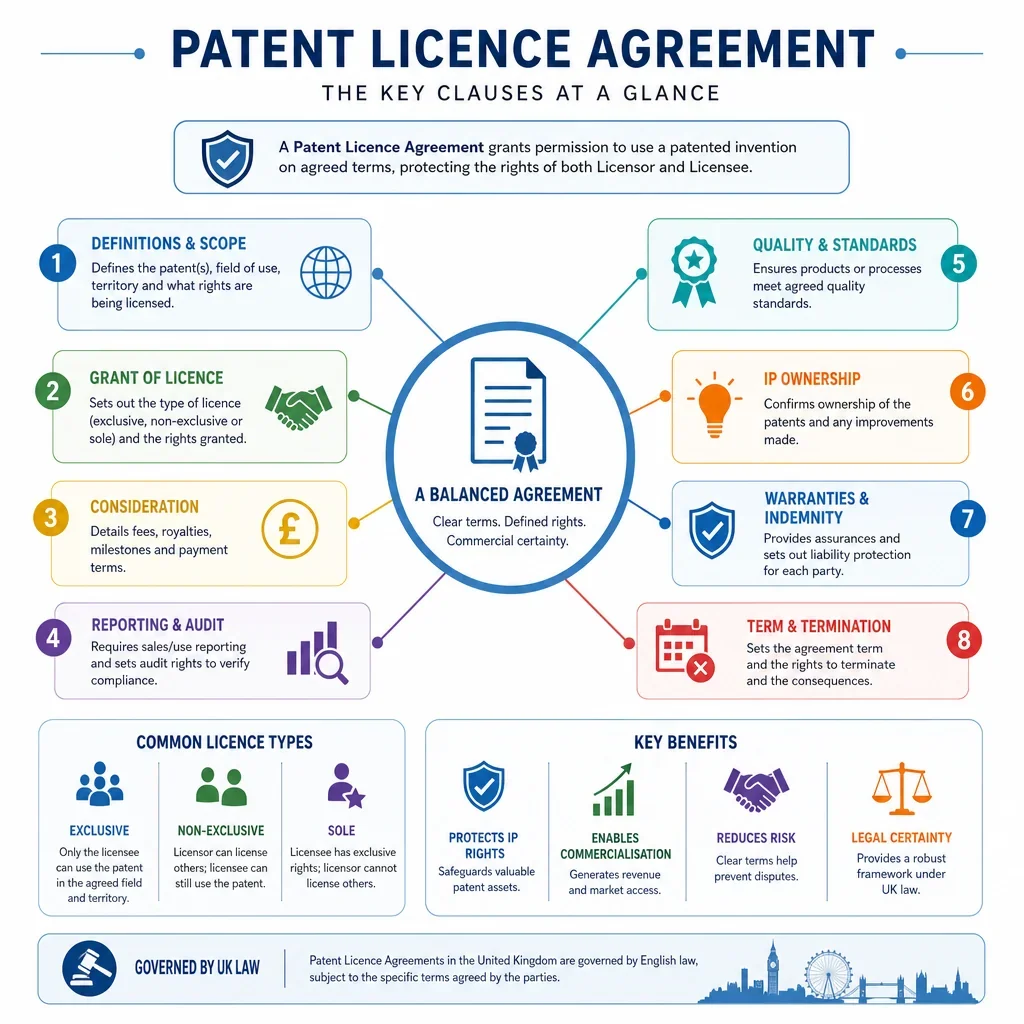
What a Proper Patent Licence Agreement Should Include
- Parties InvolvedClearly identify the licensor (patent owner) and licensee (user of the patent) with their full names and addresses.
- Patent DescriptionSpecify the exact patents or inventions being licensed, including patent numbers and details.
- Grant of RightsDefine what rights the licensee gets, such as making, using, selling, or importing products based on the patent.
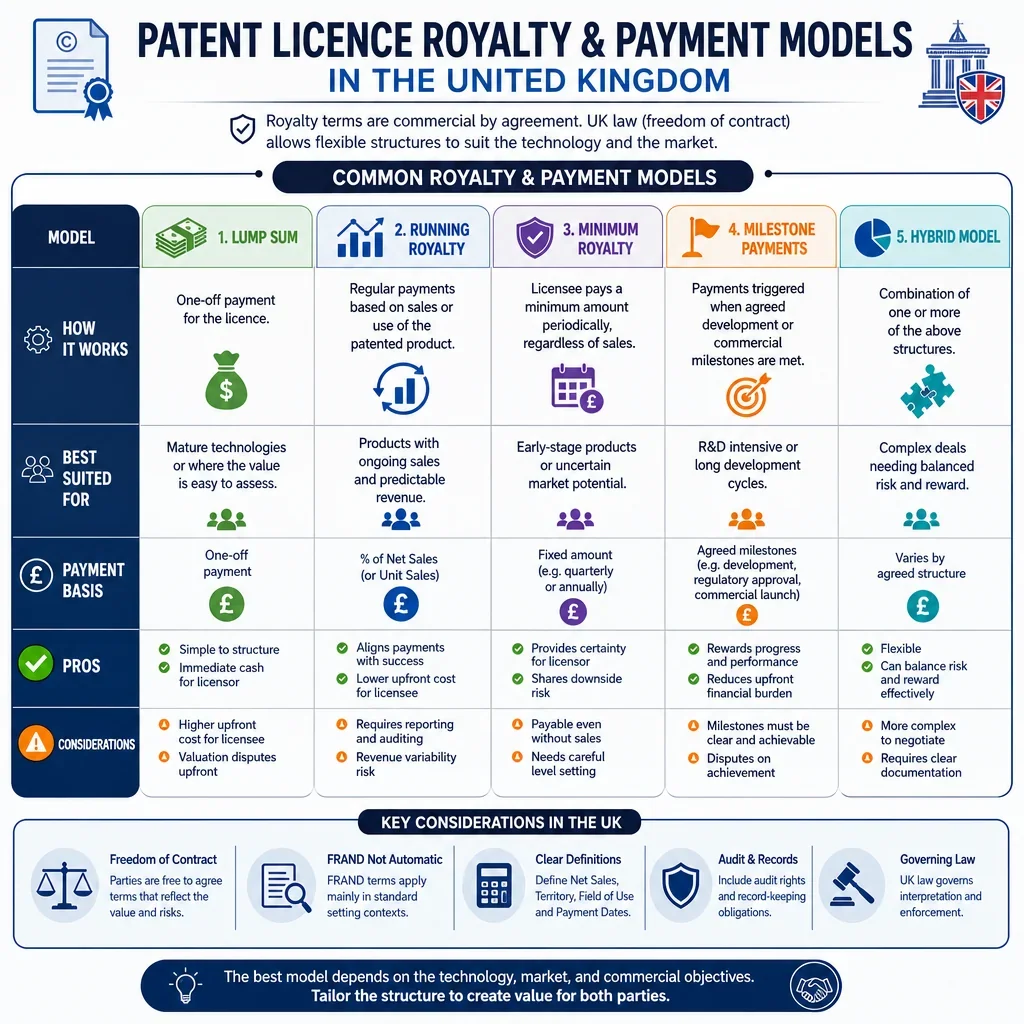
- Payment TermsOutline how the licensee will pay, including upfront fees, ongoing royalties, or other compensation methods.
- Duration and TerminationState how long the agreement lasts and under what conditions it can end, like non-payment or breach.
- ConfidentialityProtect sensitive information shared between the parties by requiring it to be kept secret.
- Infringement HandlingExplain how to deal with third parties infringing the patent, including who takes action and shares any recovery.
- Warranties and LiabilityInclude promises about the patent's validity and limits on responsibility for any issues that arise.
- Governing LawSpecify that UK law applies to the agreement and where disputes will be resolved.
Generate Your Document in 4 Easy Steps
Why Use Docaro?
 United Kingdom
Free Example Patent Licence Agreement Template
Below is a free template example of a Patent Licence Agreement for use in the United Kingdom generated by our AI model.
The clauses in your actual Patent Licence Agreement will vary from this example as they will be entirely bespoke to your requirements as set out in the questionnaire you complete.
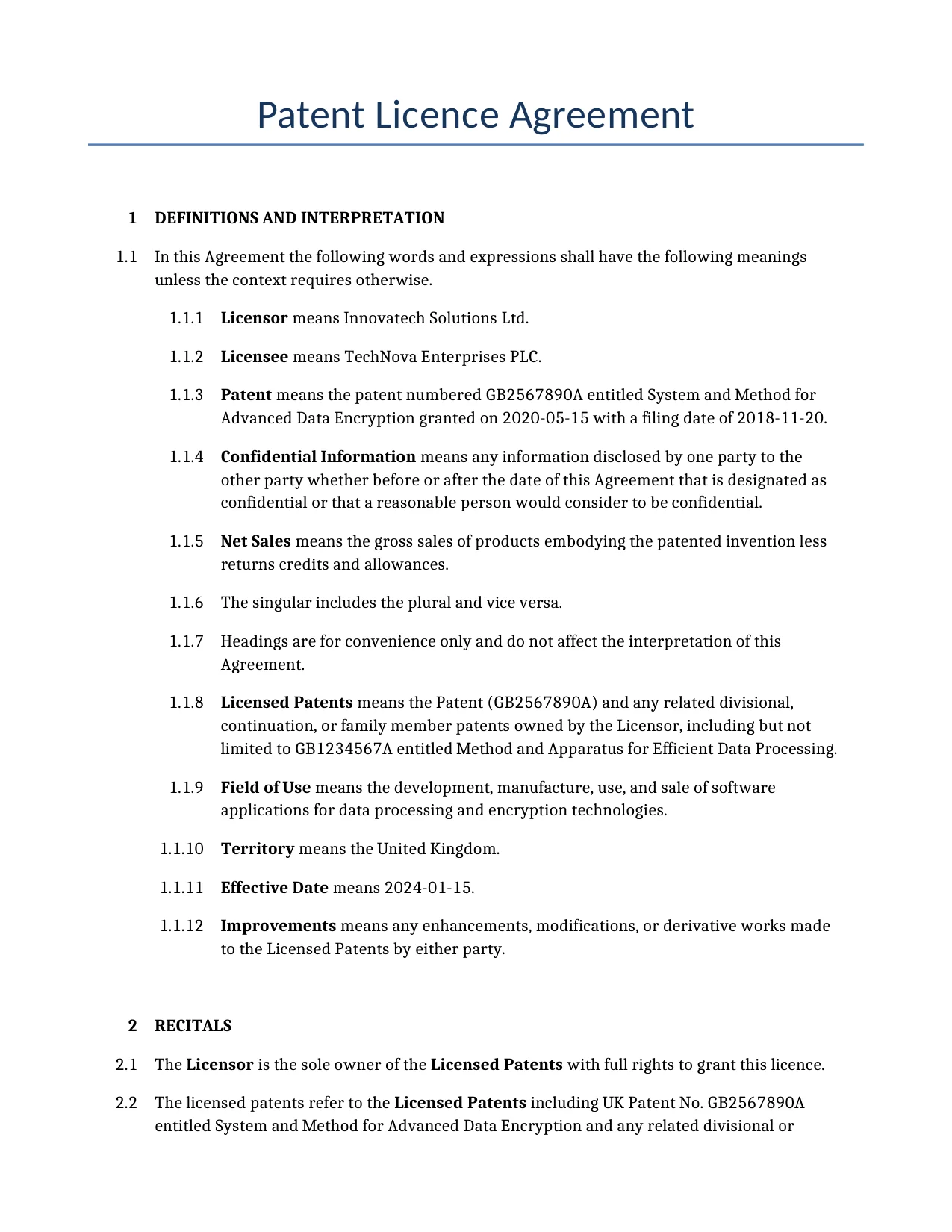
Patent Licence Agreement
1DEFINITIONS AND INTERPRETATION
In this Agreement the following words and expressions shall have the following meanings unless the context requires otherwise.
Licensor means Innovatech Solutions Ltd.
Licensee means TechNova Enterprises PLC.
Patent means the patent numbered GB2567890A entitled System and Method for Advanced Data Encryption granted on 2020-05-15 with a filing date of 2018-11-20.
Confidential Information means any information disclosed by one party to the other party whether before or after the date of this Agreement that is designated as confidential or that a reasonable person would consider to be confidential.
Net Sales means the gross sales of products embodying the patented invention less returns credits and allowances.
The singular includes the plural and vice versa.
Headings are for convenience only and do not affect the interpretation of this Agreement.
Licensed Patents means the Patent (GB2567890A) and any related divisional, continuation, or family member patents owned by the Licensor, including but not limited to GB1234567A entitled Method and Apparatus for Efficient Data Processing.
Field of Use means the development, manufacture, use, and sale of software applications for data processing and encryption technologies.
Territory means the United Kingdom.
Effective Date means 2024-01-15.
Improvements means any enhancements, modifications, or derivative works made to the Licensed Patents by either party.
2RECITALS
The Licensor is the sole owner of the Licensed Patents with full rights to grant this licence.
The licensed patents refer to the Licensed Patents including UK Patent No. GB2567890A entitled System and Method for Advanced Data Encryption and any related divisional or continuation patents owned by the Licensor.
The purpose of this licence is to enable the Licensee to develop and commercialise innovative software applications based on the licensed patents for the UK market thereby promoting technological advancement in the field of data processing.
The Licensor wishes to grant and the Licensee wishes to accept an exclusive licence under the Licensed Patents on the terms set out in this Agreement.
3GRANT OF LICENCE
The Licensor grants to the Licensee an exclusive licence under the Licensed Patents to make the patented invention use the patented invention and sell products embodying the patented invention in the Territory and within the Field of Use.
The licence granted under clause 3.1 is exclusive.
The licence granted under this Agreement includes improvements or modifications to the Licensed Patents as further detailed in the Improvements section.
4DURATION AND TERM
This Agreement shall commence on the Effective Date.
The licence granted under this Agreement shall continue until the expiry of the last valid claim of the Licensed Patents or 20 years from the Effective Date whichever is earlier unless terminated earlier in accordance with this Agreement.
Upon expiry of the Licensed Patents the Licensee shall have a paid-up non-exclusive licence to use any know-how provided under this Agreement.
This Agreement may be renewed for further periods by mutual written agreement of the parties.
Termination of this Agreement shall be without prejudice to any rights or obligations that have accrued prior to termination.
5ROYALTIES AND PAYMENTS
The Licensee shall pay to the Licensor an upfront non-refundable payment of \£100,000 on the Effective Date of this Agreement.
The Licensee shall pay to the Licensor royalties at the rate of 5.5 percent of Net Sales in GBP.
All royalties shall be exclusive of VAT which shall be payable in addition where applicable. The Licensee shall deduct any applicable withholding taxes and provide the Licensor with appropriate certificates.
The Licensee shall make royalty payments quarterly commencing on the first quarter after the Effective Date. Payments shall be made by electronic funds transfer on or before the fifteenth day of the month following the end of each quarter.
The Licensee shall provide the Licensor with a written royalty report within 30 days of the end of each quarter detailing Net Sales calculation and royalty due.
Interest shall accrue on late payments at 4% above the Bank of England base rate from the due date until payment.
The Licensor shall have the right upon 14 days written notice to audit the Licensee's records for the purpose of verifying the accuracy of royalty calculations. Audits may be conducted no more than once per year and shall cover the preceding 3 years only. The Licensor shall bear the costs of the audit unless a discrepancy of more than 5% is found in which case the Licensee shall reimburse the audit costs.
6INTELLECTUAL PROPERTY RIGHTS
The Licensor is the owner of the Licensed Patents and confirms sole and unencumbered ownership of the Licensed Patents with no co-owners or third-party claims.
There are no existing licences mortgages or other encumbrances on the Licensed Patents owned by the Licensor.
The Licensor owns the Licensed Patents outright and has full authority to enter into this Agreement.
The Licensor is not granting any other licences that would conflict with this Agreement.
There are no pending or threatened challenges to the validity of the Licensed Patents and no known claims that the Licensed Patents infringe third-party intellectual property rights.
The Licensor shall be responsible for the maintenance and prosecution of the Licensed Patents including payment of all renewal fees. The Licensee shall reimburse the Licensor for all such fees within 30 days of invoice.
The Licensor shall have the primary right but not the obligation to enforce the Licensed Patents against infringers. If the Licensor declines to enforce within 60 days the Licensee may do so at its own cost. Any damages recovered shall be shared equally after deducting enforcement costs.
The Licensor shall use best endeavours to maintain the Licensed Patents in force in the Territory.
The Licensee shall mark all products embodying the Licensed Patents with the applicable patent numbers in accordance with applicable laws to preserve the right to claim damages.
Entering into this Agreement will not conflict with any other agreements to which the Licensor is a party.
The Licensor is in compliance with all applicable laws regarding the Licensed Patents.
The Licensor retains the right to use the Licensed Patents for internal research and development.
7CONFIDENTIALITY
Each party shall keep the other party\'s Confidential Information confidential and shall not disclose it to any third party without the prior written consent of the disclosing party.
The obligations of confidentiality in clause 7.1 shall not apply to information that is already in the public domain through no breach of this Agreement or that the receiving party independently develops without reference to the disclosing party\'s information.
A party may disclose Confidential Information without prior consent if required by law or court order provided that the receiving party gives the disclosing party reasonable advance notice where legally permitted or to its professional advisors employees or contractors on a need-to-know basis who are bound by equivalent confidentiality obligations.
Upon termination of this Agreement each party shall return or destroy all materials containing the other party\'s Confidential Information and certify such return or destruction.
The obligations of confidentiality shall survive termination of this Agreement for five years except that trade secrets within the Confidential Information shall receive perpetual protection in accordance with the Trade Secrets (Enforcement etc) Regulations 2018.
The parties agree that a breach of this clause 7 may cause irreparable harm for which damages alone would not be an adequate remedy and that injunctive relief may be sought to prevent further disclosure.
In the event of a breach of confidentiality the remedies available shall include an injunction to prevent further disclosure and damages for losses incurred.
8WARRANTIES AND REPRESENTATIONS
The Licensor warrants that it is the owner of the Licensed Patents and has the right to grant the licence set out in this Agreement.
The Licensor warrants to the best of its knowledge that: (i) the Licensed Patents are valid and enforceable; (ii) there are no pending or threatened claims challenging the validity of the Licensed Patents; (iii) the Licensed Patents do not infringe any third party intellectual property rights; (iv) there is no pending or threatened litigation relating to the Licensed Patents; and (v) it has complied with all applicable laws in relation to the Licensed Patents.
Each party warrants that it has full capacity authority and all necessary approvals to enter into this Agreement.
Except as expressly provided in this Agreement no warranties representations conditions or guarantees are given by either party and all implied warranties are excluded to the fullest extent permitted by law.
9INDEMNITIES
The Licensor shall indemnify the Licensee against any claims that the Licensed Patents infringe third party intellectual property rights provided that the Licensee gives prompt notice of any such claim and does not admit liability.
The Licensee shall indemnify the Licensor against any claims arising from the Licensee\'s misuse modification or infringement caused by products made under this licence that are not directly attributable to the Licensed Patents.
The indemnified party shall provide prompt notice of any claims to the indemnifying party.
The indemnifying party shall have the right to control the defence and settlement of any indemnified claims provided that no settlement shall be made without the indemnified party\'s prior written consent (not to be unreasonably withheld).
The indemnifying party shall reimburse the indemnified party for reasonable legal costs incurred.
10LIMITATION OF LIABILITY
Subject to clause 10.3 the total liability of each party under this Agreement shall not exceed the total royalties paid by the Licensee to the Licensor in the 12 months preceding the claim.
Neither party shall be liable to the other for any consequential indirect or special damages including loss of profit or revenue.
Nothing in this Agreement shall limit or exclude liability for death or personal injury caused by negligence for fraud or wilful misconduct or any other liability that cannot be excluded under English law.
The limitation of liability in this clause 10 applies mutually to both parties and is considered reasonable under the Unfair Contract Terms Act 1977.
11TERMINATION
Either party may terminate this Agreement immediately by written notice if the other party commits a material breach and fails to remedy such breach within thirty days of notice.
Either party may terminate this Agreement for convenience on 6 months\' written notice.
This Agreement shall terminate automatically on the occurrence of insolvency bankruptcy or winding up of the other party (except for solvent reconstruction) or failure to pay royalties within 30 days of due date.
A cure period of thirty days shall apply for remedying a material breach before termination.
Upon termination for any reason the provisions of the Consequences of Termination section shall apply.
12CONSEQUENCES OF TERMINATION
Upon termination of this Agreement the Licensee shall immediately cease all use of the Licensed Patents except as permitted under any surviving licences.
Upon termination of this Agreement the Licensee shall return all Confidential Information to the Licensor and destroy all retained copies certifying the same in writing.
Accrued rights and obligations including payment of royalties for use prior to termination shall survive termination of this Agreement.
Clauses that are expressed to survive or which by their nature are intended to survive termination shall continue in full force and effect.
13GOVERNING LAW AND JURISDICTION
This Agreement and any dispute or claim arising out of or in connection with it or its subject matter or formation shall be governed by and construed in accordance with English Law.
The courts of England and Wales shall have exclusive jurisdiction over any dispute arising out of or in connection with this Agreement.
14DISPUTE RESOLUTION
The parties shall first attempt to resolve any dispute arising out of or in connection with this Agreement by negotiation between senior executives.
If the dispute is not resolved by negotiation within 30 days the parties shall proceed to mediation before arbitration.
If mediation fails the dispute shall be referred to arbitration in accordance with the rules of the London Court of International Arbitration.
The arbitration shall be governed by the laws of England and Wales and the seat shall be London.
The arbitration proceedings shall be confidential.
15FORCE MAJEURE
Neither party shall be liable for any failure to perform its obligations under this Agreement if such failure is due to a force majeure event including acts of God war or terrorism or epidemics or pandemics.
The affected party shall provide notice of the force majeure event to the other party within seven days of becoming aware of it.
Both parties shall take reasonable steps to mitigate the effects of the force majeure event.
If the force majeure event continues for more than thirty days either party may terminate this Agreement.
This clause 15 shall be governed by English Law.
16ASSIGNMENT AND SUB-LICENSING
The Licensee may assign this Agreement with the prior written consent of the Licensor which shall not be unreasonably withheld.
The Licensee may grant sub-licences to third parties with the Licensor\'s prior written consent (not to be unreasonably withheld) and shall remain fully liable for the actions and obligations of any sub-licensees.
17NOTICES
Any notice under this Agreement shall be in writing and may be served by post or email.
Notices to the Licensor shall be sent to 123 Innovation Drive Tech Park London SW1A 1AA United Kingdom to the attention of the Legal Department.
Notices to the Licensee shall be sent to 456 Business Avenue Industrial Estate Manchester M1 1AB United Kingdom to the attention of the Operations Manager.
Notices sent by post shall be deemed served two days after posting. Notices sent by email shall be deemed served on the next business day after sending provided no delivery failure notice is received.
If a notice period ends on a weekend or public holiday it shall be extended to the next business day.
18ENTIRE AGREEMENT
This Agreement constitutes the entire understanding between the parties and supersedes all prior agreements whether written or oral.
19SEVERANCE
If any provision of this Agreement is held to be invalid or unenforceable the remaining provisions shall remain in full force and effect.
20WAIVER
No failure or delay by the Licensor or the Licensee in exercising any right under this Agreement shall constitute a waiver of that right. A waiver must be in writing to be effective.
21COUNTERPARTS
This Agreement may be executed in any number of counterparts each of which when executed shall constitute an original but all of which together shall constitute one and the same instrument.
22THIRD PARTY RIGHTS
This Agreement does not confer any rights on third parties under the Contracts (Rights of Third Parties) Act 1999 except that affiliates of the Licensor and subsidiaries of the Licensee may enforce certain benefits conferred on them.
23PATENT MARKING
The Licensee shall ensure that all products and packaging embodying the Licensed Patents are marked with the relevant patent numbers (including GB2567890A) in a prominent position together with the words \‘Patented\’ or \‘Patent Pending\’ as appropriate. The Licensee shall comply with all marking requirements under UK and European patent law to preserve its rights to claim damages for infringement.
24IMPROVEMENTS
Any Improvements made by the Licensee to the Licensed Patents shall be owned by the Licensee. The Licensee grants the Licensor a non-exclusive royalty-free licence to use such Improvements for research and development purposes.
Any Improvements made by the Licensor shall be included in the licence granted under this Agreement without additional royalty.
Each party shall promptly disclose any Improvements to the other party.
25DATA PROTECTION
Each party shall comply with all applicable data protection laws including the UK GDPR and Data Protection Act 2018 in respect of any personal data processed under or in connection with this Agreement. The parties shall enter into a separate data processing agreement if required.
26EXPORT CONTROLS
The Licensee shall comply with all applicable export control laws and regulations including those of the UK EU and US when exporting or re-exporting any products or technology under this Agreement. The Licensee shall obtain all necessary licences and shall not export to prohibited destinations or entities.
27ANTI-BRIBERY COMPLIANCE
Each party shall comply with all applicable anti-bribery and anti-corruption laws including the UK Bribery Act 2010. Neither party shall offer give or receive any bribe or inducement in connection with this Agreement.
28INSURANCE
The Licensee shall maintain at its own cost adequate insurance including product liability insurance with a reputable insurer for a minimum cover of \£5,000,000 per claim. The Licensee shall provide evidence of such insurance to the Licensor upon request.
29VARIATION
No variation of this Agreement shall be effective unless it is in writing and signed by the parties (or their authorised representatives).
30COSTS
Each party shall bear its own costs and expenses incurred in connection with the negotiation preparation and execution of this Agreement.
31FURTHER ASSURANCE
Each party shall at its own cost do all such further acts and things and execute all such other documents as the other party may reasonably require to give full effect to the terms of this Agreement.
32SIGNATURES
IN WITNESS WHEREOF the parties have executed this Agreement on the date first above written.
Signed for and on behalf of Innovatech Solutions Ltd: _______________________________ Name: Title: Date:
Signed for and on behalf of TechNova Enterprises PLC: _______________________________ Name: Title: Date:
This example shows approximately 70% of a typical document and is provided for illustrative purposes only. The remaining content has been omitted.
Every document generated by Docaro is tailored to your specific circumstances, jurisdiction and the information you provide. The completed document includes all applicable clauses and provisions required for your situation.
To generate the full, personalised document, answer a short series of questions and your document will be created instantly.
Useful Resources When Considering a Patent Licence Agreement in the United Kingdom
United Kingdom Reference Legislation
Patent Licence Agreement FAQs
Document Generation FAQs
Related Articles