AI Generated Service Agreement for use in the United Kingdom
PDF & Word - 2026 Updated
Docaro Pricing
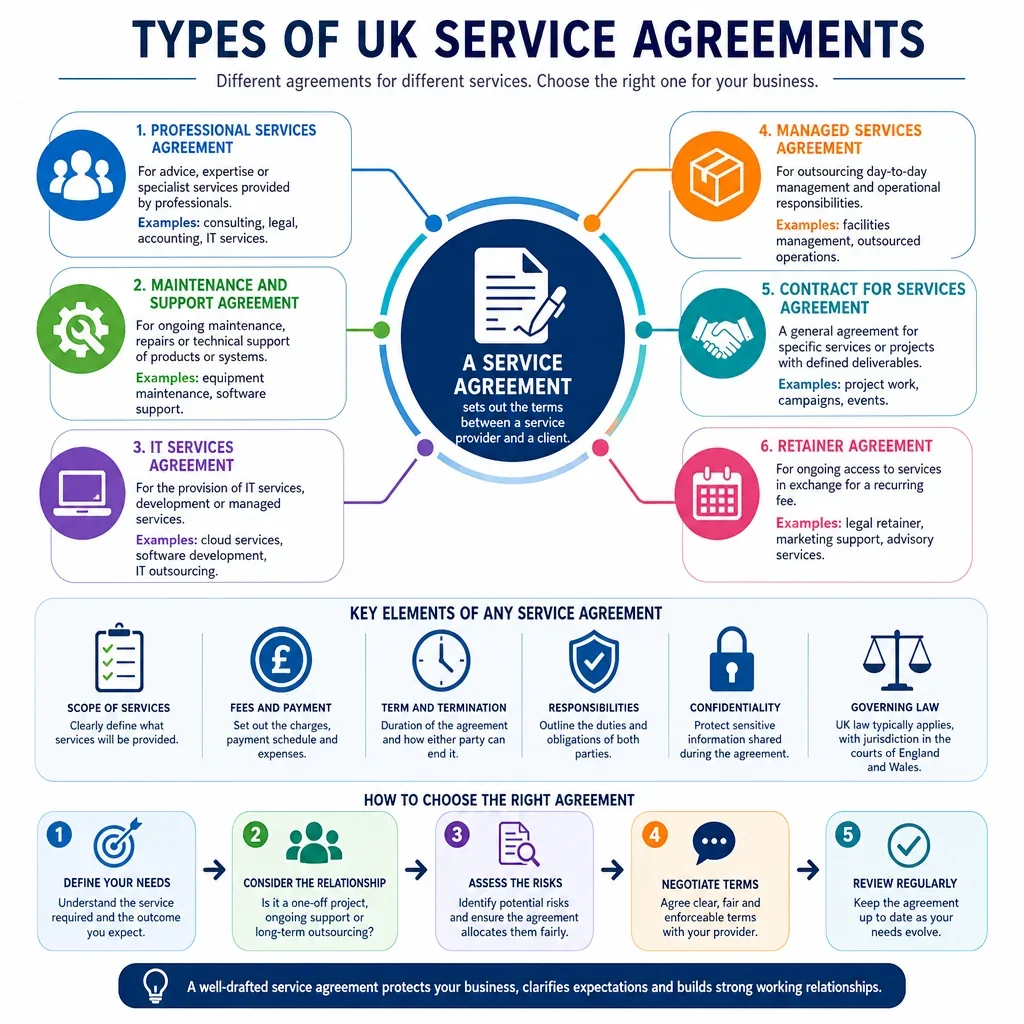
When do you need a Service Agreement in the United Kingdom?
British Legal Rules for a Service Agreement
Using the wrong structure for a service agreement can lead to unenforceable terms or unintended liabilities under UK contract law.
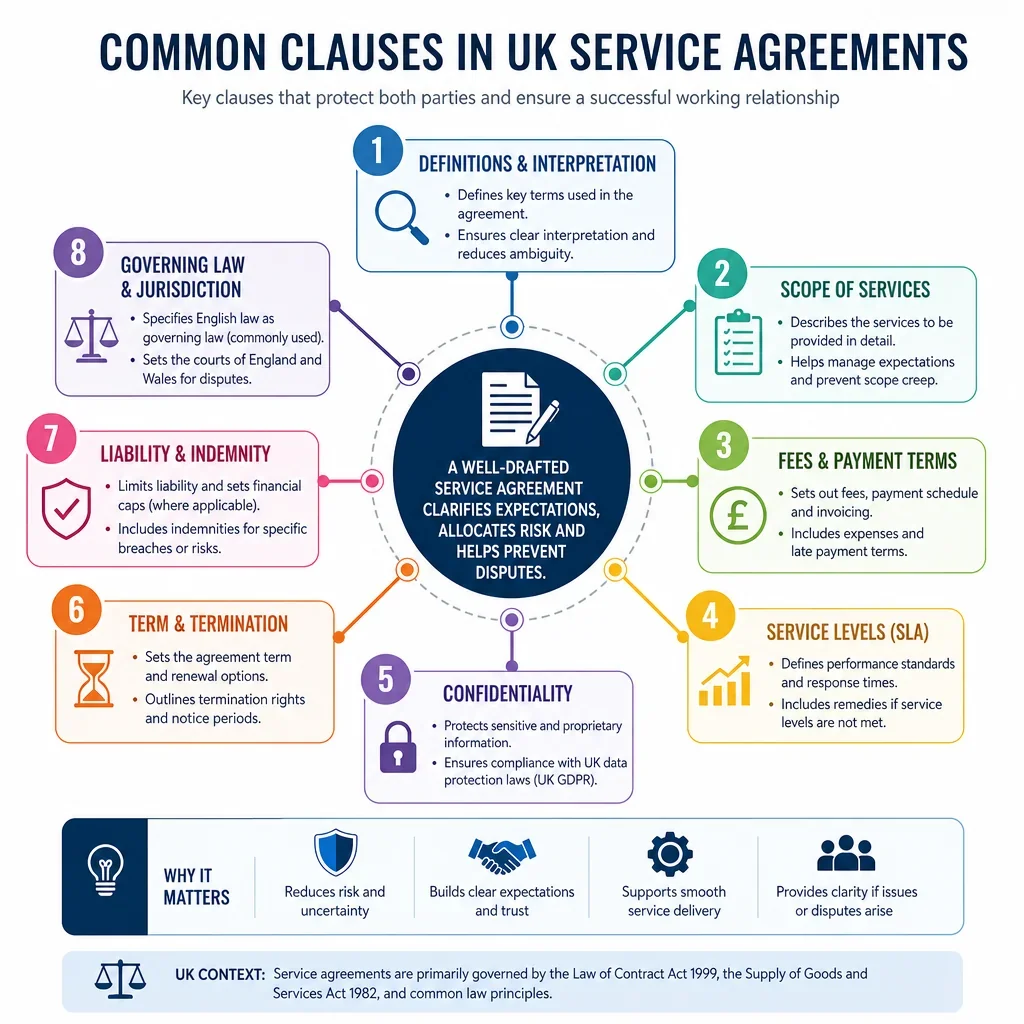
What a Proper Service Agreement Should Include
- Parties InvolvedClearly identify who is providing the service and who is receiving it, including their full names or company details.
- Description of ServicesDetail exactly what services will be provided, including any specific tasks or deliverables expected.
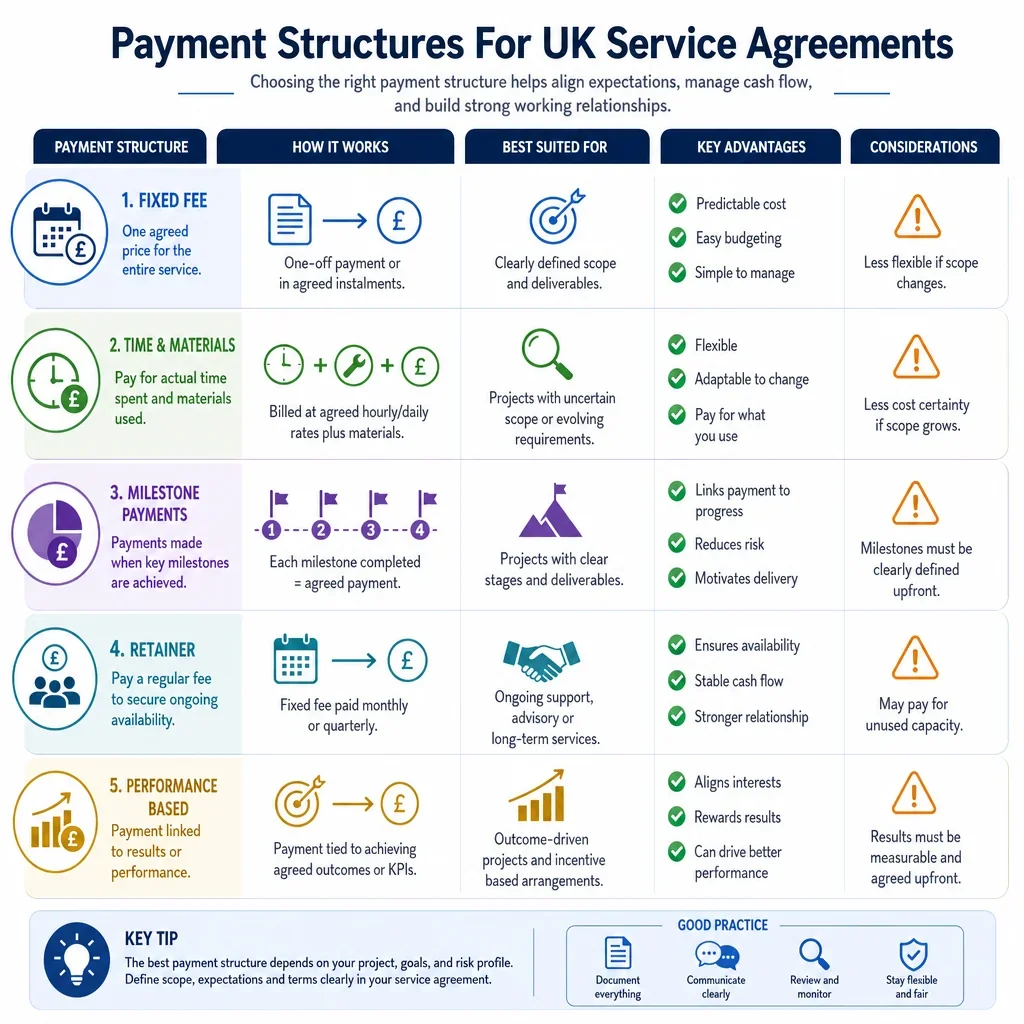
- Payment TermsSpecify how much will be paid, when payments are due, and the method of payment.
- Duration and TimelineState how long the agreement lasts and any key dates for starting or ending the services.
- ResponsibilitiesOutline what each party must do to fulfill their side of the agreement.
- ConfidentialityAgree to keep sensitive information private and not share it with others.
- Termination ConditionsExplain how and when either party can end the agreement, including notice periods.
- Dispute ResolutionDescribe how disagreements will be handled, such as through discussion or mediation.
- Liability LimitsSet boundaries on responsibility for any issues or losses that might arise.
- Governing LawConfirm that the agreement follows UK laws and which courts handle disputes.
Generate Your Document in 4 Easy Steps
Why Use Docaro?
 United Kingdom
Free Example Service Agreement Template
Below is a free template example of a Service Agreement for use in the United Kingdom generated by our AI model.
The clauses in your actual Service Agreement will vary from this example as they will be entirely bespoke to your requirements as set out in the questionnaire you complete.
Web Development and IT Support Service Agreement
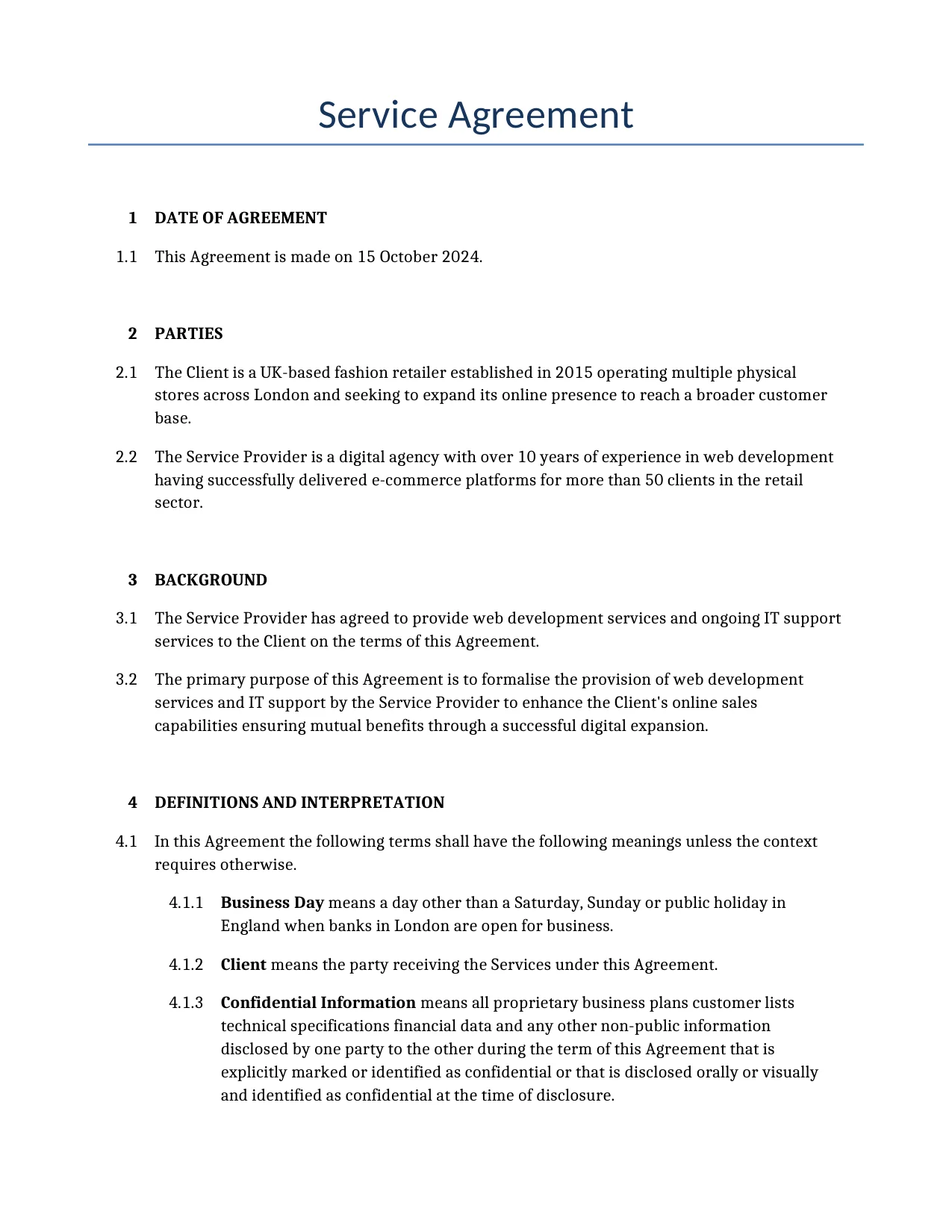
1DATE OF AGREEMENT
This Agreement is made on 15 October 2024.
2PARTIES
The Client is a UK-based fashion retailer established in 2015 operating multiple physical stores across London and seeking to expand its online presence to reach a broader customer base.
The Service Provider is a digital agency with over 10 years of experience in web development having successfully delivered e-commerce platforms for more than 50 clients in the retail sector.
3BACKGROUND
The Service Provider has agreed to provide web development services and ongoing IT support services to the Client on the terms of this Agreement.
The primary purpose of this Agreement is to formalise the provision of web development services and IT support by the Service Provider to enhance the Client's online sales capabilities ensuring mutual benefits through a successful digital expansion.
4DEFINITIONS AND INTERPRETATION
In this Agreement the following terms shall have the following meanings unless the context requires otherwise.
Business Day means a day other than a Saturday, Sunday or public holiday in England when banks in London are open for business.
Client means the party receiving the Services under this Agreement.
Confidential Information means all proprietary business plans customer lists technical specifications financial data and any other non-public information disclosed by one party to the other during the term of this Agreement that is explicitly marked or identified as confidential or that is disclosed orally or visually and identified as confidential at the time of disclosure.
Data Protection Legislation means the UK GDPR, the Data Protection Act 2018 and any other applicable data protection legislation in force from time to time.
Deliverables means the outputs of the Web Development Services including without limitation the custom e-commerce website, designs, source code, documentation and any other materials to be provided by the Service Provider to the Client as set out in Schedule 1.
Foreground IP means all Intellectual Property Rights in the Deliverables created by the Service Provider in the course of providing the Services under this Agreement.
Insolvency Event means any circumstance where a party (a) is unable to pay its debts as they fall due; (b) has a receiver, administrative receiver, administrator or similar officer appointed over all or any part of its assets; (c) passes a resolution for winding up (otherwise than for the purpose of a solvent amalgamation or reconstruction); (d) enters into any voluntary arrangement with its creditors; or (e) is subject to an equivalent process in any jurisdiction.
Intellectual Property Rights means patents, rights to inventions, copyright and related rights, moral rights, trade marks and service marks, business names and domain names, rights in get-up and trade dress, goodwill and the right to sue for passing off, rights in designs, database rights, rights to use, and protect the confidentiality of, confidential information (including know-how and trade secrets) and all other intellectual property rights, in each case whether registered or unregistered and including all applications and rights to apply for and be granted, renewals or extensions of, and rights to claim priority from, such rights and all similar or equivalent rights or forms of protection which subsist or will subsist now or in the future in any part of the world.
Material Breach means a breach of this Agreement which is not capable of remedy or, if capable of remedy, is not remedied within 14 days of receipt of written notice requiring remedy.
Service Provider means the party providing the Services under this Agreement.
Services means the Web Development Services and the IT Support Services as further described in clause 6 and Schedule 1.
Uptime Percentage means the total number of minutes in a calendar month minus the total number of minutes of Downtime (as defined in Schedule 2) in that month divided by the total number of minutes in that calendar month multiplied by 100.
VAT means value added tax chargeable under the Value Added Tax Act 1994.
Headings in this Agreement are for reference only and shall not affect the interpretation of this Agreement.
Words in the singular shall include the plural and vice versa.
References to any statute or statutory provision shall include any subordinate legislation made under that statute or statutory provision whether before or after the date of this Agreement and shall include any modification amendment consolidation or re-enactment of such statute or provision.
A reference to a clause, schedule or paragraph is to a clause, schedule or paragraph of this Agreement.
Any words following the terms including, include, in particular, for example or any similar expression shall be construed as illustrative and shall not limit the sense of the words, description, definition, phrase or term preceding those terms.
5COMMENCEMENT AND DURATION
This Agreement shall commence on the date of this Agreement and shall continue for an initial term of 12 months (the Initial Term) unless terminated earlier in accordance with its terms.
At the end of the Initial Term this Agreement shall automatically renew for successive periods of 12 months (each a Renewal Period) unless either party gives the other not less than 30 calendar days' written notice of termination expiring at the end of the Initial Term or any Renewal Period.
6SCOPE OF SERVICES
The Service Provider shall provide the Services to the Client in accordance with the terms of this Agreement and Schedule 1.
The Services comprise two distinct elements: (a) the Web Development Services, being the design, development, testing, deployment and go-live of a custom e-commerce website as further detailed in Schedule 1 (the Deliverables); and (b) the IT Support Services, being the ongoing maintenance and support services described in Schedule 1 which shall commence upon go-live of the Deliverables.
The Service Provider shall perform the Services with reasonable skill and care in accordance with the Service Levels and Performance Standards set out in clause 7 and Schedule 1.
Time shall not be of the essence in relation to the provision of the Services unless expressly agreed in writing by the parties.
7CLIENT OBLIGATIONS
The Client shall: (a) provide the Service Provider with such information, access to premises, systems, data, licences, materials and approvals as the Service Provider may reasonably require in order to provide the Services; (b) ensure that all information provided to the Service Provider is accurate, complete and not misleading; (c) obtain and maintain all necessary licences, consents and permissions required for the Service Provider to provide the Services; (d) comply with all applicable laws and regulations in relation to its use of the Services and the Deliverables; and (e) co-operate with the Service Provider in good faith and provide prompt responses to any requests for information or approvals.
If the Client fails to comply with its obligations under this clause 6A, the Service Provider shall not be liable for any delay or failure to provide the Services to the extent caused by such failure and shall be entitled to an extension of time and, where applicable, additional fees on a time and materials basis at its prevailing rates.
8SERVICE LEVELS AND PERFORMANCE STANDARDS
The Service Provider shall ensure that the Services achieve the service levels set out in Schedule 1 including an Uptime Percentage of at least 99.5 percent for the hosted website.
The Service Provider shall measure and report on the performance levels on a monthly basis using appropriate monitoring tools.
The Service Provider shall provide regular performance reports to the Client on a monthly basis.
If the Service Provider fails to meet the performance standards the Service Provider shall be entitled to a cure period of 30 days to remedy such failure.
In the event of a failure to meet the performance standards after the cure period the Client shall be entitled to service credits as set out in Schedule 2.
This Agreement shall include an escalation procedure for persistent performance issues as set out in Schedule 3.
9FEES AND PAYMENT
In consideration for the provision of the Services the Client shall pay the Service Provider the fees set out in Schedule 1.
The fees for the Web Development Services shall be a fixed price of \£15,000 (exclusive of VAT) payable as to 40% on the date of this Agreement, 30% on completion of the design phase and 30% on successful completion of acceptance testing and go-live in accordance with clause 12A.
The fees for the IT Support Services shall be \£1,250 per month (exclusive of VAT) payable monthly in advance with the first payment due on the date of go-live of the Deliverables.
All fees are exclusive of VAT which shall be charged at the prevailing rate.
The Service Provider shall issue invoices electronically to the Client. The Client shall pay each invoice within 30 days of the date of the invoice.
If the Client fails to make any payment due under this Agreement by the due date then, without limiting the Service Provider's remedies under clause 17, the Client shall pay interest on the overdue sum from the due date until payment is made in full at 8% per annum above the Bank of England base rate from time to time. The parties agree that this rate represents a substantial remedy for the purposes of the Late Payment of Commercial Debts (Interest) Act 1998.
The Service Provider may increase the monthly fees for the IT Support Services with effect from each anniversary of the date of this Agreement by giving not less than 60 days' prior written notice to the Client. Any such increase shall not exceed the increase in the Retail Prices Index (or any replacement index) over the preceding 12 month period.
10EXPENSES
The Service Provider shall be reimbursed for any out-of-pocket expenses incurred while providing the Services including travel expenses such as mileage public transport and accommodation meals and subsistence costs and other reasonable out-of-pocket expenses with prior approval.
The Service Provider shall provide receipts for all claimed expenses.
The Service Provider shall be reimbursed for VAT on expenses where the Service Provider is VAT-registered.
Any disputes over reimbursable expenses shall be resolved by direct negotiation between the parties.
11CONFIDENTIALITY
Each party shall keep the other party's Confidential Information confidential and shall not disclose it to any third party except to its employees or contractors who need to know it for the purposes of this Agreement and who are bound by equivalent confidentiality obligations, to its professional advisors or as required by law.
The obligations of confidentiality in this clause 10 shall survive for 5 years after termination of this Agreement. Trade secrets shall remain confidential for so long as they remain trade secrets.
Upon termination of this Agreement each party shall return or destroy all Confidential Information of the other party and certify the same in writing.
12DATA PROTECTION
Each party shall comply with all applicable requirements of the Data Protection Legislation. This clause 11 is in addition to, and does not relieve, remove or replace, a party's obligations or rights under the Data Protection Legislation.
The parties acknowledge that for the purposes of the Data Protection Legislation the Client is the controller and the Service Provider is the processor in respect of the personal data processed under this Agreement. Schedule 4 sets out the scope, nature and purpose of processing by the Service Provider, the duration of the processing and the types of personal data and categories of data subject.
Without prejudice to the generality of clause 11.1, the Service Provider shall, in relation to any personal data processed in connection with the performance by the Service Provider of its obligations under this Agreement: (a) process that personal data only on documented instructions from the Client (including with regard to transfers outside the UK), unless the Service Provider is required by applicable law to process such personal data (in which case the Service Provider shall inform the Client of that legal requirement before processing, unless that law prohibits such information on important grounds of public interest); (b) ensure that it has in place appropriate technical and organisational measures to protect against unauthorised or unlawful processing of personal data and against accidental loss or destruction of, or damage to, personal data; (c) ensure that all personnel who have access to and/or process personal data are obliged to keep the personal data confidential; (d) assist the Client in responding to any request from a data subject and in ensuring compliance with its obligations under the Data Protection Legislation with respect to security, breach notifications, impact assessments and consultations with supervisory authorities; (e) notify the Client without undue delay on becoming aware of a personal data breach; (f) at the Client's written direction delete or return personal data and copies thereof to the Client on termination of the Agreement unless required by applicable law to store the personal data; and (g) maintain complete and accurate records and information to demonstrate its compliance with this clause 11 and allow for audits by the Client or the Client's designated auditor.
The Client consents to the Service Provider appointing third-party processors of personal data under this Agreement. The Service Provider shall inform the Client of any intended changes concerning the addition or replacement of such processors and the Client shall not unreasonably withhold or delay consent. The Service Provider shall ensure that any such processor is subject to the same data protection obligations as set out in this clause 11.
Either party may, at any time on not less than 30 days' notice, revise this clause 11 by replacing it with any applicable controller-processor standard clauses or similar terms forming part of an applicable certification scheme (which shall apply when replacing it by attachment to this Agreement).
13INTELLECTUAL PROPERTY
All Intellectual Property Rights in any Background IP (being all Intellectual Property Rights owned by or licensed to either party prior to the date of this Agreement or developed independently of this Agreement) shall remain vested in that party or its licensors.
All Foreground IP shall vest in the Client absolutely upon full payment of all fees due under this Agreement. The Service Provider hereby assigns (by way of present assignment of future rights) all Foreground IP to the Client with full title guarantee. The Service Provider shall execute all documents and do all acts necessary to vest such rights in the Client.
The Service Provider grants to the Client a royalty-free, worldwide, non-exclusive licence to use the Service Provider's Background IP solely to the extent necessary for the Client to receive and make use of the Services and the Deliverables during the term of this Agreement.
The Client grants to the Service Provider a royalty-free, non-exclusive, non-transferable licence to use the Client's Background IP solely to the extent necessary for the Service Provider to provide the Services during the term of this Agreement.
The Service Provider warrants that the provision of the Services and the Deliverables will not infringe the Intellectual Property Rights of any third party. The Service Provider shall indemnify the Client against all liabilities, costs, expenses, damages and losses suffered or incurred by the Client arising out of or in connection with any claim that the Services or Deliverables infringe the Intellectual Property Rights of any third party (IPR Claim).
If any IPR Claim is made or threatened the Service Provider shall at its own expense either: (a) procure for the Client the right to continue using the relevant Deliverable or Service; (b) replace or modify the Deliverable or Service so that it becomes non-infringing; or (c) if neither (a) nor (b) is reasonably practicable, terminate this Agreement and refund to the Client all fees paid in respect of the infringing Deliverable or Service.
14ACCEPTANCE TESTING
Upon completion of the Web Development Services the Service Provider shall deliver the Deliverables to the Client and notify the Client that they are ready for acceptance testing.
The Client shall have a period of 14 Business Days from receipt of the Deliverables (the Testing Period) to test the Deliverables against the acceptance criteria set out in Schedule 1 (the Acceptance Criteria).
If the Deliverables meet the Acceptance Criteria the Client shall notify the Service Provider in writing of its acceptance (Acceptance).
If the Deliverables do not meet the Acceptance Criteria the Client shall notify the Service Provider in writing detailing the non-conformities. The Service Provider shall correct such non-conformities within 14 Business Days and re-submit the Deliverables for further testing. The provisions of this clause 12A shall apply to any re-submitted Deliverables.
If the Client does not notify the Service Provider of acceptance or rejection within the Testing Period the Deliverables shall be deemed accepted. Acceptance (or deemed acceptance) of the Deliverables shall not affect the Client's rights under this Agreement in respect of any latent defects.
15WARRANTIES
Each party warrants to the other that it has full power and authority to enter into this Agreement.
The Service Provider warrants to the Client that: (a) it will provide the Services with reasonable skill and care; (b) the Deliverables will conform in all material respects with the Acceptance Criteria for a period of 90 days following Acceptance; and (c) it has all necessary licences and consents to provide the Services.
All other warranties, conditions and terms implied by statute or common law are, to the fullest extent permitted by law, excluded from this Agreement.
16INDEMNITIES
The Service Provider shall indemnify the Client against all liabilities, costs, expenses, damages and losses suffered or incurred by the Client arising out of or in connection with any breach by the Service Provider of clauses 10, 11 or 12.
The Client shall indemnify the Service Provider against all liabilities, costs, expenses, damages and losses suffered or incurred by the Service Provider arising out of or in connection with any breach by the Client of clauses 6A, 10 or 11.
The indemnifying party shall have conduct of the relevant claim and the indemnified party shall provide reasonable assistance at the indemnifying party's cost.
17LIMITATION OF LIABILITY
Nothing in this Agreement shall limit or exclude the liability of either party for: (a) death or personal injury resulting from its negligence; (b) fraud or fraudulent misrepresentation; or (c) any other liability which cannot be limited or excluded by applicable law.
Subject to clause 15.1, neither party shall be liable to the other whether in contract, tort (including negligence), for breach of statutory duty or otherwise for any: (a) loss of profits; (b) loss of sales or business; (c) loss of agreements or contracts; (d) loss of anticipated savings; (e) loss of use or corruption of software, data or information; (f) loss of or damage to goodwill; or (g) any indirect or consequential loss.
Subject to clauses 15.1 and 15.2, the total liability of the Service Provider to the Client under or in connection with this Agreement shall not exceed the total fees paid or payable by the Client to the Service Provider in the 12 months preceding the event giving rise to the claim.
The limitations and exclusions in this clause 15 shall survive termination of this Agreement.
18INSURANCE
The Service Provider shall maintain in force, with a reputable insurance company, professional indemnity insurance, public liability insurance and cyber liability insurance with a minimum cover of \£5,000,000 per claim.
The Service Provider shall provide evidence of such insurance to the Client on the date of this Agreement and upon reasonable request thereafter.
19TERMINATION
Either party may terminate this Agreement immediately by written notice to the other if: (a) the other party commits a Material Breach and (if such breach is remediable) fails to remedy it within 14 days of being notified in writing to do so; (b) the other party suffers an Insolvency Event; or (c) the other party is in breach of clauses 10 or 11.
The Client may terminate this Agreement for convenience on not less than 30 days' written notice provided that all Web Development Services have been completed and accepted.
The Service Provider may terminate this Agreement for convenience on not less than 90 days' written notice after the Initial Term.
20CONSEQUENCES OF TERMINATION
On termination or expiry of this Agreement: (a) the Client shall pay all outstanding fees and expenses up to the date of termination; (b) the Service Provider shall provide the Client with reasonable transition assistance for a period of up to 30 days to enable the orderly transfer of the Services to the Client or a replacement provider (Transition Assistance). The Client shall pay the Service Provider's reasonable costs for providing Transition Assistance at its prevailing time and materials rates; and (c) each party shall return or destroy the other party's Confidential Information.
Termination or expiry of this Agreement shall not affect any rights, remedies, obligations or liabilities of the parties that have accrued up to the date of termination or expiry.
Clauses that expressly or by implication survive termination shall continue in full force and effect.
21FORCE MAJEURE
Neither party shall be liable for any failure or delay in performing its obligations under this Agreement to the extent that such failure or delay is caused by a Force Majeure event including natural disasters such as floods or earthquakes acts of war or terrorism or pandemics or epidemics provided that economic hardship or changes in market conditions shall not constitute a Force Majeure event. The affected party shall notify the other party as soon as reasonably practicable.
If a Force Majeure event continues for more than 30 days either party may terminate this Agreement by written notice.
22GOVERNING LAW AND JURISDICTION
This Agreement and any dispute or claim arising out of or in connection with it or its subject matter or formation (including non-contractual disputes or claims) shall be governed by and construed in accordance with the laws of England and Wales.
Each party irrevocably agrees that the courts of England and Wales shall have exclusive jurisdiction to settle any dispute or claim arising out of or in connection with this Agreement or its subject matter or formation (including non-contractual disputes or claims).
23DISPUTE RESOLUTION
Any dispute arising out of or in connection with this Agreement shall first be referred to senior representatives of each party for negotiation in good faith.
If the dispute is not resolved within 30 days of referral it shall be referred to mediation in accordance with the London Court of International Arbitration mediation rules.
If the dispute is not resolved by mediation it shall be finally resolved by arbitration under the rules of the London Court of International Arbitration with the seat of arbitration in London and governed exclusively by the laws of England and Wales.
24ASSIGNMENT AND SUBCONTRACTING
Neither party shall assign, transfer, mortgage, charge, subcontract, delegate, declare a trust over or deal in any other manner with any of its rights and obligations under this Agreement without the prior written consent of the other party (such consent not to be unreasonably withheld or delayed).
Notwithstanding clause 22.1 the Service Provider may subcontract its obligations under this Agreement to the extent set out in Schedule 1 provided that it remains fully liable for the acts and omissions of any subcontractor.
25NON-SOLICITATION
Neither party shall during the term of this Agreement and for a period of 12 months after its termination or expiry solicit or endeavour to solicit the employment or engagement of any employee or contractor of the other party who was involved in the provision or receipt of the Services without the prior written consent of the other party.
This clause 22A shall not apply in respect of any employee or contractor who responds to a general recruitment advertisement or who approaches the other party of their own accord.
Any breach of this clause 22A shall entitle the non-breaching party to seek injunctive relief in addition to any other remedies available to it.
26NOTICES
Any notice given under this Agreement shall be in writing and delivered by hand first class post or email to the addresses set out below or to such other address as a party may notify to the other from time to time.
Notices to the Client shall be addressed to John Smith at 123 Business Street London SW1A 1AA or the designated email address.
Notices to the Service Provider shall be addressed to Jane Doe at 456 Provider Avenue Manchester M1 1AA or the designated email address.
Notices sent by hand delivery shall be deemed received on delivery notices sent by first class post shall be deemed received 2 days after posting and notices sent by email shall be deemed received at the time of transmission if sent during Business Hours or otherwise at 9.00am on the next Business Day provided that no delivery failure notification is received.
27ENTIRE AGREEMENT
This Agreement constitutes the entire understanding between the parties and supersedes all prior agreements understandings or arrangements whether oral or in writing relating to its subject matter.
Each party acknowledges that in entering into this Agreement it has not relied on any representation, warranty or undertaking (whether written or oral) which is not expressly set out in this Agreement.
28SEVERABILITY
If any provision of this Agreement is held to be invalid or unenforceable by any court or competent authority the remaining provisions of this Agreement shall continue in full force and effect.
29WAIVER
No failure or delay by either party in exercising any right or remedy under this Agreement shall constitute a waiver of that right or remedy.
Any waiver of any right or remedy under this Agreement shall be effective only if given in writing and signed by the waiving party and shall not be deemed a waiver of any subsequent breach.
30AMENDMENTS
No amendment to this Agreement shall be effective unless it is in writing and signed by both parties.
31COUNTERPARTS
This Agreement may be executed in any number of counterparts each of which when executed shall constitute a duplicate original but all the counterparts shall together constitute one agreement.
32THIRD PARTY RIGHTS
A person who is not a party to this Agreement shall have no rights under the Contracts (Rights of Third Parties) Act 1999 to enforce any term of this Agreement.
33ANTI-BRIBERY AND MODERN SLAVERY
Each party shall: (a) comply with all applicable laws, statutes and regulations relating to anti-bribery and anti-corruption including but not limited to the Bribery Act 2010; and (b) comply with all applicable anti-slavery and human trafficking laws, statutes and regulations including but not limited to the Modern Slavery Act 2015.
The Service Provider shall notify the Client as soon as it becomes aware of any breach of clause 30.1.
34SCHEDULES
The following Schedules form part of and are incorporated into this Agreement: Schedule 1 (Detailed Service Description), Schedule 2 (Service Credits), Schedule 3 (Escalation Procedure) and Schedule 4 (Data Processing Addendum).
35EXECUTION
This Agreement is executed by the duly authorised representatives of the parties on the date first set out above.
36SIGNATURES
Signed by [Name] for and on behalf of the Client: ___________________________ Date: _______________
Signed by [Name] for and on behalf of the Service Provider: ___________________________ Date: _______________
This example shows approximately 70% of a typical document and is provided for illustrative purposes only. The remaining content has been omitted.
Every document generated by Docaro is tailored to your specific circumstances, jurisdiction and the information you provide. The completed document includes all applicable clauses and provisions required for your situation.
To generate the full, personalised document, answer a short series of questions and your document will be created instantly.
Useful Resources When Considering a Service Agreement in the United Kingdom
United Kingdom Reference Legislation
Service Agreement FAQs
Document Generation FAQs
Related Articles