AI Generated British Mutual Release Agreement
PDF & Word - 2026 Updated
Docaro Pricing
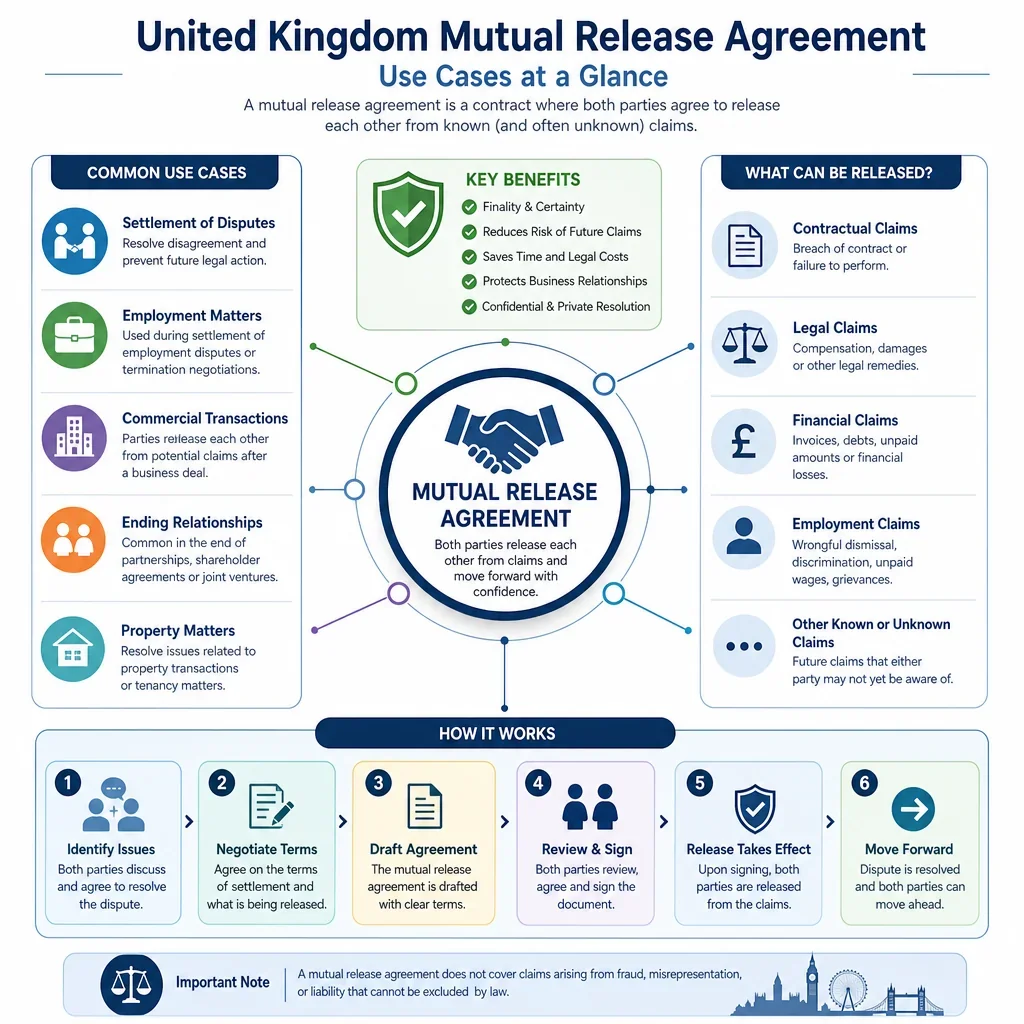
When do you need a Mutual Release Agreement in the United Kingdom?
British Legal Rules for a Mutual Release Agreement
Using the wrong structure for a mutual release agreement can fail to effectively discharge all claims or obligations between parties.
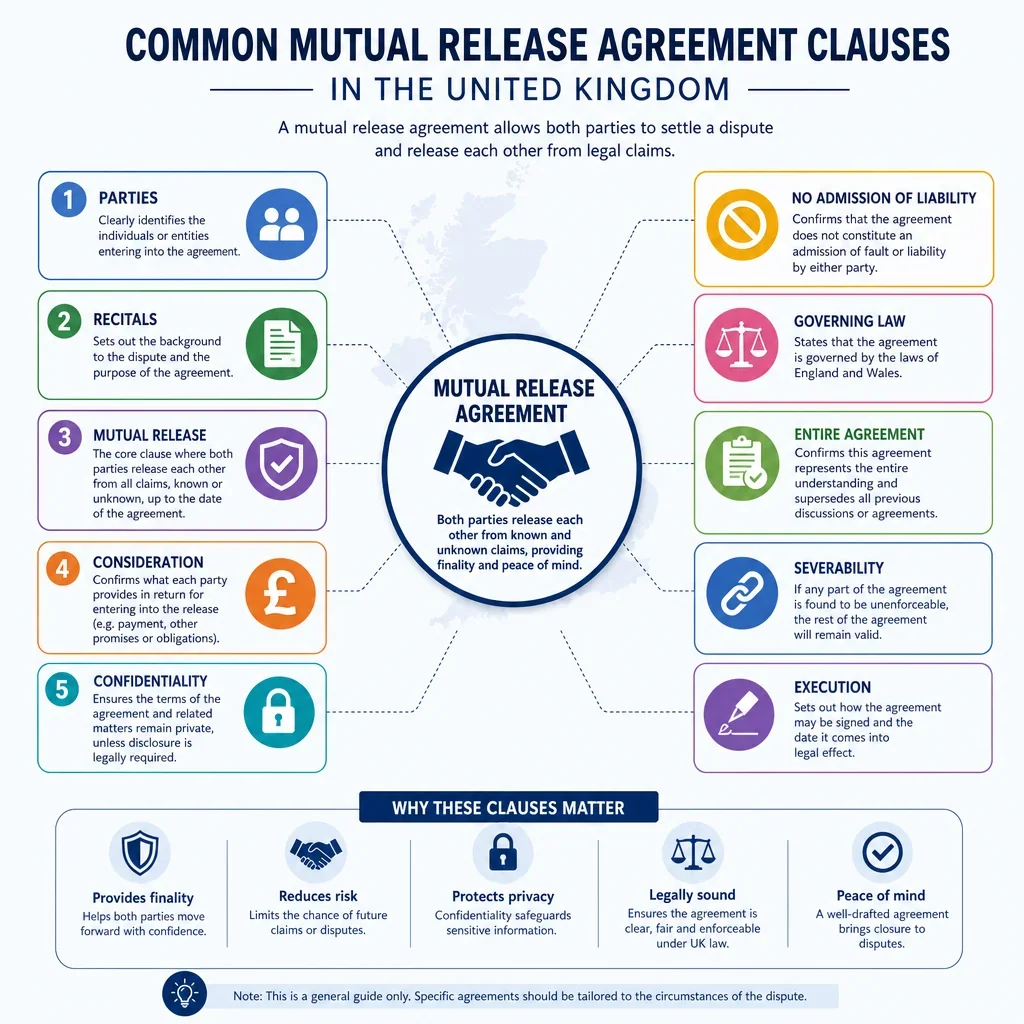
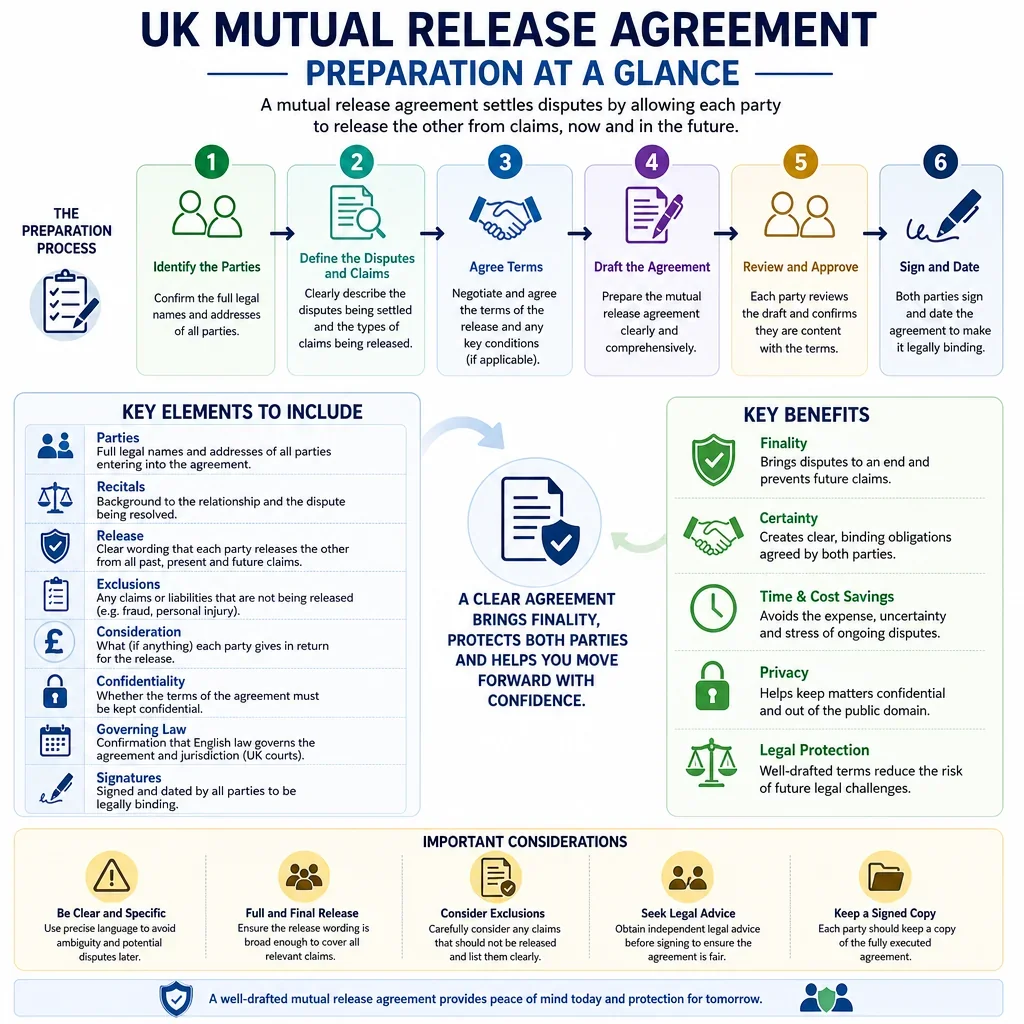
What a Proper Mutual Release Agreement Should Include
- Parties InvolvedClearly identify the people or companies agreeing to release each other from claims.
- Description of the DisputeBriefly outline the issue or disagreement that the agreement is resolving.
- Mutual Release of ClaimsState that both sides fully release each other from any past or present claims related to the dispute.
- Payment or ConsiderationDetail any money or benefits exchanged to make the agreement valid.
- Confidentiality ClauseAgree to keep the terms of the settlement private and not share them with others.
- No Admission of FaultConfirm that the agreement does not mean either side admits to any wrongdoing.
- Future Claims WaiverSpecify that the release covers any unknown future claims arising from the same issue.
- Signatures and DatesInclude spaces for both parties to sign and date the document to make it binding.
Generate Your Document in 4 Easy Steps
Why Use Docaro?
 United Kingdom
Free Example Mutual Release Agreement Template
Below is a free template example of a Mutual Release Agreement for use in the United Kingdom generated by our AI model.
The clauses in your actual Mutual Release Agreement will vary from this example as they will be entirely bespoke to your requirements as set out in the questionnaire you complete.
Mutual Release Agreement
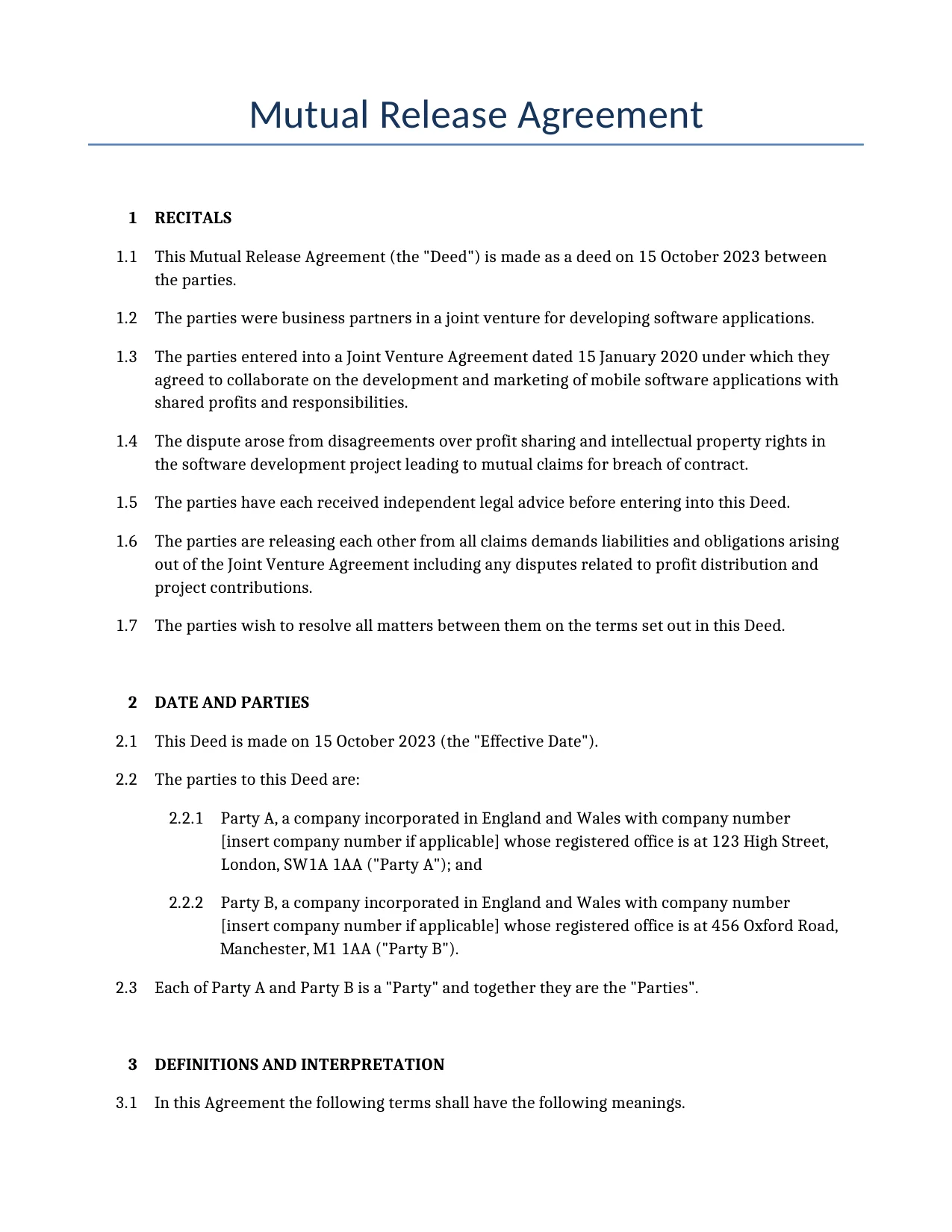
1RECITALS
This Mutual Release Agreement (the "Deed") is made as a deed on 15 October 2023 between the parties.
The parties were business partners in a joint venture for developing software applications.
The parties entered into a Joint Venture Agreement dated 15 January 2020 under which they agreed to collaborate on the development and marketing of mobile software applications with shared profits and responsibilities.
The dispute arose from disagreements over profit sharing and intellectual property rights in the software development project leading to mutual claims for breach of contract.
The parties have each received independent legal advice before entering into this Deed.
The parties are releasing each other from all claims demands liabilities and obligations arising out of the Joint Venture Agreement including any disputes related to profit distribution and project contributions.
The parties wish to resolve all matters between them on the terms set out in this Deed.
2DATE AND PARTIES
This Deed is made on 15 October 2023 (the "Effective Date").
The parties to this Deed are:
Party A, a company incorporated in England and Wales with company number [insert company number if applicable] whose registered office is at 123 High Street, London, SW1A 1AA ("Party A"); and
Party B, a company incorporated in England and Wales with company number [insert company number if applicable] whose registered office is at 456 Oxford Road, Manchester, M1 1AA ("Party B").
Each of Party A and Party B is a "Party" and together they are the "Parties".
3DEFINITIONS AND INTERPRETATION
In this Agreement the following terms shall have the following meanings.
Agreement means this mutual release agreement including any schedules or annexes.
Claims means all claims demands liabilities obligations and causes of action whether known or unknown whether arising in contract tort statute or otherwise and whether arising before on or after the date of this Deed but excluding any claims that cannot be released under English law.
Deed means this mutual release agreement which is intended to be executed and delivered as a deed for the purposes of releasing unknown claims under English law in accordance with section 1 of the Law of Property (Miscellaneous Provisions) Act 1989.
Joint Venture Agreement means the agreement dated 15 January 2020 between the parties relating to the development and marketing of mobile software applications.
Party A means the first party to this Deed whose registered office is at 123 High Street London SW1A 1AA.
Party B means the second party to this Deed whose registered office is at 456 Oxford Road Manchester M1 1AA.
Released Matters means all Claims arising out of or in connection with the Joint Venture Agreement including but not limited to disputes regarding profit sharing intellectual property rights unpaid invoices and delivery delays up to the date of this Deed.
This Deed shall be interpreted using gender neutral language wherever possible.
References to clauses are to clauses of this Deed.
Headings are for convenience only and shall not affect the interpretation of this Deed.
4MUTUAL RELEASES
In consideration of the mutual releases and the payment set out in clause 5 each Party irrevocably and unconditionally releases and discharges the other Party by way of deed from all Claims which it has or may have against the other Party arising out of or in connection with the Released Matters up to and including the date of this Deed.
Each Party warrants to the other that it has not assigned transferred or otherwise disposed of any of the Claims being released under this Deed to any third party.
The releases in clauses 4.1 extend to all contractual liabilities tortious liabilities and statutory liabilities whether known or unknown but shall not extend to any future claims that may arise after the date of this Deed except to the extent that they relate to facts or circumstances existing on or before the date of this Deed (subject always to the exclusions in clause 6).
Nothing in this Deed shall release either Party from any ongoing obligations that are expressly stated to survive this Deed.
5PAYMENT TERMS
In consideration of the mutual releases set out in clause 4 Party A shall pay to Party B the sum of \£5,000 (five thousand pounds sterling) exclusive of any applicable VAT (if any) within 14 days of the date of this Deed.
The payment shall be made by electronic transfer to the following bank account: [insert bank details including sort code and account number].
The payment referred to in clause 5.1 is a condition of the releases given in clause 4 and time for payment shall be of the essence.
If VAT is chargeable on the payment it shall be paid in addition to the \£5,000 upon receipt of a valid VAT invoice.
6SCOPE OF RELEASE
The releases set out in clause 4 shall apply to all known Claims including breach of contract regarding unpaid invoices totaling \£5,000 from services provided in 2023 and a dispute over delivery delays leading to lost business opportunities.
The releases shall also apply to all unknown Claims arising from the Released Matters up to the date of this Deed.
For the avoidance of doubt the releases shall not apply to: (a) any claims arising from fraud or dishonesty; (b) any claims for personal injury; or (c) any other claims that cannot lawfully be released under English law.
The releases shall include all Claims related to the known disputes even if not explicitly listed in this Deed.
For the avoidance of doubt the releases shall not affect any rights or obligations of third parties unless expressly provided for under the Contracts (Rights of Third Parties) Act 1999.
7REPRESENTATIONS AND WARRANTIES
Each Party represents and warrants that it has the full authority and capacity to enter into and sign this Deed (including if a company that it has obtained all necessary board and shareholder approvals).
Each Party represents and warrants that it has received independent legal advice on the terms and effect of this Deed understands the implications of the releases (including in respect of unknown claims) and that its decision to enter into this Deed and provide the release is entirely voluntary and free from any duress or undue influence.
Each Party represents and warrants that it has not transferred assigned or otherwise disposed of any Claims that are being released under this Deed to any third party.
Each Party represents and warrants that there are no pending legal actions or proceedings related to the Claims being released in this Deed.
Each Party represents and warrants that it has fully disclosed all facts and circumstances relating to the Claims being released in this Deed.
The representations and warranties in this clause 7 shall survive the execution and delivery of this Deed.
8NO ADMISSION OF LIABILITY
Nothing in this Deed shall constitute or be construed as an admission of liability or wrongdoing by Party A or Party B.
This Deed is entered into solely for the purpose of resolving the Released Matters without any admission of liability on the part of either Party.
9CONFIDENTIALITY
Each Party shall keep the terms of this Deed and any related information confidential.
The confidentiality obligation shall extend to any information beyond the terms of this Deed that relates to the Released Matters.
The confidentiality obligation shall not apply to disclosures made to legal advisors auditors or regulators or as required in legal proceedings.
The confidentiality obligation shall continue indefinitely.
In the event of a breach of this clause the innocent Party shall be entitled to seek injunctive relief.
10NON-DISPARAGEMENT
Neither Party A nor Party B shall make any negative or derogatory statements about the other Party whether in public statements private communications or social media posts.
Any breach of this clause shall entitle the innocent Party to seek damages and any other remedies available at law.
11COSTS
Each Party shall bear its own legal and other costs and expenses incurred in relation to the negotiation preparation and execution of this Deed.
12ENTIRE AGREEMENT
This Deed constitutes the entire understanding between the Parties and supersedes all prior agreements or understandings whether oral or written relating to the Released Matters.
Each Party acknowledges that it has not entered into this Deed in reliance on any representation warranty or undertaking not expressly set out in this Deed.
13SEVERABILITY
If any provision of this Deed is held to be invalid or unenforceable the remaining provisions shall continue in full force and effect.
14WAIVER
No waiver of any breach of this Deed shall be effective unless made in writing.
A single waiver shall not constitute or imply a waiver of any future breaches of this Deed.
The provisions of this clause shall apply to all obligations and breaches under this Deed.
15ASSIGNMENT
Neither Party may assign any of its rights or obligations under this Deed without the prior written consent of the other Party.
16NOTICES
Any notice given under this Deed shall be in writing and may be served by post or email.
Notices to Party A shall be sent to 123 High Street London SW1A 1AA or the email address notified in writing by Party A.
Notices to Party B shall be sent to 456 Oxford Road Manchester M1 1AA or the email address notified in writing by Party B.
Notices served by post shall be deemed served two business days after posting.
Notices served by email shall be deemed served at the time of transmission if sent during business hours or otherwise on the next business day.
All notices shall be served in English.
17COUNTERPARTS
This Deed may be executed in any number of counterparts each of which when executed shall constitute an original but all of which together shall constitute one and the same instrument.
18GOVERNING LAW AND JURISDICTION
This Deed and any dispute or claim arising out of or in connection with it or its subject matter or formation (including non-contractual disputes or claims) shall be governed by and construed in accordance with the laws of England and Wales.
The Parties agree that the courts of England and Wales shall have exclusive jurisdiction over any dispute or claim arising out of or in connection with this Deed.
19THIRD PARTY RIGHTS
A person who is not a party to this Deed shall have no rights under the Contracts (Rights of Third Parties) Act 1999 to enforce any term of this Deed except as expressly provided for in this Deed.
20EXECUTION
Executed and delivered as a deed by the Parties on the date first written above.
21SIGNATURES
Executed as a deed by Party A acting by a director in the presence of a witness: Director: _______________________________ Signature of witness: _______________________________ Name of witness: _______________________________ Address of witness: _______________________________
Executed as a deed by Party B acting by a director in the presence of a witness: Director: _______________________________ Signature of witness: _______________________________ Name of witness: _______________________________ Address of witness: _______________________________
This example shows approximately 70% of a typical document and is provided for illustrative purposes only. The remaining content has been omitted.
Every document generated by Docaro is tailored to your specific circumstances, jurisdiction and the information you provide. The completed document includes all applicable clauses and provisions required for your situation.
To generate the full, personalised document, answer a short series of questions and your document will be created instantly.
Useful Resources When Considering a Mutual Release Agreement in the United Kingdom
United Kingdom Reference Legislation
Mutual Release Agreement FAQs
Document Generation FAQs
Related Articles