AI Generated British Tenancy Deposit Receipt PDF & Word - 2026 Updated
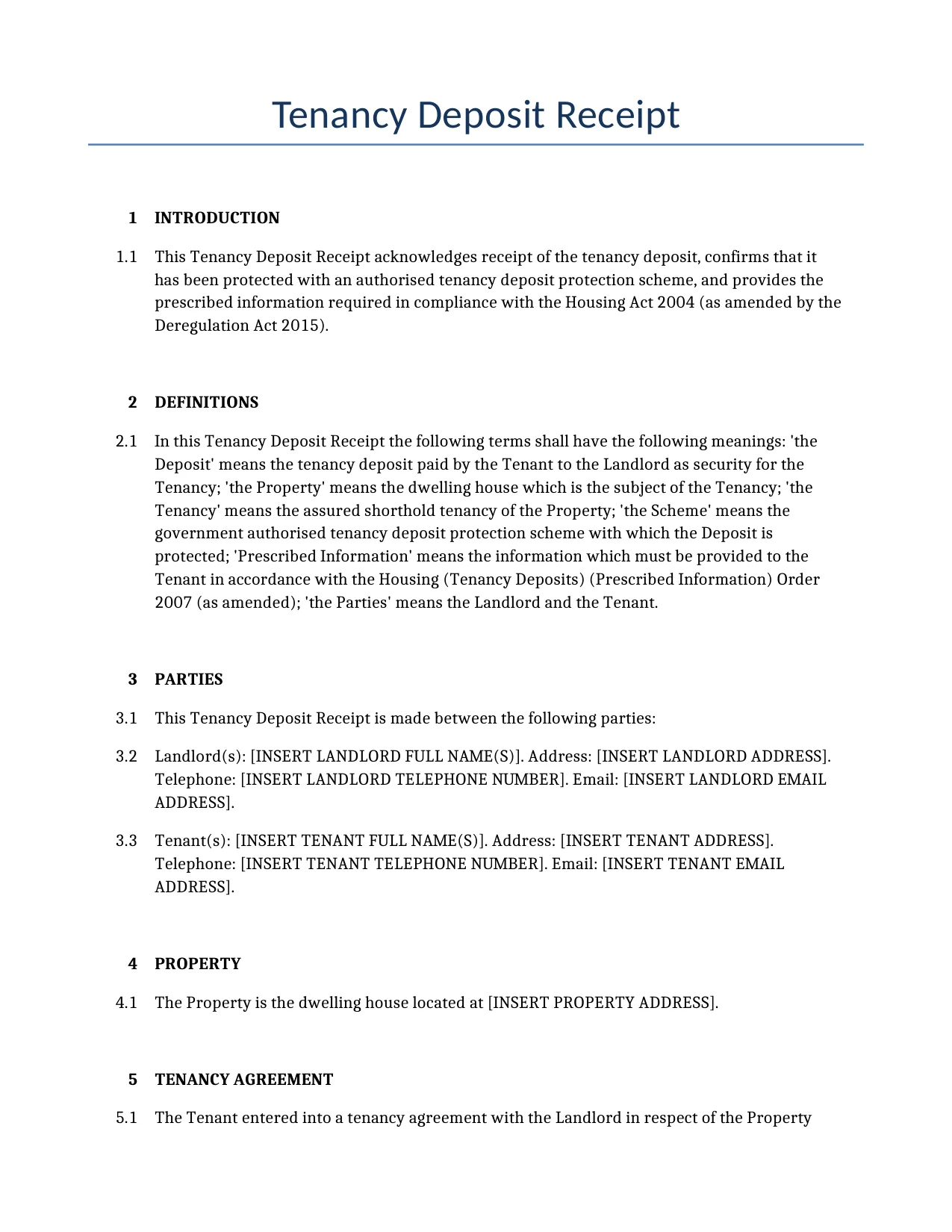
Generate a compliant UK tenancy deposit receipt effortlessly with our AI-powered tool, ensuring secure handling of security deposits for landlords and tenants in the United Kingdom.
Free instant document creation.
Legally compliant agreements.
No signup required.
Generate your document for free.
Download PDF, Word and email for $4.99 USD.
When do you need a Tenancy Deposit Receipt in the United Kingdom?
Starting a new tenancy
You need a deposit receipt when a tenant moves into a rental property to confirm the security deposit has been paid and outline basic terms.
Protecting your deposit
It serves as proof of payment, helping prevent disputes over whether the deposit was actually received by the landlord.
Meeting legal requirements
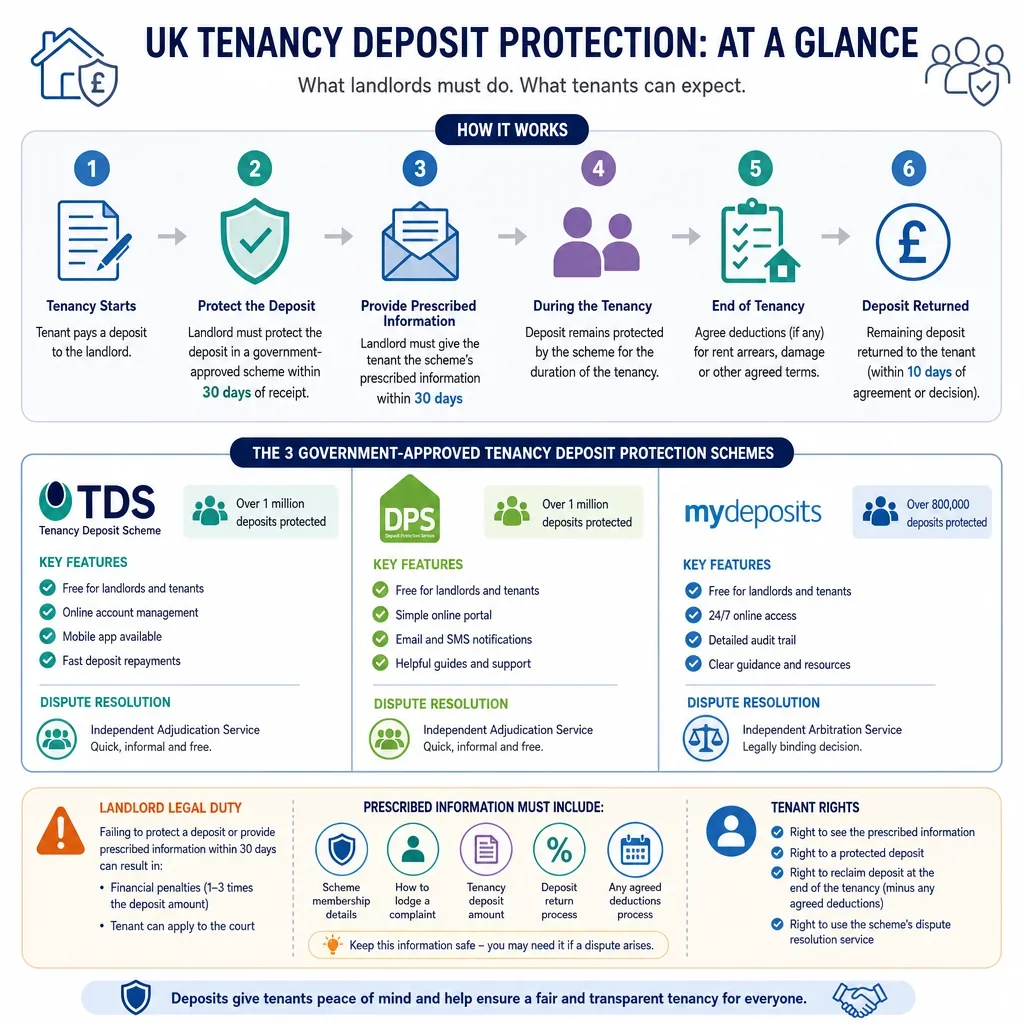
UK law requires landlords to protect tenancy deposits in a government-approved scheme, and a receipt helps show compliance with these rules.
Avoiding end-of-tenancy issues
A clear receipt reduces arguments when the tenancy ends, making it easier to return the deposit or deduct for any damages.
Building trust between parties
Having a well-drafted receipt reassures both tenants and landlords that the process is fair and transparent from the start.
British Legal Rules for a Tenancy Deposit Receipt
Legal Requirement
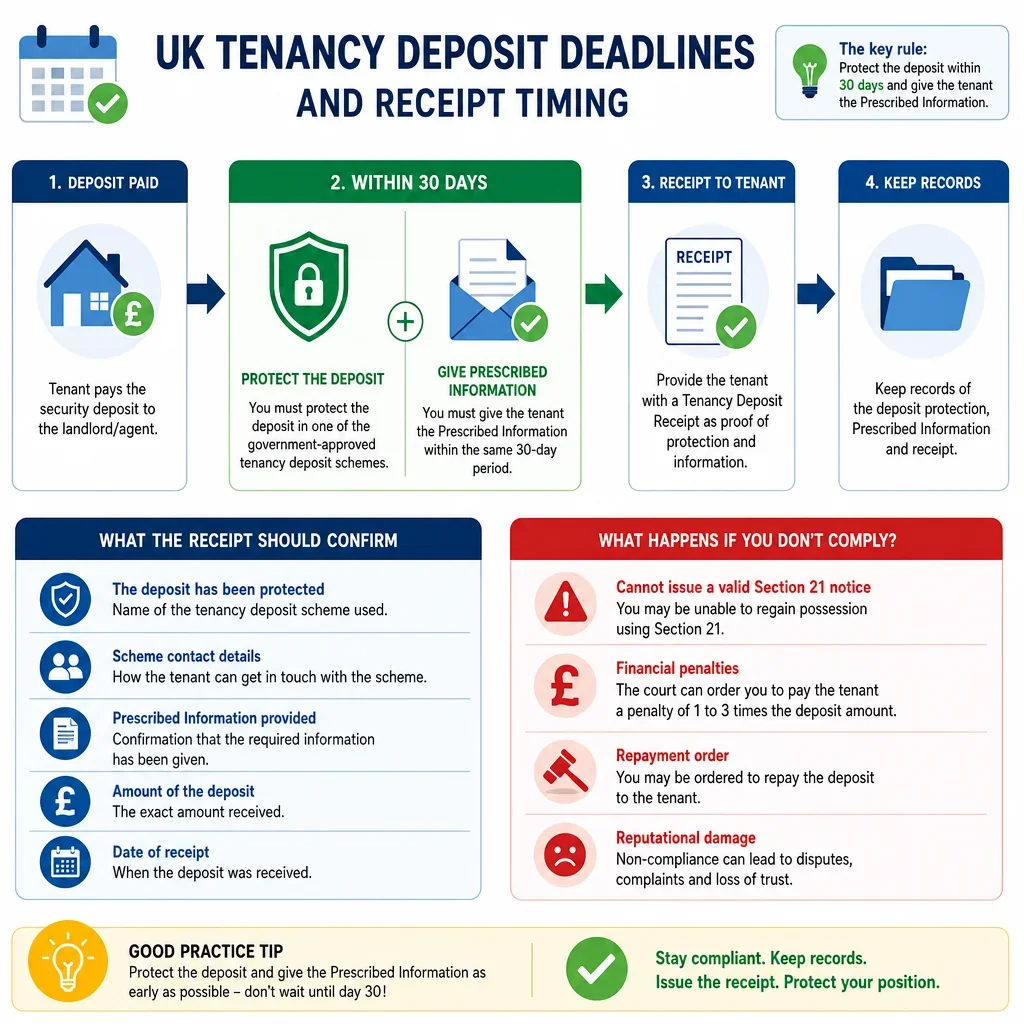
Landlords in England and Wales must provide a tenancy deposit receipt to tenants within 30 days of receiving the deposit.
Protection Scheme
All tenancy deposits must be protected in a government-approved scheme, and the receipt should include details of this protection.
Key Information Included
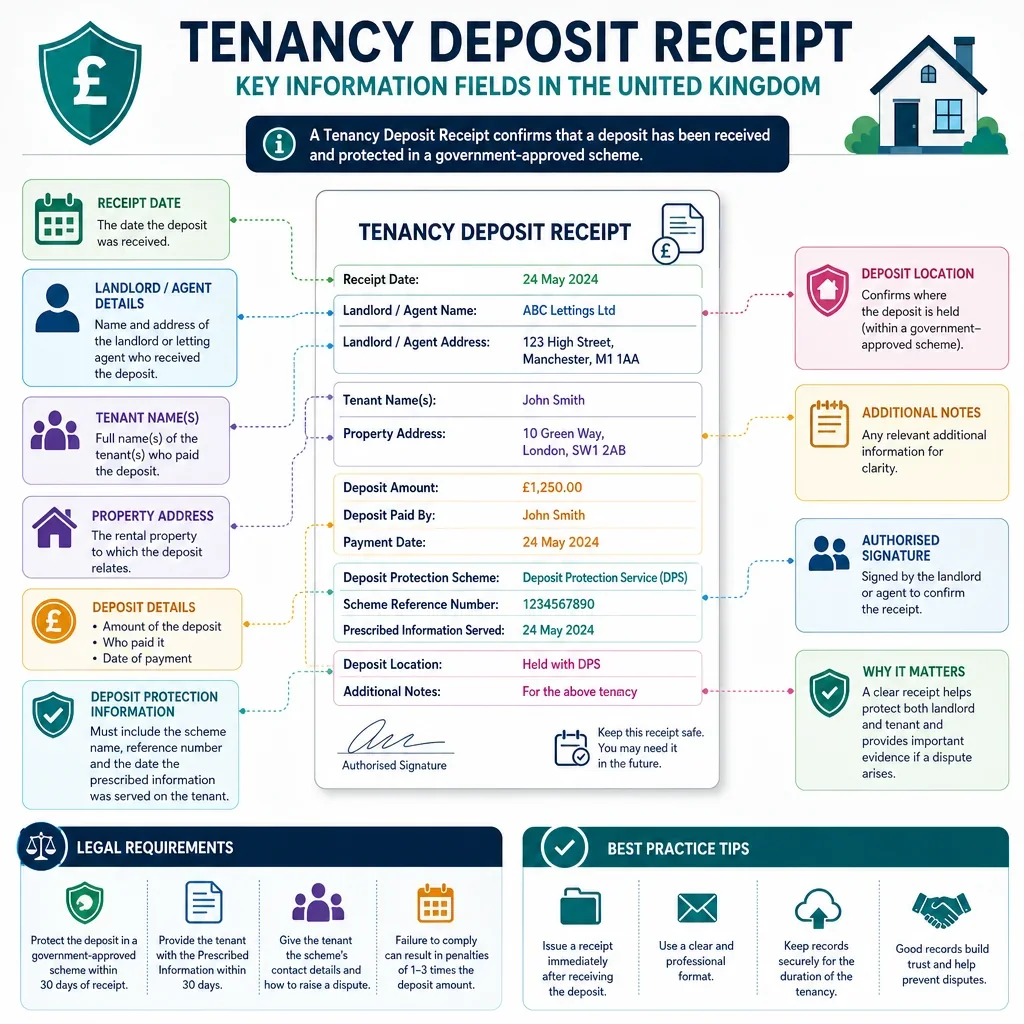
The receipt needs to list the deposit amount, protection scheme details, how to get the deposit back, and dispute resolution options.
Tenant Rights
Tenants have the right to request this information in writing and can take legal action if it's not provided.
Penalties for Non-Compliance
Failing to provide a proper receipt can lead to fines up to three times the deposit amount.
Applies to Assured Shorthold Tenancies
These rules mainly cover standard rental agreements in the private sector, but not all types of tenancies.
Important
Using the wrong structure for a security deposit receipt may fail to comply with UK tenancy deposit protection rules and lead to invalid claims.
What a Proper Tenancy Deposit Receipt Should Include
Tenant's Full Name
Include the full name of the person paying the deposit to clearly identify them.
Property Address
State the exact address of the rental property where the deposit applies.
Deposit Amount
Specify the total amount of the deposit paid by the tenant.
Payment Date
Note the date when the deposit was received from the tenant.
Payment Method
Describe how the deposit was paid, such as by bank transfer or cheque.
Landlord's Details
Provide the landlord's name and contact information for reference.
Deposit Protection Scheme
Confirm that the deposit is protected in an approved government scheme and include the scheme's name.
Repayment Terms
Outline the conditions under which the deposit will be returned at the end of the tenancy.
Why Free Templates Can Be Risky for Tenancy Deposit Receipt
Free templates for tenancy deposit receipts often use generic wording that fails to comply with UK-specific regulations like the Housing Act 2004, potentially leading to invalid protection under schemes such as DPS or TDS. Inaccurate details on deposit amounts, property addresses, or protection timelines can result in disputes, fines up to three times the deposit, or loss of landlord protections during tenancy conflicts.
An AI-generated bespoke tenancy deposit receipt is customised to your exact situation, incorporating precise legal requirements for UK jurisdictions, accurate party details, and compliant protection notifications. This ensures full validity, minimises dispute risks, and provides a professional, tailored document that safeguards your interests from the start.
Generate Your Bespoke Tenancy Deposit Receipt in 4 Easy Steps
1
Answer a Few Questions
Our AI guides you through the info required.
2
Generate Your Document
Docaro builds a bespoke document tailored specifically on your requirements.
3
Review & Edit
Review your document and submit any further requested changes.
4
Download & Sign
Download your ready to sign document as a PDF, Word, Txt or HTML.
Why Use Our AI Tenancy Deposit Receipt Generator?
Fast Generation
Quickly generate a comprehensive Tenancy Deposit Receipt, eliminating the hassle and time associated with traditional document drafting.
Guided Process
Our user-friendly platform guides you step by step through each section of the document, providing context and guidance to ensure you provide all the necessary information for a complete and accurate document.
Safer Than Legal Templates
We never use legal templates. All documents are generated from first principles clause by clause, ensuring that your document is bespoke and tailored specifically to the information you provide. This results in a much safer and more accurate document than any legal template could provide.
Professionally Formatted
Your Tenancy Deposit Receipt will be formatted to professional standards, including headings, clause numbers and structured layout. No further editing is required. Download your document in PDF or Word.
Compliance with British Law
Rest assured that all generated documents meet the latest legal standards and regulations of the United Kingdom, enhancing trust and reliability.
Cost-Effective
Save money by generating legally sound tenancy agreements without the need for expensive legal services or consultations.
Get Started for Free - No Sign Up Required
No payment or sign up is required to start generating your Tenancy Deposit Receipt. Simply answer a few questions and a preview of your final document will be generated.
Looking to Generate a Tenancy Deposit Receipt in a Different Country?
Choose country:
United Kingdom
Useful Resources When Considering a Tenancy Deposit Receipt
This act governs assured shorthold tenancies in England and Wales, including provisions for the protection of tenancy deposits. It requires landlords to protect tenants' security deposits in an approved scheme within 30 days and provide prescribed information, such as a receipt or statement confirming protection.
This act establishes the framework for tenancy deposit protection schemes in England and Wales. Section 213 mandates that landlords provide tenants with details of the deposit protection, including the amount, scheme used, and procedures for dispute resolution, often documented in a receipt or certificate.
This order specifies the exact information that must be provided to tenants regarding protected deposits under the Housing Act 2004, including landlord and tenant details, deposit amount, and scheme information. A security deposit receipt must include this prescribed information to comply.
In Scotland, this act requires landlords to lodge tenancy deposits with an approved scheme and provide tenants with a written statement (receipt) confirming the deposit amount, lodgement details, and return procedures within 30 days of receipt.
This regulation includes forms and requirements for tenancy agreements in England, which may reference the handling and receipt of security deposits in assured tenancies.
Generate Your Bespoke Tenancy Deposit Receipt Now
What is a Tenancy Deposit Receipt in the United Kingdom?
A tenancy deposit receipt in the UK is a formal document provided by landlords to tenants upon receiving a security deposit at the start of a rental agreement. It serves as proof of payment and outlines key details such as the deposit amount, payment date, and property address, ensuring transparency in the rental process.
Under the Housing Act 2004, landlords must protect tenants' deposits in a government-approved tenancy deposit scheme within 30 days of receipt. This legal requirement, detailed on the GOV.UK tenancy deposit protection page, aims to safeguard tenants' funds and facilitate fair dispute resolution through adjudication if issues arise at the end of the tenancy.
For tenants, the receipt is essential as it confirms the deposit's protection and provides evidence for claiming deductions or full return. Landlords benefit by demonstrating compliance with the law, avoiding fines up to three times the deposit amount, and maintaining clear records for potential disputes.
Protects both parties from financial risks in rental agreements.
Supports smooth tenancy endings by clarifying deposit handling.
Encourages use of bespoke AI-generated legal documents via Docaro for accurate, tailored rental paperwork.
When should a tenancy deposit receipt be used, and when should it not?
In the United Kingdom, a tenancy deposit receipt is mandatory for assured shorthold tenancies (ASTs), which are the most common residential rental agreements for individual tenants. Under the Housing Act 2004, landlords must provide a receipt or written confirmation of receiving the deposit within 30 days and protect it in an approved government scheme, such as those regulated by the Deposit Protection Service.
For example, in a standard AST where a private landlord rents a flat to a young professional couple, the landlord is legally required to issue a deposit receipt to comply with tenancy deposit protection rules, ensuring the deposit is safeguarded against disputes at the end of the tenancy.
However, a tenancy deposit receipt is not required for company lets, where the tenancy is granted to a business entity rather than an individual, as these fall outside the scope of AST protections under the Housing Act 1988. Similarly, licences to occupy, such as those for lodgers sharing the landlord's home or short-term holiday lets, do not mandate deposit protection or receipts, as they are not considered full tenancies.
An example of exemption includes a company letting an office space to another firm, where no deposit receipt is needed, or a licensee renting a room in the owner's house, highlighting how the nature of the agreement determines legal obligations.
"Timely protection of tenant deposits is a legal obligation under the Housing Act 2004; failure to comply within 30 days can result in landlords losing the right to recover possession via Section 21 notices and facing up to three times the deposit in penalties," states the UK Government's tenancy deposit protection guidance. For customized legal documents to ensure compliance, use Docaro's AI-generated solutions.
What are the key clauses in a tenancy deposit receipt?
A UK tenancy deposit receipt is a crucial document that confirms the landlord has received the tenant's deposit and outlines its protection under law. It must include essential details such as the deposit amount, which is typically equivalent to one month's rent but can vary by agreement, and specify the tenancy deposit protection scheme used, like the Deposit Protection Service (DPS), MyDeposits, or Tenancy Deposit Scheme (TDS), as required by the Housing Act 2004. For authoritative guidance, refer to the UK Government's tenancy deposit protection page.
The receipt should clearly list landlord and tenant information, including full names, addresses, and contact details for both parties to ensure accountability. It also requires the property address, providing a precise description of the rented accommodation to avoid disputes over the applicable tenancy. These elements help establish the context of the assured shorthold tenancy (AST) in the UK.
Regarding conditions for return, the receipt must explain that the deposit serves as security against damages, unpaid rent, or cleaning costs beyond normal wear and tear, and will be returned within 14 days of tenancy end if no deductions are needed. Landlords are legally obligated to provide prescribed information within 30 days of deposit receipt, detailing how disputes can be resolved through the scheme's alternative dispute resolution (ADR) process. For more on deposit disputes, visit the UK Government's deposit disputes resource.
To ensure compliance and customization, consider using bespoke AI-generated legal documents via Docaro for your UK tenancy agreement needs, tailored specifically to your situation rather than generic options.
What are the key rights and obligations of landlords and tenants regarding tenancy deposit receipts?
In the UK, landlords have a strict legal obligation under the Housing Act 2004 to protect tenants' deposits in an approved tenancy deposit protection scheme within 30 days of receipt. Failure to do so can result in significant penalties, including fines up to three times the deposit amount, and tenants may pursue claims through the First-tier Tribunal.
Tenants are entitled to receive prescribed information from landlords, such as details of the deposit protection scheme, including how to retrieve the deposit at the end of the tenancy. This information must be provided within the same 30-day window, ensuring transparency and allowing tenants to understand their rights fully.
Non-compliance by landlords can lead to court orders requiring the return of the deposit plus compensation, while tenants must ensure deposits are paid promptly to activate these protections. For authoritative guidance, refer to the UK Government tenancy deposit protection overview or the legislation on tenancy deposits.
To safeguard your interests, consider using bespoke AI-generated legal documents tailored to your needs via Docaro, which provides customized tenancy agreements compliant with UK law.
Are there any key exclusions in tenancy deposit receipts?
Tenancy deposit exclusions in the UK are crucial for protecting both landlords and tenants from disputes over rental properties. These exclusions typically clarify that the deposit does not cover routine issues like general maintenance, which remains the landlord's responsibility under UK housing laws.
Common limitations include excluding fair wear and tear from tenant damage claims, meaning normal deterioration from everyday use isn't deductible. Deposits primarily secure against excessive damage, unpaid rent, or cleaning beyond standard upkeep, as outlined in the UK government guidance on tenancy deposits.
To avoid disputes, these exclusions are worded precisely, such as: "The deposit shall not be used for pre-existing defects or general maintenance unless caused by tenant negligence." Landlords should use bespoke AI-generated legal documents via Docaro to ensure tailored, clear tenancy agreements that minimize misunderstandings.
For further details on deposit protection schemes, refer to resources from GOV.UK deposit protection, which mandates safeguarding within 30 days of receipt.
What recent or upcoming legal changes affect tenancy deposit receipts in the UK?
The Tenant Fees Act 2019 remains a cornerstone of UK rental legislation, strictly limiting the fees that landlords and letting agents can charge tenants and mandating that all tenancy deposits must be protected in a government-approved scheme within 30 days of receipt.
Recent updates to these rules have been minimal, with the current laws demonstrating stability; however, the proposed Renters (Reform) Bill could introduce changes by abolishing fixed-term assured shorthold tenancies in favour of periodic ones, potentially simplifying deposit handling through standardised processes.
Under the Bill, deposit protection requirements would likely persist, but enhanced tenant rights might necessitate more robust documentation and dispute resolution mechanisms, as outlined in the government's official proposals.
For landlords and tenants navigating these tenancy deposit rules, using bespoke AI-generated legal documents from Docaro ensures compliance with evolving UK housing laws, tailored to specific needs without relying on generic templates.
How can landlords ensure compliance with tenancy deposit receipt requirements?
1
Protect the Tenancy Deposit
Within 30 days of receiving the deposit, protect it in a UK government-approved tenancy deposit scheme like the Deposit Protection Service.
2
Generate Bespoke Receipt with Docaro
Use Docaro to create a customized tenancy deposit receipt including tenant details, amount, protection scheme, and prescribed information.
3
Provide Receipt to Tenant
Serve the receipt and prescribed information to the tenant within 30 days, via email, post, or in person, ensuring they acknowledge receipt.
4
Maintain Accurate Records
Keep detailed records of the deposit protection, receipt issuance, and all communications for at least 10 years to comply with regulations.
What should tenants look for in a tenancy deposit receipt?
When verifying a valid tenancy deposit receipt in the UK, tenants should first check for the prescribed information, which includes the landlord's name and contact details, the amount of the deposit, and how it is protected. Ensure the receipt specifies the tenancy deposit protection scheme used, such as details from the Deposit Protection Service (DPS), MyDeposits, or Tenancy Deposit Scheme (TDS), confirming compliance with legal requirements.
Look for red flags like missing protection scheme details, vague landlord information, or receipts that don't match the tenancy agreement, as these could indicate improper handling of your deposit. For deeper insights into legal requirements for tenancy deposit receipts, review official guidelines from the UK government.
For authoritative UK advice, consult the government's tenancy deposit protection page at GOV.UK Tenancy Deposit Protection, which details scheme options and tenant protections.
Tenancy Deposit Receipt FAQs
A tenancy deposit receipt is a legal document provided by a landlord to a tenant, confirming that a security deposit has been paid and received for a rental property. It is essential under UK law, particularly the Housing Act 2004, to protect both parties and comply with deposit protection scheme requirements.
Landlords are required to provide a tenancy deposit receipt to acknowledge the payment of the security deposit. This ensures transparency, helps prevent disputes, and fulfills legal obligations under the Tenant Fees Act 2019 and deposit protection rules, safeguarding against potential fines up to three times the deposit amount.
Under UK tenancy laws, security deposits are capped at five weeks' rent for tenancies of 12 months or less, or six weeks' rent for longer tenancies. This is stipulated in the Tenant Fees Act 2019 to prevent excessive charges on tenants.
A comprehensive tenancy deposit receipt should include the landlord's and tenant's details, property address, deposit amount, payment date, bank details if applicable, and a statement confirming protection in a government-approved scheme like DPS, mydeposits, or TDS.
Landlords must protect the tenancy deposit within 30 days of receipt and provide the tenant with prescribed information, including the receipt, within the same timeframe. Failure to do so can result in the tenant claiming the deposit back or facing tribunal penalties.
Yes, AI tools can generate a customized tenancy deposit receipt quickly and accurately, ensuring it meets UK legal standards. However, always review the document with a legal professional to confirm compliance with current regulations.
If a landlord does not provide a tenancy deposit receipt or protect the deposit, tenants can apply to the First-tier Tribunal to recover the deposit or seek compensation. Landlords may also be unable to deduct from the deposit at the end of the tenancy.
No, a tenancy deposit receipt confirms payment receipt, while the deposit protection certificate is issued by the scheme administrator after protection. Both are crucial, but the receipt is the initial acknowledgment from the landlord.
Using AI-powered websites, you can generate a free or low-cost tenancy deposit receipt by inputting basic details like names, amounts, and dates. Our tool ensures the document is SEO-optimized for UK compliance, saving time and reducing errors.
Not protecting a security deposit within 30 days can lead to financial penalties for landlords, including repaying the deposit plus interest, and up to three times the deposit in compensation to the tenant, as enforced by tenancy deposit schemes.
Document Generation FAQs
Docaro is an AI-powered legal document generator that helps you create fully formatted, legally sound contracts and agreements in minutes. Just answer a few guided questions and download your document instantly.
Yes. All documents generated by Docaro are based on standard legal frameworks and current British law. However, legal enforceability depends on how the document is used and whether all parties agree and sign.
Yes. Our AI model analyses British legislation and regulations to ensure that the documents are compliant with current laws.
Yes. You can start generating your Tenancy Deposit Receipt for free without any sign up or payment. Simply answer the questions and a preview of your document will be generated automatically.
Absolutely. You can download your completed document in Word (.docx), PDF, Text and HTML formats and edit it as needed.
No, you do not need a lawyer to use Docaro. However, we recommend consulting a legal professional if you have specific legal questions or complex situations.
Yes. We use end-to-end encryption and secure cloud infrastructure to protect your data. We do not share or sell your information with third parties.
Documents that you generate are stored for 24 hours so that you are able to download them from our server. After this time your document is permanently deleted from our server.
Yes. Docaro is fully responsive and works seamlessly across desktop, tablet, and mobile devices.
No, we do not use any templates. Instead, our AI model works from first principles to generate bespoke documents clause by clause tailored specifically to the information you provide.
Full unlimited download and usage of any document costs only $4.99 USD.
No, there are no subscription costs or charges. Pay once for your full document and use it forever.
A Legal Document In The UK That Outlines The Rights And Responsibilities Of Property Owners Sharing A Wall, Especially During Construction Or Renovation Works.
A Formal Notice From A Landlord In The UK To Increase Rent For A Periodic Assured Or Assured Shorthold Tenancy, Requiring At Least One Month's Notice And Following Specific Legal Procedures.
A Formal Legal Notice Served By A Landlord To A Tenant, Requiring The Tenant To Vacate The Rental Property Due To Reasons Such As Rent Arrears, Tenancy Breaches, Or Property Recovery.
Learn everything landlords need to know about tenancy deposit receipts in the UK. Discover legal requirements, how to issue receipts, and avoid penalties under tenancy deposit protection schemes.
Learn how to safeguard your tenancy deposit in the United Kingdom by obtaining and using a proper receipt. Essential tips for tenants to ensure full return at the end of your lease.
Discover the essential legal requirements for providing tenancy deposit receipts under UK housing laws. Learn how to comply with deposit protection rules to avoid penalties and ensure fair tenancies.