AI Generated Compensation Philosophy Statement for use in the United Kingdom
PDF & Word - 2026 Updated
Docaro Pricing
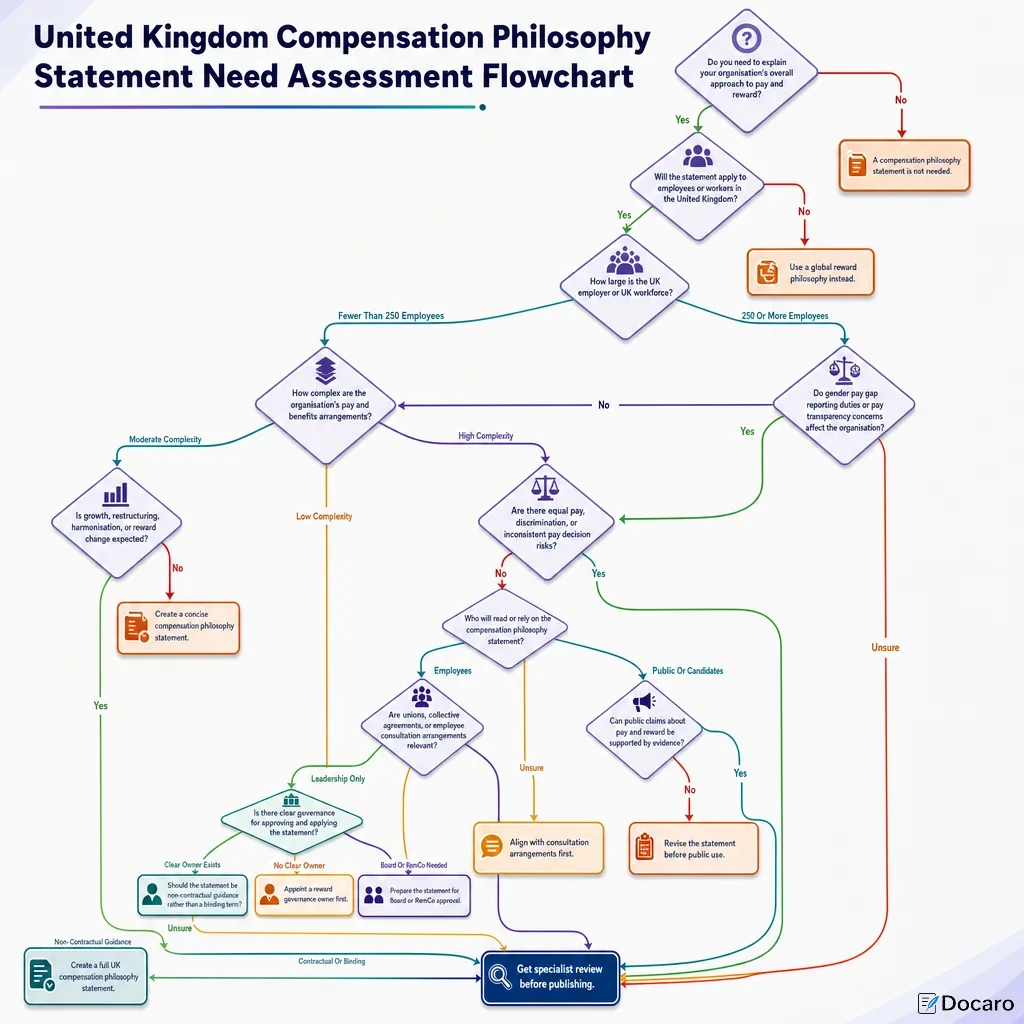
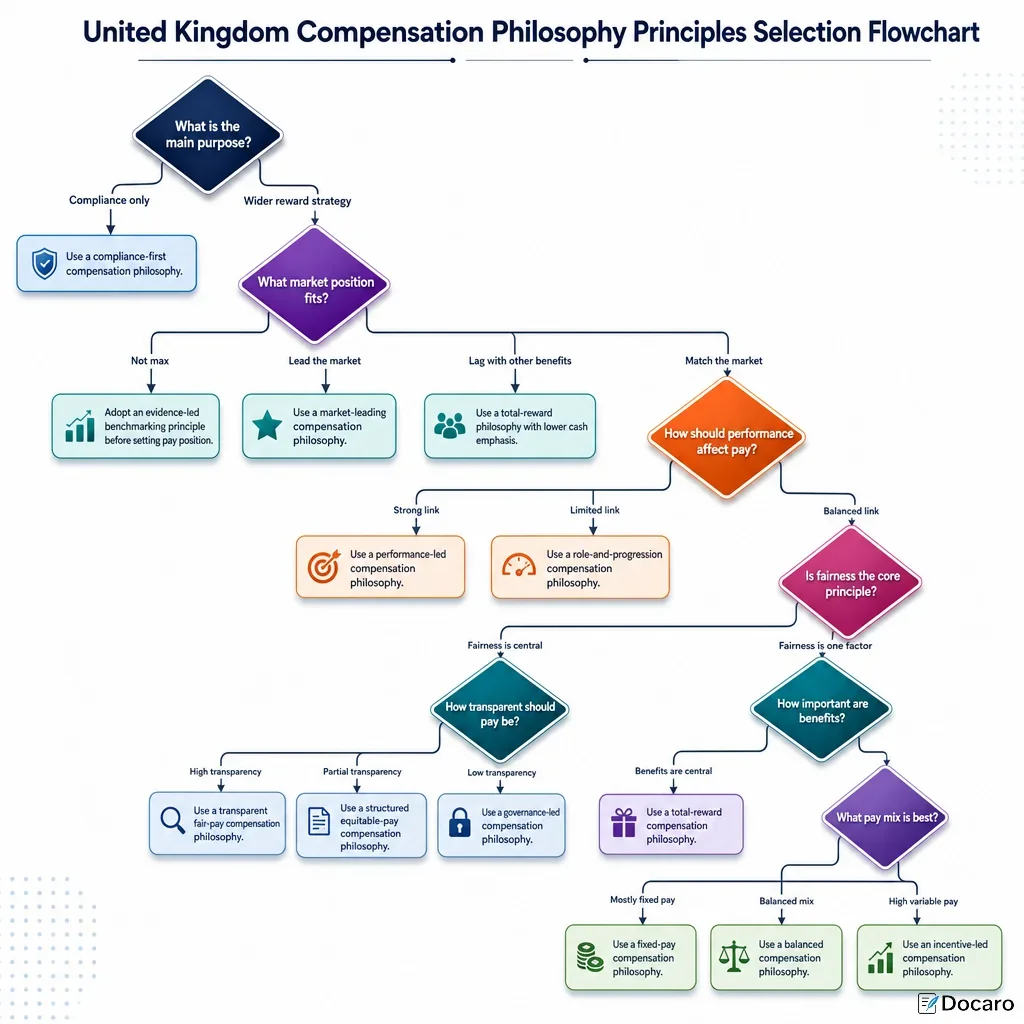
When do you need a Compensation Philosophy Statement in the United Kingdom?
British Legal Rules for a Compensation Philosophy Statement
Using an inappropriate structure for a compensation philosophy statement may lead to misalignment with UK regulatory requirements and governance standards.
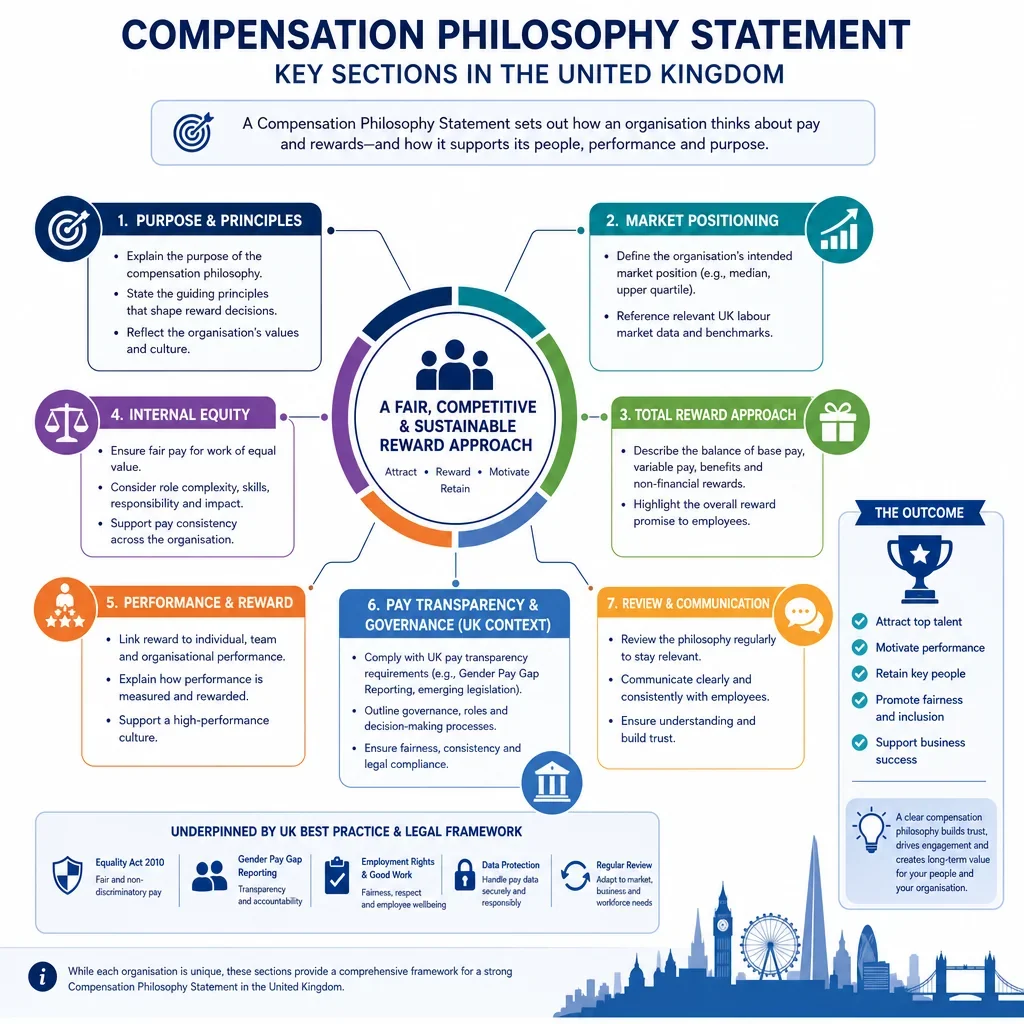
What a Proper Compensation Philosophy Statement Should Include
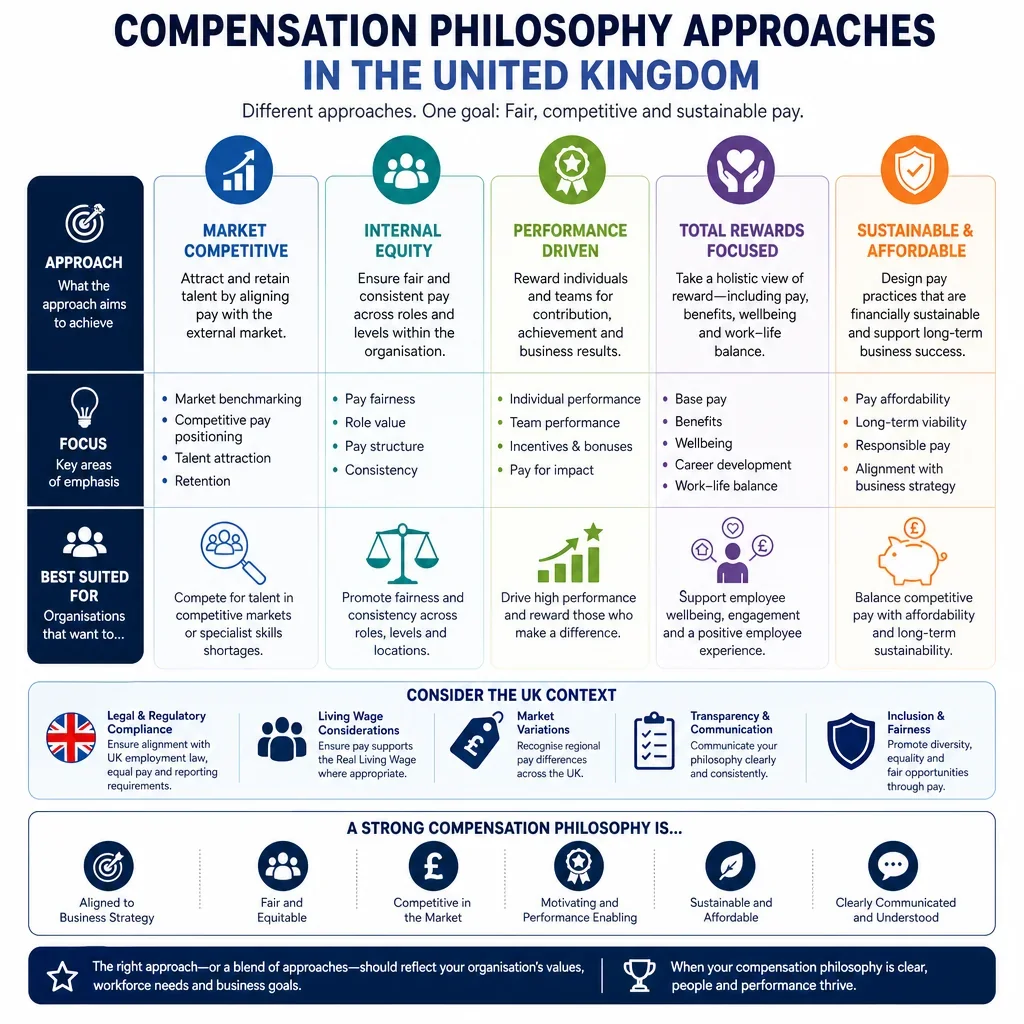
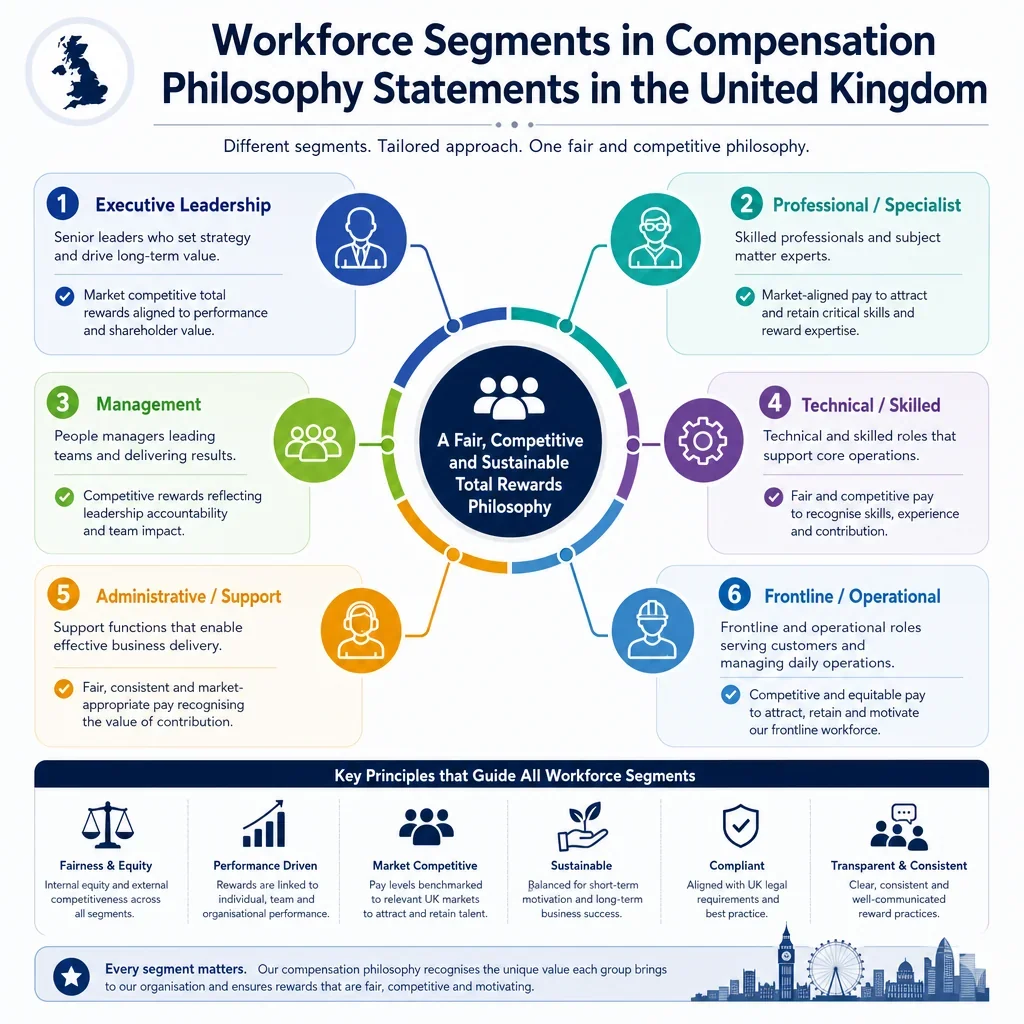
- Overall Approach to PayThis sets the general principles guiding how the company decides employee compensation, aligning it with business goals and fairness.
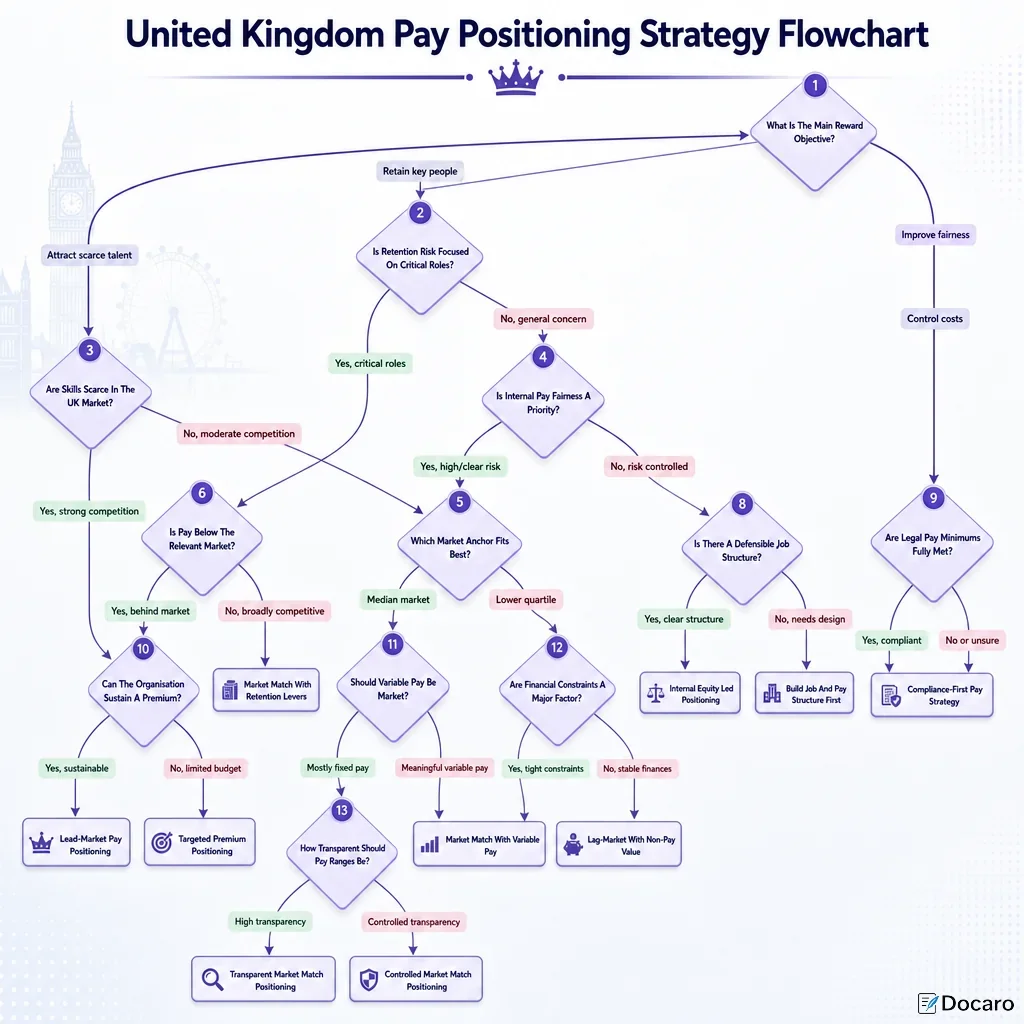
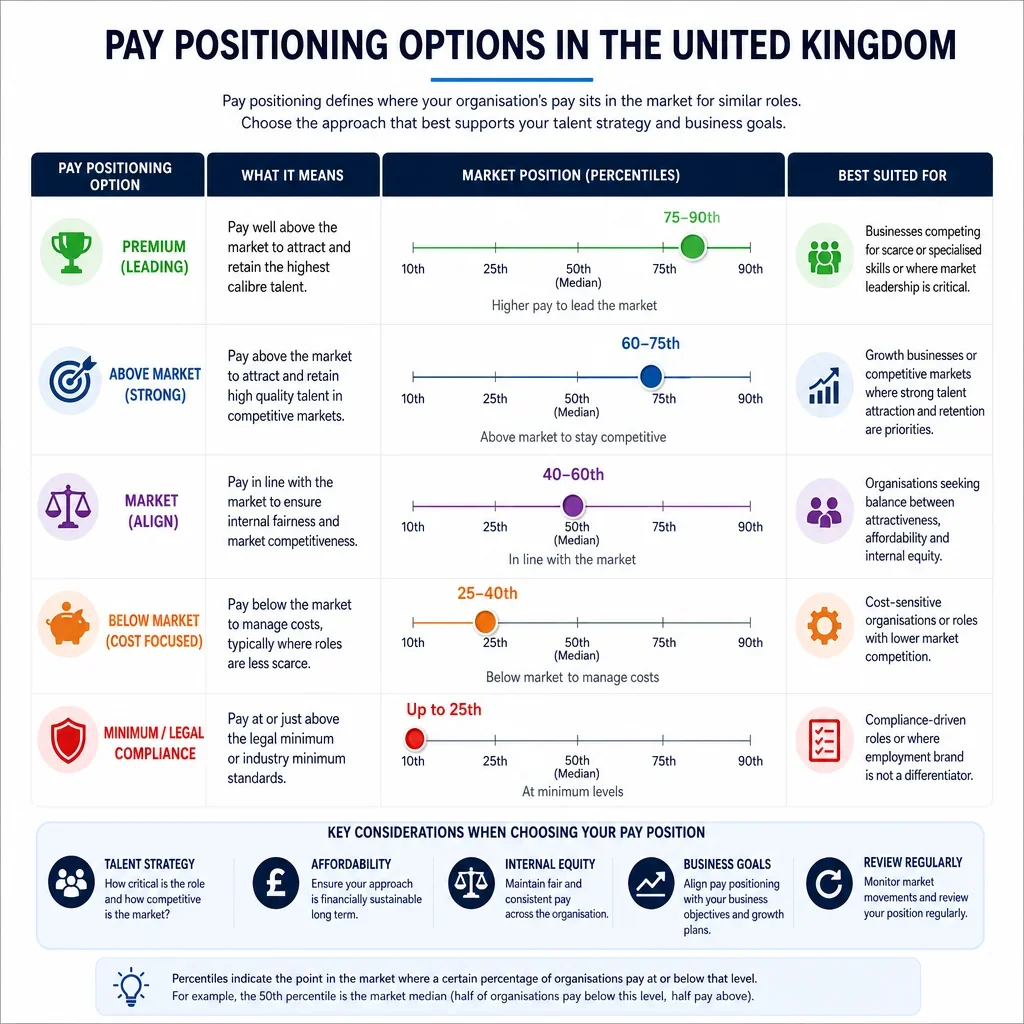
- Market PositioningIt explains where the company's pay levels stand compared to industry standards, such as matching or exceeding market rates to attract talent.
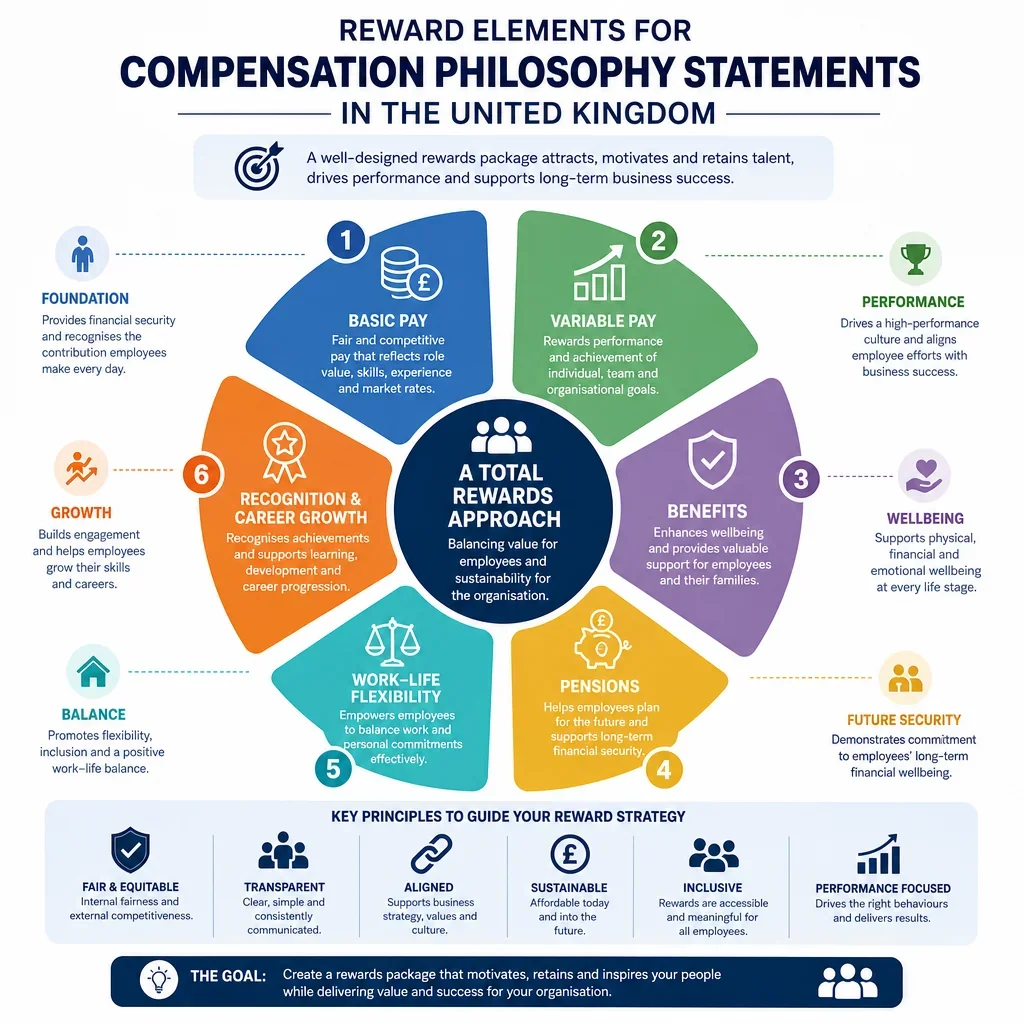
- Pay Structure and ComponentsThis details the elements of compensation, including base salary, bonuses, and benefits, to ensure transparency and consistency.
- Performance AlignmentIt describes how pay rewards individual and team achievements, linking compensation to company success and employee contributions.
- Internal EquityThis ensures fair pay differences within the company based on roles, experience, and responsibilities, promoting equality.
- Compliance with UK StandardsIt confirms adherence to UK employment laws, equality requirements, and best practices to avoid discrimination and support ethical pay.
- Review and Adjustment ProcessThis outlines how often and why compensation is reviewed, including factors like inflation or market changes, to keep it relevant.
Generate Your Document in 4 Easy Steps
Why Use Docaro?
 United Kingdom
Free Example Compensation Philosophy Statement Template
Below is a free template example of a Compensation Philosophy Statement for use in the United Kingdom generated by our AI model.
The clauses in your actual Compensation Philosophy Statement will vary from this example as they will be entirely bespoke to your requirements as set out in the questionnaire you complete.
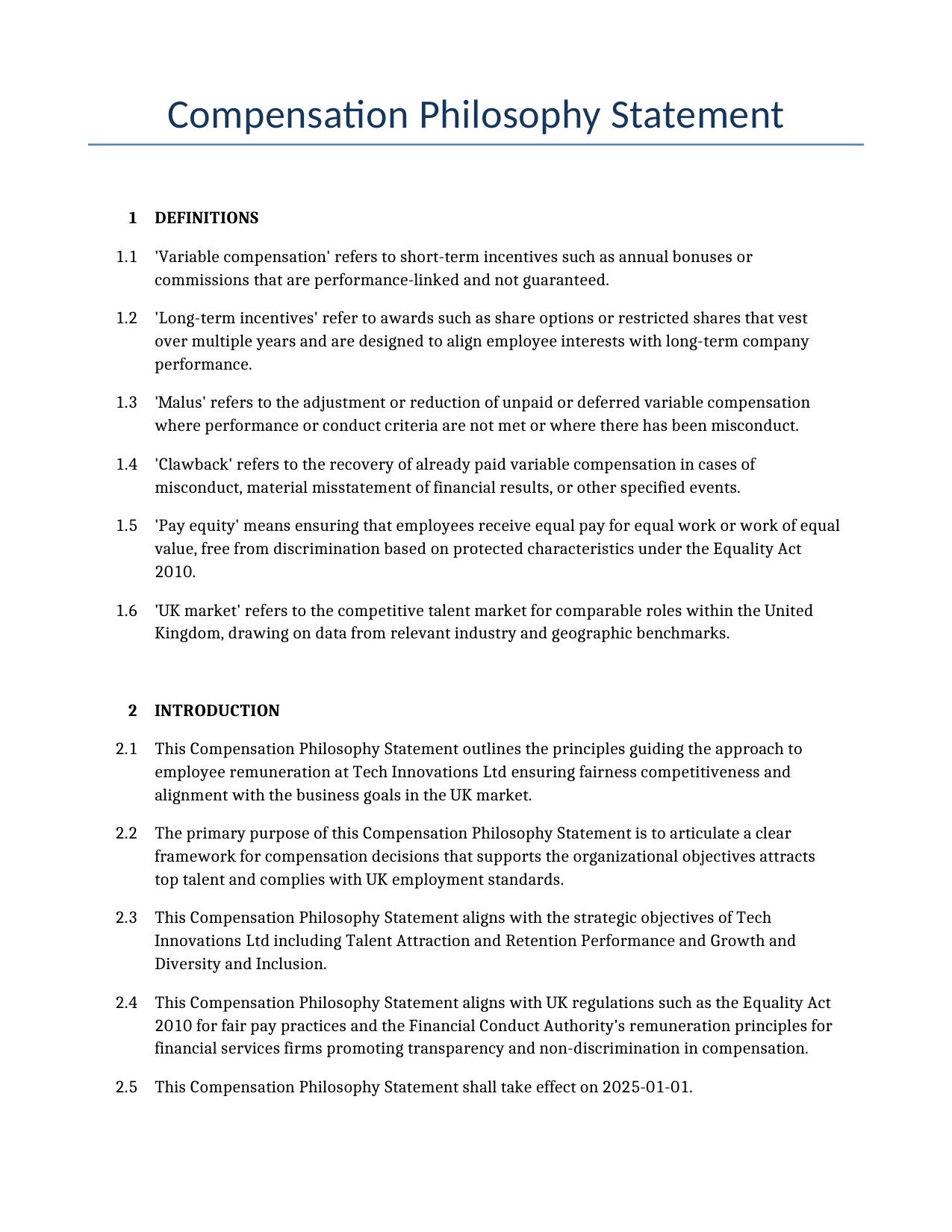
Compensation Philosophy Statement
1DEFINITIONS
'Variable compensation' refers to short-term incentives such as annual bonuses or commissions that are performance-linked and not guaranteed.
'Long-term incentives' refer to awards such as share options or restricted shares that vest over multiple years and are designed to align employee interests with long-term company performance.
'Malus' refers to the adjustment or reduction of unpaid or deferred variable compensation where performance or conduct criteria are not met or where there has been misconduct.
'Clawback' refers to the recovery of already paid variable compensation in cases of misconduct, material misstatement of financial results, or other specified events.
'Pay equity' means ensuring that employees receive equal pay for equal work or work of equal value, free from discrimination based on protected characteristics under the Equality Act 2010.
'UK market' refers to the competitive talent market for comparable roles within the United Kingdom, drawing on data from relevant industry and geographic benchmarks.
2INTRODUCTION
This Compensation Philosophy Statement outlines the principles guiding the approach to employee remuneration at Tech Innovations Ltd ensuring fairness competitiveness and alignment with the business goals in the UK market.
The primary purpose of this Compensation Philosophy Statement is to articulate a clear framework for compensation decisions that supports the organizational objectives attracts top talent and complies with UK employment standards.
This Compensation Philosophy Statement aligns with the strategic objectives of Tech Innovations Ltd including Talent Attraction and Retention Performance and Growth and Diversity and Inclusion.
This Compensation Philosophy Statement aligns with UK regulations such as the Equality Act 2010 for fair pay practices and the Financial Conduct Authority's remuneration principles for financial services firms promoting transparency and non-discrimination in compensation.
This Compensation Philosophy Statement shall take effect on 2025-01-01.
3GOVERNANCE AND OVERSIGHT
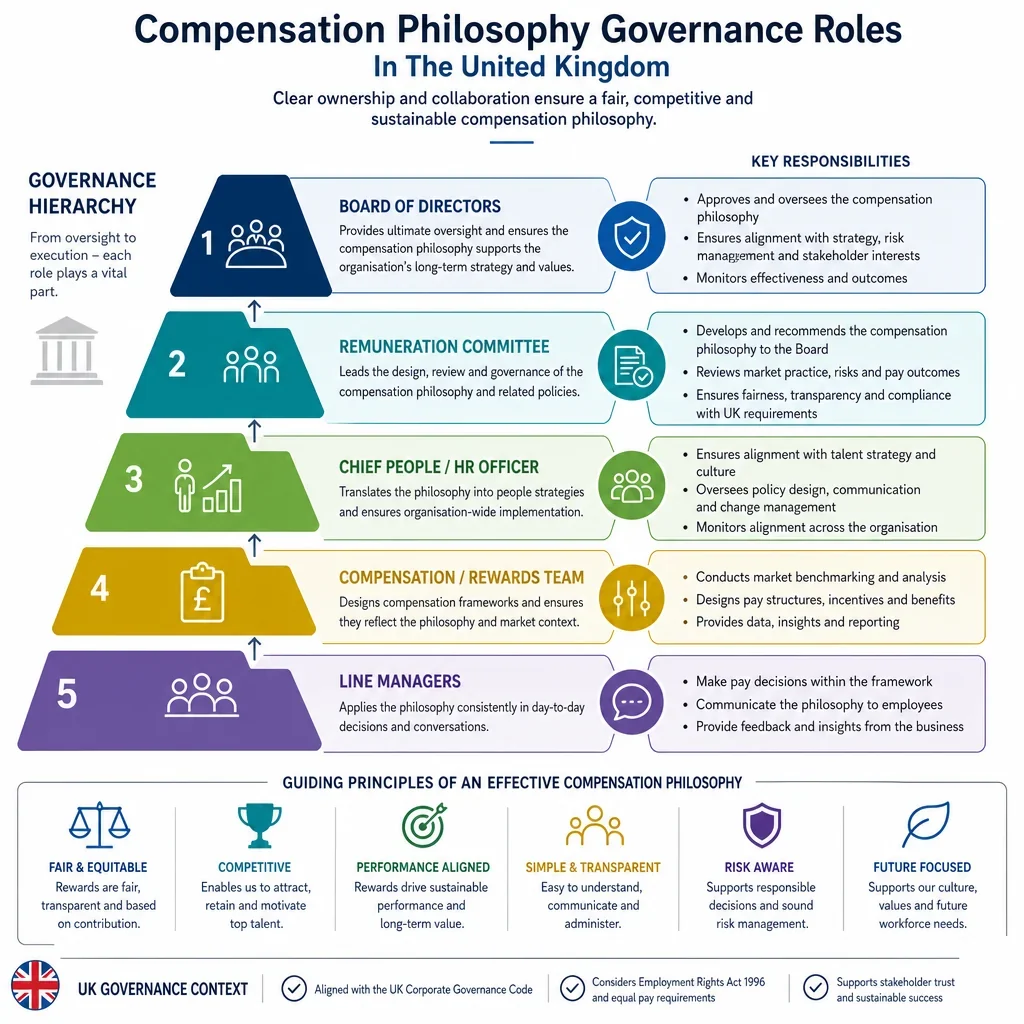
The board provides strategic oversight of compensation practices ensuring alignment with the company's long-term objectives and shareholder interests while reviewing and approving major compensation policies.
Tech Innovations Ltd has established a compensation committee for overseeing compensation practices.
The compensation committee is responsible for recommending compensation structures to the board reviewing executive pay proposals and ensuring fairness and competitiveness in line with market standards.
Management has a defined role in proposing and implementing compensation practices.
Management is tasked with developing initial compensation proposals implementing approved policies and monitoring day-to-day compliance with compensation guidelines.
The compensation committee shall aim for full compliance with the UK Corporate Governance Code in compensation oversight.
The compensation committee shall meet 4 times per year to oversee compensation practices.
The compensation committee reports to the board quarterly through formal presentations and written summaries highlighting key decisions risks and compliance status.
4MARKET POSITIONING AND BENCHMARKING
The preferred market positioning philosophy for compensation levels at Tech Innovations Ltd is Market Upper Quartile.
Tech Innovations Ltd shall conduct compensation benchmarking reviews annually with quarterly reviews for critical roles.
Tech Innovations Ltd shall use benchmarking data sources including WTW (Willis Towers Watson) Surveys and Mercer Total Remuneration Survey for UK peers and industry standards.
The peer group for benchmarking compensation in the UK is defined as companies of similar size and sector operating in the UK such as FTSE 250 firms in the technology and finance industries.
Tech Innovations Ltd shall include provisions for adjusting compensation based on market competitiveness assessments.
Tech Innovations Ltd shall benchmark against industry standards for Base Salary Annual Bonus and Long-Term Incentives to ensure fairness.
The rationale for ensuring fairness in market positioning is to promote equity and attract top talent by aligning compensation with market rates while considering internal equity and performance contributions.
5TOTAL COMPENSATION FRAMEWORK
Base salary is determined through a structured evaluation of market rates individual performance and role responsibilities ensuring competitiveness within the UK job market.
The total compensation framework at Tech Innovations Ltd includes variable pay components such as bonuses or commissions.
The total compensation framework at Tech Innovations Ltd includes benefits such as Pension Contributions Private Health Insurance and Annual Leave Entitlements.
The benefits package at Tech Innovations Ltd includes auto-enrolment pension schemes compliant with UK regulations comprehensive private health insurance and a minimum of 25 days annual leave plus bank holidays aligning with standard UK employment practices.
The total compensation framework at Tech Innovations Ltd includes long-term incentives such as share options or deferred bonuses.
The total compensation framework at Tech Innovations Ltd is explicitly tailored to UK employment norms such as statutory benefits.
6BASE SALARY DETERMINATION
Tech Innovations Ltd evaluates the role based on job responsibilities required skills and internal job grading system to assign a salary range when determining the role component for setting base salaries.
Tech Innovations Ltd includes years of experience as a factor in base salary determination.
Tech Innovations Ltd incorporates individual performance as a factor in determining base salaries.
Tech Innovations Ltd references UK market salary data as a key factor in base salary determination.
Tech Innovations Ltd uses sources such as Hays Salary Guide Robert Half UK Salary Survey and ONS Annual Survey of Hours and Earnings for base salary benchmarking.
Base salaries at Tech Innovations Ltd are positioned at median relative to UK medians.
Tech Innovations Ltd shall review and adjust base salaries every 12 months.
7VARIABLE COMPENSATION AND INCENTIVES
Tech Innovations Ltd includes short-term incentives such as annual bonuses in the compensation philosophy.
Tech Innovations Ltd includes performance-based pay linked to individual team and organizational goals.
Senior Executives Middle Management and All Employees shall be eligible for variable compensation and incentives at Tech Innovations Ltd.
Tech Innovations Ltd shall link variable compensation to specific performance metrics including key performance indicators such as revenue growth customer satisfaction scores and achievement of personal development objectives.
Tech Innovations Ltd shall link incentives to Individual Goals Team Goals and Organizational Goals.
Tech Innovations Ltd includes clawback provisions for variable compensation in cases of misconduct or performance adjustments.
8LONG-TERM INCENTIVES
Tech Innovations Ltd includes share options as part of the long-term incentives in this Compensation Philosophy Statement.
Tech Innovations Ltd includes restricted shares as part of the long-term incentives in this Compensation Philosophy Statement.
Executive Directors and Senior Management shall be eligible to participate in the long-term incentive plans at Tech Innovations Ltd.
Tech Innovations Ltd shall apply a hybrid vesting schedule for the long-term incentives.
The vesting period for the long-term incentives at Tech Innovations Ltd shall be 3 years.
The maximum annual award value for long-term incentives per participant at Tech Innovations Ltd shall be 150000.
The long-term incentive plan at Tech Innovations Ltd shall be effective from 2025-01-01.
Tech Innovations Ltd includes clawback provisions in the long-term incentive plans.
Tech Innovations Ltd shall emphasize Disclosure Requirements and Market Abuse Prevention aspects of UK securities laws in the long-term incentives description.
9BENEFITS AND PERQUISITES
Aviva is the provider of the pension scheme at Tech Innovations Ltd.
The pension scheme at Tech Innovations Ltd complies with UK auto-enrolment requirements.
Tech Innovations Ltd offers Private Medical Insurance as health insurance.
Tech Innovations Ltd provides life assurance coverage for employees.
Tech Innovations Ltd shall contribute 5 percent of qualifying earnings to the pension as the employer.
The pension scheme enrolment at Tech Innovations Ltd shall start on 2025-01-01.
Benefits and perquisites at Tech Innovations Ltd comply with the National Minimum Wage Act 1998 ensuring all employees receive at least the statutory minimum wage for all hours worked. Working Time Regulations 1998 are observed in the calculation of any overtime or on-call payments. Auto-enrolment pension contributions are made in accordance with current HMRC rules based on qualifying earnings thresholds as updated annually.
10PERFORMANCE MANAGEMENT INTEGRATION
Performance evaluations at Tech Innovations Ltd are conducted annually through a structured process involving self-assessments manager reviews and 360-degree feedback from peers and subordinates ensuring a comprehensive view of employee contributions.
Performance evaluations shall directly influence compensation decisions at Tech Innovations Ltd.
Tech Innovations Ltd shall use performance metrics including Key Performance Indicators (KPIs) Competency Assessments and Customer Feedback Scores for evaluating employee performance.
Tech Innovations Ltd shall conduct performance evaluations annually.
High performance ratings shall result in salary increases at Tech Innovations Ltd.
Tech Innovations Ltd shall use sustained high performance over time as the factor for linking performance to promotions.
11RISK MANAGEMENT IN COMPENSATION
The compensation structures at Tech Innovations Ltd mitigate risks associated with executive pay by incorporating robust performance metrics aligned with long-term shareholder value diversified incentive plans to avoid over-reliance on short-term gains and mandatory deferral of a significant portion of variable pay to ensure sustained performance. This approach aligns with the Financial Reporting Council's guidance on risk in remuneration by avoiding incentive structures that could encourage excessive risk-taking such as overly aggressive short-term targets without safeguards or uncapped rewards. Specific examples include the use of balanced scorecards with both financial and non-financial metrics caps on variable pay awards and deferral periods that allow for malus adjustments if risks materialise. Where applicable in the financial sector Tech Innovations Ltd also aligns with the Senior Managers and Certification Regime (SMCR) to ensure that remuneration for certified persons promotes sound risk management and good conduct.
Tech Innovations Ltd integrates risk-adjusted performance assessments and independent oversight by the remuneration committee to prevent excessive risk-taking.
Tech Innovations Ltd includes malus clauses in the compensation policy.
Tech Innovations Ltd shall apply pro rata reduction and performance based adjustment as the types of adjustments under the malus clauses.
Tech Innovations Ltd includes clawback provisions in the compensation policy.
The clawback provisions at Tech Innovations Ltd shall apply over a period of three years.
12DIVERSITY, EQUITY, AND INCLUSION
Tech Innovations Ltd includes a commitment to pay equity in the Diversity Equity and Inclusion section of this Compensation Philosophy Statement.
Tech Innovations Ltd explicitly states compliance with the UK Equality Act 2010 in the Diversity Equity and Inclusion section.
Tech Innovations Ltd addresses the protected characteristics under the UK Equality Act 2010 including age disability gender reassignment race sex and sexual orientation in commitments for fair compensation practices.
Tech Innovations Ltd commits to conducting regular pay equity audits as part of the compensation philosophy.
Tech Innovations Ltd commits to monitoring and reporting on the gender pay gap in line with UK regulations.
Tech Innovations Ltd commits to conducting and publishing ethnicity pay gap reporting where applicable in line with evolving UK best practices and any future regulatory requirements even if not yet mandatory.
13COMPLIANCE AND REGULATORY CONSIDERATIONS
Tech Innovations Ltd adheres to remuneration reporting requirements under the Companies Act 2006.
Tech Innovations Ltd complies with gender pay gap reporting obligations under UK law.
Tech Innovations Ltd is subject to the UK Listing Rules regarding remuneration disclosures.
The remuneration committee at Tech Innovations Ltd provides full oversight of compliance with UK regulations in this Compensation Philosophy.
Tech Innovations Ltd plans to seek shareholder approval for the remuneration policy as required by the Listing Rules.
This Compensation Philosophy Statement references the UK Corporate Governance Code (2018 or latest version) and the Directors' Remuneration Reporting Regulations. For listed entities or those in the finance sector additional sector-specific rules apply including requirements for 'say on pay' votes at the Annual General Meeting and malus/clawback policies aligned with the Investment Association's Principles of Remuneration.
14DATA PROTECTION AND PRIVACY IN COMPENSATION
Tech Innovations Ltd is committed to full compliance with the UK GDPR and the Data Protection Act 2018 in all aspects of compensation management. Employee personal data including salary performance ratings and personal details used in benchmarking performance reviews and pay decisions is processed lawfully fairly and transparently. Data is collected only for specified legitimate purposes such as ensuring competitive and equitable pay. Appropriate technical and organisational measures are in place to ensure data security including encryption access controls and regular audits to prevent unauthorised access loss or breach. Employee consent is obtained where required by law for any processing outside the legitimate interests of the company and employees have the right to access rectify or erase their data in accordance with statutory rights. Data sharing with third-party benchmarking providers is governed by robust data processing agreements that ensure equivalent protection standards.
15STAKEHOLDER ENGAGEMENT AND DISCLOSURE
Tech Innovations Ltd establishes a formal process for engaging with shareholders on compensation matters.
Tech Innovations Ltd establishes a formal process for engaging with other stakeholders such as employees or regulators on compensation matters.
Tech Innovations Ltd shall use annual general meeting discussions and surveys and questionnaires as the methods for engaging with shareholders on compensation matters.
Tech Innovations Ltd shall use employee town halls and online feedback portals as the methods for engaging with other stakeholders on compensation matters.
Tech Innovations Ltd shall conduct stakeholder engagement activities on compensation matters annually with additional ad-hoc engagements as needed following significant changes in compensation policy.
Tech Innovations Ltd shall include detailed disclosures on compensation matters in the annual report.
Tech Innovations Ltd shall disclose detailed policy and metrics regarding compensation in the annual reports.
The Remuneration Committee supported by the Head of Investor Relations shall be responsible for conducting stakeholder engagements on compensation at Tech Innovations Ltd.
Tech Innovations Ltd includes a process for incorporating stakeholder feedback into compensation decisions.
16EMPLOYEE CONSULTATION AND COMMUNICATION
Tech Innovations Ltd is committed to transparent communication of this Compensation Philosophy Statement to all employees through multiple channels including the company intranet town hall meetings and targeted communications from HR. The company will provide clear explanations of how compensation decisions are made and how they align with business objectives. Where applicable under UK law consultation will be undertaken with works councils recognised trade unions or other elected employee representatives regarding changes that may affect pay or benefits. Employees are encouraged to raise any concerns about pay fairness through established channels such as their line manager HR or an independent whistleblowing hotline. All such concerns will be handled confidentially and without fear of retaliation in line with the company's commitment to a speak-up culture and protections under the Public Interest Disclosure Act 1998.
17REVIEW AND AMENDMENT PROCESS
This Compensation Philosophy shall be reviewed annually.
The next review of this Compensation Philosophy shall occur on 2026-01-01.
This Compensation Philosophy includes provisions for ad-hoc reviews triggered by significant events.
The Board of Directors shall review proposed amendments in a dedicated meeting with input from the Compensation Committee and approve them by a majority vote after ensuring compliance with UK regulations when following the process for approving amendments to this Compensation Philosophy.
The Compensation Committee shall be responsible for initiating the periodic review of this Compensation Philosophy.
All amendments to this Compensation Philosophy must be documented in a formal amendment log including the date description of changes rationale and signatures from the approving parties with copies retained in the company's governance records.
Tech Innovations Ltd shall subscribe to updates from the UK Government and regulatory bodies such as the Financial Conduct Authority with the Legal Department conducting quarterly reviews and notifying the Compensation Committee of any relevant changes when monitoring changes in UK regulations affecting this Compensation Philosophy.
18EFFECTIVE DATE AND SCOPE
This Compensation Philosophy Statement shall take effect on 2025-01-01.
This Compensation Philosophy Statement shall apply to Senior Executives Full Time Employees and Part Time Employees within the UK organization at Tech Innovations Ltd.
This Compensation Philosophy Statement shall apply to future hires in the specified employee groups.
19GOVERNING LAW
This Compensation Philosophy Statement shall be governed by and construed in accordance with the laws of England and Wales. This document is a statement of policy only and does not form part of any employee's contract of employment or create any contractual entitlement. It may be amended or withdrawn at any time at the company's discretion. This Compensation Philosophy Statement requires approval by the Board of Directors prior to adoption and any subsequent material amendments. Execution shall be evidenced by the signature of a duly authorised director below.
20SIGNATURE
This Compensation Philosophy Statement is executed on behalf of Tech Innovations Ltd by the duly authorized signatory below.
Signed: _______________________________ Date: _______________
Name: _______________________________
Title: _______________________________
This example shows approximately 70% of a typical document and is provided for illustrative purposes only. The remaining content has been omitted.
Every document generated by Docaro is tailored to your specific circumstances, jurisdiction and the information you provide. The completed document includes all applicable clauses and provisions required for your situation.
To generate the full, personalised document, answer a short series of questions and your document will be created instantly.
Useful Resources When Considering a Compensation Philosophy Statement in the United Kingdom
United Kingdom Reference Legislation
Compensation Philosophy Statement FAQs
Document Generation FAQs
Related Articles