AI Generated British Staff Handbook
PDF & Word - 2026 Updated
Docaro Pricing
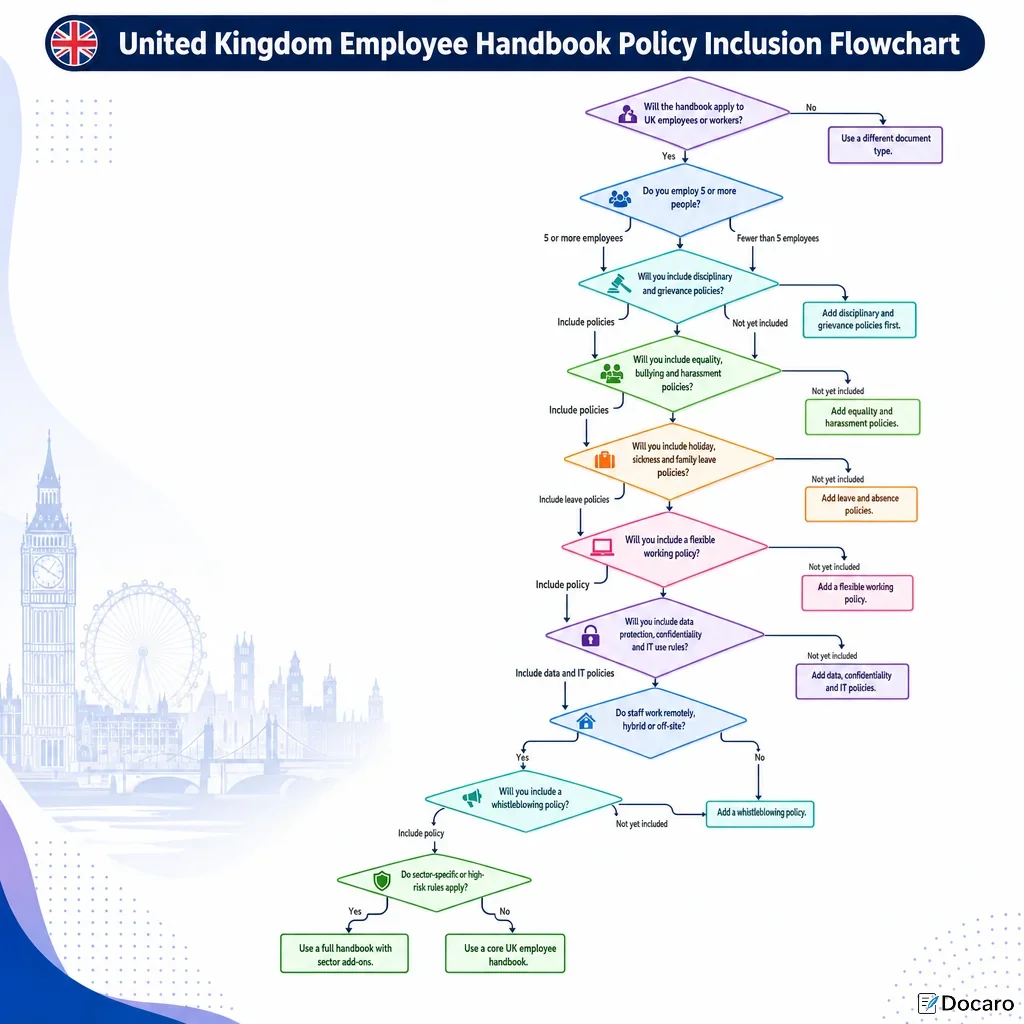
When Do You Need an Employee Handbook in the United Kingdom?
British Legal Rules for an Employee Handbook
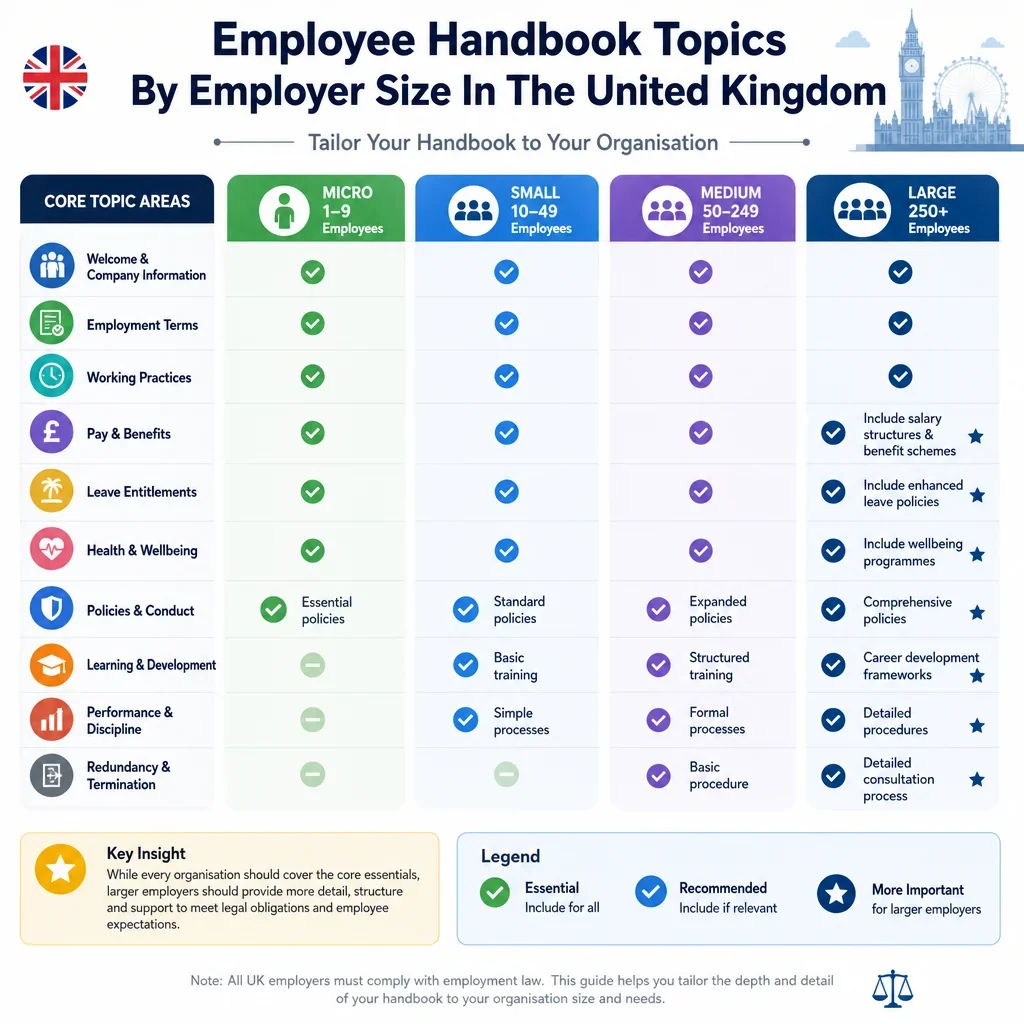
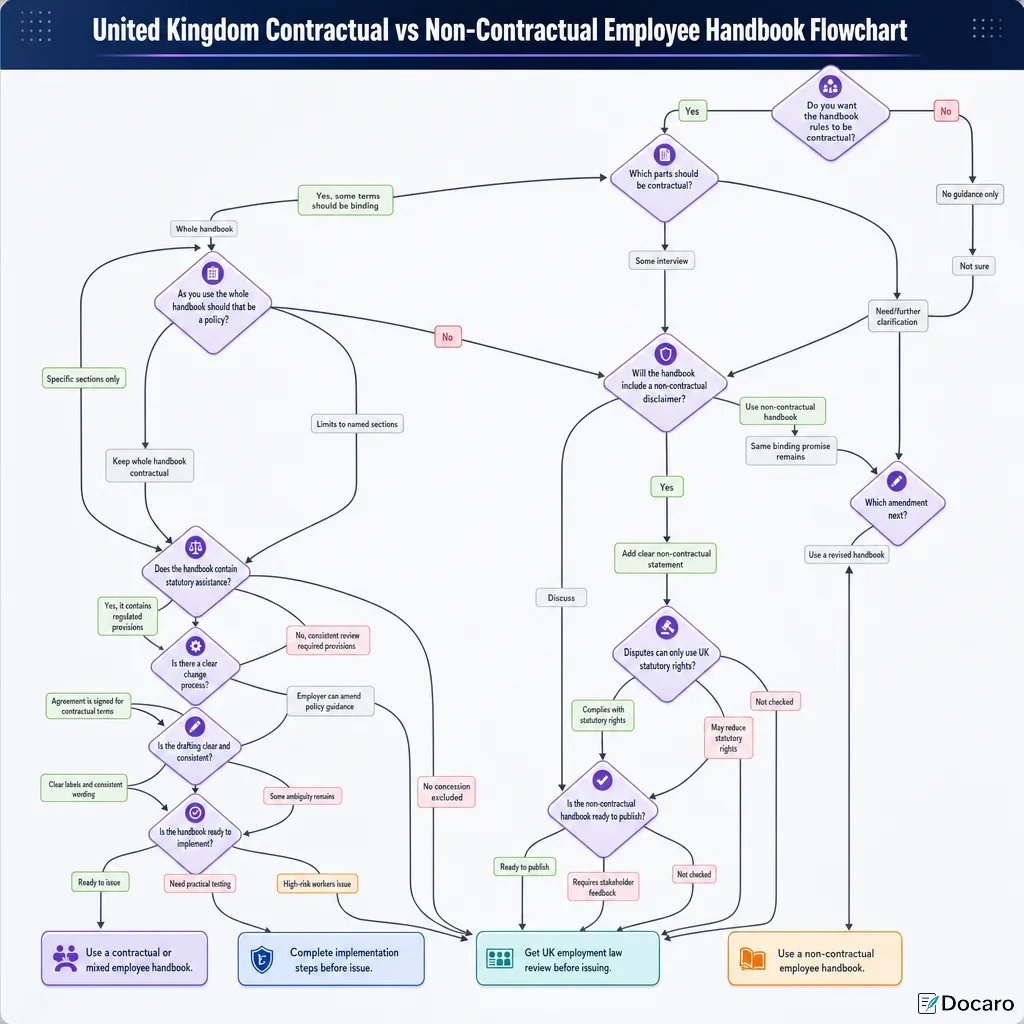
Using the wrong structure for an employee handbook may fail to comply with UK employment law requirements and expose the employer to legal risks.
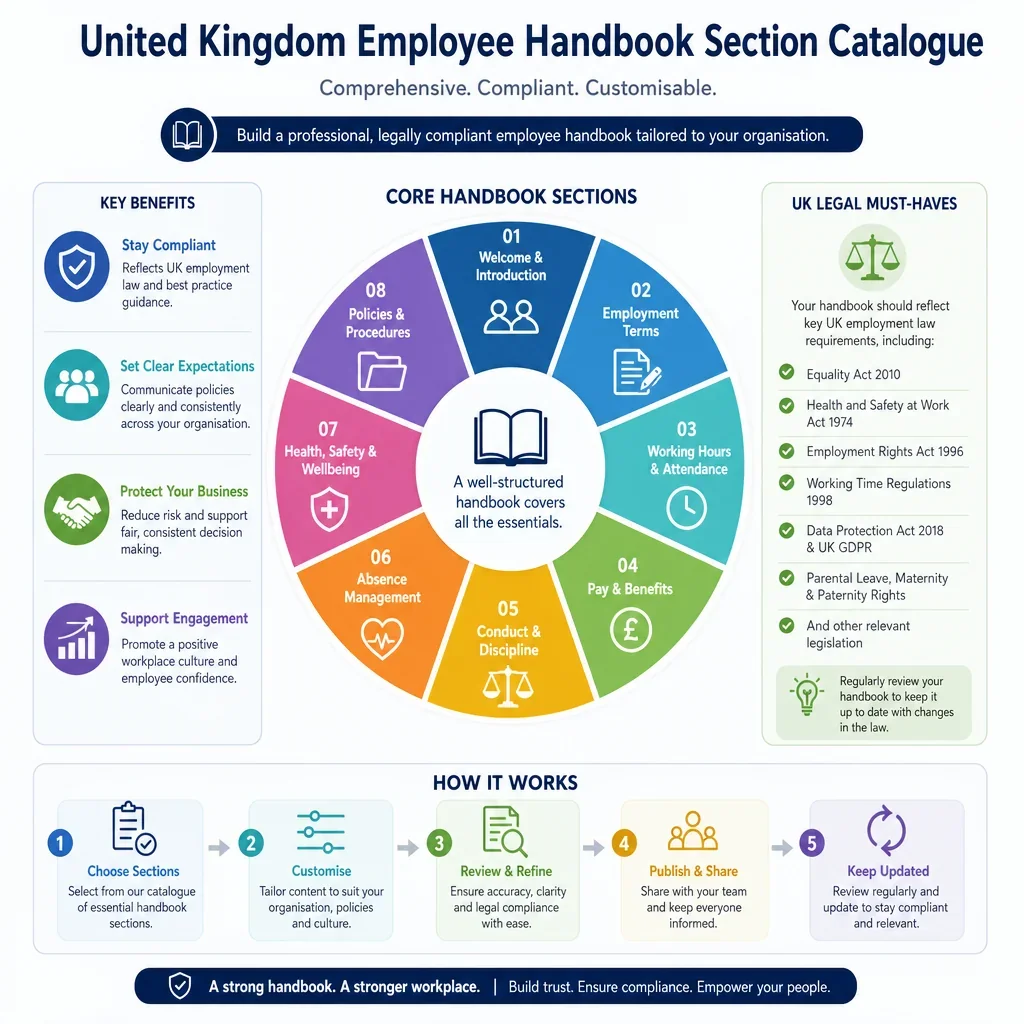
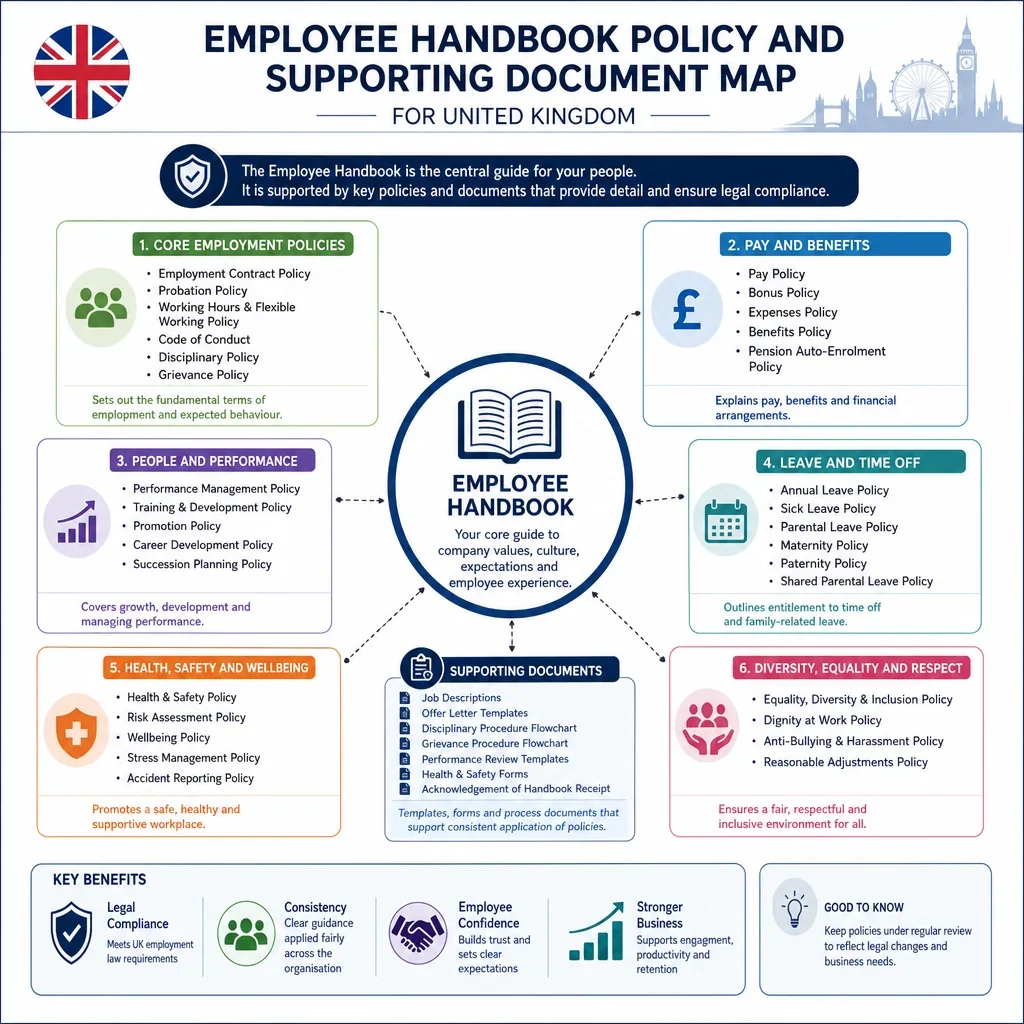
What a Proper Employee Handbook Should Include
- Welcome MessageA friendly introduction that outlines the company's values and what employees can expect.
- Company PoliciesClear rules on topics like attendance, dress code, and use of company resources.
- Work Hours and PayDetails on standard working hours, overtime, breaks, and how and when pay is received.
- Leave and HolidaysInformation on annual leave entitlement, sick days, maternity/paternity leave, and how to request time off.
- Health and SafetyGuidelines to ensure a safe workplace, including emergency procedures and risk awareness.
- Equal OpportunitiesCommitment to fair treatment for all employees regardless of background, with steps to report discrimination.
- Disciplinary and Grievance ProceduresSteps for handling rule-breaking or complaints, ensuring fairness and support for everyone involved.
- Data ProtectionHow personal information is kept secure and employees' rights regarding their data.
- Termination of EmploymentExplanation of notice periods, resignation processes, and what happens at the end of employment.
Generate Your Document in 4 Easy Steps
Why Use Docaro?
 United Kingdom
Free Example Employee Handbook Template
Below is a free template example of a Employee Handbook for use in the United Kingdom generated by our AI model.
The clauses in your actual Employee Handbook will vary from this example as they will be entirely bespoke to your requirements as set out in the questionnaire you complete.
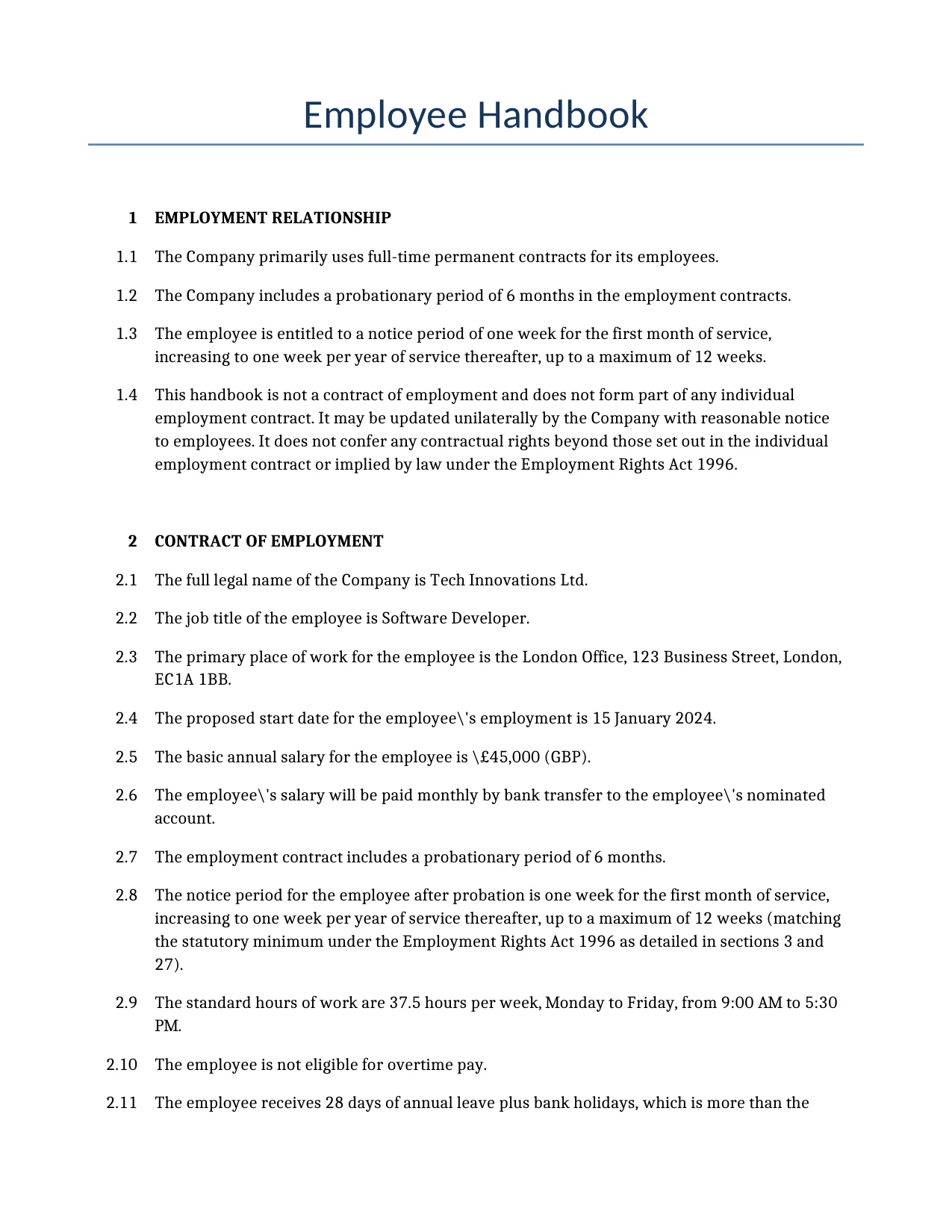
Employee Handbook
1EMPLOYMENT RELATIONSHIP
The Company primarily uses full-time permanent contracts for its employees.
The Company includes a probationary period of 6 months in the employment contracts.
The employee is entitled to a notice period of one week for the first month of service, increasing to one week per year of service thereafter, up to a maximum of 12 weeks.
This handbook is not a contract of employment and does not form part of any individual employment contract. It may be updated unilaterally by the Company with reasonable notice to employees. It does not confer any contractual rights beyond those set out in the individual employment contract or implied by law under the Employment Rights Act 1996.
2CONTRACT OF EMPLOYMENT
The full legal name of the Company is Tech Innovations Ltd.
The job title of the employee is Software Developer.
The primary place of work for the employee is the London Office, 123 Business Street, London, EC1A 1BB.
The proposed start date for the employee\'s employment is 15 January 2024.
The basic annual salary for the employee is \£45,000 (GBP).
The employee\'s salary will be paid monthly by bank transfer to the employee\'s nominated account.
The employment contract includes a probationary period of 6 months.
The notice period for the employee after probation is one week for the first month of service, increasing to one week per year of service thereafter, up to a maximum of 12 weeks (matching the statutory minimum under the Employment Rights Act 1996 as detailed in sections 3 and 27).
The standard hours of work are 37.5 hours per week, Monday to Friday, from 9:00 AM to 5:30 PM.
The employee is not eligible for overtime pay.
The employee receives 28 days of annual leave plus bank holidays, which is more than the statutory minimum holiday entitlement.
The Company provides a contractual sick pay scheme beyond statutory sick pay.
The employee will be enrolled in an auto-enrolment pension scheme with minimum contributions in line with applicable legislation. There are no collective agreements affecting the terms and conditions of employment.
The Company reserves the right to vary the terms of the contract with reasonable notice. This handbook does not form part of the contract of employment.
3HEALTH AND SAFETY
The Company includes a separate written health and safety policy document in addition to the statements in this Employee Handbook.
The date of the last comprehensive risk assessment was 15 June 2023.
The Company conducts risk assessments annually.
The Company has a designated health and safety officer.
The Company provides induction training, role-specific training, and first aid training as health and safety training to employees.
Employees report health and safety incidents using a written incident form.
The Company includes a detailed statement of employee responsibilities for health and safety in this handbook.
The main health and safety risks specific to the Company\'s business operations are slips, trips, and falls in office areas; ergonomic issues from prolonged computer use; and electrical hazards from equipment.
The Company currently has 50 employees.
The Company fully complies with the Health and Safety at Work etc. Act 1974, the Management of Health and Safety at Work Regulations 1999, the Health and Safety (Display Screen Equipment) Regulations 1992, and all other applicable legislation. For home working under the remote and hybrid working policy (see section 25), the Company ensures suitable risk assessments are completed, provides necessary equipment, and offers guidance on safe working practices. Fire safety procedures, first aid arrangements, and emergency evacuation protocols are detailed in the separate health and safety policy and will be covered during induction.
4FAMILY FRIENDLY POLICIES AND LEAVE
This section covers shared parental leave, dependency leave (also known as time off for dependants), compassionate leave, and related family-friendly policies. It integrates with holiday entitlement (section 8) and sickness absence (section 9). All policies fully comply with the Employment Rights Act 1996, the Equality Act 2010, the Maternity and Parental Leave etc. Regulations 1999 (as amended), and the Shared Parental Leave Regulations 2014. Nothing in this handbook limits statutory rights.
Shared Parental Leave (SPL): Eligible employees (with 26 weeks\' continuous service by the due date) may share up to 50 weeks of leave and 37 weeks of pay with their partner following the birth or adoption of a child. Eligibility, notice (at least 8 weeks before start), and curtailment of maternity/adoption leave requirements follow statutory rules. Pay is at Statutory Shared Parental Pay rates (matching SMP/SPP). SPL can be taken in blocks or continuously and integrates with annual leave by allowing carry-over only in exceptional cases approved by management (see section 8).
Time Off for Dependants (Dependency Leave): Employees are entitled to reasonable unpaid time off to deal with unforeseen emergencies involving dependants (e.g., illness, injury, or disruption to care arrangements). No qualifying service is required. Notice should be given as soon as possible. This is separate from annual leave (section 8) and sickness absence (section 9); it is not for providing ongoing care. The Company may request evidence of the emergency.
Compassionate Leave: The Company provides up to 5 days\' paid compassionate leave per year for the death or serious illness of a close family member or dependant, in addition to statutory rights. This integrates with holiday entitlement where further time is needed (requests per section 8). Pay is at basic salary rate. Longer periods may be granted as unpaid leave or from annual leave at the Company\'s discretion. Notice and evidence requirements apply as for dependency leave.
Eligibility generally requires continuous service as per statute (e.g., 26 weeks for SPL). All requests must be made in writing to HR with appropriate notice (minimum 8 weeks for SPL; as soon as possible for others). The Company will not discriminate on any protected characteristic under the Equality Act 2010. Employees returning from such leave are entitled to the same or a comparable role. This policy will be reviewed in line with legislative changes.
5RIGHT TO REQUEST FLEXIBLE WORKING
Employees have a statutory right to request flexible working under section 80F of the Employment Rights Act 1996 (as amended by the Employment Relations (Flexible Working) Act 2023). This section details the process and cross-references flexible working mentions in sections 7 and 25 (Remote and Hybrid Working).
Eligibility: Employees must have 26 weeks\' continuous service with the Company. The right applies to all employees, not just parents/carers, and can be exercised once per 12-month period.
Application Process: Requests must be made in writing, dated, and include the desired change, start date, impact on the business, and any proposed solutions. The Company must arrange a meeting within 28 days (or as agreed) to discuss the request.
The Company must respond in writing within 3 months (or as extended by agreement). Requests can only be refused for one of the eight valid business reasons set out in the legislation, such as burden of additional costs, inability to meet customer demand, or impact on quality/performance.
Appeal Rights: If refused, the employee has the right to appeal within 14 days. The appeal meeting must be held without unreasonable delay, and the outcome provided in writing.
Protections: Employees are protected from detriment or dismissal for making a request. Any discrimination related to a protected characteristic under the Equality Act 2010 will not be tolerated. This policy integrates with the Remote and Hybrid Working policy (section 25) and general flexible arrangements in section 7.
6DISCIPLINARY AND GRIEVANCE PROCEDURES - ADDITIONAL INFORMATION
The disciplinary and grievance procedures set out in sections 18 and 19 are non-contractual and may be varied by the Company at any time to ensure compliance with the ACAS Code of Practice on Disciplinary and Grievance Procedures (2015, as amended). They do not form part of any individual contract of employment.
Examples of gross misconduct (which may lead to summary dismissal) include theft, fraud, gross negligence, serious breach of confidentiality, violence, discrimination/harassment, serious breach of IT policies, or bringing the Company into disrepute.
Employees have the right to be accompanied at formal disciplinary or grievance hearings by a colleague or trade union representative under section 10 of the Employment Relations Act 1999. The companion may address the hearing but not answer questions on the employee\'s behalf.
These procedures are designed to ensure compliance with the law on unfair dismissal under the Employment Rights Act 1996. The Company will act fairly and reasonably, following a full investigation. Employees have the right to appeal any decision.
7MONITORING AND SURVEILLANCE
The Company may lawfully monitor employee email, internet usage, CCTV (where installed), GPS on company vehicles, and telephone calls in compliance with the UK GDPR, Data Protection Act 2018, Privacy and Electronic Communications Regulations 2003, and ICO guidance on monitoring at work. This supplements the IT monitoring references in section 16.
Privacy Notice: Employees are informed via this handbook and the Company\'s privacy policy that monitoring may occur for purposes including security, compliance, performance management, and prevention of misuse. Data collected will be processed lawfully.
Lawful Basis: Monitoring is conducted on the basis of legitimate interests (e.g., protecting business assets, ensuring productivity) or legal obligation (e.g., regulatory compliance). Consent is not relied upon as the primary basis. Impact assessments are carried out where appropriate.
Employee Rights: Employees have rights to access, rectification, erasure, and restriction of their personal data, subject to legal exemptions. Any concerns should be raised with the data protection officer. Covert monitoring will only occur in exceptional circumstances (e.g., suspected criminal activity) and in line with ICO guidance.
All monitoring is proportionate, transparent, and respects privacy. Records are retained only as long as necessary. This policy is reviewed regularly to ensure ongoing compliance.
8COMPLIANCE WITH LEGISLATION
Tech Innovations Ltd complies with all relevant UK employment legislation, including but not limited to: the Equality Act 2010, Employment Rights Act 1996, Working Time Regulations 1998, National Minimum Wage Act 1998, Maternity and Parental Leave etc. Regulations 1999, Shared Parental Leave Regulations 2014, Health and Safety at Work etc. Act 1974, UK GDPR and Data Protection Act 2018, Employment Relations Act 1999, Bribery Act 2010, Modern Slavery Act 2015, and the ACAS Code of Practice. The Company also adheres to associated regulations on pensions, family-friendly rights, and flexible working.
Nothing in this Employee Handbook should be interpreted as limiting or excluding any statutory rights or protections afforded to employees under applicable law. In the event of any inconsistency between this handbook and statute, the statutory provisions shall prevail. The Company reviews policies regularly to maintain full compliance.
9ANTI-DISCRIMINATION, BULLYING AND HARASSMENT POLICY
This policy consolidates and expands on content previously in sections 4 and 21. The Company maintains a zero-tolerance approach to discrimination, bullying, harassment, and victimisation. It fully complies with the Equality Act 2010.
Protected characteristics under the Equality Act 2010 are: age, disability, gender reassignment, marriage and civil partnership, pregnancy and maternity, race, religion or belief, sex, and sexual orientation. The Company will not discriminate in any aspect of employment, including recruitment, pay, training, promotion, or termination.
Positive action may be taken where appropriate to address under-representation or disadvantage. Reasonable adjustments will be made for employees with disabilities to remove barriers.
Harassment is unwanted conduct related to a protected characteristic that violates dignity or creates an intimidating, hostile, degrading, humiliating, or offensive environment. Bullying is offensive, intimidating, malicious, or insulting behaviour that makes the recipient feel upset or humiliated. Victimisation is detrimental treatment for asserting rights under the Act.
Examples of harassment include offensive jokes, unwanted physical contact, or derogatory comments. Examples of bullying include persistent unreasonable criticism, exclusion, or setting impossible targets. Such behaviour will not be tolerated.
Reporting: Employees should report incidents as soon as possible to their line manager, HR, or via the confidential grievance procedure (section 19). Reports can be verbal or written and will be treated confidentially and seriously, in line with data protection laws.
Investigation: The Company will conduct a prompt, fair, and impartial investigation, which may include interviews and evidence gathering. Affected employees will be offered support such as counselling or mediation.
If misconduct is found, disciplinary action will be taken under section 18, up to and including dismissal. The employee has the right to appeal any outcome. This policy is reviewed annually or as required by law.
10EMPLOYEE ACKNOWLEDGMENT
| JOHN SMITH | |
| Signature: | |
| Print Name: | |
| Date: |
I, John Smith, acknowledge that on 2024-10-15 I received a copy of the Employee Handbook.
I confirm that I understand the contents of the Employee Handbook.
This example shows approximately 70% of a typical document and is provided for illustrative purposes only. The remaining content has been omitted.
Every document generated by Docaro is tailored to your specific circumstances, jurisdiction and the information you provide. The completed document includes all applicable clauses and provisions required for your situation.
To generate the full, personalised document, answer a short series of questions and your document will be created instantly.
Useful Resources When Considering a Employee Handbook in the United Kingdom
United Kingdom Reference Legislation
Employee Handbook FAQs
Document Generation FAQs
Related Articles