AI Generated British Model Release Form
PDF & Word - 2026 Updated
Docaro Pricing
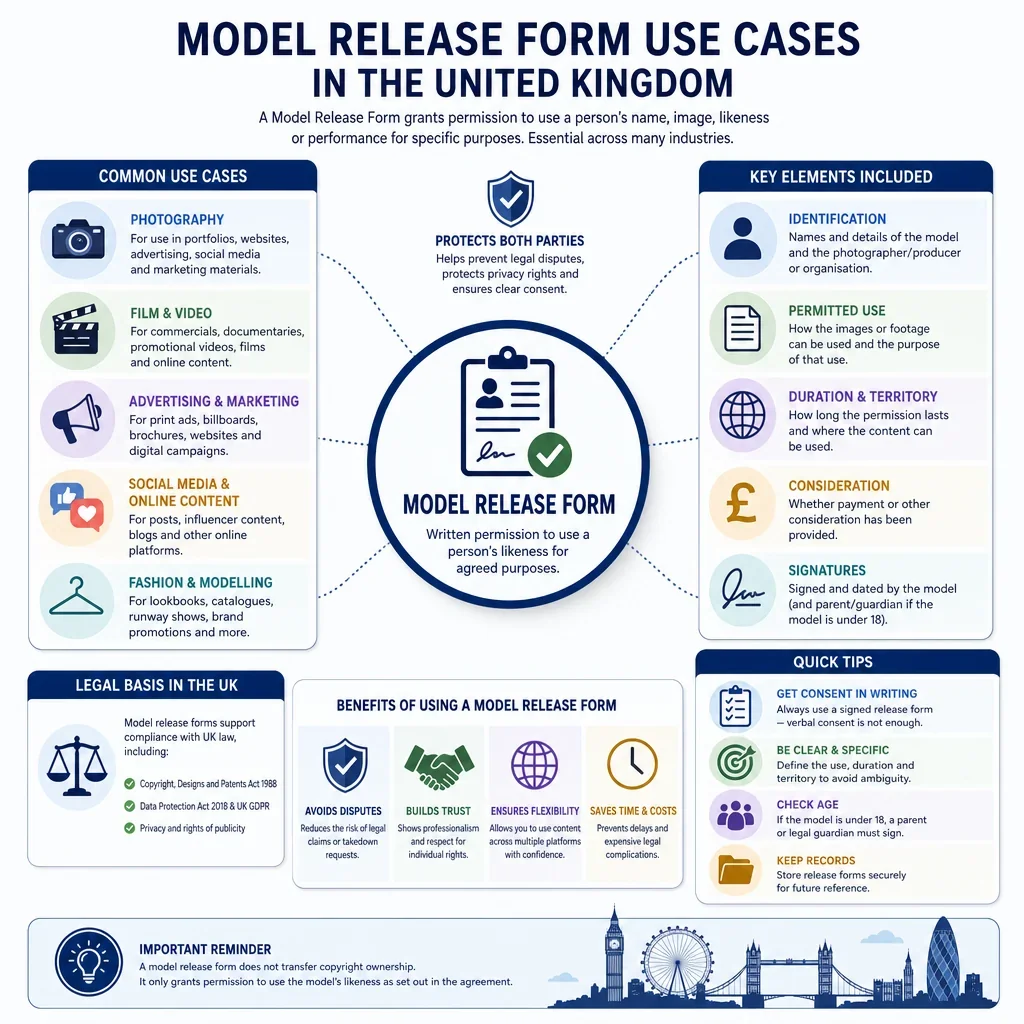
When do you need a Model Release Form in the United Kingdom?
British Legal Rules for a Model Release Form
Using an improper model release form structure may fail to adequately protect intellectual property rights or lead to unenforceable consents under UK law.
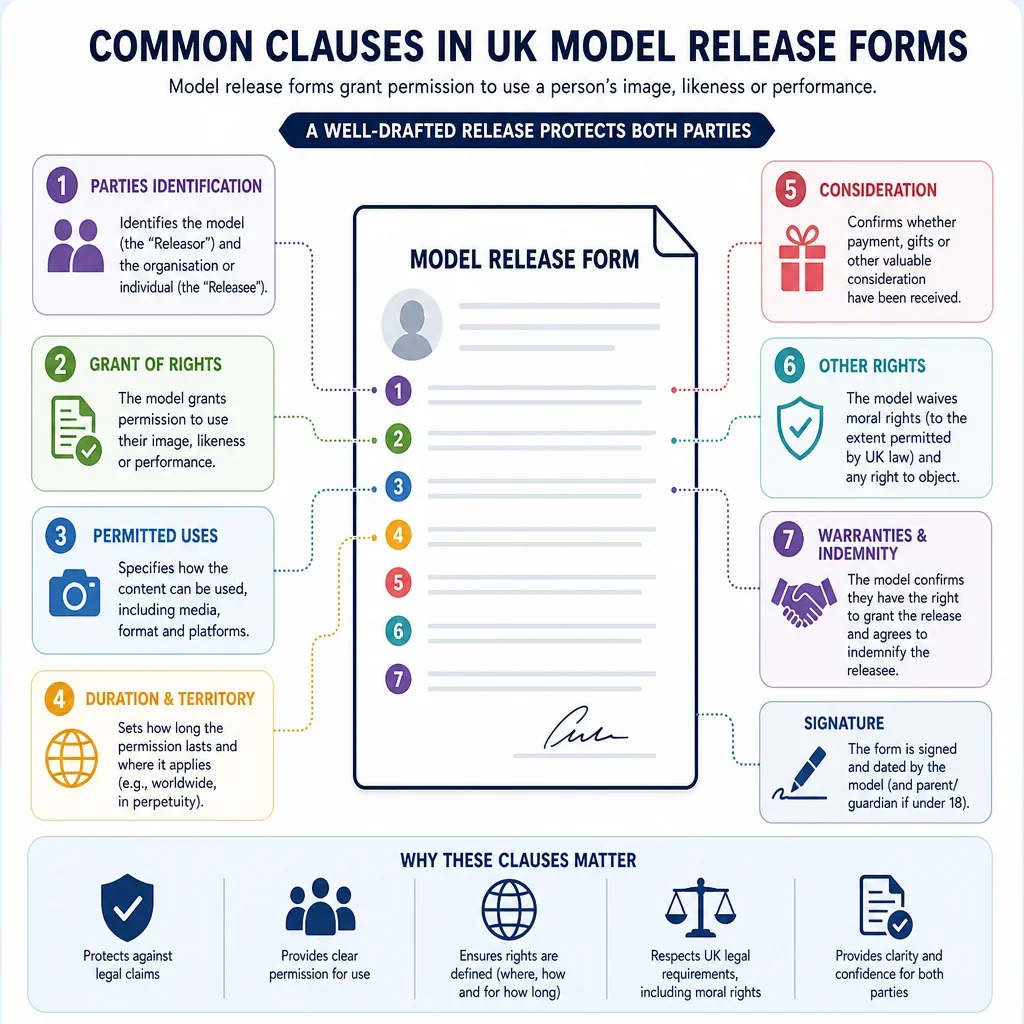
What a Proper Model Release Form Should Include
- Identification of PartiesClearly state the full names and contact details of the person being photographed (the model) and the person or company taking and using the images.
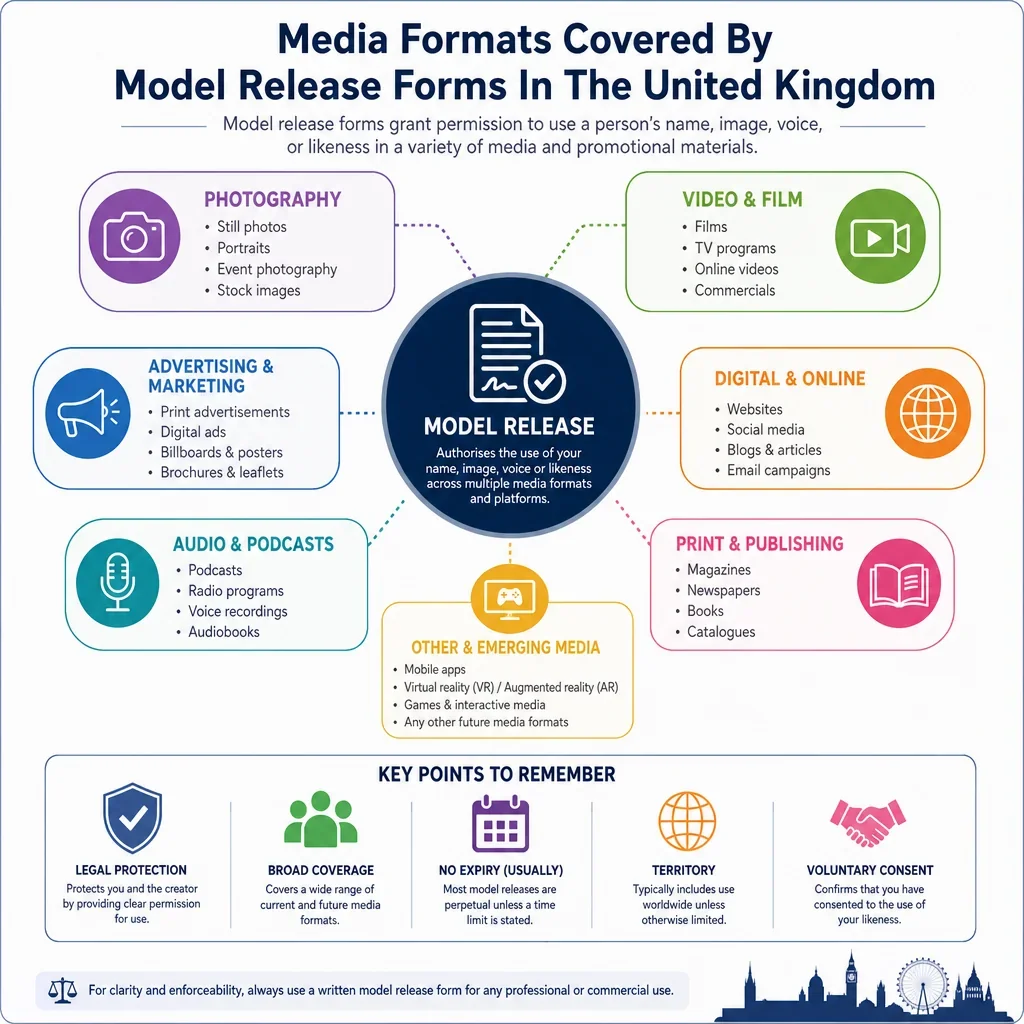
- Description of ImagesSpecify exactly what photos, videos, or other media are covered by the release.
- Rights GrantedOutline how the images can be used, such as for commercial purposes, advertising, or personal projects, and whether the model gets any payment.
- Duration of RightsIndicate how long the permission lasts, for example, forever or for a set number of years.
- Model's ConfirmationInclude a statement from the model confirming they are of legal age (18 or older), understand the terms, and give permission willingly.
- Signatures and DateRequire both parties to sign and date the form to make it official and binding.
Generate Your Document in 4 Easy Steps
Why Use Docaro?
 United Kingdom
Free Example Model Release Form Template
Below is a free template example of a Model Release Form for use in the United Kingdom generated by our AI model.
The clauses in your actual Model Release Form will vary from this example as they will be entirely bespoke to your requirements as set out in the questionnaire you complete.
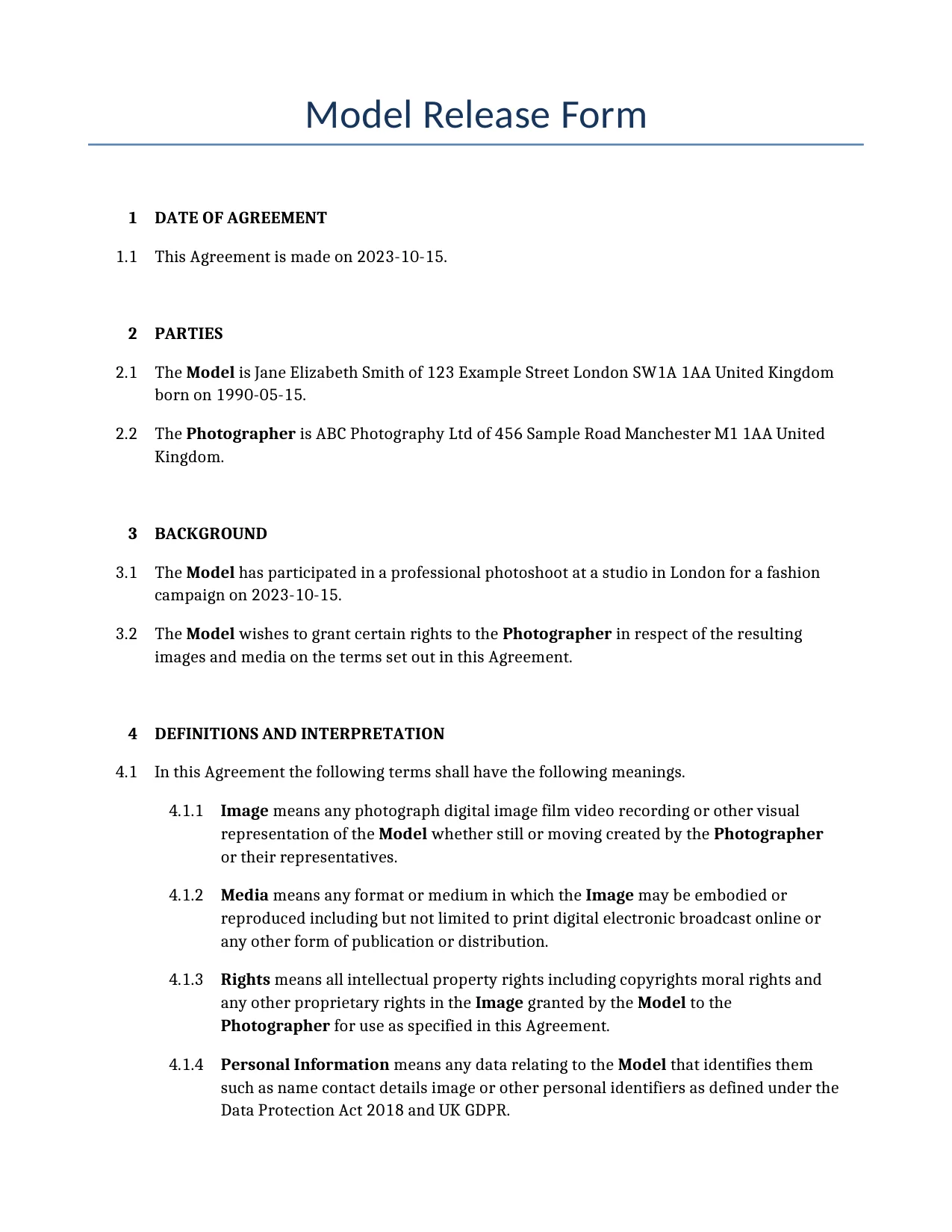
Model Release Form
1DATE OF AGREEMENT
This Agreement is made on 2023-10-15.
2PARTIES
The Model is Jane Elizabeth Smith of 123 Example Street London SW1A 1AA United Kingdom born on 1990-05-15.
The Photographer is ABC Photography Ltd of 456 Sample Road Manchester M1 1AA United Kingdom.
3BACKGROUND
The Model has participated in a professional photoshoot at a studio in London for a fashion campaign on 2023-10-15.
The Model wishes to grant certain rights to the Photographer in respect of the resulting images and media on the terms set out in this Agreement.
4DEFINITIONS AND INTERPRETATION
In this Agreement the following terms shall have the following meanings.
Image means any photograph digital image film video recording or other visual representation of the Model whether still or moving created by the Photographer or their representatives.
Media means any format or medium in which the Image may be embodied or reproduced including but not limited to print digital electronic broadcast online or any other form of publication or distribution.
Rights means all intellectual property rights including copyrights moral rights and any other proprietary rights in the Image granted by the Model to the Photographer for use as specified in this Agreement.
Personal Information means any data relating to the Model that identifies them such as name contact details image or other personal identifiers as defined under the Data Protection Act 2018 and UK GDPR.
Territory means the United Kingdom and the European Union.
Confidential Information includes any personal data biometric information from photographs and details about the Model's identity and image usage.
Use means any form of reproduction, distribution, communication to the public, making available to the public, or other exploitation of the Image in any Media and in any context, including commercial, editorial, or promotional uses.
References to clauses are to clauses of this Agreement.
5GRANT OF RIGHTS
The Model grants to the Photographer a non-exclusive licence of the Rights in the Image in the Territory commencing on 2023-10-15 in perpetuity. The licence granted is royalty-free and irrevocable, and the compensation in section 7 represents full and final payment for all rights granted and uses permitted under this Agreement. The grant includes the right to use the Model's name, likeness, and biographical information in connection with the Image.
The licence permits the Photographer to use the Image for advertising and promotion commercial licensing commercial advertising and editorial and journalistic purposes.
The licence includes full modification rights including cropping and resizing colour and editing.
The licence permits use of the Image in any Media including advertising online and print.
The Model confirms that the grant of rights is for commercial use.
6SCOPE OF RELEASE
The Model releases to the Photographer all rights in the photographs and videos created on 2023-10-15 during the professional photoshoot at a studio in London for a fashion campaign.
The released material consists of high-resolution photographs and short video clips featuring the Model in casual attire posing in urban settings intended to showcase natural expressions and movements.
The release permits use of the material in the contexts of advertising online and print within the Territory and worldwide where permitted by law.
7COMPENSATION
In consideration of the grant of rights and release the Photographer has paid to the Model the sum of [INSERT AMOUNT] which the Model hereby acknowledges receipt and acceptance of as full and final consideration for all rights granted and uses permitted under this Agreement. If a separate schedule is attached it shall detail the payment; otherwise this amount shall be inserted directly.
8REPRESENTATIONS AND WARRANTIES
The Model represents and warrants that the Model has the full legal capacity to enter into this Agreement.
The Model represents and warrants that the Model owns all rights in the Image including moral rights and has not assigned or licensed them to any third party.
The Model represents and warrants that the Image does not infringe any third-party rights including copyright privacy or publicity rights.
The Model warrants that all statements and representations made in this Agreement are true and accurate to the best of the Model's knowledge.
The Model warrants that they were over the age of 18 at the time the Images were created and on the date of this Agreement.
9INDEMNITY
The Model shall indemnify and hold harmless the Photographer against all claims, losses, and liabilities (including legal fees and costs) arising from any breach of the representations and warranties contained in this Agreement or from any use of the Image that infringes third-party rights.
10WAIVER OF RIGHTS
The Model expressly and irrevocably waives any moral rights in the Image under the Copyright Designs and Patents Act 1988 including the right to object to derogatory treatment or false attribution.
The Model expressly and irrevocably waives any privacy rights in the Image under the Human Rights Act 1998 and data protection laws.
The Model expressly and irrevocably waives any publicity rights in the Image under the laws of England and Wales.
The Model waives any right to inspect or approve the final use of the Image by the Photographer.
The waiver applies without any limitations.
The Model unconditionally and irrevocably waives all moral rights in the Image to which the Model is now or may at any time in the future be entitled under the Copyright, Designs and Patents Act 1988.
11GENERAL RELEASE
The Model releases the Photographer, their agents, licensees, and assigns from any claims, demands, or causes of action arising out of the use of the Image as permitted by this Agreement, including but not limited to claims for libel, defamation, invasion of privacy, or infringement of moral rights.
12CONFIDENTIALITY
Each party shall keep the Confidential Information of the other party confidential and shall not disclose it to any person except as permitted by this clause.
The confidentiality obligations shall last for a fixed period of 5 years from the date of this Agreement.
The Photographer may disclose Confidential Information to its legal advisors provided that such advisors are bound by equivalent confidentiality obligations.
The Photographer shall notify the Model promptly in the event of any breach of confidentiality.
In the event of breach of confidentiality the Model shall be entitled to seek injunctive relief and monetary damages.
The parties shall comply with the UK GDPR and Data Protection Act 2018 in relation to any Personal Information that constitutes Confidential Information.
13DATA PROTECTION
The Photographer shall process the Model's Personal Information solely for the purpose of creating and distributing promotional photographs featuring the Model for marketing purposes on the Photographer's website and social media channels.
The lawful basis for processing is consent given by the Model under this Agreement.
The Photographer does not intend to share the Personal Information with any third parties except as permitted under this Agreement.
The Personal Information will be stored for 5 years after the last use of the Image at which point it will be securely deleted in accordance with the Photographer's data retention policy.
The Personal Information will be stored on servers located in the United Kingdom.
No Personal Information will be transferred outside the United Kingdom.
The data controller is ABC Photography Ltd registered at 123 High Street London UK SW1A 1AA.
For data protection queries the Model may contact the Data Protection Officer at dpo@abcphotography.co.uk or telephone 020 1234 5678.
The Photographer may use data processors to handle the Personal Information on its behalf and shall ensure that such processors comply with the UK GDPR and Data Protection Act 2018.
Processing of the Personal Information shall commence on 2023-10-15.
14DATA SUBJECT RIGHTS
The Model acknowledges that they have the right to access, rectify, erase, restrict processing of, or object to the processing of their Personal Information, or to request its portability, by contacting the Data Protection Officer. The Photographer shall respond to any such request within one month. The Model has the right to withdraw consent at any time, but this will not affect the lawfulness of processing based on consent before its withdrawal, and that withdrawal of consent may prevent further use of the Image.
15GOVERNING LAW AND JURISDICTION
This Agreement shall be governed by the law of England and Wales. Each party irrevocably agrees that the courts of England and Wales shall have exclusive jurisdiction to settle any dispute or claim arising out of or in connection with this Agreement.
16DISPUTE RESOLUTION
The parties shall first attempt to resolve any dispute arising out of or in connection with this Agreement by negotiation.
If the dispute is not resolved by negotiation within 14 days the parties shall attempt to resolve it by mediation in accordance with the rules of the Centre for Effective Dispute Resolution.
If the dispute is not resolved by mediation within a further 14 days either party may refer it to arbitration under the rules of the London Court of International Arbitration.
The prevailing party in any dispute shall be entitled to recover its reasonable legal costs from the other party.
17ENTIRE AGREEMENT
This Agreement constitutes the entire agreement between the parties and supersedes any prior understandings or agreements between the parties whether oral or in writing.
18SEVERABILITY
If any provision of this Agreement is held to be invalid or unenforceable the remaining provisions shall continue in full force and effect.
19ASSIGNMENT
The Model may not assign or transfer any rights or obligations under this Agreement without the prior written consent of the Photographer.
The Model may assign rights only to affiliates or successors in business with the prior written consent of the Photographer.
The Photographer may assign or transfer its rights under this Agreement without the prior written consent of the Model provided that the assignment is only in connection with a business sale or merger or only to reputable media or advertising entities.
The Photographer may assign or transfer its obligations under this Agreement with the prior written consent of the Model.
20NOTICES
Any notice required to be given under this Agreement shall be in writing and may be delivered by post email or hand delivery.
Notices to the Model shall be sent to 123 Example Street London SW1A 1AA United Kingdom.
Notices to the Photographer shall be sent to 456 Sample Road Manchester M1 1AA United Kingdom.
Notices sent by post shall be deemed served 2 days after posting.
Any change to a notice address must be communicated in writing to the other party.
21FORCE MAJEURE
Neither party shall be liable for any failure to perform its obligations under this Agreement if such failure is caused by a force majeure event beyond its reasonable control.
The affected party shall notify the other party of the force majeure event within 7 days of becoming aware of it.
Both parties shall take reasonable efforts to mitigate the effects of the force majeure event.
If the force majeure event continues for 30 days or more either party may terminate this Agreement by giving written notice to the other.
22TERMINATION
This Agreement may be terminated by either party upon written notice if the other party commits a material breach and fails to remedy it within 14 days. Upon termination, the Photographer shall cease new uses of the Image but may continue to use existing stock. All licences granted prior to termination shall survive.
23NO PARTNERSHIP OR AGENCY
Nothing in this Agreement is intended to, or shall be deemed to, constitute a partnership or joint venture between the parties, nor constitute either party as the agent of the other. Neither party shall have authority to act in the name or on behalf of the other.
24COUNTERPARTS
This Agreement may be executed in any number of counterparts each of which when executed shall constitute an original but all of which together shall constitute one and the same instrument.
25EXECUTION
Signed by Jane Elizabeth Smith (the Model)
Signature ___________________________ Date ___________________________
Signed by ABC Photography Ltd (the Photographer) acting by its authorised signatory
Signature ___________________________ Date ___________________________
This example shows approximately 70% of a typical document and is provided for illustrative purposes only. The remaining content has been omitted.
Every document generated by Docaro is tailored to your specific circumstances, jurisdiction and the information you provide. The completed document includes all applicable clauses and provisions required for your situation.
To generate the full, personalised document, answer a short series of questions and your document will be created instantly.
Useful Resources When Considering a Model Release Form in the United Kingdom
United Kingdom Reference Legislation
Model Release Form FAQs
Document Generation FAQs
Related Articles