AI Generated British Dismissal Letter
PDF & Word - 2026 Updated
Docaro Pricing
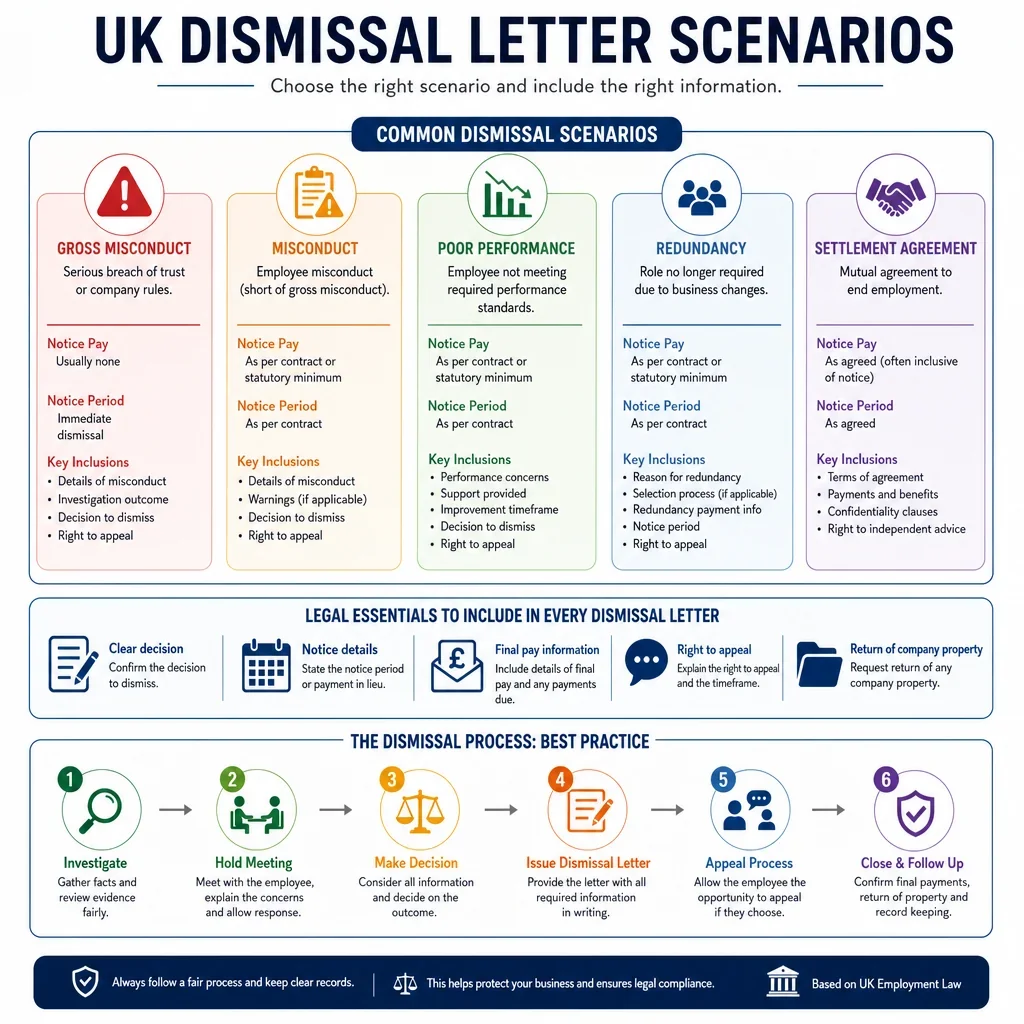
When do you need a Dismissal Letter in the United Kingdom?
British Legal Rules for a Dismissal Letter
Using the wrong type or structure of termination letter can lead to invalid dismissals or unintended employment rights.
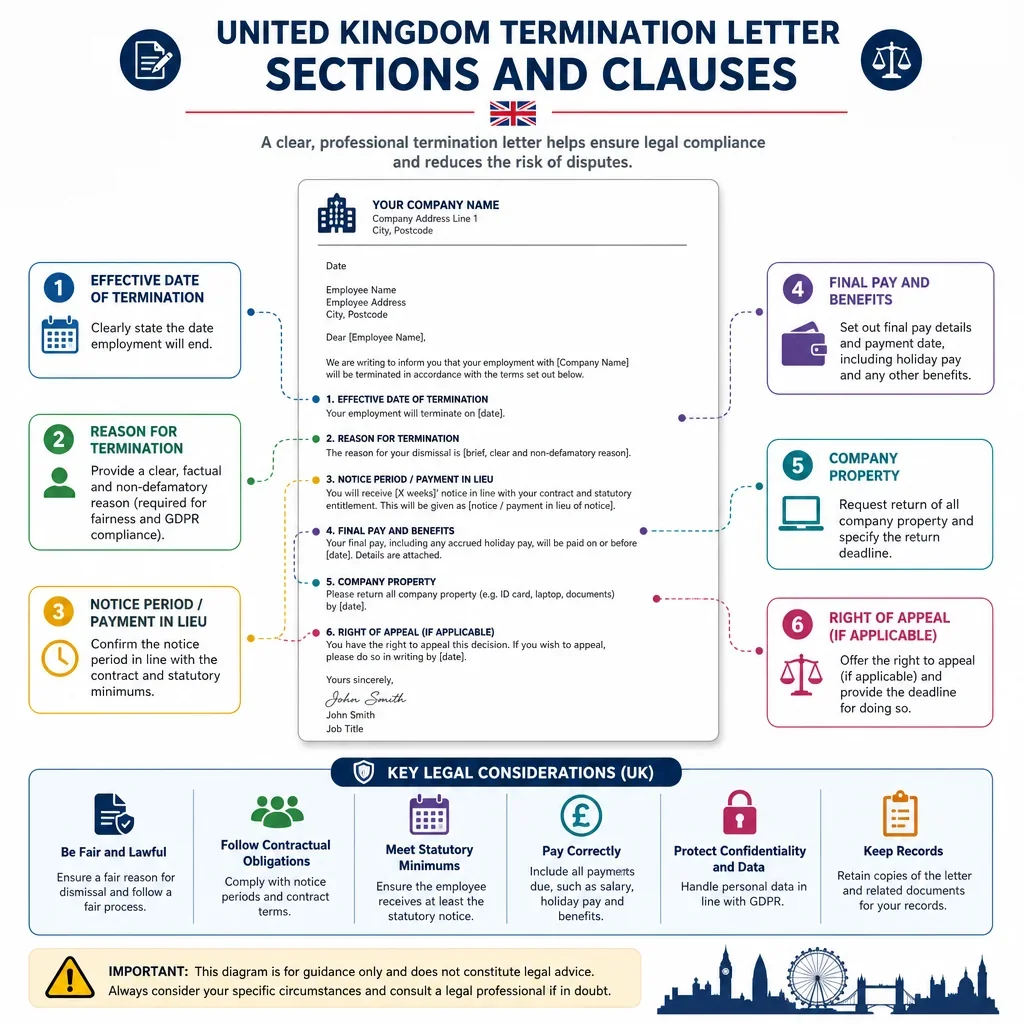
What a Proper Dismissal Letter Should Include
- Employee DetailsInclude the employee's full name, job title, and start date to clearly identify them.
- Reason for DismissalState the specific reason for ending employment, such as redundancy or poor performance, to ensure transparency.
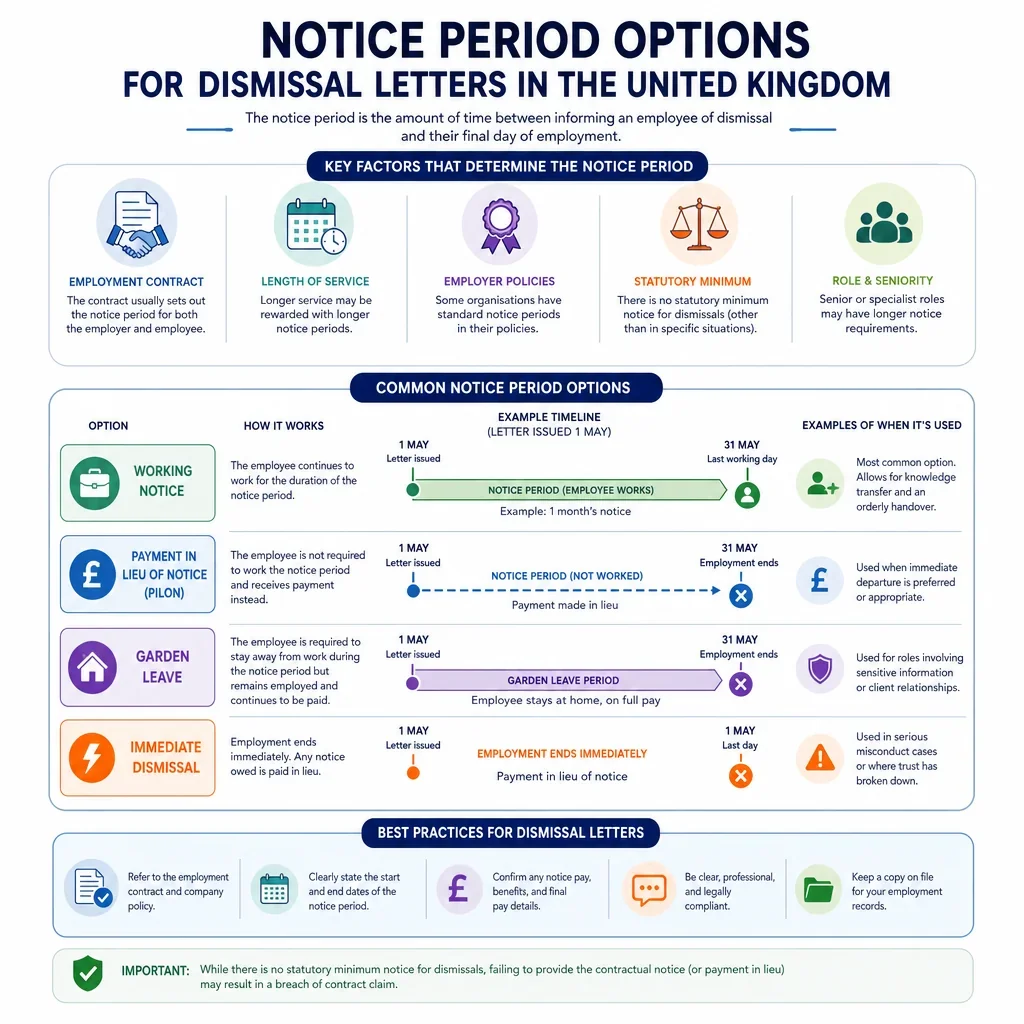
- Effective DateSpecify the exact date when employment ends, considering any required notice period.
- Notice PeriodOutline how much notice is being given or if payment in lieu of notice applies.
- Final Pay InformationDetail the final salary payment, including any owed holiday pay or bonuses.
- Return of Company PropertyList items like keys, equipment, or documents that the employee must return.
- Next StepsExplain what happens next, such as exit interviews or references, to guide the employee.
Generate Your Document in 4 Easy Steps
Why Use Docaro?
 United Kingdom
Free Example Dismissal Letter Template
Below is a free template example of a Dismissal Letter for use in the United Kingdom generated by our AI model.
The clauses in your actual Dismissal Letter will vary from this example as they will be entirely bespoke to your requirements as set out in the questionnaire you complete.
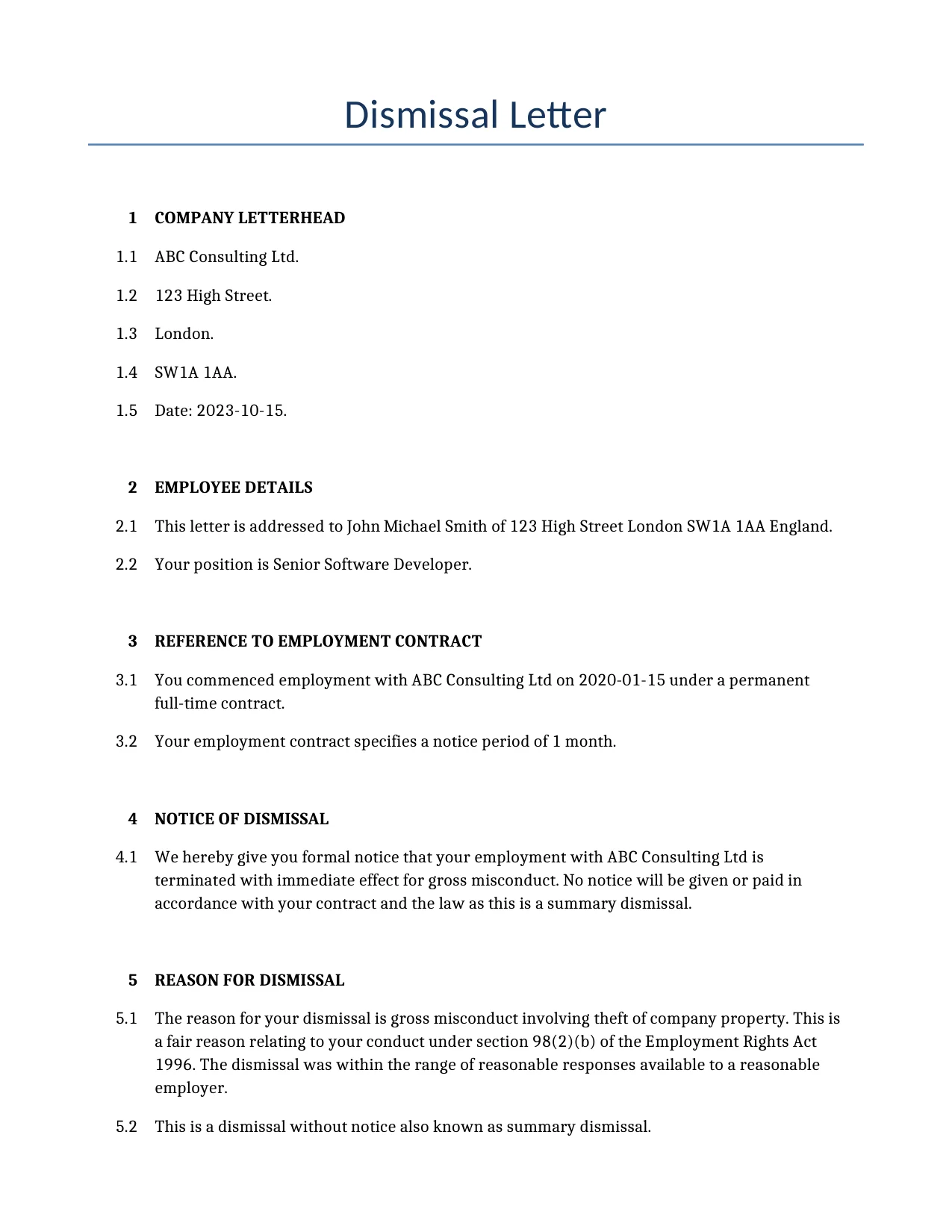
Dismissal Letter
1COMPANY LETTERHEAD
ABC Consulting Ltd.
123 High Street.
London.
SW1A 1AA.
Date: 2023-10-15.
2EMPLOYEE DETAILS
This letter is addressed to John Michael Smith of 123 High Street London SW1A 1AA England.
Your position is Senior Software Developer.
3REFERENCE TO EMPLOYMENT CONTRACT
You commenced employment with ABC Consulting Ltd on 2020-01-15 under a permanent full-time contract.
Your employment contract specifies a notice period of 1 month.
4NOTICE OF DISMISSAL
We hereby give you formal notice that your employment with ABC Consulting Ltd is terminated with immediate effect for gross misconduct. No notice will be given or paid in accordance with your contract and the law as this is a summary dismissal.
5REASON FOR DISMISSAL
The reason for your dismissal is gross misconduct involving theft of company property. This is a fair reason relating to your conduct under section 98(2)(b) of the Employment Rights Act 1996. The dismissal was within the range of reasonable responses available to a reasonable employer.
This is a dismissal without notice also known as summary dismissal.
The employee was found to have repeatedly stolen inventory from the warehouse over a period of three months as confirmed by CCTV footage and witness statements from colleagues.
This behavior constitutes gross misconduct under the company\'s disciplinary policy and breaches the trust and confidence essential to the employment relationship.
Key evidence includes CCTV recordings showing the employee removing items without authorization on multiple dates inventory discrepancy reports linking missing stock to the employee\'s shifts signed statements from two witnesses who observed the incidents and the employee\'s confession during the disciplinary investigation meeting.
6INVITATION TO DISCIPLINARY HEARING AND PROCESS
You were invited to a disciplinary hearing in writing on [insert date]. You were provided with all the evidence in advance of the hearing including the CCTV footage witness statements inventory reports and details of your confession. You were informed of your right to be accompanied at the hearing by a colleague or a trade union representative in accordance with section 10 of the Employment Relations Act 1999 and the ACAS Code of Practice. You were also informed of your right to appeal at every stage of the process. A full disciplinary procedure was followed in accordance with the ACAS Code of Practice the Employment Rights Act 1996 and the company\'s disciplinary policy. An investigation into the misconduct was conducted before deciding on dismissal. The investigation started on 2023-05-15 and concluded on 2023-06-01. The key findings from the investigation confirmed the theft of company property. You were given a full opportunity to respond to the allegations at a formal disciplinary hearing held on 2023-06-10. The outcome of the hearing was your summary dismissal for gross misconduct with immediate effect. You were informed of the right to appeal the decision. The employer fully complied with the ACAS Code of Practice in the disciplinary process.
7DISCIPLINARY PROCESS SUMMARY
A full disciplinary procedure was followed before dismissing the employee in accordance with the ACAS Code of Practice and the Employment Rights Act 1996. The employer followed its own disciplinary policy at every stage.
8EFFECTIVE DATE OF TERMINATION
The effective date of termination of your employment is 2023-10-15 which is the date of this letter. For summary dismissal without notice the EDT is the date the employment ends. You will receive pay up to and including the EDT together with pay for any accrued but untaken holiday.
9NOTICE PERIOD AND PAY
As this is a summary dismissal for gross misconduct no notice is required and no payment in lieu of notice will be made. Your contractual notice period of 1 month does not apply in cases of gross misconduct. Your final pay will be calculated up to the EDT only.
10FINAL PAYMENTS
Your final gross pay up to the EDT including accrued holiday pay will be \£2,850.50 (net pay \£2,150.75 after statutory deductions). This includes 10 days of accrued but untaken holiday calculated at your daily rate of \£135.00. Payment will be made by the next payroll date and in any event within 7 days of the EDT. Your P45 will be sent to you by post within 7 days of the EDT. Deductions will be made from your final pay for any overpayments or loans. You are not eligible for any outstanding bonus payments. You may be eligible for unemployment benefits subject to the rules of the Department for Work and Pensions.
11RETURN OF COMPANY PROPERTY
You must return all company property by 2023-12-15 to 123 Business Street London SW1A 1AA United Kingdom.
The company property to be returned includes keys and access cards electronic equipment and documents and files.
Failure to return the company property by the specified date will result in appropriate legal action being taken against you.
12CONFIDENTIALITY AND NON-COMPETE CLAUSES
You are reminded of your ongoing confidentiality obligations post-termination and your ongoing non-disclosure obligations regarding company information after your employment ends.
Your contract contains restrictive covenants including non-compete clauses which will continue to apply post-termination.
13BENEFITS CESSATION
Your health insurance coverage will cease on the effective date of termination.
Pension contributions will cease on the effective date of termination.
Any life insurance benefits will cease on the effective date of termination.
14REFERENCE POLICY
ABC Consulting Ltd will provide employment references to former employees however such references will not be provided for dismissed employees.
15RIGHT TO APPEAL
You have the right to appeal against this decision. Any appeal must be submitted in writing within 14 days of the date of this letter to appeals@company.co.uk. The appeal will be heard by a manager not previously involved in the case who will consider whether the original decision was fair and reasonable. You will be given reasonable notice of the appeal hearing and you have the right to be accompanied by a colleague or trade union representative. The decision following the appeal will be final.
16CONTACT INFORMATION
For any queries regarding this dismissal please contact Jane Smith HR Manager at jane.smith@company.co.uk or 020 7946 0000.
17BOILERPLATE PROVISIONS
This document constitutes the entire agreement between the parties relating to the dismissal and supersedes all prior agreements understandings or arrangements whether oral or in writing.
If any provision of this letter is held to be invalid or unenforceable by any court or competent authority the remaining provisions shall continue in full force and effect.
This letter and any disputes arising from it shall be governed by and construed in accordance with British law.
Any notice required to be given under this letter shall be in writing and shall be delivered personally or sent by recorded delivery to the addresses set out above or such other address as either party may notify to the other in writing.
No variation of this letter shall be effective unless it is in writing and signed by or on behalf of each party.
18WITHOUT PREJUDICE AND PROTECTED CONVERSATION
This letter is not offered on a without prejudice basis and is not part of a protected conversation under section 111A of the Employment Rights Act 1996.
19SIGNATURE SECTION
Signed on behalf of ABC Consulting Ltd: ___________________________ Date: _______________
I acknowledge receipt of this letter: ___________________________ Date: _______________
This example shows approximately 70% of a typical document and is provided for illustrative purposes only. The remaining content has been omitted.
Every document generated by Docaro is tailored to your specific circumstances, jurisdiction and the information you provide. The completed document includes all applicable clauses and provisions required for your situation.
To generate the full, personalised document, answer a short series of questions and your document will be created instantly.
Useful Resources When Considering a Dismissal Letter in the United Kingdom
United Kingdom Reference Legislation
Dismissal Letter FAQs
Document Generation FAQs
Related Articles