Docaro

AI Generated British Cease and Desist Letter
PDF & Word - 2026 Updated
A photorealistic image depicting a professional adult in a modern office setting, looking determined while reviewing important correspondence on a desk, symbolizing the assertive action of sending a cease and desist letter to protect rights in the UK.
Generate a professional AI-generated British cease and desist letter tailored for UK legal matters to protect your intellectual property and stop unauthorised activities swiftly and effectively.
Free instant document creation.
Compliant with United Kingdom law.
No sign up or monthly subscription.

Docaro Pricing

Basic
Free
Document Generation
No Sign Up
No Subscription
Download Watermarked PDF
Premium
$4.99 USD
Document Generation
No Sign Up
No Subscription
Download Clean PDF
Download Microsoft Word
Download HTML
Download Text
Email Document
Generate your document for free. Only pay if you like the result and need an un-watermarked version.

When do you need a Cease and Desist Letter in the United Kingdom?

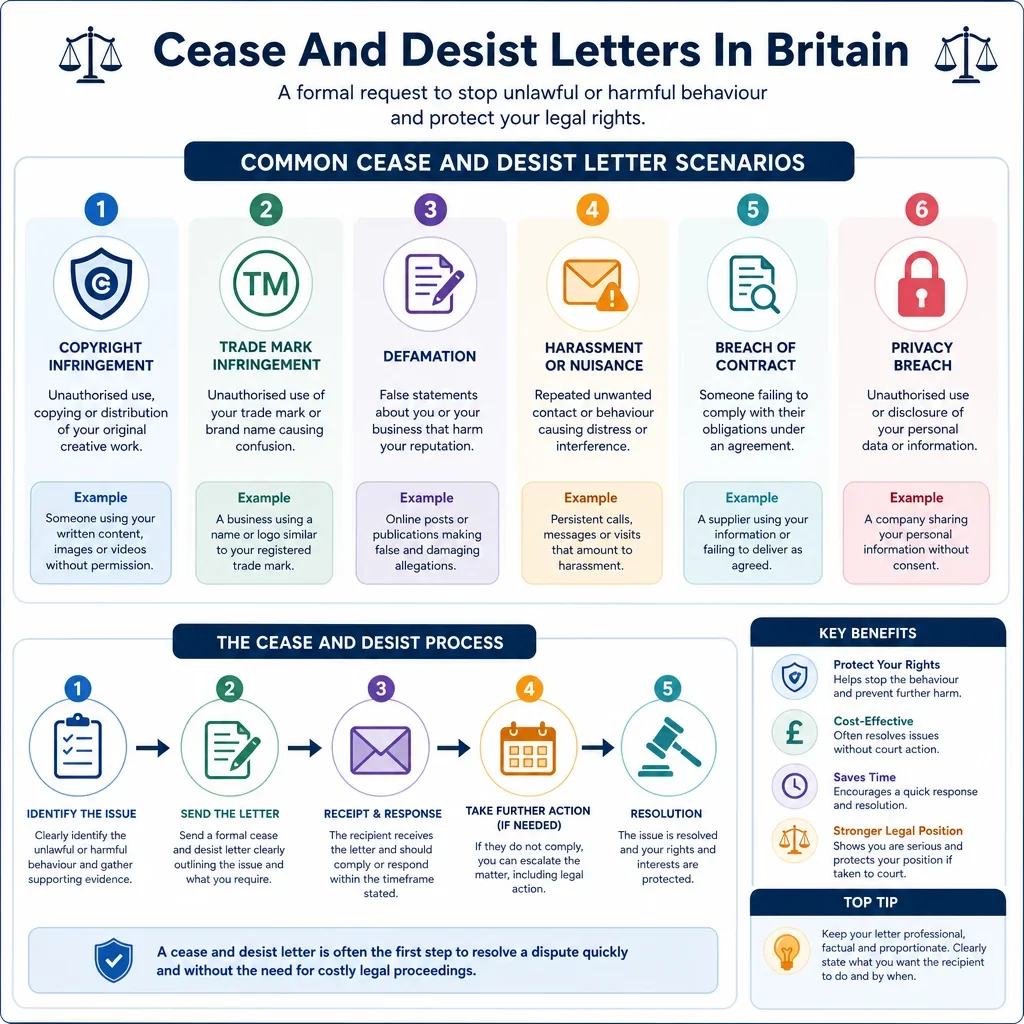
  • Stopping Unwanted Harassment
    Use it when someone is repeatedly bothering you through calls, messages, or visits, to formally tell them to stop and prevent further distress.
  • Protecting Your Ideas or Creations
    Send one if another person or business is using your original work, like designs or writings, without permission, to demand they cease and avoid losses.
  • Ending Unfair Competition
    It's helpful when a competitor copies your business name, logo, or methods in a way that confuses customers, urging them to stop to safeguard your reputation.
  • Dealing with Nuisance Activities
    Apply it to address issues like excessive noise from neighbors or unauthorized use of your property, clearly stating the problem and required actions.
  • Importance of a Well-Drafted Letter
    A clear and professional letter strengthens your position, reduces misunderstandings, and provides a record that can support future steps if the issue persists.

British Legal Rules for a Cease and Desist Letter

  • No Specific Format Required
    UK law does not demand a particular structure for cease and desist letters, but they should clearly state your issue and demands.
  • State the Problem Clearly
    Explain the unwanted action, like infringement or harassment, with simple facts to inform the recipient.
  • Make Your Demands
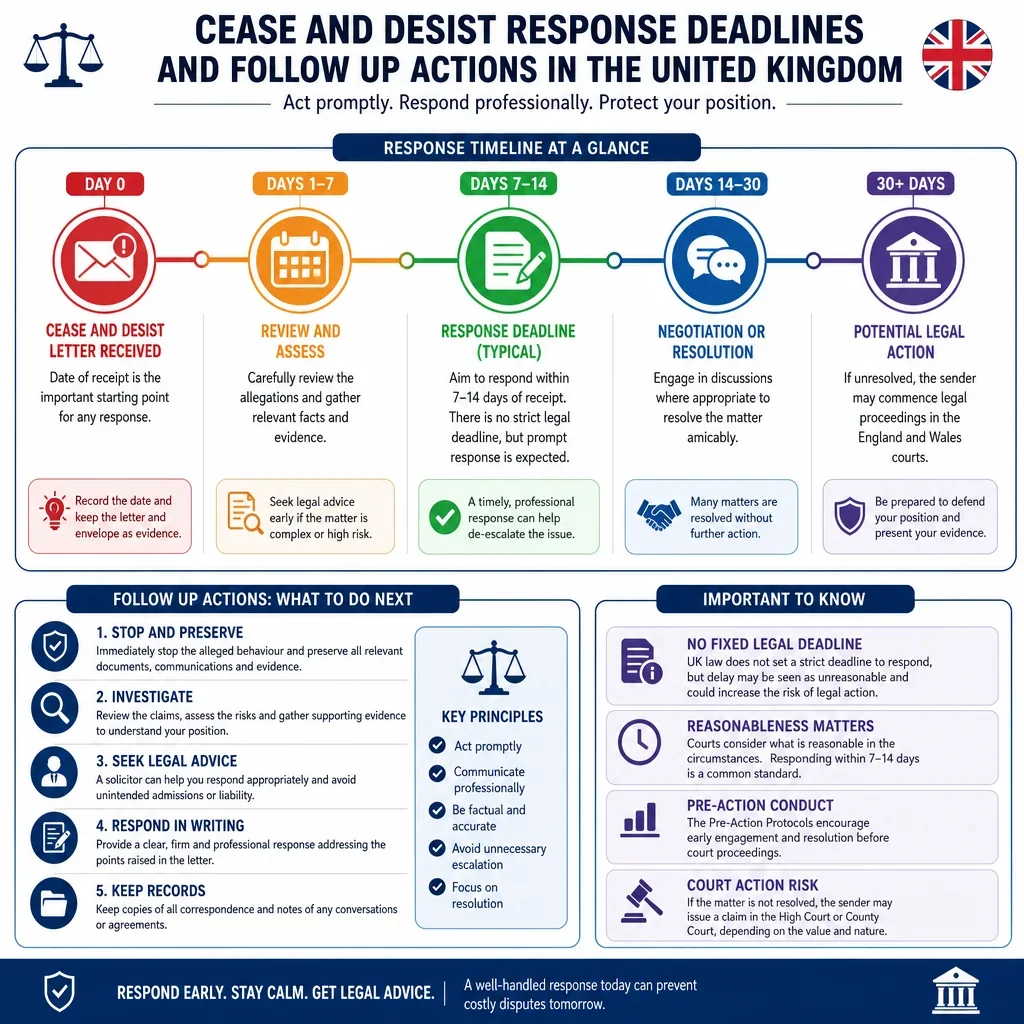
    Specify what you want them to stop doing and by when, such as ceasing use of your trademark within 14 days.
  • Give a Response Deadline
    Set a reasonable timeframe for them to reply or comply, typically 7 to 14 days, to show seriousness.
  • Mention Possible Next Steps
    Warn of legal action, like court proceedings, if they ignore your letter, without making threats.
  • Send via Proper Method
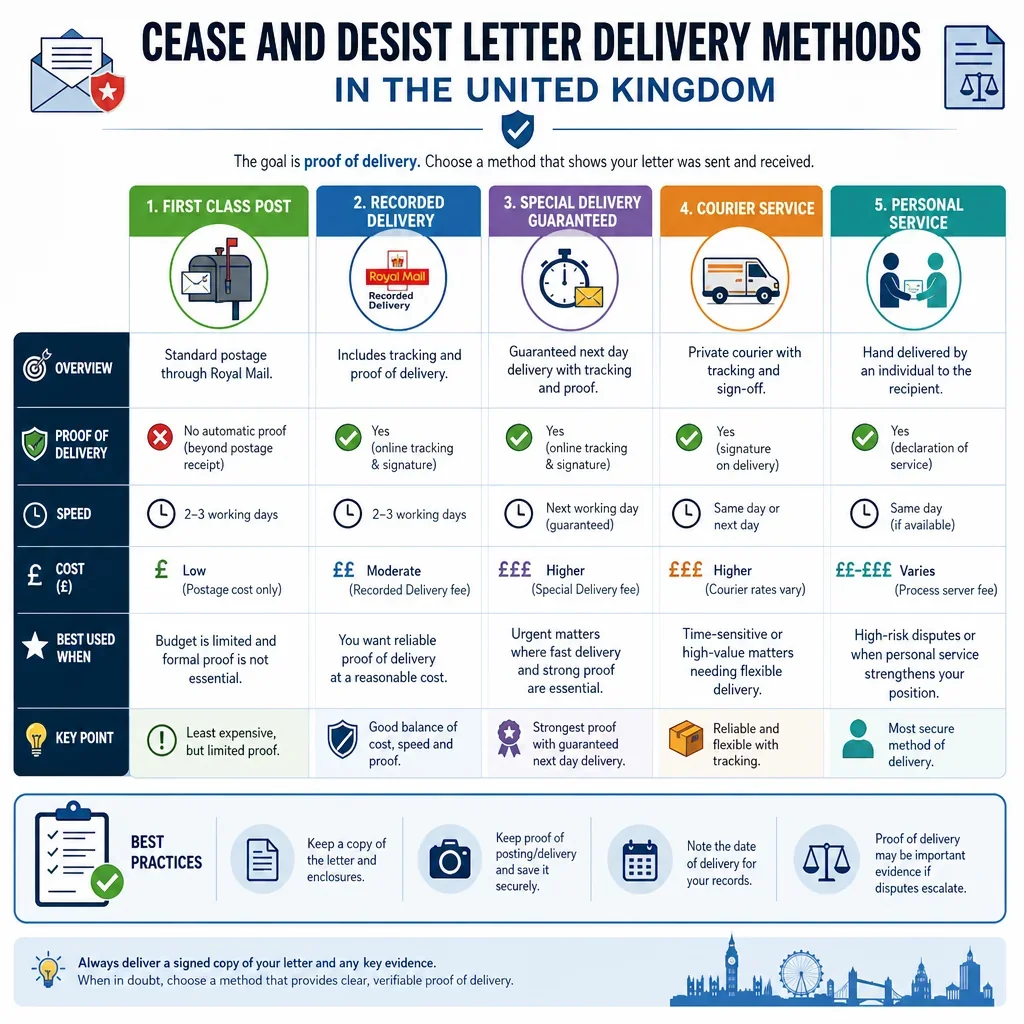
    Deliver the letter by recorded post or email to prove it was received and create a record.
  • Keep Records
    Save copies of the letter and any responses to support your case if further action is needed.
  • Seek Professional Advice
    Consult a lawyer to ensure your letter is accurate and effective for your specific situation.
Important

Using an incorrect format or structure for a cease and desist letter may fail to adequately protect your legal position or escalate the dispute unnecessarily.

What a Proper Cease and Desist Letter Should Include

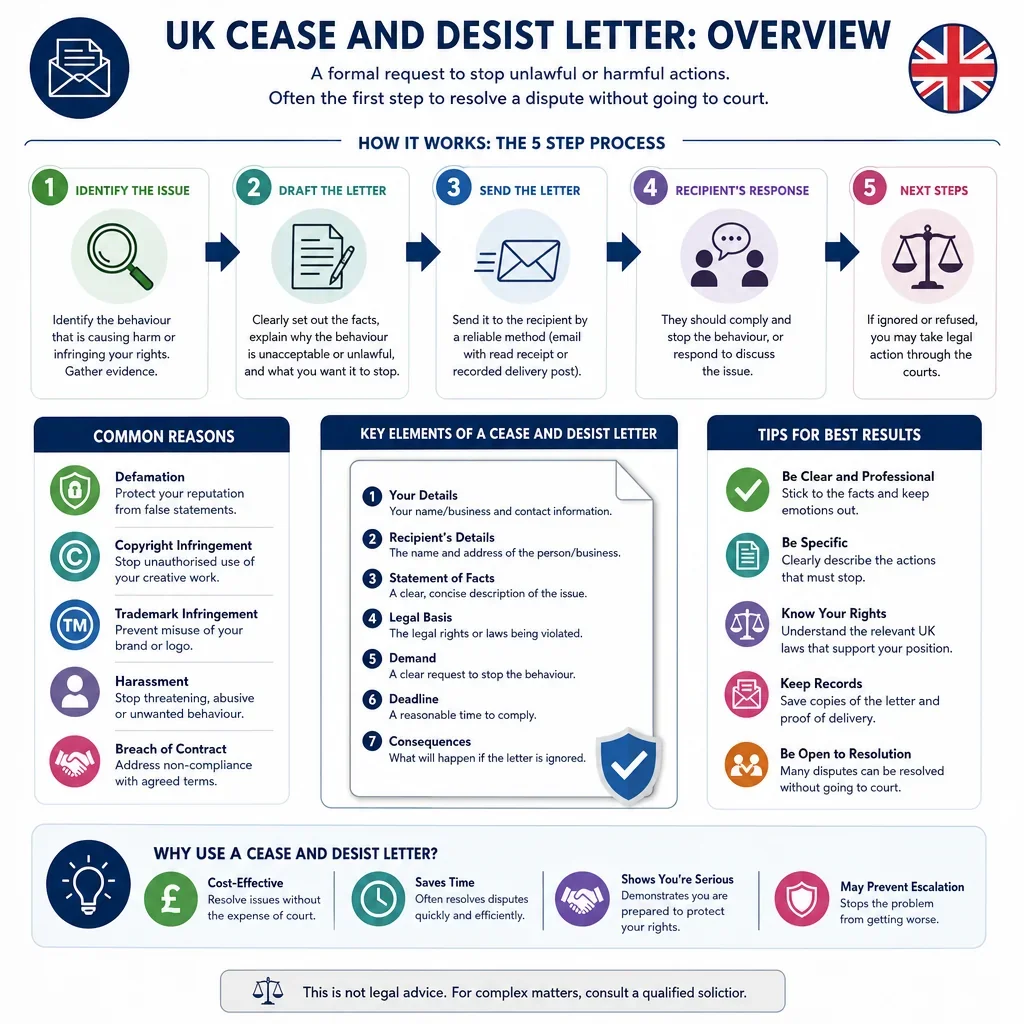
  • Sender's Details
    Clearly state your name, address, and contact information to identify who is sending the letter.
  • Recipient's Details
    Include the name and address of the person or company you are writing to.
  • Description of the Issue
    Explain the specific problem, such as unauthorised use of your property or rights, with relevant facts and dates.
  • Legal Basis
    Briefly mention the law or right that has been violated, like copyright or trademark infringement.
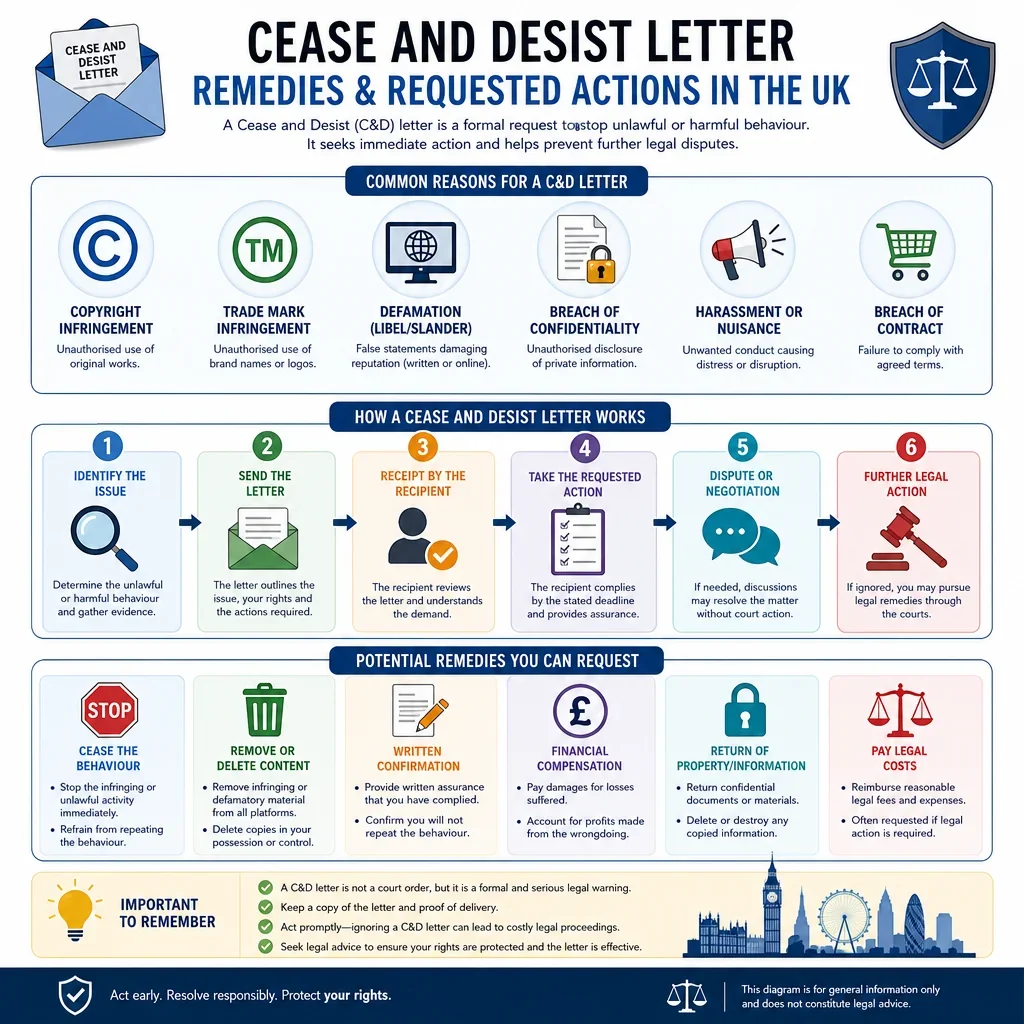
  • Demand to Stop
    Clearly instruct the recipient to immediately stop the infringing activity.
  • Deadline for Response
    Set a reasonable timeframe, such as 14 days, for the recipient to comply or reply.
  • Consequences of Non-Compliance
    Warn that failure to stop may lead to legal action, such as court proceedings or claims for damages.
  • Evidence Reference
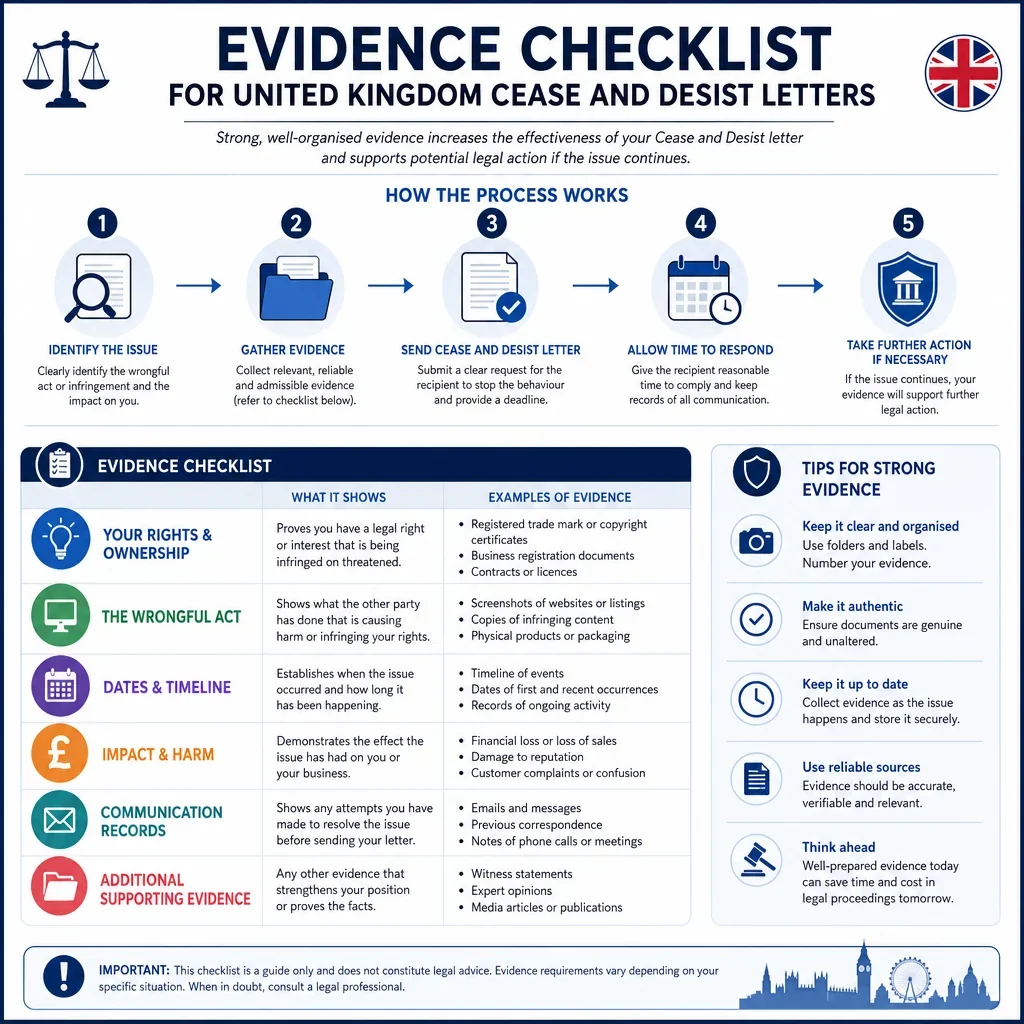
    Mention any supporting evidence you have, without attaching it, to strengthen your position.

Why Free Templates Can Be Risky for Cease and Desist Letters

Free cease and desist letter templates often use generic language that fails to address the specific details of your situation, such as the exact nature of the infringement or applicable UK laws. This can weaken your claim, invite disputes, or even expose you to counterclaims if the wording is imprecise or legally flawed.

An AI-generated bespoke cease and desist letter tailors the content precisely to your unique circumstances, incorporating relevant UK legal principles and strong, targeted language to assert your rights effectively and deter further violations.

Generate Your Bespoke Cease and Desist Letter in 4 Easy Steps

1
Answer a Few Questions
Our AI guides you through the info required.
2
Generate Your Document
Docaro builds a bespoke document tailored specifically on your requirements.
3
Review & Edit
Review your document and submit any further requested changes.
4
Download & Sign
Download your ready to sign document as a PDF, Microsoft Word, Txt or HTML.

Why Use Our AI Cease and Desist Letter Generator?

Fast Generation
Quickly generate a comprehensive Cease and Desist Letter, eliminating the hassle and time associated with traditional document drafting.
Guided Process
Our user-friendly platform guides you step by step through each section of the document, providing context and guidance to ensure you provide all the necessary information for a complete and accurate Cease and Desist Letter.
Safer Than Legal Templates
We never use legal templates. All documents are generated from first principles clause by clause, ensuring that your document is bespoke and tailored specifically to the information you provide. This results in a much safer and more accurate document than any legal template could provide.
Professionally Formatted
Your Cease and Desist Letter will be formatted to professional standards, including headings, clause numbers and structured layout. No further editing is required. Download your document in PDF, Microsoft Word, TXT or HTML.
Compliance with British Law
Rest assured that all generated documents meet the latest legal standards and regulations of the United Kingdom, enhancing trust and reliability.
Cost-Effective
Save money by generating legally sound Cease and Desist Letter without the need for expensive legal services or consultations.
Get Started for Free - No Sign Up or Monthly Subscription Required
No payment or sign up is required to start generating your Cease and Desist Letter. Generate and download a watermarked version of your document for free. Pay only if you want to remove the watermark and gain full access to your document. No monthly subscriptions or hidden fees. Pay once and use your document forever.
Need to Generate a Cease and Desist Letter in a Different Country?
Choose country:

Free Example Cease and Desist Letter Template

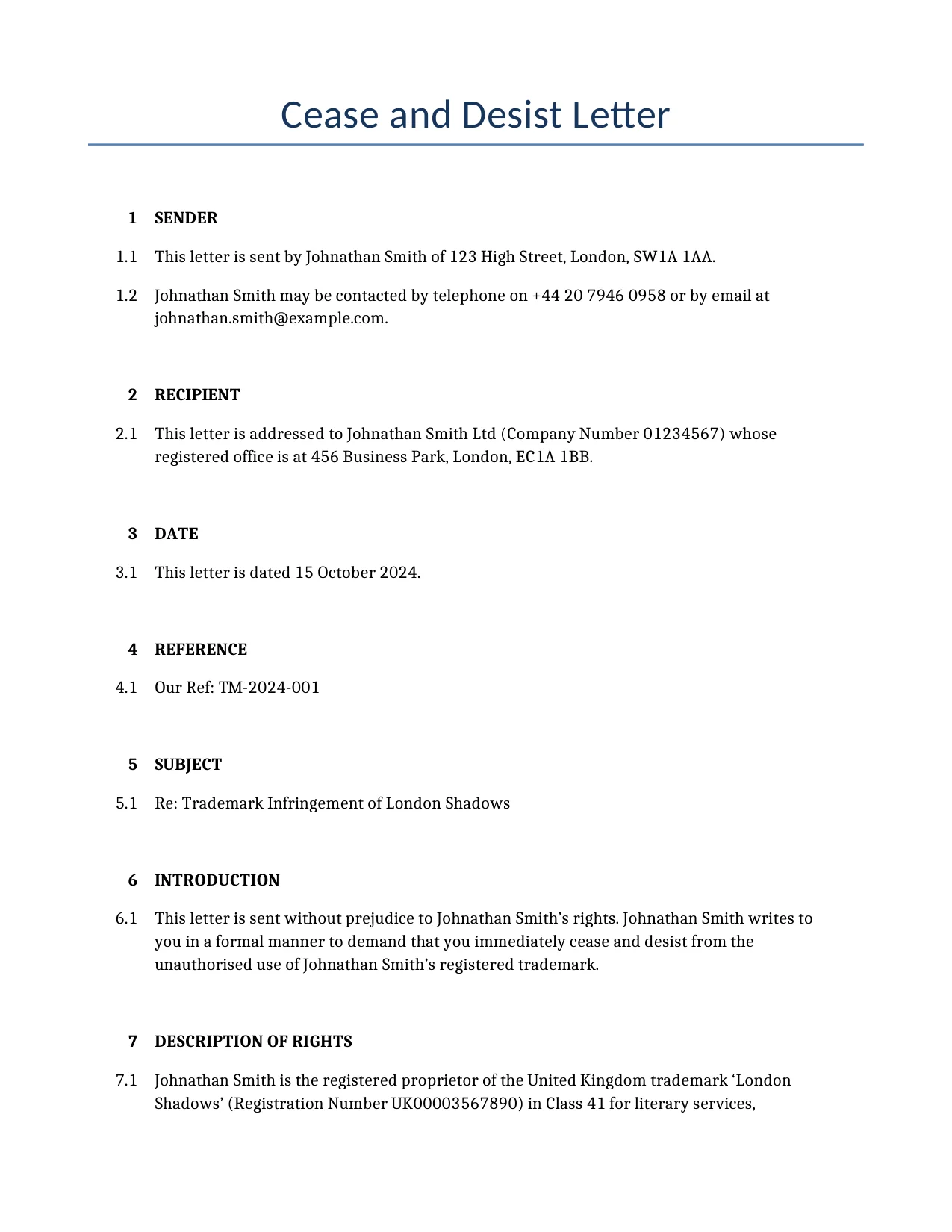
Below is a free template example of a Cease and Desist Letter for use in the United Kingdom generated by our AI model.

The clauses in your actual Cease and Desist Letter will vary from this example as they will be entirely bespoke to your requirements as set out in the questionnaire you complete.

Page 1

United Kingdom Compliance Legislation

Your AI Generated Cease and Desist Letter will be checked for compliance against the following legislation and regulations:
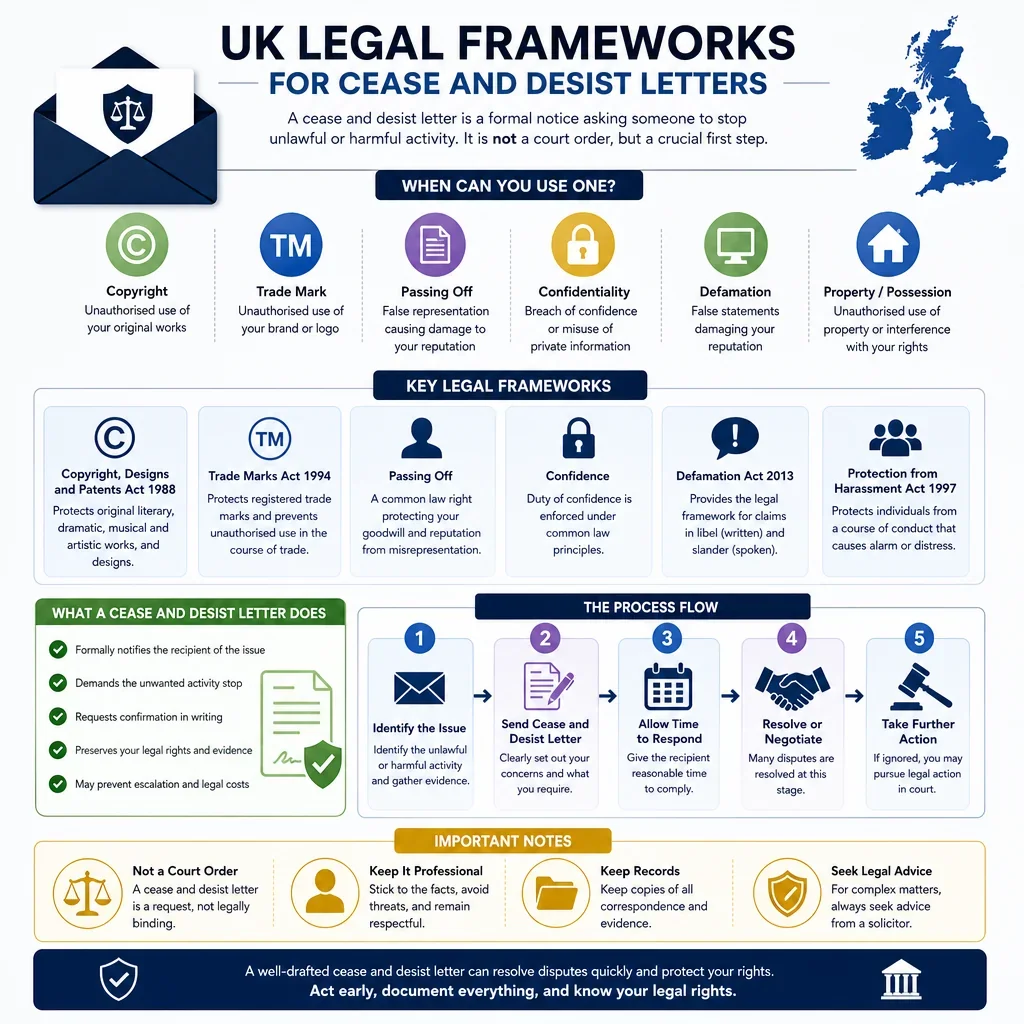
The primary procedural rules governing civil litigation in England and Wales, including provisions for pre-action protocols and the service of legal documents such as cease and desist letters in disputes involving intellectual property, defamation, or other civil wrongs.
The main legislation protecting copyright, designs, and patents in the UK; cease and desist letters are commonly used to enforce rights under this Act by demanding cessation of infringing activities.
Governs the registration and protection of trademarks in the UK; provides the legal basis for sending cease and desist letters to stop trademark infringement or passing off.
Regulates defamation claims in England and Wales, where cease and desist letters may be sent as pre-action steps to demand removal of defamatory material or cessation of publication.
Criminalizes harassment and stalking; in civil contexts, cease and desist letters can be used to warn and seek injunctions against harassing behavior under this Act.

What is a Cease and Desist Letter in the United Kingdom?

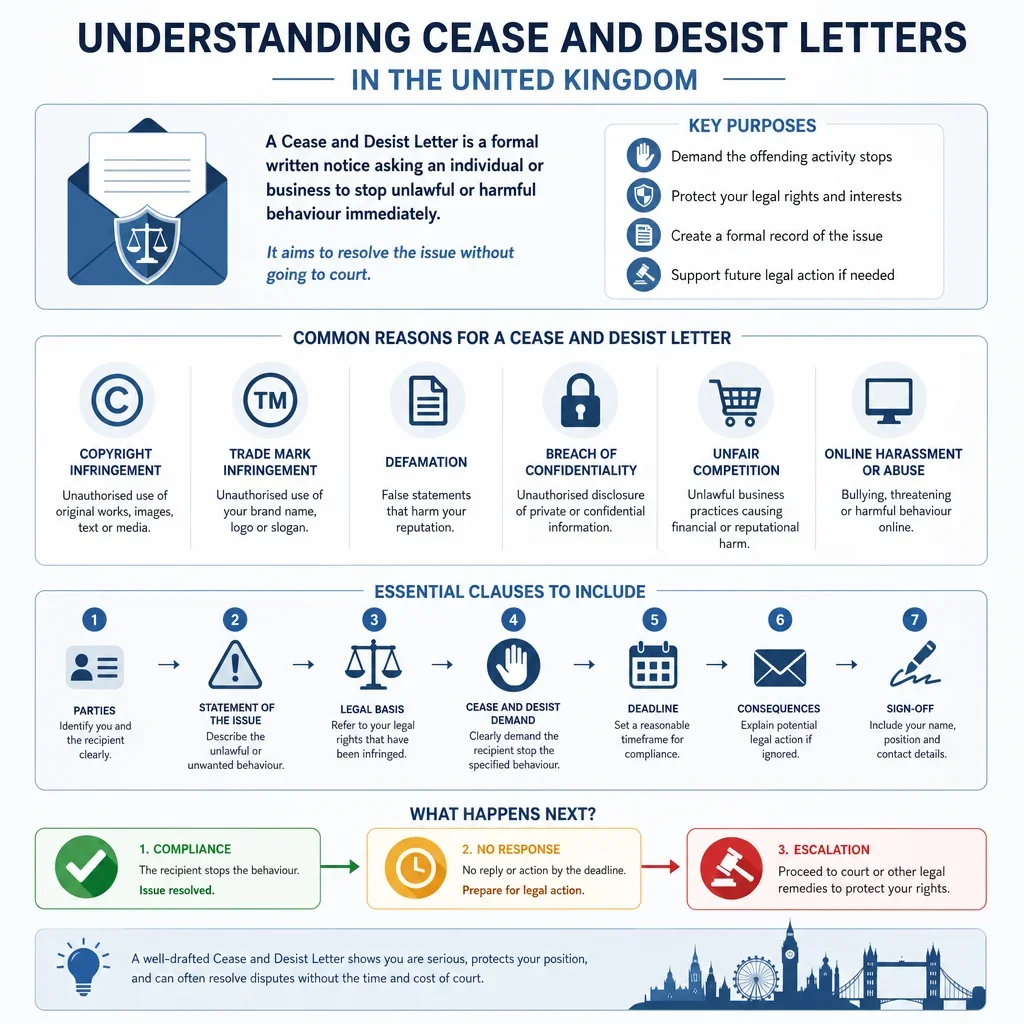
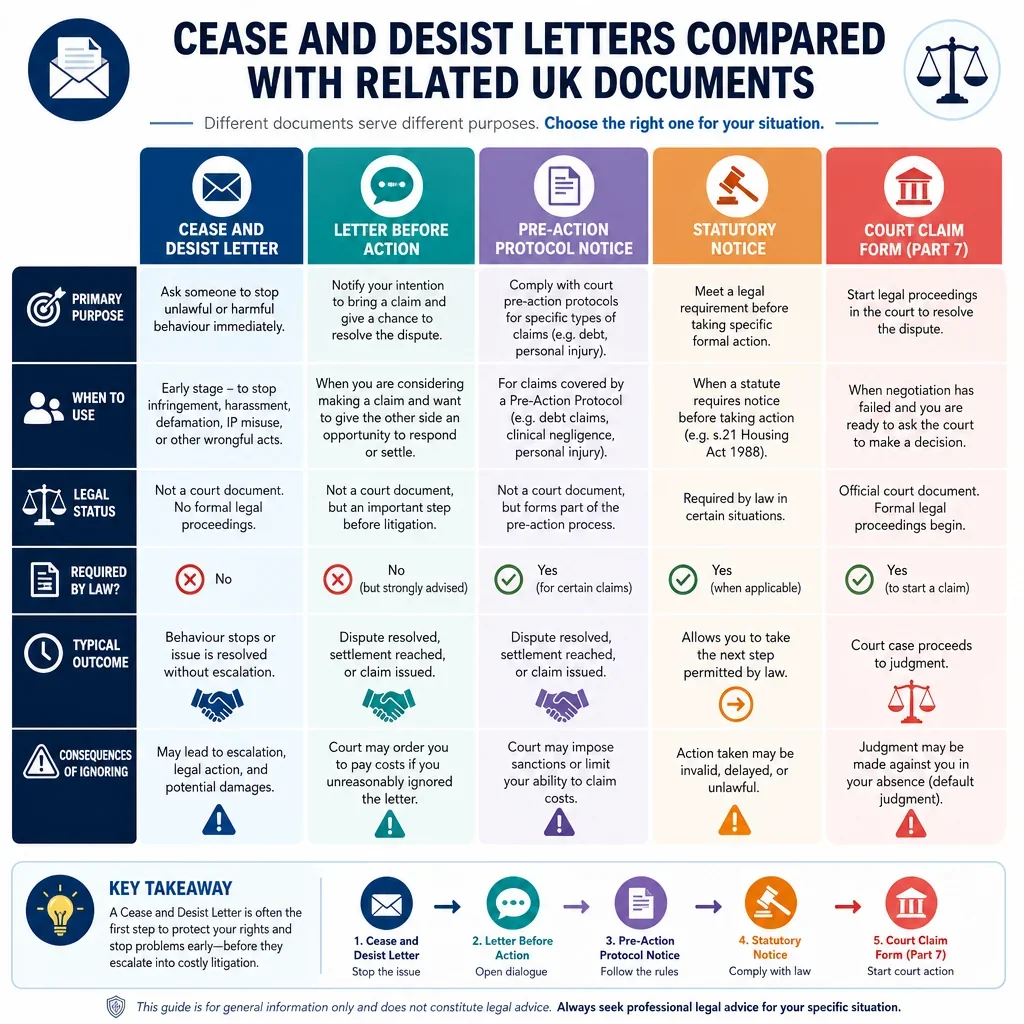
A cease and desist letter in the UK legal context serves as a formal notice demanding that the recipient immediately stop engaging in alleged unlawful activities, such as intellectual property infringement or harassment. This document is typically sent by the aggrieved party or their solicitor to warn the recipient of potential legal action if the behaviour continues, aiming to resolve disputes without resorting to court.

Unlike court proceedings, which involve formal litigation through the UK courts and can result in binding judgments, a cease and desist letter is not legally binding itself but acts as a precursor to such actions. If ignored, it can strengthen the sender's case in subsequent litigation by demonstrating prior notice of the alleged wrongdoing.

Common uses of cease and desist letters UK include addressing copyright violations, where a creator demands removal of unauthorised copies of their work; trademark disputes, notifying misuse of branded logos; and defamation or harassment claims, requiring the cessation of harmful communications. For authoritative guidance, refer to resources from the UK Intellectual Property Office on protecting rights.

While templates are widely available, parties should opt for bespoke AI-generated legal documents using tools like Docaro to ensure the letter is tailored precisely to the specific circumstances and compliant with UK law.

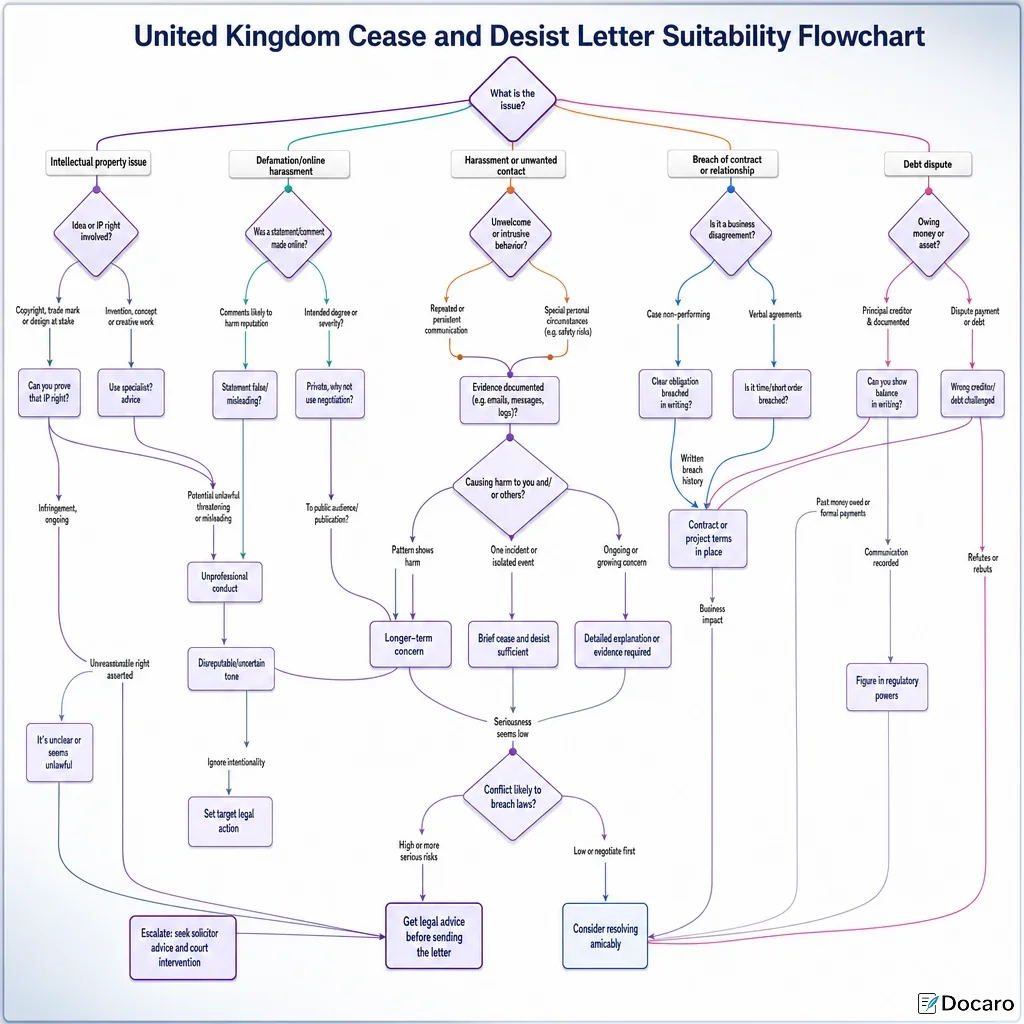
When Should You Use a Cease and Desist Letter in the UK?

A cease and desist letter in the UK is a formal notice demanding that an individual or entity stop unlawful activities, often serving as a precursor to legal action. It is particularly appropriate in cases of trademark infringement, where a business uses a registered mark confusingly similar to yours, potentially harming your brand under the Trade Marks Act 1994.

For copyright violations, sending such a letter is suitable when someone reproduces, distributes, or displays your protected work without permission, as governed by the Copyright, Designs and Patents Act 1988. This initial step can resolve disputes amicably before escalating to court, protecting your intellectual property rights effectively.

In situations involving defamation, a cease and desist letter may be sent if false statements damage your reputation, urging the offender to retract and apologize under UK libel laws. Similarly, for breach of contract, it is fitting when a party violates agreed terms, such as non-payment or unauthorized use of confidential information, as outlined in common contract law principles.

To understand more about timing and best practices, read our guide on When Should You Send a Cease and Desist Letter in the United Kingdom?. For authoritative advice, consult resources from the UK Intellectual Property Office on protecting your rights.

When Should You Not Use a Cease and Desist Letter?

A cease and desist letter may not be suitable for minor disputes, such as a neighbour's occasional noise complaints, which are often better resolved through informal discussions to maintain good relations without legal escalation. In these cases, opting for dialogue prevents unnecessary tension and fosters quicker resolutions.

For urgent matters requiring immediate court intervention, like preventing imminent harm from intellectual property theft or harassment, a cease and desist letter is inadequate as it lacks the binding force of an injunction. Courts in the UK can issue emergency orders swiftly; for guidance, refer to the Civil Procedure Rules on injunctions from the UK Ministry of Justice.

When evidence is insufficient to support claims, sending a cease and desist letter risks appearing baseless and could undermine future legal actions. Instead, consult a professional to build a strong case before proceeding.

Potential risks of using a cease and desist letter inappropriately include escalating conflicts that might otherwise fizzle out and incurring high legal costs for drafting and potential responses. To mitigate these, consider bespoke AI-generated legal documents via Docaro for tailored advice in the UK context, ensuring precision without generic templates.

What Are the Key Rights and Obligations Involved?

In the United Kingdom, senders of cease and desist letters for intellectual property infringement hold key rights under the Copyright, Designs and Patents Act 1988. This legislation grants owners the right to protect their copyright, designs, and patents by demanding that infringing activities stop, thereby safeguarding their reputation and economic interests.

Senders also have obligations, such as providing clear evidence of infringement to substantiate claims, ensuring the letter specifies the alleged violations with sufficient detail. For authoritative guidance, refer to the UK Intellectual Property Office's resources on enforcing intellectual property rights.

Recipients must comply by immediately ceasing the infringing activity to avoid further legal action, as required under UK law. However, they retain rights to respond, challenge the claims, or seek legal advice to contest validity, potentially through negotiation or court proceedings.

For robust protection, consider using bespoke AI-generated legal documents via Docaro to tailor cease and desist notices precisely to your situation, ensuring compliance with the Copyright, Designs and Patents Act 1988.

"A cease and desist letter acts as a crucial first step in protecting your rights, warning the opposing party of potential infringement and encouraging swift resolution to sidestep expensive court proceedings," says Dr. Elena Hargrove, a leading UK intellectual property solicitor. For tailored effectiveness, opt for bespoke AI-generated legal documents via Docaro to ensure precision and compliance with UK law.

What Key Clauses Should Be Included in a UK Cease and Desist Letter?

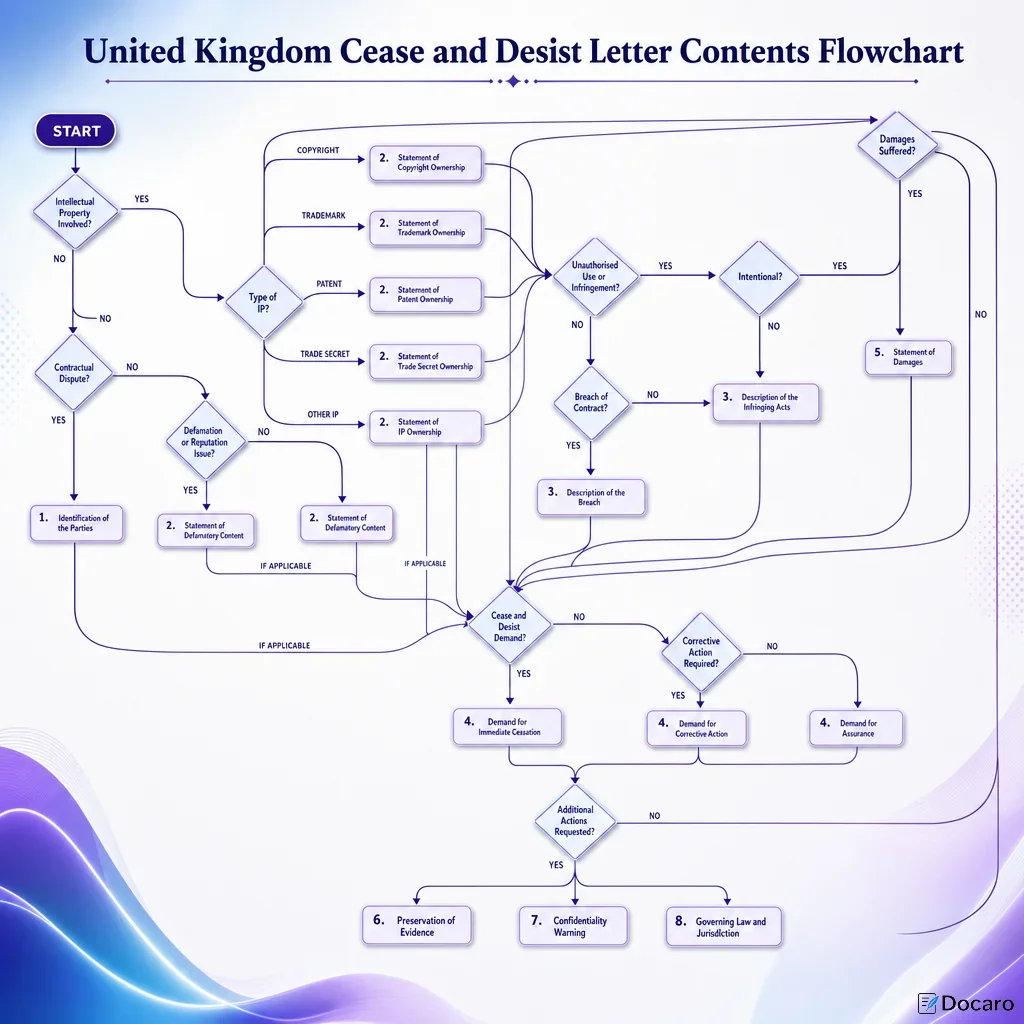
A cease and desist letter is a crucial initial step in protecting intellectual property rights under UK law, outlining demands to stop infringing activities. Essential clauses ensure the letter is clear, authoritative, and effective in resolving disputes without immediate court involvement.

Identification of the parties clearly names the sender as the rights holder and the recipient as the alleged infringer, establishing who is involved. This is important because it avoids confusion and confirms the letter's relevance, as per guidelines from the UK Intellectual Property Office.

The description of the infringing activity details the specific actions, such as trademark misuse or copyright violation, with evidence like dates and examples. It is vital to precisely outline the issue, enabling the recipient to understand and address the problem without ambiguity.

The demand to cease explicitly requires the recipient to stop the infringing behaviour immediately, often including steps like removing content. This clause is key as it formally notifies the violation and sets the expectation for compliance, strengthening any future legal claims.

A deadline for compliance specifies a reasonable timeframe, such as 14 days, for the recipient to respond and act. This is essential to create urgency and demonstrate good faith efforts to resolve the matter amicably before escalation.

Consequences of non-compliance warns of potential legal actions like lawsuits or damages claims if demands are ignored. Including this motivates swift action and documents the sender's intent to pursue remedies if necessary.

The reservation of rights clause states that the sender retains all legal options and does not waive any claims by sending the letter. It is important to preserve flexibility for further enforcement, ensuring the letter does not inadvertently limit recourse.

For tailored cease and desist letters compliant with UK regulations, consider using bespoke AI-generated legal documents through Docaro to ensure precision and professionalism without relying on generic templates.

What Are Common Key Exclusions?

Cease and desist letters in the United Kingdom often include key exclusions to safeguard the sender's legal rights. These provisions ensure that the letter does not inadvertently weaken the sender's position in potential future disputes.

A common exclusion is the non-waiver of future claims, which explicitly states that the letter does not relinquish any ongoing or prospective legal actions. This protects the sender by preserving their ability to pursue remedies for continued or repeated infringements, as outlined in UK intellectual property laws.

Another vital limitation is the exclusion of admissions of liability, clarifying that the letter neither acknowledges nor admits to any wrongdoing by the recipient. By including this, the sender avoids implying fault, maintaining a strong defensive stance in negotiations or court proceedings.

Letters may also address fair use defenses by noting that the demands do not preclude legitimate exceptions under UK copyright law, such as for criticism or review. This targeted approach reinforces the sender's claims while allowing for statutory defenses, and for bespoke drafting, consider AI-generated documents via Docaro to ensure precision.

  • Non-waiver clauses prevent loss of rights over time.
  • Liability exclusions shield against unintended concessions.
  • Fair use mentions balance enforcement with legal exceptions.

For authoritative guidance on UK cease and desist practices, refer to resources from the UK Intellectual Property Office.

Are There Recent or Upcoming Legal Changes Affecting Cease and Desist Letters in the UK?

Post-Brexit, the UK intellectual property laws have seen targeted updates to maintain alignment with EU standards while establishing independent frameworks. The Trade Marks Act 1994 remains the cornerstone for issuing cease and desist letters in trademark disputes, with no major overhauls but enhanced guidance on enforcement through the UK Intellectual Property Office.

The Digital Economy Act 2017, including its amendments, primarily bolsters online copyright protection but has limited direct impact on cease and desist letters for IP matters. Recent consultations by the UK government focus on digital markets, yet core procedures for IP notices under existing acts like the Copyright, Designs and Patents Act 1988 stay stable.

For businesses navigating UK IP enforcement, the current frameworks offer reliability, with the Trade Marks Act 1994 providing robust tools for cease and desist actions without imminent changes. To ensure compliance, opt for bespoke AI-generated legal documents via Docaro rather than generic templates.

How Can You Draft an Effective Cease and Desist Letter?

1
Gather Evidence of Infringement
Collect all documentation, screenshots, and records proving the infringement to build a strong case for your letter.
2
Identify Laws and Structure Letter
Research UK laws like copyright or trademark acts. Outline the letter with facts, legal basis, and your position. For guidance, see <a href=\'/en-gb/a/how-to-write-cease-and-desist-letter-uk-step-by-step\'>How to Write a Cease and Desist Letter in the UK: A Step-by-Step Guide</a>.
3
Include Demands and Deadlines
Clearly state what you require, such as stopping the infringement, and set a reasonable deadline for compliance.
4
Send and Seek Advice
Deliver the letter via recorded post. Consult a lawyer and consider bespoke AI-generated documents using Docaro for customization.

What Common Mistakes Should You Avoid?

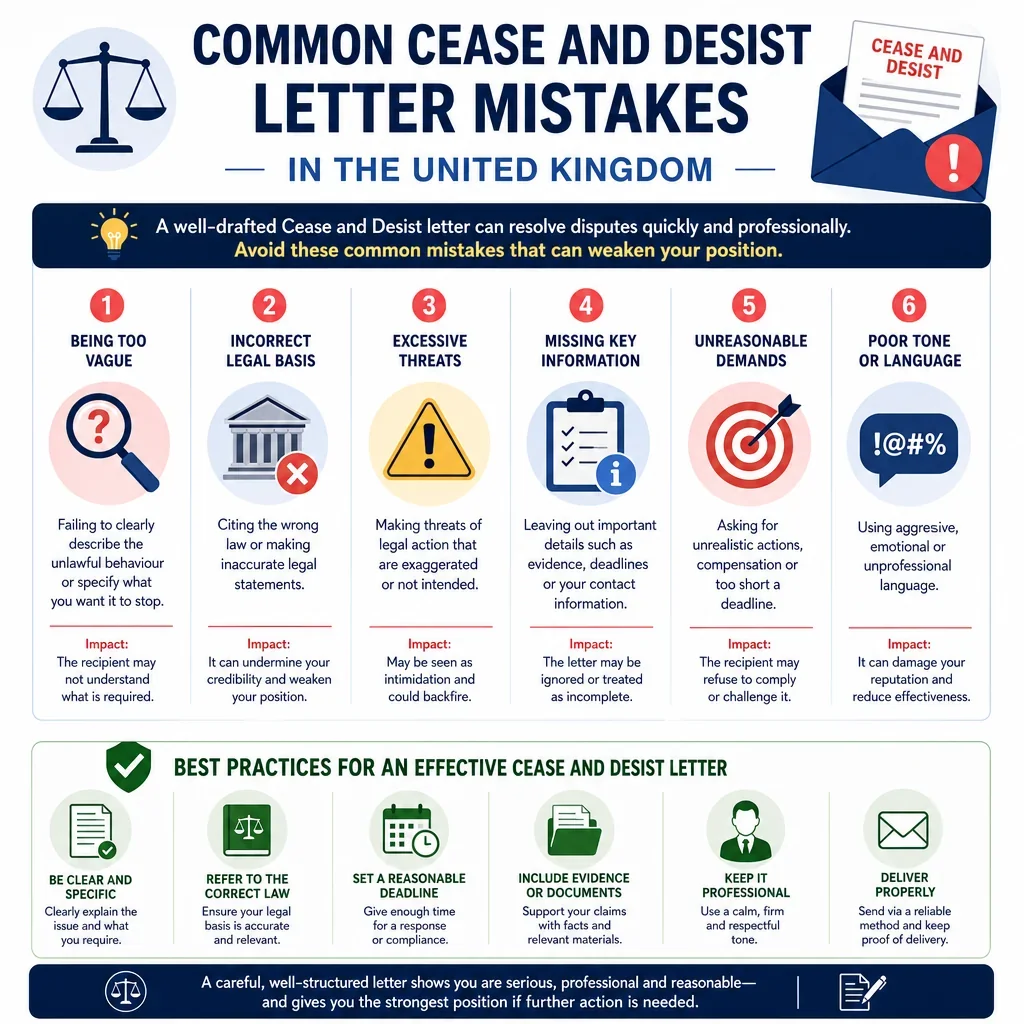
UK cease and desist letters often contain vague language that fails to clearly outline the specific infringement, such as intellectual property violations or contract breaches, leading to confusion and ineffective resolution. This error undermines the letter's purpose, as recipients may not understand the exact issue at hand.

An aggressive tone in these letters can provoke backlash, escalating disputes rather than resolving them amicably, which might result in legal counters or public relations issues. Maintaining a professional and firm approach is crucial to encourage compliance without unnecessary conflict.

Many drafters overlook specifying remedies, such as demanding cessation of activities or compensation, leaving the recipient unsure of the expected actions. For guidance on these pitfalls, explore Common Mistakes to Avoid in UK Cease and Desist Letters.

Failing to consult a solicitor before sending a cease and desist letter risks non-compliance with UK legal standards, potentially invalidating the notice. Instead of generic templates, opt for bespoke AI-generated legal documents via Docaro to ensure tailored accuracy. For authoritative advice, refer to the UK Government's guidance on intellectual property disputes.

Cease and Desist Letter FAQs

A cease and desist letter is a formal legal notice sent to an individual or business demanding they stop (cease) engaging in certain unlawful activities and refrain (desist) from doing so in the future. In the UK, it's commonly used for issues like intellectual property infringement, defamation, harassment, or breach of contract, and serves as a precursor to potential legal action.

Document Generation FAQs

Docaro is an AI-powered legal and corporate document generator that helps you create fully formatted, legally sound contracts and agreements in minutes. Just answer a few guided questions and download your document instantly.
You Might Also Be Interested In
A Legally Binding Contract Where Parties Agree To Resolve A Dispute And Settle Claims, Often Including Confidentiality And Non-disparagement Clauses.
A Legally Binding Contract Outlining The Terms Of A Mediation Process To Resolve Disputes Amicably.
A Contract Where Parties Agree To Resolve Disputes Through Arbitration Rather Than Court Litigation.
A Formal Letter Outlining A Grievance Or Dispute And Demanding Resolution Before Initiating Legal Proceedings.
A Legal Document In Which One Party Agrees To Release Another From Liability For Potential Risks Or Damages.
A Legal Document Where Two Parties Agree To Release Each Other From All Claims And Obligations Arising From A Prior Agreement Or Dispute.
A Formal Notice Sent To A Debtor Or Party In Dispute, Outlining The Claim And Demanding Resolution Before Initiating Legal Proceedings.
A Sworn Written Statement Used As Evidence In Court.

Related Articles

A photorealistic image depicting a confident adult professional in a modern UK office setting, standing with arms crossed and a determined expression, symbolizing the act of asserting one's rights and addressing a legal issue through a cease and desist letter, without showing any documents or text.
Learn how to draft a cease and desist letter in the UK with our comprehensive step-by-step guide. Protect your rights effectively against infringement or harassment.
A photorealistic image of a determined adult professional in a modern office setting, holding a formal letter and looking resolute as if issuing a warning or standing up for their rights, symbolizing the purpose of a cease and desist letter in stopping unwanted actions. The scene conveys authority and protection without showing any legal documents directly. No children are present in the image.
Discover the most common mistakes to avoid when drafting cease and desist letters in the UK. Learn expert tips to ensure your legal notice is effective and compliant with UK law.
A photorealistic image depicting a professional adult in a modern UK office setting, looking determined while reviewing paperwork at a desk, symbolizing the decision to address intellectual property or legal infringement through a cease and desist action. The scene includes elements like a Union Jack flag subtly in the background to indicate the United Kingdom context, with natural lighting and realistic details. No children are present in the image.
Learn when to send a cease and desist letter in the United Kingdom. Discover key situations, legal requirements, and steps to protect your rights effectively.