AI Generated Job Description for use in the United Kingdom
PDF & Word - 2026 Updated
Docaro Pricing
When do you need a Job Description in the United Kingdom?
British Legal Rules for a Job Description
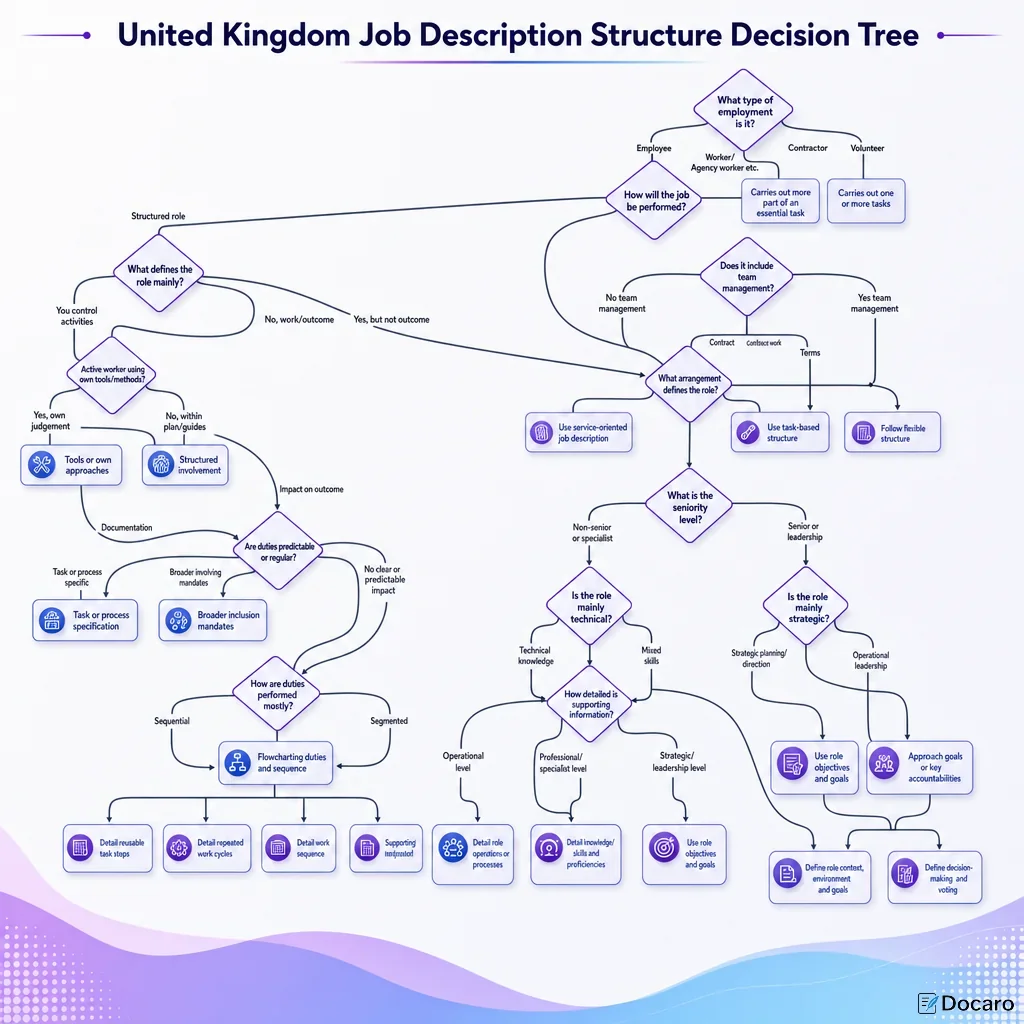
Using an inappropriate structure for a job description can lead to unintended legal liabilities or non-compliance with UK employment regulations.
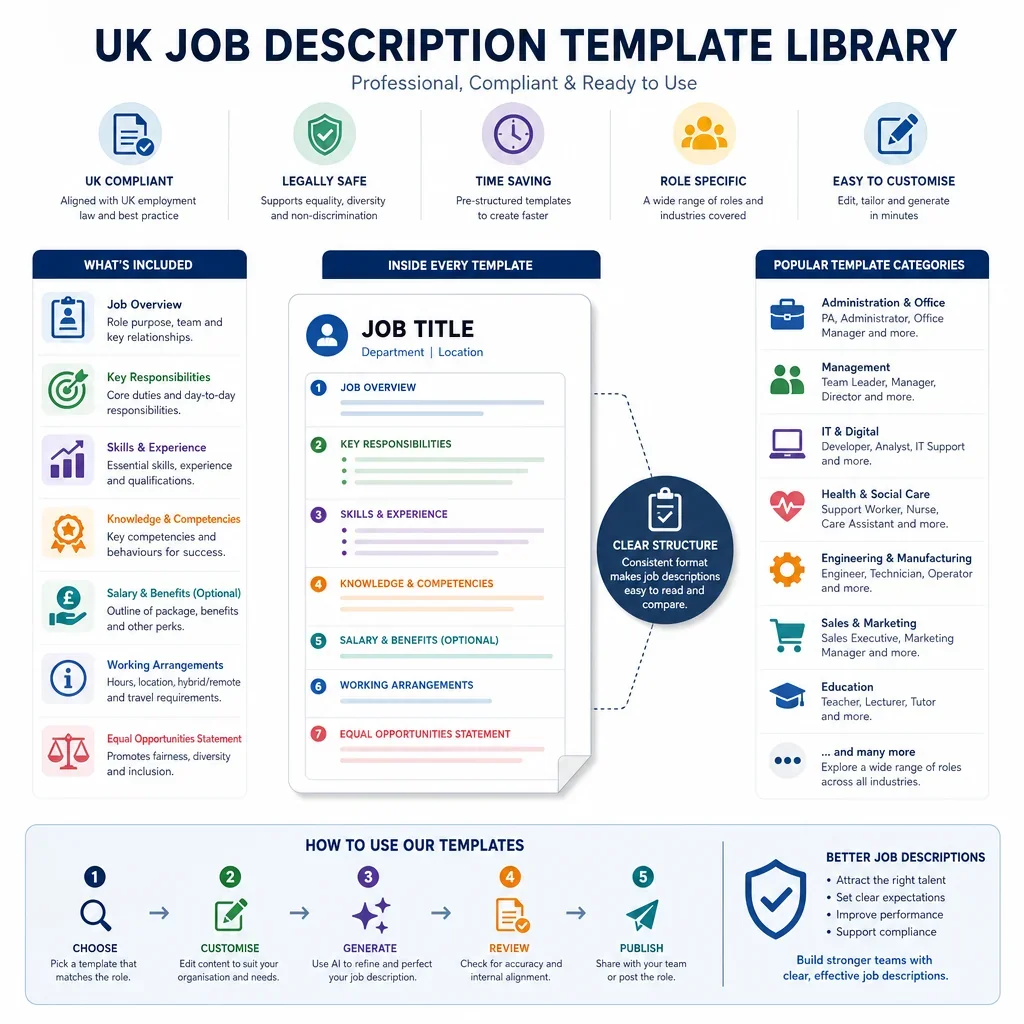
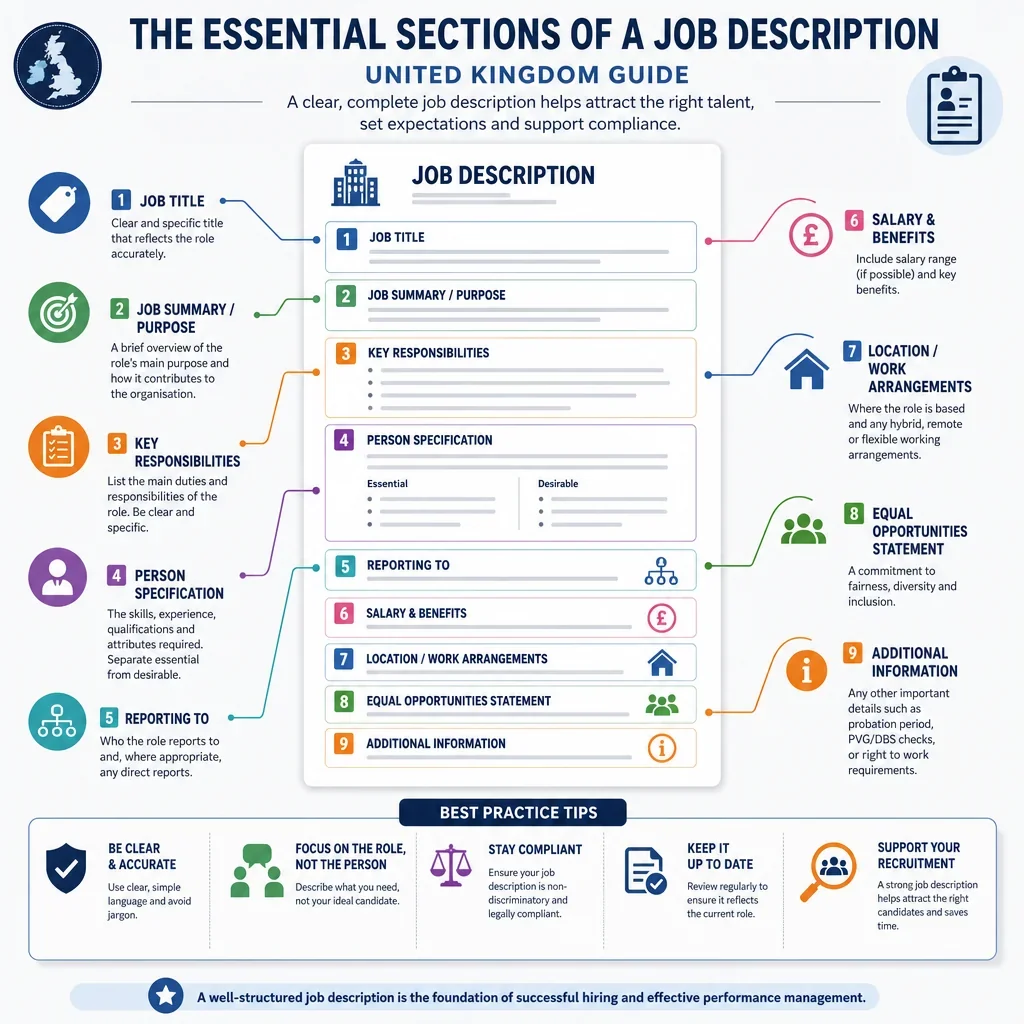
What a Proper Job Description Should Include
- Job TitleClearly state the position's name to attract suitable candidates.
- Company OverviewBriefly describe your organisation and its mission to give context to the role.
- Key ResponsibilitiesList the main duties and tasks the role involves on a daily basis.
- Required Skills and QualificationsOutline the essential experience, education, and abilities needed for success.
- Reporting StructureSpecify who the role reports to and any team involvement.
- Work EnvironmentMention the location, hours, and any remote or flexible working options.
- Equal Opportunities StatementAffirm commitment to diversity and fair treatment for all applicants.
Generate Your Document in 4 Easy Steps
Why Use Docaro?
 United Kingdom
Free Example Job Description Template
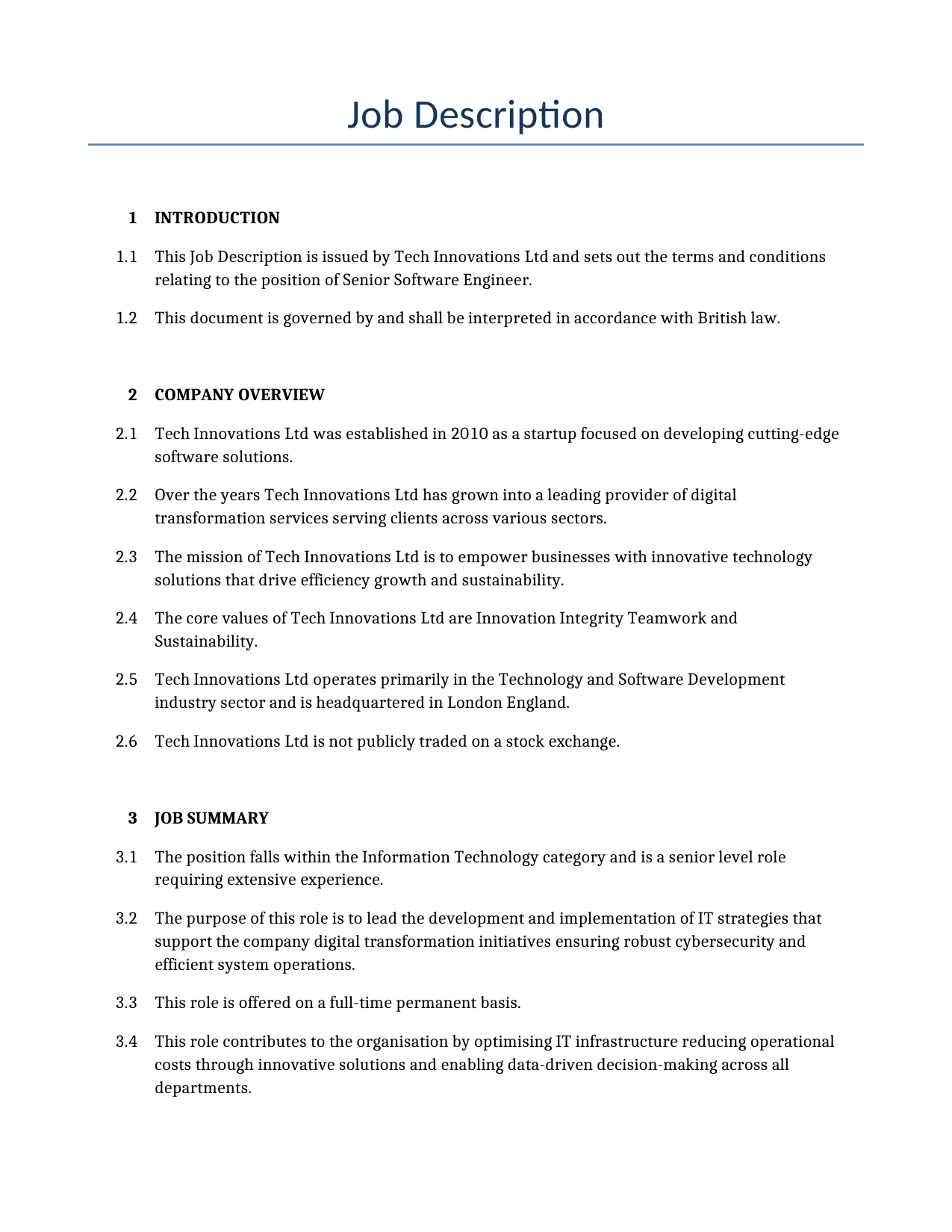
Below is a free template example of a Job Description for use in the United Kingdom generated by our AI model.
The clauses in your actual Job Description will vary from this example as they will be entirely bespoke to your requirements as set out in the questionnaire you complete.
Job Description
1INTRODUCTION
This Job Description is issued by Tech Innovations Ltd and sets out the terms and conditions relating to the position of Senior Software Engineer.
This document is governed by and shall be interpreted in accordance with British law.
2COMPANY OVERVIEW
Tech Innovations Ltd was established in 2010 as a startup focused on developing cutting-edge software solutions.
Over the years Tech Innovations Ltd has grown into a leading provider of digital transformation services serving clients across various sectors.
The mission of Tech Innovations Ltd is to empower businesses with innovative technology solutions that drive efficiency growth and sustainability.
The core values of Tech Innovations Ltd are Innovation Integrity Teamwork and Sustainability.
Tech Innovations Ltd operates primarily in the Technology and Software Development industry sector and is headquartered in London England.
Tech Innovations Ltd is not publicly traded on a stock exchange.
3JOB SUMMARY
The position falls within the Information Technology category and is a senior level role requiring extensive experience.
The purpose of this role is to lead the development and implementation of IT strategies that support the company digital transformation initiatives ensuring robust cybersecurity and efficient system operations.
This role is offered on a full-time permanent basis.
This role contributes to the organisation by optimising IT infrastructure reducing operational costs through innovative solutions and enabling data-driven decision-making across all departments.
4KEY OBJECTIVES OR PERFORMANCE MEASURES
Deliver complex software projects on time and within budget with a target of 95% on-time completion rate.
Achieve code quality metrics including maintaining less than 5% defect rate in production and achieving at least 80% unit test coverage.
Lead and mentor a team of developers resulting in measurable improvements in team velocity and employee retention rates.
Contribute to digital transformation goals by architecting scalable systems that support business growth and enhance cybersecurity posture.
Conduct regular code reviews and implement process improvements leading to reduced technical debt and enhanced system reliability.
5KEY RESPONSIBILITIES
Lead the design development and implementation of complex software solutions and system architecture.
Oversee technical strategy for software projects ensuring alignment with company digital transformation initiatives.
Mentor and provide technical leadership to junior engineers and development teams.
Ensure high standards of code quality cybersecurity best practices and compliance with relevant UK regulations.
Collaborate with stakeholders to define technical requirements and deliver innovative solutions.
Conduct performance reviews code reviews and contribute to continuous improvement of development processes.
Manage technical risks and ensure robust system operations and data security.
The employee shall have direct supervision of team members.
6REQUIRED QUALIFICATIONS
The employee must hold a Bachelor degree in Computer Science Software Engineering or a related field.
The employee must have a minimum of 7 years of relevant experience in software development with at least 3 years in a senior or lead role.
The employee must have relevant industry experience in technology and software development along with proven leadership and communication skills.
7ESSENTIAL SKILLS AND EXPERIENCE
The employee must possess advanced skills in software development system architecture design and cybersecurity principles.
The employee must have experience in leading development teams designing scalable systems implementing security controls and delivering complex technical projects.
8DESIRABLE SKILLS AND EXPERIENCE
It is desirable for the employee to possess advanced technical skills and leadership abilities.
It is desirable for the employee to have proficiency in Python and other programming languages experience with cloud platforms knowledge of DevOps practices and a track record in digital transformation initiatives.
9PERSONAL ATTRIBUTES
The employee must be a strong collaborator.
The employee must demonstrate analytical thinking and creative resolution.
The employee must possess attention to detail.
The employee must demonstrate integrity.
10LOCATION AND WORKING ARRANGEMENTS
The primary work location for the role is the Central London Office at 123 Business Street London EC1A 1BB.
The role is offered on a hybrid basis with remote work options available.
11REPORTING STRUCTURE
The employee shall report to the Head of Engineering or CTO who is at Senior Executive level.
12SALARY AND BENEFITS
The base salary for this position shall be between 45000 and 55000 per annum.
The employee shall be eligible for a performance-based bonus.
The employer shall offer a pension scheme and contribute 5 percent of salary to the pension.
Private health insurance and life assurance coverage.
Professional development allowance of up to \£2000 per year for training conferences and certifications.
Holiday entitlement of 28 days per year including bank holidays with option to purchase additional days.
Other benefits include cycle to work scheme employee assistance programme and company social events.
13WORKING HOURS AND CONTRACT TYPE
The standard working hours for this full-time role are 37.5 hours per week.
The contract type is full-time permanent.
Flexible working arrangements may be available subject to agreement with the line manager.
Overtime may be required occasionally and will be compensated in accordance with company policy.
The role will comply with the Working Time Regulations 1998 regarding working hours rest periods and holidays.
14PROBATIONARY PERIOD
This role is subject to a 6-month probationary period.
Performance will be reviewed at regular intervals during the probation period with a final review at the end of the 6 months.
During the probation period the notice period for termination by either party is 1 month.
The probationary period will be managed in accordance with UK employment law and company policies.
15TERMINATION AND NOTICE PERIODS
The contractual notice period for this senior role is 3 months by either party after successful completion of the probationary period.
Statutory notice periods under the Employment Rights Act 1996 will apply as a minimum.
The company reserves the right to pay in lieu of notice where appropriate.
16COMPLIANCE WITH LEGISLATION
The employer shall comply with the Equality Act 2010 in all aspects of employment including recruitment and treatment of employees.
The employer shall adhere to the Employment Rights Act 1996 in relation to the employee rights and the contract of employment.
The employer shall comply with the Health and Safety at Work etc. Act 1974 to ensure a safe working environment.
The employer shall observe the Working Time Regulations 1998 with regard to working hours rest periods and holidays.
The employer shall comply with the National Minimum Wage Act 1998 in setting remuneration.
The employer shall process personal data in accordance with the Data Protection Act 2018.
The employer shall ensure compliance with the UK GDPR regarding the handling and protection of personal and sensitive data.
The employer shall comply with the Modern Slavery Act 2015 where applicable in its operations and supply chains.
The employer shall adhere to relevant cybersecurity regulations and intellectual property laws including the Copyright Designs and Patents Act 1988.
17EQUAL OPPORTUNITIES STATEMENT
Tech Innovations Ltd is committed to equal opportunities and shall not discriminate on the grounds of Age Disability Race Sex Sexual Orientation or any other protected characteristic under the Equality Act 2010.
Tech Innovations Ltd is committed to making reasonable adjustments for disabled applicants or employees.
Tech Innovations Ltd shall monitor and report on applicant demographics and hiring outcomes as part of its equal opportunities practices.
18APPLICATION PROCESS
Applications may be submitted via online application form via the company website email submission to hr.recruitment@company.co.uk or post to the HR department.
Applicants must provide a CV or Resume a Cover Letter and Qualifications Certificates.
19CLOSING DATE
The deadline for submitting applications is 2024-12-31.
20CONTACT INFORMATION
Inquiries regarding this position should be directed to Jane Smith at jane.smith@company.co.uk or to the recruitment email at recruitment@company.co.uk.
21DATA PROTECTION NOTICE
Tech Innovations Ltd is the data controller for this recruitment process and its registered address is 123 Innovation Drive London SW1A 1AA. Company number: 07123456. ICO registration: ZA123456.
Personal data shall be processed on the legal bases of Contractual Necessity and Legitimate Interests.
The types of personal data collected shall include name contact details CV education and work history references and equal opportunities monitoring information.
The purposes for processing personal data are to assess suitability for the role conduct interviews verify qualifications and comply with equal opportunities reporting.
Applicant personal data may be shared with third parties but shall not be transferred outside the UK or EEA.
Data of unsuccessful applicants shall be retained for 12 months after the recruitment process.
The recruitment process shall not involve automated decision-making or profiling.
Applicants may lodge complaints by contacting the Data Protection Officer at dpo@techinnovations.co.uk or by submitting a formal complaint to the Information Commissioner Office at www.ico.org.uk.
Under UK GDPR you have the right to request access to your personal data rectification of inaccurate data erasure of data where applicable restriction of processing data portability and to object to processing. To exercise these rights please contact the Data Protection Officer at dpo@techinnovations.co.uk.
22JOB DESCRIPTION NOTE
This job description is not intended to be exhaustive. Duties and responsibilities may evolve over time and the post holder may be required to undertake additional tasks as reasonably required by the company.
23ACCEPTANCE AND SIGNATURE
The parties agree to the terms set out in this Job Description which forms part of the contract of employment.
Signed by the Employer: _______________________________ Date: _______________
Signed by the Employee: _______________________________ Date: _______________
This example shows approximately 70% of a typical document and is provided for illustrative purposes only. The remaining content has been omitted.
Every document generated by Docaro is tailored to your specific circumstances, jurisdiction and the information you provide. The completed document includes all applicable clauses and provisions required for your situation.
To generate the full, personalised document, answer a short series of questions and your document will be created instantly.
Useful Resources When Considering a Job Description in the United Kingdom
United Kingdom Reference Legislation
Job Description FAQs
Document Generation FAQs
Related Articles