AI Generated Deed of Variation for use in the United Kingdom
PDF & Word - 2026 Updated
Docaro Pricing
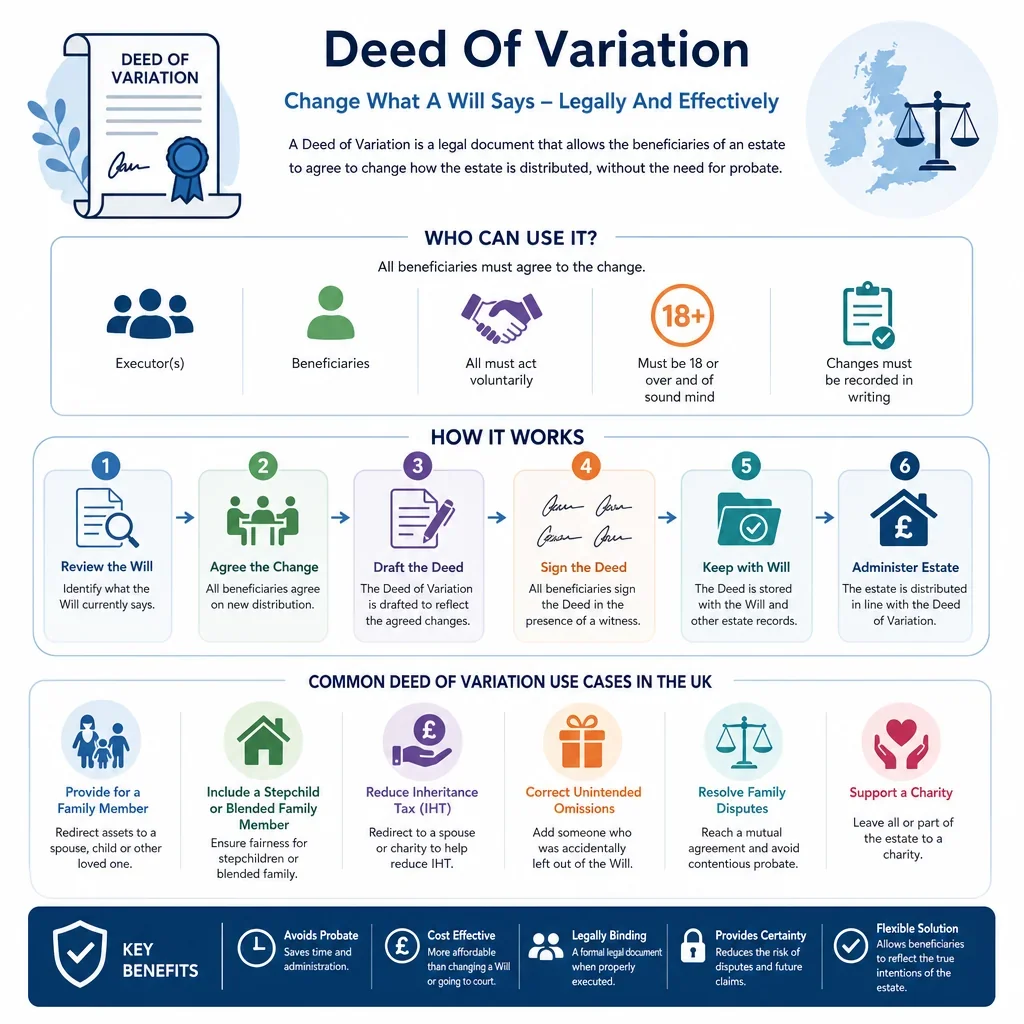
When do you need a Deed of Variation in the United Kingdom?
British Legal Rules for a Deed of Variation
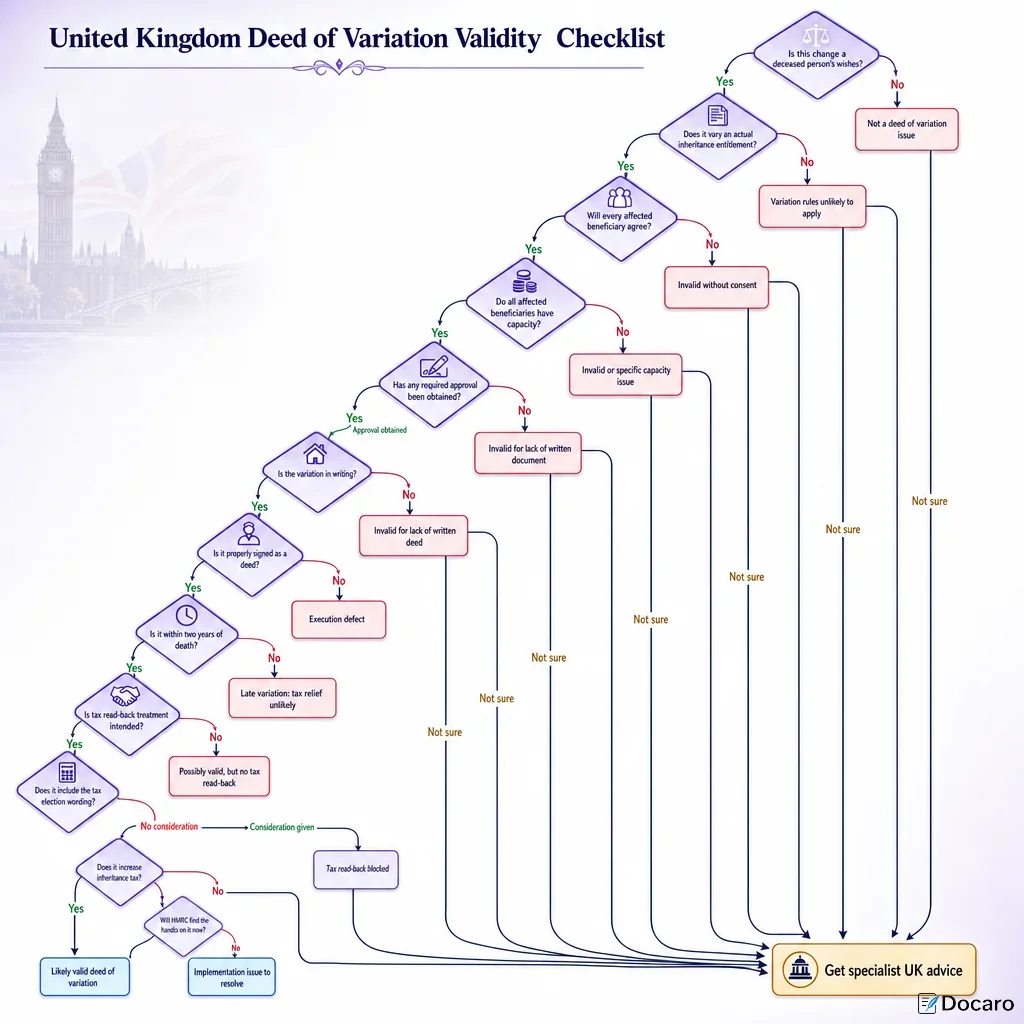
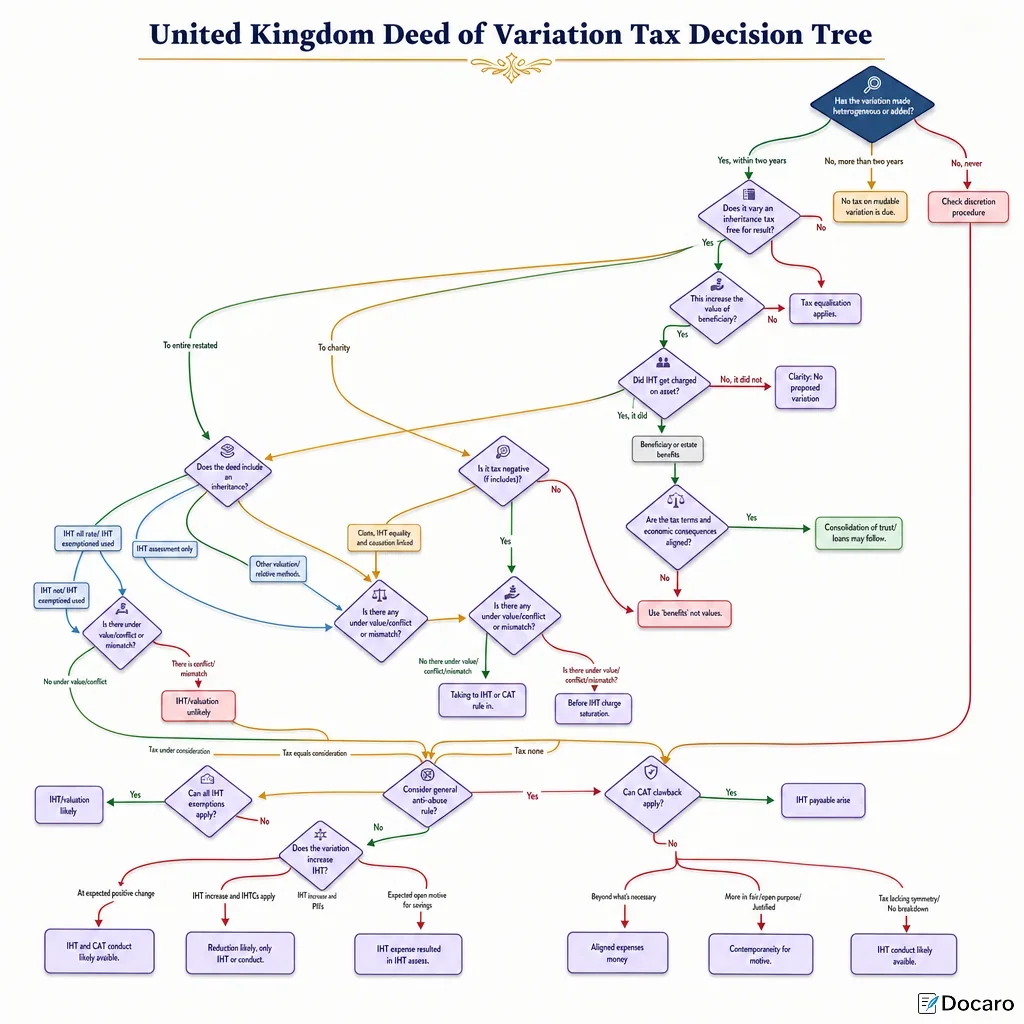
Using the incorrect structure for a deed of variation may fail to properly redirect inheritance tax liabilities or estate distributions.
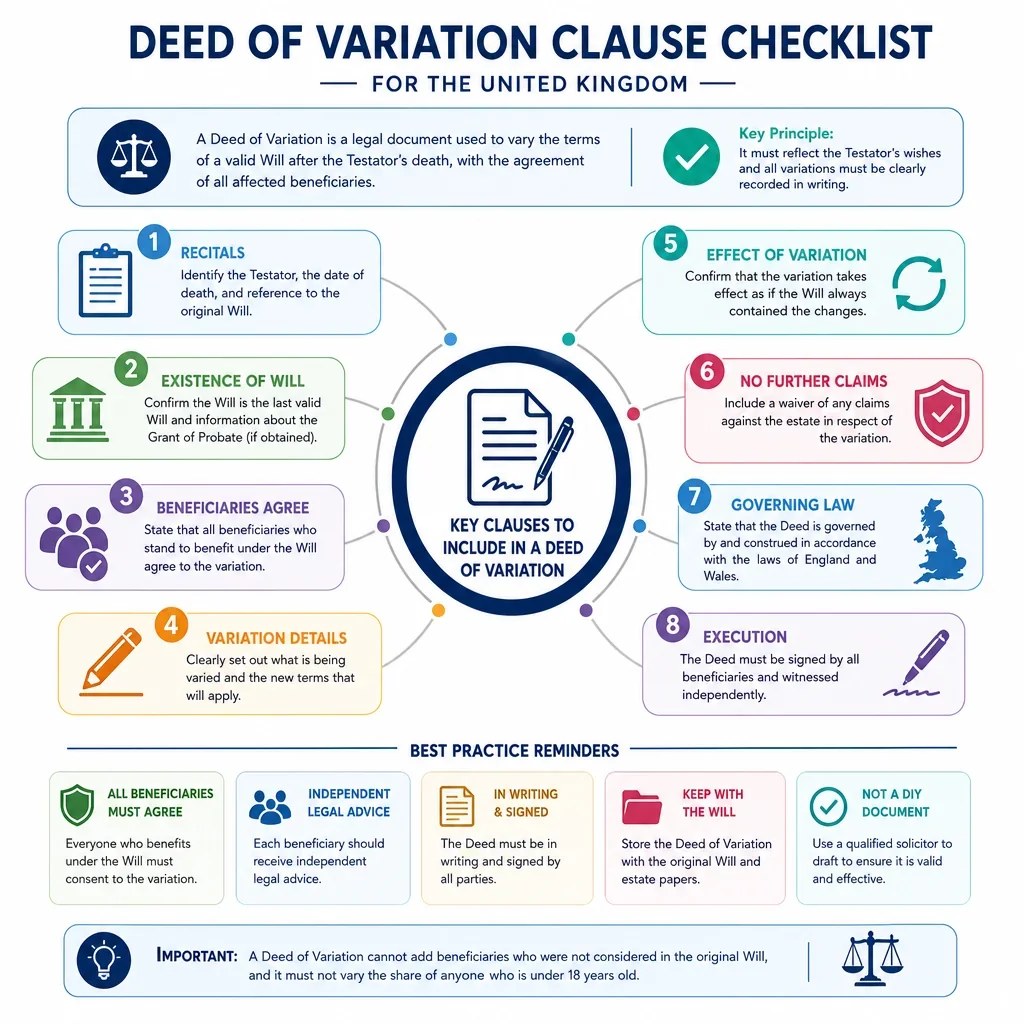
What a Proper Deed of Variation Should Include
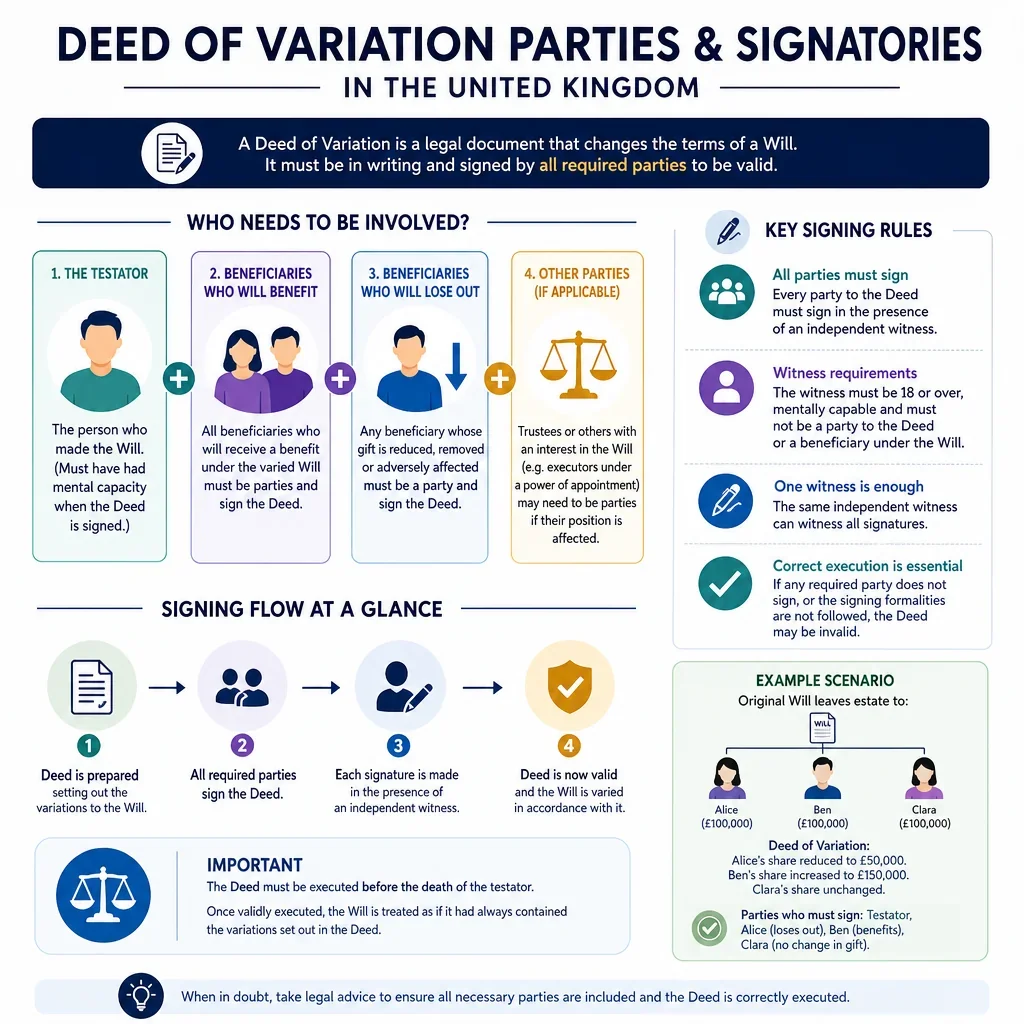
- Parties InvolvedNames and details of all people agreeing to change the will.
- Original Will DetailsReference to the original will and its date to identify what is being varied.
- Specific ChangesClear description of exactly what parts of the will are being altered and how.
- Agreement ConfirmationStatement that all parties fully agree to the changes without any pressure.
- Effective DateThe date from which the changes take effect, usually after the deceased's death.
- Signatures and WitnessesSignatures of all parties and witnesses to make the deed legally binding.
Generate Your Document in 4 Easy Steps
Why Use Docaro?
 United Kingdom
Free Example Deed of Variation Template
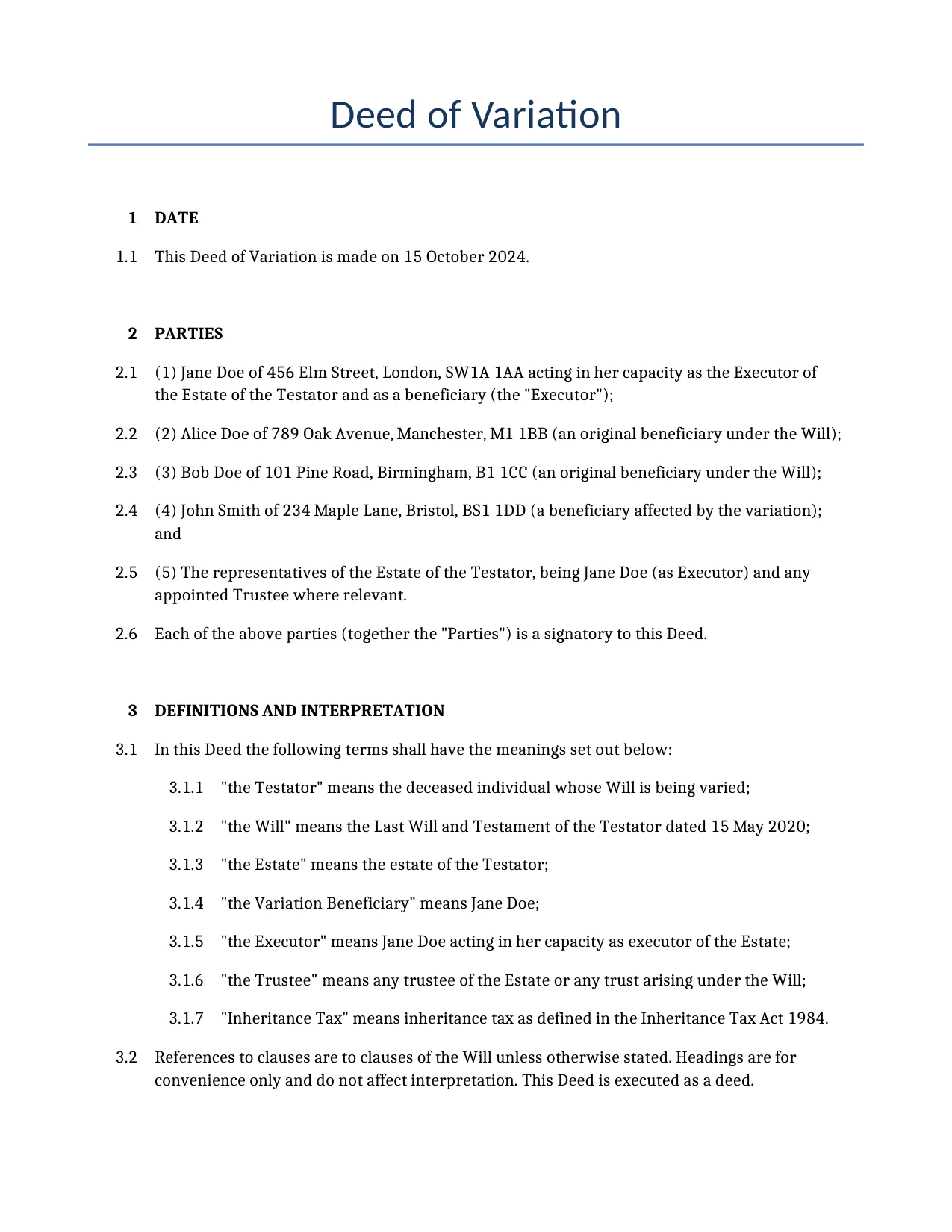
Below is a free template example of a Deed of Variation for use in the United Kingdom generated by our AI model.
The clauses in your actual Deed of Variation will vary from this example as they will be entirely bespoke to your requirements as set out in the questionnaire you complete.
Deed of Variation
1DATE
This Deed of Variation is made on 15 October 2024.
2PARTIES
(1) Jane Doe of 456 Elm Street, London, SW1A 1AA acting in her capacity as the Executor of the Estate of the Testator and as a beneficiary (the "Executor");
(2) Alice Doe of 789 Oak Avenue, Manchester, M1 1BB (an original beneficiary under the Will);
(3) Bob Doe of 101 Pine Road, Birmingham, B1 1CC (an original beneficiary under the Will);
(4) John Smith of 234 Maple Lane, Bristol, BS1 1DD (a beneficiary affected by the variation); and
(5) The representatives of the Estate of the Testator, being Jane Doe (as Executor) and any appointed Trustee where relevant.
Each of the above parties (together the "Parties") is a signatory to this Deed.
3DEFINITIONS AND INTERPRETATION
In this Deed the following terms shall have the meanings set out below:
"the Testator" means the deceased individual whose Will is being varied;
"the Will" means the Last Will and Testament of the Testator dated 15 May 2020;
"the Estate" means the estate of the Testator;
"the Variation Beneficiary" means Jane Doe;
"the Executor" means Jane Doe acting in her capacity as executor of the Estate;
"the Trustee" means any trustee of the Estate or any trust arising under the Will;
"Inheritance Tax" means inheritance tax as defined in the Inheritance Tax Act 1984.
References to clauses are to clauses of the Will unless otherwise stated. Headings are for convenience only and do not affect interpretation. This Deed is executed as a deed.
4RECITALS
The Testator died on 1 October 2023.
The Will has been admitted to probate.
The original beneficiaries under the Will included the Testator's children Alice Doe and Bob Doe, and other beneficiaries including John Smith.
The Parties have agreed to vary the Will in the manner set out in this Deed.
This Deed is made pursuant to Section 142 of the Inheritance Tax Act 1984 (IHTA 1984) and Section 62 of the Taxation of Chargeable Gains Act 1992 (TCGA 1992) and is intended to be treated for tax purposes as if the variations had been effected by the Testator.
The Parties confirm that all necessary parties consent to this variation.
This variation is made within two years of the date of death of the Testator.
5OPERATIVE PROVISIONS
The Parties agree that this Deed is made pursuant to Section 142 IHTA 1984 and that the variations set out below shall take effect as if the varied provisions had been made by the Testator.
With effect from the date of the Testator's death the Will shall be varied such that Clause 4 is deleted and replaced with the following new clause: "I give the whole of my Estate to my spouse Jane Doe absolutely."
Clause 5 of the Will shall be amended so that the beneficiary of the property at 123 High Street shall be changed from John Smith to Jane Doe.
Any income or interest accrued on the assets of the Estate since the date of death shall follow the destination of the capital as varied by this Deed.
6TAX ELECTIONS
The Parties shall make and submit a written election to HMRC under Section 142(2) IHTA 1984 within 6 months of the date of this Deed.
A copy of the election shall be provided to all Parties within 7 days of submission to HMRC.
7CONFIRMATION OF UNVARIED TERMS
The Parties confirm that all terms of the Will not expressly varied by this Deed shall remain in full force and effect.
8NO CONSIDERATION
No consideration is passing between the living parties for the variation. The Parties enter into this Deed without any monetary or other consideration passing between them in order to avoid any unintended capital gains tax or stamp duty consequences.
9REPRESENTATIONS AND WARRANTIES
Each Party represents and warrants that it has the full authority to enter into this Deed.
Each Party represents and warrants that entering into this Deed does not conflict with any of its existing obligations or agreements.
Each Party represents and warrants that this Deed complies with all applicable laws and regulations.
The Parties confirm that there are no pending legal proceedings that could affect this Deed.
The Parties confirm that they are not aware of any other prior variations or amendments to the Will besides those addressed in this Deed.
The Parties confirm that they have obtained independent tax advice regarding the potential adverse tax consequences of this variation.
Each Party confirms that they have taken independent legal advice or have had the opportunity to do so and enter into this Deed voluntarily.
10TAX INDEMNITY
In this clause the "Variation Beneficiary" means Jane Doe, the "Executor" means Jane Doe acting as executor of the Estate and the "Trustee" means any trustee of the Estate or any trust arising under the Will.
The Variation Beneficiary, the Executor and the Trustee shall indemnify the other Parties against any liability for Inheritance Tax, Capital Gains Tax, interest, penalties or other tax charges arising as a result of this Deed.
In the event of any tax claim the indemnifying parties shall be notified immediately and shall cooperate fully in the defence or settlement of such claim.
11COSTS AND EXPENSES
The Estate shall be responsible for all costs and expenses incurred in connection with the preparation and execution of this Deed including solicitor's fees printing costs and witnessing fees.
12SEVERABILITY
If any provision of this Deed is held to be invalid or unenforceable the remaining provisions shall continue in full force and effect.
13COUNTERPARTS
This Deed may be executed in any number of counterparts each of which when executed and delivered shall constitute an original but all the counterparts shall together constitute one and the same instrument.
The Parties agree that counterparts may be delivered by electronic means including by email or secure portal and that electronic signatures shall be permitted.
14NOTICES
Any notice required to be given under this Deed shall be in writing and shall be sent by recorded delivery to the address of the relevant Party or to such other address as that Party may notify to the other Parties in writing.
15VARIATION
No variation of this Deed shall be effective unless it is in writing and signed by or on behalf of each of the Parties.
16GOVERNING LAW AND JURISDICTION
This Deed and any non-contractual obligations arising out of or in connection with it shall be governed by and construed in accordance with the laws of England and Wales.
The Parties submit to the exclusive jurisdiction of the courts of England and Wales for the purpose of any dispute arising out of or in connection with this Deed.
17COMPLIANCE WITH LEGISLATION
This Deed is executed in compliance with the provisions of the Inheritance Tax Act 1984, the Administration of Estates Act 1925, the Trustee Act 1925, the Finance Act 2009 Schedule 7, the Law of Property Act 1925 and the Law of Property (Miscellaneous Provisions) Act 1989.
18POWER OF ATTORNEY
Where any Party is signing on behalf of others they confirm they have the necessary power of attorney or authority to do so and that such authority complies with the formalities required for execution as a deed.
19EXECUTION
Executed and delivered as a deed by the Parties on the date first above written.
Signed by Jane Doe (Executor and Variation Beneficiary) in the presence of a witness: ________________________ Witness Name: ________________________ Witness Address: ________________________ Witness Occupation: ________________________
Signed by Alice Doe in the presence of a witness: ________________________ Witness Name: ________________________ Witness Address: ________________________ Witness Occupation: ________________________
Signed by Bob Doe in the presence of a witness: ________________________ Witness Name: ________________________ Witness Address: ________________________ Witness Occupation: ________________________
Signed by John Smith in the presence of a witness: ________________________ Witness Name: ________________________ Witness Address: ________________________ Witness Occupation: ________________________
Signed by the representatives of the Estate of the Testator in the presence of a witness: ________________________ Witness Name: ________________________ Witness Address: ________________________ Witness Occupation: ________________________
This example shows approximately 70% of a typical document and is provided for illustrative purposes only. The remaining content has been omitted.
Every document generated by Docaro is tailored to your specific circumstances, jurisdiction and the information you provide. The completed document includes all applicable clauses and provisions required for your situation.
To generate the full, personalised document, answer a short series of questions and your document will be created instantly.
Useful Resources When Considering a Deed of Variation in the United Kingdom
United Kingdom Reference Legislation
Deed of Variation FAQs
Document Generation FAQs
Related Articles