AI Generated Tenancy Application Form for use in the United Kingdom
PDF & Word - 2026 Updated
Docaro Pricing
When do you need a Tenancy Application Form in the United Kingdom?
British Legal Rules for a Tenancy Application Form
Using the wrong type or structure of tenancy agreement can inadvertently grant the tenant greater security of tenure or rights than intended.
What a Proper Tenancy Application Form Should Include
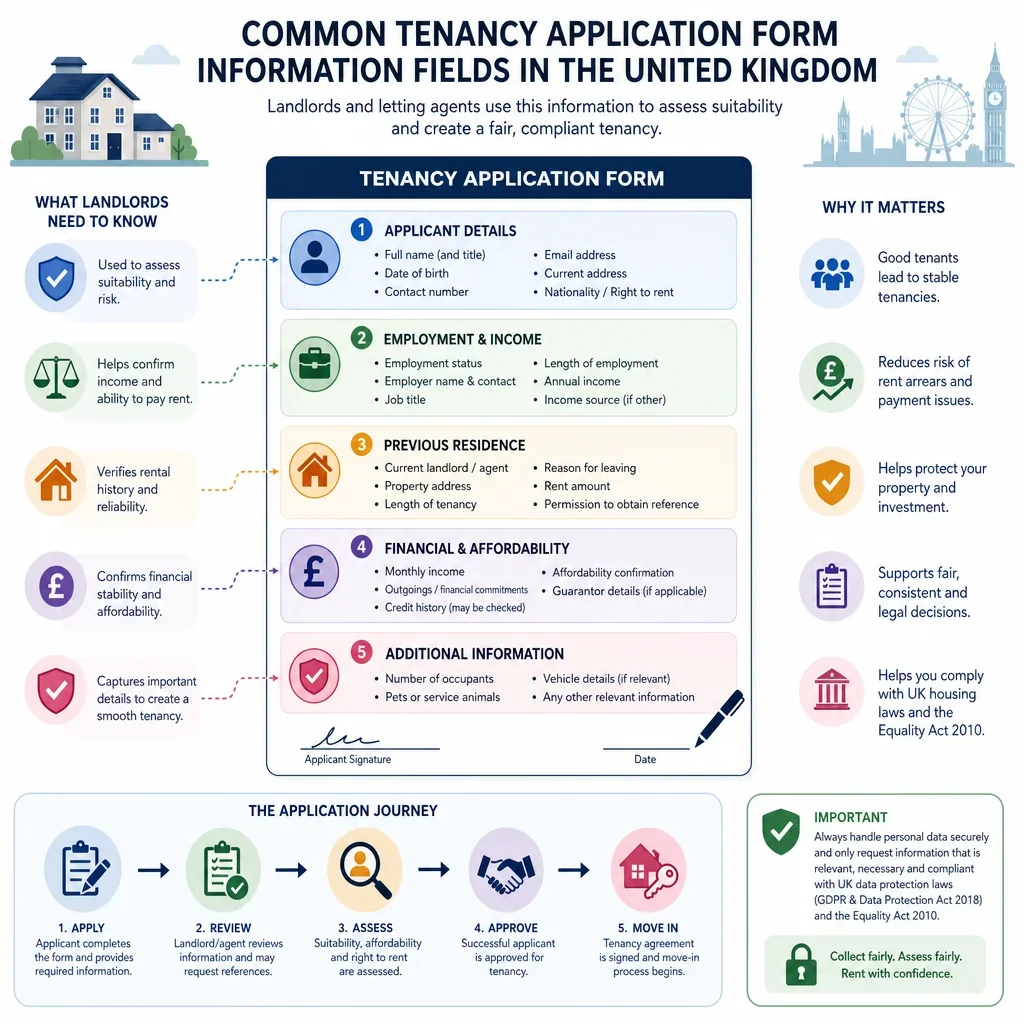
- Personal DetailsCollect the applicant's full name, date of birth, contact information, and current address to verify their identity.
- Employment InformationAsk for details about the applicant's job, employer, salary, and employment duration to assess their financial stability.
- Financial HistoryRequest information on bank accounts, credit references, and any outstanding debts to evaluate their ability to pay rent.
- Rental HistoryInclude questions about previous rentals, landlord references, and reasons for leaving past homes to check their reliability as a tenant.
- ReferencesRequire personal or professional references to confirm the applicant's character and suitability for tenancy.
- Declaration and ConsentHave the applicant declare the accuracy of their information and consent to background checks and data processing.
Generate Your Document in 4 Easy Steps
Why Use Docaro?
 United Kingdom
Free Example Tenancy Application Form Template
Below is a free template example of a Tenancy Application Form for use in the United Kingdom generated by our AI model.
The clauses in your actual Tenancy Application Form will vary from this example as they will be entirely bespoke to your requirements as set out in the questionnaire you complete.
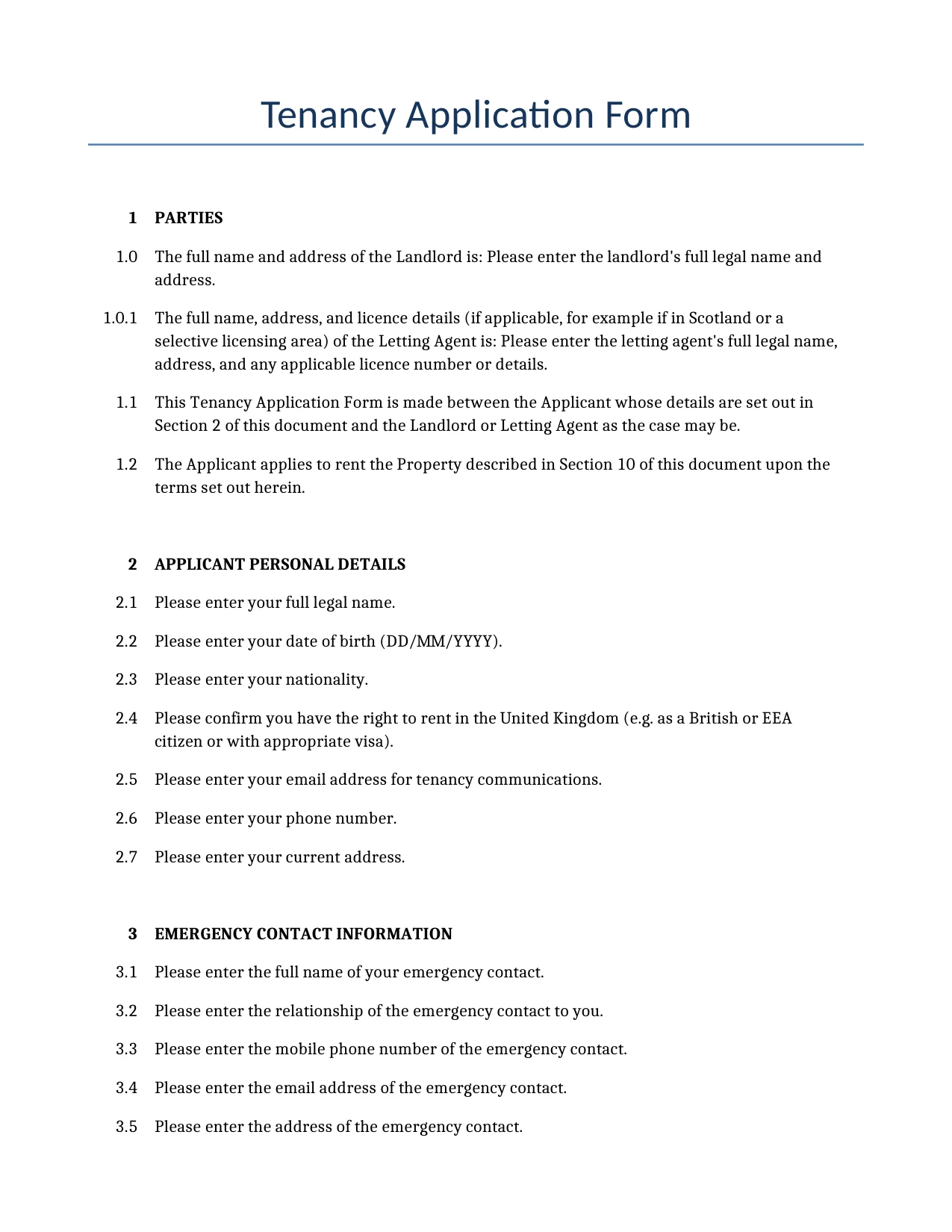
Tenancy Application Form
1PARTIES
The full name and address of the Landlord is: Please enter the landlord's full legal name and address.
The full name, address, and licence details (if applicable, for example if in Scotland or a selective licensing area) of the Letting Agent is: Please enter the letting agent's full legal name, address, and any applicable licence number or details.
This Tenancy Application Form is made between the Applicant whose details are set out in Section 2 of this document and the Landlord or Letting Agent as the case may be.
The Applicant applies to rent the Property described in Section 10 of this document upon the terms set out herein.
2APPLICANT PERSONAL DETAILS
Please enter your full legal name.
Please enter your date of birth (DD/MM/YYYY).
Please enter your nationality.
Please confirm you have the right to rent in the United Kingdom (e.g. as a British or EEA citizen or with appropriate visa).
Please enter your email address for tenancy communications.
Please enter your phone number.
Please enter your current address.
3EMERGENCY CONTACT INFORMATION
Please enter the full name of your emergency contact.
Please enter the relationship of the emergency contact to you.
Please enter the mobile phone number of the emergency contact.
Please enter the email address of the emergency contact.
Please enter the address of the emergency contact.
The emergency contact has consented to providing this information for the tenancy application of the Applicant.
4CURRENT AND PREVIOUS RENTAL HISTORY
Please enter details of your current rental property address (or confirm if not currently renting).
Please enter the start date of your current tenancy (YYYY-MM-DD).
Please enter the name of your current landlord or letting agent.
Please enter the phone number of your current landlord or letting agent.
Please confirm if you have rented properties in the past 5 years.
Please enter the address of your most recent previous rental property (if applicable).
Please enter the start and end dates of your most recent previous tenancy (YYYY-MM-DD).
Please enter the name of the landlord or letting agent for your most recent previous rental.
Please enter the phone number of the landlord or letting agent for your most recent previous rental.
Please enter the reason for leaving your most recent previous rental.
Please confirm you have no outstanding rent arrears or disputes from previous rentals.
5EMPLOYMENT AND INCOME DETAILS
Please enter your current employment status.
Please enter the name of your employer.
Please enter your job position or occupation.
Please enter the full address of your employer.
Please enter the contact phone number of your employer.
Please enter the start date of your current employment (YYYY-MM-DD).
Please enter your annual gross salary.
Please confirm if you receive regular income from employment.
Please specify the proof of income you can provide (e.g. recent payslips, employment contract, bank statements).
6FINANCIAL INFORMATION
Please provide details for your bank accounts (current and/or savings).
Please enter the name of the bank holding your account(s).
Please enter the sort code for your bank account.
Please enter your bank account number.
Please enter the credit reference agency to be used for your credit check (e.g. Experian).
Please confirm if you have any existing financial debts or commitments (provide details if yes).
Please enter your approximate monthly income.
7REFERENCES
Please confirm if you provide a personal reference.
Please enter the full name of your personal reference.
Please enter the phone number of your personal reference.
Please enter your relationship to the personal reference.
Please confirm if you provide a professional reference.
Please enter the full name of your professional reference.
Please enter the phone number of your professional reference.
Please enter the position or job title of your professional reference.
8PROPERTY DETAILS
Please enter the full address of the rental property you are applying to rent.
Please enter the type of the rental property.
Please enter the number of bedrooms in the rental property.
Please enter the proposed start date for the tenancy (YYYY-MM-DD).
Please enter the proposed duration of the tenancy (e.g. 12 months).
Please confirm how the rent will be paid (e.g. monthly).
Please enter the amount of the monthly rent.
Please confirm if the rent includes utility bills and other services.
Please confirm if pets are allowed (with permission if applicable).
Please confirm the smoking policy for the property.
9GUARANTOR INFORMATION
The Applicant provides a guarantor for the tenancy application.
Please enter the title of the guarantor (e.g. Mr, Mrs, Ms).
Please enter the full legal name of the guarantor.
Please enter the date of birth of the guarantor (YYYY-MM-DD).
Please enter the National Insurance number of the guarantor.
Please enter the gender of the guarantor.
Please enter the current full address of the guarantor (including postcode).
Please enter the contact phone number and email address of the guarantor.
Please enter the current employment status of the guarantor.
Please enter the name of the employer of the guarantor.
Please enter the job title of the guarantor.
Please enter how long the guarantor has been in their current employment.
Please enter the annual income of the guarantor.
The guarantor understands and agrees to their obligations as guarantor, which include covering rent arrears, damages, or other liabilities if the tenant defaults on the tenancy agreement. The guarantor's liability is limited to a maximum of [insert financial limit, e.g. six months' rent or specify unlimited].
The guarantor consents to the landlord or letting agent conducting credit and reference checks using the details provided and to the processing of their personal data for this purpose.
The guarantor consents to act as guarantor for this tenancy.
10ADDITIONAL OCCUPANTS
The Applicant wishes to add additional occupants to the tenancy application.
Please enter the full name of the additional occupant.
Please enter the date of birth of the additional occupant (YYYY-MM-DD).
Please enter the relationship of the additional occupant to the Applicant.
Please enter the occupation of the additional occupant.
Please enter the email address of the additional occupant.
Please enter the phone number of the additional occupant.
The additional occupant consents to credit and reference checks.
The Applicant wishes to add a pet to the tenancy application.
Please enter details of the pet (type, name, age).
Please confirm if the pet is neutered or spayed and if its vaccinations are up to date.
11PROPOSED TENANCY TERMS AND PERMITTED PAYMENTS
In compliance with the Tenant Fees Act 2019, the landlord or letting agent confirms that only the following permitted payments will be required from the tenant(s) in connection with this tenancy application and any subsequent tenancy: (a) rent; (b) a tenancy deposit of no more than five weeks' rent; (c) a holding deposit of no more than one week's rent; (d) reasonable charges for late payment of rent (if the rent is overdue by more than 14 days); (e) reasonable charges for the replacement of lost keys or security devices; and (f) charges for ending the tenancy early (if applicable and permitted by law). No prohibited fees will be charged.
The proposed amount of the tenancy deposit is [insert amount, e.g. five weeks' rent equating to £X].
The proposed amount of the holding deposit is [insert amount, e.g. one week's rent equating to £X].
The monthly rent for the property is [insert amount].
The Applicant acknowledges that any other payments not listed above as permitted under the Tenant Fees Act 2019 are prohibited and will not be charged.
12RIGHT TO RENT CHECK
The Applicant is a British citizen.
The Applicant is not an Irish citizen.
The Applicant was not a Commonwealth citizen settled in the United Kingdom before 1 January 1983.
The Applicant is not a national of the European Economic Area or Switzerland.
The current United Kingdom immigration status of the Applicant is Indefinite leave to enter or remain.
The Applicant has the original documents available for the landlord to inspect in person.
The Applicant will provide proof of the right to rent by means of Physical original documents.
Type of document provided (e.g. passport, EU settlement scheme share code, biometric residence permit): Please specify the type of document.
Document number: Please enter the document number.
Expiry date if applicable: Please enter the expiry date (if the document has one).
The landlord will retain copies of the documents provided only as permitted by law under the Immigration Act 2014 and will not retain them for longer than necessary.
13DECLARATIONS AND CONSENTS
The Applicant confirms that all the information provided in this tenancy application is true accurate and complete to the best of the knowledge of the Applicant.
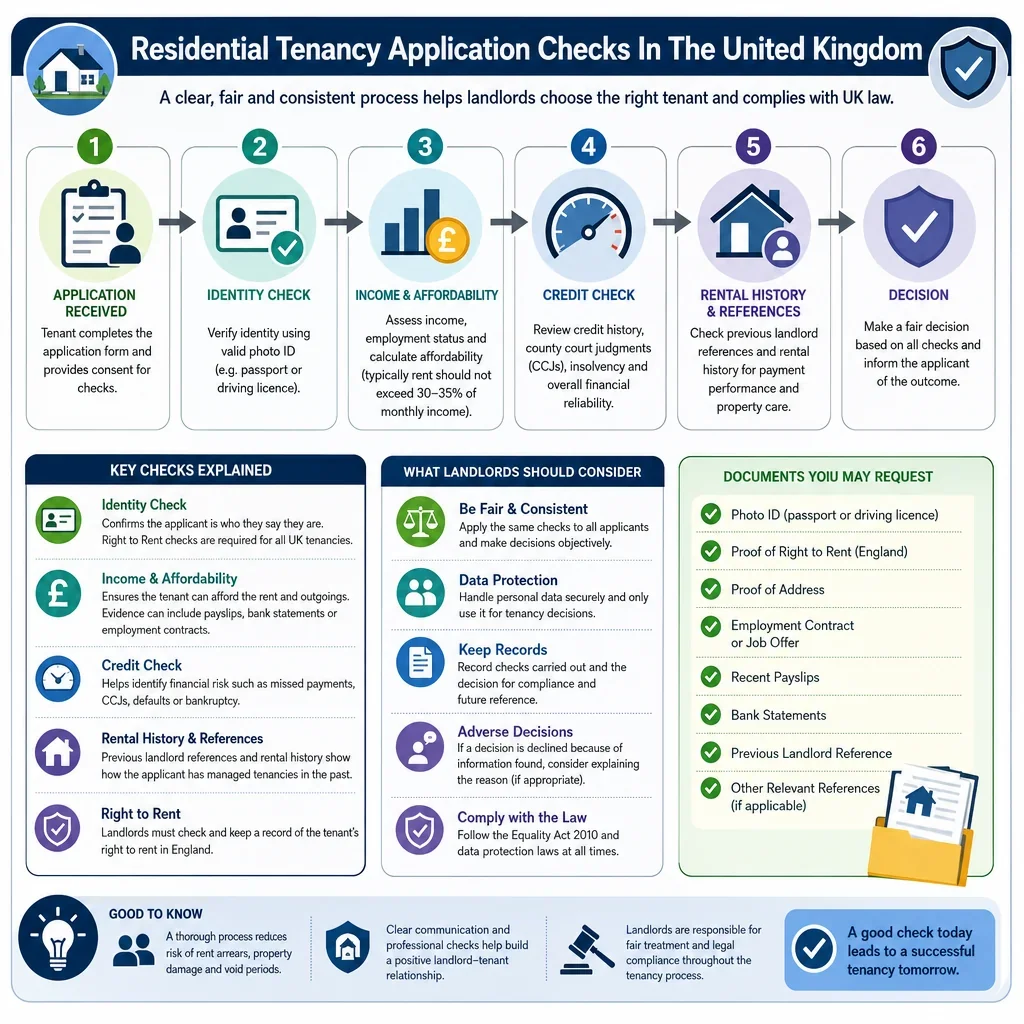
The Applicant consents to the landlord or letting agent conducting a credit check on the Applicant using the details provided.
The Applicant consents to the landlord or letting agent contacting previous landlords employers or other referees for verification purposes.
The Applicant consents to the personal data of the Applicant being processed by the landlord the letting agent and third parties for the purposes of this tenancy application including under the Data Protection Act 2018.
The Applicant explicitly consents to their personal data being shared with credit reference agencies (such as Experian, Equifax or TransUnion), reference check companies, background screening services, and other third parties necessary to assess this application. The Applicant understands that this may include a soft or hard credit check which could appear on their credit file.
The Applicant acknowledges that their personal data will be held for a period of no more than 12 months from the date of this application (or for the duration of the tenancy plus 6 years for legal and accounting purposes if a tenancy is entered into), after which it will be securely deleted unless otherwise required by law.
The Applicant has the right to access, rectify, or erase their personal data by contacting the landlord or letting agent. The Applicant confirms they have read and understood the landlord's or agent's privacy notice (a copy of which is available on request).
The Applicant has the right to withdraw their consent at any time by notifying the landlord or letting agent in writing, although this may affect the processing of this application.
14COMPLIANCE WITH LEGISLATION
This Tenancy Application Form has been prepared in compliance with the Housing Act 1988 the Landlord and Tenant Act 1985 the Protection from Eviction Act 1977 the Data Protection Act 2018 the Equality Act 2010 the Tenant Fees Act 2019 the Immigration Act 2014 (including Right to Rent rules) the Renters' Rights Bill (if enacted) and all other applicable legislation in force at the date of this application.
The parties acknowledge that any subsequent tenancy agreement arising from this application shall comply with the provisions of the Housing Act 1988 as amended and any other relevant statutes including those listed in Section 14.1 above.
15DATA PROTECTION
The Applicant acknowledges that the landlord or letting agent will process personal data in accordance with the Data Protection Act 2018, UK GDPR, and all related data protection legislation. This includes an inventory of documents that may be copied (such as passports, proof of address, income documents, and Right to Rent evidence), which will be stored securely (e.g. encrypted digital storage or locked physical files) and retained only for permitted periods.
The landlord or letting agent shall not use the personal data of the Applicant for any purpose other than assessing this tenancy application verifying references conducting credit checks and preparing a tenancy agreement without the further consent of the Applicant.
16EQUALITY ACT COMPLIANCE
The landlord or letting agent confirms that this application process complies with the provisions of the Equality Act 2010 and that no unlawful discrimination shall occur in the assessment of this application.
17TENANT FEES ACT COMPLIANCE
The landlord or letting agent confirms that only permitted payments under the Tenant Fees Act 2019 shall be required from the Applicant in connection with this tenancy application and any subsequent tenancy. A full list of permitted payments is set out in the 'Proposed Tenancy Terms and Permitted Payments' section of this form.
18ENTIRE AGREEMENT
This Tenancy Application Form constitutes the entire agreement between the parties relating to the application for the tenancy of the Property and supersedes all prior negotiations representations or agreements whether written or oral.
19SEVERABILITY
If any provision of this Tenancy Application Form is held to be invalid or unenforceable such invalidity or unenforceability shall not affect the validity or enforceability of the remaining provisions of this Tenancy Application Form.
20GOVERNING LAW
This Tenancy Application Form shall be governed by and construed in accordance with the law of England and Wales.
The parties submit to the exclusive jurisdiction of the courts of England and Wales (or the jurisdiction where the Property is located if different) in respect of any dispute arising out of or in connection with this Tenancy Application Form.
21NOTICES
Any notice required to be given under this Tenancy Application Form shall be in writing and shall be served by delivering it personally or by sending it by first class post to the address of the party set out in this document or to such other address as that party may notify in writing from time to time.
22VARIATION
No variation of this Tenancy Application Form shall be effective unless it is in writing and signed by or on behalf of each of the parties.
23LANDLORD / AGENT DECLARATIONS
The undersigned landlord or letting agent declares that they will comply with all relevant legislation including but not limited to the Housing Act 1988, Immigration Act 2014 (Right to Rent), Data Protection Act 2018 / UK GDPR, Equality Act 2010, Tenant Fees Act 2019, and the Renters' Rights Bill (if enacted). They confirm that no prohibited fees will be charged, data will be processed lawfully with appropriate consents and retention periods, and the application process is non-discriminatory.
Signed on behalf of the Landlord or Letting Agent: _______________________________ Date: ________________
Full name of the signatory for the Landlord or Letting Agent: Please enter full name.
24SIGNATURES
The Applicant hereby applies for the tenancy of the Property on the terms set out in this Tenancy Application Form and confirms the accuracy of all information provided herein.
Signed by the Applicant: _______________________________ Date: ________________
Full name of the Applicant: Please enter your full legal name.
Signed by the Guarantor: _______________________________ Date: ________________
Full name of the Guarantor: Please enter the full legal name of the guarantor.
Signed on behalf of the Landlord or Letting Agent: _______________________________ Date: ________________
Full name of the signatory for the Landlord or Letting Agent: Please enter full name.
25DOCUMENT CHECKLIST
The Applicant must supply the following documents (please tick when provided):
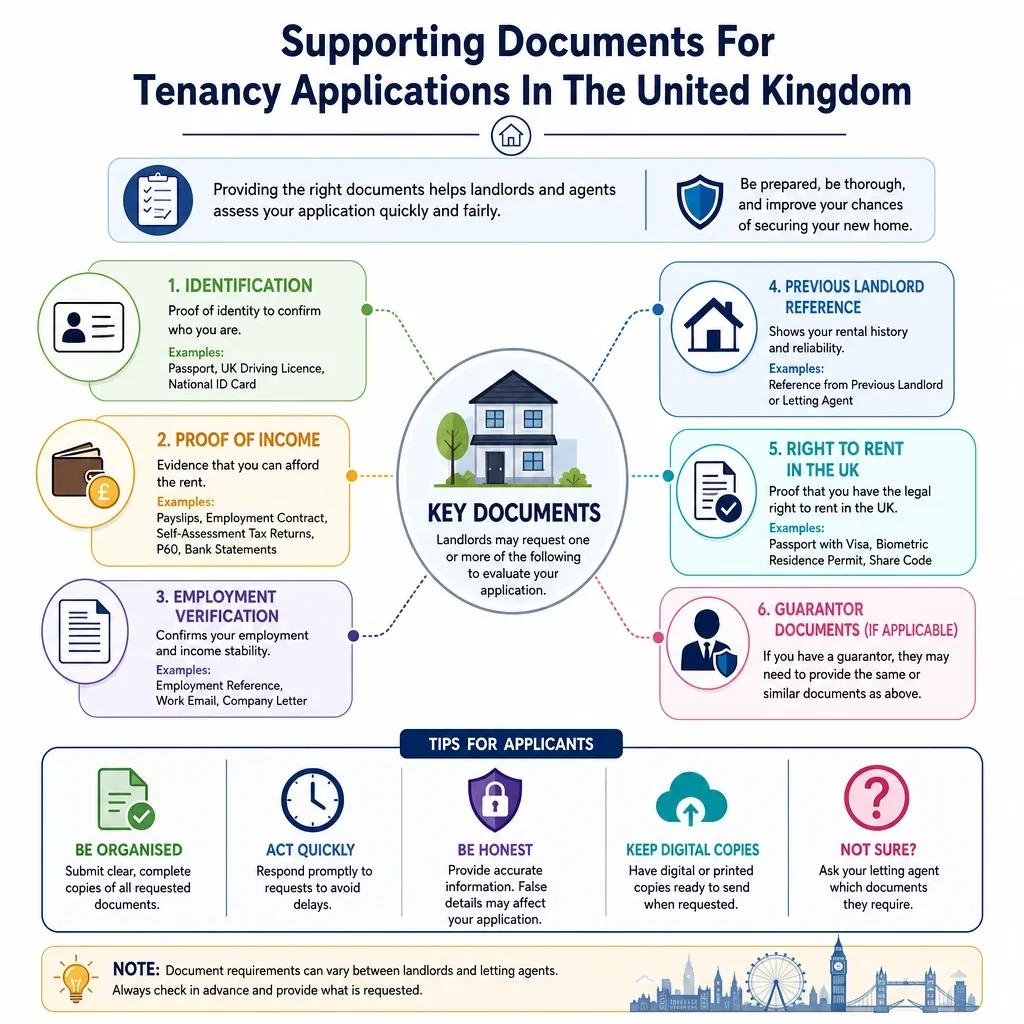
Photo ID (e.g. passport or driving licence) []
Proof of address (e.g. utility bill or bank statement dated within last 3 months) []
Proof of income (e.g. payslips, bank statements, employment contract) []
Right to Rent documents (e.g. passport, visa, share code, biometric residence permit) []
Guarantor documents (ID, proof of address, proof of income, consent form) []
References (personal and/or professional contact details) []
Any other relevant documents (e.g. pet references, credit report) []
This example shows approximately 70% of a typical document and is provided for illustrative purposes only. The remaining content has been omitted.
Every document generated by Docaro is tailored to your specific circumstances, jurisdiction and the information you provide. The completed document includes all applicable clauses and provisions required for your situation.
To generate the full, personalised document, answer a short series of questions and your document will be created instantly.
Useful Resources When Considering a Tenancy Application Form in the United Kingdom
United Kingdom Reference Legislation
Tenancy Application Form FAQs
Document Generation FAQs
Related Articles