Common Cohabitation Agreement Clauses In The UK
Clause Name | Clause Purpose | Typical Importance | Jurisdiction Relevance | When It Is Useful | Key Considerations |
|---|---|---|---|---|---|
Property and home | |||||
Ownership Shares In The Home | Records each partner's share in the home and whether ownership is equal or unequal. | High | UK-wide general relevance | When partners buy or already own a home together. | Align with title documents, mortgage terms and any declaration of trust. |
Deposit Contributions | States who paid the deposit and whether it affects ownership or repayment rights. | High | UK-wide general relevance | Where one partner, family member or inheritance funds more of the deposit. | Specify gift, loan, protected contribution or ownership share adjustment. |
Declaration Of Trust Consistency | Ensures the cohabitation agreement matches any declaration of trust for the property. | High | England and Wales | When buying as tenants in common or recording unequal beneficial shares. | Inconsistency can create disputes over which document reflects the parties' intention. |
Joint Tenants Or Tenants In Common | Confirms the chosen form of joint ownership and its practical effect. | High | England and Wales | When partners want clarity over survivorship and separable ownership shares. | Joint tenants usually pass by survivorship tenants in common can leave shares by will. |
Money and debts | |||||
Mortgage Payments | Allocates responsibility for regular mortgage payments between the partners. | High | UK-wide general relevance | Where one partner earns more or the mortgage is in joint names. | Lender rights are not limited by the agreement joint borrowers may remain jointly liable. |
Mortgage Arrears And Default | Sets steps if mortgage payments are missed or arrears arise. | High | UK-wide general relevance | When affordability depends on both partners contributing. | Include notice, temporary payment rules and contact with the lender before arrears escalate. |
Rent Contributions | States how rent is divided and paid to the landlord or lead tenant. | High | UK-wide general relevance | When partners rent together or one moves into the other's tenancy. | The tenancy agreement controls liability to the landlord cohabitation terms bind only the partners. |
Property and home | |||||
Tenancy And Occupation Status | Clarifies whether each partner is a tenant, permitted occupier, lodger or guest. | High | UK-wide general relevance | When only one partner is named on the tenancy agreement. | Landlord consent and tenancy terms may be needed before another adult moves in. |
Money and debts | |||||
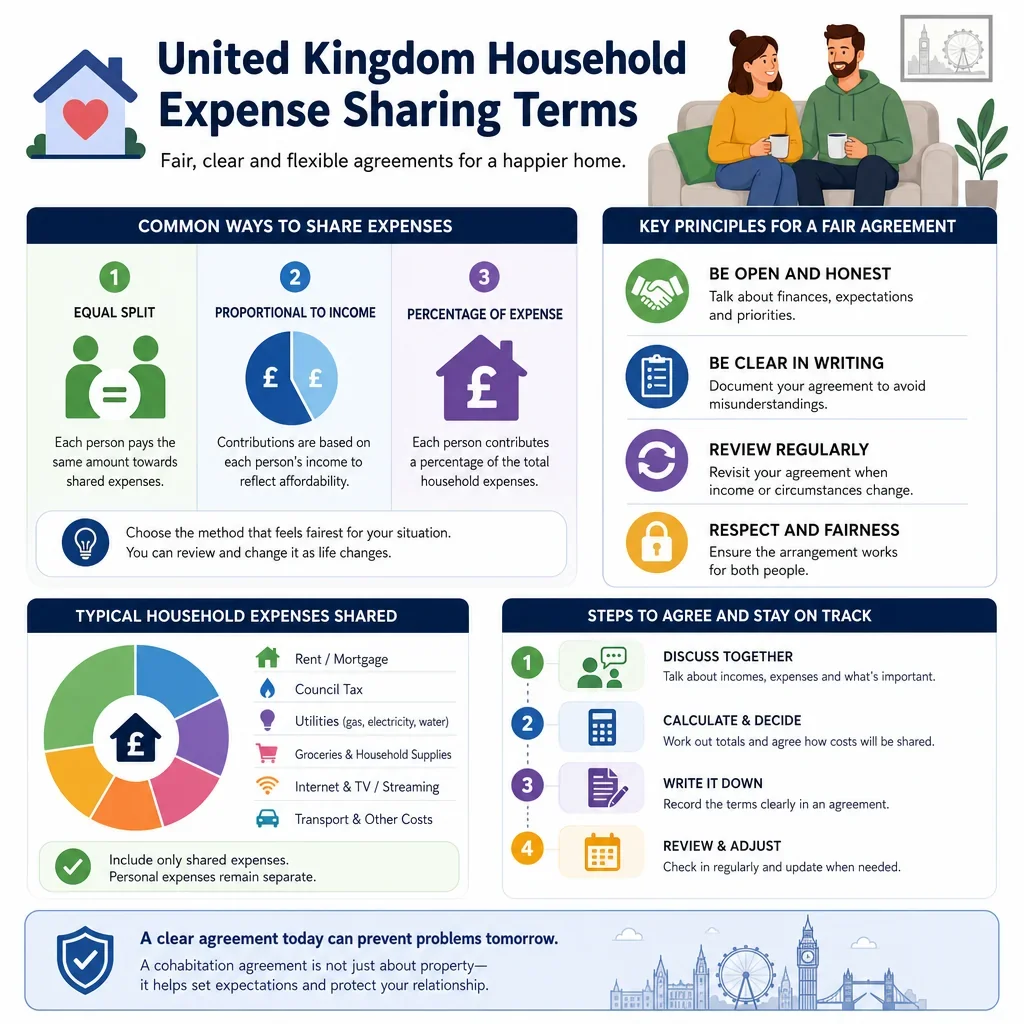
Household Bills And Utilities | Divides responsibility for electricity, gas, water, broadband, council tax and similar bills. | High | UK-wide general relevance | For any shared household with recurring expenses. | State percentages, payment dates and whether costs are split equally or by income. |
Council Tax And Local Charges | Allocates payment of council tax and local household charges between partners. | Medium | England and Wales | When only one partner is billed or one claims a discount. | Council tax liability follows statutory rules and local authority billing, not just the agreement. |
Property and home | |||||
Repairs And Maintenance | Sets who pays for routine repairs, maintenance and replacements. | High | UK-wide general relevance | For homeowners or tenants sharing ongoing property costs. | Separate routine costs from capital improvements that may affect ownership claims. |
Renovations And Improvements | Records approval and funding rules for major works improving the home. | High | UK-wide general relevance | When one partner funds extensions, conversions, kitchens or structural works. | State whether payments are reimbursable, gifts, loans or ownership-changing contributions. |
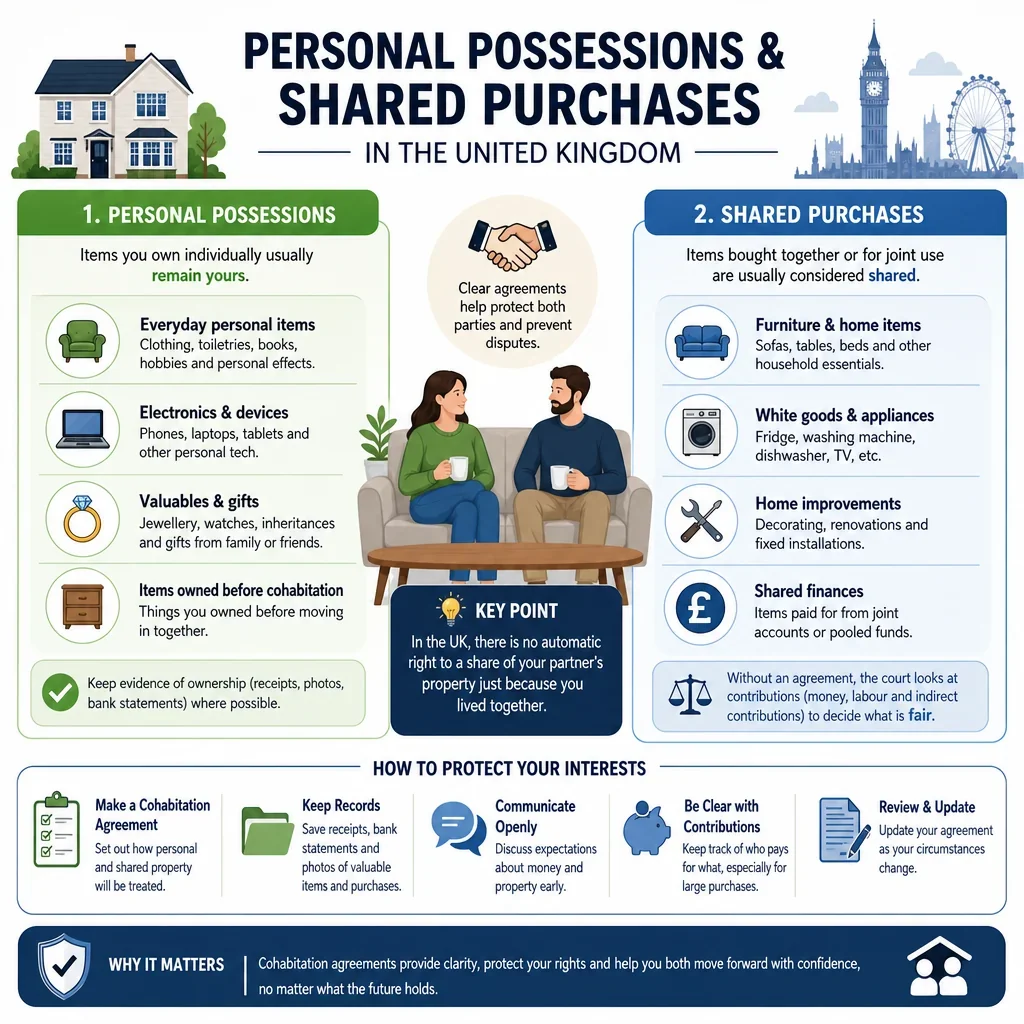
Contents And Personal Belongings | Identifies which furniture, appliances and personal items belong to each partner. | Medium | UK-wide general relevance | Where valuable items were bought before or during cohabitation. | Keep receipts, schedules and photos for high-value items. |
Jointly Purchased Items | Sets ownership and division rules for items bought together. | Medium | UK-wide general relevance | For cars, furniture, appliances, pets' equipment or shared electronics. | Specify whether ownership follows payment share, equal ownership or possession. |
Vehicles | Clarifies ownership, use, finance, insurance and transfer of cars or other vehicles. | Medium | UK-wide general relevance | When one partner pays finance but both use the vehicle. | The registered keeper is not necessarily the legal owner check finance agreements. |
Household arrangements | |||||
Pets And Animal Care | Agrees ownership, care costs and living arrangements for pets if partners separate. | Medium | England and Wales | When pets are jointly cared for or one partner bought the animal. | Animal welfare duties apply agree vet costs, insurance and day-to-day care. |
Money and debts | |||||
Savings And Bank Accounts | Confirms which accounts are separate, joint or used only for household expenses. | High | UK-wide general relevance | When partners open a joint account or keep separate finances. | Joint account holders may both access funds and may both be liable for overdrafts. |
Joint Account Rules | Sets permitted uses, contribution levels and withdrawal rules for a joint account. | High | UK-wide general relevance | When household bills are paid from one shared account. | Include spending limits, consent requirements and closure steps after separation. |
Property and home | |||||
Separate Property | Protects assets owned by each partner before cohabitation or kept separate afterwards. | High | UK-wide general relevance | Where either partner owns savings, investments, a home, business or valuables. | Avoid mixing separate assets with joint funds unless intended. |
Money and debts | |||||
Inheritance And Gifts | States whether inheritances and family gifts remain separate or become shared assets. | High | UK-wide general relevance | When family money is used for deposits, renovations or living costs. | Record whether money is a gift, loan or contribution to ownership. |
Pre-Existing Debts | Confirms that each partner remains responsible for debts they brought into the relationship. | High | UK-wide general relevance | Where either partner has loans, credit cards, tax debts or overdrafts. | Do not make joint repayments unless the intended effect is clear. |
Debts During Cohabitation | Allocates responsibility for debts taken out while living together. | High | UK-wide general relevance | When borrowing funds household spending, holidays, vehicles or renovations. | Creditors can pursue named borrowers regardless of private arrangements. |
Guarantees And Surety Obligations | Controls whether either partner may guarantee the other's debts or business liabilities. | Medium | UK-wide general relevance | Where one partner runs a business or has credit difficulties. | Guarantees can create serious personal liability independent advice is often prudent. |
Income And Earnings | Confirms whether each partner's income remains separate or partly shared. | Medium | UK-wide general relevance | When one partner earns significantly more or finances are pooled. | State whether sharing income affects asset ownership or only household budgeting. |
Income-Based Contributions | Sets contributions to bills by earnings ratio rather than equal shares. | Medium | UK-wide general relevance | Where partners have different salaries, benefits, pensions or working hours. | Include review triggers for redundancy, parental leave, illness or retirement. |
Tax Responsibilities | States each partner is responsible for their own tax unless otherwise agreed. | Medium | UK-wide general relevance | Where rental income, self-employment, capital gains or shared investments exist. | Cohabiting partners may not receive all tax treatments available to spouses or civil partners. |
Insurance | Allocates responsibility for buildings, contents, life, pet, vehicle and income protection insurance. | Medium | UK-wide general relevance | When partners own property, share valuables or depend on each other financially. | Check policyholder, beneficiary, insurable interest and mortgage lender requirements. |
Pensions And Retirement Savings | Confirms pensions remain separate unless a specific arrangement is made. | Medium | UK-wide general relevance | Where one partner reduces work or relies on the other long term. | Unmarried partners generally do not have divorce-style pension sharing claims. |
Business Interests | Protects business ownership, income, debts and confidential information. | Medium | UK-wide general relevance | When either partner owns shares, is self-employed or runs a family business. | Coordinate with company documents, partnership agreements and lender obligations. |
Household arrangements | |||||
Childcare Costs | Sets how nursery, school, clothing, activities and childcare costs are shared. | High | UK-wide general relevance | Where partners have children together or children from earlier relationships. | Do not attempt to exclude child maintenance obligations or the child's rights. |
Relationship changes | |||||
Children's Living Arrangements On Separation | Records intended practical arrangements for children if the relationship ends. | High | England and Wales | Where children live in the household and separation could affect care routines. | Courts decide children issues by welfare, so parental agreements cannot override the child's best interests. |
Household arrangements | |||||
Stepchildren And Blended Family Costs | Clarifies voluntary financial support for children who are not both partners' legal responsibility. | Medium | UK-wide general relevance | Where one partner has children from a previous relationship living in the home. | Separate voluntary household support from legal child maintenance responsibilities. |
Household Responsibilities | Records expectations for chores, shopping, admin and day-to-day home management. | Low | UK-wide general relevance | When partners want practical clarity on running the household. | Keep wording practical avoid terms that are too personal or hard to enforce. |
Caring Responsibilities | Recognises unpaid care for children, relatives, disability or illness within the household. | Medium | UK-wide general relevance | Where one partner reduces paid work to provide care. | Consider whether reduced earnings should affect contributions, savings or exit payments. |
Money and debts | |||||
Benefits And Public Support | Acknowledges that cohabitation may affect means-tested benefits and reporting duties. | Medium | UK-wide general relevance | Where either partner claims Universal Credit, housing support or other means-tested benefits. | Private agreement cannot avoid benefit reporting rules or official household assessments. |
Relationship changes | |||||
Wills And Death Planning | Encourages aligned wills and records intended provision if either partner dies. | High | UK-wide general relevance | Where partners own property, have children or want the survivor protected. | Unmarried partners may not inherit automatically without a valid will. |
Intestacy Awareness | Warns that dying without a will may leave a cohabiting partner without automatic inheritance. | High | England and Wales | Where partners wrongly assume a common-law spouse inherits automatically. | Make a will and review property ownership, nominations and life insurance beneficiaries. |
Provision For Surviving Partner | Records intended support for a surviving partner and recognises possible family provision claims. | Medium | England and Wales | Where partners are financially dependent but unmarried. | Eligible cohabitants may claim reasonable financial provision in limited circumstances. |
Life Insurance Beneficiaries | Records who should receive life insurance proceeds and who pays premiums. | Medium | UK-wide general relevance | Where a mortgage, children or financial dependency exists. | Check policy terms, trust arrangements and beneficiary nominations after separation. |
Pension Death Benefit Nominations | Encourages partners to update pension expression of wish or nomination forms. | Medium | UK-wide general relevance | Where either partner has workplace or private pensions. | Scheme trustees may have discretion nominations should be kept current. |
Illness And Incapacity | Records practical plans if a partner becomes seriously ill or loses capacity. | Medium | England and Wales | Where partners want each other involved in finances, care or medical decisions. | A cohabitation agreement is not a lasting power of attorney or advance decision. |
Separation Notice | Defines how one partner notifies the other that the relationship or cohabitation has ended. | High | UK-wide general relevance | When exit rights or buyout deadlines depend on a clear separation date. | Use written notice and specify delivery methods, date of effect and emergency exceptions. |
Moving Out Arrangements | Sets who leaves the home, timing, access and interim payment responsibilities. | High | UK-wide general relevance | Where both partners live in a jointly owned or rented home. | Do not unlawfully exclude a tenant, owner or person with occupation rights. |
Temporary Occupation After Separation | Allows one partner to remain temporarily while sale, buyout or rehousing is arranged. | High | UK-wide general relevance | When children, affordability or sale delays make immediate departure unrealistic. | Set payment rules, time limits, access arrangements and safety exceptions. |
Property and home | |||||
Property Valuation | Sets how the shared home or assets will be valued on separation or buyout. | High | UK-wide general relevance | When one partner may buy out the other or assets must be divided. | Specify valuer selection, valuation date, costs and treatment of mortgage or sale costs. |
Buyout Right | Gives one partner a process to buy the other's share after separation. | High | UK-wide general relevance | Where one partner wants to keep the home and can refinance. | Include deadlines, valuation basis, mortgage release and transfer costs. |
Sale Of The Home | Sets when and how the home will be sold if neither partner buys out the other. | High | UK-wide general relevance | When separation makes continued joint ownership impractical. | Specify estate agent choice, asking price, offers, sale costs and possession arrangements. |
Division Of Sale Proceeds | Explains how net sale proceeds are divided after mortgage and costs are paid. | High | UK-wide general relevance | When partners sell a jointly owned property. | State order of deductions and whether deposits or renovation contributions are repaid first. |
Money and debts | |||||
Negative Equity | Allocates responsibility if the home sells for less than the mortgage and sale costs. | Medium | UK-wide general relevance | Where a high loan-to-value mortgage or falling market creates risk. | Lender may pursue borrowers under the mortgage regardless of private split. |
Property and home | |||||
Occupation Rent Or Use Compensation | Deals with whether one partner pays compensation for sole use of a jointly owned home. | Medium | England and Wales | When one partner moves out while both still own the property. | Coordinate with mortgage payments, children's needs and any trust law claims. |
Dispute handling | |||||
Trusts Of Land Dispute Awareness | Recognises court powers in England and Wales for disputes over jointly or beneficially owned land. | Medium | England and Wales | Where partners may dispute ownership, sale or occupation of a home. | Clear written terms can reduce uncertainty but cannot remove all court powers. |
Relationship changes | |||||
Scottish Cohabitant Claims Awareness | Acknowledges Scottish statutory claims that may apply when cohabitants separate or one dies. | High | Scotland | Where the couple lives in Scotland or has Scottish property or succession issues. | Scotland has specific cohabitant remedies under the Family Law (Scotland) Act 2006. |
General legal terms | |||||
Northern Ireland Law Awareness | Flags that Northern Ireland rules may differ from England, Wales and Scotland. | Medium | Northern Ireland | Where partners live, own property or may separate in Northern Ireland. | Use jurisdiction-specific drafting and advice for Northern Ireland assets or residence. |
Dispute handling | |||||
Dispute Resolution Process | Sets staged steps for resolving disagreements before court action. | High | UK-wide general relevance | For disagreements about money, property, moving out or interpretation. | Include negotiation, written proposals, mediation and urgent court exceptions. |
Mediation | Encourages partners to try mediation before issuing non-urgent proceedings. | Medium | England and Wales | Where communication is possible and no urgent safeguarding issue exists. | Mediation is unsuitable where abuse, coercion or urgent protection is involved. |
Expert Determination | Allows a neutral expert to decide valuation or technical disputes. | Medium | UK-wide general relevance | For property valuations, repair costs, business values or accounting disputes. | Define expert appointment, fees, evidence, timetable and whether the decision is binding. |
Arbitration | Provides for private binding determination of certain disputes where suitable. | Low | England and Wales | For higher-value property or financial disputes needing privacy and finality. | Some family and child issues may need court oversight arbitration clauses require careful drafting. |
General legal terms | |||||
Governing Law | States which UK jurisdiction's law governs the agreement. | High | UK-wide general relevance | Where partners move between England, Wales, Scotland or Northern Ireland. | A chosen law may not override mandatory rules where property, children or proceedings are located. |
Jurisdiction And Forum | Identifies where disputes should be brought if court action is needed. | Medium | UK-wide general relevance | Where partners have homes, assets or connections in different UK jurisdictions. | Property location, child residence and statutory claims may affect the correct forum. |
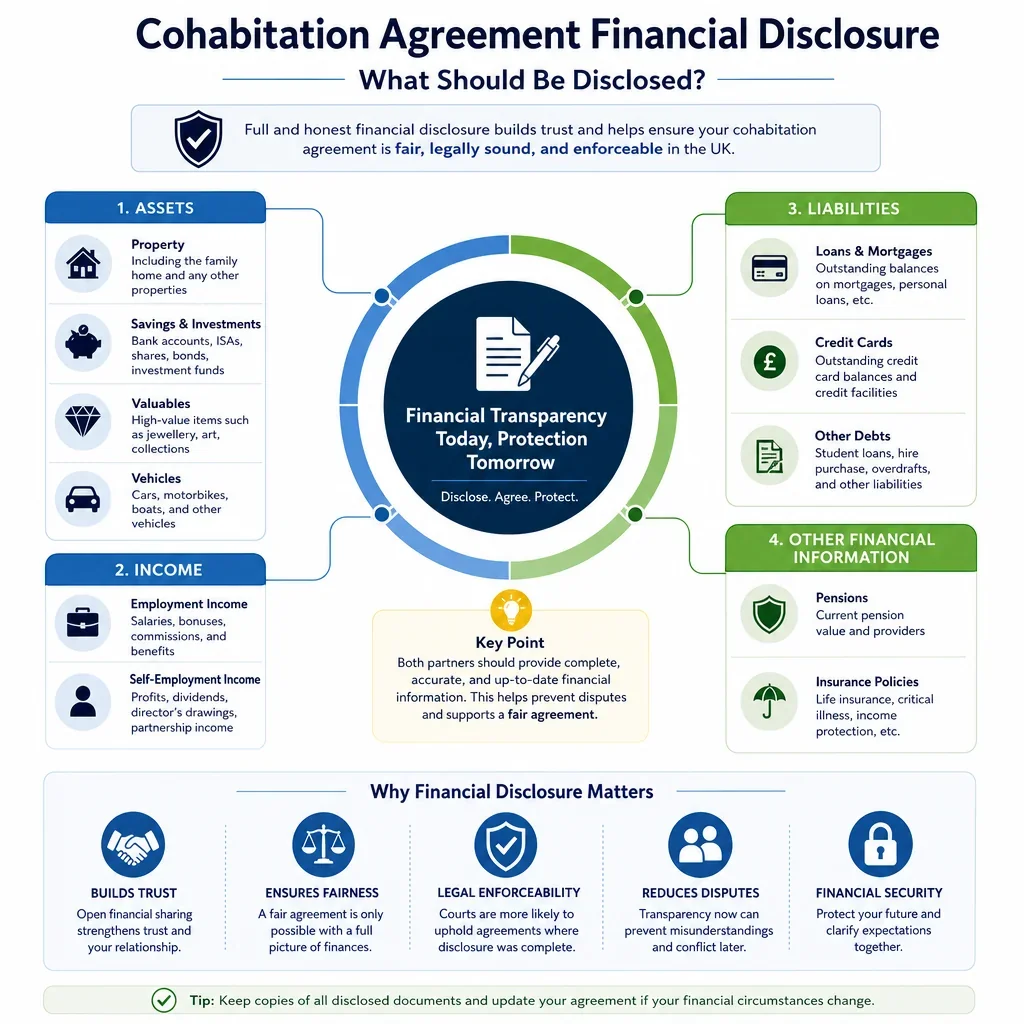
Financial Disclosure | Records that partners shared relevant financial information before signing. | High | UK-wide general relevance | When the agreement deals with property, debts, savings or unequal contributions. | Attach schedules of assets, debts, income and major liabilities for evidential clarity. |
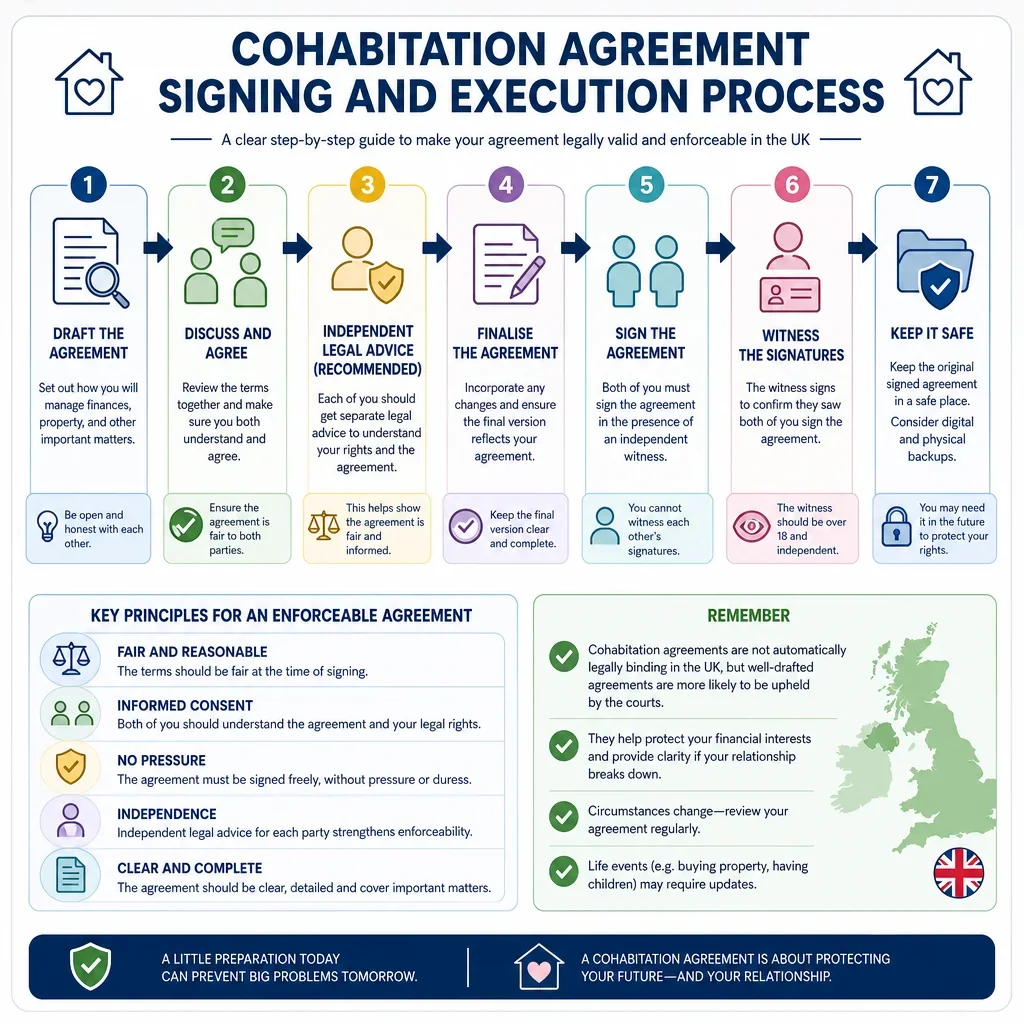
Independent Legal Advice | Records whether each partner had the chance to take separate legal advice. | High | UK-wide general relevance | Where significant assets, unequal bargaining power or complex terms exist. | Separate advice can help show informed consent and reduce later challenge risk. |
No Undue Influence Or Pressure | Confirms the agreement was signed freely without coercion or improper pressure. | High | UK-wide general relevance | Whenever one partner has more money, knowledge or control than the other. | Allow time to review, avoid last-minute signing and record advice opportunities. |
Signing And Witnessing | Sets how the agreement should be signed, dated and witnessed. | High | UK-wide general relevance | For evidential certainty and where deed-style obligations may be included. | Use correct formalities if the document is intended to operate as a deed. |
Entire Agreement | States that the written agreement replaces previous informal promises on covered topics. | Medium | UK-wide general relevance | Where partners discussed money or property before signing. | Do not contradict separate conveyancing documents, wills or trust deeds. |
Changes To The Agreement | Sets how partners can amend the agreement after signing. | High | UK-wide general relevance | When finances, home ownership, children or work patterns change. | Require written, signed amendments avoid relying on informal messages. |
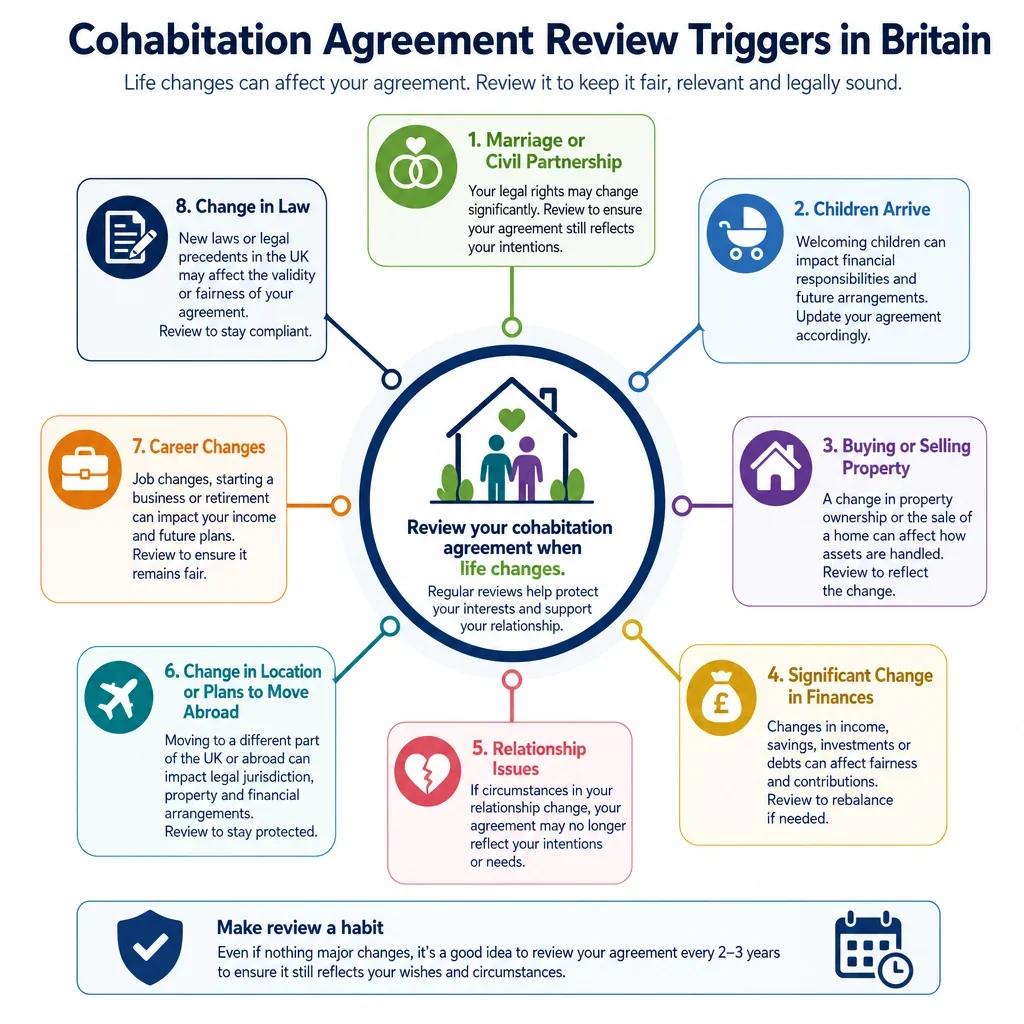
Regular Review | Requires the partners to review the agreement at set intervals or life events. | Medium | UK-wide general relevance | After buying property, having children, illness, inheritance, redundancy or relocation. | Outdated terms may not reflect current intentions or practical realities. |
Relationship changes | |||||
Marriage Or Civil Partnership | States what happens to the agreement if partners marry or form a civil partnership. | High | UK-wide general relevance | Where cohabitants may later marry or enter a civil partnership. | Marriage or civil partnership creates different financial rights consider a pre-nuptial or post-nuptial agreement. |
General legal terms | |||||
Termination Of Agreement | Defines when the agreement ends and which obligations survive. | Medium | UK-wide general relevance | On separation, marriage, sale of the home or written replacement agreement. | Property division, confidentiality, debts and dispute clauses may need to survive termination. |
Confidentiality | Protects private financial and personal information shared for the agreement. | Medium | UK-wide general relevance | Where sensitive income, debt, health, family or business information is disclosed. | Allow disclosures to lawyers, lenders, tax authorities, courts and required professionals. |
Data Protection And Document Storage | Sets how copies, personal data and supporting financial documents are stored and shared. | Low | UK-wide general relevance | Where the agreement includes bank statements, valuations or sensitive personal data. | Store securely and permit necessary professional or legal disclosure. |
Notices | Specifies how formal communications under the agreement must be sent. | Medium | UK-wide general relevance | For separation notices, buyout elections, payment demands or review requests. | Include email, post, address updates and deemed receipt rules. |
Severability | Preserves the rest of the agreement if one clause is invalid or unenforceable. | Medium | UK-wide general relevance | Where a particular term is too broad, unlawful or impractical. | Cannot save an agreement whose core purpose is unlawful or fundamentally defective. |
Counterparts And Electronic Copies | Allows partners to sign separate copies and rely on scanned or electronic versions. | Low | UK-wide general relevance | When partners sign at different times or keep digital records. | Check witnessing and deed formalities before using remote or electronic signatures. |
Third Party Rights | States whether anyone other than the partners can enforce terms of the agreement. | Low | England and Wales | Where family members provide deposits, loans or guarantees. | Expressly include or exclude third-party enforcement where relevant. |
Money and debts | |||||
Family Loans | Records repayment terms for money lent by relatives to either or both partners. | High | UK-wide general relevance | When parents help with a deposit, renovations or emergency costs. | Use a separate loan agreement state borrower, interest, repayment and security clearly. |
Household arrangements | |||||
Guests And Relatives Staying In The Home | Sets consent rules for long stays by relatives, friends or lodgers. | Low | UK-wide general relevance | Where adult children, parents or friends may stay for extended periods. | Check tenancy, mortgage, insurance and HMO rules before taking in occupants. |
Property and home | |||||
Lodgers And Subletting | Controls whether rooms may be let and how income and duties are handled. | Medium | UK-wide general relevance | When partners may rent out a spare room or sublet part of the home. | Check landlord consent, mortgage terms, insurance, tax and licensing requirements. |
Relationship changes | |||||
Relocation | Addresses what happens if one partner wants or needs to move away. | Medium | UK-wide general relevance | For job moves, caring duties, immigration issues or moving between UK nations. | Consider property sale, tenancy notice, children's arrangements and governing law. |
Immigration Status And Sponsorship | Acknowledges that cohabitation evidence and relationship changes may affect visa matters. | Medium | UK-wide general relevance | Where one partner is in the UK on a partner, family or dependent visa. | The agreement cannot guarantee immigration status take specialist advice. |
Dispute handling | |||||
Safety And Domestic Abuse Exceptions | Ensures dispute, notice or occupation terms do not prevent urgent safety action. | High | England and Wales | Where there is abuse, coercive control, harassment or risk of harm. | Do not require mediation or shared occupation where safety is at risk. |
Money and debts | |||||
Emergency Expenses | Sets how urgent home, medical, pet or child-related costs are authorised and repaid. | Medium | UK-wide general relevance | For boiler failure, leaks, urgent travel, vet bills or child emergencies. | Include spending limits, evidence required and when prior consent is not needed. |
General legal terms | |||||
Records And Receipts | Requires partners to keep evidence of payments, purchases, repairs and contributions. | Medium | UK-wide general relevance | Where ownership or reimbursement depends on proof of payment. | Keep bank records, invoices and written notes for deposits, loans and improvements. |
Money and debts | |||||
Reimbursement Of Overpayments | Sets when one partner must repay the other for paying more than agreed. | Medium | UK-wide general relevance | Where one partner temporarily covers mortgage, rent, bills or repairs. | State whether extra payments are gifts, loans, advances or reimbursable debts. |
Interest On Unpaid Sums | Provides interest or compensation if agreed payments are late. | Low | UK-wide general relevance | Where significant loans, buyout payments or reimbursements may be delayed. | Use a reasonable rate and avoid penalty-style wording. |
Set-Off | Allows mutual debts to be deducted against each other where appropriate. | Low | UK-wide general relevance | Where both partners owe reimbursements, bills or buyout adjustments. | Define which debts can be set off and require written calculations. |
Property and home | |||||
Sale And Transfer Costs | Allocates estate agent, conveyancing, valuation, mortgage and transfer fees. | Medium | UK-wide general relevance | When selling the home or transferring one partner's share. | State whether costs are paid before dividing proceeds or by a specific partner. |
Money and debts | |||||
Land Transaction Taxes | Deals with who pays land transaction taxes on purchase or transfer. | Medium | UK-wide general relevance | When buying, transferring shares or replacing one owner with another. | Different taxes apply: SDLT in England and Northern Ireland, LTT in Wales, LBTT in Scotland. |
Welsh Land Transaction Tax Awareness | Flags Welsh land transaction tax where property is in Wales. | Low | England and Wales | Where the couple buys or transfers residential property in Wales. | Welsh LTT rules differ from SDLT obtain conveyancing tax advice. |
Scottish LBTT Awareness | Flags Scottish LBTT where property is in Scotland. | Low | Scotland | Where the couple buys or transfers residential property in Scotland. | Scottish LBTT and Additional Dwelling Supplement rules may affect transfers. |
Property and home | |||||
Lender Consent And Property Restrictions | Requires lender or third-party consent before transfers, charges or occupation changes. | High | UK-wide general relevance | When a home is mortgaged or subject to title restrictions. | Private agreement cannot force a lender to release a borrower or approve transfer. |
Money and debts | |||||
Capital Gains Tax Awareness | Flags possible tax on selling or transferring property or investments. | Medium | UK-wide general relevance | Where a property is not both partners' only or main residence. | Unmarried partners may have different tax outcomes from spouses or civil partners. |
Household arrangements | |||||
Home Working And Business Use | Regulates use of the home for employment, self-employment or business activities. | Low | UK-wide general relevance | Where one partner works from home or sees clients at the property. | Check mortgage, tenancy, insurance, planning and tax implications. |
Property and home | |||||
DIY Labour And Non-Financial Contributions | Records whether unpaid labour or homemaking affects ownership or reimbursement. | Medium | UK-wide general relevance | Where one partner renovates, decorates, manages projects or provides unpaid care. | Be explicit if non-cash contributions create no ownership change or a defined adjustment. |
Household Inventory | Creates a schedule of important household items and ownership details. | Low | UK-wide general relevance | For valuable art, jewellery, furniture, appliances or inherited items. | Update after major purchases, gifts, insurance claims or separation. |
Money and debts | |||||
Subscriptions And Memberships | Allocates responsibility for streaming, gym, club, software and other recurring subscriptions. | Low | UK-wide general relevance | Where recurring payments continue after one partner leaves. | Record whose name the contract is in and how cancellation will be handled. |
Property and home | |||||
Digital Assets And Online Accounts | Deals with shared devices, cloud storage, domain names, cryptoassets and online accounts. | Low | UK-wide general relevance | Where partners share devices, passwords, media libraries or digital investments. | Avoid unlawful account access record ownership and recovery arrangements securely. |
Household arrangements | |||||
Social Media And Privacy | Sets expectations for posting private information, images or relationship details online. | Low | UK-wide general relevance | Where partners want privacy around finances, children, home or separation. | Do not rely on it as a substitute for harassment, privacy or safeguarding remedies. |
Relationship changes | |||||
Collection Of Personal Belongings | Sets a safe process for collecting possessions after one partner leaves. | Medium | UK-wide general relevance | Where separation is tense or one partner no longer has keys. | Include notice, attendance by third party, storage, safety and abandoned items rules. |
Property and home | |||||
Keys, Access And Security | Controls keys, alarms, access codes and security changes during and after cohabitation. | Medium | UK-wide general relevance | After separation or where one partner moves into the other's home. | Avoid unlawful exclusion urgent safety concerns may justify immediate protective steps. |
Relationship changes | |||||
Abandoned Property | Sets notice and storage rules for belongings left behind after separation. | Low | UK-wide general relevance | Where one partner leaves furniture, clothes, files or equipment in the home. | Give reasonable written notice before disposal or sale of another person's goods. |
Pet Living Arrangements On Separation | Decides who keeps pets and whether contact, costs or insurance continue. | Medium | UK-wide general relevance | Where pets are emotionally important or jointly funded. | Courts often treat pets as property, but welfare and practical care evidence matter. |
Property and home | |||||
Unequal Ownership And Equal Mortgage Liability | Explains how unequal beneficial shares interact with joint mortgage responsibility. | High | UK-wide general relevance | When ownership shares are unequal but both partners are named on the mortgage. | The lender may pursue either borrower for the full debt despite unequal beneficial ownership. |
Single-Owner Home Contributions | Clarifies whether payments by a non-owner create any interest in the owner's home. | High | UK-wide general relevance | When one partner moves into a home owned by the other. | Distinguish rent, bills, mortgage contributions and improvement payments clearly. |
Licence To Occupy | Sets the non-owner partner's permission to live in the owner's property. | Medium | UK-wide general relevance | Where a partner lives in the other partner's solely owned home. | Avoid unintentionally creating tenancy rights consider mortgage and insurance conditions. |
Money and debts | |||||
Payments To Owner Partner | Labels payments to an owner partner as rent, contribution, loan or investment. | High | UK-wide general relevance | When a non-owner contributes to mortgage or housing costs. | Ambiguous payments can later support claims of shared intention or beneficial interest. |
General legal terms | |||||
No Partnership Or Agency | States that living together does not create a business partnership or authority to bind each other. | Low | UK-wide general relevance | Where partners share expenses but do not intend commercial obligations. | Separate from actual business arrangements, joint ventures or companies. |
Money and debts | |||||
Tenancy Deposit And Deductions | Allocates tenancy deposit contributions and responsibility for landlord deductions. | Medium | England and Wales | When renting and one partner paid more of the deposit. | Tenancy deposit protection rules apply where required agreement should mirror tenancy records. |
Rent Arrears In A Joint Tenancy | Sets how partners share responsibility if rent arrears arise under a joint tenancy. | High | UK-wide general relevance | Where both partners are named tenants and one stops paying. | Joint tenants may be jointly and severally liable to the landlord for all rent. |
Relationship changes | |||||
Ending A Tenancy | Sets consent and payment rules for giving notice or ending a rented home. | High | UK-wide general relevance | When partners rent together and one wants to leave. | Tenancy terms and landlord requirements control notice validity and continuing rent liability. |
Money and debts | |||||
Shared Investments | Sets ownership and division rules for shares, funds, ISAs or crypto bought together. | Medium | UK-wide general relevance | Where partners invest jointly or one holds investments for both. | Record beneficial ownership, tax reporting, platform access and sale authority. |
Property and home | |||||
Future Property Purchases | Sets default rules if partners later buy another property together. | Medium | UK-wide general relevance | Where partners rent now but expect to buy later. | Update the agreement at purchase and align with conveyancing documents. |
Money and debts | |||||
Large Discretionary Spending | Requires agreement before major non-essential shared spending. | Low | UK-wide general relevance | For holidays, weddings, parties, gifts, furniture or vehicles. | Set approval thresholds and whether spending is reimbursable if plans change. |
Relationship changes | |||||
Engagement And Wedding Costs | Deals with responsibility for wedding-related deposits, gifts and cancellation costs. | Low | UK-wide general relevance | Where partners are engaged or planning a ceremony. | Marriage or civil partnership changes legal rights review the agreement before the ceremony. |
Dispute handling | |||||
Enforcement Costs | Sets whether a breaching partner pays reasonable costs of enforcing the agreement. | Low | UK-wide general relevance | Where unpaid sums, refusal to sign transfers or property disputes arise. | Court cost rules may override or modify private cost arrangements. |
Remedies For Breach | Explains what happens if a partner breaches payment, transfer or cooperation duties. | Medium | UK-wide general relevance | Where one partner may not cooperate with sale, valuation or repayment. | Remedies should be proportionate and not operate as unenforceable penalties. |
Property and home | |||||
Cooperation With Sale Or Transfer | Requires partners to sign documents and take steps needed for sale or transfer. | High | UK-wide general relevance | When property division depends on timely conveyancing cooperation. | Include deadlines, solicitor instructions and consequences of unreasonable delay. |
Land Registry Restrictions | Records whether a restriction or notice should protect agreed property interests. | Medium | England and Wales | Where tenants in common, trust interests or consent controls are intended. | Land Registry entries must match the legal and beneficial ownership structure. |
Scottish Title And Survivorship Destination | Flags Scottish title wording and survivorship destinations for jointly owned property. | High | Scotland | Where cohabitants own or buy heritable property in Scotland. | Scottish conveyancing and succession terms differ align title, will and cohabitation agreement. |
Money and debts | |||||
Credit Cards And Consumer Credit | Allocates responsibility for credit cards, loans and finance agreements used by the household. | High | UK-wide general relevance | Where one partner borrows for shared furniture, travel or living costs. | The lender can enforce against the named borrower despite private sharing terms. |
Insolvency Or Bankruptcy | Sets notification and protection steps if either partner becomes insolvent. | Medium | UK-wide general relevance | Where one partner has business risk, heavy debts or joint assets. | Creditors and insolvency office-holders may affect jointly owned assets despite private agreement. |
Joint Financial Products On Separation | Requires steps to close, freeze or separate joint accounts, loans and cards after separation. | High | UK-wide general relevance | When partners have joint bank accounts, overdrafts, credit cards or loans. | Contact providers promptly credit links may continue until accounts are settled and disassociated. |
Credit File Disassociation | Records intention to remove financial associations after joint products end. | Medium | UK-wide general relevance | After closing joint accounts or repaying joint credit. | Apply to credit reference agencies once there are no active joint financial links. |
Relationship changes | |||||
Child Maintenance Scheme Awareness | Recognises that statutory child maintenance may apply despite private arrangements. | High | UK-wide general relevance | Where partners have children together and may separate. | Private clauses cannot remove statutory child maintenance responsibilities. |
General legal terms | |||||
Asset And Liability Schedule | Lists key assets, debts, ownership and values at the date of signing. | High | UK-wide general relevance | For agreements involving homes, savings, loans, businesses or valuable possessions. | Update or annex evidence when major assets or debts change. |
Fairness And Changed Circumstances Review | Creates a review if the agreement becomes unfair due to major life changes. | Medium | UK-wide general relevance | After children, disability, long-term illness, major wealth change or dependency. | A rigid agreement may be more vulnerable if circumstances radically change. |
Dispute handling | |||||
Prompt Claims And Delay | Encourages partners to raise claims promptly after separation or breach. | Medium | UK-wide general relevance | Where buyout, reimbursement or Scottish cohabitant claims may have time limits. | Statutory limitation periods and jurisdiction-specific deadlines can override informal delay. |
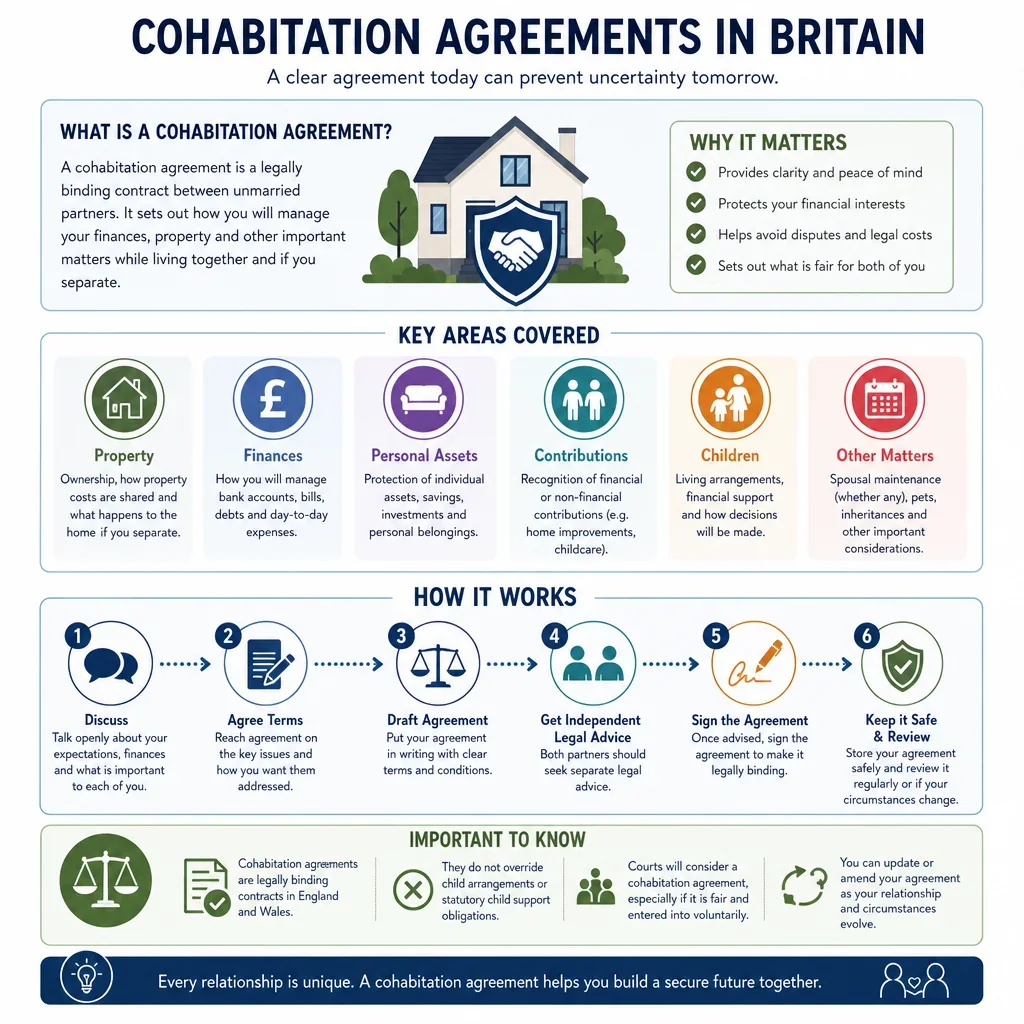
What Clauses Matter Most In A UK Cohabitation Agreement?
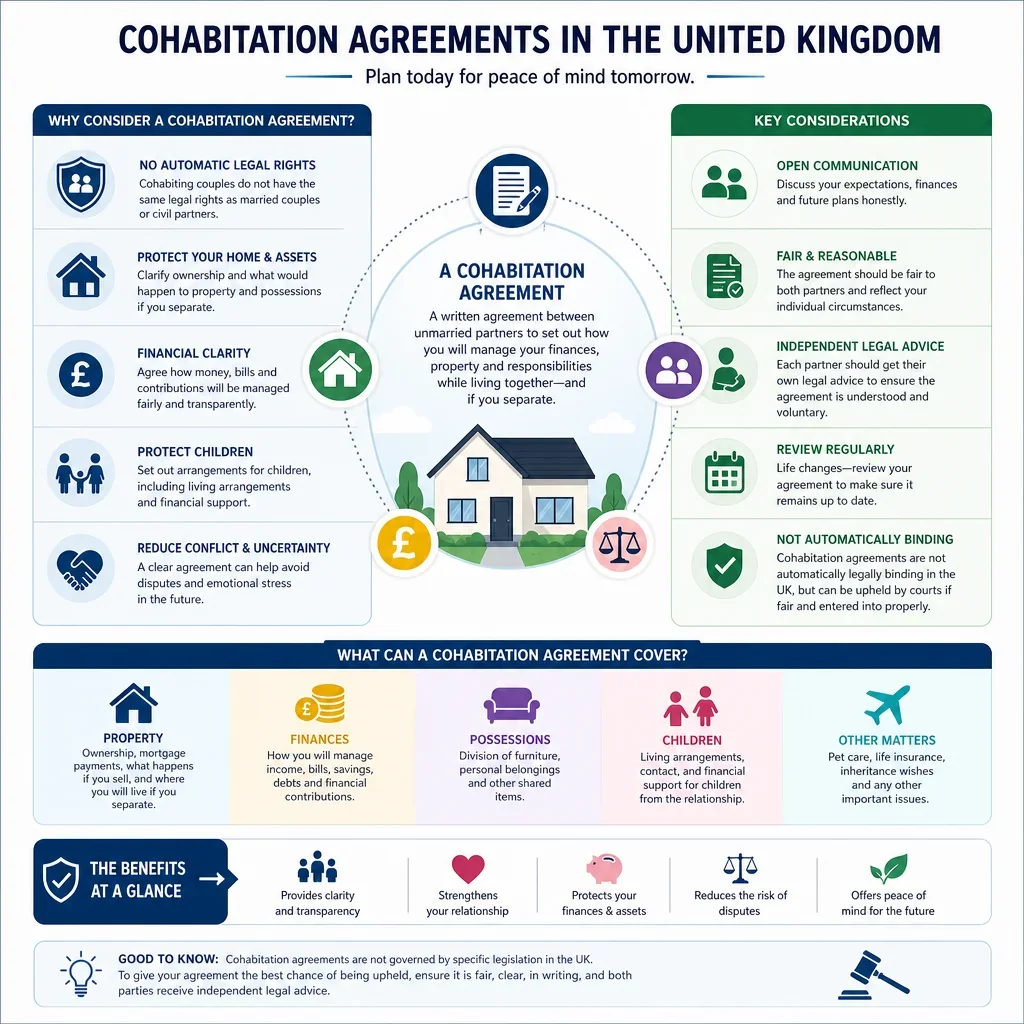
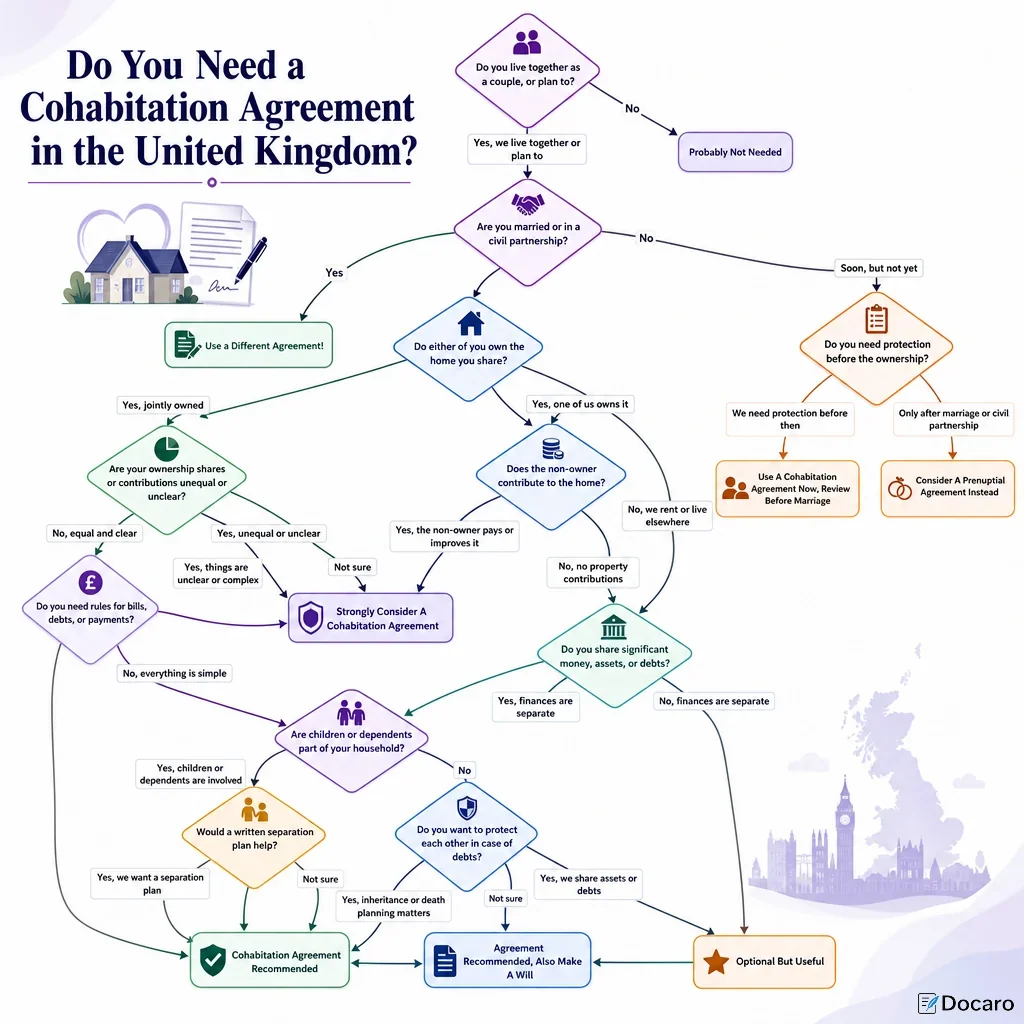
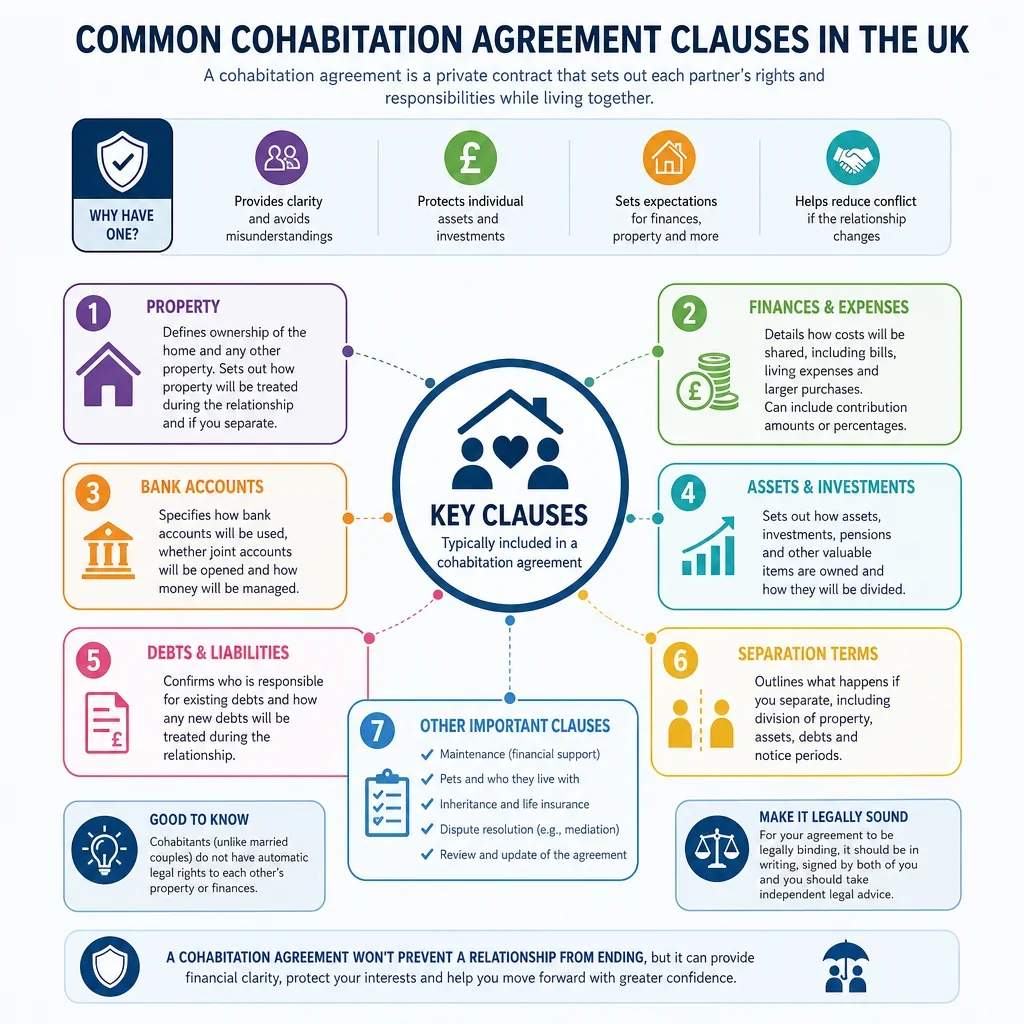
Property ownership, mortgage responsibility, household bills, debts and separation arrangements are usually the highest-impact clauses. Unmarried cohabitants do not automatically get the same financial rights as spouses or civil partners, so the agreement should clearly state who owns what, who pays what, and what happens if the relationship ends.
Why Are Home Ownership Clauses Especially Important?
For a shared home in England and Wales, beneficial ownership can be affected by documents, contributions and shared intentions. A cohabitation agreement should work alongside the conveyancing documents, mortgage terms and any declaration of trust. In Scotland and Northern Ireland, different property and family law rules may apply, so jurisdiction-specific advice is important.
Which Clauses Help Avoid Disputes If A Couple Separates?
- Separation notice, valuation and buyout clauses can create a practical route for one partner to leave or buy out the other.
- Sale of home and division of proceeds clauses can reduce uncertainty where neither partner can afford to retain the property.
- Mediation and dispute resolution clauses can help avoid immediate court action.
What Should Couples With Children Or Unequal Contributions Consider?
Clauses about childcare costs, living arrangements and emergency payments can be useful, but they should not try to restrict a child\'s legal rights or override the court\'s welfare-based powers. Where one partner pays more of the deposit, mortgage or renovation costs, the agreement should record whether this is a gift, loan, unequal ownership contribution or shared expense.
How Can A Cohabitation Agreement Be Made More Reliable?
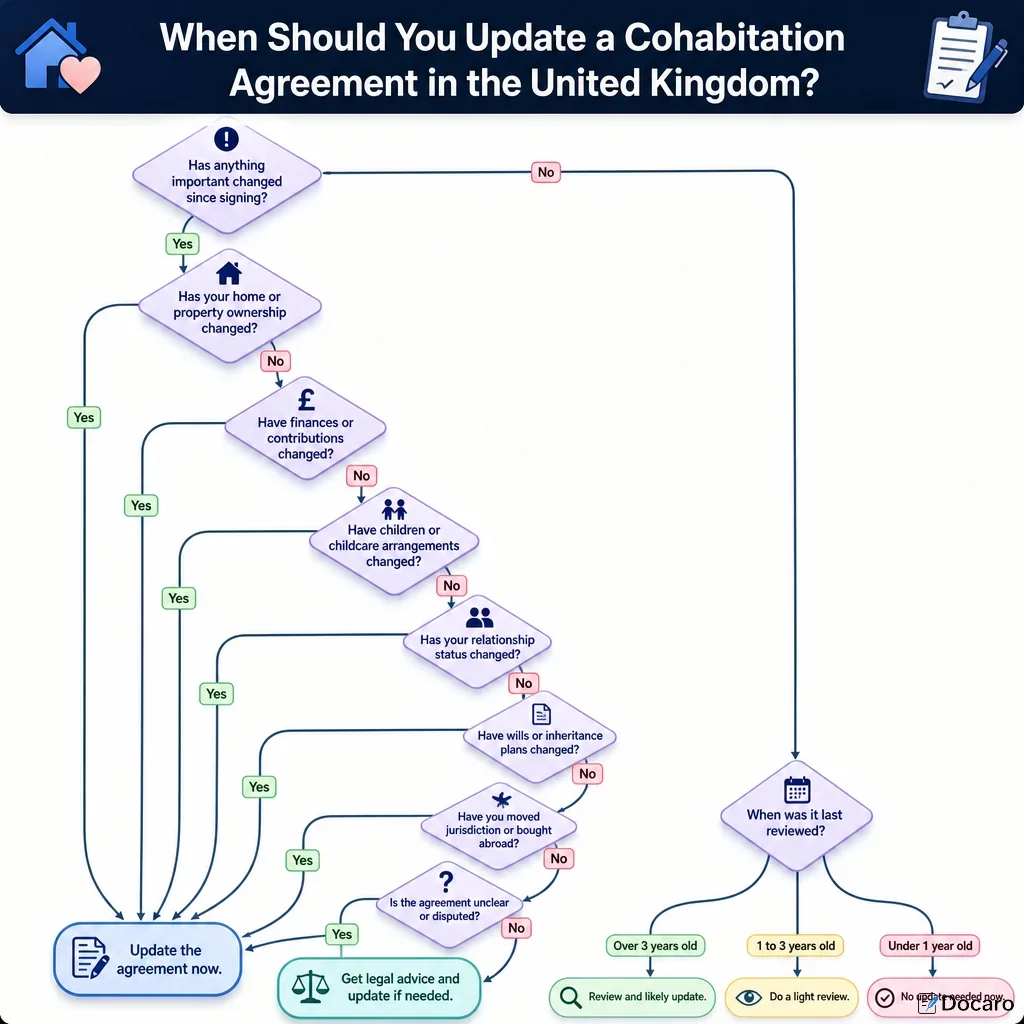
Use clear evidence of intention, full financial disclosure, independent legal advice where possible, and regular review after major events such as buying a home, having a child, refinancing, inheritance, serious illness or relocation within the UK.
FAQs
You Might Also Be Interested In