

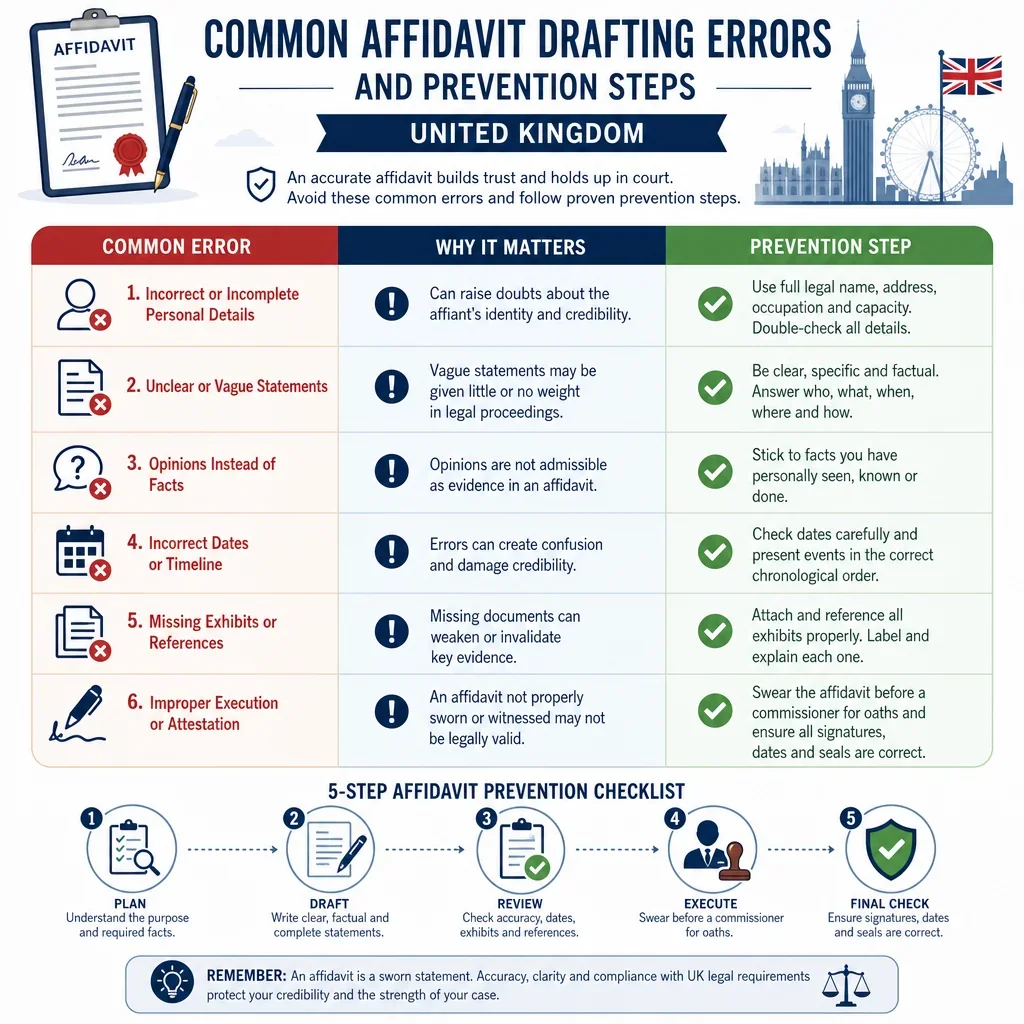
Common Affidavit Drafting Errors And Prevention Steps In The United Kingdom
Created:
This guide highlights common affidavit drafting errors and practical prevention steps, helping readers create clearer, more accurate documents. It is especially useful alongside the AI Generated Affidavit for use in the United Kingdom category page.
Drafting error | Why it matters | Prevention step | Impact level | Best review stage |
|---|---|---|---|---|
Identity details | ||||
Using initials, nicknames, or an incomplete legal name. | May make the deponent hard to identify or match to records. | Use the deponent’s full legal name and check it against ID. | High | Before signing |
Including an outdated or incorrect address. | Can create doubt about identity, service, or relevance. | Confirm the current address before signing. | Medium | Before signing |
Omitting occupation, role, or relationship to the dispute. | Readers may not understand why the deponent has knowledge. | State occupation, capacity, or connection to the facts. | Medium | During drafting |
Not stating whether the deponent acts personally or for a company. | Can cause uncertainty about authority and whose evidence is given. | State the role, employer, and authority to give the affidavit. | High | Before drafting |
Omitting date of birth where identity may otherwise be unclear. | People with similar names may be confused. | Add date of birth only where necessary and proportionate. | Medium | Before drafting |
Using different spellings of a person’s name in the affidavit. | May confuse parties, witnesses, or exhibit references. | Create a name list and use one spelling throughout. | Medium | Before signing |
Failing to explain former names, aliases, or trading names. | Documents may appear to relate to a different person or business. | Define each former name or alias at first mention. | Medium | During drafting |
Submission details | ||||
Naming the wrong court, tribunal, or division. | May cause rejection, delay, or confusion on filing. | Copy the court heading from the current case documents. | High | Before submission |
Using an incorrect or missing claim or case number. | The affidavit may be filed on the wrong matter or rejected. | Check the number against the latest court order or notice. | High | Before submission |
Using outdated or shortened party names in the heading. | May not match the proceedings or filing system. | Copy party names from the claim form or current order. | Medium | Before submission |
Facts and evidence | ||||
Not stating what the affidavit is made in support of. | The reader may not know which application or issue it addresses. | Add a short purpose paragraph near the start. | Medium | During drafting |
Not identifying whether facts are personal knowledge or information received. | The court may give less weight to unsupported second-hand evidence. | State the source of each non-personal fact. | High | During drafting |
Relying on hearsay without identifying the source. | Hearsay may be challenged or given reduced weight. | Name the source and explain how the information was obtained. | High | During drafting |
Including opinions instead of facts, unless expert evidence is intended. | Opinion evidence may be disregarded if the deponent is not qualified. | Rewrite opinions as observed facts or obtain expert evidence. | High | During drafting |
Turning the affidavit into legal argument or submissions. | Argument may distract from evidence and reduce clarity. | Keep evidence factual and leave submissions to the advocate. | Medium | During drafting |
Making conclusions without stating the supporting facts. | The reader cannot assess how the conclusion was reached. | Add the factual basis or remove the conclusion. | High | During drafting |
Dates and chronology | ||||
Using vague phrases such as "recently" or "a while ago". | Unclear timing can undermine the chronology. | Use exact dates or explain the best available estimate. | Medium | During drafting |
Dates in the affidavit conflict with exhibits or pleadings. | Inconsistencies may damage credibility or require correction. | Cross-check every date against source documents. | High | Before signing |
Presenting events out of order without explanation. | A confused structure can make the evidence difficult to follow. | Use chronological order unless issue-based order is clearer. | Medium | Before drafting |
Leaving out key dates for agreements, notices, or events. | Limitation, compliance, or procedural timing may be unclear. | Prepare a chronology before drafting. | High | Before drafting |
Using ambiguous numeric dates such as 03/04/2026. | Readers may misread the day and month. | Write dates as day, month name, and year. | Medium | Before signing |
Dating the affidavit before it is actually sworn or affirmed. | The jurat may be inaccurate and the affidavit may be challenged. | Insert the signing date only when sworn or affirmed. | High | Before signing |
Reusing an old affidavit without updating dates and facts. | Outdated evidence may be misleading or incomplete. | Review all carried-over text against current facts. | High | During drafting |
Facts and evidence | ||||
Failing to state important facts that did not happen. | Silence may leave gaps in proof, such as non-payment or no reply. | Identify required proof points, including non-events. | Medium | Before drafting |
Using exaggerated or absolute language not supported by evidence. | Overstatement may damage credibility if challenged. | Use precise, neutral wording tied to evidence. | High | Before signing |
Including long irrelevant background details. | Important facts may be obscured and costs may increase. | Keep only facts needed for the issue or application. | Medium | During drafting |
Including legally privileged communications by mistake. | Privilege may be waived and sensitive strategy exposed. | Review for legal advice privilege before finalising. | High | Before signing |
Including unnecessary personal or confidential data. | May create privacy, confidentiality, or redaction problems. | Remove or redact data not needed for the affidavit. | High | Before submission |
Exhibits | ||||
Referring to documents without identifying date, author, or title. | The exhibit may be hard to locate or verify. | Describe each document clearly at first reference. | Medium | During drafting |
Referring to an exhibit that is not attached or available. | A key assertion may be unsupported. | Check each exhibit reference against the final bundle. | High | Before signing |
Using inconsistent exhibit labels in text and attachments. | The reader may rely on the wrong document. | Number or letter exhibits sequentially and cross-check labels. | High | Before signing |
Attaching exhibits without a clear exhibit mark or cover sheet. | Attachments may be separated or misidentified. | Mark each exhibit with the deponent’s initials and sequence number. | Medium | Before signing |
Attaching documents that are not referred to in the affidavit. | The purpose and relevance of the document may be unclear. | Refer to each exhibit in the paragraph it supports. | Medium | Before signing |
Using faint, cropped, or unreadable exhibit copies. | The evidence may be impossible to assess. | Use complete, clear copies and check scans before filing. | High | Before submission |
Exhibiting only extracts without explaining missing context. | The extract may appear selective or misleading. | Exhibit the full document or explain the extract’s limits. | High | During drafting |
Using highlighted, annotated, or altered exhibits without explanation. | The authenticity or neutrality of the exhibit may be questioned. | Use clean copies or explain any markings clearly. | Medium | Before submission |
Exhibiting a foreign-language document without translation. | The court or recipient may not be able to use the evidence. | Provide a certified translation where required. | High | Before submission |
Submission details | ||||
Using an affidavit when a witness statement is required or sufficient. | The document may not meet the procedural requirement. | Check the relevant rule, order, or tribunal direction first. | High | Before drafting |
Witnessing and signature | ||||
Not stating whether the affidavit is sworn or affirmed. | The formal basis of the affidavit may be unclear. | Use the correct oath or affirmation wording before the jurat. | High | Before signing |
Submitting an affidavit that the deponent has not signed. | It may not be treated as sworn evidence. | Check all signature blocks before filing. | High | Before submission |
Omitting the jurat showing when and before whom it was sworn. | The affidavit may not show proper administration of the oath. | Include a completed jurat with date, place, and commissioner details. | High | Before signing |
Swearing the affidavit before a person not authorised to administer oaths. | The affidavit may be defective or need to be re-sworn. | Use a solicitor, commissioner for oaths, notary, or authorised officer. | High | Before signing |
Using a witness with a personal interest in the affidavit. | Independence may be questioned and acceptance may be delayed. | Use an independent authorised person where possible. | Medium | Before signing |
Commissioner or witness does not verify the deponent’s identity. | The affidavit may be vulnerable to identity challenge. | Take valid photo ID to the swearing appointment. | High | Before signing |
Assuming remote witnessing is accepted without checking requirements. | The recipient may require in-person swearing or specific safeguards. | Check the court, tribunal, or recipient’s current remote signing rules. | High | Before signing |
Editing the affidavit after it has been sworn or affirmed. | Changes may not form part of the sworn evidence. | Make changes before signing or swear a corrected affidavit. | High | Before submission |
No interpreter details where the deponent needs language support. | It may be unclear whether the deponent understood the affidavit. | Record interpreter details and confirmation of interpretation. | High | Before signing |
No statement that the affidavit was read aloud where needed. | Understanding and consent may be questioned. | Add the required confirmation where the deponent cannot read it. | High | Before signing |
Formatting | ||||
No page numbers on the affidavit or exhibit bundle. | References are harder to follow in hearings or review. | Paginate the affidavit and exhibits before final review. | Medium | Before submission |
Using unnumbered paragraphs. | The court and parties cannot easily cite specific evidence. | Number every paragraph consecutively. | Medium | Before signing |
Putting several unrelated facts in one long paragraph. | Specific admissions, denials, or references become difficult. | Use one topic or event per numbered paragraph. | Low | During drafting |
Using defined terms inconsistently or without explanation. | Readers may misunderstand parties, documents, or events. | Define key terms once and use them consistently. | Medium | During drafting |
Using dense text, inconsistent fonts, or unclear headings. | The affidavit may be harder to read and navigate. | Use clear headings, spacing, and a consistent style. | Low | Before signing |
Leaving comments, tracked changes, or drafting notes in the file. | May disclose privileged or embarrassing drafting material. | Accept changes and inspect the final PDF before signing. | High | Before signing |
Submission details | ||||
Submitting an editable file when a sealed or PDF copy is required. | The filing may be rejected or altered unintentionally. | Check the filing portal or recipient’s format rules. | Medium | Before submission |
Using a witness statement without the required statement of truth. | The statement may be inadmissible or require permission to rely on it. | Use the current statement of truth wording if drafting a witness statement. | High | Before signing |
Using outdated statement of truth contempt warning wording. | The statement may not comply with current civil procedure wording. | Copy the latest wording from Practice Direction 22. | High | Before signing |
Ignoring the deadline for serving or filing the affidavit. | Late evidence may need permission or be refused. | Diary the deadline and build in time for swearing and service. | High | Before drafting |
Not keeping proof of filing or service. | Compliance with service requirements may be disputed. | Keep portal receipts, emails, certificates, or postal proof. | High | Before submission |
Serving the affidavit at the wrong address or email. | Service may be ineffective and deadlines may be missed. | Check the address for service against the latest notice. | High | Before submission |
Ignoring specific affidavit directions in a court order. | The evidence may be non-compliant or excluded. | Check the order for length, topics, deadlines, and format. | High | Before drafting |
Using England and Wales wording for Scotland or Northern Ireland without checking. | Formal requirements may differ across UK jurisdictions. | Confirm the jurisdiction and local procedure before drafting. | High | Before drafting |
Witnessing and signature | ||||
Swearing an overseas affidavit without checking local or UK acceptance rules. | The affidavit may require notarisation, legalisation, or re-swearing. | Check with the recipient and use a notary or consular service if needed. | High | Before signing |
Submission details | ||||
Failing to obtain an apostille where the affidavit is for overseas use. | Foreign authorities may refuse the document. | Check legalisation requirements before arranging signature. | High | Before signing |
Identity details | ||||
Not stating capacity when acting as attorney, deputy, or litigation friend. | Authority to give evidence may be unclear. | State the capacity and exhibit the authority if needed. | High | Before drafting |
Witnessing and signature | ||||
Using a child or vulnerable deponent without checking suitability. | Capacity, understanding, and safeguarding concerns may arise. | Seek legal guidance and use appropriate safeguards. | High | Before drafting |
Formatting | ||||
Leaving template placeholders such as "[insert date]" in the final affidavit. | The document appears unfinished and may be rejected. | Search for brackets, highlights, and placeholder text before signing. | Medium | Before signing |
Misspelling key names, addresses, courts, or exhibit labels. | Minor errors can create avoidable uncertainty. | Proofread key identifiers against source documents. | Medium | Before signing |
Facts and evidence | ||||
Stating inconsistent amounts, currencies, or calculations. | Financial evidence may be challenged or misunderstood. | Check all figures against invoices, statements, or schedules. | High | Before signing |
Claiming a total without explaining the calculation. | The amount may be difficult to verify. | Add a short calculation explanation or exhibit a schedule. | Medium | During drafting |
Exhibits | ||||
Exhibiting emails without headers, dates, or full thread context. | Authenticity, timing, or meaning may be disputed. | Use complete email copies with sender, recipient, date, and thread. | High | Before submission |
Relying on screenshots without date, URL, or context. | The screenshot may be difficult to authenticate. | Record URL, capture date, device context, and full page where possible. | High | During drafting |
Witnessing and signature | ||||
Making handwritten amendments without initials or confirmation. | It may be unclear whether changes were approved before swearing. | Prepare a clean revised version before swearing. | Medium | Before signing |
Signing without reading the final affidavit and exhibits. | The deponent may swear inaccurate or incomplete evidence. | Read the final PDF and exhibit bundle before swearing. | High | Before signing |
Facts and evidence | ||||
Including statements the deponent does not honestly believe are true. | False evidence may expose the deponent to contempt or criminal risk. | Remove uncertain claims or qualify them accurately before swearing. | High | Before signing |
Not updating the affidavit after new facts emerge before filing. | The evidence may be incomplete or misleading when submitted. | Review for changes immediately before signing and filing. | High | Before submission |
Submission details | ||||
Submitting duplicate or inconsistent affidavit versions. | The court may be unsure which version is relied on. | Use version control and file only the final sworn version. | High | Before submission |
Exhibits | ||||
No exhibit index for a long exhibit bundle. | Large bundles become slow to navigate. | Add a short exhibit index with labels and descriptions. | Low | Before submission |
Exhibiting unnecessary documents that do not support a point. | May obscure the key evidence and increase costs. | Include only exhibits tied to specific affidavit paragraphs. | Medium | During drafting |
Not having exhibits identified by the person administering the oath where required. | The link between affidavit and exhibit may be challenged. | Ask the commissioner to mark or certify exhibits as required. | High | Before signing |
Witnessing and signature | ||||
Arriving to swear without checking commissioner or notary fees. | Signing may be delayed if the fee or process is not prepared. | Confirm fees, ID, exhibits, and appointment details in advance. | Low | Before signing |
What Affidavit Drafting Errors Most Often Cause Problems In The UK?
The highest-risk errors are usually those that affect identity, truth, exhibits, signature, and filing. An affidavit may be harder to rely on if the deponent is not clearly identified, if statements mix facts with opinion, if exhibits are missing or mislabelled, or if the affidavit is not sworn or affirmed before an authorised person.
When Should An Affidavit Be Checked Before It Is Used?
Most errors should be caught before signing, because the affidavit becomes a sworn or affirmed statement at that point. However, chronology, evidence selection, and court or tribunal requirements are best checked before drafting so the affidavit is built around the correct issues from the start.
What UK-Specific Rules Should Be Checked?
- Courts: check the relevant court rules and practice directions, especially where a witness statement can be used instead of an affidavit.
- Commissioning: make sure the affidavit is sworn or affirmed before a person authorised to administer oaths under the law applying in the relevant UK jurisdiction.
- Statements of truth: where the document is a witness statement rather than an affidavit, ensure the correct statement of truth wording is used.
- Exhibits: every exhibit referred to in the affidavit should be attached, labelled consistently, and easy for the court, tribunal, or recipient to match to the text.
Want to Generate Your own Affidavit?
Docaro AI can help you write your own Affidavit for use in the United Kingdom in minutes.
FAQs
Common affidavit drafting errors in the UK include missing or incorrect jurat wording, unsigned or improperly witnessed statements, vague facts, hearsay presented as first-hand evidence, inconsistent dates, unclear exhibits, and failure to follow the relevant court or tribunal rules.
Show All FAQs
You Might Also Be Interested In
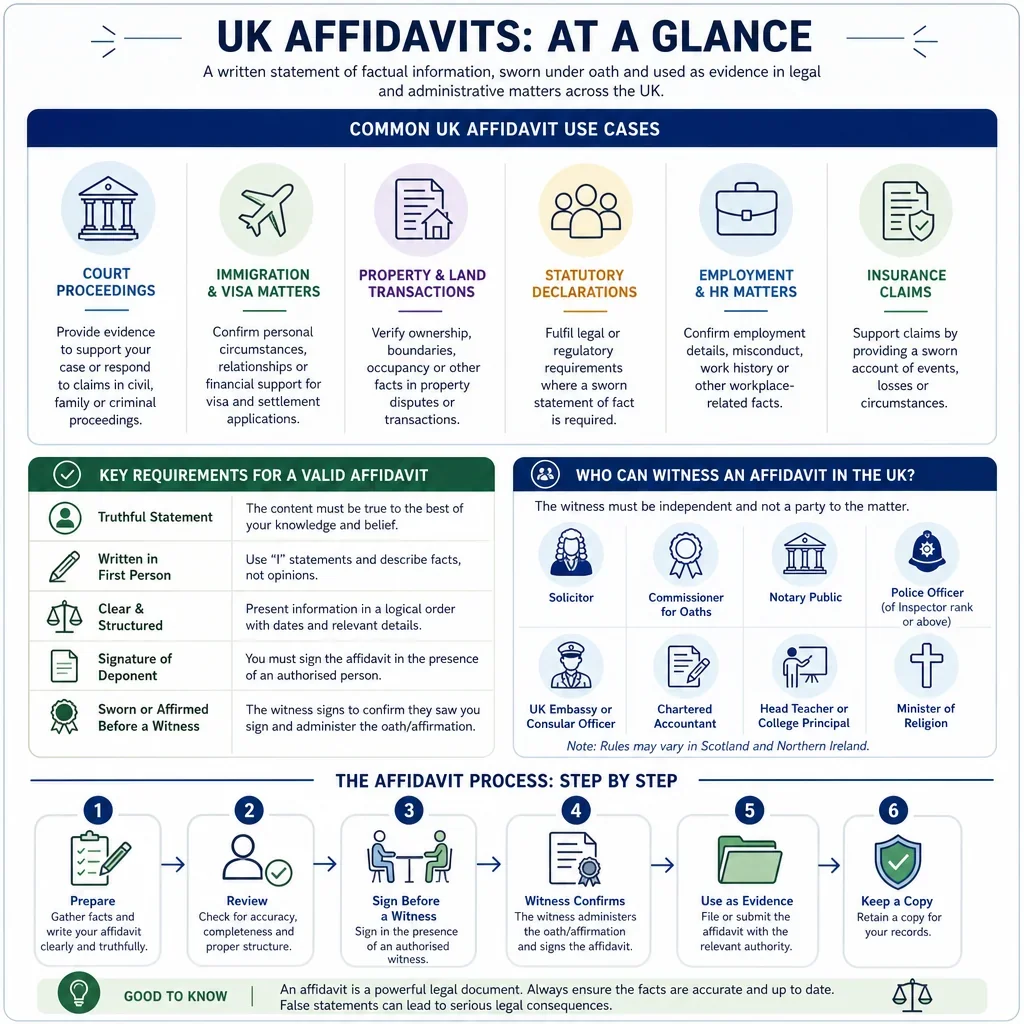
Understand common UK affidavit uses, key requirements, and when you may need one for legal, court, or official purposes.
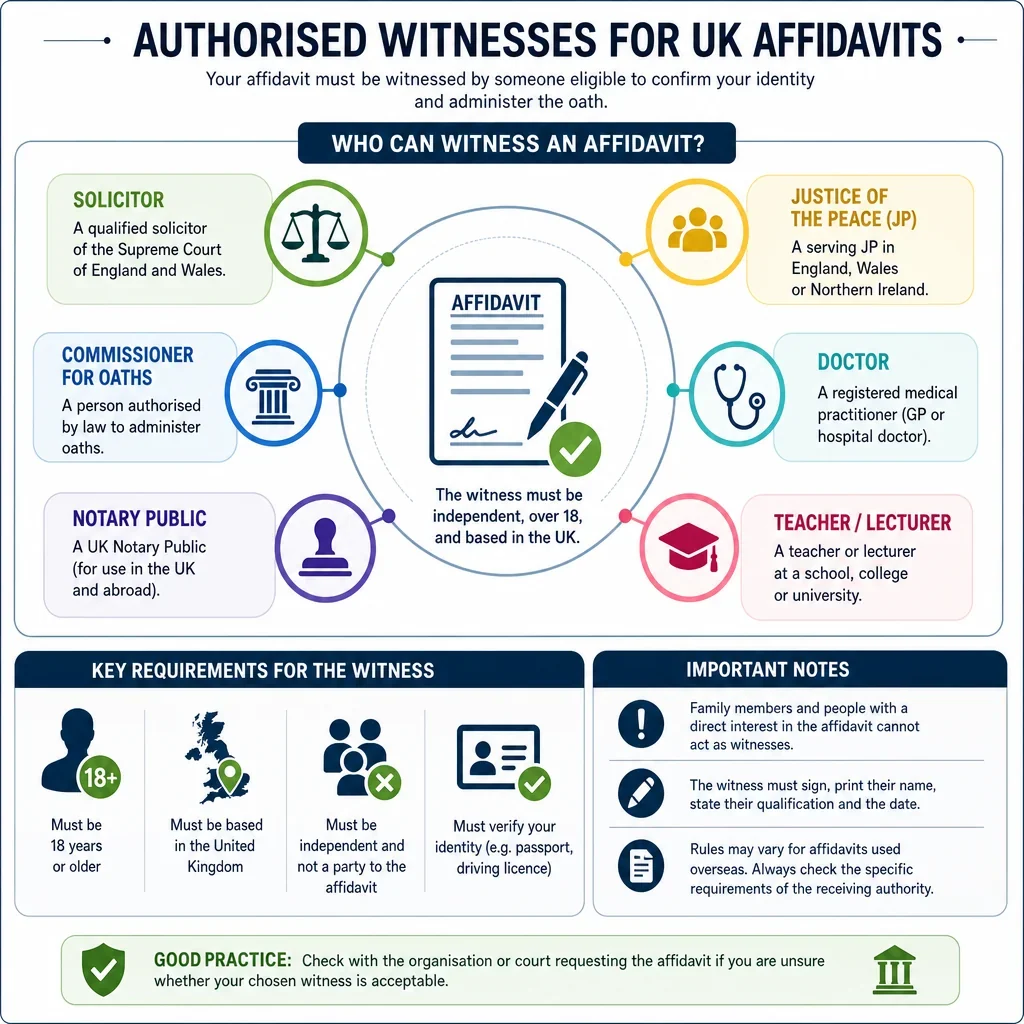
Learn who can act as authorised witnesses for UK affidavits and why the right witness matters for validity and acceptance.
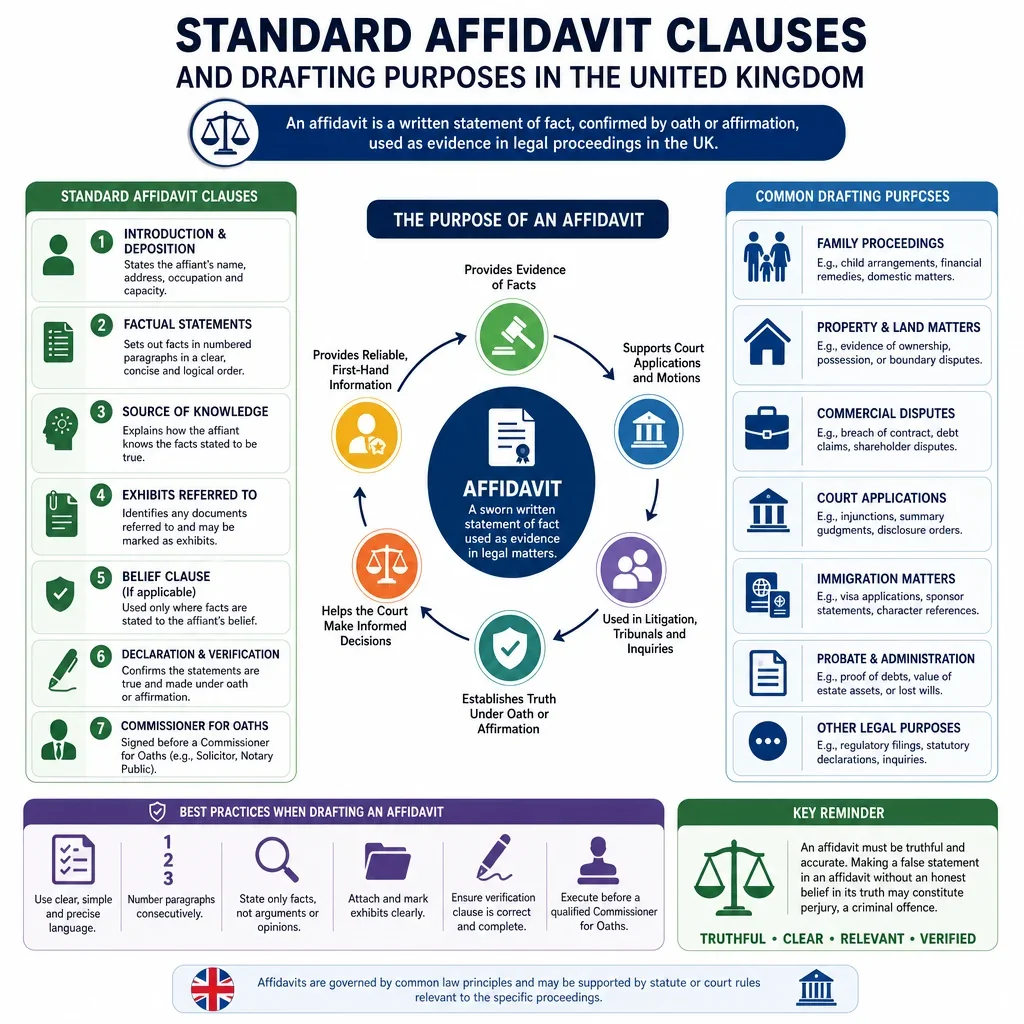
Explore standard affidavit clauses in the United Kingdom, with drafting purposes and practical guidance for clearer legal statements.
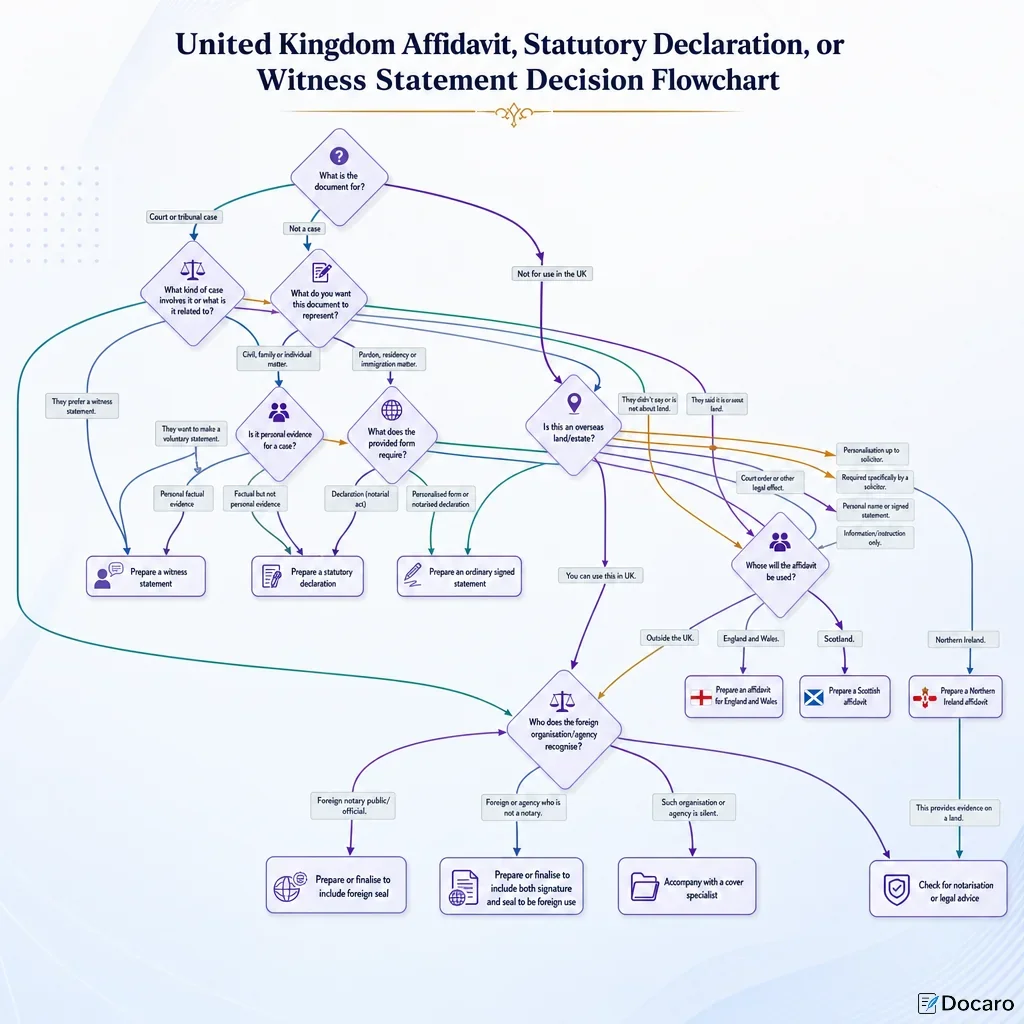
United Kingdom guide to choosing an affidavit, statutory declaration, or witness statement with a practical decision flowchart.
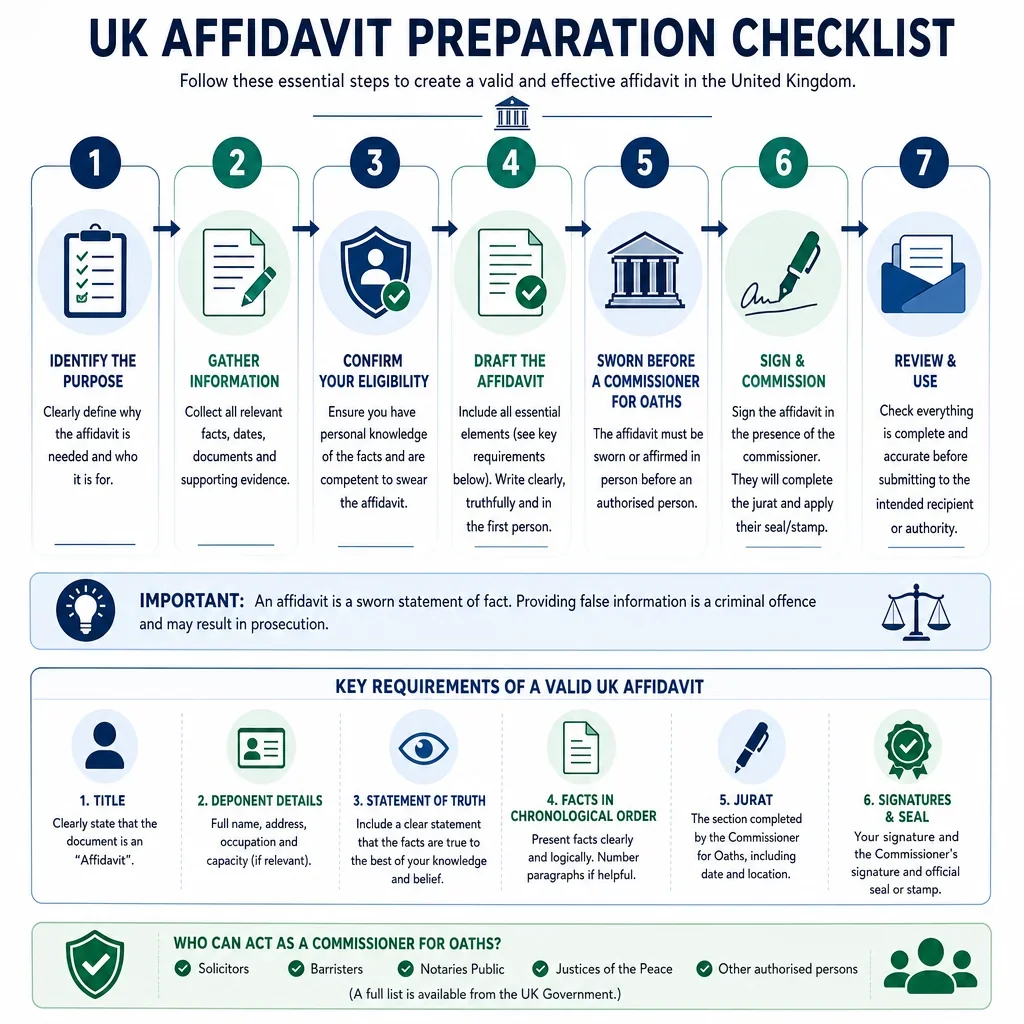
United Kingdom affidavit checklist items to help prepare key details, evidence, and supporting information for a clear statement.
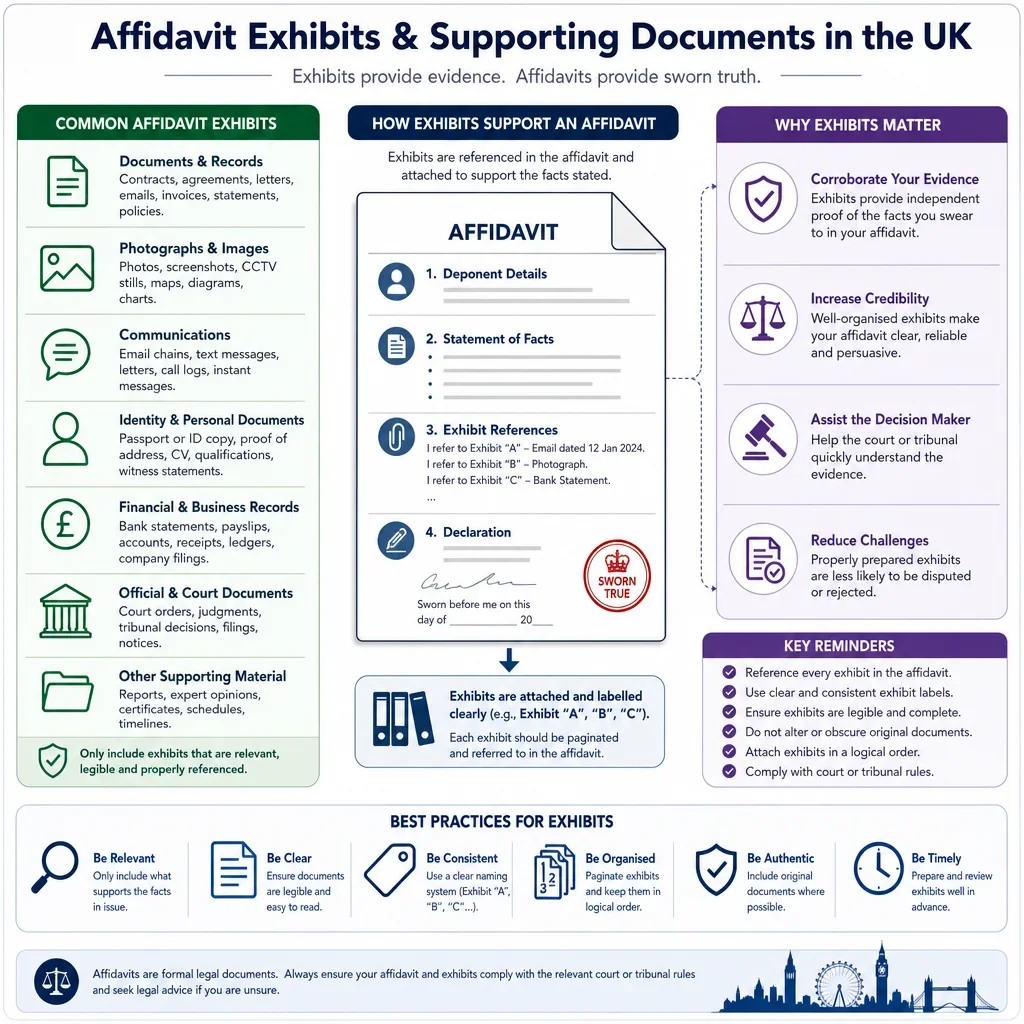
Common affidavit exhibits and supporting documents in the United Kingdom, with practical guidance on evidence used in sworn statements.
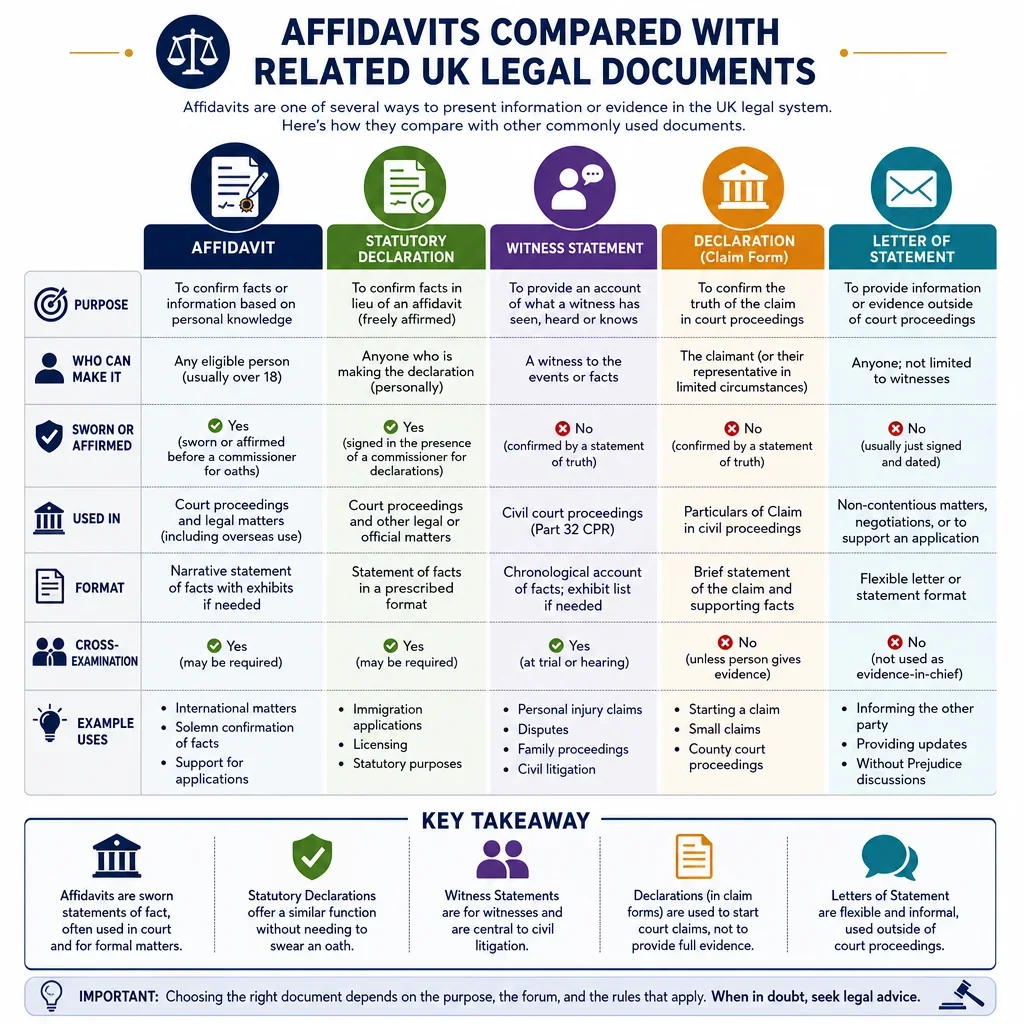
Compare affidavits with related UK legal documents and understand when each is used in legal or formal contexts.
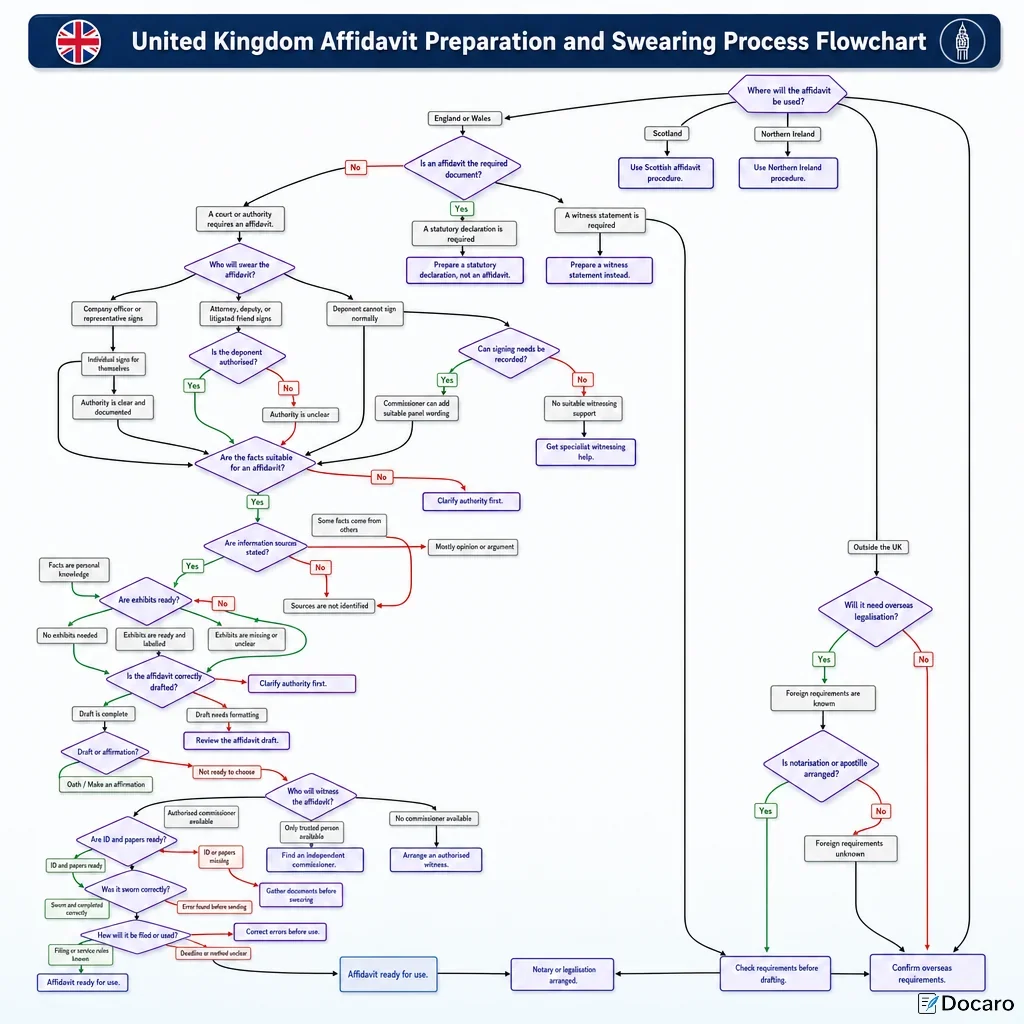
Follow the United Kingdom affidavit preparation and swearing process with a clear flowchart for faster, more confident completion.
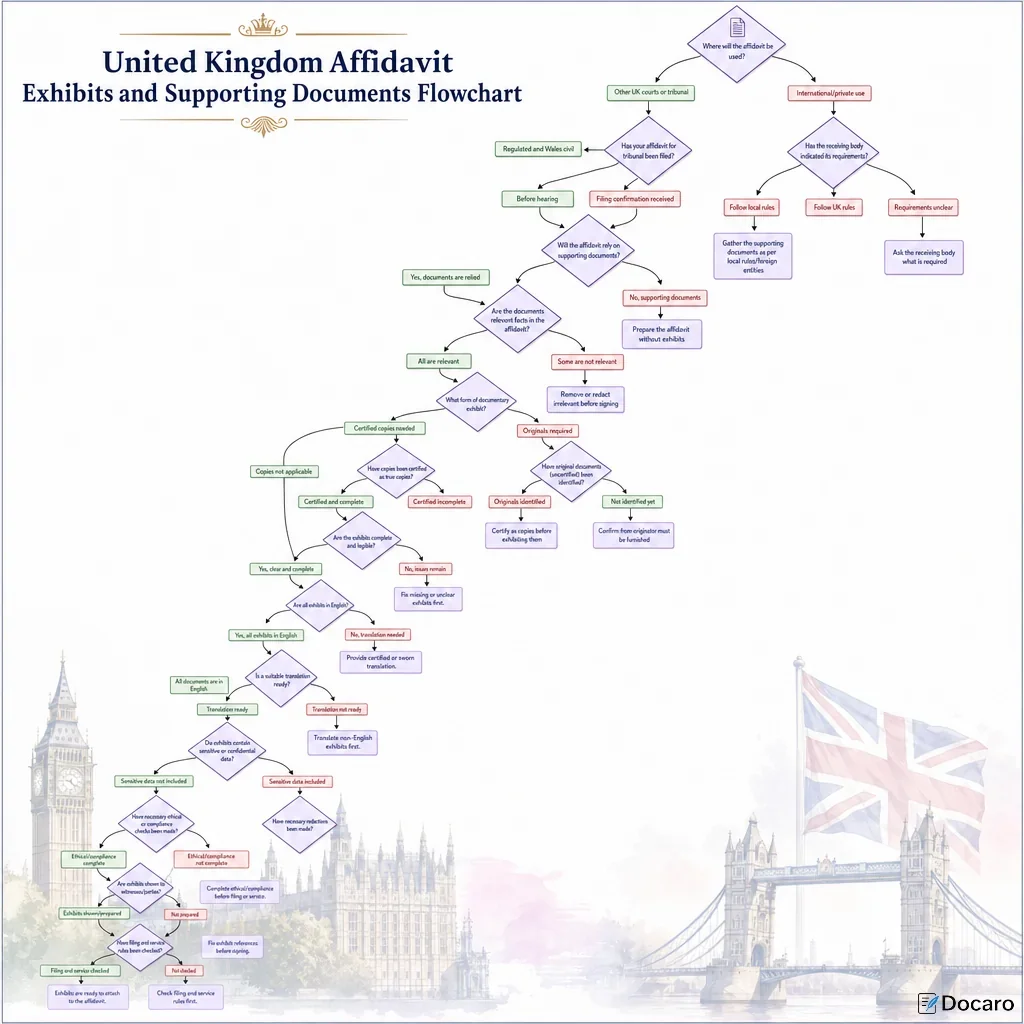
United Kingdom affidavit exhibits flowchart for organising supporting documents and evidence clearly.
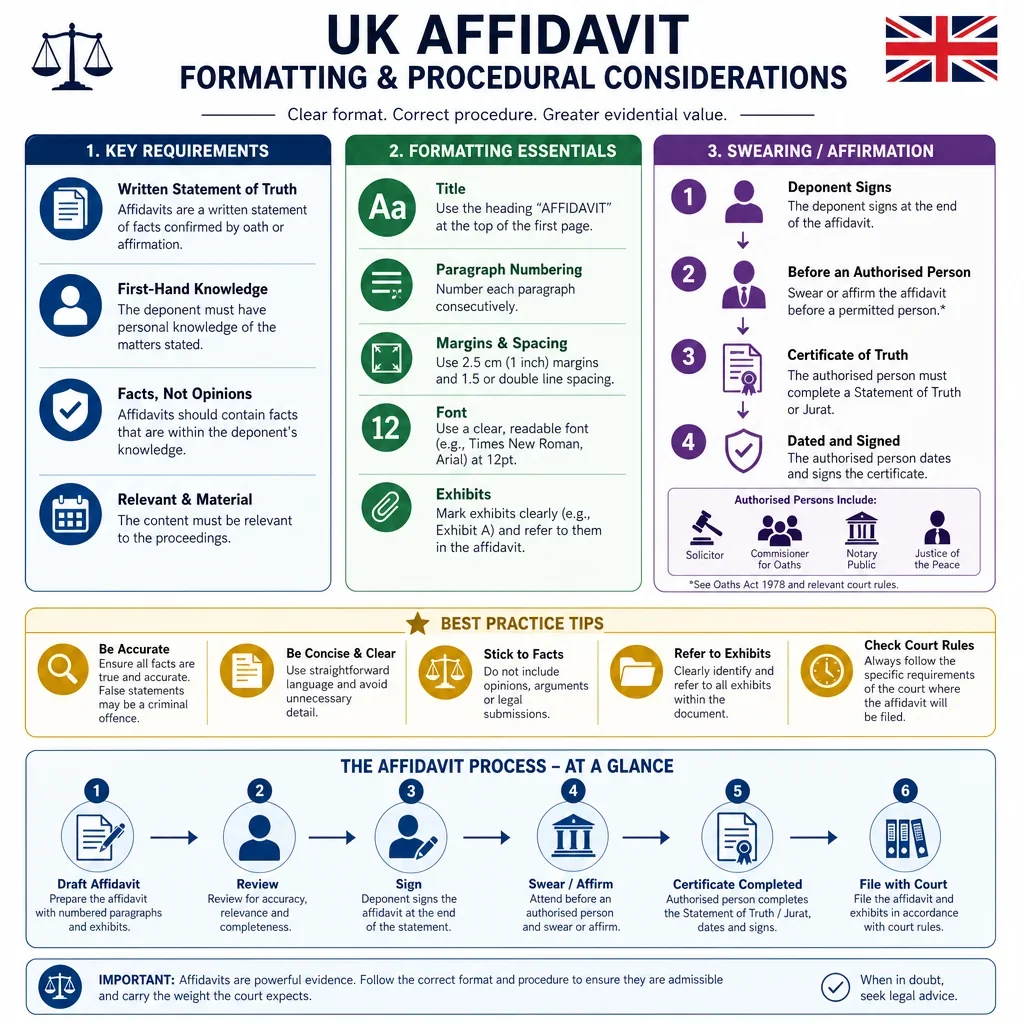
UK affidavit formatting and procedural considerations for clearer, compliant affidavit preparation in the United Kingdom.
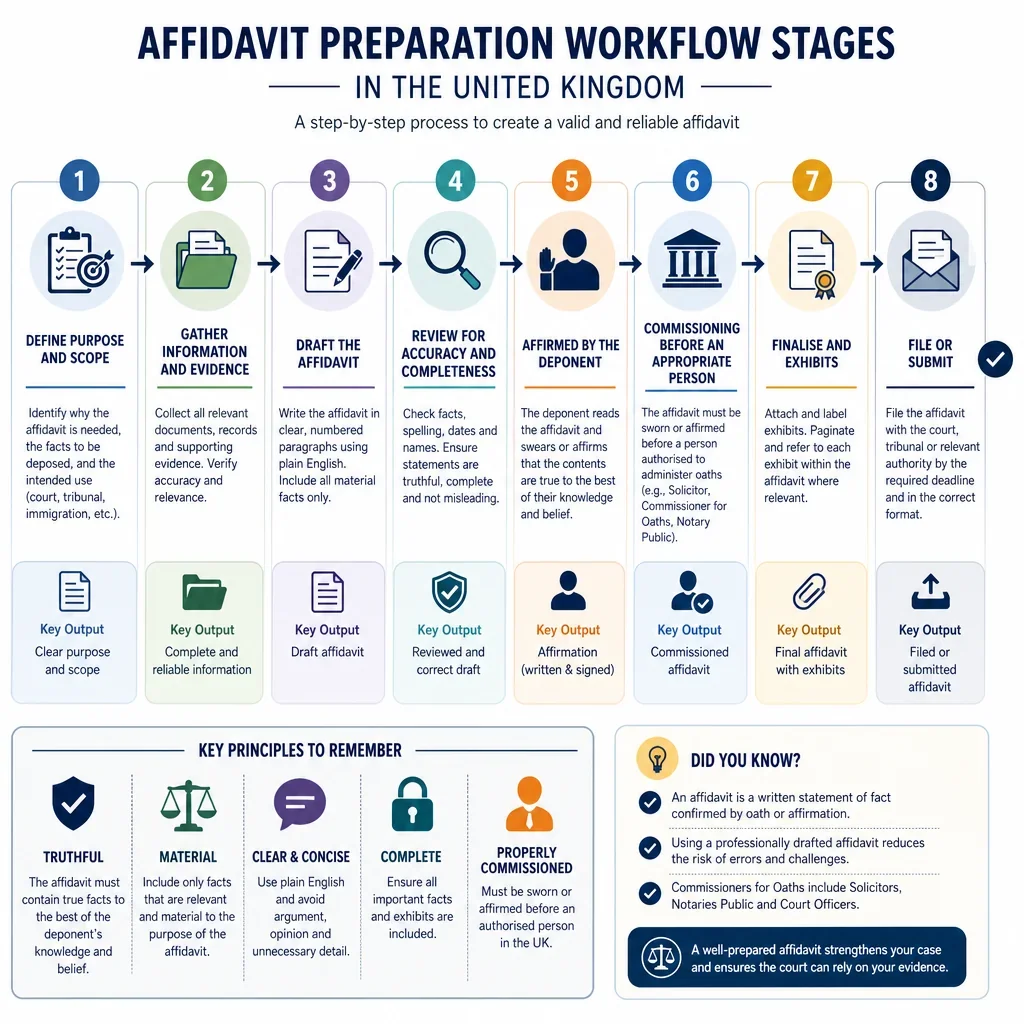
Affidavit preparation workflow stages in the United Kingdom, from fact gathering to review, signing, and completion.
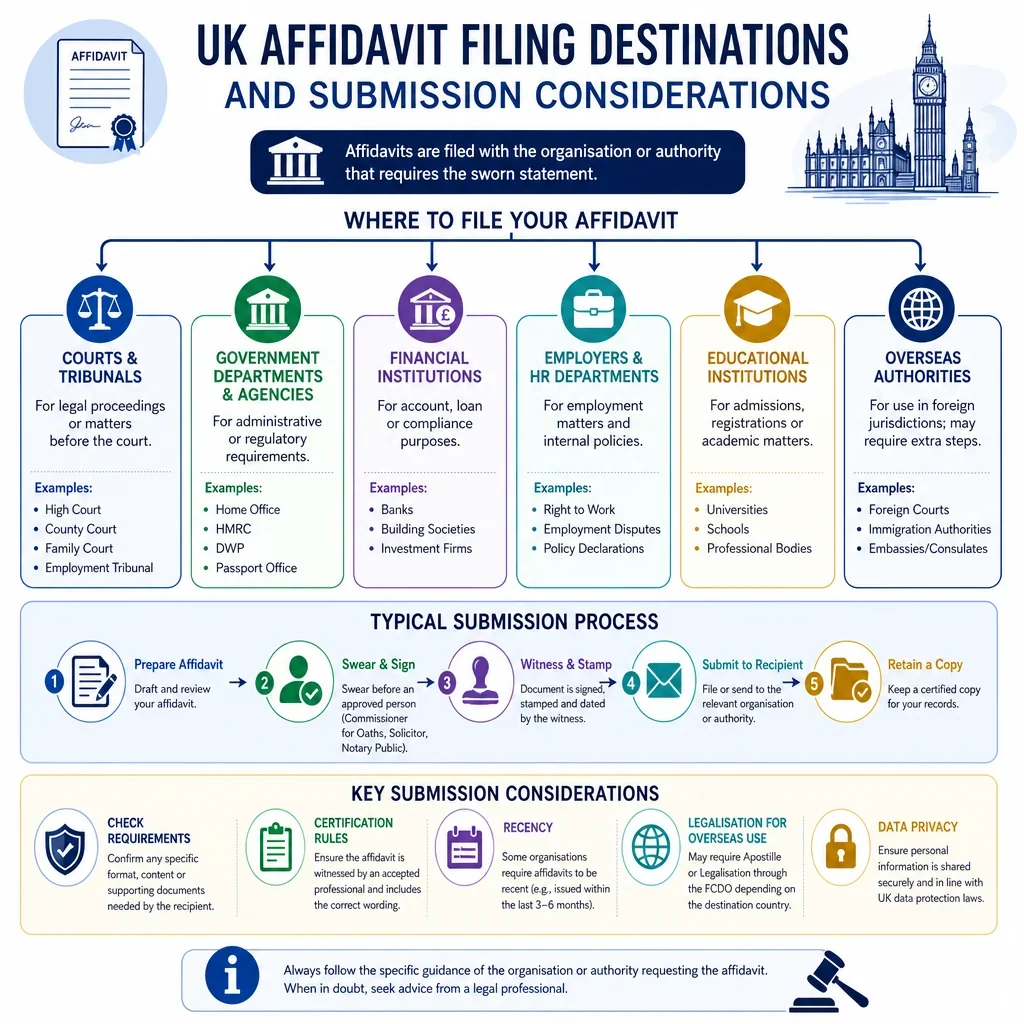
UK affidavit filing destinations, submission options, and practical considerations for preparing documents with confidence.