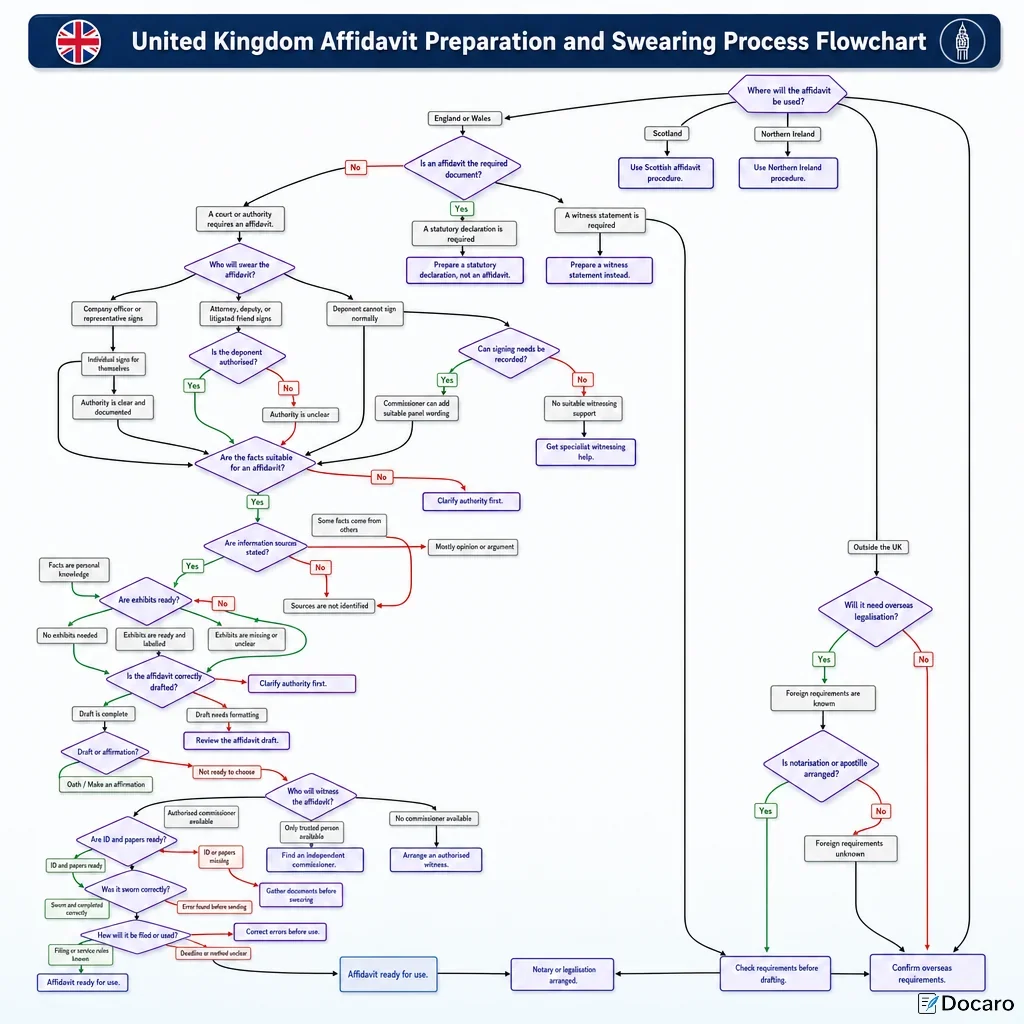
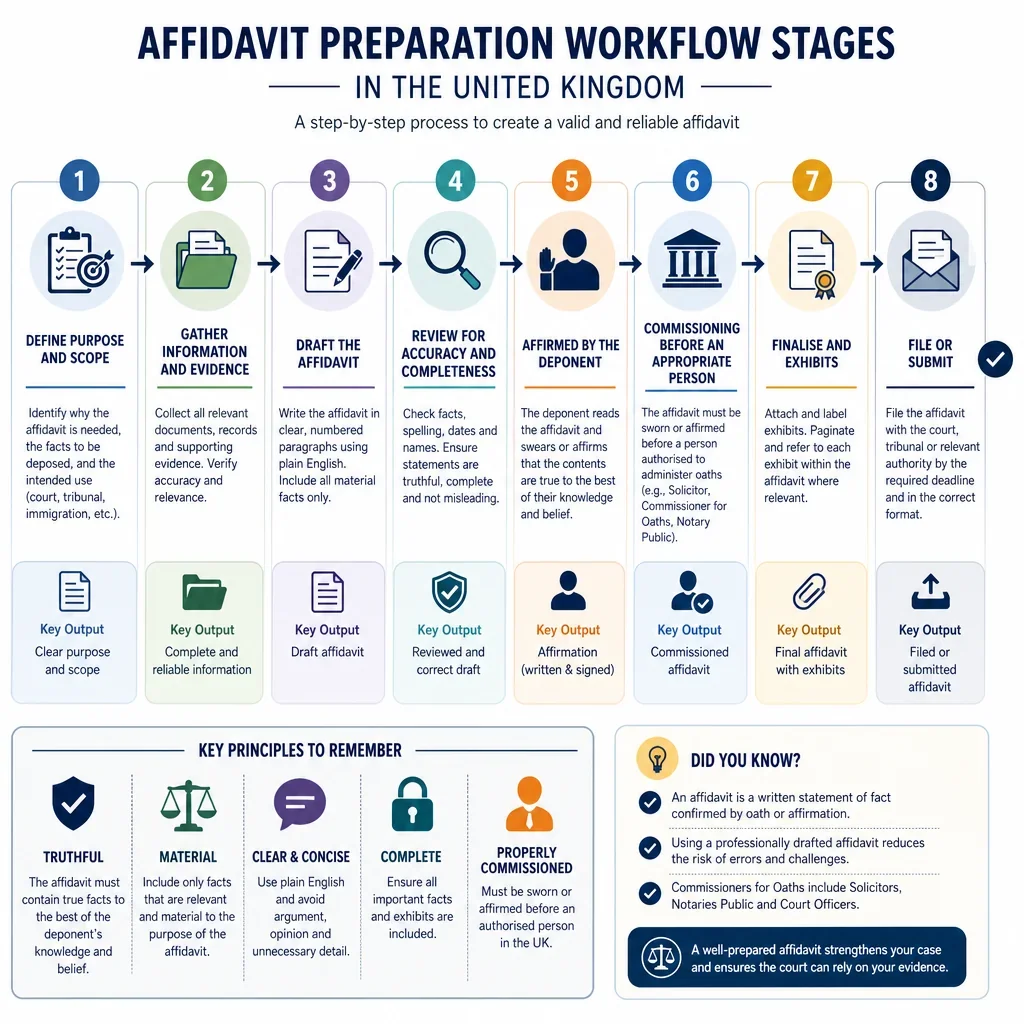
Affidavit Preparation Workflow Stages In The United Kingdom
Task | Responsible party | Input required | Output | Task status | Notes |
|---|---|---|---|---|---|
Gather information | |||||
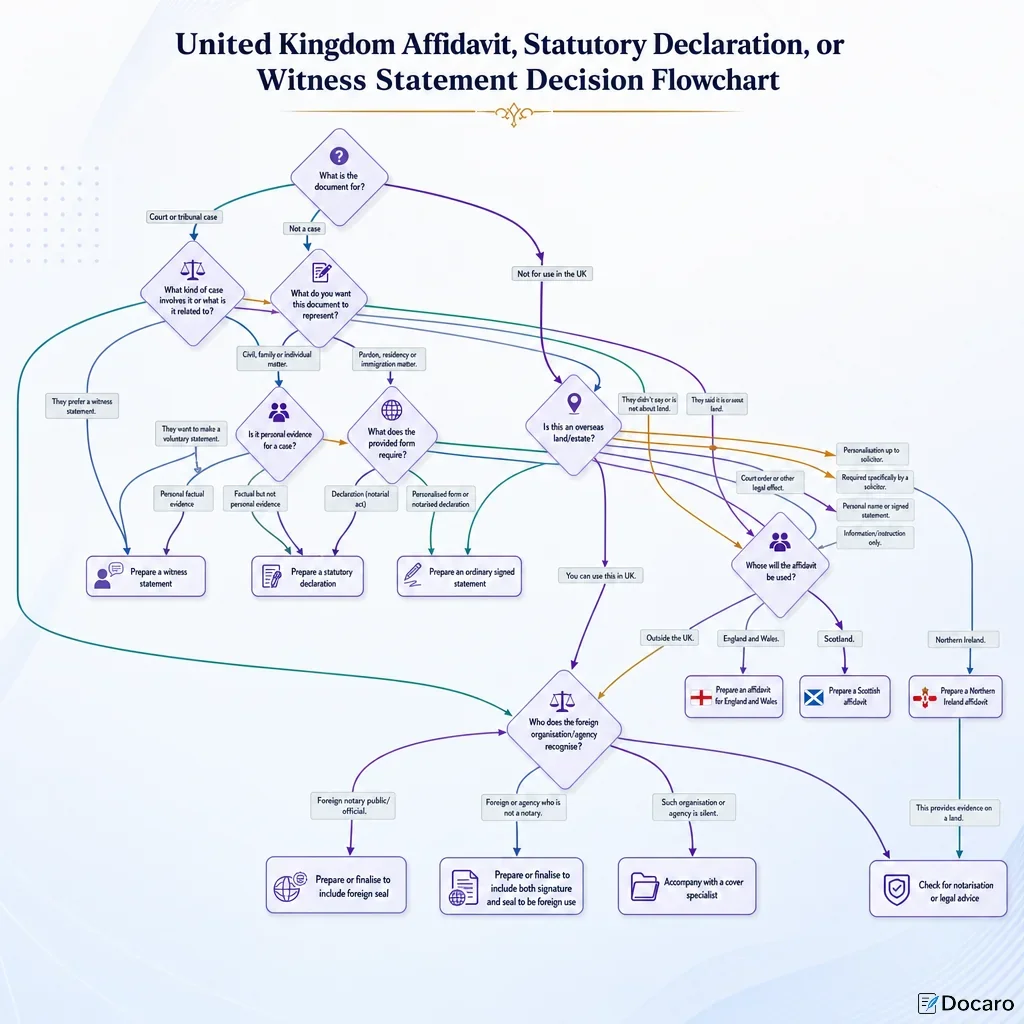
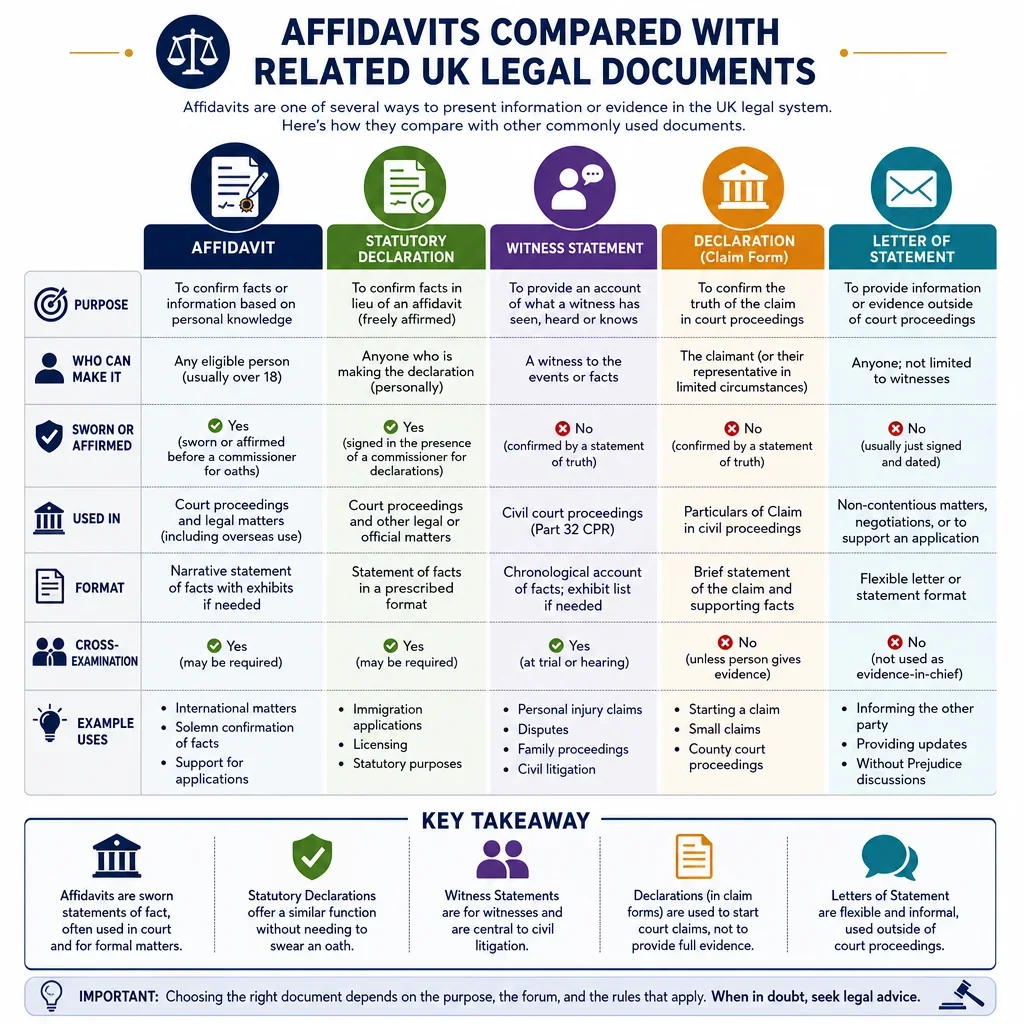
Identify why the affidavit is needed | Deponent | Court request, application requirement or receiving body instructions | Clear purpose and required scope | Not started | Confirm whether an affidavit, witness statement or statutory declaration is required. |
Identify court or receiving body rules | Solicitor or legal representative | Case type, court, tribunal or organisation details | Relevant filing and format requirements | Not started | Civil affidavits should be checked against CPR Part 32 and Practice Direction 32. |
Collect deponent identity details | Deponent | Full name, address, occupation and contact details | Accurate deponent profile | In progress | Use current legal name and details matching identification documents. |
Confirm deponent capacity or authority | Solicitor or legal representative | Role, authority, company position or personal knowledge basis | Statement of capacity for the affidavit | In progress | If signing for an organisation, confirm authority before drafting. |
Prepare factual chronology | Deponent | Key dates, events, names and locations | Chronological fact list | In progress | Separate direct knowledge from information received from others. |
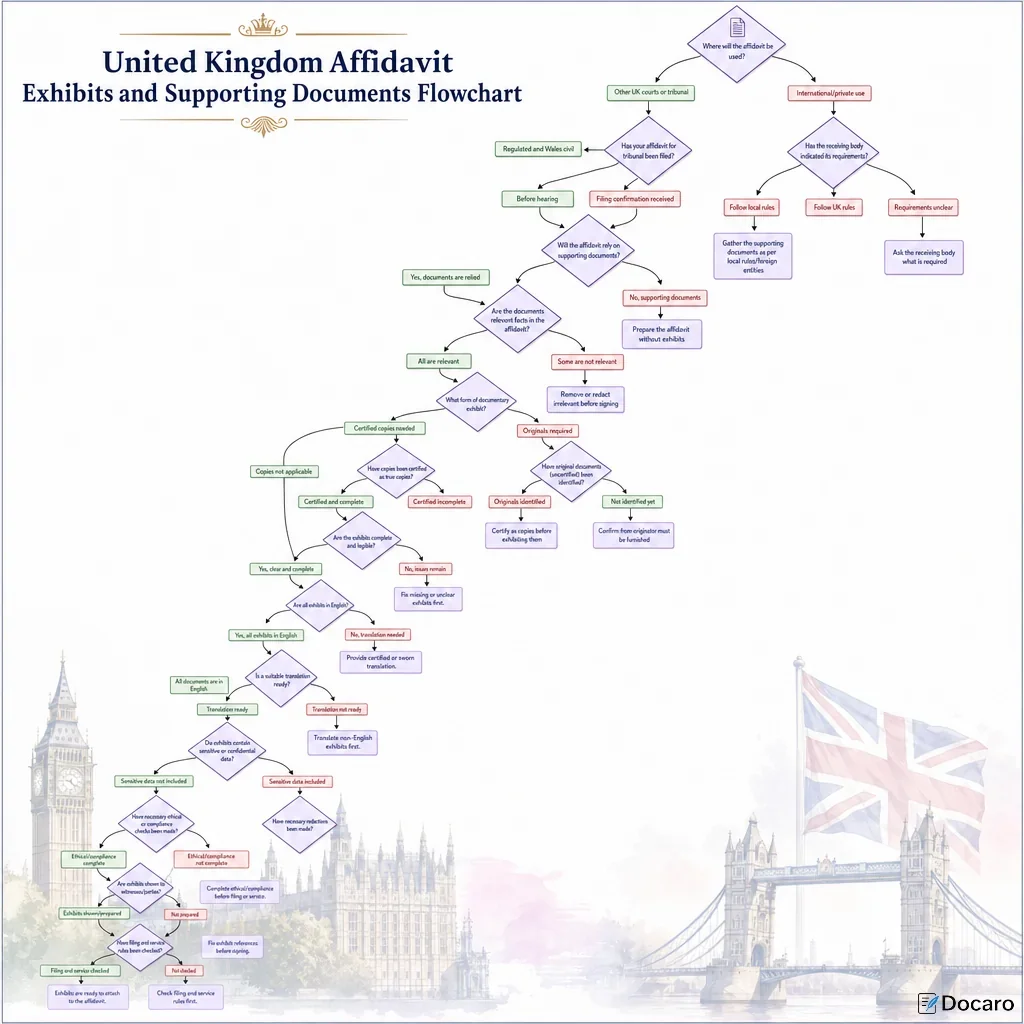
Collect supporting documents | Deponent | Contracts, letters, emails, photos, records or official documents | Potential exhibit bundle | In progress | Keep originals safe and use complete, legible copies where possible. |
Flag confidential or sensitive material | Solicitor or legal representative | Personal data, children details, medical records or commercial information | Confidentiality and redaction plan | Ready for review | Consider data protection, privacy restrictions and court anonymity rules. |
Confirm filing deadline | Administrative support | Court order, procedural timetable or receiving body deadline | Calendar entry and completion timetable | Not started | Allow time for drafting, exhibits, swearing and filing. |
Choose oath or affirmation route | Deponent | Religious preference or non-religious affirmation choice | Selected swearing method | Not started | A solemn affirmation is generally available as an alternative to an oath. |
Draft affidavit | |||||
Select correct affidavit format | Solicitor or legal representative | Court form, precedent or receiving body guidance | Suitable affidavit template | Not started | Some applications require prescribed wording or forms. |
Draft case or matter heading | Administrative support | Court name, claim number, parties and application title | Accurate affidavit heading | In progress | Match the heading used in the proceedings or application. |
Draft deponent introduction | Solicitor or legal representative | Deponent name, address, occupation and role | Opening identity paragraph | In progress | State how the deponent knows the facts. |
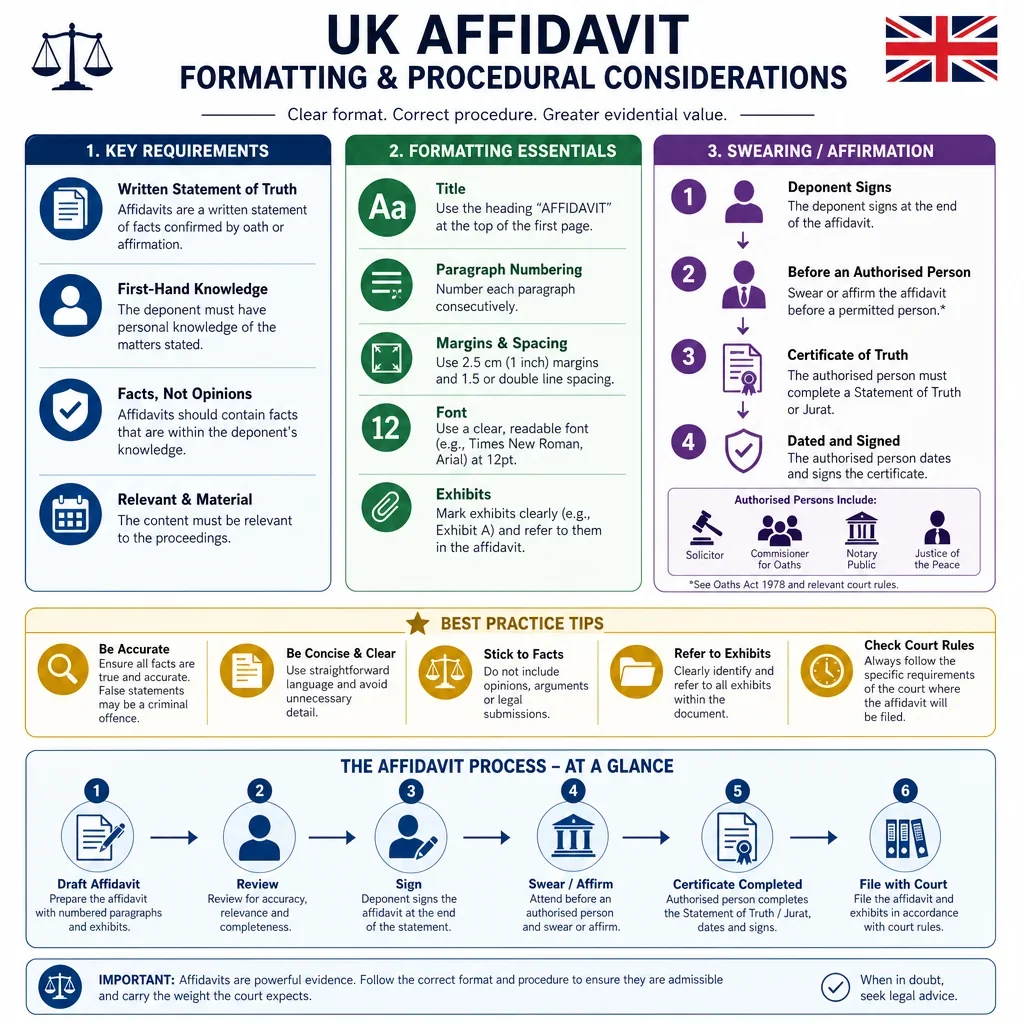
Draft numbered factual paragraphs | Solicitor or legal representative | Chronology and supporting evidence | Structured affidavit body | In progress | Use concise numbered paragraphs and avoid argument unless required. |
Identify sources of information and belief | Solicitor or legal representative | Facts personally known and information from others | Source-labelled evidence paragraphs | Ready for review | Say who provided information and why it is believed true. |
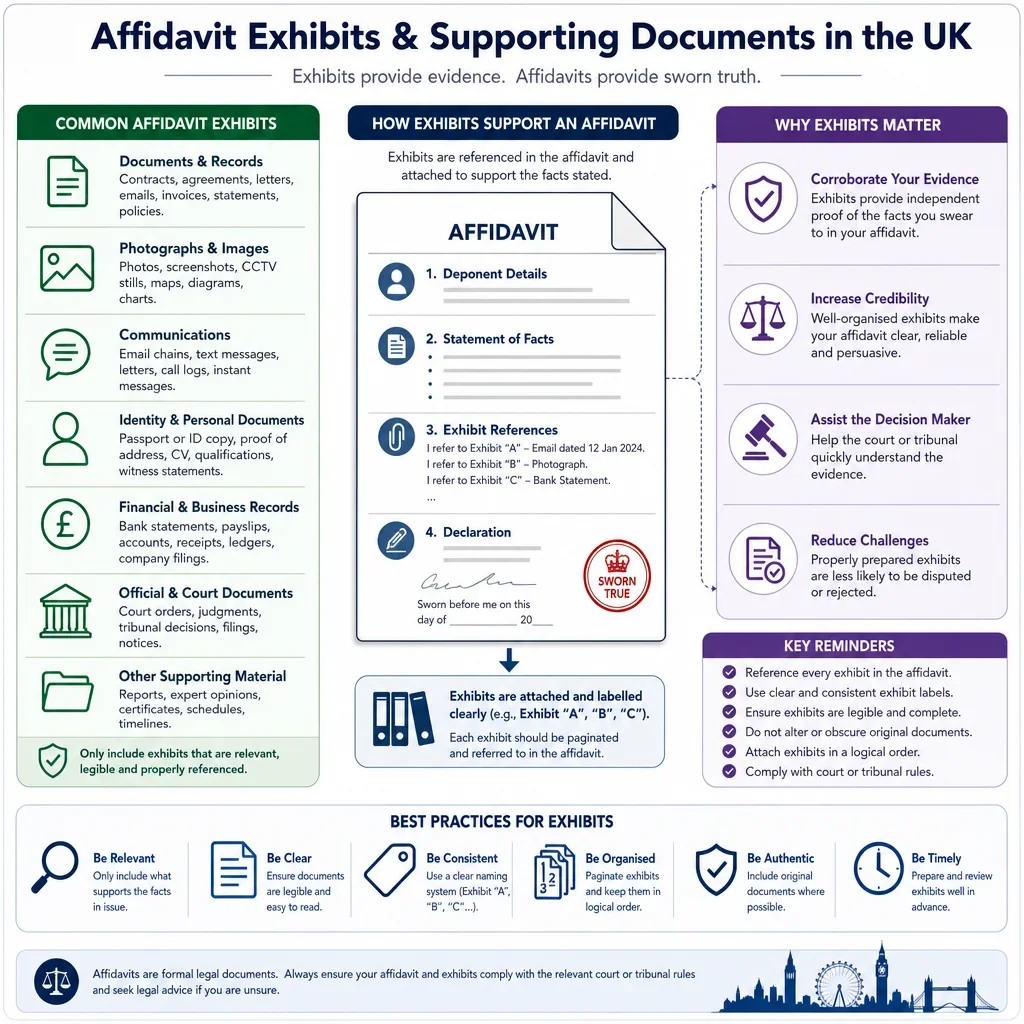
Insert exhibit references | Solicitor or legal representative | Final exhibit list and paragraph locations | Affidavit with exhibit references | In progress | Use consistent labels such as initials and sequential numbers. |
Add jurat wording placeholder | Solicitor or legal representative | Oath or affirmation wording and witness details | Draft jurat section | Ready for review | The jurat must be completed at swearing, not guessed in advance. |
Edit for clarity and precision | Solicitor or legal representative | Draft affidavit text | Clear revised draft | Ready for review | Avoid vague phrases, exaggeration and legal conclusions without facts. |
Review facts and exhibits | |||||
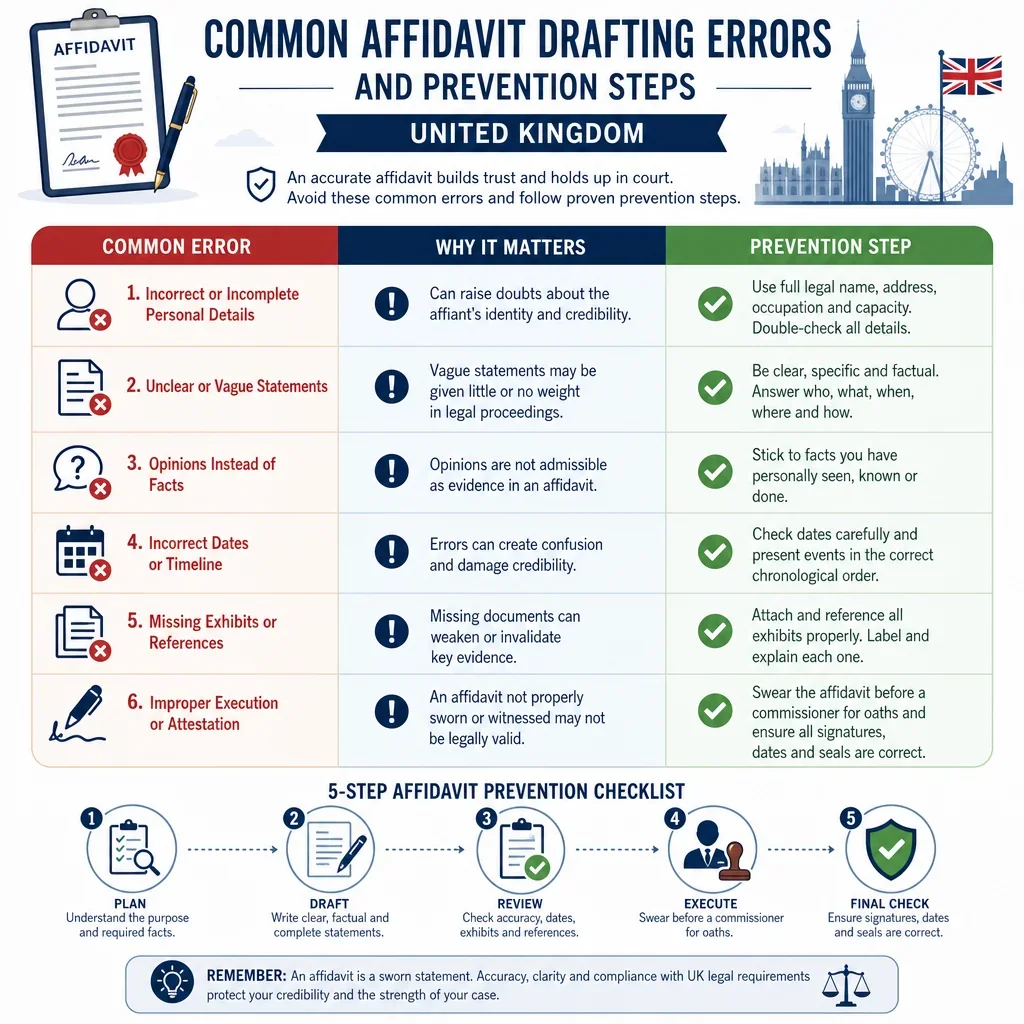
Check names, dates and numbers | Administrative support | Draft affidavit and source documents | Corrected factual details | In progress | Small errors can create doubt or require re-swearing. |
Deponent reviews truth and completeness | Deponent | Full draft affidavit and exhibits | Approved or amended draft | Ready for review | The deponent must not swear facts they know are false. |
Review relevance and admissibility | Solicitor or legal representative | Draft affidavit, pleadings, application and evidence | Legally focused evidence draft | Ready for review | Remove irrelevant material, privileged content or unsupported assertions. |
Mark each exhibit clearly | Administrative support | Exhibit documents and agreed exhibit labels | Labelled exhibit set | In progress | Ensure exhibit labels match the affidavit paragraph references exactly. |
Paginate affidavit and exhibits | Administrative support | Final draft and exhibit bundle | Paginated affidavit bundle | In progress | Check any court-specific pagination or electronic bundle rules. |
Verify every exhibit is present | Administrative support | Affidavit references and exhibit bundle | Complete exhibit cross-check | Ready for review | Missing exhibits should be added before swearing. |
Check translations and certificates | Solicitor or legal representative | Foreign-language documents and certified translations | Translation-ready exhibit set | Ready for review | Confirm whether the court requires a translator certificate or affidavit. |
Remove blanks and draft comments | Administrative support | Final pre-swearing version | Clean final affidavit | Completed | Do not leave placeholders except the jurat details to be completed at swearing. |
Arrange oath or affirmation | |||||
Book authorised witness | Administrative support | Availability of solicitor, commissioner for oaths or officer | Swearing appointment confirmed | Not started | Check the witness is authorised to administer oaths in the relevant jurisdiction. |
Confirm commissioner or solicitor authority | Authorised witness | Professional status and authority to administer oaths | Valid authorised witness confirmed | Ready for review | Commissioners for oaths have statutory powers to administer oaths and take affidavits. |
Prepare identification for appointment | Deponent | Passport, driving licence or other accepted ID | Identity documents ready | Not started | Ask the witness what ID they require before attending. |
Print or prepare final version | Administrative support | Approved final affidavit and exhibits | Execution copy ready | In progress | Use the exact version reviewed by the deponent. |
Arrange interpreter if required | Solicitor or legal representative | Language needs and interpreter availability | Interpreter attendance arranged | Not started | The deponent must understand the affidavit and oath or affirmation. |
Confirm in-person or remote procedure | Authorised witness | Receiving body rules and witness procedure | Accepted execution procedure confirmed | Ready for review | Do not assume remote swearing is accepted by the receiving body. |
Check oath fee and payment method | Administrative support | Witness fee information and exhibit count | Payment ready | Not started | Fees may apply per affidavit and per exhibit. |
Sign and complete jurat | |||||
Read final affidavit before swearing | Deponent | Execution copy and exhibits | Final confirmation of truth | In progress | Do not sign if any statement is inaccurate or unclear. |
Administer oath or affirmation | Authorised witness | Deponent, final affidavit and chosen oath or affirmation | Affidavit sworn or affirmed | In progress | The oath or affirmation must occur before signing is treated as complete. |
Deponent signs affidavit | Deponent | Sworn or affirmed final affidavit | Signed affidavit | Completed | Sign where directed and initial alterations if required by the witness. |
Complete jurat with date and place | Authorised witness | Swearing date, location and witness details | Completed jurat | Completed | The jurat should show before whom and where the affidavit was sworn. |
Authenticate exhibits | Authorised witness | Exhibit sheets and affidavit references | Witnessed exhibit markings | Completed | Each exhibit should be identifiable as the document referred to in the affidavit. |
Initial approved handwritten corrections | Deponent | Minor correction approved before swearing | Corrected and initialled execution copy | Completed | Major changes should usually be typed and rechecked before swearing. |
Add witness signature and details | Authorised witness | Witness name, capacity, firm or office and signature | Witness-completed affidavit | Completed | Use official stamp where required or customary. |
Scan signed affidavit and exhibits | Administrative support | Original signed affidavit bundle | Electronic signed copy | Completed | Check every signed page and exhibit is readable in the scan. |
File or submit document | |||||
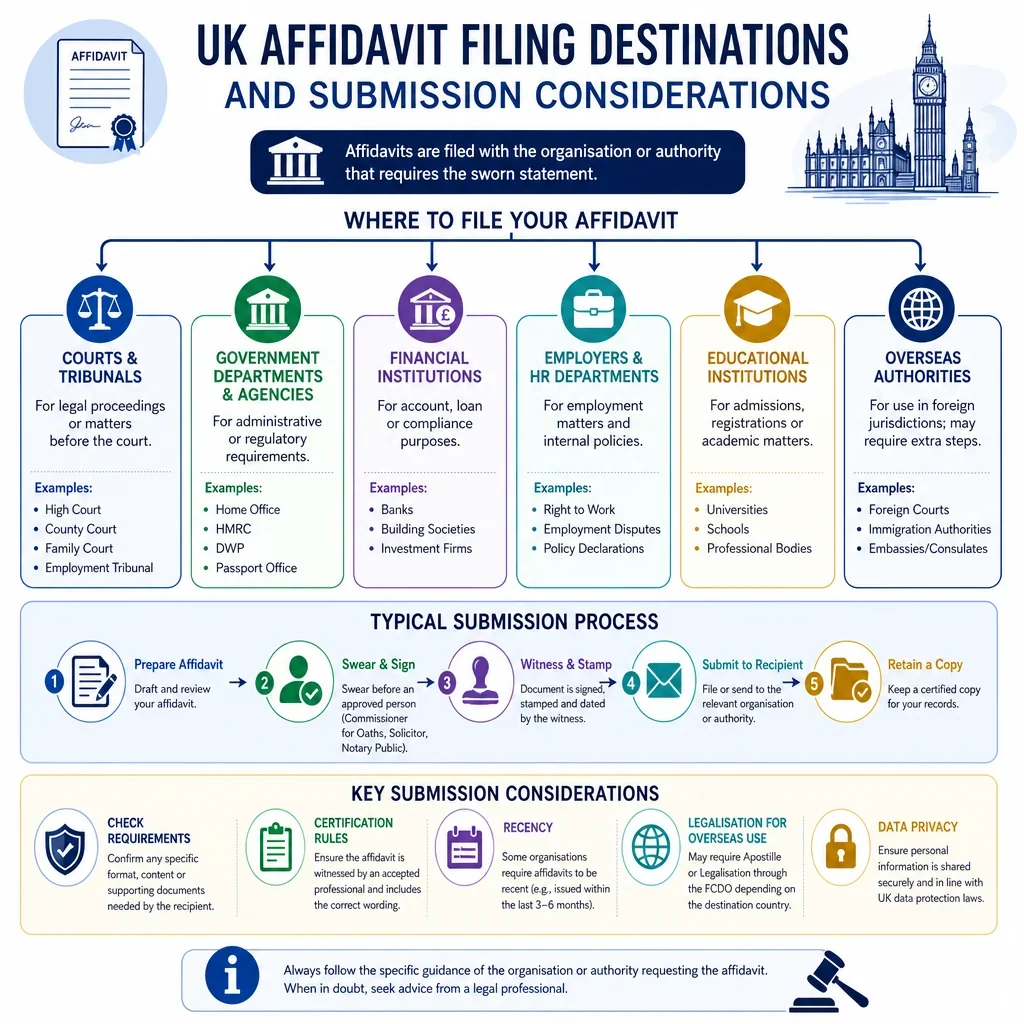
Confirm filing method | Court or receiving body | Court guidance, portal rules or postal address | Chosen submission route | Not started | HMCTS e-filing may apply in some jurisdictions and court centres. |
Prepare filing fee if required | Administrative support | Fee order, court fee guidance or payment reference | Payment arranged | Not started | Check current court fees before filing. |
Upload affidavit to filing portal | Administrative support | Signed PDF, case number and portal credentials | Electronic submission made | In progress | Use searchable PDF and correct case reference where possible. |
Lodge paper affidavit if required | Administrative support | Original signed affidavit and required copies | Paper document lodged | In progress | Confirm whether the receiving body needs the original, copies or both. |
Serve affidavit on required parties | Solicitor or legal representative | Service list, permitted method and deadline | Affidavit served | In progress | Keep proof of service and comply with the applicable procedural rules. |
Obtain filing receipt or seal | Court or receiving body | Submitted affidavit and case reference | Filing confirmation or sealed copy | Completed | Save the receipt, portal notification or sealed copy immediately. |
Respond to filing rejection | Solicitor or legal representative | Rejection notice and filed document set | Corrected resubmission | Not started | Act quickly if a deadline is affected by rejection. |
Notify deponent of filing outcome | Solicitor or legal representative | Filing confirmation, seal or rejection notice | Deponent updated | Completed | Record any further hearing or response deadlines. |
Store copies | |||||
Store original signed affidavit | Administrative support | Original affidavit and exhibits | Secure physical file | Completed | Keep the original safe if the court or receiving body may request it. |
Save electronic copy and exhibits | Administrative support | Signed scan, exhibits and filing receipt | Complete electronic archive | Completed | Use clear file names with date, deponent and case reference. |
Store proof of service | Administrative support | Email receipts, certificate of service or postal proof | Service evidence saved | Completed | Proof of service may be needed if service is later disputed. |
Apply retention and data protection controls | Solicitor or legal representative | File closing policy and personal data assessment | Compliant retention plan | Ready for review | Affidavits may contain personal data and sensitive exhibits. |
Record audit trail | Administrative support | Draft versions, review notes, execution date and filing receipt | Document history log | Completed | Keep enough history to explain changes if the affidavit is challenged. |
Return or retain originals as agreed | Solicitor or legal representative | Client instructions and court requirements | Originals retained or returned | Completed | Do not destroy originals while proceedings or related deadlines remain active. |
Diary follow-up evidence dates | Administrative support | Court directions, response periods and hearing dates | Follow-up reminder schedule | Completed | Further affidavits may be needed if evidence changes or is challenged. |
What Are The Key Steps To Prepare A UK Affidavit Correctly?
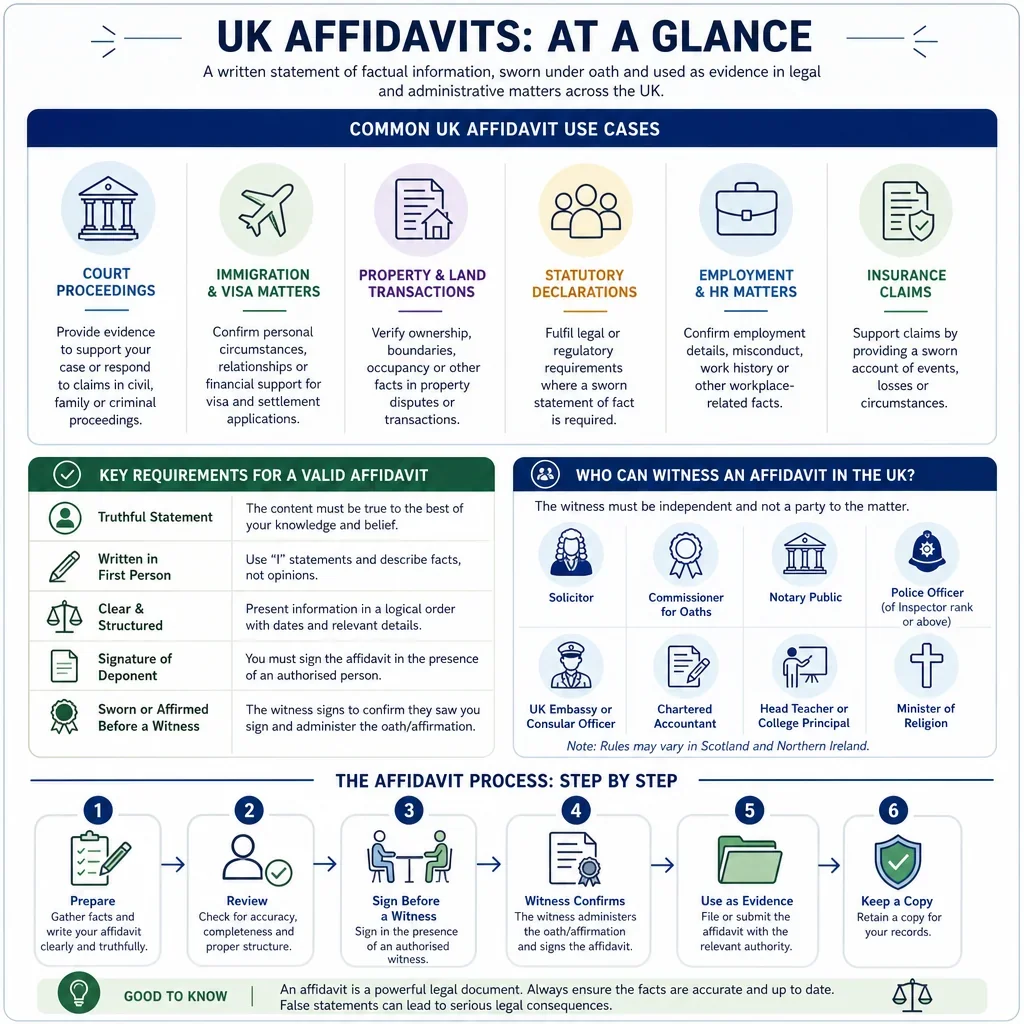
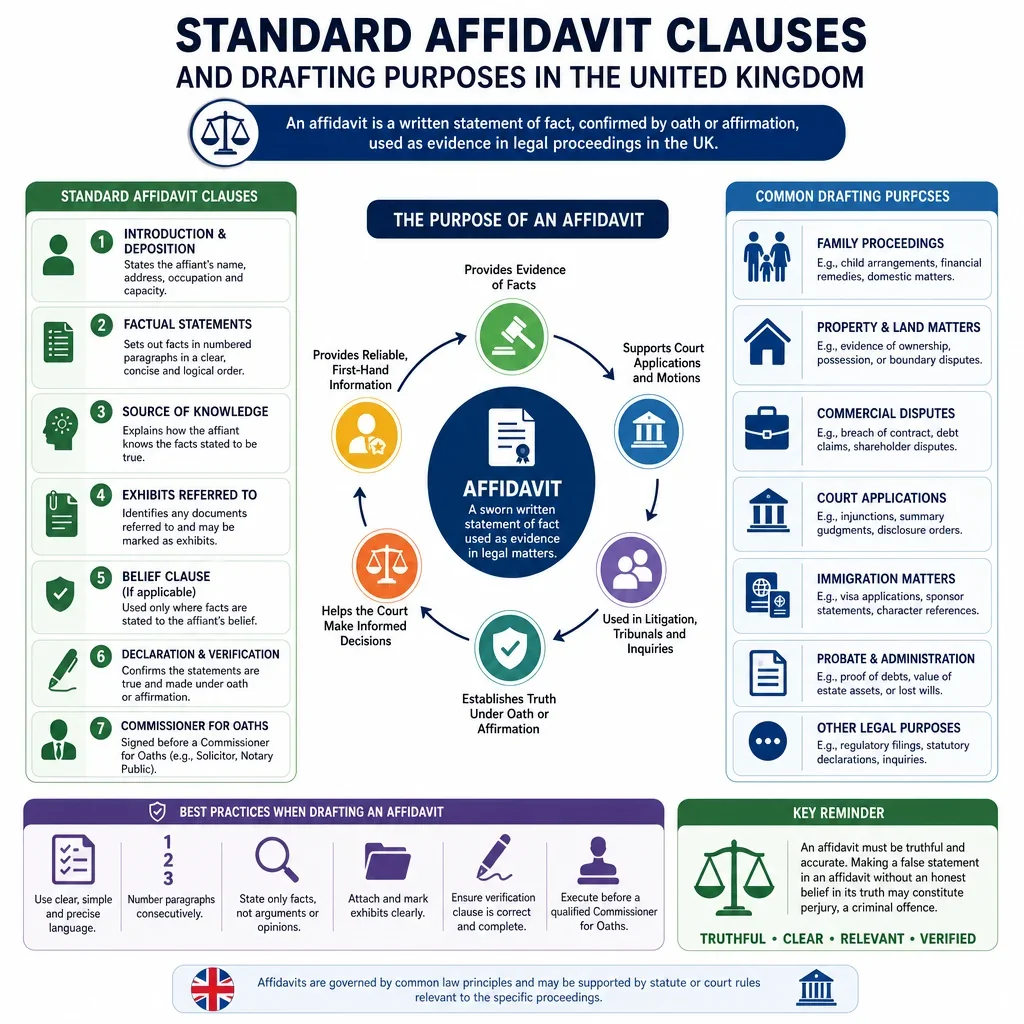
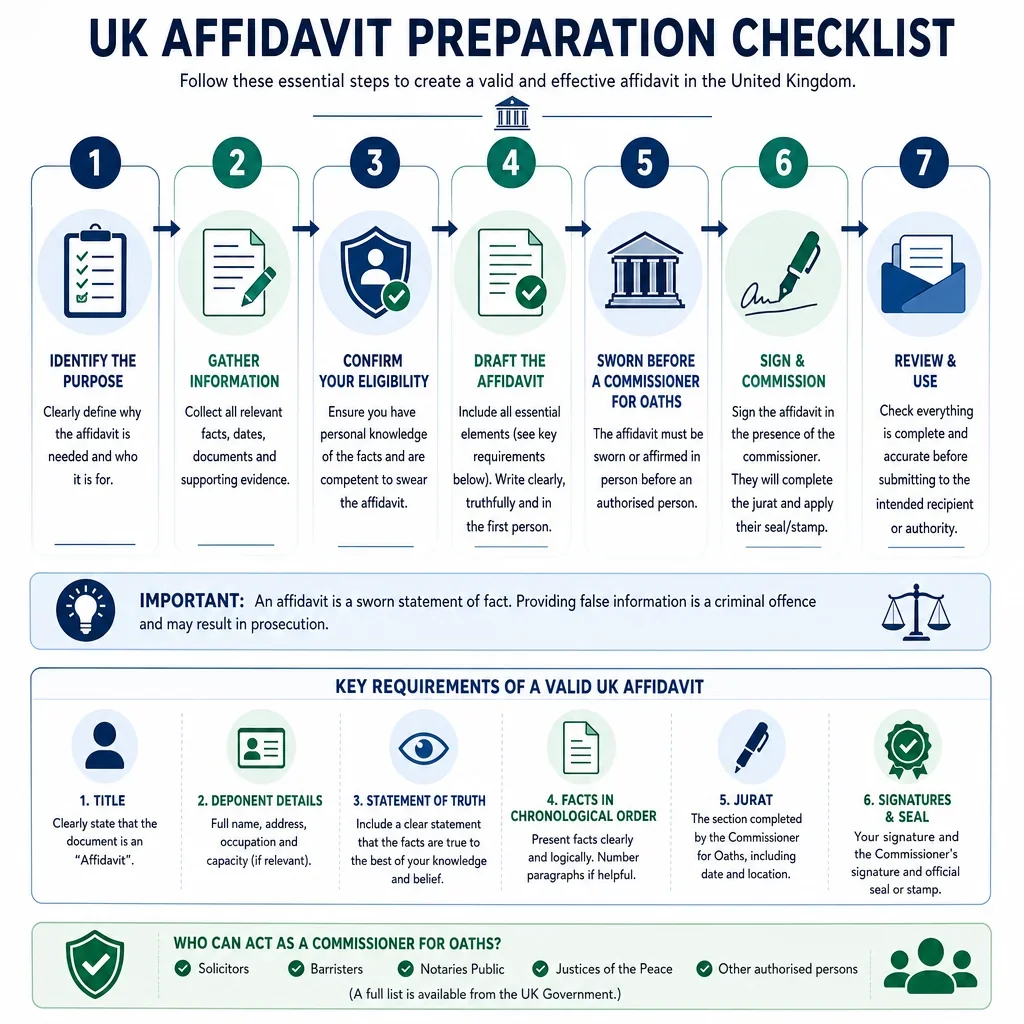
A UK affidavit should be treated as sworn evidence, not just a narrative statement. The deponent should first gather precise personal details, dates, facts and exhibits, then ensure the affidavit is drafted in numbered paragraphs and checked for accuracy before it is sworn or affirmed.
Who Can Witness An Affidavit In The UK?
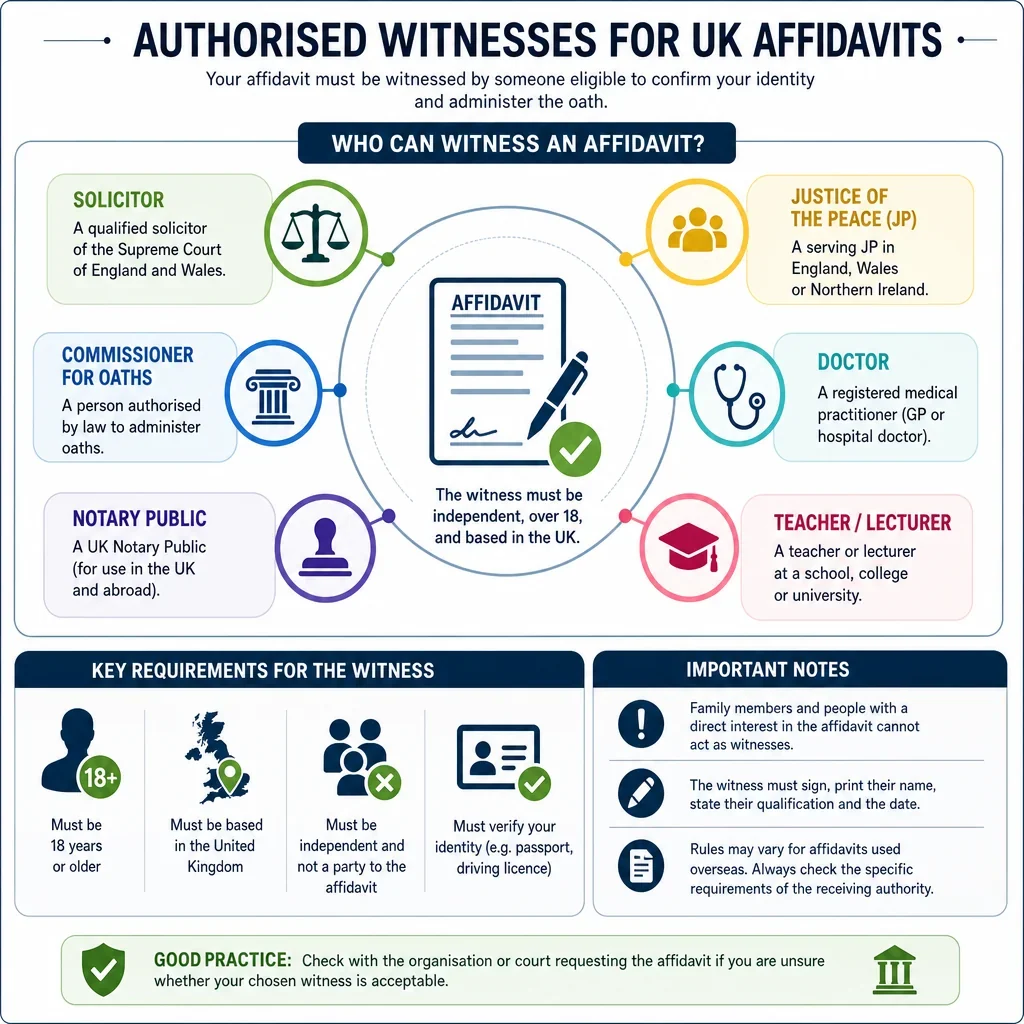
The affidavit must usually be sworn or affirmed before an authorised person, commonly a solicitor, commissioner for oaths or other authorised officer. The authorised witness completes the jurat, which records when, where and before whom the affidavit was sworn or affirmed.
Why Are Exhibits Important In An Affidavit?
Documents referred to in the affidavit should be clearly identified, ordered and marked as exhibits. Each exhibit should match the affidavit text, because missing, mislabelled or inconsistent exhibits can delay filing or reduce the usefulness of the evidence.
What Should Be Checked Before Filing An Affidavit?
Before filing or submitting the affidavit, check the receiving court or body rules, page numbering, exhibit labels, signatures, jurat wording and any required fee or method of submission. Civil court affidavits may need to comply with the Civil Procedure Rules and Practice Direction 32.
What Are The Main Risks If An Affidavit Is Wrong?
- Unsuitable witness: the affidavit may be rejected if it is not sworn or affirmed before an authorised person.
- Inaccurate facts: the deponent may face serious consequences for knowingly false sworn evidence.
- Poor exhibit handling: unclear or missing exhibits can undermine the document.
- Late filing: missing a court or tribunal deadline can affect the underlying application or proceedings.
FAQs
You Might Also Be Interested In