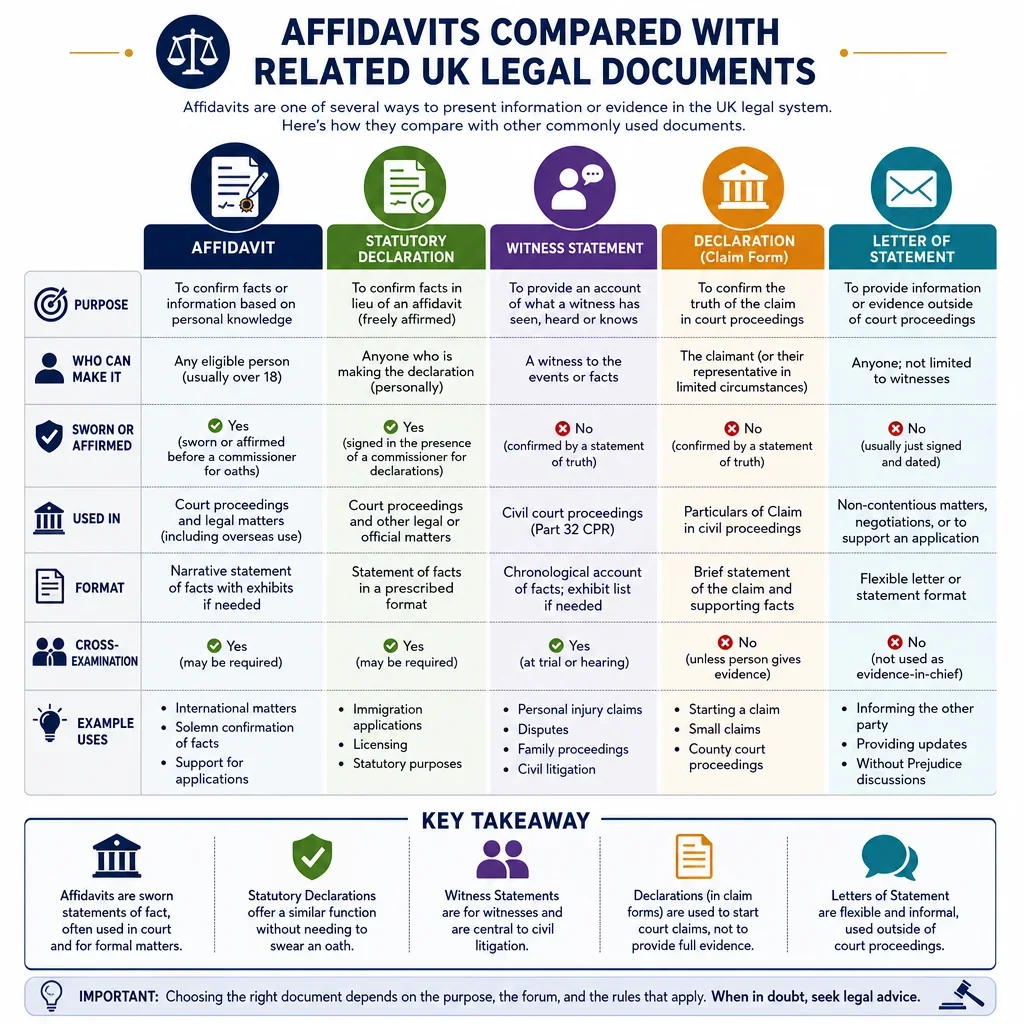
Affidavits Compared With Related UK Legal Documents
Main purpose | Authentication method | Usual signer | Common UK uses | Formality level | Difference from affidavit |
|---|---|---|---|---|---|
Affidavit | |||||
Formal written evidence of facts made on oath or affirmation. | Sworn or affirmed | Deponent with personal knowledge of the facts. | Court evidence, probate, insolvency, land registration, overseas legal processes. | High | This is the reference document: sworn or affirmed evidence. |
Statutory declaration | |||||
Formal declaration of facts made under statutory procedure. | Declared | Declarant confirming facts required by law or an authority. | Name changes, lost documents, marital status, identity, property and immigration matters. | High | Declared under statute not sworn as evidence on oath. |
Witness statement | |||||
Written evidence setting out a witness's factual account. | Signed with statement of truth | Witness giving factual evidence in proceedings. | Civil claims, applications, interim hearings, employment and tribunal evidence. | Medium | Usually signed with statement of truth, not sworn or affirmed. |
Statement of truth | |||||
Verification wording confirming belief in a document's truth. | Signed with statement of truth | Party, litigation friend, legal representative or witness as applicable. | Statements of case, witness statements, expert reports and court documents. | Medium | It verifies another document it is not usually a standalone sworn document. |
Certificate or confirmation letter | |||||
Administrative confirmation of a fact, status, record or relationship. | Signed without oath or affirmation | Employer, institution, professional, company officer or records holder. | Proof of employment, address, student status, account details or company records. | Low | Usually not sworn, declared or court-ready evidence. |
Affidavit | |||||
Sworn evidence supporting probate or estate administration facts. | Sworn or affirmed | Executor, administrator, witness to a will or other person with knowledge. | Explaining will execution issues, missing documents, aliases or estate facts. | High | Affidavit type used when probate evidence must be sworn or affirmed. |
Statutory declaration | |||||
Formal declaration recording adoption of a new name. | Declared | Person changing name. | Evidence of name change for banks, employers and public bodies. | High | Records a formal declaration rather than sworn evidential testimony. |
Witness statement | |||||
Written family court evidence from a party or witness. | Signed with statement of truth | Parent, party, professional or other family court witness. | Children cases, financial remedy applications, injunctions and case management. | Medium | Family evidence is often by statement unless affidavit evidence is directed. |
Affidavit | |||||
Sworn evidence supporting insolvency applications or creditor steps. | Sworn or affirmed | Creditor, process server, office-holder or person with relevant facts. | Service evidence, bankruptcy petitions, winding-up petitions and insolvency applications. | High | Affidavit format may be required for insolvency evidence in specific contexts. |
Statement of truth | |||||
Confirms a statement of case is believed to be true. | Signed with statement of truth | Party or legal representative authorised to sign. | Claim forms, particulars of claim, defences and replies. | Medium | No oath ceremony court rules prescribe verification wording. |
Statutory declaration | |||||
Formal declaration explaining loss or absence of a document. | Declared | Person responsible for or affected by the missing document. | Lost certificates, missing title documents, lost share certificates or licences. | High | Used as a statutory declaration of loss, not sworn evidence on oath. |
Witness statement | |||||
Records how, when and where documents were served. | Signed with statement of truth | Process server, solicitor, agent or person who served documents. | Proving service of claim forms, applications and court orders. | Medium | Civil service evidence is often by certificate or statement, not affidavit. |
Certificate or confirmation letter | |||||
Confirms employment status, role, salary or work dates. | Signed without oath or affirmation | Employer, HR officer, manager or company signatory. | Mortgage applications, tenancy checks, visa support and income verification. | Low | Confirms records administratively does not create sworn evidence. |
Affidavit | |||||
Sworn evidence where family rules or court directions require it. | Sworn or affirmed | Party, witness or professional directed to give sworn evidence. | Specific applications where the court directs affidavit evidence. | High | Affidavit evidence is exceptional where statements of truth usually suffice. |
Statutory declaration | |||||
Declares marital status or freedom to marry where required. | Declared | Person confirming status for marriage or overseas recognition. | Marriage abroad, consular processes and civil status confirmation. | High | A formal declaration of status, not sworn litigation evidence. |
Witness statement | |||||
Sets out workplace evidence for tribunal hearing use. | Signed with statement of truth | Claimant, respondent, manager, colleague or HR witness. | Unfair dismissal, discrimination, wages and whistleblowing disputes. | Medium | Prepared for tribunal evidence exchange normally not sworn. |
Statement of truth | |||||
Verifies an expert report and confirms expert duties. | Signed with statement of truth | Court expert or party-appointed expert. | Medical, valuation, engineering, accounting and professional negligence reports. | Medium | Confirms expert report compliance not sworn factual testimony. |
Certificate or confirmation letter | |||||
Confirms enrolment, attendance, course or qualification status. | Signed without oath or affirmation | School, college, university or training provider officer. | Council tax discounts, visas, banking, accommodation and funding checks. | Low | Institutional confirmation only not sworn evidence by the student. |
Affidavit | |||||
Sworn confirmation of loss, identity or document circumstances. | Sworn or affirmed | Document holder or person reporting the loss. | Replacement documents, consular requests and overseas administrative requirements. | High | Affidavit format is used when the recipient requires sworn confirmation. |
Statutory declaration | |||||
Declares personal, relationship, sponsorship or identity facts formally. | Declared | Applicant, sponsor, partner, parent or supporting declarant. | Visa evidence, relationship facts, address history and identity discrepancies. | High | Formal declaration may be accepted where sworn evidence is not required. |
Witness statement | |||||
Records accident, injury, treatment or loss evidence. | Signed with statement of truth | Claimant, defendant, eyewitness, clinician or loss witness. | Road traffic claims, workplace accidents and clinical negligence disputes. | Medium | Civil trial evidence is usually by signed witness statement. |
Statement of truth | |||||
Verifies evidence supporting an interim or procedural application. | Signed with statement of truth | Applicant, respondent, solicitor or witness with relevant facts. | Summary judgment, relief from sanctions, extensions and procedural orders. | Medium | Application evidence can often be verified without an oath. |
Certificate or confirmation letter | |||||
Confirms a person's address or residence record. | Signed without oath or affirmation | Landlord, employer, university, local authority or service provider. | KYC checks, school applications, tenancy checks and benefit administration. | Low | Relies on organisational records, not personal sworn evidence. |
Affidavit | |||||
Sworn evidence supporting land registration or title facts. | Sworn or affirmed | Owner, occupier, conveyancer, neighbour or knowledgeable witness. | Adverse possession, boundaries, lost deeds and ownership history. | High | Affidavit may be accepted where sworn title evidence is requested. |
Statutory declaration | |||||
Formal declaration of property occupation, use or title facts. | Declared | Owner, occupier, seller, neighbour or conveyancing witness. | Rights of way, boundaries, lost deeds and absence of breaches. | High | Often used for conveyancing declarations instead of sworn affidavit evidence. |
Witness statement | |||||
Sets out tenancy, rent arrears or possession-related facts. | Signed with statement of truth | Landlord, tenant, housing officer, managing agent or neighbour. | Possession claims, disrepair disputes, rent arrears and injunctions. | Medium | Normally court-rule evidence with statement of truth rather than oath. |
Statement of truth | |||||
Confirms truth and creates consequences for false verification. | Signed with statement of truth | Person responsible for the verified document. | Court documents where false statements may lead to contempt proceedings. | Medium | Serious verification, but no commissioner administers an oath. |
Certificate or confirmation letter | |||||
Confirms company information held in official or internal records. | Signed without oath or affirmation | Company officer, accountant, solicitor, Companies House or records provider. | Due diligence, banking, tendering, authority checks and corporate records. | Low | Confirms records it is not sworn personal testimony. |
Affidavit | |||||
Sworn evidence for applications requiring affidavit evidence. | Sworn or affirmed | Applicant, respondent, officer, solicitor or knowledgeable witness. | Specific civil applications where rules, practice directions or orders require it. | High | Affidavit remains appropriate where the procedure expressly requires oath evidence. |
Statutory declaration | |||||
Declares identity, nationality or personal history facts formally. | Declared | Applicant, parent, sponsor or person confirming personal facts. | Citizenship applications, name discrepancies and personal history evidence. | High | Administrative declaration rather than evidence sworn for court proceedings. |
Witness statement | |||||
Sets out evidence for public law and judicial review claims. | Signed with statement of truth | Claimant, public authority officer, solicitor or affected witness. | Judicial review, planning challenges, immigration decisions and public authority disputes. | Medium | Usually verified by statement of truth under CPR procedure. |
Statement of truth | |||||
Verifies possession claim facts and supporting court forms. | Signed with statement of truth | Landlord, claimant, authorised officer or legal representative. | Residential possession claims and related procedural documents. | Medium | Verification is procedural no oath is usually administered. |
Certificate or confirmation letter | |||||
Confirms professional opinion, status or records in letter form. | Varies by context | Solicitor, accountant, surveyor, GP, notary or regulated professional. | Identity certification, source of funds, capacity letters and transaction support. | Medium | Professional confirmation may carry weight but is not sworn evidence unless made as an affidavit. |
Affidavit | |||||
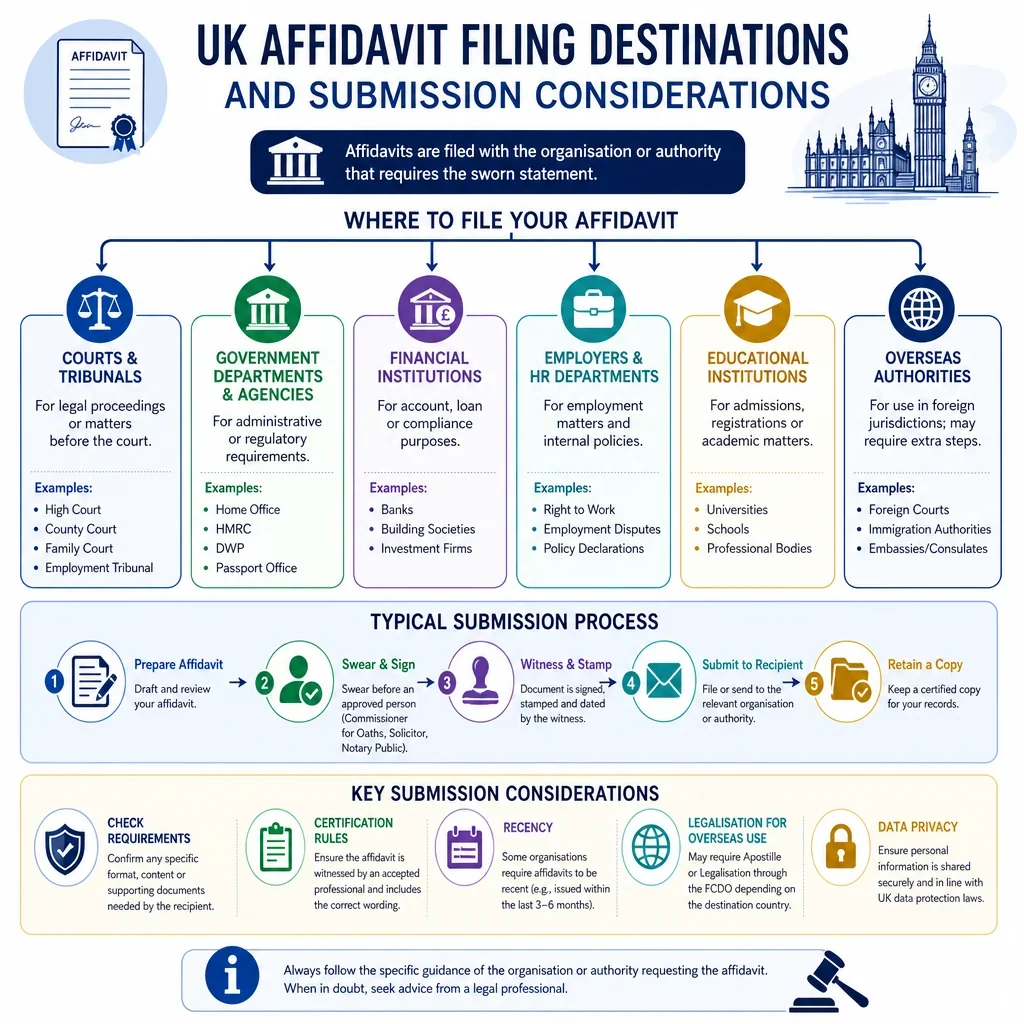
Sworn evidence intended for foreign authorities or overseas proceedings. | Sworn or affirmed | Person needing sworn facts accepted abroad. | Foreign court filings, immigration, marriage abroad and overseas property matters. | High | Affidavit may also need notarisation, legalisation or apostille for overseas use. |
Statutory declaration | |||||
UK-wide formal declaration where a prescribed declaration is acceptable. | Declared | Declarant before an authorised solicitor, commissioner or officer. | Administrative and legal declarations across UK jurisdictions subject to local rules. | High | Declaration procedure is statutory affidavit practice depends more on court or recipient rules. |
Witness statement | |||||
Gives concise written evidence for a small claim hearing. | Signed with statement of truth | Claimant, defendant, customer, trader or eyewitness. | Consumer claims, unpaid invoices, deposits and modest contract disputes. | Medium | Simpler court evidence usually no oath or commissioner needed. |
Statement of truth | |||||
Confirms court claim information is true when filing. | Signed with statement of truth | Claimant, defendant or authorised representative. | Money claims, responses, defences and online court filings. | Medium | Digital or paper verification replaces oath for many routine court filings. |
Certificate or confirmation letter | |||||
Confirms account details, balance, funds or banking relationship. | Signed without oath or affirmation | Bank, building society, accountant or finance officer. | Visa applications, mortgages, audits, litigation disclosure and source-of-funds checks. | Low | Bank record evidence is institutional, not a sworn personal account. |
Affidavit | |||||
Sworn proof where legislation or procedure permits affidavit evidence. | Sworn or affirmed | Officer, prosecutor, complainant or witness with relevant facts. | Specific statutory proofs, warrants, enforcement and procedural evidence. | High | Affidavit use depends on the exact statutory power or criminal procedure. |
Statutory declaration | |||||
Formal non-oath declaration for people confirming facts solemnly. | Declared | Person making a solemn declaration before an authorised witness. | Administrative facts where oath wording is unnecessary or inappropriate. | High | Solemn declaration wording differs from sworn or affirmed affidavit wording. |
Witness statement | |||||
Sets out evidence about negotiations, performance, breach or loss. | Signed with statement of truth | Director, employee, customer, supplier, broker or professional adviser. | Contract claims, debt disputes, misrepresentation and business tort claims. | Medium | Modern civil procedure normally uses witness statements for trial evidence. |
Statement of truth | |||||
Verifies costs documents and assessment information. | Signed with statement of truth | Solicitor, costs lawyer, party or authorised representative. | Bills of costs, points of dispute and detailed assessment documents. | Medium | Costs verification is by prescribed statement rather than sworn affidavit. |
Certificate or confirmation letter | |||||
Confirms health, fitness for work or medical attendance facts. | Signed without oath or affirmation | GP, nurse, occupational therapist, pharmacist, physiotherapist or doctor. | Sick pay, workplace absence, benefits, insurance and reasonable adjustments. | Medium | Professional medical confirmation, not sworn evidence by the patient. |
Affidavit | |||||
Sworn document administered by a solicitor, commissioner or notary. | Sworn or affirmed | Deponent appearing before an authorised oath administrator. | Documents requiring an oath, including some foreign and court documents. | High | Affidavit validity depends on proper oath or affirmation administration. |
Statutory declaration | |||||
Creates a legally serious declaration with criminal consequences if false. | Declared | Declarant who knows or believes the declared facts. | Important factual confirmations where the recipient needs legal seriousness. | High | False statutory declarations may be prosecuted under perjury legislation. |
Witness statement | |||||
Sets out incidents and risk evidence for protective orders. | Signed with statement of truth | Applicant, respondent, police officer, support worker or witness. | Non-molestation orders, occupation orders and urgent family applications. | Medium | Urgent family evidence commonly uses statements rather than sworn affidavits. |
Statement of truth | |||||
Verifies family court forms, applications and evidence. | Signed with statement of truth | Applicant, respondent, litigation friend or legal representative. | Children applications, divorce-related forms and financial remedy evidence. | Medium | Family procedure commonly verifies documents without a sworn oath. |
Certificate or confirmation letter | |||||
Certifies a copy document as a true copy of the original. | Signed without oath or affirmation | Professional, bank official, solicitor, teacher or authorised certifier. | Passport copies, identity checks, banking, recruitment and applications. | Medium | Certifies a copy document it does not swear the facts in it. |
When Should You Use An Affidavit Instead Of A Statement Or Declaration?
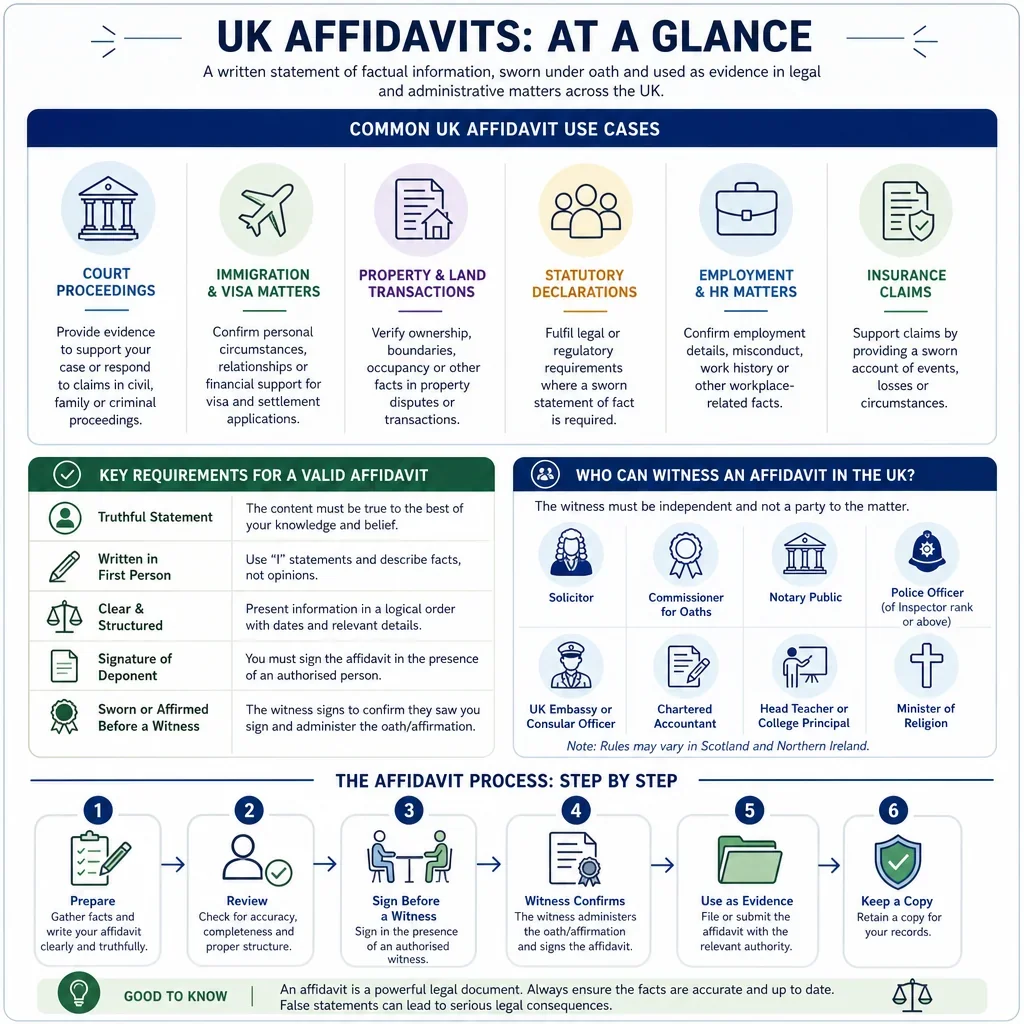
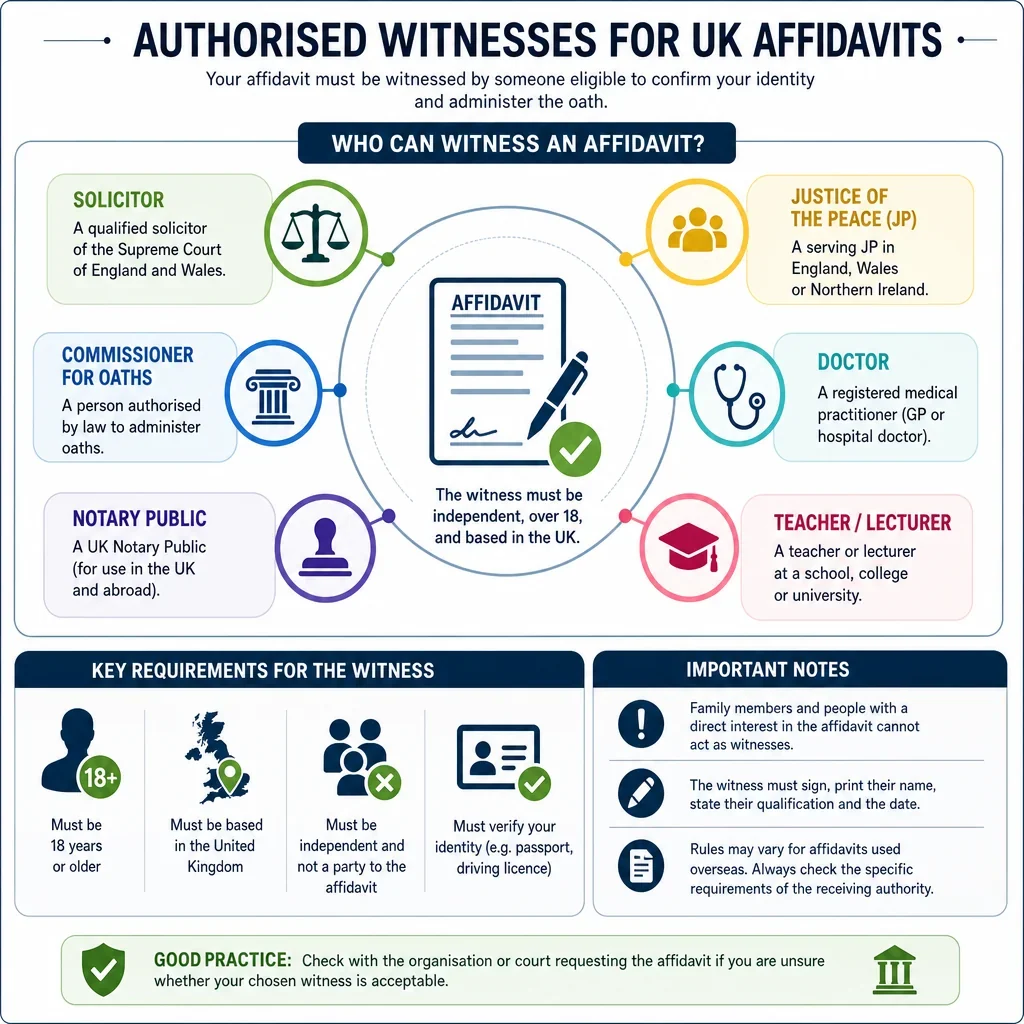
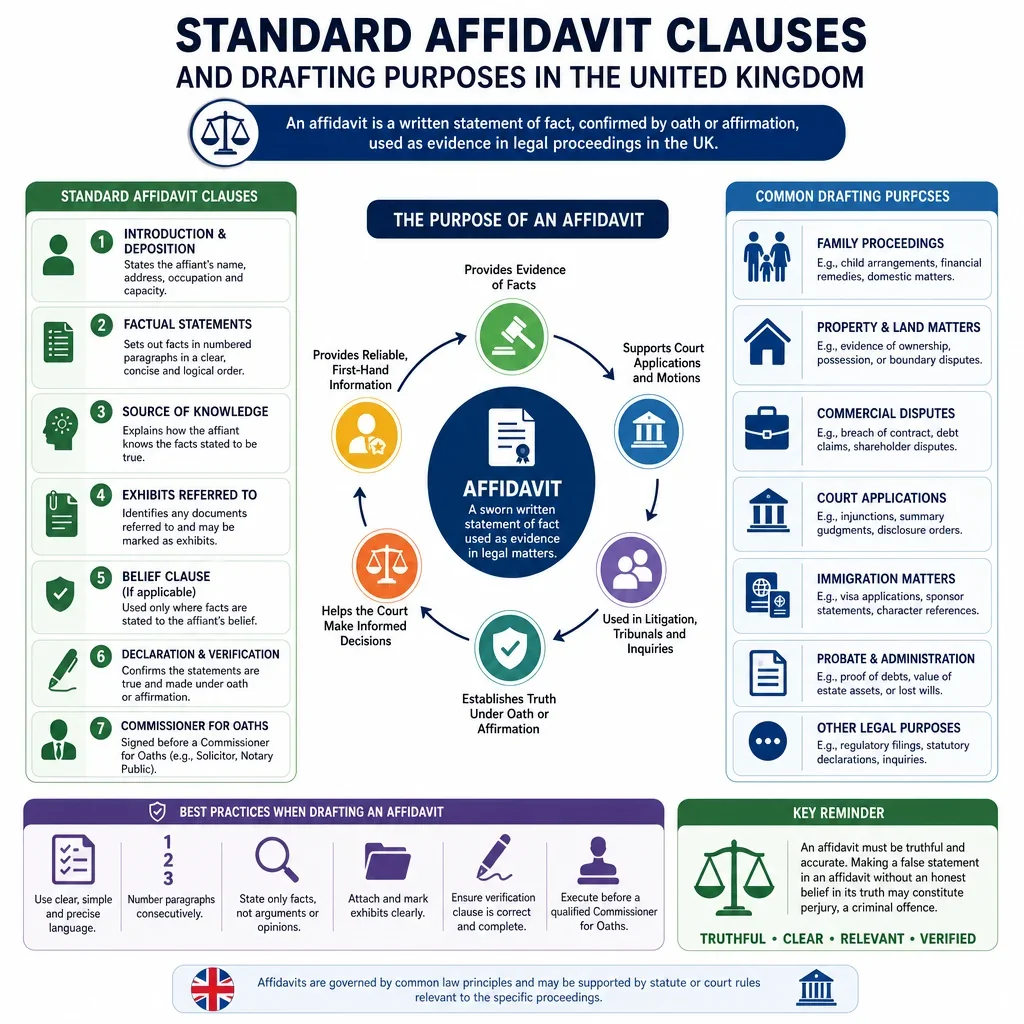
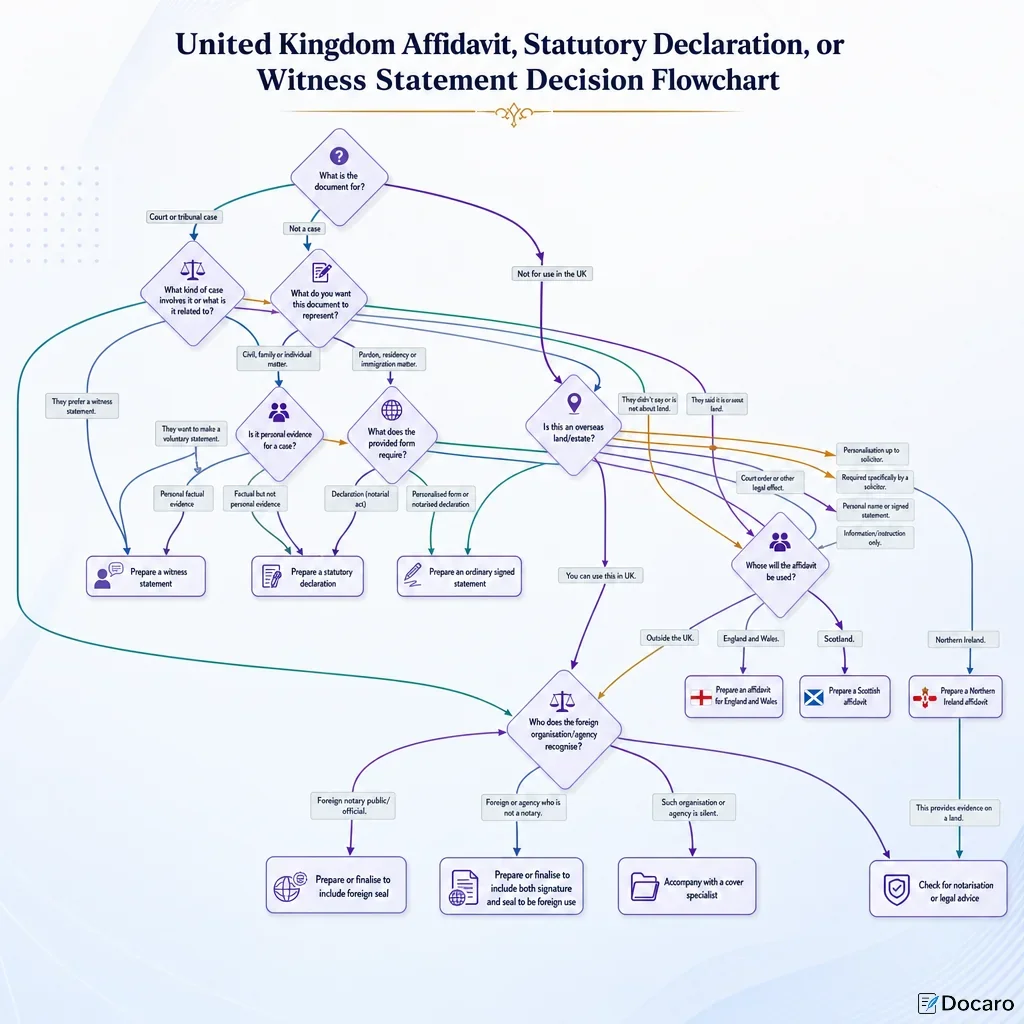
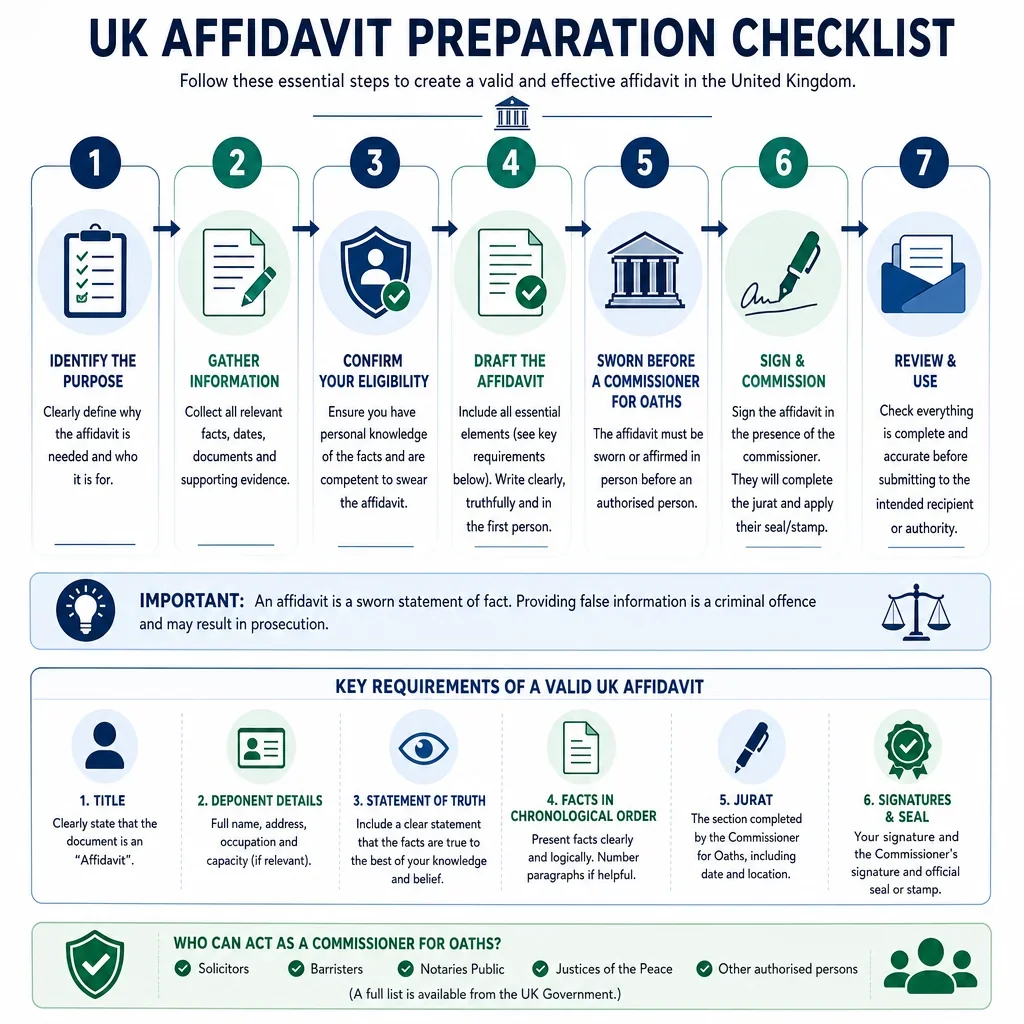
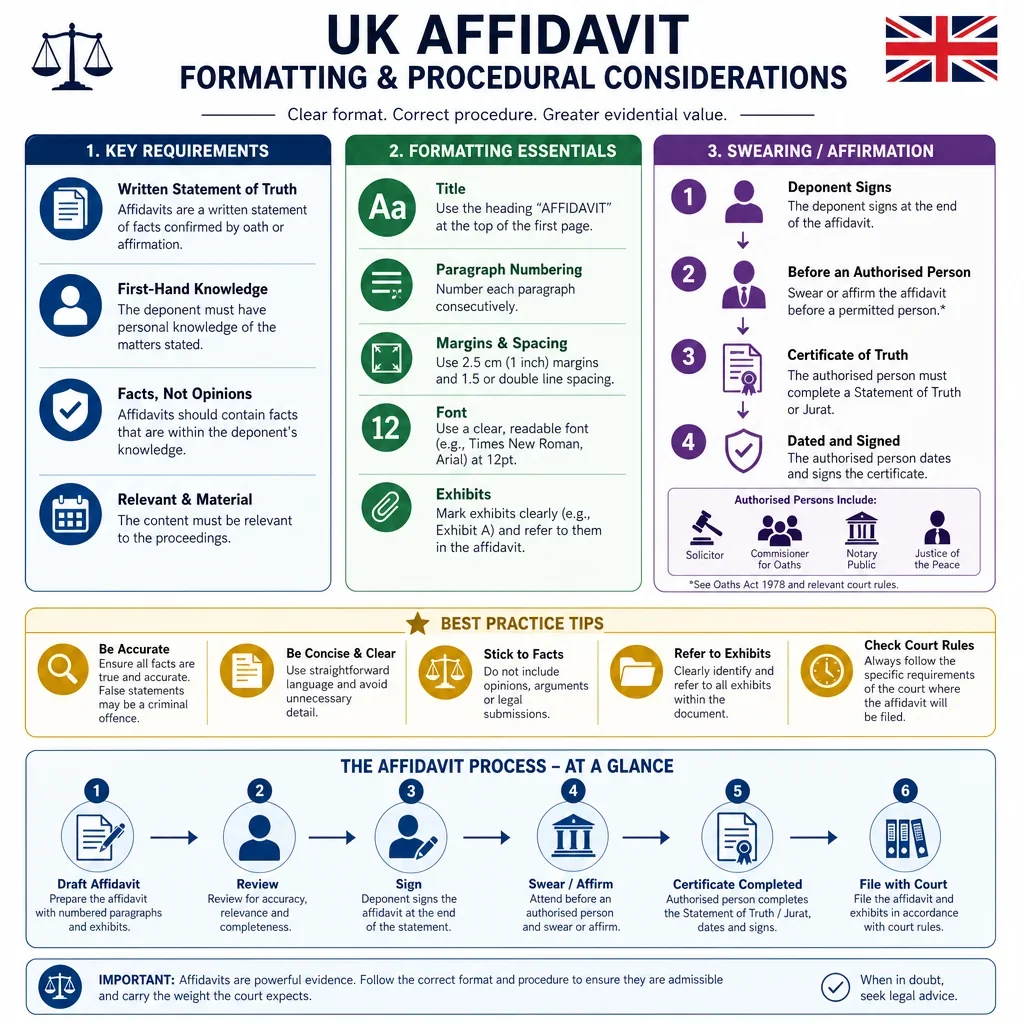
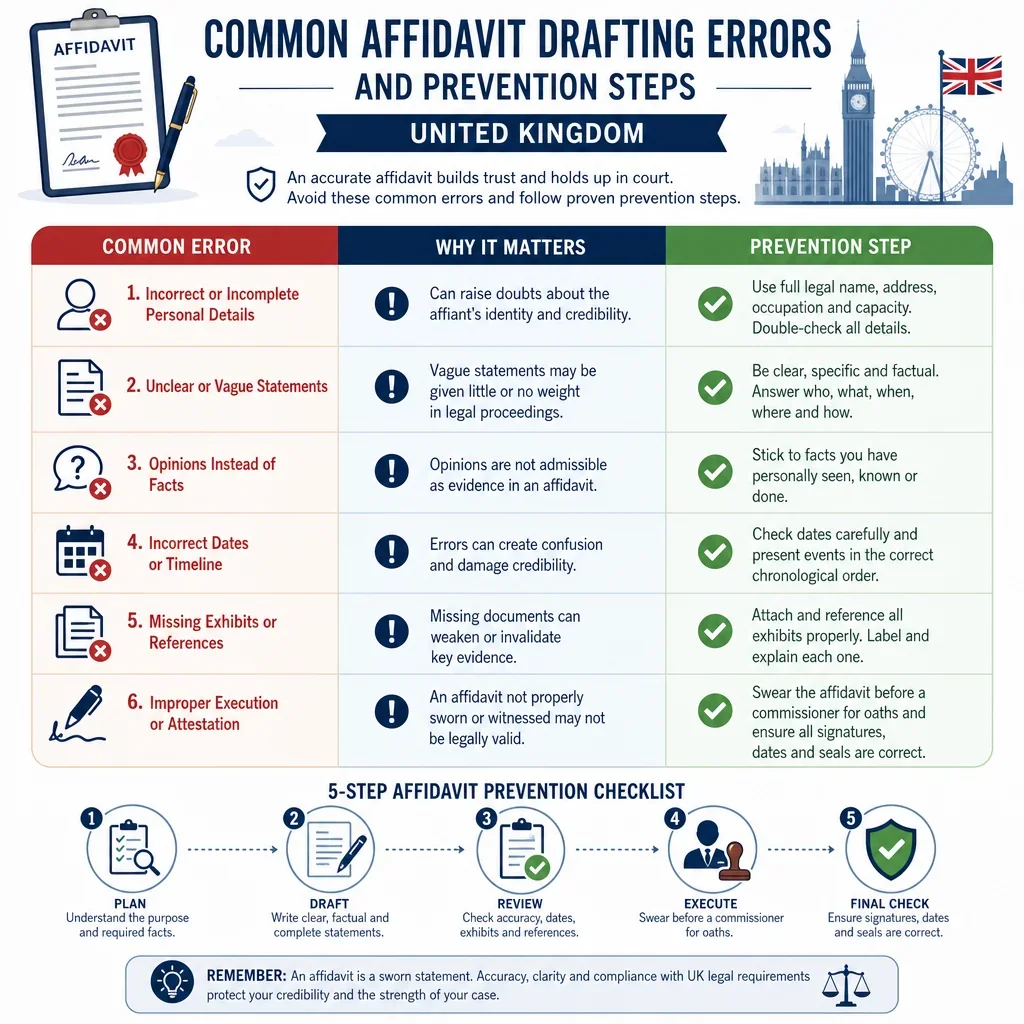
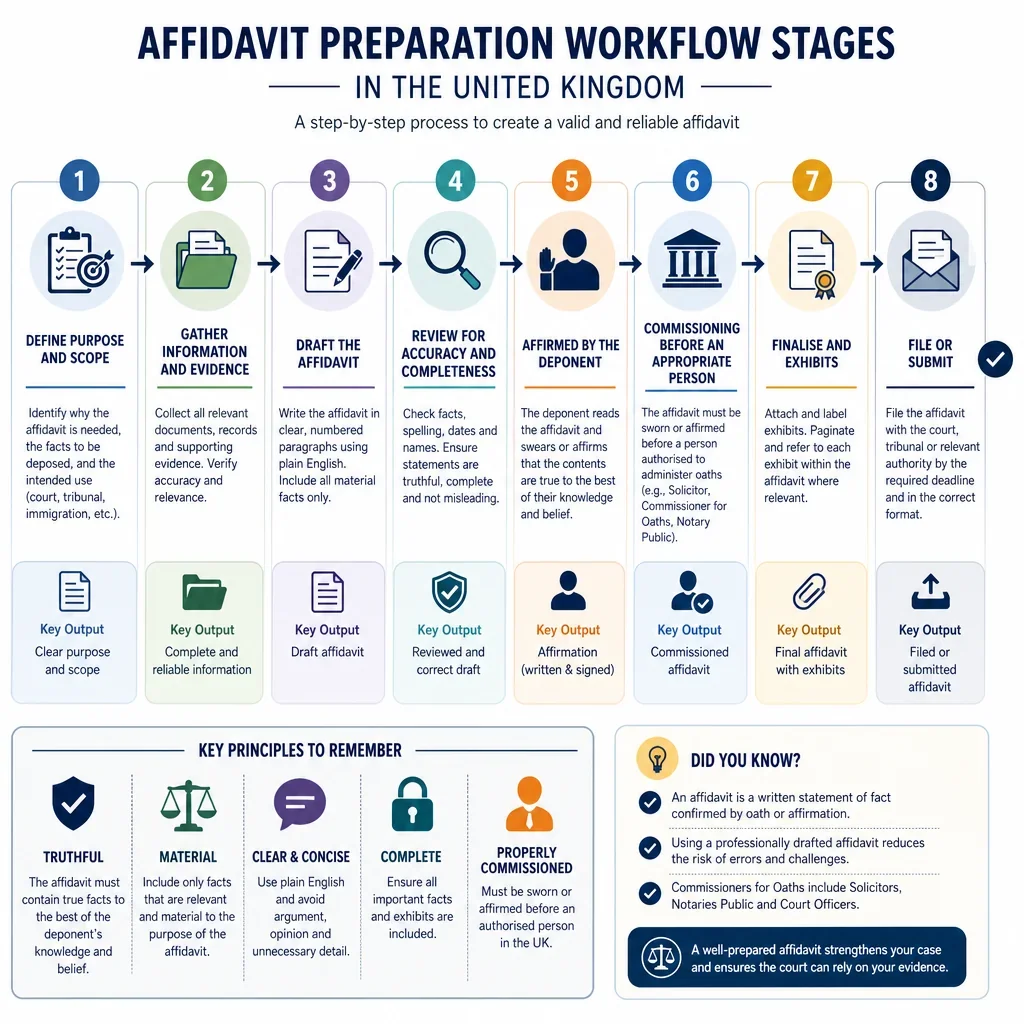
In the UK, an affidavit is generally the most formal evidence document in this comparison because it is sworn or affirmed before an authorised person. It is commonly needed where a court rule, tribunal rule, land process, probate process or overseas authority specifically requires evidence on oath.
What Is The Practical Difference Between An Affidavit And A Statutory Declaration?
A statutory declaration is also formal, but it is declared rather than sworn or affirmed. It is commonly used where legislation or an administrative body requires a formal declaration of facts, such as identity, change of name, lost documents or certain immigration and property matters.
Can A Witness Statement Replace An Affidavit?
Often, no. A witness statement is usually signed with a statement of truth and is the normal form of written evidence in many civil proceedings. However, if a rule or recipient specifically asks for an affidavit, a witness statement may not be accepted.
Why Does The Statement Of Truth Matter?
A statement of truth is not usually a standalone evidence document. It is wording added to documents such as witness statements, statements of case and application notices to confirm belief in the truth of the contents. False statements verified by a statement of truth can have serious consequences, including contempt of court.
Are Confirmation Letters A Substitute For Affidavits?
A certificate or confirmation letter is usually less formal and is often used to confirm administrative facts, such as employment, address, academic status or account details. It is not normally sworn, affirmed or declared, so it should not be used where a court, government body or overseas authority requires evidence on oath or a statutory declaration.
FAQs
You Might Also Be Interested In