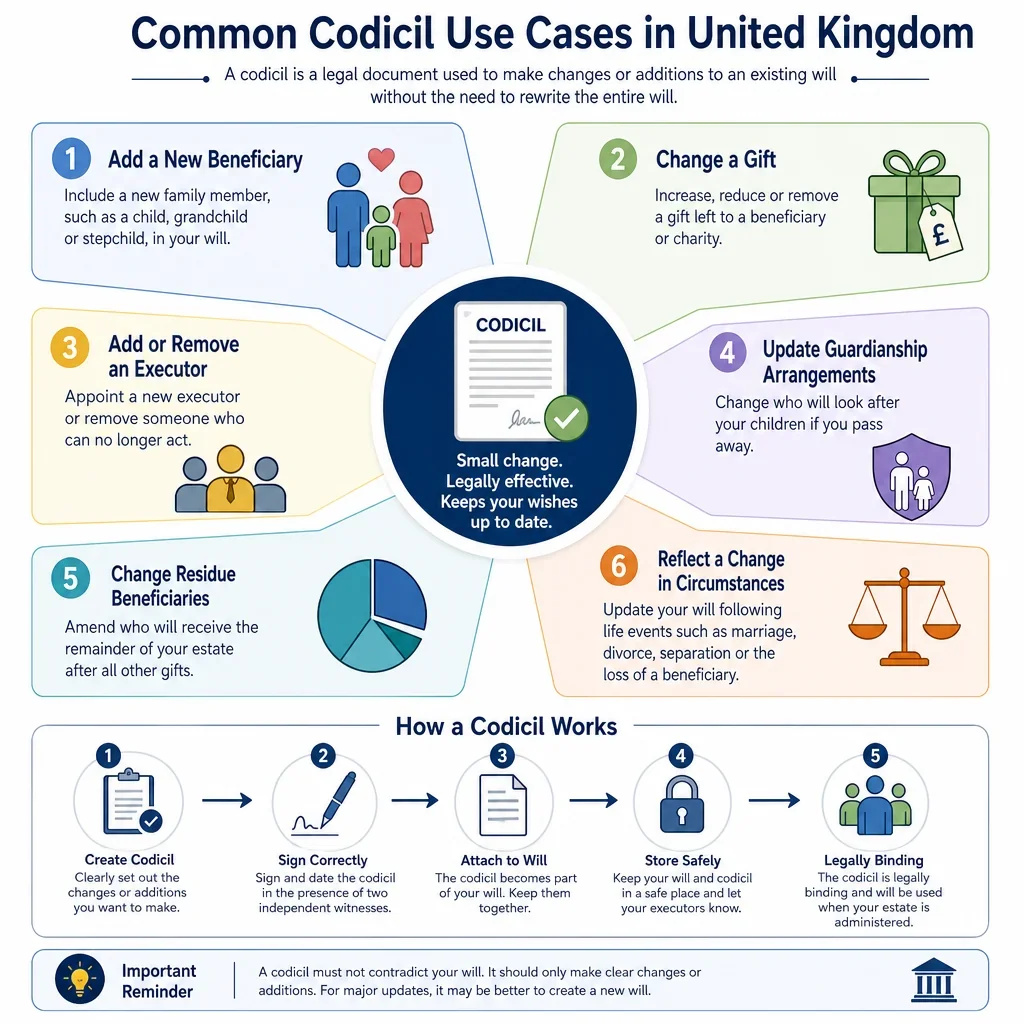
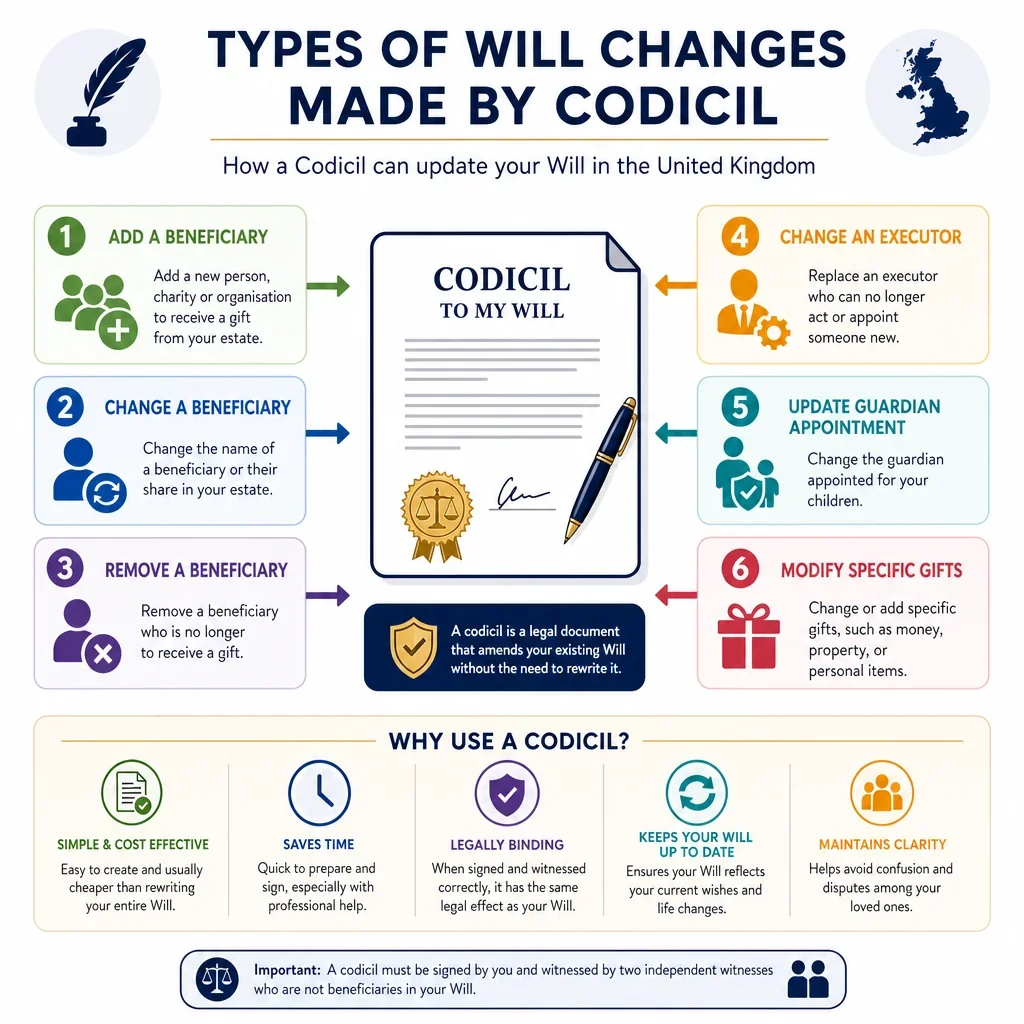
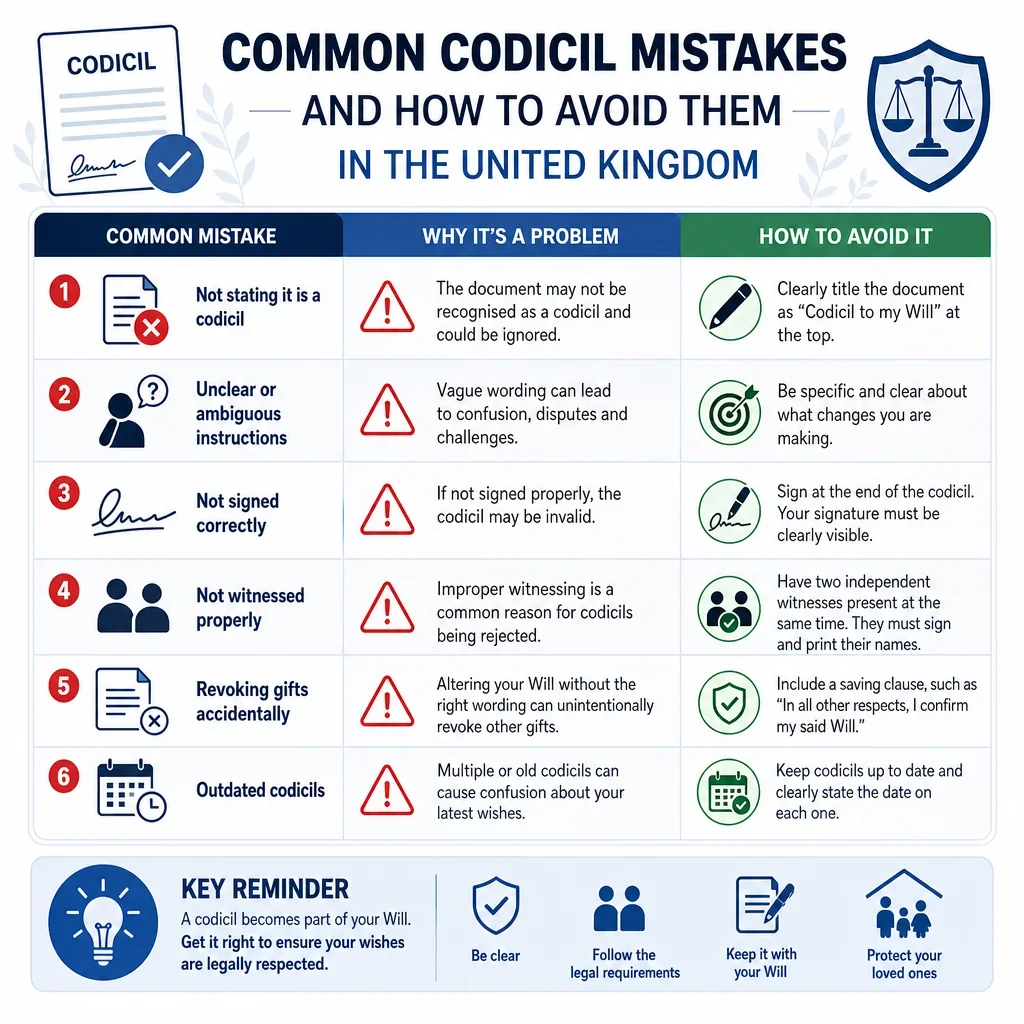
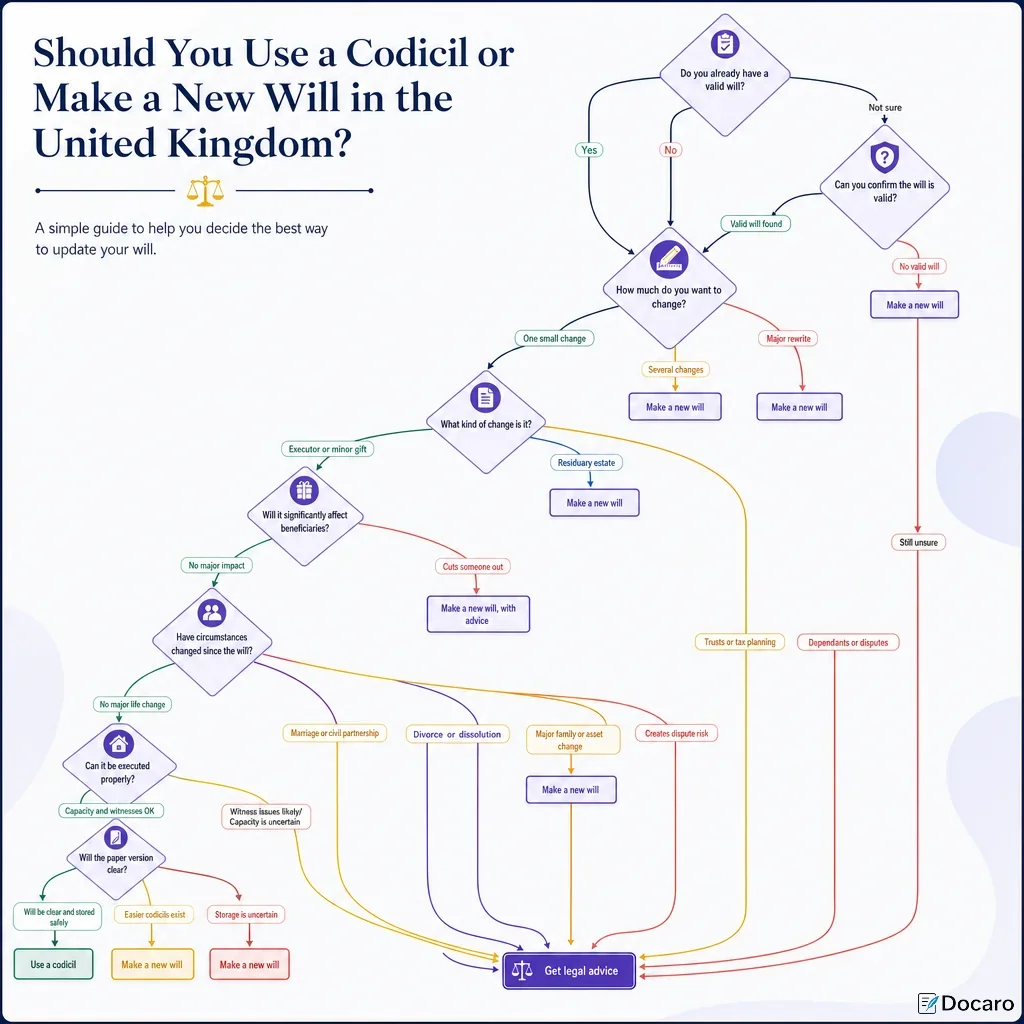
United Kingdom Codicil Signing And Witnessing Requirements
Testator Signing Requirement | Number Of Witnesses | Witness Eligibility Notes | Execution Notes | Invalidity Risk |
|---|---|---|---|---|
England and Wales | ||||
The testator must sign the codicil, or acknowledge their signature, intending to give effect to it. | 2 | Witnesses should be independent adults and should not be beneficiaries or married to, or in a civil partnership with, beneficiaries. | Both witnesses must be present at the same time when the testator signs or acknowledges the codicil, and each witness must attest and sign. | High |
Another person may sign for the testator if they do so in the testator's presence and by the testator's direction. | 2 | Use two independent witnesses who are not beneficiaries and are not spouses or civil partners of beneficiaries. | The directed signature must still be made or acknowledged in the presence of both witnesses present at the same time. | High |
The testator may acknowledge a pre-existing signature instead of signing again. | 2 | Witnesses must be present together for the acknowledgement and should be independent of any benefit under the codicil. | The testator should clearly confirm to both witnesses that the signature is theirs and that the document is a codicil. | High |
The testator's signing requirement is unchanged even if a beneficiary witnesses the codicil. | 2 | A gift to a witness, or to the witness's spouse or civil partner, is generally void. | The codicil may still be valid, but the affected gift can fail, so choose witnesses with no benefit under the will or codicil. | Medium |
Privileged will rules may relax normal formality for certain service personnel and mariners. | 0 | Normal witness rules may not apply to a valid privileged testamentary disposition. | This is a narrow exception ordinary civilian codicils should follow the two-witness rule. | High |
Northern Ireland | ||||
The testator must sign the codicil, or acknowledge their signature, intending it to operate as a testamentary document. | 2 | Witnesses should be independent and should not be beneficiaries or spouses or civil partners of beneficiaries. | The testator must sign or acknowledge the signature in the presence of two witnesses present at the same time. | High |
Another person may sign for the testator in the testator's presence and by the testator's direction. | 2 | Use two independent adult witnesses with no entitlement under the will or codicil. | The signing by direction must be witnessed in the same way as the testator's own signature. | High |
The testator may acknowledge an existing signature to both witnesses instead of signing again. | 2 | Both witnesses should be independent and present together for the acknowledgement. | Each witness must attest and sign, or acknowledge their signature, in the testator's presence. | High |
The testator's signature can still satisfy formalities even if a beneficiary acts as witness. | 2 | A gift to an attesting witness, or to their spouse or civil partner, is generally void. | Avoid using anyone who receives a gift under the will or codicil as a witness. | Medium |
Privileged will rules may relax normal formality for certain service personnel and mariners. | 0 | Normal witnessing rules may not apply to a valid privileged testamentary disposition. | This is a limited exception ordinary codicils should be signed with two witnesses present together. | High |
Scotland | ||||
The testator must subscribe the codicil, normally by signing at the end of the document. | 1 | A witness should know the testator, see the testator sign or hear acknowledgement, and be named and identified in the testing clause. | One witness is not always needed for basic validity, but it is normally used so the codicil is self-proving. | Medium |
A subscribed testamentary codicil may be valid even without a witness. | 0 | No witness is required for this narrow validity point, but lack of a witness can cause proof problems. | Without proper attestation, the codicil may not be self-proving and may need extra evidence after death. | Medium |
The testator should sign at the end of the codicil before, or acknowledge the signature to, one witness. | 1 | The witness should sign and their full name and address should be stated in the attestation clause. | A properly witnessed codicil is presumed to have been subscribed by the testator, reducing evidential burden. | Medium |
The testator should sign at the end of the codicil, not merely initial pages or sign elsewhere. | 1 | Use a witness who is not taking a benefit and who can later confirm the circumstances of signing. | Failure to subscribe the codicil properly can put the whole codicil at risk. | High |
The testator's subscription requirement is separate from whether a witness benefits under the codicil. | 1 | Avoid beneficiary witnesses use an independent adult witness to reduce challenge and evidence risks. | Scottish attestation focuses on proof of subscription, but independence is still best practice for a codicil. | Low |
If the testator cannot sign normally, specialist execution wording and advice should be used. | 1 | Use an independent witness able to confirm the testator understood and adopted the codicil. | Non-standard signing can affect whether the codicil is treated as validly subscribed and self-proving. | High |
England and Wales | ||||
Use the England and Wales two-witness execution method if the codicil is intended to operate there. | 2 | Choose independent witnesses to minimise issues if the estate includes assets in more than one UK jurisdiction. | A codicil should identify the will it amends and should not accidentally revoke or conflict with it. | High |
Northern Ireland | ||||
Use the Northern Ireland two-witness execution method if the codicil is intended to operate there. | 2 | Use independent witnesses who receive nothing under the will or codicil. | Two witnesses should be physically present together unless a specific valid exception applies. | High |
Scotland | ||||
Use Scottish subscription and one-witness self-proving formalities for a codicil intended to operate in Scotland. | 1 | Use an independent witness and include their full details in the attestation clause. | A codicil made for a non-Scottish will should be checked for compatibility with Scottish succession formalities. | Medium |
England and Wales | ||||
The codicil must be signed with the same formality as a will. | 2 | The witnesses do not have to be the same people who witnessed the original will. | Do not make handwritten changes on the signed will use a properly executed codicil or a new will. | High |
Northern Ireland | ||||
A codicil should be signed and witnessed with the same care as the original will. | 2 | New witnesses can be used, provided they are suitable and independent. | The codicil should clearly refer to the will it changes and be kept with it. | High |
Scotland | ||||
A Scottish codicil should be subscribed and, for proof, witnessed in the same way as a will. | 1 | The witness can be different from the witness to the original will, but should be independent and identifiable. | The codicil should expressly identify the will and be kept safely with it to avoid uncertainty. | Medium |
How Many Witnesses Does A Codicil Need In The UK?
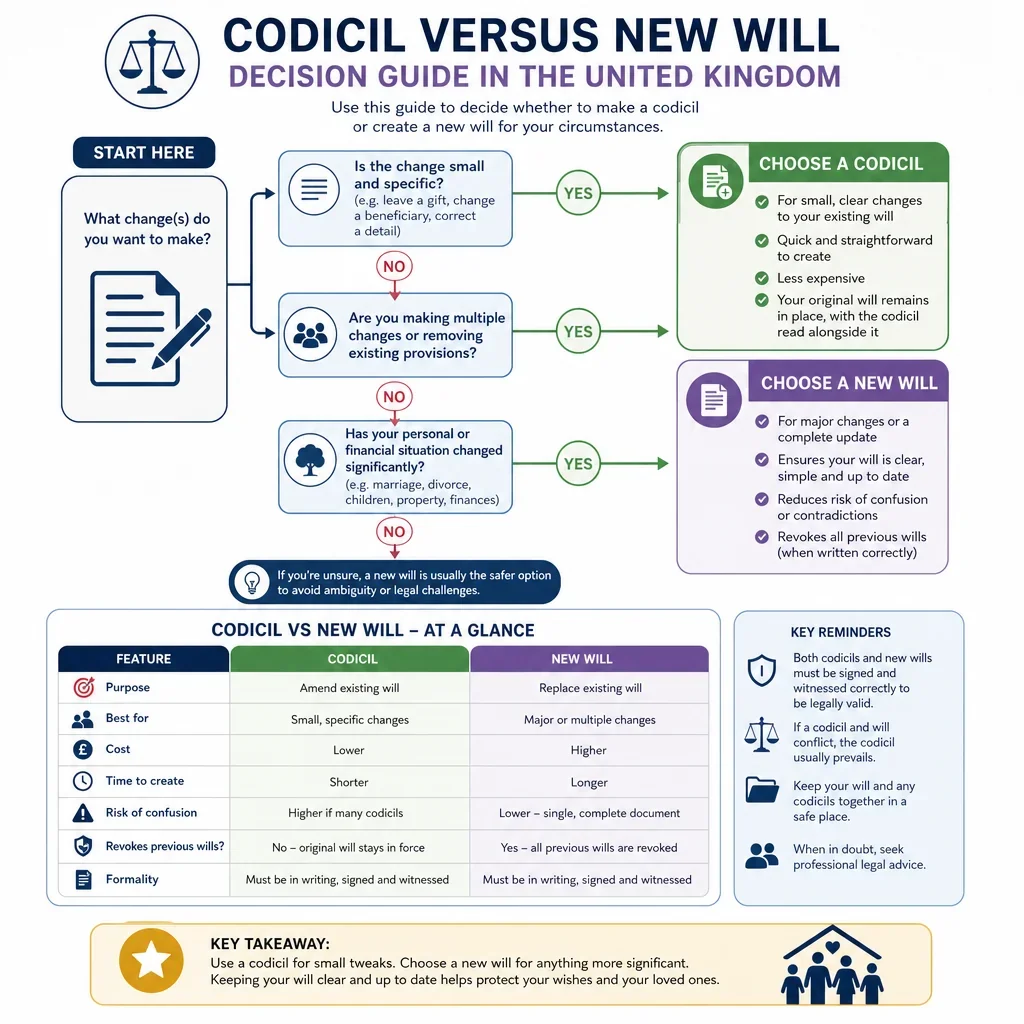
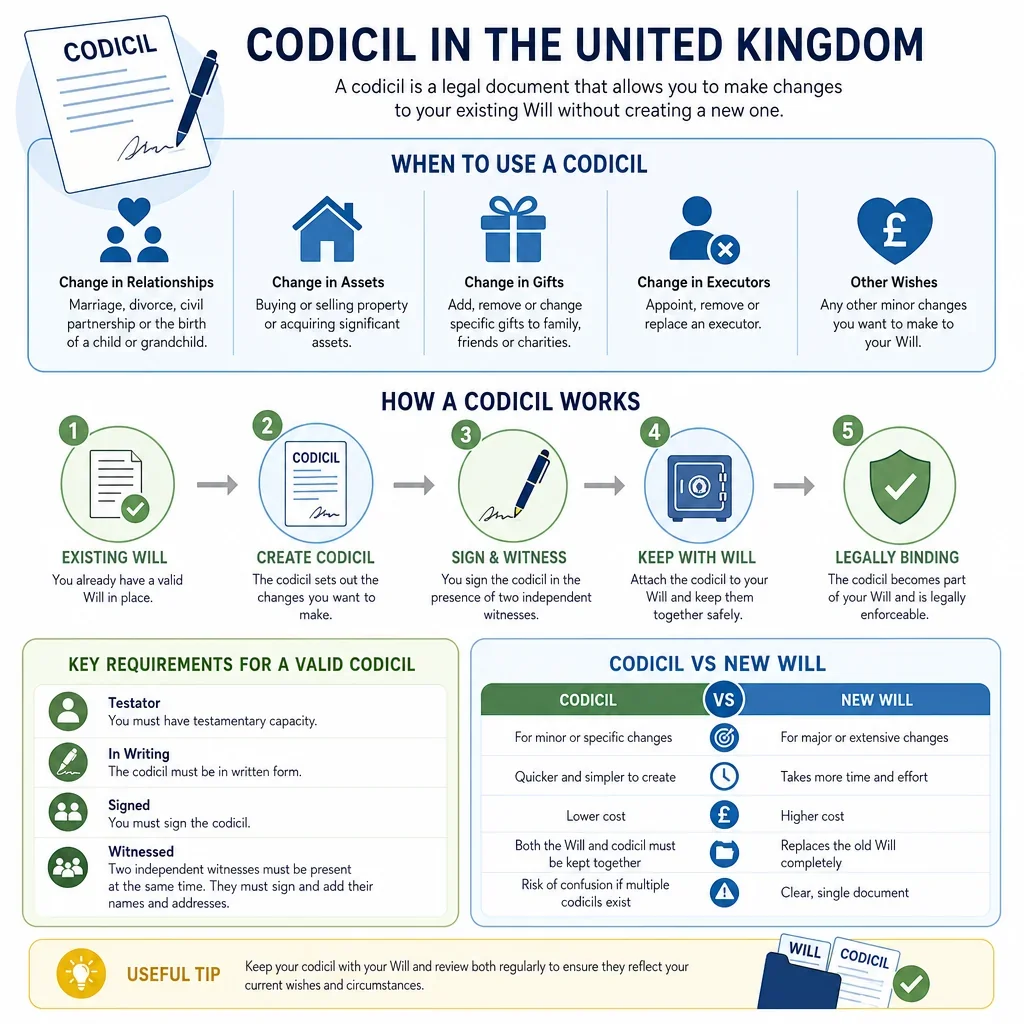
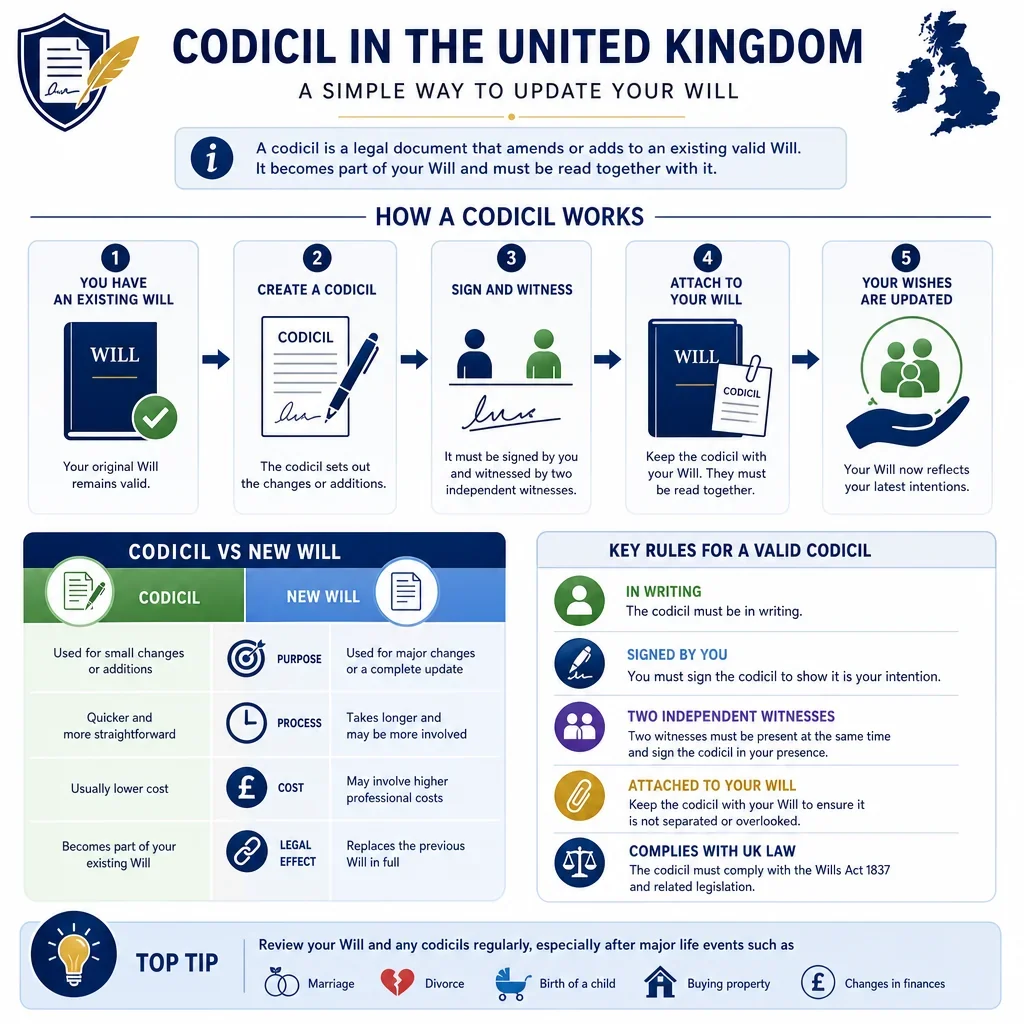
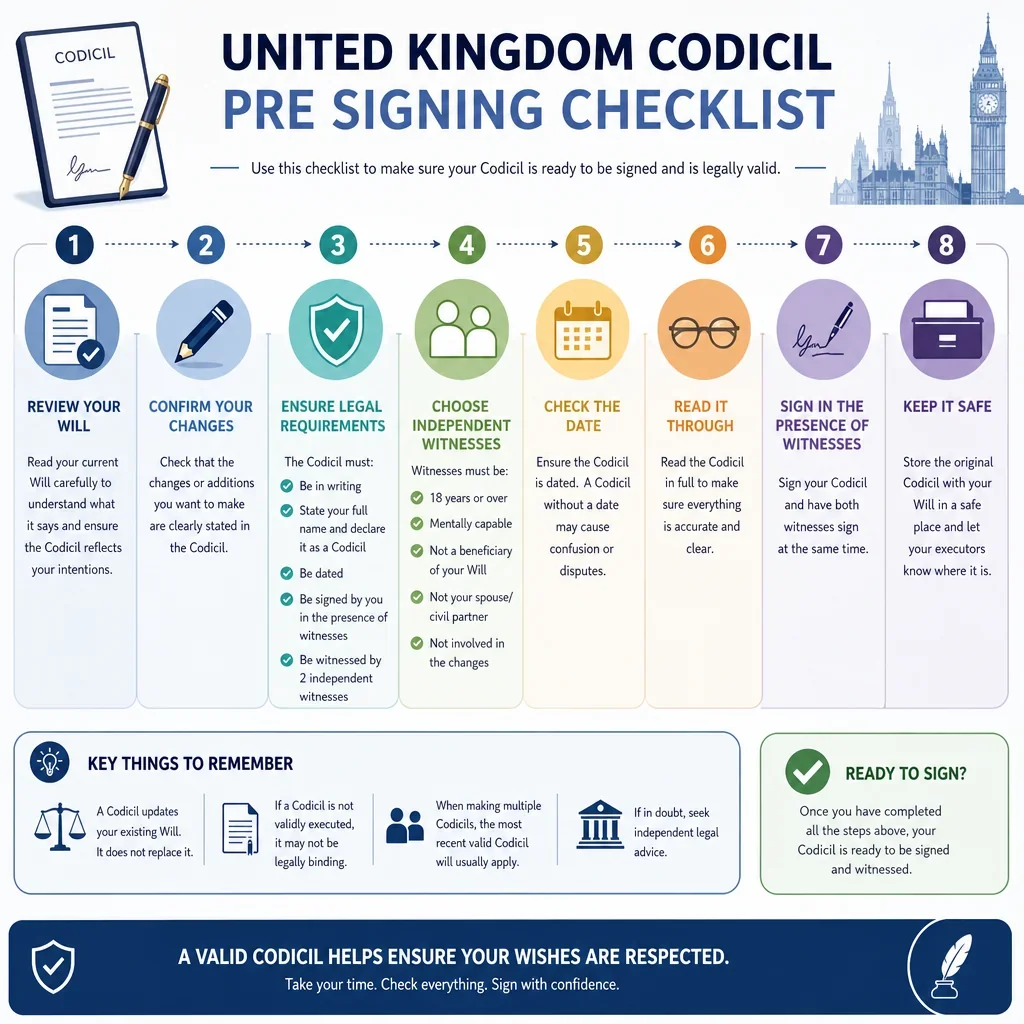
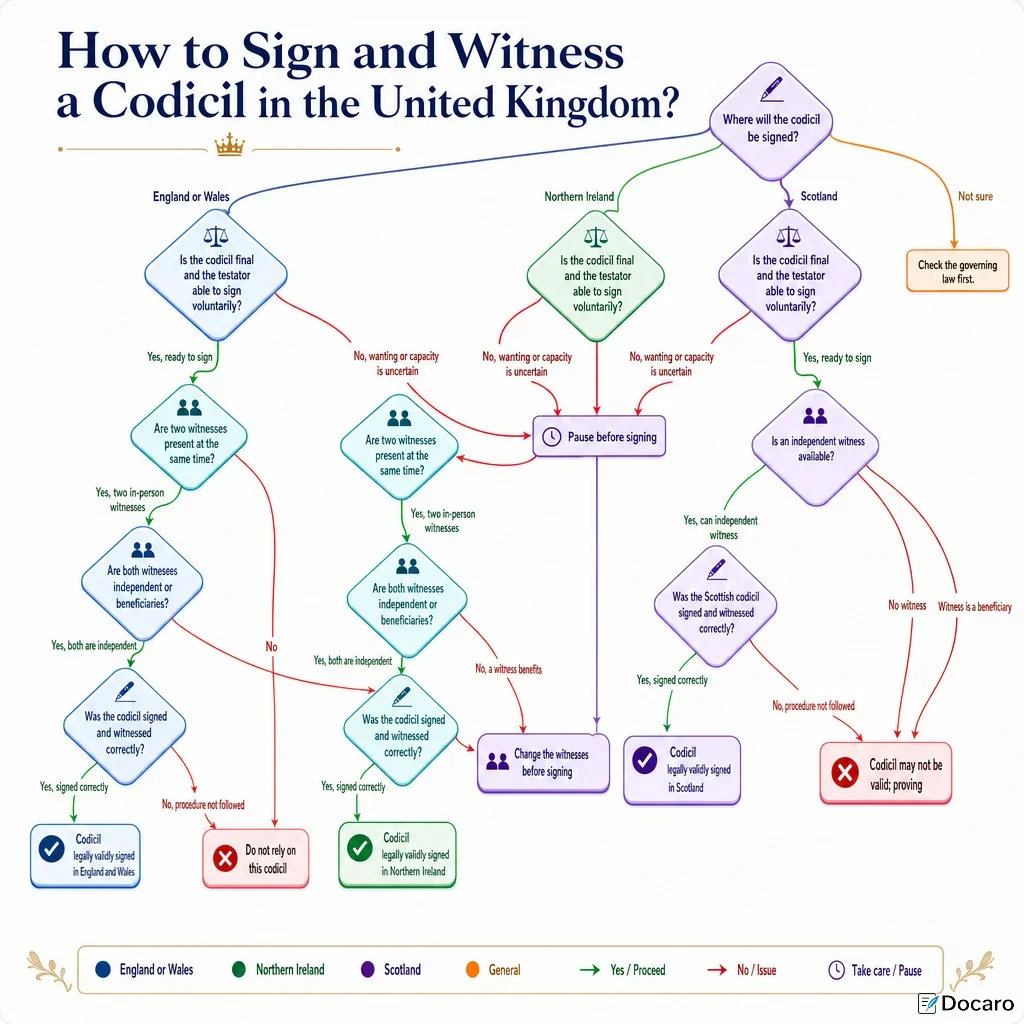
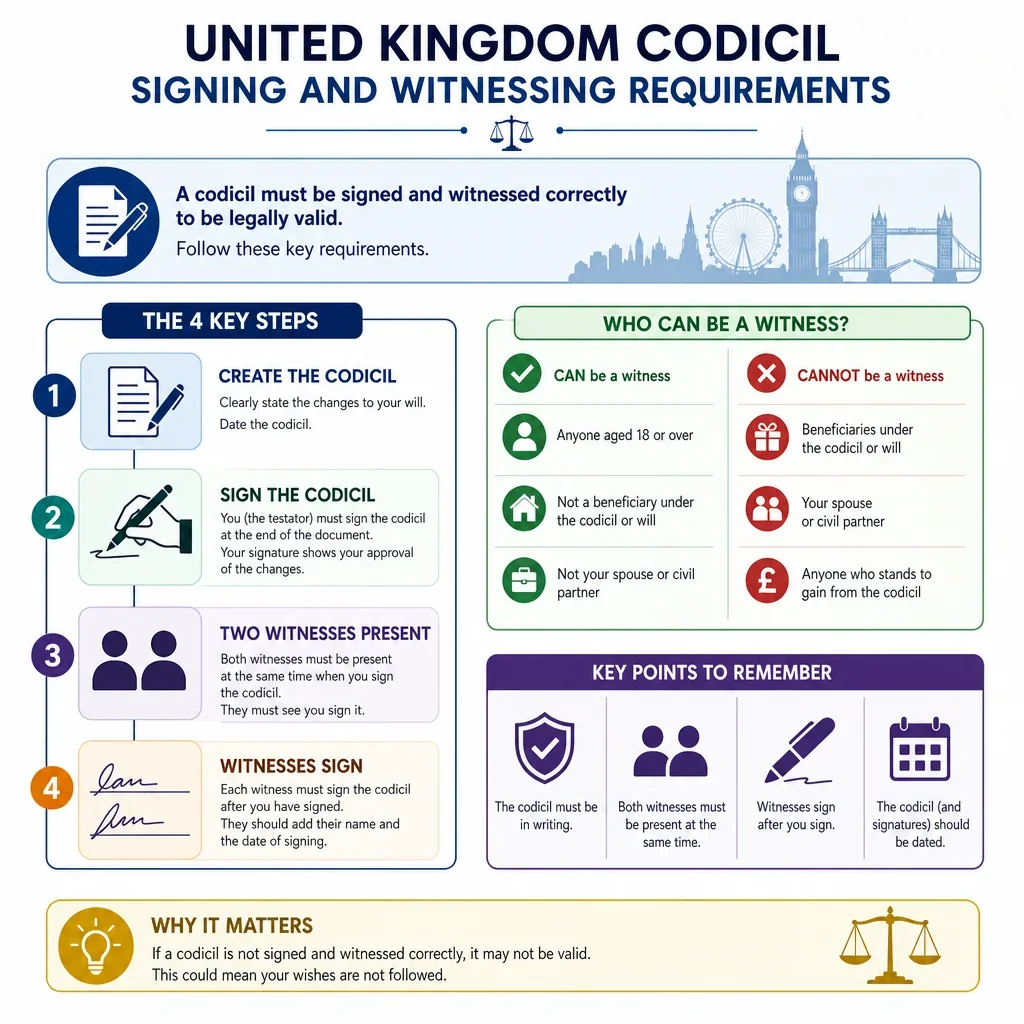
England and Wales and Northern Ireland usually require the testator to sign or acknowledge the codicil in the presence of two witnesses present at the same time. Scotland is different: a codicil can be valid if subscribed by the testator, but using one witness is important to make the document self-proving.
Who Should Witness A Codicil?
Use independent adult witnesses wherever possible. In England and Wales and Northern Ireland, a witness who benefits under the codicil, or the witness's spouse or civil partner, may cause that gift to fail even if the codicil itself remains valid. In Scotland, a witness should be identifiable and independent, and a beneficiary witness can create avoidable evidential and challenge risks.
What Is The Biggest Signing Risk?
The highest-risk mistake in England and Wales and Northern Ireland is not having both witnesses present together when the testator signs or acknowledges the codicil. In Scotland, the key practical risk is failing to sign at the end of the codicil or failing to include a proper witness attestation if probate-style evidential acceptance is needed.
Can Someone Else Sign For The Testator?
In England and Wales and Northern Ireland, another person may sign for the testator if this is done in the testator's presence and by the testator's direction, but the witnessing requirements still apply. In Scotland, signing by another person is more technical and should normally be handled with specialist advice.
FAQs
You Might Also Be Interested In