

Codicil Glossary Of Terms In The United Kingdom
Created:
This glossary explains key codicil terms used in the United Kingdom, helping you understand legal language before updating a will. It is a useful companion to our AI Generated British Codicil resources.
Term | Plain English Meaning | Codicil Context | Complexity | Example Use |
|---|---|---|---|---|
Document or clause | ||||
Codicil | A formal document that changes an existing will. | Used to add, remove, or amend terms in a will without replacing it. | Beginner | She made a codicil to change one cash gift. |
Will | A legal document saying what happens to property after death. | The original document that the codicil changes or confirms. | Beginner | The codicil referred to the will dated 4 June 2021. |
Person or role | ||||
Testator | The person who makes a will or codicil. | The testator signs the codicil to show the intended change. | Beginner | The testator signed the codicil before two witnesses. |
Executor | A person appointed to deal with the estate after death. | A codicil may appoint, remove, or replace an executor. | Beginner | The codicil appointed her brother as an additional executor. |
Beneficiary | A person or organisation receiving something from the estate. | A codicil often adds, removes, or changes a beneficiary's gift. | Beginner | The codicil added a charity as a beneficiary. |
Signing and witnessing | ||||
Witness | A person who watches the signing and signs to confirm it. | A codicil normally needs two witnesses, as a will does. | Beginner | Both witnesses signed the codicil after the testator. |
Attestation Clause | A clause recording that the document was signed correctly. | Used to show the codicil was signed and witnessed properly. | Intermediate | The attestation clause appeared above the witness signatures. |
Execution | The formal signing and witnessing of a legal document. | A codicil must be executed with the required formalities. | Intermediate | Improper execution may cause the codicil to be challenged. |
Wills Act 1837 | The main Act setting many will-making rules in England and Wales. | Its signing rules usually apply to codicils as well as wills. | Intermediate | Section 9 of the Wills Act 1837 is relevant to execution. |
Section 9 Wills Act 1837 | The provision requiring proper signature and witnessing. | Important when checking if a codicil was validly signed. | Advanced | The codicil was signed in line with Section 9. |
Person or role | ||||
Testamentary Capacity | The mental ability needed to make or change a will. | A codicil can be challenged if capacity is in doubt. | Intermediate | Capacity was considered when the later codicil was made. |
Signing and witnessing | ||||
Knowledge And Approval | Understanding and accepting the contents of a will or codicil. | Relevant if someone says the testator did not understand the change. | Advanced | The dispute focused on knowledge and approval of the codicil. |
Person or role | ||||
Undue Influence | Improper pressure causing someone to change their will. | A ground for disputing a codicil made under pressure. | Advanced | The family alleged undue influence over the codicil. |
Document or clause | ||||
Revocation | Cancelling a will, codicil, gift, or appointment. | A codicil may revoke a clause while leaving the rest unchanged. | Intermediate | The codicil revoked the previous gift of jewellery. |
Partial Revocation | Cancelling only part of a will or earlier codicil. | Common where one gift or appointment is being removed. | Intermediate | The codicil made a partial revocation of clause 5. |
Republication | Treating an earlier will as confirmed at a later date. | A duly executed codicil can republish the will it confirms. | Advanced | The codicil republished the will as amended. |
Confirmation Clause | A clause saying the will remains valid except as changed. | Used to avoid doubt about unchanged parts of the will. | Beginner | The confirmation clause kept the rest of the will in force. |
Clause | A numbered or separate section of a legal document. | A codicil often amends a specific clause of a will. | Beginner | Clause 4 was changed by the codicil. |
Amendment | A change made to an existing document. | A codicil is used to make a formal amendment to a will. | Beginner | The amendment changed the executor's address. |
Alteration | A change to wording in a will or codicil. | A codicil is usually safer than handwritten alterations on a will. | Intermediate | The alteration was not relied on without proper signing. |
Interlineation | Words inserted between existing lines of text. | May cause uncertainty if used instead of a properly signed codicil. | Advanced | The interlineation was unclear, so a codicil was prepared. |
Obliteration | Crossing out or covering words so they cannot be read. | Can affect whether a later change is valid or provable. | Advanced | The obliteration made the old gift unreadable. |
Manuscript Change | A handwritten change on a document. | May be disputed if not signed and witnessed correctly. | Intermediate | A manuscript change was replaced by a formal codicil. |
Schedule | An attached list forming part of a document. | May list changed gifts or items referred to in the codicil. | Intermediate | The schedule listed the replacement jewellery gifts. |
Date Of Will | The date on which the will was signed. | Used to identify exactly which will the codicil changes. | Beginner | The codicil named the will dated 12 March 2020. |
First Codicil | The first formal amendment made to a will. | Used when numbering amendments to avoid confusion. | Beginner | The first codicil changed the funeral wishes. |
Later Codicil | A codicil made after an earlier codicil. | Can override an earlier codicil if the two conflict. | Intermediate | The later codicil replaced the gift in the first codicil. |
Inconsistent Provisions | Clauses that cannot sensibly operate together. | May arise where a codicil conflicts with the will or another codicil. | Advanced | The two gifts created inconsistent provisions. |
Gift or property | ||||
Gift | Something left to a person or organisation in a will. | A common reason for a codicil is changing a gift. | Beginner | The codicil added a gift of £2,000 to a niece. |
Legacy | A gift left by will, often money or property. | A codicil may add, increase, reduce, or cancel a legacy. | Beginner | The legacy to the museum was increased by codicil. |
Pecuniary Legacy | A gift of a fixed amount of money. | Often amended where a testator changes a cash gift. | Intermediate | The codicil added a pecuniary legacy of £5,000. |
Specific Legacy | A gift of a particular identifiable item. | Used for items such as jewellery, cars, shares, or collections. | Intermediate | The codicil changed the specific legacy of the watch. |
Demonstrative Legacy | A money gift paid from a named fund or asset. | May need updating if the named fund changes or disappears. | Advanced | The codicil changed the source of the demonstrative legacy. |
Residuary Gift | A gift of what is left after debts, costs, and other gifts. | Changing residue can affect most of the estate. | Intermediate | The codicil changed one half of the residuary gift. |
Residue | Everything left in the estate after debts and specific gifts. | A codicil may redirect all or part of the residue. | Beginner | The residue was left to the testator's children. |
Chattel | Personal movable property, such as furniture or jewellery. | Often used when changing gifts of personal items. | Intermediate | The codicil gave certain chattels to a friend. |
Personal Chattels | Personal belongings, excluding certain business or investment assets. | A codicil may change who receives belongings or collections. | Intermediate | The codicil excluded the paintings from personal chattels. |
Real Property | Land and buildings owned by the testator. | A codicil may change a gift of a house or land. | Intermediate | The real property gift was amended after the sale. |
Personal Property | Property other than land, such as money and belongings. | Used when changing gifts of non-land assets. | Beginner | The codicil changed a gift of personal property. |
Probate and administration | ||||
Estate | Everything a person owns and owes when they die. | A codicil changes how part of the estate is dealt with. | Beginner | The codicil affected only a small part of the estate. |
Gift or property | ||||
Asset | Something owned, such as money, property, or possessions. | A codicil may refer to a particular asset being given away. | Beginner | The codicil dealt with a newly acquired asset. |
Probate and administration | ||||
Liability | A debt or financial obligation owed by the estate. | Relevant because debts are normally paid before gifts are distributed. | Beginner | Liabilities reduced the amount left for the cash legacies. |
Abatement | Reduction of gifts when the estate cannot pay them all. | May matter if a codicil adds gifts without enough estate value. | Advanced | The added legacies were subject to abatement. |
Gift or property | ||||
Ademption | Failure of a specific gift because the item no longer exists or is owned. | A codicil may replace a gift after an item is sold or lost. | Advanced | The car gift failed by ademption after it was sold. |
Lapse | Failure of a gift because the beneficiary dies first. | A codicil may name a replacement beneficiary after a death. | Intermediate | The codicil avoided lapse by naming a substitute beneficiary. |
Person or role | ||||
Substitute Beneficiary | A backup recipient if the first beneficiary cannot inherit. | Used to update a gift where the original recipient has died. | Beginner | The codicil named a substitute beneficiary for the cash gift. |
Document or clause | ||||
Survivorship Clause | A clause requiring a beneficiary to outlive the testator for a period. | A codicil may add or change a survivorship requirement. | Intermediate | The codicil added a 28-day survivorship clause. |
Gift or property | ||||
Class Gift | A gift to a group, such as children or grandchildren. | May need updating after births, deaths, or family changes. | Intermediate | The codicil widened the class gift to include grandchildren. |
Charity Gift | A gift left to a registered charity in a will or codicil. | A codicil may add or update a charity name or number. | Beginner | The codicil added a charity gift to Cancer Research UK. |
Charitable Exemption | Inheritance tax relief for gifts to qualifying charities. | Relevant when adding a charity gift to a will by codicil. | Advanced | The charity gift was expected to qualify for charitable exemption. |
Probate and administration | ||||
Inheritance Tax | A tax that may be payable on a person's estate after death. | Changing gifts by codicil can affect tax outcomes. | Intermediate | The codicil was reviewed for inheritance tax effects. |
Nil Rate Band | The inheritance tax threshold charged at 0%. | Relevant if a codicil changes tax-sensitive gifts or trusts. | Advanced | The nil rate band was considered before changing the residue. |
Residence Nil Rate Band | Extra inheritance tax allowance linked to a home left to descendants. | May be affected if a codicil changes who receives a home. | Advanced | The codicil was checked against the residence nil rate band rules. |
Gift or property | ||||
Spouse Exemption | Inheritance tax exemption for many gifts to a spouse or civil partner. | Relevant if a codicil redirects assets away from a spouse or civil partner. | Advanced | The spouse exemption was considered before changing the gift. |
Document or clause | ||||
Trust | An arrangement where trustees hold assets for beneficiaries. | A codicil may amend trustees, trust gifts, or trust wording. | Advanced | The codicil changed one trustee of the will trust. |
Person or role | ||||
Trustee | A person who manages trust assets for beneficiaries. | A codicil may appoint, remove, or replace trustees. | Intermediate | The codicil appointed a new trustee for the children's trust. |
Guardian | A person chosen to care for a child if parents die. | A codicil may update a guardian appointment for minor children. | Beginner | The codicil named a new guardian for the children. |
Minor Beneficiary | A beneficiary who is under 18. | Important where a codicil adds gifts for children or grandchildren. | Beginner | The codicil added gifts for minor beneficiaries. |
Document or clause | ||||
Age Contingency | A condition that a beneficiary must reach a stated age. | A codicil may change the age for receiving a gift. | Intermediate | The codicil changed the age contingency from 21 to 25. |
Gift or property | ||||
Life Interest | A right to benefit from property during one's lifetime. | A codicil may amend a life interest or the remainder beneficiaries. | Advanced | The codicil changed the property subject to the life interest. |
Person or role | ||||
Remainder Beneficiary | A person who receives trust property after an earlier interest ends. | May be changed when a codicil alters a life interest trust. | Advanced | The codicil added a remainder beneficiary after the spouse's death. |
Document or clause | ||||
Condition Precedent | A condition that must happen before a gift takes effect. | May be added or changed for conditional gifts. | Advanced | The codicil removed a condition precedent from the gift. |
Gift or property | ||||
Gift Over | A backup gift if the first gift fails. | A codicil may add a gift over to avoid uncertainty. | Intermediate | The codicil added a gift over to the grandchildren. |
Document or clause | ||||
Letter Of Wishes | A non-binding note explaining wishes to executors or trustees. | Often updated alongside, but separate from, a codicil. | Beginner | A new letter of wishes explained the codicil. |
Funeral Wishes | Personal wishes about funeral arrangements. | A codicil may update funeral preferences, though practical notice matters. | Beginner | The codicil changed the funeral wishes to cremation. |
Probate and administration | ||||
Personal Representative | An executor or administrator dealing with the estate. | The codicil may affect who acts as personal representative. | Intermediate | The personal representatives submitted the will and codicil. |
Administrator | A person appointed to administer an estate where there is no executor able to act. | Relevant if executor appointments in the will and codicil fail. | Intermediate | An administrator was needed because no executor could act. |
Grant Of Probate | Court authority allowing executors to deal with the estate. | The will and valid codicils are normally submitted for probate. | Beginner | The grant of probate referred to the will and two codicils. |
Probate | The legal process for proving a will and administering an estate. | A codicil may be checked during probate to confirm validity. | Beginner | Probate was delayed while the codicil was reviewed. |
Letters Of Administration | Court authority for an administrator to deal with an estate. | May be needed if no executor appointment is effective. | Intermediate | Letters of administration were issued after the executor renounced. |
Renunciation | An executor's formal decision not to act. | A codicil may name a replacement executor if one has renounced or may do so. | Intermediate | The codicil appointed a substitute in case of renunciation. |
Power Reserved | An executor does not act now but may join later. | Relevant if a codicil appoints multiple executors. | Advanced | Probate was granted with power reserved to the second executor. |
Caveat | A formal notice stopping a probate grant temporarily. | May be entered if someone disputes a codicil's validity. | Advanced | A caveat was entered after the codicil was found. |
Contentious Probate | A dispute about a will, codicil, or estate administration. | Can arise where a codicil changes expected inheritances. | Advanced | The late codicil led to contentious probate proceedings. |
Intestacy | The rules applying when someone dies without a valid will. | May matter if a codicil fails to fix an invalid or incomplete will. | Beginner | A failed residuary gift risked partial intestacy. |
Partial Intestacy | When part of an estate is not covered by a valid will gift. | Can happen if a codicil revokes a gift without replacing it. | Intermediate | The codicil accidentally created a partial intestacy. |
Document or clause | ||||
Marriage Revocation | The rule that marriage or civil partnership can revoke a will. | A codicil cannot safely be considered without checking later marriage status. | Advanced | The marriage revocation rule affected the earlier will and codicil. |
Divorce Effect On Will | Divorce can make gifts and appointments for an ex-spouse fail. | A codicil may be needed after divorce to update gifts and executors. | Advanced | The codicil updated the will after the divorce order. |
Person or role | ||||
Civil Partner | A person in a registered civil partnership. | Civil partnership can affect wills, inheritance, and witness rules. | Beginner | The codicil named the civil partner as executor. |
Signing and witnessing | ||||
Beneficiary Witness Rule | A beneficiary witness, or their spouse or civil partner, may lose the gift. | Important when choosing witnesses for a codicil adding a gift. | Intermediate | The beneficiary witness rule made the new gift risky. |
Presence | Being physically present when signatures are made or acknowledged. | The testator and two witnesses must meet the presence requirement. | Intermediate | The witnesses signed in the testator's presence. |
Signature | A mark or name used to sign the codicil. | Needed to show the testator intended the codicil to take effect. | Beginner | The signature appeared at the end of the codicil. |
Acknowledgement Of Signature | Confirming an existing signature as one's own. | Relevant if the testator signed before the witnesses arrived. | Intermediate | The testator acknowledged the signature before both witnesses. |
Independent Witness | A witness who is not a beneficiary or closely affected person. | Best used to reduce risk of witness-related gift failure. | Beginner | Two neighbours acted as independent witnesses. |
Person or role | ||||
Blind Or Illiterate Testator | A testator who cannot read the document unaided. | Extra evidence may help show the codicil was read and understood. | Advanced | The codicil was read aloud to the blind testator. |
Signing and witnessing | ||||
Mark Signature | A simple mark used instead of a full written signature. | May be used where the testator cannot write a full signature. | Intermediate | The testator signed the codicil by making a mark. |
Signing On Behalf | Another person signs for the testator at their direction. | Used only where the testator directs someone else to sign for them. | Advanced | A helper signed on behalf of the testator at her direction. |
Document or clause | ||||
Engrossment | The final clean version prepared for signing. | The version of the codicil that should be executed. | Advanced | The engrossment was printed before the signing meeting. |
Original Will | The signed will document, not a copy. | A codicil should be stored with the original will where possible. | Beginner | The original will and codicil were found together. |
Copy Will | A photocopy or digital copy of a signed will. | Can create probate issues if the original will or codicil is missing. | Intermediate | Only a copy will was available with the original codicil. |
Probate and administration | ||||
Safe Custody | Secure storage of the original will and codicil. | Helps ensure the codicil is found and used after death. | Beginner | The codicil was placed in safe custody with the will. |
Document or clause | ||||
Revocation By Destruction | Cancelling a will by burning, tearing, or otherwise destroying it with intent. | Relevant if someone destroys an old codicil or will after making a new one. | Advanced | The old codicil was revoked by destruction. |
Dependent Relative Revocation | A doctrine where cancellation may fail if based on a mistaken replacement. | May arise if a codicil revokes a gift expecting another gift to work. | Advanced | The court considered dependent relative revocation after the codicil failed. |
Construction | Interpreting the meaning of will or codicil wording. | Needed if the codicil wording is unclear or conflicts with the will. | Advanced | The dispute turned on construction of the codicil. |
Probate and administration | ||||
Rectification | Court correction of a will that fails to reflect intentions due to error. | May be sought if a codicil contains a clerical or drafting error. | Advanced | Rectification was requested for the mistaken codicil wording. |
Document or clause | ||||
Clerical Error | A typing, copying, or administrative mistake in wording. | May support a rectification claim if the codicil says the wrong thing. | Advanced | A clerical error misstated the charity number. |
Privileged Will | A special informal will allowed for certain service personnel or mariners. | Rarely relevant, but may affect service personnel changing testamentary wishes. | Advanced | The rules on privileged wills were considered during deployment. |
Mutual Wills | Wills made under an agreement not to change them later. | A codicil may breach or conflict with a mutual wills agreement. | Advanced | The codicil raised a question about mutual wills. |
Mirror Wills | Separate wills with similar terms, often made by partners. | One person can usually change their own mirror will by codicil. | Intermediate | Only his mirror will was changed by the codicil. |
Joint Will | One will document made by two or more people. | Changing one can be complex and may require specialist advice. | Advanced | A codicil to the joint will was not straightforward. |
Probate and administration | ||||
Domicile | A person's long-term legal home for some legal and tax purposes. | Can affect tax and succession issues where assets or connections are international. | Advanced | Domicile was considered before amending the foreign property gift. |
Gift or property | ||||
Foreign Assets | Property or money located outside the United Kingdom. | A codicil changing foreign assets may interact with overseas succession rules. | Advanced | The codicil excluded the French apartment from the UK will. |
Joint Tenancy | Co-ownership where the survivor usually takes the whole property automatically. | A codicil may not control property passing automatically by survivorship. | Intermediate | The jointly owned home did not pass under the codicil. |
Tenants In Common | Co-owners each owning a separate share of property. | A codicil can change who receives the testator's property share. | Intermediate | The codicil changed the gift of her tenant in common share. |
Survivorship | Property passing automatically to a surviving joint owner. | Important because a codicil may not override survivorship property. | Intermediate | Survivorship meant the bank account did not pass by codicil. |
Document or clause | ||||
Nomination | A non-will instruction naming who may receive certain benefits. | Pension or death benefit nominations may need separate updating from a codicil. | Intermediate | The pension nomination was updated separately from the codicil. |
Gift or property | ||||
Joint Bank Account | A bank account held in more than one person's name. | May pass outside the will depending on ownership and survivorship. | Intermediate | The joint bank account was not dealt with by the codicil. |
Severance | Changing joint tenants into tenants in common. | May be needed before a codicil can effectively leave a property share. | Advanced | Severance was considered before changing the property gift. |
Residuary Estate | The remaining estate after debts, expenses, tax, and specific gifts. | Often affected where a codicil adds new legacies or changes shares. | Intermediate | The codicil changed the shares of the residuary estate. |
Share | A stated portion of an asset or estate. | A codicil may change percentage or fractional shares. | Beginner | The codicil changed the brother's share from one third to one half. |
Per Stirpes | Distribution by family branch if a beneficiary has died. | May be used when altering gifts to children and grandchildren. | Advanced | The codicil changed the residue to pass per stirpes. |
Per Capita | Distribution equally among living named people or class members. | May be contrasted with per stirpes in family gifts. | Advanced | The codicil said the grandchildren should share per capita. |
Document or clause | ||||
Executor Appointment Clause | A clause naming who will act as executor. | Often amended to replace an executor who died, moved, or cannot act. | Beginner | The codicil replaced the executor appointment clause. |
Person or role | ||||
Substitute Executor | A backup executor if the first choice cannot act. | Commonly added by codicil to keep administration practical. | Beginner | The codicil appointed a substitute executor. |
Professional Executor | A solicitor, trust corporation, or professional appointed as executor. | A codicil may add or remove a professional executor. | Intermediate | The codicil removed the professional executor. |
Document or clause | ||||
Charging Clause | A clause allowing a professional to charge for estate work. | May need review if a codicil appoints a professional executor or trustee. | Advanced | The codicil kept the charging clause for the solicitor executor. |
Trustee Power | An authority given to trustees to manage trust assets. | A codicil may amend powers in a will trust. | Advanced | The codicil expanded the trustees' investment powers. |
Probate and administration | ||||
Trustee Act 2000 | An Act setting duties and powers for trustees in England and Wales. | Relevant where a codicil affects trustees or will trusts. | Advanced | Trustee powers were considered under the Trustee Act 2000. |
Inheritance Act Claim | A claim for reasonable financial provision from an estate. | May arise if a codicil reduces or removes provision for a dependant. | Advanced | The disinherited child considered an Inheritance Act claim. |
Inheritance (Provision For Family And Dependants) Act 1975 | The Act allowing certain people to claim financial provision from an estate. | Relevant if a codicil leaves someone financially dependent without provision. | Advanced | The 1975 Act was considered after the codicil removed provision. |
Administration Of Estates Act 1925 | An Act governing estate administration and related succession rules. | Relevant to estate administration after a will and codicil take effect. | Advanced | The estate was administered under the 1925 Act framework. |
Gift or property | ||||
Law Of Property Act 1925 | An Act governing many property law rules in England and Wales. | May be relevant when a codicil concerns land ownership or severance. | Advanced | Property ownership was checked under the Law of Property Act 1925. |
Person or role | ||||
Mental Capacity Act 2005 | An Act setting rules about decision-making capacity and support. | Relevant background where mental capacity is questioned, though testamentary capacity has its own test. | Advanced | Capacity concerns were assessed with legal advice before the codicil. |
Document or clause | ||||
Statutory Will | A will authorised by the Court of Protection for someone lacking capacity. | Relevant if the person cannot validly make their own codicil. | Advanced | A statutory will was considered instead of a codicil. |
Person or role | ||||
Attorney | A person appointed to make decisions under a power of attorney. | An attorney cannot simply make a codicil for the testator. | Intermediate | The attorney arranged advice but did not sign the codicil. |
Document or clause | ||||
Lasting Power Of Attorney | A document appointing someone to make decisions during lifetime. | Does not itself authorise the attorney to change a will by codicil. | Intermediate | The lasting power of attorney did not replace a codicil. |
No-Contest Clause | A clause intended to discourage beneficiaries from disputing the will. | May be added or affected where a codicil changes contentious gifts. | Advanced | The codicil did not change the no-contest clause. |
Forfeiture Clause | A clause causing a gift to be lost in stated circumstances. | May need review when changing conditional or trust gifts. | Advanced | The codicil left the forfeiture clause unchanged. |
Gift or property | ||||
Property Passing Outside The Will | Assets that transfer without using the will or codicil. | Important because a codicil cannot always redirect these assets. | Intermediate | The pension death benefit passed outside the will. |
Probate and administration | ||||
Estate Accounts | Records showing estate assets, debts, payments, and distributions. | Executors use the will and codicil to show distributions in accounts. | Intermediate | The estate accounts showed the new codicil legacy. |
Assent | A transfer of estate property from personal representatives to beneficiaries. | May be used to transfer land given by a will as amended by codicil. | Advanced | The executors signed an assent for the property gift. |
Document or clause | ||||
Deed Of Variation | A post-death document changing who receives an inheritance. | Different from a codicil because it is made after death by beneficiaries. | Intermediate | After death, the family used a deed of variation, not a codicil. |
Gift or property | ||||
Testamentary Disposition | A gift or instruction taking effect on death. | A codicil changes testamentary dispositions in the will. | Advanced | The new testamentary disposition benefited a charity. |
Probate and administration | ||||
Hotchpot | A method of accounting for lifetime advances when sharing an estate. | May be changed if a codicil adjusts equality between beneficiaries. | Advanced | The codicil removed the hotchpot provision. |
Advancement | Payment or application of trust capital for a beneficiary's benefit. | May be relevant if a codicil changes trust powers for young beneficiaries. | Advanced | The codicil widened the trustees' power of advancement. |
Maintenance Power | Power to use income for a beneficiary's maintenance or education. | Relevant if a codicil creates or changes gifts for minors. | Advanced | The codicil left the maintenance power unchanged. |
Trustee Act 1925 | An Act containing important trustee powers and rules. | Relevant where a codicil changes trusts or trustee powers. | Advanced | Trust provisions were reviewed against the Trustee Act 1925. |
Executor's Year | The traditional period for executors to administer an estate before pressure to distribute. | May affect expectations where codicil changes make administration more complex. | Intermediate | The added codicil gifts complicated the executor's year. |
Death Certificate | Official record of a person's death. | Needed for estate administration after the will and codicil become relevant. | Beginner | The executor obtained the death certificate before applying for probate. |
Probate Registry | The court service dealing with probate applications. | May ask for evidence about the condition or validity of a codicil. | Intermediate | The probate registry received the will and codicil. |
Will Search | A search for a will, codicil, or probate record. | Important if a later codicil may exist but has not been found. | Beginner | A will search found a codicil stored with the solicitor. |
Affidavit Of Due Execution | A sworn statement confirming a will or codicil was signed correctly. | May be needed if the attestation details are unclear or missing. | Advanced | The witness provided an affidavit of due execution. |
Affidavit Of Plight And Condition | A statement explaining marks, damage, or changes on a will document. | May be required if a codicil or will has crossings-out or damage. | Advanced | The torn codicil required an affidavit of plight and condition. |
Standing Search | A continuing search for a probate grant for a set period. | Useful if someone is monitoring probate after a disputed codicil appears. | Intermediate | A standing search was entered while the codicil issue remained unresolved. |
Grant With Will Annexed | A grant issued where there is a will but no executor can prove it. | May be needed if codicil executor appointments do not produce an acting executor. | Advanced | A grant with will annexed was issued after both executors died. |
Estate Expenses | Costs paid from the estate before distribution. | Relevant because added gifts are paid after debts and expenses. | Beginner | Estate expenses reduced the residue changed by the codicil. |
Funeral Expenses | Reasonable costs of the funeral, usually paid from the estate. | May affect the amount left for gifts added by codicil. | Beginner | Funeral expenses were paid before the codicil legacies. |
Debts | Money owed by the deceased or estate. | Debts are relevant because they are paid before beneficiaries receive gifts. | Beginner | Debts reduced the cash available for the codicil gift. |
Insolvent Estate | An estate where debts exceed assets. | A codicil gift may not be paid if the estate is insolvent. | Intermediate | The insolvent estate could not pay the added legacy. |
Person or role | ||||
Residuary Beneficiary | A person or organisation receiving the residue of the estate. | Often affected when a codicil adds fixed gifts or changes residue shares. | Beginner | The codicil reduced the residuary beneficiary's share. |
Signing and witnessing | ||||
Witness Beneficiary | A person who both witnesses and receives a gift. | Creates risk that the gift to that witness will fail. | Intermediate | A witness beneficiary should not witness the codicil. |
Spouse Or Civil Partner Of Witness Beneficiary | A witness married to, or in civil partnership with, a beneficiary. | Can cause the beneficiary's gift under the codicil to fail. | Intermediate | Her husband did not witness because she received a codicil gift. |
Blind Witness | A witness who cannot see the signing clearly. | Not suitable because the witness must witness the act of signing. | Intermediate | A blind witness was not used for the codicil. |
Attesting Witness | A witness who signs to confirm execution of the document. | Attesting witnesses help prove the codicil was signed properly. | Intermediate | The attesting witnesses later confirmed the signing procedure. |
Executor As Witness | An executor who also witnesses the will or codicil. | An executor may witness, but gift and charging issues still need care. | Intermediate | The executor as witness received no gift under the codicil. |
Interested Witness | A witness who may benefit from the will or codicil. | Can create validity and gift-failure issues for codicil gifts. | Intermediate | An interested witness was avoided at the codicil signing. |
Document or clause | ||||
Beneficiaries List | A list of people or organisations receiving gifts. | Often checked before adding or removing gifts by codicil. | Beginner | The beneficiaries list was updated after the codicil. |
Gift or property | ||||
Charity Number | The registered number identifying a charity. | Helps identify a charity accurately when adding or changing a gift. | Beginner | The codicil included the charity number to avoid confusion. |
Person or role | ||||
Registered Charity | A charity recorded on the official charities register. | Often named as a beneficiary in a codicil. | Beginner | The registered charity received a legacy under the codicil. |
Full Name | A person's complete legal or commonly used name. | Used to identify the testator, executors, witnesses, and beneficiaries. | Beginner | The codicil used each beneficiary's full name. |
Address | A person's home or contact location. | Helps identify parties, especially witnesses and beneficiaries with common names. | Beginner | The witness address was written below the signature. |
Signing and witnessing | ||||
Witness Occupation | The witness's job or role, used for identification. | Often recorded with witness names and addresses to aid later proof. | Beginner | The codicil recorded the witness occupation as teacher. |
Document or clause | ||||
Page Numbering | Numbering pages so the document is complete and orderly. | Helps avoid doubts about missing or added pages. | Beginner | The codicil used page numbering on both pages. |
Signing and witnessing | ||||
Initials | Shortened signature marks, often first letters of names. | Sometimes placed on pages or changes, but not a substitute for proper execution. | Beginner | The testator initialled each page and signed at the end. |
Document or clause | ||||
Holograph Will | A handwritten will, a term more common in other jurisdictions. | In England and Wales, handwriting alone does not remove signing formalities. | Advanced | The handwritten codicil still needed proper witnessing. |
Gift or property | ||||
Donatio Mortis Causa | A deathbed gift made in contemplation of death. | Different from a codicil and often legally difficult to prove. | Advanced | The alleged deathbed gift was not a codicil. |
Document or clause | ||||
Testamentary Expenses Clause | A clause saying estate costs are paid before gifts. | May affect how much remains for gifts added by codicil. | Intermediate | The codicil did not alter the testamentary expenses clause. |
Payment Of Tax Clause | A clause stating which fund or gifts bear inheritance tax. | Important when adding taxable or exempt gifts by codicil. | Advanced | The codicil left the payment of tax clause unchanged. |
Probate and administration | ||||
Net Estate | Estate value after deducting debts, costs, and liabilities. | Determines what is available for gifts amended by codicil. | Beginner | The net estate was smaller than expected after the codicil. |
Gross Estate | Total estate value before deducting debts and costs. | Relevant when assessing whether added gifts are affordable. | Beginner | The gross estate included the house and savings. |
Valuation | Estimating the value of assets in the estate. | May affect whether codicil gifts can be paid in full. | Beginner | The valuation showed enough assets for the added legacy. |
What Codicil Terms Matter Most In The United Kingdom?
A codicil is a formal document used to change an existing will, so terms about execution, witnesses, revocation, gifts, and executors are especially important. In England and Wales, the core signing rules come from the Wills Act 1837: the testator must sign or acknowledge the signature in the presence of two witnesses present at the same time, and the witnesses must sign or acknowledge their signatures in the testator's presence.
- Small changes can have large effects: a new legacy, altered executor appointment, or changed residuary gift can affect the whole distribution of the estate.
- Witness choice is critical: a beneficiary or their spouse or civil partner should not witness, because this can make the gift to that person fail while the will or codicil may otherwise remain valid.
- A codicil should identify the will clearly: dates, full names, and a confirmation clause help show which will is being changed and which parts remain in force.
- Major life or estate changes may need a new will: multiple codicils, marriage, divorce, new property, changed family circumstances, or tax-sensitive gifts can make a fresh will safer than repeated amendments.
- Probate terminology matters: executors, personal representatives, grant of probate, assets, liabilities, and residue are the terms most likely to affect how the codicil is used after death.
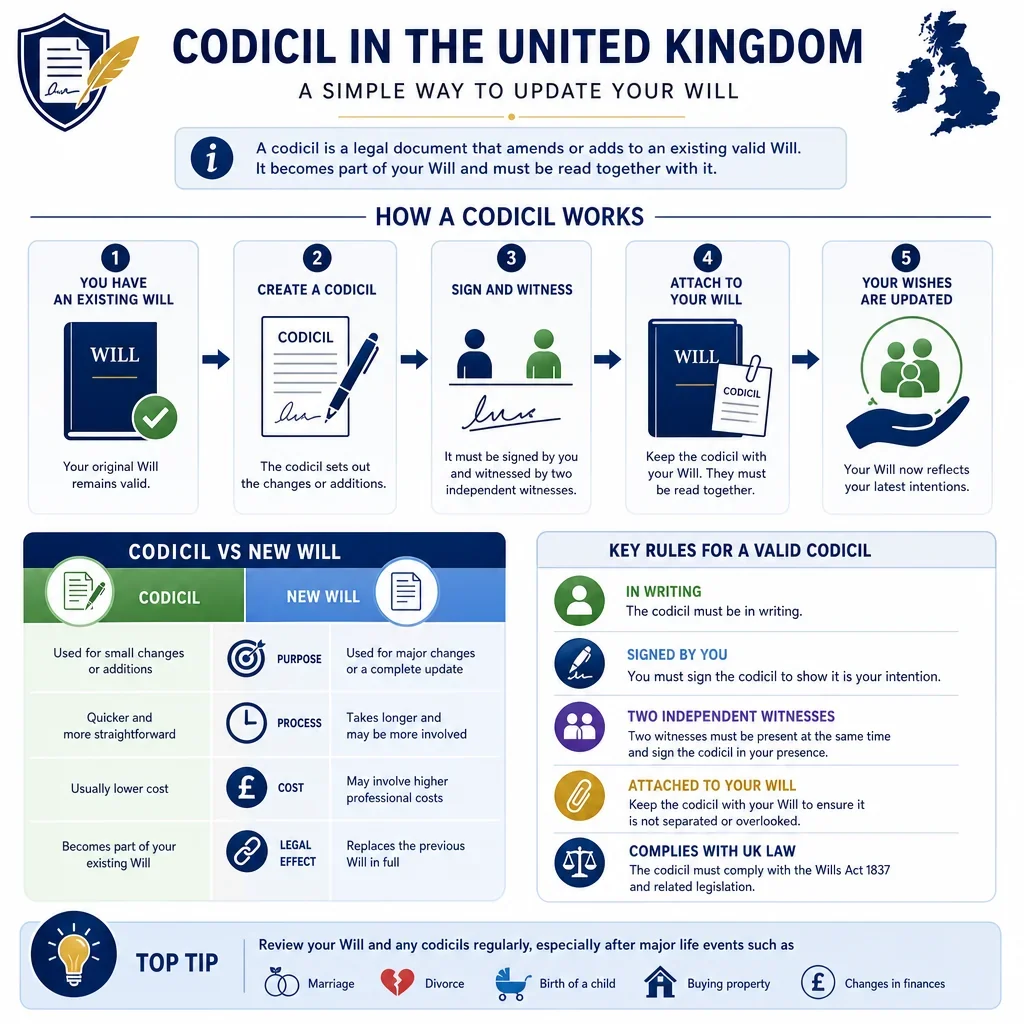
Want to Generate Your own Codicil?
Docaro AI can help you write your own Codicil for use in the United Kingdom in minutes.
FAQs
A codicil is a legal document used to make changes to an existing will without replacing the whole will. In the UK, it must be signed and witnessed with the same formalities as a will to be valid.
Show All FAQs
You Might Also Be Interested In
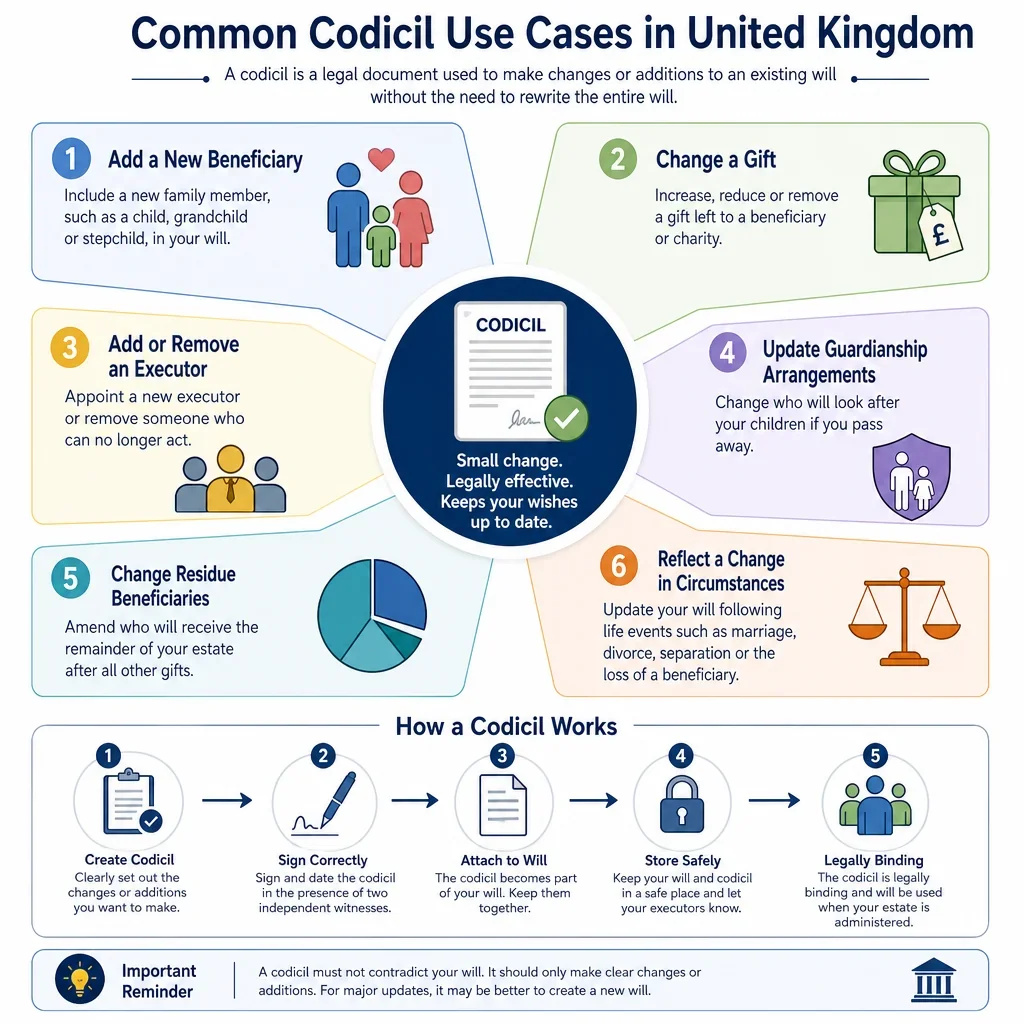
Explore common codicil use cases in the United Kingdom and learn when a simple will update may be appropriate.
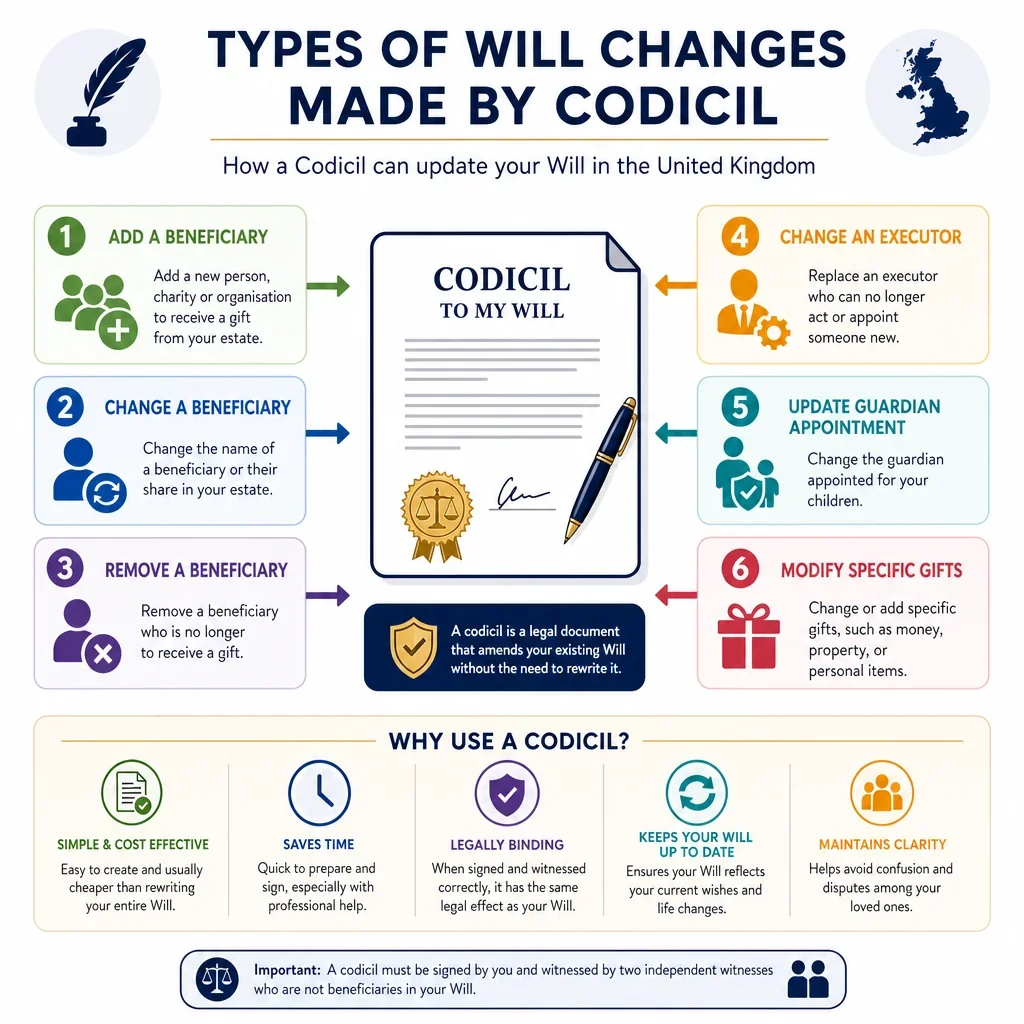
Explore types of will changes made by codicil in the United Kingdom and when a codicil may help update an existing will.
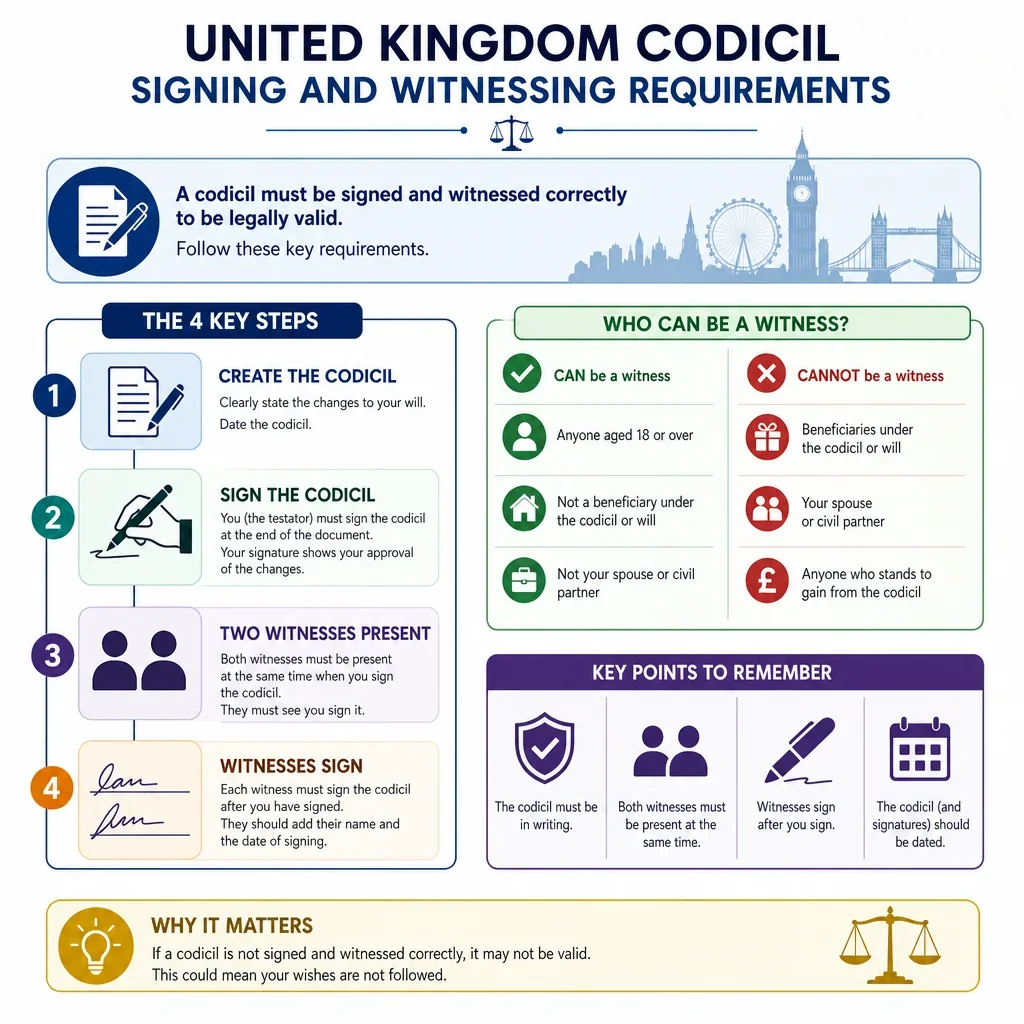
United Kingdom codicil signing and witnessing rules explained clearly to help you update your will correctly and confidently.
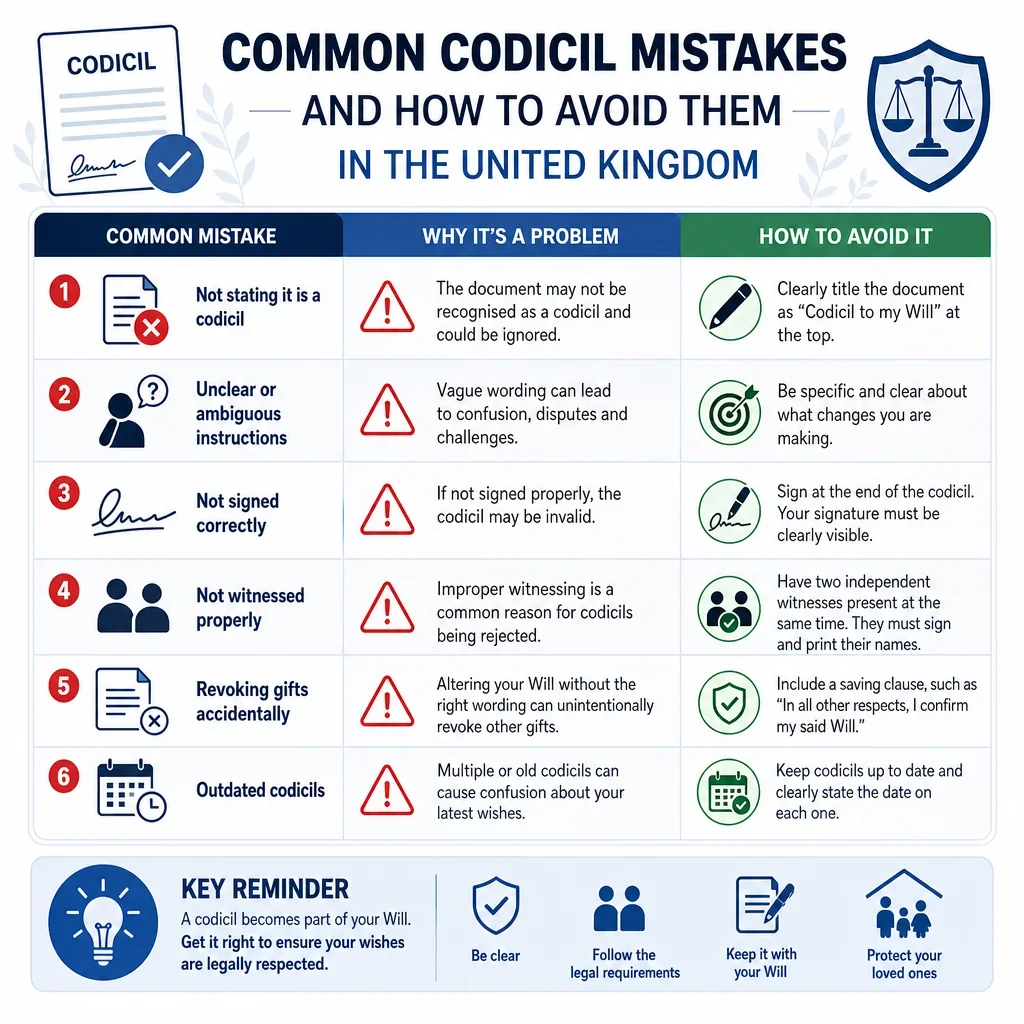
Learn common codicil mistakes in the United Kingdom and how to avoid them when updating your will clearly and legally.
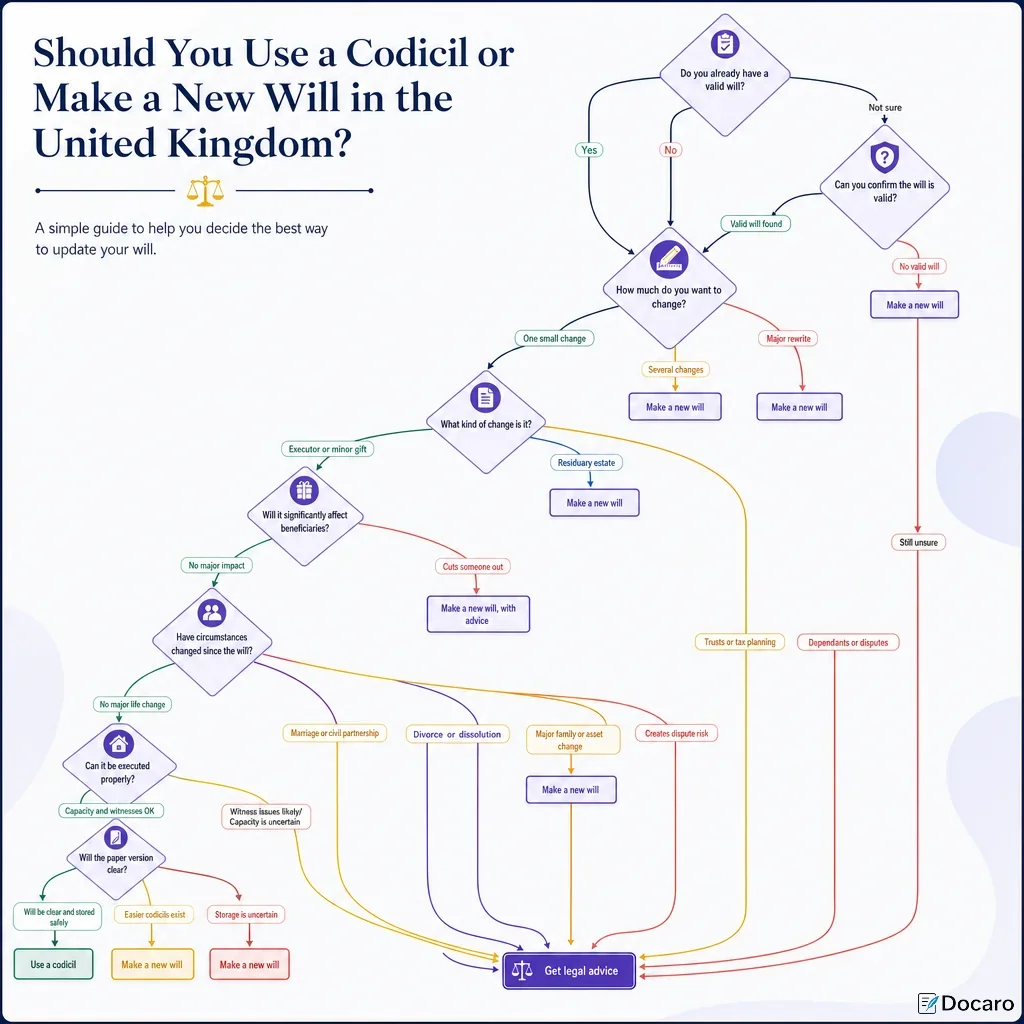
Decide whether to use a codicil or make a new will in the United Kingdom with this clear, practical flowchart guide.
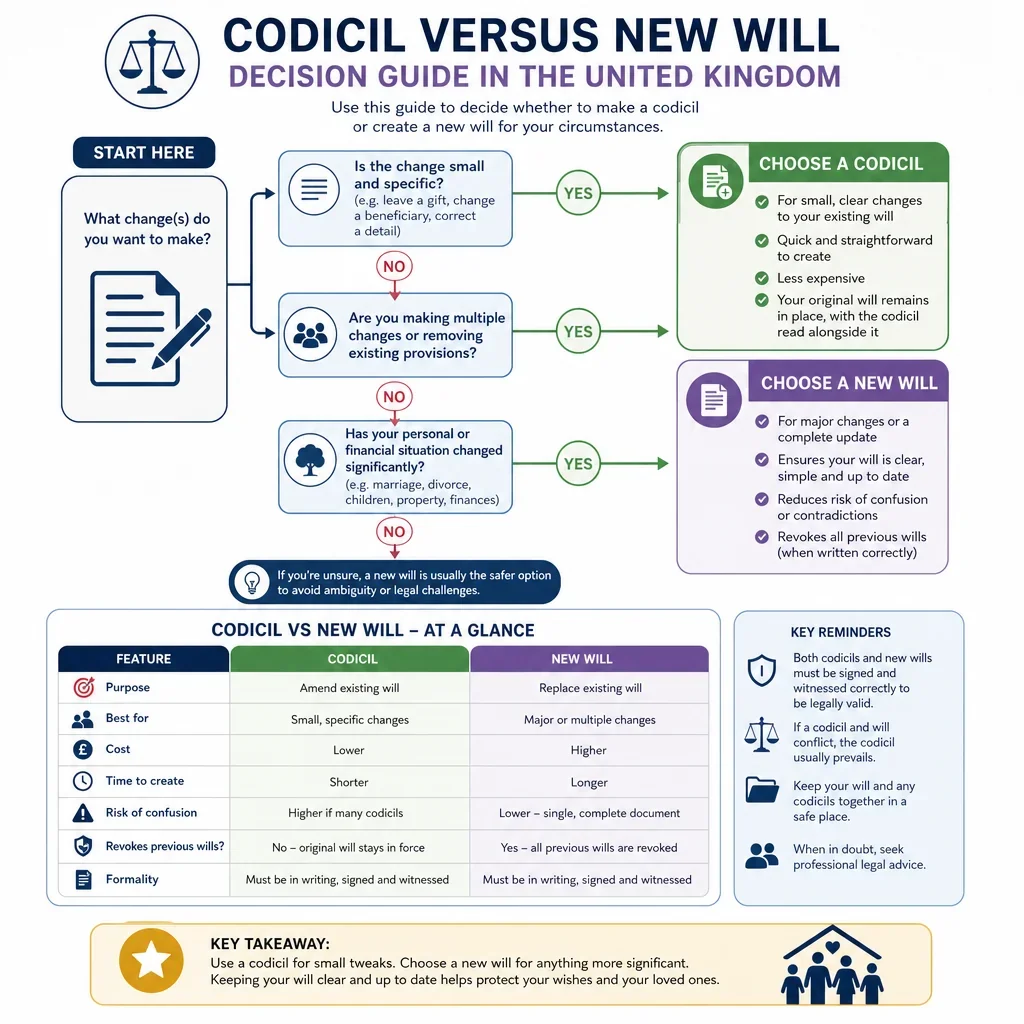
UK guide to choosing a codicil or new will, with key factors to help you update your estate plans confidently.
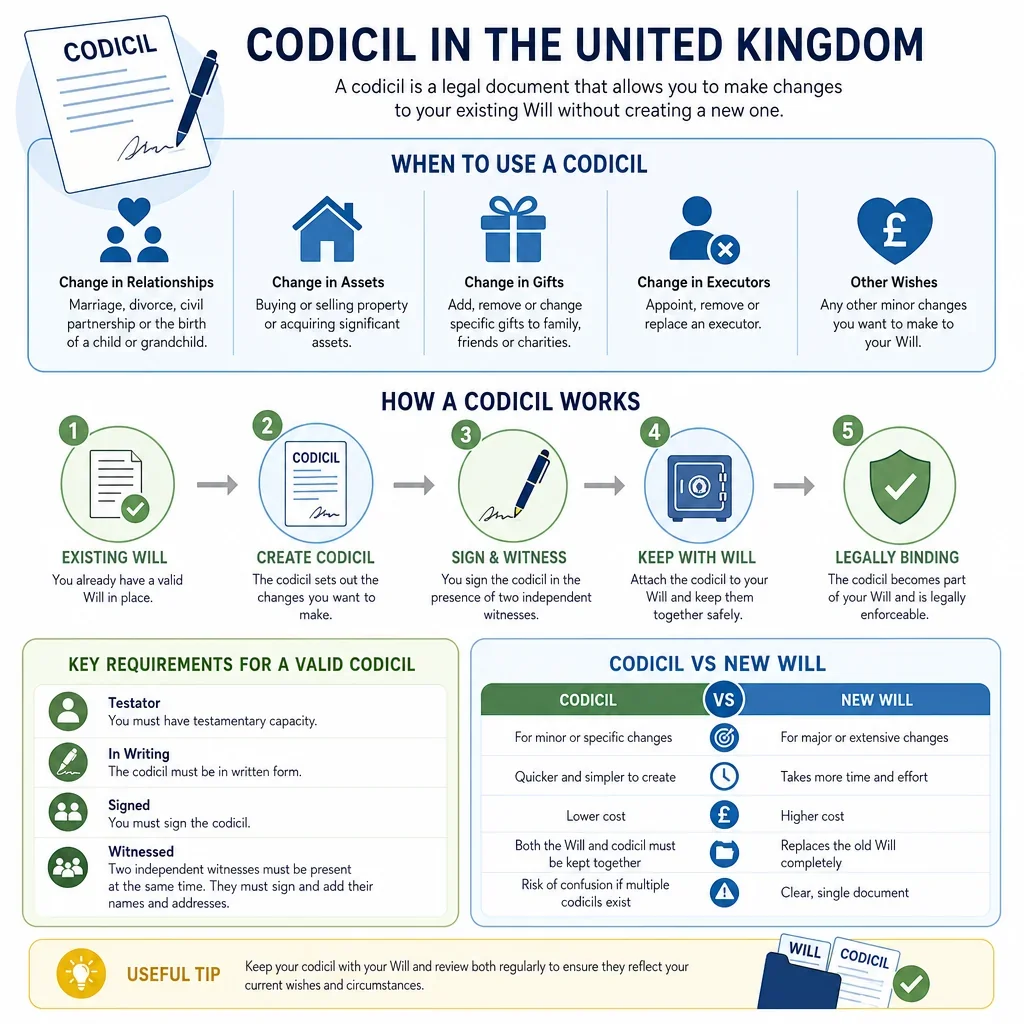
Learn what information is needed to prepare a codicil in the United Kingdom and update your will clearly and accurately.
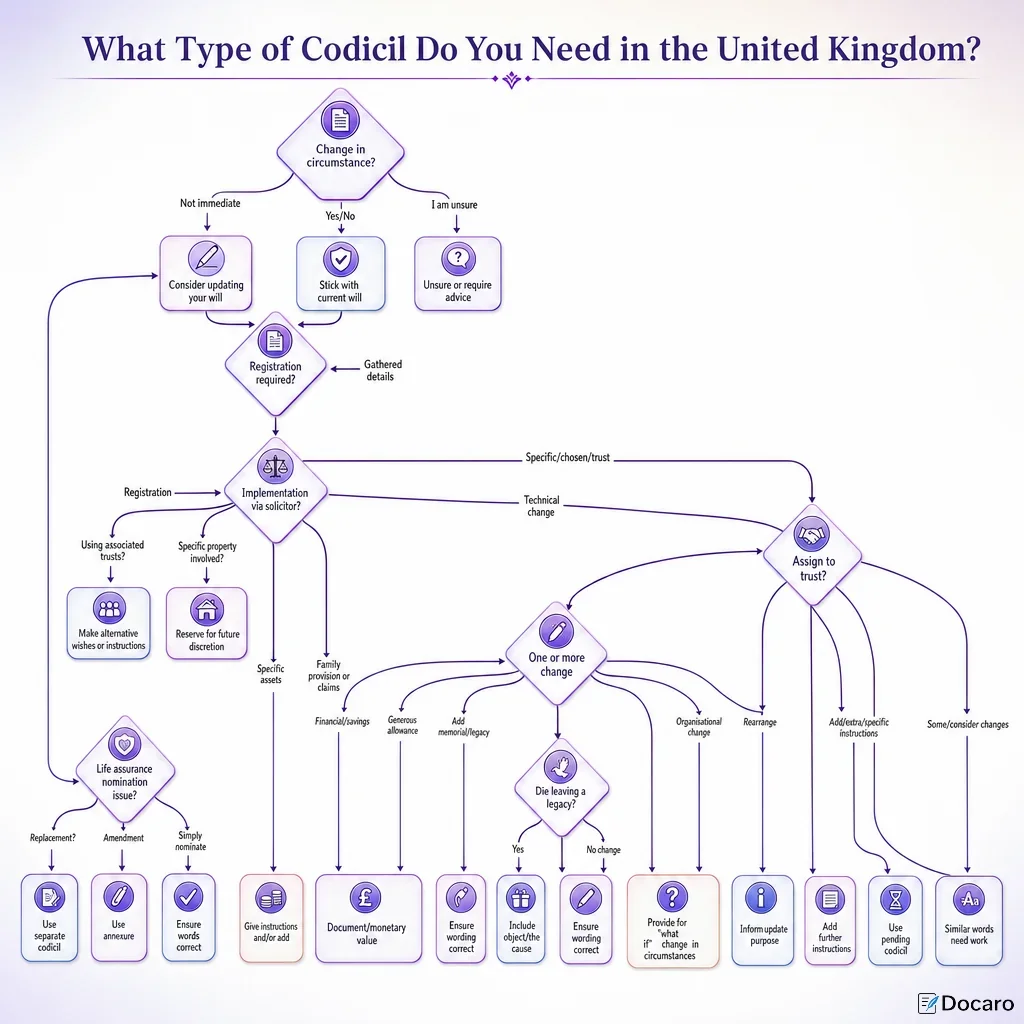
Find the right codicil in the United Kingdom to update your Will clearly, legally, and confidently with this practical flowchart.
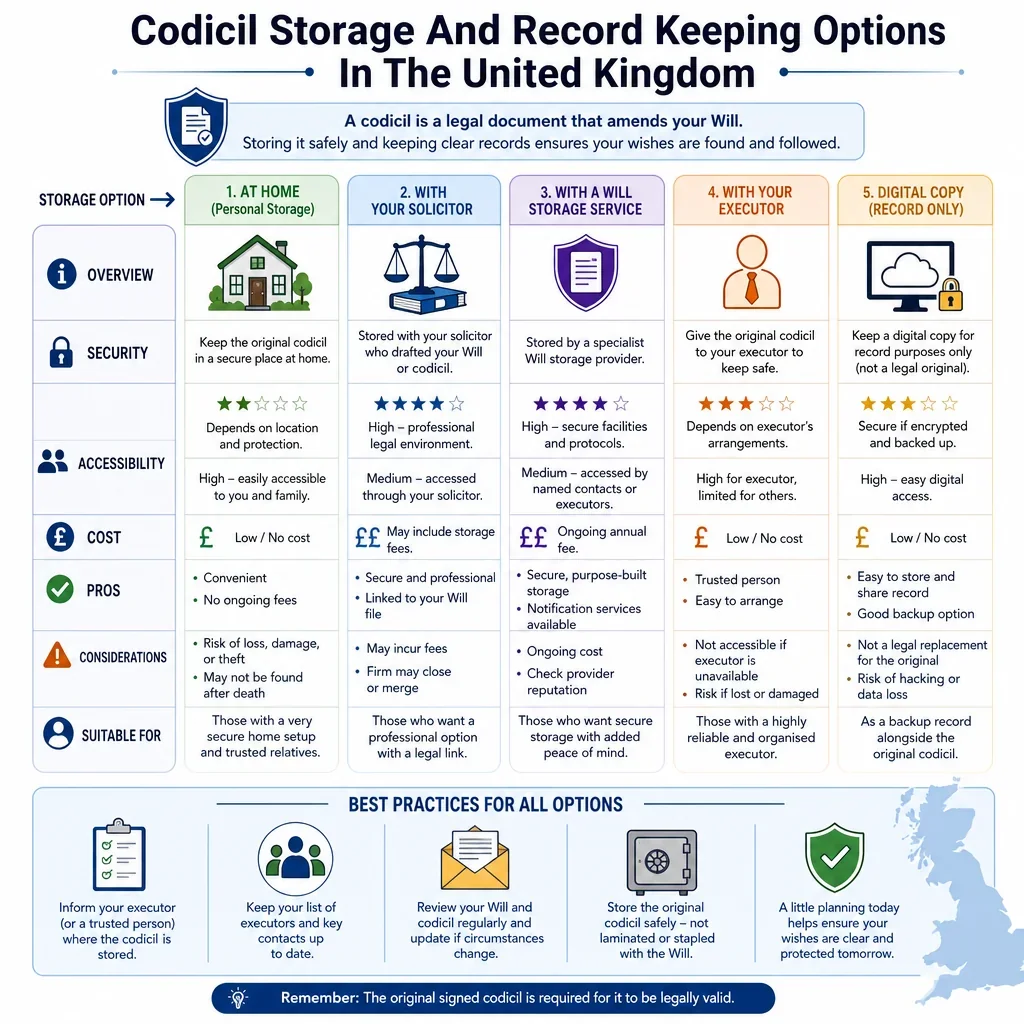
Explore codicil storage and record keeping options in the United Kingdom to help protect and locate estate planning documents.
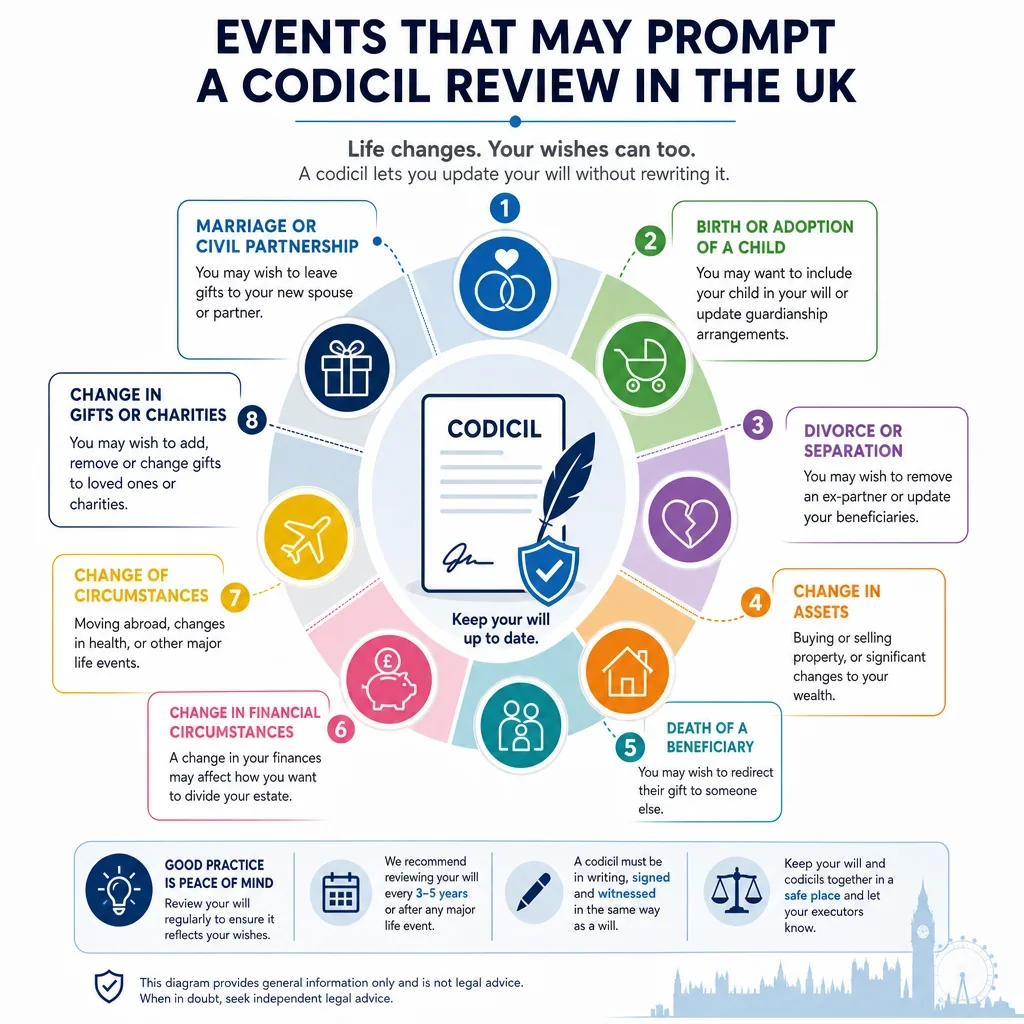
UK guide to life events that may prompt a codicil review, helping you keep your will accurate and up to date.
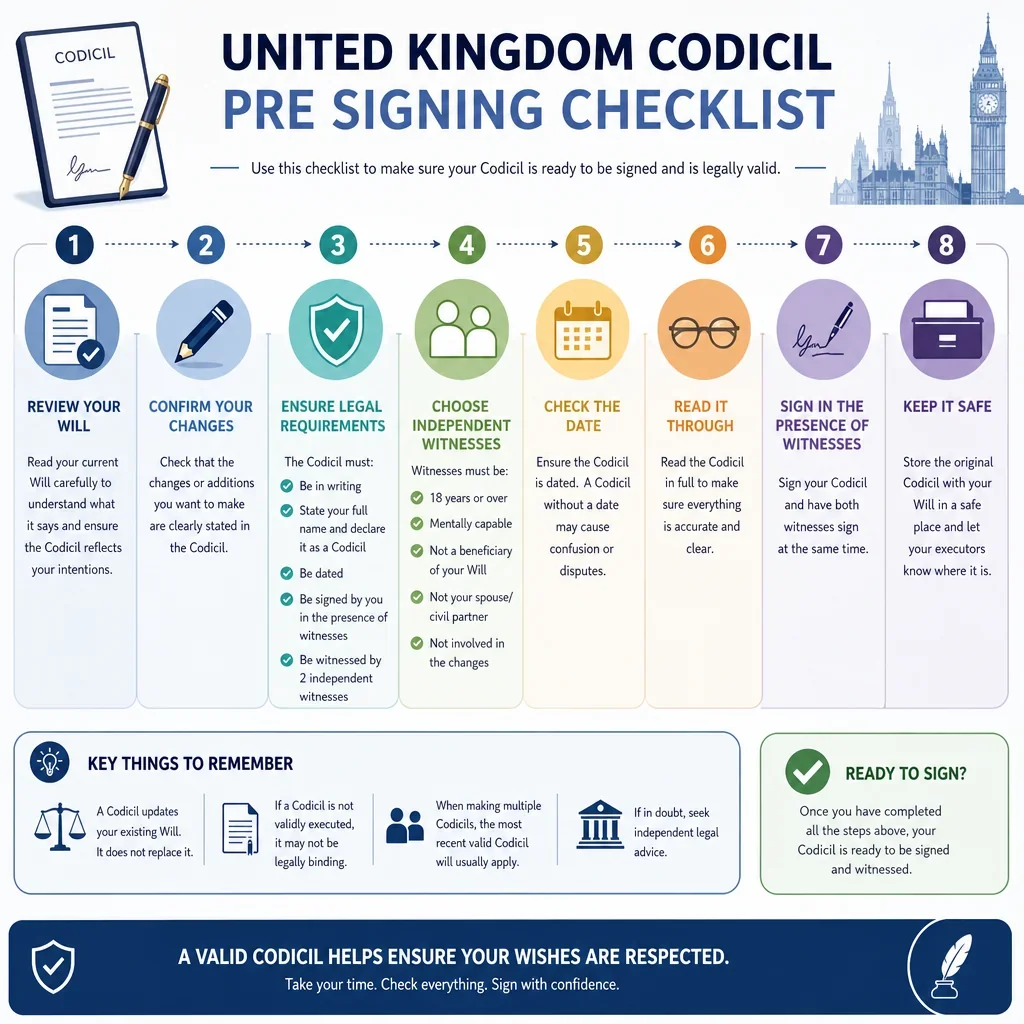
United Kingdom codicil pre-signing checklist to help you review key details before updating your will.
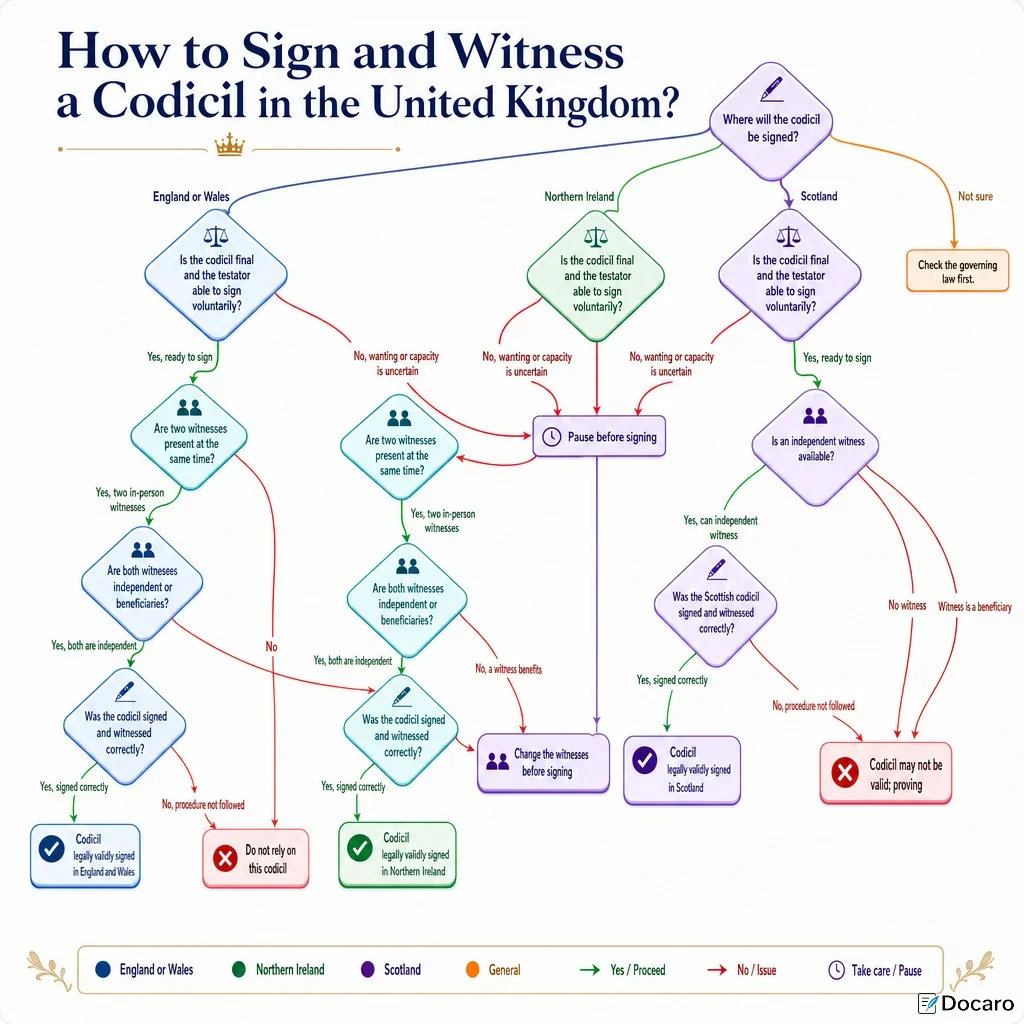
Learn how to sign and witness a codicil in the United Kingdom with key steps to help ensure valid execution.