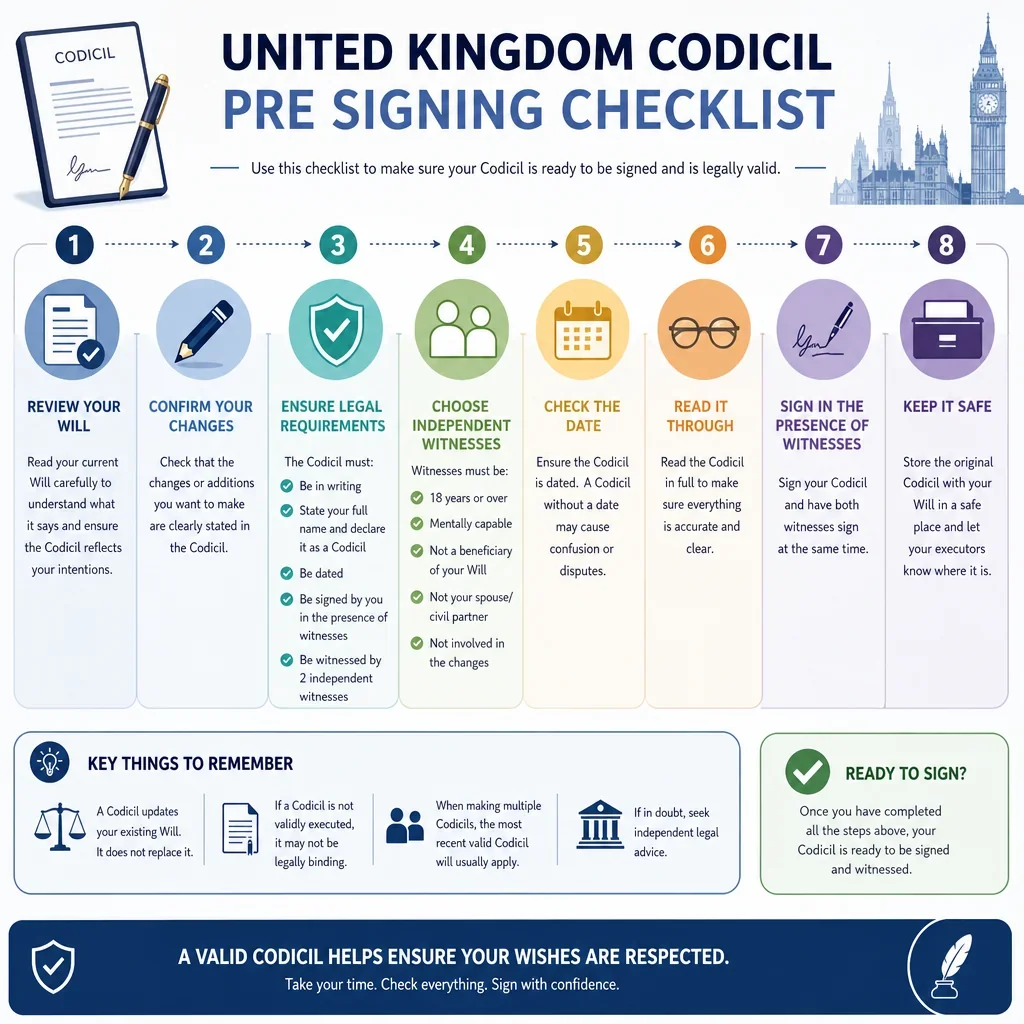
United Kingdom Codicil Pre Signing Checklist
Check Item | What To Confirm | When To Check | Importance | Practical Note |
|---|---|---|---|---|
Identity details | ||||
Confirm full legal name | Name matches the existing will and current ID. | Before printing | High | Avoids doubt about who made the codicil. |
Check former or alternative names | Any maiden, former or known-as names are clear. | Before printing | Medium | Helps link the codicil to the will and assets. |
Confirm current address | Address is current or otherwise not misleading. | Before printing | Medium | Supports identification if names are common. |
Confirm age 18 or over | Testator is legally old enough to make a will. | Before signing | High | A codicil changes a will and needs testamentary capacity. |
Final review | ||||
Confirm mental capacity | Testator understands the codicil and its effect. | Before signing | High | Capacity disputes can undermine the codicil. |
Check free choice | No one is pressuring the testator to sign. | Before signing | High | Pressure or coercion may lead to a challenge. |
Will reference | ||||
Locate original will | Original will is available for comparison. | Before printing | High | Prevents amendments to the wrong or outdated will. |
Check will date | Codicil states the exact date of the will amended. | Before printing | High | Correctly identifies the document being changed. |
Match will-maker name | Will reference uses the same testator identity. | Before printing | High | Avoids uncertainty where family names repeat. |
List earlier codicils | All previous codicils are identified or accounted for. | Before printing | High | Prevents conflicting amendments being overlooked. |
Document consistency | ||||
Check revocation of earlier codicils | Any revoked earlier codicil is clearly named. | Before printing | High | Reduces risk of two amendments applying together. |
Keep remaining will in force | Codicil confirms the rest of the will remains valid. | Before printing | High | Shows the change is limited to stated amendments. |
Check clause numbers | Every clause number matches the original will. | Before printing | High | Wrong clause references can change the wrong gift. |
Check schedules and paragraphs | Schedule, paragraph and annex references are accurate. | Before printing | Medium | Prevents ambiguity in longer wills. |
State the exact change | Change is specific, complete and not implied. | Before printing | High | Executors need clear instructions to administer the estate. |
Identify changed gifts clearly | Amounts, items, percentages and recipients are precise. | Before printing | High | Unclear gifts often cause executor disputes. |
Check beneficiary names | Each beneficiary is named consistently and accurately. | Before printing | High | Avoids confusion between relatives or charities. |
Check charity details | Charity name and registered charity number are correct. | Before printing | High | Charities may have similar names or merged entities. |
Check property descriptions | Address or title details identify the property clearly. | Before printing | High | Property descriptions must avoid mistaken assets. |
Check account descriptions | Financial assets are described without unnecessary risk. | Before printing | Medium | Account numbers may change before death. |
Check executor amendments | Executor appointments, removals and replacements are clear. | Before printing | High | Executors need unambiguous authority after death. |
Check guardian amendments | Guardian changes are clear and consistent with the will. | Before printing | High | Important where minor children are involved. |
Check fallback gifts | Replacement beneficiaries are named where needed. | Before printing | Medium | Stops a gift failing if a beneficiary dies first. |
Check residue impact | Changes do not accidentally disturb the residue clause. | Before printing | High | Residue usually covers the remaining estate. |
Check tax clause impact | New gifts do not conflict with tax payment clauses. | Before signing | Medium | Tax clauses affect what beneficiaries actually receive. |
Check survivorship wording | Any survival period is consistent with the will. | Before printing | Medium | Inconsistent survival periods can affect gift timing. |
Check for contradictions | No new wording conflicts with unchanged clauses. | Before signing | High | Conflicting clauses create probate uncertainty. |
Final review | ||||
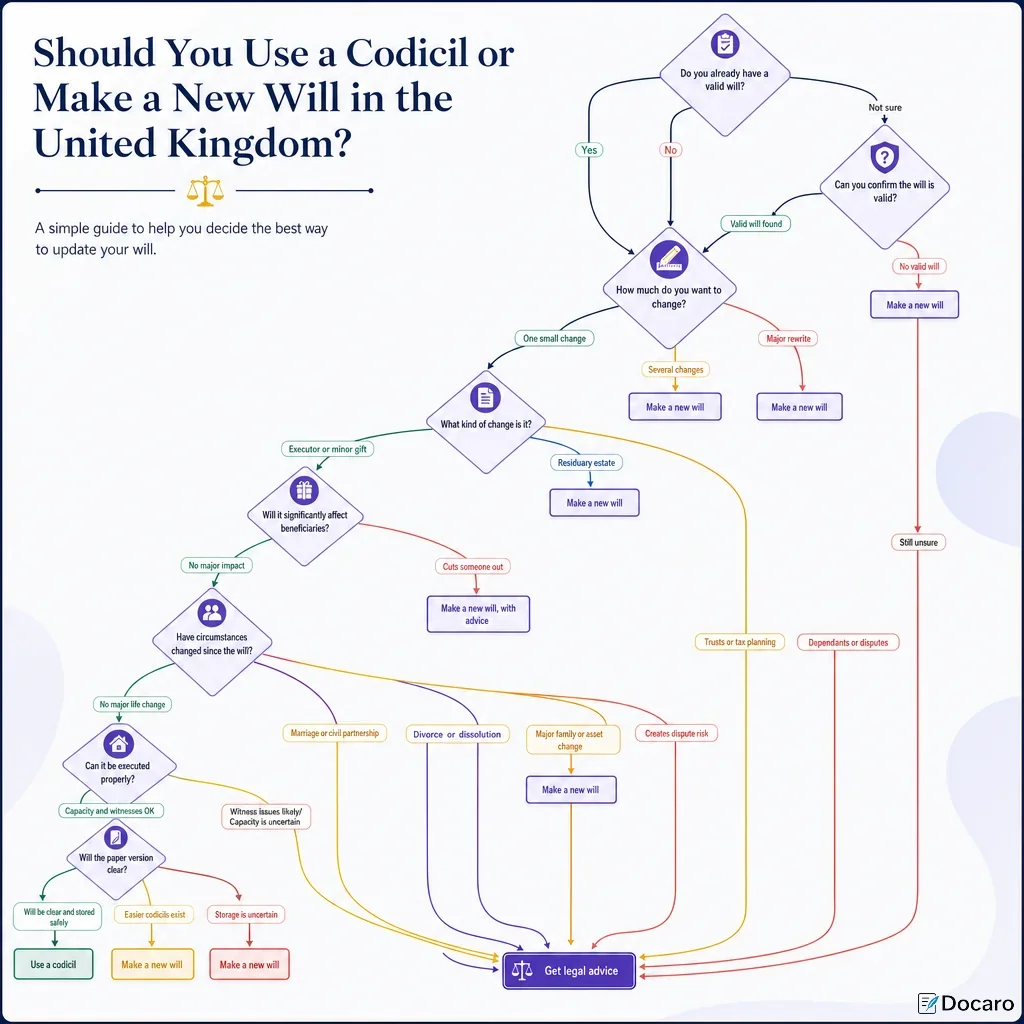
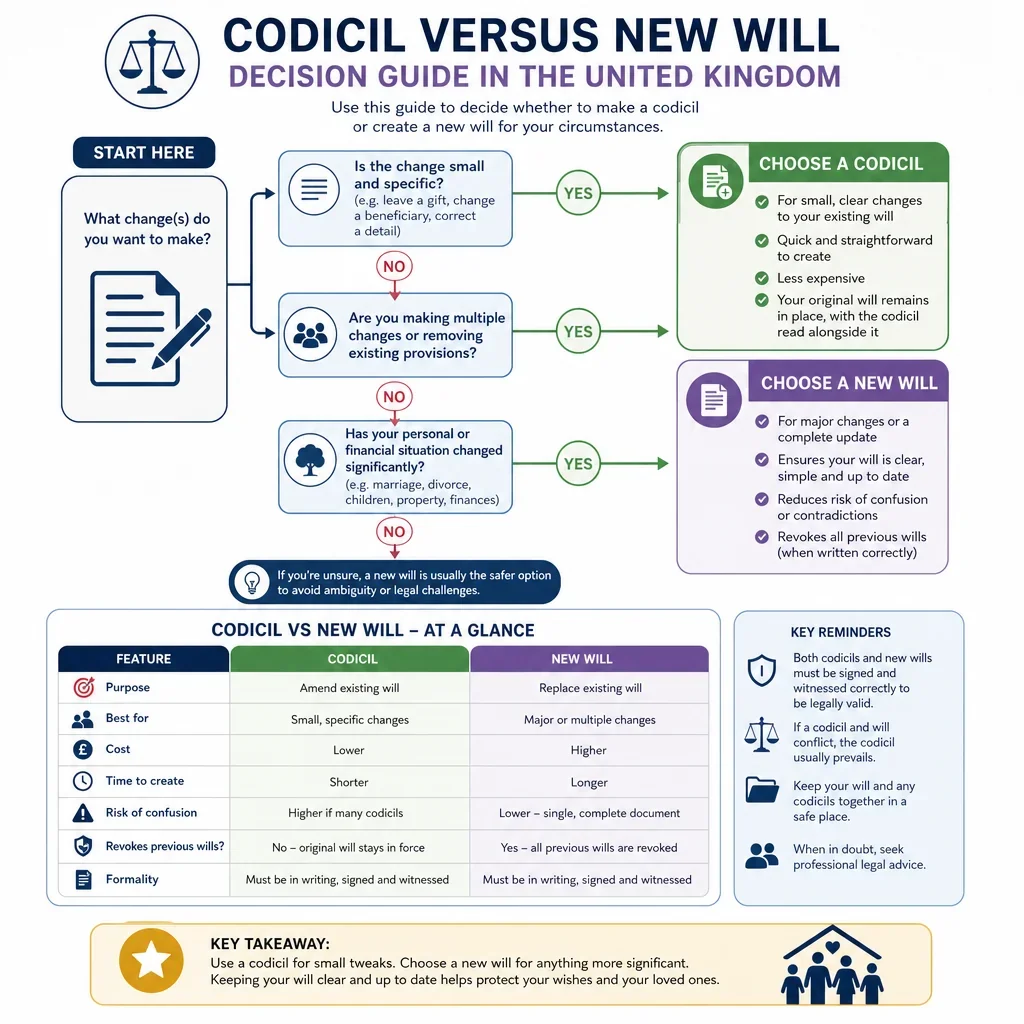
Consider if new will is safer | Changes are limited enough for a codicil. | Before signing | High | Multiple or major changes may justify a new will. |
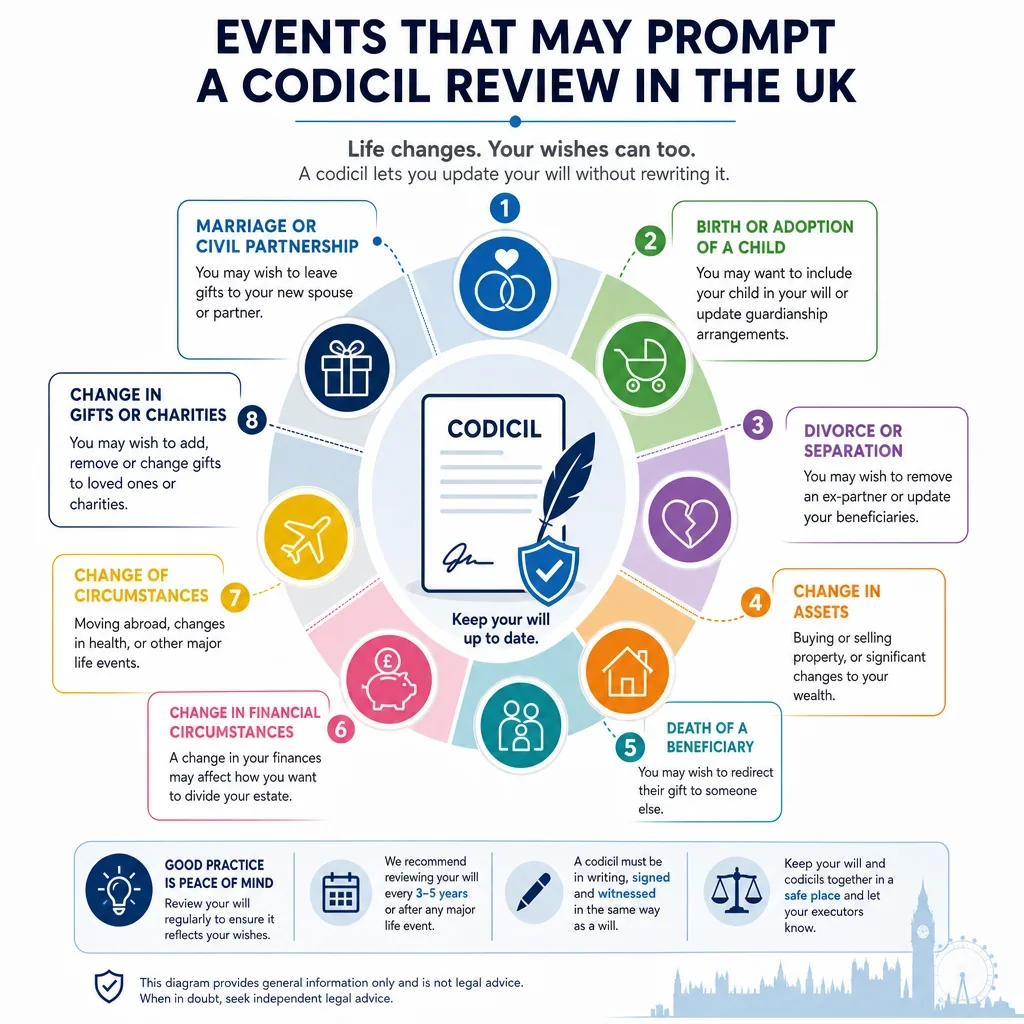
Check marriage impact | Marriage or civil partnership has not revoked the will. | Before signing | High | A codicil cannot safely amend a revoked will. |
Check divorce impact | Divorce or dissolution effects are understood. | Before signing | High | Former spouse gifts or appointments may be affected. |
Check jointly owned property | Joint tenancy assets may pass outside the will. | Before signing | Medium | Codicil gifts cannot control some survivorship assets. |
Check non-estate assets | Pensions, trusts and nominations are not assumed estate assets. | Before signing | Medium | Some assets pass outside the will and codicil. |
Document consistency | ||||
Remove unresolved edits | No draft notes, comments or tracked changes remain. | Before printing | High | Draft markings can create uncertainty about intent. |
Check page numbering | Pages are numbered and in the correct order. | Before signing | Medium | Reduces later concerns about missing pages. |
Final review | ||||
Print final version only | Signing copy is the final clean version. | Before signing | High | Avoids signing a draft by mistake. |
Read the codicil aloud or carefully | Testator agrees every amendment before signing. | Before signing | High | Helps evidence knowledge and approval. |
Witness arrangements | ||||
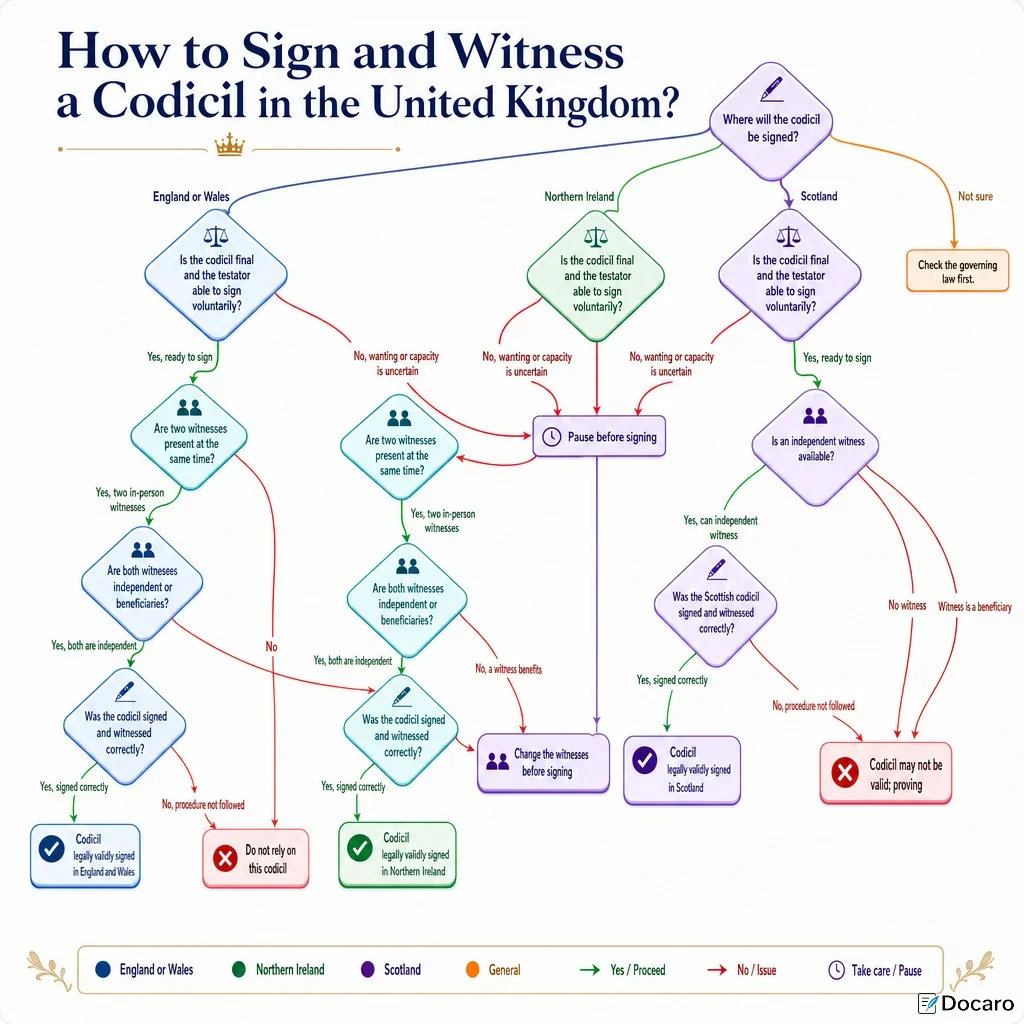
Arrange two witnesses | Two witnesses will be present at the same time. | Before signing | High | English and Welsh wills require two simultaneous witnesses. |
Use independent adult witnesses | Witnesses are adults and not beneficiaries. | Before signing | High | Independent witnesses reduce challenge risk. |
Do not use beneficiaries as witnesses | No witness receives a gift under the will or codicil. | Before signing | High | A witness-beneficiary may lose their gift. |
Avoid beneficiary spouses as witnesses | Witness is not married to or civil partner of a beneficiary. | Before signing | High | Their partner’s gift may otherwise fail. |
Confirm witnesses can see signing | Both witnesses can see the testator sign or acknowledge. | During signing | High | Presence is central to valid execution. |
Testator signs first | Testator signs before witnesses add signatures. | During signing | High | Follows the usual execution sequence. |
Sign in the correct place | Testator signs the signature block, not a draft area. | During signing | High | Clear signature placement avoids execution doubts. |
Confirm intention to sign | Testator intends the signature to validate the codicil. | During signing | High | The signature must be intended to give effect. |
Witnesses sign in testator presence | Each witness signs or acknowledges in the testator’s presence. | During signing | High | Witness attestation completes formal execution. |
Witnesses print full names | Each witness prints full name clearly. | During signing | Medium | Makes witnesses traceable if probate questions arise. |
Witnesses add addresses | Each witness adds a current address. | During signing | Medium | Helps locate witnesses later if needed. |
Witnesses add occupation if requested | Occupation field is completed if present. | During signing | Low | Extra details can help identify witnesses. |
Date the codicil correctly | Date matches the actual signing date. | During signing | High | Dating helps determine order of testamentary documents. |
Use permanent ink | All signatures are made in permanent ink. | During signing | Medium | Protects the original from fading or alteration concerns. |
Avoid electronic signatures | Wet-ink signing is used unless legally advised otherwise. | Before signing | High | Wet-ink execution is the conventional probate-safe method. |
Use in-person witnessing | Witnesses are physically present unless valid rules apply. | Before signing | High | Temporary video-witnessing rules were time limited. |
Sign one original document | Testator and witnesses sign the same original codicil. | During signing | High | Separate copies can create execution uncertainty. |
Initial any last-minute correction | All parties initial unavoidable handwritten corrections. | During signing | Medium | A clean reprint is usually safer than corrections. |
Final review | ||||
Avoid staples and paperclips | Codicil is not fixed in a way that leaves marks. | After signing | Medium | Marks can raise questions about removed pages. |
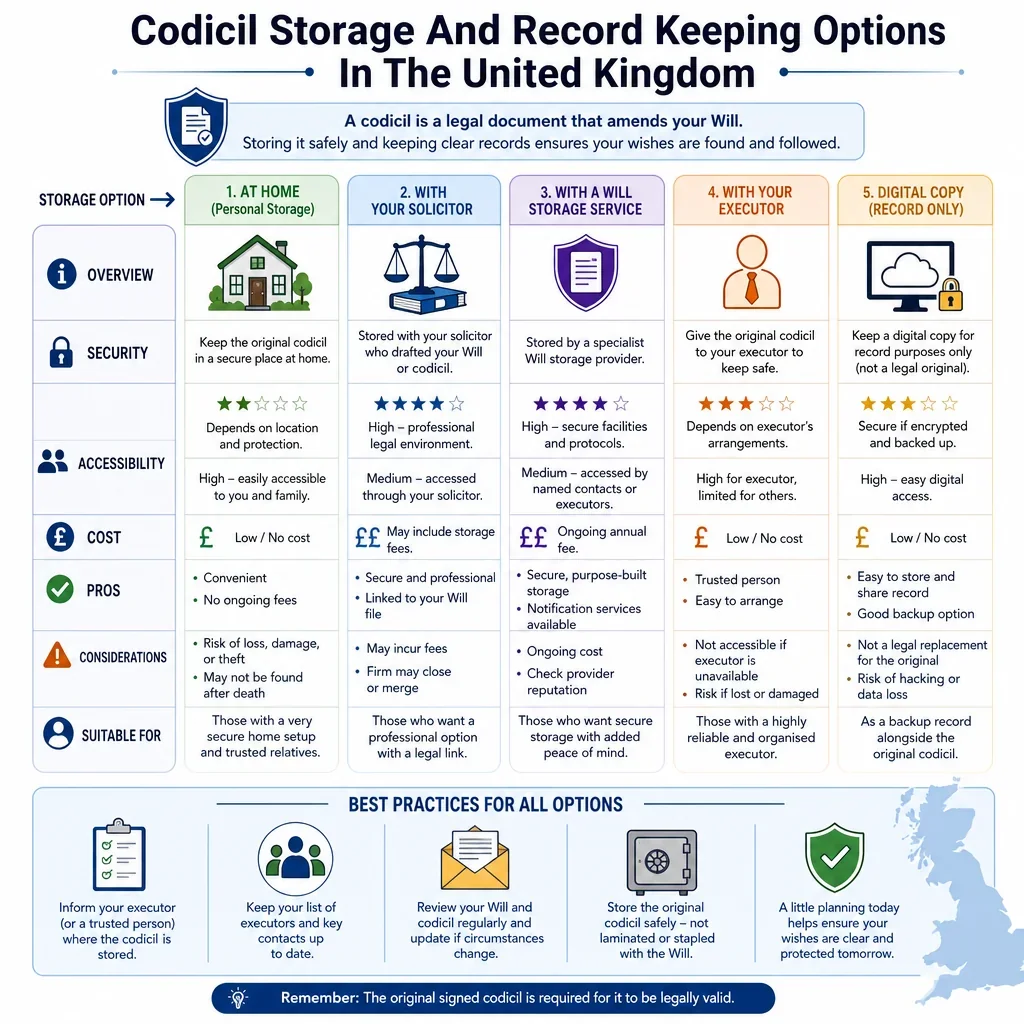
Store with original will | Original codicil is stored with or near the will. | After signing | High | Executors must find both documents after death. |
Tell executors storage location | Executors know where the original codicil is kept. | After signing | High | A lost codicil may not be applied in probate. |
Mark copies clearly | Any copies are labelled as copies, not originals. | After signing | Medium | Avoids confusion over which document controls. |
Do not damage the will | Original will is not torn, marked or destroyed. | After signing | High | Physical destruction can revoke a will if intended. |
Keep a signing note | Record date, location and witness names separately. | After signing | Low | Helpful if execution is later questioned. |
Document consistency | ||||
Check conditional wording | No accidental condition limits the codicil’s effect. | Before signing | Medium | Conditional language may prevent the change applying. |
Check document title | Title clearly states it is a codicil to a will. | Before printing | Medium | Helps executors recognise its legal purpose. |
Witness arrangements | ||||
Check attestation clause | Signing clause reflects two-witness execution. | Before signing | High | Good attestation wording supports probate evidence. |
Check assisted signing wording | If another signs for the testator, authority is clear. | Before signing | High | Signing by another person needs careful compliance. |
Use reading-over clause if needed | Codicil was read to a visually impaired testator. | During signing | High | Helps prove knowledge and approval. |
Final review | ||||
Confirm language understanding | Testator understands the English wording used. | Before signing | High | Translation issues can undermine knowledge and approval. |
Check jurisdiction suitability | Document is suitable for the relevant UK jurisdiction. | Before signing | High | Scotland has different succession and signing rules. |
Check Northern Ireland rules if relevant | Signing and content suit Northern Ireland if applicable. | Before signing | High | UK succession rules are not fully uniform. |
Witness arrangements | ||||
Avoid conflicted witnesses | Witnesses are not carers or financially interested people. | Before signing | Medium | Independence helps rebut undue influence allegations. |
Confirm witnesses can observe signing | Witnesses can observe the signature or acknowledgement. | Before signing | High | A witness must be able to witness the act. |
Document consistency | ||||
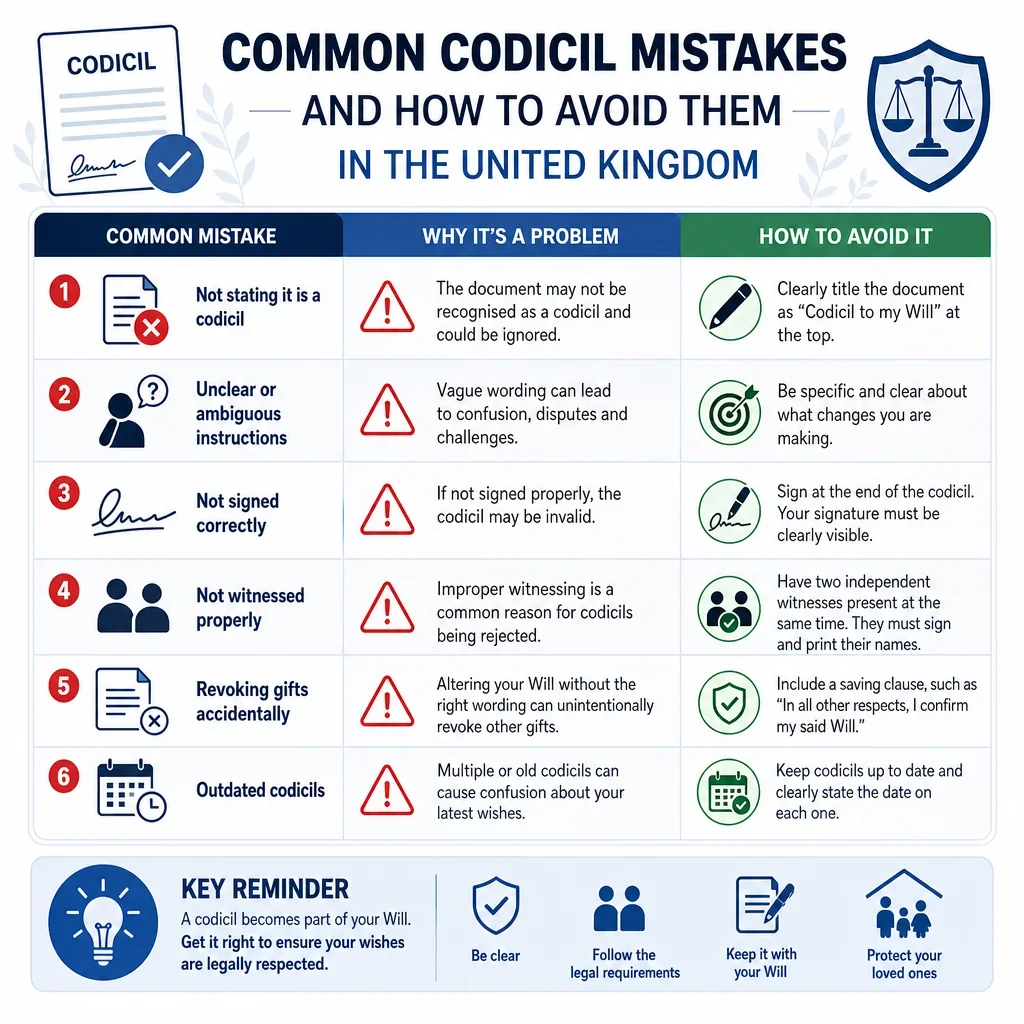
Avoid accidental full revocation | Revocation wording only cancels intended clauses. | Before signing | High | Broad revocation wording can defeat the will plan. |
Check all referenced documents are present | Any referenced schedule or list is included or identified. | Before signing | Medium | Missing attachments can make amendments unclear. |
Final review | ||||
Keep original despite scans | Scans are for reference only, not replacement originals. | After signing | High | Probate usually needs the original testamentary document. |
Consider professional capacity evidence | Medical or legal support is considered if capacity may be challenged. | Before signing | High | Extra evidence can reduce later disputes. |
Check foreign asset impact | Foreign property or wills are not unintentionally affected. | Before signing | Medium | Cross-border estates often need specialist advice. |
What Should You Check Before Signing A Codicil In The UK?
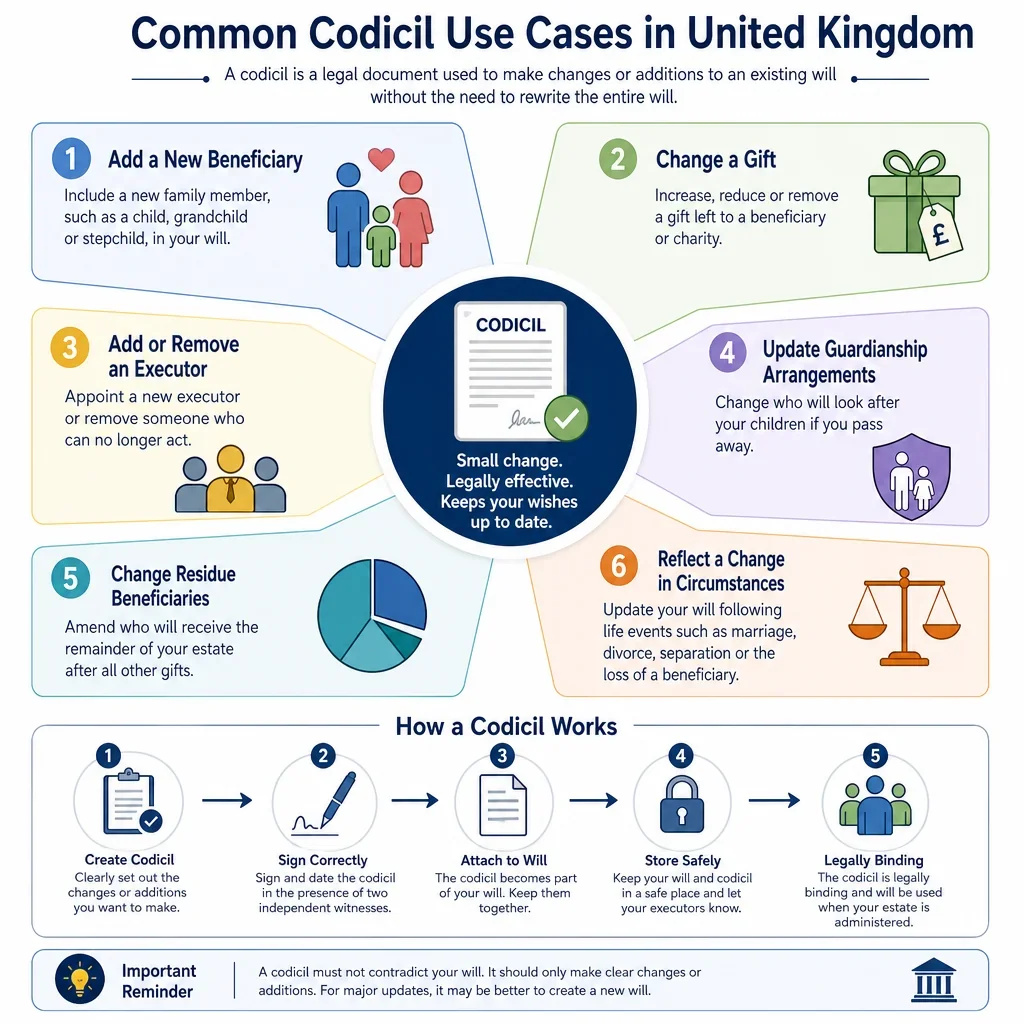
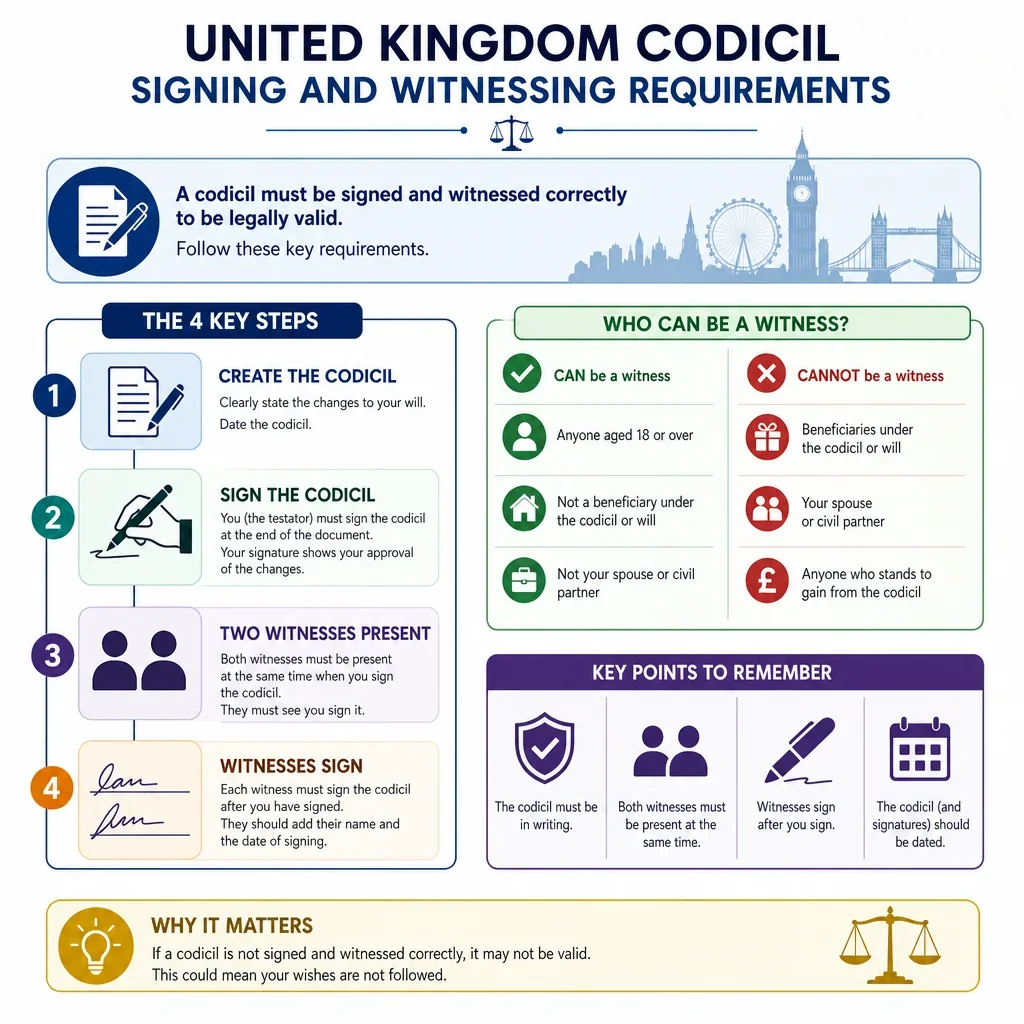
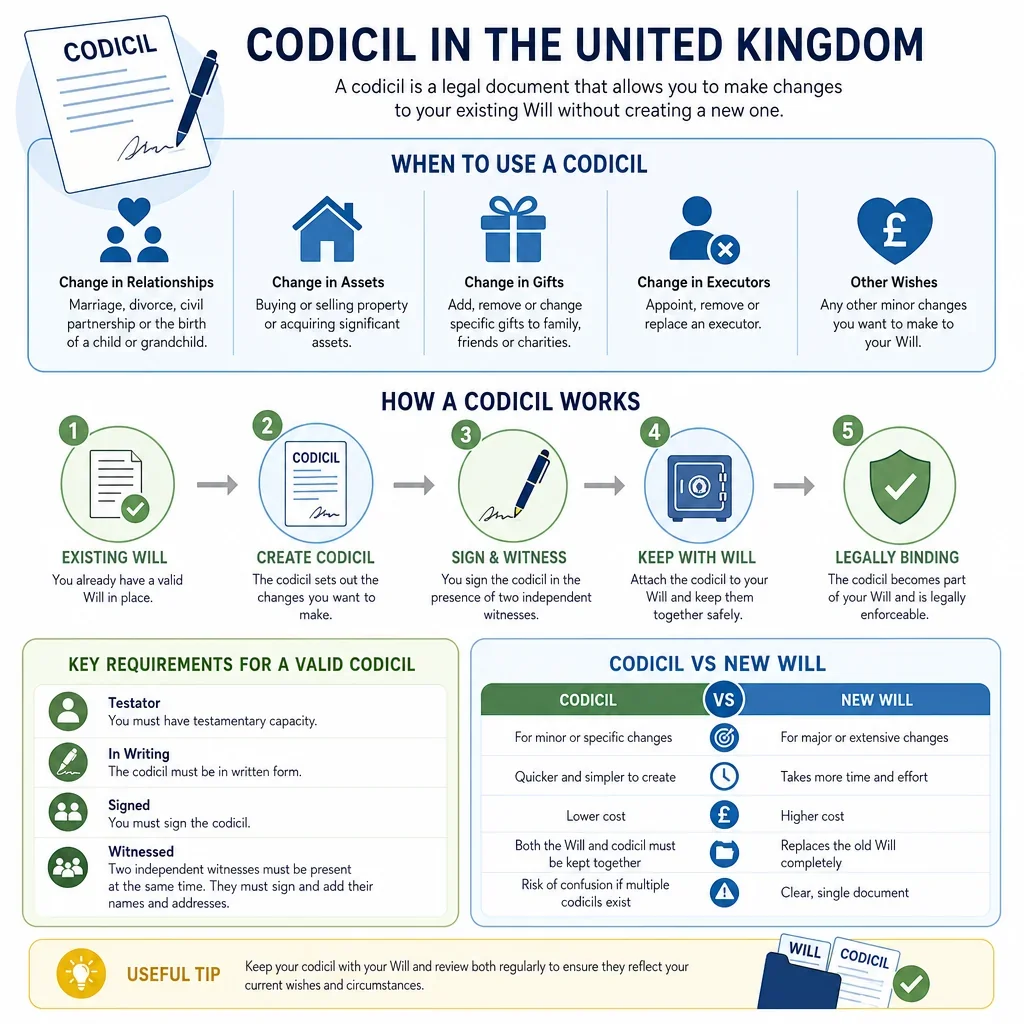
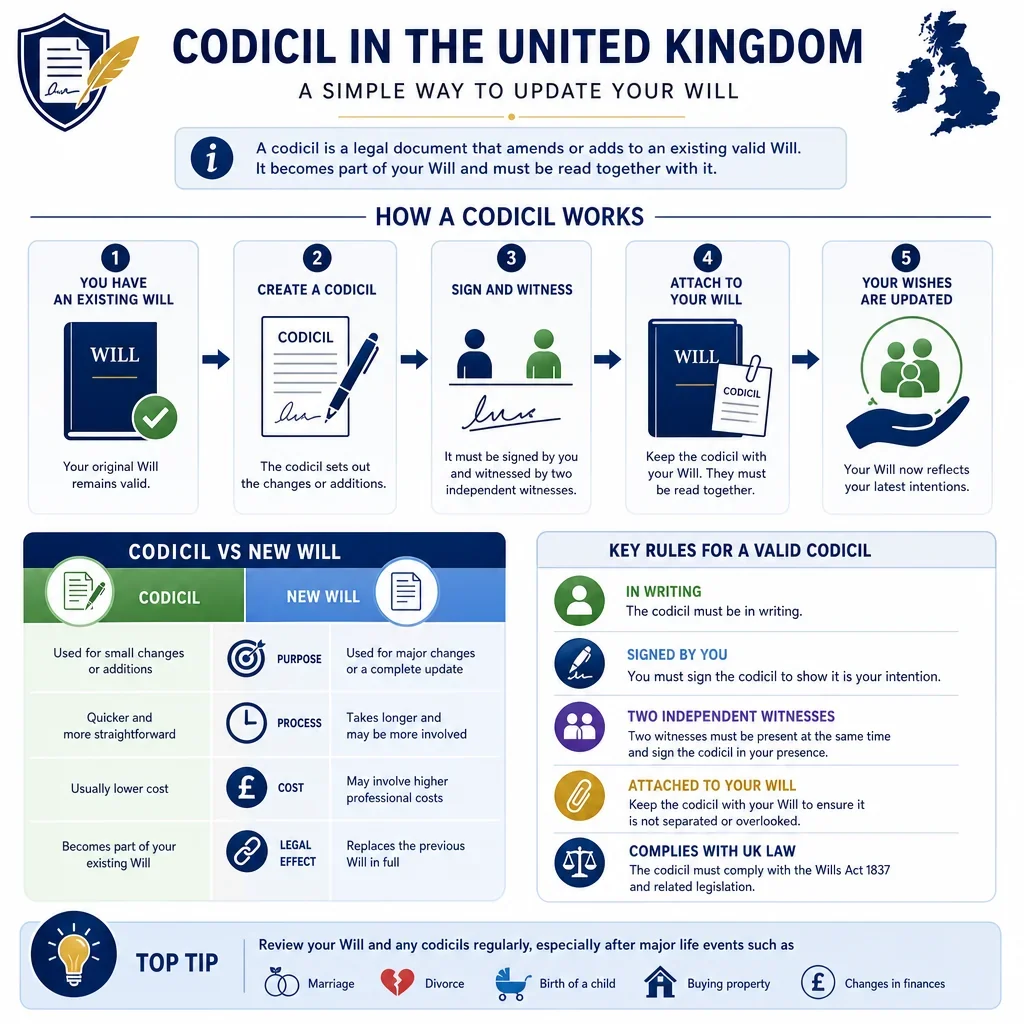
A codicil should be treated with the same care as a will. The key practical checks are that the codicil clearly identifies the existing will, states exactly what is being changed, and leaves the rest of the will in force. In England and Wales, the safest signing process is to follow the formalities in section 9 of the Wills Act 1837: the testator signs, or acknowledges their signature, in the presence of two witnesses present at the same time, and each witness signs or acknowledges their signature in the testator’s presence.
Why Are Witness Checks So Important?
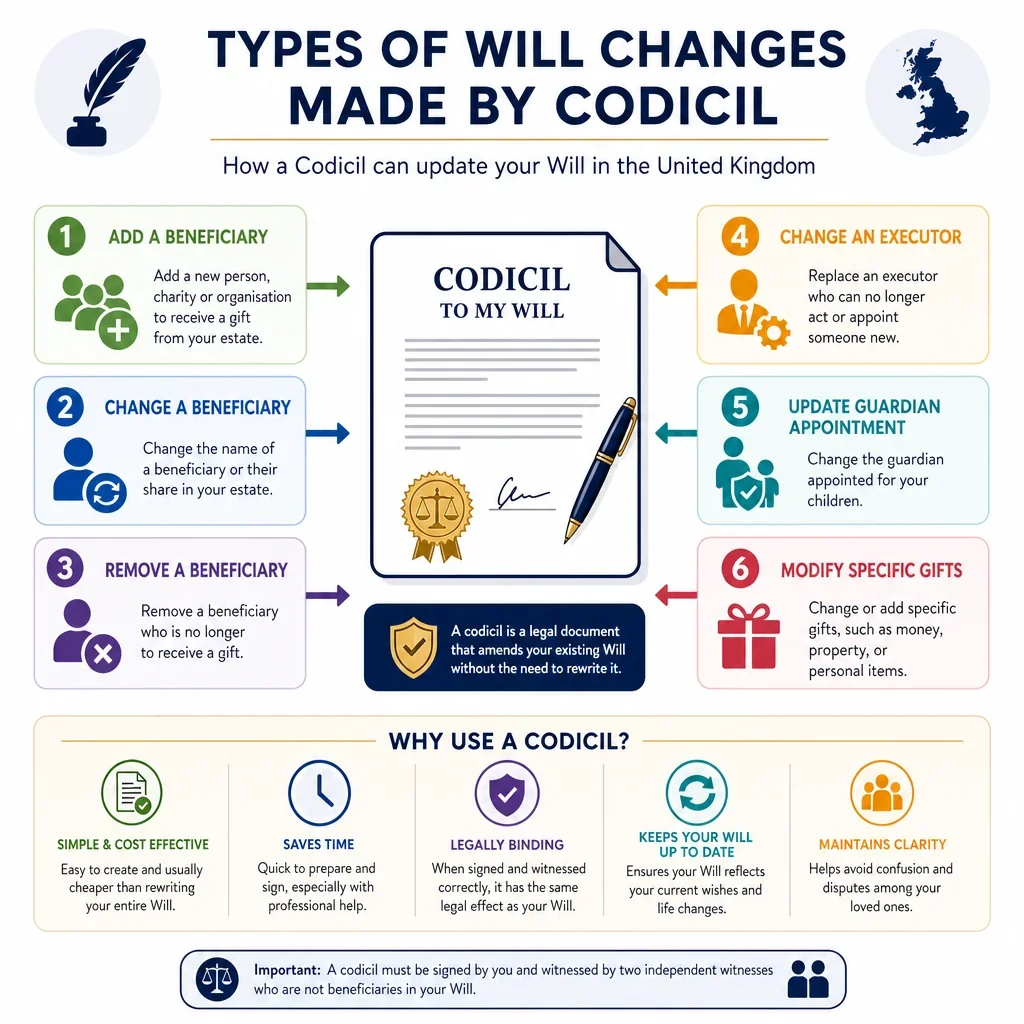
Witness arrangements are high risk because a codicil can fail if signing formalities are not followed. Also, a witness or the spouse or civil partner of a witness may lose any gift made to them under the will or codicil, so beneficiaries should not act as witnesses. Use two independent adult witnesses who can see the signing and who are not beneficiaries or closely connected to beneficiaries.
When Is A Codicil Not The Best Option?
A codicil is usually best for a limited, clear amendment. If there are several changes, inconsistent clauses, changes to executors, major changes to gifts, marriage, divorce or uncertainty about the original will, a new will is often safer than adding another codicil.
How Should The Signed Codicil Be Stored?
After signing, keep the original codicil with the original will and tell executors where both documents are stored. Do not attach pages with staples or clips if that may later create questions about missing pages or alteration. Keep copies clearly marked as copies.
FAQs
You Might Also Be Interested In