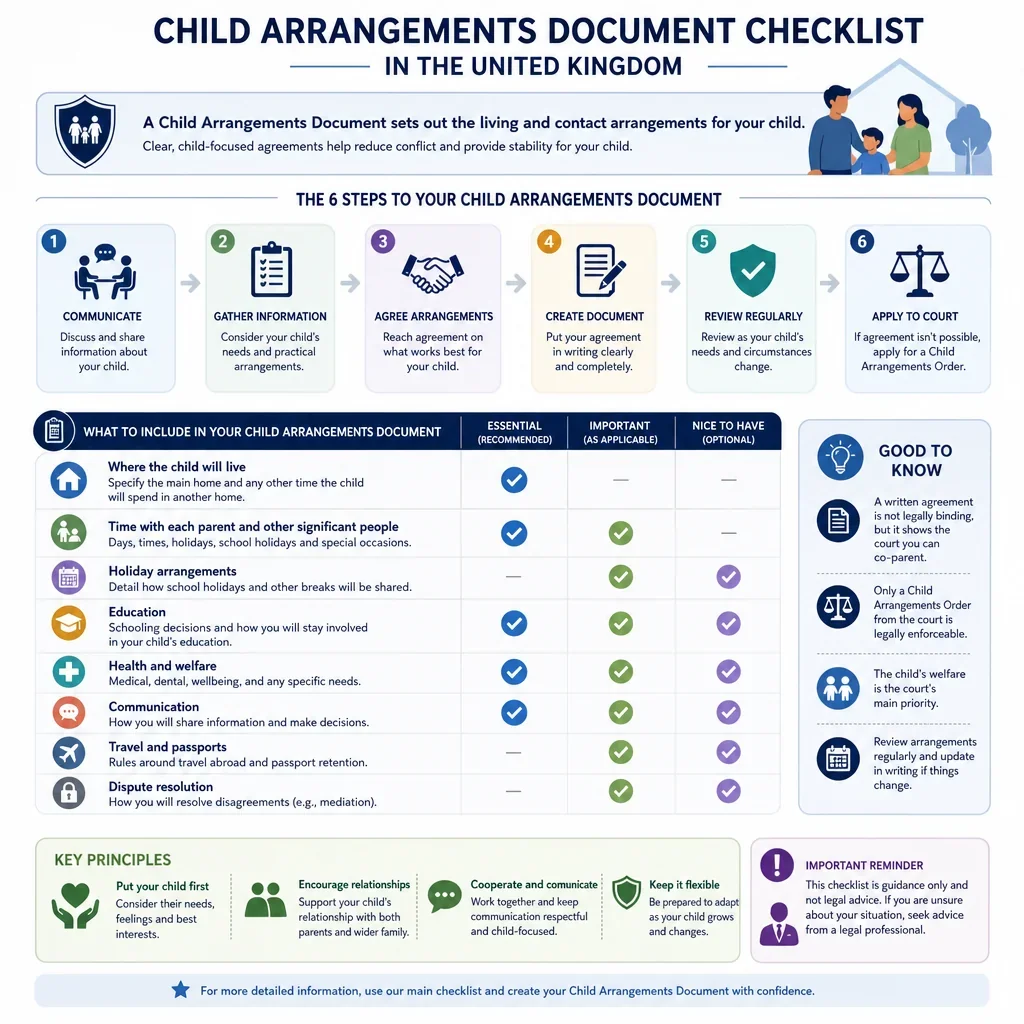
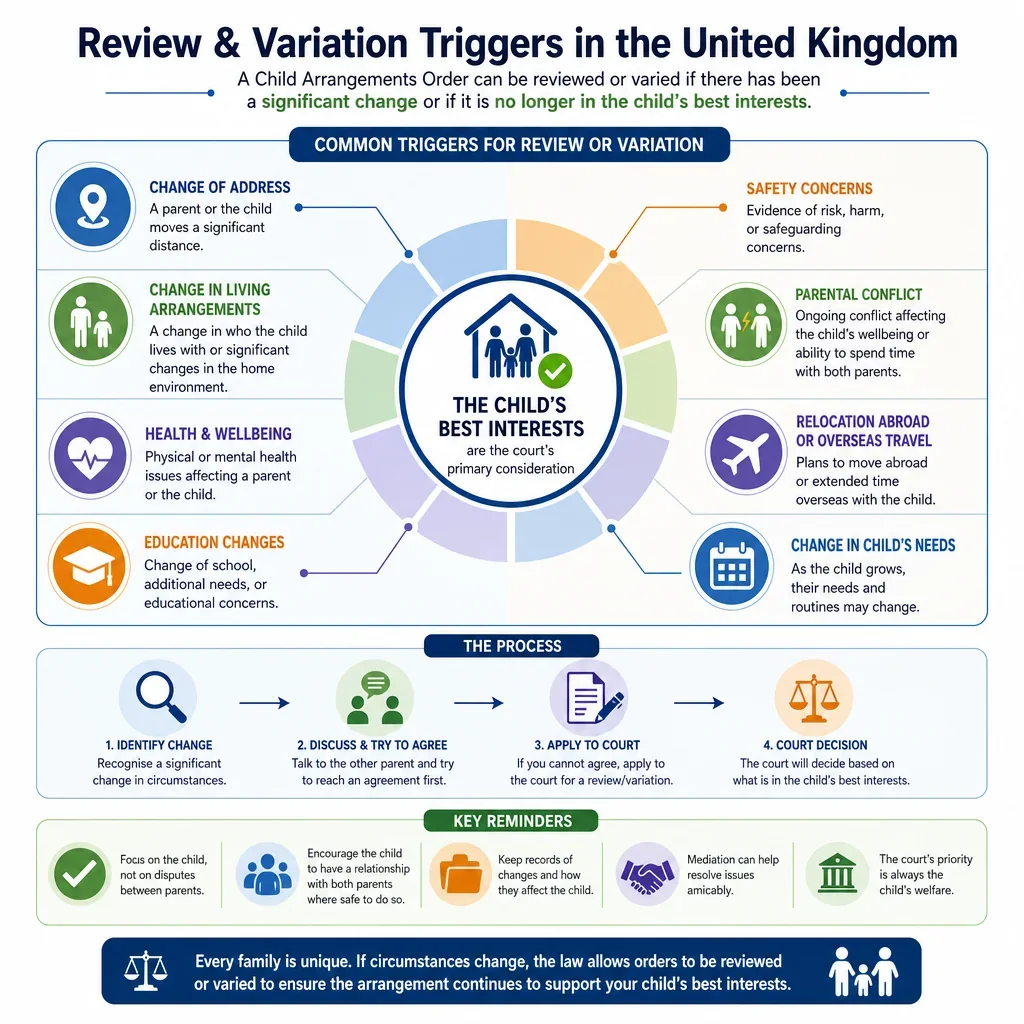
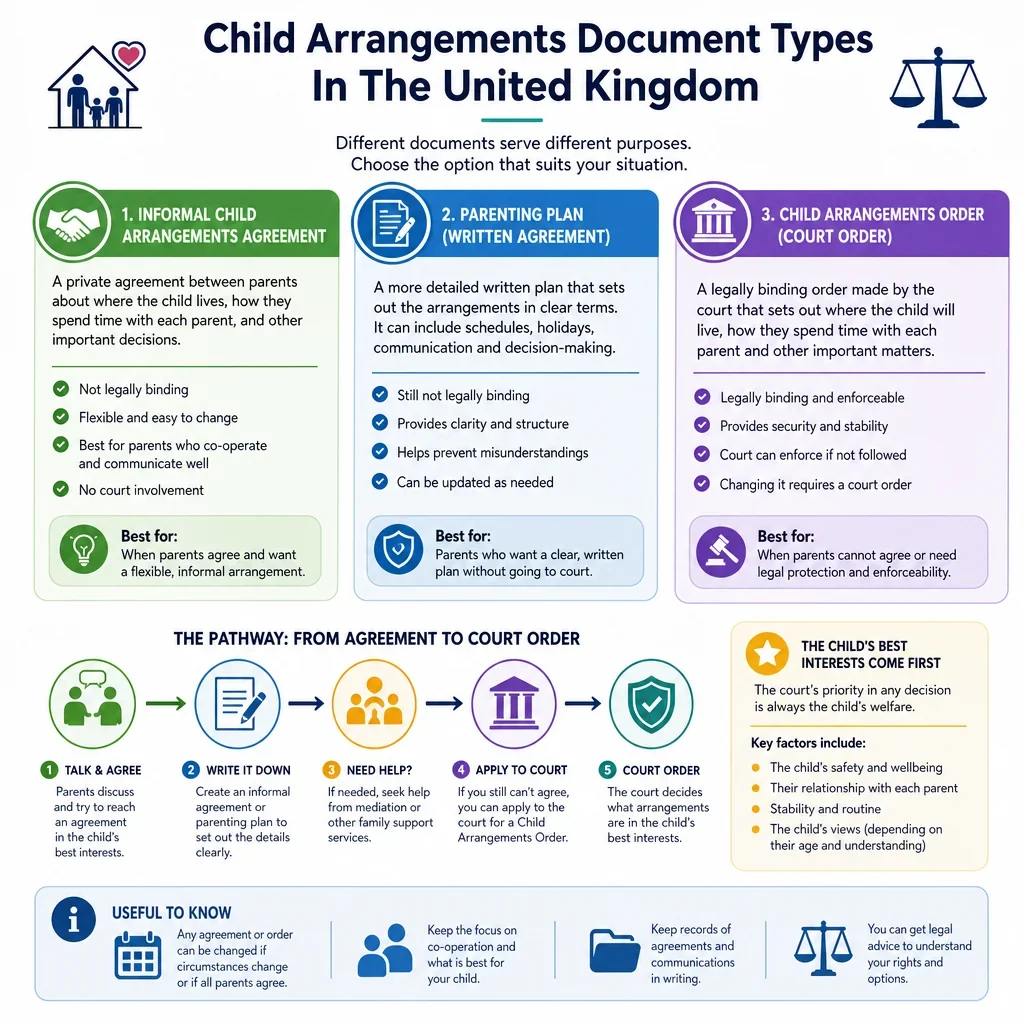
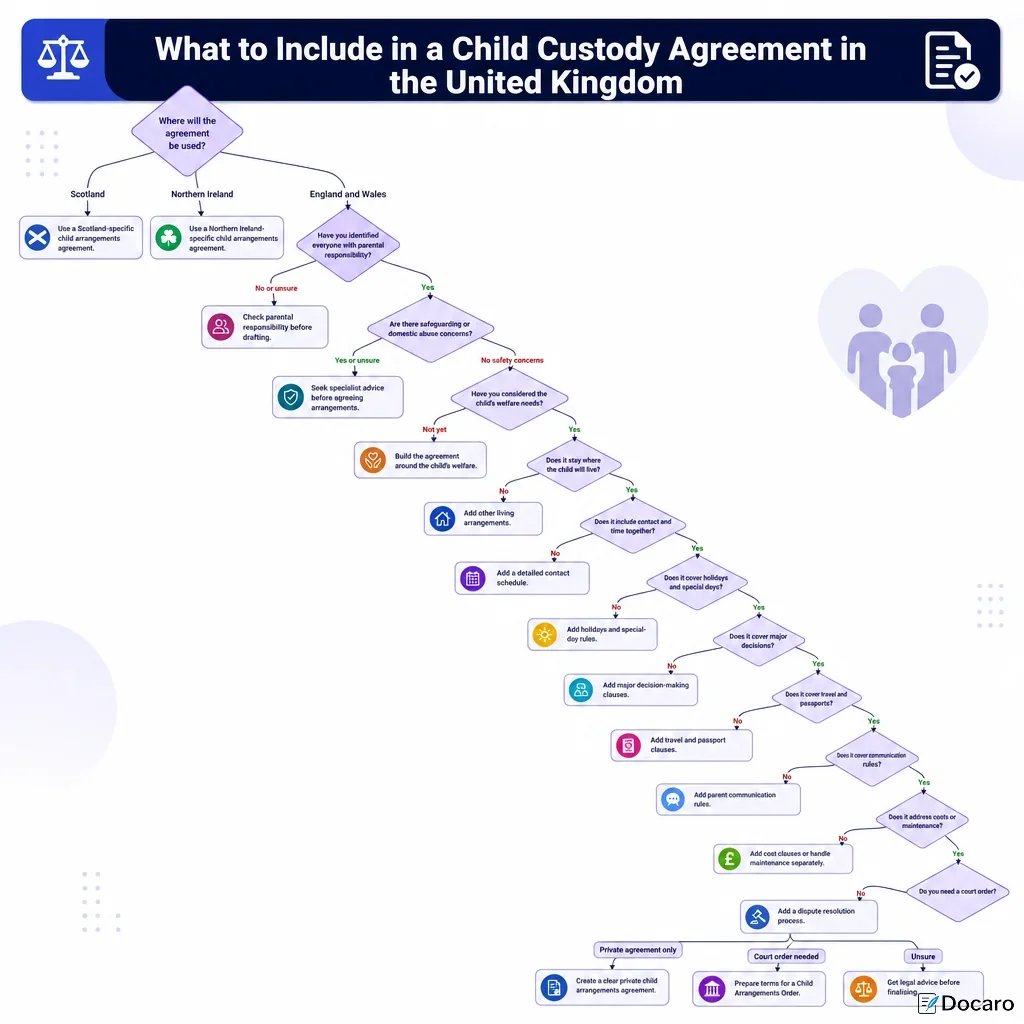
Child Arrangements Legal Glossary In The United Kingdom
Term | Plain English Meaning | How It Is Used | Jurisdiction Context | Practical Note |
|---|---|---|---|---|
Order type | ||||
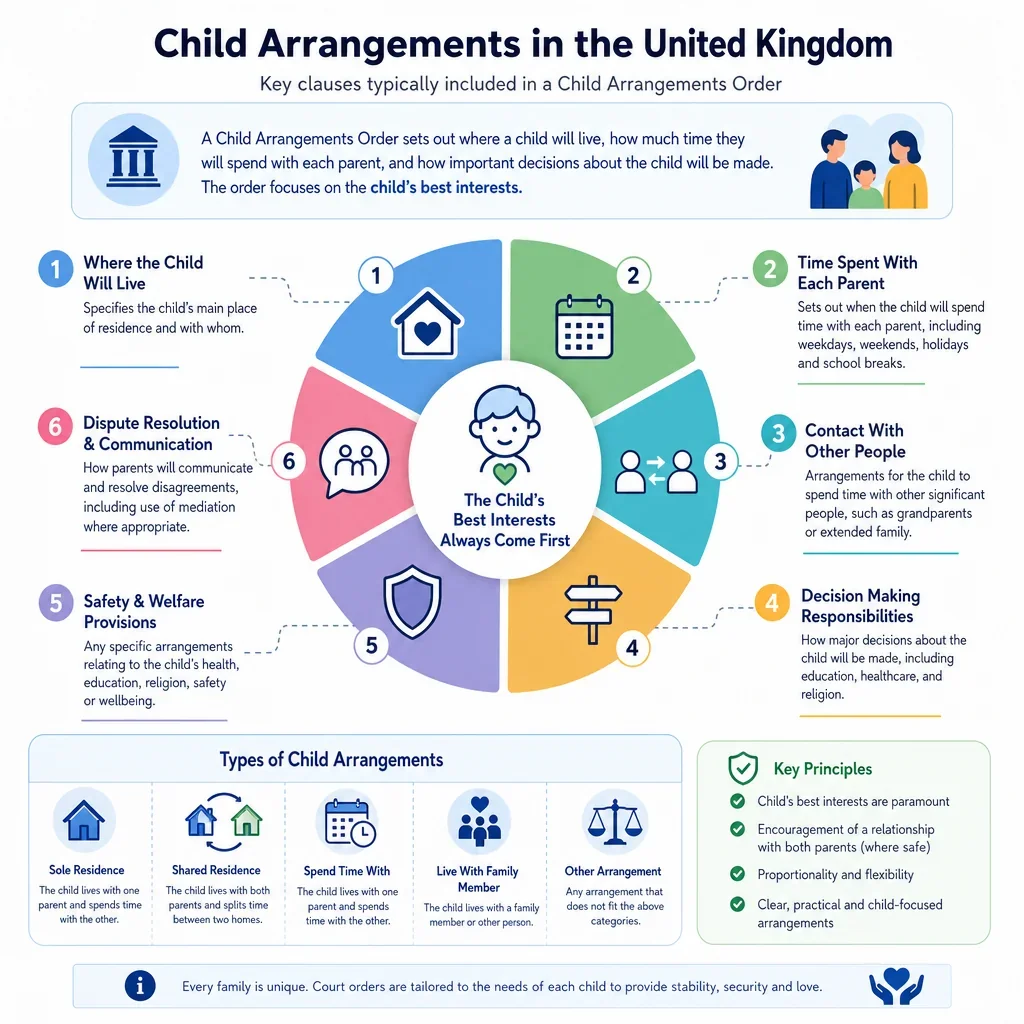
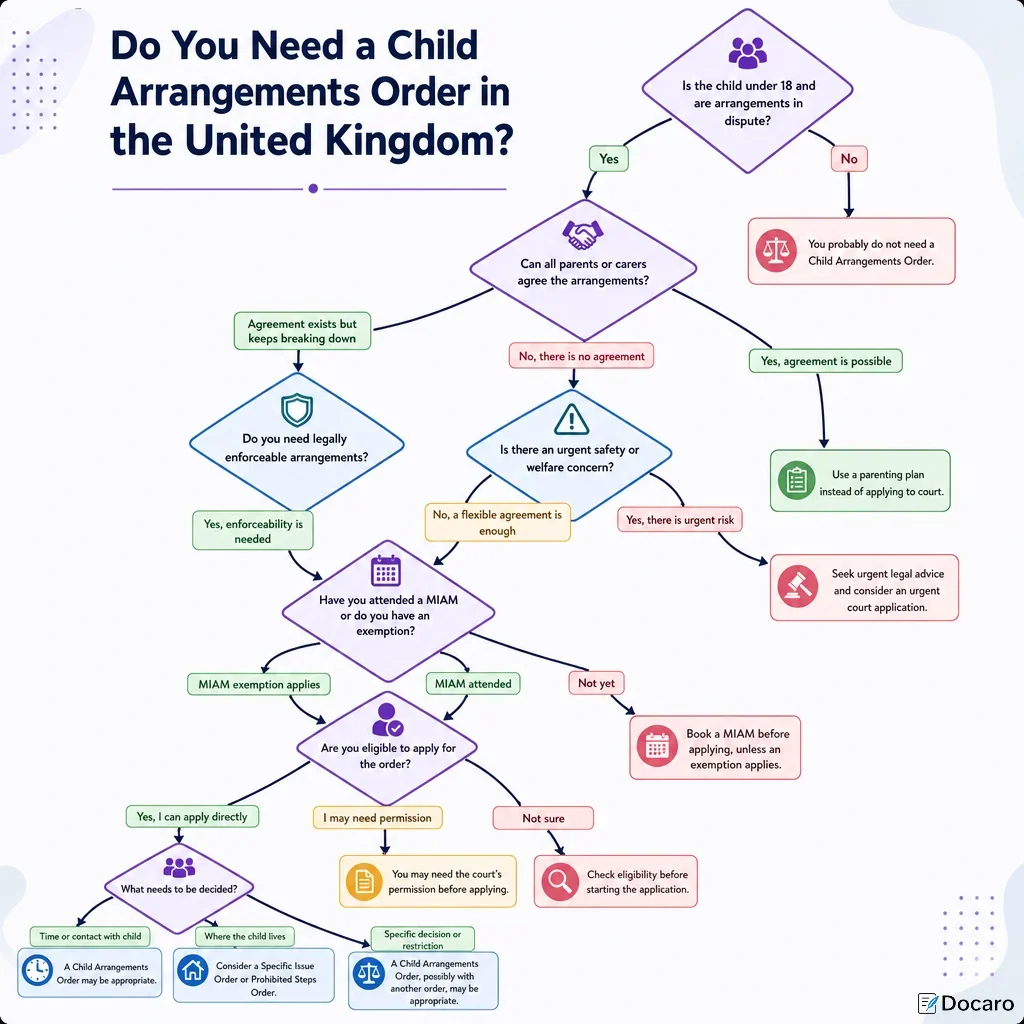
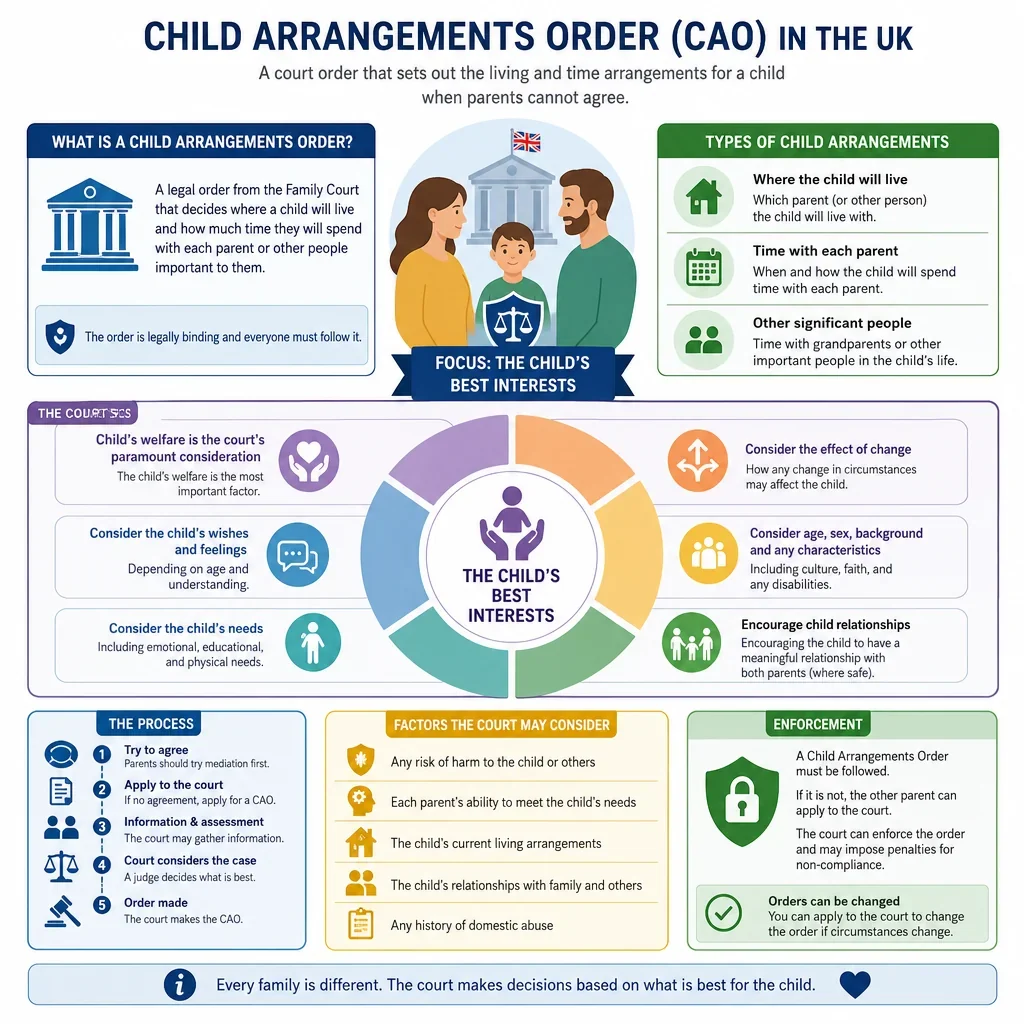
Child Arrangements Order | A court order saying where a child lives and when they spend time or communicate with each parent. | Used to make child living and contact arrangements legally binding. | England and Wales | This is the current term older terms such as custody and access are informal or historic. |
Parenting arrangement | ||||
Child Arrangements | The practical plan for where a child lives and how they keep in contact with each parent. | Used as the umbrella term for living, contact, holiday and communication arrangements. | England and Wales | Use precise details rather than broad phrases such as reasonable contact. |
Custody | An older or informal word for care of a child after separation. | Often used by parents online, but less commonly used in modern court wording in England and Wales. | UK general | For England and Wales, use child arrangements, lives with and spends time with. |
Residence | An older term for where a child lives. | May appear in older orders or discussions about a child's main home. | England and Wales | Modern orders normally use the wording lives with instead. |
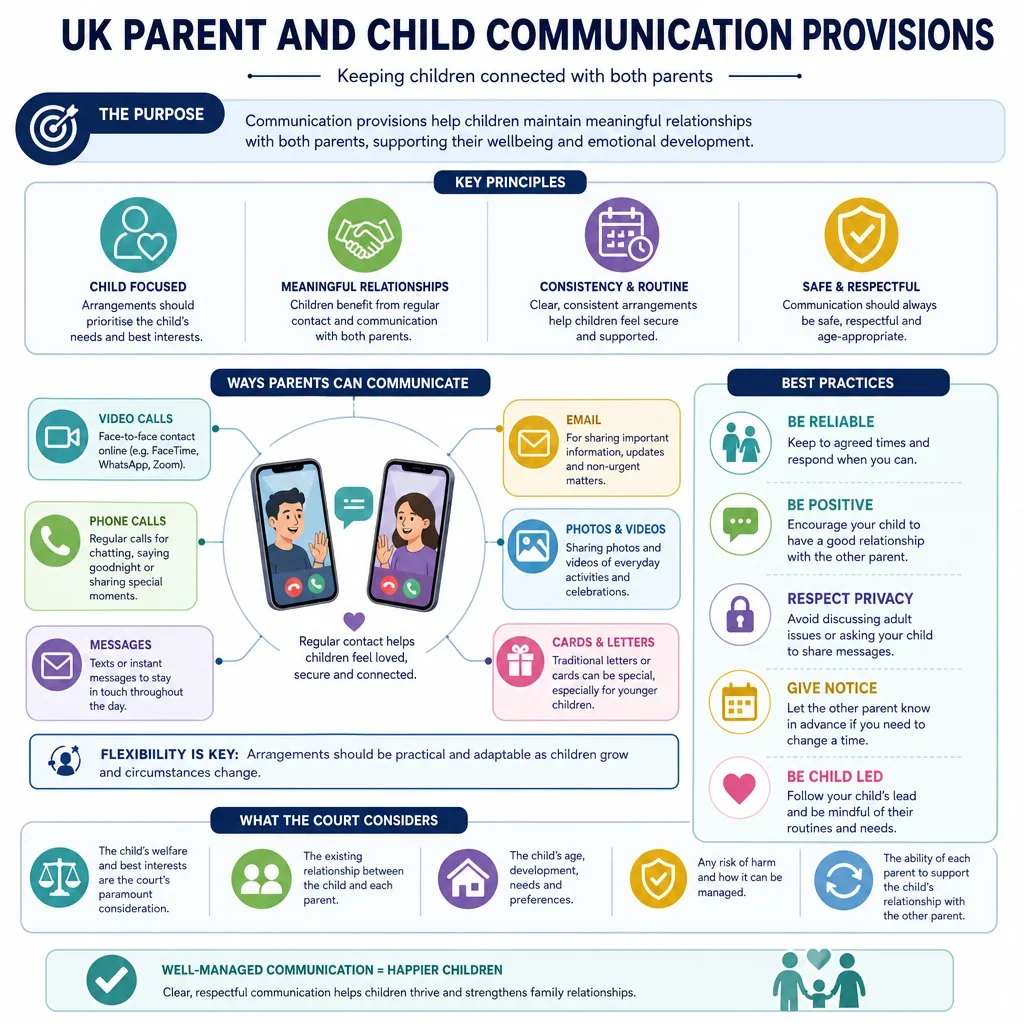
Contact | Time or communication between a child and a person they do not live with full time. | Used for visits, overnight stays, calls, video calls and indirect communication. | UK general | Specify frequency, timing, location, transport and holiday changes. |
Access | An older informal term for a parent's contact with a child. | Often used in everyday speech to mean visits or time with a child. | UK general | Use spends time with or contact for clearer modern wording. |
Lives With | The part of an order saying which parent or person the child lives with. | Used to identify the child's home pattern, including shared living arrangements. | England and Wales | A lives with order can affect practical issues such as taking a child abroad for up to 28 days. |
Spends Time With | The part of an order saying when a child sees or stays with someone. | Used for weekly time, weekends, overnights, holidays and special occasions. | England and Wales | Avoid vague wording include start and end times and handover arrangements. |
Otherwise Has Contact With | The part of an order covering contact that is not physical time together. | Used for phone calls, video calls, messages, letters and online communication. | England and Wales | Set communication method, frequency, privacy and device responsibilities. |
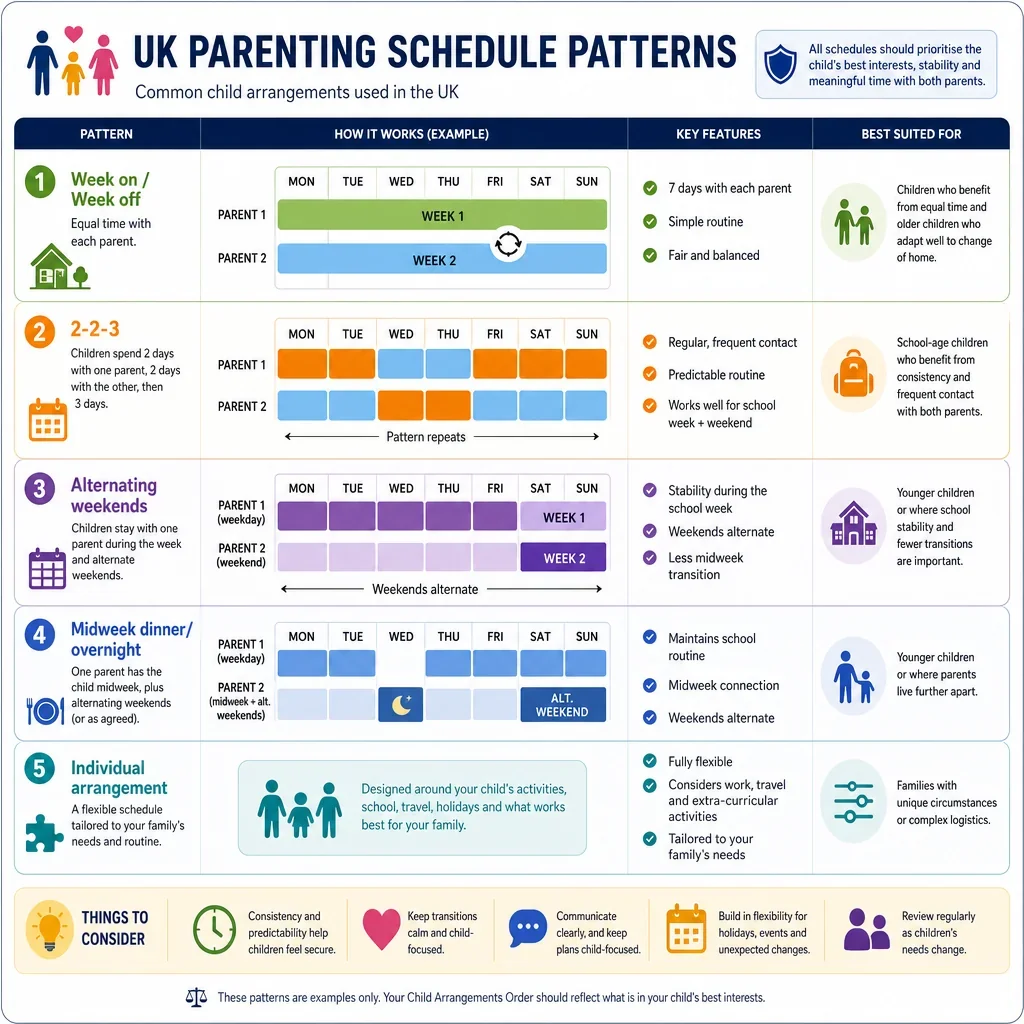
Shared Care | An arrangement where a child spends substantial time living with both parents. | Used to describe a regular pattern such as alternate weeks or midweek overnights. | UK general | Shared care does not automatically mean exactly equal time or equal child maintenance. |
50/50 Care | A care pattern where the child spends roughly equal time with each parent. | Used in parenting plans and negotiations about weekly or fortnightly schedules. | UK general | It should still be tested against the child's welfare, routine, school and travel needs. |
Primary Carer | The person who provides most of the child's day-to-day care. | Used informally in discussions about routine, school, health care and benefits. | UK general | It is not the same as having sole parental responsibility. |
Non-Resident Parent | A parent the child does not live with most of the time. | Used in contact, maintenance and practical parenting discussions. | UK general | The label does not remove parental responsibility if the parent has it. |
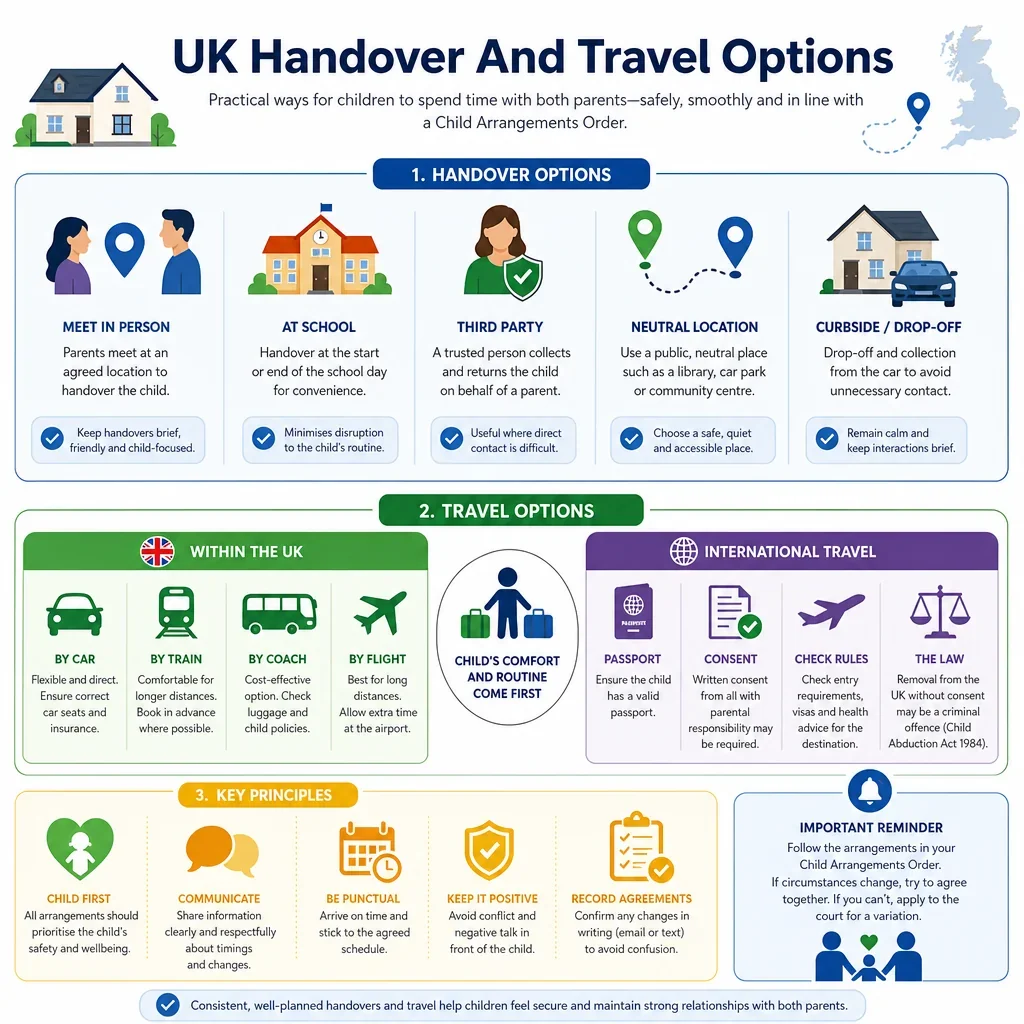
Handover | The point when care of the child passes from one parent or carer to another. | Used to state pickup times, drop-off places and who transports the child. | UK general | Neutral locations or third-party handovers can reduce conflict. |
Indirect Contact | Contact without meeting in person. | Used for letters, cards, emails, messages, telephone calls or video calls. | UK general | Useful where direct contact is not safe, practical or immediately appropriate. |
Direct Contact | Face-to-face time between the child and another person. | Used for visits, daytime time together, overnights and holidays. | UK general | Consider supervision, location and gradual progression if there are concerns. |
Supervised Contact | Contact watched closely by another adult or service to manage risk. | Used where safeguarding concerns mean contact needs observation and reporting. | UK general | It is more intensive than supported contact and may involve a contact centre. |
Supported Contact | Contact in a safe setting with staff nearby but not closely monitoring all interaction. | Used for lower-risk contact, often at a child contact centre. | UK general | It should not be confused with supervised contact, which involves closer observation. |
Contact Centre | A place where children can meet a parent or relative in a managed setting. | Used where neutral, supported or supervised contact is needed. | UK general | Availability, fees, referral rules and waiting times vary by centre. |
Overnight Contact | A child stays overnight with a parent or other person. | Used in schedules for weekends, school nights and holiday stays. | UK general | Include bedtime routines, school transport, medication and belongings. |
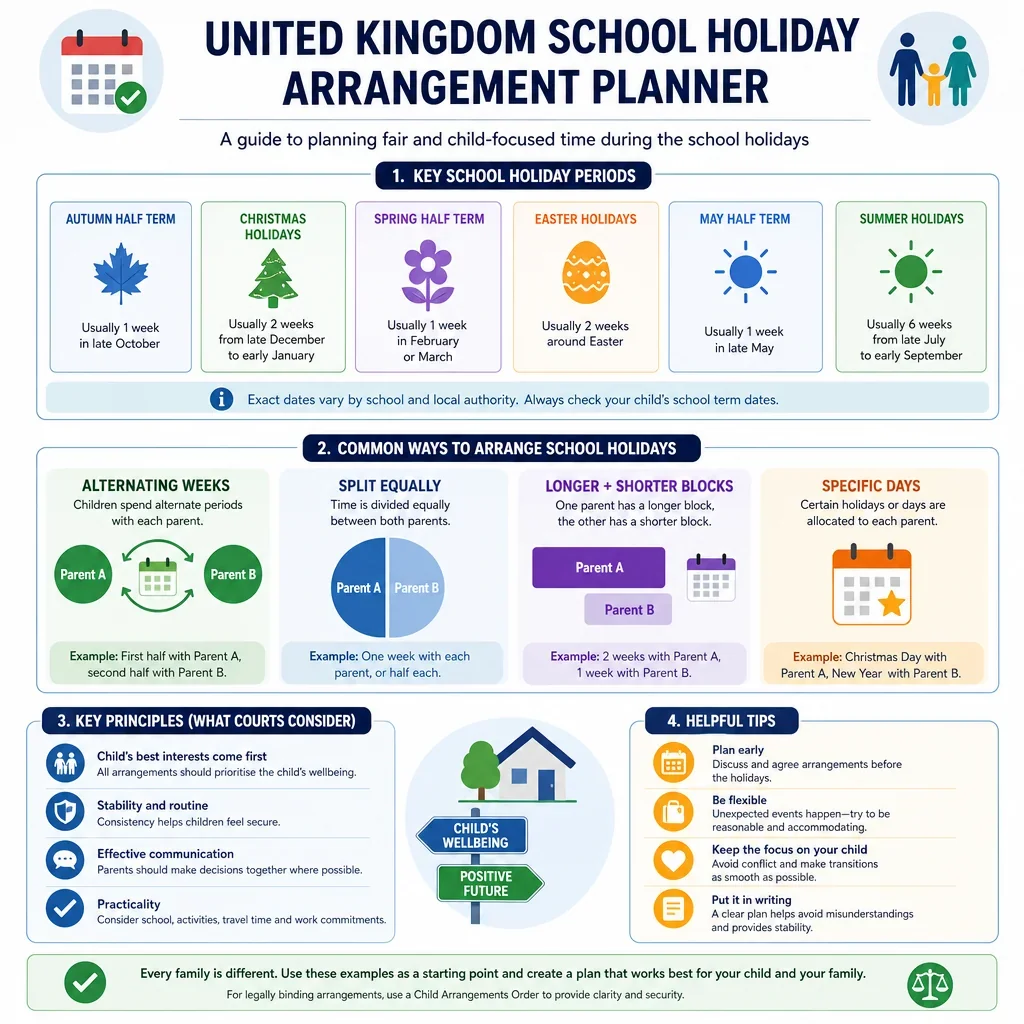
School Holiday Arrangements | How a child spends half terms, summer holidays and other school breaks. | Used to override or adjust the usual term-time schedule. | UK general | State whether holiday arrangements replace or run alongside normal weekends. |
Christmas Arrangements | The plan for Christmas Eve, Christmas Day and related holiday time. | Often alternated yearly or split by times on key days. | UK general | Include collection times because vague Christmas wording often causes disputes. |
Special Occasions | Important dates such as birthdays, Mother's Day, Father's Day and religious holidays. | Used to create exceptions to the ordinary weekly schedule. | UK general | Say which arrangement takes priority if dates clash. |
International Travel | Taking a child outside the UK for a holiday or trip. | Used to set consent, passport, itinerary and emergency contact rules. | UK general | Taking a child abroad without required consent may be child abduction. |
Relocation | A proposed move that may affect the child's home, school or contact pattern. | Used in disputes about moving within the UK or overseas with a child. | UK general | If a move would disrupt arrangements, legal advice or a specific issue application may be needed. |
Parental responsibility | ||||
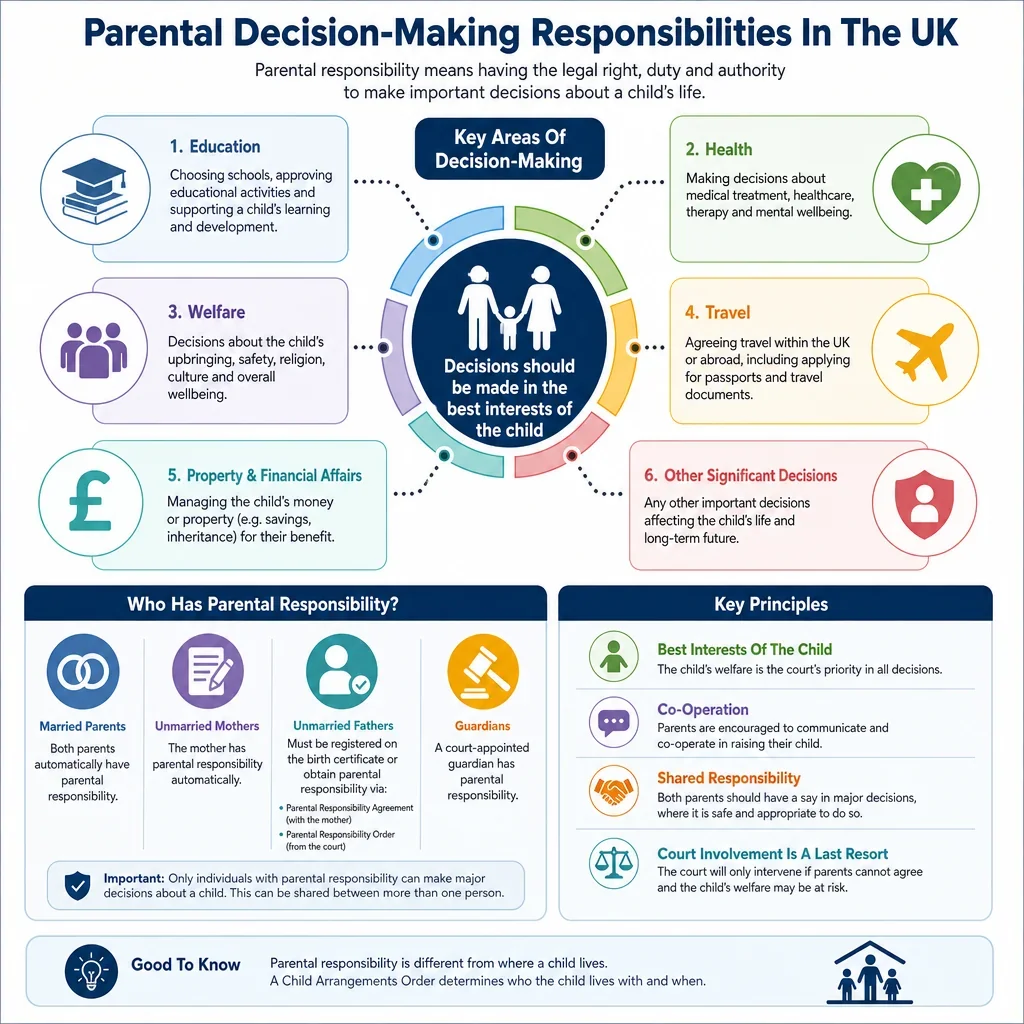
Parental Responsibility | The legal rights, duties, powers and responsibilities a person has for a child. | Used for decisions about education, health, religion, names, passports and major welfare issues. | UK general | It is separate from where the child lives or how much contact a parent has. |
Mother's Parental Responsibility | A child's mother automatically has parental responsibility from birth. | Relevant when identifying who must agree to major decisions about the child. | UK general | Automatic parental responsibility does not determine the child's living arrangements. |
Father's Parental Responsibility | A father may have parental responsibility automatically or by agreement, order or registration rules. | Relevant to consent for schooling, medical treatment, passports and travel. | UK general | Rules differ by marital status, birth registration date and jurisdiction. |
Parental Responsibility Agreement | A formal agreement giving parental responsibility to someone who does not already have it. | Used where eligible parents or step-parents agree to share legal responsibility. | England and Wales | It must be completed and registered correctly to be effective. |
Order type | ||||
Parental Responsibility Order | A court order giving parental responsibility to someone who does not already have it. | Used where agreement is not possible or the court must decide whether responsibility should be granted. | England and Wales | It does not automatically create a child arrangements schedule. |
Parental responsibility | ||||
Step-Parent Parental Responsibility | Parental responsibility that may be given to a step-parent by agreement or court order. | Used where a step-parent needs legal authority for decisions about the child. | England and Wales | Marriage to a parent does not by itself always give parental responsibility. |
Special Guardian | A person given long-term care responsibility for a child by a special guardianship order. | Used when a child lives with someone other than a parent on a secure long-term basis. | England and Wales | It is different from adoption because legal links with birth parents are not fully ended. |
Guardian | A person appointed to care for a child if a parent dies. | Used in wills and contingency planning for children. | UK general | Appointment may not take effect until there is no surviving parent with parental responsibility able to act. |
Order type | ||||
Specific Issue Order | A court order deciding one particular question about a child's upbringing. | Used for disputes about school, medical treatment, religion, names, passports or travel. | England and Wales | It is for a defined issue, not a full parenting schedule unless combined with other orders. |
Prohibited Steps Order | A court order stopping someone from taking a specified step about a child without consent. | Used to prevent removal from school, name changes, relocation or overseas travel. | England and Wales | The prohibited action should be described clearly and narrowly. |
Family Assistance Order | An order requiring a CAFCASS officer or local authority officer to advise and support a family for a period. | Used where professional short-term support may help arrangements work. | England and Wales | It requires consent of each person named unless legislation provides otherwise. |
Interim Order | A temporary court order made before the final decision. | Used to manage arrangements while court proceedings continue. | UK general | Do not assume an interim arrangement will automatically become final. |
Consent Order | A court order made in agreed terms without a fully contested hearing. | Used when parents agree arrangements and ask the court to approve them. | England and Wales | The court must still consider the child's welfare before making the order. |
Court process | ||||
No Order Principle | The court should not make an order unless doing so is better for the child than making no order. | Used when deciding whether a formal child arrangements order is necessary. | England and Wales | An agreed parenting plan may be enough if there is no dispute or enforcement need. |
Welfare Principle | The child's welfare is the court's paramount consideration. | Used as the main test for child arrangements decisions. | England and Wales | The court focuses on the child, not on fairness between parents. |
Welfare Checklist | A statutory list of factors the court considers when deciding what is best for a child. | Used to assess wishes, needs, harm, capability of carers and likely effect of changes. | England and Wales | Evidence should address the child's needs rather than parental blame alone. |
Presumption Of Parental Involvement | The court presumes involvement of each parent will further the child's welfare unless shown otherwise. | Used when considering whether and how both parents should be involved in the child's life. | England and Wales | It does not create a right to equal time and is subject to safeguarding concerns. |
Dispute resolution | ||||
MIAM | A Mediation Information and Assessment Meeting about whether mediation could help. | Usually required before applying to court for child arrangements, unless an exemption applies. | England and Wales | Attending a MIAM is not the same as agreeing to mediate. |
Mediation | A process where an independent mediator helps parents try to reach agreement. | Used to agree parenting schedules before or instead of court proceedings. | UK general | Mediators do not make binding decisions agreements may need formal recording. |
Shuttle Mediation | Mediation where parents are in separate rooms or separate online meetings. | Used where direct discussion is difficult or unsafe but mediation may still be possible. | UK general | It may reduce conflict but is not suitable for all safeguarding situations. |
Parenting Plan | A written plan setting out practical arrangements for children after separation. | Used to record agreements about routines, communication, holidays and decision-making. | England and Wales | It is not automatically a court order unless approved or incorporated by the court. |
Family Arbitration | A private process where an arbitrator decides a family dispute. | Used as an alternative to court for some children issues where appropriate. | England and Wales | Safeguarding and suitability must be considered before choosing arbitration for children matters. |
Collaborative Law | A process where each parent has a lawyer and everyone agrees to resolve issues without court. | Used to negotiate parenting arrangements in structured meetings. | UK general | If the process breaks down, the collaborative lawyers usually cannot act in court proceedings. |
Early Neutral Evaluation | A neutral professional gives a non-binding view on likely outcomes. | Used to help parents settle by reality-testing their positions. | UK general | It is guidance, not a court order or binding decision. |
Negotiation | Direct or solicitor-led discussion to try to reach agreement. | Used before court or alongside proceedings to settle child arrangements. | UK general | Keep proposals child-focused and record agreed points clearly. |
Evidence and forms | ||||
C100 Form | The main application form for a child arrangements, specific issue or prohibited steps order. | Filed with the family court to start private children proceedings. | England and Wales | Check MIAM requirements and any domestic abuse or urgency exemptions before filing. |
C1A Form | A form for allegations of harm, domestic abuse or risk in children proceedings. | Filed with or after a C100 where safety concerns must be brought to the court's attention. | England and Wales | Use specific, factual details and link concerns to the child's welfare. |
FM1 Form | A form recording MIAM attendance or a MIAM exemption. | Used with certain family applications to show mediation requirements have been considered. | England and Wales | Current online processes may capture MIAM information differently, so check the latest form route. |
EX160 Fee Remission | An application for help paying court fees if you have low income or certain benefits. | Used when filing a court application and asking for the fee to be reduced or waived. | England and Wales | Apply before or at the time of filing to avoid fee delays. |
Witness Statement | A written account of facts a person wants the court to consider. | Used to explain events, concerns and proposed arrangements with evidence. | UK general | Keep it factual, chronological and focused on the child's welfare. |
Position Statement | A short written summary of what a party wants the court to decide and why. | Used before hearings to help the judge understand the key issues and proposals. | UK general | It should be concise and should not replace ordered evidence. |
Court Bundle | An organised set of documents prepared for a family court hearing. | Used by the judge and parties to find applications, orders, statements and reports. | England and Wales | Bundles must follow court directions and page limits where applicable. |
Safeguarding Letter | A CAFCASS letter to the court summarising initial safeguarding checks and issues. | Used before the first hearing to highlight risks and recommend next steps. | England and Wales | It is an early safeguarding overview, not a final welfare report. |
Section 7 Report | A welfare report prepared for the court about the child's circumstances and best interests. | Ordered when the court needs a CAFCASS or local authority assessment before deciding arrangements. | England and Wales | Engage constructively with the report writer and focus on the child's needs. |
Section 37 Report | A local authority report on whether public law child protection action may be needed. | Ordered in private proceedings if the court is concerned the child may need protective orders. | England and Wales | It signals serious welfare concerns and should be taken very seriously. |
Court process | ||||
CAFCASS | The Children and Family Court Advisory and Support Service in England. | Advises the family court on children's welfare in many private law cases. | England and Wales | CAFCASS covers England Wales has CAFCASS Cymru. |
CAFCASS Cymru | The Welsh service that advises family courts on children's welfare. | Used in Welsh family court cases involving children. | England and Wales | Use the correct service name depending on whether the case is in England or Wales. |
Family Court | The court that deals with many children and family disputes in England and Wales. | Used for applications about child arrangements and related children orders. | England and Wales | Court procedures and forms differ from Scotland and Northern Ireland. |
Private Law Children Case | A court case between private individuals about a child, usually parents or relatives. | Used for child arrangements, specific issue and prohibited steps applications. | England and Wales | It is different from public law care proceedings brought by a local authority. |
Applicant | The person who starts a court application. | Used on court forms and orders to identify who applied. | UK general | Being the applicant does not give an automatic advantage on the outcome. |
Respondent | The person who responds to a court application. | Used on court papers to identify the other party to proceedings. | UK general | Respondents should still file evidence and proposals when directed. |
Party | A person or organisation formally involved in the court case. | Used in orders, directions and hearings to refer to those bound by the proceedings. | UK general | Only parties normally receive documents and can make applications within the case. |
Directions | Instructions from the court about what must happen next and by when. | Used to set deadlines for statements, reports, disclosure and hearings. | UK general | Missing directions can harm your case or cause delay. |
Order type | ||||
Directions Order | A written court order setting out procedural steps in the case. | Used after hearings to record deadlines and case management decisions. | UK general | Read it carefully it may contain mandatory deadlines. |
Court process | ||||
FHDRA | The First Hearing Dispute Resolution Appointment in private children proceedings. | Used to identify issues, consider safeguarding and decide next steps or settlement. | England and Wales | Arrive with clear proposals and any urgent safeguarding concerns identified. |
DRA | A Dispute Resolution Appointment where the court helps narrow or settle issues. | Used after evidence or reports to see if agreement can be reached before final hearing. | England and Wales | It is not always the final hearing, but final orders can sometimes be made by agreement. |
Final Hearing | The hearing where the court makes a final decision if the parties cannot agree. | Used for evidence, questioning, submissions and the judge's decision. | UK general | Preparation should follow all directions, including statements and bundles. |
Fact-Finding Hearing | A hearing where the court decides disputed factual allegations, often about harm or abuse. | Used before welfare decisions where alleged facts may affect safe child arrangements. | England and Wales | Allegations should be specific, dated where possible and linked to child welfare. |
Practice Direction 12J | Court guidance on child arrangements cases involving domestic abuse or harm. | Used to manage safety, evidence, interim contact and welfare decisions where abuse is alleged. | England and Wales | Domestic abuse allegations can change how and whether contact is progressed. |
Safeguarding Checks | Initial checks with agencies such as police and local authority to identify child safety concerns. | Used by CAFCASS before the first hearing in private children cases. | England and Wales | Raise urgent safety information early and accurately. |
Safeguarding | Protecting a child from harm and promoting their welfare. | Used in court decisions about risk, contact, supervision and protective measures. | UK general | Safeguarding concerns should be specific and evidence-based where possible. |
Domestic Abuse | Abusive behaviour between personally connected people, including physical, emotional, controlling or coercive behaviour. | Used to assess risk, MIAM exemptions, evidence, and whether contact is safe. | England and Wales | Abuse is not limited to physical violence and may affect child arrangements even if directed at a parent. |
Controlling Or Coercive Behaviour | A pattern of behaviour that controls, isolates, intimidates or harms another person. | Used as evidence of domestic abuse and risk in child arrangements cases. | England and Wales | Patterns of behaviour may matter even where single incidents seem minor. |
Harm | Ill-treatment or impairment of a child's health or development. | Used when assessing safeguarding risks and whether arrangements may expose a child to danger. | England and Wales | Harm can include seeing or hearing another person being abused. |
Enforcement | Asking the court to take action because a child arrangements order is not being followed. | Used where one person repeatedly breaches an order without reasonable excuse. | England and Wales | Keep a clear record of missed contact, reasons given and attempts to resolve issues. |
Breach Of Order | Failure to follow a court order. | Used in enforcement applications and evidence about missed or obstructed arrangements. | UK general | A breach may be excused if there is a reasonable safeguarding or practical reason. |
Warning Notice | A notice on a child arrangements order warning about consequences of non-compliance. | Used to support later enforcement if the order is breached. | England and Wales | Read the warning notice carefully it may affect enforcement options. |
Order type | ||||
Enforcement Order | An order imposing unpaid work where a child arrangements order has been breached without reasonable excuse. | Used as a court response to serious or repeated non-compliance. | England and Wales | The court must consider welfare and whether there was reasonable excuse. |
Court process | ||||
Variation | Changing an existing court order. | Used when existing arrangements no longer work or need updating. | England and Wales | Do not simply ignore an order apply to vary it if agreement is not possible. |
Discharge Of Order | Ending an existing court order. | Used where an order is no longer needed or appropriate. | England and Wales | Check whether ending the order affects travel, parental responsibility or enforcement. |
Without Notice Application | An urgent application made without telling the other party first. | Used where giving notice could create immediate risk or defeat the purpose of the order. | UK general | The court expects full and frank disclosure, including facts that do not help your case. |
Ex Parte | An older term for a without notice application or hearing. | May appear in older legal discussions about urgent orders. | UK general | Modern wording usually says without notice. |
Urgent Application | A court application needing quick consideration because delay may cause harm or serious problems. | Used for risks such as abduction, serious safeguarding concerns or imminent relocation. | England and Wales | Explain clearly why the matter cannot wait for the normal timetable. |
Child Abduction | Wrongfully taking or keeping a child away, especially outside the UK or away from a person with rights. | Used in urgent applications about passports, travel restrictions and return of children. | UK general | Get urgent legal advice if a child may be taken abroad without consent. |
Order type | ||||
Passport Order | An order about holding, surrendering or applying for a child's passport. | Used where there is concern about unauthorised travel or dispute over passport control. | UK general | Passport terms should identify who holds the passport and when it must be provided. |
Parenting arrangement | ||||
Prohibited Travel | A restriction on taking a child to another country or area without consent or court permission. | Used in prohibited steps orders or travel clauses in child arrangements orders. | UK general | State destination, duration, notice, itinerary and consent requirements. |
Parental responsibility | ||||
Permission To Take A Child Abroad | Consent or court permission needed before taking a child outside the UK in many cases. | Used in holiday clauses and disputes about overseas travel. | UK general | A person with a lives with child arrangements order may usually take the child abroad for up to 28 days unless an order says otherwise. |
Parenting arrangement | ||||
Child Maintenance | Money paid by one parent to help with a child's living costs. | Often discussed alongside care patterns but usually dealt with separately from child arrangements orders. | UK general | More overnight care can affect maintenance calculations, but the systems are not identical. |
Court process | ||||
Parental Alienation | A disputed label often used for behaviours that may turn a child against a parent without good reason. | Used in cases alleging one parent is obstructing the child's relationship with the other. | England and Wales | Focus on specific behaviours and child impact rather than relying only on the label. |
Alienating Behaviours | Actions by a parent or carer that may unjustifiably damage a child's relationship with another parent. | Used in welfare assessments and evidence about resistance to contact. | England and Wales | The court will also consider whether the child's resistance is justified by harm or abuse. |
Parental responsibility | ||||
Gillick Competence | A child's ability to make certain decisions if they have enough understanding and intelligence. | Used in disputes about medical decisions, confidentiality and the child's views. | UK general | It depends on the child and the decision, not just the child's age. |
Evidence and forms | ||||
Child's Wishes And Feelings | What the child says they want, considered in light of age and understanding. | Used as part of the welfare checklist in court decisions. | England and Wales | Children should not be pressured to choose between parents. |
Court process | ||||
Guardian Ad Litem | A person appointed to represent a child's interests in some court proceedings. | Used in Northern Ireland and some contexts where the child's welfare needs independent representation. | Northern Ireland | Do not confuse this with CAFCASS terminology in England. |
Curator Ad Litem | A person appointed in Scotland to represent a child's interests in court proceedings. | Used in some Scottish child law cases where independent representation is needed. | Scotland | Scottish terminology and procedures differ from England and Wales. |
Parental responsibility | ||||
Parental Responsibilities And Rights | The Scottish legal term for parents' responsibilities and rights in relation to a child. | Used in Scottish law instead of the England and Wales term parental responsibility. | Scotland | Do not use England and Wales forms for Scottish child arrangements disputes. |
Order type | ||||
Residence Order In Scotland | A Scottish court order deciding where or with whom a child lives. | Used in Scotland for child residence disputes. | Scotland | Terminology differs from child arrangements orders in England and Wales. |
Contact Order In Scotland | A Scottish court order deciding contact between a child and another person. | Used in Scotland for arrangements about seeing or communicating with a child. | Scotland | Scottish orders use different statutory wording from England and Wales. |
Residence Order In Northern Ireland | A Northern Ireland order deciding where and with whom a child lives. | Used in Northern Ireland private children disputes. | Northern Ireland | Northern Ireland has its own Children Order terminology and procedure. |
Contact Order In Northern Ireland | A Northern Ireland order requiring contact between a child and a named person. | Used for visits, stays and other contact in Northern Ireland child cases. | Northern Ireland | Do not assume English C100 procedures apply in Northern Ireland. |
Court process | ||||
Leave Of The Court | Permission from the court to take a procedural step or make an application. | Used where a person needs permission before applying for a child-related order. | UK general | Check whether you have automatic entitlement to apply or need permission first. |
Permission To Apply | Court approval needed by some people before they can apply for a children order. | Used for some relatives or non-parents seeking child arrangements orders. | England and Wales | Parents usually do not need permission, but many non-parents should check the rules. |
Parenting arrangement | ||||
Grandparents' Contact | Arrangements for a child to spend time or communicate with a grandparent. | Used in family agreements or applications by grandparents seeking contact. | England and Wales | Grandparents may need court permission before applying for a child arrangements order. |
Kinship Care | Care of a child by relatives or friends when parents cannot provide care. | Used for informal care, child arrangements orders, special guardianship or fostering contexts. | UK general | Legal status affects parental responsibility, support and decision-making authority. |
Court process | ||||
Looked After Child | A child in local authority care or accommodated by a local authority. | Used where local authority involvement affects private family arrangements. | England and Wales | Public law status may limit what private agreement can achieve without local authority involvement. |
Local Authority | The council body responsible for children's social care and safeguarding in its area. | May provide safeguarding information, assessments or reports in children cases. | UK general | Local authority involvement can change the urgency and complexity of arrangements. |
Order type | ||||
School Change Dispute | A disagreement about moving or choosing a child's school. | Often dealt with by a specific issue order or prohibited steps order. | England and Wales | Apply early if school deadlines or term dates make timing critical. |
Medical Treatment Dispute | A disagreement about a child's health care or treatment. | May be resolved by a specific issue order if parents with responsibility disagree. | England and Wales | Urgent medical issues may require immediate legal and medical advice. |
Parental responsibility | ||||
Change Of Child's Surname | Changing a child's legal surname or recorded name. | Used in disputes requiring consent of people with parental responsibility or court permission. | UK general | Do not change a child's name without the required consent or order. |
Parental Consent | Agreement from a person with parental responsibility. | Used for travel, medical treatment, school moves, name changes and passports. | UK general | Written consent is safer for travel or major decisions. |
Dispute resolution | ||||
Without Prejudice | A label for genuine settlement communications usually not shown to the court on disputed issues. | Used in negotiations to encourage settlement proposals. | UK general | The label is not magic the communication must genuinely aim to settle a dispute. |
Open Proposal | A proposal that can be shown to the court. | Used to set out child-focused arrangements a party wants the court to consider. | UK general | Be careful not to mix open proposals with without prejudice settlement discussions. |
Court process | ||||
Undertaking | A formal promise to the court to do or not do something. | Used to manage behaviour, handovers, travel, documents or communication without a full order. | UK general | Breaking an undertaking can have serious consequences. |
Penal Notice | A warning on an order that breach may lead to punishment, including committal. | Used where the court wants an order to be enforceable by contempt proceedings. | UK general | Take any order with a penal notice extremely seriously and get advice if unsure. |
Committal | Proceedings that may punish someone for contempt of court. | Used for serious breaches of court orders or undertakings. | UK general | Committal can involve loss of liberty and requires strict procedural safeguards. |
Special Measures | Court arrangements to help a vulnerable person take part safely and fairly. | Used for screens, separate waiting areas, video links or other protections. | England and Wales | Ask early if domestic abuse, intimidation or vulnerability affects participation. |
Litigant In Person | A person who represents themselves in court without a lawyer. | Used to describe many parents in child arrangements proceedings. | UK general | Self-represented parties must still follow court rules, orders and deadlines. |
McKenzie Friend | A person who can provide quiet support to a litigant in person in court. | Used for note-taking, organisation and moral support during hearings. | England and Wales | They do not automatically have a right to address the court or conduct litigation. |
Family Procedure Rules | The rules governing procedure in family courts in England and Wales. | Used for applications, evidence, service, hearings and case management. | England and Wales | Practice directions can be as important as the main rules. |
Service Of Documents | The formal process of giving court papers to another party. | Used to ensure parties know about applications, hearings and evidence. | England and Wales | Improper service can delay a case or prevent a hearing going ahead. |
Evidence and forms | ||||
Acknowledgement Of Service | A form or step confirming that court papers have been received. | Used to show a respondent knows about the proceedings. | UK general | Do not ignore court papers even if you dispute the application. |
Disclosure | Providing documents or information relevant to the case. | Used for police records, medical records, school records or messages where ordered. | UK general | Do not share confidential records without consent or a proper court order. |
Expert Evidence | Opinion evidence from a qualified expert, allowed only where needed to resolve the case. | Used for psychological, psychiatric, drug, alcohol or other specialist assessments where permitted. | England and Wales | Expert reports usually require court permission before instruction. |
Drug And Alcohol Testing | Testing used to assess substance misuse concerns relevant to child safety. | May be ordered or agreed where substance use is alleged to affect parenting. | UK general | Testing windows, sample type and chain of custody matter. |
Scott Schedule | A table setting out allegations, responses and the court's findings. | Used in some fact-finding hearings to organise disputed allegations. | UK general | Include concise allegations with dates or date ranges where possible. |
Court process | ||||
Findings Of Fact | The court's decisions about what did or did not happen. | Used after a fact-finding hearing to guide welfare and contact decisions. | UK general | Once findings are made, later arguments should address their welfare impact. |
Evidence and forms | ||||
Balance Of Probabilities | The civil standard of proof: more likely than not. | Used by the family court when deciding disputed factual allegations. | UK general | It is lower than the criminal standard of beyond reasonable doubt. |
Court process | ||||
Best Interests | What best promotes the child's welfare in the circumstances. | Used in agreements and court decisions about living, contact and major decisions. | UK general | Best interests are assessed from the child's perspective, not parental convenience alone. |
Parenting arrangement | ||||
Stability | Consistency in a child's home, school, routines and relationships. | Used when assessing proposed changes to living or contact arrangements. | UK general | A stable routine can matter more than a mathematically equal schedule. |
Routine | The child's ordinary pattern for school, sleep, activities and care. | Used to design practical schedules and handovers. | UK general | Include school runs, clubs, homework, meals and bedtimes for workable arrangements. |
Communication Book | A shared written record for passing child-related information between carers. | Used for medication, meals, school updates, sleep and practical messages. | UK general | Keep entries factual and child-focused, not argumentative. |
Co-Parenting App | An app used to manage calendars, messages, expenses and child information. | Used to reduce conflict and keep a clear record of arrangements. | UK general | Agree which app, who pays and what communication must go through it. |
Right Of First Refusal | An agreement to offer the other parent care before using a babysitter or third party. | Used in parenting agreements for childcare during a parent's scheduled time. | UK general | Define minimum absence length and response time to avoid disputes. |
Make-Up Time | Replacement time offered when scheduled contact is missed. | Used in agreements to manage illness, travel disruption or unavoidable cancellations. | UK general | State when make-up time is available and how quickly it must be arranged. |
Reasonable Contact | A vague phrase meaning contact that is fair or appropriate in the circumstances. | Sometimes used in informal agreements or older orders. | UK general | Avoid it in new agreements unless supported by clear fallback details. |
No Contact | An arrangement or order where a person has no contact with the child. | Used where contact is not safe, not beneficial or not currently appropriate. | UK general | No contact is a serious restriction and should be linked to clear welfare reasons. |
Graduated Contact | Contact that increases step by step over time. | Used to rebuild relationships or move from supervised to unsupervised contact. | UK general | Set review dates, conditions and what happens if a stage fails. |
Court process | ||||
Review Hearing | A hearing to check progress or reconsider arrangements after a period of time. | Used after interim, supervised or graduated contact arrangements. | UK general | Keep records of how the arrangements worked before the review. |
Return Date | A follow-up hearing date, often after an urgent or without notice order. | Used so the other party can attend and respond after an urgent order is made. | UK general | Prepare evidence quickly because urgent orders may be reconsidered at the return date. |
Order type | ||||
Order By Consent | Another way of describing a court order made because the parties agree. | Used to formalise agreed child arrangements within proceedings or by application. | England and Wales | Even agreed orders should be workable, specific and child-focused. |
What Do Child Arrangements Terms Mean In England And Wales?
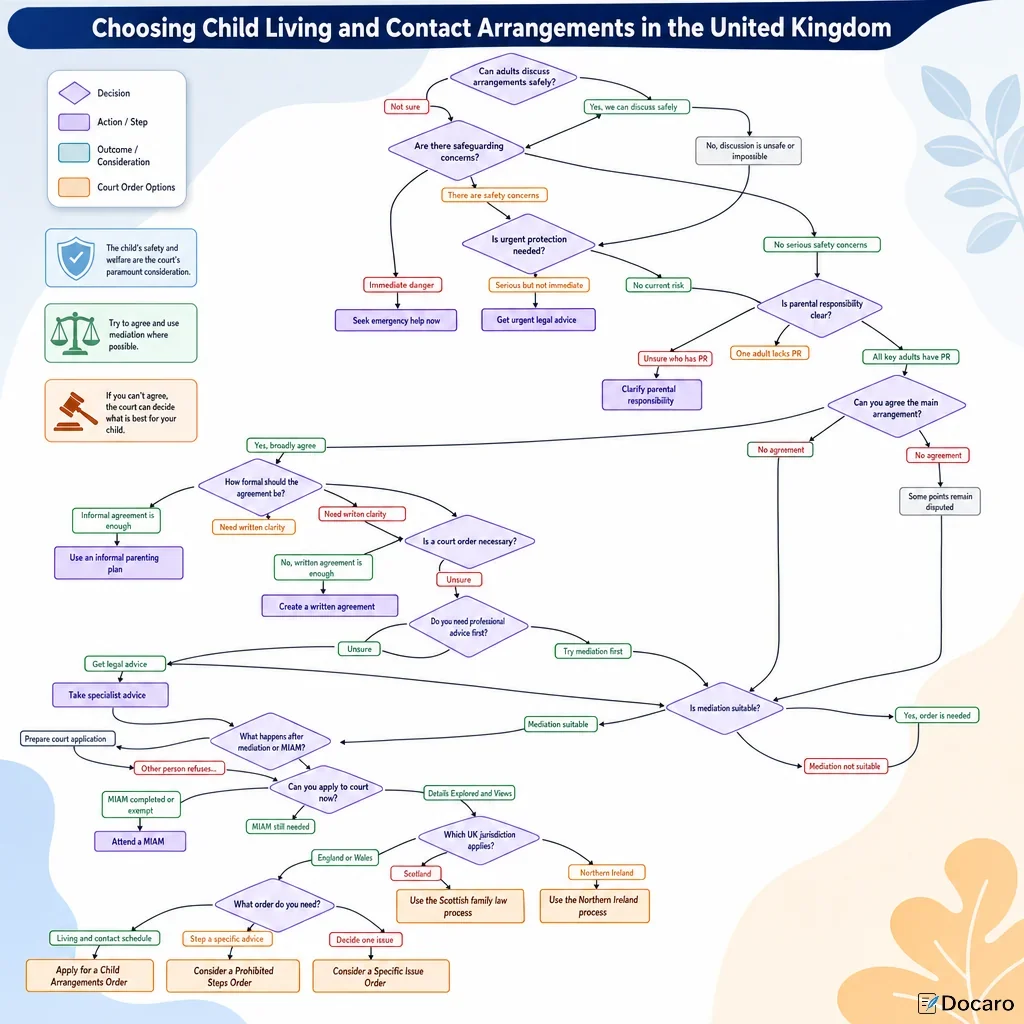
Child arrangements is the modern term used in England and Wales for decisions about where a child lives, when they spend time with each parent, and other forms of contact. Older wording such as custody, residence and access may still be used informally, but formal documents should usually use current terminology.
When Is A Court Order Needed For Child Arrangements?
Parents are usually expected to try agreement or mediation first, unless an exemption applies. A Child Arrangements Order is most useful where arrangements need to be enforceable, there is disagreement, safeguarding concern, relocation issue, or uncertainty about parental responsibility.
Which Terms Matter Most In A Parenting Agreement?
- Lives with and spends time with should be stated clearly, with dates, times, school holiday arrangements and handover details.
- Parental responsibility is separate from day-to-day care. A parent may have parental responsibility even if the child does not live with them.
- Specific issue and prohibited steps terms are useful where parents disagree about a defined matter, such as schooling, holidays abroad, medical treatment or relocation.
- MIAM, C100, C1A and CAFCASS safeguarding checks are key terms if court proceedings are being considered.
Why Should UK Users Be Careful With The Word Custody?
In England and Wales, custody is not the usual legal label for new private children cases. Using precise wording such as Child Arrangements Order, lives with, spends time with and parental responsibility reduces ambiguity and makes a draft agreement easier to compare with court terminology.
FAQs
You Might Also Be Interested In