UK Jurisdiction Notes For Advance Healthcare Directives
Topic | Summary | Uses specific statutory terminology | Jurisdiction note |
|---|---|---|---|
England and Wales | |||
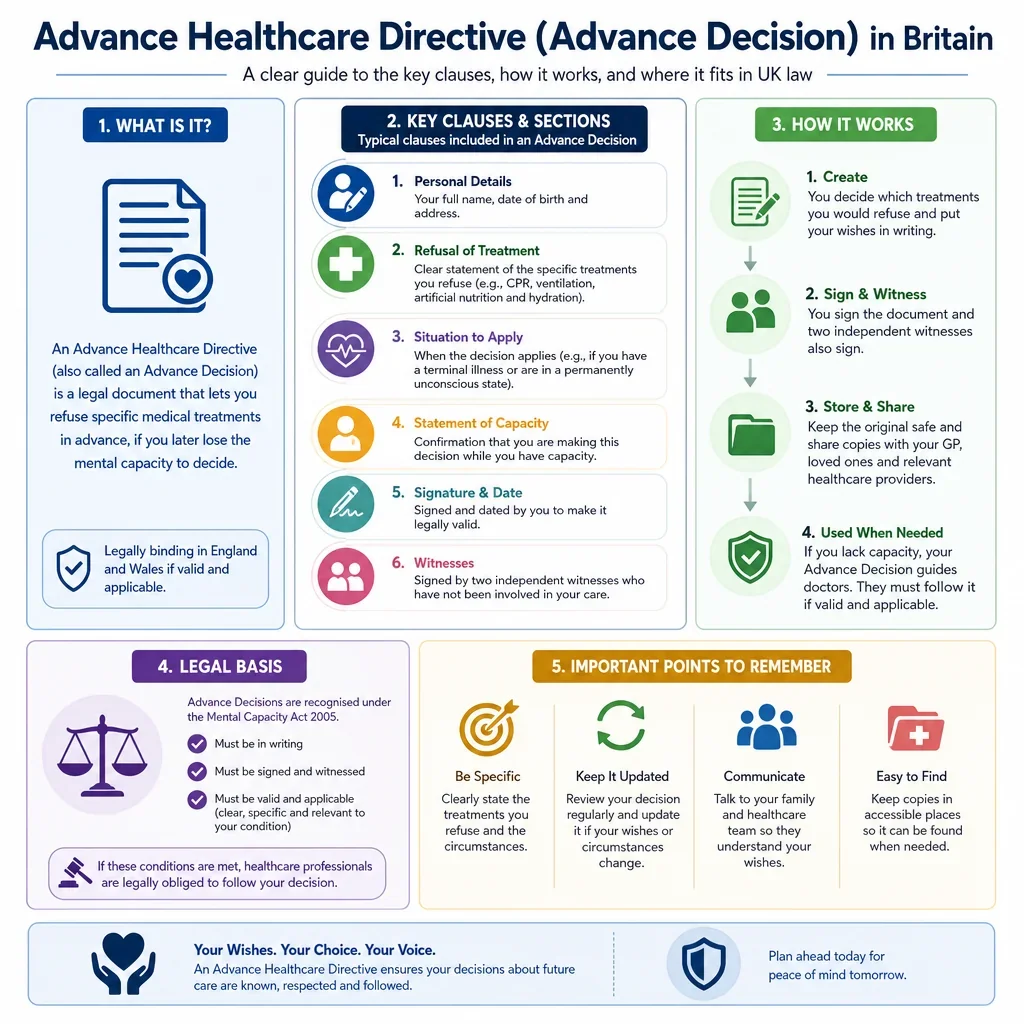
Statutory basis for advance decisions | The Mental Capacity Act 2005 gives legal effect to valid and applicable advance decisions refusing treatment. | true | Use the term advance decision when preparing a refusal of treatment for England and Wales. |
Scotland | |||
Recognition of advance refusals | Advance directives are recognised in practice, but Scotland does not use the same Mental Capacity Act framework as England and Wales. | false | Check Scottish NHS guidance and consider taking advice when drafting an advance directive for Scotland. |
Northern Ireland | |||
Recognition of advance decisions | Advance decisions and advance statements are used in Northern Ireland, but the legal framework differs from England and Wales. | true | Use Northern Ireland guidance when preparing an advance decision or advance statement for use there. |
United Kingdom general | |||
Terminology across the UK | Terms such as advance decision, advance directive, living will, and advance statement are used differently across the UK. | true | Match the wording of the document to the law and health service guidance for the relevant UK nation. |
England and Wales | |||
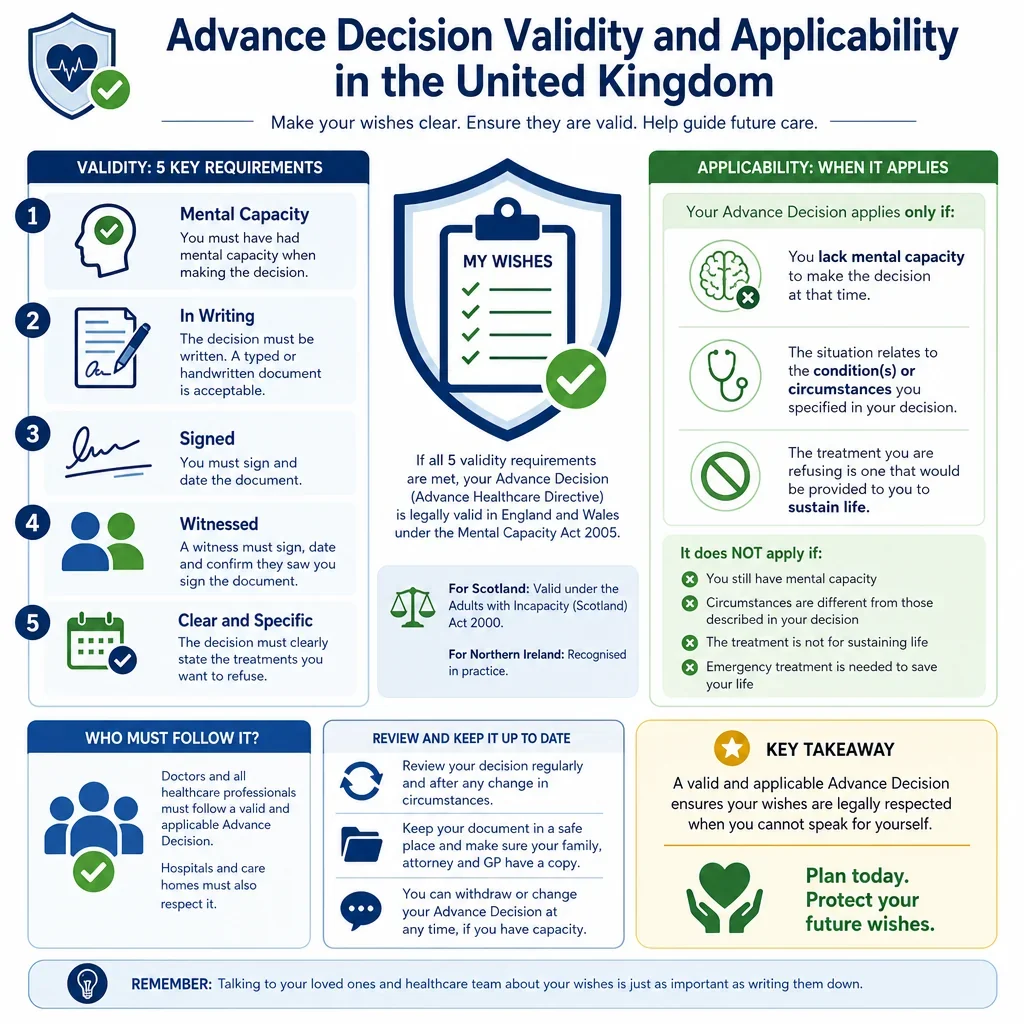
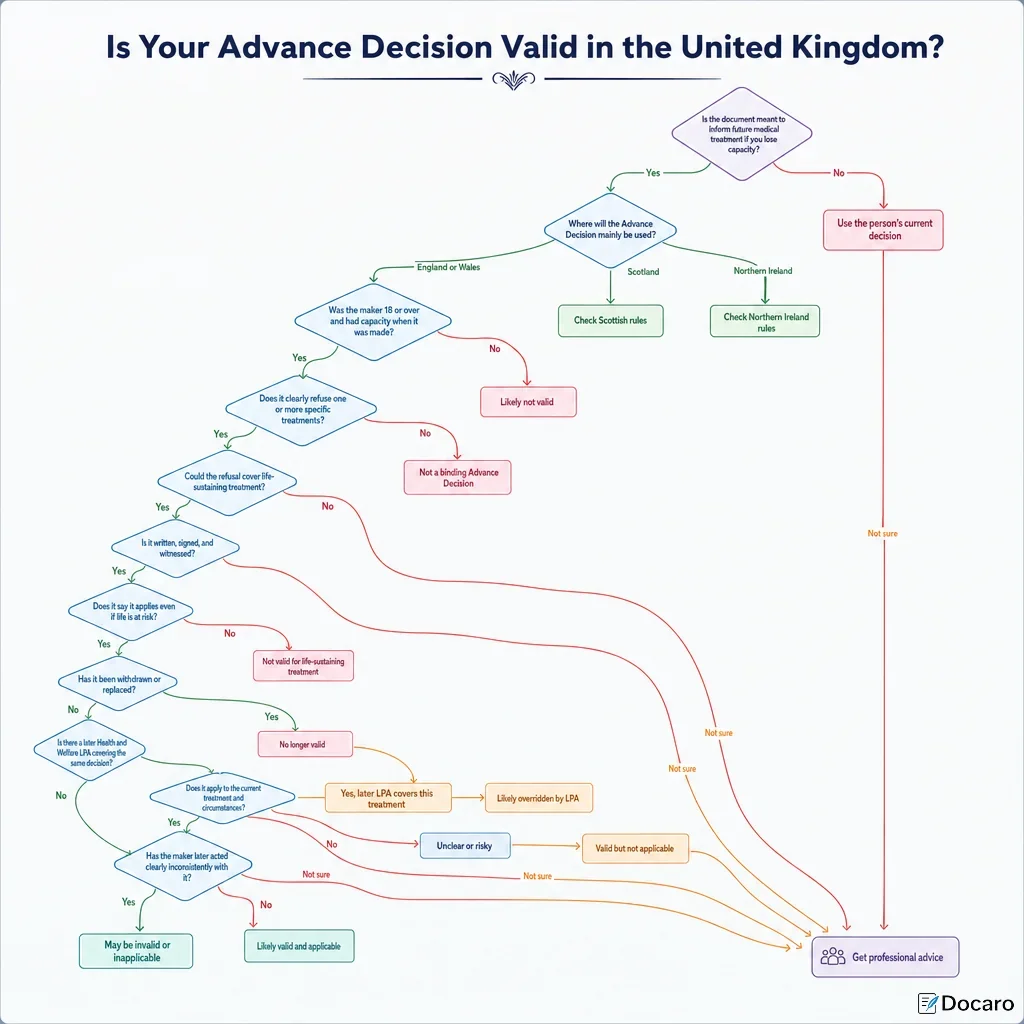
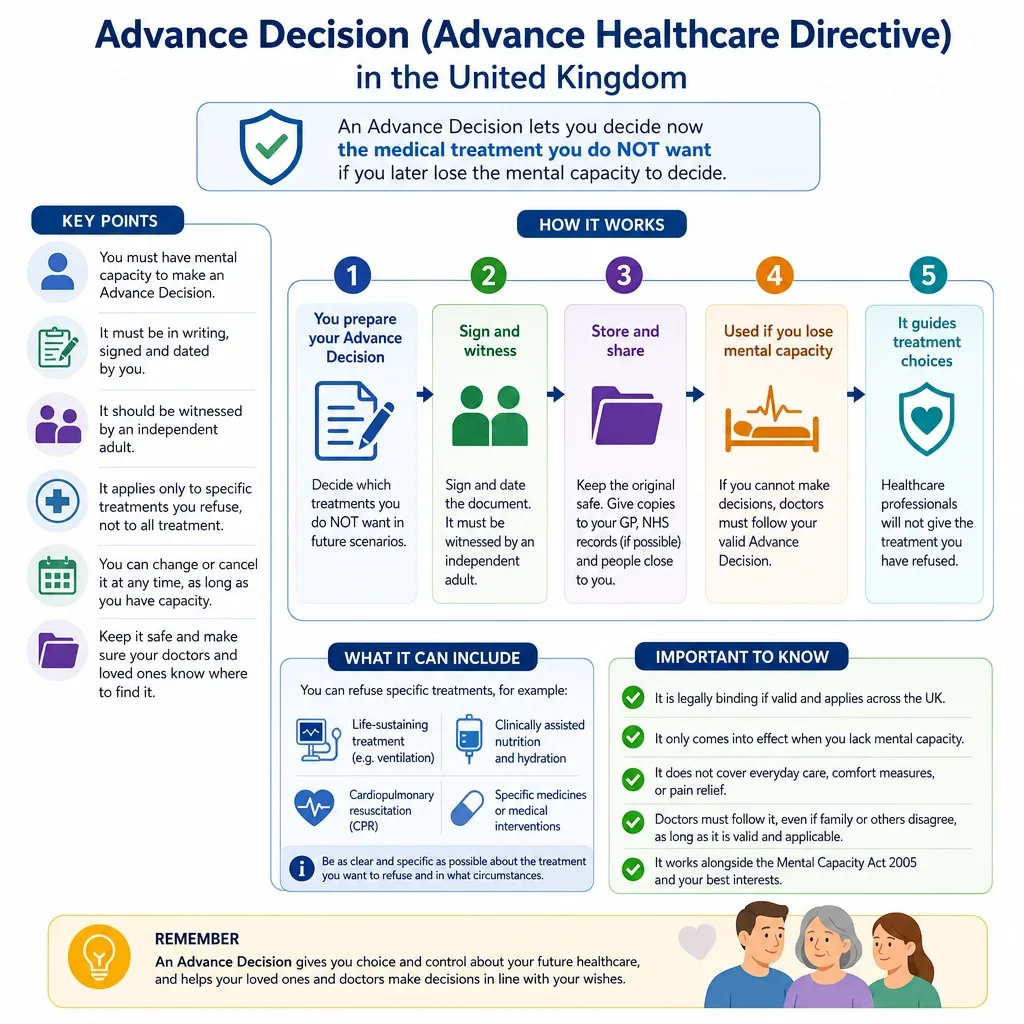
Refusal of life-sustaining treatment formalities | A refusal of life-sustaining treatment must be written, signed, witnessed, and state that it applies even if life is at risk. | true | Include the life-risk statement if refusing life-sustaining treatment in England and Wales. |
Refusal of non-life-sustaining treatment | A non-life-sustaining advance refusal need not be in writing, but written evidence is strongly preferable. | true | Record refusals in writing to reduce uncertainty for clinicians in England and Wales. |
Capacity when making the document | The maker must be 18 or over and have capacity when making the advance decision. | true | Capacity should be documented if there may later be doubt about the decision. |
Scotland | |||
Capacity and incapacity terminology | Scottish adult incapacity law uses principles under the Adults with Incapacity (Scotland) Act 2000, but advance directives are not set out like MCA advance decisions. | true | Scottish users should consider capacity evidence and local medical advice when signing an advance directive. |
Northern Ireland | |||
Capacity law context | Northern Ireland has separate capacity legislation and guidance advance decisions should follow local rules and practice. | true | Do not assume the English Mental Capacity Act wording applies in Northern Ireland. |
England and Wales | |||
Validity and applicability | An advance decision only binds clinicians if it is valid and applicable to the treatment and circumstances. | true | Describe the refused treatments and circumstances precisely for use in England and Wales. |
Advance statements of wishes | An advance statement records wishes and preferences but is not the same as a binding advance refusal. | false | Separate preferences from binding refusals to avoid confusion in England and Wales. |
Northern Ireland | |||
Advance statements | Advance statements can record preferences, beliefs, and care wishes, but they differ from refusals of treatment. | true | Northern Ireland users should distinguish an advance decision from an advance statement. |
England and Wales | |||
Legal effect on clinicians | If valid and applicable, an advance decision has the same effect as a contemporaneous capacitous refusal. | true | Make the document easy for clinicians to verify quickly in England and Wales. |
Assisted dying and assisted suicide | An advance decision cannot require assisted suicide or active steps to end life. | true | Limit the document to refusals of treatment and care preferences, not requests to cause death. |
Scotland | |||
Assisted dying and assisted suicide | An advance directive in Scotland cannot require clinicians to take unlawful active steps to end life. | false | Frame the Scottish document as refusal of treatment and expression of wishes, not assisted dying. |
Northern Ireland | |||
Assisted dying and assisted suicide | An advance decision cannot authorise assisted suicide or unlawful active ending of life. | true | Use Northern Ireland wording focused on treatment refusals and care preferences. |
United Kingdom general | |||
Basic care and comfort care | Advance directives usually address medical treatment refusals, not ordinary comfort, hygiene, warmth, or basic nursing care. | false | State clearly whether the document refuses treatment or only records comfort-care preferences. |
Clinically assisted nutrition and hydration | Clinically assisted nutrition and hydration is medical treatment and may need explicit wording if it is to be refused. | false | Name artificial nutrition and hydration expressly if the refusal is intended to cover it. |
Cardiopulmonary resuscitation refusal | CPR refusal should be clear and should sit consistently with ReSPECT, DNACPR, or local emergency care forms. | true | Ask local clinicians how an advance refusal of CPR should be recorded and shared. |
England and Wales | |||
Emergency treatment where document is uncertain | Clinicians may treat to prevent serious deterioration while deciding whether an advance decision exists, is valid, and applies. | true | Keep copies accessible so emergency clinicians in England and Wales can verify the decision quickly. |
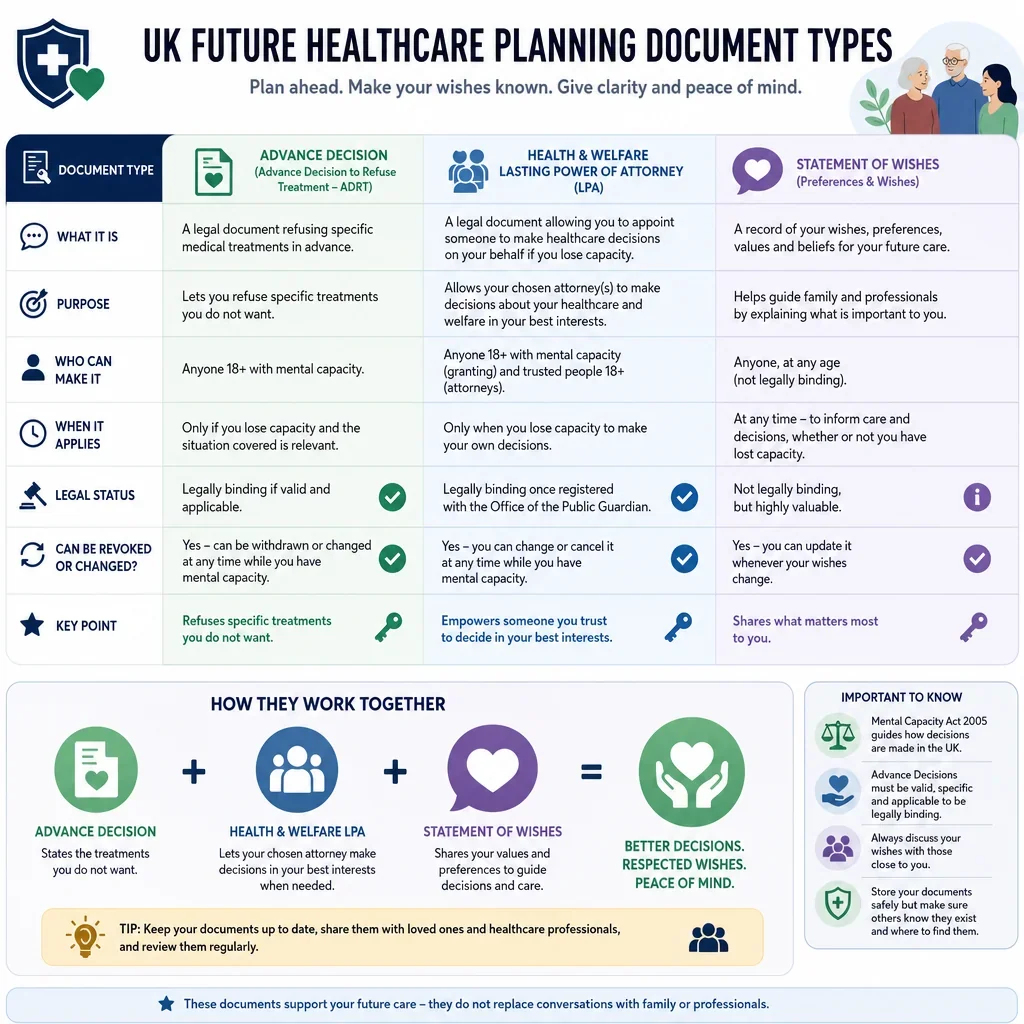
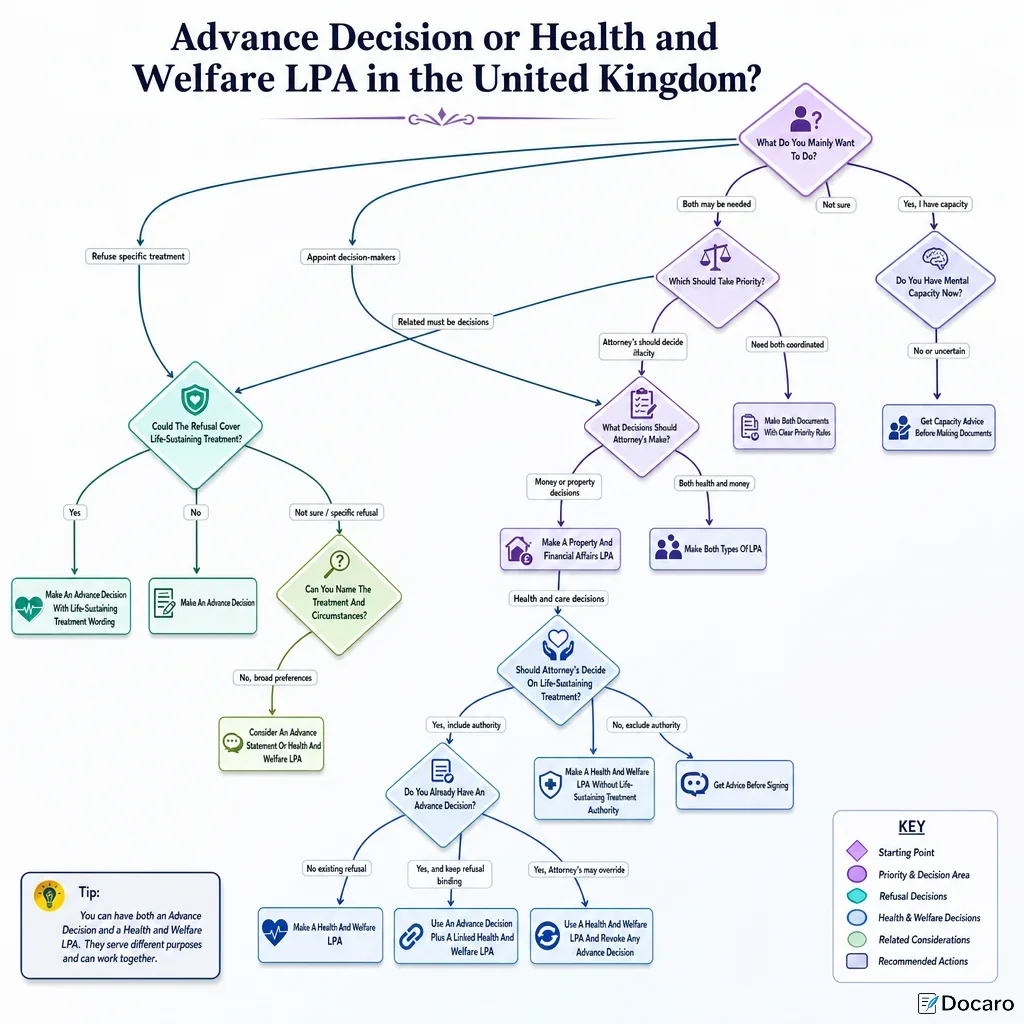
Interaction with health and welfare LPA | A later health and welfare LPA may affect an earlier advance decision if it gives authority over the same treatment. | true | Check dates and wording of any LPA before relying on an advance decision in England and Wales. |
Scotland | |||
Interaction with welfare power of attorney | A Scottish welfare attorney may have relevant healthcare powers, so the advance directive should be consistent with the power of attorney. | true | Scottish users should align the directive with any welfare power of attorney. |
England and Wales | |||
Court disputes about validity or applicability | The Court of Protection can determine disputes about whether an advance decision exists, is valid, or applies. | true | Seek urgent specialist advice if an advance decision is disputed in England and Wales. |
Best interests where no valid refusal applies | If no valid and applicable advance decision applies, treatment decisions are made under best interests rules. | true | Use precise refusals if you want to avoid a later best-interests decision about that treatment. |
Scotland | |||
Principles for decisions about incapable adults | Scottish decisions for incapable adults are guided by statutory principles including benefit and least restrictive intervention. | true | Scottish advance directives should be drafted with the Adults with Incapacity principles in mind. |
England and Wales | |||
Minimum age | A statutory advance decision under the Mental Capacity Act must be made by a person aged 18 or over. | true | Do not use an adult advance decision template for a child without specialist advice. |
United Kingdom general | |||
Children and young people | Advance refusal rules for under-18s are complex and differ from adult advance directive practice. | false | Seek specialist advice before preparing any treatment refusal for a child or young person. |
England and Wales | |||
Withdrawal or alteration | An advance decision may be withdrawn or altered while the person has capacity, and withdrawal need not be in writing. | true | Record any withdrawal or update clearly and tell clinicians and attorneys. |
Later inconsistent conduct | An advance decision may be invalid if the person later acts in a way clearly inconsistent with it remaining fixed. | true | Review the document after major life or health changes to avoid doubts about later conduct. |
United Kingdom general | |||
Specific treatment wording | The document should name treatments and circumstances clearly, especially ventilation, CPR, antibiotics, surgery, and artificial feeding. | false | Avoid vague refusals tailor the wording to your likely medical circumstances and local rules. |
England and Wales | |||
Application in Wales | Wales shares the Mental Capacity Act advance decision framework with England, though NHS operational guidance may differ. | true | Welsh users should follow MCA requirements and check Welsh NHS care-planning practice. |
Mental Capacity Act Code of Practice | The Code of Practice gives practical guidance on advance decisions, capacity, best interests, and healthcare decisions. | true | Use the Code of Practice when checking how an advance decision should work in England and Wales. |
United Kingdom general | |||
GMC professional guidance | GMC guidance informs how doctors approach end-of-life treatment, advance care planning, and treatment refusals across the UK. | false | Check both legal rules and professional guidance because clinicians must consider both. |
Scotland | |||
NHS Scotland guidance | NHS Inform explains Scottish advance directives as a way to tell healthcare professionals about treatments you would refuse. | false | Scottish users should follow NHS Inform terminology and local clinical recording practice. |
Northern Ireland | |||
Northern Ireland public guidance | NI Direct explains advance decisions and advance statements and encourages making wishes known to healthcare staff and family. | true | Use NI Direct guidance as a starting point for Northern Ireland-specific drafting. |
United Kingdom general | |||
Requests for specific treatment | An advance directive can refuse treatment or express preferences, but it cannot require clinicians to give clinically inappropriate treatment. | false | Frame desired care as preferences unless local law gives a specific decision-maker authority. |
England and Wales | |||
Mental health legislation interaction | Mental health legislation can affect whether some refusals of treatment for mental disorder are followed. | true | Get specialist advice if the document refuses treatment for mental disorder while detained or compellable. |
Scotland | |||
Mental health legislation interaction | Scottish mental health legislation may affect treatment decisions despite an advance directive. | true | Scottish users refusing psychiatric treatment should seek advice on mental health legislation. |
Northern Ireland | |||
Mental health legislation interaction | Northern Ireland mental health law may affect refusals relating to psychiatric treatment or detention. | true | Check Northern Ireland mental health rules if the advance decision concerns psychiatric treatment. |
United Kingdom general | |||
Organ and tissue donation | Organ donation wishes should be recorded separately through the relevant NHS organ donation process. | false | Do not rely only on an advance directive to record organ donation choices. |
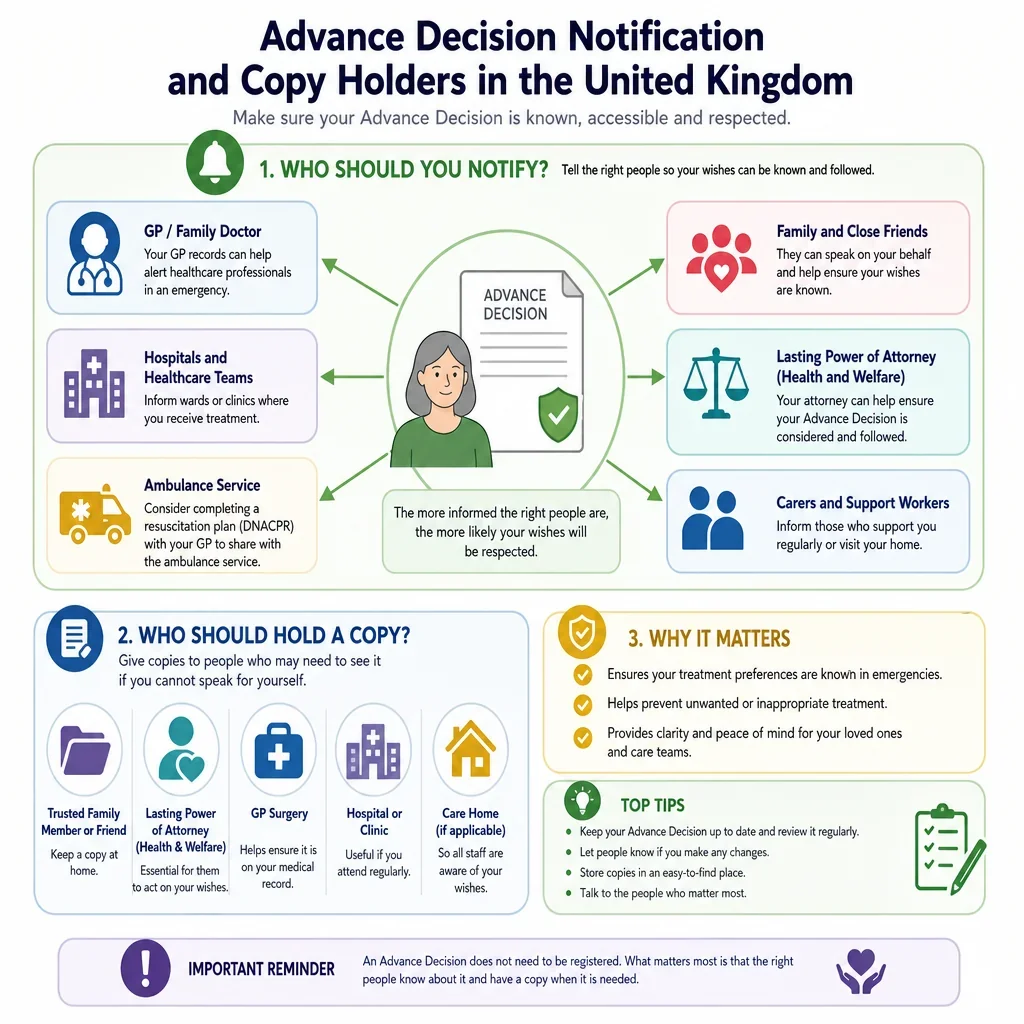
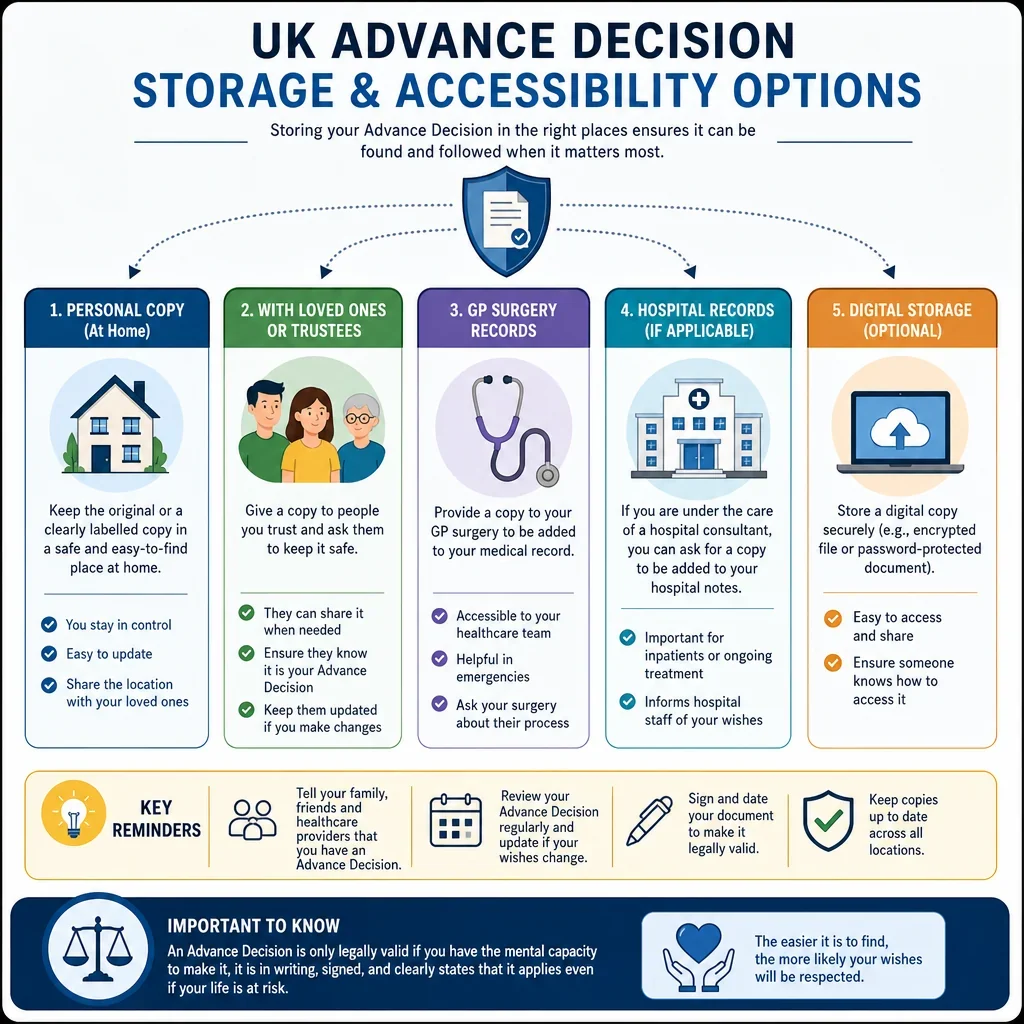
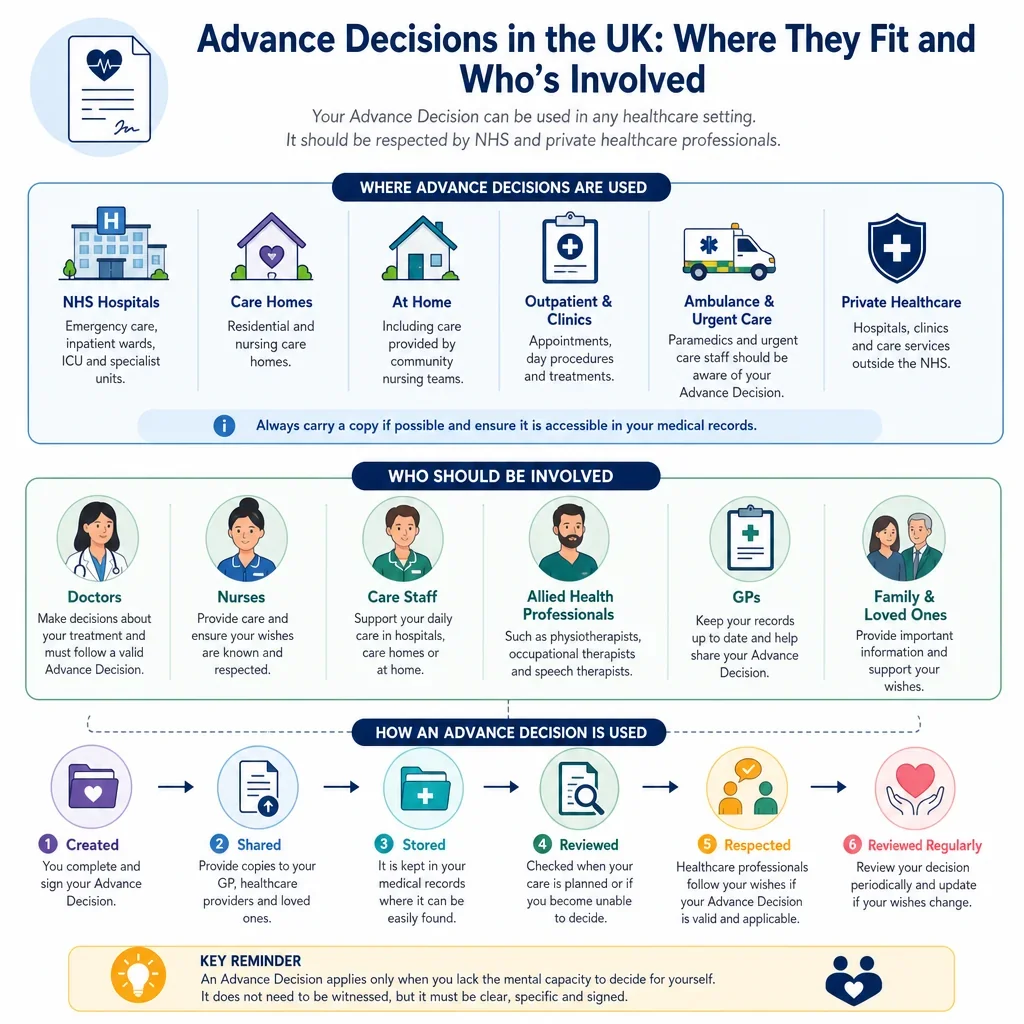
Storage and sharing with healthcare providers | The document is more likely to be followed if GP, hospital, care home, attorneys, and relatives know it exists and have access to it. | false | Ask local NHS services how to place the document on records in your area. |
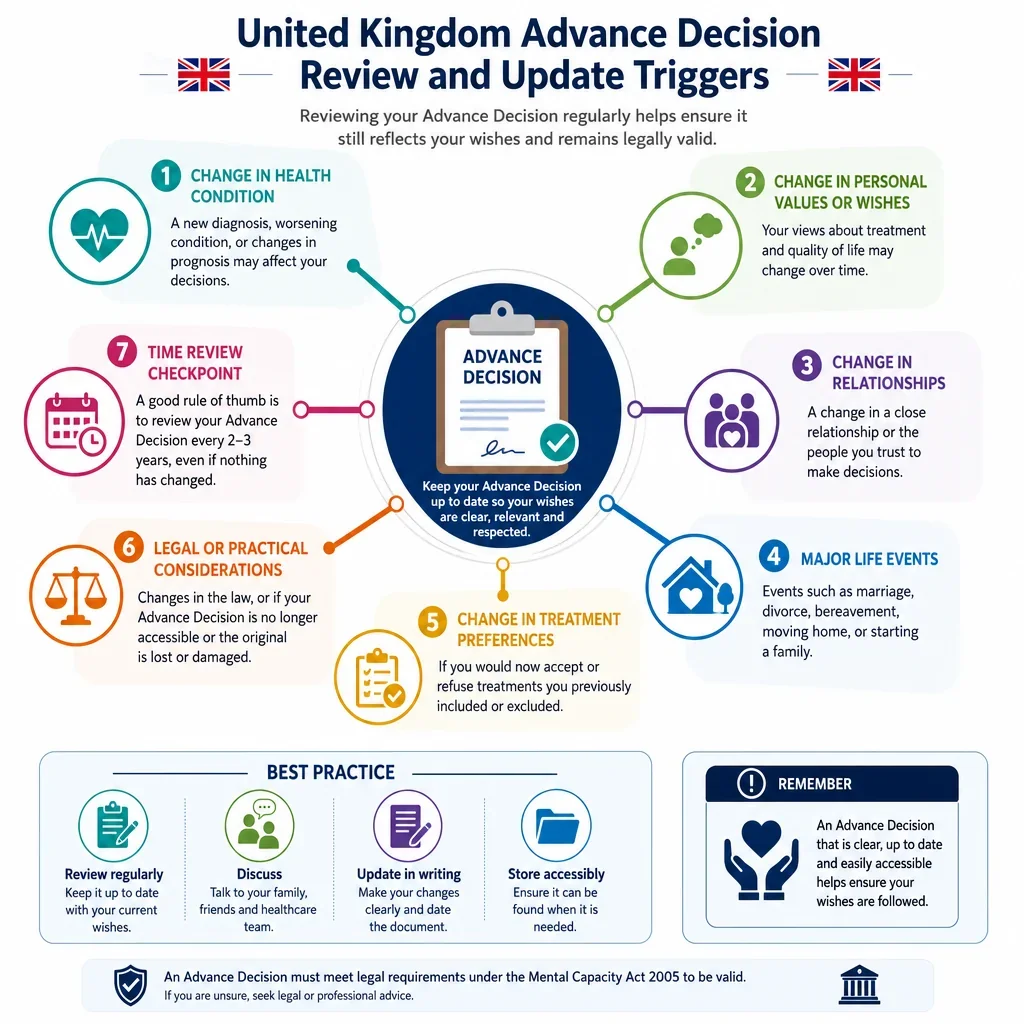
Reviewing the document | Regular review helps show the document still reflects the person’s wishes and current medical circumstances. | false | Review after diagnosis, hospital admission, treatment changes, moving home, or making a power of attorney. |
Witnessing signatures | Witnessing is essential for life-sustaining refusals in England and Wales and good practice elsewhere. | false | Use an independent adult witness and keep contact details where possible. |
Electronic copies and digital access | Digital copies can help access, but signed and witnessed originals remain important where formalities apply. | false | Check whether local services will store or view an electronic copy in an emergency. |
England and Wales | |||
Language and accessibility in Wales | Wales uses the same MCA law, but Welsh-language care settings may need accessible copies and clear English or Welsh wording. | true | Ensure Welsh clinicians can read and verify the document quickly in the relevant language. |
United Kingdom general | |||
Moving or receiving care across UK borders | A document made for one UK nation may need review before use in another because terminology and legal frameworks differ. | false | Review the document if moving between England, Wales, Scotland, or Northern Ireland. |
England and Wales | |||
Serious medical treatment disputes | Serious disputes about life-sustaining treatment and advance decisions may require urgent court involvement. | true | Families and clinicians should seek urgent legal advice if disagreement risks delaying critical care. |
United Kingdom general | |||
Pain relief and palliative care | A refusal of life-prolonging treatment should not be confused with refusal of pain relief or palliative care unless expressly stated. | false | State whether comfort medication and palliative care are wanted even when other treatment is refused. |
Pregnancy considerations | Pregnancy can create complex clinical and legal questions, so documents should say whether refusals apply during pregnancy. | false | Take medical and legal advice if refusing life-sustaining treatment during pregnancy. |
Role of family members | Family members should know the person’s wishes, but they do not automatically have authority to override a valid refusal. | false | Give copies to family, but also use the correct legal appointment if someone should make decisions. |
Naming a contact person | Naming a person to be consulted is helpful, but it is not the same as granting formal healthcare decision-making powers. | false | Use an LPA, welfare power of attorney, or local equivalent if formal authority is intended. |
Clinical awareness of the document | A valid document may be ineffective in practice if clinicians cannot find it when treatment decisions are needed. | false | Carry a card or note and ask the GP to record the document on the patient record. |
England and Wales | |||
Public health and compulsory treatment limits | Public health powers may affect healthcare decisions in specific infectious disease or public health situations. | true | Check public health rules if the refusal relates to infectious disease controls or compulsory measures. |
United Kingdom general | |||
Distinction from a will | An advance healthcare directive deals with treatment while alive, not distribution of property after death. | false | Use a separate will for estate planning and a separate advance directive for healthcare refusals. |
Dating and version control | Dating each version helps clinicians identify the current document and spot conflicts with later powers of attorney. | false | Destroy or mark old copies as revoked when a new version is signed. |
England and Wales | |||
Signing on behalf of the maker | For life-sustaining treatment refusals, another person may sign at the maker’s direction and in the maker’s presence. | true | Record the reason for assisted signing and ensure the statutory witness requirement is met. |
When the document operates | An advance decision operates when the person lacks capacity to consent to or refuse the treatment at the relevant time. | true | If the person has capacity at the time, their current decision should be sought directly. |
Scotland | |||
Use of the term advance directive | Scottish public guidance commonly uses advance directive for written refusals of treatment. | false | Use terminology clinicians in Scotland will recognise, while making the refusals explicit. |
Northern Ireland | |||
Life-sustaining treatment refusals | Northern Ireland guidance treats advance decisions refusing life-sustaining treatment as needing especially clear written evidence. | true | For Northern Ireland, put life-sustaining refusals in clear written, signed, and witnessed form. |
Scotland | |||
Life-sustaining treatment refusals | Scottish life-sustaining treatment refusals should be written very clearly and discussed with healthcare professionals. | false | In Scotland, discuss life-sustaining refusals with a doctor and ensure records are updated. |
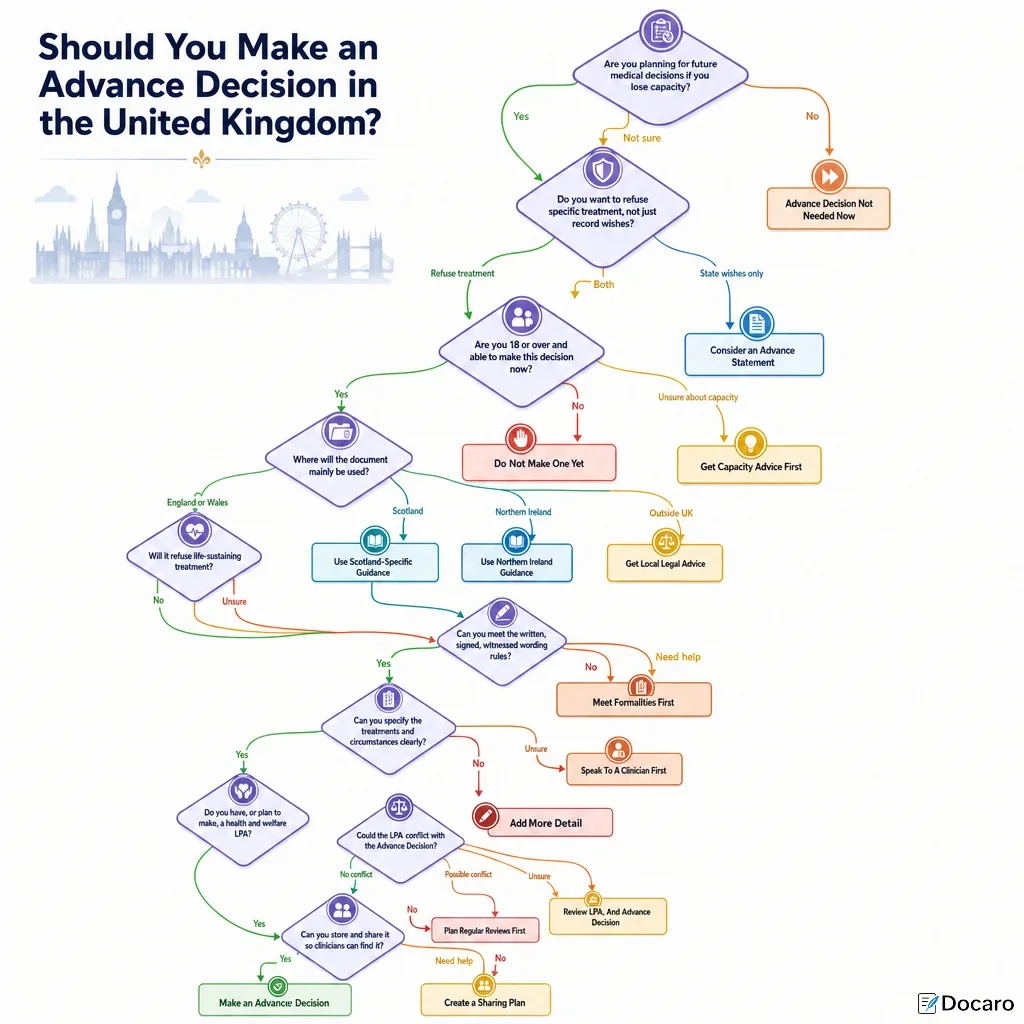
Which UK Advance Healthcare Directive Rules Matter Most?
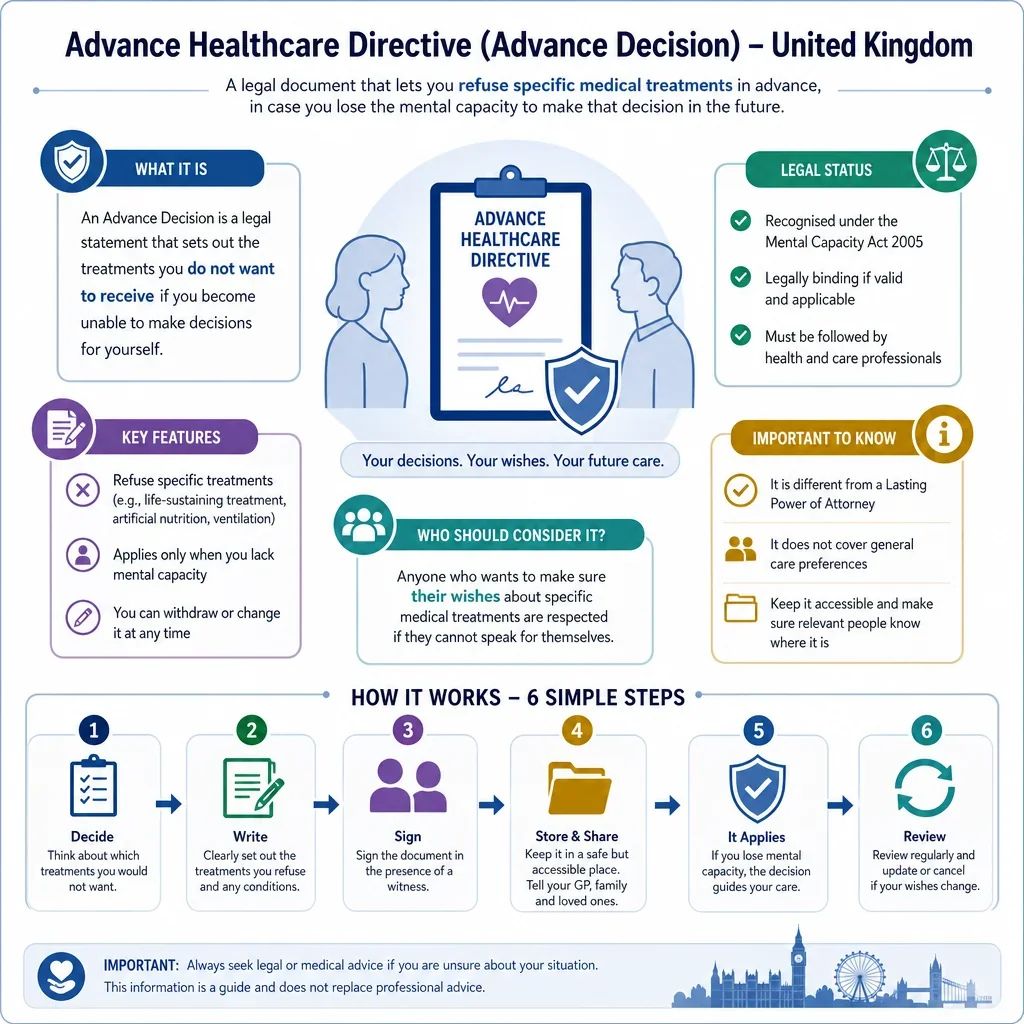
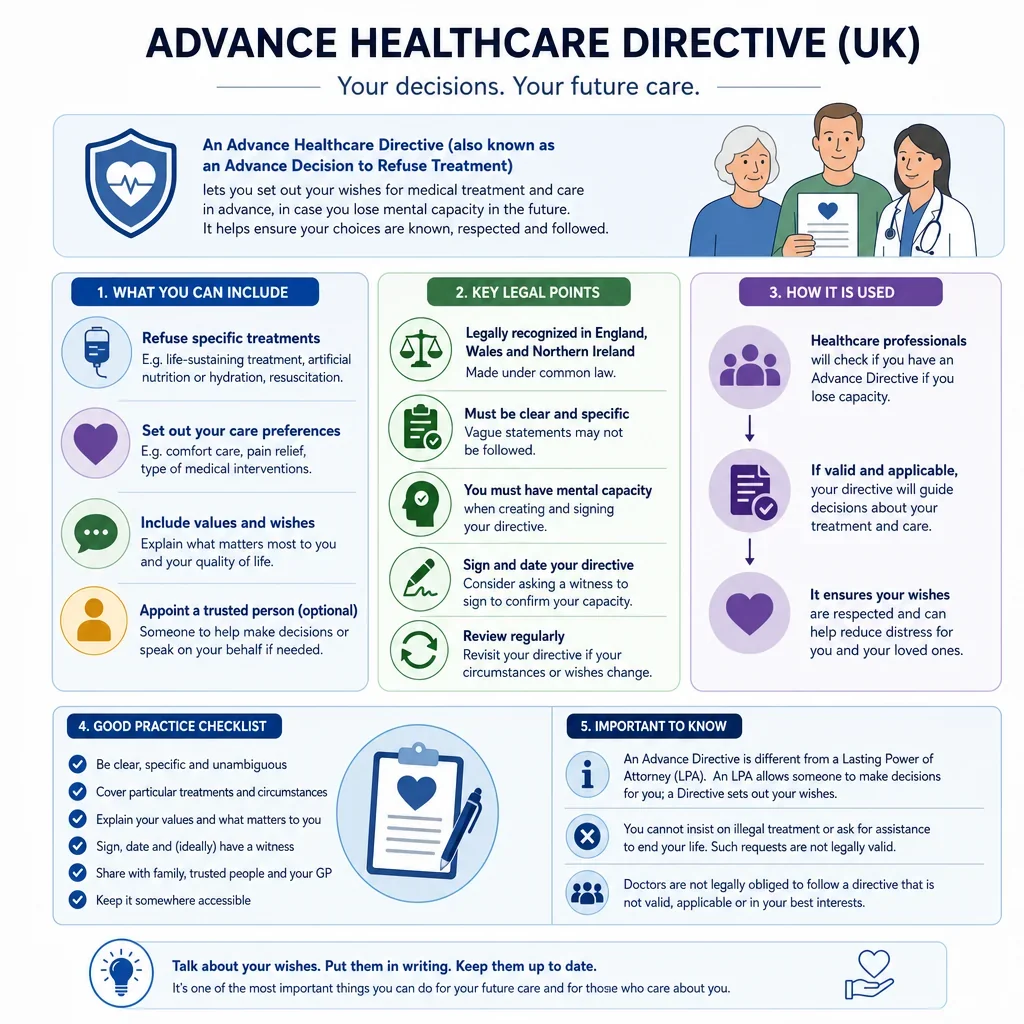
England and Wales has the clearest statutory framework: a refusal of treatment can be an advance decision under the Mental Capacity Act 2005, and refusals of life-sustaining treatment need writing, signature, witnessing, and a statement that the decision applies even if life is at risk.
Scotland and Northern Ireland recognise advance refusals differently, with less detailed statutory formality. In practice, users should make the document clear, signed, witnessed, and clinically accessible, and should check local NHS guidance before relying on it.
Lasting Powers of Attorney and welfare powers can affect an advance directive. In England and Wales, a valid and applicable advance decision can override later best-interests treatment decisions, but conflicts with a health and welfare LPA depend on timing and wording.
Emergency access is practical as well as legal. Users should tell their GP, hospital team, care home, attorney, proxy, and close family where the document is kept, and should review it after diagnosis, treatment changes, moving jurisdiction, or making a power of attorney.
FAQs
You Might Also Be Interested In