

United Kingdom Advance Healthcare Directive Glossary
Created:
This glossary explains key terms used in advance healthcare directives, helping you understand relevant concepts and make informed planning decisions. For related guidance, visit AI Generated British Advance Decision.
Term | Definition | Example use | Commonly used in MCA context |
|---|---|---|---|
Legal concept | |||
Advance Decision | A legally binding refusal of specified medical treatment made in advance by an adult with capacity. | "I refuse mechanical ventilation if I am permanently unconscious." | true |
Advance Directive | A commonly used informal name for an Advance Decision or statement about future care wishes. | The person called their Advance Decision an advance healthcare directive. | false |
Document clause | |||
Advance Statement | A non-binding statement of wishes, values and care preferences for future treatment or care. | "I would prefer to be cared for at home if possible." | true |
Legal concept | |||
Mental Capacity Act 2005 | The main law in England and Wales governing decision-making for people who may lack capacity. | The Advance Decision must comply with the Mental Capacity Act 2005. | true |
Process | |||
Mental Capacity Act Code of Practice | Official guidance explaining how the Mental Capacity Act should be applied in practice. | Doctors should consider the Code of Practice when assessing capacity. | true |
Healthcare concept | |||
Capacity | The ability to make a specific decision at the time it needs to be made. | The person had capacity when signing the Advance Decision. | true |
Lack Of Capacity | An inability to make a specific decision because of an impairment or disturbance in the mind or brain. | The Advance Decision is considered only if the patient lacks capacity. | true |
Process | |||
Capacity Assessment | A decision-specific assessment of whether a person can understand, retain, use and weigh information and communicate a decision. | A capacity assessment was completed before relying on the directive. | true |
Legal concept | |||
Understand, Retain, Use And Weigh | The statutory abilities considered when deciding whether someone can make a decision. | She could understand and weigh the risks of refusing CPR. | true |
Best Interests | The decision-making standard used when a person lacks capacity and no valid applicable refusal decides the issue. | Doctors considered best interests for treatment not covered by the Advance Decision. | true |
Valid And Applicable | The test for whether an Advance Decision must be followed for the treatment and circumstances in question. | The refusal was valid and applicable to artificial ventilation. | true |
Validity | Whether the Advance Decision has been made and not withdrawn, overridden or undermined by later inconsistent acts. | The hospital checked the validity of the refusal before acting on it. | true |
Applicability | Whether the Advance Decision covers the exact treatment and circumstances now arising. | Its applicability was questioned because the infection was treatable. | true |
Healthcare concept | |||
Life-Sustaining Treatment | Treatment which the person providing healthcare regards as necessary to sustain life. | The directive refused life-sustaining treatment in advanced dementia. | true |
Document clause | |||
Life At Risk Statement | Required wording confirming a refusal applies even if life is at risk. | "This refusal applies even if my life is at risk." | true |
Signature Requirement | A refusal of life-sustaining treatment must be signed by the person or by another person in their presence and direction. | The life-sustaining treatment refusal was signed and dated. | true |
Witness Requirement | A witness must witness the signature for a life-sustaining treatment refusal. | The witness confirmed the patient signed the Advance Decision. | true |
Specified Treatment | The particular treatment or treatments that the person refuses in the Advance Decision. | The specified treatment was cardiopulmonary resuscitation. | true |
Specified Circumstances | The situation or medical condition in which the treatment refusal is intended to apply. | The refusal applied if the person had irreversible coma. | true |
Process | |||
Withdrawal | Cancelling an Advance Decision, which may be done at any time while the person has capacity. | She withdrew her earlier refusal after discussing treatment options. | true |
Revocation | Another term for cancelling or withdrawing a previous Advance Decision. | The revocation was recorded in her medical notes. | true |
Legal concept | |||
Lasting Power Of Attorney | A legal document appointing attorneys to make decisions if the donor lacks capacity. | Her Health and Welfare LPA appointed her sister to make treatment decisions. | true |
Health And Welfare LPA | An LPA allowing attorneys to make health and care decisions when the donor lacks capacity. | The Health and Welfare LPA authorised decisions about life-sustaining treatment. | true |
Person or role | |||
Attorney | A person appointed under an LPA to make decisions for the donor within their authority. | The attorney gave doctors a copy of the Advance Decision. | true |
Donor | The person who makes a Lasting Power of Attorney. | The donor also made an Advance Decision refusing ventilation. | true |
Donee | The statutory term for an attorney appointed under a Lasting Power of Attorney. | The donee had no authority to override this earlier refusal. | true |
Court Of Protection | The specialist court for decisions and disputes about mental capacity and best interests in England and Wales. | The hospital applied to the Court of Protection about the disputed refusal. | true |
Deputy | A person appointed by the Court of Protection to make decisions for someone who lacks capacity. | The deputy provided evidence of the personu0027s past wishes. | true |
Independent Mental Capacity Advocate | An advocate supporting certain people who lack capacity and have no appropriate family or friends to consult. | An IMCA was instructed for a serious medical treatment decision. | true |
Healthcare concept | |||
Serious Medical Treatment | Treatment involving serious consequences, major choices or fine balance between benefits and burdens. | Withdrawal of ventilation was treated as serious medical treatment. | true |
Clinically Assisted Nutrition And Hydration | Food and fluids provided by medical means, such as a feeding tube or intravenous line. | The directive refused clinically assisted nutrition and hydration in permanent unconsciousness. | true |
CANH | Abbreviation for clinically assisted nutrition and hydration. | The Advance Decision stated that CANH should be refused. | false |
Artificial Nutrition And Hydration | Older term for nutrition and fluids delivered by clinical methods rather than normal eating and drinking. | The document used the older phrase artificial nutrition and hydration. | false |
Cardiopulmonary Resuscitation | Emergency treatment to try to restart breathing or the heart, often called CPR. | The Advance Decision refused cardiopulmonary resuscitation if death was expected. | false |
CPR | Common abbreviation for cardiopulmonary resuscitation. | "I refuse CPR if I have advanced terminal cancer." | false |
DNACPR | A clinical decision or recommendation that CPR should not be attempted if the heart or breathing stops. | The Advance Decision was kept with the DNACPR form. | false |
DNAR | Alternative abbreviation meaning do not attempt resuscitation. | A DNAR note did not replace the wider Advance Decision. | false |
Mechanical Ventilation | Use of a machine to support or take over breathing. | The person refused mechanical ventilation in irreversible brain injury. | false |
Assisted Ventilation | Breathing support provided by a ventilator or similar medical equipment. | The refusal included assisted ventilation after severe stroke. | false |
Intubation | Insertion of a breathing tube into the airway, usually to support ventilation. | The Advance Decision refused intubation in end-stage lung disease. | false |
Antibiotics | Medicines used to treat or prevent some bacterial infections. | The directive refused antibiotics for recurrent pneumonia in advanced dementia. | false |
Blood Transfusion | A procedure where donated blood is given through a tube into a vein. | The Advance Decision refused blood transfusion on religious grounds. | false |
Dialysis | Treatment that removes waste products and excess fluid when kidneys cannot do so. | The person refused dialysis if permanently unable to recognise family. | false |
Surgery | Medical treatment involving an operation or invasive procedure. | The directive refused major surgery if recovery to awareness was unlikely. | false |
Palliative Care | Care focused on comfort, symptom relief and quality of life for people with serious illness. | The Advance Decision requested palliative care even where treatment was refused. | false |
End Of Life Care | Support and treatment for people expected to be in the last months or years of life. | The directive was included in her end of life care plan. | false |
Terminal Illness | An illness that cannot be cured and is likely to lead to death. | The refusal applied if she had terminal illness and could not communicate. | false |
Permanent Unconsciousness | A long-term state of unconsciousness where recovery of awareness is not expected. | The refusal applied in permanent unconsciousness after brain injury. | false |
Vegetative State | A disorder of consciousness where a person is awake but shows no signs of awareness. | The directive refused CANH if diagnosed in a permanent vegetative state. | false |
Minimally Conscious State | A disorder of consciousness with clear but minimal and inconsistent awareness. | The refusal mentioned prolonged minimally conscious state after severe brain injury. | false |
Dementia | A group of symptoms affecting memory, thinking, communication and daily functioning. | The directive stated refusals for advanced dementia with inability to recognise family. | false |
Advanced Dementia | Later-stage dementia with severe problems in communication, recognition, mobility or daily care. | The refusal applied in advanced dementia with repeated aspiration pneumonia. | false |
Stroke | A serious condition where blood supply to part of the brain is cut off. | The directive applied after a catastrophic stroke causing permanent incapacity. | false |
Brain Injury | Damage to the brain caused by trauma, illness or lack of oxygen. | The Advance Decision refused ventilation after irreversible brain injury. | false |
Coma | A state of unconsciousness where a person cannot be woken and does not respond normally. | The refusal applied if coma was irreversible after specialist assessment. | false |
Person or role | |||
Clinician | A healthcare professional involved in diagnosing, treating or caring for a patient. | The clinician checked whether the refusal was applicable. | false |
Consultant | A senior hospital doctor responsible for a patientu0027s specialist care. | The consultant reviewed the Advance Decision before intensive care admission. | false |
GP | General practitioner a local doctor providing primary medical care. | The person gave a copy of the Advance Decision to their GP. | false |
Next Of Kin | A person identified as a contact or family member not automatically a legal decision-maker. | Her next of kin told doctors where the Advance Decision was stored. | false |
Witness | A person who observes and confirms a signature on the Advance Decision where required. | The witness signed after seeing the patient sign the refusal. | true |
Certificate Provider | A person who confirms a donor understands an LPA and is not under pressure. | The certificate provider was relevant to the later LPA, not the Advance Decision. | true |
Legal concept | |||
Consent | Permission for treatment, which must usually be voluntary and informed. | An Advance Decision can refuse treatment when the person cannot give consent. | true |
Informed Refusal | A decision to refuse treatment after understanding relevant risks, benefits and alternatives. | The GP recorded that the refusal was informed and discussed. | false |
Refusal Of Treatment | A decision not to receive a particular medical treatment. | The document contained a refusal of treatment for CPR and ventilation. | true |
Document clause | |||
Treatment Request | A wish to receive a treatment usually not legally binding like a refusal in an Advance Decision. | "I would like pain relief even if it makes me drowsy." | false |
Preferences And Wishes | The personu0027s values, beliefs and past or present wishes relevant to best interests decisions. | Her preferences and wishes were recorded alongside the binding refusal. | true |
Religious Beliefs | Faith-based beliefs that may be relevant to treatment refusals or best interests decisions. | The refusal of blood transfusion referred to religious beliefs. | true |
Beliefs And Values | Personal matters doctors must consider when making best interests decisions. | The statement explained her beliefs and values about independence. | true |
Legal concept | |||
Restraint | Using or threatening force, or restricting liberty, where MCA safeguards are satisfied. | Restraint was not justified to give treatment refused by a valid Advance Decision. | true |
Deprivation Of Liberty | A level of restriction amounting to loss of liberty, requiring legal authorisation if the person lacks capacity. | Care arrangements were reviewed separately from the Advance Decision. | true |
Process | |||
DoLS | Deprivation of Liberty Safeguards the current authorisation system for some care home and hospital restrictions. | A DoLS authorisation did not remove the need to follow a valid refusal. | true |
Liberty Protection Safeguards | Planned replacement scheme for authorising deprivation of liberty under the Mental Capacity Act framework. | LPS is separate from the rules on Advance Decisions. | true |
Emergency Treatment | Urgent treatment given while clinicians determine whether an Advance Decision exists, is valid and applies. | Emergency treatment was started while staff checked the document. | true |
Legal concept | |||
Reasonable Belief | A clinicianu0027s legally relevant belief about whether an Advance Decision exists, is valid or applicable. | The doctor had no reasonable belief that the refusal applied to sepsis treatment. | true |
Liability Protection | Protection for acts done or not done where clinicians reasonably believe the MCA conditions are met. | Liability protection depends on reasonable beliefs about validity and applicability. | true |
Process | |||
Treatment And Care Towards The End Of Life | GMC guidance for doctors on decisions, communication and care near the end of life. | The doctor followed GMC end of life guidance when reviewing the refusal. | false |
Healthcare concept | |||
Treatment Escalation Plan | A clinical plan recording what treatment should be started, limited or avoided if health worsens. | The escalation plan referred staff to the Advance Decision. | false |
Document clause | |||
ReSPECT Form | A recommended summary plan for emergency care and treatment, including CPR recommendations. | The ReSPECT form noted the location of the Advance Decision. | false |
Care Plan | A record of a personu0027s assessed needs and how care or support should be provided. | The care plan included a note about the Advance Decision. | false |
Medical Records | Health information held by NHS or private healthcare providers about a patient. | A copy of the directive was uploaded to the medical records. | false |
Review Date | A date showing the Advance Decision has been reconsidered and remains current. | The document included a review date and fresh signature. | false |
Date Of Execution | The date the Advance Decision is signed or formally completed. | The date of execution was before the later Health and Welfare LPA. | false |
Healthcare concept | |||
Mental Disorder | A disorder or disability of the mind under the Mental Health Act 1983. | Different rules may apply if treatment is for mental disorder under the Mental Health Act. | true |
Legal concept | |||
Mental Health Act 1983 | Law governing assessment, detention and treatment of people with mental disorder in England and Wales. | The Mental Health Act may affect some refusals of treatment for mental disorder. | true |
Section 28 MCA | MCA rule preserving Mental Health Act powers despite Advance Decisions in specified situations. | Section 28 MCA was considered because the treatment related to mental disorder. | true |
Euthanasia | Deliberately ending a personu0027s life to relieve suffering illegal in the UK. | An Advance Decision cannot request euthanasia. | false |
Assisted Suicide | Helping another person end their life generally a criminal offence in England and Wales. | The directive refused treatment but did not request assisted suicide. | false |
Suicide Act 1961 | Law including the offence of encouraging or assisting suicide in England and Wales. | The Suicide Act is relevant because an Advance Decision cannot authorise assisted suicide. | false |
Healthcare concept | |||
Pain Relief | Medication or care intended to reduce pain or distress. | The Advance Decision refused ventilation but requested pain relief. | false |
Symptom Control | Treatment aimed at reducing symptoms such as pain, breathlessness, nausea or anxiety. | The directive allowed symptom control even where curative treatment was refused. | false |
Hospice | A service providing specialist palliative and end of life care, often outside hospital. | The advance statement said she preferred hospice care if home care was impossible. | false |
Document clause | |||
Place Of Care | The preferred location for receiving care, such as home, hospital, care home or hospice. | The advance statement named home as the preferred place of care. | false |
Place Of Death | The preferred location where a person would like to die, if clinically and practically possible. | The statement recorded home as the preferred place of death. | false |
Healthcare concept | |||
Organ Donation | Donation of organs or tissue after death for transplantation or medical use. | The advance statement noted the personu0027s organ donation wishes. | false |
Legal concept | |||
Human Tissue Act 2004 | Law governing removal, storage and use of human tissue, including consent rules. | Organ donation wishes may sit alongside, but are separate from, an Advance Decision. | false |
Deemed Consent For Organ Donation | The England organ donation system where consent may be deemed unless the person opted out or was excluded. | The advance statement clarified organ donation wishes despite deemed consent rules. | false |
Process | |||
Safeguarding | Protecting adults at risk from abuse, neglect or coercion. | Safeguarding concerns arose where relatives pressured the patient to sign. | false |
Legal concept | |||
Undue Influence | Improper pressure that may undermine whether a person freely made a decision. | Doctors questioned validity because of possible undue influence. | false |
Coercion | Pressure, threats or control that prevents a decision being made freely. | The Advance Decision should be made without coercion from relatives. | false |
Duress | Unlawful pressure or threats that may invalidate a decision or document. | Evidence of duress could call the directive into question. | false |
Document clause | |||
Ambiguity | Unclear wording that may make it difficult to decide whether a refusal applies. | Ambiguity arose because the directive said "no heroic measures" only. | false |
No Heroic Measures | Informal wording that is usually too vague to identify specific refused treatment. | The phrase "no heroic measures" was replaced with specific refusals. | false |
Legal concept | |||
Inconsistent Conduct | Later actions clearly inconsistent with the Advance Decision remaining the personu0027s fixed decision. | Recent acceptance of the same treatment raised inconsistent conduct concerns. | true |
Material Change In Circumstances | A significant change that the person did not anticipate and that may make the refusal inapplicable. | A new effective treatment was argued to be a material change in circumstances. | true |
Later LPA | An LPA made after an Advance Decision that may affect the Advance Decision if it gives authority over the same treatment. | The later LPA authorised the attorney to decide on life-sustaining treatment. | true |
Earlier Advance Decision | An Advance Decision made before another legal document, such as a Health and Welfare LPA. | The earlier Advance Decision was checked against the later LPA. | true |
Process | |||
Oral Advance Decision | A spoken refusal of future treatment not enough for life-sustaining treatment refusals. | The oral refusal was recorded but CPR refusal needed written formalities. | true |
Document clause | |||
Written Advance Decision | A documented Advance Decision mandatory if it refuses life-sustaining treatment. | The written Advance Decision was signed and witnessed. | true |
Process | |||
Making An Advance Decision | The process of recording future refusals of treatment while the person has capacity. | She discussed risks with her GP before making an Advance Decision. | true |
Reviewing An Advance Decision | Checking that the document still reflects the personu0027s wishes and current medical circumstances. | He reviewed the directive after receiving a new diagnosis. | false |
Storing An Advance Decision | Keeping the document where healthcare professionals and trusted people can find it quickly. | A copy was stored with the GP and emergency care plan. | false |
Sharing Copies | Giving copies to relevant people such as GP, relatives, attorneys and care providers. | She shared copies with her attorney and hospital team. | false |
Document clause | |||
NHS Summary Care Record | An electronic NHS record containing key patient information for urgent and unscheduled care. | The Summary Care Record flagged the existence of the Advance Decision. | false |
Process | |||
NHS App | An NHS service that lets patients access some health information and services digitally. | The patient checked whether their record mentioned the Advance Decision. | false |
Applicability To Current Treatment | Whether the actual treatment proposed is the same as the treatment refused in the document. | The refusal of ventilation did not cover a short course of antibiotics. | true |
Applicability To Current Circumstances | Whether the present medical facts match the circumstances described in the Advance Decision. | The refusal applied only if recovery of awareness was unlikely. | true |
Legal concept | |||
Binding Refusal | A valid and applicable Advance Decision that has the same effect as a contemporaneous refusal by a capacitated adult. | The binding refusal meant the operation could not be performed. | true |
Process | |||
Best Interests Meeting | A meeting to gather views and decide what is in a personu0027s best interests. | A best interests meeting covered care issues not decided by the refusal. | true |
Legal concept | |||
Consultation Duty | The need to consult relevant people, where practical and appropriate, when deciding best interests. | Doctors consulted the attorney about care not covered by the Advance Decision. | true |
Least Restrictive Option | The MCA principle requiring decisions to restrict rights and freedoms as little as possible. | Care planning used the least restrictive option alongside the treatment refusal. | true |
Presumption Of Capacity | The MCA principle that a person is assumed to have capacity unless it is established otherwise. | The patient was presumed to have capacity when reviewing the directive. | true |
Process | |||
Support To Make Decisions | The MCA principle requiring practical help before treating someone as unable to decide. | A communication aid was used before assessing capacity. | true |
Legal concept | |||
Unwise Decision | A decision others think unwise does not by itself prove lack of capacity. | Refusing dialysis was not treated as incapacity merely because it was unwise. | true |
Process | |||
Communication Of Decision | The ability to communicate a decision by speech, sign language or any other means. | She communicated the refusal using an eye-gaze board. | true |
Healthcare concept | |||
Impairment Or Disturbance | A problem in the functioning of the mind or brain relevant to capacity assessment. | Delirium was the impairment affecting the patientu0027s capacity. | true |
Delirium | Sudden confusion that can affect attention, understanding and decision-making. | Capacity was reassessed after delirium improved. | false |
Serious Brain Disorder | A severe condition affecting brain function, consciousness or cognition. | The directive covered treatment after serious brain disorder causing permanent incapacity. | false |
What Should You Know Before Making An Advance Decision In The UK?
An Advance Decision is legally significant in England and Wales only if it meets the Mental Capacity Act 2005 requirements. If it refuses life-sustaining treatment, it must be in writing, signed, witnessed and include a clear statement that it applies even if life is at risk.
- Clarity matters: refusals should identify the treatment and the circumstances in which the refusal applies.
- Capacity matters: the person must have capacity when making the decision, and the document is used only if they later lack capacity.
- Conflicts matter: a valid and applicable Advance Decision can override later best-interests decision-making for the refused treatment.
- LPAs matter: a later Health and Welfare LPA may affect an earlier Advance Decision if the attorney is given authority over the same treatment decisions.
- Availability matters: doctors and attorneys need to know the document exists, where it is kept, and whether it has been updated or revoked.
Which Terms Are Most Important In An Advance Healthcare Directive?
The most important terms are capacity, best interests, valid and applicable, life-sustaining treatment, lasting power of attorney, DNACPR, and clinically assisted nutrition and hydration. These terms affect whether healthcare professionals must follow the instruction, when the document takes effect, and how it interacts with emergency and end-of-life care decisions.
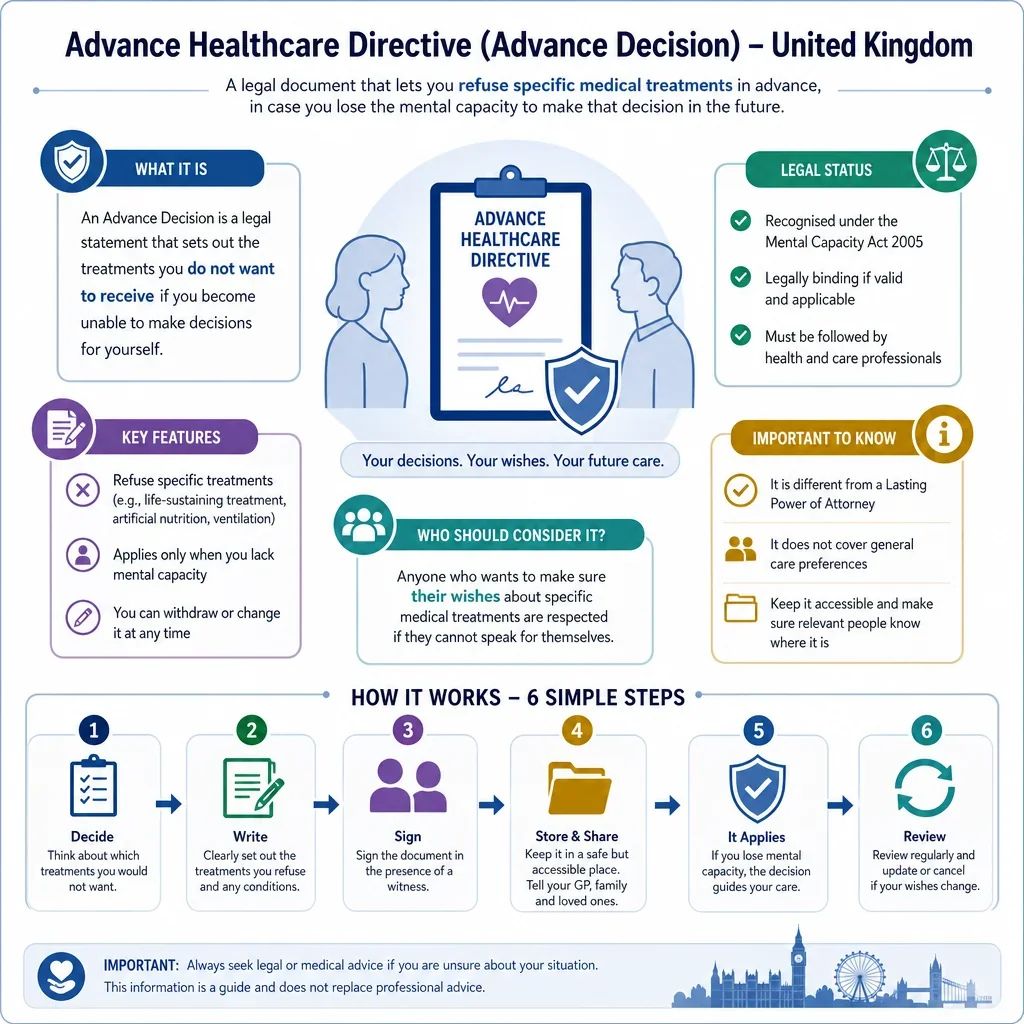
Want to Generate Your own Advance Decision?
Docaro AI can help you write your own Advance Decision for use in the United Kingdom in minutes.
FAQs
An Advance Healthcare Directive is a document that records your healthcare wishes in case you lose mental capacity. In the UK, it is commonly called an Advance Decision or Advance Decision to Refuse Treatment.
Show All FAQs
You Might Also Be Interested In
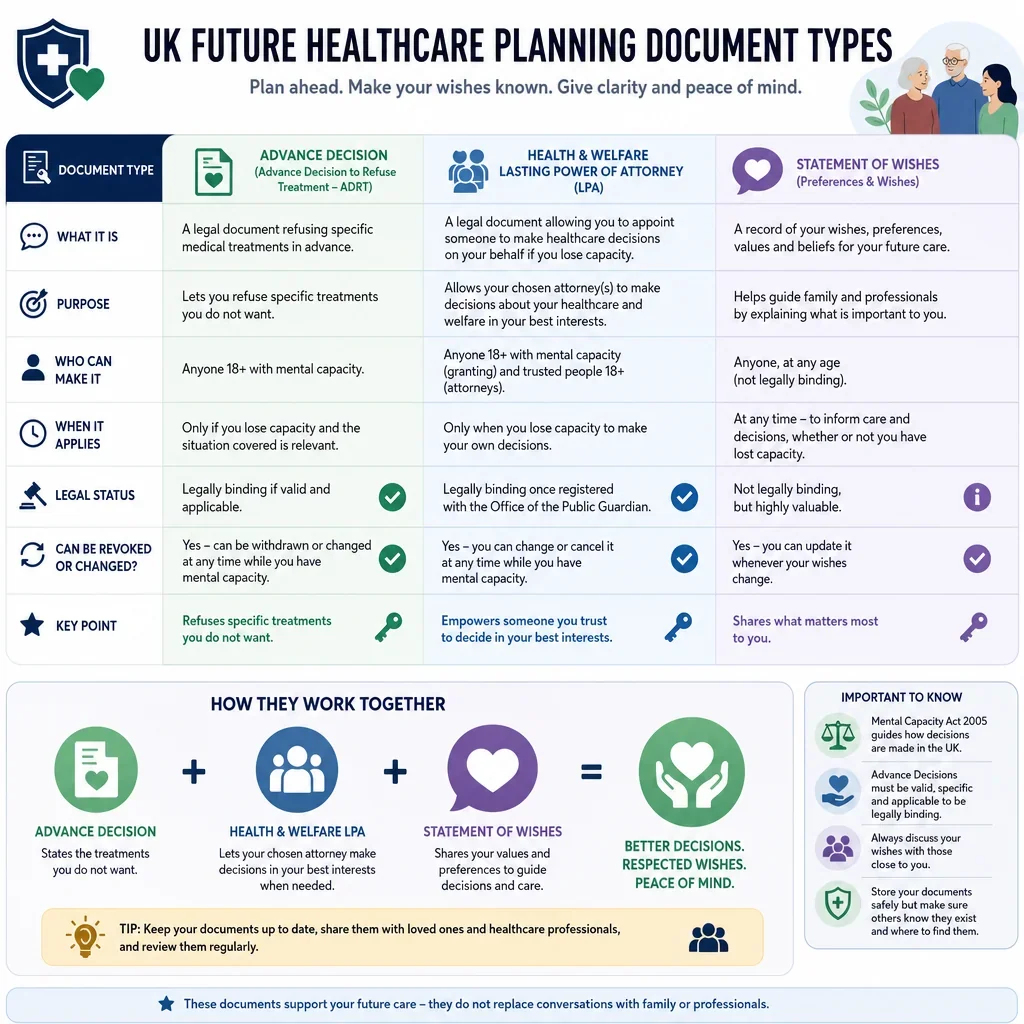
UK guide to future healthcare planning document types, helping you compare care planning options and understand key legal choices.
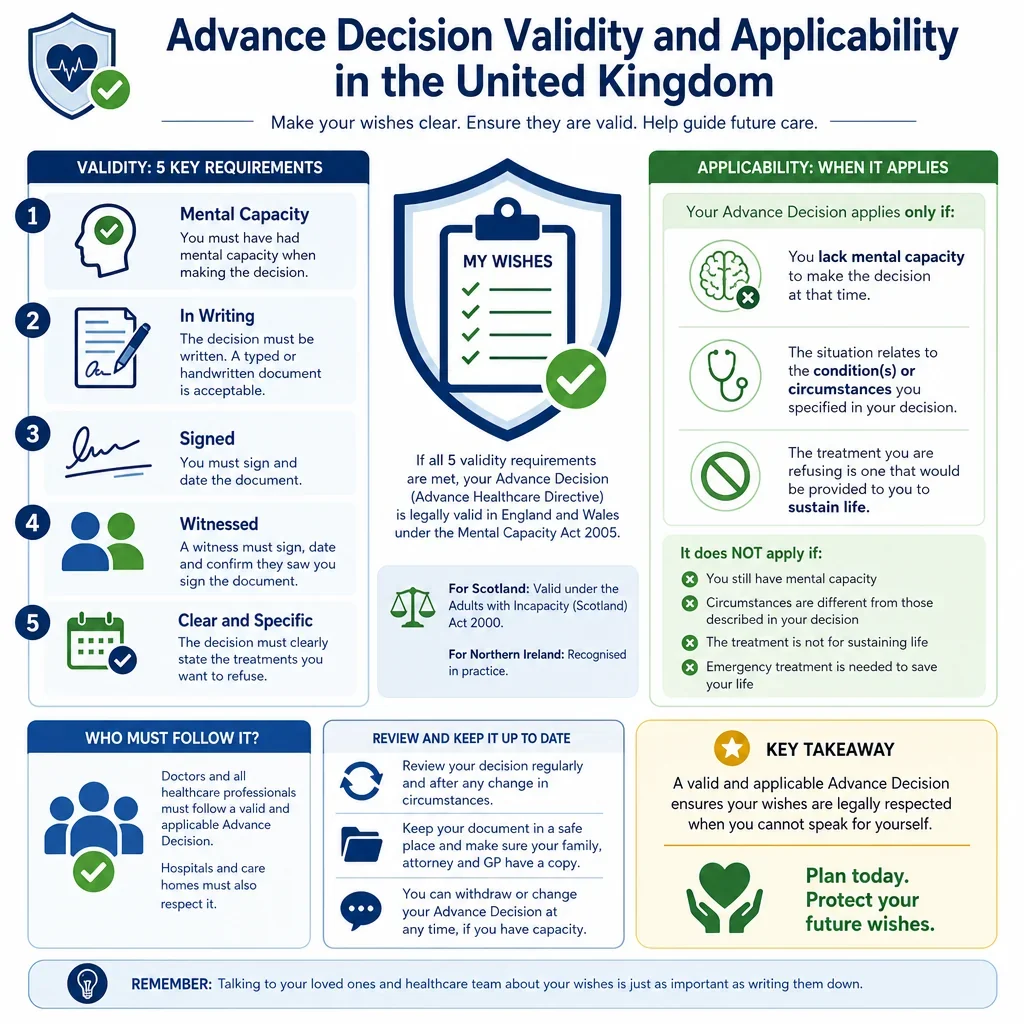
UK checklist for assessing advance decision validity and applicability, with key legal and healthcare planning points.
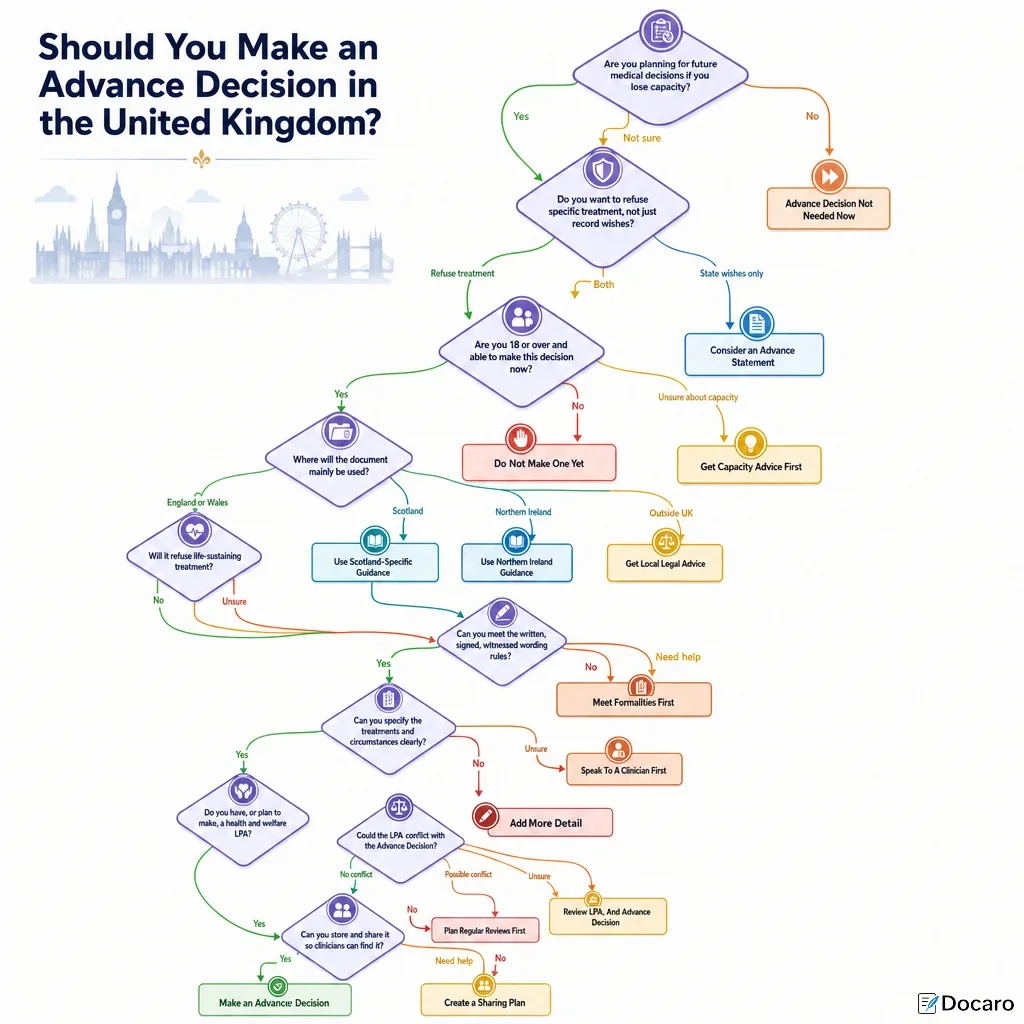
Learn whether making an Advance Decision in the United Kingdom is right for your healthcare choices and future planning.
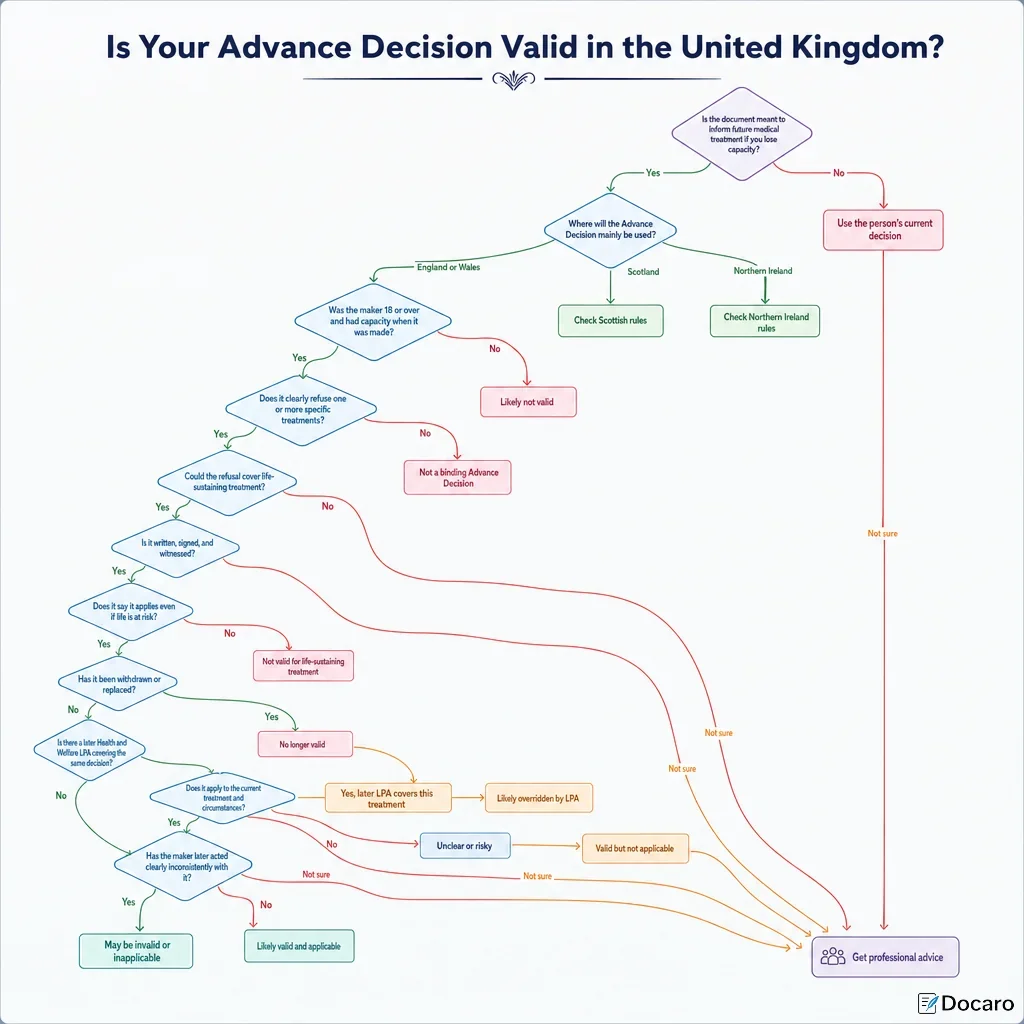
Check if your Advance Decision is valid in the United Kingdom with this clear flowchart covering key legal requirements.
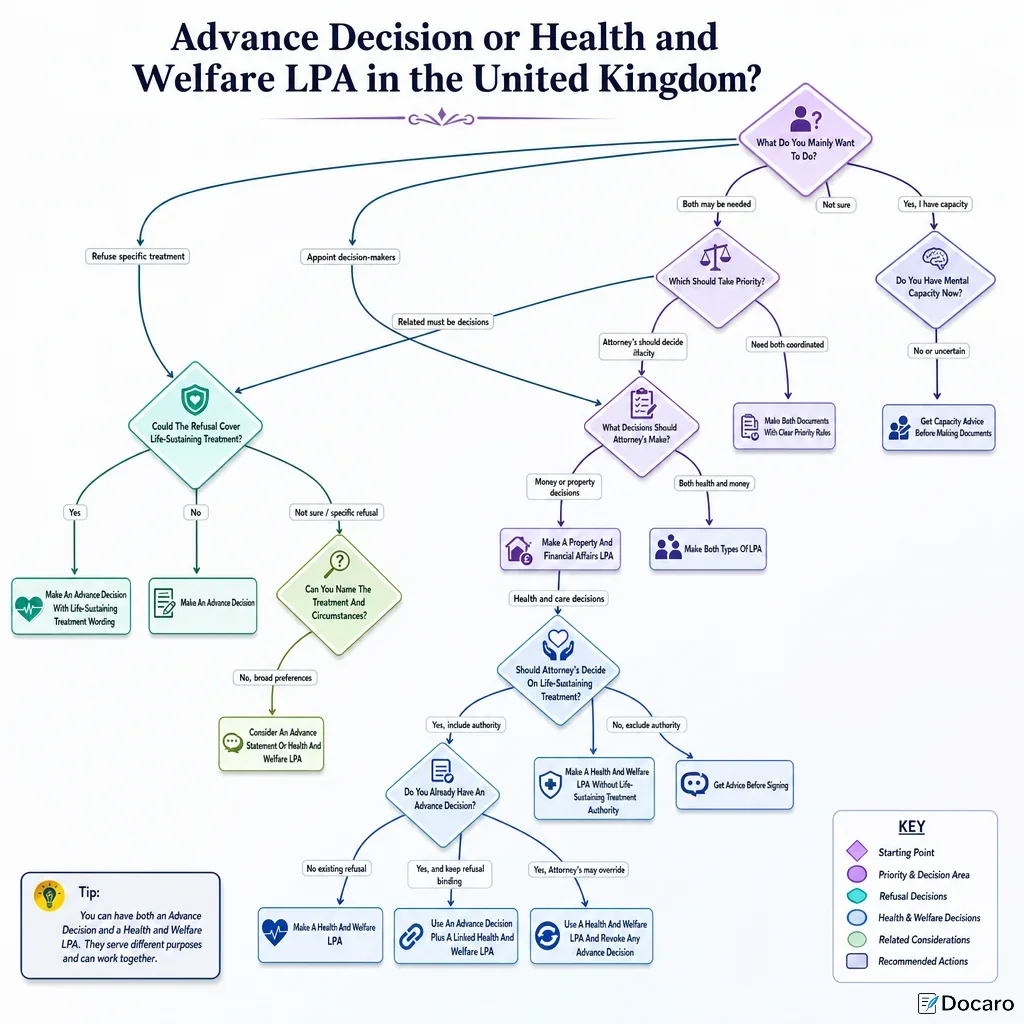
Compare Advance Decisions and Health and Welfare LPAs in the United Kingdom to choose the right future care planning option.
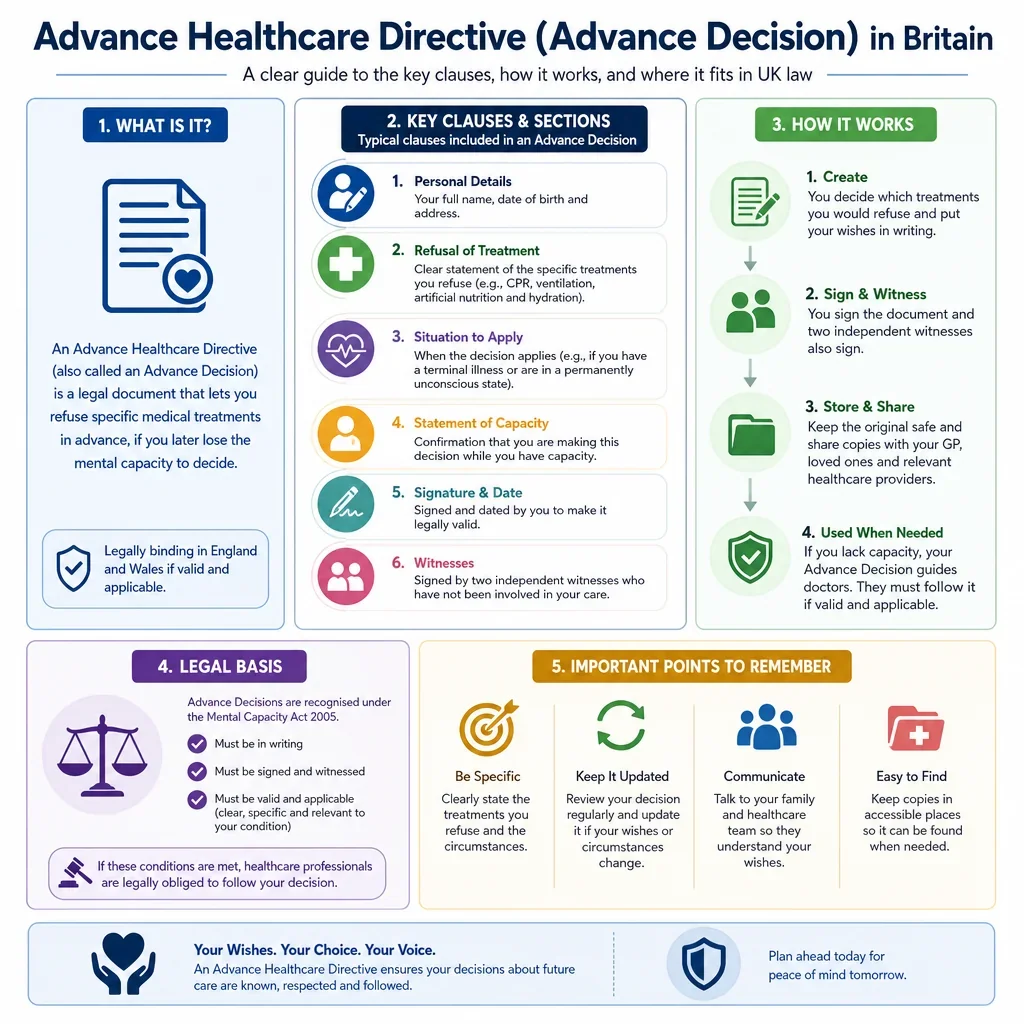
Explore advance healthcare directive clauses and sections in Britain, with structured insights to support informed care planning.
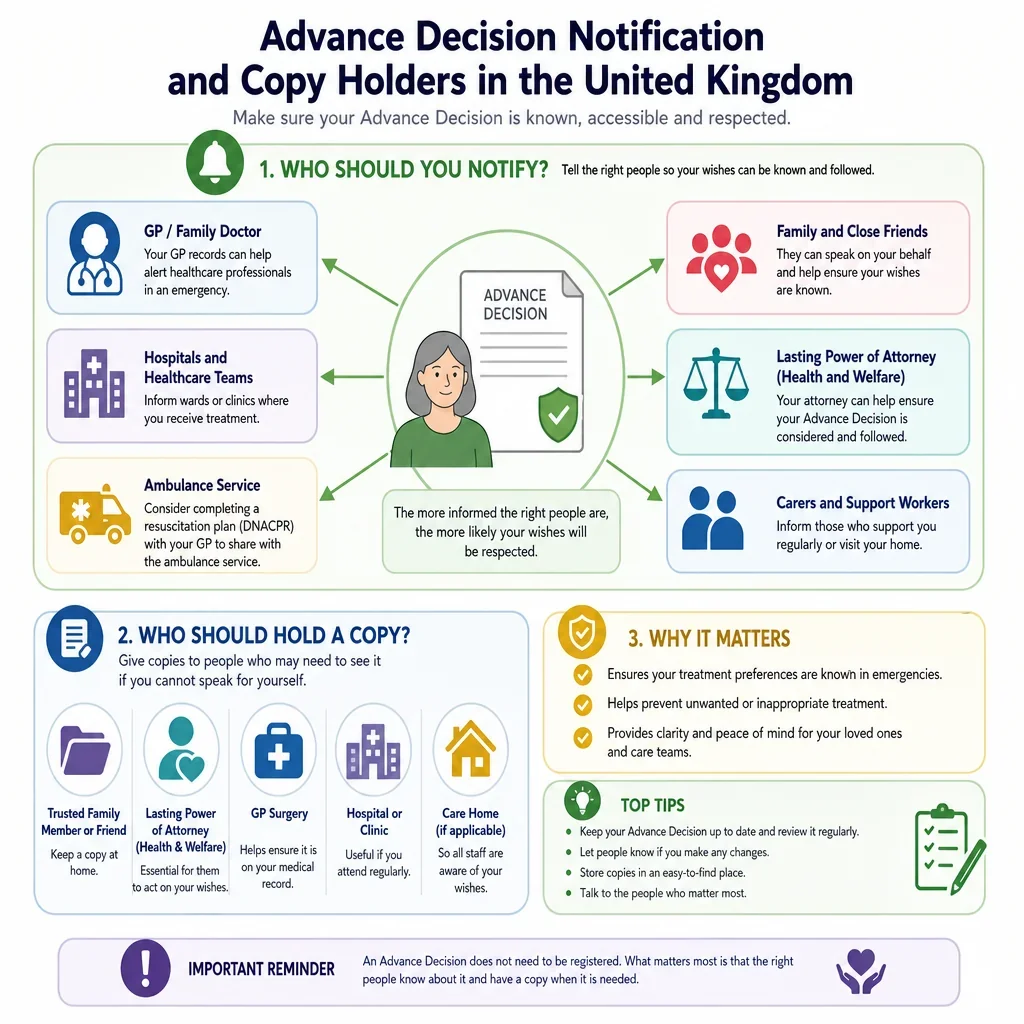
Learn about Advance Decision notification and copy holders in the United Kingdom, including who to inform and why copies matter.
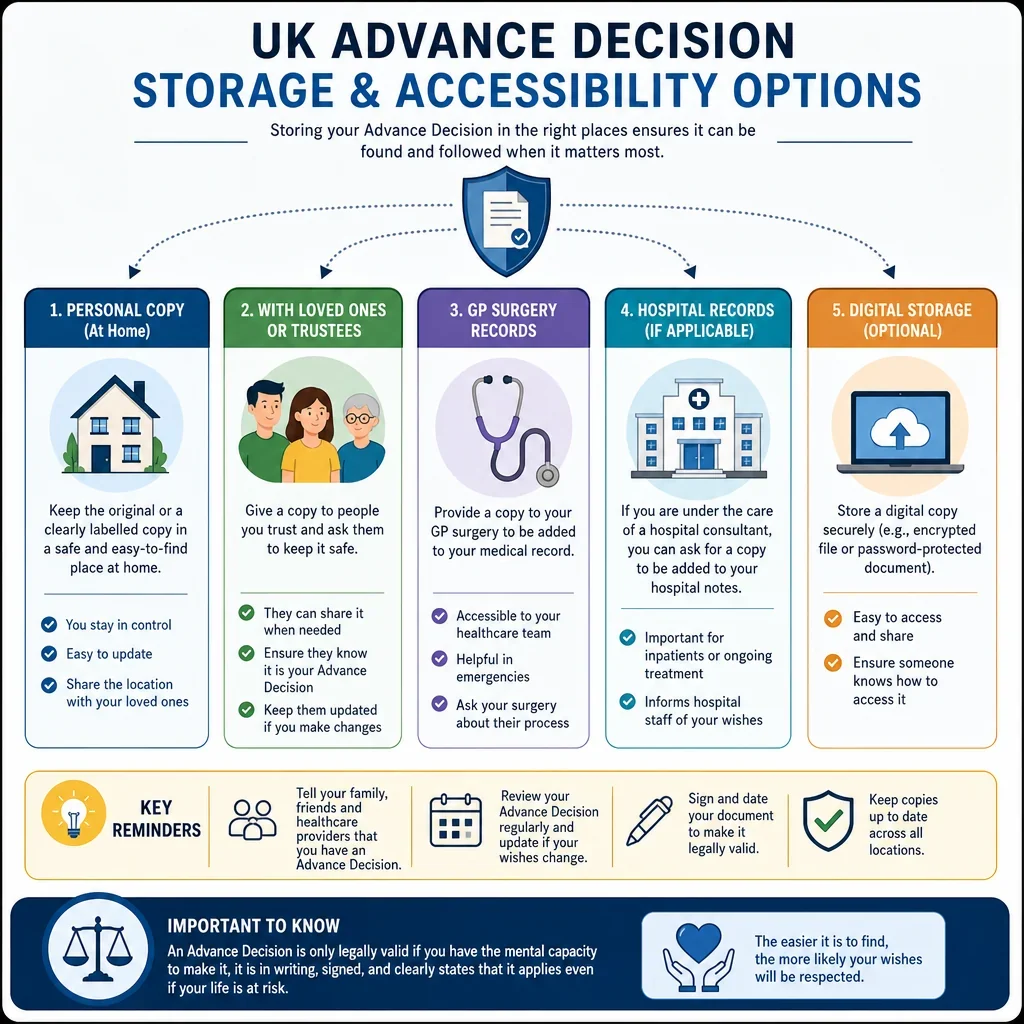
Learn UK advance decision storage and accessibility options so your healthcare wishes are easy to find when needed.
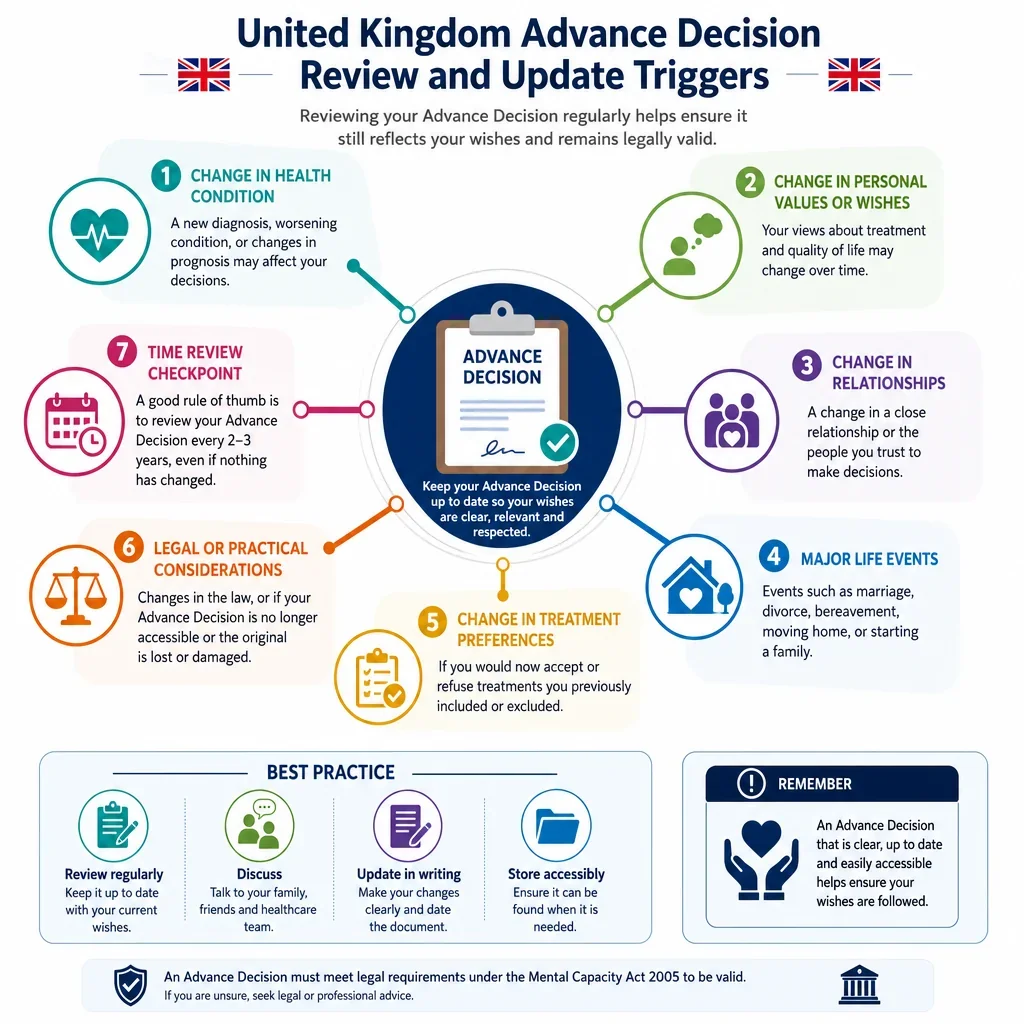
United Kingdom guide to key triggers for reviewing and updating an advance decision to keep healthcare wishes clear and current.
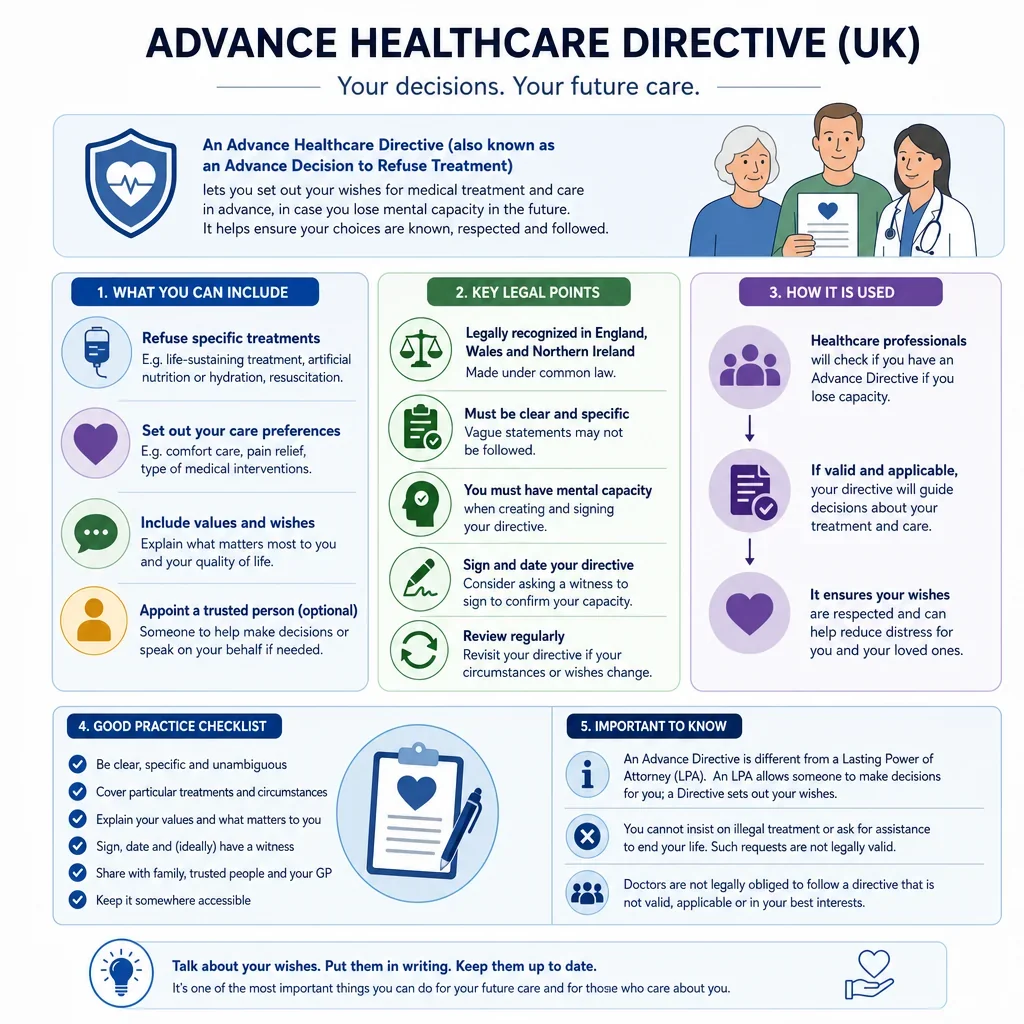
UK jurisdiction notes for advance healthcare directives, helping readers understand legal context and planning considerations.
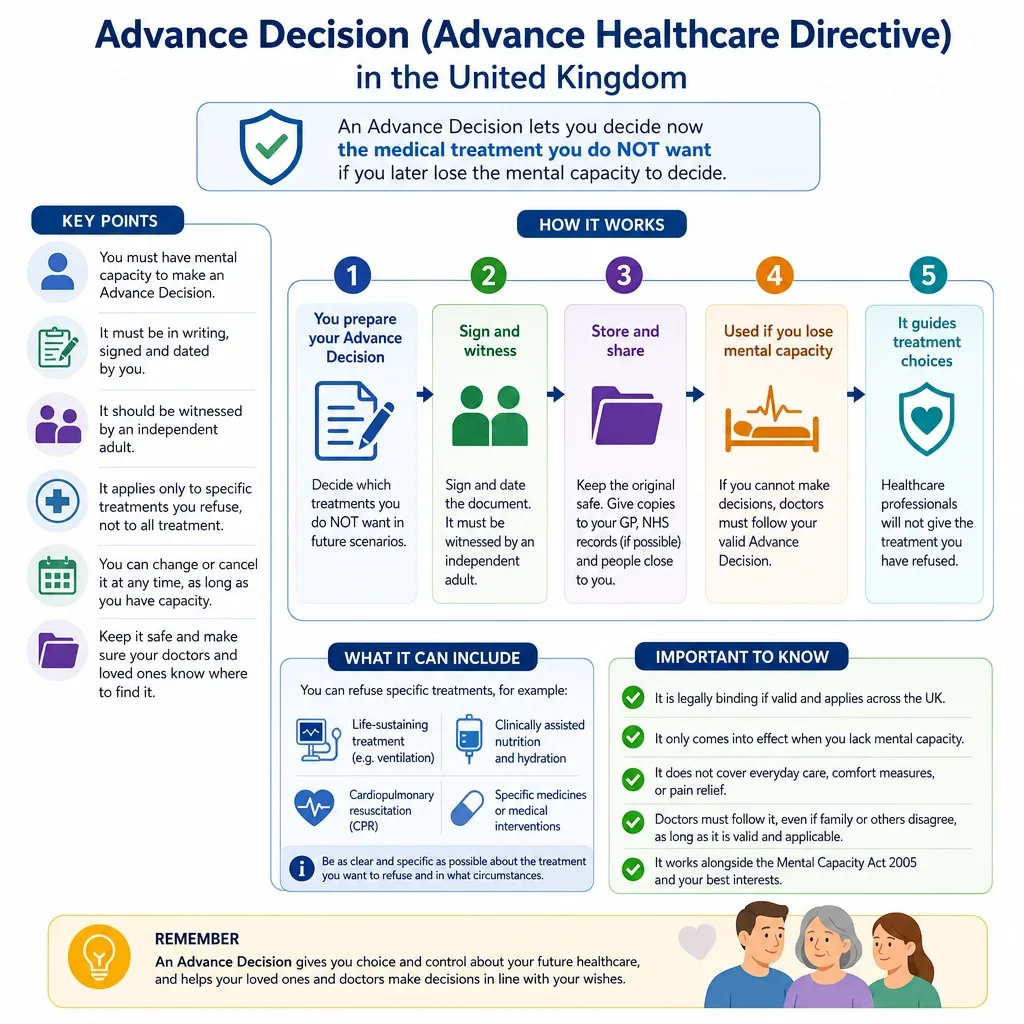
United Kingdom guide to practical Advance Decision questions, covering choices, legal points, and healthcare planning essentials.
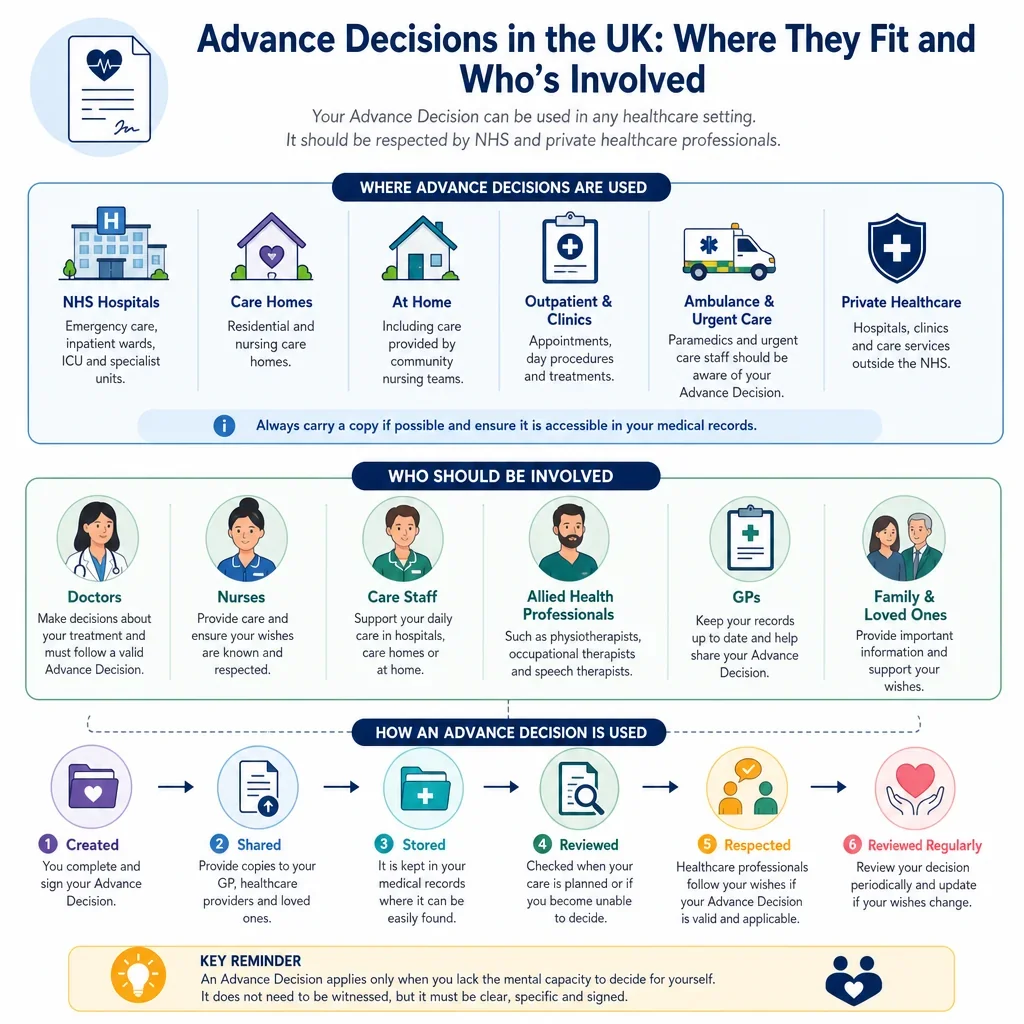
Explore UK healthcare settings and professional roles linked to Advance Decisions, with clear context for planning and care.