Reporting And Enforcement Provisions In The United Kingdom
Element name | Policy function | Key audience | Inclusion priority | Practical notes |
|---|---|---|---|---|
Reporting concern | ||||
Multiple Reporting Channels | Provides routes such as manager, HR, compliance, legal or hotline. | All personnel | Essential | Avoid a single reporting route, especially where the line manager may be involved. |
Whistleblowing Disclosure Route | Explains how workers can raise protected public interest concerns. | Employees | Essential | Link to any separate whistleblowing policy and prescribed person guidance. |
Protection from retaliation | ||||
Protected Disclosure Protection | Confirms protection for qualifying protected disclosures under UK law. | All personnel | Essential | Do not require employees to prove wrongdoing before raising a concern. |
Reporting concern | ||||
Anonymous Reporting | Allows concerns to be raised without giving a name. | Employees | Strongly recommended | Explain that anonymity may limit follow-up questions and evidence gathering. |
Confidentiality | ||||
Confidential Reporting | Limits disclosure of the reporter’s identity and report details. | All personnel | Essential | Avoid absolute confidentiality promises disclosure may be needed for fairness or law. |
Initial assessment | ||||
Immediate Risk Escalation | Escalates urgent safety, fraud, safeguarding or legal risks quickly. | Managers | Essential | Set emergency contacts and authority to preserve evidence or suspend access. |
Triage And Severity Assessment | Classifies reports by risk, seriousness, urgency and required handler. | Compliance or legal team | Essential | Use objective criteria to avoid inconsistent handling of similar concerns. |
Handler Conflict Check | Checks whether any recipient or investigator has a conflict. | Human resources | Strongly recommended | Reassign cases involving a manager, close colleague or implicated function. |
Acknowledgement Of Report | Confirms receipt and explains next steps where contact is possible. | Employees | Recommended | Do not promise outcomes before facts are reviewed. |
Investigation process | ||||
Appointment Of Investigator | Allocates a suitably independent and competent investigator. | Human resources | Essential | Use external investigators for senior, sensitive or high-risk allegations. |
Investigation Scope | Defines issues, evidence sources, witnesses and reporting lines. | Compliance or legal team | Essential | Keep scope flexible enough to include related misconduct found during review. |
Evidence Preservation | Preserves documents, messages, access logs and physical evidence. | Compliance or legal team | Essential | Suspend routine deletion where lawful and proportionate. |
Fair Witness Interviews | Explains how witnesses and subjects may be interviewed fairly. | Managers | Strongly recommended | Give accused employees a fair chance to respond before disciplinary decisions. |
Decision and outcome | ||||
Separation Of Roles | Separates investigator, decision-maker and appeal reviewer where possible. | Human resources | Strongly recommended | Especially important in disciplinary cases and senior management matters. |
Protection from retaliation | ||||
Interim Protective Measures | Allows temporary steps to protect people and evidence during review. | Managers | Strongly recommended | Measures should be neutral, proportionate and not punitive. |
No Retaliation Rule | Prohibits dismissal, detriment, harassment or victimisation for raising concerns. | All personnel | Essential | Treat retaliation allegations as separate misconduct requiring prompt review. |
Corrective action | ||||
Bad Faith Allegations | Explains consequences for knowingly false or malicious reports. | All personnel | Recommended | Distinguish malicious reports from honest concerns that are not upheld. |
Decision and outcome | ||||
Outcome Communication | Explains what outcome information may be shared and with whom. | Employees | Strongly recommended | Balance transparency with confidentiality, employment rights and data protection. |
Corrective action | ||||
Disciplinary Consequences | States that policy breaches may lead to disciplinary action. | Employees | Essential | Cross-refer to disciplinary procedure and apply sanctions consistently. |
Remedial Action Plan | Sets actions such as training, control changes or process improvements. | Managers | Strongly recommended | Assign owners, deadlines and follow-up checks. |
Decision and outcome | ||||
Senior Escalation | Escalates serious, systemic or executive-level concerns to leadership. | Senior leadership | Strongly recommended | Use board or committee oversight for senior implicated persons. |
Regulatory Notification Assessment | Assesses whether regulators, police or authorities must be notified. | Compliance or legal team | Strongly recommended | Seek legal input for fraud, bribery, sanctions, safety or regulated-sector issues. |
Reporting concern | ||||
Bribery Concern Escalation | Requires prompt escalation of suspected bribery or improper payments. | All personnel | Essential | Link with anti-bribery controls, gifts registers and third-party due diligence. |
Personal Data Incident Escalation | Requires swift reporting of suspected personal data breaches. | All personnel | Essential | Escalate immediately because ICO notification may be time-sensitive. |
Investigation process | ||||
Harassment And Discrimination Reports | Requires fair handling of discrimination, harassment and victimisation concerns. | Managers | Essential | Consider reasonable adjustments and protection from victimisation during handling. |
Reporting concern | ||||
Health And Safety Concern Escalation | Requires prompt reporting and response to workplace safety risks. | All personnel | Essential | Escalate imminent risks immediately to competent safety personnel. |
Modern Slavery Concern Reporting | Escalates concerns about forced labour or trafficking in operations or supply chains. | All personnel | Strongly recommended | Coordinate with procurement, HR and safeguarding contacts where relevant. |
Record keeping | ||||
Investigation File | Keeps reports, evidence, notes, decisions and corrective actions together. | Human resources | Essential | Use secure access controls and avoid unnecessary personal commentary. |
Data Protection Controls | Controls collection, sharing, retention and access to investigation data. | Compliance or legal team | Essential | Apply UK GDPR principles of purpose limitation, minimisation and security. |
Retention Schedule | Sets how long reports and investigation records are retained. | Human resources | Strongly recommended | Retention should reflect legal risk, limitation periods and data minimisation. |
Aggregated Reporting To Leadership | Reports trends, themes and serious matters to senior leadership. | Senior leadership | Recommended | Use anonymised or aggregated data where individual details are unnecessary. |
Decision and outcome | ||||
Outcome Review Or Appeal | Allows review of disciplinary or grievance-related outcomes where applicable. | Employees | Strongly recommended | Appeal reviewer should be impartial and not previously involved where possible. |
Reporting concern | ||||
External Reporting Guidance | Explains when concerns may be raised outside the organisation. | Employees | Recommended | Do not unlawfully restrict protected disclosures to prescribed persons. |
Third-Party Misconduct Reporting | Covers concerns involving suppliers, agents, contractors or customers. | All personnel | Strongly recommended | Link to procurement, contract remedies and third-party due diligence processes. |
Corrective action | ||||
Lessons Learned Review | Uses findings to improve controls, training and culture. | Senior leadership | Recommended | Focus on systemic causes, not only individual blame. |
What Reporting And Enforcement Clauses Should A UK Code Of Conduct Include?
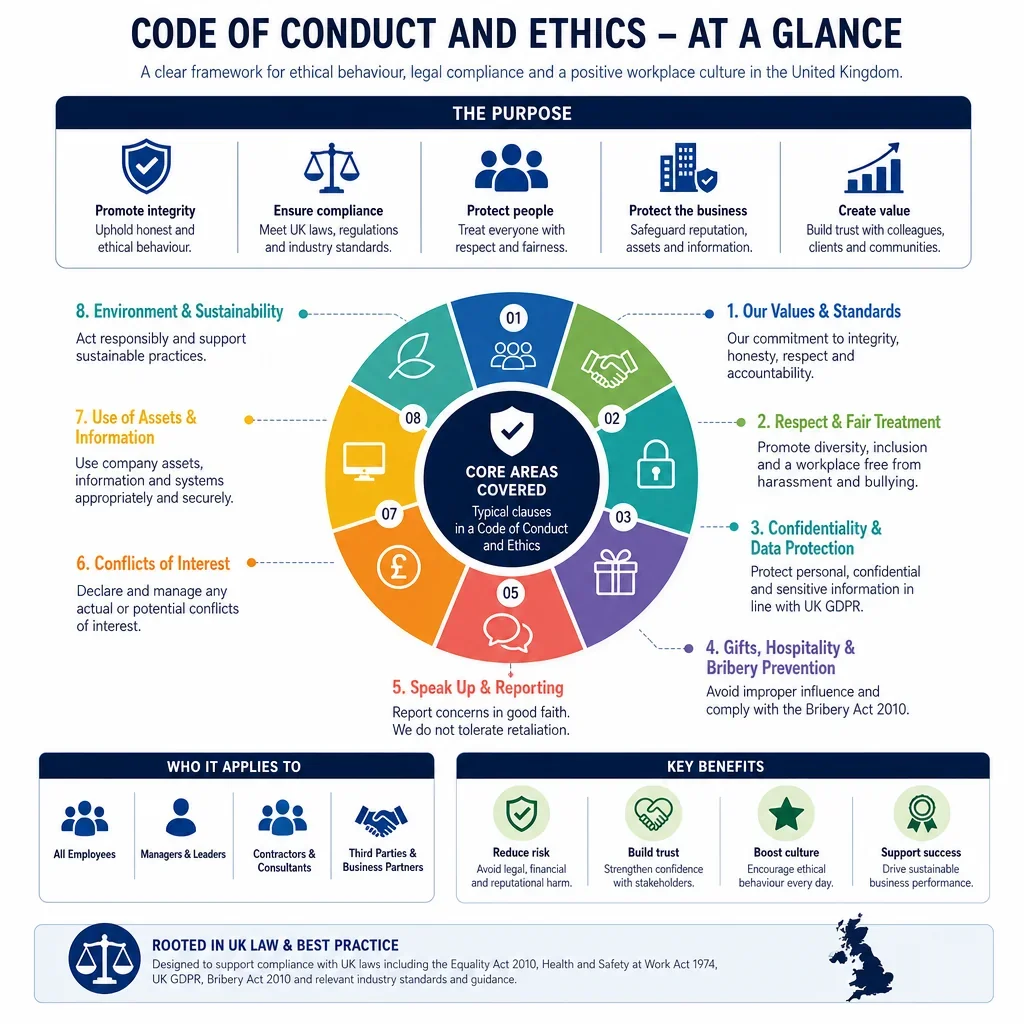
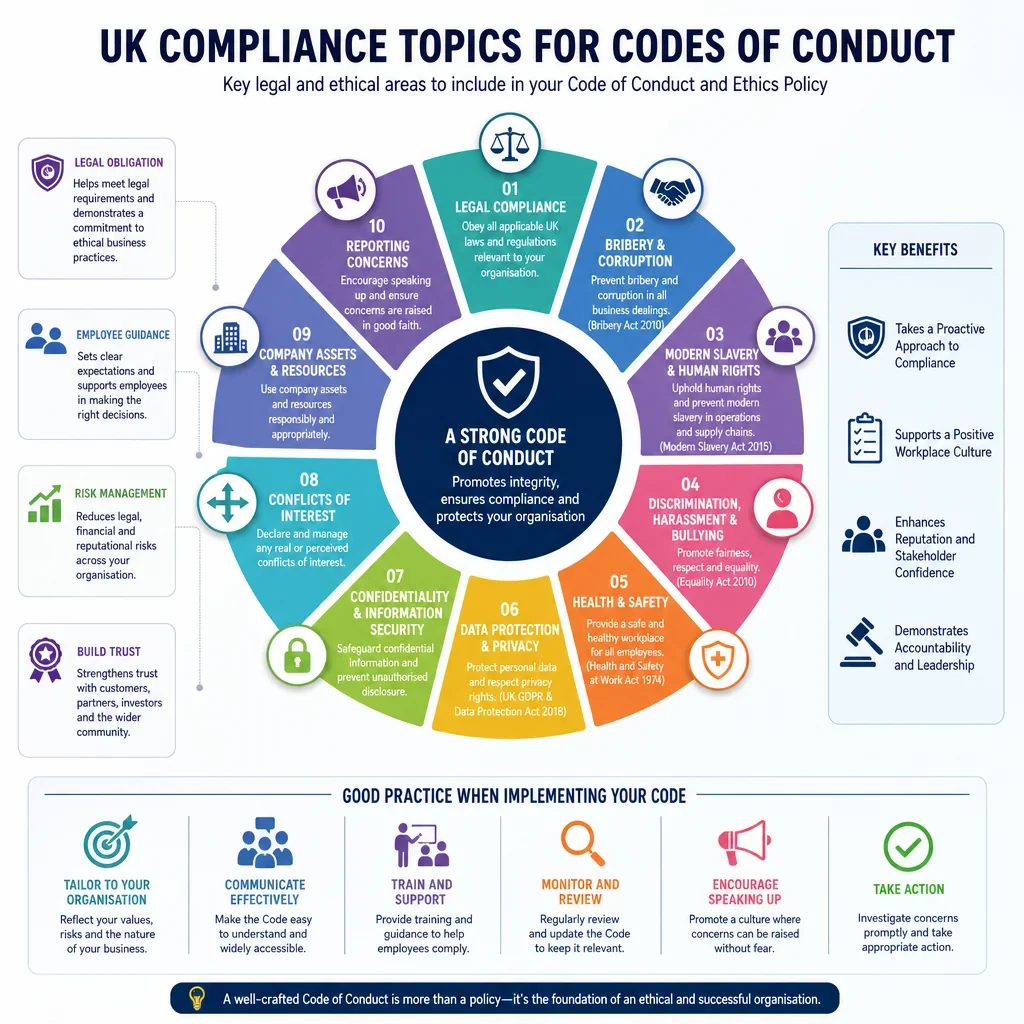
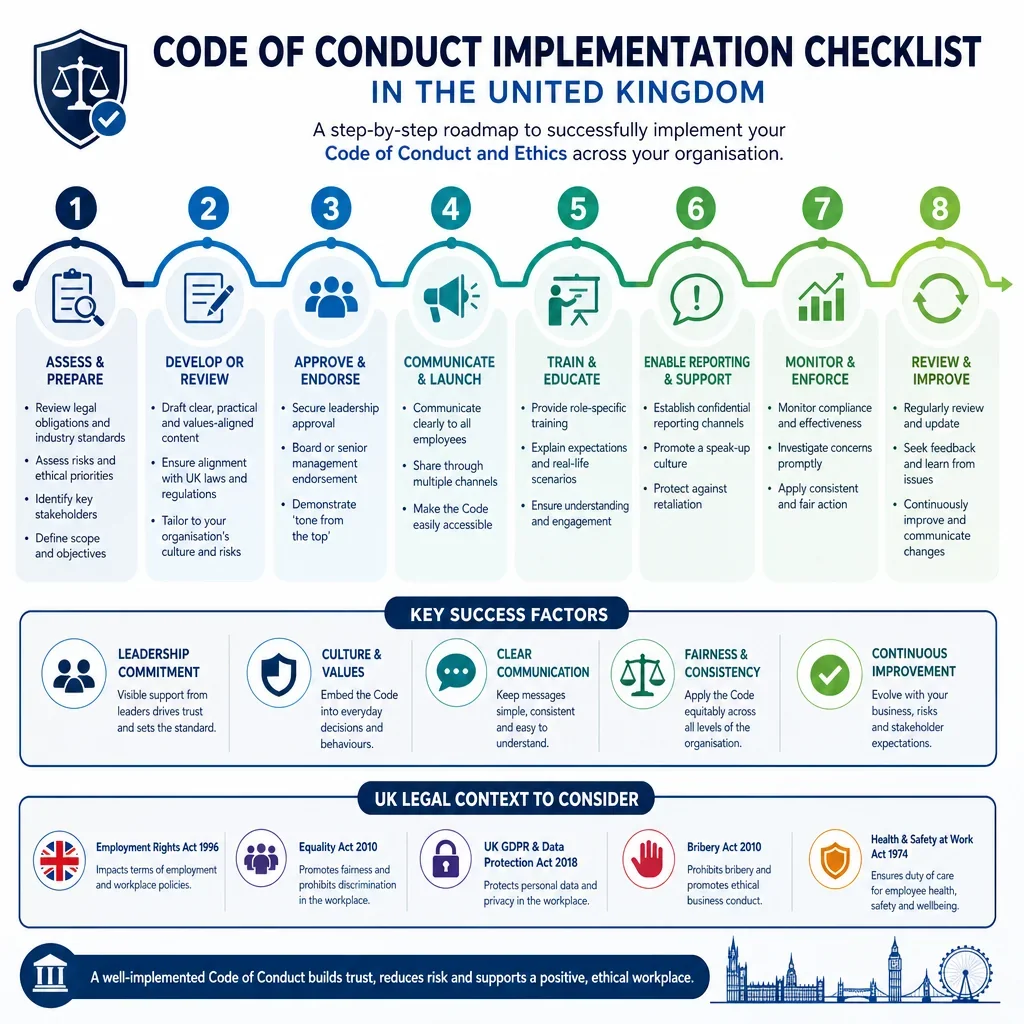
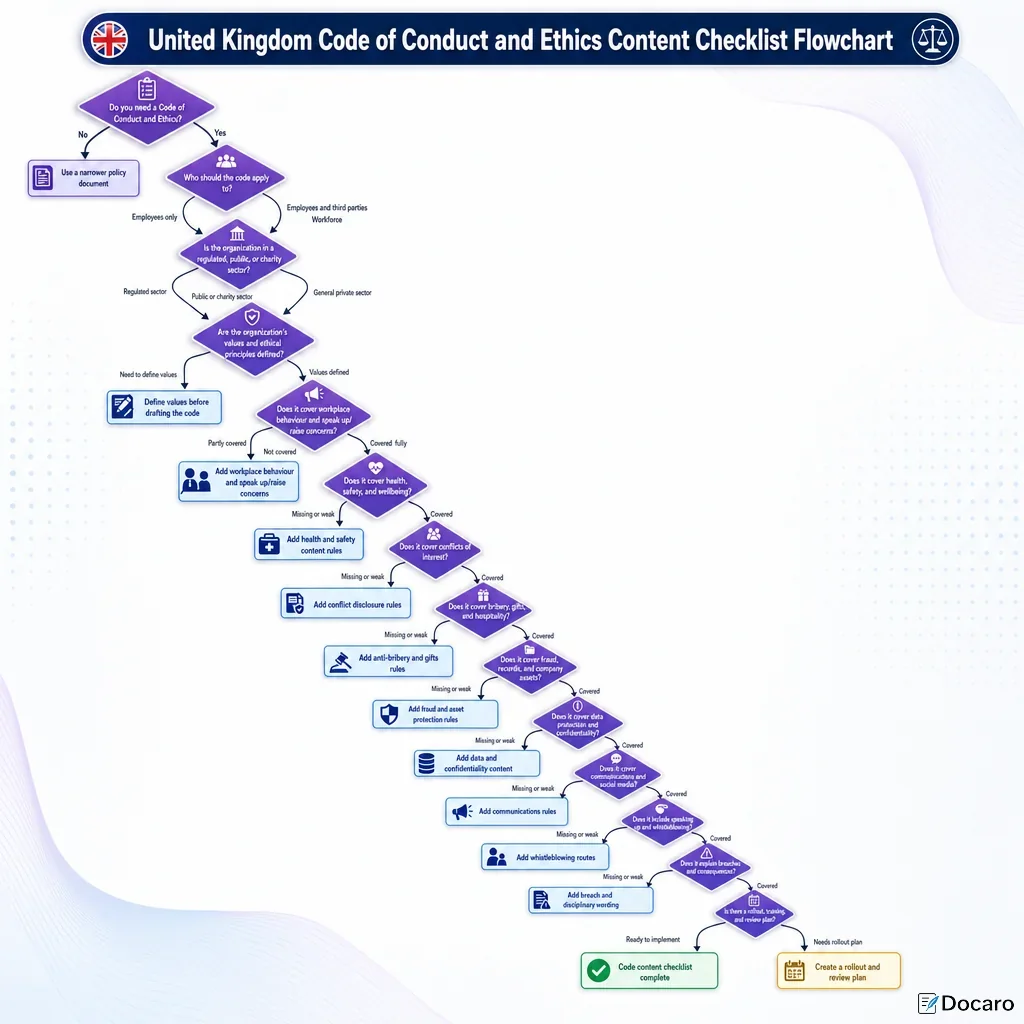
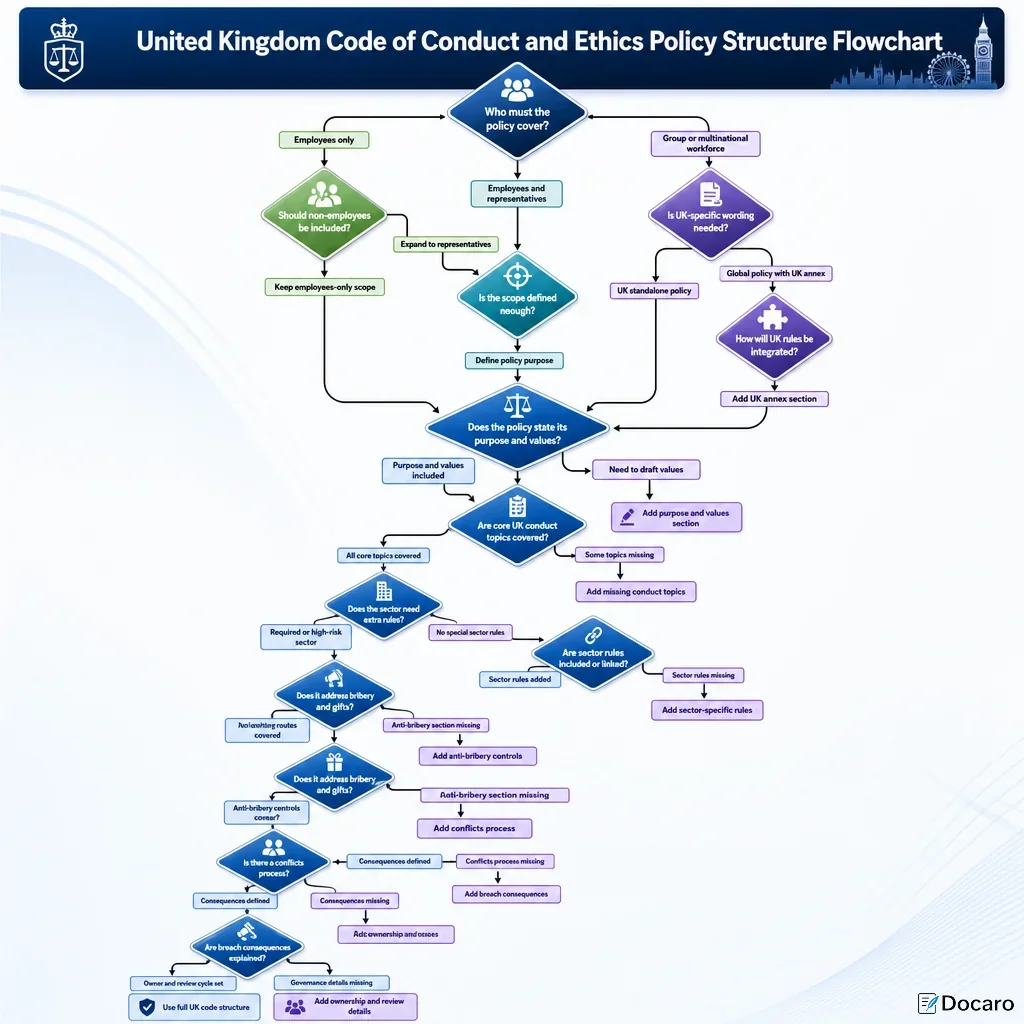
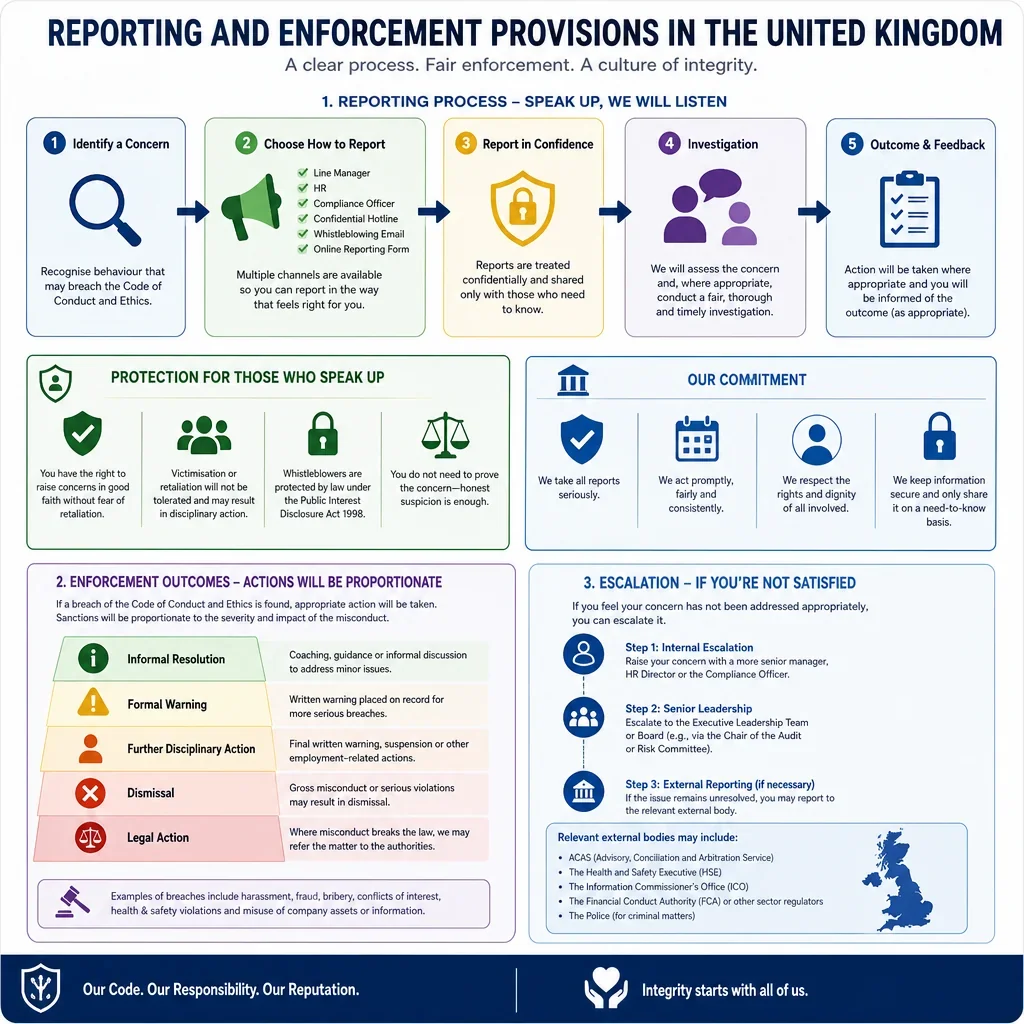
A credible UK Code of Conduct and Ethics should explain how concerns are reported, triaged, investigated, decided and recorded. The strongest provisions give employees more than one reporting route, include whistleblowing escalation where appropriate, and state that retaliation will not be tolerated.
How Should UK Employers Protect Whistleblowers?
Policies should reflect the Public Interest Disclosure Act 1998 framework by making clear that workers can raise protected disclosures about wrongdoing, including legal breaches, health and safety risks, environmental damage, cover-ups and similar matters. The policy should also make clear that victimisation for raising a protected concern may lead to disciplinary action.
Why Do Investigation Procedures Need Clear Roles And Records?
UK employers should separate reporting, investigation and decision-making roles where possible, keep investigation records proportionate, and apply outcomes consistently. This supports fairness under employment law and helps demonstrate reasonable and lawful handling if a grievance, disciplinary issue, whistleblowing complaint or regulatory concern later arises.
How Should Confidentiality And Data Protection Be Handled?
Confidentiality should be promised only so far as reasonably possible. Investigation records may contain personal data, so access, retention and sharing should be limited in line with UK GDPR and Data Protection Act 2018 requirements. Anonymous reports should be permitted where appropriate, but the policy should explain that anonymity may restrict the organisation’s ability to investigate fully.
What Makes Enforcement Proportionate?
Corrective action should match the seriousness of the breach and may include coaching, training, process changes, disciplinary action, supplier escalation, board reporting or regulatory notification. Policies should avoid automatic sanctions and instead require evidence-based decisions, documented reasons and consistent treatment across comparable cases.
FAQs
You Might Also Be Interested In