United Kingdom Memorandum and Articles of Association Glossary
Term | Plain-English Meaning | Practical Example | Related Context | Related Terms |
|---|---|---|---|---|
Incorporation document | ||||
Memorandum of association | The formation document in which the first subscribers agree to form the company. | Each founder signs the memorandum when registering a new private limited company. | Memorandum of association | Subscriber, incorporation, Companies House, articles of association |
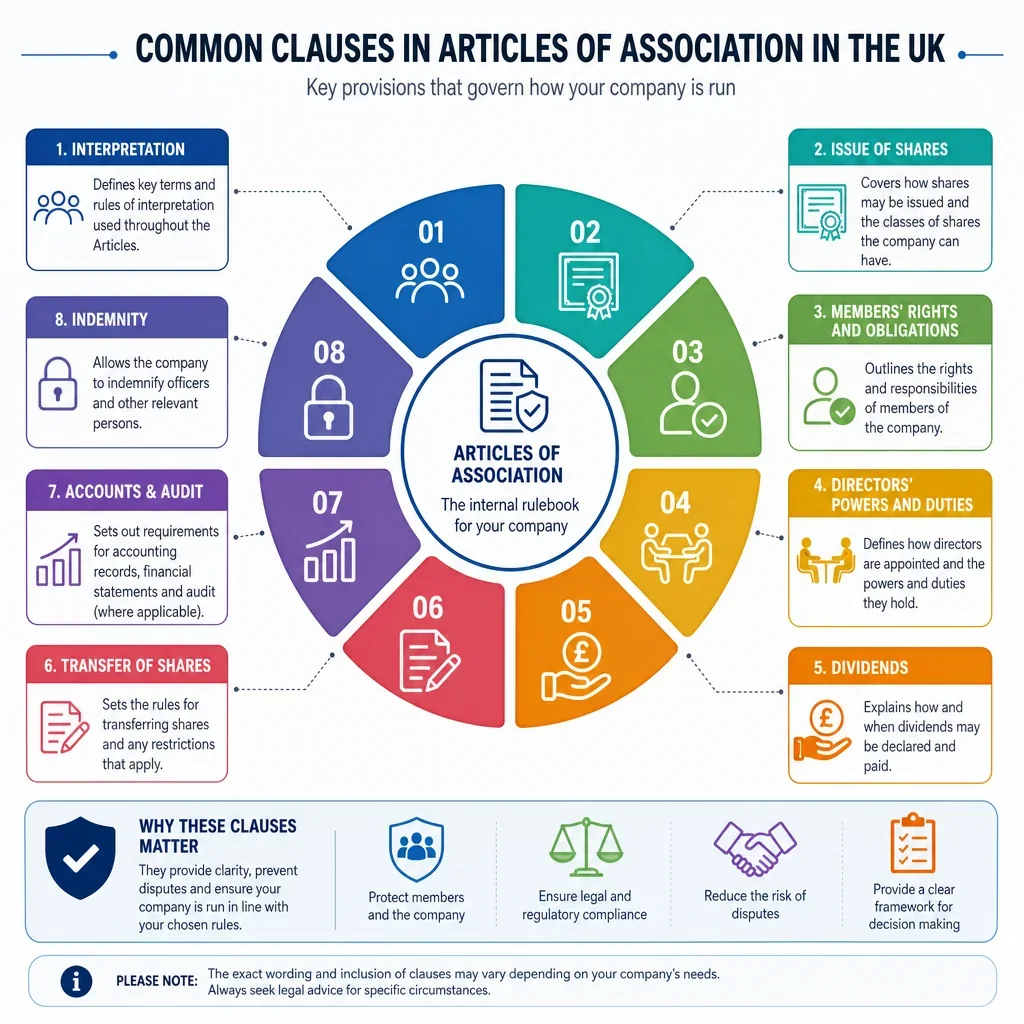
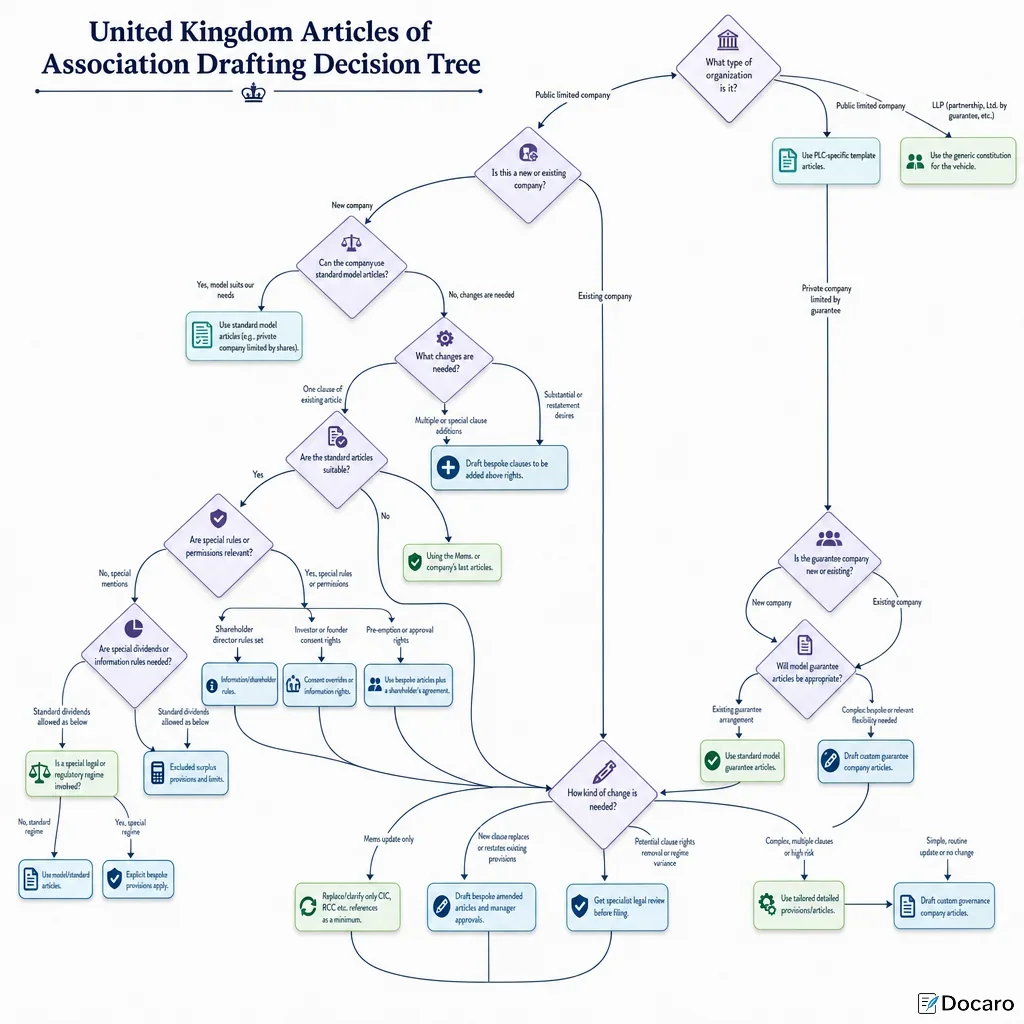
Articles of association | The company’s constitutional rules for governance, shares and decision-making. | The articles say how directors are appointed and how shares may be transferred. | Articles of association | Model articles, constitution, special resolution, members |
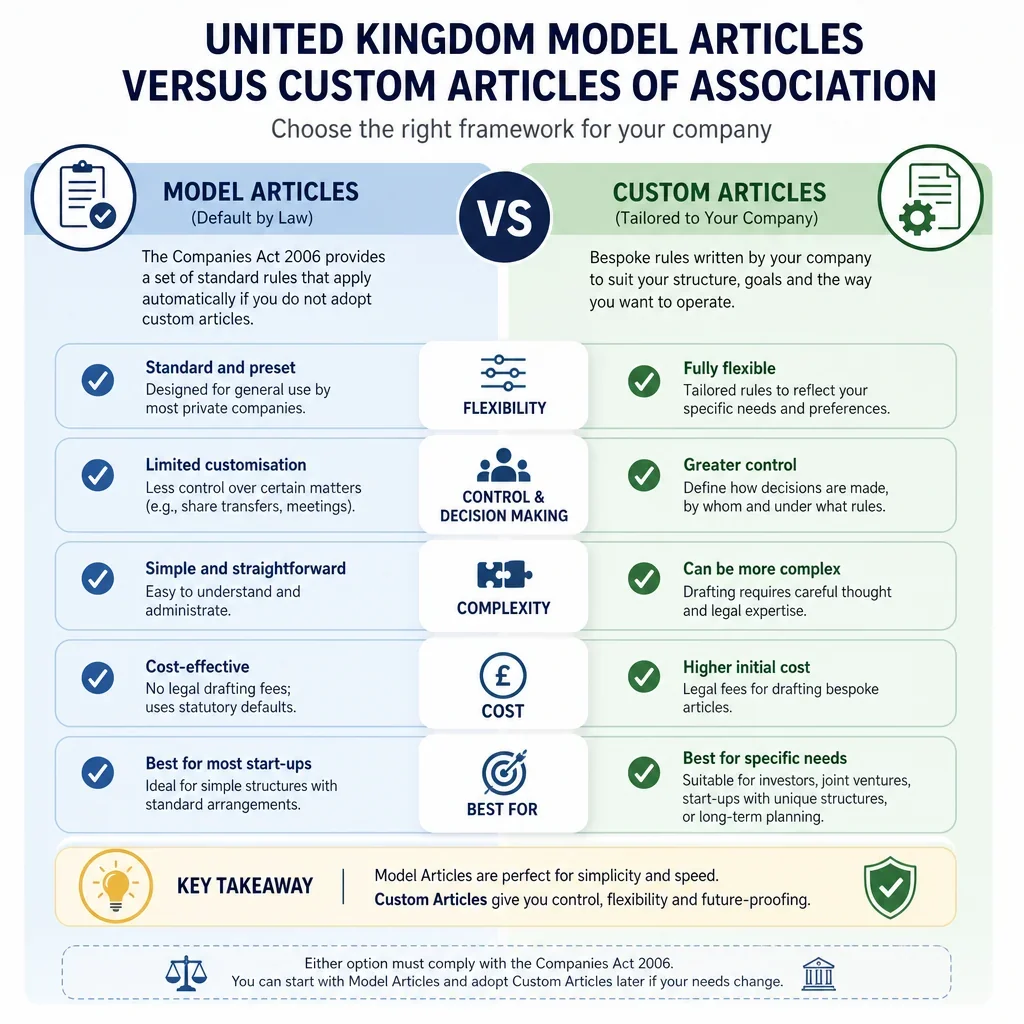
Model articles | Default articles prescribed by law for companies that do not adopt bespoke articles. | A startup adopts the model articles without amendments on incorporation. | Articles of association | Default articles, bespoke articles, Companies Act 2006 |
Bespoke articles | Custom articles drafted to suit a company’s particular ownership and governance arrangements. | Investor consent rights and share transfer controls are added before a funding round. | Articles of association | Model articles, reserved matters, class rights, shareholders’ agreement |
Company constitution | The company’s articles and certain resolutions or agreements affecting its constitution. | A special resolution changing share rights becomes part of the constitutional record. | Articles of association | Articles, resolutions, constitutional documents, Companies House filing |
Filing and procedure | ||||
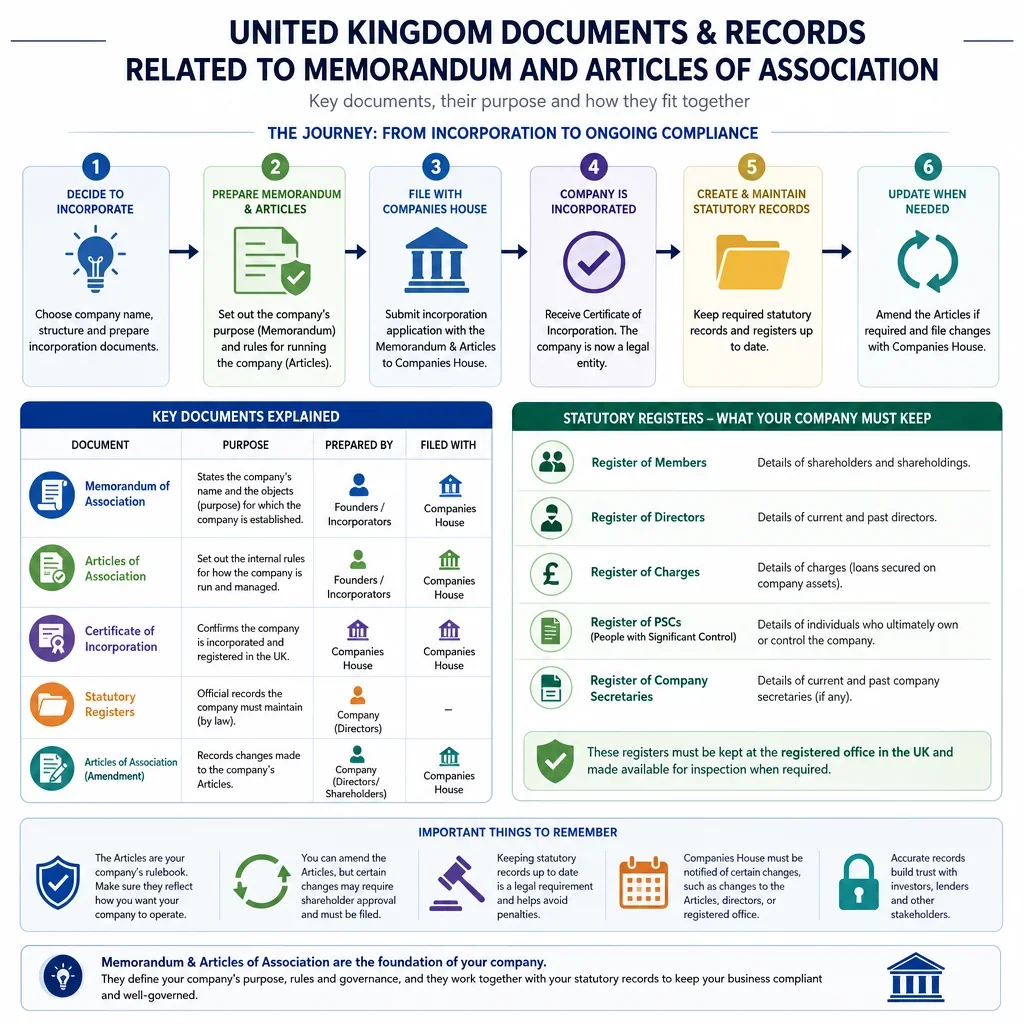
Certificate of incorporation | The Companies House certificate proving the company has been legally formed. | A bank asks for the certificate before opening a business account. | Companies House filing | Incorporation, company number, registrar, memorandum |
Member rights | ||||
Subscriber | A person who signs the memorandum and takes the first shares or guarantee membership. | Two founders are subscribers for one ordinary share each. | Memorandum of association | Founder, member, shareholder, statement of capital |
Member | A person entered in the company’s register of members. | A share buyer becomes a member when their name is entered in the register. | Shareholder decision | Shareholder, register of members, voting rights |
Shareholder | A member who owns shares in a company limited by shares. | An investor becomes a shareholder after receiving newly issued preference shares. | Shareholder decision | Member, share, dividend, voting rights |
Governance role | ||||
Director | A person responsible for managing the company and making board decisions. | The articles allow the board to appoint an additional director. | Board process | Board, statutory duties, appointment, removal |
Board of directors | The directors acting collectively as the company’s management body. | The board approves a new share issue at a board meeting. | Board process | Director, board meeting, quorum, board resolution |
Alternate director | A person appointed to act for a director when permitted by the articles. | An investor director appoints an alternate to attend a board meeting. | Board process | Director, board meeting, appointment, quorum |
Company secretary | An officer who usually manages company administration and filings. | The secretary files amended articles after a special resolution. | Companies House filing | Officer, Companies House, statutory registers, minutes |
Person with significant control | A person or entity with significant ownership or control over the company. | A founder owning more than 25% of shares is usually recorded as a PSC. | Company record | PSC register, voting rights, shareholding, control |
Share capital | ||||
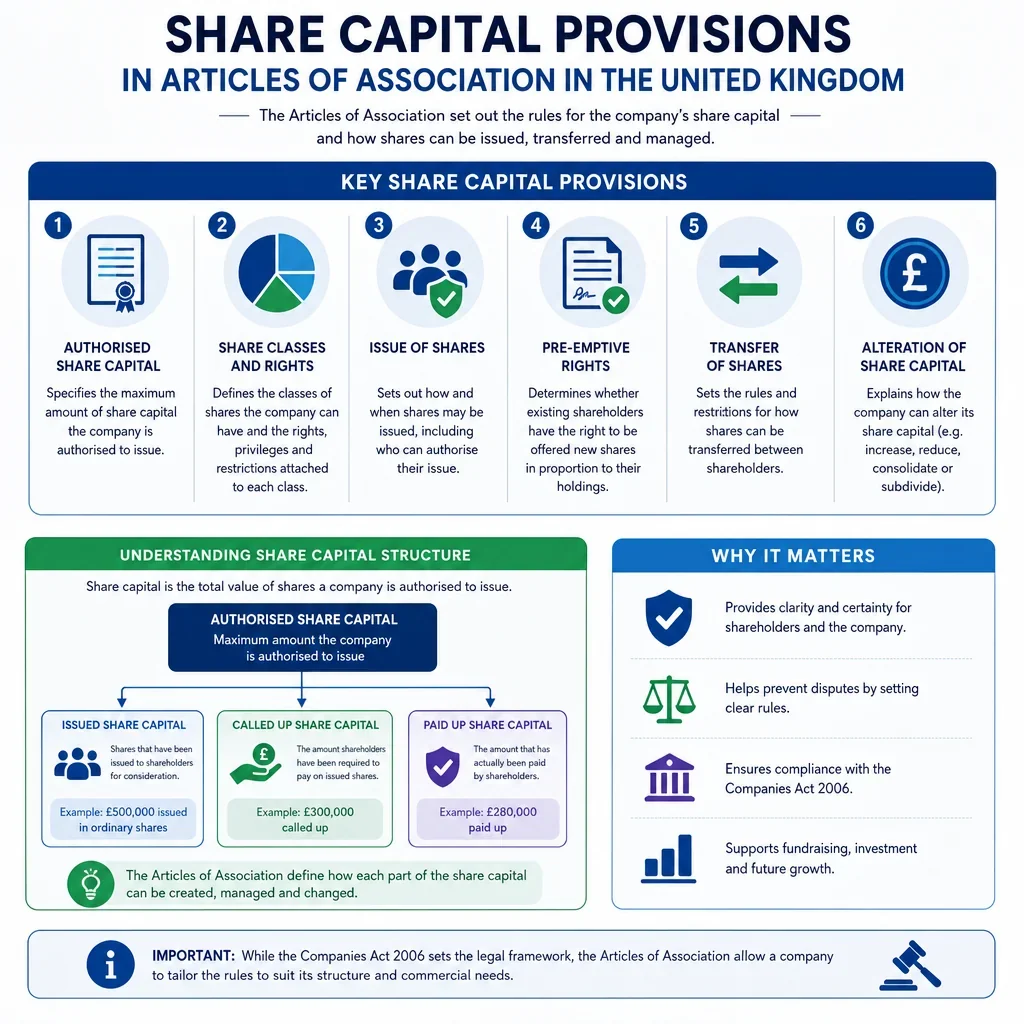
Ordinary share | A common share class usually carrying voting, dividend and capital rights. | Founders each hold ordinary shares with one vote per share. | Articles of association | Share class, voting rights, dividend, nominal value |
Preference share | A share giving priority rights, often to dividends or return of capital. | An investor receives preference shares with a preferred return on exit. | Articles of association | Class rights, dividend preference, liquidation preference, variation of rights |
Redeemable share | A share that the company can buy back or redeem under set terms. | Articles allow employee shares to be redeemed when employment ends. | Articles of association | Redemption, buyback, share capital, class rights |
Deferred share | A share with rights postponed behind other share classes. | Deferred shares receive no dividends until ordinary shares are paid first. | Articles of association | Share class, class rights, dividend rights, capital rights |
Share class | A group of shares with the same rights attached to them. | A company has A ordinary shares and B ordinary shares with different votes. | Articles of association | Class rights, ordinary shares, preference shares, voting rights |
Member rights | ||||
Class rights | Rights attached to a particular class of shares. | Preference shares carry priority dividend rights set out in the articles. | Articles of association | Share class, variation of rights, consent, special resolution |
Variation of class rights | A change to rights attached to a class of shares. | The company seeks class consent before reducing preference dividend rights. | Shareholder decision | Class rights, consent, special resolution, share class |
Share capital | ||||
Nominal value | The face value assigned to each share, such as £1 or £0.01. | A company issues 100 ordinary shares with a nominal value of £1 each. | Companies House filing | Share capital, paid-up, statement of capital, allotment |
Paid-up share | A share for which the holder has paid the amount due. | A founder pays £1 for a £1 ordinary share, making it fully paid. | Companies House filing | Unpaid share, nominal value, liability, share capital |
Unpaid share | A share where some or all of the amount due remains unpaid. | A shareholder still owes £0.50 on each partly paid £1 share. | Company record | Paid-up share, calls on shares, liability, forfeiture |
Authorised share capital | An old-style cap on share capital, generally abolished under the Companies Act 2006. | Older articles may still contain a share capital limit needing review. | Articles of association | Share capital, allotment authority, Companies Act 2006 |
Allotment of shares | The process of creating and issuing new shares to a person. | The board allots new shares to an investor after approval. | Board process | Share issue, authority to allot, pre-emption rights, SH01 |
Director powers | ||||
Authority to allot | Permission for directors to issue new shares. | Shareholders pass a resolution authorising directors to allot investment shares. | Shareholder decision | Allotment, directors’ powers, pre-emption rights, ordinary resolution |
Member rights | ||||
Pre-emption rights | Rights giving existing shareholders first refusal on certain new share issues. | Existing shareholders must be offered shares before a third-party investor subscribes. | Shareholder decision | Disapplication, allotment, dilution, statutory pre-emption |
Disapplication of pre-emption rights | A permitted waiver or exclusion of shareholders’ first-refusal rights on new shares. | Members approve disapplication so shares can be issued directly to an investor. | Shareholder decision | Pre-emption rights, special resolution, allotment, dilution |
Share capital | ||||
Share transfer | A transfer of existing shares from one holder to another. | A founder sells 10 ordinary shares to a co-founder. | Articles of association | Stock transfer form, board approval, transfer restrictions, register of members |
Member rights | ||||
Transfer restrictions | Rules limiting when or to whom shares may be transferred. | Articles require board approval before a shareholder can sell shares. | Articles of association | Share transfer, pre-emption on transfer, permitted transfer, board discretion |
Permitted transfer | A share transfer allowed without the usual restrictions. | Articles allow a shareholder to transfer shares to a family trust. | Articles of association | Transfer restrictions, family transfer, group transfer, pre-emption |
Drag-along rights | Rights allowing majority sellers to force minority shareholders to sell on an exit. | A buyer wants 100% ownership, so majority holders trigger drag-along rights. | Articles of association | Tag-along rights, exit, majority shareholder, minority shareholder |
Tag-along rights | Rights allowing minority shareholders to join a majority sale on the same terms. | Minority investors tag along when founders sell a controlling stake. | Articles of association | Drag-along rights, exit, transfer restrictions, minority protection |
Leaver provisions | Rules requiring an employee or founder to sell shares after leaving. | A founder who resigns must offer shares back to the company or other holders. | Articles of association | Good leaver, bad leaver, compulsory transfer, valuation |
Good leaver | A departing holder treated favourably under leaver rules. | A founder leaving due to illness is allowed fair value for shares. | Articles of association | Bad leaver, leaver provisions, compulsory transfer, fair value |
Bad leaver | A departing holder treated less favourably under leaver rules. | A dismissed founder must sell shares at a discounted price under the articles. | Articles of association | Good leaver, leaver provisions, compulsory transfer, valuation |
Dividend | A distribution of company profits to shareholders. | Directors recommend a final dividend for shareholder approval. | Shareholder decision | Distribution, distributable profits, final dividend, interim dividend |
Distribution | A transfer of value to members, usually a dividend, governed by statutory rules. | The board checks distributable profits before declaring an interim dividend. | Board process | Dividend, profits available for distribution, accounts, solvency |
Voting rights | Rights attached to shares or membership allowing votes on company decisions. | Each ordinary share carries one vote at a general meeting. | Shareholder decision | Ordinary resolution, special resolution, poll vote, show of hands |
Weighted voting rights | Voting rights giving some shares or holders more votes than others. | A founder’s A shares carry 10 votes per share. | Articles of association | Share class, voting rights, control, class rights |
Ordinary resolution | A shareholder resolution passed by a simple majority of votes. | Shareholders pass an ordinary resolution to authorise directors to allot shares. | Shareholder decision | Special resolution, written resolution, voting rights, members |
Special resolution | A shareholder resolution needing at least 75% of votes in favour. | Members pass a special resolution to amend the articles. | Shareholder decision | Ordinary resolution, articles amendment, filing, written resolution |
Written resolution | A shareholder decision made in writing without holding a general meeting. | Members sign a written special resolution adopting new articles. | Shareholder decision | Ordinary resolution, special resolution, members, circulation date |
General meeting | A meeting of members to discuss and vote on company matters. | The company holds a general meeting to approve new articles. | Shareholder decision | Notice, quorum, proxy, poll vote, minutes |
Annual general meeting | A yearly member meeting required for public companies, not usually private companies. | A private company’s articles may voluntarily require an AGM. | Shareholder decision | General meeting, notice, members, public company |
Filing and procedure | ||||
Notice of meeting | Formal advance notice of a shareholder meeting. | Members receive at least 14 clear days’ notice for a private company general meeting. | Shareholder decision | General meeting, short notice, agenda, resolution |
Short notice | Holding a meeting on less than the usual statutory notice with required consent. | Most voting members agree to hold an urgent general meeting tomorrow. | Shareholder decision | Notice, general meeting, consent, members |
Quorum | The minimum number of people needed for a valid meeting or decision. | The articles require two directors for a valid board meeting. | Board process | Board meeting, general meeting, chair, resolution |
Director powers | ||||
Director quorum | The minimum number of directors needed to make board decisions. | A sole director checks whether the articles permit one-director decisions. | Board process | Quorum, board meeting, sole director, model articles |
Board meeting | A meeting of directors to make company management decisions. | Directors meet to approve share allotments and bank mandates. | Board process | Board resolution, minutes, quorum, chair |
Board resolution | A formal decision made by the directors. | The board resolves to register a share transfer. | Board process | Board meeting, written board resolution, minutes, directors |
Governance role | ||||
Chair | The person who leads a meeting and may have procedural powers. | The articles give the chair a casting vote at board meetings. | Board process | Quorum, casting vote, board meeting, general meeting |
Director powers | ||||
Casting vote | An extra tie-break vote given to a meeting chair if the articles allow it. | Two directors split evenly, so the chair uses a casting vote. | Board process | Chair, deadlock, quorum, board resolution |
Conflict of interest | A situation where a director’s personal interests may conflict with company interests. | A director discloses an interest in a supplier contract before board approval. | Board process | Declaration of interest, director duties, authorisation, board approval |
Director duties | Statutory duties directors owe to the company, including promoting its success. | Directors consider creditors, employees and shareholders before a major decision. | Board process | Section 172, conflict of interest, reasonable care, fiduciary duty |
Reserved matters | Important decisions requiring specified shareholder, investor or director consent. | Articles require investor consent before issuing new shares or borrowing heavily. | Articles of association | Investor consent, veto rights, board approval, shareholder approval |
Member rights | ||||
Veto rights | Rights allowing a holder to block specified company decisions. | An investor can veto amendments to preference share rights. | Shareholder decision | Reserved matters, consent rights, class rights, investor protections |
Proxy | A person appointed by a member to attend and vote for them. | A shareholder appoints a proxy to vote at a general meeting while abroad. | Shareholder decision | General meeting, voting rights, poll vote, notice |
Show of hands | A vote counted by people present rather than by shares held. | At a meeting, each attending member raises a hand to vote. | Shareholder decision | Poll vote, proxy, voting rights, general meeting |
Poll vote | A vote counted according to voting rights, usually shares held. | A 60% shareholder demands a poll so votes reflect shareholdings. | Shareholder decision | Show of hands, voting rights, proxy, ordinary resolution |
Filing and procedure | ||||
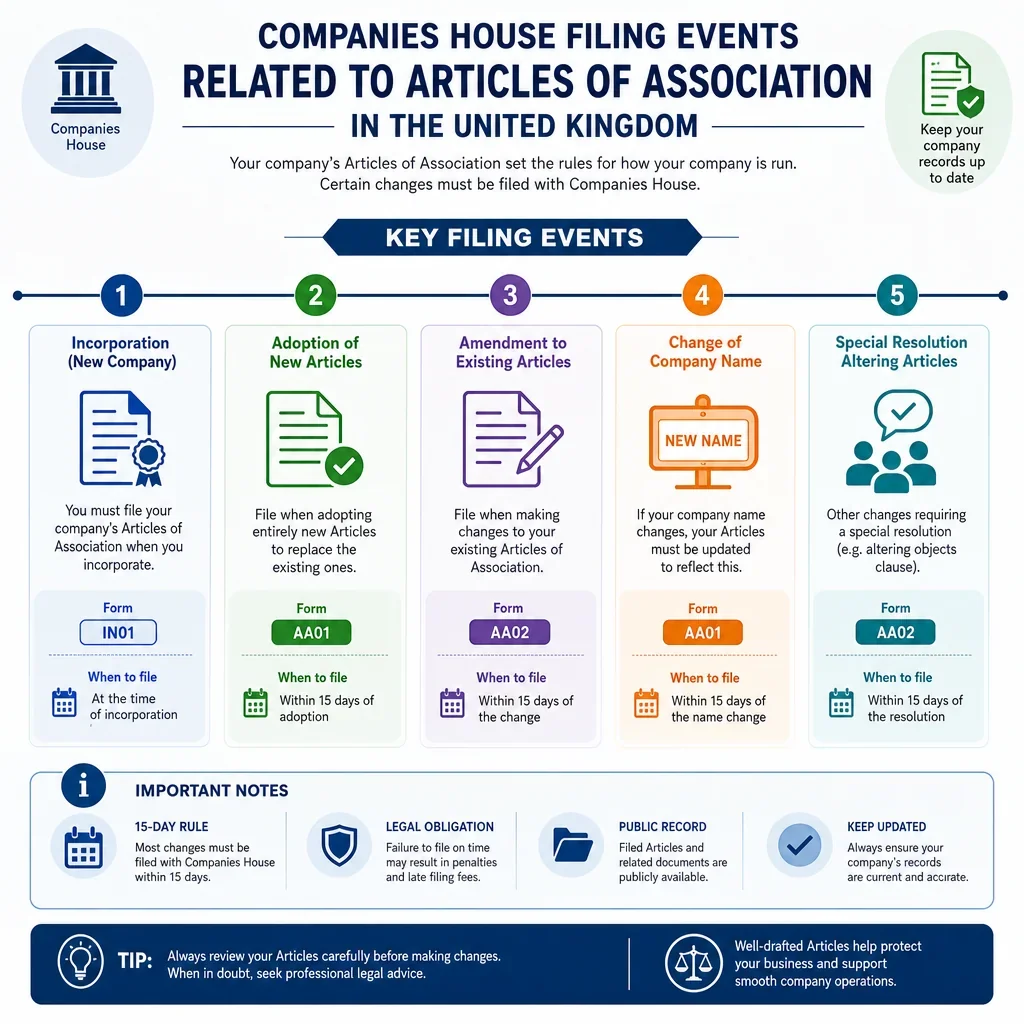
Amendment of articles | Changing the company’s articles, usually by special resolution. | Members approve new transfer restrictions by special resolution. | Companies House filing | Special resolution, filing, amended articles, constitution |
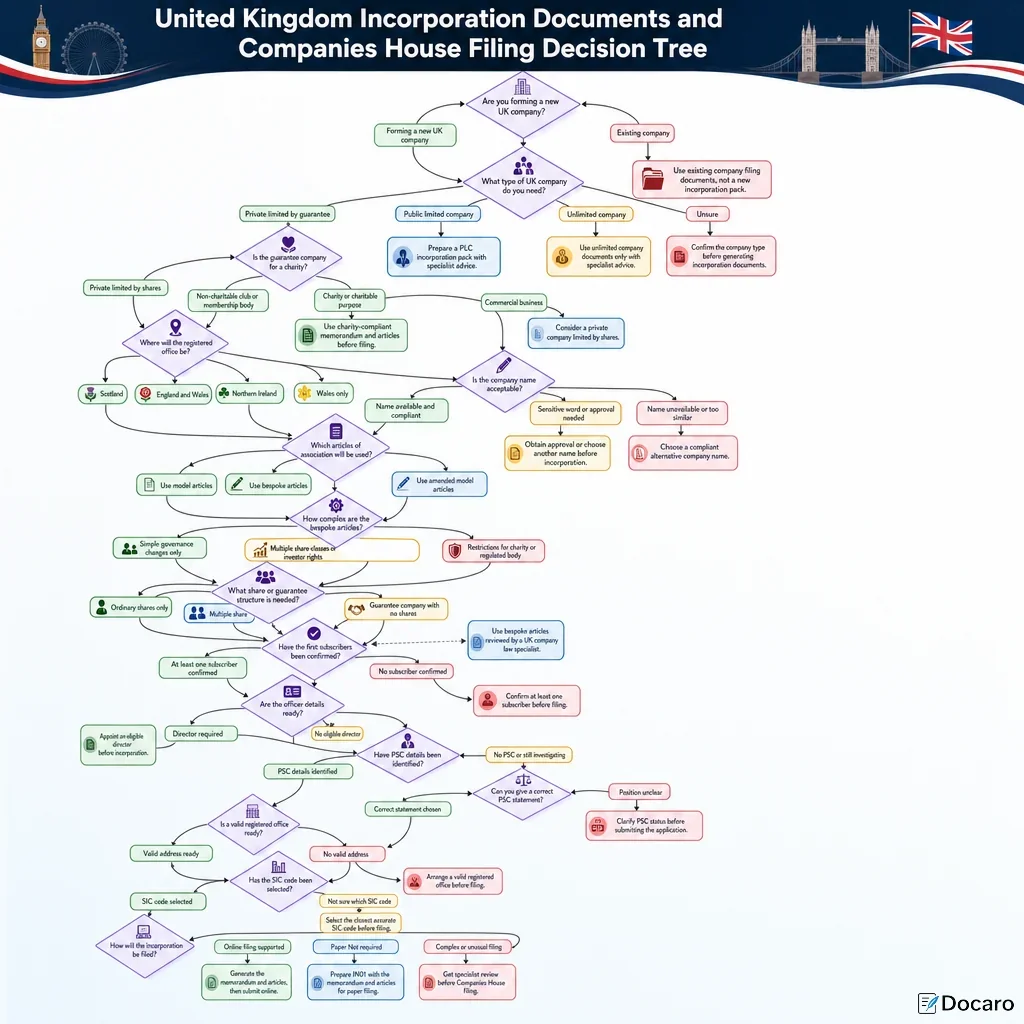
Companies House | The UK registrar where companies are incorporated and public filings are made. | The company files its incorporation application and articles at Companies House. | Companies House filing | Registrar, incorporation, confirmation statement, company number |
Registrar of companies | The official responsible for registering and maintaining company records. | The registrar issues the certificate of incorporation. | Companies House filing | Companies House, filing, company register, incorporation |
Form IN01 | The Companies House application form used to register a company. | Founders submit Form IN01 with the statement of capital and articles. | Companies House filing | Incorporation, memorandum, articles, statement of capital |
Share capital | ||||
Statement of capital | A filing showing the company’s issued shares and rights attached to them. | On incorporation, the company states it has 100 £1 ordinary shares. | Companies House filing | Share class, nominal value, paid-up, voting rights |
Incorporation document | ||||
Statement of guarantee | A formation statement showing each guarantor’s liability for a company limited by guarantee. | A charity company states each member guarantees £1 if it is wound up. | Companies House filing | Guarantor, company limited by guarantee, memorandum, member |
Company record | ||||
Registered office | The company’s official address for legal notices and Companies House records. | The articles and filings use the company’s registered office address in England. | Companies House filing | Sail address, registered email, jurisdiction, service address |
Registered email address | The official email address held by Companies House for company communications. | A new company provides a registered email address during incorporation. | Companies House filing | Registered office, Companies House, confirmation statement, company record |
Service address | An official contact address for directors, PSCs or secretaries. | A director uses the registered office as their public service address. | Companies House filing | Registered office, officer, PSC, Companies House record |
Filing and procedure | ||||
Jurisdiction of incorporation | The UK legal jurisdiction where the company is registered. | A company registers in England and Wales, Scotland, or Northern Ireland. | Companies House filing | Registered office, Companies House, company name, governing law |
Company name | The registered legal name of the company. | A private company limited by shares usually ends its name with Limited or Ltd. | Companies House filing | Name ending, sensitive words, incorporation, certificate of incorporation |
Incorporation document | ||||
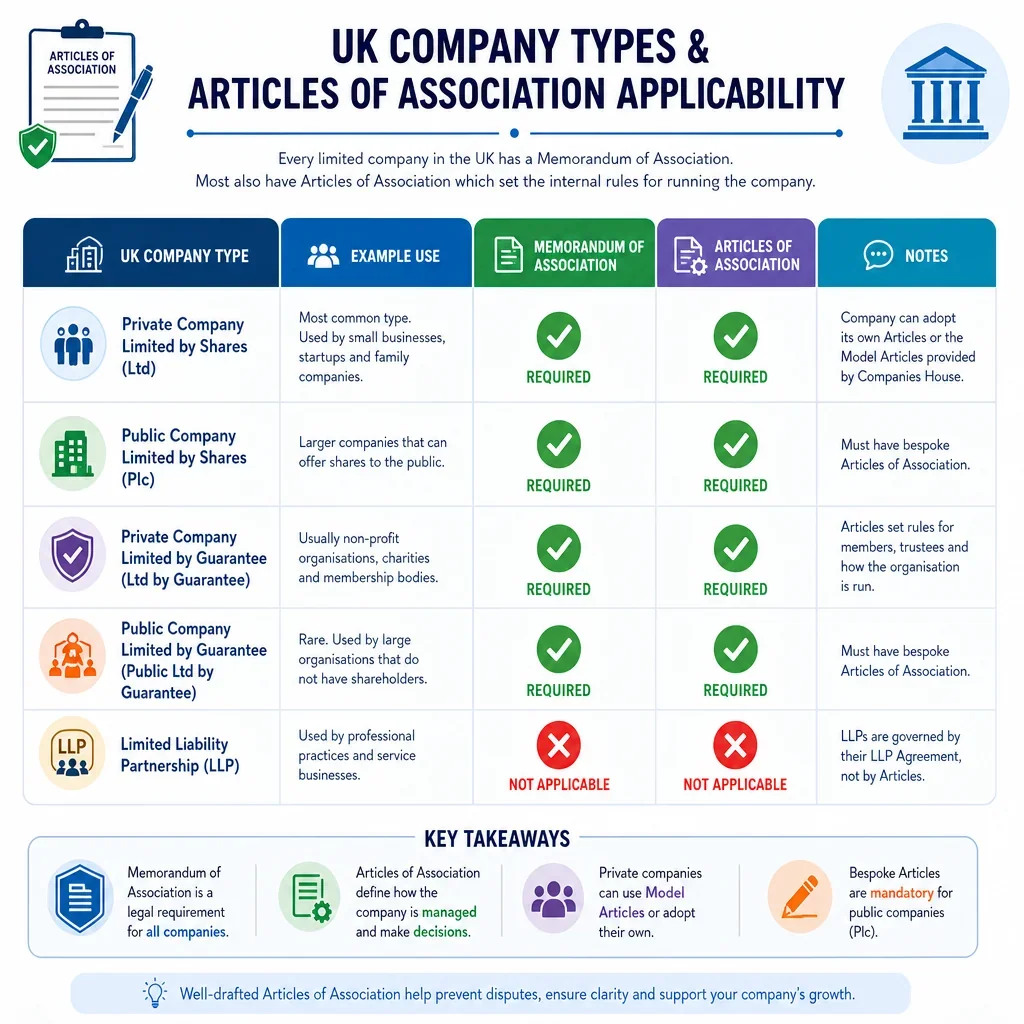
Private company limited by shares | A company owned by shareholders whose liability is limited to unpaid share amounts. | Most UK startups incorporate as private companies limited by shares. | Memorandum of association | Shareholder, share capital, articles, limited liability |
Company limited by guarantee | A company whose members guarantee a fixed amount instead of holding shares. | A sports club incorporates with members each guaranteeing £1. | Memorandum of association | Guarantor, statement of guarantee, member, articles |
Member rights | ||||
Guarantor | A member of a guarantee company who promises to contribute a fixed amount. | A guarantor agrees to contribute £1 if the company is wound up. | Memorandum of association | Company limited by guarantee, member, statement of guarantee |
Company record | ||||
Register of members | The statutory record of the company’s members and their shareholdings. | After a share transfer, the buyer is entered in the register of members. | Company record | Member, shareholder, share transfer, statutory registers |
Register of directors | The statutory record of the company’s directors. | A new director’s details are added to the register after appointment. | Company record | Director, AP01, officer, statutory registers |
PSC register | The statutory record of people with significant control over the company. | A company records a 30% shareholder in its PSC register. | Company record | PSC, control, voting rights, confirmation statement |
Statutory registers | Company records required by law, such as member and director registers. | The company updates its registers after appointing a director and issuing shares. | Company record | Register of members, register of directors, PSC register, minutes |
Minutes | Written records of meeting proceedings and decisions. | Board minutes record approval of a share allotment. | Board process | Board meeting, general meeting, resolutions, company records |
Filing and procedure | ||||
Resolution filing | Sending required resolutions or agreements to Companies House. | A special resolution amending articles is filed after members approve it. | Companies House filing | Special resolution, amended articles, Companies House, constitution |
Amended articles filing | Filing a copy of updated articles after an amendment takes effect. | The company files its amended articles within 15 days of amendment. | Companies House filing | Amendment of articles, special resolution, Companies House, constitution |
Confirmation statement | A regular Companies House filing confirming company information is up to date. | The company confirms its shareholders, SIC codes and PSC details each year. | Companies House filing | CS01, PSC register, statement of capital, registered office |
Company record | ||||
Share certificate | A document evidencing a person’s legal title to shares. | A founder receives a share certificate after incorporation. | Company record | Shareholder, register of members, share transfer, allotment |
Filing and procedure | ||||
Stock transfer form | The usual form used to transfer certificated shares. | A buyer signs a stock transfer form and pays stamp duty if required. | Company record | Share transfer, stamp duty, share certificate, register of members |
Share capital | ||||
Share buyback | A company purchase of its own shares under statutory rules. | The company buys back a departing founder’s shares after member approval. | Shareholder decision | Redemption, leaver provisions, distributable profits, capital reduction |
Capital reduction | A formal reduction of a company’s share capital under statutory procedures. | A solvent private company reduces capital using a solvency statement procedure. | Shareholder decision | Share capital, solvency statement, special resolution, Companies House filing |
Filing and procedure | ||||
Solvency statement | A directors’ statement that the company can pay its debts after a capital reduction. | Directors sign a solvency statement before reducing share capital. | Board process | Capital reduction, directors, special resolution, solvency |
Company record | ||||
Company seal | An optional official seal used to execute documents in the company’s name. | The articles state how the company seal may be used for deeds. | Articles of association | Execution, deed, board authority, company records |
Director powers | ||||
Indemnity | Protection for directors against certain liabilities, subject to statutory limits. | Articles allow indemnity for directors where permitted by law. | Articles of association | Directors’ liability, insurance, qualifying third-party indemnity, duties |
Directors’ insurance | Insurance the company may buy for directors against certain liabilities. | The board arranges D&O insurance for all directors. | Board process | Indemnity, director duties, liability, board approval |
Incorporation document | ||||
Objects clause | A clause limiting the company’s purposes or activities. | A charity company’s articles restrict activities to charitable purposes. | Articles of association | Unlimited objects, capacity, charitable objects, constitution |
Unlimited objects | The default position that a company’s objects are unrestricted unless articles say otherwise. | A trading company has no objects clause and may carry on any lawful business. | Articles of association | Objects clause, capacity, articles, Companies Act 2006 |
Entrenchment provision | A rule making certain articles harder to amend than by special resolution alone. | Articles require founder consent before changing founder share rights. | Articles of association | Special resolution, amendment of articles, protected provisions, consent |
Shareholders’ agreement | A private contract between shareholders governing rights and obligations. | Founders sign a shareholders’ agreement alongside bespoke articles. | Shareholder decision | Articles, reserved matters, transfer restrictions, confidentiality |
Articles Conflict | A mismatch between the articles and another document, often a shareholders’ agreement. | The agreement permits a transfer but the articles require board approval. | Articles of association | Shareholders’ agreement, constitution, transfer restrictions, priority clause |
Filing and procedure | ||||
Deed of adherence | A deed making a new shareholder party to an existing shareholders’ agreement. | A share buyer signs a deed of adherence before registration as a shareholder. | Shareholder decision | Shareholders’ agreement, share transfer, transfer restrictions, deed |
Director powers | ||||
Execution of documents | How a company validly signs contracts, deeds and other documents. | Two directors sign a deed for the company. | Board process | Company seal, deed, director signature, authority |
Filing and procedure | ||||
Electronic communications | Use of email, websites or electronic means for company notices and documents. | Articles permit notices to be sent to members by email. | Articles of association | Notice, registered email, member consent, Companies Act communications |
Incorporation document | ||||
Communications provisions | Article rules stating how notices and documents are sent to members and directors. | The articles allow notices by email and specify when they are deemed received. | Articles of association | Electronic communications, notice, deemed receipt, registered email |
Filing and procedure | ||||
Deemed receipt | The time when a notice is treated as received, even without proof of reading. | An email notice is deemed received 24 hours after being sent. | Articles of association | Notice, electronic communications, communications provisions, service |
Share capital | ||||
Transmission of shares | Shares passing by law on death, bankruptcy or similar events, not by sale. | A deceased shareholder’s personal representative becomes entitled to the shares. | Company record | Share transfer, personal representative, register of members, title |
Lien on shares | A company’s right to keep or sell shares to recover unpaid amounts owed. | Articles give the company a lien over partly paid shares for unpaid calls. | Articles of association | Calls on shares, unpaid shares, forfeiture, lien sale |
Calls on shares | A demand for shareholders to pay unpaid amounts on their shares. | The board calls the unpaid 50p per share from partly paid shareholders. | Board process | Unpaid share, lien on shares, forfeiture, paid-up share |
Forfeiture of shares | Loss of shares because required payments have not been made. | A shareholder fails to pay a call, so the board forfeits the shares under the articles. | Articles of association | Calls on shares, unpaid share, lien on shares, share capital |
Consolidation of shares | Combining shares into fewer shares with a higher nominal value. | Ten £0.10 shares are consolidated into one £1 share. | Shareholder decision | Subdivision, redenomination, share capital, ordinary resolution |
Subdivision of shares | Splitting shares into more shares with a lower nominal value. | One £1 share is subdivided into 100 £0.01 shares. | Shareholder decision | Consolidation, redenomination, share capital, ordinary resolution |
Redenomination of share capital | Changing the currency denomination of shares. | A company redenominates sterling shares into euro shares. | Shareholder decision | Share capital, nominal value, consolidation, subdivision |
Prescribed particulars | Details of share rights that must be stated in a statement of capital. | The filing states voting, dividend and capital rights for each share class. | Companies House filing | Statement of capital, share class, class rights, voting rights |
Filing and procedure | ||||
Incorporation application | The application submitted to the registrar to form a company. | The founders submit an incorporation application with required statements. | Companies House filing | Form IN01, memorandum, articles, statement of capital |
Statement of compliance | A statement confirming legal incorporation requirements have been met. | The incorporation application includes a statement of compliance. | Companies House filing | Incorporation application, registrar, Companies House, certificate of incorporation |
Lawful purpose statement | A statement that the company’s intended purposes are lawful. | Founders confirm the company is being formed for lawful purposes only. | Companies House filing | Incorporation application, statement of compliance, objects clause, Companies House |
Lawful use statement | A confirmation that company activities will be lawful, introduced by recent company law reforms. | A company confirms lawful use when filing its confirmation statement. | Companies House filing | Confirmation statement, lawful purpose statement, Companies House reform, ECCTA |
Economic Crime and Corporate Transparency Act 2023 | UK legislation reforming Companies House powers and company transparency rules. | Companies House requires registered email and lawful use confirmations under reforms. | Companies House filing | Registered email, lawful use statement, identity verification, Companies House |
What Should UK Founders Know Before Using Articles Of Association?
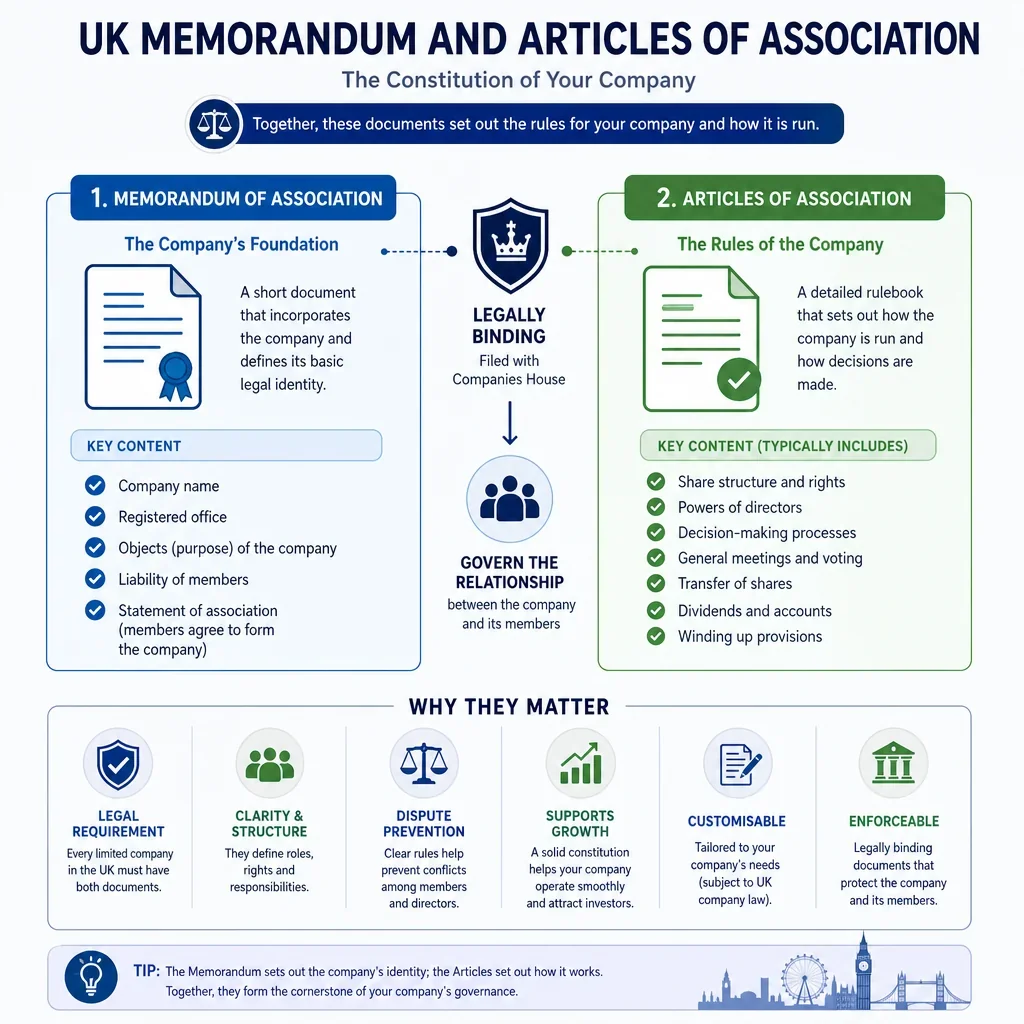
The memorandum and articles serve different purposes. The memorandum is a short formation document signed by the first subscribers, while the articles are the company’s continuing constitutional rules. For most private companies limited by shares, the articles will matter far more in day-to-day governance.
Can You Rely On The Model Articles?
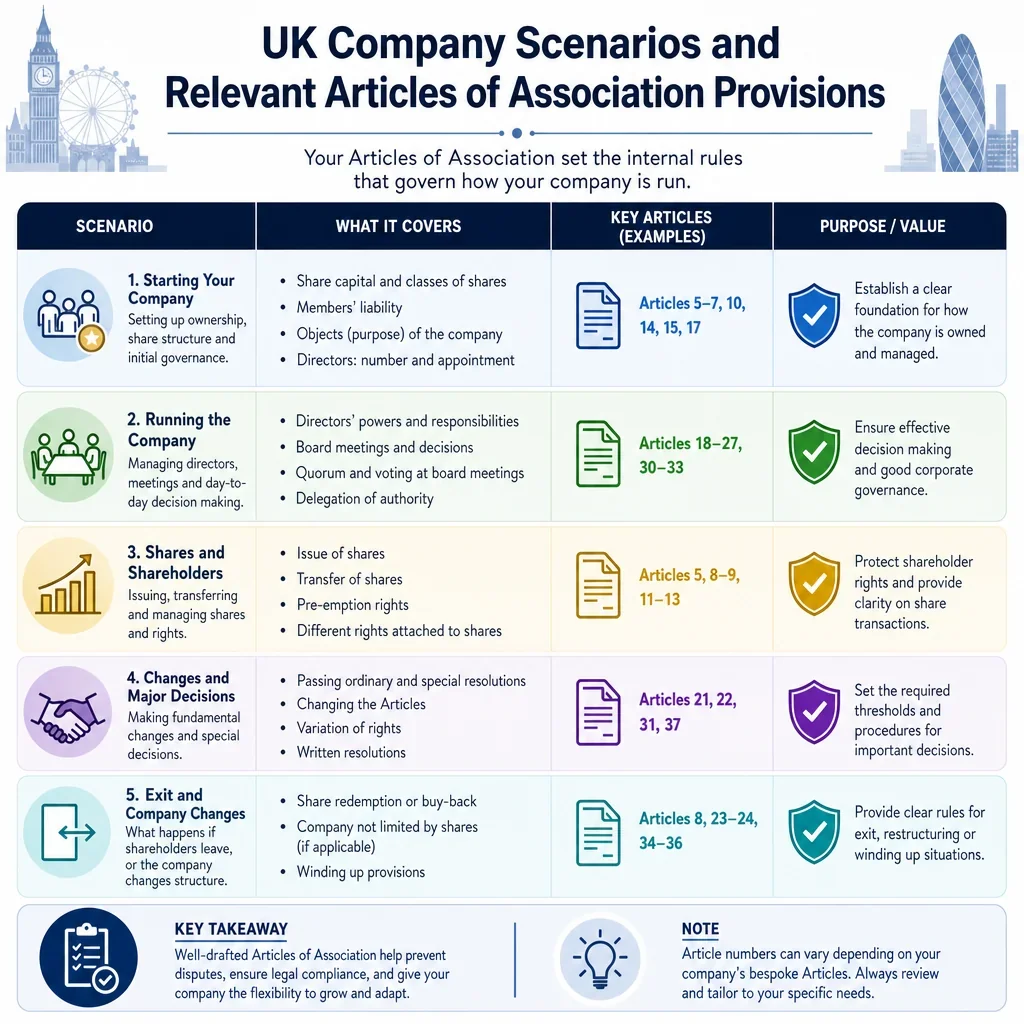
The model articles are the default statutory template, but they may not cover every commercial need. Founders should consider bespoke provisions on share transfers, pre-emption rights, director quorum, reserved matters, and drag-along or tag-along rights before filing or adopting articles.
Which Clauses Most Affect Control Of A UK Company?
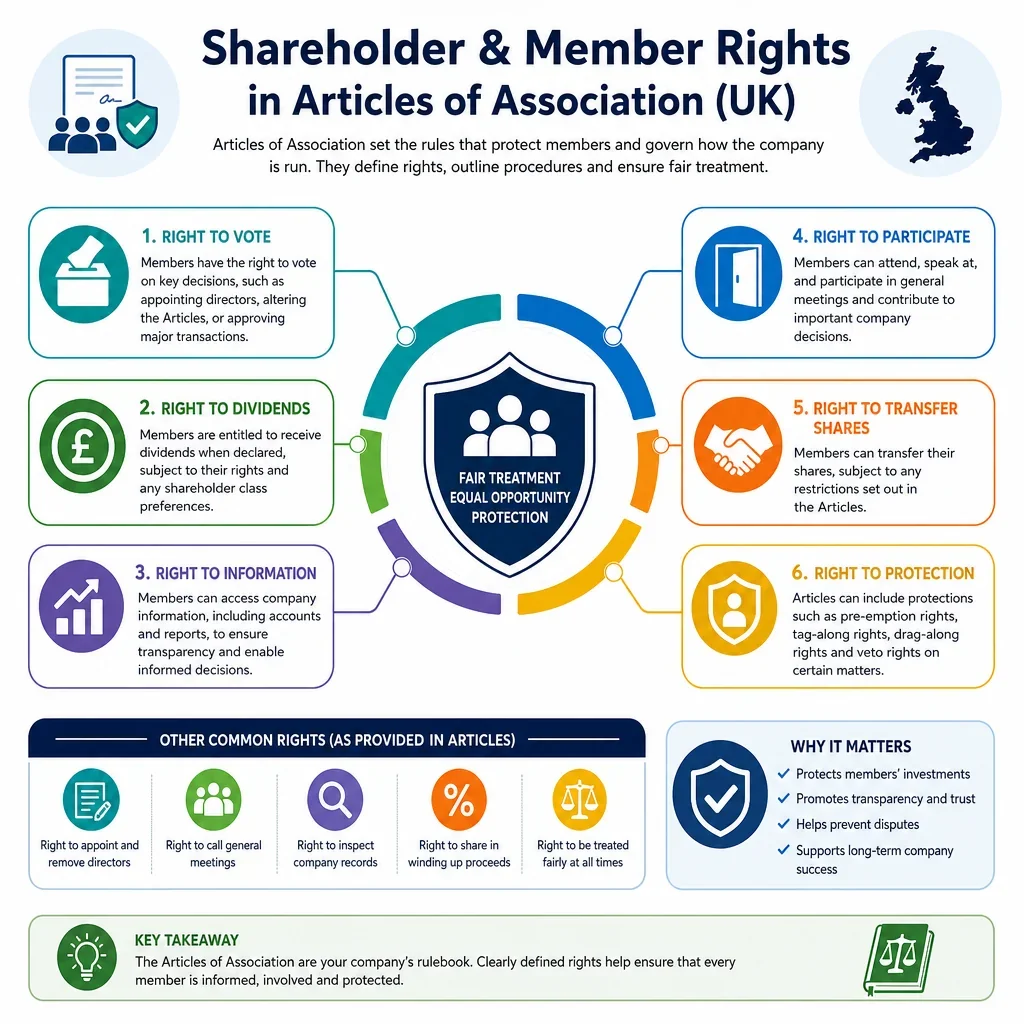
- Voting rights, quorum, class rights and weighted voting determine who can pass decisions.
- Appointment and removal of directors determine who controls the board.
- Pre-emption and transfer restrictions control who may become a shareholder.
- Variation of class rights protects investors or founders holding a separate share class.
When Must Articles Be Filed At Companies House?
Articles are filed on incorporation unless model articles are adopted without amendment. Later changes usually require a special resolution and a copy of the amended articles to be filed at Companies House within the statutory time limit. Key company records, including registers and resolutions, should be kept consistently with the articles.
Why Do Definitions Matter In Articles?
Definitions such as ordinary resolution, special resolution, member, shareholder, paid-up share, and class rights affect voting thresholds, ownership rights and filing duties. Ambiguous wording in articles can create disputes over whether decisions were validly made.
FAQs
You Might Also Be Interested In